

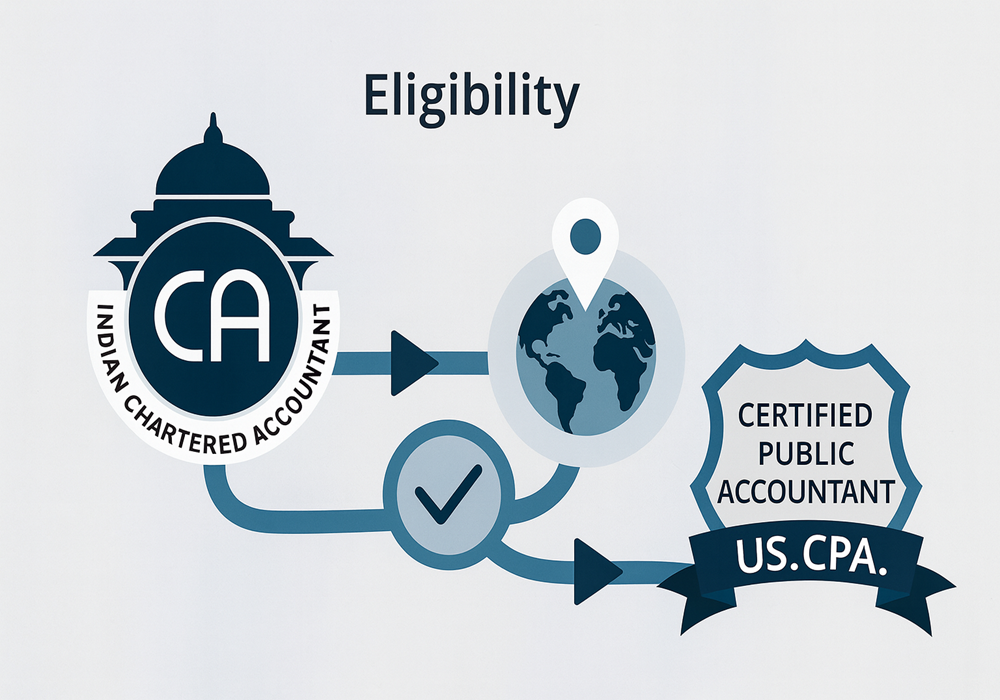
Indian CAs are eligible for the US CPA exam with significant advantages. Learn credit requirements, best states for CA holders, and essential steps to begin your CPA journey. This article is written by Rohit Arora, Senior Associate at LawSikho.
Table of Contents
Indian Chartered Accountants often wonder whether their prestigious qualification opens the door to the US CPA certification.
The good news is that CAs are not only eligible to take the CPA exam but also have a significant advantage over other candidates due to their rigorous training in accounting, auditing, and financial reporting.

This guide breaks down the essential eligibility requirements, credit calculations, and practical steps for CA holders looking to add the US CPA credential to their professional profile.
Are Indian CAs Eligible for the US CPA Exam?
The short answer and key conditions
Yes, Indian Chartered Accountants can absolutely take the US CPA exam. The American Institute of Certified Public Accountants (AICPA) allows international candidates to pursue this credential, and your CA qualification positions you favorably for meeting the requirements.
However, eligibility comes with conditions. You need to satisfy educational credit requirements, pass a four-part examination, and complete relevant work experience. The specifics vary depending on which US state you choose to apply through, which is why state selection becomes an important strategic decision for Indian candidates.
The fundamental requirement is demonstrating that your education equals what US state boards expect from CPA candidates. Your combination of undergraduate degree and CA qualification typically meets these expectations, though you will need official credential evaluation to confirm this.
Why CAs have an advantage in CPA eligibility?
Your CA journey has prepared you remarkably well for the CPA exam.
Think about what you have already accomplished: multiple levels of rigorous examinations, three years of hands-on articleship training, and deep study in financial reporting, auditing, taxation, and corporate law. This preparation overlaps significantly with what the CPA exam tests.
When US state boards review applications from Indian CAs, they see candidates with professional training that rivals or exceeds many domestic applicants.
Your CA Final examinations covered advanced topics that align closely with CPA content areas. The analytical skills you developed while navigating complex accounting standards translate directly to CPA exam questions.
Beyond exam preparation, your articleship experience demonstrates practical competency. You have audited real companies, prepared actual tax filings, and advised genuine clients. This hands-on training is precisely what the CPA experience requirement seeks to verify. Many states recognize that CA articleship provides exactly this kind of qualifying experience.
Understanding Credit Requirements for CA Holders
How your B.Com and CA translate to US credits?
The US education system measures academic achievement in semester credit hours. One year of full-time university study equals approximately 30 credits. To sit for the CPA exam, you typically need 120 credits. To obtain your license after passing, you need 150 credits.
Your three-year B.Com degree translates to roughly 90 semester credits under standard evaluation. This creates an apparent gap, but your CA qualification fills it. The CA is generally recognized as equivalent to 30 to 60 additional credits, depending on which state and evaluation agency assesses your credentials.
Here is how the math typically works for Indian CAs:
Your B.Com provides approximately 90 credits. Your CA qualification adds 30 to 60 credits. Together, you have somewhere between 120 and 150 total credits.

If your B.Com came from a NAAC A-grade accredited university and you earned first division marks, some evaluators treat it as equivalent to a four-year US degree, granting you 120 credits for the undergraduate degree alone. In this scenario, your CA qualification pushes you comfortably past the 150-credit threshold.
Meeting the 150 Credit Requirement for Licensing
If your initial evaluation falls short of 150 credits, you have options. The most straightforward path is adding a postgraduate qualification. An M.Com or MBA adds approximately 60 credits, which would give you roughly 180 total credits and eliminate any eligibility concerns.
Alternatively, you can take additional coursework through US-based programs or online bridge courses offered by various providers. Some candidates complete these additional credits after passing the CPA exam but before applying for their license.
The important point is this: falling slightly short of 150 credits should not discourage you from starting the CPA journey. Many states allow you to sit for the exam with 120 credits and complete the remaining credits before licensure. You can begin studying and taking exam sections while simultaneously addressing any credit shortfall.
Choosing the Right US State for Your CPA Application
Top States That Welcome Indian CA Candidates
The United States has 55 jurisdictions that grant CPA licenses, each with its own requirements. Some states are significantly more accommodating for international candidates than others. For Indian CAs, certain states have emerged as preferred choices due to their flexible policies.
Guam consistently ranks as the most popular option for Indian candidates. This US territory does not require a Social Security Number, has no residency requirements, accepts 120 credits for exam eligibility, and participates in NASBA’sexperience verification service. If you are unsure where to apply, Guam is a safe and practical starting point.
Montana offers similar flexibility with no SSN requirement and acceptance of international credentials. The state has historically been friendly toward CA holders and participates in NASBA’s experience verification program, which helps candidates whose work experience was supervised by non-CPA professionals.
Illinois appeals to candidates seeking a more traditionally recognized state. It does not require an SSN and offers some flexibility in experience verification. Virginia stands out for allowing non-CPA supervisors to verify work experience, which benefits candidates working in India under CA supervision.
Colorado and New Hampshire round out the list of CA-friendly states. Both accept international certifications and have streamlined their processes for foreign credential evaluation in recent years.
What to Consider Before Selecting Your State
Your state selection should account for several practical factors beyond basic eligibility. Think through these questions before committing to an application:
Do you have a US Social Security Number? If not, eliminate states that require one. Guam, Montana, Illinois, and Virginia are among those that do not require an SSN.
Where was your work experience gained, and who supervised it? If you worked under a CA rather than a US CPA, you need a state that accepts alternative verification methods. States participating in NASBA’s experience verification service can help bridge this gap.
Which credential evaluation agencies does the state accept? Some states exclusively require NIES evaluations, while others accept WES or multiple agencies. Confirm this before paying for an evaluation.
Do you plan to eventually practice in a specific US state? CPA licenses can often transfer between states through reciprocity agreements. However, starting with a flexible state makes your initial application easier, and you can transfer later if needed.
What is the Credential Evaluation Process for Indian CAs?
WES vs NIES: Which one should you choose?
Before any US state board will consider your application, you need official evaluation of your Indian credentials. Two agencies dominate this space: World Education Services (WES) and NASBA International Evaluation Services (NIES).
NIES operates under NASBA, the same organization that coordinates CPA examination services. This direct connection means many state boards prefer or exclusively accept NIES evaluations. If you have not yet decided which state to target, NIES offers an “Undecided Jurisdiction Evaluation” that assesses your credentials against multiple states’ requirements.
WES is a well-established independent evaluation agency with extensive experience assessing Indian qualifications. They offer a CPA-specific evaluation package, but not all states accept WES reports. Before choosing WES, verify that your target state accepts their evaluations.
For most Indian CAs, NIES is the safer choice. It provides maximum flexibility across states and eliminates the risk of having to repeat the evaluation process if you change your target jurisdiction.
Documents you need to prepare for credit evaluation
Gathering proper documentation is essential for smooth evaluation. You will need materials from two sources: your university and the Institute of Chartered Accountants of India.
From your university, obtain official transcripts or mark sheets for your B.Com degree. These must be on official letterhead with the registrar’s signature and institutional seal. You also need your degree certificate or provisional certificate. If you completed an M.Com, MBA, or other postgraduate qualification, include those transcripts and certificates as well.
From ICAI, you need your membership certificate confirming CA qualification, mark sheets for all examination levels (Foundation, Intermediate, and Final), and your articleship completion certificate documenting your practical training.
Any documents not in English require certified word-for-word translations submitted alongside the originals. Plan ahead when requesting these documents, as universities and professional bodies sometimes take weeks to process requests.
The evaluation process itself typically takes three to four weeks after all documents are received. Express services are available for additional fees if you need faster processing. Budget approximately ₹20,000 to ₹35,000 for the complete evaluation, including document delivery.
What Should Indian CAs Do Next to Begin Their CPA Journey?
Quick action plan for ca holders
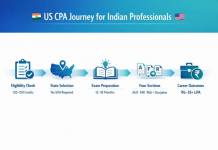
Starting your CPA journey requires methodical preparation, but the path is straightforward once you understand the steps. Here is your action plan:
Step 1: Assess Your Credits Calculate your approximate credit hours based on your qualifications. B.Com typically equals 90 credits; CA adds 30 to 60 credits; any postgraduate degree adds another 60 credits. If your total approaches or exceeds 150, you are well-positioned to proceed.
Step 2: Choose Your Target State Based on your SSN status, work experience verification needs, and personal preferences, select a state. If uncertain, Guam is the most flexible starting point for Indian candidates. Review the state board’s specific requirements on the NASBA website.
Step 3: Request Your Documents Contact your university registrar and ICAI to request official transcripts, degree certificates, membership certificates, and examination mark sheets. Start this process early, as document procurement often takes longer than expected.
Step 4: Submit for Credential Evaluation Apply to NIES or WES (depending on your state’s requirements) and submit all documentation. Track your evaluation status and respond promptly to any requests for additional information.
Step 5: Begin Exam Preparation While awaiting evaluation results, start studying for the CPA exam. Your CA knowledge gives you a head start on the FAR and AUD sections. Invest in a quality review course that fits your learning style and budget.
Step 6: Apply to Your State Board Once your evaluation confirms eligibility, submit your application to the state board. Upon approval, you will receive your Notice to Schedule (NTS), allowing you to book exam appointments at Prometric testing centers in India.
Step 7: Pass the Exam and Complete Licensing Requirements Take and pass all four CPA exam sections within the 30-month rolling window. Complete any remaining credit requirements and experience verification. Apply for your license once all requirements are satisfied.
Conclusion
Indian Chartered Accountants stand in an excellent position to pursue US CPA certification. Your rigorous training in accounting, auditing, and financial reporting has already prepared you for much of what the CPA exam tests.
The credit requirements, while initially confusing, are manageable for most CA holders, especially those with postgraduate qualifications or degrees from NAAC A-grade universities.
The most important step is getting started. Request your official documents from your university and ICAI today. Submit for credential evaluation through NIES or WES. Choose a CA-friendly state like Guam, Montana, or Illinois for your application. Within 12 to 18 months of focused effort, you can join the growing community of professionals who hold both the CA and CPA credentials, opening doors to global opportunities that neither qualification alone could provide.
For a detailed guide on how to CA’s eligibility into CPA, read my detailed guide here.
 Serato DJ Crack 2025Serato DJ PRO Crack



 Allow notifications





