

Compare CPA vs CA for Indian professionals. Understand key differences in difficulty, duration, cost in INR, and career opportunities to make the right choice. This article is written by Rohit Arora, Senior Associate at LawSikho.
Table of Contents
If you’re a commerce graduate or working professional in India weighing your options between the US CPA and Indian CA credentials, you’re facing one of the most important career decisions in accounting.
Both qualifications command respect and open doors to rewarding careers, but they serve fundamentally different purposes.

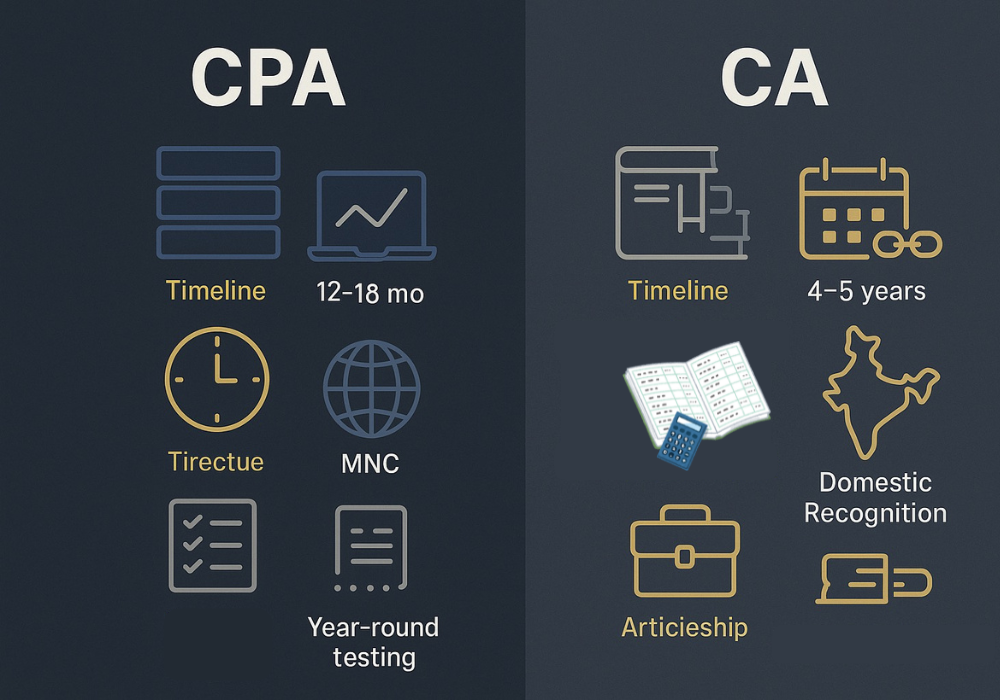
CPA positions you for international roles and MNC opportunities with a 12-18 month commitment, while CA provides comprehensive Indian practice rights through a 4-5 year journey.
This guide cuts through the noise to help you make a quick, informed decision based on your specific career goals, timeline, and circumstances.
How Do the CPA and CA Exam Structures and Timelines Compare?
The most striking difference between CPA and CA isn’t difficulty or cost; it’s how long each credential takes to earn.
CPA’s streamlined four-exam format allows completion in just over a year, while CA’s three-tier progression with mandatory practical training extends across half a decade.
Understanding these structural differences reveals why each credential suits different life stages and career situations.
When you compare a focused four-section exam against a 20+ paper journey spanning Foundation to Final, the time investment equation becomes clear. CPA assumes you already have accounting education and tests specific competencies efficiently.
CA builds your knowledge from scratch, layer by layer, while simultaneously training you through real-world articleship experience. Neither approach is superior; they simply serve different purposes for different candidates.
CPA Exam Structure Under CPA Evolution
The CPA exam underwent a significant transformation in January 2024 with the launch of CPA Evolution, creating a more specialised testing model. You now take three mandatory core sections covering Auditing and Attestation (AUD), Financial Accounting and Reporting (FAR), and Regulation (REG), plus one discipline section of your choice.
The discipline options include Business Analysis and Reporting (BAR), Information Systems and Controls (ISC), and Tax Compliance and Planning (TCP), allowing you to align your exam with career interests.
Each CPA section runs four hours and uses a computer-based format combining multiple-choice questions with Task-Based Simulations that test practical application. According to AICPA’s official guidelines, you need a scaled score of 75 out of 99 to pass each section. Indian candidates typically complete all four sections within 12-18 months, though motivated individuals with strong backgrounds can finish in 9-12 months.
The 30-month passing window starting from your first passed section provides flexibility to handle work commitments or unexpected delays without losing credit for sections already cleared.
What makes CPA particularly accessible for Indian professionals is the year-round testing availability at Prometric centers in major cities including Mumbai, Delhi, Bangalore, Hyderabad, Chennai, and Kolkata. Unlike fixed exam windows, you can schedule when your preparation is complete, maintaining momentum rather than waiting months between attempts. This flexibility is why so many working professionals choose CPA; you control your timeline rather than adapting to rigid exam schedules.
CA’s Three-Level Journey with Articleship
The Chartered Accountancy course follows a fundamentally different philosophy, building comprehensive expertise through three progressive levels.

Foundation covers basic accounting, business law, quantitative aptitude, and economics. Intermediate expands into advanced accounting, taxation, auditing, and financial management across two groups with six papers total. Final tests mastery across complex topics, including advanced financial reporting, strategic management, and specialised areas, through another six papers in two groups.
The total paper count across all CA levels exceeds 20, but what truly distinguishes CA from other credentials is the mandatory 3-year articleship. This practical training period, completed under a practising Chartered Accountant, runs parallel to your Final exam preparation. You cannot qualify as a CA without completing articleship, regardless of how quickly you pass exams. ICAI structures this requirement to ensure newly qualified CAs possess both theoretical knowledge and hands-on experience in auditing, taxation, and compliance work.
Most CA candidates require 4-5 years to complete the entire journey, and this assumes reasonably smooth exam progress. With pass rates hovering between 10% and 20% at advanced levels, many candidates need additional attempts that extend their timeline to 6-7 years. ICAI conducts exams three times annually in January, May, and September, gradually transitioning from paper-based to computer-based formats. The structured progression ensures thorough preparation but demands patience and persistence that CPA’s focused approach doesn’t require.
Which Exam Is More Difficult — CPA or CA?
Ask any Indian accounting professional which exam is harder, and you’ll get passionate opinions on both sides. The honest answer is that they’re difficult in different ways.
CA has statistically lower pass rates and requires much longer commitment, making it harder to complete. CPA demands mastery of unfamiliar US-centric content with no room for weakness in any area. Your background, preparation quality, and how you define “difficult” ultimately determine which credential feels more challenging.
Pass rates provide objective data points, but they don’t capture the full picture. CA’s low percentages reflect candidates attempting multiple subjective papers simultaneously, while CPA’s higher rates reflect focused preparation for individual computer-graded sections. Understanding what these numbers actually represent helps you set realistic expectations for whichever path you choose.
CPA Section-Wise Pass Rates
CPA pass rates in 2024 varied significantly across sections, revealing clear patterns about where candidates struggle and succeed. FAR (Financial Accounting and Reporting) consistently presents the biggest challenge, with pass rates around 40%, dropping to just 36.80% in Q4 2024. The massive syllabus covering governmental accounting, not-for-profit entities, and complex consolidation topics alongside standard financial reporting makes FAR the section that fails the most candidates.
AUD (Auditing and Attestation) performs slightly better at approximately 46%, while REG (Regulation) shows surprisingly strong performance at around 63% despite covering US federal tax law that’s entirely unfamiliar to Indian candidates.
The discipline sections show dramatic variation: TCP leads at 75-82% because candidates with tax backgrounds self-select into this option, BAR struggles at 33-40%, and ISC falls in the middle at 56-58%.
The 75/99 pass requirement deserves attention because it’s more demanding than it appears. The scaled score uses Item Response Theory weighting, meaning you can’t compensate for weakness in one content area with strength in another. You need consistent competence across all tested topics, not just high average performance.
This is why quality review courses emphasise comprehensive coverage rather than focusing only on high-weight areas; gaps in preparation can fail you even if your overall knowledge seems adequate.
CA Pass Rates Across Foundation, Intermediate & Final
CA pass rates paint a picture of extraordinary selectivity that filters out most aspirants. November 2024 CA Final results showed a both-groups pass rate of just 13.44%, meaning roughly 86 out of every 100 candidates attempting both Final groups together did not succeed. Individual group pass rates were somewhat higher at 16.8% for Group 1 and 21.36% for Group 2, reflecting that many candidates focus on one group at a time for better results.
Intermediate presents even starker numbers when attempting both groups simultaneously. September 2024 results showed a combined pass rate of just 5.66%, though single-group pass rates reached 14.67% for Group 1 and 21.51% for Group 2. Foundation pass rates hover around 20%, meaning even the entry level fails 4 out of 5 candidates. These numbers explain why completing CA in the minimum timeframe is genuinely an achievement that most aspirants don’t accomplish.
However, context matters when interpreting these statistics.
CA allows unlimited attempts without strict time pressure, unlike CPA’s 30-month window. Well-prepared candidates from reputable coaching institutes report significantly higher personal success rates than the aggregate numbers suggest. The low percentages partly reflect underprepared candidates, those attempting too many papers simultaneously, and the cumulative challenge of building knowledge across multiple levels. For serious, well-prepared candidates, the path is demanding but far from impossible.
Complete Cost Comparison in Indian Rupees
Money matters when planning professional credentials, and the cost profiles of CPA and CA differ substantially in both total investment and payment timing. CPA concentrates significant expenses into 12-18 months, requiring either savings or financing arrangements upfront. CA spreads lower total costs across 4-5 years, making annual outlay more manageable for families funding a student’s education gradually.
Understanding the complete cost picture prevents the common mistake of underestimating CPA expenses or forgetting to account for CA coaching costs. Many candidates start their journeys without full financial clarity and face difficult decisions when funds run short before completion. Budget honestly before committing to either path.
CPA Total Investment: ₹3.5-7 Lakhs
The CPA journey for Indian candidates involves multiple cost components that add up quickly. Before you can sit for any exam, your educational credentials must be evaluated by agencies like NIES (NASBA International Evaluation Services) or WES (World Education Services) to confirm you meet the 150 credit hour requirement. This evaluation costs ₹15,000-25,000 depending on processing speed and agency choice, with additional expenses for document courier charges and transcript requests from Indian universities adding ₹5,000-10,000.
State board application fees vary by jurisdiction but typically add ₹12,000-16,000 to your costs. The exam fees themselves are where expenses accumulate significantly. Each section costs approximately ₹33,000 in base exam fees, plus international testing fees of roughly ₹43,000 per section for the privilege of testing at Indian Prometric centers rather than travelling to the US. For all four sections, assuming first-attempt passes, you’re looking at approximately ₹3,00,000-3,25,000 in exam-related costs alone.
Review course investment significantly impacts your pass probability and shouldn’t be minimised. Quality programs from providers like Becker, Wiley, Surgent, or Gleim through Indian coaching partners range from ₹1,00,000 to ₹2,50,000, depending on features and support levels. Becker reports that their prepared students achieve pass rates 64% higher than average, which translates to meaningful savings by reducing expensive retake fees. Total CPA investment typically falls between ₹3.5 lakhs and ₹7 lakhs, depending on review course selection and whether retakes are needed.
CA Total Investment: ₹3-4 Lakhs
CA costs spread across the 4-5 year journey rather than concentrating in a short window, making the credential more accessible for families without large upfront savings. ICAI’s statutory fees for the complete journey are remarkably affordable compared to other professional qualifications. Foundation registration costs ₹9,000, Intermediate registration for both groups is ₹18,000, and Final registration adds ₹22,000. Exam form fees, training registrations, and mandatory courses bring total ICAI fees to approximately ₹85,000-1,10,000 across all levels, assuming you pass each level without multiple retakes.
Private coaching constitutes the bulk of CA expenses and is technically optional, though most successful candidates invest in quality instruction. Foundation coaching typically costs ₹40,000-60,000, Intermediate coaching for both groups ranges from ₹70,000-1,20,000, and Final coaching commands ₹80,000-1,50,000. Premium institutes in metros charge at the higher end, while online options and institutes in tier-2 cities offer more affordable alternatives. Study materials, test series, mock exams, and reference books add ₹20,000-40,000 across all levels.
The 3-year articleship provides stipends that partially offset living costs during practical training. ICAI mandates minimum monthly stipends ranging from ₹3,000-6,000 depending on city size and year of training, though many reputable firms pay ₹15,000-25,000 or more. Total CA investment typically ranges from ₹3-4 lakhs, making it nominally more affordable than CPA. However, the opportunity cost calculation changes for working professionals: someone earning ₹8 LPA who leaves their job for articleship forgoes roughly ₹24 lakhs in salary over three years while receiving perhaps ₹5-7 lakhs in stipends, representing a high hidden cost that direct comparisons miss.
What Career and Salary Opportunities Do CPA and CA Offer in India?
Both credentials lead to successful, well-compensated careers in accounting and finance, but the nature of opportunities differs based on each credential’s recognition and the skills it certifies. CPA holders find the strongest demand in organisations with US business exposure, while CAs have the broadest options within India’s domestic market. Understanding where each credential carries the most weight helps you align your choice with realistic career expectations.
The question isn’t which credential pays more in some absolute sense; it’s which credential opens doors to the specific career path you want.
A CPA targeting Indian statutory audit faces limitations, just as a CA targeting US GAAP advisory roles faces limitations. Match the credential to your genuine career aspirations rather than chasing abstract prestige.
CPA Career Paths and Earning Potential in India
CPAs in India find strong demand in specific market segments where US accounting expertise is essential. Big 4 firms actively recruit CPAs for US GAAP advisory practices, SOX compliance testing, international tax work involving US-India transactions, and roles serving American clients. Entry packages for CPAs at Big 4 firms typically range from ₹12 lakhs to ₹20 lakhs annually, positioning CPA holders significantly above general accounting hires from the start.
Global Capability Centers (GCCs) operated by American corporations represent another major employment category. Technology giants, financial services firms, and manufacturing companies with significant US operations employ thousands of finance professionals in Indian cities. Companies like Amazon, Google, Microsoft, Goldman Sachs, and JP Morgan specifically value CPA credentials for roles involving US financial reporting, internal audit with SOX focus, and business controllership functions. Mid-career CPAs with 5-8 years of experience earn ₹18 lakhs to ₹28 lakhs, while senior professionals with 10+ years command ₹28 lakhs to ₹40 lakhs or more in Director and VP Finance positions.
The important limitation to understand is that CPA doesn’t grant signing authority for statutory audits in India; that right belongs exclusively to Chartered Accountants under Indian law. CPA is highly valued for corporate employment in MNCs and advisory roles, but it’s not valid for Indian public practice. If your aspirations include signing audit reports, appearing before Indian tax authorities, or independent practice in India, a CPA alone won’t get you there.
CA Career Paths and Earning Potential in India
Chartered Accountants enjoy the widest career options within India among all accounting credentials. The CA qualification grants exclusive rights that no other credential provides: authority to sign statutory audit reports, certify various regulatory filings, appear before income tax appellate authorities, and conduct attestation engagements. These exclusive rights make CAs indispensable across India’s business ecosystem regardless of economic cycles or market trends.
ICAI’s 60th Campus Placement Drive in 2024 reported an average fresher package of ₹12.49 lakhs per annum, with the highest domestic offer reaching ₹26.7 lakhs. These campus figures represent the top tier of CA fresher hiring; many qualified CAs secure positions through direct applications or networking at different salary levels, typically ₹4.5 lakhs to ₹7 lakhs initially for off-campus placements. The variance reflects firm size, city, and role type rather than candidate quality alone.
CA career paths include public practice (establishing your own firm with audit signing authority), Big 4 audit and tax practices, corporate finance roles across industries, and CFO tracks at companies of all sizes. Mid-career CAs with 5-10 years earn ₹15 lakhs to ₹30 lakhs depending on role and industry. Senior CAs in leadership positions command ₹30 lakhs to ₹50 lakhs, with Big 4 partners and corporate CFOs potentially exceeding ₹1 crore. The ceiling for CA earnings is exceptionally high for those who reach senior partnership or corporate leadership, though reaching these levels requires 15-20+ years of progressive career building.
How Should You Decide Between CPA and CA?
After comparing structures, difficulty, costs, and career outcomes, the decision ultimately comes down to your specific circumstances and professional goals. Neither credential is universally better; each serves different purposes for different people at different career stages. Honest self-assessment about your timeline, career aspirations, and practical constraints leads to the right choice.
The framework below helps you match your situation to the appropriate credential. Consider where you are today, where you genuinely want to be in 5-10 years, and what path makes practical sense given your current life circumstances. Getting this decision right saves years of effort and significant financial investment.
Choose CPA If These Factors Apply to You
CPA makes strategic sense if you already hold a degree meeting the 150 credit hour requirement, such as B.Com combined with M.Com, B.Com with MBA, or an existing CA qualification. These educational backgrounds typically fulfil CPA eligibility without requiring additional coursework, allowing you to start exam preparation immediately after credential evaluation.
The credential suits professionals targeting MNC finance roles, US-facing positions at Big 4 advisory practices, or Global Capability Center careers. If your goal involves working with US clients, specialising in US GAAP or IFRS, or eventually relocating to the United States, CPA provides direct value that CA alone doesn’t offer.
Working professionals who need flexible study schedules find CPA’s self-paced approach practical; you can earn the credential in 12-18 months while maintaining full employment without the career interruption that CA’s articleship would require.
For existing CAs, adding CPA creates a powerful dual credential commanding premium compensation across employer types. Your CA foundation accelerates CPA preparation, and the combined qualification opens doors that neither credential alone provides. Many CAs complete CPA in 9-12 months rather than the typical 12-18 months, making the additional investment of time and money highly efficient.
Choose CA If These Factors Apply to You
CA makes strategic sense if you’re starting early in your educational journey, whether after 12th standard or during undergraduate studies, with 4-5 years available before you need full professional employment. This timing allows you to complete CA before peers finish postgraduate degrees, entering the job market with India’s most respected accounting credential.
The path suits those committed to careers primarily within India’s domestic market. If you aspire to independent practice with your own CA firm, statutory audit signing authority, representation before tax authorities, or deep expertise in Indian taxation and company law, CA is essential because no other credential provides these exclusive rights. CFO tracks at major Indian companies and Big 4 audit partnership tracks also typically expect CA qualification.
The lower overall cost makes CA accessible to students from varied financial backgrounds, with expenses spreading across years rather than concentrating upfront. CA also creates excellent pathways to add international credentials later; many CAs add CPA, ACCA, or CMA after qualifying once they’ve established themselves professionally and can invest in credential expansion.
Conclusion
Both CPA and CA are valuable credentials that lead to successful accounting careers, but they serve fundamentally different purposes. CPA offers international recognition, faster completion in 12-18 months, and premium value in MNC finance roles, Big 4 advisory practices, and US-facing positions.
CA provides the broadest career options within India, including exclusive practice rights, statutory audit signing authority, and pathways to CFO roles and Big 4 partnership tracks, though it requires a 4-5 year commitment, including mandatory articleship. Your choice should align with your career goals, available timeline, and where you genuinely envision building your professional life.
For many ambitious professionals, pursuing CA first and adding CPA later offers the best of both worlds, creating a dual credential that commands respect across all employer types, though this path requires the longest total time investment.
For a detailed comparison between the CPA and CA exams, read my article here.
 Serato DJ Crack 2025Serato DJ PRO Crack



 Allow notifications





