


CPA exam difficulty explained for Indian professionals: Q3 pass rates, section-wise challenges, how your CA/B.Com/MBA background affects preparation, and realistic study timelines. This article is written by Rohit Arora, Senior Associate at LawSikho.
Table of Contents
Is the CPA exam really as hard as everyone says?
If you are an Indian accounting professional considering this credential, you have probably heard conflicting opinions ranging from “it’s manageable with proper preparation” to “it’s one of the toughest professional exams globally.”

The truth lies somewhere in between, and understanding exactly where requires looking beyond surface-level advice. With pass rates hovering around 50% per section and successful candidates investing 400 or more hours in preparation, the CPA exam demands genuine commitment.
This guide gives you the unfiltered reality: what makes the exam difficult, how your specific Indian background shapes your experience, and what separates candidates who pass from those who do not.
The Reality of CPA Exam Difficulty
Before diving into preparation strategies or review course comparisons, you need an honest assessment of what you are signing up for. The CPA exam has earned its reputation as a challenging professional credential, but that reputation sometimes gets exaggerated or understated depending on who you ask.
Data tells a clearer story than opinions, and recent AICPA statistics reveal exactly how candidates are performing across all six exam sections.
What Do Current CPA Pass Rates Really Tell Candidates?
The most recent Q3 2025 data from AICPA shows meaningful variation across exam sections.
The most recent Q3 2025 data from AICPA shows meaningful variation across exam sections. FAR (Financial Accounting and Reporting) recorded a 43.07% pass rate, making it statistically the most challenging Core section. AUD (Auditing and Attestation) came in at 50.03%, representing a near coin-flip probability for candidates. REG (Regulation) performed strongest among Core sections at approximately 66%, reflecting higher success rates among candidates who commit adequately to tax and business law preparation.
The Discipline sections introduced under CPA Evolution show even wider spreads.
BAR (Business Analysis and Reporting) remains one of the most difficult, with pass rates around the low-40% range. ISC (Information Systems and Controls) recorded approximately 67% in Q3 2025, reflecting improving outcomes as preparation resources mature. TCP (Tax Compliance and Planning) continues to lead all sections with pass rates above 76%, making it statistically the most approachable Discipline.
However, these numbers require interpretation. A published pass rate does not reflect an individual candidate’s probability of success. Well-prepared candidates consistently outperform the average, which includes underprepared and prematurely scheduled exam attempts. Individual outcomes depend primarily on preparation quality, study time, and exam readiness
Five Factors That Make the CPA Exam Challenging
The CPA exam’s difficulty stems from multiple compounding factors rather than any single element. Understanding each factor helps you address them systematically during preparation.
First, the syllabus volume is substantial. FAR alone covers US GAAP financial reporting, governmental accounting, not-for-profit accounting, and select IFRS topics. REG encompasses individual taxation, business taxation, business law, and professional ethics. No single section allows shallow knowledge; each demands genuine understanding across broad content areas.
Second, the exam uses multiple question formats testing different skills. Multiple-choice questions assess recognition and quick application, while task-based simulations require you to apply knowledge in realistic scenarios. The simulations often present complex fact patterns requiring careful analysis, research, and calculations. Many candidates comfortable with MCQs struggle when simulations demand deeper application.
Third, time pressure is real. Each section allocates exactly four hours, including a 15-minute optional break. Question counts vary significantly: FAR has 50 MCQs while ISC has 82. Running out of time means leaving questions unanswered, and unanswered questions score zero. Mental stamina across four hours of concentrated effort challenges candidates who have not practiced under timed conditions.

Fourth, the adaptive testing mechanism adjusts difficulty based on your performance. Strong performance on initial MCQ testlets triggers harder questions in subsequent testlets. This means the exam feels progressively more difficult for well-prepared candidates, creating psychological pressure even when you are performing well.
Fifth, the 30-month completion window creates ongoing pressure. Once you pass your first section, you have 30 months to pass the remaining three. Credits expire on a rolling basis, meaning poor planning can result in retaking sections you already passed. This timeline constraint adds strategic complexity to your overall exam journey.
Which CPA Section Is the Hardest and How Should You Plan for It?
Section difficulty varies based on content type, your background, and how recently you studied related material. However, pass rate patterns reveal consistent trends about where candidates struggle most. Strategic planning based on these patterns improves your overall success probability.
Core Sections: FAR, AUD, and REG
FAR earns its reputation as the most challenging Core section through both statistics and candidate experience. The 43% pass rate reflects the section’s vast scope covering financial accounting frameworks, governmental accounting, and not-for-profit reporting. For Indian candidates specifically, FAR difficulty compounds because US GAAP treatment of topics like revenue recognition, leases, and stock compensation differs from Indian Accounting Standards. You are not just learning new material; you are sometimes unlearning existing frameworks.
AUD presents different challenges at its 50% pass rate. The section tests professional judgment around audit procedures, internal controls, and ethical requirements. Questions often present scenarios where multiple answers seem partially correct, requiring you to identify the “best” response. Indian candidates with audit experience find some concepts familiar, but US auditing standards (GAAS, PCAOB requirements) differ meaningfully from Indian Standards on Auditing. The conceptual nature of AUD questions frustrates candidates who prefer objective, calculation-based problems.
REG achieves the strongest Core section pass rate at 66%, but this number can mislead Indian candidates. American candidates often studied US taxation in undergraduate programs, making the REG partly review material.
For you, US federal taxation represents an entirely new subject area with no foundation from Indian tax knowledge. Topics like basis calculations, passive activity limitations, and S-corporation taxation follow rules completely different from anything in Indian tax law. Budget preparation time accordingly, despite the favorable statistics.
Discipline Section Selection Based on Your Strengths
Your Discipline choice meaningfully impacts overall exam difficulty, and the decision deserves careful consideration rather than defaulting to whichever section seems easiest.
BAR extends FAR content into advanced accounting topics and financial analysis. Pass rates in the low-40% range place it alongside FAR as the most challenging section overall. Candidates choosing BAR typically have strong accounting backgrounds and target financial reporting roles where this expertise provides career value. Indian CAs often select BAR because it aligns with their training, accepting the lower pass rate in exchange for relevance.
ISC covers information technology governance, system controls, and cybersecurity concepts. With pass rates in the high-60% range, it is statistically more approachable, and the content translates across borders better than tax law. The section uniquely weights MCQs at 60% compared to 40% for simulations.
TCP builds directly on REG content, extending into advanced tax planning. Pass rates above 75% make it the most approachable Discipline, partly because candidates who succeed in REG often select TCP. However, TCP requires the same US tax foundation as REG; struggles in REG typically carry forward rather than disappear.
The content overlap between REG and TCP allows efficient preparation, but Indian candidates must recognize that TCP requires the same US tax foundation as REG. If you struggled with REG content, TCP will not suddenly become easy.
Choose based on career goals and genuine interest rather than pass rates alone. A section with higher pass rates becomes harder for you personally if the content does not align with your background or engage your interest. Conversely, a statistically harder section becomes manageable when the content matches your expertise and professional aspirations.
How Your Indian Background Affects CPA Difficulty
Your experience with the CPA exam will differ meaningfully from that of American candidates who studied US accounting and taxation throughout their education. Recognizing these India-specific factors helps you plan realistically and avoid underestimating preparation requirements.
What Unique Challenges Do Indian CPA Aspirants Face?
The US GAAP learning curve hits Indian accounting professionals harder than most anticipate. If you trained under Indian Accounting Standards or worked with Ind AS in practice, you have internalized frameworks that sometimes contradict US GAAP treatment. Revenue recognition under ASC 606, lease accounting under ASC 842, and consolidation procedures all require learning new rules. Worse, your existing knowledge can create confusion when familiar transactions receive different accounting treatment under US standards.
US federal taxation represents the steepest learning curve for most Indian candidates. Nothing in Indian tax education or practice prepares you for concepts like basis, at-risk limitations, qualified business income deductions, or estate and gift taxation. American candidates often find REG manageable because they covered these topics in undergraduate coursework. You are starting from zero, making REG and TCP substantially more time-intensive despite their favorable pass rates.
Studying while working full-time in India creates practical challenges beyond the universal difficulty of balancing work and exam preparation. Indian corporate culture often involves long hours, weekend availability expectations during busy periods, and limited flexibility for personal commitments. Finding 15 to 20 hours weekly for focused study requires intentional scheduling and often difficult conversations with supervisors about workload management during preparation periods.
Testing logistics adds another layer of complexity. Prometric administers the CPA exam at eight centers across India in Ahmedabad, Bangalore, Calcutta, Chennai, Hyderabad, Mumbai, New Delhi, and Trivandrum. Seat availability can be limited, particularly during popular testing months. Discipline sections are offered only during quarterly windows, requiring you to align preparation timelines with these limited opportunities.
Does Your Indian Qualification Make CPA Easier or Harder?
Your specific Indian credentials shape your CPA experience in distinct ways, and understanding these dynamics helps you plan preparation strategically.
Indian Chartered Accountants bring the strongest technical foundation to CPA preparation. CA training develops rigorous accounting knowledge and professional discipline that transfers well to CPA study habits. However, CAs often struggle more than expected because their expertise creates overconfidence about US-specific content. The accounting principles feel familiar, but the specific rules differ enough to cause errors. CAs benefit from focusing preparation time on US GAAP differences rather than assuming their existing knowledge covers the material.
B.Com graduates face a different challenge. Without professional qualification training, foundational concepts may need more development before tackling CPA-level material. However, B.Com holders often approach US content with fewer preconceptions to unlearn. The learning curve is steeper initially, but without the interference effects that trip up experienced practitioners.
MBA Finance graduates have a business context that helps with understanding how accounting fits into organizational decision-making. However, MBA programs vary significantly in accounting depth, and many MBA holders lack the technical foundation that CA or even B.Com programs provide. Evaluate your specific coursework honestly rather than assuming the MBA credential signals exam readiness.
Each background has advantages and challenges. The key is honest self-assessment about where your preparation needs to focus rather than assuming your credentials automatically translate to CPA readiness.
How Much Study Time Does the CPA Exam Really Require?
Time investment is the factor most within your control, and understanding realistic requirements helps you plan effectively. Underestimating study hours is among the most common mistakes candidates make, leading to failed sections that could have been passed with adequate preparation.
Total Hours and Weekly Commitment
Industry consensus from AICPA, major review providers, and successful candidate data suggests 300 to 500 total hours across all four sections. Becker recommends 400 to 600 hours, breaking down to 100 to 150 hours per section. AICPA’s guidance indicates 330 to 500 hours for typical candidates. These ranges reflect variation in candidate backgrounds and study efficiency.
For Indian candidates, planning toward the higher end makes sense.
US-specific content that American candidates partly review represents new learning for you, adding hours to each section. FAR typically demands 100 to 150 hours given its scope and US GAAP depth. AUD and REG each require 90 to 120 hours, with REG potentially needing more for Indian candidates without a US tax foundation. Discipline sections generally need 80 to 100 hours, varying based on which section you choose and how it relates to your background.
Translating totals into weekly schedules, most working professionals target 15 to 20 hours. At 15 hours weekly, a 120-hour section requires 8 weeks of preparation. The math suggests 8 to 10 months for all four sections at this pace, not counting breaks between sections or potential retake time. Realistically, most Indian working professionals complete the CPA exam in 18 to 24 months, with some finishing faster through more intensive weekly commitments.
Completion Timeline Options for Indian Professionals
Your timeline should reflect an honest assessment of available time rather than aspirational targets you cannot sustain.
A 12-month aggressive timeline works for candidates with significant study availability. This might include recent graduates not yet working full-time, professionals on sabbatical, or those whose employers provide study time. This pace requires 20 to 25 hours weekly and leaves minimal buffer for failed sections. The advantage is maintaining momentum and minimizing the risk of forgetting earlier material.
An 18-month balanced approach suits most working professionals. This timeline allows 15 to 20 hours weekly with reasonable buffers between sections. You can absorb a failed section without derailing your overall plan. The pace remains aggressive enough to maintain engagement without requiring unsustainable sacrifices.
A 24-month extended timeline fits candidates managing particularly heavy work commitments or significant personal obligations. This pace requires only 10 to 15 hours weekly but demands sustained commitment over a longer period. The risk is losing momentum or forgetting earlier material, but the approach proves necessary for some candidates whose circumstances do not permit more intensive preparation.
Choose your timeline based on honest assessment of sustainable weekly hours rather than comparing yourself to others whose circumstances differ from yours.
How Long Does It Take to Complete the CPA Exam from India?
The total journey from deciding to pursue CPA to holding your license extends beyond just exam preparation time. Understanding the complete timeline helps you set realistic expectations and plan your career moves accordingly.
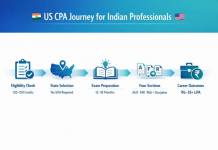
Most Indian candidates complete all four exam sections within 18 to 24 months from their first exam date. However, the complete process starts earlier with credential evaluation (typically 4 to 8 weeks through agencies like NASBA International Evaluation Services or WES), state board application (2 to 6 weeks depending on jurisdiction), and Notice to Schedule receipt (several weeks after application approval). Adding these pre-exam phases, the total journey from initial decision to final exam pass typically spans 2 to 3 years.
Factors that extend timelines include failed sections requiring retakes, work commitments that reduce available study time, and scheduling challenges with Prometric availability. Factors that compress timelines include prior US accounting education, employer support providing study time, and aggressive but sustainable weekly hour commitments. Most candidates experience some combination of accelerating and delaying factors.
The 30-month credit window provides meaningful flexibility compared to the previous 18-month requirement. However, planning to use the full 30 months from the start often leads to procrastination and credit expiration pressure later. Aim to complete within 18 to 24 months while treating the additional buffer as insurance against unexpected setbacks rather than as your primary plan.
Conclusion
The CPA exam is genuinely difficult, and approaching it with anything less than serious commitment sets you up for frustration and wasted resources. Pass rates around 50% per section, hundreds of required study hours, and unfamiliar US-specific content all demand respect. For Indian professionals, additional challenges around US GAAP transitions, entirely new taxation frameworks, and balancing preparation with demanding work schedules compound the baseline difficulty.
However, difficulty does not mean impossibility. Thousands of Indian professionals earn CPA credentials annually, many while managing full-time jobs and family responsibilities. Success requires realistic expectations, strategic preparation focused on your specific gaps, and sustained commitment across 18 to 24 months. The candidates who pass are not necessarily the smartest or most experienced; they are the ones who prepared adequately, managed their time effectively, and persisted through setbacks.
Your next step is honest self-assessment. Evaluate your background against the challenges outlined in this guide. Identify which sections will prove most difficult for you, specifically, not just statistically. Estimate sustainable weekly study hours based on your actual schedule, not aspirational targets. Then commit to the preparation required, understanding that the career opportunities CPA unlocks justify the investment you are about to make.
For a deeper analysis of CPA exam difficulty, read my detailed article on Is the CPA Exam Hard?
 Serato DJ Crack 2025Serato DJ PRO Crack



 Allow notifications





