

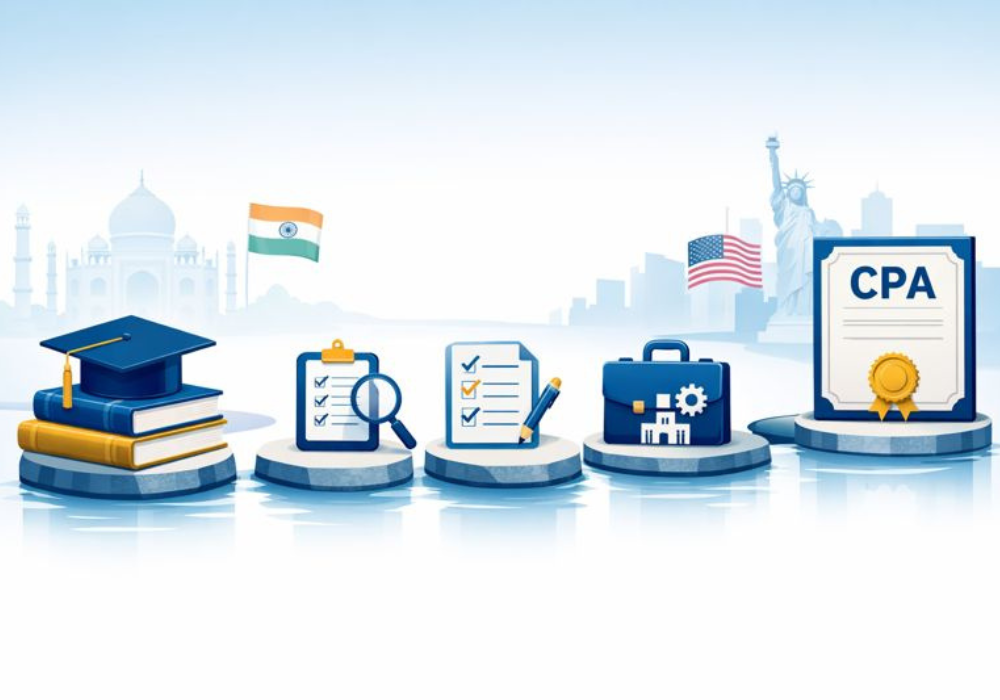
Practical roadmap to US CPA certification from India. Understand eligibility, exam structure, costs in INR, and best states for Indian candidates without SSN. This article is written by Medha Vinod, Senior Associate at LawSikho.
Table of Contents
The US CPA credential has become increasingly accessible for Indian accounting professionals, and if you’ve been considering this path, now is an excellent time to start. With Prometric test centers operating in eight Indian cities and state boards that accommodate international candidates, you no longer need to relocate or travel abroad to earn one of the world’s most recognized accounting qualifications. The question isn’t whether it’s possible, but rather how to navigate the process efficiently.
This roadmap cuts through the complexity to give you a clear action plan. You’ll understand how your Indian qualifications translate to US credit requirements, which states offer the smoothest pathway for candidates without a Social Security Number, what the exam actually involves under the new CPA Evolution format, and what investment in time and money you should realistically expect. By the end, you’ll have the clarity needed to take your first concrete step toward CPA certification.

CPA Eligibility Based on Indian Qualifications
Your first task is determining whether your current qualifications make you eligible for the CPA exam, and if not, what additional credentials you need. The US system measures education differently from India, using credit hours rather than degree names. Understanding this conversion is fundamental to planning your pathway.
The Credit System and How Your Indian Degree Fits
US state boards evaluate CPA candidates based on semester credit hours, with most requiring 120 credits to sit for the exam and 150 credits for full licensure. Your Indian degrees and professional qualifications get converted to this system through credential evaluation agencies that assess your transcripts and certificates.
A standard three-year Indian B.Com evaluates to roughly 90 credit hours, falling short of the 120-credit exam threshold. This means B.Com holders need additional qualifications to become eligible. However, if you hold a postgraduate degree, the picture changes significantly. An M.Com or MBA adds approximately 60 credits, bringing your total to around 150, which satisfies even the licensure requirement.
Professional certifications carry substantial weight in this calculation. The Indian CA qualification adds between 30 and 60 credits, depending on how the evaluation agency assesses it, making most CAs immediately eligible for the CPA exam when combined with their undergraduate degree. Similarly, CMA and CS certifications receive credit recognition, though typically in lower ranges than CA.
Eligibility Pathways for Different Indian Qualifications
Your starting point determines your most efficient pathway. If you hold only a B.Com, your clearest route involves completing a postgraduate qualification such as M.Com or MBA, which brings you to 150 credits and full eligibility. Alternatively, pursuing the Indian CA alongside your B.Com creates a powerful combination that qualifies you for CPA while also giving you domestic credentials.
Chartered Accountants find themselves well-positioned from the start. With CA plus B.Com typically evaluating to 120 to 150 credits, most CAs can proceed directly to credential evaluation and state board application. This makes the CA plus CPA combination particularly efficient for those wanting both Indian and international recognition.
M.Com and MBA holders with commerce undergraduate backgrounds generally meet the 150-credit threshold without additional coursework. If your credential evaluation confirms sufficient credits, you can move straight to state selection and application. The accounting content in these programs also provides useful preparation for CPA exam topics, particularly in financial accounting and business concepts.
CPA Exam: Structure, Preparation, and Costs
Once you’ve confirmed eligibility, understanding what the exam actually involves helps you plan realistically. The CPA exam changed significantly in January 2024 with CPA Evolution, introducing a new structure that every candidate must understand.
CPA Exam Section Format: Core and Discipline Sections
The current CPA exam consists of three mandatory Core sections plus one Discipline section of your choice, totaling four exams you must pass. The Core sections, which every candidate takes, are:
- Financial Accounting and Reporting (FAR),
- Auditing and Attestation (AUD), and
- Taxation and Regulation (REG).
Each Core section is a four-hour exam combining multiple-choice questions and task-based simulations.
Your Discipline choice adds specialization to your CPA credential.
- Business Analysis and Reporting (BAR) extends financial accounting into analytical and managerial topics.
- Information Systems and Controls (ISC) focuses on IT governance, cybersecurity, and system controls.
- Tax Compliance and Planning (TCP) deepens taxation knowledge beyond the Core REG section.
Choose based on your career interests rather than perceived difficulty.
Pass rates vary across sections, providing useful context for your preparation. According to AICPA data through Q3 2025, REG shows the strongest Core performance at 64%, while FAR and AUD hover around 43% and 48% respectively. Among Disciplines, TCP leads at 78%, ISC at 68%, and BAR at 43%. These variations reflect content breadth and candidate self-selection rather than inherent difficulty differences.

Preparation Timeline for CPA Exam
Realistic preparation for all four sections requires 300 to 400 hours of study, distributed based on each section’s demands and your background. FAR typically needs the most time, at 150 to 200 hours, due to its comprehensive coverage of accounting standards across corporate, governmental, and not-for-profit entities. AUD and REG each require 100 to 130 hours, while your chosen Discipline adds another 80 to 120 hours.
For working professionals in India, this translates to a 12 to 18-month journey when studying 15 to 20 hours weekly. Some candidates accelerate this timeline with more intensive preparation, while others extend it to accommodate demanding work schedules. The key is consistent daily study rather than sporadic weekend cramming.
Your 30-month window for passing all sections, measured from your first passed exam, provides reasonable flexibility. However, planning to complete all sections within 12 to 18 months reduces the risk of early sections expiring before you finish. Many successful candidates take one section every three to four months, maintaining momentum while allowing adequate preparation time.
Investment for Working Professionals
The financial commitment for CPA certification has increased notably in 2025, particularly for international candidates. Following NASBA’s June 2025 fee update, Indian candidates now pay $510 per exam section, up from $390 previously. This $120 per-section increase brings total exam fees for all four sections to $2,040, approximately ₹1,83,600 at current exchange rates.
Beyond exam fees, your investment includes credential evaluation at ₹20,000 to ₹30,000, state application fees at ₹15,000 to ₹25,000 (such as $150 for New York), review course materials at ₹1,20,000 to ₹2,50,000, and post-exam licensing costs at ₹30,000 to ₹50,000. The complete investment ranges from ₹3,00,000 to ₹4,50,000, a significant but worthwhile commitment given the career returns.
Review course selection significantly impacts both cost and success probability. Premium options like Becker and Wiley range from ₹1,80,000 to ₹3,00,000 but offer comprehensive materials and proven methodologies. Indian coaching institutes like Simandhar Education, Miles Education, and LawSikho bundle international content with local instruction for ₹1,20,000 to ₹2,00,000, providing mentorship in Indian time zones alongside application support.
Selecting Your US State and Completing Credential Evaluation
Your choice of US state determines your application requirements, experience verification process, and eventual license. For Indian candidates, this decision carries particular weight because state policies toward international applicants vary significantly.
States That Work Best for Indian Candidates Without SSN
Most Indian candidates lack a US Social Security Number, immediately narrowing the viable state options. Guam emerges as the most practical choice for several reasons: no SSN requirement, acceptance of 120 credits for exam eligibility, participation in NASBA’s experience verification service, and a straightforward application process. If you’re uncertain where to apply, Guam represents the lowest-risk starting point.
Montana offers similar flexibility with no SSN requirements and accommodating experience verification policies. Montana has historically been friendly toward CA holders, while Washington has recently streamlined its processing for international applications. Alaska works well for candidates who haven’t completed their education, as it allows exam registration before graduation if you’ve fulfilled sufficient accounting credits.
Illinois appeals to candidates seeking a more traditionally recognized state jurisdiction while still avoiding SSN requirements. The state has expanded acceptance of online degrees from accredited institutions, benefiting candidates who completed distance education programs. However, verify current policies directly with any state board before applying, as requirements change periodically.
Getting Your Credentials Evaluated Through NIES or WES
Before applying to any state, you need an official credential evaluation that converts your Indian qualifications to US credit equivalents. Two agencies dominate this process: NASBA International Evaluation Services (NIES) and World Education Services (WES). Both produce evaluations accepted by major CPA-friendly states.
NIES operates as NASBA’s dedicated evaluation service for CPA candidates, meaning their reports align precisely with state board requirements. Fees run $205 to $300, depending on service level, with standard processing taking six to eight weeks. The direct connection to NASBA makes NIES the safer choice if CPA licensing is your sole objective.
WES offers a broader credential evaluation useful beyond CPA licensing, such as for immigration or graduate school applications. Fees are comparable, and processing times are similar. For CA holders, WES requires ICAI verification before including your qualification, adding a step to the process. Choose WES if you anticipate needing your evaluation for multiple purposes.
Both agencies require official documents sent directly from your Indian institutions in sealed envelopes. Start gathering transcripts, degree certificates, and professional membership certificates early, as Indian universities often take several weeks to process transcript requests. Allow three to four months for the complete evaluation process before your planned state application.
From Exam to License: Completing Your CPA Journey
Passing all four exam sections represents a major milestone, but your CPA journey isn’t complete until you hold an actual license. Understanding post-exam requirements helps you plan the full pathway from the start.
Meeting Experience Requirements from India
Every state requires relevant work experience for licensure, typically one to two years under appropriate supervision. The challenge for Indian candidates lies in experience verification, as some states require a US-licensed CPA to verify your work, while you may work under CA supervision in India.
States participating in NASBA’s experience verification service provide the solution. Guam, Montana, and several other international-friendly states accept verification from qualified professionals, including Indian CAs, eliminating the need for US CPA supervision. This makes state selection even more critical, as your choice determines whether your Indian work experience will count toward licensure.
Your experience must involve accounting work at a professional level, typically including financial statement preparation, audit participation, tax compliance, or related activities. General bookkeeping or clerical accounting work may not satisfy requirements. Document your experience thoroughly, maintaining records of projects, responsibilities, and supervisor details that you’ll need for your license application.
Applying for Your License and Maintaining It
Once you’ve passed all four sections and accumulated the required experience, you apply for your CPA license through your state board. This application involves submitting experience verification, passing an ethics exam in most states, paying license fees, and completing any state-specific requirements.
The ethics requirement typically involves the AICPA Professional Ethics course and exam, costing approximately $200. Most states accept this standardized course, though some require state-specific ethics content. You can complete ethics requirements before, during, or after your CPA exams, providing flexibility in timing.
License maintenance requires ongoing Continuing Professional Education, typically 40 hours annually, depending on your state. CPE ensures your knowledge remains current with evolving standards and regulations. Budget ₹20,000 to ₹50,000 annually for CPE courses, choosing from numerous providers offering content in formats ranging from self-study to live seminars. Some employers cover CPE costs as part of professional development benefits.
Conclusion
The pathway to US CPA certification from India is clearer than it has ever been. With Prometric centers in eight Indian cities, state boards accommodating international candidates, and established evaluation processes for Indian qualifications, the logistical barriers that once made this credential difficult to obtain have largely disappeared. What remains is the commitment to prepare thoroughly, invest appropriately, and execute systematically.
Your next step depends on your current position. If you’re uncertain about eligibility, begin with a credential evaluation to confirm your credit count. If you know you qualify, select your state and start the application process. If you’re already approved, invest in quality review materials and build a realistic study schedule. Each step moves you closer to a credential that opens doors across the global accounting profession.
For more detailed guide, visit this SkillArbitrage article.
 Serato DJ Crack 2025Serato DJ PRO Crack


 Allow notifications





