

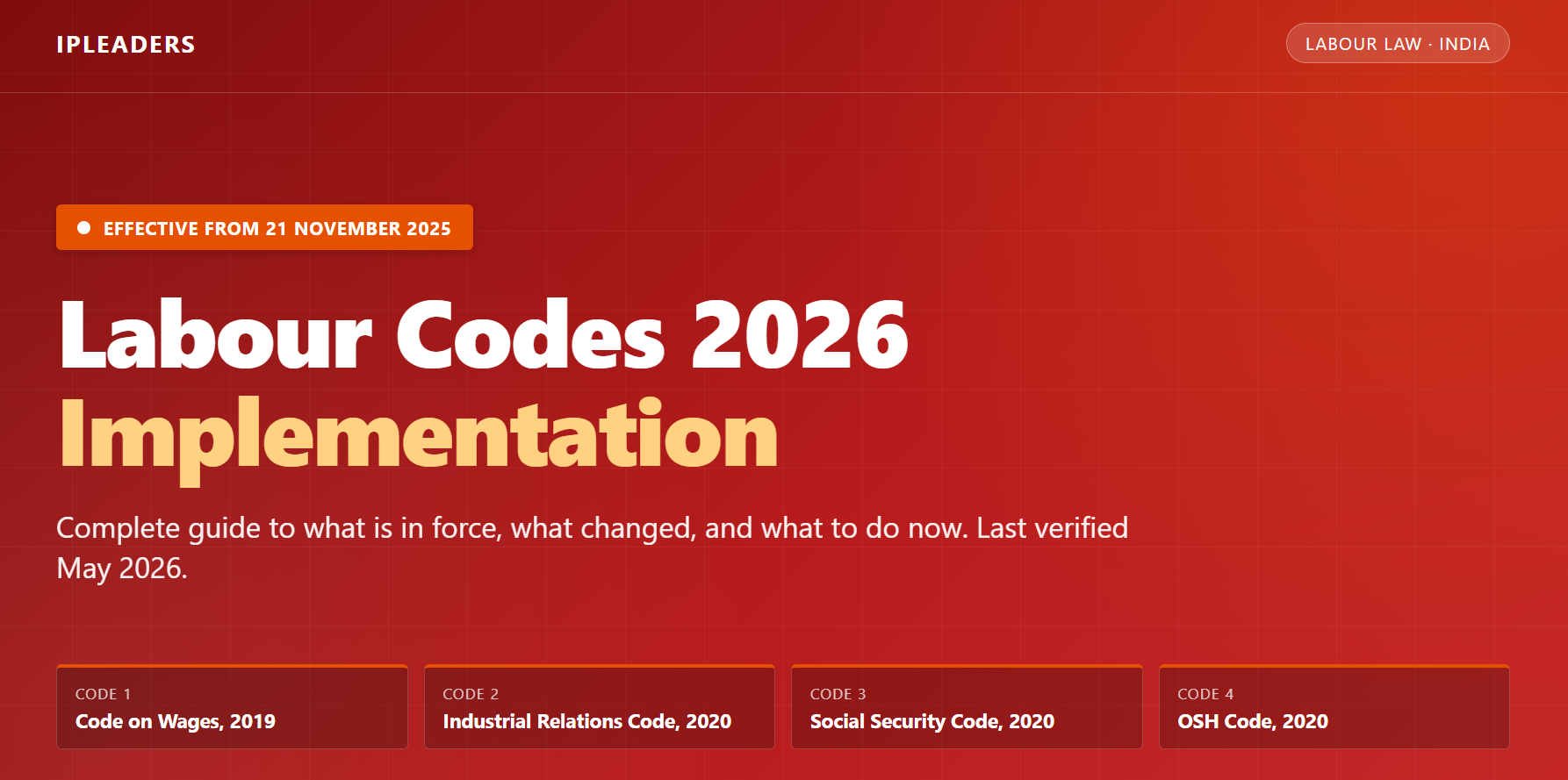
Last verified: 8 May 2026
The PIB feed updated late on a Friday afternoon. It was 21 November 2025, the gazette notification number appeared on compliance feeds at around 4:30 pm, and within an hour the Ministry of Labour and Employment had notified the largest single-day repeal of central labour statutes in independent India’s history. Twenty-nine separate Acts, the earliest dating to 1923, stood repealed under one notification. With the same notification, all four new Codes, the Code on Wages 2019, the Industrial Relations Code 2020, the Social Security Code 2020, and the Occupational Safety, Health and Working Conditions Code 2020, were declared effective.
What followed has been the most consequential Labour Codes 2026 implementation rollout the country has seen in decades.
The numbers from that notification are still being absorbed. Twenty-nine laws consolidated into four Codes. Over fifty crore Indian workers brought under a single statutory framework for wages, industrial relations, social security, and occupational safety. Payroll structures across IT, manufacturing, gig and MSME sectors required substantial restructuring. And for the first time in Indian labour history, gig and platform workers received statutory cover for social security, financed through a contribution levy on the aggregator platforms they work for. Few earlier labour reforms had moved this far in a single notification.

By April 2026 the operational picture had grown more complex rather than less. Maharashtra, Gujarat, and Karnataka had notified rules under most of the four Codes. West Bengal, Tamil Nadu, and Nagaland had not. On 12 February 2026, ten Central Trade Unions called a nationwide strike against the rollout, disrupting coal, banking, transport, and agriculture. The Ministry of Labour and Employment released Additional FAQs on 16 March 2026 to address the lingering operational ambiguities. The Government’s targeted full-enforcement date of 1 April 2026 passed with substantial state-rule machinery still pending. Then, on 8 April 2026, the Kerala High Court delivered the first reported judgment under the new IR Code, upholding the provision that allows existing labour tribunals to continue functioning until the new Industrial Tribunal architecture is operational.
If you’re working in HR at a 250-person services firm, your question is probably: are we compliant? If you’re an employee looking at a payslip restructured under the new wage definition, the question is: will my take-home shrink? If you’re a labour-law lawyer briefed on a writ petition, the question is: what’s the litigation exposure? And if you’re an MSME founder with 180 workers across three units, the question is more pointed: do the 100-to-300 worker thresholds save you, or expose you? This article maps each of those answers as the position stands in May 2026: what is in force, what is pending, what is contested in court, and what HR teams need to do this quarter.
The four Labour Codes, the Code on Wages 2019, Industrial Relations Code 2020, Social Security Code 2020, and Occupational Safety, Health and Working Conditions Code 2020, were notified effective on 21 November 2025, repealing 29 central labour laws. Full enforcement, including remaining state-rule notifications, was targeted for 1 April 2026, with several states still pending as of May 2026.
The sections that follow set out the practical map every reader needs: the live status, the 50% wage rule, sectoral salary math, the state-rule fragmentation, the litigation, and a 60- to 90-day compliance roadmap.
What is in force right now: status of the Labour Codes (May 2026)
For a year now, the single most-asked question on every HR helpdesk and labour-law forum has been the same: are the Codes actually in force, or is this still a draft regime? The answer, as of May 2026, is: yes, the Codes are in force, but the operational coverage depends on where your establishment sits and which Code you’re asking about.
The notification of 21 November 2025 made all four Codes effective in law. Central Rules under each Code were pre-published on 30 and 31 December 2025. The Ministry of Labour and Employment then released the Additional FAQs document on 16 March 2026, which clarified several open questions on wages, overtime, gratuity, and full-and-final settlement. The targeted full-enforcement date was 1 April 2026, and central provisions are now live. State Rules, however, drive operability for the state-jurisdiction segment of every employer’s compliance map.
In practice, what experienced practitioners track is two parallel timelines. The central effectiveness timeline is closed: the Codes are notified, central rules are in force, and the Ministry FAQs are the operating reference document. The state-by-state timeline is open: until your state of operation has notified rules under each Code, the operational machinery for that Code in that state is incomplete. This is why a multi-state employer cannot simply tick a single box marked “compliant”.
A common question raised in HR community threads is this: “If I’m a centrally-regulated establishment, like a bank or a railway contractor, am I bound by central rules alone?” Yes. For centrally-regulated establishments, the central rules are sufficient and operative. For state-jurisdiction establishments, including the bulk of factories, shops, and services, full operability follows your state’s rule notification.
The 21 November 2025 notification: what it actually did
The PIB notification of 21 November 2025 did three legally distinct things in one stroke. First, it brought all four Codes into force across India. Second, it repealed the twenty-nine corresponding central labour statutes that the Codes were designed to subsume. And third, it triggered the deadline cascade for state governments to notify their own rules under each Code.
The historical scale matters. India had been talking about consolidation since the 2002 recommendations of the Second National Commission on Labour. The Code on Wages received Presidential assent in August 2019, the other three Codes were passed in September 2020, and then implementation slipped year after year for half a decade. The November 2025 notification ended that limbo decisively.
The 1 April 2026 target and why state rules still matter
The 1 April 2026 date was framed in Government communications as the full-enforcement target, not as the legal effective date. The Codes had legal effect from 21 November 2025. April 2026 was the operational target by which state rules, payroll system upgrades, and standing-order migrations were expected to be in place. Several states didn’t make that target.
Five-state status check for May 2026:

- Maharashtra: rules notified across all four Codes; portal-driven compliance live.
- Gujarat: rules notified across all four Codes; phased registration window.
- Karnataka: rules notified across all four Codes; legacy standing-orders migration ongoing.
- West Bengal: notification under multiple Codes pending as of May 2026.
- Tamil Nadu: Social Security Code rules pending; OSH and IR rules notified in part.
If your establishment operates across all five, you cannot run a single uniform compliance template, you have to maintain a state-keyed matrix.
A quick checklist: are you covered today?
Three rapid checks will tell most employers where they stand: first, has your state notified rules under each of the four Codes that apply to your establishment type? Second, has your payroll system been re-configured to apply the Section 2(y) wage definition under the Code on Wages? Third, have your standing orders, exit workflows, and gratuity provisioning been updated to mirror the Codes and the Ministry’s 16 March FAQs?
If any of those three is “no”, you are mid-implementation, not compliant. The Ministry FAQs make this distinction explicit and treat partial implementation as an interim state, not as compliance.
The pitfall most employers stumble into here is mistaking the November 2025 notification for the end of the compliance project. It’s the start. The notification opened the door to the operational rollout that’s still happening across most states.
The four Labour Codes: what each one replaces (29-to-4 mapping)
Until 21 November 2025, the central labour-law statute book listed twenty-nine separate Acts: Industrial Disputes Act 1947, Trade Unions Act 1926, Factories Act 1948, Payment of Wages Act 1936, Minimum Wages Act 1948, Equal Remuneration Act 1976, Employees’ Provident Funds and Miscellaneous Provisions Act 1952, Employees’ State Insurance Act 1948, Payment of Gratuity Act 1972, Maternity Benefit Act 1961, and many more. A practising HR advisor at a mid-cap services firm had to track all of them simultaneously, often through a stack of state-amendment overlays.
The four new Codes consolidate this into a cleaner architecture. Each Code groups statutes by subject area: wages and remuneration into one, industrial relations into another, social security into a third, and occupational safety with working conditions into the fourth. The result is a more navigable statute book, even if the rule layer still varies state to state.
Below is the full repeal-mapping for the central laws absorbed (Table 1).
| Old Act (year) | Subject area | Replaced by | Section reference in new Code |
|---|---|---|---|
| Payment of Wages Act, 1936 | Wage payment | Code on Wages, 2019 | Chapter II (Sections 5-25) |
| Minimum Wages Act, 1948 | Statutory minimum wages | Code on Wages, 2019 | Chapter III |
| Payment of Bonus Act, 1965 | Annual statutory bonus | Code on Wages, 2019 | Chapter IV |
| Equal Remuneration Act, 1976 | Gender pay parity | Code on Wages, 2019 | Section 3 |
| Trade Unions Act, 1926 | Trade union registration | Industrial Relations Code, 2020 | Chapter III |
| Industrial Employment (Standing Orders) Act, 1946 | Standing orders | Industrial Relations Code, 2020 | Chapter IV (Section 28 onwards) |
| Industrial Disputes Act, 1947 | Disputes, retrenchment, layoffs | Industrial Relations Code, 2020 | Chapters V to X |
| Employees’ Provident Funds Act, 1952 | PF, EPS, EDLI | Social Security Code, 2020 | Chapter III |
| Employees’ State Insurance Act, 1948 | ESI medical and cash benefits | Social Security Code, 2020 | Chapter IV |
| Payment of Gratuity Act, 1972 | Gratuity | Social Security Code, 2020 | Chapter V (Section 53 onwards) |
| Maternity Benefit Act, 1961 | Maternity benefits | Social Security Code, 2020 | Chapter VI |
| Employees’ Compensation Act, 1923 | Workmen’s compensation | Social Security Code, 2020 | Chapter VII |
| Unorganised Workers’ Social Security Act, 2008 | Unorganised-sector cover | Social Security Code, 2020 | Chapter IX |
| Factories Act, 1948 | Factory licensing, hours, OSH | OSH Code, 2020 | Chapters III to VIII |
| Mines Act, 1952 | Mine safety | OSH Code, 2020 | Chapter X (Section 65 onwards) |
| Contract Labour (Regulation and Abolition) Act, 1970 | Contract labour licensing | OSH Code, 2020 | Chapter XI |
| Inter-State Migrant Workmen Act, 1979 | Migrant worker protection | OSH Code, 2020 | Chapter XII |
(For the full thirty-statute repeal sweep, the Ministry of Labour FAQs of 16 March 2026 list every Act. The table above covers the most operationally significant.)
The structural payoff is real. A reader trying to understand workplace standing orders no longer has to triangulate between the 1946 Act, state amendments, and Industrial Disputes Act provisions on layoffs. The IR Code now puts standing orders, layoffs, retrenchment, conciliation, and tribunal procedure in one statute. India’s labour-law architecture before the Codes was, frankly, a maze. The new mapping is a single floor plan with four rooms.
Code on Wages 2019: which four wage statutes it absorbs
The Code on Wages folds four old Acts into one: the Payment of Wages Act 1936, the Minimum Wages Act 1948, the Payment of Bonus Act 1965, and the Equal Remuneration Act 1976. The unified definition of “wages” under Section 2(y) of the Code on Wages, 2019 is the engine that makes this consolidation work.
It standardises what counts as wages for minimum-wage compliance, bonus computation, equal-remuneration evaluation, and PF and gratuity arithmetic. PRS Legislative Research’s tracking of the Code on Wages bill captures the full legislative history for readers who want the consolidation rationale on record.
IR, SS and OSH Codes: the consolidation map
The Industrial Relations Code subsumes the Trade Unions Act 1926, the Industrial Employment (Standing Orders) Act 1946, and the Industrial Disputes Act 1947.
The Social Security Code absorbs the Employees’ Provident Funds Act 1952, the Employees’ State Insurance Act 1948, the Payment of Gratuity Act 1972, the Maternity Benefit Act 1961, the Employees’ Compensation Act 1923, and the Unorganised Workers’ Social Security Act 2008.
The OSH Code absorbs the Factories Act 1948, the Mines Act 1952, the Contract Labour Act 1970, the Inter-State Migrant Workmen Act 1979, and several smaller industry-specific safety statutes (plantations, beedi and cigar workers, motor transport workers, sales promotion employees).
A common pitfall is to assume that the Industrial Disputes Act 1947 still applies because it still appears in older HR templates. It doesn’t. The IR Code repealed it on 21 November 2025, and the procedural successors live inside Chapters V to X of the Code.
Code on Wages 2019: the 50% wage rule and the new “wages” definition
The single most disruptive structural change introduced by the Labour Codes is the new definition of “wages”. For the better part of three decades, Indian salary structures had drifted toward an architecture where basic pay was a small slice of total CTC and a long list of allowances filled the rest. That arrangement was tax-efficient and PF-light. The 50% wage rule under the Code on Wages dismantles it.
Section 2(y) defines “wages” as basic pay, dearness allowance, and retaining allowance, and it lists specific exclusions: HRA, conveyance, statutory bonus, overtime, commission, gratuity, and the like. But it builds in a structural floor: if the excluded components together exceed 50% of total remuneration, the excess is folded back into “wages” for the purposes of PF, gratuity, bonus, and any other provision keyed to the wage definition. In effect, “wages” must be at least 50% of total remuneration.
That rewires the arithmetic of every Indian salary structure that was previously basic-light. PF contributions, capped earlier at 12% of basic, now apply to a larger base. Gratuity, computed at 15 days of “wages” per year of service, now rises in line. The 16 March 2026 Ministry of Labour FAQ adds a further point that several payroll vendors initially missed: overtime allowance, even though it’s listed as an exclusion, counts within the 50% floor calculation. Treating overtime as outside the floor would understate “wages” and trigger a compliance shortfall.
The practical implication for HR architects is that any CTC structure where allowances historically ran at 60% or 65% of total now needs reduction to at most 50%, with the corresponding rebalance to basic plus DA. Most allowance-heavy services-sector salary letters fall into this bucket.
In practice, what tier-1 firm advisors are circulating internally is a three-step approach: audit each CTC band against the Section 2(y) test; identify the gap (allowances over the 50% threshold); and rebuild the salary letter so that basic plus DA crosses 50% before any allowance is layered in.
What “wages” now means: the inclusion / exclusion / cap test
The inclusion test under Section 2(y) starts simple: basic pay plus DA plus retaining allowance is “wages”. The exclusion list is long but bounded:
- house rent allowance
- conveyance allowance
- statutory bonus payable under Chapter IV of the Code
- overtime allowance
- commission
- contributions to PF or pension
- gratuity payable on termination
- retrenchment compensation
- amounts paid to defray special expenses
If those excluded items together exceed 50% of total remuneration, the excess is added back into “wages” for all calculations under the Code, the SS Code, and any other Code that adopts the same wage definition. So the question every payroll team is now asking is: does the total of allowances plus bonus plus overtime plus commission, in any month, push above the 50% threshold? If yes, the excess gets reclassified.
The Ministry FAQ also clarifies that HRA, conveyance, and special allowance, common ingredients in IT and services pay structures, fall on the exclusion side as a default but get pulled in via the 50% override.
The overtime-in-50% trap (16 March 2026 FAQ clarification)
The 16 March 2026 Ministry of Labour FAQ resolved a question that had divided payroll commentary through January and February: is overtime allowance counted within the 50% floor? The Ministry’s position is yes. Overtime, although listed as an exclusion, forms part of the 50% calculation. The reasoning is that the floor is intended to prevent a structural circumvention of “wages” through over-classification of variable items.
Worth flagging: this is one of the FAQs that has the largest live operational impact and the smallest competitor coverage. Most vendor blogs still omit it. Payroll runs that don’t bake the overtime rule into the 50% test will under-pay PF and under-provide gratuity, both correctable but both penalty-attracting once an inspection lands.
How to restructure CTC to comply
The cleanest restructuring path runs in three movements. Move basic plus DA up to at least 50% of total fixed CTC. Compress allowances to fit under the residual 50%. Communicate the change to employees clearly: monthly take-home will dip slightly, retirement and statutory benefits will rise correspondingly, and the net long-run economic position is broadly neutral or marginally positive for the employee. The communications piece is where most rollouts go wrong.
Take-home, PF and gratuity under the new wage definition
The 50% rule’s effect on take-home pay shows up most starkly when you run the numbers across sectors. The Code on Wages and the Social Security Code together rewrite three lines on the typical Indian payslip: PF (Chapter III of the SS Code), gratuity (Section 53 of the Code on Social Security, 2020 onwards), and the variable employer-side cost driven by both. The overall direction is consistent: monthly take-home compresses, employer-side retirement provisions expand, gross CTC stays roughly flat in the medium term.
Below (Table 2) is a sectoral worked-example matrix to make this concrete. Each row uses representative compensation drawn from published payroll commentary (the figures are illustrative, not from a single employee).
| Profile | Old monthly take-home (approx.) | New monthly take-home (approx.) | PF impact | Gratuity impact |
|---|---|---|---|---|
| IT SDE in Bengaluru, ₹18 LPA fixed CTC | ₹1,30,000 | ₹1,22,000-₹1,24,000 | Employer + employee PF rises by ~₹1,800-₹2,200 per month | Gratuity accrual rises ~30-35% |
| Factory worker in Chennai, ₹4.2 LPA fixed CTC | ₹30,500 | ₹29,200-₹29,600 | PF base rises ~12-15% | Gratuity accrual rises ~10-12% |
| Gig rider on platform aggregator, ₹35,000/month earnings | ₹35,000 (cash-in-hand) | Largely unchanged | Aggregator levy creates social-security contribution; benefit entitlement phases in | First-time gratuity-style cover under SS Code Chapter IX |
| Permanent mid-manager, ₹12 LPA in MSME services | ₹86,000 | ₹81,500-₹83,000 | PF base rises significantly | Gratuity rises in line with new wage base |
The numbers above sit within the 3% to 7% take-home dip that most payroll commentaries are now publishing. The variation depends on how allowance-heavy the original structure was, how the employer chooses to redistribute the residual 50%, and whether DA is built in or merit-only.
The IT employee: ₹18 LPA SDE worked example (Bengaluru)
Take a Bengaluru software engineer on a fixed CTC of ₹18 lakh per annum. Under a typical pre-Codes structure, basic might have been ₹4.5 lakh per year (25% of CTC), with HRA, special allowance, conveyance, telephone, and books allowance making up the bulk of the rest. Monthly take-home (post-tax, post-PF) sits near ₹1,30,000.
Under the new wage definition, basic plus DA must rise to at least ₹9 lakh per year. PF (12% employer, 12% employee on the new wage base) increases on both sides. The employee’s monthly take-home dips by roughly ₹6,000-₹8,000 in the first cycle. Gratuity provisioning, calculated on 15 days of new-base wages per year of service, rises sharply. The bigger employer-side cost is absorbed within the same gross CTC envelope, which is why employees see a take-home decline without an offsetting CTC increase.
A common question employees raise is: “Will my PF contribution actually increase?” Yes. The new wage base is larger, so the 12%-of-base contribution is larger.
The factory worker: ₹4.2 LPA Chennai unit
For a Chennai unit factory worker on ₹4.2 LPA, the pre-Codes salary structure is typically less allowance-heavy than the IT example. Basic plus DA may already have been close to half of total. The take-home dip is therefore smaller, often within ₹1,000-₹1,500 per month. PF and gratuity bases still rise, but the relative shift is gentler.
The gig rider: ₹35k/month platform worker
A Mumbai gig rider earning ₹35,000 per month from a platform aggregator sees a different shape entirely. There is no traditional “wage” structure to restructure. Under Section 114 of the SS Code, the Code creates a Social Security Fund for gig and platform workers, financed through aggregator contributions (a percentage of platform turnover, capped).
The rider’s monthly cash-in-hand stays effectively unchanged. What changes is that, for the first time in Indian labour history, the rider becomes entitled to phased benefit cover (medical, life, accident, old-age) under a statutory scheme rather than a discretionary corporate one.
The 1-year gratuity rule: who qualifies, who doesn’t
Section 53 of the SS Code sets a category-segmented gratuity rule. For permanent employees, the qualifying threshold remains five years of continuous service, the long-standing position under the 1972 Act. For fixed-term employees, the proviso to Section 53(1) makes gratuity payable after one year of continuous service, calculated pro-rata against the same 15-days-per-year formula. The Ministry FAQ explicitly states that the one-year rule does not extend to permanent employees.
This is one of the most misunderstood changes in employee-side conversations. A permanent employee at a services firm asking “do I get gratuity after a year now?” should be told no, the five-year rule still applies. A fixed-term employee on a 14-month contract who completes the full term, on the other hand, does qualify.
Industrial Relations Code 2020: standing orders, retrenchment, tribunals, strikes
The IR Code is the most contested of the four. It rewrites the architecture for trade union recognition, standing orders, retrenchment, layoffs, conciliation, strikes, and tribunal procedure. The Industrial Disputes Act 1947 was the central artery of Indian industrial relations for seventy-eight years, and replacing it generated more litigation exposure than any other piece of the consolidation.
The single biggest operational change is the threshold lift, from 100 workers to 300, for both standing orders applicability (Section 28 of the Industrial Relations Code, 2020) and retrenchment approval (Section 77). The strike-and-lockout regime (Section 62) tightens the notice and conciliation requirements. Tribunal continuity is governed by Section 104(1-A), which the Kerala High Court interpreted in M.K. Suresh Kumar v. Union of India on 8 April 2026.
In practice, what the Code does is move many establishments out of the procedural straitjacket that the 1947 Act applied to factories of 100-plus workers, while simultaneously formalising union recognition rules and codifying conciliation timelines. Whether the net effect is “business-friendly” or “worker-unfriendly” is one of the most fiercely debated questions in the litigation pipeline.
Standing orders: 100-to-300 worker threshold change
Standing orders, the workplace rulebook governing classification of workmen, hours, leave, holidays, attendance, shifts, payment of wages, suspension, and grievance procedure, were previously mandatory for any industrial establishment employing 100 or more workers. The IR Code raises that threshold to 300. Establishments below the new threshold continue to be governed by the model standing orders or by their existing certified standing orders, but the certification requirement falls away.
A natural follow-up is what happens to the standing orders that were already certified under the 1946 Act for 100-to-299 worker establishments. The IR Code preserves them as valid and operative. Employers in this bracket are not required to re-certify. Adoption of model standing orders or contractual employment terms is enough.
The question practitioners often see is: “If we drop below the 300 threshold mid-year due to attrition, do we still need standing orders?” The cleaner answer is: maintain them. A drop-out of the threshold doesn’t necessarily kill the requirement (continuity is the driver, not the snapshot), and re-instating certified standing orders later if you grow back through 300 is more painful than just retaining what you have.
Retrenchment threshold: 100-to-300, the operational reality
Retrenchment, the termination of a workman for reasons other than misconduct, previously required prior government approval for industrial establishments with 100 or more workers. The IR Code raises this threshold to 300 as well. Establishments in the 100-to-299 worker bracket can now retrench without seeking prior approval, subject to the procedural prerequisites: notice, retrenchment compensation, and last-in-first-out ordering.
For mid-sized employers, this is the single most impactful change. The compliance bottleneck of seeking government approval, often a months-long process subject to political and procedural variables, is gone for the bracket where most retrenchment activity historically clustered. That’s the headline. But the procedural backbone (notice period, retrenchment compensation at 15 days of wages per year of service, valid retrenchment grounds) is still intact and is enforceable in the new IR Code’s tribunal regime.
Strikes, conciliation and the 60-day notice rule
The IR Code formalises a 60-day prior notice requirement for strikes in industrial establishments under Section 62, and the strike cannot commence within 14 days of giving such notice. The right to strike is preserved, but the procedural envelope around it is tighter. Conciliation officers must initiate proceedings within prescribed timelines, and the strike cannot proceed during conciliation or for seven days after a conciliation officer’s report.
A persistent reading in trade-union commentary is that the Code has weakened the right to strike. The Code’s drafters dispute that framing: the right is intact, the procedural compliance has merely been codified more explicitly. Both positions have litigation traction, and a Supreme Court writ on the strike provisions is widely expected.
Tribunal continuity: Section 104(1-A) and the Kerala HC ruling
Section 104 of the IR Code provides a continuity mechanism for the existing labour tribunal architecture, allowing legacy Labour Courts and Industrial Tribunals to continue functioning until the IR Code’s Industrial Tribunals are operational. On 8 April 2026, in M.K. Suresh Kumar v. Union of India, the Kerala High Court (Single Judge) upheld the constitutional validity of Section 104(1-A), holding that the continuity provision is neither manifestly arbitrary nor violative of Articles 14 or 21. SCC OnLine’s commentary on the ruling, published 28 April 2026, captures the doctrinal reasoning.
The practical effect is that employers and workers with disputes pending before the legacy tribunals on 21 November 2025 continue under those forums until the IR Code’s procedural successors are in place. The continuity is expected to last 12 to 24 months in most states.
The 100-to-300 worker threshold: who actually benefits, who actually loses
Around the 100-to-300 worker threshold, the Codes draw the sharpest distributional line in the entire consolidation. The bracket of mid-sized employers, broadly defined as establishments with between 100 and 299 workers, gets two big procedural reliefs (no mandatory standing orders certification, no retrenchment-approval requirement) without losing any of the consolidation’s payroll-restructuring obligations. That asymmetry produces both clear winners and a less obvious set of second-order losers.
The mid-sized employer (100-299 workers): the new winners
The mid-sized employer is the single biggest procedural beneficiary of the IR Code. A 250-worker manufacturing unit in Pune that previously needed to seek state government approval for any retrenchment can now retrench within the procedural envelope of notice and compensation alone. Standing orders certification is no longer mandatory. Many tier-1 firm advisories have called this the most consequential reduction in the regulatory burden on mid-sized Indian employers in a decade.
The flip side is the payroll-restructuring obligation under the Code on Wages applies fully. So the mid-sized employer wins on the IR Code side and bears the compliance cost on the wage side. The net financial position is neutral to slightly positive, depending on the labour intensity of the operation.
Workers in the deregulated bracket: the second-order effect
The less visible side of the threshold lift is the worker who, until 21 November 2025, sat inside a 100-plus-worker establishment with mandatory standing orders and a procedural buffer against arbitrary retrenchment, and who, under the new Codes, sits in a deregulated bracket. These workers haven’t lost any individual statutory entitlement, retrenchment compensation is still payable, notice is still required, the right to challenge a retrenchment in tribunal is intact, but the structural procedural protection that the 100-worker threshold encoded in the 1947 Act is gone for them.
The pre-Codes Supreme Court jurisprudence on permanency for long-serving contract workers performing core perennial functions (the worker-rights baseline anchored, among other rulings, in Jaggo v. Union of India) continues to apply. Tribunals will read the new IR Code against that baseline. But the absence of the prior-approval gate means more retrenchments will reach tribunals as a fait accompli rather than be filtered out at the approval stage.
A common community question is whether the threshold lift was politically debated before being passed. The legislative record shows the IR Code was passed in the 2020 monsoon session largely without committee scrutiny. The leaflet critique of 31 March 2026 captures this point in detail.
OSH Code 2020: working hours, the 4-day work-week option, overtime rules
The OSH Code consolidates the Factories Act 1948, the Mines Act 1952, the Contract Labour Act 1970, the Inter-State Migrant Workmen Act 1979, and a clutch of industry-specific safety statutes. For most non-mining, non-plantation employers, the practical hooks are in Section 25 of the OSH Code, 2020 (daily and weekly hours), Section 26 (overtime), and Section 27 (rest intervals).
The headline-grabbing change is the explicit accommodation of a four-day working week as a permissible (not mandatory) arrangement. Daily working hours, including breaks, must not exceed twelve. Weekly working hours must not exceed forty-eight. Overtime, paid at twice the ordinary rate of wages, applies to any time worked beyond the daily eight-hour mark or the weekly forty-eight-hour mark, whichever the employer’s policy uses as the trigger.
Daily, weekly and overtime hour caps
The OSH Code’s hour discipline is built around three fixed numbers and one calculated boundary:
- daily working hours including rest intervals: maximum 12
- weekly working hours: maximum 48
- ordinary working hours per day before overtime kicks in: 8
- overtime rate: twice the ordinary rate of wages, payable for time worked beyond the daily 8-hour mark
The Ministry FAQ of 16 March 2026 clarifies that overtime is computed on the ordinary rate of “wages” as defined in Section 2(y), not on “basic” alone. That brings overtime arithmetic into alignment with the 50% floor.
The OSH Code also retains sectoral exemptions for mines, plantations, and motor transport workers, where additional rest, daily-hour, and shift-length restrictions apply.
The 4-day week: what the rule actually says
A four-day working week is permissible if the daily-hours cap (12 hours including breaks) and the weekly-hours cap (48) are both respected. So a 4 x 12 = 48 hour week is on the right side of the cap; a 4 x 12 schedule that includes breaks within the 12-hour envelope and stays at 48 hours over the week is compliant. Overtime applies to anything beyond 8 hours per day.
A community misconception worth correcting: the four-day week doesn’t mean “any four days you choose, with hours unspecified.” It means a four-day-a-week schedule that fits within the OSH Code’s daily and weekly caps, with overtime triggered at 8 hours daily. Without the overtime payment, the schedule isn’t compliant.
Quora threads on the topic frequently assume the Government has mandated a four-day week. It hasn’t. The Code permits it. Whether to adopt it is the employer’s decision.
Annual bonuses, leave encashment, performance pay treatment
Statutory bonus is computed under Chapter IV of the Code on Wages. Leave encashment is payable on cessation as part of full-and-final settlement, capped at the limits specified in the SS Code rules. Performance pay (annual variable, KPI bonuses, retention bonuses) is, by default, on the exclusion list under Section 2(y), but the 50% override applies if it pushes total exclusions above the threshold.
The pitfall here is the mistake of treating annual performance bonus as outside the wage definition for all purposes. It’s outside as a default classification but inside under the override.
Social Security Code 2020 and gig workers: India’s first formal cover
The SS Code consolidates PF, ESI, gratuity, maternity benefit, employees’ compensation, and the unorganised-workers regime into one statute. The most consequential expansion is Chapter IX, which brings gig workers and platform workers within statutory cover for the first time. This is the change that brought the most international attention to the Indian labour reform.
Section 109 of the SS Code, read with Sections 113 and 114, defines the scheme. Gig workers and platform workers are eligible for benefit cover financed through aggregator contributions to a Social Security Fund. Benefits are phased: medical, accident, life, and old-age cover come on stream over the first 24 months. ESI thresholds and fixed-term gratuity parity are governed by Section 53 (proviso to sub-section (1)) and the ESIC notifications.
Who counts as a gig or platform worker
The SS Code’s definitional architecture distinguishes a “gig worker” (a person performing work outside a traditional employer-employee relationship) from a “platform worker” (a person working through a digital platform that facilitates work assignment). The two categories overlap heavily. Most app-based delivery riders, ride-hail drivers, and on-demand service workers fall into both. The benefit entitlement runs from either categorisation.
The aggregator levy and the Social Security Fund
Section 114 of the SS Code creates the financing mechanism. Aggregators (defined as digital intermediaries that link buyers to gig or platform workers) contribute to the Social Security Fund within a statutory range of not less than 1% and not more than 2% of annual turnover, with a separate ceiling that the contribution cannot exceed 5% of the amount paid or payable by the aggregator to gig and platform workers.
The exact contribution rate and the operational mechanics (payment cycle, return formats, commencement date) are notified by the Central Government under Section 114, and the Ministry of Labour FAQ of 16 March 2026 is the operative reference for the rate and cap as they currently stand.
A second-order effect that compliance-tech vendors are watching: the aggregator levy formalises platform turnover as a regulatory data point. Once aggregators report turnover for levy purposes, the data flow opens upstream visibility into gig-economy scale that didn’t previously exist.
ESI thresholds and fixed-term gratuity parity
ESI cover applies to employees within the wage threshold notified by the ESIC. Fixed-term employees gain gratuity parity under the proviso to Section 53(1): a one-year qualifying threshold and the same 15-days-per-year formula as permanent employees. The Ministry FAQ confirms that fixed-term contracts cannot be used to deny social security benefits that the SS Code makes universal.
The 2-working-day full-and-final settlement rule (operational mechanics)
Section 17(2) of the Code on Wages mandates that wages payable on cessation of employment, whether by resignation, removal, retirement, retrenchment, or termination, must be paid within two working days. This is one of the most operationally severe changes in the Codes, and most HR teams are still rebuilding their exit workflows around it.
What “wages” means for F&F (and what’s excluded)
The wages payable on cessation include unpaid salary up to the date of cessation, leave encashment, statutory bonus accrued, and any other amount classified as “wages” under Section 2(y). Gratuity, where payable, follows a separate timeline under the SS Code (within 30 days of cessation), but the Ministry FAQ has clarified that gratuity computation must begin on the cessation date so that the statutory window is met.
Notice-period adjustments, retrenchment compensation, and any contractually-agreed severance form part of the F&F payable. Tax deductions, recoveries (advances, loans, asset returns) net out within the same calculation.
Penalty exposure for delayed F&F
Delayed F&F triggers penalty exposure under Section 54 of the Code on Wages, which sits within the broader penalty structure of Chapter X (a first-offence fine of up to ₹50,000 for paying less than the amount due, with a repeat-offence uplift to imprisonment up to three months and / or fine up to ₹1,00,000 within five years). The Ministry FAQ has confirmed that the inspector-cum-facilitator can order interest on delayed wages in addition to the statutory penalty.
A frequent HR community question is whether the two-day clock starts from the last working day or the date of acceptance of resignation. The Code’s text is “cessation of employment”, which the Ministry has interpreted as the actual last working day, not the resignation acknowledgement date. So if an employee resigns on 1 April with a 30-day notice and works through 30 April, the F&F clock starts on 1 May.
How HR teams should rebuild exit workflows
The clean rebuild looks like this: pre-compute leave encashment, statutory bonus, and notice-pay positions on the day notice is served, not on the day notice expires. Reconcile recoveries (advances, asset returns, loan balances) at least seven days before the last working day. Initiate the gratuity computation on the last working day. Trigger the F&F payment within two working days of the last working day. Issue the experience certificate, no-dues certificate, and Form 16 within the same two-day envelope.
The pitfall most often stumbled into is starting the F&F computation on the last working day. Two days isn’t enough to compute, approve, and pay if computation hasn’t been pre-staged.
Central Rules vs State Rules: the fragmentation problem and a live state map
Labour, in India, is a Concurrent List subject under the Seventh Schedule. The Centre legislates the Code; states notify the rules that operationalise the Code within state-jurisdiction establishments (factories, shops, services, plantations, motor transport). Without state rules, the Code’s operational machinery is incomplete in that state for the establishment types it governs.
This is the structural reason why the November 2025 notification did not produce uniform compliance across India. Each state has its own pace, its own gazette process, and its own portal-development timeline. The Lawrbit state-rule tracker, kept current monthly, is the most reliable cross-state map; the Ministry’s labour.gov.in portal hosts the central rules and the FAQs; the Maharashtra Labour Department’s notification page is the cleanest example of state-side rule communication.
Why central rules are not enough
For centrally-regulated establishments, banks, railways, mines, oil and gas, central PSUs, the central rules are sufficient and operative. For state-jurisdiction establishments, the central rules don’t apply directly, and the state’s own rule-making determines what’s enforceable. So a 250-worker private services firm with branches in five states cannot run a single compliance template. It runs five.
The fragmentation isn’t a bug; it’s the constitutional design. But it does mean the implementation timeline is, by definition, state-paced.
State-by-state notification status (May 2026)
The state map below (Table 4) captures the position as of May 2026 across major states (illustrative, sourced from the Lawrbit tracker and individual state portal notifications).
| State / UT | Code on Wages | IR Code | SS Code | OSH Code | Latest gazette month | Source |
|---|---|---|---|---|---|---|
| Maharashtra | Notified | Notified | Notified | Notified | Mar 2026 | labour.maharashtra.gov.in |
| Gujarat | Notified | Notified | Notified | Notified | Mar 2026 | Gujarat Labour Dept |
| Karnataka | Notified | Notified | Notified | Notified | Apr 2026 | Karnataka Labour Dept |
| Madhya Pradesh | Notified | Notified | Notified | Notified | Apr 2026 | MP Labour Dept |
| Uttar Pradesh | Notified | Notified | Notified | Pending | Apr 2026 | UP Labour Dept |
| Andhra Pradesh | Notified | Notified | Pending | Notified | Mar 2026 | AP Labour Dept |
| Telangana | Notified | Notified | Pending | Notified | Mar 2026 | Telangana Labour Dept |
| Tamil Nadu | Notified | Partial | Pending | Notified | Mar 2026 | TN Labour Dept |
| West Bengal | Pending | Pending | Pending | Pending | (none) | WB Labour Dept |
| Nagaland | Pending | Pending | Pending | Pending | (none) | Nagaland Labour Dept |
| Delhi (UT) | Notified | Notified | Notified | Notified | Feb 2026 | Delhi Labour Dept |
(The full 28-state plus 8-UT matrix is maintained on the Lawrbit tracker and updated monthly.)
A direct comparison practitioners use: Maharashtra moved fastest among the large industrial states, Tamil Nadu lagged on the Social Security Code, and West Bengal lagged across all four. The state-rule trajectory will likely converge over 2026-27 as political and procedural variables resolve, but full convergence isn’t imminent.
What if your state hasn’t notified, are you bound?
If your establishment sits in a state-jurisdiction segment and your state hasn’t notified rules under the relevant Code, the Code’s central provisions still apply, but the operational machinery (registration, returns, inspections, scheme-specific filings) is incomplete. The Ministry FAQ treats this as an interim position. Centrally-regulated portions of compliance (PF and ESI under SS Code Chapters III and IV) operate through the EPFO and ESIC portals on the central timeline regardless.
A common pitfall is to assume that, because state rules are pending, the Code doesn’t apply. It does. The substantive Code is law from 21 November 2025. The state-rule layer adds operability for state-jurisdiction items only.
| State / UT | Wages | IR | SS | OSH |
|---|---|---|---|---|
| Maharashtra | N | N | N | N |
| Gujarat | N | N | N | N |
| Karnataka | N | N | N | N |
| Madhya Pradesh | N | N | N | N |
| Delhi (UT) | N | N | N | N |
| Uttar Pradesh | N | N | N | P |
| Andhra Pradesh | N | N | P | N |
| Telangana | N | N | P | N |
| Tamil Nadu | N | Pt | P | N |
| West Bengal | P | P | P | P |
| Nagaland | P | P | P | P |
Sectoral impact: IT, manufacturing, MSME and gig platforms
The four sectors that have absorbed the largest cumulative impact from the Codes are IT and ITeS, manufacturing, MSMEs, and gig platforms. Each sector hits a different set of provisions hardest, and each is on a different operational timeline.
IT and ITeS: CTC re-pricing and 50% rule
The IT and ITeS sector is the single most disrupted segment by the Code on Wages. Allowance-heavy CTC structures dominate the sector; the 50% floor forces structural rebalancing across the entire compensation grid. Bar & Bench analysis through Q1 2026 captured this as the largest-impact change for white-collar India in a generation. Tier-1 firm commentary forecasts a 3-7% reduction in nominal monthly take-home across most IT employees within the first three pay cycles of restructuring.
The forward signal is that the wage-base re-pricing is likely to extend across BPO, KPO, GCC, and shared services through 2026-27. Once one large IT services firm rebases CTC, peer pressure forces convergence. Early signals suggest several large employers had completed restructuring by April 2026; the long tail of mid-sized IT services firms is on a 2026-Q3 timeline.
Manufacturing: hours, overtime, OSH
Manufacturing’s biggest hits sit in the OSH Code’s hours-and-overtime regime and in the IR Code’s 100-to-300 threshold lift. Mid-sized factories in the 100-299 worker bracket gain procedural flexibility on retrenchment and standing orders; the daily-12 / weekly-48 hour caps remain the operational ceiling. The leaflet critique published in March 2026 reads the manufacturing impact as a net structural win for owners and a procedural loss for organised workers in the bracket.
MSME and gig platforms: compliance burden vs cover
MSMEs face a real compliance cost: payroll restructuring, F&F redesign, state-rule mapping, and standing-orders alignment. They lack the in-house compliance bench depth that larger employers have. MSME associations have flagged the implementation timeline as a stretch.
Gig platforms face a different shape: aggregator levy, contribution discipline, and reporting obligations under SS Code Chapter IX. The compensating gain is regulatory legitimacy, gig and platform workers within statutory cover signals a maturing regulatory relationship that platform companies have been advocating for years.
Litigation, constitutional challenges and trade-union opposition
The Codes face a layered set of legal challenges. The most prominent is the writ pipeline through state High Courts and the constitutional challenge expected to consolidate before the Supreme Court. Trade unions called a nationwide strike on 12 February 2026, ten Central Trade Unions joining a single platform against the rollout, with disruption across coal, banking, transport, and agriculture. The constitutional grounds being argued span Articles 14, 19, 21, and the Directive Principles of State Policy.
Whether the Codes are “business-friendly” or “worker-friendly” on net is one of the most fiercely contested questions in the litigation. The Government’s position is that the consolidation simplifies compliance and expands coverage (gig workers, fixed-term parity, social security thresholds). Trade unions argue that the threshold lifts, strike-notice tightening, and inspector-to-facilitator transition together weaken worker protection. Both sides have litigation traction.
The Kerala HC ruling on Section 104(1-A) IR Code (8 April 2026)
The first reported High Court judgment under the Codes came from the Kerala High Court on 8 April 2026 in M.K. Suresh Kumar v. Union of India. The challenge concerned Section 104(1-A) of the IR Code, the continuity provision allowing existing labour tribunals to function until IR Code Industrial Tribunals are operational.
The petitioner argued that the continuity provision violated Articles 14 and 21. The Single Judge dismissed the writ, holding that the continuity provision is neither manifestly arbitrary nor unconstitutional. SCC OnLine’s commentary on the ruling, published 28 April 2026, is the most accessible secondary source for the doctrinal reasoning.
The procedural background includes an earlier 2026 round, M.K. Suresh Kumar v. Union of India (earlier order, 17 February 2026), addressing the December 2025 notification on continued functioning of existing labour authorities, which set up the April 2026 ruling.
The Kerala HC’s ruling is significant for three reasons. It’s the first reported HC judgment on the Codes. It applies the manifestly-arbitrary test from Shayara Bano v. Union of India, (2017) 9 SCC 1 in a labour-Code context. And it sets a doctrinal anchor that any future Supreme Court challenge will have to engage with. The ruling is widely expected to be appealed, but the Single Judge’s reasoning is being read as a credible doctrinal floor.
Trade-union challenges and the 12 February 2026 nationwide strike
The 12 February 2026 nationwide strike was called by a joint platform of ten Central Trade Unions. Coverage from the day’s news (Business Standard’s reporting captured the scale) put participation in the tens of crores of workers and farmers. The disruption hit coal, banking, transport, and agriculture. AICCTU statements through February 2026 framed the strike as the precursor to a sustained legal and political challenge to the Codes.
The unions’ core arguments centre on the threshold lifts, strike-notice tightening, the inspector-to-facilitator transition, and the perceived weakening of standing orders and tribunal procedure. Several union platforms have indicated they intend to file consolidated writs at the Supreme Court level.
A common community framing reads the strike as primarily political. The legal layer is real, the writs are being drafted; the political layer is also real, the strike was designed to force political negotiation as much as legal review. Both layers will run in parallel.
Constitutional grounds: Articles 14, 19, 21 and DPSP
The constitutional challenges run on four spines. Article 14 (equality before law and equal protection of laws) is the manifestly-arbitrary doctrine anchor, the test articulated in Shayara Bano v. Union of India and applied by the Kerala HC. Article 19 challenges focus on the right-to-strike compression and the standing-orders threshold. Article 21 (right to life and personal liberty) is being argued as an envelope for the right to dignified work and procedural due process. The Directive Principles of State Policy (Articles 39, 41, 43, 43A) are being invoked as interpretive lodestars.
The leaflet’s academic critique of 31 March 2026 (authored by a senior labour-economics scholar) captures the academic case against the Codes most fully. The Kerala HC ruling captures the first sustained judicial engagement with the doctrinal challenges. The Supreme Court pipeline, when it activates, will likely consolidate writs across multiple states.
A pitfall worth flagging: a constitutional challenge filed is not a stay granted. Several commentaries have conflated the two. As of May 2026, no court has stayed the operation of any provision of the Codes. The Codes are in force, and the litigation is running in parallel, not against a backdrop of suspension.
The Inspector-cum-Facilitator regime and the new penalty structure
One of the more philosophically loaded changes in the Codes is the relabelling of the labour inspector. Across all four Codes, the official tasked with workplace inspection is now an “Inspector-cum-Facilitator”, with an explicit dual mandate: inspect for compliance and facilitate compliance through advice. The Code on Wages provides for this in Chapter X (sections 51 onwards), the IR Code in Chapter XIII, and the OSH and SS Codes in their respective enforcement chapters.
What changes when the inspector is now a facilitator
The facilitator framing introduces a soft-touch enforcement layer before the hard-touch penalty layer kicks in. The inspector can now issue advisory communications, set timelines for cure, and re-inspect before penalty proceedings begin. Whether this is a compliance-friendly evolution or a dilution of inspection rigour is one of the contested points in the trade-union critique. Tier-1 firm commentary reads it as a meaningful procedural shift; trade-union commentary reads it as an unwarranted softening.
In practice, what experienced compliance officers are reporting is that the facilitator interface is genuinely useful for borderline cases (computational ambiguity, transitional non-compliance) and procedurally identical to the prior inspection regime for clear-cut violations. Wilful, repeat, or large-scale non-compliance still triggers penalty proceedings without a facilitator buffer.
Penalty matrix: minimum, maximum, repeat-offender uplift
The penalty structure varies by Code and offence (Table 3).
| Code | Section | Offence type | First-offence fine ceiling | Repeat-offence (within 5 years) |
|---|---|---|---|---|
| Code on Wages | Section 54(1)(a) | Paying less than the amount due (including underpayment / minimum-wage shortfall) | Up to ₹50,000 | Up to 3 months’ imprisonment, or fine up to ₹1,00,000, or both |
| Code on Wages | Section 54(1)(c) | Contravention of any other provision, rule or order under the Code | Up to ₹20,000 | Up to 1 month’s imprisonment, or fine up to ₹40,000, or both |
| Code on Wages | Section 54(2) | Failure to maintain or improperly maintaining records | Up to ₹10,000 | Compounding available on first offence |
| IR Code | Chapter XIII | Illegal strike or lockout (employer-side) and other contraventions | Statutory fine ranges set out per offence | Imprisonment uplift on repeat |
| OSH Code | Chapter XIV | Safety contravention causing serious bodily injury or death | Higher fine slab plus imprisonment | Imprisonment uplift on repeat |
| OSH Code | Chapter XIV | Hours-of-work or other working-conditions violation | Statutory fine set per offence | Compounding available on first |
| SS Code | Chapter XIII | Non-payment of PF / ESI dues | Statutory fine plus recovery and interest | Imprisonment uplift on repeat |
(Code on Wages figures are taken directly from Section 54 of the Code on Wages, 2019. The IR Code, OSH Code and SS Code penalty regimes follow the per-offence schedule in the respective Chapters; refer to the bare Act for the exact slab applicable to a specific contravention. Tier-1 firm advisories track the operational reality and are summarised below.)
The penalty structure is materially more granular than the old per-Act penalty regimes, and senior officers (directors, managers, employer-designate persons) can be held liable in addition to the company.
A 60- to 90-day compliance roadmap for HR teams
For HR leaders running Labour Codes 2026 implementation across a multi-state footprint, the cleanest operational sequence over a 60- to 90-day window looks like this:
- Wage-definition audit (Week 1-2): Map every CTC band against the Section 2(y) test. Identify the gap (excluded items as a percentage of total) for each band.
- Identify allowance-over-50% gap (Week 2-3): For each band where excluded items push above 50% of total, compute the excess to be folded back into wages.
- Restructure CTC and communicate (Week 3-5): Rebuild salary letters so that basic plus DA crosses 50% before allowances. Issue clear employee communication on the take-home shift, the PF/gratuity uplift, and the net-of-tax position.
- Rebuild PF and gratuity provisions (Week 4-6): Re-base PF on the new wage definition. Re-provision gratuity on the new wage base. Update HRMS calculation rules.
- Redesign F&F (2-day) workflow (Week 5-7): Pre-compute leave encashment, statutory bonus, and notice-pay on notice-of-resignation date. Set up the 2-day-pay trigger on cessation date. Coordinate with finance on payment cycles.
- State-rule mapping (Week 6-9): Map each operating location to its state’s notification status across the four Codes. Note which state-jurisdiction items are operative and which are pending.
- Update standing orders / contracts (Week 7-10): Update standing orders for establishments above 300 workers. Update employment contracts to reflect the new wage definition, fixed-term gratuity terms, and notice provisions.
- Sign-off pack to leadership / board (Week 10-12): Compile a one-page compliance status, a state-rule heatmap, an exception list (gaps requiring escalation), and a 90-day refresh cadence.
Steps 1-3: audit, redefine wages, restructure CTC
Steps 1 to 3 are the heart of the wage-restructuring exercise. The Cyril Amarchand Mangaldas “60 Days of the Labour Codes” PDF, published in January 2026, captures the cleanest tier-1 firm framing of this sequence. The audit-redefine-restructure cycle is where most rollout failures originate; rolling forward without a complete audit produces band-by-band non-compliance that’s hard to detect until an inspection.
Steps 4-6: rebuild exit, gratuity and PF processes
Steps 4 to 6 are the back-office rebuild. The Ministry FAQ of 16 March 2026 is the primary operating reference here, the SS Code Chapter III (PF) and Chapter V (gratuity, including Section 53 and the proviso for fixed-term employees) is the statutory underlay. Most HRMS vendors have shipped Code-aligned configuration packs through Q1 2026. The lift is in calibration, not in software replacement.
Steps 7-8: state-rule mapping, training, board-pack
Steps 7 and 8 close the loop. The Lawrbit state-rule tracker and the Ministry of Labour FAQs (Annexure section) are the working references. The board-pack should be short, a single page summarising state-rule status, exception items, and the 90-day refresh cadence is more useful to leadership than a 40-page compliance report.
A common cluster of mistakes here is to start with state-rule mapping (step 6) before completing the wage audit (step 1). The wage audit is the foundation; without it, the state-rule mapping has no compliance basis to map to.
For HR teams that want to go deeper into structured training on this kind of end-to-end labour-law thinking, LawSikho’s Certificate Course in Labour Laws and HR Practices covers wage-definition restructuring, gratuity and PF re-architecture, state-rule mapping, and exit-process design under the four Labour Codes. It’s built around the 2025-2026 rollout and is paced for working professionals.
Common implementation mistakes employers are already making
Five mistakes recur across tier-1 firm advisories and HR community threads:
- Treating “wages” as old-CTC arithmetic. Computing PF and gratuity on the old basic-only base while the salary letter is notionally restructured produces a hybrid that fails inspection.
- Skipping state-rule mapping. Central-rule-aligned compliance assumed as uniform misses pending state items in West Bengal, Tamil Nadu, and Nagaland.
- Bonus and commission misclassification. Treating annual variable, KPI bonus, and commission as outside “wages” without testing the 50% override is the most common payroll miss.
- Mistaking notification for full enforcement. Reading the November 2025 notification as project-end rather than project-start produces drift through the first cycle.
- Excluding gratuity from F&F planning. Gratuity has its own 30-day SS Code window, but computation must begin on cessation; waiting for the claim form misses the F&F envelope.
Treating “wages” as old-CTC arithmetic
Many mid-sized services employers shift the salary letter to basic-plus-DA at 50% without rebasing PF and gratuity. The letter looks compliant; the back-office numbers don’t move. It’s the most penalty-attracting hybrid.
Skipping state-rule mapping
The Lawrbit tracker resolves state-rule status in an afternoon. The failure isn’t data availability; it’s that mapping isn’t treated as a critical-path step.
Bonus / commission misclassification
Annual variable and KPI bonuses sit on the Section 2(y) exclusion side by default. The 50% override pulls them in once total exclusions cross the threshold, and most payroll runs skip that test.
What employees and contract workers should do now
For employees and contract workers, the May 2026 reading list is shorter and more direct.
Reading the new payslip
The new payslip should show basic plus DA at 50% or more of total. PF (12% employer, 12% employee) on the new wage base. Gratuity provisioning visible. Allowances (HRA, conveyance, special) capped. If the new payslip looks materially different from the old, that’s expected; the take-home dip should sit in the 3-7% range for most allowance-heavy structures.
Gratuity, PF and ESI: what to confirm with HR
For permanent employees: confirm that gratuity is being provisioned at 15 days of new-base wages per year of service. For fixed-term employees: confirm that the one-year qualifying threshold is being applied to your contract. For ESI-covered employees: confirm wage-threshold position. For contract workers: confirm that PF and ESI deductions are being remitted by the principal employer where applicable.
Interns, apprentices and contract workers: edge cases
Interns under formal internship arrangements aren’t generally covered for PF and ESI. Apprentices under the Apprentices Act 1961 (still in force, distinct from the Codes) follow that Act’s stipend and benefit framework. Contract workers under the OSH Code Chapter XI continue to be covered by the principal employer for statutory entitlements.
Trainee categories sit in a grey zone; a common community question is whether a one-year management trainee is a “fixed-term employee” for SS Code purposes. The answer turns on the contract terms; if the trainee designation is fixed-term in substance, the proviso to Section 53(1) applies.
State Shops and Establishments Acts continue in force in parallel with the Codes. They govern weekly off, daily working hours for shop employees, and registration for retail and services establishments.
The road ahead: future trends in labour-law compliance (2026-2029)
Three signals will shape the trajectory of Labour Codes 2026 implementation over the next two to four years.
State-rule convergence and SC consolidated writ
State-rule convergence is likely through 2026-27, with West Bengal, Tamil Nadu (especially the SS Code), and Nagaland completing notifications within 12-18 months. Variation narrows but doesn’t vanish. At the Supreme Court level, a consolidated writ on rule-making, the inspection regime, and the right-to-strike is widely expected in a 2026-Q3 to 2027 window.
Wage-base re-pricing of CTC across IT/ITeS
Wage-base re-pricing will extend across IT, ITeS, BPO, and GCC employers through 2026-27. JM Financial reads the medium-term margin impact on IT services as moderate but real; the Cyril Amarchand Mangaldas “60 Days” PDF flags it as the most consequential P&L line for white-collar India.
Compliance-tech market expansion
The labour-compliance technology market is repositioning around the Codes. Q1 2026 vendor coverage flagged early signals from Omnivoo, Cleartax, Greythr, and factoHR; expect further consolidation through 2026-28. A second-order effect: as compliance-tech matures, state-rule mapping gets cheaper and the inspection-baseline floor rises.
Frequently asked questions on the Labour Codes 2026 implementation
The questions below cover the issues HR teams, employees, and labour-law practitioners ask most frequently about Labour Codes 2026 implementation, drawn from community threads, Quora, and helpdesk queues since the November 2025 notification.
Are the four Labour Codes in force in India right now?
Yes. All four Codes were notified effective on 21 November 2025. Central Rules under each Code are in force. Full enforcement, including remaining state-rule notifications, was targeted for 1 April 2026, though several states (West Bengal, Tamil Nadu, Nagaland) still had pending notifications under one or more Codes as of May 2026.
From what date are the new Labour Codes effective?
The notification effective date is 21 November 2025. Central provisions are operative from that date, and central rules came into force on 31 December 2025. Full implementation, including state-jurisdiction operability through state-rule notifications, was targeted for 1 April 2026 and remains in progress through May 2026 across the lagging states.
What is the 50% wage rule under the Code on Wages?
Under Section 2(y) of the Code on Wages 2019, basic plus DA plus retaining allowance must constitute at least 50% of total remuneration. If excluded components (HRA, conveyance, statutory bonus, overtime, commission) together exceed 50% of total, the excess is folded back into “wages” for PF, gratuity, bonus, and other Code computations.
Will my take-home salary decrease under the new Labour Codes?
For employees with allowance-heavy CTC structures, monthly take-home is likely to dip 3% to 7% in the first restructuring cycle. PF and gratuity provisions rise correspondingly, so the long-run economic position is broadly neutral or marginally positive. Workers in factory or low-allowance structures see smaller dips, often within 2% of prior take-home.
Is gratuity now payable after 1 year of service?
Yes, but only for fixed-term employees. Under the proviso to Section 53(1) of the Social Security Code 2020, fixed-term employees become eligible for gratuity after one year of continuous service, calculated pro-rata at 15 days of wages per year. Permanent employees retain the five-year qualifying threshold under the long-standing rule.
Does the 1-year gratuity rule apply to permanent employees too?
No. The one-year rule is restricted to fixed-term employment under the proviso to Section 53(1) of the SS Code. Permanent employees continue to qualify for gratuity at five years of continuous service, calculated at the same 15-days-per-year formula. The Ministry of Labour FAQ of 16 March 2026 explicitly clarifies this distinction.
Are gig workers and platform workers covered for PF / ESI?
Yes. The Social Security Code creates a Social Security Fund under Section 114, financed through aggregator contributions, that delivers phased benefit cover to gig and platform workers. Cover includes medical, accident, life, and old-age components, rolled out across 24 months. ESI cover applies where the wage threshold is met under ESIC notifications.
Which states have notified rules under all four Labour Codes?
As of May 2026, Maharashtra, Gujarat, Karnataka, Madhya Pradesh, and Delhi have notified rules across all four Codes. Several others (Andhra Pradesh, Telangana, Tamil Nadu, Uttar Pradesh) have notified rules under three of the four. West Bengal and Nagaland still had pending notifications under all four. The Lawrbit tracker maintains current status.
Has the 4-day work week become legal in India?
A four-day work week is permitted, not mandated, under the OSH Code 2020. It requires that daily working hours stay within the 12-hour cap (including breaks) and weekly hours stay within 48. Overtime at twice the ordinary rate of wages applies for time beyond 8 hours daily. Whether to adopt a four-day schedule is the employer’s policy decision.
Does the 4-day work week mean a 12-hour daily limit?
The four-day option pairs with the 12-hour daily ceiling under Section 25 of the OSH Code, but only if the employer pays overtime for any time worked beyond 8 hours per day. So a four-day x twelve-hour week is permissible if compensated as four hours of overtime per day at twice the ordinary rate, plus the ordinary 8 hours.
What is the new full-and-final settlement timeline?
Under Section 17(2) of the Code on Wages, full-and-final wages must be paid within two working days of cessation of employment, whether by resignation, removal, retirement, retrenchment, or termination. Wages here include unpaid salary, leave encashment, statutory bonus accrued, and other items classified as wages. Gratuity follows a separate 30-day window under the SS Code.
Is overtime allowance counted in the 50% wage floor?
Yes. The Ministry of Labour FAQ of 16 March 2026 clarified that overtime allowance, although listed as an exclusion under Section 2(y), forms part of the 50% wage floor calculation. Treating overtime as fully outside the floor would understate “wages” for PF, gratuity, and bonus, and trigger compliance shortfalls.
Where can I find the official Government FAQ on the Codes?
The Ministry of Labour and Employment’s “Additional FAQs on the Labour Codes” was released on 16 March 2026 and is hosted on labour.gov.in. The document covers wage-definition clarifications, gratuity and PF computation, F&F mechanics, overtime, and state-rule operability. It’s the primary operating reference for HR teams and is updated periodically by the Ministry.
If my company is non-compliant, what penalties apply?
Penalties range from monetary fines to imprisonment, depending on the offence and the Code. Under Section 54 of the Code on Wages, paying less than the amount due attracts a fine of up to ₹50,000 for a first offence, with a repeat offence within five years drawing imprisonment of up to three months, a fine of up to ₹1,00,000, or both. The IR, OSH, and SS Codes carry parallel per-offence penalty regimes. Senior officers (directors, employer-designate persons) can be held individually liable in addition to the company.
What if my state has not yet notified its rules, am I bound?
Central provisions apply to centrally-regulated establishments regardless of state-rule status. For state-jurisdiction establishments, the Code’s substantive provisions still apply from 21 November 2025, but full operational machinery (registration, returns, scheme-specific filings) requires state-rule notification. Centrally-administered items (PF and ESI) operate through EPFO and ESIC portals on the central timeline.
Is 1 April 2026 too soon for full enforcement?
Critics, including the leaflet’s academic critique of 31 March 2026, argue yes. The arguments cite state-rule fragmentation, payroll-system upgrade timelines, and the open litigation pipeline. The Government’s position is that full enforcement is being achieved through phased state-rule notification. The Codes are in force; whether implementation is “complete” is a state-paced question.
Old gratuity (5-year minimum) vs new gratuity (1 year for fixed-term), what’s the difference?
For permanent employees: the qualifying threshold is still five years of continuous service, the same as under the 1972 Act. For fixed-term employees: under the proviso to Section 53(1) of the SS Code, gratuity is payable after one year of continuous service, pro-rata. Computation in both cases is 15 days of wages per year of service, calculated on the new Section 2(y) wage base.
Is there a labour-code salary calculator I can use?
Several free calculators exist on payroll-tech platforms (bharatpayroll, calculator vendor pages, HRMS platform tools). Before relying on any calculator, check three things: it uses the Section 2(y) wage definition, it applies the 50% override correctly (especially for overtime and bonus), and it bases PF and gratuity on the new wage base. Calculators that haven’t been updated post-March 2026 may miss the overtime-in-50% rule.
References
Case Law
- M.K. Suresh Kumar v. Union of India, 2026 SCC OnLine Ker 4432 (Kerala HC, 8 April 2026). First reported HC judgment under the Codes; upheld Section 104(1-A) of IR Code (tribunal continuity).
- M.K. Suresh Kumar v. Union of India (earlier order), 2026 SCC OnLine Ker 2389 (Kerala HC, 17 February 2026). Procedural anchor on continued functioning of existing labour authorities.
- Shayara Bano v. Union of India, (2017) 9 SCC 1. Articulated the manifestly-arbitrary doctrine under Article 14; doctrinal foundation cited by the Kerala HC.
- Jaggo v. Union of India, 2024 INSC 1034 (Supreme Court, 20 December 2024). Pre-Codes baseline on path to permanency for long-serving contract workers performing core perennial functions.
Statutes
- Code on Wages, 2019, sections cited: 2(y), 17(2), 51, 54, Chapter II, Chapter III, Chapter IV, Chapter X.
- Industrial Relations Code, 2020, sections cited: 28, 62, 77, 104(1-A), Chapter III, Chapter IV, Chapter X, Chapter XIII.
- Code on Social Security, 2020, sections cited: 53 (proviso to sub-section (1) for fixed-term employee gratuity), 109, 113, 114, Chapter III, Chapter IV, Chapter V, Chapter VI, Chapter IX, Chapter XIII.
- Occupational Safety, Health and Working Conditions Code, 2020, sections cited: 25, 26, 27, Chapter III, Chapter VIII, Chapter X, Chapter XI, Chapter XII, Chapter XIV.
Government and primary regulatory sources
- PIB notification of 21 November 2025 (Government of India press release on Labour Codes effective date).
- Ministry of Labour and Employment Additional FAQs on the Labour Codes (16 March 2026).
- PRS Legislative Research, Code on Wages 2019 bill tracker.
- Maharashtra Labour Department, new Labour Code notification page.
Secondary sources
- Cyril Amarchand Mangaldas, “60 Days of the Labour Codes” (January 2026).
- SCC OnLine commentary on the Kerala HC ruling on Section 104(1-A) IR Code (28 April 2026).
- The Leaflet, “Four Labour Codes, one bad idea: why April 1, 2026 is too soon” (31 March 2026).
- Business Standard, coverage of the 12 February 2026 nationwide trade-union strike.
- Lawrbit state-rule tracker for the Labour Codes.
iPleaders cluster (related reading)
- The 2020 critique of the four labour-code bills.
- Industrial Relations Code 2020: an overview.
- Standing orders under the Industrial Relations Code.
- Social Security Code: divergence between labour and industry.
- Labour laws in India: cluster anchor.
Disclaimer and last verified
This article is for informational purposes only and does not constitute legal advice. For specific legal guidance on Labour Codes 2026 implementation, consult a qualified legal professional.
Last verified: 8 May 2026
 Serato DJ Crack 2025Serato DJ PRO Crack




 Allow notifications





