

Last verified: 9 May 2026
On 7 April 2026, a single-judge bench of the Bombay High Court (Justice Somasekhar Sundaresan) closed the door on a Pune developer’s seven-year fight against a ₹1.35 crore RERA refund order. The buyer had booked a flat in 2014 and got nothing for years. She used the RERA complaint procedure as soon as the law allowed in 2017, won her order in 2019, and watched the developer try every reopening route. Twelve years after the booking, she walked out with finality on her side.
The 2019 MahaRERA order did three things that became the spine of her win. It granted refund under Section 18 of the Real Estate (Regulation and Development) Act, 2016. It directed interest at 10.20 per cent. And it was passed by the RERA Authority under Section 31, the procedural section that turns a buyer’s grievance into a binding order.
The developer dragged it through the appellate tribunal and the High Court, eventually invoking the Supreme Court’s 2021 Newtech Promoters and Developers Pvt. Ltd. v. State of Uttar Pradesh clarification on the AO’s compensation jurisdiction. The argument was that only the AO, not the Authority, could pass refund orders. The Bombay HC said no: once the statutory appeal window closes, the order has attained finality. Later jurisprudence cannot reopen it.

That ruling lands in a wider moment. On 12 September 2025, the Supreme Court in Mansi Brar Fernandes v. Shubha Sharma, 2025 INSC 1110 recognised that the right to secure and timely possession of a home is a facet of the fundamental right to shelter under Article 21. The bench (Justices J.B. Pardiwala and R. Mahadevan) directed States to ensure that RERA authorities are adequately staffed with infrastructure, experts, and resources, and that at least one member of every RERA authority must be a legal expert or consumer advocate with proven expertise in real estate.
By the 5th Central Advisory Council meeting in September 2025, RERA authorities across the country had disposed of over 1.47 lakh complaints nationally and registered 1.51 lakh projects and 1.06 lakh agents. The system is finding its rhythm.
The Pune buyer did three things right. She picked the correct forum (RERA Authority for refund and interest under Section 31, not the AO under Section 71). She filed within the limitation window using the right form for her state. And she defended the order through every appeal stage so it attained finality. This piece walks through each step as you’d take it in 2026, including the unified MoHUA portal launched September 2025 and state-by-state filing variations that still matter on the ground.
Here is how the RERA complaint procedure works in 2026, start to finish.
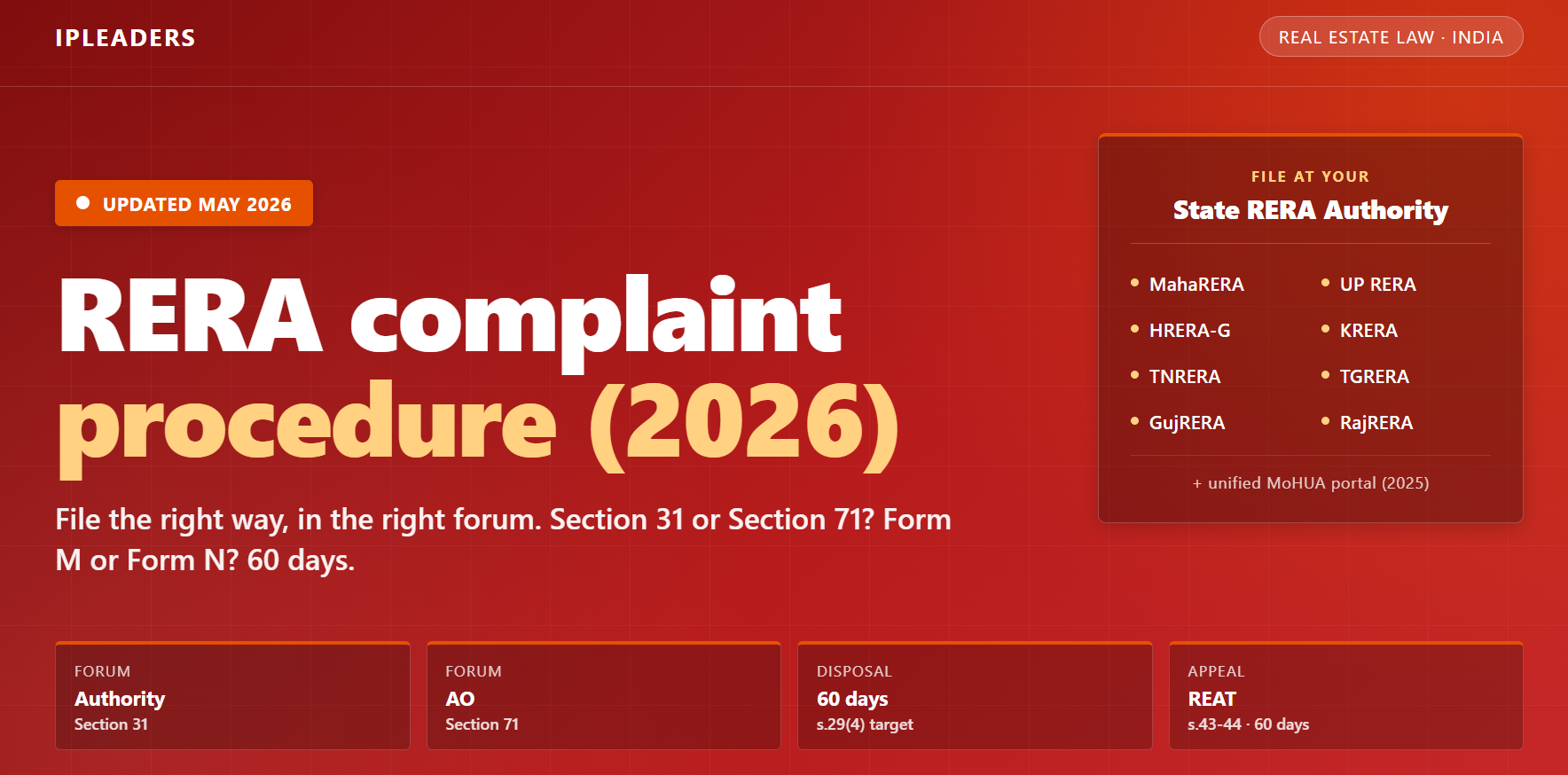
A RERA complaint is filed online on your state’s RERA portal within three years of the cause of action. For refund, interest, or possession under Section 31 of the RERA Act, 2016, file with the RERA Authority (Form M; fee ₹1,000 to ₹5,000). For compensation under Section 71, file with the Adjudicating Officer (Form N; fee usually ₹5,000). The statutory disposal target is 60 days.
The rest of this guide unpacks each clause: forum, drafting, state fees and forms, the appeal route, and the standard playbook of builder defences.
RERA in 2026: what the statute does and why complaints exist
The RERA Act, 2016 sets up a real-estate regulator in every state, requires builders to register projects above certain thresholds, mandates disclosure on a public portal, and gives buyers a quick statutory route to refund, interest, possession, and compensation when promises break. The complaint procedure under Section 31 is the operational heart of all this. Without it, every other right the Act creates would route through ordinary civil courts.
What the RERA Act, 2016 protects
Section 3 of the Real Estate (Regulation and Development) Act, 2016 requires every promoter to register a real estate project before advertising, marketing, or selling. Section 11 makes the promoter publish project details on the RERA portal: quarterly updates, sanction plans, completion timelines. Section 14 freezes the sanctioned plan (no major alterations without two-thirds allottee consent). Section 18, the most-cited section in any complaint, gives the buyer a clean choice when possession is delayed: walk away with a full refund plus interest, or stay put and claim interest for every month of delay.
RERA orders are recoverable as land revenue arrears under Section 40. Non-compliance attracts daily fines, project deregistration, and, in extreme cases, imprisonment.
Does RERA cover commercial property? Yes. The Act applies to every “real estate project” (residential, commercial, or mixed) provided the project meets the registration thresholds. Office space, shop bookings, and commercial showrooms in a registered project are all within scope.
Who can file: allottee, association, aggrieved person
Section 31 lets any “aggrieved person” file. In practice, this covers three categories. The allottee (a flat or shop buyer with a direct contract). An association of allottees (RWAs and formal societies fighting for all members). And any aggrieved person (courts have read this broadly to include co-applicants, nominees, and investors with assigned rights). State Authorities also run portal sweeps for lapsed registrations on their own, push show-cause notices, and freeze accounts of non-compliant projects.
MahaRERA’s December 2024 action is the headline example: show-cause notices to 10,773 lapsed projects, with bank-account freezes and registration suspensions on 1,950 of those projects after responses were scrutinised. The Authority might already be looking at your project before you file. Worth a portal check first.

Can a real estate agent be made a respondent? Yes. Section 9 makes agent registration mandatory; Section 31 allows complaints against the agent (not just the promoter). If the agent misrepresented project details, helped collect un-disclosed money, or sold a flat without a registered project, name the agent as a co-respondent.
What you can claim: refund, interest, compensation, possession
Most buyers trip up here. For the rights backdrop, see the broader rights and remedies that the RERA Act gives allottees. The short version: a full refund of amounts paid with interest (delay); interest for the delay (if you keep the flat); possession with completion directions; and compensation under Sections 12, 14, 18, 19. Refund and interest go to the Authority; compensation to the AO. The next section fixes the split. For broader context, see the legacy iPleaders overview of complaints against developers and agents.
Before you file: the four-question pre-flight checklist
Filing the wrong complaint in the wrong forum on the wrong form can cost you a year. This four-question pre-flight check takes ten minutes.
Is your project registered (or was it ever)?
Open the state RERA portal and search by project name, builder name, or registration number. Three outcomes: currently registered (file directly); lapsed (still file, citing the show-cause history); never registered (still file, because Section 31 applies to “registered or unregistered” projects). The Karnataka High Court in Amit Garg v. Karnataka Real Estate Regulatory Authority, 2025:KHC:12445, held that the RERA Registry’s function is purely administrative and cannot rule on maintainability; determination of maintainability is a judicial function vested in the RERA Authority itself. A builder saying “we’re not registered, RERA can’t touch us” is wrong on the law.
What’s the cause of action and when did it arise?
Three years from the cause of action. The cause is usually the date possession was promised, or the date the builder confirmed non-delivery. Courts read limitation strictly: COVID-19 doesn’t reset every clock automatically. The Supreme Court’s 2021 limitation extension covers the formal limitation period, not the contractual extension. Identify your trigger date precisely.
Refund, compensation, possession, or interest?
This decides which forum gets the case. Most buyers want refund plus interest (Authority, Section 31) or possession plus interest (Authority, Section 31). For compensation (mental agony, property-appreciation loss, interior expenses), file a parallel complaint with the AO under Section 71, or sequence them as we describe below.
Have you sent a written notice to the builder?
Not statutorily required, but practitioner habit. A written demand notice (15-30 day deadline) builds the record on cause of action, opens settlement before the regulator gets involved, and makes conciliation smoother. Send by email and registered post; keep delivery proof. If the builder ignores it, that silence helps you.
A buyer with a registered project, clean cause-of-action date, refund claim, and written notice is filing the cleanest version of the complaint. Without those four boxes ticked, the complaint gets adjourned twice before the merits even open.
RERA Authority vs Adjudicating Officer: getting the forum right (post-Newtech)
Most guides get this wrong, treating “file with RERA” as if the Authority and the AO were the same body. They aren’t. Here’s the clean split.
What the RERA Authority decides (Section 31)
The RERA Authority is the regulator. Under Section 31, it adjudicates violations of the Act, rules, and regulations. Practically: refund of the principal, interest on refund (typically SBI MCLR + 2 per cent under most state rules), interest for delayed possession, possession with completion directions, and regulatory directions to the promoter. The Authority cannot quantify mental agony or interior renovation losses. That’s the AO’s job.
What the Adjudicating Officer decides (Section 71)
The AO is a quasi-judicial officer (typically a retired district judge) appointed under Section 71. The AO adjudicates compensation under Sections 12 (false advertising), 14 (unauthorised structural changes), 18 (delay-of-possession beyond what interest covers), and 19 (information-rights failures). The AO can also award interest on compensation. Where the Authority gives you back the money you paid, the AO gives you the money you lost.
The Newtech split, in plain English
The Supreme Court in Newtech Promoters and Developers Pvt. Ltd. v. State of Uttar Pradesh, Civil Appeal Nos. 6745-6757 of 2021 (decided 11 November 2021) drew the bright line. RERA applies retroactively to ongoing projects without OCs. The Authority decides refund and interest under Section 31. The AO adjudicates compensation under Section 71. Two forums, two distinct relief categories. The Pune developer in Marvel Landmarks tried to use Newtech to reopen a 2019 refund order; the Bombay HC said Newtech is forward-looking and can’t demolish closed orders.
The sequence-both pattern (Pareena Infrastructure)
Here’s the move most guides miss. You can sequence both reliefs without a res judicata problem. The Haryana REAT in Pareena Infrastructure Pvt. Ltd. v. Mabood Aryaman, Appeal No. 577 of 2025 (decided 19 January 2026) confirmed that Section 71 compensation proceedings before the AO are independent of, and not barred by, prior Section 18 refund relief by the Authority. The playbook: file with the Authority first, secure refund and interest, then file with the AO for compensation. The April 2026 Marvel Landmarks ruling adds the finality lesson: once the Authority’s order survives the statutory appeal window, it sticks.
What the SBI MCLR + 2% interest rule means in practice
When the Authority orders interest, the rate isn’t the BBA rate. Most state rules and tribunals have settled on SBI’s MCLR plus 2 per cent as the prescribed rate, overriding contrary BBA clauses. The West Bengal REAT recently reiterated this benchmark, in line with the wider judicial trend. Builders’ pre-2017 9 per cent simple interest clauses are routinely held void to the extent they go below MCLR + 2 per cent.
Documents you need before you file
The complaint is only as strong as the documents it rests on. Here’s the working checklist used in real filings, refined against the MahaRERA, KRERA, and UP RERA portal requirements.
The 10-document checklist
- Allotment letter (original, issued by the promoter at booking).
- Builder-buyer agreement or agreement-for-sale (signed, with all annexures).
- Payment receipts and bank statements (every transfer with dates).
- PAN and Aadhaar of the complainant.
- Project’s RERA registration number (with date and current status).
- Builder’s contact details (registered office, email, phone for service of notice).
- Cause-of-action chronology (one-page: booking, possession promised, breach, demand notice, response).
- Demand notices and email correspondence (cleanly printed thread).
- Vakalatnama if filed through an advocate.
- Verification affidavit (formats downloadable from the portal).
Page-cap rule: MahaRERA’s 20-page limit
MahaRERA’s Order No. 23 of 2021 (dated 8 September 2021) requires complainants to submit a “Convenience Document” set of no more than 20 pages, due at least one week before the hearing, with the vakalatnama or authority letter as the first document. The trick: file with the core documents (chronology, BBA extract, payment summary, demand notice) inside the 20-page set, then submit bulky annexures (full BBA, full bank statements, project plans) as additional documents once the case number is allotted. Don’t cram 200 pages into the initial filing.
Vakalatnama and authorisation
A vakalatnama is the formal authorisation a client gives an advocate to appear. Required if you’re filing through a lawyer; not if you’re filing yourself (the portal accepts a self-verified declaration). NRIs typically execute a vakalatnama via consular attestation or a Power-of-Attorney. Even when filing yourself, an advocate review before submission is the highest-ROI step: most procedural defects get caught at this stage.
Where to file in 2026: unified MoHUA portal vs state portals
On 4 September 2025, the Ministry of Housing and Urban Affairs launched the Unified RERA Portal at rera.mohua.gov.in at the 5th meeting of the Central Advisory Council. It was pitched as a single national front-door for the regime. Most competitor guides published since then have either ignored it or mis-described it. Here’s where it actually fits in 2026.
What the unified MoHUA portal does today
The MoHUA portal is currently a centralised project search and complaint-status layer. Search any RERA-registered project across India; see basic details; track public-domain complaint status where the state RERA has integrated. It’s a research tool. In 2026, it is not the adjudication-filing front-door for most states. State RERAs hold the adjudicatory power. The unified portal is the discovery layer; the state portal is the filing layer.
When to file on the state portal
Jurisdiction follows the project, not your residence. A Bengaluru resident with a Pune flat files on MahaRERA, not KRERA. MahaRERA for Maharashtra, KRERA for Karnataka, TNRERA for Tamil Nadu, UP RERA for UP, and so on.
Online vs offline filing
Most states are online-only by 2026 for both Form M and Form N. Tamil Nadu still requires Form N offline at the AO’s office. Smaller-state RERAs (Bihar, Jharkhand, Chhattisgarh) take a hybrid approach. Always check the current state portal’s “filing instructions” page; portals update procedure quietly.
Forward-looking, the unified portal is positioned to deploy AI tools to flag potentially delayed or stalled projects, with deeper integration across state portals over the next few years. State RERAs and MoHUA have publicly signalled expansion into a more centralised filing experience as states’ systems mature.
Step-by-step: filing your complaint on the state RERA portal
The seven-step workflow below mirrors the standard online filing path on most state RERA portals. MahaRERA is the canonical example; deltas for other state RERAs are flagged where they matter.
Step 1: Register on the state RERA portal
Create a complainant account on the state RERA portal: email, mobile, PAN. The portal sends OTP and email activation. MahaRERA also asks for residential address and a profile photograph; KRERA is lighter. NRIs without an Indian mobile can register with a VOIP-supported number; verify SMS gateway support before starting.
Step 2: Pick the right form
Form M goes to the Authority under Section 31. Form N goes to the AO under Section 71. MahaRERA uses combined Form A under Rule 6 of the Maharashtra Real Estate (Regulation and Development) (Recovery of Interest, Penalty, Compensation, Fine Payable, Forms of Complaints and Appeal, etc.) Rules, 2017, routing by prayer. Karnataka calls it a “complaint format”; Tamil Nadu uses Form A and Form B. Form-name confusion is real, but the underlying logic is identical: prayer determines forum.
Step 3: Fill the complaint
The form asks for project details, parties, statement of facts, relief sought, claim valuation, and cause-of-action date. The statement of facts is where most filings under-deliver. Write it in numbered chronological paragraphs: booking, BBA signing, every payment, every demand, date of breach, date of demand notice. Three to five pages of clean chronology beats fifteen pages of mixed narrative.
Step 4: Upload documents within the page-cap
Upload core documents from the checklist. Keep under 20 pages where the portal caps. Use clearly named PDFs (e.g., “01_Allotment_Letter.pdf”); split files above the 10 MB upload limit. OCR scanned PDFs to make them text-searchable.
Step 5: Pay the fee online
UPI, netbanking, debit, credit. MahaRERA charges ₹5,000 for an Authority complaint; most other states charge ₹1,000. AO complaints are typically ₹5,000 (sometimes higher for compensation claims above ₹1 crore). Save the fee receipt.
Step 6: Submit, save the acknowledgement, check status
On submission, the portal generates a CC number (“complaint case number”). Save it. Status checks, hearing notices, and orders all use it. MahaRERA updates the hearing list a week before each hearing; UP RERA pushes notifications by SMS.
Step 7: Notice to respondents and first hearing
The Authority issues notice to the respondents within 7 to 14 days of admission. First hearing is usually 4 to 6 weeks out. By default in 2026, hearings are by video conference in most states. Physical hearings happen on request or for evidence-heavy cases.
Can you file without a lawyer? Yes. MahaRERA, UP RERA, and KRERA explicitly accept party-in-person filings. That said, a single lawyer review before submission catches the procedural defects most buyers introduce: wrong prayer category, missing valuation, defective verification.
State-by-state RERA filing reference (Maharashtra, Karnataka, Tamil Nadu, UP, Telangana, Gujarat, Haryana, Delhi, Rajasthan, MP, and more)
Filing variations across state RERAs are real. The same complaint, drafted identically, faces different fees, queue durations, and procedural rules across states. Here’s the operating reference.
The state-by-state table
| State / RERA | Portal | Complaint form | Fee (Authority) | Fee (AO) | Cumulative disposal rate | Conciliation track |
|---|---|---|---|---|---|---|
| Maharashtra (MahaRERA) | maharera.maharashtra.gov.in | Form A (Rule 6) | ₹5,000 | ₹5,000 | ~82% | Yes (Conciliation Forum) |
| Karnataka (KRERA) | rera.karnataka.gov.in | Complaint format | ₹1,000 | ₹5,000 | ~82% | Lok Adalat referrals |
| Tamil Nadu (TNRERA) | rera.tn.gov.in | Form A / Form B | ₹1,000 | ₹5,000 | data not separately published | No |
| UP (UP RERA) | up-rera.in | Form M / Form N | ₹1,000 | ₹5,000 | ~87% | Yes (settlement bench) |
| Telangana (TGRERA) | rera.telangana.gov.in | Form M / Form N | ₹1,000 | ₹5,000 | data not separately published | No |
| Gujarat (GujRERA) | gujrera.gujarat.gov.in | Form M / Form N | ₹1,000 | ₹5,000 | data not separately published | No |
| Haryana, Gurugram (HRERA-G) | haryanarera.gov.in | Form M / Form N | ₹1,000 | ₹5,000 | ~94% (full pre-2024 backlog cleared) | No |
| Haryana, Panchkula (HRERA-P) | haryanarera.in | Form M / Form N | ₹1,000 | ₹5,000 | data not separately published | No |
| Delhi (RERA Delhi) | rera.delhi.gov.in | Form M / Form N | ₹1,000 | ₹5,000 (typical) | data not separately published | No |
| Rajasthan (RajRERA) | rera.rajasthan.gov.in | Form M / Form N | ₹1,000 | ₹5,000 | data not separately published | No |
| Madhya Pradesh (MP-RERA) | rera.mp.gov.in | Form M / Form N | ₹1,000 | ₹5,000 | data not separately published | No |
| Andhra Pradesh (AP-RERA) | rera.ap.gov.in | Form M / Form N | ₹1,000 | ₹5,000 | data not separately published | No |
| Kerala (K-RERA) | rera.kerala.gov.in | Form A / Form B | ₹1,000 | ₹5,000 | data not separately published | No |
| Punjab (Punjab RERA) | rera.punjab.gov.in | Form M / Form N | ₹1,000 | ₹5,000 | data not separately published | No |
| Chhattisgarh (RERA-C) | rera.cgstate.gov.in | Form M / Form N | ₹1,000 | ₹5,000 | data not separately published | No |
| Bihar (RERA Bihar) | rera.bihar.gov.in | Form M / Form N | ₹1,000 | ₹5,000 | data not separately published | No |
| Odisha (Odisha RERA) | rera.odisha.gov.in | Form M / Form N | ₹1,000 | ₹5,000 | data not separately published | No |
| Jharkhand (RERA Jharkhand) | rera.jharkhand.gov.in | Form M / Form N | ₹1,000 | ₹5,000 | data not separately published | No |
Disposal rates are cumulative percentages for the four state RERAs that have published comparative figures (MahaRERA 82.03%, KRERA 81.54%, UP RERA 86.71%, HRERA-Gurugram 93.62%). Fees and forms reflect the position on the date of last verification (May 2026); always confirm current fee from the state portal before paying. Most state RERAs charge a flat ₹1,000 for Authority complaints; MahaRERA is the outlier at ₹5,000. AO fees vary; ₹5,000 is the most common figure across states.
MahaRERA specifics
MahaRERA’s combined Form A under Rule 6 of the Maharashtra Rules 2017 is the operative format. The portal routes to the Authority or AO based on your prayer flag. Group complaints under Sections 7 and 8 of the state rules are permitted only when complainants share the same project and cause of action. The 20-page document cap (Order 23 of 2021) applies to the initial submission. MahaRERA also operates a dedicated Conciliation Forum (Section 32(g)).
Karnataka, Tamil Nadu, UP, Telangana, Gujarat, Haryana
Karnataka’s KRERA uses a single format that routes by prayer; it pushes high volumes through a Lok Adalat track. TNRERA requires Form B (AO complaints) offline at the AO’s office in Chennai; Form A is online. UP RERA runs a settlement bench parallel to its main workflow. HRERA-Gurugram cleared its entire pre-2024 backlog by April 2026, with a cumulative 93.62 per cent disposal rate.
RERA-pending states and UTs
A handful of UTs and smaller states still don’t have a fully constituted RERA Authority. The interim remedy is the Consumer Forum or a civil suit. As state Authorities come online, the gap is closing. Check the MoHUA portal’s “Authorities” tab before filing.
| State / RERA | Portal | Form | Fee Auth. | Fee AO | Disposal | Concil. |
|---|---|---|---|---|---|---|
| Maharashtra (MahaRERA) | maharera.maharashtra.gov.in | Form A (Rule 6) | ₹5,000 | ₹5,000 | 82.03% | Yes |
| Karnataka (KRERA) | rera.karnataka.gov.in | Complaint format | ₹1,000 | ₹5,000 | 81.54% | Lok Adalat |
| Tamil Nadu (TNRERA) | rera.tn.gov.in | Form A / Form B | ₹1,000 | ₹5,000 | Not published | No |
| Uttar Pradesh (UP RERA) | up-rera.in | Form M / Form N | ₹1,000 | ₹5,000 | 86.71% | Yes |
| Telangana (TGRERA) | rera.telangana.gov.in | Form M / Form N | ₹1,000 | ₹5,000 | Not published | No |
| Gujarat (GujRERA) | gujrera.gujarat.gov.in | Form M / Form N | ₹1,000 | ₹5,000 | Not published | No |
| Haryana — Gurugram (HRERA-G) | haryanarera.gov.in | Form M / Form N | ₹1,000 | ₹5,000 | 93.62% | No |
| Haryana — Panchkula (HRERA-P) | haryanareraprera.gov.in | Form M / Form N | ₹1,000 | ₹5,000 | Not published | No |
| Delhi (RERA Delhi) | rera.delhi.gov.in | Form M / Form N | ₹1,000 | ₹5,000 | Not published | No |
| Rajasthan (RajRERA) | rera.rajasthan.gov.in | Form M / Form N | ₹1,000 | ₹5,000 | Not published | No |
| Madhya Pradesh (MP-RERA) | rera.mp.gov.in | Form M / Form N | ₹1,000 | ₹5,000 | Not published | No |
| Andhra Pradesh (AP-RERA) | rera.ap.gov.in | Form M / Form N | ₹1,000 | ₹5,000 | Not published | No |
| Kerala (K-RERA) | rera.kerala.gov.in | Form A / Form B | ₹1,000 | ₹5,000 | Not published | No |
| Punjab (Punjab RERA) | rera.punjab.gov.in | Form M / Form N | ₹1,000 | ₹5,000 | Not published | No |
| Chhattisgarh (RERA-C) | rera.cgstate.gov.in | Form M / Form N | ₹1,000 | ₹5,000 | Not published | No |
| Bihar (RERA Bihar) | rera.bihar.gov.in | Form M / Form N | ₹1,000 | ₹5,000 | Not published | No |
| Odisha (Odisha RERA) | rera.odisha.gov.in | Form M / Form N | ₹1,000 | ₹5,000 | Not published | No |
| Jharkhand (RERA Jharkhand) | rera.jharkhand.gov.in | Form M / Form N | ₹1,000 | ₹5,000 | Not published | No |
MahaRERA Conciliation Forum: the faster pre-adjudication track
This is the option no competitor guide explains. Section 32(g) of the RERA Act requires every state Authority to facilitate amicable settlement of disputes. MahaRERA built that into a working Conciliation Forum and it’s one of the most under-used routes in Indian real-estate dispute resolution.
What the Conciliation Forum does
The MahaRERA Conciliation Forum is a voluntary mediation track at MahaRERA’s premises. A panel of two conciliators (one nominated by builder associations, one by buyer associations) helps parties negotiate a settlement. Discussions are without prejudice; failed conciliation moves to formal adjudication without prejudice. Settlement orders, once registered, carry the same enforceability as Authority orders.
When to opt in vs go straight to adjudication
Conciliation works best when the builder isn’t entirely hostile and a face-saving settlement can be structured, when the dispute is small enough that quick negotiation beats adjudication time, or when the buyer wants the flat (not a refund) and needs builder cooperation. Avoid it when the builder has a bad-faith track record, when the project is functionally dead, or when the buyer wants a full exit.
Other states with conciliation tracks
UP RERA’s settlement bench runs similar logic. Karnataka’s KRERA routes through a Lok Adalat track (Lok Adalat awards have the force of a civil court decree under the Legal Services Authorities Act, 1987). Other state RERAs handle settlement-by-consent orders informally. Whichever route you take, get the settlement reduced to a written, signed, registered order. Verbal agreements at the conciliation table die when the next builder excuse arrives.
How RERA hearings work in 2026: video conferencing default and what to expect
Hearings are no longer in-person by default. The pandemic-era pivot to video conferencing stuck, and most state Authorities run VC hearings as the standard mode in 2026. Knowing how the workflow runs day-of saves you the rookie mistakes that cost adjournments.
Hearing notices, virtual links, document submission
The Authority issues a hearing notice 7 to 14 days before the date, by email and SMS. The notice carries case number, time slot, VC link/platform (Webex, Zoom, or state-specific), and the bench names. Join 5 to 10 minutes early with camera and mic tested and documents organised by tab. If you’re appearing through an advocate, the advocate joins; the client can usually be on the same connection.
Adjournments and how to push back
Builders’ lawyers love adjournments. The standard playbook: first hearing, no representation; second, counsel newly engaged; third, illness or double-booking; fourth, additional documents. Each buys the builder one to two months. The pushback: formally object to repeated adjournments at the third occurrence, cite the 60-day target under Section 29(4), and ask the bench to close arguments or impose costs. Get the objection on the record either way.
The 60-day disposal target
Section 29(4) sets a 60-day disposal target from admission. State performance varies: HRERA-Gurugram has cleared 93.62 per cent of cumulative complaints; UP RERA 86.71 per cent; MahaRERA 82.03 per cent; Karnataka 81.54 per cent. Smaller-state RERAs lag. For a buyer, a clean complaint can realistically expect a final order within 90 to 120 days in the better states. Much faster than consumer forum, much faster than civil court.
Disposal numbers track state resourcing. Where Authorities have been understaffed, the same 60-day target slips to 9 to 12 months. The Supreme Court’s September 2025 directions in Mansi Brar Fernandes (including its order that States must adequately staff RERA authorities and that at least one member of every RERA must be a legal expert with proven real-estate expertise) will push convergence over 2026-27.
Common builder defences and how to counter them (practitioner voice)
If you’ve talked to a real estate lawyer, you’ve heard the same five builder defences play on loop. Here’s the practitioner counter for each, with the case law that backs it.
“Force majeure / COVID-19 extension covers our delay”
Defence: the pandemic or supply-chain disruption triggered the BBA’s force majeure clause, extending possession by 12-24 months. Counter: force majeure under a BBA requires a specific event, causation, and prompt invocation through the contractual notice route. If the builder didn’t issue a force majeure notice when the event occurred, the defence is reactive and weak. Cause-of-action analysis: a 2018 possession date isn’t covered by COVID-19; a 2020-21 date is covered only for the genuine disruption window, not three additional years.
“OC was issued so RERA doesn’t apply”
Defence: the OC has been received, so the project is “complete” and RERA doesn’t apply. Counter: the “ongoing project” definition under the 2016 Act and the Newtech retroactivity ruling. A project stays within RERA if the OC was not yet issued when the grievance arose, common areas haven’t been handed to the allottees’ association, or the project is structurally incomplete despite a paper OC. The Authority looks at substantive completion, not the certificate alone.
“Agreement-for-sale clause says arbitration only”
The defence: the BBA contains an arbitration clause specifying exclusive arbitration as the dispute-resolution mechanism, so the buyer must arbitrate, not file with RERA. The counter: Section 79 and the Supreme Court’s Imperia Structures Ltd. v. Anil Patni, Civil Appeal Nos. 3581-3590 of 2020 ruling. Section 79 makes it clear that no civil court has jurisdiction over matters that the Authority or AO can decide.
Imperia Structures held that the existence of a statutory consumer remedy (and by parity of reasoning, RERA) cannot be ousted by an arbitration clause. The buyer can elect a statutory consumer or regulatory forum regardless of what the BBA says. Read more on arbitration clauses in builder-buyer agreements for the detailed drafting and enforceability angle.
“You have already taken possession”
Defence: you accepted possession, so you’ve waived your delay claim. Counter: possession-acceptance doesn’t extinguish delay-of-possession interest under Section 18 or compensation for structural defects and other failures under Sections 12, 14 and 19. State RERAs and tribunals routinely grant compensation for financial loss, mental agony and litigation costs in addition to refund and interest, where the underlying breach is established. Possession is not a release.
“You’re a single buyer, the case will collapse”
Defence: without 50 buyers backing the complaint, RERA won’t take it seriously. Counter: bluff. Section 31 expressly permits individual filings; most reported orders are individual, not class actions. The Authority adjudicates on the merits, not the headcount. The builder is really saying they don’t want to fight 50 separate complaints. Single-buyer complaints are the bedrock of the new RERA bar.
If these defences worked, why have state RERAs and tribunals consistently issued buyer-favourable orders running into the tens of thousands? Builders run the playbook because it sometimes buys time. Adjudicating Authorities see the playbook every day. They aren’t impressed.
The appeal route: Authority/AO to REAT to High Court (and rarely the Supreme Court)
Most competitor guides stop at “you can appeal to a tribunal.” That’s like a doctor saying “you can take medicine.” Here’s the actual map.
Stage 1: Real Estate Appellate Tribunal (REAT)
Under Sections 43 and 44, any aggrieved party can appeal to the state Real Estate Appellate Tribunal within 60 days of the order. Miss the window, and the Marvel Landmarks Pvt. Ltd. v. State of Maharashtra, 2026:BHC-AS:16466 finality lesson applies: the order attains finality and cannot be reopened by later jurisprudence. Section 43(5) requires promoters appealing refund or interest orders to pre-deposit the awarded amount; this stops frivolous developer appeals filed only to delay disbursement. For appellate-tribunal context, see REAT, the appellate tribunal under the RERA Act.
Stage 2: High Court under Section 58
After REAT, an appeal lies to the High Court under Section 58. But (and this is critical) the High Court appeal is only on a substantial question of law, not on facts. So if you lost at REAT because the bench reweighed the evidence, you don’t have a High Court route. If you lost because the bench misapplied a statutory provision (say, calculated interest at the BBA rate rather than MCLR + 2 per cent), that’s a question of law and the appeal is maintainable. The 60-day filing window applies here too.
Stage 3: Supreme Court (rare)
A Special Leave Petition under Article 136 of the Constitution is the last route. The SC takes very few RERA matters: usually only those involving (a) inter-state divergence in interpretation, (b) constitutional validity of a provision, or (c) an irreconcilable High Court split. If your case has any of these flags, a SLP makes sense. If it doesn’t, you’re effectively at the end of the road after the High Court.
The finality lesson from Marvel Landmarks
The April 2026 Marvel Landmarks ruling crystallised what practitioners had said informally: appeal in time or lose the right forever. The developer waited beyond the 60-day REAT window, then tried to use Newtech to attack a 2019 order. The High Court refused. Closed orders stay closed. For buyers, this means a favourable order once unappealed cannot be reopened by builder cleverness.
If the builder ignores the order: execution, recovery certificate, attachment, and prosecution
Order in your favour means nothing if the builder doesn’t pay. Here’s how RERA orders convert into actual money in your account.
Recovery certificate and attachment by the District Collector
Section 40 lets any RERA-order amount be recovered as land revenue arrears. The buyer applies to the Authority for a recovery certificate; the Authority transmits it to the District Collector, who attaches builder property (unsold flats, project lands, other immovable assets) and auctions through the land-revenue recovery procedure. This is RERA’s most powerful enforcement tool, and it’s under-used; most buyers stop after the order. For practical context, see what non-compliance with a RERA order can cost a developer.
Penalties, daily fines, and possible imprisonment
Penalties layer under Sections 59, 63, and 64. Section 59 covers non-registration (up to 10 per cent of project cost; on continued violation, the section permits imprisonment for a term which may extend up to three years, or further fine which may extend up to a further 10 per cent, or both). Section 63 covers contravention of Authority directions (a per-day penalty cumulatively capped at 5 per cent of project cost). Section 64 covers contravention of AO orders (per-day penalty cumulatively capped at 10 per cent of project cost). Daily-fine accumulations have been the most effective compliance pressure. For the compounding option, see compounding of RERA offences and the conditions that apply.
MP HC’s February 2026 directive on execution
The Madhya Pradesh High Court (Justice Vishal Mishra) on 14 February 2026 directed a homebuyer to approach the MP Real Estate Appellate Tribunal for execution of a possession order, applying the doctrine of merger. Other High Courts haven’t followed uniformly; in Maharashtra, Karnataka, and UP, the Authority typically issues the recovery certificate and the Collector handles recovery. Check local practice.
Edge cases: NRI buyers, lapsed registration, OC issued, unregistered agreement, RERA-pending states
The standard procedure handles 80 per cent of cases. The remaining 20 per cent are edge cases that competitor guides skip. Here’s the working approach for each.
NRI complaints
NRI buyers can absolutely file. The complainant executes a Power-of-Attorney in favour of an Indian advocate or relative, notarised at an Indian consulate abroad, then registered under the Registration Act, 1908. The POA-holder files and represents. VC hearings let the NRI complainant join from abroad alongside the Indian advocate; submit a written communication preference at filing.
Lapsed-registration projects
MahaRERA’s December 2024 sweep issued show-cause notices to 10,773 lapsed projects. Buyer remedies survive even if registration has lapsed. The Authority can still adjudicate (and the lapse itself is a buyer-favourable fact going to the developer’s compliance failure). File citing the lapse history and any show-cause documentation on the portal.
OC issued mid-project
The “ongoing project” definition under Section 3 and Newtech retroactivity cover this. A project stays “ongoing” if the OC wasn’t in hand on the law’s commencement date or substantive work remained pending. A mid-project OC doesn’t take the project out of RERA if the grievance arose before the OC. Cite both dates and let the Authority decide.
Unregistered agreement-for-sale
Section 13 caps booking advance at 10 per cent of project value before the agreement is signed and registered. Builders collecting more than 10 per cent on an unregistered agreement violate Section 13 directly. You can file even without a registered ATS; the Section 13 violation is independent. Cite the receipts and file. The Authority’s order can include both refund and a regulatory direction.
RERA-pending UTs and smaller states
For UTs and smaller states without a fully constituted Authority, the interim remedy is the Consumer Forum or a civil suit. The Supreme Court’s September 2025 staffing directive in Mansi Brar Fernandes and the wider central push are closing the gap. Check the MoHUA portal’s “Authorities” tab before defaulting to consumer forum; some pending UT Authorities are accepting filings even before full bench operation.
RERA vs Consumer Forum vs IBC/NCLT vs civil suit: choosing your forum
You usually have a forum choice. Picking right matters more than people assume. Here’s the comparison.
| Forum | Best for | Limitation | Fee | Pre-deposit | Avg disposal |
|---|---|---|---|---|---|
| RERA Authority | Refund, interest, possession, regulatory direction | 3 years from cause of action | ₹1,000 to ₹5,000 | Builder pre-deposit on appeal | 60-120 days |
| RERA AO (s.71) | Compensation under s.12, 14, 18, 19 | 3 years | ₹5,000 typically | Builder pre-deposit on appeal | 60-180 days |
| Consumer Forum | Service deficiency, refund, compensation | 2 years (extendable by sufficient cause) | Tiered by claim value | None | 6 months to 2 years (varies) |
| NCLT (IBC) | Insolvency-trigger when builder is genuinely defaulting | None within insolvency framework | ~₹25,000 | None | 9-18 months |
| Civil suit | Specific performance, partition, title disputes | 3 years for breach; longer for property | Court fee on claim value | None | 3-7 years |
RERA vs Consumer Forum
The SC in Imperia Structures held Section 79 doesn’t bar Consumer Forum jurisdiction. Buyers elect either forum. Read the choice between RERA and consumer-protection remedies for the election deep-dive. RERA is faster, cheaper, and built for builder-buyer disputes. Consumer Forum can grant punitive damages RERA AOs hesitate to award, and has a District > State > National pipeline for high-value claims. Default to RERA; switch only when state RERA is under-resourced or you have a service-deficiency claim outside Sections 12/14/18/19.
RERA vs IBC/NCLT
The SC in Pioneer Urban Land and Infrastructure Ltd. v. Union of India, (2019) 8 SCC 416 held homebuyers are financial creditors under Section 5(8)(f) of the IBC. The 2025 Mansi Brar Fernandes ruling refined this: speculative investors with buy-back or assured-return clauses aren’t “genuine homebuyers” for IBC purposes and must use RERA or the Consumer Protection Act. See homebuyers as financial creditors under the IBC for the Pioneer Urban scaffolding. Trigger IBC only when the builder is genuinely insolvent and you have 100+ allottees or 10 per cent of the project. Otherwise, RERA.
RERA vs civil suit
Section 79 bars civil court jurisdiction in matters the Authority or AO can decide. Civil suits for refund, interest, possession, or RERA-section compensation are out. What remains: specific performance (narrow circumstances), partition (multiple co-owners), and title disputes. For pure builder-buyer breach, civil court is not the route.
Sample complaint: annotated walkthrough (Form M, India-specific facts)
No competitor guide gives you a sample complaint. Here’s the skeleton, with annotations on what each block does.
Cover page and parties
Before the Real Estate Regulatory Authority, [State]. Complaint No. ___ of 2026. [Complainant], residing at [address], PAN [__]: Complainant. Versus [Promoter] (Companies Act, 2013), registered office at [address]: Respondent No. 1. [Agent, if applicable]: Respondent No. 2. Project: [Name], at [address], RERA Registration No. [___], dated [__]. The cover page sets up jurisdiction, case style, and project linkage.
Statement of facts (numbered, chronological)
- The Complainant booked Apartment No. __ in the Project on [date] for a total consideration of ₹[__].
- The Complainant has paid ₹[__] to Respondent No. 1 in [N] instalments between [date] and [date] (receipts at Annexure A).
- The Builder-Buyer Agreement dated [__] (Annexure B) recorded a possession date of [__].
- As of [date], possession has not been delivered, despite [N] demand notices (Annexure C).
- Respondent No. 1, by letter dated [__] (Annexure D), confirmed possession will not be delivered before [__], a delay of [N] months.
- The Complainant, by demand notice dated [__] (Annexure E), called upon Respondent No. 1 to refund the amount with interest. The notice has gone unanswered.
Numbered, chronological, every claim cited to an annexure. Let the facts carry the prayer.
Relief sought
The Complainant prays that the Hon’ble Authority be pleased to: (a) direct Respondent No. 1 to refund ₹[__] paid towards the Apartment under Section 18 of the RERA Act, 2016; (b) direct Respondent No. 1 to pay interest at SBI MCLR + 2 per cent per annum from the date of each payment until refund, in line with the prescribed rule under the applicable State Rules and as confirmed by appellate tribunals; (c) direct payment of costs; and (d) pass such further or other order as deemed fit.
Every prayer is statutorily anchored. Avoid kitchen-sink prayers; they dilute the focus and invite procedural objections.
Verification, vakalatnama, list of documents
Verification: standard statutory verification, signed and dated. List of documents: Annexures A through E, paginated and named cleanly. Vakalatnama (if through advocate): with stamp duty per state schedule.
Three drafting habits that reduce adjournments
Draft the prayer crisply (a clear three-clause prayer is decidable in one hearing). Paginate and label annexures cleanly. File a concise 2-3 page written submission at the first substantive hearing summarising facts, prayer, and authority; the bench reads it in 10 minutes and the builder’s lawyer doesn’t have a counter.
Settlement strategy: when to accept, when to push for the order
Builders settle at three points: just before admission (rare), just before the first substantive hearing (common), and just after a buyer-favourable interim ruling (very common). Knowing how to think about settlement at each point is the practitioner’s edge.
The economics of settlement
Interest at MCLR + 2 per cent is running every day the builder doesn’t pay. An order, once passed and surviving appeal, is the leverage. The settlement test: is the offer better than the discounted present value of the likely order, net of additional time-cost and litigation risk? An offer of 80 per cent principal plus 50 per cent expected interest within 30 days usually beats waiting six months. An offer of 60 per cent with a vague “interest later” doesn’t.
Don’t drop the case for promised possession
The classic squeeze: “drop the complaint and we’ll give possession next month.” It’s a trap. Once withdrawn, your leverage evaporates. Convert the settlement into a consent order, recording the terms in the Authority’s order. Possession then becomes enforceable, not promised. If the builder refuses to agree to an order, the offer wasn’t real.
The “toothless body” worry
The 2025 Mansi Brar Fernandes ruling is the SC’s modern answer to the “toothless body” worry. The bench recognised the right to secure and timely possession of one’s home as a facet of the fundamental right to shelter under Article 21 and directed that RERA authorities must be adequately staffed with infrastructure, experts, and resources. The data: by the September 2025 Central Advisory Council meeting, RERA authorities had registered 1.51 lakh projects and 1.06 lakh agents and disposed of 1.47 lakh complaints; MahaRERA’s 10,773-project lapsed-projects sweep; HRERA-Gurugram’s full pre-2024 backlog clear-out. RERA is finding its teeth. The buyers who file are the ones who benefit.
What the data and the 2025-26 directives signal for the regime
The September 2025 Mansi Brar Fernandes directive on RERA staffing, the unified MoHUA portal launch, and the steady disposal numbers from leading state RERAs together mark the most consequential procedural shifts since 2017.
What is settled in 2025-26
The Supreme Court has confirmed that RERA authorities must be adequately staffed and that at least one member of every RERA authority must be a legal expert or consumer advocate with proven real-estate expertise. The unified MoHUA portal at rera.mohua.gov.in is live and consolidating data across state RERAs. The MoHUA-PIB position is that the portal will deploy AI tools to flag potentially delayed or stalled projects.
Disposal scale and what it signals
By the September 2025 Central Advisory Council meeting, 35 States/UTs had established Real Estate Regulatory Authorities, 29 States/UTs had set up Appellate Tribunals, and 27 had appointed Adjudicating Officers, with 1.51 lakh projects, 1.06 lakh agents registered and 1.47 lakh complaints disposed nationally. MahaRERA achieved a 137 per cent disposal rate in 2025 by clearing more cases than were filed in the year. HRERA-Gurugram cleared its pre-2024 backlog by April 2026. UP RERA stands at 86.71 per cent cumulative disposal. The arc is of a maturing regime.
What 2026-28 likely brings
AI-assisted case triage is closest to deployment, signalled by the unified portal’s design. The Mansi Brar Fernandes line on speculative investors versus genuine homebuyers is likely to harden through follow-on litigation, narrowing IBC and pushing more cases back to RERA. State governments will face continuing pressure to fill REAT and authority vacancies in line with the September 2025 directions.
A second-order effect: a specialist tier-2 city RERA bar is forming, much like the cheque-bouncing-cases bar of the 1990s. High volume, predictable procedure, decent fees, repeat clients. Real estate dispute work is one of the fastest-growing practice areas for advocates outside the metros.
Frequently asked questions
1. How do I file a RERA complaint against a builder online in 2026?
File on the state RERA portal of the project’s state. Register an account (PAN, mobile, email), pick Form M (Authority, Section 31) or Form N (AO, Section 71), fill project and party details, upload documents within the page-cap, pay the fee, submit. Save the complaint number for status tracking.
2. What is the fee for a RERA complaint, and does it differ by state?
Yes. Most states charge ₹1,000 for an Authority complaint and ₹5,000 for an AO complaint. Maharashtra is the outlier at ₹5,000 for the Authority. Karnataka, Tamil Nadu, UP, Telangana, Gujarat, Haryana, Rajasthan, and most others sit at ₹1,000 for Authority filings.
3. What documents must I attach to a RERA complaint?
Allotment letter, BBA, payment receipts and bank statements, PAN and Aadhaar, RERA registration number, builder’s contact details, cause-of-action chronology, demand notices, vakalatnama if through advocate, and a verification affidavit. Most state portals cap initial submission at 20 pages.
4. Is there a time limit for filing a RERA complaint?
Yes. Three years from the cause of action (the date possession was promised, the date non-delivery was confirmed, or the date of breach). Identify your trigger date precisely and back-calculate.
5. Can I file a RERA complaint without a lawyer?
Yes. Party-in-person filings are accepted on every state portal. That said, a one-hour lawyer review before submission catches most procedural defects.
6. Can I file a RERA complaint against an unregistered project?
Yes. Section 31 applies to both registered and unregistered projects. The Karnataka High Court in 2025 confirmed the registration authority cannot rule on maintainability; the Authority handles it based on the merits.
7. What is the difference between Form M and Form N?
Form M goes to the Authority under Section 31 (refund, interest, possession, regulatory directions). Form N goes to the AO under Section 71 (compensation under Sections 12, 14, 18, 19). MahaRERA uses a combined Form A (Rule 6, Maharashtra Rules 2017) that routes by prayer; Tamil Nadu uses Form A and Form B with the same logic.
8. How long does a RERA complaint take to be resolved?
Section 29(4) sets a 60-day target from admission. Better-resourced state RERAs (HRERA-Gurugram, UP RERA, MahaRERA, KRERA) run a 90-120 day median. Smaller-state RERAs lag at 9-12 months. REAT appeals add 3-6 months; High Court appeals can add a year or more.
9. Can I appeal a RERA order, and where?
Yes. Appeal goes to the state REAT under Sections 43-44 within 60 days of the order. From REAT, an appeal lies to the High Court under Section 58, but only on a substantial question of law. A Supreme Court SLP under Article 136 is exceptional. Promoter-appellants must pre-deposit the awarded amount before REAT admits the appeal.
10. Can NRIs file a RERA complaint from abroad?
Yes. NRIs file through a Power-of-Attorney holder (advocate or relative in India), with the POA notarised at an Indian consulate abroad and registered under the Registration Act. VC hearings let the NRI join from abroad alongside the Indian advocate.
11. Can I file a RERA complaint after taking possession?
Yes. Possession-acceptance doesn’t extinguish delay-of-possession interest under Section 18 nor compensation for failures under Sections 12, 14, or 19. State RERAs and tribunals routinely award compensation for financial loss, mental agony, and litigation costs alongside refund or interest where the underlying breach is established, even after possession.
12. What is the unified MoHUA RERA portal, and do I file there or on the state portal?
The unified MoHUA portal at rera.mohua.gov.in, launched September 2025, is currently a centralised project search and complaint-status layer. For adjudication, file on the state RERA portal. The MoHUA portal supplements, it doesn’t replace. A unified filing front-door is expected in the 2026-28 window.
References
Case Law
- Amit Garg v. Karnataka Real Estate Regulatory Authority, 2025:KHC:12445 (Karnataka High Court, 2025).
- Imperia Structures Ltd. v. Anil Patni & Anr., Civil Appeal Nos. 3581-3590 of 2020; AIR 2021 SC 70 (Supreme Court of India, 2 November 2020).
- Mansi Brar Fernandes v. Shubha Sharma & Anr., 2025 INSC 1110 (Supreme Court of India, 12 September 2025).
- Marvel Landmarks Pvt. Ltd. v. State of Maharashtra & Ors., 2026:BHC-AS:16466 (Bombay High Court, 7 April 2026).
- Newtech Promoters and Developers Pvt. Ltd. v. State of Uttar Pradesh & Ors., Civil Appeals Nos. 6745-6757 of 2021 (Supreme Court of India, 11 November 2021).
- Pareena Infrastructure Pvt. Ltd. v. Mabood Aryaman, Appeal No. 577 of 2025 (Haryana Real Estate Appellate Tribunal, 19 January 2026).
- Pioneer Urban Land and Infrastructure Ltd. & Anr. v. Union of India & Ors., (2019) 8 SCC 416 (Supreme Court of India, 9 August 2019).
Statutes and rules
- The Real Estate (Regulation and Development) Act, 2016 (Act No. 16 of 2016): sections cited 3, 11, 12, 13, 14, 18, 19, 29(4), 31, 32, 40, 43, 44, 58, 59, 63, 64, 71, 79.
- The Maharashtra Real Estate (Regulation and Development) (Recovery of Interest, Penalty, Compensation, Fine Payable, Forms of Complaints and Appeal, etc.) Rules, 2017: Rule 6, Form A. See MahaRERA’s Complaint Filing under Registered Project page for the operative form and procedure; Order No. 23 of 2021 (8 September 2021) on the 20-page Convenience Document.
Government and regulatory sources
- Press Information Bureau, “Union Minister Shri Manohar Lal launches Unified RERA Portal at 5th Meeting of Central Advisory Council” (4 September 2025).
- MahaRERA show-cause sweep on 10,773 lapsed projects (December 2024): Punekar News report.
- Supreme Court directions in September 2025 on filling NCLT/NCLAT vacancies and adequately staffing RERA: LiveLaw report.
- HRERA-Gurugram cumulative disposal at 93.62%: Tribune India report.
- MahaRERA 137% disposal rate, 6,045 complaints cleared.
- Madhya Pradesh High Court ruling, 14 February 2026, on REAT execution and the doctrine of merger.
Secondary commentary
- LiveLaw, “Delegation of Refund Power to Adjudicating Officer Not Contrary to Scheme of RERA Act’: Bombay High Court” (April 2026, Marvel Landmarks).
- West Bengal REAT ruling on SBI MCLR-based interest under RERA: LiveLaw report.
Disclaimer
This article is for informational and educational purposes only and does not constitute legal advice. RERA practice varies materially across states; state-specific procedure, fees, and case-law evolve regularly. For specific legal guidance on your matter, consult a qualified advocate practising in real estate law in the relevant jurisdiction.
 Serato DJ Crack 2025Serato DJ PRO Crack



 Allow notifications





