

Last verified: May 2026
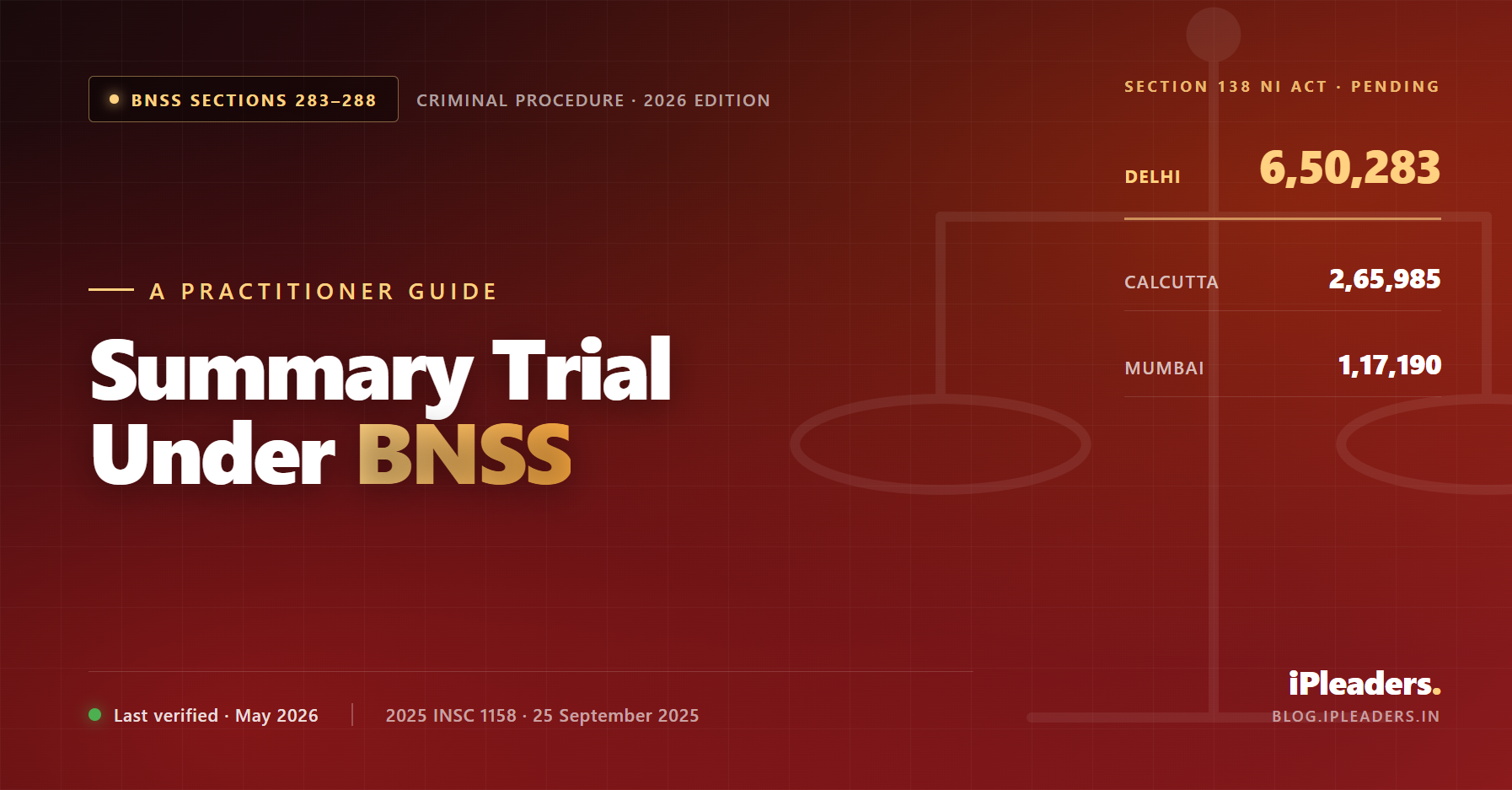
On 25 September 2025, a two-judge bench of the Supreme Court sat staring down numbers that have haunted India’s criminal justice system for almost two decades. As of 1 September 2025, the National Judicial Data Grid recorded 6,50,283 pending Section 138 Negotiable Instruments Act, 1881 cases in Delhi’s district courts alone, 2,65,985 in Calcutta, and 1,17,190 in Mumbai (figures cited at paragraph 33 of the judgment). In Delhi, Section 138 cases account for 49.45% of total trial-court pendency: nearly half of every file the city’s Magistrates handle (see LiveLaw’s coverage of the directions). What followed wasn’t a routine cheque-bounce ruling. It was a wholesale reset of how a summary trial under BNSS must operate for India’s most-filed criminal offence. The judgment, in Sanjabij Tari v. Kishore S. Borcar, 2025 INSC 1158, reshaped daily Magistrate-court practice within weeks.
Walk through what the Court actually ordered, and the scale of the change becomes clearer. Dasti service of summons under Section 227 of the Bharatiya Nagarik Suraksha Sanhita, 2023. Electronic service of summons over WhatsApp and email under the BNSS service-of-process rules. QR-code-based online payment kiosks at every District Court so that accused persons who simply want to settle a stale cheque liability could do so without endless adjournments. And, perhaps the single most important practitioner-facing change, a mandatory “cogent reasons recorded in writing” requirement before any Magistrate dares to convert a Section 143 NI Act summary trial into a summons trial. The Court paired this with a holding that the pre-cognisance summons requirement under Section 223 of the BNSS does not apply to Section 138 NI Act complaints, because the NI Act is a special enactment that overrides the general BNSS procedure.
But Sanjabij Tari isn’t an isolated direction. It’s the late-2025 culmination of an architecture Parliament rewrote in 2023. Sections 283-288 of the Bharatiya Nagarik Suraksha Sanhita, 2023 (BNSS) replaced CrPC Sections 260-265, raising the property-value threshold for mandatory summary trial of theft from ₹200 to ₹20,000 (a 100x jump that pulled tens of thousands of pending cases into the summary track), and expanding discretionary summary trial to offences punishable with up to three years’ imprisonment. The implementation deadline for High Courts and District Courts was 1 November 2025. So as of May 2026, every criminal-trial practitioner is operating under a procedural regime that’s roughly six months old in its modern, post-direction form.

So what does this post do? It walks through how summary trial under BNSS actually works in 2026: who can conduct it, which offences fit, what the procedure looks like step-by-step, why the NI Act overrides the BNSS sentencing cap, when a Magistrate can convert back to a regular trial, and how the September 2025 SC directions reshape day-to-day cheque-bounce practice. Strip the procedural complexity for a moment and the statutory definition is short.
A summary trial under BNSS is a fast-track criminal trial governed by Sections 283-288 of the Bharatiya Nagarik Suraksha Sanhita, 2023, used for petty offences punishable by up to three years’ imprisonment. A Chief Judicial Magistrate or First Class Magistrate hears the case using simplified summons-case procedure, with sentences capped at three months (one year for Section 138 NI Act cases).
From this short definition flows a great deal of practical complexity. The sections below unpack every layer: eligibility, magistrate class, the five-step procedure, the NI Act overlay, and the conversion mechanism that defence and prosecution counsel now battle over. Let’s be honest, it’s the kind of topic that rewards a careful read.
What is a summary trial under BNSS?
So why does a parallel “fast-track” trial procedure exist at all? The reason is structural. India’s district courts process the bulk of the country’s petty criminal docket, and the National Judicial Data Grid shows a backlog that simply cannot be cleared through ordinary summons-case procedure. Summary trial is the legislative answer: a procedure that compresses the steps, simplifies the record, and caps the sentence, so that genuine pendency relief becomes possible for offences where the social interest in finality outweighs the marginal value of a fully reasoned judgment.
Here’s the thing: four statutory ingredients define a BNSS summary trial. First, eligibility: the offence must fall within the categories listed in Section 283(1) of the Bharatiya Nagarik Suraksha Sanhita, 2023. Second, the magistrate class: only a Chief Judicial Magistrate, a Magistrate of the First Class, or (where the High Court has so notified) a Magistrate of the Second Class can conduct it. Third, the procedure: summons-case procedure under Chapter XX BNSS applies, with the modifications spelt out in Sections 284-288. Fourth, the sentence: imprisonment is capped at three months, with the well-known NI Act exception of one year for Section 138 cases.
There’s a number worth remembering. In Sanjabij Tari, the Court cited an RBI figure that had been quoted in earlier proceedings: 3.3 million Section 138 cases pending at the peak. Even if the May 2026 figure has come down because of the September 2025 directions, the gravitational pull behind every NI Act summary-trial ruling is this volume. Speed isn’t an academic preference. It’s the only thing keeping the district criminal docket from collapsing entirely.
In practice, what experienced practitioners know is that “summary trial” is a misleading shorthand. It is still a full criminal trial. The prosecution must prove guilt beyond reasonable doubt; the accused has every defence available. What’s simplified isn’t the standard of proof, but the procedural overhead: no formal charge, abbreviated record, no detailed judgment writing. A common practitioner question raised on legal forums is whether a summary trial means “no trial worth defending.” The honest answer is no. Defence counsel who treat a summary-trial brief as low-value lose the case on procedural grounds the same way they would lose a summons case. The trial-craft is identical; only the paperwork shrinks.
And here’s the pitfall. Magistrates sometimes treat the simplified record as a licence to skip the substance-of-accusation step under Section 274 of the BNSS. That’s the most common appellate ground in summary-trial appeals. For a fuller comparison with the earlier CrPC framework for summary trial, the predecessor regime remains useful background for anyone with pending cases that started under the 1973 Code.
Offences triable summarily under BNSS Section 283
So which offences actually qualify? The answer sits in Section 283(1) of the Bharatiya Nagarik Suraksha Sanhita, 2023, which carries a categorical list of mandatorily summary-eligible offences and a residual discretionary bucket. Get this wrong and the trial is void from the start. Get it right and you’ve cleared the gate to a 45-day disposal arc.
The practical reality is that the mandatory summary-eligible offences under BNSS Section 283(1)(a)-(g) include:
- Theft (under Section 303(2) of the Bharatiya Nyaya Sanhita, 2023) where the property’s value does not exceed ₹20,000
- Receipt of stolen property worth up to ₹20,000 under Section 317 of the BNS
- Criminal trespass under Section 329 of the BNS and house-trespass in non-aggravated form
- Criminal intimidation under Section 351 of the BNS in non-aggravated form
- Abetment of any of the above
- Attempt to commit any of the above, where such attempt is itself an offence
- Offences under Section 20 of the Cattle-Trespass Act, 1871 (the residual carry-over from the CrPC list)
Mandatory summary-trial offences under Section 283(1)(a)-(g)
The categorical list is meant to be applied without discretion. If the offence is on the list and the property value (where relevant) is within the cap, the Magistrate’s only question is whether summary-trial procedure is suitable on the particular facts. A practitioner in Mumbai handling a theft brief involving a ₹15,000 mobile phone, for instance, walks into court already knowing the file will travel through Sections 283-288, not Chapter XX summons procedure. And that’s a planning advantage worth a great deal on day one.
Discretionary summary-trial offences under Section 283(1)(h)
Then there’s the discretionary bucket. Under Section 283(1)(h), any offence punishable with imprisonment for a term not exceeding three years may be tried summarily, at the Magistrate’s discretion. The CrPC predecessor capped this at two-year offences. The expansion is significant. It draws in a wider class of petty offences, including several BNS offences that previously had to go through full summons procedure. And the discretionary nature means the Magistrate writes a one-line order recording the decision to proceed summarily, with that order itself reviewable on appeal.

The property-value threshold jump
The ₹200 to ₹20,000 jump is the biggest single change in the offence-eligibility map. Under CrPC Section 260, mandatory summary trial for theft and receipt of stolen property was capped at ₹200, a number set in 1973 and never indexed. By the time BNSS was drafted, the figure had become absurd. The 100x revision brings genuine petty offences (small-value shoplifting, electronics theft, neighbourhood-level receipt cases) into the summary track. A common community question on practitioner forums is whether the threshold is the same for retail-theft brands chasing organised pilferage. The short answer: the threshold is the property’s market value at the time of the offence; the identity of the complainant doesn’t shift the calculus.
What’s the pitfall? Treating a partly summary-eligible composite offence as wholly summary. Where the same incident involves a theft below ₹20,000 and a hurt offence punishable with three-plus years, the Magistrate can’t try the combined matter summarily. The composite-offence trap is, bottom line, the single most common cause of summary-trial reversals at the appellate stage. For the boundary question between bailable and non-bailable, what counts as a bailable or non-bailable offence remains the most-asked follow-up from readers scoping eligibility.
Who can conduct a summary trial under BNSS (Sections 283 and 284)
Who exactly is empowered to hold a summary trial? The question matters because a summary-trial judgment delivered by a Magistrate without authority is void from inception. The BNSS splits the answer across two sections.
Chief Judicial Magistrate and First Class Magistrate powers
Under Section 283 of the Bharatiya Nagarik Suraksha Sanhita, 2023, the Chief Judicial Magistrate and any Magistrate of the First Class are empowered to try summarily any offence falling within the categorical list or the three-year discretionary bucket. No further notification is required. The empowerment is statutory and automatic. And in practice, every CJM and JMFC court in the country operates as a default summary-trial venue for the eligible docket, with the Magistrate’s only operational decision being whether to elect summary procedure on the file in front of them.
Second Class Magistrate powers under Section 284
Section 284 of the BNSS handles the Second Class Magistrate. Here’s where it gets interesting: the empowerment isn’t automatic. The High Court of the State must specifically notify which Magistrates of the Second Class are empowered to try summarily, and the empowerment is typically limited to a narrower list of offences (usually those punishable with fine only, or imprisonment up to six months). The notification route gives the High Court flexibility to expand summary-trial capacity where district-court pendency is acute, without changing the underlying statutory ceiling.
State-by-state notification variation
What practitioners are now seeing, in the first eighteen months of BNSS, is a federal-procedure puzzle. Different High Courts have notified Section 284 powers on Second Class Magistrates with different sub-lists. A Bombay High Court bench has notified a broader list than, say, the Karnataka High Court. The Bureau of Police Research and Development’s BNSS training material flags this expressly. And the downstream consequence is real: the same offence may be summary-eligible before a Second Class Magistrate in one state and not in another, even though the underlying BNSS section is identical across the federation. Practitioners working across state borders must check the relevant High Court notification before assuming jurisdiction.
A common question that practitioner Telegram groups raise: can a Magistrate of the Second Class try a Section 138 NI Act case summarily? The honest answer is: only where the relevant High Court has specifically notified that offence within the Section 284 empowerment. Many High Courts have done so; some haven’t. The defence point worth flagging at the cognisance stage is whether the Magistrate hearing the file is statutorily empowered to do so at all. And a jurisdiction-first defence has won more BNSS cases in the first year than any other procedural argument.
BNSS vs CrPC: what changed in summary trial provisions
For practitioners who spent two decades operating under CrPC Sections 260-265, the BNSS rewrite is more substantial than it looks at first read. The sentencing cap stays at three months. The procedural skeleton stays similar. But the thresholds and the discretionary scope have shifted in ways that change the case-load economics. So what actually changed?
Section-by-section mapping: BNSS 283-288 vs CrPC 260-265
The cleanest way to see the delta is a side-by-side table:
| Topic | CrPC | BNSS | What changed |
|---|---|---|---|
| Mandatory summary-trial offences | Section 260 | Section 283(1)(a)-(g) | Property-value threshold raised from ₹200 to ₹20,000 |
| Discretionary summary trial | Section 260(1)(ii) | Section 283(1)(h) | Imprisonment threshold raised from 2 years to 3 years |
| Second Class Magistrate empowerment | Section 261 | Section 284 | Substantively similar; HC notification still required |
| Procedure and judgment | Sections 262-265 | Sections 285-288 | Substantively similar; minor language modernisation |
| Community service as a sentence | Not available | Section 23 of the BNSS read with Section 4(f) of the Bharatiya Nyaya Sanhita, 2023 | Entirely new sentencing lane for 6 BNS offences |
One general caution is worth flagging at this point. Early High Court engagement with BNSS provisions has signalled that BNSS sections require fresh interpretation, rather than uncritical CrPC-precedent carry-over. The same caution applies to summary trial. Bottom line: don’t assume that every CrPC summary-trial precedent transfers cleanly to BNSS. Some do; some don’t. The careful practitioner reads each precedent for its statutory anchor and asks whether the BNSS section is materially identical.
The 100x property-value threshold jump
₹200 to ₹20,000 isn’t a cosmetic update. At a 100x increase, the threshold pulls a category of cases into the summary track that earlier required summons procedure. A handset theft, a small-value receipt case, a mid-range household burglary recovery: all now travel summary-trial procedure by default. And the cascading effect on district-court pendency is the part most commentary still understates. Thousands of theft cases that were earlier waiting eighteen months for first witness recording now move to a 45-day disposal arc. The economics of small-value theft defence and prosecution have changed accordingly.
Discretionary summary trial expansion
The two-year to three-year threshold expansion under Section 283(1)(h) is less visible but arguably more important. Many BNS offences in the one-to-three-year band that were previously stuck in regular procedure are now discretionary-summary-eligible. The Magistrate’s decision to elect summary procedure on these offences sits within Section 283(1)(h), and the discretion is real. But the appellate courts will be reading this expansion as a legislative invitation to use summary procedure more aggressively, and trial-court behaviour will follow.
Community service as a punishment
The single largest structural addition is community service. Section 23 of the BNSS permits, and Section 4(f) of the BNS defines, community service as an authorised punishment for six specific BNS offences. Several of those offences are summary-eligible: petty theft (where the value is under ₹5,000 and it’s the offender’s first conviction), drunken misconduct in public, defamation, certain forms of public-order disturbance. The result is a new summary-sentencing lane: instead of a 30-day prison term, the Magistrate may order, say, 50 hours of community work at a notified facility. This is the genuine novelty in BNSS summary sentencing, and it’s still being operationalised across district courts.
Will community service become the default summary-trial outcome for first-time petty offenders? Early signals suggest yes. Magistrates in metro courts (Mumbai, Delhi, Bangalore) have begun ordering it in clear-fact, first-conviction matters where the alternative is a short prison term. Practitioners expect the pattern to consolidate over 2026-2028 as the High Courts issue guidance on what counts as suitable community-service tasks. And the careful defence practitioner asks for community service at the sentencing stage on every summary-eligible first conviction.
| Dimension | CrPC (1973) | BNSS (2023) | Change |
|---|---|---|---|
| Statutory anchor | Sections 260-265 | Sections 283-288 | Re-numbered; structure carried forward |
| Mandatory threshold for theft (property value) | Up to Rs 200 | Up to Rs 20,000 | 100x increase |
| Discretionary summary trial cap | Offences up to 2 years imprisonment | Offences up to 3 years imprisonment | +1 year expansion |
| Sentencing cap in summary trial | 3 months | 3 months (general); 1 year (NI Act 138 via Section 143) | Unchanged general cap; NI Act override codified by case law |
| Punishment options | Imprisonment, fine | Imprisonment, fine, community service (via BNS Section 4(f)) | Community service is a new lane |
| Conversion to regular trial | Magistrate’s discretion (reasons in writing) | Magistrate’s discretion (reasons in writing) + Sanjabij Tari ‘cogent reasons’ overlay for NI Act cases | Tighter standard for NI Act conversions post-2025 |
Procedure for summary trial under BNSS (Sections 284-288)
The five-step procedure for a BNSS summary trial is the spine of the topic. Get the sequencing right and the trial moves cleanly through to judgment. Miss a step (especially the substance-of-accusation step) and the trial collapses on appeal. So what does the actual lifecycle look like?
Step 1: Cognisance and issuance of process
The Magistrate takes cognisance of the offence under Section 223 of the Bharatiya Nagarik Suraksha Sanhita, 2023 (cognisance on complaint) or the equivalent BNSS provision for police-report cases. Process then issues under Section 227 of the BNSS. Worth flagging at the cognisance stage: the Supreme Court’s September 2025 ruling in Sanjabij Tari v. Kishore S. Borcar, 2025 INSC 1158 holds that the BNSS Section 223 pre-cognisance summons requirement doesn’t apply to Section 138 NI Act complaints. For NI Act cases, cognisance can be taken without first summoning the accused, because the NI Act is a special enactment that overrides BNSS general procedure. For non-NI offences, the Section 223 path applies in the ordinary course.
Step 2: Service of summons
Service has moved decisively beyond the traditional process server. Dasti service (where the complainant is given the summons to deliver personally on the accused) is permitted under BNSS service rules, and Sanjabij Tari explicitly endorsed it for cheque-bounce cases. Electronic summons over WhatsApp and email, where the accused’s contact details are on record, is also permitted. The Magistrate’s order sheet must record the mode of service elected and confirm proof of service before the next listing. And where dasti service fails, the court reverts to substituted service or proclamation under the standard BNSS provisions.
Step 3: Stating the substance of accusation
Here’s the step that fails most often on appeal. Under Section 274 of the BNSS, read with the summary-trial framework, the Magistrate must state the substance of the accusation to the accused. No formal charge is framed (that’s the procedural simplification at the heart of summary trial), but the substance must be put. The accused is then asked to plead. For the formal charge-framing analogue that operates in summons and warrant cases, how charges are framed under BNSS Section 251 walks through the equivalent procedure outside the summary track. Skipping the substance-of-accusation step (or recording it in a single boilerplate sentence) is the most reliable way to lose a summary-trial conviction on appeal.
Step 4: Recording the plea and evidence
Once the substance is stated and the plea recorded, the Magistrate hears the prosecution evidence under the simplified procedure in Section 285 of the BNSS. Witnesses are examined, with their examination-in-chief and cross-examination recorded in substance (not verbatim) in the case-record book. The accused’s statement under the equivalent of CrPC Section 313 is recorded, and the defence evidence (if any) is led. And affidavit evidence is permissible where the law specifically allows it; in NI Act 138 summary trials, affidavit evidence under Section 145 NI Act is the routine practice rather than the exception.
Step 5: Judgment under Section 285(2)
The judgment itself is short. Section 285(2) requires the Magistrate to record only the substance of the evidence and the findings, together with the brief reasons for those findings. Worth noting: there’s no requirement of a detailed reasoned judgment in the style required for sessions trials. The sentence is recorded in the case-record book, and a copy is supplied to the accused on application. The whole judgment may run two to three pages in a routine summary trial, a quarter of the length of a comparable summons-case judgment.
What’s the practitioner reality? In practice, what experienced trial counsel know is that the brevity of the summary-trial judgment cuts both ways. Conviction-stage brevity makes the judgment easier to attack on appeal where the trial court has cut corners on the substance of evidence. Acquittal-stage brevity, by contrast, makes the judgment harder to challenge because the appellate court has less to dissect. And the defence’s first instinct should always be to insist on accurate recording of the substance of evidence, line by line.
Cognisance and issuance of process
BNSS Sections 223, 227
Pre-cognisance summons under Section 223 does NOT apply to Section 138 NI Act cases (per Sanjabij Tari, 2025).
Service of summons
BNSS service-of-process rules; Sanjabij Tari directions
Dasti service and electronic service (email, WhatsApp) now permissible.
Substance of accusation explained to accused
BNSS Section 274 (read into summary procedure)
No formal charge framed; substance recorded in the case record book.
Evidence, plea, and examination
BNSS Section 285(1) (simplified summons-case procedure with modifications)
Affidavit evidence available under BNSS Section 265 / NI Act Section 145 for NI cases.
Judgment
BNSS Section 285(2)
Substance only; no detailed reasoning required; recorded in court language under Section 288.
Sentencing limits under summary trial: BNSS Section 285 and community service
Sentencing in a BNSS summary trial sits within tight statutory limits. The Magistrate cannot exceed them. Where they do, the judgment is reversible on appeal solely on that ground. So what are the limits?
The 3-month imprisonment cap under Section 285(1)
Section 285(1) of the Bharatiya Nagarik Suraksha Sanhita, 2023 caps imprisonment at three months. The cap applies to substantive sentences and to default sentences in fine cases. Where the Magistrate is persuaded that a longer sentence is required (say, on aggravating facts or repeat-offender pattern), the only path is to convert the trial back to a regular summons trial under Section 283(2) before judgment, record cogent reasons for the conversion, and then pass the longer sentence in the summons-trial format. A Magistrate who simply ignores the cap and passes a six-month sentence in a summary trial is overruled on appeal as a matter of statutory reading. And the cap doesn’t admit of discretionary exception.
Fine limits in summary trials
Fines are capped at the maximum prescribed for the offence in the BNS itself. The BNSS summary-trial procedure doesn’t impose a separate fine ceiling. But in practice, the Magistrate’s discretion runs to a moderate fine plus the cap-bound imprisonment, with default imprisonment for non-payment limited to the same three-month ceiling. Compensation orders under the BNSS victim-compensation framework are available in summary trials, and many Magistrates now order victim compensation in lieu of, or alongside, a small fine, especially in petty-theft and assault matters.
Community service as summary-trial sentencing
Community service is the genuine 2024-onwards novelty. Section 23 of the BNSS read with Section 4(f) of the Bharatiya Nyaya Sanhita, 2023 permits community service for six BNS offences: petty theft of property under ₹5,000 (where it’s the offender’s first conviction, under Section 303(2)), receipt of stolen property in defined low-value circumstances, drunken misconduct in public, defamation in certain forms, public-order disturbance in non-aggravated forms, and one additional category. Several of these offences are summary-eligible. The Magistrate’s sentencing toolkit therefore now includes a community-service order in place of a 30-day or 60-day prison term.
A practitioner-side reality worth flagging: the three-month cap is so favourable to the accused that defence counsel actively seek to maintain the summary track. The classic prosecution counter is to move the Magistrate to convert under Section 283(2) before judgment so that a longer sentence becomes available. That tactical battle, between defence pushing for summary retention and prosecution pushing for conversion, now plays out in every borderline file. Whether a Magistrate exceeds the 3-month cap (a question raised on practitioner forums) is rare in practice because trial courts are aware that cap-exceeding judgments are appealable on that ground alone. But the cap-blind judgment does happen occasionally, especially in matters where the Magistrate is inexperienced. And when it happens, the appellate fix is mechanical: the excess portion gets struck down on revision without the conviction itself being disturbed.
What’s the pitfall? A common error in early BNSS practice is the Magistrate who imposes a three-month substantive sentence plus a three-month default sentence for fine non-payment, taking the total exposure to six months. The Bombay High Court has already corrected this pattern on revision in the first half of 2026: the total custodial exposure on a summary-trial conviction must not exceed the cap, default sentence included.
Records and judgment language under BNSS Sections 286-288
The simplified record is the procedural quid pro quo for the three-month sentencing cap. The Magistrate gets to dispose of the case quickly because the record itself is abbreviated. What goes into the case-record book?
Mandatory entries under Section 286
Section 286 of the Bharatiya Nagarik Suraksha Sanhita, 2023 mandates a structured case-record book. The required entries include: the serial number of the case, the date of commission of the offence, the date of the complaint or FIR, the name of the complainant, the name and parentage of the accused, the offence complained of (with the relevant BNS section), the offence proved (with the relevant BNS section), the plea of the accused and their examination if any, the finding (and where convicted, a brief statement of reasons), the sentence or other final order, and the date on which the proceedings terminated. Section 287 of the BNSS adds the requirement of the particulars of the evidence in substance. And the case-record book is the trial record itself: no separate detailed deposition or detailed judgment is required.
Language of record and judgment under Section 288
Section 288 of the BNSS requires the record and judgment to be in the language of the court. That language is fixed by the State Government for each district court. So in a Tamil Nadu district court, the summary-trial record may be kept in Tamil; in a Maharashtra court, in Marathi; in a Punjab and Haryana court, in either Hindi or English depending on the High Court rules. There’s no requirement that the judgment be written in English or Hindi specifically. The choice is the court-language choice, set state-by-state.
A practitioner-side note worth flagging: where the accused doesn’t understand the court language, the substance of the accusation and the judgment must be explained through an interpreter, with the interpreter’s name recorded. That requirement is non-negotiable. And skipping interpreter-recording is another reliable appellate ground.
Conversion from summary to regular trial under Section 283(2)-(3)
Not every summary-eligible case stays in the summary track. The Magistrate retains the power to convert the trial back to regular summons procedure at any stage before judgment, and the trigger is usually one of three things: the evidence reveals aggravating facts requiring a heavier sentence, the case turns out to be more complex than the summary frame allows, or the parties themselves move for conversion. So when can conversion happen?
When the Magistrate may convert under Section 283(2)
Section 283(2) of the Bharatiya Nagarik Suraksha Sanhita, 2023 empowers the Magistrate to recall any witness and to proceed thereafter in the regular summons-case manner, where in the course of a summary trial it appears that the case should not be tried summarily. The trigger threshold is “appears” (a low evidentiary bar). But the consequence is significant. Once converted, the file moves into Chapter XX summons procedure, the sentence cap dissolves, and the matter takes on the timeline of a regular trial. The accused must be heard before the conversion order issues.
Cogent recorded reasons after Sanjabij Tari
The September 2025 ruling in Sanjabij Tari v. Kishore S. Borcar, 2025 INSC 1158 added a critical practitioner safeguard. The Court held that before any Magistrate converts a Section 143 NI Act summary trial into a summons trial, cogent reasons must be recorded in writing. The principle is rooted in the earlier holding in J.V. Baharuni v. State of Gujarat, (2014) 10 SCC 494, which established that conversion under the NI Act-summary-trial framework requires recorded reasons and a hearing. Sanjabij Tari sharpened the requirement, calling for “cogent” reasons specifically, and made non-compliance a ground for setting aside the conversion. And a bare “interests of justice require conversion” recital is no longer enough.
Recall of witnesses under Section 283(3)
Section 283(3) of the BNSS deals with the procedural mechanics after conversion. Any witnesses who have already been examined in the summary phase may be recalled for fresh examination under the regular summons procedure, and the accused has the right to insist on this recall. The purpose is to ensure that the accused isn’t prejudiced by the procedural shift. In practice, defence counsel will routinely insist on recall (because the substantive evidentiary record can be tightened on a regular cross-examination), while prosecution counsel will resist (because the recall delays disposal). And the Magistrate’s discretion on this point is reviewable on revision.
What’s the defence opening here? In practice, what experienced criminal-defence counsel know is that the cogent-reasons rule arms the defence to challenge any prosecution-driven conversion. Where the prosecution moves for conversion late in the trial (typically because the evidence is shaping toward an aggravated sentence), the defence opens its objection with the Sanjabij Tari standard: “Has the prosecution articulated cogent reasons in writing?” If not, the conversion order is appealable. A common practitioner complaint mined from criminal-bar Telegram groups is that Magistrates convert too easily, with one-line orders that don’t survive Sanjabij Tari scrutiny. Defence counsel who flag the standard at the conversion stage win that battle more often than they lose it.
The pitfall is the mirror image. Converting without recording cogent reasons is itself an appealable defect (the principle that runs from Baharuni forward). A trial-court Magistrate who issues a perfunctory conversion order risks having the entire summons trial that followed set aside on revisional grounds.
Summary trial under Section 143 NI Act for cheque bounce: the BNSS-NI Act interface
This is the densest section of the topic, and for good reason. The Supreme Court’s count in Sanjabij Tari put Section 138 NI Act pendency at 6,50,283 cases in Delhi, 2,65,985 in Calcutta, and 1,17,190 in Mumbai as of 1 September 2025, with the Delhi figure alone amounting to 49.45% of the city’s trial-court load. Every one of those cases sits in the summary-trial framework. The interface between BNSS and the NI Act determines how each file moves. So what overrides what?
Section 143 NI Act’s 1-year sentencing override
Section 143(1) of the Negotiable Instruments Act, 1881 mandates summary trial of all offences punishable under Chapter XVII of the NI Act, which includes Section 138 cheque bounce. The provision contains a critical override: the Magistrate in a Section 143 summary trial may impose imprisonment up to one year, notwithstanding any general limit on summary trial sentencing in the procedural code. The override matters because the BNSS Section 285 cap is three months. And the NI Act, being a special enactment, displaces the BNSS general cap on this specific issue.
The Supreme Court’s decision in J.V. Baharuni v. State of Gujarat, (2014) 10 SCC 494 is the foundational authority. The ruling held that Section 143 of the NI Act prevails over the procedural code’s general cap, allowing the Magistrate to impose a sentence up to one year in NI Act summary trials. The 2017 ruling in Meters and Instruments Pvt. Ltd. v. Kanchan Mehta, (2018) 1 SCC 560 reinforced this, treating Section 138 NI Act as primarily a compensatory offence and confirming that the one-year cap operates as the relevant ceiling for NI Act summary-trial sentencing. Bottom line: the override is settled law. For the full procedural treatment of Section 138 and 143A, the dedicated NI Act post is the natural companion read.
Affidavit evidence under Section 145 NI Act
Section 145 of the NI Act permits the complainant in a Section 138 prosecution to give evidence on affidavit. The provision was designed to compress the examination-in-chief step, which had become the single longest segment of NI Act trials. The Supreme Court in M/s Mandvi Co-Op Bank Ltd. v. Nimesh B. Thakore, (2010) 3 SCC 83 settled a recurring practitioner question: can the accused similarly file affidavit evidence in lieu of examination-in-chief? The court held no. The statutory facility under Section 145 is the complainant’s alone. The accused must lead defence evidence in the regular manner.
The asymmetry is sometimes attacked on fair-trial grounds, but the apex court has consistently upheld it as the legislative bargain. The complainant gets affidavit-evidence speed, the accused gets the full cross-examination right, and the system gets faster disposal. Mandvi Bank remains the settled position.
A common community question is whether the accused can insist on cross-examining the complainant before the affidavit evidence is taken on record. The short answer is yes, in the ordinary course. The accused’s right to cross-examine the complainant on the affidavit is preserved; Mandvi Bank merely settled that the accused can’t file their own affidavit in lieu of examination-in-chief.
Compounding under Section 147 NI Act and the Damodar Prabhu cost-scale
Section 147 of the NI Act makes Section 138 NI Act offences compoundable. The Supreme Court in Damodar S. Prabhu v. Sayed Babalal H., (2010) 5 SCC 663 laid down a graded cost-scale for compounding: nil at the first or second hearing before the Magistrate, escalating to 10% at the subsequent Magistrate stage, 15% at the Sessions or High Court appeal/revision stage, and 20% at the Supreme Court stage, with the costs payable to the Legal Services Authority. The scale was designed to disincentivise delayed settlement. Subsequent rulings have softened the rigidity of the scale, treating it as guidance rather than a strict tariff. But the principle that compounding becomes costlier as the proceeding ages is well-settled.
In a summary trial, the compounding offer can be made at the very first hearing, and many Magistrates now actively encourage compounding at the cognisance stage. And the QR-code online-payment infrastructure mandated by Sanjabij Tari is designed precisely to make settlement-at-first-hearing the easiest possible path.
The 2014 Indian Bank Association directions
Indian Bank Association v. Union of India, (2014) 5 SCC 590 is the foundational expediting framework. The 2014 Supreme Court direction-set required: same-day cognisance and summons on compliant complaints, summons service by post and email, a three-month examination-cross-examination-re-examination window, restricted adjournments, and use of Section 145 affidavit evidence. Every subsequent direction (Kanchan Mehta, Sanjabij Tari) builds on the IBA scaffold. And the 2014 directions remain operationally binding on every Magistrate handling a Section 138 file.
Sanjabij Tari v. Kishore S. Borcar (2025): the modern operating manual
Sanjabij Tari v. Kishore S. Borcar, 2025 INSC 1158 is the 2025 reset. The Court directed: no pre-cognisance summons required under Section 223 of the BNSS (the NI Act overrides), dasti and electronic (email and WhatsApp) summons under BNSS service rules, QR-code-based online payment at every District Court, mandatory cogent recorded reasons before any conversion of summary trial to summons trial, a standardised complaint format, and a 1 November 2025 implementation deadline for all High Courts and District Courts. The directions are now the modern operating manual for NI Act summary-trial practice across the country.
What experienced cheque-bounce counsel know is that the override doctrine (NI Act as special law over BNSS as general procedural code) is the structural foundation of NI Act practice. The real question on every Section 138 file is whether the practitioner has internalised the doctrine fully. Get it right and the procedural map is clear; get it wrong and the same Magistrate will treat the file as a generic BNSS summary trial, which produces predictable errors at the sentencing and conversion stages.
Summary trial vs summons trial vs warrant trial vs plea bargaining under BNSS
How does a practitioner choose between four parallel procedural tracks? The choice isn’t actually open in many cases (the offence dictates the track), but where discretion exists (either the Magistrate’s discretion under Section 283(1)(h) or the accused’s election for plea bargaining), the structural differences matter. So how do the four tracks compare?
Four-way comparison table
| Feature | Summary trial | Summons trial | Warrant trial | Plea bargaining |
|---|---|---|---|---|
| Statutory anchor | Section 283 of the BNSS | Section 274 of the BNSS | Section 263 of the BNSS | Section 289 of the BNSS |
| Sentencing cap | 3 months (1 year for NI Act) | Up to 7 years (offence-specific) | Up to life (offence-specific) | 50% of statutory maximum |
| Charge framing | No formal charge; substance stated | No formal charge; substance stated | Formal charge framed | No formal charge; mutually agreed |
| Appeal route | BNSS Section 422/423 | BNSS Section 422/423 | BNSS Section 422/423 | Limited appeal (Section 290) |
| Record format | Abbreviated case-record book | Standard record | Detailed record with charge | Application + plea-bargain order |
| Typical timeline | 45-90 days | 6-18 months | 12-36 months | 30-60 days |
When each track applies
The decision tree is mechanical at the entry stage. If the offence is on the Section 283(1) list (mandatory) or within the three-year discretionary bucket (Section 283(1)(h)), the Magistrate may elect summary trial. If the offence is punishable with up to seven years’ imprisonment, it’s a summons case under Section 274 of the BNSS. Anything heavier is a warrant case under Section 263 of the BNSS. And plea bargaining under Section 289 of the BNSS is available across summons and warrant cases, but not where the offence is punishable with death, life imprisonment, or imprisonment exceeding seven years, and not where the offence affects the socio-economic condition of the country or has been committed against a woman or a child below fourteen.
The strategic-choice question for the defence, in practice, is whether to push for summary-track retention (favourable sentencing cap) or to elect plea bargaining (further sentence reduction at the cost of admitting guilt). In NI Act 138 cases, summary trial is the default and plea bargaining isn’t elected (compounding is the better route under Section 147 NI Act). Bottom line: in petty-theft cases under Section 283(1)(a), summary trial with a community-service sentencing target is often optimal.
Summary trial vs fast-track court
There’s a frequently confused boundary: summary trial vs fast-track court. They aren’t the same thing. Summary trial is a procedural designation under BNSS Chapter XXII; the Magistrate uses a simplified procedure and a capped sentence. Fast-track court is an institutional designation: a court (usually a sessions court) constituted by the High Court or the State Government specifically for the rapid disposal of certain categories of cases, typically POCSO cases or cases against women. The fast-track court runs full procedure but operates on an expedited listing schedule. And a Magistrate’s court conducting a summary trial isn’t a fast-track court, just as a fast-track court isn’t running summary trial procedure unless the offence itself qualifies.
What’s the second-order effect worth flagging? Plea-bargain + summary trial convergence is becoming a tactical option. Where an offence is summary-eligible and plea-bargain-eligible (some petty offences fall in both buckets), the defence may elect plea bargaining within the summary-track timeline to compress disposal to thirty days. Early signals suggest district courts are accepting this combined election, though guidance from the High Courts is still evolving.
| Dimension | Summary Trial | Summons Trial | Warrant Trial | Plea Bargaining |
|---|---|---|---|---|
| Statutory anchor | BNSS Sections 283-288 | BNSS Sections 274-279 | BNSS Sections 263-273 | BNSS Sections 289-300 |
| Offence type | Petty offences (theft up to Rs 20,000; up to 3-year imprisonment in discretionary track) | Offences up to 2 years imprisonment not requiring warrant procedure | Offences punishable with imprisonment exceeding 2 years | Offences not exceeding 7 years; excludes offences against women, children, socio-economic offences |
| Charge framing | No formal charge; substance of accusation only (Section 274 read in) | No formal charge; particulars of offence stated (Section 274) | Formal charge framed under Section 251 | Accused applies after charge framing |
| Sentencing cap | 3 months (general); 1 year for NI Act 138 (Section 143) | Up to statutory maximum for the offence | Up to statutory maximum for the offence | Mutually satisfactory disposition; typically half the minimum statutory sentence |
| Appeal route | Appeal under BNSS Section 422 / 423; restricted where no substantive sentence | Appeal under BNSS Section 422 | Appeal under BNSS Section 422 (broader grounds) | No appeal under Section 297: bar on appeal once disposition recorded |
| Evidence treatment | Substance recorded; affidavit evidence permitted | Oral examination; record on every adjournment | Full examination-in-chief, cross-examination, re-examination on record | No trial: disposition agreed |
Appeals and revisional powers in summary-trial cases
A common misconception is that summary-trial outcomes are not appealable. That’s incorrect. The appellate route is alive and well; it’s the threshold that’s been adjusted in some statutory edge cases. So how does an appeal from a summary trial actually work?
When a summary-trial order is appealable
Under Section 422 of the Bharatiya Nagarik Suraksha Sanhita, 2023, any judgment passed by a Magistrate in a summary trial is appealable, with the exception of sentences of fine not exceeding ₹200 (or such other small amount as the section may specify in the BNSS-era revision; readers should check the operative text). For any custodial sentence (including a community-service order treated as a substitute for imprisonment), and for any fine above the de minimis threshold, the appellate right is intact. And Section 423 of the BNSS handles the appellate procedure: limitation of 30 days, filing in the court of session having jurisdiction, and the appellate court’s powers of confirmation, modification, or reversal.
Where the appeal is filed
The appellate forum maps to the Magistrate class. An appeal from a Chief Judicial Magistrate’s summary-trial conviction goes to the Court of Session for the district. An appeal from a First Class Magistrate’s summary-trial conviction also goes to the Court of Session. An appeal from a Second Class Magistrate’s summary-trial conviction goes to the Chief Judicial Magistrate (in some State Governments’ notifications) or directly to the Court of Session (in others). Worth flagging: practitioners must check the operative High Court rules for the relevant state. The 30-day limitation runs from the date of the order; condonation under Section 528 of the BNSS is available on cause shown.
Transfer of a summary trial under BNSS Section 528
The High Court’s inherent powers under Section 528 of the BNSS are available in summary-trial matters as in any other. A petition for transfer or quashing of a summary-trial complaint or order is filed before the High Court under the Section 528 framework. For a complete walk-through of Section 528 quashing, the dedicated post unpacks the standard, the grounds, and the strategic considerations.
What’s the pitfall? The appeal-vs-revision confusion. An aggrieved party who files a revision petition where an appeal lies (or an appeal where only a revision is available) loses on the threshold question. Revision under BNSS lies in narrow circumstances: jurisdictional defect, glaring error of law on the face of the record, or where the order is interlocutory and not appealable. An appeal, by contrast, lies as a matter of right where the section permits. The first decision in any post-conviction strategy is the appeal-vs-revision choice. And getting it wrong costs the client both forums.
Electronic procedure, digital evidence, and remote summary trials under BNSS
BNSS made significant additions on the electronic-procedure front, and the late-2025 directions from the Supreme Court have started to operationalise them. What does this mean for the typical summary trial?
Affidavit evidence under BNSS Section 265 read with NI Act Section 145
Section 265 of the Bharatiya Nagarik Suraksha Sanhita, 2023 generally permits affidavit evidence in summons cases. Combined with Section 145 of the NI Act (for cheque-bounce summary trials), the affidavit-evidence pathway is now the routine practice rather than the exception. The Magistrate’s case-record book records the filing of the affidavit, the cross-examination of the deponent (where the accused insists on it), and the resulting findings. And in non-NI Act summary trials, affidavit evidence remains the Magistrate’s discretionary call.
Video-conferencing trials and BNSS Section 530
Section 530 of the BNSS permits video-conferencing for various procedural steps, including summons service, recording of evidence in certain circumstances, and accused-appearance. In practice, what trial courts have adopted is video-conferencing for the accused’s first appearance in less serious matters (where the accused is in another district), for witness examination where the witness is located far from the trial court, and for compounding-stage appearances in NI Act files. Practitioner unease around WhatsApp service and video-conferencing summary trials is real. But the rulings so far have treated electronic mode as procedurally valid where the safeguards (verified contact details, recorded service confirmation) are observed.
Digital evidence vetting under BNSS Section 173(3)
Section 173(3) of the BNSS requires investigating officers to vet digital evidence carefully. The provision applies to summary trials where digital evidence (CCTV, mobile-recording, WhatsApp screenshots) is sought to be relied upon. The Magistrate’s record must show that the certification under the Bharatiya Sakshya Adhiniyam, 2023 framework is in place. And in NI Act summary trials specifically, the digital evidence question typically arises around bank statements and email correspondence, both of which now require the relevant certification at the production stage.
The Sanjabij Tari electronic-summons direction sits in the same ecosystem. By validating WhatsApp and email summons under BNSS service rules, the apex court effectively confirmed that the electronic-mode shift is permanent for routine NI Act summary trials. The real question (currently before some High Courts) is whether the entire NI Act summary trial can be conducted on a remote-only basis where neither party objects. Early signals from district courts in metro centres suggest yes. But the High Court rules will need updating before the practice becomes uniform.
Critique: speed vs fair trial in BNSS summary procedure
Every summary-trial framework carries an inherent tension. Speed is the legislative purpose. Fairness is the constitutional floor. Where the two collide, which wins? The BNSS architecture sits at this faultline. So is the critique fair?
The “reasonable opportunity of being heard” debate
Section 283(2) of the Bharatiya Nagarik Suraksha Sanhita, 2023 requires that the accused be given a reasonable opportunity of being heard before conversion. The same standard is read into the cognisance stage by analogy. What “reasonable opportunity” actually means in a high-volume Magistrate court (where the typical NI Act 138 hearing runs four to seven minutes) is a question that trial courts and High Courts are still working out. The minimum content of the right includes: notice of the proposed action, a chance to be heard in person or through counsel, and a Magistrate’s order recording the substance of what was heard. And anything less is appealable.
Audi alteram partem at the cognisance stage
The audi alteram partem principle, the right to be heard before adverse cognisance, governs cognisance practice even where the BNSS framework permits expedited procedure. Procedural-fairness safeguards apply across the board; the speed objective doesn’t displace them. And trial courts and High Courts have repeatedly read this guarantee into BNSS cognisance practice, with the takeaway for the practitioner being that a Magistrate’s cognisance order issued without notice and a hearing where one was statutorily owed is vulnerable on revision.
Why summary trial is sometimes called a threat to fair trial
The fair-trial critique sits in three places. First, the abbreviated record makes appellate review harder. Second, the substance-of-accusation step is sometimes treated as a formality. Third, the conversion power gives the Magistrate, not the accused, the final say on procedural intensity. The BPRD’s training material flags this expediency-fairness tension expressly.
But what practitioner commentary makes clear is that the critique is fair in the abstract and overstated in practice. A well-conducted summary trial is no less fair than a well-conducted summons trial. The poorly-conducted summary trial (where the substance is skipped and the record is perfunctory) is unfair, but so is the poorly-conducted summons trial. The fix isn’t to abolish summary procedure; it’s to enforce the procedural minimums.
Is the BNSS framework being used in PMLA prosecutions? The honest answer is rarely, because PMLA itself prescribes a different procedural code. But the underlying constitutional principles (audi alteram partem at the cognisance stage, the requirement of reasoned orders) extend across statutory boundaries whenever fundamental fairness is in issue.
Common pitfalls and practitioner mistakes in BNSS summary trials
After 18 months of BNSS practice, certain mistakes have settled into a recurring pattern. Practitioner Telegram groups, LiveLaw commentary, and the Bar & Bench reports together surface a clear top four. What are they?
Skipping the “substance of accusation” requirement
The single most common ground for overturning a summary-trial conviction on appeal is failure to record the substance of accusation under Section 274 of the Bharatiya Nagarik Suraksha Sanhita, 2023. A Magistrate’s order sheet that records “substance of accusation explained; pleaded not guilty” without specifying what was actually put to the accused is appealable. The fix is mechanical: the order sheet must reproduce, in two or three sentences, what the accused was told the case against them was. And defence counsel should always ask for verbatim recording at the hearing itself.
Failing to record cogent reasons before conversion
Post-Sanjabij Tari, a Magistrate who converts a Section 143 NI Act summary trial to a summons trial without recording cogent reasons in writing is exposing the conversion order to direct attack on revision. The standard is now “cogent” reasons, not merely “reasons” of any kind. Here’s the thing: a one-line order (“conversion is in the interests of justice”) fails the standard. The fix is to ensure the conversion order articulates the specific facts of the case that make summary procedure unsuitable.
Treating partly-summary-eligible offences as wholly summary
Where the same incident or set of facts gives rise to both summary-eligible and non-summary-eligible offences, the Magistrate can’t try the combined matter summarily. The composite-offence trap, in practice, is a common error in early BNSS practice. The fix is to separate the offences procedurally where the law permits, or to elect summons procedure for the combined matter. And defence counsel should flag this at the cognisance stage to lock in the favourable procedural posture.
Juvenile-case mishandling
Summary trial isn’t available where the accused is a juvenile. The Juvenile Justice (Care and Protection of Children) Act, 2015 framework governs, and the Juvenile Justice Board (JJB), not the Magistrate, has jurisdiction. Cases occasionally drift into summary-trial procedure where the accused’s age is initially recorded incorrectly. The remedy is to move the Magistrate for transfer to the JJB on age verification. And practitioners working in petty-theft or trespass matters should always verify the age at the cognisance stage.
Recent developments and future trends in BNSS summary trial
The first eighteen months of BNSS summary-trial practice have produced more case-law and procedural development than any equivalent period under the CrPC. What’s been settled, and what’s coming?
Sanjabij Tari 1 November 2025 implementation timeline
The 1 November 2025 implementation deadline set by the Supreme Court in Sanjabij Tari triggered a wave of operational changes across district courts. QR-code online-payment kiosks have been installed in the major metro court complexes (Tis Hazari, Patiala House, Esplanade, Bombay City Civil and Sessions, Bangalore City Civil and Sessions) and are being rolled out across the smaller district courts through 2026. Dasti and electronic summons service is now the default in NI Act 138 files in most metro courts. And the conversion-with-cogent-reasons rule is being enforced visibly on revision.
AI-assisted summary trial drafting and the 45-day disposal target
Early signals suggest that Magistrate courts will adopt speech-to-text recording and AI-generated case sheets for the highly templated summary-trial flow. The practical reality is that the 45-day disposal target (the institutional target widely cited in BNSS commentary) makes templating a survival mechanism, not a luxury. Practitioners expect that the case-record book entries under Section 286 of the Bharatiya Nagarik Suraksha Sanhita, 2023 will increasingly be auto-populated from electronically generated court-recording transcripts within the next twelve to twenty-four months.
Community service displacing short-term imprisonment
Early signals suggest community service will become the dominant summary-trial outcome for first-time petty offenders. With Section 4(f) of the Bharatiya Nyaya Sanhita, 2023 recognising community service for offences like Section 303(2) theft (first offence, value under ₹5,000), drunken misconduct, and defamation, summary trials are likely to shift away from short-term imprisonment toward community service orders. And practitioners expect the High Courts to issue clarificatory guidance through 2026-2027 on the form, duration, and supervisory framework for community-service orders.
Plea-bargain and summary trial convergence
A non-obvious second-order effect of the BNSS architecture is the plea-bargain plus summary-trial overlap. With BNSS introducing a structured plea-bargaining window post-charge under Section 290 of the BNSS, and summary trial being the natural procedural home for petty offences, expect cross-pollination. Here’s what that actually looks like in practice: the accused electing plea bargain at the cognisance stage of an otherwise summary-eligible offence can compress disposal to under thirty days, with a sentence at 50% of the statutory maximum. Defence counsel are starting to use this combined election strategically in clear-fact petty matters.
From CrPC Sections 260-265 to BNSS Sections 283-288: a brief history
To understand where summary trial under BNSS is going, it helps to see where it came from. The institutional design has been remarkably stable across nearly 130 years of Indian criminal procedure. What changed, and when?
The 1973 CrPC framework
The CrPC Sections 260-265 framework preserved most of the 1898 Code of Criminal Procedure’s summary-trial architecture, with modest modernisation. The 1973 Code raised the property-value threshold from ₹50 (under the 1898 Code) to ₹200 (under Section 260 of the 1973 Code), capped the discretionary summary trial at two-year offences, and kept the three-month sentencing cap. And the basic procedural rhythm (cognisance, substance of accusation, summary procedure, abbreviated record, capped sentence) was inherited largely intact.
The 2008-2017 NI Act jurisprudence wave
Between 2008 and 2017, the Supreme Court worked out the modern operating doctrine for NI Act summary trials. Indian Bank Association v. Union of India, (2014) 5 SCC 590 in 2014 laid down the foundational expediting directions. J.V. Baharuni v. State of Gujarat, (2014) 10 SCC 494 in 2014 settled the 1-year sentencing override and the conversion mechanism. Meters and Instruments Pvt. Ltd. v. Kanchan Mehta, (2018) 1 SCC 560 in 2017 reframed Section 138 NI Act as primarily a compensatory offence and confirmed the override doctrine. Bottom line: these three rulings together produced the doctrinal framework that BNSS-era practice is now inheriting and adapting.
The 2023 BNSS reset
The Bharatiya Nagarik Suraksha Sanhita, 2023 received Presidential assent on 25 December 2023 and commenced on 1 July 2024. Sections 283-288 carried forward the CrPC 260-265 architecture but with three substantive changes: property-value threshold raised from ₹200 to ₹20,000 (the 100x revision), discretionary cap raised from two years to three years, and the introduction of community service as an authorised punishment under Section 23 BNSS read with Section 4(f) BNS. And the 2025 Sanjabij Tari directions are the first major post-commencement Supreme Court intervention; they’ve already started reshaping the everyday practice of every Magistrate handling a cheque-bounce docket.
Frequently asked questions about summary trial under BNSS
Q1: What is a summary trial under BNSS in plain language?
A summary trial under BNSS is a fast-track criminal trial for petty offences punishable with imprisonment up to three years. It runs on simplified summons-case procedure under Sections 283-288 of the Bharatiya Nagarik Suraksha Sanhita, 2023, with an abbreviated case-record book, no formal charge framed, and a sentence cap of three months (or one year for Section 138 NI Act cases). Speed is the design purpose, and pendency relief is the institutional goal.
Q2: Which sections of BNSS govern summary trial?
Sections 283 to 288 of the Bharatiya Nagarik Suraksha Sanhita, 2023 form the core. Section 283 deals with eligibility, Section 284 with Second Class Magistrate empowerment, Section 285 with the procedure and sentencing cap, Section 286 with the record-book requirements, Section 287 with the particulars of evidence, and Section 288 with the language of record and judgment. Section 23 BNSS and Section 4(f) BNS add the community-service sentencing lane.
Q3: What is the 45-day disposal timeline in BNSS summary trials?
The 45-day disposal target is the operational benchmark widely referenced in BNSS commentary and BPRD training material, particularly for Section 138 NI Act files following the 2014 Indian Bank Association directions. The honest answer is that it isn’t a hard statutory deadline within Sections 283-288 themselves, but Magistrates are expected to dispose of summary-eligible cases within this window absent good reason. The Supreme Court’s 2025 Sanjabij Tari directions reinforce the expectation through procedural innovations like dasti service and QR-code payment.
Q4: What is the maximum sentence a Magistrate can impose in a BNSS summary trial?
The Magistrate may impose imprisonment up to three months under Section 285 of the BNSS for the general run of summary-eligible offences. Here’s the thing: a critical exception applies to Section 138 NI Act cases, where Section 143 of the NI Act overrides the BNSS cap and permits up to one year’s imprisonment. A community-service order may also be made under Section 23 BNSS read with Section 4(f) BNS for six specific BNS offences, typically in lieu of a short prison term.
Q5: Who is empowered to conduct a summary trial under BNSS?
The short answer is: Section 283 BNSS empowers the Chief Judicial Magistrate and any Magistrate of the First Class automatically. Section 284 BNSS allows a Magistrate of the Second Class to conduct summary trials only where the relevant State High Court has issued a specific notification empowering them, typically for a narrower list of offences. Worth flagging: the empowerment scope varies state by state, and practitioners must check the operative High Court notification before assuming jurisdiction.
Q6: What is the property-value threshold for a summary trial of theft?
Under Section 283(1) of the BNSS, the property-value threshold for mandatory summary trial of theft is ₹20,000. The CrPC predecessor under Section 260 had capped this at ₹200, set in 1973. Worth remembering: the 100x revision under BNSS pulls a substantial volume of petty-theft cases (handset theft, small-value receipt cases, mid-range household burglary recoveries) into the summary track, with significant downstream consequences for district-court pendency.
Q7: Can community service be ordered in a summary trial under BNSS?
Yes, where the offence is one of the six BNS offences for which Section 4(f) recognises community service as an authorised punishment. These include petty theft (first offence, value under ₹5,000) under Section 303(2) BNS, certain receipt offences, drunken misconduct in public, defamation in defined forms, and public-order disturbance in non-aggravated forms. The community-service order is made under Section 23 BNSS in lieu of a short prison term, and the form and duration are increasingly being templated by High Courts.
Q8: Is affidavit evidence allowed in summary trials under BNSS?
The short answer is yes, with statutory qualifications. Section 265 BNSS permits affidavit evidence in summons-case procedure generally, which extends to summary trials. In Section 138 NI Act cases, Section 145 of the NI Act permits the complainant to give evidence on affidavit. The Supreme Court in Mandvi Cooperative Bank settled that the accused can’t file a parallel affidavit in lieu of examination-in-chief; the statutory facility is the complainant’s alone in NI Act files.
Q9: Can a summary trial be converted into a regular trial?
Yes. Section 283(2) of the BNSS empowers the Magistrate to convert a summary trial into a regular summons-case trial at any stage before judgment, where it appears that the case shouldn’t be tried summarily. Worth flagging: after Sanjabij Tari, cogent reasons must be recorded in writing for any conversion of a Section 143 NI Act summary trial. Section 283(3) allows recall of witnesses already examined, so the accused isn’t prejudiced by the procedural shift.
Q10: Why do Magistrates convert summary trials to summons trials so often?
In practice, the most common triggers are: evidence revealing aggravating facts that require a heavier sentence than the three-month cap allows, factual complexity that the abbreviated record can’t accommodate, prosecution pressure where a stronger sentence is sought, and the Magistrate’s own assessment that summary procedure is unsuitable on the specific facts. Post-Sanjabij Tari, the cogent-reasons requirement has tightened the conversion practice in NI Act files, with defence counsel actively challenging perfunctory conversion orders.
Q11: Can a summary trial be appealed under BNSS?
The short answer is yes. Section 422 of the BNSS makes summary-trial judgments appealable, with a narrow exception for fines below a small de minimis threshold. The appellate forum is the Court of Session for the district, and the limitation period is 30 days from the date of the order. The appellate court can confirm, modify, or reverse the conviction and sentence under Section 423 BNSS. And revision under the BNSS revisional framework is the alternative remedy in narrow circumstances.
Q12: How is BNSS Section 283 different from CrPC Section 260?
The honest answer is: three substantive changes. First, the property-value threshold for mandatory summary trial of theft is raised from ₹200 to ₹20,000 (a 100x increase). Second, the discretionary summary trial under Section 283(1)(h) is expanded from two-year-imprisonment offences to three-year offences. Third, community service is introduced as a punishment for six specific BNS offences, several of which are summary-eligible. Bottom line: the procedural skeleton stays similar; the thresholds and discretionary scope have shifted.
Q13: What is the difference between summary trial and summons trial under BNSS?
A summary trial uses an abbreviated case-record book, no formal charge, and a three-month sentencing cap, governed by Sections 283-288 BNSS. A summons trial uses standard summons-case procedure under Section 274 BNSS with a full record and a sentencing range determined by the offence (typically up to seven years). The trial-format choice depends on the offence: summary track for eligible petty offences, summons track for offences punishable up to seven years.
Q14: What is the difference between summary trial and plea bargaining under BNSS?
Summary trial is a court-driven procedural designation; the Magistrate elects the track. Plea bargaining under Section 289 BNSS is an accused-driven election; the accused approaches the court with an application within a thirty-day window. Plea bargaining results in a sentence at typically 50% of the statutory maximum and is not available for offences punishable with death, life imprisonment, exceeding seven years, or affecting the country’s socio-economic condition.
Q15: Are cheque-bounce cases tried summarily under BNSS?
Yes. Section 143(1) of the Negotiable Instruments Act, 1881 mandates summary trial of all offences punishable under Chapter XVII of the NI Act, which includes Section 138 cheque-bounce. The NI Act, being a special enactment, operates alongside the BNSS general procedural code. And the 2025 Sanjabij Tari directions of the Supreme Court are now the modern operating manual for how this procedure is run in district courts.
Q16: Does the BNSS 3-month sentencing cap apply to Section 138 NI Act cases?
The short answer is no. Section 143 of the NI Act, as interpreted by the Supreme Court in J.V. Baharuni and Meters and Instruments v. Kanchan Mehta, permits the Magistrate in a Section 138 summary trial to impose imprisonment up to one year, notwithstanding the general three-month limit on summary-trial sentencing. The NI Act, as a special enactment, overrides the BNSS general cap on this specific point. Bottom line: the one-year ceiling is the operative limit for NI Act summary-trial sentencing.
Q17: What did the Supreme Court hold in Sanjabij Tari v. Kishore Borcar (2025)?
The Court issued comprehensive BNSS-era directions for fast-tracking Section 138 NI Act cases, decided on 25 September 2025. The directions include: no pre-cognisance summons required under BNSS Section 223 (the NI Act overrides), dasti and electronic (email and WhatsApp) summons under BNSS service rules, QR-code-based online payment at every District Court, mandatory cogent recorded reasons before any conversion of summary trial to summons trial, a standardised complaint format, and a 1 November 2025 implementation deadline.
Q18: Which overrides which, BNSS Section 285 or NI Act Section 143?
Section 143 of the NI Act overrides Section 285 of the BNSS on the specific issue of sentencing in Section 138 cheque-bounce cases. The NI Act is a special enactment; BNSS is the general procedural code. The Supreme Court has consistently held, from J.V. Baharuni through Meters and Instruments to Sanjabij Tari, that the special-law-overrides-general-law principle applies. The one-year cap under Section 143 NI Act displaces the three-month cap under BNSS Section 285 in NI Act summary trials.
References
Case Law
- Damodar S. Prabhu v. Sayed Babalal H., (2010) 5 SCC 663: Supreme Court of India, 3-judge bench, 3 May 2010
- Indian Bank Association v. Union of India, (2014) 5 SCC 590: Supreme Court of India, division bench, 21 January 2014
- J.V. Baharuni v. State of Gujarat, (2014) 10 SCC 494: Supreme Court of India, division bench, 16 October 2014
- M/s Mandvi Co-Op Bank Ltd. v. Nimesh B. Thakore, (2010) 3 SCC 83: Supreme Court of India, division bench, 11 January 2010
- Meters and Instruments Pvt. Ltd. v. Kanchan Mehta, (2018) 1 SCC 560: Supreme Court of India, division bench, 5 October 2017
- Sanjabij Tari v. Kishore S. Borcar, 2025 INSC 1158: Supreme Court of India, division bench, 25 September 2025
Statutes
- Negotiable Instruments Act, 1881: sections cited: 138, 143, 145, 147
- Bharatiya Nyaya Sanhita, 2023: sections cited: 4(f), 23, 303(2), 317, 329, 351
- Bharatiya Nagarik Suraksha Sanhita, 2023: sections cited: 23, 173(3), 223, 227, 263, 265, 274, 283, 284, 285, 286, 287, 288, 289, 290, 422, 423, 528, 530
Disclaimer
This article is for informational and educational purposes only and does not constitute legal advice. Statutory provisions, judicial pronouncements, and procedural rules may change after this article’s last verified date. Readers should consult a qualified legal professional in their jurisdiction before acting on any procedural or substantive matter covered here. The author and iPleaders disclaim liability for any consequences arising from reliance on this content.
 Serato DJ Crack 2025Serato DJ PRO Crack





 Allow notifications





