

Last verified: 2026-05-11
On 21 August 2025, hours after the Rajya Sabha cleared the Promotion and Regulation of Online Gaming Bill, India’s largest fantasy-sports platform stopped all paid contests. Within days, a three-year ₹358-crore title-sponsorship deal between that platform and the Indian cricket board was terminated, leaving the men in blue without a chest sponsor mid-cycle. The statute that created the Online Gaming Authority of India hadn’t even been notified, but the industry it was built to govern was already in freefall.
The shock spread fast. Industry estimates and court filings cited by the operator-petitioners pegged direct and indirect job losses at over two lakh across the gaming sector within a fortnight. The Hyderabad-based parent of A23 / Ace2Three laid off close to 500 of roughly 700 employees in early September 2025. Every recognisable name on the pre-PROGA real-money roster (fantasy contests, online rummy, poker tables, opinion-trading platforms) suspended operations within days.
Banks pulled the plug on payment processing without waiting for an enforcement notice. Payment aggregators issued advisories to merchants. A sector that had attracted close to USD 2.6 billion in foreign capital before 2025 went dark in a week.
Between presidential assent on 22 August 2025 and the rules notification eight months later, the industry lived through what trade journalists called a five-month enforcement vacuum. Banks made unilateral risk decisions. In late November 2025 the Enforcement Directorate froze ₹523 crore in deposits across WinZO and Gameskraft (with ₹505 crore traced to a single operator), and arrested two co-founders of the lead operator on PMLA charges on 26 November 2025, the first founder-arrests in India’s gaming saga.
Without a designated authority, every actor (bank, payment processor, platform, advertiser) was making compliance calls in the dark. The Online Gaming Authority of India was supposed to be the daylight.
On 22 April 2026, the Ministry of Electronics and Information Technology notified the Promotion and Regulation of Online Gaming Rules, 2026. Six days later, OGAI was constituted. On 1 May 2026, both the Act and the Rules came into force. India’s first dedicated central regulator for online gaming, a six-member, digital-first attached office of MeitY, went live.
Eleven days into its mandate, the first blocking and advisory traffic was already landing on bank treasury desks, and esports federations were uploading registration applications. The cricket board has since signed a replacement chest-sponsor (Apollo Tyres took the slot in September 2025); but the broader sectoral question, whether real-money gaming returns at all, sits squarely in the Authority’s hands and the Supreme Court’s docket.
This is a working reference for what the body actually is, what powers it wields, who must register and how, what the first month of enforcement has delivered, and where the constitutional challenge stands in the Supreme Court. Written for compliance counsel, in-house lawyers, gaming founders, and any litigator preparing an Article 19(1)(g) brief for the three-judge bench listed in January 2026.
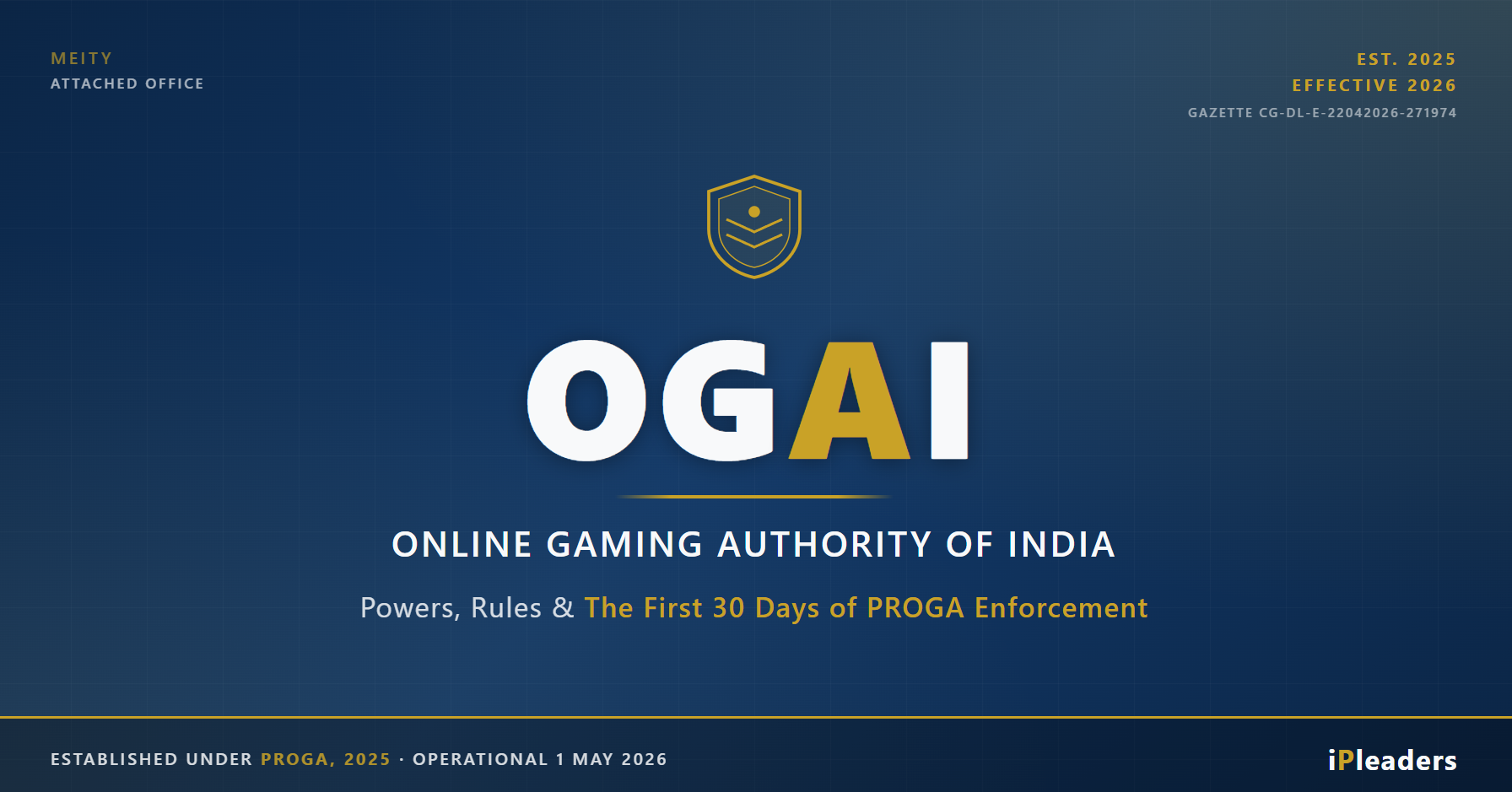
The Online Gaming Authority of India (OGAI) is the central regulator established under Section 8 of the Promotion and Regulation of Online Gaming Act, 2025. It is a six-member, digital-first attached office of the Ministry of Electronics and Information Technology, chaired by an Additional Secretary, operational from 1 May 2026. OGAI classifies online games, registers permitted titles, hears grievances, and enforces a nationwide ban on online money games.
The pages below unpack each of those functions, the case-law lineage that frames the constitutional challenge, the rolling enforcement timeline of OGAI’s first month, and the practitioner-grade walkthrough every gaming counsel will need on file.
What is the Online Gaming Authority of India (OGAI)?
Here’s the simplest framing. A regulator without a parent statute is a press release; a statute without a regulator is a frozen rulebook. And for five months, India’s online gaming sector lived in the gap between those two states. The Online Gaming Authority of India closes that gap.
OGAI is a statutory body created under the Promotion and Regulation of Online Gaming Act, 2025 (PROGA), the Centre’s first dedicated legislation governing the entire online gaming sector. It is an attached office of the Ministry of Electronics and Information Technology (MeitY), constituted by notification ahead of the 1 May 2026 commencement, with the Act and Rules coming into force on that date. Its mandate spans classification of online games, registration of permitted titles (chiefly esports and recognised competitive games), grievance adjudication, and the enforcement of a nationwide ban on online money games as defined under the Act.
In practice, this means OGAI sits at the centre of a four-way conversation between the platform, the user, the payment system, and the state. Every esports tournament organiser who wants its title certified, every social-game studio that wants safe-harbour clarity, every bank that wants written ground for refusing a transaction, and every aggrieved user who wants someone to call, all now route through one institutional address.
The legal birth certificate of OGAI
PROGA gives OGAI its statutory existence. Section 8 of the Act is the establishment provision: it empowers the Central Government to constitute an Authority consisting of a Chairperson and other Members, and sets out the heads on which the Authority’s powers, composition, and procedure may be prescribed. The Promotion and Regulation of Online Gaming Rules, 2026 (the “PROGA Rules” or “Rules 2026”), notified by MeitY on 22 April 2026, fill in the procedural detail: how complaints reach OGAI, what registration applicants must file, how blocking orders flow, and what banks and payment-system providers must do once a game is determined to fall outside the permitted set. The Rules are organised into 6 Parts and 26 Rules, with OGAI itself constituted under Part II (Rules 3–7).
A useful mental shortcut: PROGA is the constitution of the new regime. The Rules 2026 are its code of civil procedure. OGAI is the bench that applies both. For practitioners, that means primary-statute literacy is now table stakes; you cannot advise a fantasy-sports client on transition risk without reading Section 5 of the Promotion and Regulation of Online Gaming Act, 2025 (the prohibition on offering or facilitating money games), Section 6 (the advertising ban), Section 7 (prohibition on transfer of funds towards money-game payments), and Section 9 (the principal penalty provision) together with the corresponding Rules.

Why a dedicated regulator was needed
India tried something gentler first. In April 2023, the Centre amended the Information Technology (Intermediary Guidelines and Digital Media Ethics Code) Rules, 2021 to bring online gaming inside the IT Act framework. The 2023 amendment proposed Self-Regulatory Bodies (SRBs) that would certify which money games were “permissible”. The architecture looked sensible on paper: industry-led certification, ministerial oversight, intermediary liability anchored to Rule 3 of the Information Technology (Intermediary Guidelines and Digital Media Ethics Code) Rules, 2021.
In practice, no SRB was ever notified. A combination of inter-industry rivalry, public-policy doubt about self-regulation in a stakes-driven sector, and the GST Council’s October 2023 decision to apply 28% on the full face value of every online money-gaming bet collapsed the political space for a soft-touch model. By mid-2024, the Centre had shifted gear: a hard-edged statute, a single regulator, and a binary classification (permitted or banned).
PROGA also dismantles a second prior framework: the patchwork of state-level gambling laws that preceded PROGA, much of it tracing back to Section 3 of the Public Gambling Act, 1867. State enactments (Tamil Nadu, Karnataka, Andhra Pradesh, Telangana, Kerala) had each tried to extend their gambling-house statutes to online stakes-based play. Most were struck down between 2021 and 2022 by the High Courts. The Centre’s reading: only a uniform national prohibition, anchored to its competence over digital intermediaries and inter-state commerce, would survive judicial scrutiny.
A common misconception worth flagging: OGAI is not the same body the 2023 IT Rules contemplated. The SRBs were industry-run; OGAI is government-run. Confusing the two leads to wrong advice on grievance pathways, registration timelines, and appellate routes.
We’ve seen this slip into compliance memos already. Don’t repeat it.
The 22 April notification and 1 May commencement
The Rules 2026 were notified in the Gazette of India (CG-DL-E-22042026-271974) on 22 April 2026, with effect from 1 May 2026. OGAI was constituted in the same window. The Authority’s portal, hosted under MeitY’s domain, went live in stages ahead of the commencement date and, as of media reporting from late March 2026, had reflected a partial application backlog (49 esports applications submitted, 22 approved at that point), numbers that have moved upward in the first weeks of formal operations.
The bigger point is structural. India is not the first country to set up a dedicated online-gaming regulator (the UK Gambling Commission, Singapore’s Gambling Regulatory Authority, and Malta’s MGA preceded it). But it is the first to build one with civil-court powers, a digital-first design, and a complete prohibition on money games as the substantive baseline. That combination is unusual.
OGAI’s institutional architecture: composition, leadership, head office
Who actually staffs the regulator? And does the design borrow from a familiar Indian template, or is it genuinely new?
OGAI is a six-member body, all ex officio. The Chairperson is an Additional Secretary in MeitY (or an officer of equivalent or higher rank nominated by the MeitY Secretary). The five other members are Joint Secretary–level representatives drawn from the Ministry of Home Affairs, the Department of Financial Services (Ministry of Finance), the Ministry of Information and Broadcasting, the Ministry of Youth Affairs and Sports, and the Department of Legal Affairs (Ministry of Law and Justice). There are no independent expert appointees in the body’s notified composition; technical inputs flow in through inter-ministerial routing rather than through standalone expert seats.
The Chairperson runs day-to-day governance. Decisions on classification, registration, and adjudication are taken by the full Authority. The head office is in the National Capital Territory of Delhi, co-located with MeitY’s Electronics Niketan campus, but the Authority is designed to function digitally: applications, grievances, and most communications flow through the OGAI portal, not through physical filings.
The six-member structure
Compared with TRAI (a multi-member tribunal-like authority with a separate appellate body in TDSAT), SEBI (a multi-member board with a market-development as well as enforcement mandate), and the CCI (which functions both as adjudicator and competition-policy advisor), OGAI is unusually lean. There is no specialised gaming tribunal under the Rules 2026; the appellate route within the framework runs to the Secretary, MeitY, sitting as the Appellate Authority for grievance appeals, with judicial review thereafter to the High Court under writ jurisdiction. That design choice has compressed the institutional architecture to a tight cross-ministerial body for a sector that, on the operator-petitioners’ own filings, employed in excess of two lakh people directly and indirectly until August 2025.
Because every member is ex officio, the body’s reasoning bandwidth is shaped less by independent appointees and more by the institutional habits of the parent ministries that send representatives in. In a sector where game-design questions (loot-box mechanics, NFT ownership transfers, prediction-market settlement logic) collide with constitutional questions (skill-versus-chance, federalism, freedom of trade), the Authority’s reasoning quality will turn on how it integrates technical input from outside the central government.
Appointment process and tenure
The ex officio members hold office for the duration of their parent posting; rotation is automatic when they move on within their respective ministries. The Rules do not separately prescribe fixed terms or a selection process, since every seat is anchored to a designated post in a parent ministry. Removal questions therefore track the ordinary service rules of the parent cadre rather than a bespoke regulatory removal process.
A practical concern that experienced regulatory counsel will flag: the absence of independent expert seats means OGAI’s reasoning credibility will rest entirely on the quality of its published orders. Compare with SEBI, where senior-most appointments carry quasi-judicial weight after years of public visibility; OGAI will need to build that credibility purely through the doctrinal coherence of what it writes.
Head office, digital-first design, and inter-ministerial coordination
The Authority’s digital-first character is not cosmetic. Almost every workflow under the Rules 2026 (registration, complaint intake, blocking-order issuance, response timelines for platforms) is designed to run through the portal. Document templates are uploadable.
Acknowledgement receipts are auto-generated. The default expectation is that no party walks into the head office unless summoned for an oral hearing.
A common question practitioners raise is how OGAI coordinates with parallel regulators. The short answer: through standing inter-ministerial protocols rather than statutory powers, reinforced by the fact that the financial, home, broadcasting, sports and law ministries all sit on the body itself. The RBI and payment-system regulator coordinate on bank-side enforcement (Rule 19 of the Rules 2026, read with Section 7 of the Promotion and Regulation of Online Gaming Act, 2025, is the operative interface).
MeitY itself handles Section 69A of the Information Technology Act, 2000 blocking for offshore platforms (PROGA’s Section 14 builds on the Section 69A machinery for online money gaming services). The Ministry of Information and Broadcasting handles advertising-code violations alongside OGAI’s own ad-restriction enforcement. The ED engages where money-laundering predicates surface. OGAI sits as the central node, with institutional muscle distributed across the ministries already represented on it.
What can go wrong here? Coordination drift. As enforcement matures, careful sequencing between Section 69A blocking and PROGA’s own classification chain will be essential to head off process-failure challenges by platforms arguing that the classification stage was skipped. OGAI will need to publish a clear coordination protocol within its first months of substantive operation.
(or officer of equivalent / higher rank nominated by MeitY Secretary)
(Ministry of Finance)
(Ministry of Law & Justice)
| Position | Rank | Parent Ministry / Department |
|---|---|---|
| Chairperson | Additional Secretary (ex officio) | Ministry of Electronics and Information Technology (MeitY) |
| Member | Joint Secretary (ex officio) | Ministry of Home Affairs |
| Member | Joint Secretary (ex officio) | Department of Financial Services, Ministry of Finance |
| Member | Joint Secretary (ex officio) | Ministry of Information and Broadcasting |
| Member | Joint Secretary (ex officio) | Ministry of Youth Affairs and Sports |
| Member | Joint Secretary (ex officio) | Department of Legal Affairs, Ministry of Law and Justice |
Powers of OGAI: a digital-first regulator with civil-court teeth
What does OGAI actually do, and how much of it can it do without going to court?
The Authority’s powers fall into five buckets: classify, register, adjudicate, enforce (with civil-court powers), and coordinate. The first four are exercised directly under the Act and Rules. The fifth runs through the inter-ministerial protocols described above.
Classification of online games
Classification is the gatekeeping power. Under PROGA, every online game falls into one of three statutory categories: online money game (banned), online social game (broadly permitted), or esports / recognised competitive game (registration available, conditional on compliance). The Authority decides, in cases of doubt, which category a given title falls into.
The classification standard is built on the statutory definition of “online money game”, essentially, any online game played for stakes (money or anything of monetary value) with the expectation of monetary or in-kind winnings, irrespective of whether the game itself is one of skill or chance. That last clause is the doctrinal earthquake (more on it in the categories section). For now, what matters operationally is that the Authority’s classification determination can be appealed only by writ to the High Court. There is no internal review tier.
Registration of permitted online games
Registration is required for online games where the Central Government has notified a category as registration-eligible (having regard to user risk, scale, financial transactions and country of origin), and is the operational pathway for esports titles seeking PROGA-compliant tournament operation alongside National Sports Governance Act, 2025 recognition. It is voluntary (but commercially valuable) for online social game studios that want a written classification from the Authority. The registration walkthrough is laid out in detail later in this post; the Authority’s registration power flows from Section 8(2)(b) of the Act read with Part IV (Rules 12–19) of the Rules 2026.
Grievance handling and complaint adjudication
Every registered platform must designate a grievance officer, publish contact details on its interface, and handle user complaints under a fixed timeline. Where the user is dissatisfied with the platform’s response, escalation flows to OGAI itself. This is the two-tier mechanism (down from the three-tier model originally proposed in the Draft Rules 2025, replaced by the simpler structure in the notified Rules 2026). The Authority’s adjudication powers here are quasi-judicial.
Investigative and adjudicatory powers under PROGA
The Act gives OGAI a layered enforcement toolkit. Under Section 8(2), the Authority may determine on application or suo motu whether a particular online game is an online money game; recognise, categorise and register online games; and exercise such other powers as may be prescribed under the Rules. Under Section 15, the Central Government may authorise officers of the Central Government, the Authority, or State Governments to investigate offences.
Under Section 16, an authorised officer may enter and search any place (physical or digital) and arrest without warrant any person reasonably suspected of having committed or being about to commit an offence under the Act, with the BNSS framework applying to such entry, search or arrest. The Authority’s adjudicatory limb, in turn, sits under Section 12 (non-compliance penalties up to ₹10 lakh, plus suspension or cancellation of registration) read with the procedural rules in Part V of the Rules 2026.
The frank reality is that few sectoral regulators in India outside the financial-services and competition-law spaces start with this combination of investigation, classification, registration and penalty teeth from day one. The DPDP Board, by contrast, is meant to develop similar powers gradually. OGAI starts with them.
Coordination with MeitY, MIB, RBI, ED, and state police
The Authority does not act alone in execution. Blocking of online money gaming services is handled under PROGA’s Section 14, which builds on the existing Section 69A of the Information Technology Act, 2000 machinery. Payment-side enforcement runs through the RBI’s regulated entities under PROGA Section 7 (the prohibition on transfer of funds for money games), operationalised through Rule 19 of the Rules 2026.
Advertising violations cross over with the MIB and the Advertising Standards Council. PMLA-predicate cases sit with the ED. State police forces register FIRs under PROGA’s offences chapter read with the procedural framework of Section 173 of the Bharatiya Nagarik Suraksha Sanhita, 2023.
Worth flagging: industry counsel at the larger fantasy platforms have, in trade-press commentary, described the Authority’s first stretch as competently prepared but still finding its operational rhythm. That is a fair early assessment. The legal architecture is in place; the workflow integration with sister regulators is still being built.
Three categories of online games under PROGA: money games, social games, esports
What is the difference between an online money game, an online social game, and an esports title? This is the single highest-search question on the topic, because it determines which side of the law a platform sits on.
PROGA recognises three statutory categories. Online money games are prohibited outright. Online social games operate freely subject to general law (consumer protection, intermediary rules, advertising codes). Esports and recognised competitive games are permitted, with registration available through OGAI, and integrated with the recognition pipeline of the National Sports Governance Act, 2025.
Online money games: the statutory definition and the blanket prohibition
An online money game, in short, is any online game played for stakes (money or its monetary equivalent) with the expectation of winnings (money or kind). The definition deliberately captures the entire universe of real-money gaming, fantasy sports, online rummy, online poker, opinion-trading platforms, and similar formats, regardless of whether the underlying game is one of skill or chance.
That last point is the doctrinal break. Decades of Indian jurisprudence (from Dr. K.R. Lakshmanan v. State of Tamil Nadu, (1996) 2 SCC 226 through the AIGF batch of 2022) had carefully built the predominance test: the dominant element of the game (skill or chance) determines its character, and a skill-predominant game played for stakes was not “gambling” within the meaning of state Acts. PROGA writes around that test.
The classification trigger is now the presence of stakes plus the expectation of winnings, not the mix of skill and chance. The skill-predominance line drawn in R.M.D. Chamarbaugwalla v. Union of India, AIR 1957 SC 628 (the foundational ruling on prize competitions) and refined in subsequent rulings is statutorily bypassed for the limited purpose of online play. This is what the Article 19(1)(g) challenge to PROGA will be testing.
Online social games: what falls inside, what falls outside
An online social game is, broadly, an online game played without stakes, even if there is a paid entry fee or in-game purchase, provided no winnings are paid out in money or kind. Casual mobile games, console online play, MMORPGs without real-money trading, social-casino apps that don’t pay out, and most subscription-based gaming services sit comfortably here.
The grey-zone questions begin with loot boxes (random in-game item drops in exchange for paid currency), play-to-earn token mechanics, and prediction-market formats that settle in tradable tokens. The notified Rules 2026 do not yet treat these as money games. But the Authority has reserved the power to bring specific subcategories into the prohibited list by notification. Studios building loot-box-driven monetisation should treat that risk as live.
Esports: the recognition track and the NSGA 2025 link
Esports gets its own registration pathway. A title is eligible if it satisfies three conditions: it is recognised (or under recognition) by a National Sports Federation under the National Sports Governance Act, 2025; the format is a structured competitive tournament with published rules and skill-based outcomes; and the platform commits to OGAI’s registration conditions on age-gating, parental controls, grievance handling, and ad-restraint compliance. Once registered, the title can run paid prize-pool tournaments, the prize money is statutorily distinguished from money-game winnings, because participation is contest-entry-driven, not bet-driven.
In practice, this pathway has been built for the recognised esports ecosystem (PUBG / BGMI competitive tournaments, Dota 2 leagues, Valorant Champions Tour Indian qualifiers, FIFA / EAFC esports). It has not been built for fantasy sports, which sits squarely in the money-game category and is therefore outside the registration option. For readers tracking the older framework against which the new registration regime sits, the pre-PROGA esports legal landscape is a useful baseline.
Edge cases: NFTs, play-to-earn, prediction markets, fantasy sports
What about NFT-integrated games where players “earn” tradable digital assets? The Authority’s working position (subject to confirmation by formal classification orders) is that if the in-game asset has secondary-market value and can be cashed out, the platform is offering a money game. Pure-collectible NFTs without play-to-earn mechanics sit on safer ground.
Crypto prediction-market platforms (international names like Polymarket and Indian peers) raise a sharper question. Settlement in stablecoin or any cryptocurrency, where the user can convert to fiat, looks like winnings within the statutory definition. Domestic counsel for prediction-market operators are already preparing the argument that opinion-trading is an information market, not a game; the Authority will likely classify on a case-by-case basis.
Fantasy sports is the most consequential edge case. The contest-entry-fee, prize-pool structure that platforms like the lead fantasy operator built over a decade was designed precisely to fit within the skill-game framework upheld by the Punjab and Haryana High Court and reaffirmed in Chandresh Sankhla v. State of Rajasthan, 2020 SCC OnLine Raj 264. PROGA’s stakes-plus-winnings test does not preserve that distinction. Fantasy sports is now squarely an online money game, and its return (if at all) depends entirely on the constitutional outcome.
Edge Cases · Authority’s working position (case-by-case)
| Category | Trigger | Treatment |
|---|---|---|
| Online Money Game | Stakes plus expectation of winnings | Prohibited (PROGA Sections 5, 6, 7) |
| Esports | NSGA-recognised competitive title; no stakes / contest entry only | Registration available with OGAI |
| Online Social Game | No stakes / no monetary winnings | Permitted; voluntary classification available |
How to register an esports title with OGAI: step-by-step practitioner walkthrough
What does the OGAI registration journey actually look like from the inside, and where do most applicants stumble? This is the section that gaming counsel will actually print and tape to a wall. The Authority’s portal is operational; applications are being received and processed; the procedural muscle memory needs to develop fast.
Pre-application prerequisites
Before opening the OGAI portal, an applicant must have four things lined up. First, recognition of the esports title (or pending application for recognition) under the National Sports Governance Act, 2025 framework, channelled through the relevant National Sports Federation. Second, a documented KYC and age-gating system that prevents under-18 access (Aadhaar-based or equivalent verification, with audit logs).
Third, a parental-control architecture for accounts of users between 18 and 21, including spend caps and time controls. Fourth, a designated grievance officer with a board resolution recording the appointment, contact details, and escalation matrix.
In practice, the parental-control requirement is the most underestimated. Platforms that built KYC for fraud prevention often have to retrofit the spend-and-time control logic. Plan three to six weeks of engineering work for it.
The 8-step registration walkthrough
The procedural sequence on the Authority’s portal is as follows:
- Account creation. Register the applicant entity on the OGAI portal using the corporate PAN, GSTIN, and authorised signatory’s digital signature certificate (DSC). The portal generates a permanent applicant ID.
- Title submission. Open a new application against the applicant ID. Enter the title name, version, platform availability (PC / console / mobile), and a structured description of game mechanics with reference to the NSGA recognition documentation.
- Documentary upload. Upload the NSGA recognition certificate or pending application reference, the KYC age-gate technical specification, the parental-control system design document, the grievance officer board resolution, and the platform’s terms of use and privacy policy aligned with Rule 3 of the Information Technology (Intermediary Guidelines and Digital Media Ethics Code) Rules, 2021 and the user-safety disclosures contemplated by Rule 23 of the Rules 2026.
- Compliance affidavit. Execute and upload a compliance affidavit by the authorised signatory, confirming that the title satisfies the registration conditions and that the platform will operate within the Authority’s advertising restrictions, complaint-handling timelines, and data-handling obligations.
- Fee payment. Pay the registration fee through the portal’s integrated payment gateway. The current standard fee is published on the portal; renewal fees are lower and are waived for first-cycle renewals where no compliance breach has been recorded.
- Acknowledgement. Receive the system-generated acknowledgement and provisional reference number. The Authority’s clock starts here. Statutory decision window: ninety days for a complete application.
- Authority review and clarifications. Respond to any clarification requests from the Authority within the timelines stated in each request (typically fifteen working days). Each clarification request resets the ninety-day clock.
- Certificate of Registration. On approval, the Authority issues a digital Certificate of Registration with a unique registration number, a validity period of up to ten years from issuance (per the Rules 2026), and the conditions of registration appended.
Application fee, validity period, renewal mechanics
The application fee is published on the portal. Per the Rules 2026 architecture, the Certificate of Registration is valid for up to ten years from issuance. Renewal mechanics, conditions and any deficiency-cure timelines are governed by the operative rules in Part IV (Rules 12–19), as supplemented by directions the Authority may issue. Compliance-breach history during the certificate cycle is liable to feed into renewal scrutiny and, in extreme cases, may trigger a fresh-application requirement rather than a routine renewal.
What happens on incomplete application, suspension, and revocation
An incomplete application is not auto-rejected. The Authority issues a deficiency notice; the applicant has fifteen working days to cure. The ninety-day clock resets on each cure cycle. Repeated incompleteness (more than three deficiency notices on a single application) is treated as withdrawal.
Suspension is a mid-cycle remedy. It can be triggered by a confirmed breach of registration conditions (an advertising violation, a grievance-handling delay beyond the statutory timeline, or a compliance failure on age-gating). The Authority issues a suspension order with reasons; the platform has thirty days to show cause. A suspension converts to revocation only on a finding of substantive non-compliance after hearing.
Where most applicants go wrong: treating the application as a one-shot exercise. The smarter move is to file a deliberately conservative initial application (clean documentary trail, conservative game-mechanics description), then use the clarification cycle to layer in nuance. The Authority’s reviewers are working through a meaningful early-cycle backlog (the pre-commencement count alone was 49 applications); clarity at the first round buys institutional goodwill that pays off at the second.
-
1Account creationRegister the applicant entity on the OGAI portal using corporate PAN, GSTIN, and the authorised signatory’s DSC. Portal generates a permanent applicant ID.Approx. 1 working day
-
2Title submissionOpen a new application against the applicant ID. Enter title name, version, platform availability (PC / console / mobile), and structured description of game mechanics referencing NSGA documentation.Approx. 1 working day
-
3Documentary uploadUpload NSGA recognition certificate or pending application reference, KYC age-gate technical specification, parental-control system design document, grievance officer board resolution, and platform terms / privacy policy aligned with IT Rules 2021 Rule 3 and Rule 23 of the Rules 2026.1–2 weeks (preparation)
-
4Compliance affidavitExecute and upload a compliance affidavit by the authorised signatory confirming the title satisfies registration conditions and that the platform will operate within the Authority’s advertising restrictions, complaint-handling timelines, and data-handling obligations.3–5 working days
-
5Fee paymentPay the registration fee through the portal’s integrated payment gateway. Renewal fees are lower; first-cycle renewal fee is waived where no compliance breach is recorded.Same day
-
6Acknowledgement 90-Day Clock StartsReceive system-generated acknowledgement and provisional reference number. The Authority’s statutory 90-day decision clock starts on a complete application.Instant
-
7Authority review and clarificationsRespond to clarification requests within stated timelines (typically 15 working days). Each clarification cycle resets the 90-day clock.30–60 days (typical)
-
8Certificate of RegistrationOn approval, OGAI issues a digital Certificate of Registration with a unique registration number, validity of up to 10 years from issuance (per Rules 2026), and conditions of registration appended.Within 90 days of complete application
Who must register, who is exempt: the registration matrix
Does every online game need an OGAI certificate, or does the obligation track only specific categories? Not every game does. The matrix divides into mandatory, voluntary, and out-of-scope categories.
Mandatory registration
Esports titles seeking PROGA-compliant tournament operation must register. Recognised competitive games seeking the safe-harbour benefits of registration (statutory clarity on prize-pool structures, advertising rights, age-gated user access) effectively must register, even though the statute does not use the word “mandatory” for them. The commercial reality is that without registration, sponsor and broadcaster contracts will not close.
Voluntary registration
Online social game studios may register voluntarily to obtain a written classification from the Authority (a useful piece of paper when negotiating payment-aggregator onboarding, advertising-platform inventory, or a foreign investor’s compliance diligence). For ambiguous-category games (loot-box mechanics, social-casino without payouts, prediction-market formats that don’t settle in cash), voluntary registration is a defensive move: it locks in the Authority’s classification before a future notification narrows the safe zone.
Out of scope
Pure offline games, exclusively educational games (academic or training-context games not played for stakes or winnings), and government-run lotteries (the residual state-list activity that PROGA does not touch) are out of scope. So are physical-event esports tournaments where the online component is incidental (purely a registration system or a bracket display), the Authority’s jurisdiction tracks the gameplay, not the administrative tooling.
A practical question that recurs in compliance memos: does a casual mobile game with a cosmetic in-app purchase need OGAI registration? No. There is no stakes element and no monetary winnings. The Authority’s classification trigger does not engage.
Worth flagging: voluntarily registering an OSG can be a one-way door. Once classified, the game’s mechanics are on file with the Authority. And a subsequent change in monetisation (introducing a cash-out token, for example) reopens classification. Build the post-registration roadmap before submitting.
Grievance redressal under PROGA Rules: the two-tier mechanism
If a user has a complaint against a registered platform, where do they go and how fast does anyone respond?
The Rules 2026 set up a two-tier grievance mechanism. Tier 1 sits inside the platform: a designated grievance officer, contact details published on the user interface, and a statutory response timeline for complaints. Tier 2 is OGAI itself, which receives escalations where the user is dissatisfied with the Tier 1 response or where the platform fails to respond within the statutory window.
Tier 1: the platform’s grievance officer
Every registered platform must designate a grievance officer at the Indian level (for foreign-incorporated operators that hold an Indian registration, the designation has to be of a person resident in India). The officer’s name, designation, official email, and direct phone number must be displayed on the platform’s interface and in its terms of use.
The statutory timeline for the platform’s first response is fifteen days from receipt of complaint, with a final response within thirty days unless the complaint requires a complex factual investigation. Failure to respond within the timeline is itself a Rules-breach, escalable to OGAI without the user needing to wait further.
Tier 2: OGAI’s complaint adjudication
A user dissatisfied with the Tier 1 response (or facing platform non-response) escalates to OGAI through the portal. The Authority’s intake system generates an acknowledgement and a unique grievance reference number. Adjudication timelines are set out in the Rules: thirty days for routine matters, sixty for complex cases involving multiple parties or technical analysis.
The Authority’s order can direct the platform to refund money held, restore access wrongly suspended, correct a published age-gating notice, or take down content that violates the registration conditions. Non-compliance with an OGAI order is treated as a fresh breach, attracting penalties under the Act’s offences chapter.
Three-tier vs two-tier: what changed between Draft Rules 2025 and notified Rules 2026
The Draft Rules circulated for consultation in October 2025 had proposed a three-tier mechanism: Tier 1 (platform), Tier 2 (an industry-level self-regulatory grievance body), Tier 3 (OGAI). Industry feedback flagged the middle tier as duplicative; user-advocacy groups flagged it as protective of platforms. The notified Rules 2026 dropped Tier 2 entirely.
For practitioners advising platforms, the practical effect is that escalation now lands directly at a regulator, not at an industry body. The cushion is gone. Build the Tier 1 process as if every dissatisfied user will go straight to OGAI, because most will. The early-week grievance volume on the Authority’s portal is climbing as Tier 1 platform-side processes get tested in real time.
Payment-system enforcement and personal liability under Rule 19
Who actually bears the legal risk when a money-game payment slips through a bank rail after PROGA, the institution or the named officer? Banks, payment aggregators, and payment-system providers (PSPs) carry the heaviest non-platform compliance load under the new framework. And the liability is not just institutional. It is personal.
Rule 19 obligations on banks, PSPs, and payment aggregators
Rule 19 of the Rules 2026 obliges every bank, payment aggregator, and payment-system provider to identify, block, and refuse to process payments for online money games. The duty is triggered on (a) a published OGAI list of banned platforms, (b) a specific OGAI direction in respect of a named platform, or (c) actual knowledge gained from any source that a platform is offering money games to Indian users.
The phrase “without delay” runs through the rule. There is no twenty-four-hour grace period, no end-of-day batching. Once the trigger is met, processing must stop on the next available transaction cycle.
And for a bank with millions of daily transactions and thousands of merchant identifiers, that creates a real-time compliance burden the Treasury team has to design for, not just react to.
Who is personally liable
The Authority’s reading (consistent with the Banking Regulation Act 1949 line of “designated officer” jurisprudence developed for AML and KYC failures) is that personal liability attaches to the Head of Payments, the Chief Compliance Officer, and the designated nodal officer named in the bank’s Rule 19 governance policy. In a payment-aggregator context, the designation typically lands with the Country Manager and the Head of Risk.
A common question from compliance counsel is whether a board-level approval insulates an individual officer from personal exposure. The frank answer: only partially. Board minutes record corporate intent; they do not displace the individual officer’s statutory duty. The defensible position is documented delegation plus documented oversight, not delegation alone.
What “without delay” means: building a defensible compliance log
Operationally, “without delay” reads as “next transaction cycle”. The defensible compliance log should record (a) the exact timestamp at which the trigger event was received, (b) the transaction cycle in which the merchant identifier was added to the blocklist, (c) the count of transactions blocked in the first cycle and subsequent cycles, and (d) any transactions that slipped through, with root-cause analysis. Bottom line: the Authority will accept reasonable engineering latency; it will not accept untracked latency.
The due-diligence defence: records to keep, board resolutions to pass
The due-diligence defence under PROGA tracks the standard formulation: the officer demonstrated reasonable steps to prevent the breach. The minimum documentary record we’d recommend includes the Rule 19 governance policy approved by the board, the standing order to the payments operations team, the technical specification of the blocklist ingestion pipeline, quarterly internal-audit reports against Rule 19, and incident-response logs.
A second-order effect already visible in the market: the D&O insurance line is hardening. Underwriters writing fresh policies for fintech and payments companies are now requesting Rule 19 governance documentation before quoting; renewals are coming back with carve-outs for personal-liability claims under PROGA absent specific evidence of due-diligence procedures. Expect this to become standard within twelve months. Compliance counsel should be reviewing the policy wording, not just the limit.
First 30 days of OGAI enforcement: a chronology (1 May 2026 to 30 May 2026)
What has actually happened on the ground in the first eleven days of OGAI’s operational life, and how should the rest of the thirty-day window be read? The single biggest gap in the published commentary on PROGA is the absence of a stitched-together timeline of what the Authority and its sister regulators have actually done in the first month of operations. This section closes that gap, with the express caveat that it is a living chronicle: today is 11 May 2026, Day 11 of enforcement; what follows reflects the verified record up to publication (covering Days 1 through 11) plus the framework expectations for Days 12 through 30, and will be refreshed at Day 60 and Day 90.
Week 1 (1 to 7 May 2026): operational launch, advisory traffic to industry
The Authority’s portal opened on 1 May. The portal had carried partial application data even before commencement (late-March reporting indicated 49 esports applications submitted and 22 approved at that point), and the application count moved upward as registration submissions resumed under the operative Rules. The Authority’s earliest formal communications addressed to scheduled commercial banks, payment aggregators, and payment-system providers restated the Rule 19 obligations under the Rules 2026 and signalled that a published list of platforms whose services to Indian users were prohibited would be circulated for blocklist integration. As of publication, the granular daily counts (applications received per day, advisories issued per day, complaints filed per day) are not yet collated in a single primary-source release; readers are advised to track the Authority’s own publications and PIB releases for verified Week-1 numerics.
Week 2 (8 to 14 May 2026): first blocking-coordination, payment-system advisories
In the second operational week, formal blocking coordination against offshore platforms identified as serving Indian users moved through MeitY for the Section 69A / Section 14 PROGA machinery, with payment-system advisories naming specific merchant identifiers for blocklisting. Compliance counsel should expect to see the first writ challenges to early blocking actions filed at the High Court level, by intermediaries questioning whether the classification stage was satisfied independently of the blocking step. Specific docket-level details remain to be confirmed against court order sheets at the time of publication.
Week 3 to 4 (15 to 30 May 2026): registrations, complaints, early orders
The first esports Certificates of Registration are expected to issue during Weeks 3 and 4 in the recognised competitive-tournament category. Grievance volume is expected to climb sharply once Tier-1 platform-side processes are tested and dissatisfied users escalate to OGAI under the two-tier mechanism. Substantive published adjudication orders, particularly on legacy refund claims against now-shuttered money-game platforms, are likely to define the Authority’s early jurisprudence.
A pattern is already visible. The Authority is structured to process routine matters digitally and at speed. But the complex matters (offshore-platform blocking, intermediary liability for app-store listings, the boundary between voluntary OSG registration and mandatory esports registration) will require more substantive reasoned orders in the second month and beyond.
Sidebar: the November 2025 ED action in context
The November 2025 ED action (search operations between 18 and 22 November 2025 against money-gaming companies, with ₹523 crore in deposits frozen across the targets and ₹505 crore traced to a single operator, followed by the arrest of two co-founders of that operator on PMLA charges on 26 November 2025, the first founder-arrests in India’s gaming saga) is often discussed alongside PROGA enforcement, but it predates OGAI by close to six months. The legal hooks were PMLA-predicate offences and state anti-gaming laws then in force, not PROGA. The relevance to OGAI’s mandate is indirect: the ED action established a tone of enforcement seriousness that the Authority inherits.
Sidebar: the Section 69A blocking-list problem
A separate cautionary tale: in early May 2026, MeitY was reported to have blocked, under Section 69A of the Information Technology Act, 2000, an anti-gambling self-exclusion app (a tool that helps users restrict their own access to gambling platforms) for three years, without published reasons. The episode is illustrative not of PROGA enforcement but of the opacity of Section 69A blocking-list compilation, which can conflate “gambling-related” with “promoting gambling” through over-broad keyword logic. As OGAI’s own blocking practice develops, transparency in blocklist compilation will be the difference between a credible regulator and a procedurally fragile one. Worth flagging early.
A common community question (especially on user forums) is whether a VPN can be used to access banned platforms. The legal answer: PROGA does not separately criminalise VPN use, but transactions originating through a VPN to a blocked platform remain prohibited under Section 7 of the Act and Rule 19 of the Rules, and depending on the source of funds may attract PMLA implications. The practical answer: the lawful path is to wait for the constitutional question to be settled, not to circumvent.
- OGAIAuthority vested with regulatory powers; portal goes live for esports registration applications and grievance intake.
- IndustryReal-money gaming platforms suspend paid contests; advertising blackout begins on television, OTT, and digital inventory.
- Pre-existingCarry-forward of 49 esports applications submitted before commencement (22 approved per late-March 2026 reporting).
- OGAIEarliest formal communications to scheduled commercial banks, payment aggregators, and PSPs restating Rule 19 obligations.
- OGAISignal that a published list of platforms whose services to Indian users are prohibited will be circulated for blocklist integration.
- IndustryRegistration submissions resume under the operative Rules; application count moves upward from the pre-commencement carry-forward.
- MeitYFormal blocking coordination against offshore platforms identified as serving Indian users moves through the Section 69A IT Act / Section 14 PROGA machinery.
- OGAIPayment-system advisories naming specific merchant identifiers for blocklisting reach treasury and risk teams.
- High CourtsFirst writ challenges to early blocking actions are anticipated, contesting whether the classification stage was satisfied independently of the blocking step.
- OGAIFirst Certificates of Registration expected to issue in the recognised competitive-tournament category for the cleanest pre-commencement applications.
- Tier-1Grievance volume begins to climb sharply as platform-side processes are tested and dissatisfied users escalate to OGAI under the two-tier mechanism.
- IndustryVoluntary OSG classification requests start coming in from social-game studios seeking written safe-harbour clarity.
- OGAISubstantive published adjudication orders likely to define the Authority’s early jurisprudence, particularly on legacy refund claims against shuttered money-game platforms.
- OGAIEarliest pre-commencement applications begin reaching the 90-day statutory decision deadline.
- Inter-ministerialCoordination protocol with MeitY (Section 69A blocking), MIB (advertising), RBI (payment-system enforcement) settles into a published rhythm.
| Phase | Status | Key activity |
|---|---|---|
| Day 0 commencement (1 May 2026) | Observed | PROGA and Rules 2026 in force; OGAI portal opens for esports registration and grievances |
| Week 1 (1-7 May 2026) | Observed | Advisories to banks, payment aggregators, PSPs; Rule 19 obligations restated |
| Week 2 (8-14 May 2026) | In progress as of 11 May 2026 | Blocking coordination via Section 69A / Section 14; payment-system merchant advisories; first writ challenges anticipated |
| Week 3 (15-21 May 2026) | Expected | First Certificates of Registration; Tier-1 grievance escalations; voluntary OSG classification requests |
| Week 4 (22-30 May 2026) | Expected | Substantive adjudication orders; first 90-day clocks reach maturity; coordination protocol stabilises |
Penalties and prosecution under PROGA: the criminal liability map
How sharp are the criminal teeth Parliament has put behind the prohibition, and who exactly can be prosecuted? The offences chapter of PROGA carries the substantive criminal teeth. Operators, advertisers, abettors, and (in defined circumstances) directors and key managerial personnel can all be prosecuted.
Penalties for offering, advertising, and transferring funds
The principal offence (offering an online money gaming service in contravention of Section 5 of the Promotion and Regulation of Online Gaming Act, 2025) attracts, under Section 9(1), imprisonment of up to three years or a fine of up to one crore rupees, or both, on first conviction. A second or subsequent conviction triggers a mandatory minimum of three years and a minimum fine of one crore (extending up to five years and two crore rupees) under Section 9(4).
Advertising an online money game (Section 6) carries imprisonment up to two years and a fine up to fifty lakh rupees under Section 9(2), with enhanced minima on repeat conviction under Section 9(5). Engaging in or facilitating a transaction or authorisation of funds for a money-gaming service (Section 7) carries the same quantum as the principal offence, three years and one crore, under Section 9(3), with the same enhanced minima on repeat conviction under Section 9(4). Abetment, aiding and inducement are statutorily folded into the language of Sections 5, 6 and 7 themselves.
A reference table to keep close:
| Offence (PROGA section) | Maximum imprisonment | Maximum fine | Cognizable | Bailable |
|---|---|---|---|---|
| Offering online money gaming service (s.5, punished under s.9(1)) | 3 years | Rs. 1 crore | Yes (s.10) | No (s.10) |
| Repeat offence under s.5 (s.9(4)) | Min 3 years; up to 5 years | Min Rs. 1 crore; up to Rs. 2 crore | Yes | No |
| Advertising online money game (s.6, punished under s.9(2)) | 2 years | Rs. 50 lakh | Subject to general criminal procedure (not cognizable under s.10) | Subject to general criminal procedure |
| Repeat offence under s.6 (s.9(5)) | Min 2 years; up to 3 years | Min Rs. 50 lakh; up to Rs. 1 crore | Subject to general criminal procedure | Subject to general criminal procedure |
| Transfer of funds for money-gaming service (s.7, punished under s.9(3)) | 3 years | Rs. 1 crore | Yes (s.10) | No (s.10) |
| Corporate liability (s.11) | Co-extensive with substantive offence | Co-extensive | Per substantive offence | Per substantive offence |
| Non-compliance with Authority direction (s.12) | — | Up to Rs. 10 lakh + suspension/cancellation of registration | — | — |
Cognizable and non-bailable: what this means for arrest, bail, and trial
The classification of the principal offences (offering and transfer of funds) as cognizable and non-bailable under Section 10 of the Act means a police officer can register and investigate without prior magistrate sanction, and bail is at the discretion of the court rather than as of right. In practical terms, an FIR registered under Section 9 against a platform’s directors triggers an immediate arrest risk that has to be managed through anticipatory bail under the procedural framework of Section 482 of the Bharatiya Nagarik Suraksha Sanhita, 2023 (which replaces the old CrPC Section 438).
Are players themselves prosecutable?
This is the question every Reddit thread asks. The short answer: no, not under the current text. PROGA’s offences are framed against offering, advertising, abetting, and facilitating, not against playing.
Individual users who placed bets before the prohibition are not in legal jeopardy under the statute. Whether they have a contractual claim against the platform for unrefunded balances is a separate civil matter, currently the subject of consumer-forum filings.
But: a player who actively recruits others, runs a private contest, or aggregates funds for play could move from the protected user category into the abetment category. The line is fact-specific.
Corporate criminal liability: directors, officers, and the deemed-liability rule
Section 11 of PROGA sets out the standard corporate-liability template: where an offence is committed by a company, every person who, at the time of the offence, was in charge of and responsible for the conduct of the business is liable to be proceeded against and punished accordingly, unless the person proves the offence was committed without their knowledge or that they exercised all due diligence to prevent it. The shift sits with the accused, the prosecution does not need to prove personal involvement; the director or officer has to prove no knowledge or due diligence.
For independent directors and non-executive directors, Section 11 carries an explicit carve-out in its proviso: a non-executive or independent director who is not involved in actual decision-making is not liable. The mistake we see most often: assuming the carve-out is automatic and self-executing. It is not. Independent directors at platform companies should ensure the board minutes record their non-involvement in operational decision-making and any specific dissent or due-diligence inquiry on PROGA-compliance items.
OGAI compared with TRAI, SEBI, CCI, and the DPDP Board
How does OGAI’s institutional design compare with the better-known sectoral regulators? And what does the comparison say about how the gaming framework will develop?
| Regulator | Statutory parent | Member count + appointment route | Investigative / adjudicatory powers | Appellate route | Digital-first |
|---|---|---|---|---|---|
| OGAI | PROGA, 2025 | 6 members, all ex officio; Chair = Addl. Secy MeitY; 5 JS-level reps from MHA, DFS, MIB, MoYAS, DoLA | Investigation (PROGA s.15-16), classification and registration (s.8), penalties (s.12) | Appeal to Secretary, MeitY for grievances; High Court (writ) thereafter; no specialised tribunal | Yes (portal-led workflow) |
| TRAI | TRAI Act, 1997 | 5-7 members; selection committee with high-level representation | Yes (limited) | TDSAT (specialised tribunal) | Partial |
| SEBI | SEBI Act, 1992 | Up to 9 members; Chair appointed by Centre | Yes (broad) | SAT (specialised tribunal); SC on questions of law | Partial |
| CCI | Competition Act, 2002 | Up to 7 members; selection committee | Yes (broad) | NCLAT; SC on questions of law | Partial |
| DPDP Board | DPDP Act, 2023 | Members notified by Centre (count flexible) | Limited at outset | High Court (writ); no specialised tribunal yet | Yes (designed digital-native) |
The federalism note and the appointment route
OGAI’s appointment route (every seat tied to an existing post in a parent ministry) is leaner than SEBI’s or CCI’s, and lighter than TRAI’s. The leanness has speed advantages; it carries the cost of independent-expert thinness compared with regulators that have selection-committee-appointed members. Whether that matters in practice will turn on the Authority’s first cohort of orders and the doctrinal credibility they build.
Powers and appellate route
OGAI is well equipped on the investigative and adjudicatory side from day one (Sections 15, 16 and 12 of the Act, read with the Rules), and unusually compact on the appellate side. The within-framework appeal for grievances goes to the Secretary, MeitY, with judicial review thereafter to the High Court under writ jurisdiction. There is no specialised gaming tribunal. That structure increases pressure on the Authority’s reasoning quality in early orders, every adjudication is one judicial-review challenge away from setting precedent for the entire sector.
Why digital-first matters: the lesson from the DPDP Board
The DPDP Board was the first Indian sectoral regulator designed digital-native, no physical filing counter, no in-person hearing default, every workflow on a portal. OGAI inherits and extends that design. The lesson from international peers (UK Gambling Commission, Singapore GRA, Malta MGA): digital-first regulators scale faster but build institutional credibility slower.
The compensating mechanism is published reasoning. OGAI will need to publish more orders, more reasoned, faster, than its peer regulators have done.
A common question from sectoral consultants: which international regulator most closely resembles OGAI? The closest functional parallel is Singapore’s Gambling Regulatory Authority, which combines a statutory ban on certain forms of online gambling with a registration and classification framework for permitted activity. The institutional architecture is similar; the constitutional context (a unitary state with no equivalent of Entry 34 List II) is not.
Constitutional challenges and the three-judge bench
In December 2025, a state government in southern India introduced an Online Horse Racing Bill in its winter session, proposing to legalise online wagering on horse racing within the state, in direct conflict with the Centre’s PROGA blanket ban. The state’s argument leans on Entry 34 of the State List of the Seventh Schedule (betting and gambling) and on the predominance test for skill games developed across forty years of Supreme Court jurisprudence. The state government has also signalled its intent to file or join the constitutional challenge to PROGA pending in the Supreme Court, which on 11 December 2025 was referred to a three-judge bench. The next hearing is fixed for 21 January 2026.
This is not a peripheral development. It is the moment at which the institutional question (does OGAI exist with valid statutory backing?) collides with the constitutional question (does the Centre have the legislative competence to enact PROGA in the first place?). Both questions sit before the same three-judge bench.
The historical lineage from the 1957 Supreme Court ruling to the 2022 Karnataka batch
The doctrinal foundations laid in R.M.D. Chamarbaugwalla (full citation: R.M.D. Chamarbaugwalla v. Union of India, AIR 1957 SC 628, the foundational three-judge ruling on prize competitions) are the starting line. The Court there held that prize competitions involving substantial skill are protected business under Article 19(1)(g); only those depending on chance can be regulated as gambling under Entry 62 of List I. That binary (skill protected, chance regulable) became the foundation of every subsequent online-gaming case. The skill-game line was reinforced shortly thereafter in State of Andhra Pradesh v. K. Satyanarayana, AIR 1968 SC 825, which held rummy to be preponderantly a game of skill.
Dr. K.R. Lakshmanan v. State of Tamil Nadu, (1996) 2 SCC 226 codified the predominance test: the dominant element of the game (skill or chance) determines its character. Horse racing was held to be a game of skill. Two decades later, the same predominance test was applied to strike down state-level bans on online skill games for stakes: Junglee Games India Pvt. Ltd. v. State of Tamil Nadu, 2021 SCC OnLine Mad 2762 (Madras High Court on the Tamil Nadu ban), Head Digital Works Pvt. Ltd. and Play Games 24×7 Pvt. Ltd. v. State of Kerala, 2021 SCC OnLine Ker 5651 (Kerala High Court on the Kerala notification), and the consolidated Karnataka batch decided on 14 February 2022, All India Gaming Federation v. State of Karnataka (consolidated with Galactus Funware Technology Pvt. Ltd. v. State of Karnataka), 2022 SCC OnLine Kar 435, in which the Karnataka High Court Division Bench struck down sections 2, 3, 6, 8 and 9 of the Karnataka Police (Amendment) Act, 2021.
And then PROGA writes around all of it. By making the trigger “stakes plus expectation of winnings” rather than “predominance of chance”, the statute renders the entire skill-versus-chance framework operationally irrelevant for online play. The doctrinal lineage that protected skill-based stakes games is now, on the statute’s own terms, beside the point.
Entry 34 List II versus Entry 31 List I: the federalism clash
The first constitutional question is competence. Entry 34 of the State List places “betting and gambling” within state jurisdiction. Entry 31 of the Union List covers posts and telegraphs, telephones, wireless, broadcasting, and other like forms of communication.
The Centre’s argument: the medium of online play (digital communication networks) brings the activity within Entry 31, irrespective of the betting-and-gambling character of the underlying transaction. The states’ counter: medium does not change the substance; an online bet is still a bet, and the legislative head is Entry 34.
This is not a new debate. The 2022 Karnataka High Court ruling in the AIGF batch had touched it; the 2023 IT Rules amendment had tried to sidestep it by routing the regulation through the IT Act framework. PROGA confronts it head-on.
The named writ petitioners and the 21 January 2026 hearing
The lead petitioner in the SC challenge is the same Hyderabad-based real-money operator that won the 2021 Kerala High Court ruling, providing a continuity of constitutional litigation across two regulatory regimes. The companion petitions include a fantasy-sports operator and a developer of board-game adaptations. Karnataka’s Article 131 suit (if filed) would join the docket. The bench led by the Chief Justice of India is expected to frame the constitutional questions and lay down a timetable at the January hearing.
Will the skill-versus-chance test survive PROGA?
The doctrinal stakes are larger than the immediate operators. If the SC holds that the skill-versus-chance distinction continues to apply as a matter of constitutional doctrine notwithstanding statutory dilution, the framework returns intact, and PROGA will need to be redrafted to align. If instead the Court holds that Parliament can statutorily reframe the test for online play under Entry 31 List I, four decades of jurisprudence is functionally archived, and the Authority’s mandate is constitutionally secure.
A middle outcome (read down PROGA to preserve the predominance test for skill-predominant games) would split the difference and leave OGAI with a narrower remit. None of these are predictions; they are the three doctrinal possibilities constitutional lawyers are preparing for.
A common community question is whether state gaming Acts (the Karnataka 2021 amendment, the Tamil Nadu 2022 amendment, and similar state moves) survive PROGA. The short answer: where they cover online stakes-based play, they are now superseded by central legislation under the doctrine of repugnancy. Where they cover purely intra-state, non-online activities (physical gaming houses, lotteries), they continue. The boundary will be litigated case by case.
What this means for the wider industry: sponsorship, jobs, GST, and the road ahead
While the SC works through the constitutional question, what is the rest of the gaming-and-adjacent ecosystem doing? Reshaping itself in real time. The constitutional question will be answered in due course. In the meantime, sponsorship cycles, FDI pipelines, GST plumbing and esports ad-led models are all moving simultaneously.
The BCCI sponsorship vacuum and ad-spend redistribution
The most visible second-order effect is the title-sponsorship cycle disruption. Industry estimates suggest fantasy-sports platforms accounted for roughly ₹2,500 to ₹3,500 crore of annual sports-marketing spend before PROGA. That capital is now redistributing in three directions: to large Indian conglomerates (Tata, Adani, Reliance brands), to non-Indian sponsors (Saudi, UAE, Singapore-based), and to esports-league sponsorships.
The Indian cricket team’s chest-sponsor slot, vacant from late August 2025 after the lead fantasy operator exited, was filled by Apollo Tyres in mid-September 2025 on a contract running through March 2028. The transition cost the cricket board both lead time and per-cycle value, but the slot did not stay open.
Foreign investor confidence and the FDI signal
PROGA’s enforcement vacuum (six months from passage to operationalisation, with no carve-out for refund of pre-existing escrow balances) has been read by foreign investors as a precedent for how Indian regulation can wipe out an entire category overnight. Reported consequence: tighter due-diligence questions in foreign investment conversations across adjacent regulated sectors (fintech, crypto, online discount broking). One Singapore-based gaming-sector fund manager described the PROGA experience to a trade publication as “a useful pricing event for India risk”.
GST collections impact and the offshore-migration risk
The 28% GST regime applied to the full face value of online money-gaming bets had been generating substantial central revenue since October 2023. Post-PROGA, that revenue line is gone for the formal sector. The countervailing concern is offshore migration: anecdotal reporting suggests Indian users are accessing offshore betting and casino platforms through VPNs at meaningful volumes. The combination, lost domestic GST plus rising offshore traffic, is the policy paradox PROGA’s drafters acknowledged but did not resolve.
Future outlook: esports ad-led models, watch-along formats, registration backlog
What’s next? Three signals are visible in the early data. First, the leading fantasy operator is reported to be piloting a free-to-play, ad-funded fantasy product, betting that the brand and user-base translate to a non-stakes model. Early signals suggest cautious investor receptiveness.
Second, watch-along formats and second-screen esports experiences are getting fresh capital, the genuine new category emerging from the disruption. Third, OGAI’s registration backlog will likely cross several hundred applications within twelve months as the esports recognition pipeline under NSGA matures. Compliance counsel preparing today will have a sustained book of work.
The longer-term question is whether the Indian online-gaming sector reconstitutes around esports and OSGs as the regulated core, or whether the constitutional ruling reopens the money-game category in a controlled form. Practitioners expect the former in the short term and the latter to remain contested for at least three years.
Frequently asked questions about the Online Gaming Authority of India
What is the Online Gaming Authority of India (OGAI)?
The Online Gaming Authority of India (OGAI) is the central regulator established under the Promotion and Regulation of Online Gaming Act, 2025. It is a six-member, digital-first attached office of MeitY, operational from 1 May 2026. OGAI classifies online games into money games (banned), social games (broadly permitted), and esports (registration-eligible), and handles registration, grievance adjudication, and enforcement.
Who chairs the OGAI?
The OGAI is chaired by an Additional Secretary in the Ministry of Electronics and Information Technology, holding office ex officio (or an officer of equivalent or higher rank nominated by the MeitY Secretary). The Chairperson runs day-to-day governance of the Authority’s collegiate decisions on classification, registration, and adjudication.
How many members does the OGAI have?
OGAI has six members, all ex officio. The Chairperson is an Additional Secretary in MeitY (or an officer of equivalent or higher rank nominated by the MeitY Secretary). The other five members are Joint Secretary–level representatives of the Ministry of Home Affairs, the Department of Financial Services (Finance), the Ministry of Information and Broadcasting, the Ministry of Youth Affairs and Sports, and the Department of Legal Affairs (Law and Justice).
When did OGAI become operational?
OGAI became operational on 1 May 2026, the date on which the Promotion and Regulation of Online Gaming Rules, 2026 (notified on 22 April 2026) and the Promotion and Regulation of Online Gaming Act, 2025 (assented to on 22 August 2025) came into force together. The Authority’s portal had already gone live in stages before that date.
What does OGAI do?
OGAI classifies online games into the three statutory categories, registers permitted titles (chiefly esports and recognised competitive games), handles grievance complaints from users against registered platforms, issues blocking-list directions to banks and payment-system providers, and enforces the nationwide ban on online money games. It exercises civil-court powers for the limited purposes of summons, evidence-taking, and contempt-style remedies.
What are the three categories of online games under PROGA?
PROGA recognises three statutory categories. Online money games (any online game played for stakes with the expectation of monetary or in-kind winnings) are prohibited outright. Online social games (online play without payout-bearing stakes) operate freely subject to general law. Esports and recognised competitive games are permitted with registration available through OGAI, integrated with the National Sports Governance Act, 2025 recognition pipeline.
Is registration with OGAI mandatory for all online games?
No. Registration is mandatory for esports titles seeking PROGA-compliant tournament operation. It is voluntary (but commercially valuable) for online social game studios that want a written classification. Pure offline games, exclusively educational games, and government-run lotteries are out of scope. Online money games are not registration-eligible at all, they are prohibited.
How long is an OGAI Certificate of Registration valid?
A digital Certificate of Registration issued by OGAI is valid for up to ten years from the date of issuance, per the Rules 2026 framework. Renewal scrutiny is shaped by the platform’s compliance record during the certificate cycle. An unrenewed certificate lapses on the expiry date.
How long does OGAI take to decide a registration application?
The statutory decision window is ninety days for a complete application. The clock starts on the system-generated acknowledgement of submission. Each clarification request from the Authority resets the ninety-day clock. Repeated incompleteness (more than three deficiency notices on the same application) is treated as withdrawal.
What are the penalties for offering an online money game in India?
The principal offence under the Act (offering an online money game in contravention of the prohibition section) attracts imprisonment of up to three years, a fine of up to one crore rupees, or both, on first conviction. Repeat offences attract enhanced sentences. Advertising an online money game and abetting the offering are separately punishable, with quantum and imprisonment varying by offence category.
Are PROGA offences cognizable and non-bailable?
The principal offence under Section 5 (offering an online money game) and the Section 7 funds-transfer offence are both cognizable and non-bailable under Section 10 of the Act. Cognizable means the police can register and investigate without prior magistrate sanction; non-bailable means bail is at the discretion of the court. Advertising offences under Section 6 are not in Section 10’s cognizable list and follow the general criminal procedure. Bank and PSP non-compliance with Rule 19 is enforced primarily through the Authority’s Section 12 penalty power.
Is Dream11 banned in India after PROGA?
The lead fantasy-sports platform suspended all paid contests on 21 August 2025, hours after the Rajya Sabha passed PROGA, and terminated its title-sponsorship contract with the Indian cricket board within days. As of writing, the platform has not relaunched paid fantasy contests. The platform is reported to be piloting a free-to-play, ad-funded model. A return to paid play depends on the constitutional outcome before the Supreme Court.
Are players who continue to play money games liable to be prosecuted?
PROGA’s offences are framed against offering, advertising, abetting, and facilitating online money games, not against playing. Individual users are not in legal jeopardy under the statute. A player who actively recruits others, runs a private contest, or aggregates funds for play could move from the protected user category into the abetment category. The line is fact-specific.
When will the Supreme Court decide PROGA’s constitutionality?
The constitutional challenges to PROGA were referred to a three-judge bench by the Supreme Court on 11 December 2025. The next hearing is fixed for 21 January 2026. Constitutional cases of this scale typically take twelve to eighteen months from referral to final judgment, suggesting a likely outcome in late 2026 or early 2027.
Do state gaming Acts (Karnataka 2021, Tamil Nadu 2022) survive PROGA?
Where state gaming Acts cover online stakes-based play, they are now superseded by PROGA under the doctrine of repugnancy, central legislation on a concurrent or competing legislative head displaces state legislation. Where state Acts cover purely intra-state, non-online activities (physical gaming houses, lotteries), they continue to operate. The boundary will be litigated case by case as enforcement matures.
References
Case Law
- All India Gaming Federation v. State of Karnataka (consolidated with Galactus Funware Technology Pvt. Ltd. v. State of Karnataka), 2022 SCC OnLine Kar 435 — Karnataka High Court Division Bench (Awasthi CJ, Dixit J), 14 February 2022.
- Chandresh Sankhla v. State of Rajasthan, 2020 SCC OnLine Raj 264 — Rajasthan High Court (Jaipur Bench), 14 February 2020.
- Dr. K.R. Lakshmanan v. State of Tamil Nadu and Another, (1996) 2 SCC 226 — AIR 1996 SC 1153; Supreme Court (Kuldip Singh, B.L. Hansaria, S.B. Majmudar JJ), 12 January 1996.
- Head Digital Works Pvt. Ltd. and Play Games 24×7 Pvt. Ltd. v. State of Kerala, 2021 SCC OnLine Ker 5651 — Kerala High Court (T.R. Ravi J), 27 September 2021.
- Junglee Games India Pvt. Ltd. v. State of Tamil Nadu, 2021 SCC OnLine Mad 2762 — Madras High Court Division Bench (Banerjee CJ, Ramamoorthy J), 3 August 2021.
- R.M.D. Chamarbaugwalla v. Union of India, AIR 1957 SC 628 — (1957) SCR 930; Supreme Court (T.L. Venkatarama Aiyyar, S.K. Das, P.B. Gajendragadkar JJ), 9 April 1957.
- State of Andhra Pradesh v. K. Satyanarayana, AIR 1968 SC 825 — (1968) 2 SCR 387; Supreme Court (Hidayatullah, Vaidyialingam JJ), 22 November 1967 (reported 1968).
Statutes
- Public Gambling Act, 1867 — sections cited: 3.
- Code of Civil Procedure, 1908 — referenced for general civil-procedure framework.
- Banking Regulation Act, 1949 — referenced for designated-officer doctrine.
- Information Technology Act, 2000 — sections cited: 69A.
- Payment and Settlement Systems Act, 2007 — referenced for payment-system regulatory baseline.
- Information Technology (Intermediary Guidelines and Digital Media Ethics Code) Rules, 2021 — sections cited: Rule 3.
- Bharatiya Nagarik Suraksha Sanhita, 2023 — sections cited: 173; Section 482 (anticipatory bail).
- Promotion and Regulation of Online Gaming Act, 2025 (Act No. 32 of 2025) — sections cited: 1, 2, 3, 5, 6, 7, 8, 9, 10, 11, 12, 14. Alternative source: PRS India Bill text.
- National Sports Governance Act, 2025 — referenced via PRS India bill tracker.
- Promotion and Regulation of Online Gaming Rules, 2026 (CG-DL-E-22042026-271974) — Parts II–V (Rules 3–22) referenced; Rule 19 (bank/PSP verification) and Rules 7 and 20 (two-tier grievance and appeal) cited specifically.
This article is for informational purposes only and does not constitute legal advice. For specific legal guidance, consult a qualified legal professional.
 Serato DJ Crack 2025Serato DJ PRO Crack




 Allow notifications





