

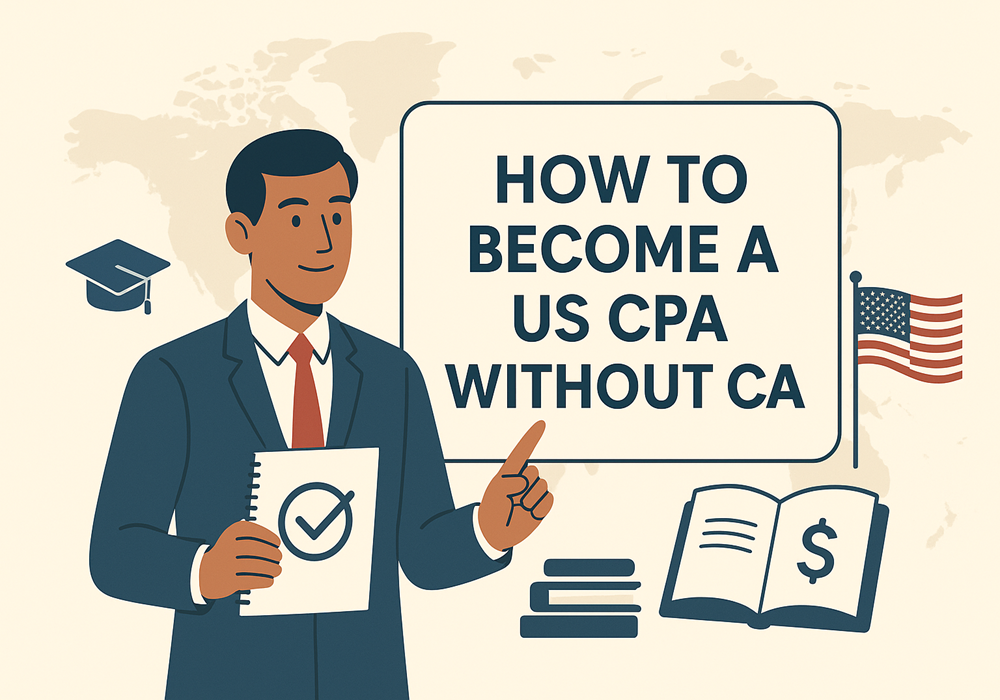
Learn how to pursue US CPA exam without CA qualification. Explore M.Com, MBA, CS, and CMA India pathways, state selection tips, and step-by-step action plan for Indian professionals. This article is written by Medha Vinod, Senior Associate at LawSikho.
Table of Contents
Can you become a US CPA without being a Chartered Accountant? Absolutely, yes. This is one of the most persistent myths in the Indian finance community, and it is time to put it to rest. If you hold an M.Com, MBA in Finance, Company Secretary qualification, or CMA India credential, you have a legitimate pathway to the prestigious US CPA certification. This article will help you quickly assess your eligibility and understand exactly what steps you need to take. We will cover how the credit system works, explore three proven pathways, help you choose the right US state, and give you a clear action plan to begin your CPA journey.
CPA Exam Eligibility for non-CA professionals: Understanding the CPA Eligibility
Before diving into specific pathways, you need to understand how US state boards evaluate your eligibility. The system is different from India, but once you grasp the basics, everything else becomes much clearer.
The Credit Hour System That Determines Your Eligibility
US CPA eligibility revolves around credit hours, not specific degrees. Think of credit hours as a universal currency that measures your educational achievement. One year of full-time university study in the US equals approximately 30 credit hours. To sit for the CPA exam, you need 120 credit hours. To obtain your license after passing, you need 150 credit hours.
These credit hours must include a certain number in accounting subjects (typically 24 credits) and business subjects (typically 24 credits). The remaining credits can come from general education. This is why your specific degree matters less than the total credits and subject distribution it provides. A well-structured M.Com or MBA can meet these requirements just as effectively as a CA qualification.
How Do Different Indian Qualifications Convert to US Credits?
Your Indian qualifications convert to US credits through a formal evaluation process. Here is a quick reference for common Indian credentials:
A three-year B.Com degree equals approximately 90 credit hours. This falls short of the 120 needed for exam eligibility, which is why B.Com alone is not sufficient. However, when you add a postgraduate degree or professional qualification, you quickly reach the threshold.
A two-year M.Com adds 60 credits, bringing your B.Com plus M.Com total to 150 credits. This meets the licensing requirement, not just the exam eligibility. Similarly, a two-year MBA adds 60 credits, giving you the same 150 credit total. Professional qualifications like CS from ICSI and CMA from ICMAI are typically evaluated at 60 credits each.
Three Proven Pathways to CPA Without CA Qualification
Now that you understand the credit system, let us look at the three main pathways available to you. Each has its own advantages, and the best choice depends on your current qualification and career goals.
Pathway 1: The Postgraduate Route Using M.Com or MBA
This is the most straightforward pathway for many Indian professionals. If you have completed B.Com followed by M.Com or MBA, you likely already have 150 credit hours, meeting the full licensing requirement.
The M.Com route is particularly strong because it typically includes heavy coursework in financial accounting, cost accounting, auditing, and taxation. These subjects directly align with CPA exam content areas. Your preparation for the exam becomes more focused on US GAAP specifics rather than learning foundational concepts from scratch.
The MBA Finance route works equally well, though you should check your transcript for accounting course credits. Some MBA programs are lighter on accounting and heavier on corporate finance or strategy. If your MBA has fewer than 24 credits in pure accounting subjects, some states may require supplementary coursework. This is easily identified through a pre-evaluation before you formally apply.
Distance MBA or M.Com degrees from UGC recognized universities are generally accepted. The key is that your institution must have proper accreditation. Degrees from well-known universities like IGNOU, Symbiosis, or state university distance programs are typically evaluated without issues.
Pathway 2: The Professional Qualification Route Using CS or CMA India
If you pursued Company Secretary or Cost and Management Accountancy instead of CA, you have not closed the door to CPA. These qualifications contribute substantial credit hours toward your eligibility.
The CS qualification from ICSI is typically evaluated at 60 credit hours. Combined with your B.Com, this gives you 150 credits. The curriculum covers corporate law, governance, and compliance extensively, with some overlap in areas like business law that appear on the CPA exam. However, CS is lighter on financial accounting than CPA requires, so you may need to supplement with additional accounting coursework depending on your chosen state’s requirements.
CMA India from ICMAI also provides approximately 60 credit hours. The cost accounting and management accounting foundation from CMA India translates well to CPA exam preparation. Many CMA India holders find the Financial Accounting and Reporting section of the CPA exam requires the most additional study, while other sections feel more familiar.

Both CS and CMA India holders should consider states with flexible credential evaluation policies. Alaska, Montana, and Guam have track records of accepting these professional qualifications when combined with undergraduate degrees.
Pathway 3: The Bridge Course Route for Credit Shortfalls
What if you only have a B.Com and no postgraduate degree or professional qualification? You are not out of options. Bridge courses exist specifically to fill the credit gap and make you CPA eligible.
Bridge courses are educational programs that provide US-recognized credit hours in accounting and business subjects. Most programs offer 30 to 60 credits, depending on the structure. A typical one-year bridge course providing 40 credits would take your B.Com total from 90 to 130 credits, making you exam eligible with room to spare.
Several reputable providers serve Indian candidates. Simandhar Education offers a bridge course providing 40 credits at approximately INR 35,000. Miles Education provides similar programs through partnerships with accredited universities. These courses can be completed online while you work, typically taking six to twelve months.
The bridge course route requires more investment than other pathways, but it opens the CPA door for professionals who choose not to pursue postgraduate studies. Many B.Com holders in their late twenties or thirties find this more practical than going back for a full M.Com degree.
Selecting the Right US State Board for Your Qualification
The US has 55 jurisdictions that grant CPA licenses, and each has slightly different requirements. Choosing the right state can make the difference between a smooth application and a frustrating rejection.
States That Welcome Indian Candidates Without an SSN
Most Indian candidates do not have a US Social Security Number, which some states require. Fortunately, several states have eliminated this requirement for examination purposes, making them accessible to international candidates.
Some of the popular states among Indian CPA aspirants are Guam, Alaska, Montana, Washington, etc. Guam is particularly favored due to its straightforward application process and acceptance of diverse international credentials. The territory actively welcomes international candidates and participates in NASBA’s experience verification service, which helps with the work experience requirement.
Alaska and Montana are known for their flexible approach to credential evaluation. They assess candidates holistically rather than rigidly requiring specific degree types. Washington and Colorado also accept Indian qualifications, though Colorado sometimes requires additional coursework in ethics.
Matching Your Qualifications to the Best State
Your specific qualification influences which state suits you best. Here is a quick matching guide:
M.Com holders with 150 credits have the widest choice. Most CPA friendly states will accept your credentials. Focus on states with convenient experience verification processes, since that will be your next challenge after passing the exam.
MBA Finance holders should verify their accounting credit count before selecting a state. If you have adequate accounting coursework, you have flexibility similar to M.Com holders. If your MBA was light on accounting, prioritize states like Guam and Alaska that take a more holistic view of your overall education.
CS and CMA India holders should focus on states with proven acceptance of these credentials. Alaska, Montana, and Guam are your best bets. Getting a pre-evaluation from NASBA International Evaluation Services before committing to a state application is highly recommended.
What Should Be Your Action Plan to Begin the CPA Journey?
Understanding eligibility is important, but action is what gets you to the finish line. Here is your practical roadmap from where you are now to sitting for your first CPA exam section.
Step-by-Step Process from Evaluation to Exam Registration
Step 1: Calculate your credits. Based on what you learned above, estimate your total credit hours. B.Com gives you 90, postgraduate degrees add 60, and professional qualifications add 60. If you are at or above 120, you can proceed. If not, plan for bridge courses.
Step 2: Collect your documents. You will need official transcripts from all universities attended, degree certificates, and professional qualification certificates if applicable. Contact your university’s examination section to request an official transcript dispatch. This process can take four to eight weeks with Indian universities, so start early.
Step 3: Choose your state. Based on your qualification profile and the guidance above, select a state board. If unsure, Guam is a safe choice for most Indian candidates with diverse qualifications.
Step 4: Apply for credential evaluation. Submit your application to NASBA International Evaluation Services. Pay the evaluation fee (approximately $250) and ensure your institutions send official documents directly to NIES. The evaluation takes six to eight weeks after all documents arrive.
Step 5: Review your evaluation report. Your report will show total credits, accounting credits, and business credits. If you meet your chosen state’s requirements, proceed. If there are gaps, address them through supplementary coursework or bridge courses.
Step 6: Apply to sit for the exam. Once your evaluation is accepted, apply through your state board. After approval, you will receive a Notice to Schedule that allows you to book your exam at a Prometric center.
Step 7: Begin exam preparation. Enroll in a CPA review course and create your study plan. Most candidates take nine to twelve months to pass all four sections while working full-time.
Common Pitfalls to Avoid and How to Stay on Track
Many candidates stumble on avoidable mistakes. Here are the most common pitfalls and how to prevent them.
Choosing the wrong state. Research thoroughly before applying. Switching states mid-process wastes time and money. If your qualification is non-traditional, get a pre-evaluation before committing.
Document delays. Indian universities are often slow with official transcript dispatch. Start this process immediately, even before you have finalized your state selection. Having documents ready prevents bottlenecks.
Underestimating study time. The CPA exam is challenging. Plan for 300 to 400 hours of study across all four sections. Trying to rush through with minimal preparation leads to failed attempts and extended timelines.
Ignoring experience requirements. Passing the exam is not enough for licensure. You need verified work experience. Start thinking about this early. If you work at a company without US CPAs, consider states that participate in NASBA’s experience verification service or accept alternative verifiers.
Going it alone without guidance. The CPA process has many moving parts. Working with a reputable coaching institute or advisor familiar with Indian candidate challenges can save you significant time and frustration. Their expertise in state selection, documentation, and exam preparation is worth the investment.
Conclusion
The path to a US CPA is open to you regardless of whether you pursued CA. Your M.Com, MBA Finance, CS, or CMA India qualification provides a legitimate foundation for CPA eligibility. Even B.Com graduates can qualify through bridge courses designed specifically to fill credit gaps. The key is understanding how your credentials translate to US credit hours, selecting the right state board for your profile, and following a systematic process from evaluation to examination. Start by calculating your credits today, and take your first step toward joining the growing community of Indian professionals who proudly hold the US CPA credential.
If you want to read more in-depth information on this, please click here.
 Serato DJ Crack 2025Serato DJ PRO Crack


 Allow notifications





