

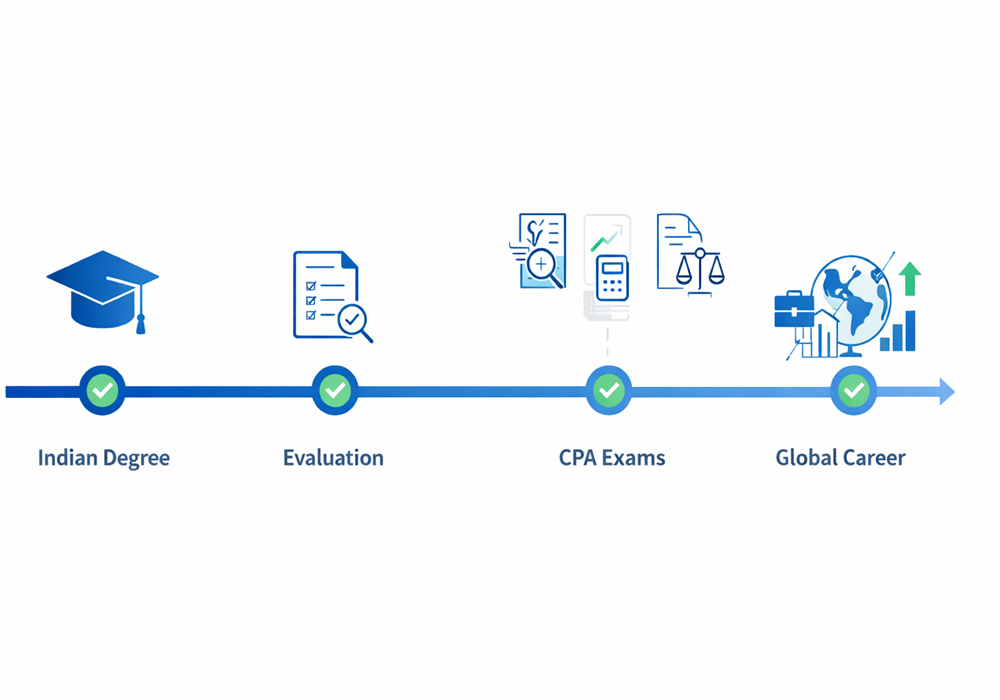
Practical guide to US CPA course from India covering eligibility for Indian qualifications, CPA Evolution exam structure, updated fees in INR, preparation timeline, and career opportunities. This article is written by Rohit Arora, Senior Associate at LawSikho.
Table of Contents
If you are an Indian accounting professional eyeing global career opportunities, the US CPA credential has probably crossed your radar more than once.
The Certified Public Accountant designation opens doors to multinational corporations, Big 4 firms, and international finance roles that remain inaccessible to most Indian accountants.

But here is the reality: pursuing CPA from India involves navigating US state board requirements, understanding a completely restructured exam format launched in 2024, and budgeting for costs that recently increased significantly in June 2025. This guide provides a practical roadmap covering eligibility pathways, the new exam structure, current costs in Indian Rupees, and realistic career outcomes to help you decide if CPA aligns with your professional goals.
CPA Eligibility Pathways for Different Indian Qualifications
The first question every Indian candidate asks is whether their existing qualifications make them eligible for CPA. The answer depends on how your Indian education translates into the US credit hour system and which US state you choose for licensing. Unlike India’s uniform CA eligibility rules, CPA requirements vary across 55 different US jurisdictions, each with distinct education and experience criteria.
How Do US CPA Credit Hour Requirements Apply to Indian Degrees?
US state boards measure educational qualifications in semester credit hours rather than years of study. Most states require 120 credit hours to appear for the exam and 150 credit hours to obtain the full CPA license. The general conversion rule applied by credential evaluation agencies assigns approximately 30 US credits per year of Indian university education, though this varies based on your university’s accreditation and academic performance.
If you hold a three-year B.Com degree, expect your credentials to convert to roughly 90 credit hours.
This means you can sit for the exam in most states but will need additional credits for full licensure. Candidates with M.Com or MBA degrees alongside their B.Com typically reach the 150-hour threshold without additional coursework. Indian Chartered Accountants find themselves well-positioned because the CA qualification, combined with a bachelor’s degree, generally touches the 120-150 hour requirement.
For those falling short, bridge courses from accredited institutions can fill the gap. Several Indian CPA coaching providers partner with US universities to offer these supplementary credits. CMA India holders with bachelor’s degrees often meet the requirements too, though exact credit counts depend on evaluation by agencies like NIES or WES.
State Selection Criteria for Indian Candidates
Choosing the right US state is a strategic decision that affects your entire CPA journey. Not every state welcomes international candidates equally, and requirements around Social Security Numbers, US residency, and work experience vary dramatically.
For Indian candidates planning to take exams from India without immediate US relocation plans, Montana, Colorado, Alaska, and Guam stand out as accessible options.
These states do not require a Social Security Number for examination or licensing and have no US residency mandates. Montana has become particularly popular because it accepts work experience verified by a Chartered Accountant, not just a US CPA, making it ideal for candidates whose supervisors hold Indian credentials.
Colorado offers a unique advantage through its CPA certificate option, which you can obtain after passing all exam sections, even before completing the experience requirement.
This allows you to add the credential to your resume while accumulating qualifying work experience in India. Experience requirements across states range from one to two years of supervised accounting work, so reviewing each state’s specific provisions through NASBA’s official directory before applying is essential.
Understanding the CPA Exam: Core Sections and Discipline Choices
The CPA exam underwent its most significant overhaul in decades when AICPA launched CPA Evolution in January 2024. If you have researched CPA online, you may have encountered outdated information referencing the old four-section format, including BEC. That structure no longer exists. The current exam requires passing three mandatory Core sections plus one Discipline section of your choice.
Three Core Sections All Candidates Must Pass
Every CPA candidate must clear Auditing and Attestation, Financial Accounting and Reporting, and Taxation and Regulation. Each section runs four hours and requires a minimum score of 75 on a 0 to 99 scale. The three sections test foundational knowledge that AICPA determined essential for all CPAs regardless of their eventual specialization.

FAR presents the steepest challenge, with pass rates hovering around 40 to 43 percent (42.80% cumulatively in 2025. The section covers US GAAP extensively, including financial statement preparation, governmental accounting, and not-for-profit accounting. Indian candidates with strong accounting fundamentals find the conceptual overlap helpful, but the sheer volume of material demands significant study time.
AUD tests audit procedures, attestation standards, and professional ethics, with pass rates of 48.01% in 2025. Candidates from CA backgrounds often recognize familiar concepts, though
US-specific regulations require dedicated preparation. REG covers US federal taxation and business law, and despite the unfamiliar US tax code, it posts the highest Core section pass rate at 63 to 64 (63.94% cumulatively in 2025) percent due to its more structured, rule-based content.
Choosing Your Discipline: BAR, ISC, or TCP
Beyond the three Core sections, you select one Discipline that aligns with your career trajectory. This choice matters because each Discipline focuses on specialized knowledge and carries different difficulty levels based on pass rate data.
TCP, covering Tax Compliance and Planning, boasts the highest pass rate of any CPA exam section at 78.06% cumulatively in 2025. If you performed well on REG or have tax experience, TCP builds naturally on that foundation. Candidates targeting tax advisory careers or those wanting the statistically most approachable Discipline often choose this path.
ISC focuses on Information Systems and Controls, testing IT governance, cybersecurity, and technology risk. With pass rates around 68.21% cumulatively in 2025, it suits candidates with technology backgrounds or those eyeing IT audit and systems consulting roles. BAR, covering Business Analysis and Reporting, incorporates advanced financial reporting and data-driven decision making from the retired BEC section. At 38 to 45 percent pass rate, BAR is the most demanding Discipline but suits those pursuing financial analysis or corporate accounting leadership positions.
How Much Does the CPA Course Cost to an Indian Candidate?
Cost planning requires careful attention because CPA involves payments to multiple organizations across different stages. Many candidates underestimate the total investment, especially after NASBA significantly increased examination fees for international candidates in June 2025.
Complete Cost Breakdown in Indian Rupees
The complete CPA journey costs Indian candidates between ₹2.5 lakh and ₹5.5 lakh, depending on your choices and whether you pass all sections on the first attempt. Understanding where your money goes helps you budget accurately.
Credential evaluation through NIES costs $225 to $275 (approximately ₹19,000 to ₹23,000), while WES charges $160 to $225 (₹13,500 to ₹19,000). State board application fees range from $90 to $245 (₹7,500 to ₹21,000) depending on your chosen jurisdiction. The biggest expense comes from examination fees, which increased substantially in June 2025 from $390 to $510 per section for international candidates. For all four sections, you now pay $2,040 (approximately ₹1,73,000) in exam fees alone.
Add ethics exam fees of $200 to $270 required by most states, licensing fees of $100 to $500 (₹8,500 to ₹42,500), and contingency for retakes or document courier costs. The mandatory fees without coaching total approximately ₹2.2 to ₹2.8 lakh. Factor in review courses, and the total reaches ₹2.5 to ₹5.5 lakh.
Which CPA Review Courses Are Available in India
Quality review courses significantly improve pass rates, and several options serve Indian candidates through local partnerships or direct access. Your choice depends on budget, learning style, and support preferences.
Becker, available through Indian partners like Simandhar Education and Miles Education, offers comprehensive preparation with pricing ranging from ₹1,20,000 to ₹2,00,000. Their adaptive technology and extensive question banks justify the premium for many candidates. SkillArbitrage provides CPA preparation with competitive pricing and India-focused support, making it worth exploring. UWorld Roger CPA Review offers lifetime access with strong visual explanations at ₹80,000 to ₹1,20,000, while Surgent and Gleim provide adaptive learning and extensive practice questions at ₹70,000 to ₹1,00,000. Most providers offer EMI options through Indian partners, spreading the financial burden over several months.
How Long Does It Take to Prepare for the CPA While Working Full-Time?
Balancing CPA preparation with a demanding Indian work schedule is challenging but achievable with realistic planning. Most successful candidates complete the journey in 12 to 24 months while working full-time, though your timeline depends on study consistency and exam performance.
Realistic Timeline: 12 to 24 Months
Plan for 300 to 400 total study hours across all four sections. This translates to approximately 15 to 20 hours weekly over 12 to 18 months for working professionals. FAR typically demands the most preparation time at 100 to 150 hours due to its extensive syllabus. AUD and REG each require 80 to 100 hours, while your chosen Discipline needs 60 to 80 hours.
The 30-month testing window provides flexibility that the previous 18-month limit did not offer. Once you pass your first section, you have two and a half years to clear the remaining three. This extended window accommodates work demands, travel schedules, and life events that inevitably interrupt study plans. Many Indian professionals structure their preparation by tackling FAR first while motivation is highest, then moving through AUD, REG, and their Discipline sequentially.
Creating consistent study routines matters more than marathon weekend sessions. Early morning study from 5 AM to 7 AM works well for some candidates, while others prefer evening blocks from 8 PM to 11 PM. Mobile-friendly review courses allow studying during commutes and lunch breaks, maximizing limited free time.
Exam Scheduling and Prometric Centers in India
You can take the CPA exam entirely in India without traveling to the US. Prometric operates testing centers in eight Indian cities: Ahmedabad, Bangalore, Chennai, Hyderabad, Kolkata, Mumbai, New Delhi, and Trivandrum. This geographic distribution means most candidates can reach a testing center within a few hours.
Core sections are available for scheduling throughout the year under continuous testing, giving you flexibility to choose dates that align with your preparation. Discipline sections have specific testing windows in January, April, June, July, and October. Avoid scheduling during the final days of any testing window when centers are busiest, and stress levels run highest. Book your slot several weeks in advance to secure your preferred date and time.
Career Outcomes and Salary After CPA in India
The career impact of CPA certification in India has grown substantially as multinational corporations, Big 4 firms, and Global Capability Centers expand operations. The credential signals expertise in US GAAP, international reporting standards, and cross-border financial management that Indian employers increasingly seek.
Job Roles and Hiring Companies
All Big 4 firms operating in India actively recruit CPA professionals. Deloitte, PwC, EY, and KPMG hire CPAs for US-focused audit engagements, advisory services for American clients, and international reporting roles. These firms handle substantial US GAAP work for Indian subsidiaries of American companies, creating consistent demand for CPA qualified professionals.
Beyond Big 4, multinational corporations seek CPAs for financial controller positions, internal audit leadership, and US reporting roles. Global Capability Centers of companies like Amazon, Google, Microsoft, and major banks specifically recruit CPAs for their India operations. Investment banks, consulting firms, and private equity houses value the analytical rigor and international standards expertise that CPA represents. Common roles include audit manager, tax consultant, financial controller, and paths leading to CFO positions.
Salary Expectations: Freshers to Experienced
Entry-level CPAs in India earn ₹6 to ₹12 lakh per annum at mid-sized firms, rising to ₹10 to ₹15 lakh at Big 4 practices. This represents a 20 to 40 percent premium over non-CPA accountants at similar experience levels, and the salary differential widens as careers progress.
With 3 to 5 years of post-CPA experience, professionals typically earn ₹15 to ₹25 lakh annually. Senior managers and directors with CPA credentials command ₹25 lakh and above, particularly in Big 4 firms and large MNCs. The CA plus CPA combination often commands premium compensation, with professionals reporting ₹25 to ₹40 lakh packages at senior levels. Those who relocate internationally with their CPA credentials see even greater returns, with US-based CPAs earning $80,000 to $130,000 annually.
Conclusion
CPA represents a significant investment of ₹2.5 to ₹5.5 lakh and 12 to 24 months of dedicated preparation, but the returns in career growth, salary premium, and global opportunities justify the commitment for Indian professionals targeting international accounting careers.
The key lies in strategic planning: select your state based on eligibility requirements that match your qualifications, understand the new Core plus Discipline exam structure, budget realistically, including the June 2025 fee increases, and commit to consistent weekly study alongside your work schedule. Whether you hold a B.Com exploring global opportunities, a CA seeking international credentials, or have work experience in MNC finance roles, the CPA pathway from India is more accessible than ever through eight local testing centers and multiple coaching options serving Indian candidates.For a complete guide on CPA Course, read my detailed article on the CPA Course in India: Complete Guide.
 Serato DJ Crack 2025Serato DJ PRO Crack



 Allow notifications





