

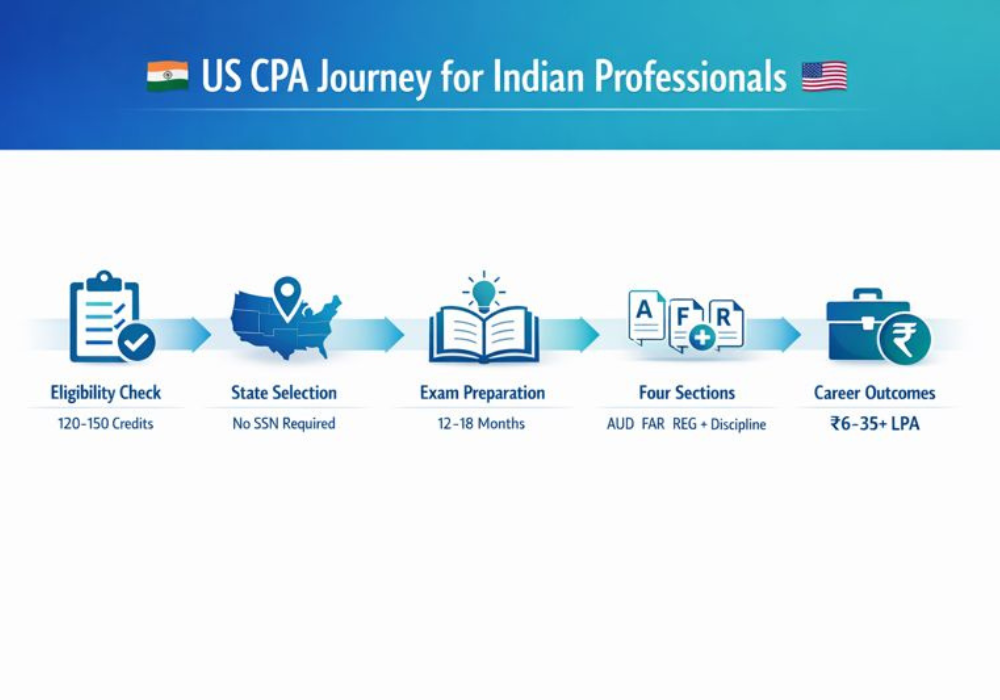
US CPA course guide for Indian professionals covering exam structure, eligibility requirements, fees in INR, career opportunities, and step-by-step roadmap to certification. This article is written by Medha Vinod, Senior Associate at LawSikho.
Table of Contents
The Certified Public Accountant credential has rapidly become one of the most sought-after international qualifications among Indian finance professionals. As global corporations establish their finance operations in India and Big 4 firms expand their service delivery centers, professionals with a US CPA certification find themselves at a significant advantage. This guide covers everything you need to evaluate whether pursuing the CPA makes sense for your career and provides a practical roadmap for getting started, from understanding eligibility requirements and costs to mapping out your preparation timeline and career outcomes.
CPA Exam Structure
The CPA examination underwent a significant transformation in January 2024 when AICPA and NASBA introduced CPA Evolution, fundamentally restructuring how candidates demonstrate their competency. The new model recognizes that modern CPAs need both foundational knowledge shared across the profession and specialized expertise aligned with their career direction. Understanding this structure helps you plan your preparation strategically and make informed decisions about your specialization path.

Three Core Sections and One Discipline Choice
Every CPA candidate must pass three Core sections:
- Auditing and Attestation (AUD),
- Financial Accounting and Reporting (FAR), and
- Taxation and Regulation (REG).
These sections test the fundamental competencies that every CPA needs, regardless of their eventual practice area.
Beyond the Core sections, you select and pass one Discipline section from three options:
- Business Analysis and Reporting (BAR),
- Information Systems and Controls (ISC), or
- Tax Compliance and Planning (TCP).
Each section runs four hours and requires a minimum scaled score of 75 to pass. The scoring system evaluates your performance against a competency standard rather than comparing you against other candidates, meaning everyone who demonstrates adequate knowledge passes. You have 30 months from passing your first section to complete all four sections, providing reasonable flexibility for working professionals managing exam preparation alongside career responsibilities.
The discipline choice carries real career implications. BAR suits candidates interested in financial planning, analysis, and CFO-track roles. ISC appeals to those pursuing IT audit, cybersecurity, or technology advisory positions. TCP works well for professionals building careers in tax planning and compliance. Your background and career goals should guide this selection rather than perceived difficulty levels.
CPA Exam Format and What Indian Candidates Should Expect
The exam combines multiple-choice questions (MCQs) and task-based simulations (TBSs) across each section. MCQs test your knowledge, recall, and conceptual understanding, while TBSs evaluate your ability to apply knowledge to realistic work scenarios requiring analysis and professional judgment. Most sections weigh these components equally at 50% each, though ISC weights MCQs slightly higher at 60%.
Indian candidates can take the CPA exam at Prometric testing centers located in eight cities: Ahmedabad, Bangalore, Calcutta, Chennai, Hyderabad, Mumbai, New Delhi, and Trivandrum. This domestic availability eliminates the expense and logistics of international travel that earlier candidates faced. Core sections follow continuous testing, meaning you can schedule appointments throughout the year whenever slots are available at your preferred center.
Discipline sections operate on a quarterly testing window system, available only during the first month of each calendar quarter. Missing your target discipline window means waiting until the next quarter, so factor this timing into your preparation schedule. The combination of continuous Core testing and quarterly Discipline windows allows strategic scheduling based on your readiness for each section.
Eligibility Criteria and Credit Requirements for CPA Exam
The most common confusion among Indian candidates involves understanding credit hour requirements. The US education system measures coursework in semester credit hours rather than years of study, and CPA eligibility involves two distinct thresholds: 120 credits to sit for the examination and 150 credits for full licensure. Many states allow you to begin testing once you reach 120 credits while completing additional requirements before obtaining your license.
How Indian Qualifications Translate to US Credits
Your Indian qualifications convert to US credit hours through credential evaluation agencies, with the specific count depending on your degree type and university curriculum. A standard three-year B.Com typically provides 90 to 100 semester credit hours, falling short of both exam and licensure thresholds. Adding a two-year M.Com brings your total to approximately 150 credits, meeting full licensure requirements in most states.
Candidates falling short of credit requirements can bridge the gap through various pathways without pursuing additional full degrees. Several US universities offer online bridge programs specifically designed for international CPA candidates, allowing you to complete targeted coursework remotely. NASBA also maintains relationships with approved educational providers offering supplementary courses focused on common gap areas like advanced accounting or taxation.
State Selection and International Candidate Considerations
State selection significantly impacts your CPA journey because each of the 55 US jurisdictions sets its own eligibility criteria, experience requirements, and application procedures. Most Indian candidates lack a US Social Security Number, immediately narrowing viable options to states that explicitly welcome international candidates without SSN requirements.
Montana, and Alaska have emerged as popular choices among Indian candidates. These states participate in international exam administration through NASBA, accept credentials evaluated by recognized agencies, and verify international work experience without requiring US-based CPA supervision. Washington handles the highest volume of Indian applications, combining clear requirements with efficient processing and strong industry recognition.

Your state selection should consider your current credit count, experience status, and long-term career plans. If you already have 150 credits, states like Washington offer complete licensure pathways. If you have only 120 credits currently, some states permit exam sitting while you accumulate additional credits before final licensure. Research specific state requirements before applying to avoid wasted fees and application delays.
CPA Course Fees and Investment for Indian Candidates
Planning your CPA investment requires understanding the complete cost picture beyond just exam fees. Total investment typically ranges from ₹2.5 lakhs to ₹4 lakhs for Indian candidates, depending on your review course selection, state choice, and number of exam attempts. This investment spans credential evaluation, examination fees, study materials, and licensing costs spread across your preparation timeline.
Exam Fees, Evaluation Costs, and Application Charges
Credential evaluation through agencies like WES or NIES costs between $200 and $400, approximately ₹17,000 to ₹34,000 at current exchange rates. This one-time expense provides the official report that state boards require to assess your eligibility. Processing takes four to eight weeks, so initiate evaluation early in your planning process.
Exam fees represent the largest single expense category. As of 2025, Indian candidates pay $510 per section, totaling $2,040 for all four sections, roughly ₹1,83,000. This amount reflects the international administration surcharge that funds testing center operations outside the US. State board application fees add another $90 to $245, depending on your chosen jurisdiction. Failed sections require full fee repayment for retakes, creatinga strong financial incentive for thorough first-attempt preparation.
Review Course Options and Preparation Investment
Quality review course investment significantly impacts your passing probability and overall cost efficiency. Major international providers include Becker (₹1.2 to ₹1.8 lakhs), recognized as the industry standard used by Big 4 firms for employee preparation. Surgent and Gleim offer strong alternatives at ₹80,000 to ₹1.2 lakhs, differentiating through adaptive learning technology and extensive practice question banks, respectively.
Indian coaching institutes provide localized support with live instruction in convenient time zones. SkillArbitrage offers a CPA Prep and Global Finance Career Acceleration Program at ₹1,20,000, combining comprehensive exam preparation with practical career skills development, including finance tools training, automation skills, and freelancing guidance. The program spans six months with structured study planning and career support throughout your journey.
Evaluate review courses based on your learning style preferences rather than price alone. Visual learners benefit from engaging video instruction, while practice-oriented learners thrive with extensive question banks. Self-motivated candidates can succeed with technology-driven adaptive platforms, while others need the accountability of scheduled live sessions. The cost difference between basic and premium options often proves insignificant compared to the expense of retaking failed sections.
Career Outcomes and CPA Salary Potential in India
India’s emergence as a global hub for finance shared services, combined with expanding MNC operations and Big 4 service delivery centers, has created robust demand for CPA-qualified professionals. Organizations value CPAs for their demonstrated competence in international accounting standards, rigorous examination process, and ethical grounding. This demand translates directly into attractive compensation packages and accelerated career progression compared to peers without international credentials.
Salary Expectations Across Experience Levels
Entry-level CPAs in India typically earn between ₹6 lakhs and ₹9 lakhs per annum, with Big 4 firms and major MNCs offering packages toward the higher end. Metropolitan markets like Mumbai, Bangalore, and Delhi offer premium compensation reflecting higher cost of living and concentration of multinational employers.
Mid-level professionals with five to ten years of experience command ₹15 lakhs to ₹25 lakhs annually, particularly those working on US client engagements or international financial reporting.
Combination credentials significantly enhance earning potential. Professionals holding both CPA and Indian CA qualifications command premium compensation reflecting their dual expertise in US and Indian accounting standards. Similarly, CPA combined with MBA or specialized certifications in areas like forensic accounting or data analytics positions you for the highest-paying roles requiring both technical depth and business breadth.
Top Employers and Career Roles for CPAs in India
Big 4 accounting firms, including Deloitte, PwC, EY, and KPMG, actively recruit CPA-qualified professionals for their India operations serving global clients. These firms offer structured career progression, international exposure, and premium compensation packages. Beyond the Big 4, major MNCs, including Amazon, Google, Microsoft, and numerous Fortune 500 companies, maintain substantial finance teams in India staffed with CPA holders.
Banking and financial services institutions, consulting firms, and Indian conglomerates with international operations also seek CPA talent. Typical roles include Financial Analyst, Tax Consultant, Internal Auditor, Controller, Finance Manager, and Treasury Analyst. The CPA credential positions you for advancement into CFO and executive finance leadership roles as your career progresses.
Career flexibility represents another significant advantage. The CPA qualification opens doors across industries since the competencies it certifies apply broadly. Professionals can transition between public accounting, corporate finance, consulting, and specialized practice areas throughout their careers. This flexibility provides career security and optionality that narrow specializations cannot match.
Getting Started: Your CPA Journey Roadmap
Understanding the process sequence helps you plan effectively and avoid common mistakes that delay progress. The CPA journey involves multiple stages from initial evaluation through final licensing, each with specific requirements and timelines. Following a structured approach ensures you complete each step efficiently without backtracking or wasted effort.
Step-by-Step Process from Evaluation to CPA Exam
Your journey begins with state selection based on your qualification profile and career plans. Research specific requirements for international-friendly states like Montana, comparing credit requirements, experience verification procedures, and processing efficiency. Your chosen state becomes your licensing jurisdiction throughout the process.
Next, obtain a credential evaluation through WES, NIES, or another recognized agency. This requires gathering official transcripts sent directly from your educational institutions, degree certificates, and verification of any professional qualifications. Allow four to eight weeks for processing after documents reach the evaluation agency.
With the evaluation report in hand, submit your application to your chosen state board, typically through the NASBA candidate portal. The state board reviews your credentials and confirms eligibility within four to eight weeks. Upon approval, you receive Authorization to test for specific exam sections.
After paying examination fees through NASBA, you receive your Notice to Schedule (NTS), unlocking appointment booking at Prometric testing centers. Schedule your exam at any of the eight Indian testing centers: Ahmedabad, Bangalore, Calcutta, Chennai, Hyderabad, Mumbai, New Delhi, or Trivandrum. Complete all four sections within your 30-month window, then fulfill any remaining experience requirements before applying for your final license.
CPA Exam Timeline and Preparation Recommendations
Working professionals should plan for 12 to 18 months to complete all four CPA sections, studying 15 to 20 hours weekly while maintaining work responsibilities. This timeline allocates three to four months per section with brief intervals between exams for scheduling and recovery. Attempting to compress the timeline significantly often leads to failed sections that extend your overall duration.
Total preparation requires approximately 300 to 400 hours across all sections. FAR typically demands the most time, at 120 to 150 hours, given its extensive content coverage. Your chosen Discipline section needs 80 to 100 hours or more, depending on your background alignment with the specialization.
Consider starting with FAR or AUD based on your individual strengths and background. Some candidates prefer tackling FAR first because it covers the broadest content and has the lowest pass rates, reasoning that completing the hardest section early builds momentum. Others prefer starting with a section where their background provides an advantage, building confidence before facing challenging content. Either approach can succeed with adequate preparation.
Choose a review course matching your learning preferences early in your journey. Quality materials, structured study plans, and extensive practice significantly impact your passing probability. Consistent daily study proves more effective than sporadic intensive sessions, so build sustainable habits that you can maintain across your entire preparation timeline.
Conclusion
The US CPA credential offers Indian professionals a proven pathway to global career opportunities, enhanced earning potential, and accelerated professional progression. With exam availability at eight Indian testing centers, a manageable total investment of ₹2.5 to ₹4 lakhs, and realistic 12 to 18-month timelines for working professionals, the CPA has become more accessible than ever for committed candidates.
Success requires informed planning, consistent effort, and realistic expectations. Start by researching state requirements aligned with your qualification profile, obtain a credential evaluation to confirm your eligibility, and select a review course matching your learning style. Thousands of Indian professionals earn their CPA licenses annually, and with methodical preparation and sustained dedication, you can join them in accessing the career opportunities this internationally recognized credential unlocks.
For more details on this topic, click here.
 Serato DJ Crack 2025Serato DJ PRO Crack


 Allow notifications





