

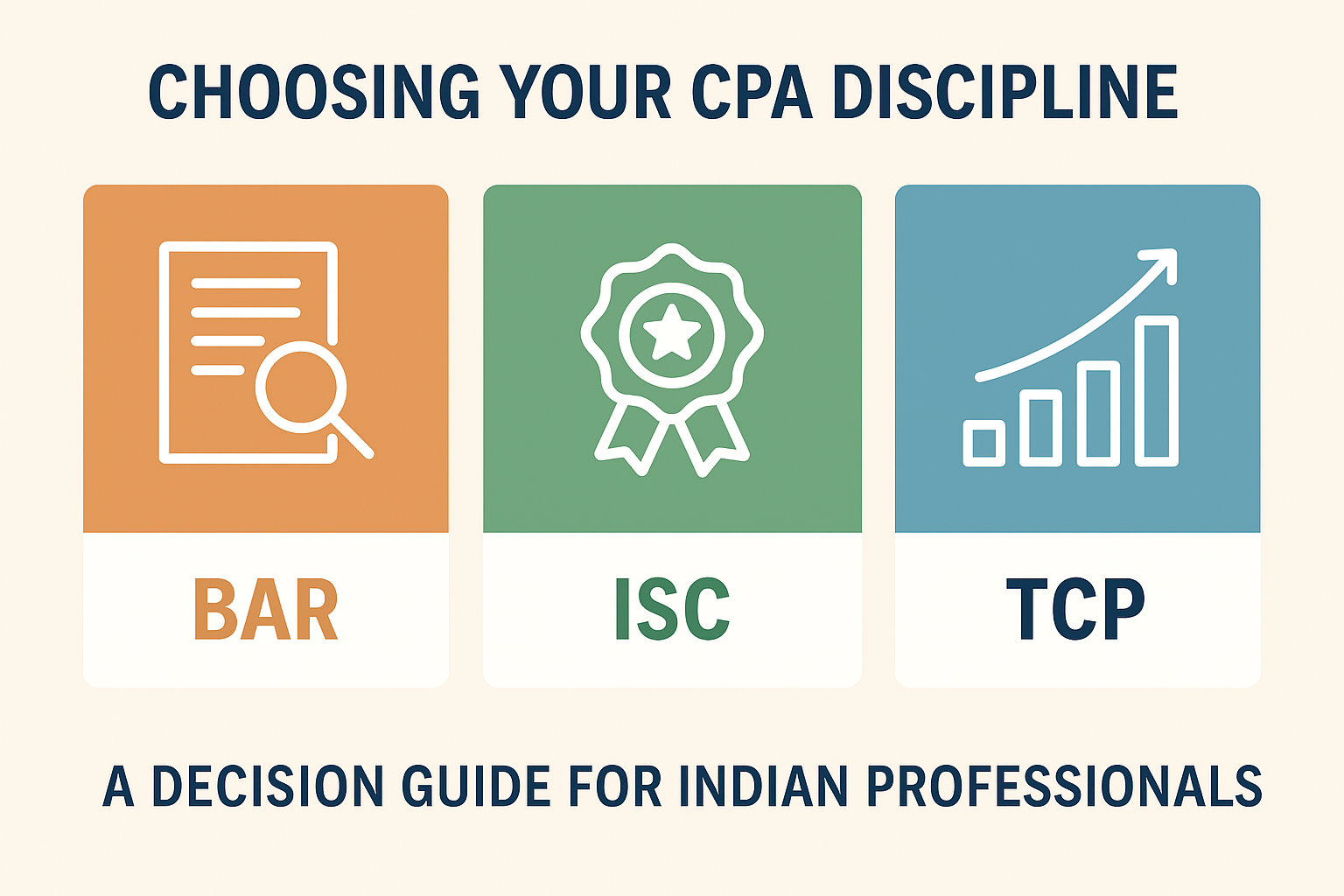
Practical guide for Indian professionals choosing between CPA disciplines BAR, ISC, and TCP. Learn how to match your strengths to the right discipline and make a confident decision. This article is written by Media Vinod, Senior Associate at LawSikho.
The CPA Evolution transformed the exam structure in January 2024, replacing the traditional four-section format with a Core + Discipline model. Now, every CPA candidate must pass three Core sections and select one Discipline from BAR, ISC, or TCP. For Indian professionals balancing demanding work schedules with CPA preparation, this additional decision can feel like one more complication in an already challenging journey. The good news is that choosing your discipline does not need to be stressful. With a clear understanding of what each discipline offers and an honest assessment of your strengths, you can make a confident choice that sets you up for exam success. This guide cuts through the confusion and gives you a practical framework for selecting the discipline that fits your background, abilities, and career aspirations.
Understand the Three CPA Discipline Options
Quick Comparison of BAR, ISC, and TCP
Each CPA discipline builds on one of the three Core sections and allows you to demonstrate deeper expertise in a specific area. Understanding what each discipline tests and who it serves best is your starting point for making an informed choice.
- Business Analysis and Reporting, commonly called BAR, extends the Financial Accounting and Reporting Core section into advanced territory. This discipline covers sophisticated financial statement analysis, complex accounting treatments like derivatives and consolidations, data analytics for business decisions, and state and local government accounting. BAR suits candidates who excel at financial reporting concepts and want careers in corporate accounting, financial advisory, or controller-track positions. If you found FAR intuitive and enjoyed working through technical accounting problems, BAR is your natural extension.
- Information Systems and Controls, known as ISC, builds on the Auditing and Attestation Core section with a technology focus. This discipline tests IT governance, data management, cybersecurity controls, and SOC engagement procedures. ISC is designed for candidates interested in IT audit, risk advisory, systems consulting, or technology governance roles. If you have an IT background, enjoy working with systems and controls, or see yourself in technology-focused accounting roles, ISC aligns with that trajectory.
- Tax Compliance and Planning, abbreviated as TCP, deepens the Regulation Core section into advanced taxation. This discipline covers sophisticated individual tax scenarios, entity tax compliance for corporations and partnerships, tax planning strategies, and property transactions. TCP fits candidates with tax backgrounds or those targeting careers in tax compliance, planning, or advisory services. If REG was your strongest Core section and tax rules feel logical to you, TCP leverages that foundation effectively.
Key Differences in Exam Structure
Beyond content differences, the three disciplines have distinct exam formats that may influence your choice. All three sections give you 4 hours to complete the exam, but the question distribution varies significantly.

BAR includes 50 multiple-choice questions and 7 task-based simulations, with an equal 50/50 scoring weight between MCQs and TBSs. This balanced format means your performance on both question types matters equally. TCP follows a similar structure with 68 MCQs and 7 TBSs, also weighted 50/50. The additional MCQs in TCP compared to BAR mean you will face more individual tax and entity compliance questions.
ISC stands apart with 82 multiple-choice questions and only 6 task-based simulations. More importantly, ISC uses different scoring weights, with MCQs contributing 60 percent and TBSs contributing 40 percent of your final score. If you perform better on multiple-choice questions than on simulations, ISC’s format may work in your favor. Conversely, if you excel at simulations, BAR or TCP’s balanced weighting might suit you better.
What Current Pass Rates Mean for Indian Candidates
Pass rates are often the first thing candidates look at when choosing a discipline, but interpreting these numbers correctly matters more than simply picking the highest rate. According to AICPA data, the 2025 cumulative pass rates through Q3 show TCP leading at 78 percent, followed by ISC at 68 percent, and BAR at 42 percent. These differences are dramatic, but they do not tell the complete story.
TCP’s exceptionally high pass rate reflects two important factors that may not apply to you. First, TCP content aligns very closely with REG, more so than the other Core-Discipline pairings. Candidates who take TCP immediately after passing REG benefit from significant content overlap and fresh tax knowledge. Second, early TCP candidates were disproportionately experienced tax professionals who self-selected into this discipline because it matched their existing expertise. The AICPA has noted that TCP candidates in initial quarters were unusually well-prepared compared to typical exam populations.
BAR’s lower pass rate does not mean the exam is inherently unfair or impossible. BAR absorbed challenging content from the eliminated BEC section, including cost accounting and managerial accounting topics. The discipline also includes governmental accounting, which is unfamiliar territory for most candidates, especially those from India. However, candidates with strong FAR performance and a genuine interest in financial analysis often pass BAR without unusual difficulty.
The critical insight for Indian candidates is this: aggregate pass rates reflect the entire candidate population, not your individual situation. A candidate who struggled through REG may find TCP harder than BAR despite the pass rate difference. Your personal strengths determine your personal likelihood of success. Choose the discipline where your background gives you the strongest foundation, and prepare thoroughly. Do not select TCP simply because 78 percent sounds better than 42 percent.
Choosing Your CPA Discipline: A Practical Framework
Match Your Discipline to Your Strongest Core Section
The most reliable predictor of discipline success is your performance on the related Core section. This connection exists because each discipline builds directly on Core content, creating natural preparation advantages when you stay within your strength area.
If FAR was your highest-scoring or most comfortable Core section, BAR is your strategic choice. The advanced financial reporting concepts, technical accounting treatments, and analytical skills tested in BAR extend what you already demonstrated in FAR. Taking BAR immediately after passing FAR allows you to leverage fresh knowledge rather than relearning concepts months later.
If AUD resonated with you and you found audit concepts logical, ISC builds on that foundation. The control environments, risk assessment frameworks, and assurance principles from AUD connect to ISC’s IT governance and SOC engagement content. Candidates who enjoyed the conceptual nature of auditing often appreciate ISC’s focus on systems and controls.
If REG was where you performed best and tax calculations felt natural, TCP is your obvious path. The individual and entity taxation topics in TCP directly extend REG content into more sophisticated scenarios. Many candidates report that TCP felt like a continuation of REG rather than an entirely new subject area. Taking TCP right after REG while tax rules remain fresh in memory is the recommended sequencing strategy.
Factor in Your Indian Qualifications and Experience
Your Indian educational background and work experience should heavily influence your discipline decision. Different qualifications create different starting points for each discipline.
Chartered Accountants typically have strong foundations for both BAR and TCP. Your CA training in advanced accounting standards supports BAR content, while your taxation studies prepare you for TCP. The choice between these two often comes down to which area you found more engaging during your CA journey. If you gravitated toward financial reporting and enjoyed audit work, BAR aligns with that preference. If taxation was your stronger suit and you see yourself in tax roles, TCP makes strategic sense. ISC may require more new learning for CAs unless your work experience includes significant IT audit or systems control exposure.

B.Com and M.Com graduates should consider their specialization and subsequent work experience. If your commerce degree emphasized accounting and you have worked in financial reporting roles, BAR builds on that background. If your studies or career leaned toward taxation, TCP leverages your existing knowledge. Those working in audit firms with IT audit exposure might find ISC approachable despite it being less directly connected to the typical commerce curriculum.
CMA holders often find BAR appealing because the discipline includes cost accounting and managerial accounting content that transferred from the old BEC section. Your CMA training in performance management and financial analysis provides a head start on BAR’s business analysis content areas.
Consider your current job role as well. If you work on audit teams and want to continue that trajectory, BAR or ISC both connect to audit-related career paths. If you work in tax compliance or advisory, TCP demonstrates a commitment to your specialization. Aligning your discipline with your current work creates study efficiency because you encounter familiar concepts rather than entirely new material.
Career Implications of Your Discipline Choice
One of the biggest concerns Indian candidates express about discipline selection is whether it limits future career options. The straightforward answer is no. Your discipline does not restrict your practice rights in any way. Every CPA receives the same license regardless of whether they passed BAR, ISC, or TCP. You can work in tax even if you passed BAR, and you can work in audit even if you passed TCP. Employers hire CPAs based on overall competence and relevant experience, not based on which discipline appears on your score report.
That said, the specialized knowledge you gain while preparing for your discipline can provide career advantages in certain contexts. Understanding how each discipline connects to the Indian job market opportunities helps you make a strategically informed choice.
TCP is particularly valuable for Indian professionals targeting US tax compliance roles. Major accounting firms and captive centers in India have substantial practices serving US clients with tax return preparation, tax research, and compliance support. CPAs with TCP expertise demonstrate relevant knowledge for these roles. If you see yourself in the US tax practice at a Big 4 firm or in a KPO serving American clients, TCP aligns with that career direction.
ISC connects to the growing demand for IT audit, risk advisory, and technology governance services in India. As organizations face increasing cybersecurity threats and regulatory scrutiny around data protection, professionals who understand IT controls and SOC engagements become more valuable. If you are interested in risk advisory services or see technology-focused accounting as an emerging opportunity, ISC positions you well.
BAR supports traditional accounting career paths, including financial reporting, corporate accounting, and the controller-to-CFO trajectory. MNCs operating in India need professionals who understand advanced financial reporting requirements, and BAR expertise signals that capability. If your ambition is to lead finance functions at corporations or to work in financial advisory services, BAR knowledge serves that direction.
For Indian candidates planning eventual relocation to the US, all three disciplines have strong market demand. American employers value your CPA credential and your ability to demonstrate competence in interviews and on the job. The specific discipline matters far less than your overall professional capability and how well you present yourself as a candidate.
Conclusion
Choosing your CPA discipline comes down to a simple framework: assess your Core section performance to identify where you are strongest, consider how your Indian qualifications and work experience align with each discipline, and think about your career direction. The discipline that matches your strengths is the discipline where you have the best chance of passing efficiently. Do not overcomplicate this decision by worrying about pass rate statistics that may not reflect your individual situation, or by trying to predict what employers might prefer years from now.
Your discipline choice matters for your exam preparation journey because content alignment makes studying more efficient and passing more likely. However, this choice does not define your entire CPA career. Once you earn your license, you have the same credentials and practice rights as every other CPA. Focus on selecting a discipline you can prepare for confidently, study thoroughly, and pass on your first attempt. Make your decision, commit to your preparation, and move forward knowing that your CPA credential, not your discipline choice, is what will open doors throughout your career.
If you want to know more about CPA Discipline sections, click here.
 Serato DJ Crack 2025Serato DJ PRO Crack



 Allow notifications





