

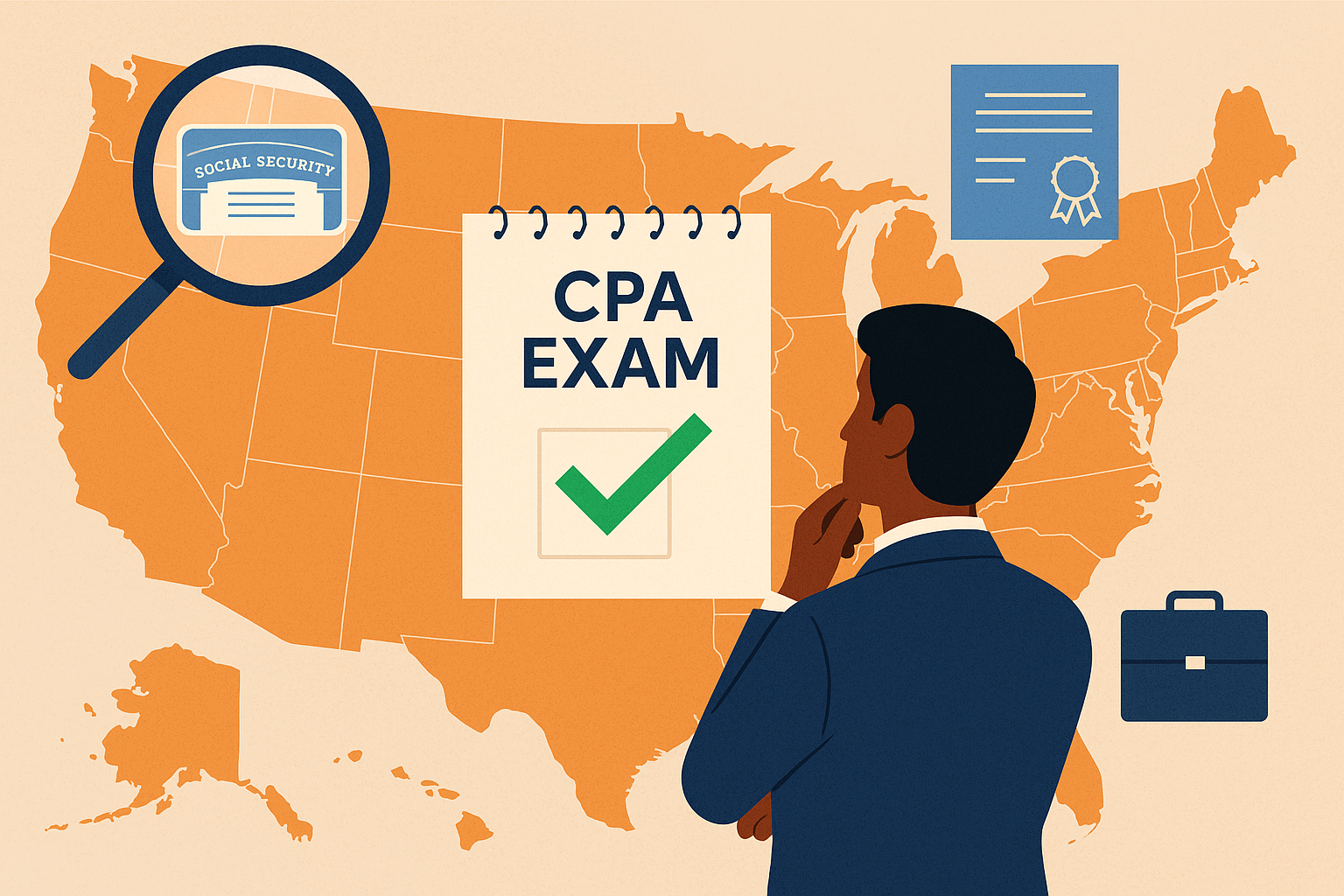
Quick guide for Indian professionals choosing the best US state for CPA exam. Compare Washington, Alaska, Guam, Illinois based on SSN, credits, and experience requirements. This article is written by Rohit Arora, Senior Associate at LawSikho.
Table of Contents
Choosing the right US state to register for your CPA exam is one of the most important decisions Indian candidates make, yet most get overwhelmed by 55 different jurisdictions with varying rules.
Each state has its own policies on education requirements, Social Security Number mandates, and experience verification, and picking the wrong one can mean rejected applications or passing all four exams only to discover you cannot get licensed. This guide cuts through the confusion and gives you a clear framework to pick the best state based on your specific qualifications, whether you have access to a Social Security Number, and your work experience situation.

What Are the Most Important Factors to Consider Before Selecting a CPA State Board?
Before comparing individual states, you need to understand the five factors that determine whether a state will actually work for your situation. Getting this wrong upfront leads to wasted fees and frustrating delays, so take time to assess each factor against your circumstances.
SSN Requirements
The Social Security Number requirement eliminates more states from consideration than any other single factor for Indian candidates. Some states require SSN just to apply for the exam, others need it only at the licensing stage, and a handful offer complete exemptions or waiver processes. If you do not have an SSN through a US work visa or other means, your realistic options narrow to approximately five or six states.
Washington, Alaska, Montana, Guam, and Illinois all allow Indian candidates to complete the entire CPA process without ever providing an SSN. States like Virginia and California occupy a middle ground, letting you sit for exams without SSN but requiring it before they issue your license. If your immigration status might change and you expect to obtain SSN eventually, these middle-ground states become viable. Otherwise, focus exclusively on states with full SSN exemptions.
How flexible are state boards with Indian degrees and credit hours?
US states measure education in semester credit hours, typically requiring 120 credits for exam eligibility and 150 credits for full licensure. Your Indian degree operates on a completely different system, so evaluation agencies like NASBA International Evaluation Services (NIES) convert your transcripts into US equivalents. A 3-year B.Com usually yields 90 to 110 credits, while adding an M.Com brings most candidates to 120 to 150 credits total.
The key question is whether your target state allows exam eligibility at 120 credits or requires the full 150 upfront. Most international-friendly states let you begin the exam with 120 credits and complete additional coursework before licensing. However, Kansas, Louisiana, Rhode Island, and a few others require 150 credits before you can schedule your first exam section. Alaska stands out by allowing candidates who are within 18 credits of completing their degree to start the exam process immediately.
What do states require for work-experience verification?
Even after passing all four CPA exam sections, you need verified work experience to receive your license. Most states require one to two years of accounting experience supervised and verified by an active US CPA. For Indian candidates working in India, finding a US CPA willing to verify your experience becomes a significant challenge that many candidates underestimate.
Illinois offers the most flexibility here by accepting experience verification from any supervisor, regardless of whether they hold CPA credentials. Washington requires verification by a US CPA but allows it to be someone other than your direct supervisor, as long as they have held an active license for at least five years. Guam sidesteps this problem entirely by offering an “inactive” license to candidates who pass the exam but cannot fulfill experience requirements.
Do states require US residency or citizenship?
Residency and citizenship requirements vary significantly across states. The good news is that most international-friendly states have eliminated these barriers. Washington, Alaska, Montana, Guam, and Illinois do not require you to be a US citizen, US resident, or even to have ever visited the United States. You can complete your entire CPA journey from India.
However, some states that otherwise seem attractive have hidden residency clauses. Delaware requires state residency or employment, effectively excluding Indian candidates. A few states require you to maintain a US address for correspondence purposes, which can be managed through a registered agent service if needed. Always verify residency requirements before committing to a state.
What are the key cost components across different state boards?
Total CPA costs typically range from ₹2,00,000 to ₹2,60,000 if you take your exams in the US. For candidates testing in India, the total cost increases to approximately ₹3,30,000 to ₹3,80,000 due to the international testing surcharge.
The major components include
- credential evaluation fees $250 (₹21,000–₹25,000),
- state application fees (₹7,500–₹20,000),
- exam fees for four sections (₹1,30,000–₹1,70,000 for US testing), and
- licensing fees (₹8,000–₹25,000).
Candidates taking the exam in India pay an additional $390 per section (about ₹1,30,000 total), which significantly increases the cost. Alaska’s licensing fees are at the higher end compared to states like Washington or Illinois.
Top 5 States for Indian CPA Candidates
Based on the factors above, five states consistently emerge as the best options for Indian professionals. Each has distinct advantages depending on your specific situation.

Why Is Washington State the Most Popular Option for Indian CPA Aspirants?
Washington has become the default recommendation for Indian CPA candidates, and for good reason. The Washington State Board of Accountancy (WSBA) does not require SSN (though you should confirm this by writing directly to WSBA, accepts NIES credential evaluations, and allows experience verification by any US CPA with five or more years of active licensure. This means your verifier does not need to be your direct supervisor or even someone you have worked with directly.
The trade-off is that Washington requires 120 credit hours to sit for the exam, which is higher than some alternatives. If your B.Com plus M.Com combination evaluates to 150 credits, Washington offers the smoothest pathway. If you fall short, you will need to complete bridge courses before applying. Application processing in Washington has improved significantly in recent years, and the state’s established systems handle international candidates efficiently.
For a B.Com plus M.Com holder working in an Indian company who can connect with a US CPA through professional networks or coaching institute alumni, Washington represents the most balanced choice across all factors.
Why Is Alaska a Strong Choice for B.Com Graduates from India?
Alaska shines for candidates whose credentials fall short of the standard 120-credit exam threshold. The Alaska Board of Public Accountancy allows candidates to begin the exam process when they are within 18 semester hours of completing their bachelor’s degree requirements. This policy means a B.Com graduate whose evaluation yields only 105 credits can potentially start taking exam sections while completing additional coursework.
Alaska also does not require SSN, citizenship, or state residency. The experience requirement is two years of relevant accounting work, interpreted broadly to include various accounting-adjacent roles. Starting January 2026, Alaska will implement an alternative pathway allowing candidates to substitute additional experience for the 150-credit requirement, making it even more accessible.
The downside is cost. Alaska’s licensing fees are higher than most states, with a $200 application fee plus a $300 certificate fee. For candidates prioritizing an early start over minimizing expenses, Alaska’s credit flexibility outweighs its higher fees.
How Does Guam Help Candidates Without Work Experience or SSN?
Guam solves a problem that frustrates many Indian candidates: what happens if you pass all four exam sections but cannot find a US CPA to verify your work experience? The Guam Board of Accountancy offers an “inactive” CPA certificate to candidates who pass the exam and meet education requirements without completing the experience component.
This inactive certificate is not a full practice license, but it officially recognizes your exam achievement and education qualifications. You can list it on your resume, and it demonstrates to employers that you have passed one of the most challenging professional exams in accounting. Later, when you fulfill experience requirements or relocate to a jurisdiction where verification is easier, you can convert to active status or transfer your credentials.
Guam requires 120 credit hours to sit for the exam, does not require SSN, and has no residency requirements. For candidates concerned about the experience verification bottleneck, Guam provides a guaranteed endpoint to the exam journey even if full licensure takes longer.
Why Do Many Indian Candidates Prefer Illinois for Its Flexibility?
Illinois deserves serious consideration despite requiring 150 credit hours because it offers something almost no other state does: experience verification without requiring your supervisor to be a CPA. The Illinois Board of Examiners accepts verification from any supervisor familiar with your accounting work, regardless of their credentials.
For Indian professionals working in Bangalore, Mumbai, or Delhi under managers who are not US CPAs, this policy is transformative. Your Indian employer can verify your experience directly, eliminating the need to find an external US CPA verifier. Illinois also does not require SSN and has well-established processes for international candidates.
The catch is an additional requirement: 3 credit hours specifically in research and analysis coursework. Many candidates need to take one extra course beyond their standard evaluation to meet this mandate. Application processing in Illinois tends to be slower than Washington, so factor additional time into your planning.
How Does Montana Serve as a Balanced and Reliable Alternative?
Montana provides a straightforward option for candidates who meet the 150-credit threshold. The Montana Board of Public Accountants does not require SSN and follows standard one-tier licensing, meaning you receive both your certificate and license upon meeting all requirements. Experience requirements are one year verified by a licensed CPA, and the state’s processes are efficient without excessive bureaucracy.
Montana changed its rules in 2015, eliminating a previous certificate-only option that had made it popular for credentials-only purposes. Under current rules, Montana functions similarly to Washington but with slightly less name recognition. For candidates whose credentials comfortably meet 150 credits and who have access to a US CPA verifier, Montana offers a clean, predictable pathway.
The state’s higher application fee ($245 versus Washington’s $90) makes it slightly more expensive at the application stage, though total journey costs remain comparable across these top states.
Quick Decision Matrix: Which State Fits Your Profile?
Rather than analyzing every state’s requirements in isolation, match your specific profile to the state that addresses your biggest constraints.
If You Are a Chartered Accountant
Your CA qualification from ICAI adds value to your credential evaluation but does not provide automatic recognition in any US state since Colorado and Michigan changed their policies. Have your B.Com plus CA combination evaluated through NIES to determine your total credit count. Most CA holders with a 3-year B.Com reach 130 to 145 credits after evaluation, placing you in a strong position for multiple states.
If your evaluation reaches 150 credits with robust accounting course coverage, Washington offers the best combination of efficient processing and flexible experience verification. If you fall slightly short of 150 credits, Illinois lets you begin after completing one or two bridge courses while offering the advantage of non-CPA supervisor verification for your Indian work experience.
Your CA background demonstrates accounting competency that strengthens your profile regardless of which state you choose. Focus your decision on the practical factors of credit hours and experience verification rather than seeking CA-specific recognition that no longer exists.
If You Have B.Com and M.Com
The B.Com plus M.Com combination represents the clearest pathway for Indian candidates. Your combined credentials typically evaluate to 120 to 150 semester credits depending on your specific programs, course content, and the evaluation agency’s interpretation. Request your NIES evaluation early so you know exactly where you stand before committing to a state.
If your evaluation reaches 150 credits, Washington should be your default choice. It offers the most established processes, competitive fees, and flexible experience verification through any US CPA connection. If your evaluation falls between 120 and 149 credits, you can still apply to Washington while completing additional online courses to reach 150 before your exam eligibility is processed.
If your evaluation yields between 100 and 119 credits, Alaska’s policy of accepting candidates within 18 credits of completion gives you the earliest possible start on your exam journey. Begin bridge coursework immediately and apply to Alaska once you are within that 18-credit window.
If You Only Have B.Com (3-Year Degree)
A 3-year B.Com alone typically evaluates to 90 to 110 credits, which falls short of even the minimum 120-credit exam threshold in most states. You have two strategic options: pursue additional education first or leverage Alaska’s flexibility.
The additional education route involves completing an M.Com, relevant professional certification, or bridge courses through accredited online programs until your total credits reach exam eligibility thresholds. Many candidates complete 30 to 40 additional credits through part-time study while working, then apply to Washington or Illinois.
The Alaska route lets you start sooner. If your B.Com evaluation yields 105 credits, you are technically within 18 credits of the typical 120-hour threshold and might qualify to begin exams in Alaska while completing additional coursework. This approach works best if you are disciplined about simultaneously studying for exams and completing credit courses.
Regardless of your path, accept that additional coursework is necessary. No state offers full CPA licensure to candidates with only 90 to 110 credits, so budget both time and money for educational supplements.
What Steps Should You Follow After Finalising Your CPA State Choice?
Once you have identified your target state, execution becomes straightforward if you follow the proper sequence.
How Should You Get Your Academic Credentials Evaluated?
Start your credential evaluation through NIES immediately, even before finalizing every detail of your state choice. The evaluation takes approximately six weeks after NIES receives all documents, but getting those documents from Indian universities often adds another four to eight weeks. Beginning this process early prevents delays later.
Contact your university’s examination department to request sealed transcripts sent directly to NIES. Many Indian universities require specific request forms, payment of fees, and sometimes in-person visits to initiate this process. Follow up persistently because administrative delays at the university level are the most common source of timeline slippage.
Once your evaluation is complete, you will receive a detailed report showing your US credit equivalents, distribution across accounting and business subjects, and any coursework gaps. This report determines which states you qualify for and whether additional courses are needed.
How Do You Submit a Complete Application to the State Board?
With your evaluation report in hand, apply to your chosen state through their designated portal. Most internationally friendly states use NASBA’s CPA Central system for application processing. Create your account, upload your evaluation report, complete the application forms, and pay the required fees.
Double-check that you are applying for education evaluation and exam eligibility as separate steps if your state requires this. Washington and Alaska, for example, require an initial education evaluation application before you can apply for specific exam sections. Missing this step creates confusion and delays.
Ensure all names across your documents match exactly. Your passport name, evaluation report name, and application name must be identical, including middle names, suffixes, and spelling variations. Discrepancies trigger verification holds that add weeks to your processing time.
What Happens After Your Application Is Approved (NTS, Scheduling, Timelines)?
Upon approval, you receive an Authorization to Test (ATT) confirming your exam eligibility. Shortly after, NASBA issues your Notice to Schedule (NTS), which authorizes you to book specific exam sections at Prometric testing centers. Your NTS is typically valid for six months, meaning you must schedule and take the listed exam sections within that window or lose your fees.
Schedule your exam through Prometric’s website, selecting either US-based testing centers or international locations in India, the Middle East, or other participating countries. Popular testing windows fill quickly, so book as soon as you receive your NTS rather than waiting until your preferred date approaches.
After taking each exam section, scores are released according to AICPA’s published schedule, typically within four to six weeks of your testing window close. You need a score of 75 or higher on each section to pass. Once all four sections are passed within the 30-month rolling window (previously 18 months), you can apply for your license by submitting experience verification and completing any remaining requirements like the ethics exam.
Conclusion
Selecting the right state for your CPA exam registration requires matching your specific situation, including your credit hours, SSN status, and experience verification options, to states that genuinely accommodate those circumstances. Washington works best for B.Com plus
M.Com holders with 150 credits who can connect with a US CPA verifier. Alaska suits candidates with fewer credits who want to start exams sooner. Guam provides a safety net for those worried about experience verification. Illinois helps candidates whose supervisors are not US CPAs. Montana offers a reliable alternative for those meeting standard thresholds.
Your next step is clear: request your credential evaluation through NIES today. The evaluation report will confirm exactly where you stand on credit hours and accounting coursework, transforming abstract state comparisons into concrete eligibility determinations. From there, select your state based on the framework in this guide, submit your application, and begin your CPA exam preparation with confidence that your path to licensure is viable. The CPA credential opens career doors that justify this investment, and choosing your state strategically ensures you reach that destination without unnecessary detours.If you want to learn in details about which US state works best for you? Then, read my article here.
 Serato DJ Crack 2025Serato DJ PRO Crack


 Allow notifications





