

Understand the CPA exam structure, sections, question types, and scoring for Indian candidates. Learn about core vs discipline sections, pass rates, and testing logistics in India. This article is written by Medha Vinod, Senior Associate at LawSikho.
The CPA exam follows a straightforward structure once you understand its core components. You’ll complete four sections total: three mandatory core sections covering audit, financial accounting, and taxation, plus one discipline section of your choice. Each section is four hours long and combines multiple-choice questions with practical simulations. This guide breaks down the exam structure, question formats, and key considerations to help Indian candidates approach the CPA exam strategically.
CPA Exam Structure Explained: The Core + Discipline Model
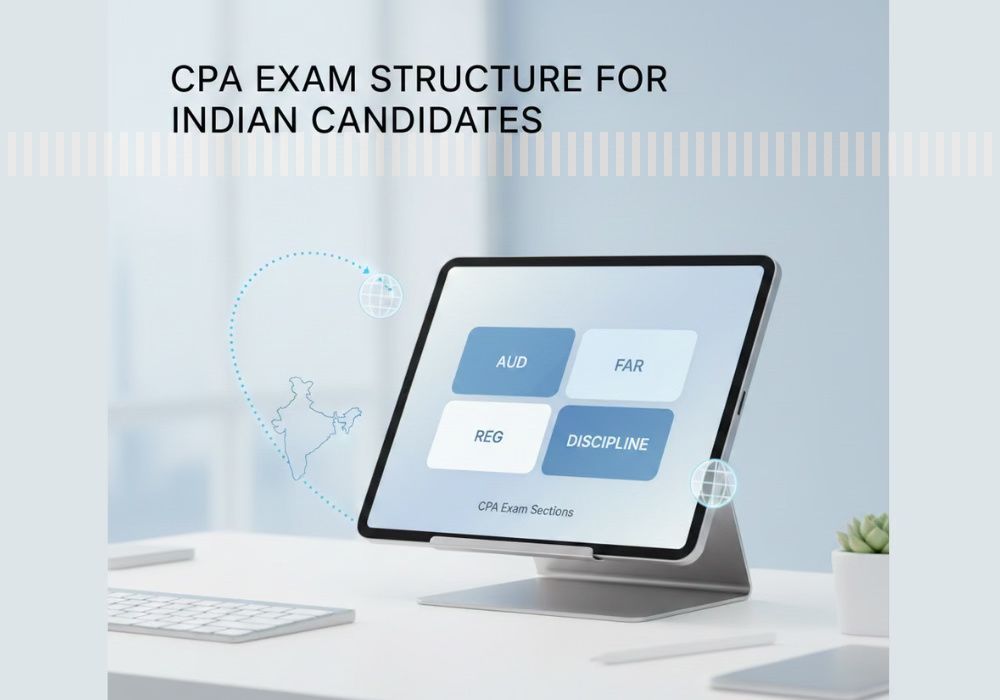
The CPA exam operates on a “Core + Discipline” framework that took effect in January 2024 under what AICPA and NASBA call CPA Evolution. This structure replaced the previous four-section model (which included AUD, BEC, FAR, and REG) with a more flexible system. Now, every candidate completes three identical core sections testing essential accounting knowledge, then selects one discipline section that aligns with their career specialization. The total remains four exams, but you now have a meaningful choice in your fourth section.
This model benefits Indian candidates because you can tailor part of your certification to your professional goals. Someone pursuing Big 4 audit work might choose differently from someone building a career in tax advisory or IT audit. Understanding this structure upfront helps you plan not just your study approach, but your entire CPA journey.

Three Core Sections (AUD, FAR, REG) Every Candidate Must Pass
The three core sections form the foundation of CPA competence and are non-negotiable for all candidates worldwide. Auditing and Attestation (AUD) tests your understanding of audit processes, professional responsibilities, and reporting requirements under US auditing standards. Financial Accounting and Reporting (FAR) covers US GAAP extensively, including financial statement preparation, governmental accounting, and IFRS comparisons. Taxation and Regulation (REG) addresses US federal taxation for individuals and entities, business law fundamentals, and ethical responsibilities.
Each core section runs four hours and combines multiple-choice questions with task-based simulations. The question counts differ: AUD has 78 MCQs, FAR has 50, and REG has 72. These variations affect your time management strategy, which we’ll address later. As of 2025, all three core sections offer continuous testing, meaning you can schedule them any day a Prometric center operates rather than waiting for specific testing windows.
For Indian professionals, these sections present both familiar and unfamiliar territory. If you hold a CA qualification, audit and accounting concepts will have parallels, though the standards differ significantly. US federal taxation will likely be entirely new, requiring dedicated study time regardless of your Indian tax experience.
Choosing One Discipline Section (BAR, ISC, or TCP)
Your discipline choice is where strategy enters the equation. You’ll select one of three options: Business Analysis and Reporting (BAR), Information Systems and Controls (ISC), or Tax Compliance and Planning (TCP). Each discipline extends one of the core sections into advanced territory. BAR builds on FAR with complex accounting topics and financial analysis. ISC extends AUD into IT audit, cybersecurity, and system controls. TCP deepens REG content with advanced tax compliance and planning.
The discipline you select should reflect your career aspirations rather than perceived difficulty. AICPA guidance explicitly recommends choosing based on your education, work experience, and professional interests. Pass rates vary significantly across disciplines (from 41% for BAR to 78% for TCP), but a higher pass rate doesn’t mean a section will be easier for you personally.
Unlike core sections, disciplines are offered only during specific quarterly windows in 2025. You’ll need to align your preparation timeline with these windows, which fall primarily in January, April, July, and October, with an additional June window added for 2025.
Question Types and Exam Format
Every CPA exam section, whether core or discipline, uses the same two question formats: multiple choice questions (MCQs) and task-based simulations (TBSs). This standardized approach allows consistent competency assessment across all sections. Gone are the written communication tasks that existed in the old BEC section; as of 2024, the exam tests your knowledge entirely through objective question types.
The exam delivers questions in five testlets per section. You’ll complete two MCQ testlets first, take a 15-minute break that doesn’t count against your time, then work through three TBS testlets. Once you submit a testlet, you cannot return to it, so manage your time within each testlet carefully.
Multiple Choice Questions and Task-Based Simulations
MCQs test your ability to recall information, understand concepts, and apply knowledge to specific scenarios. Each question presents four answer choices, and you select the single best response. There’s no negative marking, so answering every question, even with an educated guess, is always better than leaving blanks. MCQs contribute 50% of your total score in most sections (60% in ISC).
The CPA exam uses adaptive testing for MCQs. Your first MCQ testlet contains medium-difficulty questions. Based on your performance, the exam algorithm adjusts your second testlet to either medium or higher difficulty. Receiving a harder second testlet actually signals that you performed well initially, and the scoring accounts for this difficulty adjustment.
Task-based simulations test the practical application of accounting knowledge through realistic work scenarios. You’ll analyze documents, complete calculations using a SpreadJS spreadsheet tool, research authoritative literature, and make professional judgments. TBSs contribute 50% of your score in most sections (40% in ISC). These simulations require more than content knowledge; familiarity with the exam interface and practice with simulation formats is essential.
MCQ and TBS Counts by Section
Question counts vary substantially across sections, directly impacting how much time you can spend per question. Here’s the complete breakdown from the 2025 AICPA Blueprint:

| Section | Type | MCQs | TBSs | MCQ Weight | TBS Weight |
| AUD | Core | 78 | 7 | 50% | 50% |
| FAR | Core | 50 | 7 | 50% | 50% |
| REG | Core | 72 | 8 | 50% | 50% |
| BAR | Discipline | 50 | 7 | 50% | 50% |
| ISC | Discipline | 82 | 6 | 60% | 40% |
| TCP | Discipline | 68 | 7 | 50% | 50% |
Notice the range: FAR and BAR have only 50 MCQs, giving you roughly 1.8 minutes per question, while ISC has 82 MCQs, limiting you to about 1.3 minutes each. REG stands out with 8 TBSs, the highest simulation count. ISC is unique with its 60/40 weighting toward MCQs and only 6 simulations.
These numbers should inform your preparation. Sections with fewer MCQs (FAR, BAR) demand stronger conceptual understanding since each question carries more weight. Sections with more MCQs (AUD, ISC) require faster pacing and broad content coverage.
Scoring, Pass Rates, and Time Allocation for CPA Exam
Understanding how the CPA exam is scored helps you set realistic expectations and interpret your results correctly. The scoring system differs from percentage-based grading you may be familiar with from Indian examinations. Your preparation strategy should also account for current pass rates and build in deliberate time management frameworks.
The 75 Pass Mark and Scaled Scoring System
To pass any CPA exam section, you need a minimum scaled score of 75 on a 0-99 scale. This 75 is not a percentage; it’s a scaled score derived from your raw performance adjusted for question difficulty and the specific mix of items you received. You might answer 68% of questions correctly and pass, or answer 72% correctly and fail, depending on which questions you got right.
The AICPA’s scoring process weights your MCQ and TBS performance according to the section’s allocation (typically 50/50), adjusts for question difficulty, and scales to the final score. Harder questions contribute more to your score than easier ones, which is why the adaptive testing that gives you harder MCQs in Testlet 2 can work in your favor.
If you fail a section, you’ll receive a Candidate Performance Report showing how you performed across content areas. This diagnostic information helps you focus retake preparation on your weakest topics.
Current Pass Rates and Section Difficulty
Pass rates provide useful benchmarks, though they reflect aggregate candidate performance rather than inherent section difficulty. Based on Q3 2025 data, here’s how sections compare:
Core Sections:
- REG leads with approximately 64% pass rate
- AUD follows at roughly 48%
- FAR has the lowest core pass rate at approximately 43%
Discipline Sections:
- TCP has the highest pass rate of any section at approximately 78%
- ISC sits around 68%
- BAR has the lowest overall pass rate at approximately 43%
For Indian candidates, these numbers offer context but shouldn’t dictate your choices. FAR’s low pass rate reflects its extensive US GAAP content, but a CA holder with strong accounting fundamentals might find it manageable. TCP’s high pass rate partly results from candidates choosing it after strong REG performance, creating a self-selected group already comfortable with tax content.
The key takeaway: prepare thoroughly for any section you attempt. Even TCP with its 75% pass rate, means one in four candidates fail.
Time Management Across Question Types
You have 240 minutes (four hours) per section, but effective time allocation varies based on question counts. A practical framework: spend roughly 45-50% of your time on MCQs, take your 15-minute break, then allocate the remaining time to TBSs.
For MCQs, your per-question time depends on the section. For TBSs, budget 15-25 minutes per simulation depending on complexity. Some simulations involving straightforward calculations take 12-15 minutes; others requiring extensive analysis need 25+ minutes. Complete easier simulations quickly to bank time for complex ones.
If you’re running short on time, answer every remaining MCQ (no penalty for guessing) and attempt all TBSs even partially. TBSs offer partial credit, so entering some correct data earns points even if you can’t complete everything.
CPA Exam: Discipline Selection for Indian Career Paths
Your discipline selection is the most strategic decision in your CPA journey. Unlike core sections where everyone covers the same ground, your discipline choice signals your specialization to employers and shapes the knowledge you’ll carry into your career. For Indian professionals, this choice should factor in local market demand, your existing qualifications, and whether you plan to work primarily in India, the US, or cross-border roles.
BAR for Financial Analysis Roles
Business Analysis and Reporting suits candidates pursuing careers in corporate financial reporting, Big 4 audit practice, equity research, or investment banking. The section covers advanced accounting topics, including complex revenue recognition, business combinations, derivatives, hedge accounting, and financial statement analysis using data analytics. It also includes state and local government accounting.
BAR’s 41% pass rate, the lowest among all sections, reflects the advanced technical content. Candidates who excelled at FAR and genuinely enjoy complex accounting problems tend to perform best here. If you’re a CA holder moving into audit or financial reporting roles in MNCs, BAR provides credentials directly relevant to US GAAP compliance work.
The career payoff: BAR-qualified CPAs are valued in Big 4 assurance practices, corporate accounting departments of US-based multinationals operating in India, and financial advisory roles involving US market transactions.
ISC for IT Audit and Systems Careers
Information Systems and Controls targets candidates interested in IT audit, technology risk advisory, cybersecurity consulting, or SOC (System and Organization Controls) attestation work. Content areas include IT governance, data management, security and privacy controls, and SOC engagement frameworks. This discipline has the unique 60/40 MCQ/TBS weighting and the highest MCQ count at 82 questions.
ISC’s 56% pass rate reflects a candidate pool often self-selected for technology comfort. You don’t need to be a software engineer, but familiarity with IT concepts helps significantly. Indian professionals working in IT audit roles or interested in the rapidly growing technology risk practices at Big 4 firms will find ISC directly applicable.
The career opportunity: As digital transformation accelerates across Indian businesses and global capability centers expand, ISC-qualified CPAs are increasingly sought for technology consulting, IT internal audit, and cybersecurity assurance roles.
TCP for Tax Specialization
Tax Compliance and Planning is the natural extension for candidates building tax careers. The section covers advanced individual and entity tax compliance, tax planning strategies, estate and gift taxation, and personal financial planning. Content closely aligns with REG, making it accessible for candidates who performed well on that core section.
TCP’s 75% pass rate, the highest of any CPA section, results from several factors: candidates typically complete REG first (building foundational tax knowledge), many TCP candidates already work in tax roles, and the structured nature of tax rules suits candidates who prefer definitive answers over judgment-based questions.
For Indian CPAs interested in US-India cross-border tax practice, transfer pricing, or serving NRI clients, TCP provides essential specialized knowledge. The career applications include Big 4 tax practices, international tax departments of MNCs, and private wealth advisory serving clients with US tax obligations.
CPA Exam Testing Logistics for Indian Candidates
Taking the CPA exam from India has become substantially easier since NASBA opened permanent testing at Indian Prometric centers. You no longer need to travel internationally to sit for the exam, though Indian testing involves additional fees and specific scheduling considerations. Understanding these logistics helps you build a realistic timeline for completing your CPA.
Prometric Centers and Scheduling in India
Eight Prometric testing centers across India offer the CPA exam: Ahmedabad, Bangalore, Chennai, Hyderabad, Kolkata, Mumbai, New Delhi, and Trivandrum. This geographic distribution means most candidates can find a center within a reasonable distance, though seat availability varies. Mumbai, Bangalore, and Delhi centers tend to fill faster due to higher candidate concentrations.
To test in India, you must pay an International Administration Fee through your NASBA CPA Candidate Account portal after receiving your Notice to Schedule (NTS). This fee is separate from standard exam section fees and must be processed before Indian testing locations appear in the Prometric scheduling system. Plan to complete this step at least a week before attempting to book your exam date.
Schedule your exam 30-45 days in advance to secure your preferred date and location. You can check seat availability using Prometric’s online tool before paying fees. Testing centers operate on standard hours and are closed on Sundays and Indian public holidays.
Continuous Testing vs Quarterly Windows
Starting in 2025, the three core sections (AUD, FAR, REG) offer continuous testing. This means you can schedule these exams any day a Prometric center is open, giving you maximum flexibility. You’re not restricted to specific quarterly windows, and score release is faster, typically within 1-2 weeks of testing.
Discipline sections (BAR, ISC, TCP) operate differently. These are offered only during specific testing windows: January, April, June, July, and October in 2025. Missing a window means waiting several weeks for the next opportunity. Score release for disciplines takes 4-8 weeks after each window closes.
For Indian working professionals, this distinction matters for planning. You can complete core sections at your own pace throughout the year, but you must align your discipline preparation with the quarterly windows. Many candidates complete all three core sections first, then target a specific discipline window for their final exam.
The extended 30-month completion window (up from 18 months in most jurisdictions) benefits Indian professionals balancing exam preparation with demanding jobs. Once you pass your first section, you have 30 months to pass the remaining three before that first credit expires.
Conclusion
The CPA exam’s Core + Discipline structure offers Indian candidates a clear pathway to US CPA certification. You’ll complete three core sections testing foundational knowledge in audit, accounting, and taxation, plus one discipline of your choice that aligns with your career goals. Each section runs four hours, combining multiple-choice questions with task-based simulations, and requires a scaled score of 75 to pass.
Your preparation approach should account for the varying question counts across sections (50-82 MCQs, 6-8 TBSs), the different pass rates (43% for FAR to 75% for TCP), and the testing logistics specific to Indian candidates. With eight Prometric centers across India, continuous testing for core sections, and a 30-month completion window, the exam has never been more accessible. Choose your discipline strategically based on career goals rather than pass rates, build time management skills through practice, and approach each section with thorough preparation.
 Serato DJ Crack 2025Serato DJ PRO Crack



 Allow notifications





