

Learn CPA exam requirements for Indian candidates: eligibility criteria, state selection without SSN, credential evaluation process, exam structure, costs in INR, and realistic timelines. This article is written by Rohit Arora, Senior Associate at LawSikho.
Table of Contents
If you are an Indian accounting professional eyeing the US CPA credential, you have probably encountered a maze of information about eligibility requirements, state boards, credit hours, and evaluation processes.
The complexity is real, but so is the opportunity. Thousands of Indian professionals successfully earn their CPA licenses each year, and with the right roadmap, you can join them.

This guide cuts through the confusion to give you a practical, step-by-step understanding of what it takes to qualify for the CPA exam from India, which decisions matter most, and how to begin your application process with confidence.
CPA Exam Eligibility Criteria for Indian Qualifications
Understanding whether you qualify for the CPA exam is the foundation of your entire journey. Unlike Indian professional exams where eligibility is straightforward, the US CPA system evaluates candidates through a credit-based framework that requires Indian qualifications to be translated into American educational terms. Getting clarity on this upfront saves you from investing in a path you cannot complete and helps you identify any gaps you need to address before applying.
Credit Hour Requirements and Indian Degree Equivalence
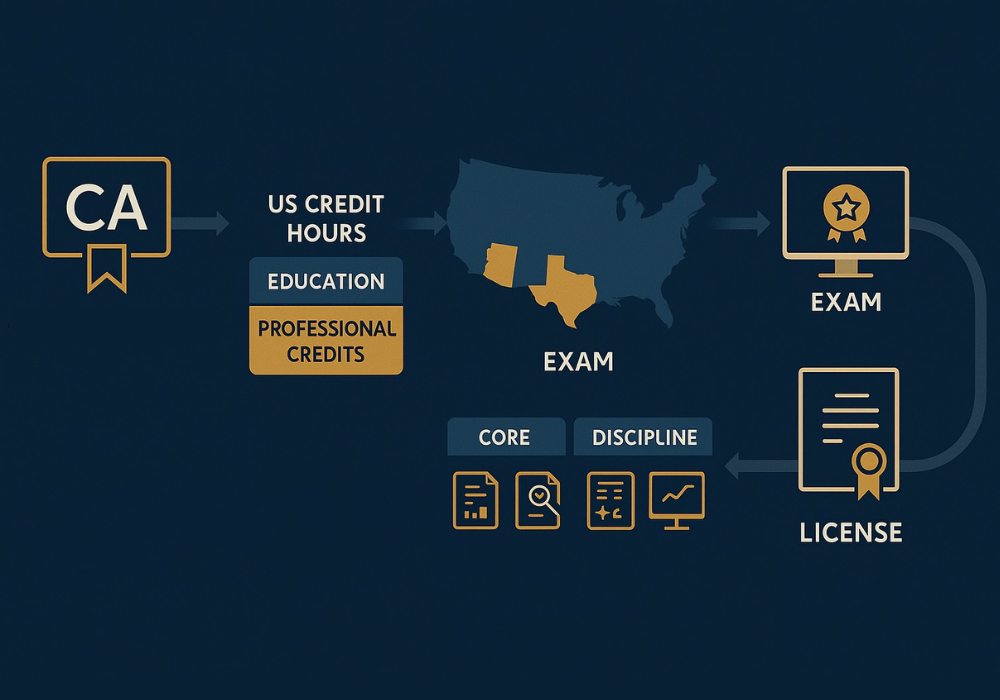
The US measures higher education in semester credit hours, a unit that does not directly correspond to Indian degree structures. Most state boards require 120 credit hours to sit for the CPA exam and 150 credit hours for full licensure. For Indian candidates, this means your degrees must be evaluated by authorized agencies that convert your academic records into US credit equivalents based on course content, duration, and institutional accreditation.
A standard three-year Bachelor of Commerce from an Indian university typically converts to around 90 US semester credit hours. This falls short of both the 120-credit exam threshold and the 150-credit license requirement. If you hold a B.Com plus a two-year M.Com, your combined credentials generally reach approximately 150 credits, meeting full licensure requirements in most states. Professional qualifications add additional value: Chartered Accountancy typically adds 30 to 60 credits depending on the evaluating agency and state board, while CS and CMA qualifications receive varying recognition. The practical implication is clear: B.Com-only holders need additional education, while B.Com plus M.Com or B.Com plus CA holders usually meet requirements directly.
What Work Experience is Required for CPA Licensure?
Passing all four CPA exam sections does not automatically make you a licensed CPA. Every US state requires candidates to complete supervised work experience, typically one to two years of full-time accounting work equivalent to approximately 2,000 hours. This experience must be verified by a licensed CPA, which creates a specific challenge for Indian candidates whose supervisors may not hold US CPA licenses.
The solution lies in strategic career positioning. Working for Big 4 accounting firms in India provides access to US-licensed CPAs who can verify your experience. Employment with multinational corporations that have US operations often offers similar opportunities. Some candidates fulfill this requirement through remote work arrangements with US-based firms or after relocating internationally.
State requirements vary, with some accepting only public accounting experience while others recognize industry, government, or academic work. Research your target state’s specific requirements before assuming your current role will qualify.
Selecting the Right US State for Indian Candidates
Your choice of US state board is not a minor administrative decision; it fundamentally shapes your CPA journey. The CPA license is issued at the state level, and each of the 55 US jurisdictions sets its own rules for education, experience, and examination. For Indian candidates, the critical filter is whether a state accepts applications from international candidates who do not possess a Social Security Number. Choosing wisely here prevents application rejections and wasted fees.
Five States That Accept Candidates Without SSN
Five US states have become go-to destinations for Indian CPA candidates because they process international applications without requiring a Social Security Number: Washington, Montana, Alaska, Guam, and Pennsylvania. Each participates in the international administration of the CPA exam through NASBA, allowing Indian candidates to apply, get evaluated, and take exams at Prometric centers within India.
Washington stands out as the most popular choice, combining clear requirements with efficient processing and strong recognition. The state requires 150 semester hours with specific accounting and business credits, plus one year of experience for licensure. Montana offers a streamlined alternative with comparable requirements and potentially faster turnaround times.
Alaska and Guam provide options for candidates whose credit profiles may not align perfectly with Washington or Montana specifications. Pennsylvania rounds out the options, though its requirements tend to be more complex for international applicants. Application fees range from approximately $90 to $245 across these states, with processing times varying from four to twelve weeks depending on application volume and completeness.
How Should Indian Candidates Choose a CPA State Based on Their Qualifications and Career Goals?
Rather than defaulting to the most popular state, match your selection to your specific situation. If you hold a B.Com plus M.Com with a clean 150-credit evaluation, Washington’s straightforward process makes it an excellent choice. CA holders often find Montana accommodating because it tends to recognize professional qualifications favorably when calculating credit equivalencies.
Consider factors beyond immediate eligibility. If you plan to eventually practice in a specific US state, research reciprocity agreements that would allow your license to transfer. Some states have more favorable mobility provisions than others.

Processing times matter if you are working against deadlines, whether professional goals or the expiration of study materials. Fee differences, while not dramatic, add up when combined with evaluation costs and exam fees. Finally, some candidates report that certain state boards respond more helpfully to inquiries from international applicants, a soft factor that can reduce frustration during a complex process.
How Does the CPA Credential Evaluation and Application Process Work for Indian Applicants?
Before any US state board will consider your application, your Indian educational credentials must undergo formal evaluation by an approved agency. This mandatory step translates your degrees, transcripts, and professional qualifications into terms American regulators understand. The evaluation determines your US credit hour equivalent and verifies that you meet the accounting and business course requirements of your chosen state. Skipping this step or selecting an unapproved agency means starting over, so getting it right the first time matters.
NIES vs WES: Choosing Your Evaluation Agency
Two evaluation agencies dominate the landscape for Indian CPA candidates: NASBA International Evaluation Services and World Education Services. Both are widely accepted, but they differ in process, fees, and specific advantages.
NIES operates as NASBA’s own evaluation service, designed specifically for CPA candidates. This direct connection to the CPA licensing system means evaluations align precisely with what state boards need. Fees typically run $200 to $300, depending on service level, with standard processing taking six to eight weeks. NIES requires official transcripts sent directly from your Indian institutions in sealed envelopes, plus degree certificates and mark sheets. WES offers a more general credential evaluation that can serve multiple purposes beyond CPA licensing, such as immigration applications or graduate school admissions. Fees are comparable at $200 to $350, with similar processing times. WES requires transcripts to be verified through their designated verification partner in India. For CA holders, WES needs ICAI verification before including the qualification in your evaluation. Both agencies are accepted by the major no-SSN states, so your choice may come down to whether you want a CPA-specific evaluation or a multi-purpose credential report.
From Application to Notice to Schedule (NTS)
Once your evaluation report arrives showing your US credit equivalency, the formal application process begins. You will apply to your chosen state board, typically through the NASBA candidate portal, submitting your evaluation report, application forms, and fees. State boards take four to eight weeks to verify your credentials and confirm eligibility.
Upon approval, you receive an Authorization to Test confirming you can sit for specific exam sections. After paying examination fees through NASBA, you receive your Notice to Schedule, the document that unlocks appointment booking at Prometric testing centers. Your NTS has a validity period, typically six to nine months, depending on your state, and expired documents mean forfeited fees. This creates important planning pressure: only apply for exam sections you can realistically prepare for within your NTS window. Paying for all four sections upfront may seem efficient, but if you cannot prepare in time, you lose those fees and must reapply.
CPA Exam Structure and Testing in India
The CPA exam itself underwent major changes in January 2024 with the launch of CPA Evolution, restructuring from four traditional sections to a Core plus Discipline model. Understanding this new format is essential for planning your preparation and selecting materials.
Equally important for Indian candidates is knowing that you can complete the entire examination within India at Prometric testing centers, eliminating the international travel that previous generations of candidates required.
Core Sections and Discipline Selection Under CPA Evolution
Under CPA Evolution, every candidate must pass three Core sections that test foundational knowledge all CPAs need: Financial Accounting and Reporting, Auditing and Attestation, and Taxation and Regulation. Each section is four hours long and includes multiple-choice questions and task-based simulations.
Beyond these mandatory sections, you choose one of three Discipline sections that allow specialization:
- Business Analysis and Reporting,
- Information Systems and Controls, or
- Tax Compliance and Planning.
Your discipline choice should reflect both your career direction and strategic exam planning. According to AICPA pass rate data, TCP consistently records the highest pass rates at 72% to 82%, largely because candidates choosing tax specialization typically have strong REG foundations and active tax experience.
BAR has recorded the lowest pass rates at 34% to 41%, building on FAR content that many candidates find challenging. ISC falls in between at 56% to 59%, appealing to candidates with technology backgrounds.
If you struggled with FAR, choosing BAR compounds that challenge. If you excelled in REG and work in taxation, TCP leverages your strengths. Choose strategically rather than randomly.
Prometric Centers in India and Scheduling
Indian candidates can take all CPA exam sections at Prometric testing centers in eight cities: Ahmedabad, Bangalore, Calcutta, Chennai, Hyderabad, Mumbai, New Delhi, and Trivandrum. This domestic availability, which became permanent in 2020, eliminates the significant costs and logistics of international travel that earlier candidates faced.
Core sections now follow continuous testing, meaning you can schedule FAR, AUD, and REG appointments throughout the year whenever slots are available.
This flexibility allows you to pace preparation according to your schedule rather than racing to meet testing window deadlines. Discipline sections operate differently, available only during the first month of each calendar quarter with scores released approximately one to two months later. Missing a discipline window means waiting until the next quarter, so plan your discipline timing carefully. Popular morning and weekend slots fill quickly; booking four to six weeks ahead ensures better availability. Rescheduling is free if done more than 30 days before your appointment, with fees applying for closer changes.
Cost Investment and Timeline Expectations
Money and time are the two resources every working professional guards carefully. Understanding exactly what the CPA journey costs and how long it realistically takes helps you plan appropriately, set expectations with family and employers, and avoid the frustration of underestimating the commitment involved.
Complete Cost Breakdown in Indian Rupees
The total CPA investment for Indian candidates typically falls between ₹3,00,000 and ₹4,50,000 when accounting for all components from credential evaluation through licensing. Credential evaluation from NIES or WES costs ₹15,000 to ₹25,000 including document handling and verification fees. State board application and registration fees add ₹7,500 to ₹20,000, depending on your chosen state.
Examination fees represent the largest single component. Each section costs $390 in base fees, but Indian candidates testing at domestic Prometric centers pay an additional international administration fee of approximately $120 per section, bringing the total to roughly $510 per section. Across all four sections, examination fees alone total approximately ₹1,70,000 to ₹2,00,000 at current exchange rates. Review courses from established providers range from ₹80,000 to ₹1,50,000, with Indian coaching partners sometimes offering bundled pricing with support services. Finally, licensing fees after passing all sections add ₹10,000 to ₹25,000. Budget for potential retakes as well; failing a section means paying examination fees again for that section.
What Is a Realistic CPA Timeline for Working Professionals in India?
Most Indian CPA candidates are working professionals who cannot study full-time. Setting realistic timeline expectations prevents the discouragement that comes from missing arbitrary deadlines. The complete journey from starting document gathering to holding your license typically takes eighteen to twenty-four months for working professionals.
The pre-exam phase consumes three to six months: two to four weeks gathering official documents from Indian institutions, six to eight weeks for credential evaluation processing, and another four to eight weeks for state board application approval. Only after this phase can you schedule your first exam. The examination phase typically spans twelve to eighteen months for all four sections when studying fifteen to twenty hours weekly alongside full-time work. At this pace, each section requires eight to twelve weeks of preparation. The 30-month credit retention window provides a buffer, but maintaining steady progress prevents the stress of approaching deadlines with sections still remaining. Some highly motivated candidates compress this timeline, but assuming eighteen to twenty-four months total sets you up for sustainable progress rather than burnout.
Conclusion
The CPA exam requirements for Indian candidates, while complex, follow a logical structure once you understand the credit-based system, state selection criteria, and application workflow.
Your B.Com, M.Com, CA, or other Indian qualifications can meet eligibility requirements through proper evaluation and strategic state selection. The investment of ₹3,00,000 to ₹4,50,000 and eighteen to twenty-four months of committed effort opens doors to a globally recognized credential that commands premium salaries and career opportunities.
If this guide has confirmed your eligibility, your next concrete step is to begin credential evaluation. Contact NIES or WES, request official transcripts from your institutions, and set the process in motion. Every successful Indian CPA started exactly where you are now: with questions, some uncertainty, and a decision to move forward anyway. The requirements are clear, the pathway is proven, and the destination is worth the journey.
For a detailed guide on the CPA exam requirements, read my article here.
 Serato DJ Crack 2025Serato DJ PRO Crack



 Allow notifications





