

Understand CPA exam sections, question types, and fees for Indian candidates. Learn about Core and Discipline sections, pass rates, and how to choose your specialization strategically. This article is written by Medha Vinod, Senior Associate at LawSikho.
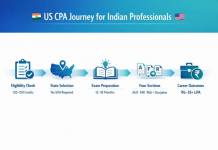
The CPA exam consists of four sections that you must pass within 30 months to earn your credential. Three of these are mandatory Core sections covering audit, accounting, and taxation, while the fourth is a Discipline section you choose based on your career direction. This guide cuts through the complexity to explain exactly how the exam works, what each section tests, and the strategic decisions that will shape your CPA journey as an Indian professional.
CPA Exam Structure: Core and Discipline Sections
The CPA exam operates under a framework called “Core plus Discipline” that launched in January 2024 through the CPA Evolution initiative. This structure replaced the old four-section model, where everyone took identical exams. Now you’ll complete three mandatory Core sections testing foundational knowledge, then choose one Discipline section that aligns with where you want to take your career. Understanding this framework is your first step toward strategic exam planning.
Three Core Sections: AUD, FAR, and REG
Every CPA candidate globally must pass the same three Core sections regardless of specialization or career goals.
- Auditing and Attestation (AUD) tests your knowledge of audit procedures, professional responsibilities, and attestation standards under US frameworks.
- Financial Accounting and Reporting (FAR) covers extensive US GAAP requirements, financial statement preparation, and governmental accounting.
- Taxation and Regulation (REG) addresses US federal taxation for individuals and entities, along with business law fundamentals.
These Core sections ensure every licensed CPA possesses essential competencies that employers and clients expect. For you as an Indian candidate, this means encountering both familiar territory and entirely new material. Your accounting background provides advantages in FAR and AUD conceptually, though the specific standards differ from Indian practices. REG will likely require the most new learning since the US federal tax law shares virtually nothing with Indian taxation.

The Core sections now offer continuous testing throughout 2025, meaning you can schedule them any day Prometric centers operate. This flexibility lets you test when your preparation reaches exam-ready status rather than waiting for specific windows. You’ll receive scores within 1-2 weeks of testing, dramatically faster than the old quarterly release schedule.
Three Discipline Options: BAR, ISC, and TCP
After completing Core sections, you’ll select one Discipline from three options:
- Business Analysis and Reporting (BAR),
- Information Systems and Controls (ISC), or
- Tax Compliance and Planning (TCP).
Each Discipline extends one Core section into advanced territory, allowing you to specialize based on career direction.
BAR builds on FAR with complex accounting topics, financial statement analysis, and data analytics applications. It suits candidates pursuing audit practice, corporate financial reporting, or investment analysis roles. ISC extends AUD into IT audit, cybersecurity controls, and SOC attestation engagements, appealing to those targeting technology risk advisory or IT audit careers. TCP deepens REG content with advanced tax compliance and planning strategies, ideal for cross-border tax practice or transfer pricing roles.
Unlike Core sections, Disciplines operate on quarterly testing windows in 2025. You can only take BAR, ISC, or TCP during specific months: January, April, June, July, and October. Missing a window means waiting weeks for the next opportunity, so plan your preparation timeline accordingly.
What Does Each CPA Exam Section Test?
Each CPA section runs four hours and combines two question formats: multiple choice questions (MCQs) and task-based simulations (TBSs). The specific content, question counts, and weightings vary across sections. Knowing what each section covers helps you assess how your existing knowledge transfers and where you’ll need focused preparation.
Auditing and Attestation (AUD) Content and Format
AUD tests the complete audit cycle from planning through reporting. You’ll demonstrate understanding of risk assessment procedures, evidence gathering techniques, internal control evaluation, and the auditor’s reporting responsibilities. The section covers US Generally Accepted Auditing Standards, PCAOB requirements for public company audits, and attestation engagements beyond traditional audits.
Content is divided into four areas: Ethics and Professional Responsibilities (15-25%), Assessing Risk and Developing Responses (25-35%), Performing Procedures and Obtaining Evidence (30-40%), and Forming Conclusions and Reporting (10-20%). The evidence-gathering area carries the heaviest weight, testing your ability to execute audit procedures appropriately.
AUD includes 78 MCQs and 7 TBSs, each contributing 50% to your score. The high MCQ count means you’ll average about 1.2 minutes per question, requiring efficient pacing. Current pass rates hover around 48%, placing AUD in the middle difficulty range. If you’ve worked in audit roles in India, many concepts will feel familiar, though US-specific standards require dedicated study.
Financial Accounting and Reporting (FAR) Content and Format
FAR represents the most content-heavy section, covering broad US GAAP requirements across nearly every accounting topic. You’ll need strong knowledge of financial statement preparation, complex transactions, and specialized areas like governmental and not-for-profit accounting. The section tests both conceptual understanding and technical application of accounting standards.
Content spans three major areas: Financial Reporting (30-40%), Select Balance Sheet Accounts (30-40%), and Select Transactions (25-35%). These areas cover everything from basic financial statement presentation to complex topics like business combinations, derivatives, and segment reporting. Governmental accounting, which has no direct Indian equivalent, accounts for meaningful FAR content.
FAR has only 50 MCQs alongside 7 TBSs, the lowest MCQ count among all sections. This means each question carries more weight, and the simulations demand strong technical skills. With a pass rate around 42-43%, FAR challenges even well-prepared candidates. Your Indian accounting background helps conceptually, but transitioning from Ind AS to US GAAP requires significant adjustment.

Taxation and Regulation (REG) Content and Format
REG covers US federal taxation and business law, areas where your Indian knowledge provides essentially no advantage. The section tests individual taxation, entity taxation, property transactions, and professional ethics alongside contract law, agency relationships, and business structures under US legal frameworks.
Content divides into five areas: Ethics and Tax Procedures (10-20%), Business Law (15-25%), Property Transactions (5-15%), Individual Taxation (23-32%), and Entity Taxation (23-33%). The individual and entity taxation areas together represent over half of your exam, requiring a solid understanding of US tax code provisions, calculations, and compliance requirements.
REG includes 72 MCQs and 8 TBSs, the highest simulation count among all sections. The 50/50 weighting means simulations carry substantial impact, often requiring multi-step tax calculations. Despite being entirely new material for most Indian candidates, REG’s pass rate of approximately 63-64% reflects its logical structure that rewards systematic study. Approach it as fresh learning rather than trying to map Indian tax concepts.
Discipline Section Content Overview
Your Discipline choice extends one Core section’s content into a specialized territory. BAR covers advanced accounting topics (40-50%), technical accounting and reporting (35-45%), and state/local government accounting (10-20%). With 50 MCQs and 7 TBSs weighted 50/50, BAR matches FAR’s format but with advanced content that produces pass rates around 41-43%.
ISC focuses on Information Systems and Data Management (35-45%), Security, Confidentiality, and Privacy (35-45%), and SOC Engagement Considerations (15-25%). Its unique 82 MCQs and 6 TBSs with 60/40 weighting toward MCQs suits candidates comfortable with technology concepts who can move quickly through questions. ISC’s pass rate of approximately 68% reflects growing familiarity with this content area.
TCP addresses Individual Tax Compliance and Planning (30-40%), Entity Tax Compliance (30-40%), Entity Tax Planning (10-20%), and Property Transactions (10-20%). With 68 MCQs and 7 TBSs weighted 50/50, TCP closely aligns with the REG format and content. Its pass rate of 75-78%, the highest among all sections, reflects strong candidate self-selection from those who performed well on REG.
CPA Question Types, Scoring, and Time Allocation
Understanding how the CPA exam tests you and calculates your score helps set realistic expectations. The exam uses two question formats delivered in testlets, with a scoring system that differs fundamentally from percentage-based grading you may know from Indian examinations.
MCQs and Task-Based Simulations Explained
Multiple choice questions present four answer options where you select the single best response. MCQs test recall, understanding, and application of concepts across the section content areas. The exam uses adaptive testing for MCQs: your first testlet contains medium-difficulty questions, and based on your performance, your second testlet adjusts to either medium or higher difficulty. Receiving harder questions signals a strong initial performance and doesn’t disadvantage your score.
Task-based simulations test practical application through realistic work scenarios. You’ll analyze documents, perform calculations using spreadsheet tools, research authoritative guidance, and make professional judgments. TBS formats include document review, calculation problems, form completion, and research tasks where you locate specific guidance within the FASB Codification or Internal Revenue Code.
There’s no negative marking on either format, so answer every question even when guessing. MCQs contribute 50% of your score in most sections (60% in ISC), while TBSs contribute the remaining 50% (40% in ISC). Both formats require practice to develop familiarity with the exam interface and question styles.
CPA Pass Mark and Scaled Scoring
You need a minimum scaled score of 75 on a 0-99 scale to pass each section. This 75 is not a percentage correct; it’s a scaled score derived from your raw performance adjusted for question difficulty. According to AICPA’s official scoring methodology, the scaling ensures consistent standards across different test forms and dates, meaning the exam isn’t harder or easier at different times.
Your total score combines weighted scaled scores from MCQs and TBSs according to section-specific allocations. Harder questions contribute more to your score than easier ones, which is why adaptive testing that assigns harder MCQs to strong performers actually benefits those candidates. If you fail, you’ll receive a Candidate Performance Report showing strengths and weaknesses by content area.
The 75 passing standard has remained consistent for decades. Roughly half of all test-takers pass on any given attempt, though this varies by section. Your goal isn’t to achieve a high score above 75; passing with 76 earns the same credential as passing with 95.
Time Management Across Different Sections
You have 240 minutes (four hours) per section, with an optional 15-minute break after completing both MCQ testlets. The break doesn’t count against your time. Effective time allocation varies based on each section’s question counts and your personal strengths.
Sections with fewer MCQs (FAR and BAR at 50 each) allow approximately 1.5-1.8 minutes per question, while sections with more MCQs (ISC at 82) require faster pacing around 1.0-1.1 minutes each. Plan to spend roughly 45-50% of your time on MCQs and 50-55% on TBSs as a starting framework.
For simulations, budget 15-25 minutes each, depending on complexity. Some require straightforward calculations; others demand extensive document analysis. If time runs short, answer all remaining MCQs (no penalty for guessing) and attempt all TBSs at least partially since they offer partial credit for correct components.
CPA Testing Schedule and Fees for Indian Candidates
Practical logistics significantly impact your CPA journey. Understanding when you can test, what it costs in Indian Rupees, and how to navigate Prometric booking helps you plan realistically and avoid surprises.
Continuous Testing vs Quarterly Windows
Core sections (AUD, FAR, REG) now offer continuous testing throughout 2025. You can schedule these exams on any day Prometric centers operate, excluding brief maintenance blackouts. This flexibility means testing when your preparation reaches exam-ready status rather than aligning with arbitrary calendar windows. Core section scores typically release within 1-2 weeks of testing.
Discipline sections (BAR, ISC, TCP) operate differently with quarterly testing windows. In 2025, these windows fall in January, April, June, July, and October. Miss a window, and you’ll wait weeks or months for the next opportunity. Discipline scores take 6-8 weeks to release after each window closes, requiring patience before knowing your results.
This distinction matters for planning. You can complete Core sections at your own pace year-round, but you must align Discipline preparation with fixed calendar windows. Many candidates complete all three Core sections first, then target a specific Discipline window for their final exam.
Current CPA Fee Structure
In June 2025, NASBA increased exam fees for international candidates testing outside the United States. The fee per section jumped from $390 to $510, a 31% increase. At current exchange rates of approximately ₹90 per dollar, this translates to roughly ₹45,900 per section or ₹1,83,600 for all four sections in exam fees alone.
Beyond exam fees, you’ll pay evaluation fees ($250 through NIES), state application fees ($90-150), registration fees ($93 per section), and international administration fees. The complete investment ranges from approximately ₹2.8 lakhs to ₹5.5 lakhs, depending on review course choices and whether you pass all sections on first attempts.
Prometric Centers and Booking Process in India
India hosts eight Prometric testing centers: Ahmedabad, Bangalore, Chennai, Hyderabad, Kolkata, Mumbai, New Delhi, and Trivandrum. This distribution means most candidates can find a center within a reasonable distance, though availability varies by location and date.
After receiving your Notice to Schedule (NTS) from your state board, you must pay the international administration fee through your NASBA account before Indian testing locations appear in the Prometric system. Complete this payment at least one week before you plan to book to allow processing time.
Schedule 30-45 days before your target exam date to secure preferred time slots. Mumbai and Bangalore centers fill quickly, so book earlier for these locations. Your NTS is valid for six months, so time your application appropriately; applying too early wastes validity before you’re ready, while applying too late risks scheduling conflicts.
Choosing Your CPA Discipline Section Strategically
Your Discipline selection represents the most important strategic decision in your CPA journey. Unlike Core sections, where everyone covers identical material, your Discipline signals your specialization and shapes the knowledge you’ll carry into your career.
Matching Discipline Selection to Career Goals
Choose based on where you want your career to go rather than optimizing for pass rates. BAR suits careers requiring deep financial analysis and reporting expertise: Big 4 assurance practice, corporate accounting at US multinationals, financial advisory, or investment analysis. If you’re targeting roles involving complex US GAAP judgments and financial statement preparation, BAR provides directly relevant credentials.
ISC targets careers in technology risk, IT audit, cybersecurity consulting, or SOC attestation work. India’s prominence in IT services and expanding global capability centers creates strong demand for professionals bridging accounting and technology. If you currently work in IT audit or have a technology background alongside accounting qualifications, ISC leverages your existing knowledge.
TCP serves careers in tax compliance, tax planning, or cross-border advisory. The growing population of NRIs, Indian businesses expanding to US markets, and US companies with Indian operations create sustained demand for professionals who understand both tax systems. If you’re building expertise in international taxation or transfer pricing, TCP provides essential credentials.
How an Indian Professional Background Influences Your Choice
Your existing qualifications and experience should inform your Discipline decision. CA holders with audit experience often gravitate toward BAR or ISC, depending on whether their interest lies in advanced accounting or technology controls. Those working in tax roles or with a genuine interest in taxation find TCP a natural extension of REG preparation.
Consider your REG performance when evaluating TCP. The sections share substantial content, and strong REG performance often predicts TCP success. Similarly, strong FAR performance may indicate readiness for BAR’s advanced accounting topics. If you struggled with particular Core sections, the related Discipline may compound those challenges.
Don’t chase pass rates. TCP’s 78% rate doesn’t make it objectively easy; it means candidates choosing TCP tend to have relevant backgrounds and interests. A candidate who excelled at FAR but struggled with REG would likely find BAR more manageable than TCP despite the pass rate differential. Select the Discipline that aligns with your strengths and career trajectory.
Conclusion
The CPA exam’s Core plus Discipline structure provides a clear pathway to certification while allowing specialization that matches your career goals. You’ll complete three mandatory Core sections covering audit, accounting, and taxation fundamentals, then choose one Discipline reflecting your professional direction. Each section runs four hours, combining MCQs and TBSs that require both content knowledge and practical application skills.
As an Indian professional, approach this journey strategically. Understand that pass rates ranging from 42% for FAR to 78% for TCP reflect candidate preparation and self-selection rather than inherent difficulty. Budget ₹2.8-5.5 lakhs, depending on your choices. Leverage the eight Prometric centers across India and the 30-month completion window that accommodates working professionals. Most importantly, choose your Discipline based on where you want your career to go, not which section appears easiest on paper. With a clear understanding of what lies ahead and thoughtful planning, you can join the growing community of Indian CPAs advancing their careers through this globally recognized credential.
For information on CPA Exam Details, visit this link.
 Serato DJ Crack 2025Serato DJ PRO Crack




 Allow notifications





