

CPA job roles and responsibilities guide for Indian professionals covering duties, employer landscape, salary expectations, required skills, and CPA vs CA career distinctions. This article is written by Rohit Arora, Senior Associate at LawSikho.
Table of Contents
Before investing time, money, and effort into earning the US CPA credential, understanding exactly what you will be doing once you have those letters after your name makes practical sense. The Indian job market for CPAs has transformed dramatically over the past decade, with multinational corporations, Big 4 firms, and Global Capability Centers actively competing for qualified professionals.
This guide breaks down the actual job responsibilities, employer landscape, compensation expectations, and skill requirements so you can make an informed decision about whether a CPA aligns with your career vision.

What Does a CPA Actually Do?
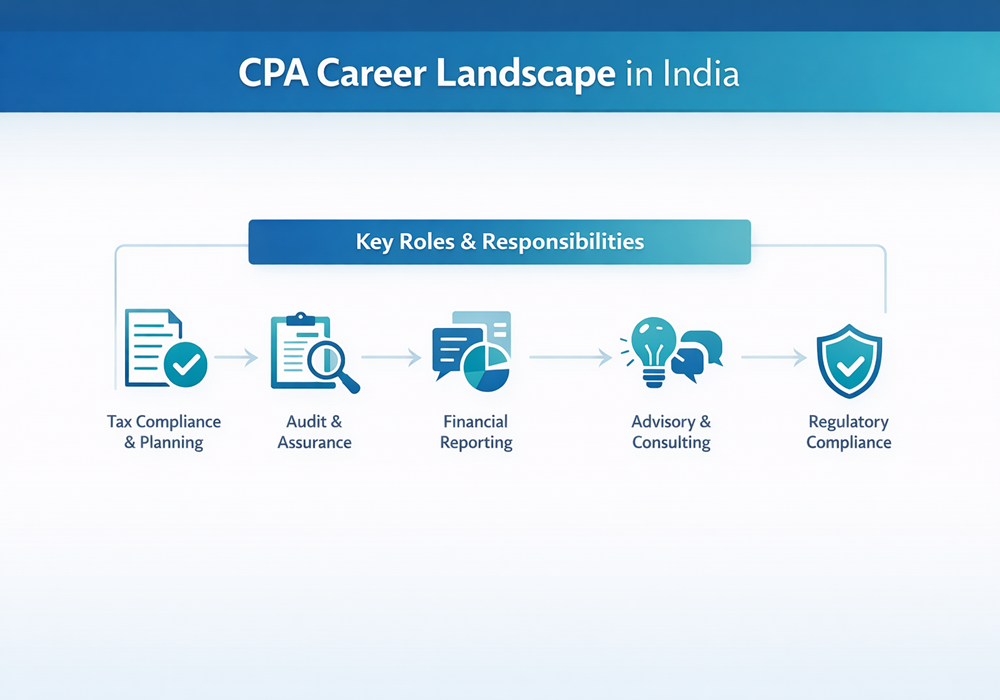
The CPA credential opens doors to diverse roles spanning financial reporting, taxation, auditing, and strategic advisory. Unlike some professional qualifications that funnel graduates into narrow career tracks, CPA holders find opportunities across industries and functions. What unites these varied positions is a foundation of rigorous technical competence and ethical standards that employers trust for their most critical financial work.
Core Duties Across All CPA Roles
Regardless of specific job title or employer, certain responsibilities appear consistently in CPA positions. Financial statement preparation and review form the backbone of most roles, requiring CPAs to ensure organizational finances are accurately captured and reported according to applicable standards. This involves analyzing transactions, preparing journal entries, reconciling accounts, and producing reports that stakeholders rely upon for decision-making.
Compliance represents another universal responsibility. CPAs ensure their organizations or clients meet regulatory requirements ranging from tax filings to SEC disclosures to industry-specific mandates. This protective function requires staying current with evolving rules and translating complex requirements into practical organizational processes. When compliance issues arise, CPAs often lead remediation efforts and implement controls to prevent recurrence.
Advisory functions round out core CPA work. Even in positions primarily focused on compliance or reporting, CPAs regularly advise on the financial implications of business decisions. They analyze cost structures, evaluate investment opportunities, assess risk exposures, and provide the financial perspective that leadership needs for informed strategy development. This advisory dimension grows increasingly prominent as careers advance.
Practice Area Specializations (Tax, Audit, Advisory)
Most CPAs develop expertise in one of three primary practice areas, each offering distinct daily work experiences and career trajectories. Tax specialists help individuals and organizations navigate federal, state, and international tax obligations. Their work cycles between compliance seasons focused on return preparation and planning periods where they develop strategies to minimize future tax burdens. Tax roles require comfort with detailed regulations and the analytical skills to apply complex rules to specific situations.
Audit practitioners examine financial records to provide independent assurance that statements fairly represent organizational performance. External auditors work for accounting firms conducting engagements across multiple clients, while internal auditors focus on their own organization’s controls and risk management. Audit work involves testing transactions, evaluating processes, and exercising professional skepticism to identify potential misstatements or control weaknesses.
Advisory and consulting roles leverage CPA expertise for strategic problem-solving beyond traditional accounting functions. This includes transaction support for mergers and acquisitions, forensic investigation of suspected fraud, operational improvement consulting, and technology implementation guidance. Advisory work tends to be project-based with varied client engagements, appealing to professionals who thrive on diverse challenges and client interaction.
CPA Career Opportunities in India
India has emerged as a global hub for finance talent, with employers across categories actively seeking CPA-qualified professionals. The combination of strong educational foundations, English proficiency, and favorable economics has made India a priority market for organizations building finance capabilities. Understanding where these opportunities exist helps you target your career development effectively.
Top Employers Hiring CPAs (Big 4, MNCs, GCCs)
The Big 4 accounting firms represent the largest and most visible CPA employers in India. Deloitte, PwC, EY, and KPMGcollectively plan to hire approximately 100,000 new employees in India during FY25, spanning audit, tax, and advisory service lines. These firms offer structured career progression, global client exposure, and premium compensation packages. CPA holders are particularly valued for engagements serving US-headquartered clients requiring American accounting standard expertise.
Multinational corporations have established Global Capability Centers across Indian metros, centralizing finance operations that previously resided at headquarters locations. Companies like Amazon, Google, Microsoft, Accenture, and American Express maintain substantial India-based finance teams handling everything from transaction processing to strategic analysis. These GCCs employ CPAs for US GAAP reporting, internal audit, treasury operations, and finance leadership roles. The work often involves direct collaboration with global teams and exposure to enterprise-scale operations.
Beyond Big 4 and traditional multinationals, Indian IT companies with significant US revenue streams actively recruit CPAs for their corporate finance functions. Organizations including Infosys, Wipro, TCS, and HCL require professionals who understand American accounting standards for SEC reporting and investor communications. Additionally, mid-tier accounting firms, Indian financial institutions, and consulting companies have increased CPA hiring as they expand international service offerings.
Job Roles by Experience Level
Entry-level CPAs typically join as staff accountants or associate auditors, spending their first two years building foundational skills under supervision. Daily work involves transaction processing, account reconciliations, audit procedure execution, and supporting senior team members on client deliverables. The focus at this stage is on developing technical proficiency, learning organizational processes, and demonstrating reliability with assigned responsibilities.
Mid-level professionals in years three through seven assume greater ownership and begin supervising others. Senior accountants lead month-end close processes and handle complex technical issues independently. Audit and tax managers run engagements, manage client relationships, and ensure quality standards. These roles bridge execution and leadership, requiring both technical excellence and emerging management capabilities. Compensation increases substantially as professionals demonstrate they can deliver results with less oversight.

Senior positions from director level through partner or executive ranks focus primarily on strategy, business development, and organizational leadership. Finance directors and controllers oversee departmental operations and partner with business leaders. CFOs serve as executive team members, shaping organizational direction. Partners in accounting firms own equity, develop client relationships, and guide firm strategy. These roles reward professionals who have built track records of delivering results and developing others over sustained careers.
CPA Salary Expectations in India
Compensation represents a primary consideration for professionals evaluating credential investments. CPA salaries in India have risen steadily as demand outpaces supply, creating favorable conditions for qualified candidates. Understanding market rates helps you evaluate opportunities and negotiate effectively.
Salary Range by Experience (Entry to Senior)
Fresh CPAs entering quality employers typically earn between ₹6 lakhs and ₹10 lakhs per annum. Big 4 firms and major multinational corporations position their offers at the higher end of this range, with exceptional candidates sometimes receiving packages reaching ₹12 lakhs. Smaller organizations and regional firms generally start lower, though they may offer faster advancement opportunities or other trade-offs.
Mid-career professionals with three to seven years of experience see compensation climb to ₹12 lakhs to ₹20 lakhs annually. Those working on US client engagements or in specialized high-demand areas often exceed these figures. The jump from entry to mid-level reflects demonstrated capability to handle complex work independently and contribute beyond assigned tasks. Performance differentiation becomes increasingly visible in compensation at this stage.
Senior professionals in manager, director, and leadership roles earn ₹20 lakhs to ₹40 lakhs or more, depending on employer and specific position. CFO-level roles in mid-sized organizations command ₹50 lakhs to ₹1 crore packages, while executive positions at large multinationals can exceed these figures substantially. At senior levels, compensation structures often include significant variable components tied to business performance and individual contribution.
Factors Affecting CPA Compensation
Several variables beyond experience influence earning potential. Employer type matters significantly, as Big 4 firms and multinational corporations generally pay more than domestic companies or smaller practices for comparable roles. Geographic location also impacts pay, with Mumbai, Bangalore, and Delhi commanding premiums of 20% to 30% over tier-two cities.
Practice area specialization affects salary trajectories as well. CPAs in transaction advisory, international taxation, technology consulting, and forensic accounting typically earn more than generalists in routine compliance roles. Additional credentials compound earning power, with professionals holding both CPA and CA qualifications commanding premium packages reflecting their dual expertise. Finally, business development contribution and leadership demonstrated through team building increasingly influence senior-level compensation.
Essential Skills for CPA Jobs
Employers evaluate candidates on both technical capabilities and interpersonal effectiveness. Understanding these requirements helps you assess readiness and prioritize development areas. The most successful CPAs combine deep expertise with the communication and relationship skills needed to deliver value in organizational contexts.
Technical Competencies Required
US GAAP knowledge forms the foundation for most India-based CPA positions, particularly those serving American clients or parent companies. This includes understanding revenue recognition, lease accounting, financial instruments, business combinations, and consolidation requirements. For roles involving multiple jurisdictions, IFRS familiarity adds value. The ability to research technical issues, apply standards to complex transactions, and explain positions clearly distinguishes strong candidates.
Technology proficiency has become essential rather than optional. CPAs work with enterprise systems like SAP, Oracle, and NetSuite daily, requiring comfort navigating complex applications and extracting needed information. Advanced Excel capabilities, including complex functions, pivot tables, and data analysis tools, remain universally expected. Increasingly, employers value experience with data analytics platforms, visualization tools, and automation technologies that are transforming traditional accounting work.
For specialized roles, additional technical depth is required. Tax positions demand a comprehensive understanding of federal and state codes, along with planning strategies. Audit roles require mastery of auditing standards, sampling techniques, and control evaluation methods. Advisory positions call for analytical frameworks, financial modeling capabilities, and presentation skills appropriate to executive audiences.
Soft Skills That Drive Career Growth
Communication skills differentiate CPAs who advance quickly from those who plateau. This encompasses explaining complex financial concepts to non-technical stakeholders, writing clear and concise reports, presenting confidently to leadership, and building productive relationships with clients and colleagues. The ability to translate technical expertise into business-relevant insights creates value that organizations reward with advancement and compensation.
Analytical thinking enables CPAs to move beyond processing transactions to solving problems and identifying opportunities. This involves examining information critically, recognizing patterns, evaluating alternatives, and developing practical recommendations. Strong analytical skills position professionals for advisory work that typically commands premium compensation.
Leadership capabilities become essential for career progression beyond individual contributor roles. This includes managing teams effectively, developing junior staff, driving results through others, and contributing to organizational direction. Even early in careers, demonstrating initiative, taking ownership of outcomes, and supporting team success signals leadership potential that accelerates advancement.
CPA vs CA: Understanding the Job Role Differences
Indian professionals often compare a CPA with a Chartered Accountant when evaluating credential options. Both designations indicate advanced accounting competence and open doors to quality employers. Understanding their similarities and distinctions helps you make the choice that best fits your career aspirations.
Where CPA and CA Roles Overlap
In core functions, CPAs and CAs perform substantially similar work. Both conduct audits, prepare financial statements, provide tax services, and offer business advisory services. Both credentials require rigorous examination and ongoing professional development. Organizations employing both CPA and CA holders typically assign comparable responsibilities to professionals at similar experience levels.
The technical foundations also overlap significantly. Accounting principles, regardless of specific framework, share fundamental concepts that transfer across jurisdictions. Audit methodology follows similar logic whether testing under US or Indian standards. Tax planning requires analytical skills that apply regardless of which country’s code you are navigating. Professionals often find that expertise developed under one credential translates reasonably well when encountering the other’s domain.
Career Path Distinctions for Indian Professionals
The primary distinction involves geographic focus and regulatory scope. CA provides practice rights in India and recognition in Commonwealth countries, essential for Indian statutory work, including company audits and domestic tax practice. CPA enables practice in the United States and carries strong global recognition, particularly valuable for roles serving American clients or requiring US GAAP expertise.
Employer preferences vary accordingly. Multinational corporations with US parent companies, Big 4 firms serving American clients, and finance shared services supporting US operations show a strong preference for CPA holders. Conversely, domestic Indian companies, statutory audit work, and positions requiring signing authority for Indian regulatory filings require a CA qualification. Many organizations value professionals holding both credentials for their ability to bridge Indian and American accounting requirements.
Career paths diverge based on these jurisdictional differences. Professionals targeting international careers, particularly involving US-headquartered organizations, find CPA opens more doors. Those focused on domestic Indian practice, particularly in areas requiring statutory signing authority, need a CA qualification. The optimal choice depends on your specific career goals, with many ambitious professionals eventually pursuing both credentials to maximize flexibility.
Conclusion
Understanding CPA job responsibilities before pursuing the credential enables informed career decisions. CPAs perform essential functions spanning financial reporting, compliance assurance, and strategic advisory across diverse organizational settings. The Indian job market offers abundant opportunities through Big 4 firms, multinational corporations, and Global Capability Centers actively competing for qualified professionals.
Compensation rewards experience and specialization, with entry-level packages starting at ₹6 to ₹10 lakhs and senior roles commanding ₹30 lakhs to ₹50 lakhs or more. Success requires combining technical competence in areas like US GAAP with communication and leadership skills that enable organizational impact. For Indian professionals targeting careers with an international dimension, particularly those involving US-headquartered organizations, the CPA credential provides meaningful differentiation and opens doors to rewarding career opportunities.
Click here to read a detailed article on CPA Job Roles and Responsibilities.
 Serato DJ Crack 2025Serato DJ PRO Crack



 Allow notifications





