

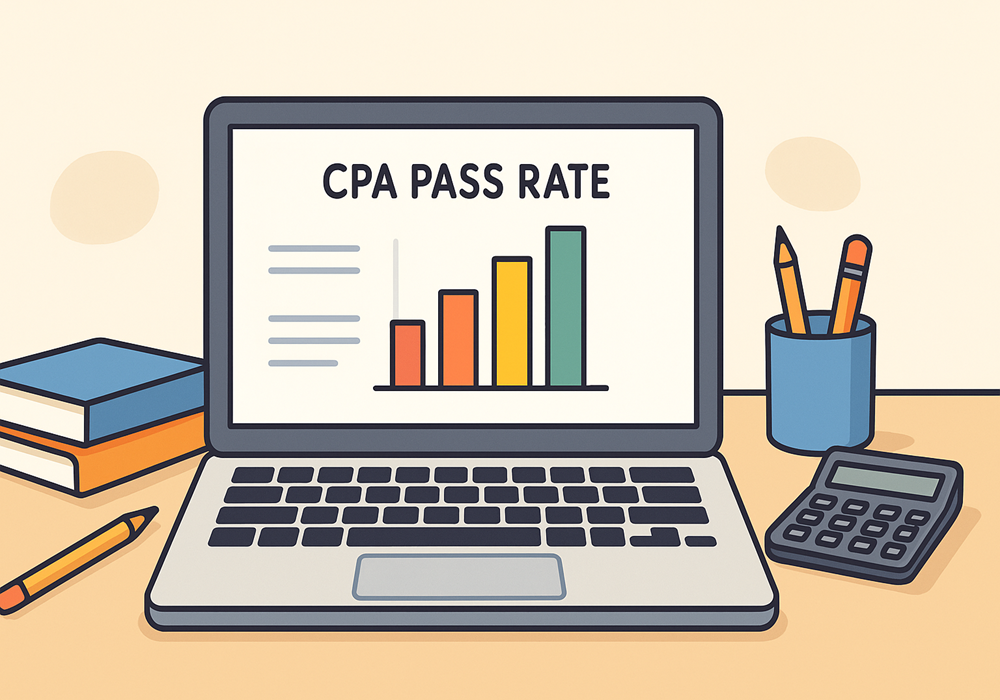
CPA exam pass rates: Understand section-wise difficulty, choose the right discipline, and learn proven strategies to pass. This article is written by Rohit Arora, Senior Associate at LawSikho.
Table of Contents
If you are an Indian professional considering the US CPA certification, understanding pass rates is one of the smartest moves you can make before diving into preparation. These numbers are not just statistics.
They reveal which sections challenge candidates the most, how the exam has evolved under CPA Evolution, and what realistic expectations you should set for your journey.

Whether you are a Chartered Accountant looking to add an international credential, a B.Com graduate exploring global opportunities, or a working professional in a Big 4 firm, this guide breaks down exactly what 2025 pass rates mean for you and how to use this data to plan a winning strategy.
CPA Exam Pass Rates at a Glance: What Candidates Need to Know
Before you start preparing for any section of the CPA exam, you need to understand where candidates typically succeed and where they struggle. The American Institute of Certified Public Accountants releases pass rate data quarterly, and the 2024 and 2025 numbers tell a compelling story about the exam’s difficulty under the new CPA Evolution format.
The CPA exam now consists of three core sections that everyone must pass, plus one discipline section of your choice.
The core sections are
- Auditing and Attestation (AUD),
- Financial Accounting and Reporting (FAR), and
- Regulation (REG).
For your discipline, you choose one from Business Analysis and Reporting (BAR), Information Systems and Controls (ISC), or Tax Compliance and Planning (TCP). Each section requires a minimum score of 75 on a 0 to 99 scale, and you must pass all four within an 18 to 30-month window, depending on your jurisdiction.
Pass Rate Trends for Core CPA Sections: AUD, FAR, and REG
The three core sections show distinctly different performance patterns, and understanding these differences can shape how you approach your preparation.
FAR consistently records the lowest pass rates among core sections.
In 2025, the cumulative pass rate stands at approximately 42.80%, with quarterly figures hovering between 41% and 43%.
This section covers extensive financial accounting and reporting standards under US GAAP, including complex topics like consolidations, government accounting, and not for profit entities.
For Indian candidates trained primarily in Ind AS or IFRS, the adjustment to US GAAP principles adds another layer of challenge. If you find yourself wondering why so many candidates struggle with FAR, the answer lies in its sheer volume and the depth of technical knowledge required.
AUD falls in the middle of the difficulty spectrum with a 2025 cumulative pass rate of around 48%. The section tests your understanding of audit procedures, professional responsibilities, and attestation engagements. While the concepts may feel familiar if you have audit experience, the exam requires you to apply judgment in scenario-based questions. Many candidates find AUD tricky because correct answers often depend on subtle distinctions between acceptable and best practices.
REG stands out as the strongest performer among core sections, with pass rates consistently above 60%.
The 2025 cumulative rate sits at approximately 64%, making it the most passable core section. REG covers federal taxation for individuals, entities, and property transactions, along with business law and ethics. Indian candidates often find REG challenging initially because US tax law differs significantly from Indian taxation. However, the structured nature of tax rules means that a dedicated study typically yields good results.

Discipline Section Pass Rates: How BAR, ISC, and TCP Perform in Recent Years
The discipline sections introduced under CPA Evolution in 2024 have shown dramatically different pass rates, and these numbers should definitely influence your selection strategy.
TCP leads all sections with the highest pass rates by a significant margin. The cumulative 2025 pass rate exceeds 78%, with some quarters reaching above 80%. According to AICPA’s official pass rate data, TCP’s strong performance can be attributed to its close alignment with REG content.
Candidates who perform well in REG often carry that momentum into TCP, especially if they work in tax or have a genuine interest in taxation. For Indian CAs with taxation experience, TCP often feels like a natural extension of what they already know.
ISC has shown remarkable improvement since its introduction. Pass rates climbed from around 51% in early 2024 to approximately 68% cumulatively in 2025. This upward trend suggests that candidates and review course providers have adapted well to the section’s content, which covers information systems, data management, and cybersecurity concepts. If you have a background in IT audit, systems implementation, or data analytics, ISC might be your strongest option.
BAR presents the greatest challenge among discipline sections.
The cumulative 2025 pass rate hovers around 42%, with Q4 2024 dropping as low as 33%. BAR absorbed much of the advanced financial reporting content that previously lived in FAR, including topics like business combinations, derivatives, and foreign currency transactions. Candidates without strong advanced accounting backgrounds often find BAR overwhelming. If you choose BAR, expect to invest significantly more study time compared to TCP or ISC.
What These Pass Rates Mean for Indian Candidates
Understanding pass rates is valuable, but the real question is how these numbers apply specifically to your situation as an Indian professional. The CPA exam is identical worldwide, meaning you face the same questions and scoring standards as candidates in the United States. However, your path to success involves navigating challenges that American candidates simply do not encounter.
Challenges Unique to Indian Professionals
Indian candidates typically perform at par with global averages, achieving pass rates between 45% and 55% across sections. However, several factors make your journey distinct from U.S.-based candidates.
The transition from Indian accounting standards to US GAAP creates a learning curve that American accounting graduates do not face. While Ind AS has converged significantly with IFRS, US GAAP remains a separate framework with its own rules for revenue recognition, leases, and financial instruments. You will need to unlearn certain approaches and relearn them the American way, which requires additional study time.
Working while preparing for the CPA exam is the reality for most Indian candidates.
Unlike many American candidates who take the exam shortly after graduation, Indian professionals often pursue a CPA while managing full-time jobs, sometimes with demanding schedules in Big 4 firms or MNCs. Balancing a 50 to 60-hour work week with CPA preparation requires exceptional time management.
Time zone differences affect your access to live classes, doubt-clearing sessions, and even exam scheduling. If you are working with a US-based review course, live sessions might fall at inconvenient hours. Planning your study schedule around these constraints becomes essential.
The psychological aspect matters too. Pass rates below 50% can feel intimidating, especially when you are investing significant money in exam fees, review courses, and credential evaluation.
Understanding that roughly half of all candidates pass each section should motivate you to join the successful half through thorough preparation rather than discourage you from attempting the exam.
How to Use Pass Rate Data in Your Exam Planning
Pass rates become genuinely useful when you translate them into actionable planning decisions rather than viewing them as abstract statistics.
Start by identifying which sections play to your strengths.
If you have a taxation background, the combination of REG and TCP gives you two sections with historically high pass rates. If your experience lies in audit, pairing AUD with ISC might leverage your existing knowledge. Matching your background to favorable sections improves your odds significantly.
Consider exam sequencing based on difficulty patterns.
Many successful candidates recommend taking the FAR first while your motivation is highest and your study habits are fresh. Getting the hardest section out of the way early prevents it from becoming a psychological barrier later. Alternatively, some candidates prefer building confidence by passing an easier section first. There is no universally correct answer, but your decision should be informed by the data.
Pay attention to quarterly variations when scheduling your exams. Pass rates typically dip in Q1 and Q4, coinciding with the busy season for accountants and holiday distractions. Q2 and Q3 tend to show stronger performance as recent graduates enter the candidate pool with fresh academic knowledge. If your schedule allows flexibility, targeting these quarters might work in your favor.
How to Choose the Right CPA Discipline Section Based on Your Background
Selecting your discipline section is one of the most consequential decisions in your CPA journey. While pass rates provide useful guidance, your choice should ultimately align with your educational background, professional experience, and career aspirations.
Matching Your Academic and Professional Background to the Best CPA Discipline
Your existing knowledge base significantly influences how difficult each discipline section will feel during preparation.
Chartered Accountants typically find TCP most accessible. Your CA curriculum covered extensive taxation concepts, and while US tax law differs from Indian law, the analytical approach transfers well. The structured nature of tax rules means you can systematically learn the differences. Many Indian CAs report that TCP felt manageable after completing REG, as the sections share conceptual foundations.
B.Com and M.Com graduates without CA should evaluate their coursework and interests carefully. If your degree included strong exposure to advanced accounting topics like consolidations and derivatives, BAR might not feel as daunting. However, if your accounting education focused more on the basics, TCP or ISC could offer smoother paths. Consider which subjects you enjoyed and performed well in during your degree.
MBA Finance professionals and Company Secretaries often gravitate toward ISC, especially if their roles involve governance, internal controls, or information systems.
The section covers SOC reports, IT general controls, and data analytics, topics that align well with corporate governance and risk management backgrounds. If you have worked on systems implementations or IT audit engagements, ISC leverages that experience directly.
Candidates currently working in tax roles, whether in Big 4 or industry, almost always benefit from choosing TCP. Your daily work reinforces the concepts tested, and you can apply practical knowledge to exam scenarios.
The inverse applies too. If you have never touched a tax return and find taxation concepts unintuitive, forcing yourself through TCP because of its high pass rate might backfire.
Why CPA Pass Rates Should Guide, Not Decide, Your Discipline Selection
While TCP’s 78% pass rate looks attractive compared to BAR’s 42%, choosing solely based on these numbers can lead you astray.
The AICPA has explicitly stated that higher pass rates do not mean a section is easier for every candidate. TCP’s strong numbers partly reflect self-selection.
Candidates who choose TCP often have tax backgrounds or have just completed REG, meaning they enter the section with relevant preparation. Similarly, BAR attracts candidates pursuing careers in financial reporting, many of whom accept the challenge despite knowing it is difficult.
Your career goals should weigh heavily in this decision. If you plan to specialize in financial reporting, work in controllership, or pursue CFO track roles, BAR provides directly relevant knowledge despite its lower pass rate. The concepts you learn will serve you throughout your career. Choosing TCP solely for an easier path, while planning a career in financial reporting, means you miss valuable learning opportunities.
Consider the study time trade-off realistically. BAR might require 150 hours of preparation, whereas TCP requires 100 hours. If that extra 50 hours prevents burnout and keeps you engaged with material you find interesting, the investment pays dividends. If those extra hours feel like a grind through content you will never use professionally, TCP becomes the smarter choice.
How to Pass the CPA Exam: Five Strategies
Knowing pass rates and understanding section difficulty only helps if you translate that knowledge into effective preparation habits. Here are five strategies that consistently separate candidates who pass from those who struggle.
The Best Timing and Sequencing Strategy for CPA Exam Attempts
Strategic timing can meaningfully improve your chances of joining the successful candidate pool.
Many successful candidates recommend the FAR first approach. Since FAR has the lowest pass rate and the most extensive content, tackling it early ensures you engage with the hardest material when your energy and commitment are highest. Passing the FAR first also builds tremendous confidence. You have conquered the most feared section, and everything else feels achievable by comparison.
Alternatively, some candidates prefer the confidence builder approach, starting with REG or their chosen discipline section if they have relevant background knowledge. Passing your first section validates your preparation methods and proves you can succeed. This psychological boost carries forward into subsequent sections.
Regardless of which section you start with, avoid scheduling your toughest sections in Q4. The data consistently shows lower pass rates during October through December. Holiday commitments, year-end work pressures, and general fatigue take their toll. If possible, schedule challenging sections for Q2 or Q3 when candidate performance historically peaks.
Use the 18-month window strategically. While some candidates rush to complete all sections quickly, others space them out to allow for adequate preparation. Your ideal pace depends on your work schedule, personal commitments, and study capacity. A candidate who takes 18 months and passes all sections on the first attempt spends less money and experiences less stress than someone who rushes, fails multiple sections, and extends their timeline through retakes.
Effective Study Approaches for Working Indian Professionals
Preparing for the CPA exam while working full-time in India requires a disciplined approach tailored to your constraints.
Invest in a quality review course from providers like Becker, Wiley, Gleim, or Surgent. These courses structure the vast CPA content into manageable modules, provide practice questions aligned with exam format, and offer simulated exams that build familiarity with the testing interface. The cost feels significant, but candidates who use structured review courses consistently outperform those who attempt self-study.
Create a realistic study schedule that accounts for your actual availability. Most candidates need 300 to 400 hours of total study time across all four sections, translating to roughly 80 to 100 hours per section. If you can dedicate 15 hours weekly to studying, one section takes approximately 6 to 7 weeks. Build in buffer time for unexpected work demands, illness, or simply needing a mental break.
Prioritize practice questions over passive reading. The CPA exam tests application, not memorization. Working through hundreds of multiple-choice questions and task-based simulations builds the pattern recognition and analytical skills the exam rewards. Many successful candidates follow the 80/20 rule, spending 80% of their study time on active practice and only 20% on reviewing content.
Join study groups or online communities with other Indian CPA candidates. Platforms like Reddit, LinkedIn groups, and coaching institute forums connect you with peers facing identical challenges. Discussing difficult concepts, sharing study strategies, and simply knowing others understand your struggle provides both practical help and emotional support.
Conclusion
CPA exam pass rates tell a clear story for Indian candidates. FAR and BAR demand the most preparation, REG and TCP reward structured study with higher success rates, and AUD and ISC fall somewhere in between.
Your background, career goals, and personal circumstances should guide your discipline selection rather than pass rates alone. Strategic exam timing, quality review materials, and consistent practice separate successful candidates from those who struggle. The roughly 50% overall pass rate means that half of all candidates prove it is possible. With the right preparation, you can absolutely join them.
For an in-depth article on the CPA Exam Pass Rate, read my article here.
 Serato DJ Crack 2025Serato DJ PRO Crack



 Allow notifications





