

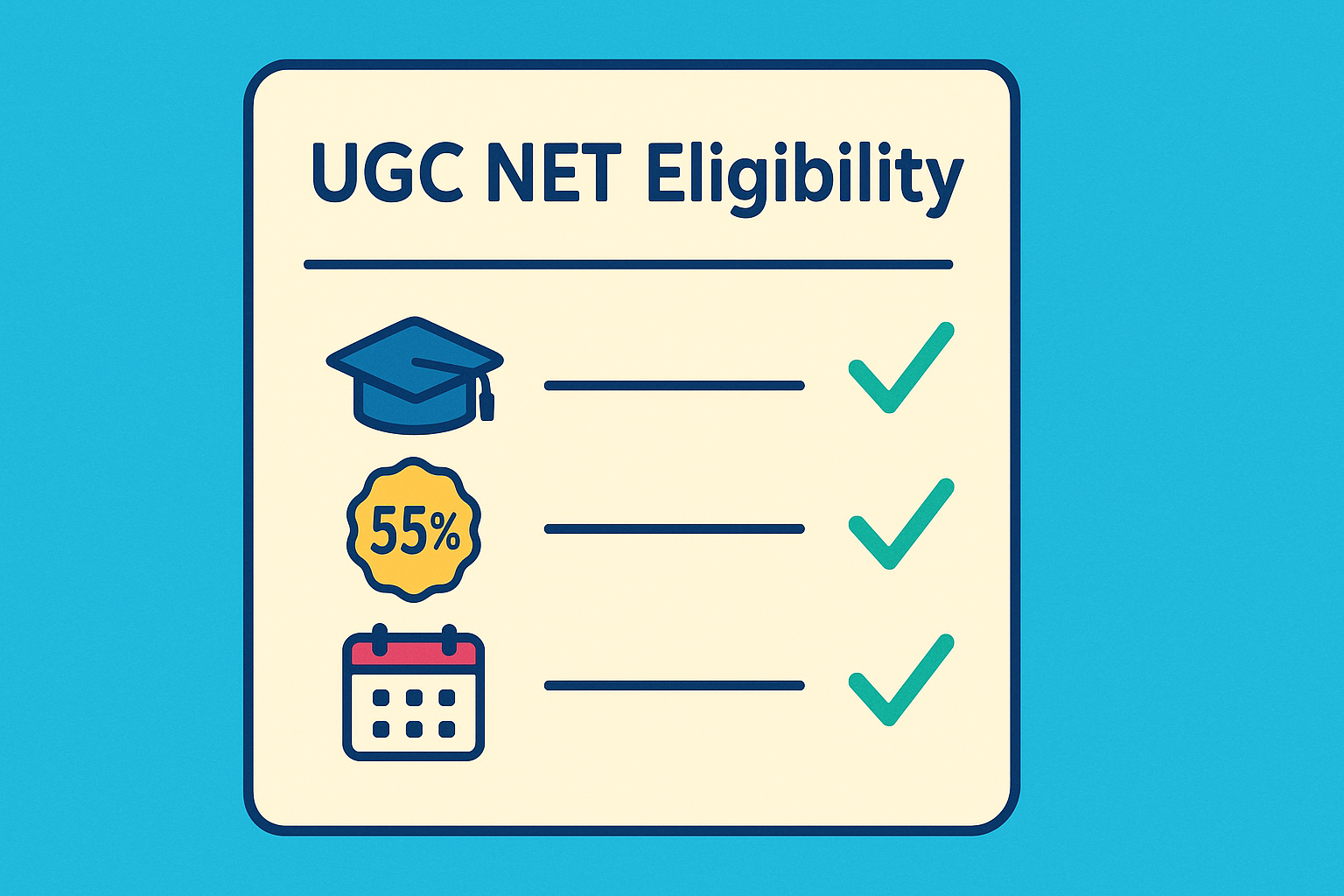
UGC NET Eligibility 2025-2026: Quick guide on educational qualifications, age limits, exemptions & common mistakes for JRF and Assistant Professor aspirants. This article is written by Urvi Shah, Senior Associate at LawSikho.
Table of Contents
Stop right there. Before you download that UGC NET syllabus, before you invest in expensive coaching classes, before you spend the next six months buried in textbooks, answer this one question: Are you even eligible to sit for the exam?
Every year, thousands of aspiring academics get their applications rejected. Not because they lack talent, but because they missed one tiny eligibility detail. Maybe they assumed their LLB qualified them for UGC NET Law (it doesn’t). Or they calculated their age wrong and crossed the JRF cutoff.

The worst part? You won’t discover these mistakes until after you’ve prepared for months.
But here’s the good news: UGC NET eligibility isn’t rocket science. Whether you’re a Master’s graduate eyeing JRF, a working professional shifting to academia, or a final year student getting a head start, this guide has you covered.
In a few minutes, you’ll know who can apply, who gets age relaxations, and the critical mistakes that lead to disqualification. No jargon. Just clarity.
Ready? Let’s make sure you’re eligible before you waste a single hour.
Who is Eligible to Apply for UGC NET?
Educational Qualification Requirements
The fundamental eligibility requirement for UGC NET is a Master’s degree from a UGC recognised university with a minimum percentage of marks. Candidates belonging to the General and Economically Weaker Section (EWS) categories must have secured at least 55% marks in their post graduation, this figure is applied strictly without any rounding off.
For reserved category candidates including OBC (Non Creamy Layer), SC, ST, Persons with Disability (PwD), and Third Gender, the minimum requirement is relaxed to 50% marks.
The Master’s degree must be in a subject covered under the UGC NET subject list, which spans 85 disciplines including law, commerce, humanities, social sciences, and computer applications.
For law aspirants specifically, an LLM degree is mandatory; an LLB alone, regardless of whether it is a 3 year or 5 year programme, does not qualify you to appear for UGC NET Law (Subject Code 58).
Candidates are advised to appear in the subject of their post graduation only, though those whose exact post graduation subject is not listed may appear in a closely related subject after careful consideration of the syllabus overlap.
Can Final Year Students Apply?
Yes, candidates who are in the final year of their Master’s programme or whose results are awaited can apply for UGC NET on a provisional basis and they will only be considered eligible for JRF award or Assistant Professor eligibility after they pass their Master’s degree with the required percentage (55% for General/EWS, 50% for reserved categories).
This provision allows you to appear for the examination while completing your degree, saving valuable time in your academic career progression. However, there is a critical condition attached to this provisional eligibility.
If you qualify for UGC NET while your degree is pending, you must complete your Master’s examination with the required percentage within two years from the date of NET result declaration.
For those qualifying under the ‘PhD Admission Only’ category, this window is even shorter, just one year. Failure to meet these deadlines results in automatic disqualification, and your NET certificate becomes invalid. This means you would need to appear for the examination again after completing your degree, having lost both time and the earlier qualification.

What is the Age Limit for UGC NET?
JRF Age Limit and Relaxations
The age limit for UGC NET applies specifically to candidates seeking Junior Research Fellowship; you must not exceed 30 years of age as on the first day of the month in which the examination concludes.
For UGC NET June 2025, this reference date would be 1st June 2025. The age is calculated based on your date of birth as recorded in your Class 10 certificate, which serves as the standard reference document for all government examinations in India.
Recognising diverse circumstances, the UGC provides age relaxations for various categories. SC, ST, OBC NCL, PwD, Third Gender, and women candidates of all categories receive a relaxation of 5 years, extending their eligibility to 35 years.
LLM degree holders get an additional 3 years’ relaxation, acknowledging the longer educational pathway in law.
Candidates with research experience in their post graduation subject can claim relaxation equal to the research period (maximum 5 years), while armed forces personnel receive up to 5 years based on service length.
One crucial rule to remember is that the total relaxation from all grounds combined cannot exceed 5 years; you cannot simply add multiple relaxations together.
Armed Forces Services
Candidates who have served in the armed forces are entitled to age relaxation of up to 5 years, subject to the length of their service in the armed forces up to the first day of the month in which the UGC NET examination is conducted.
Assistant Professor: No Age Barrier
Unlike JRF, there is absolutely no upper age limit for candidates appearing for UGC NET solely for Assistant Professor eligibility.
Whether you are 25, 45, or 60 years old, you can appear for the examination and, upon qualifying, become eligible for appointment as an Assistant Professor in universities and colleges across India.
This provision makes UGC NET particularly attractive for working professionals who decide to transition into academia later in their careers, career changers exploring teaching opportunities, and candidates who may have crossed the JRF age limit but still aspire to teach.
PhD Admission Through UGC NET
There is no upper age limit for candidates applying for UGC NET for admission to PhD programs.
Can Age Relaxations Be Combined?
The most important rule that candidates must understand is that the total age relaxation from all grounds combined shall not exceed 5 years under any circumstances.
This means even if you belong to multiple categories eligible for relaxation, the maximum relaxation you can claim is still capped at 5 years.
Key Exemptions and Special Cases
When is UGC NET Not Required for Assistant Professor?
Not everyone needs to clear UGC NET to become an Assistant Professor. The UGC Regulations provide specific exemptions that you should be aware of. First, candidates who hold a PhD degree awarded in accordance with UGC (Minimum Standards and Procedure for Award of Ph.D. Degree) Regulations, 2009, are exempted from the NET/SET/SLET requirement for Assistant Professor recruitment.
This exemption recognises that rigorous doctoral training under these standards adequately prepares candidates for academic positions.
Second, candidates who have cleared the State Eligibility Test (SET) before 1st June 2002 can apply for Assistant Professor positions anywhere in India without NET.
However, those who have cleared the SET after this date can only apply within the state where they qualified. For national mobility, they would need UGC NET.
Third, candidates who passed the UGC/CSIR JRF examination prior to 1989 are also exempted. It is important to note that these exemptions apply only to Assistant Professor eligibility; none of them grant exemption from NET for claiming Junior Research Fellowship benefits.
Distance Education and Foreign Degree Holders
Candidates who have completed their Master’s degree through distance education mode are eligible for UGC NET, provided the degree is from a university recognised by UGC and the distance programme itself is approved.
Universities like IGNOU and various state open universities offer valid programmes that qualify candidates for NET. The degree certificate should clearly indicate the university’s UGC recognition status.
For candidates with foreign degrees, the pathway involves an additional step. You must obtain an equivalence certificate from the Association of Indian Universities (AIU), New Delhi, confirming that your foreign qualification is equivalent to an Indian Master’s degree.
This process typically takes 10 to 30 days and should be initiated well before the NET application deadline. Without AIU equivalence, foreign degree holders cannot establish their eligibility for UGC NET. For law degrees from foreign universities, additional recognition from the Bar Council of India may be required.
Post Graduate Diploma Holders
Candidates with a postgraduate diploma or certificate course are generally not eligible for UGC NET unless their qualification has been officially recognized as equivalent to a postgraduate degree by the Association of Indian Universities (AIU).
If your diploma appears on this list, you are eligible to apply for UGC NET. If it is not listed, you cannot appear for the examination.
You can verify your equivalency by going to the AIU official website. The AIU maintains an official list of diplomas and certificates that have been granted equivalence status.
Common Eligibility Mistakes to Avoid
Many candidates face rejection or disqualification not due to lack of merit but because of avoidable eligibility errors. The most frequent mistake involves OBC certificates, using a State OBC certificate when the community does not appear in the Central OBC NCL list published by NCBC at www.ncbc.nic.in.
UGC NET recognises only the Central list, and candidates from state listed OBC communities must apply under the General category with a 55% marks requirement. Many candidates round off their percentage, such as converting 54.6% to 55%, but UGC NET requires a percentage without rounding off.
Another common error is name or date of birth mismatches across documents. If your name appears as “Rahul Sharma” in your Class 10 certificate but “Rahul Kumar Sharma” in your Master’s degree, this discrepancy can create problems during verification.
Similarly, expired category certificates, particularly OBC NCL and EWS certificates which typically have one year validity, lead to rejection of reservation claims. Candidates also frequently select the wrong subject during application, and since NTA does not allow offline corrections after the correction window closes, this results in either appearing in an unfamiliar subject or skipping the examination cycle entirely.
Candidates with diplomas or certificates often make the mistake of not checking AIU equivalence, assuming their diploma is equivalent to a Master’s degree without verification. Always check the AIU equivalence list on www.aiu.ac.in before applying.
Finally, candidates on provisional eligibility often fail to track the two year (or one year for PhD category) deadline for completing their Master’s degree with required marks. Missing this deadline invalidates the entire NET qualification.
The solution is simple: verify every detail before applying, ensure all documents are current and consistent, and maintain a calendar reminder for critical deadlines.
Conclusion
UGC NET eligibility criteria are straightforward once you understand the key parameters: a Master’s degree with 55% marks (50% for reserved categories), age limit of 30 years only for JRF (with relaxations available), and subject selection aligned with your post graduation.
Final year students can apply provisionally, distance education degrees are valid, and several categories of candidates are exempted from NET for Assistant Professor positions. The examination itself does not verify your eligibility during application this responsibility rests entirely with you, and any misrepresentation discovered later leads to disqualification and potential legal consequences.
Before you begin your UGC NET preparation journey, take time to verify your eligibility against the official NTA Information Bulletin, gather all required documents, and ensure your category certificates are valid and from the correct issuing authority.
With eligibility confirmed, you can focus entirely on preparation, confident that your efforts will translate into a valid qualification that opens doors to a fulfilling academic career in India’s universities and colleges.
Want to learn more about eligibility criteria, exam pattern, and syllabus, please visit this link.
 Serato DJ Crack 2025Serato DJ PRO Crack





 Allow notifications





