

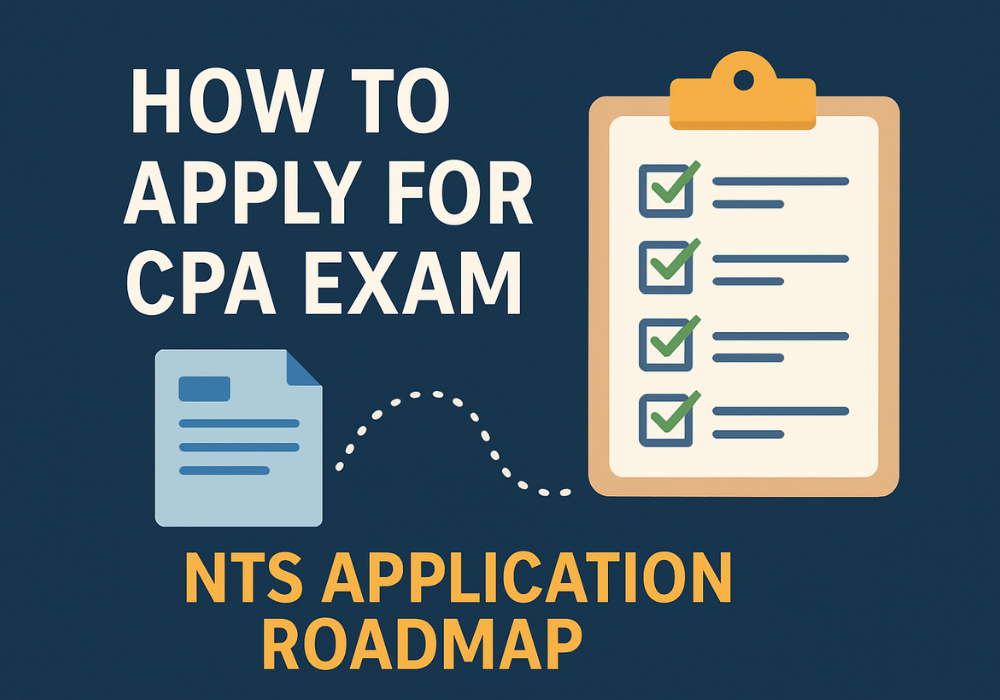
Learn the 5-stage NTS process, 2025 costs in INR, state selection tips, and Prometric scheduling for Indian candidates. The article is written by Medha Vinod, Senior Associate at LawSikho.
The CPA exam application process involve multiple organizations, several fee payments, and unfamiliar terminology that can overwhelm Indian candidates. This guide breaks down the entire journey into five clear stages, helping you understand exactly what to do at each step, how much it costs in Indian Rupees, and how long each phase takes. Whether you are a B.Com graduate, CA, or working professional, this roadmap will help you navigate from credential evaluation to your Prometric appointment.
The Five Stages of CPA Exam Application for Indian Candidates
The path from deciding to pursue the CPA to actually sitting in a Prometric center follows a predictable sequence of five stages. Each stage has specific requirements, timelines, and costs that you need to understand before moving forward. Knowing what comes next at each point prevents surprises and helps you plan both your time and finances effectively.
Stage 1: Credential Evaluation
Your journey begins with getting your Indian educational credentials evaluated by an approved agency. This step typically takes four to eight weeks and costs between $225 and $305 (₹18,900 to ₹25,600). You will need to gather official transcripts from your Indian university and submit them to either NIES or WES, depending on which state you plan to apply through. Start this process early because Indian universities can take two to four weeks just to process your transcript request.
Stage 2: State Board Application
Once your credentials are evaluated, you submit your application to your chosen state board through the NASBA CPA Portal. Application fees range from $50 to $200 (₹4,200 to ₹16,800) depending on the state. After reviewing your application and evaluation report, the state board issues your Authorization to Test (ATT), which confirms you are eligible to take the exam. This stage typically takes three to six weeks from submission to ATT receipt.
Stage 3: NTS Registration and Fee Payment
With your ATT in hand, you have 90 days to pay exam section fees and receive your Notice to Schedule (NTS). Each section costs $390 (₹32,760) in exam fees. For Candidates outside the US and Canada, the fee is $510. Once you pay, NASBA generates your NTS within a few business days, which becomes your actual exam ticket. The NTS is valid for six months in most states, so only pay for sections you can realistically prepare for and take within that window.
Stage 4: International Testing Registration
Before scheduling at an Indian Prometric center, you must pay an additional international administration fee. This is paid through your NASBA candidate account by selecting “International Administration.” After payment, you must wait 24 hours before you can access the scheduling system. This brings your total per-section cost to $780 (₹65,520) for testing in India.
Stage 5: Prometric Scheduling
The final stage is booking your actual exam appointment through Prometric’s scheduling system. You can choose from eight testing centers across India: Ahmedabad, Bangalore, Kolkata, Chennai, Hyderabad, Mumbai, New Delhi, and Trivandrum. Select your preferred date and time based on seat availability, and you will receive a confirmation email with your appointment details. From start to finish, the entire five-stage process takes approximately four to six months.
Credential Evaluation for CPA Exam: Getting Your Indian Degree Recognized
US state boards cannot directly interpret Indian degrees, transcripts, or grading systems. They rely on specialized evaluation agencies to translate your academic credentials into US credit hour equivalents. This translation determines whether you meet the education requirements to sit for the exam and eventually qualify for licensure.
Understanding Credit Hour Requirements
The US education system measures academic achievement in semester credit hours, with bachelor’s degrees typically totaling 120 credits. Most states require 120 credits to sit for the CPA exam and 150 credits for full licensure. A three-year Indian B.Com degree generally evaluates to 90 to 120 US credits, which may qualify you to sit for the exam but usually falls short of the 150-credit licensure requirement.
If you hold an M.Com, an MBA in Finance, or have completed the CA qualification, your credit total will be higher. M.Com graduates typically receive 140 to 160 credits after evaluation, often meeting or exceeding the 150-credit threshold. Chartered Accountants benefit from additional professional credits that can push the total well above minimum requirements. Understanding where your specific qualification lands helps you choose appropriate states and plan for any additional coursework needed for licensure.
Choosing Your Evaluation Agency
Two agencies dominate credential evaluation for CPA candidates: NASBA International Evaluation Services (NIES) and World Education Services (WES). Your choice depends primarily on which agency your target state accepts. Some states, like Alaska, Arizona, and Georgia, only accept NIES evaluations, while others accept both agencies.
NIES charges $225 to $300, depending on service level, and offers a unique “Undecided Jurisdiction” option that recommends suitable states based on your credentials. WES charges approximately $305 for its CPA-specific evaluation package and is widely recognized across multiple professions. Before paying either agency, verify your chosen state’s requirements on their official website. Paying for an evaluation from the wrong agency means starting over and paying again, which is one of the most expensive mistakes candidates make.
Document Preparation for Indian Universities
Evaluation agencies require official documents sent directly from your institution or in sealed envelopes that you forward unopened. You will need consolidated marksheets for all years of your degree, your degree certificate or provisional certificate, and sometimes course descriptions or syllabi detailing what each subject covered.
Contact your university’s examination section or registrar’s office at least three to four weeks before you need documents. Indian universities often have bureaucratic processes that take longer than expected, and rushing this step leads to errors. If your documents are not in English, arrange for certified translations before submission. Keep copies of everything you send, and use tracked courier services when mailing documents internationally to avoid loss.
State Selection and Application Strategy for CPA Exam
Your choice of US state affects your eligibility, costs, evaluation agency options, and long-term licensure path. Unlike the CA exam administered uniformly across India, CPA licensing is handled by 55 different state boards with varying requirements. Making an informed state choice upfront prevents complications and additional expenses later in your journey.

Key Factors for Indian Candidates
Education requirements vary significantly between states. Some states allow candidates to sit for the exam with just 120 credit hours, making them accessible to B.Com graduates. Other states require 150 credits even to take the exam, which would require additional coursework for most Indian candidates before they can apply.
Social Security Number requirements matter for international candidates. States including Colorado, Montana, Alaska, Washington, New Hampshire, and Maine do not require an SSN for exam eligibility, making them popular among Indian candidates. Most states also do not require US residency to take the exam, though some have residency requirements for final licensure.
Application Process Overview
Start by creating an account on the NASBA CPA Portal using your email address and personal information. Your name must exactly match your passport because this information flows through to your NTS and must match your test center identification. Upload your credential evaluation report and complete the application form for your chosen state.
Submit your application along with the required fee. Some states process applications directly, while others use NASBA’s CPAES system. After submission, the state board reviews your credentials, and either approves your application or requests additional documentation. Plan for three to six weeks between submission and receiving your Authorization to Test, though processing times vary by state and time of year.
From ATT to NTS: The Critical Transition
The Authorization to Test confirms your eligibility but does not allow you to schedule an exam. Think of it as approval to proceed rather than an exam ticket. Your ATT is valid for 90 days in most states, during which you must pay exam section fees to convert it into a Notice to Schedule. Letting your ATT expire without paying fees may require reapplication and additional application fees.
Once you pay section fees through the NASBA portal, your NTS is generated within a few business days. The NTS contains your Exam Section ID, which you need for Prometric scheduling, and specifies the validity period during which you must schedule and complete your exam. Most states provide six months of NTS validity. Plan your study timeline before paying for sections; if you cannot realistically prepare for a section within six months, wait until you can rather than risking fee forfeiture.
Complete Breakdown in Indian Rupees
Understanding the full cost picture prevents financial surprises and helps you plan payments across your CPA journey. Costs are spread across multiple stages rather than all at once, which provides some cash flow flexibility. However, the total investment is substantial, so budgeting accurately from the start is essential.
Fee-by-Fee Breakdown
Your credential evaluation costs $225 to $305 (₹18,900 to ₹25,600), depending on agency and service level. State board application fees will be $100. Registration fees, charged when you request an NTS, range from $40 to $200 depending on how many sections you register for at once.
Exam section fees are $510 per section, totaling $2,040 (₹1,83,600) for all four sections. Adding evaluation, application, and registration fees, expect to spend ₹2,90,000 to ₹3,20,000 on exam-related costs alone.
Additional Costs to Consider
Most candidates invest in a CPA review course to maximize their chances of passing. Courses from providers like Becker, Wiley, or Surgent range from ₹80,000 to ₹2,00,000, depending on the package and whether you access them through an Indian coaching institute. Some candidates also need bridge courses if their credit evaluation falls short of state requirements, adding another ₹20,000 to ₹50,000.
Retake fees are a significant potential expense. If you fail a section and need to retake it, you pay the full fee again for the exam and international fees. Rescheduling fees apply if you change your exam date close to your appointment. Building a buffer of 10-15% into your budget accounts for these possibilities and currency fluctuations.
Smart Budgeting Tips
Pay for one or two sections at a time rather than all four at once. This approach reduces the risk of forfeiting fees if your NTS expires before you can take all sections. While you pay a small registration fee each time you request a new NTS, this is far cheaper than losing $780 on an untaken section.
Factor in currency fluctuation by adding 5-10% to your budget calculations. The rupee-dollar exchange rate can shift significantly over your six to twelve-month CPA journey. Explore EMI options offered by many Indian coaching institutes if paying the full amount upfront is challenging. Most importantly, invest in quality preparation to pass on your first attempt. Each retake costs ₹65,520, making first-attempt success the single most effective cost-saving strategy.
Prometric Scheduling and Exam Day Preparation for CPA Exam
With your NTS in hand and international fees paid, you are ready to book your actual exam appointment. This final stage transforms months of application work into a confirmed date and time when you will sit for the exam. Proper scheduling and exam day preparation ensure that administrative issues do not derail your testing experience.
Booking Your Exam Appointment
Access Prometric’s ProScheduler through their website after waiting 24 hours from your international fee payment. Select “Uniform CPA Exam” as your program, then enter your Exam Section ID from your NTS along with the first four letters of your last name. The system will show available appointments at testing centers based on your international registration.
Choose from the eight Indian Prometric centers based on availability and convenience: Ahmedabad, Bangalore, Kolkata, Chennai, Hyderabad, Mumbai, New Delhi, and Trivandrum. Select a date that allows adequate preparation time while leaving a buffer before your NTS expires. Consider score release dates if you want results before scheduling subsequent sections. Popular testing dates fill up quickly, especially around quarter-ends, so book as early as your study timeline allows.
Rescheduling Rules and Fees
Life circumstances change, and Prometric allows rescheduling with varying fees based on notice provided. If you reschedule more than 61 days before your exam, there is no fee. Otherwise, it costs $35. Changes made between 24 hours and 5 days before exam day cost $84.84.
If you are within 24 hours of your appointment or fail to appear, you forfeit all fees for that section and must pay again to register. This includes both the exam section fee and the international fee. If you realize you are not ready, reschedule early rather than hoping you will catch up.
Critical Checklist Before Exam Day
Your passport is your primary identification at the test center, and the name on it must exactly match the name on your NTS. Even minor variations like “Kumar” versus “K.” can cause problems. Verify this match well before exam day and contact your state board immediately if corrections are needed.
Bring a printed or digital copy of your NTS, as you cannot test without it. Know your test center address and plan your route, accounting for traffic and allowing time for security procedures. Save your confirmation number in multiple places: email, phone, and written backup. Arrive at least 30 minutes before your scheduled time to complete check-in procedures without rushing. The exam itself is challenging enough; eliminating administrative stress lets you focus entirely on demonstrating your knowledge.
Conclusion
The CPA application journey from India involves five distinct stages spanning four to six months and costing approximately ₹3 to ₹5.5 lakhs, depending on coaching choices. Start with credential evaluation and state research, as these decisions impact everything that follows. Your evaluation determines your credit hours, which affects state eligibility. Your state choice determines evaluation agency requirements, fees, and NTS validity periods.
Pay for exam sections strategically, keeping NTS validity in mind. Most working professionals benefit from registering for one or two sections at a time rather than all four at once. This approach reduces financial risk and allows you to adjust your timeline based on how preparation progresses. Build buffer time into your schedule for unexpected delays in any stage.
With proper planning and realistic timeline expectations, the application process becomes manageable rather than overwhelming. Thousands of Indian candidates navigate this path successfully each year, securing positions in Big Four firms, advancing in multinational corporations, and building rewarding global finance careers. Your CPA journey begins with understanding the roadmap, and now you have it.
For more details on the application process for CPA Exam, visit this link.
 Serato DJ Crack 2025Serato DJ PRO Crack



 Allow notifications





