

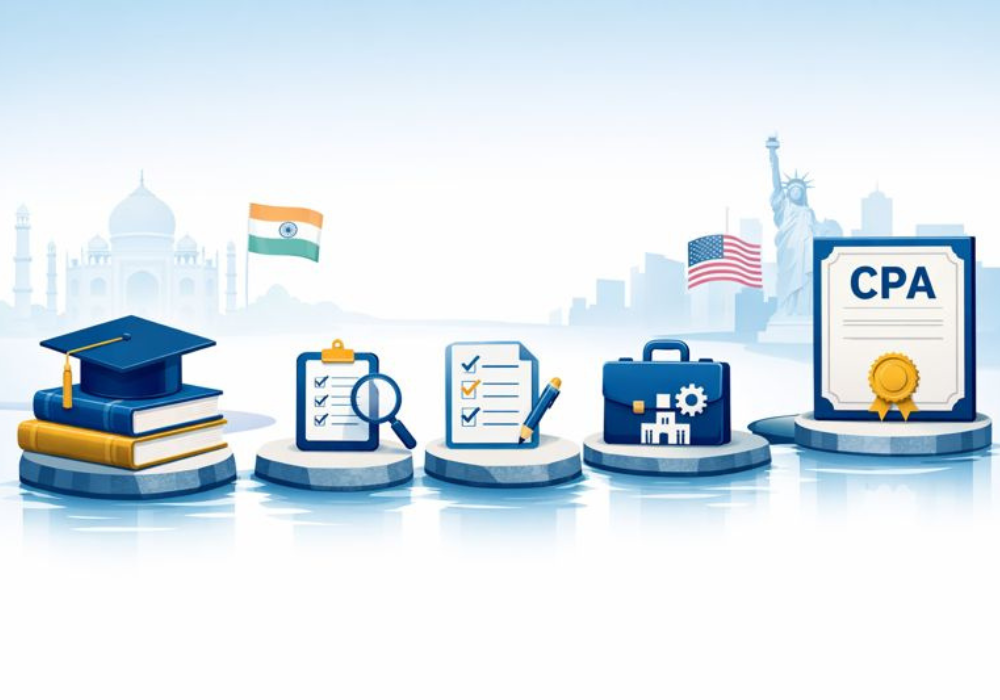
How to become a US CPA: Learn eligibility, exam syllabus, application process, costs, and career opportunities for Indian professionals. This article is written by Medha Vinod, Senior Associate at LawSikho.
Table of Contents
The US CPA certification has become one of the most sought-after credentials for Indian accounting professionals looking to build global careers. If you’re wondering how to become a Certified Public Accountant from India, the process involves three essential components: meeting education requirements, passing a four-part examination, and gaining relevant work experience. Whether you’re a commerce graduate exploring international credentials, a CA aspirant considering alternatives, or a qualified Chartered Accountant seeking global recognition, the CPA pathway is accessible from India. This guide walks you through each step clearly, from assessing your eligibility to earning your license and launching your career.
Introduction to US CPA
The Certified Public Accountant designation is awarded by the American Institute of Certified Public Accountants (AICPA) and represents the gold standard for accounting professionals in the United States. CPAs are licensed professionals authorized to perform audits, sign tax returns, and provide attestation services. The credential is recognized in over 130 countries and has become increasingly valuable in India as multinational corporations expand their operations.

Unlike the Indian CA, which is regulated by ICAI, the US CPA operates under a state-based licensing system where each of the 55 US jurisdictions sets its own requirements. This means you choose which state to apply through, and the requirements vary accordingly. The good news for Indian candidates is that since 2020, you can take all CPA exam sections at Prometric centers across eight major Indian cities, eliminating the need for expensive international travel.
Can Indians Give the US CPA Exam?
Yes, Indian citizens can absolutely take the US CPA exam and obtain licensure. The exam and licensing process is the same for international candidates as it is for US citizens, with a few additional considerations around credential evaluation and state selection. Thousands of Indian professionals successfully earn their CPA licenses every year while living and working in India.
The key requirement is meeting the education standards set by your chosen state board of accountancy. Indian qualifications like B.Com, M.Com, CA, CS, and CMA are accepted, though they must be evaluated by an approved credential assessment agency to determine US credit equivalency. States like Guam, Montana, etc have established international-friendly policies that accommodate candidates without US Social Security Numbers.
Indians from commerce backgrounds are particularly well-positioned for CPA success. Your foundational knowledge in accounting, taxation, and business law provides a strong base for the CPA exam content. Many CA aspirants and qualified CAs pursue CPA to add international credentials to their profile, and the overlap in fundamental concepts makes the transition manageable.
CPA Exam Eligibility
CPA eligibility operates on a credit-based system rather than specific degree requirements. Most states require 120 credit hours to sit for the exam and 150 credit hours for full licensure. The challenge for Indian candidates is understanding how their qualifications translate to this US credit system and identifying which states align with their academic profile.
Indian commerce degrees convert to US credits based on years of study, with one academic year typically equaling 30 credit hours. A three-year B.Com translates to approximately 90 credits, while adding an M.Com brings you to around 150 credits. Professional qualifications like CA add additional credits, typically 30 to 60 hours, depending on the evaluation agency’s assessment. This means a B.Com plus CA combination often meets or exceeds the 150-credit threshold.
The credential evaluation process is mandatory for all international candidates. You’ll submit your transcripts and certificates to agencies like NASBA International Evaluation Services (NIES) or World Education Services (WES), which translate your Indian qualifications into US-equivalent terms. This evaluation typically costs $150 to $200 and takes four to eight weeks to complete. For detailed eligibility pathways based on Indian qualifications, you can refer to the comprehensive guide on CPA Exam Eligibility for Indian B.Com Graduates published on SkillArbitrage.
How do Indian Qualifications Convert to US Credits for CPA Exam?
The 120-credit threshold gets you into the exam room, while 150 credits are needed for your actual license. Understanding this distinction is crucial for planning your CPA journey. A standard three-year Indian B.Com provides roughly 90 credits, leaving you 30 credits short of exam eligibility. However, completing an M.Com or MBA adds approximately 60 credits, bringing your total to 150 and meeting full licensure requirements.
For CA-qualified professionals, the picture is more favorable. Your CA credential typically adds 30 to 60 credits when evaluated, meaning a B.Com plus CA combination often reaches 120 to 150 credits. CS and CMA India qualifications similarly contribute additional credits. The exact count depends on your evaluation agency and the specific state board’s policies, so getting your credentials evaluated early provides clarity on where you stand.
The evaluation process requires official transcripts sent directly from your Indian universities to the evaluation agency. You’ll also need degree certificates and detailed mark sheets. For CA, CS, or CMA credentials, certificates from the respective institutes (ICAI, ICSI, ICMAI) are required. Budget two to three months for the complete evaluation process, including time for your institutions to send documents and the agency to complete their assessment.
Choosing the Right US State for Your CPA Journey
State selection significantly impacts your CPA journey because requirements vary considerably across jurisdictions. For Indian candidates without a US Social Security Number, this narrows your options to international-friendly states that waive the SSN requirement. Making the wrong choice can mean delays, additional costs, or even the inability to complete licensure.
Guam is a popular choice for Indian candidates. This US territory accepts 120 credits for exam eligibility, has no SSN or residency requirements, and participates in NASBA’s experience verification service for candidates whose work experience wasn’t supervised by a US CPA.
When selecting your state, consider these factors: Do you have 120 or 150 credits? Can you get your experience verified by a US-licensed CPA, or do you need a state that accepts alternative verification? Are there any specific accounting or business credit requirements you might not meet? Answering these questions honestly points you toward the right state for your situation.

Application Process for CPA Exam
The CPA exam underwent major restructuring in January 2024 with CPA Evolution, replacing the traditional four-section format with a Core plus Discipline model. Understanding this new structure and navigating the application process efficiently sets you up for a smooth journey from application to exam day.
CPA Exam: Core Sections and Discipline Choices
Under the current structure, all candidates must pass three Core sections: Auditing and Attestation (AUD), Financial Accounting and Reporting (FAR), and Taxation and Regulation (REG). These tests are fundamental knowledge every CPA needs regardless of career specialization. Each Core section is four hours long with a 50-50 split between multiple-choice questions and task-based simulations.
The fourth section is a Discipline of your choice from three options. Business Analysis and Reporting (BAR) suits those pursuing financial reporting and analysis careers. Information Systems and Controls (ISC) aligns with IT audit and cybersecurity roles. Tax Compliance and Planning (TCP) extends your REG knowledge and fits tax practice aspirations. Current pass rate data shows TCP with the highest success rate at 75-78%, followed by ISC at around 68%, and BAR at 34-41%.
Your discipline choice should reflect your career goals rather than just pass rates. If you’re targeting Big 4 tax practice or corporate tax roles, TCP makes sense. For those interested in technology-focused positions or IT audit, ISC provides relevant specialization. BAR aligns with CFO-track positions and financial analysis roles in corporate settings.
Application Process and Scheduling at Indian Prometric Centers
The application process begins after your credential evaluation is complete. Create an account on NASBA CPA Central and submit your application to your chosen state board.
Your NTS is valid for six to nine months, depending on your state. Within this window, you must schedule and complete your exam sections through Prometric. India has eight testing centers: Ahmedabad, Bangalore, Calcutta, Chennai, Hyderabad, Mumbai, New Delhi, and Trivandrum. Schedule your preferred date early, especially at popular locations like Mumbai and Bangalore that fill up faster.
The typical timeline from starting your application to sitting for your first exam section is three to four months. This includes credential evaluation (6-8 weeks), state board application review (2-4 weeks), and scheduling lead time. International candidates pay an additional testing surcharge of approximately $120 per section, bringing the total per-section cost to around $510.
Preparing for the US CPA Exam
Successful CPA preparation requires structured study using quality review materials, realistic time investment, and strategic planning around your work and personal commitments. The total study time needed varies by section based on content volume and complexity, and understanding these differences helps you allocate your preparation time effectively.
FAR (Financial Accounting and Reporting) demands a study time of approximately 120 to 150 hours due to its extensive content covering US GAAP, governmental accounting, nonprofit accounting, and financial statement preparation. Most candidates find FAR the most challenging simply because of the sheer volume of material to master. REG (Taxation and Regulation) requires around 80 to 110 hours, with the learning curve focused on understanding the US federal tax code from scratch since Indian candidates have no prior exposure to these concepts.
AUD (Auditing and Attestation) typically needs 110 to 140 hours, and candidates with audit experience or CA backgrounds often find this section more intuitive due to conceptual overlaps with Indian auditing standards. For the Discipline sections, TCP and ISC do not need as much as BAR. Working professionals studying 15 to 20 hours weekly should budget five to six weeks per section, with FAR potentially requiring seven to eight weeks.
US CPA Exam Syllabus
Each CPA exam section covers specific competency areas defined in the AICPA’s Exam Blueprints, and understanding the topic-wise breakdown helps you prioritize your preparation effectively. The syllabus was restructured under CPA Evolution 2024, with some topics shifting between sections and a new emphasis on technology and data analytics throughout.
- AUD (Auditing and Attestation) tests your knowledge across four major areas. Indian candidates familiar with Indian Standards on Auditing will find conceptual similarities, though US-specific standards like PCAOB requirements need focused learning.
- FAR (Financial Accounting and Reporting) covers the broadest content range. FAR’s challenge lies in memorizing specific US GAAP treatments that differ from Indian Accounting Standards.
- REG (Taxation and Regulation) is divided into two main areas. Federal taxation and business law. For Indian candidates, the entire federal taxation portion requires fresh learning since US tax concepts differ fundamentally from Indian taxation.
- Discipline sections dive deeper into specialized areas. Your discipline choice should align not just with pass rates but with the content you’re most interested in mastering for your career.
Review Course Selection for Indian Candidates
A comprehensive CPA review course is the most critical investment in your preparation journey. These courses provide structured video lectures, extensive question banks, simulated exams, and study planning tools that self-study simply cannot replicate. The market offers several reputable options with different strengths, price points, and learning approaches suited to various candidate profiles.
Becker remains the market leader with the most comprehensive content library, typically priced at $2,400 to $3,500 (₹2,00,000 to ₹2,94,000). It offers structured learning paths, extensive practice questions, and strong brand recognition among employers.
Surgent uses adaptive learning technology that customizes your study path based on performance, priced at $1,500 to $2,200 (₹1,26,000 to ₹1,85,000), potentially reducing total study time by focusing on weak areas.
Indian coaching institutes offer localized alternatives, bundling international review materials with Indian support. Miles Education, Simandhar Education, and Zell Education provide programs ranging from ₹1,00,000 to ₹2,00,000 that include live classes scheduled for Indian time zones, application assistance, and peer study communities. These can be particularly valuable if you prefer structured classroom-style learning or need guidance navigating the registration process.
SkillArbitrage offers the CPA Prep & Global Finance Career Acceleration Program. It is a structured 6-month online certification course designed to help learners prepare for the U.S. CPA (Certified Public Accountant) exam and build a global finance career, with an expected commitment of about 8–10 hours per week. The program also includes mentoring on freelancing, networking, client proposals, and job‐readiness skills, and on successful completion, students receive a certificate co-branded by NSDC and Skill India. It features live online classes, practical assignments, instructor feedback, and support through an LMS, with a waitlist for enrollment.
Before committing, take advantage of free trials offered by most providers to assess which teaching style and platform interface works best for your learning preferences. For detailed comparisons of CPA courses and their features, refer to the CPA Course Guide on SkillArbitrage.
Completing Experience Requirements and Earning Your License
Passing all four exam sections is a major milestone, but licensure requires meeting experience requirements as well. Most states require one to two years of relevant accounting experience verified by a licensed CPA. Understanding these requirements and planning for them ensures you can obtain your license after passing your exams.
Experience Verification and License Application Process
The experience requirement typically involves 2,000 hours of work in accounting, auditing, taxation, or related areas. This experience must be verified, traditionally by a supervising US-licensed CPA. For Indian candidates working in India, this creates a challenge since most supervisors hold CA credentials rather than CPA licenses.
States like Guam and Montana address this through NASBA’s experience verification service, which provides alternative pathways for international candidates. Through this service, your experience can be verified even without direct US CPA supervision, though the process involves additional documentation and fees. Some states also accept verification from non-CPA supervisors in specified circumstances.
After meeting all requirements, you submit your license application to your state board with applicable fees. The board reviews your documentation, and upon approval, you receive your CPA license. Ongoing requirements include completing 40 hours of Continuing Professional Education (CPE) annually and paying license renewal fees to maintain active status.
Steps in Brief
For Indian professionals seeking CPA licensure, here’s the complete journey summarized:
For B.Com Graduates:
- Get your credentials evaluated through NIES or WES (90 credits from 3-year B.Com)
- Complete additional coursework or postgraduate studies to reach 120 credits for exam eligibility
- Select an international-friendly state (Guam, Montana, or Washington recommended)
- Apply through NASBA CPA Central and receive your NTS
- Prepare using a quality review course (budget 300-400 total study hours)
- Pass all four exam sections within the 30-month rolling window
- Accumulate 1-2 years of relevant experience and get it verified
- Apply for licensure and complete ethics requirements if applicable
- Maintain license through annual CPE and renewal
For CA Qualified Professionals:
- Get your B.Com plus CA credentials evaluated (typically 120-150 credits total)
- Select your state based on experience verification options
- Apply and receive your NTS
- Leverage your CA foundation while learning US-specific content
- Pass all four exam sections
- Verify your Indian work experience through NASBA’s verification service or eligible state processes
- Apply for licensure upon meeting all requirements
- Continue CPE obligations annually
Career Opportunities After CPA
The CPA credential opens significant career opportunities in India’s growing economy. Big 4 firms (Deloitte, PwC, EY, KPMG) actively recruit CPAs for audit, tax, and advisory roles across their Indian offices. Beyond the Big 4, multinational corporations like Amazon, Accenture, JP Morgan, and Fortune 500 companies with Indian operations hire CPAs for finance leadership, internal audit, and compliance positions.
Location impacts salary significantly. Mumbai, Bangalore, and Delhi NCR offer the highest compensation, reflecting the concentration of employers and cost of living. The CPA also provides global mobility; if international opportunities arise, your credential transfers across borders far more easily than India-specific qualifications.
Conclusion
Becoming a US CPA from India follows a clear path: assess your eligibility through credential evaluation, select an international-friendly state, pass four rigorous exam sections, and fulfill experience requirements for licensure. The journey typically takes 12 to 24 months and requires an investment of ₹3 to ₹5 lakhs, including exam fees, review courses, and application costs.
The returns justify this investment through enhanced career opportunities, significant salary premiums, and global professional recognition. Whether you’re a B.Com graduate building international credentials or a CA adding global mobility to your profile, the CPA pathway is proven and achievable. Thousands of Indian professionals complete this journey successfully every year, and with proper planning and commitment, you can too. Your first step is getting your credentials evaluated to understand exactly where you stand and which states align with your profile.
For detailed information on become a CPA, visit here.
 Serato DJ Crack 2025Serato DJ PRO Crack



 Allow notifications





