

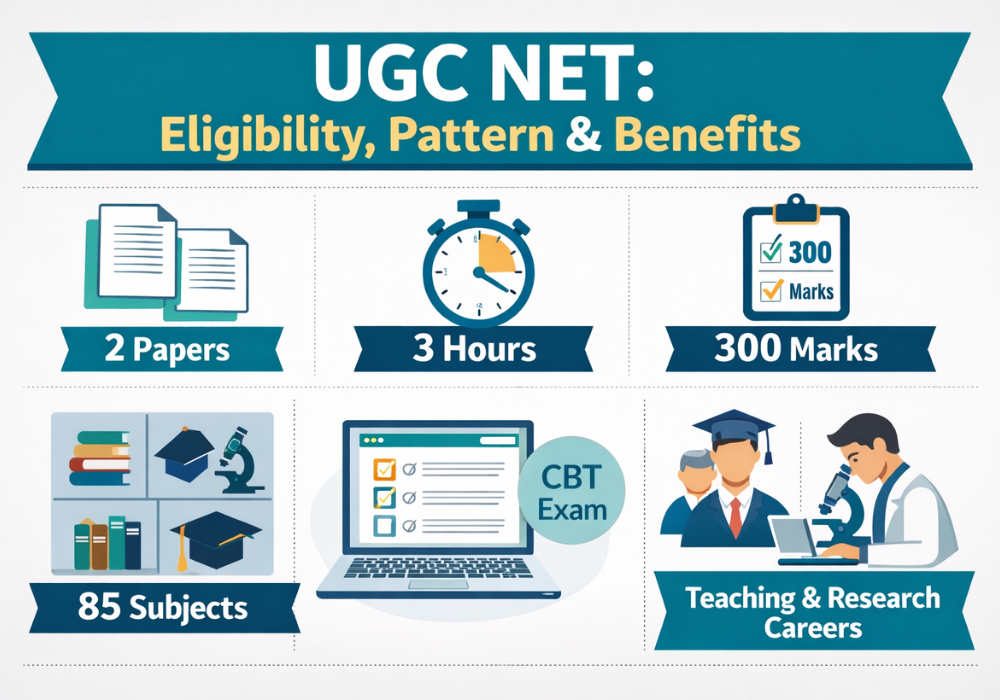
Essential UGC NET Exam guide covering eligibility, exam pattern (Paper I & II, 300 marks), syllabus overview, application process, cut-offs, and career outcomes. This article is written by Neeli Neelay Shah, Senior Legal Content Writer at LawSikho.
The UGC NET exam stands as the definitive pathway into India’s academic world, whether you aspire to teach at universities or pursue funded doctoral research. Conducted twice yearly by the National Testing Agency, this national-level examination determines your eligibility for Assistant Professor positions across the country and qualifies top performers for Junior Research Fellowship with monthly stipends. With over 9 lakh candidates competing each session, understanding this exam thoroughly gives you a decisive advantage in your preparation journey.
UGC NET Exam and Its Significance for Your Academic Career
The University Grants Commission National Eligibility Test, commonly known as UGC NET, is India’s premier examination for assessing the eligibility of candidates seeking teaching and research positions in higher education. The National Testing Agency (NTA) conducts this examination on behalf of UGC in Computer-Based Test format, offering candidates two opportunities annually through June and December cycles. Your performance in this single examination can open doors to stable government teaching positions or provide financial support for your doctoral studies.
Junior Research Fellowship and Assistant Professor Eligibility Through UGC NET Exam
When you appear for UGC NET, you compete for two distinct qualifications based on your score. Candidates who rank in the top 6% nationally earn Junior Research Fellowship, which provides ₹37,000 monthly during the first two years of PhD, increasing to ₹42,000 (contingency fund 10,000 (JRF) –₹12,000 (SRF) from the third year. Those who clear the minimum qualifying marks but fall outside the top 6% receive Assistant Professor eligibility, allowing them to apply for permanent teaching positions in universities and colleges. The beauty of scoring in the top bracket is that JRF holders automatically qualify for both benefits, giving them flexibility to choose between research and teaching careers.

Eligibility for UGC NET Exam
The UGC NET Exam eligibility criteria are designed to be inclusive, ensuring most postgraduate students can participate in this examination.
Nationality
Only Indian nationals can appear for UGC NET examination. This requirement exists because the exam determines eligibility for teaching and research positions specifically in Indian universities and colleges under UGC jurisdiction.
Educational Requirements and Percentage Criteria
You need a Master’s degree from a UGC-recognized university to be eligible for UGC NET. The minimum percentage requirement is 55% for General and EWS category candidates. If you belong to SC, ST, OBC (Non-Creamy Layer), PwD or Third Gender categories, the requirement relaxes to 50% marks. Final year postgraduate students can also apply by selecting “Appearing” status, though they must complete their degree with required percentage within two years of appearing. Under NEP 2020, candidates completing Four-Year Undergraduate Programmes with 75% marks (70% if you are an OBC-NCL/SC/ST/PwD) can now apply directly without a Master’s degree.
Age Limits for JRF and Assistant Professor
Here is where things get interesting. For Assistant Professor eligibility alone, there is no upper age limit whatsoever, making this exam accessible even to mid-career professionals seeking academic transitions. However, for JRF qualification, the maximum age is 30 years as on the first day of the notification month. Reserved category candidates (SC/ST/OBC-NCL/PwD/Women) receive 5 years relaxation, effectively extending their JRF eligibility to 35 years.
UGC NET Exam Pattern
Understanding the examination structure helps you allocate preparation time strategically across both papers. The pattern has remained consistent, allowing you to plan with certainty.
Exam Format
The structural design of UGC NET Exam requires you to balance general aptitude skills with deep subject knowledge within a single examination session.
Two Papers in a Single Three-Hour Session
UGC NET Exam comprises Paper I testing general teaching and research aptitude, and Paper II testing your chosen subject expertise. Both papers are attempted consecutively in a single 180-minute session without any break. This continuous format requires building mental stamina alongside academic preparation.
Computer-Based Test (CBT) Mode
The examination happens exclusively on computers at designated test centres. You answer questions by clicking options on screen, can navigate freely between papers, and mark questions for later review using the question palette. NTA provides free mock tests on their official portal that simulate the actual interface, and practicing with these before exam day eliminates any technology-related anxiety.
Total Questions, Marks, and Time Allocation
The examination contains 150 questions worth 300 marks total. Paper I has 50 questions carrying 100 marks, while Paper II has 100 questions carrying 200 marks. Most successful candidates allocate roughly 50-60 minutes to Paper I and 120-130 minutes to Paper II, proportional to their mark weightage.
UGC NET Exam Paper I: Teaching and Research Aptitude
Paper I is identical for all candidates regardless of their subject choice, creating a common evaluation ground for teaching aptitude and research understanding.
50 Questions Carrying 100 Marks in Paper 1
Each of the 50 questions in Paper I carries 2 marks, totaling 100 marks. The questions test your aptitude for academic careers through diverse topics ranging from teaching methodology to logical reasoning. Since this paper is common for everyone, your performance here directly compares against candidates from all 85 subjects.
All 10 Units at a Glance
Paper I covers ten units: Teaching Aptitude, Research Aptitude, Reading Comprehension, Communication, Mathematical Reasoning and Aptitude, Logical Reasoning, Data Interpretation, Information and Communication Technology, People Development and Environment, and Higher Education System. Each unit contributes approximately 5-6 questions, though distribution varies slightly between exam sessions.

Paper II: Subject-Specific Knowledge Assessment
Paper II tests your expertise in your chosen discipline at postgraduate level, carrying double the weightage of Paper I.
100 Questions Worth 200 Marks
With 100 multiple-choice questions worth 2 marks each, Paper II contributes 200 marks to your total score. The questions assess both theoretical understanding and application of concepts, matching the depth expected of someone qualified to teach at university level.
Choosing Your Subject from 85 Options
NTA offers 85 subjects for Paper II spanning humanities, social sciences, languages, commerce, and applied sciences. Your selection should correspond to your Master’s degree specialization. Law graduates choose Subject Code 58, Commerce postgraduates select Subject Code 08, and so on. This choice is final once you submit your application, so decide carefully after reviewing the complete syllabus.
Marking Scheme and Qualifying Criteria for UGC NET Exam
The scoring system and qualification thresholds directly impact your exam strategy and target-setting.
+2 Marks Per Question with No Negative Marking
Every correct answer earns you 2 marks, while wrong or unattempted questions carry zero penalty. This candidate-friendly scheme means you should attempt every single question, even through educated guessing. Unlike many competitive exams, UGC NET does not punish incorrect attempts, making it strategically sensible to never leave any question blank.
Minimum 40% in Each Paper to Qualify
General category candidates must score an aggregate of at least 40% in both the papers to qualify. Reserved categories need an aggregate of 35%. Meeting these thresholds makes you eligible for consideration, with final qualification determined by cut-off percentiles. Candidates in the top 6% nationally qualify for JRF, while those clearing minimum marks but below this bracket qualify only for Assistant Professor eligibility.
UGC NET Exam Syllabus
Your syllabus is essentially your preparation checklist. Knowing exactly what topics fall within scope ensures you do not waste time on irrelevant material or miss crucial areas.
Paper I Syllabus: 10 Units Explained
Each UGC NET Paper I unit has specific topics that appear repeatedly across examination cycles. Familiarizing yourself with these helps prioritize preparation.
Unit 1: Teaching Aptitude (Methods, Learner Characteristics, Evaluation)
This unit covers teaching objectives, levels of teaching, and various methodologies including lecture, discussion, and demonstration methods. You encounter questions on learner characteristics across developmental stages, factors affecting learning, and evaluation systems including Bloom’s Taxonomy and continuous assessment approaches.
Unit 2: Research Aptitude (Methodology, Sampling, Data Analysis)
Research Aptitude covers the entire research cycle from problem identification to conclusion drawing. Key areas include types of research (quantitative vs qualitative, basic vs applied), sampling techniques, hypothesis formulation, and basic statistical concepts like measures of central tendency and correlation.
Units 3-5: Comprehension, Communication, Mathematical Reasoning
Unit 3 presents reading passages with comprehension questions testing inference and vocabulary skills. Unit 4 covers communication types, barriers, and models like Shannon-Weaver. Unit 5 tests numerical ability through number series, percentages, ratios, and basic mathematical problem-solving.
Units 6-7: Logical Reasoning and Data Interpretation
Logical Reasoning tests analytical thinking through syllogisms, Venn diagrams, coding-decoding, blood relations, and argument evaluation. Data Interpretation requires analyzing information presented in tables, bar graphs, pie charts, and line graphs to calculate percentages, identify trends, and make comparisons.
Units 8-10: ICT, Environment, Higher Education System
ICT covers computer fundamentals, internet technologies, and government digital initiatives like SWAYAM, Swayam Prabha and Digital India. The environment unit addresses sustainable development, climate issues, and international environmental agreements. Higher Education System covers UGC functions, NAAC accreditation, and significantly, National Education Policy 2020 provisions which have become high-frequency topics in recent examinations.
Paper II Syllabus: Subject-Specific Units
Paper II syllabi vary for each of the 85 subjects and typically cover the core postgraduate curriculum of that discipline.
Law Subject (Paper II) Syllabus
The UGC NET Law Paper II syllabus (Subject Code 58) consists of 10 units that together cover the full breadth of core and specialized legal subjects. Key units include Jurisprudence (legal theories, schools of thought, concepts of rights and duties), Constitutional and Administrative Law (fundamental rights, directive principles, constitutional remedies, judicial review), and Public International Law & International Humanitarian Law, alongside Law of Crimes (IPC and its mapping to the new Bharatiya Nyaya Sanhita), Law of Torts and Consumer Protection, Commercial Law (laws on contracts, company/partnership, negotiable instruments), Family Law (personal laws and succession), Environment and Human Rights Law, Intellectual Property and Information Technology Laws, and Comparative Public Law and systems of governance.
Commerce Subject (Paper II) Syllabus
The UGC NET Commerce syllabus (Subject Code 08) covers 10 units spanning accounting, finance, marketing, human resources, and business law. Major units include Business Environment (economic reforms, globalization, corporate governance), Accounting and Financial Management (cost accounting, financial statement analysis, capital structure theories), and Marketing Management (consumer behaviour, branding, digital marketing).
Additional units cover Human Resource Management (training, performance appraisal, industrial relations), Business Statistics and Research Methods, Banking and Financial Institutions, International Business, and Income Tax and GST provisions. The exam pattern for UGC NET Commerce Paper 2 consists of both: theoretical and numerical based questions.
Download Official UGC NET Exam Syllabus PDFs
Only official syllabus documents should guide your preparation, as questions are set strictly based on these. So you can download subject-wise syllabi from the NTA UGC NET portal. Navigate to the syllabus section, select your subject, and download the PDF in English or Hindi. Print this document and use it as your preparation tracker.
UGC NET Exam: A Step-by-Step Guide for Application Process
The application process is entirely online and must be completed accurately to avoid rejection. Understanding each step ensures smooth submission.
Registration Process
The online application involves multiple stages that must be completed sequentially within the notification window.
Registration and Login Credentials
Visit the NTA UGC NET website and click “New Registration.” Enter basic details including name, email, mobile number, and date of birth to generate your Application Number and Password. These credentials are essential for all future activities including application completion, admit card download, and result checking.
Filling Personal and Academic Details
After logging in, complete the application form section by section. Enter personal details matching your Class 10 certificate, educational qualifications including Master’s degree information, and select your Paper II subject from the 85 available options. Double-check all entries before proceeding as some fields cannot be modified after submission.
Photo and Signature Upload Specifications
Upload a recent passport-size colour photograph (JPG/JPEG, 10-200 KB) with white background and clear face visibility. Your signature should be in black ink on white paper (JPEG, 4-30 KB). Non-compliant uploads are a common rejection reason, so verify specifications before uploading.
UGC NET Exam Application Fees and Payment
Application fees were: ₹1,150 for General (UR), ₹600 for General-EWS and OBC-NCL, and ₹325 for SC, ST, PwD, and Third Gender candidates. Female applicants from General and OBC-NCL categories paid ₹600. These fees are non-refundable.
You can pay through credit card, debit card, net banking, or UPI. After successful payment, download the confirmation page showing your Application Number and transaction details. Save this receipt as proof of successful submission.
UGC NET Admit Card Download
Admit cards typically release 7-10 days before examination. Log in with your Application Number and Date of Birth, download the PDF from the “Admit Card” section, and print multiple copies. Verify all details including your photograph, exam centre address, and reporting time. Carry this along with a valid photo ID (Aadhaar, Passport, Voter ID, or PAN Card) on exam day.
Practical Tips to Prepare for UGC NET Exam
Strategic preparation outweighs mere hard work. Understanding what to study and how to approach each component maximizes your score potential.
Paper I Strategy: Scoring Units and Time Allocation
Among UGC NET Exam Paper I’s ten units, Logical Reasoning and Data Interpretation reward consistent practice and can become your highest-scoring areas. Teaching Aptitude and Research Aptitude require conceptual clarity rather than memorization. Current affairs units (ICT, Environment, Higher Education) need regular updates on government initiatives and NEP 2020 provisions. Allocate daily practice time for reasoning and DI, conceptual study for aptitude units, and weekly updates for current affairs sections.
Paper II Approach: Leveraging Your Subject Expertise
Your Master’s degree coursework provides approximately 60-70% of Paper II preparation foundation. Download the official syllabus, map it against your postgraduate curriculum, and identify topics needing fresh learning versus simple revision. Prioritize high-weightage areas that appear frequently in previous year papers, and build depth in your strong topics to maximize scoring potential.
Preparation Timeline
With six months, spend the first two months building foundations across all units, months three and four for deep diving into high-weightage topics, month five for revision and previous year papers, and the final month exclusively for mock tests. With three months, compress this schedule by prioritizing high-scoring areas. Even with 30 days, focused preparation on frequently tested topics combined with extensive mock test practice can yield qualification.
Books and Resource Recommendations for UGC NET Exam
For Paper I, Trueman’s UGC NET Paper I and KVS Madaan’s comprehensive guide cover all ten units effectively. R.S. Aggarwal’s books excel for Logical Reasoning and Data Interpretation practice. Regular reading of education news supplements current affairs units.
For UGC NET Exam Law Paper II, rely on standard postgraduate textbooks supplemented with subject-specific NET guides. Law aspirants should reference M.P. Jain for Constitutional Law, Avtar Singh for Contracts and Torts, and K.D. Gaur for Criminal Law. Commerce candidates benefit from S.P. Gupta for Business Statistics and S.N. Maheshwari for Accounting. Trueman’s and Arihant publish subject-wise NET guides containing practice questions aligned with examination patterns.
UGC NET Exam Cut-off and Results
Understanding how cut-offs function and when results arrive helps you set realistic targets and plan post-exam activities.
Cut-Off for UGC NET Exam
UGC NET cut-off represents the minimum combined score needed for qualification, varying by subject, category, and examination cycle. NTA releases subject-wise and category-wise cut-offs after each cycle based on exam difficulty and score distribution.
From recent cycles, indicative cut-offs for popular subjects show Commerce JRF around 224 marks, Political Science JRF around 224, Law JRF 200 out of 300 total marks. Assistant Professor cut-offs typically fall 10-15 marks lower than JRF thresholds. Target at least 15-20 marks above historical cut-offs for comfortable qualification margin.
UGC NET Exam Result Declaration
Results follow a systematic process that typically takes 6-8 weeks after examination completion, beginning with the release of the provisional answer key, followed by a challenge period, and culminating in the final result declaration.
NTA first releases provisional answer keys along with recorded candidate responses for verification, and if you find any answer incorrect, you can submit a challenge by paying ₹200 per question within the 3-5 day challenge window: expert committees then review these challenges, and valid objections lead to answer key revisions before final result computation.
To check your result, visit the NTA UGC NET website when results are declared, click the “Result” link, enter your Application Number and Date of Birth, and view your qualification status (JRF, Assistant Professor, or Not Qualified) along with your percentile score.
UGC NET Exam Scorecard
Your scorecard displays personal details, roll number, subject code, marks in Paper I and Paper II separately, total marks, overall percentile, and qualification status. Download and save multiple copies for use in job applications and further studies.
UGC NET Certificate Download and Validity
The NET qualification certificate is your official recognition document for career applications.
How to Download Your NET Qualification Certificate
After qualifying, access your e-certificate through the UGC portal using your credentials. The certificate contains your photograph, qualification details, and a unique verification code for employer verification.
H3: Certificate Validity Period and Usage
For Assistant Professor eligibility, the certificate remains valid for life, allowing you to apply for teaching positions at any career stage. JRF fellowship must be availed within two years of qualifying; afterwards, only Assistant Professor eligibility continues. Keep your certificate secure for teaching position applications, PhD admissions, and research opportunities.
Jobs and Salary After UGC NET Exam Qualification
Qualifying UGC NET unlocks multiple career pathways with attractive compensation in academia and related sectors.
Assistant Professor Salary Under 7th Pay Commission
NET-qualified Assistant Professors receive 7th Pay Commission Level 10 salary with basic pay starting at ₹57,700 and reaching ₹1,82,200 at maximum. Adding Dearness Allowance (currently 55%), House Rent Allowance (8-24% based on city), and other benefits, gross monthly salary in central universities typically ranges from ₹95,000 to ₹1,05,000 at entry level. State universities and private colleges offer varying packages based on their pay structures.
JRF Stipend and Career in Research
JRF provides ₹37,000 monthly during the first two years of PhD, increasing to ₹42,000 from year three onwards as Senior Research Fellow. You also receive annual contingency grants for research expenses and House Rent Allowance where hostel accommodation is unavailable. Over a five-year fellowship, total financial support approximates ₹20-25 lakh. After PhD completion, careers include university teaching at enhanced pay scales, research scientist positions at national institutes, and post-doctoral opportunities in India and abroad.
EdTech, Coaching, and Content Development and Writing Opportunities
Beyond traditional academia, NET qualification signals verified subject expertise valued across the education industry. EdTech platforms like LawSikho actively recruit NET-qualified professionals for online teaching, content creation, and curriculum development. Coaching institutes hire subject experts for classroom and online instruction. Publishing houses and educational websites employ NET-qualified candidates for developing study materials, question banks, and academic content. These roles often match or exceed traditional academic salaries while offering greater flexibility.
Conclusion
UGC NET Exam remains your essential qualification for entering India’s academic ecosystem, whether through teaching or research pathways. With eligibility requiring Master’s degree (55%/50% based on category), an exam pattern of 150 questions worth 300 marks across two papers, and rewards including Assistant Professor positions (₹95,000+ monthly) or JRF fellowship (₹37,000-₹42,000 monthly), the investment in preparation delivers substantial career returns. For comprehensive coverage of every aspect including detailed preparation strategies and subject-specific guidance, explore the complete UGC NET guide on LawSikho.
This topic is covered in detail on our LawSikho blog, click here.
 Serato DJ Crack 2025Serato DJ PRO Crack





 Allow notifications





