This article is authored by Subhashree S. It discusses in detail the Hardeep Singh v. State of Punjab which is regarding provision of Section 319 CrPC. It discusses facts, issues, arguments of the parties and the judgement. It also presents issue-wise analysis of the judgement.
In law, there are two competing principles – “dubio pro reo” which means that, when in doubt, the judge must rule in favour of the accused and “judex damnatur cum nocens absolvitur” which means that “a judge is condemned when a guilty is unpunished”. These maxims underscore the complexities of ensuring justice and demand efforts from legislature as well as the judiciary to strike a balance and ensure that a fair trial is conducted. And thus, to uphold the constitutional mandate as provided under the Constitution of India, 1950 vide Article 20 which provides protection for individuals with respect to conviction for offences and Article 21 which speaks about right to life and personal liberty.
Therefore, keeping that in mind, the legislature incorporated Section 319 of Code of Criminal Procedure,1973 (Hereinafter referred to as CrPC) to ensure justice. The judiciary with aid of the doctrine ‘judex damnatur cum nocens absolvitur’ constructively interpreted Section 319 of CrPC- its scope and application to uphold criminal justice in the leading case of Hardeep Singh vs. State of Punjab.
History of Section 319 CrPC
In 1898 Criminal Procedural Code (Hereinafter referred to as old Code), Section 351 was analogous to Section 319 of CrPC, 1978. This is because Section 351 of the old Code was made to be comprehensive in the new 1978 Code due to the 48th report of the Law commission, 1970’s recommendation.
Some of the recommendations are:-
Firstly, under Section 351 of CrPC, 1898 a magistrate can summon individuals other than accused if evidence shows their connection with the said offence. But a magistrate can summon and involve a person in the proceedings, only when the person is present in the court. Hence, there is no express provision as to if a person is not present in the court. Hence, the recommendation to add this was made, in order to make the provision comprehensive.
Secondly, under Section 315, the power of the magistrate to take cognizance of the case when addition of the accused is done was dealt. But there is no clear explanation as to how the cognizance would be taken. Section 190 of old Code provides a mode of taking cognizance exhaustively, which further leads to the question as to how cognizance should be taken under Section 351, either by way of invoking Section 190(1), or only in the same manner as it is taken for accused? This point becomes necessary, as in both the situations, different methods of inquiry and trial are followed.
The Law Commission recommended that it seems that the main purpose of this particular provision is that the case should proceed with all known suspects in an expeditious and convenient manner. So cognizance for a newly added accused should be taken in the same manner as that of the other accused.
Therefore, with all these recommendations taken into consideration, a provision Section 319 in CrPC, 1978 was drafted, which states that :-
During the course of any inquiry or trial of an offence, if it becomes evident to the court via evidence that there are other persons involved in the offence other than the accused, then the court can proceed and try the other person along with the accused.
If such a person does not appear in court, he can be summoned or arrested as per the circumstances. However, if he attends the court, he may be detained for the purpose of inquiry or trial of the offence, regardless of whether he is arrested or summoned initially.
If the court makes such an addition of a person in an offence other than accused, then the court should commence proceedings, hear witnesses afresh. But otherwise, the case proceeds as if they were initially considered as an accused person.
With this explanation on Section 319 of CrPC, it brings us to a point to understand the clear ambit, scope and extent of Section 319 , which is resolved in the Hardeep Singh case.
Hardeep Singh vs. State of Punjab (2014)
Facts and background of the case
In 2008, there was a criminal case involving multiple defendants, where the auction for leasing the land was held by the panchayat and a bid of appellant was accepted and lease was granted. On June 24, 2004, the appellant was ploughing the land, the accused persons went there with deadly weapons and caused injuries to the appellant as well as other prosecution witnesses. Thus, FIR was lodged and accused charged under 326 (Voluntarily cause grievous hurt by dangerous weapons or means), 336 (Act endangering life or personal safety of others) , 427 (mischief causing damage) of the Indian Penal Code, 1860 (IPC) (Now, BNS). Out of the multiple accused, 2 individuals claimed innocence and were initially discharged after an inquiry by the senior Superintendent of Police. During the trial, an application was filed under Section 319 of CrPC to include these 2 individuals as accused. It was rejected by the court and subsequently, an appeal was filed before the High Court seeking a revision of the rejection. The High Court upheld the decision of the trial court on the grounds that there is no sufficient grounds to proceed against those people. The case reached the Supreme Court.
The Supreme Court noted the conflicts of judgements as in the case of Rakesh v. State of Haryana (2001), wherein it was held by this court that based on the evidence deposited, though no cross examination happened, if the evidence shows the person’s complicity with the offence , then the addition of the person, can be done. However, in Mohd. Shafi v. Mohd. Rafiq and Anr(2007) the court held that to exercise power under Section 319 the court had to wait till the completion of the cross-examination. Therefore, the matter was referred to a 3 judge bench of the Supreme Court in 2008.
In 2011, the three-judge bench noted that Dharam Pal and ors. V. State of Haryana and Anr. (2013), involving the identical issue, had been referred to the constitutional bench. The Supreme Court in its judgement held that even if Section 319 of CrPC cannot be invoked at the stage of committal as the Section can be applied only after the trial, but with the aid of Section 193 of CrPC, where it allows the court of session for addition of an accused before trial, the court of session can proceed to array any other person.
Therefore, in this case, the three-judge bench felt it was appropriate to let the constitutional bench resolve this issue. Finally, the case was referred to the constitutional Bench of the Supreme Court, known as Hardeep Singh and Ors. vs. State of Punjab and Ors.( 2014). Along with the Hardeep Singh case, 9 other cases with similar issues were also clubbed. The main issue in this case is that under Section 319 CrPC what is the scope and extent of the powers to arraign any persons as an accused during the course of inquiry or trial for the Courts.
Issues raised
At what stage, power under Section 319 of CrPC can be invoked?
Whether the word “evidence” under Section 319(1) of CrPC will mean only the evidence tested by cross-examination or it also includes the statement made by the witnesses in chief examination?
Whether the word “evidence” under Section 319(1) of CrPC can be used in the comprehensive sense to include evidence collected during investigation or in the limited sense as to consider only the evidence recorded during the trial?
What level of satisfaction is required to exercise Section 319 of CrPC?
Is the power under Section 319 of CrPC extended to persons not named in the FIR, or named in FIR and not in charge sheet, or who have been discharged?
Arguments of the parties
Appellants
Counsel of the appellants argued that the judgement of hon’ble trial court and judgement of hon’ble high court of Punjab and Haryana which rejected the addition of respondents as an accused is completely incorrect as there is sufficient evidence against the accused to showing their participation in the incident and was having weapons with them and that the judgement should be deemed invalid as it paves way for injustice.
Appellants highlighted Section 319 of CrPC and argued that an individual can be added as an accused even if his/her name is not mentioned in FIR, if there is evidence emerging during investigation.
Respondent
The counsel of the respondent stood by the decision of the trial and the High Court and argued to uphold the same as of refraining the addition of a respondent as an accused. They contented that these judgements are made after careful consideration of facts and laws, and thus valid and just.
Respondents contended that Vijay Preeti Singh, one of the respondents, arrived at the scene of the incident i.e. to the land of appellant were ploughing was taking place only after the incident, and thus he cannot be considered as an accused in this case.
Further regarding another respondent, Jagtar Singh, it was contented that his name was not there in FIR and there was no evidence from the investigation against Jagtar Singh and thus the Court’s order rejecting to add him as an accused was made rightfully.
Finally, the state’s counsel was also in alignment with the contention of the respondent and contended to dismiss the appeal.
Analysis of the court in the case
Before delving into the core issues’ discussion, the court explicitly addressed 3 things which play pivotal roles in addressing the core issues. They are-
Meaning of ‘court’ under Section 319 of CrPC
Who comes under the ambit of “court” to exercise powers as provided under Section 319 of CrPC ?
The court, while interpreting the word “court” in Section 319 of CrPC, made a comparison with Section 2(g) of CrPC, which defines inquiry as an “inquiry other than trial by a magistrate or a court”. But in Section 319(1) the legislature specifically has mentioned only the word “court” and not a magistrate. And it is of the clear fact that the word “court” in the hierarchy of criminal court has been defined in Section 6 of CrPC, which includes “the Courts of Sessions, Judicial Magistrates, Metropolitan Magistrates as well as Executive Magistrates”.
So it was concluded that under Section 319(1) it is only the court of session or court of magistrate performing the duties as a court under CrPC can exercise power under Section 319 and not by any officers. Thus, Section 2(g) allows the court to summon accused during ongoing trial. However, this can only be exercised by a court actively performing function under CrPC and by the magistrate who is not functioning as a court.
Persons against whom summons can be issued under Section 319 of CrPC
Person should not be accused who is already facing trial.
He can either be a person mentioned in the charge sheet under Section 173 of CrPC (lays down rules and procedure for investigation agencies to file reports upon conclusion of an investigation). It also includes details against whom the police found no case, or a person whose name is disclosed before the court in any material that is considered for the purpose of trying the offence, but not yet investigated.
A person whose complicity is indicated in the commission of the offence.
If addition of accused can be done at the stage of committal?
This issue was just to give clarity to this Hardeep Singh case, as the issue had been already answered by this court in the case of Dharam Pal (Supra) with a constitutional bench.
In the case of Dharam Pal (Supra), this court has pinpointed the conflict in the decisions of Kishun Singh and Ors. v. State of Bihar and Ranjit Singh v. State of Punjab and referred the case to the constitutional Bench. In the Kishun Singh (Supra) case this court observed that the court can only deal with accused referred in Section 209 (commitment of case to court of sessions when offence is exclusively triable by it) of CrPC and no addition can be done from the stage of committal till the stage indicated in Section 230 of CrPC (date for prosecution evidence) by the session courts. While in the Ranjit case (Supra), it was held that addition of accused can be done in committal stage itself by invoking Section 193 of CrPC, and that it does not need to wait till the stage of Section 319 is reached.
In case of Dharm Pal Singh (Supra), it was clarified that both the judgements had to be given different effects. The less serious offences which are triable by the magistrate, the court of sessions have power of addition of the accused at any time when court is satisfied of the complicity of the person with the accused but for serious offences court have to wait till it reaches the stage under Section 319 of CrPC.
Therefore, in this case of Hardeep Singh, the court opined that it will not delve into the said issue as it was already answered by 5 judge bench. However, it provided clarity and stated that in Section 193 of CrPC only after committal court of sessions can take cognizances and as far of Section 319 of concern it is an enabling provision and thus there is no conflict as to deal upon the situation discussed in Dharam Pal Singh case.
Judgement in Hardeep Singh vs. State of Punjab (2014)
In this case, the court delved into the nuance interpretation and application of Section 319 of CrPC, and it clarified several questions surrounding Section 319. It was held that Section 319 can be invoked at any stage if compelling evidence demonstrates a person’s involvement in the offence. Further, the court emphasised that the evidence under Section 319 not only includes cross-examination but also those made during examination-in-chief. Moreover, the term evidence in the Section is used in a limited sense as to include only the evidence during trial. Moreover, to exercise power under this Section the requirement for satisfaction of involvement in commission of offence is more stringent than a prima facie but less than a certainty regarding conviction.
Regarding individuals not named in FIR or charge sheet, the court held that any person not being accused, including those relieved during police investigation can also be summoned under Section 319 if evidence presented during the trial implicates them. Discharged individuals can also be summoned, ensuring fairness and avoiding abuse of power.
Issue wise judgement
Now, let us dive into the core issues that were dealt with in the Hardeep Singh case, one by one.
At what stage power under Section 319 of CrPC can be invoked?
In order to answer this issue, understanding as to what “the course of inquiry or trial” in Section 139(1) means, would subsequently answer the issue raised.
Therefore, the court, while considering at which stage Section 319 can be invoked, comprehensively understood the meanings that can be ascertained to the words ‘inquiry’ and ‘trial’ used in the Section 319 of the CrPC from numerous decisions.
Referring to Raghubans Dubey v. State of Bihar case where, the Supreme Court held that cognizance is taken for the offence and not of the offender. Thus, it becomes the duty of the magistrate to summon additional accused. Further with reference to Section 2(g) the court stated that the stage of inquiry commences, from the filing of the charge sheet and considering the material collected by the prosecution by the court. The court clarified that the inquiry will be a forerunner to the trial by referring to Moly and Anr. v. In Kerala, the court observed that although the word “trial” is not defined, it is clearly distinguishable from inquiry. The court referred to Common cause v. Union of India and ors. where it was held that:-
As far as session court is concerned, the trial is considered to be commenced when charges are framed under Section 228 of CrPC.
Trial in case of warrant cases by Magistrate: If case commenced on police report, then trial shall be treated to have commenced from the time when charges framed under Section 240 of CrPC. However, in other cases when charges are framed under Section 246 of CrPC it shall be considered to have been commenced.
In summons cases, trial shall be considered as commenced when the accused who appear or brought before magistrate are asked where they plead guilty or have defence under Section 251.
From the above analysis, the court came to the conclusion that at the stage of framing charges the court informs the accused as what is the case against him, and thus trial commences only on charges being framed. Further by referring to Section 2(g) of CrPC, it stated that the word “inquiry” is not that done by the investigation agency rather it is after filing the charge sheet before court. Further, it concluded that the word “course” in Section 319 indicates that the Section can be invoked only during the period of when inquiry has commenced and trial is going on.
Hence, once a charge sheet is filed before the court it is considered that the court has reached the stage of inquiry and as soon as charges are framed it is considered that a trial is commenced. Thus, the use of the word “course” in Section 319 allows the court to invoke the Section from the stage of inquiry till the conclusion of trial except during the stage of Section 207 (supplying copy of police report and other documents to accused) or Section 208 of CrPC, as it is only intended to put process in motion as at this time magistrate only performs the administrative functions. This conclusion is brought in reference to SWIL Ltd. v. State of Delhi and Anr (2001) case where it was concluded that once the process has been issued, it is neither an inquiry nor trial and thus Section 319 of CrPC cannot be invoked.
In complaint cases, which is one of the categories of criminal cases, Section 319 of CrPC can be invoked based on the evidence coming before the court in the complaint cases. But evidence recorded during trial for the purpose of Section 319 can only be used in these cases as corroborative, as there is no accused present before the court.
Thus in essence, it can be concluded that Section 319 of CrPC can be invoked based on the evidence showing complicity of other persons in the offence, rather than the stage of proceedings.
Whether the word “evidence” under Section 319(1) of CrPC will mean only the evidence tested by cross examination or it also includes the statement made by the witnesses in chief examination?
To answer this issue, the court explained what is known as evidence under Section 3 of Indian Evidence Act, 1872 and stated that evidence means and includes the statement of the witnesses before the court with regards to the facts in issue and the documentary evidence. The statement of the prosecution witnesses is evidence, therefore evidence included statements made in examination in chief. Further, the court referred to Rakesh (Supra) case, where it was held that considering the statements made in examination in chief , prima facie court is of the opinion that the person has complicity with the offence, it can invoke Section 319 of CrPC, though no cross examination has commenced.
Further, when the case of Ranjit Singh (Supra) was referred. The court held it is not necessary for the court to wait till the entire evidence is collected to invoke Section 319 of CrPC.
Moreover, the court held that this court had misread the decision of the case of Mohd. Shafi (Supra). It held that to invoke Section 319 satisfaction of the court is required. In order to get the satisfaction, the court can wait till cross examination and it is not illegal. And that the court does not hold that the court must wait till cross examination to invoke Section 319 of CrPC.
After considering all the diverse opinions, the court concluded that statements recorded in examination in chief become part of record and matter of where it is being rebutted or not become matter of consideration at the time of judgement. Despite that, it is the evidence, based on which, if the court finds complicity i.e. involvement in a wrongful act, it can proceed against the person. Further, it was held that there is no straight jacket formula that is laid down as a condition precedent for arriving at an opinion that the person has complicity, so even if the magistrate has convinced even based on the evidence from examination in chief it can exercise power under Section 319 of CrPC.
As the word “such person could be tried” instead of “should be tried” is used in the Section, it does not require a mini-trial to be conducted to invoke Section 319 by having examination in chief and cross examination and then to arrive to the decision whether to include that person as or not.
Whether the word “evidence” under Section 319(1) of CrPC can be used in the comprehensive sense to include evidence collected during investigation or in the limited sense as to consider only the evidence recorded during the trial?
In order to answer this issue, court examined Section 3 of Indian Evidence Act, which gives meaning for evidences, accordingly evidence means and includes;
All statements made by witnesses before the court related to matter of fact under inquiry, which are known as oral evidence
All documents which are produced before the court for the purpose of inspection, including e-records are known as documentary evidence.
Court after examination, referring to cases such as Mahalakshmi Oil Mills v. State of A.P.,1988etc., held that the definition is exhaustive in nature, as the word “means and include” are used which indicate the fact that it is a hard and fast definition.
Further, the court referred to the case of Lok Ram v. Nihal Singh and Anr, 2006, where it was held that, even though the person’s name is not mentioned in FIR and charge sheet but if evidence submitted before court shows the existences of connection the person with the offence, then the person can also be added as an accused, ensuring that the evidence submitted should not be based on the materials available in charge sheet and case diary.
On further referring to the case of Kishun Singh (Supra), where it was held that on simple reading of the Section 319 (1), it is clear that only from the evidence acquired from the course of inquiry or trial, addition of accused can be done if it appears from the evidence that he would have committed an offence.Further, by referring to Lal Suraj @ Suraj Singh and anr. V. State of Jharkhand, 2008, the court clarified that to invoke Section 319 of the CrPC, fresh evidence must be presented for consideration alongside all materials required by the prosecution for framing charges.
In this context, the court concluded that the materials collected during investigation at maximum can be used for the purpose as provided under Section 157 of Evidence Act, i.e. either to corroborate or contradict the witness’s statement. Thus, to exercise power under Section 319 of CrPC, the materials that have come before the court during inquiry or trial can only be used.
Moreover, the court held that though in stricto sensuo (in the strict sense), the material collected during inquiry is not an evidence, rather it is an information, but this information itself be a prima facie satisfaction for the court to know the complicity of a person with the offence. Thus, it can be used for exercising power under Section 319 of CrPC. It can be concluded that only the evidence collected during trial can be utilised to invoke section 319 of CrPC. All other materials received by the court after talking of cognizance and before commencement of trial can only be used in corroborative nature, and thus the word evidence used in Section 319 of CrPC is in limited sense.
What level of satisfaction is required to exercise Section 319 of CrPC?
To answer the issue, the court highlighted that word “appear” in the Section 319 of CrPC and stated that the word appear means “clear to the comprehension”, or a phrase near to, if not synonymous with “proved”. It imparts a lesser degree of probability than proof.
The court referred to the case ofRam Singh and Ors. v. Ram Niwas and Anr, 1951. The court determined that to meet the condition of suspecting a person has committed an offence, it must ensure the presence of exceptional circumstances allowing it to exercise extraordinary power under Section 319. This entails being convinced that the prosecution’s evidence, if unchallenged, could result in the conviction.
The Court further noted that prima facie satisfaction is required for taking cognizance of the case, but to invoke Section 319 of CrPC, the degree of satisfaction that is required is more. Additionally, citing the Rajendra Singh case, the court noted that to proceed under Section 319 of the CrPC, it is not necessary for the court to be convinced that the person has committed an offence rather it’s appearance to be so, is enough. Even after which it is the discretion of the court as the term may be used is not ‘shall’ in the Section. This is further substantiated by referring to Sarabjit Singh and Anr. v. State of Punjab and Anr, 2021, in which the court observed that as Section 319 is conditional upon following ingredients,
(i) exercising it only in an “extraordinary case”, and
(ii) the satisfaction that is required is more than that of prima facie satisfaction.
Thus, the court held that for invoking Section 319 of CrPC, the satisfaction required is more than prima facie but lower than that if the evidence goes un-rebutted would definitely lead to conviction.
Is the power under Section 319 of CrPC extended to persons not named in the FIR, or named in FIR and not in charge sheet, or who have been discharged?
In order to answer this issue, various references to other judgements were made. In Joginder Singh and Anr. v. State of Punjab and Anr, 1979, the Supreme Court concluded, based on the language of Section 319 of the CrPC, that the Section is not applicable to persons released by police under Section 169 of the CrPC (release of accused when evidence deficient)and is listed in the charge sheet column 2 which contains name of the persons against whom no case is found after investigation by police. This is because the Section refers to “any person not being the accused,” encompassing individuals who were previously accused but have since been released. Furthermore, it was determined that individuals dropped by the police during the investigation, yet still implicated by evidence in the offence, fall under Section 319 of the CrPC.
Further in Suman v. State of Rajasthan and Anr, 2009 , the court observed that there is no hindrance in the language of Section 319 of CrPC, that refrains the court from exercising power under Section 319 against the person whose name is in the FIR or complaint, but against whom there is no charge-sheet. Further, the constitution bench in Dharma Pal (Supra) case, interpreted that the court can invoke Section 319 and summon a person whose name appears in FIR and column 2 of the charge sheet but not in the main part of the charge sheet.
With regards to discharged persons, the court took stand that different footing should be given to discharged persons as they have already faced the stage of inquiry and court discharged him based on the materials collected during investigation. Therefore, careful consideration is necessary as to the witness against the discharged person, the court should ensure that the witness is not giving evidence, merely to take revenge or for any other extraneous purposes. After careful consideration, if the court opined the existence of evidence against the person discharged, then it can proceed under Section 398 of CrPC (Power to order inquiry), without directly invoking Section 319 of CrPC. Further, referring to Municipal Corporation of Delhi v. Ram Kishan Rohtagi and ors, 1982., the court observed that if the prosecution provides evidence at any stage which is sufficient to establish that the person discharged would have also involved in the offence, then the court, under Section 319 of CrPC, can take cognizance.
Thus, the court concluded that Section 319 of CrPC can be exercised against a person not a part of investigation, or named in column 2 of the charge sheet, or have been discharged provided no proceedings against discharged person can be done directly via section 319 of Crpc without invoking Section 300(5) r/w Section 398 of CrPC.
Conclusion
In this landmark judgement, the court illuminated the path towards a more robust and equitable criminal justice system by expanding the scope of Section 319 of CrPC.
Furthermore, the court emphasised the doctrine of “judex damnatur cum nocens absolvitur”, which underpins the essence of Section 319 of the CrPC. It underscored the court’s responsibility to ensure the punishment of the actual wrongdoer and uphold justice. This judgement strikes a balance by empowering courts to summon additional accused individuals, while simultaneously safeguarding against frivolous or vindictive applications. In essence, this judgement is a testament to the unwavering dedication of our courts to uphold the principle of justice and safeguard the rights of all individuals before the law.
Frequently Asked Questions (FAQs)
What is the scope of Section 319 of CrPC?
This Section empowers the court to add any person as an accused during the course of trial or inquiry, if there is evidence showing their complicity with the offence. This power can be exercised even if the person’s name is not mentioned in FIR or ChargeSheet.
Can evidence collected during investigation be considered under Section 319?
Yes, the term “evidence” in this Section is comprehensive and inclusive of the evidence collected during the investigation phase.
What level of satisfaction is required to invoke Section 319?
The satisfaction should be more than that of prima facie and less than a certainty regarding conviction.
If a person’s name is mentioned in the FIR but not in the chargesheet. Can a court invoke Section 319 against such a person?
Yes, the court can exercise Section 319 of CrPC, against a person named in the FIR, but not in the charge sheet. But in order to do this, there should be compelling evidence, showing complicity of the person with the offence.
Can Section 319 be invoked against a discharged person?
Yes, it can be done. But there is a requirement of careful consideration by the court upon the statements of the witness against the discharged person. The court should ensure that the witness is not giving evidence, merely to take revenge or for any other extraneous purposes.
Cybercrime is a criminal activity that is carried out by the perpetrator not by doing any physical activity but by using computer sources, networks and network devices. Cybercrime is mounting against individuals, corporations and governments. The motive of cyber criminals can be monetary, personal, politically influential and internationally threatening. Cross border cyber attacks are done to scare other countries and show them their power.
A primary case of cybercrime is financial. Different types of profit generating cybercrime activities are done by the criminals, such as ransomware attacks, email, internet and identity fraud, as well as stealing the information of credit cards, bank accounts, debit cards and UPI driven activities.
Cybercriminals also steal individual information and corporate data of individuals for sale to gain profit and they also do stalking as well as bullying because these are easy to carry out due to non availability of physical presence when committing crime.
Cyber criminals use computers in three ways to commit cyber crimes such as a target, where the computing device is targeted by them to gain access to a computer network; as a weapon by launch of denial of service, in which perpetrators make a machine or computer network unavailable to the intended users temporarily or indefinitely disrupting the service of a host connected to the network; and as an accessory, in which computers are used to store illegally obtained data.
What is digital spying
Digital spying, also called cyber espionage, is the act of procuring digital information secretly without providing information to the person whose information is being stolen by the use of the internet, networks, spyware, trojan horses, etc. Cyber espionage is done by one Country on another, which can be an enemy, to steal their secret information to gain the financial, political and safety purpose of their Country.
Cyber espionage started in 1996, when internet connectivity was spread to governments and corporations, Many cases of cyber espionage were seen at that time.
Analysing the cost of cyber crime and digital spying
The top 6 most expensive cyber attacks in the world
ExPetr / NotPetya (2017): $10 Billion
The ransomware was sent as an update by the hackers using the MeDoc (malicious software) update service. Users of infected computers were prevented from accessing any files until they paid a $300 Bitcoin ransom.
Epsilon (2011): $4 Billion
Epsilon helps brands better understand their customers and removes duplicate data. Out of which Best Buy, JPMorgan Chase, and Target were impacted by the theft of thousands of names and email addresses from email marketing, Epsilon. The customer notification, settlement, and compliance costs for each of those customers were close to $5 million. Epsilon is consequently out billions of dollars as it must account for obligations, lost revenue.
Mafiaboy Attack (2000): $1 Billion
A DDoS (distributed denial of service) attack was launched in 2000 against well-known websites like Amazon, CNN, eBay, Yahoo!, and Dell by 15-year-old Michael Calce, alias Mafiaboy. He used a collection of university networks to disturb the bigger websites with information. By doing this, he caused a loss of $1 billion in lost income, cyber security upgrades and investigations.
Veterans Affairs (2006): $500 Million
The VA committed several cyber security errors, including failing to encrypt its data, which allowed 26.5 million veterans, active duty service members, and their families’ patient information to be physically stolen.
Hannaford Bros (2007): $252 Million
About 300 East Coast Hannaford Bros. supermarkets all experienced significant security breaches as a result of malware spreading from their primary servers. The business lost millions of dollars as a result of the cybercriminals gaining access to 4.2 million debit and credit card numbers.
Sony PlayStation (2011): $171 Million
Over 100 million online accounts’ data was compromised when hackers broke into Sony’s digital network, forcing the PlayStation Online service to be briefly suspended. Insurance against identity theft, security upgrades, customer assistance and investigations were all affected by the attack. In addition to this already astounding sum, Sony Corp. lost billions of dollars in revenue and suffered grave damage to its reputation.
The cost of cybercrime in the U.S.
Statistics from the National Institute of Standards and Technology (NIST) suggest that cybercrime costs the United States hundreds of billions, potentially as much as 1-4% of America’s annual GDP.
As per the report of the FBI for the year 2021, out of 8, 47,376 cybercrime cases, the loss was nearly $7 billion. Out of the reported cases, the majority comprise ransomware, business e-mail compromise schemes and cryptocurrency scams.
The global cost of cybercrime
The global cost of cybercrime was estimated to be about $8 trillion in 2022. The figure is expected to go beyond $11 trillion in 2023. It is predicted that the global economy will be hit by a cybercrime cost of $20 trillion by 2026, which is 1.5 times more than the figure for 2022.
The cybercrime industry is growing year over year. In 2021, the cost of cybercrime was $6 trillion. The value is expected to grow by 15% annually. As per the predictions of experts, the cost of cybercrime by 2025 will reach nearly $10.5 trillion.
The cost of ransomware
Cisco’s statistics say that each ransomware victim paid more than $300k on average, an increase of 171% year to year. In 2020, the biggest ransom was paid at $10 million, up by $5 million in 2019.
In 2020, after the ransomware attack, the cost of a forensic investigation was $200,000.
As the statistics show an increase in ransomware attacks or cybercrime, industries or business units, as well as the government, are investing in cyber security to lower the devastating cost of cyber attacks, as the cyber attack costs more than the cyber security cost.
What is the real cost of cybercrime
Sometimes, the cost of a cyber attack is so high that it affects the security of a nation, which cannot be calculated in terms of amount, so the government and corporate industries are investing more in cyber security. Cybercrime or cyberattacks not only affect the organisation financially but also affect its reputation. It takes lots of years to create a reputation but it takes a single minute to lose it.
No organisation is immune to the cost of cybercrime. When any cybercrime occurs, it hits its IT infrastructure, steals confidential data, and does its usual activities. It also threatens to leak its data for any type of terrorist activity or sell the data to the organisation that misuses it. Cybercrimes are the usual activity of an organisation for which the organisation not only loses its day to day work but also its reputation. In the future, nobody wants to share their information with an organisation that does not invest in cyber security.
For this reason, for any digitally enabled organisation, it becomes very necessary for them to protect the data of their clients or customers through the use of cyber security.
Cyber crimes in India
Delhi, Chandigarh, and Haryana reported the highest cybercrime rate in India in 2023. Mewat emerges as a hub for sextortion, a serious online crime. The crime rate per lakh people in 2023 in states such as Delhi is 755, Chandigarh is 432, Haryana is 381 and so on, and the national average is 129. National agencies have blocked 2.9 lakh fake SIMs, 2810 malicious URLs and 595 mobile apps. Out of the said cybercrimes, most of the crimes comprise refund based, KYC expiry, sextortion and customer case related fraud.
The government data shows Rs. 10,390 crore was lost to cybercrimes in the past three years after the launch of the National Cybercrime Reporting Portal in 2019.
The Cyber Crime Helpline 1930 is aiding in the recovery of lost money and in three years, Rs. 1127 crore belonging to 4.3 lakh citizens have been recovered through official systems developed by linkage between the government and 23 banks and e-commerce companies.
The recovery is around 10 percent of the money lost, “Rajesh Kumar, head of the Home Ministry’s India Cyber Crime Coordination Centre, said.
The G20 website saw 16 lakh cyberattacks per minute.
The national agencies successfully thwarted a massive coordinated cyber attack on India’s G20 website at the peak of the global summit hosted by PM Narendra Modi in New Delhi on September 9 and 10, 2023. The official summit website, at the height of the event, saw as many as 16 lakh cyber intrusions a minute by way of Distributed Denial of Service (DDoS) attacks, which have emerged as a primary concern in Internet security worldwide.
The National Cyber Crime Reporting Portal, on average, received 50,000 daily complaints on Toll-free number 1930 in 2023. Of these, 40-50 per cent originated outside India.
Steps taken by the Government of India against cybercrime
The ” Cyber Swachhta Kendra ” (Botnet Cleaning and Malware Analysis Centre) is a part of the Government of India’s Digital India initiative under the Ministry of Electronics and Information Technology (MeitY) to create a secure cyberspace by detecting botnet infections in India and to notify, enable cleaning and secure systems of end users so as to prevent further infections. The ” Cyber Swachhta Kendra ” (Botnet Cleaning and Malware Analysis Centre) is set up in accordance with the objectives of the “National Cyber Security Policy”, which envisages creating a secure cyber ecosystem in the country. This centre operates in close coordination and collaboration with Internet Service Providers and Product/Antivirus companies. This website provides information and tools to users to secure their systems/devices. This centre is being operated by the Indian Computer Emergency Response Team (CERT-In) under provisions of Section 70B of the Information Technology Act, 2000.
Free Security Tools offered by the government of India to control Cyber Crime
In India, there are various laws in place to prevent cybercrimes and safeguard individuals and organisations from online threats. These laws aim to address various forms of cybercrime, including hacking, phishing, online fraud, cyberbullying, and child pornography.
Information Technology Act, 2000 (IT Act)
The Information Technology Act of 2000 (IT Act) is a significant piece of legislation in India that governs various aspects of information technology, including electronic commerce, digital signatures, cybercrimes, and data protection. The Act comprises several important sections, each addressing specific areas of information technology. Here is an elaboration and expansion of the input text:
Section 43A: Compensation for failure to protect data:
This section imposes a legal obligation on body corporates to protect the personal information of individuals in their possession or control.
In case of any negligence or failure to take reasonable security measures leading to unauthorised access, use, or disclosure of personal information, the affected individuals can seek compensation from the concerned body corporate.
Section 66A: Punishment for sending offensive messages through communication services:
This section deals with the offence of sending offensive, menacing, or false messages through electronic communication services.
It prohibits the transmission of messages that are grossly offensive, sexually explicit, or cause annoyance or inconvenience to the recipient.
Section 66C: Punishment for identity theft:
This section criminalises identity theft, which involves impersonating another person by using their identity information without their consent.
It aims to protect individuals from unauthorised access to their personal information and the subsequent misuse of their identity.
Section 66D: Punishment for cheating by personation through communication technology:
This section addresses the offence of cheating by impersonating another person through electronic communication technology.
It criminalises the act of fraudulently obtaining money or other valuable things from an individual by pretending to be someone else.
Section 67: Punishment for publishing or transmitting obscene material in electronic form:
This section prohibits the publication or transmission of obscene material in electronic form.
Obscene material is defined as content that is lascivious or appeals to the prurient interest of an average person, applying contemporary community standards.
Section 72A: Power to issue directions for blocking public access to information:
This section empowers the Central Government or its authorised agencies to block public access to certain online content deemed unlawful or harmful.
It can be invoked in cases of national security, public order, or to prevent incitement of an offence.
Section 79: Intermediary guidelines and digital due diligence:
This section provides a framework for intermediary liability and imposes due diligence obligations on intermediaries (such as social media platforms and e-commerce websites) to address unlawful content and user safety.
Intermediaries are required to remove or disable access to unlawful content promptly upon receiving actual knowledge of its existence.
These are a few examples of the important sections of the Information Technology Act, 2000, which collectively aim to regulate the use of information technology in India, protect individuals’ rights, and ensure a safe and secure digital environment.
The Indian Penal Code (IPC)
The Indian Penal Code (IPC) has undergone significant amendments to address the rapidly evolving landscape of cybercrime. These amendments aim to provide a robust legal framework to combat various forms of online threats and protect individuals from cyber-related offences.
Cybercrime provisions
Section 66C (Identity theft):This section criminalises the fraudulent use of another person’s identity, such as using someone else’s name, address, or other personal information to commit a crime or impersonate someone else.
Section 66D (Online stalking):This section addresses the issue of cyberstalking, where a person repeatedly uses electronic means to harass, intimidate, or cause alarm to another person. It includes sending unwanted messages, making threatening calls, or posting defamatory content online.
Section 66E (Child pornography):Child pornography is a serious offence under the IPC. This section prohibits the creation, distribution, or possession of child pornographic material.
Section 67A (Cyberbullying):Cyberbullying involves the use of electronic devices to harass, bully, or intimidate another person. This section criminalises the act of publishing or transmitting malicious content with the intent to cause annoyance, humiliation, or emotional distress.
2. Penalties and punishment:
The amendments to the IPC prescribe strict penalties for cybercrimes. Depending on the nature and severity of the offence, individuals convicted of cybercrimes can face imprisonment ranging from a few months to several years.
Additionally, fines may be imposed to deter offenders from engaging in such activities.
3. Reporting and investigation:
The amendments emphasise the importance of timely reporting cybercrimes to law enforcement authorities.
Specialised cybercrime cells and units have been established within the police force to investigate and handle such cases efficiently.
4. Victim protection:
The amendments include provisions to protect the rights and privacy of victims of cybercrimes.
Victims are entitled to legal assistance, counselling, and support during the investigation and trial process.
5. Awareness and education:
The government and law enforcement agencies conduct awareness campaigns to educate the public about cybercrimes and preventive measures.
Educational institutions also play a crucial role in raising awareness among students and young adults about the potential risks and consequences of cybercrime.
These amendments to the IPC demonstrate the commitment of the Indian government to combat cybercrime and ensure the safety and security of its citizens in the digital age.
Prevention of Electronic Crimes Act, 2018 (POECA)
POECA was enacted to strengthen the legal framework for combating cybercrimes in India.
It introduces provisions related to cyberterrorism, online child sexual abuse, and cyberstalking.
The act also sets up a National Cybercrime Reporting Portal for individuals to report cyber offences.
The National Cyber Security Policy
The National Cyber Security Policy, enacted in 2013, is a comprehensive framework designed to safeguard India’s cyberspace and critical information infrastructure. It recognises the growing significance of cyberspace in various aspects of modern life, including economic development, national security, and individual privacy. The policy aims to achieve the following key objectives:
Protection of critical information infrastructure (CII): The policy identifies CII as critical to the functioning of the nation and seeks to protect it from cyber threats. CII includes sectors such as energy, transportation, finance, and healthcare.
Enhancing cyber security awareness: The policy emphasises the importance of raising awareness about cyber security among various stakeholder groups, including individuals, businesses, and government agencies. It encourages educational programmes, public awareness campaigns, and the promotion of best practices in cybersecurity.
Development of a skilled workforce: Recognising the need for a skilled workforce in cybersecurity, the policy calls for the development and implementation of educational programmes and training initiatives to prepare individuals for careers in the field.
Fostering international cooperation: The policy acknowledges the global nature of cyberspace and stresses the importance of international cooperation in addressing cybersecurity challenges. It encourages collaboration with other countries, international organisations, and industry partners to share information, best practices, and resources.
Legal and regulatory framework: The policy highlights the need for a robust legal and regulatory framework to address cyber crimes and promote responsible behaviour in cyberspace. It calls for the review and strengthening of existing laws and regulations, as well as the development of new legal provisions to address emerging cyber security challenges.
Public-private partnership: The policy recognises the importance of public-private partnerships in enhancing cyber security. It encourages collaboration between government agencies and the private sector to share information, expertise, and resources.
Continuous monitoring and improvement: The policy emphasises the need for continuous monitoring and improvement of cyber security measures. It calls for the establishment of a robust cyber security monitoring system to identify and respond to cyber threats in a timely manner.
Emergency response and crisis management: The policy acknowledges the potential for cyber attacks to cause significant disruption and damage. It calls for the development of comprehensive emergency response and crisis management plans to effectively address cyber security incidents.
The National Cyber Security Policy provides a roadmap for India’s efforts to protect its cyberspace and critical information infrastructure. It emphasises the importance of collaboration, awareness, and continuous improvement to effectively address the evolving challenges of cyber security.
Cyber security and e-governance standards
The Government of India has developed various standards and guidelines for cyber security and e-governance.
These standards aim to ensure the security of government websites, digital infrastructure, and electronic services.
Cybercrime cells and task forces
Several law enforcement agencies in India have dedicated cybercrime cells and task forces to investigate and prosecute cybercrimes.
These units are equipped with specialised personnel and resources to handle complex cyber investigations.
International cooperation
India, in its endeavour to combat cybercrime effectively, actively engages in international cooperation on various levels. The country collaborates with other nations and international organisations through various mechanisms to share information, best practices, and technical assistance.
Bilateral agreements:
India has signed bilateral agreements on cyber security and mutual legal assistance with several countries.
These agreements provide a framework for cooperation in investigations, evidence collection, and extradition of cybercriminals.
Notable bilateral agreements include those with the United States, United Kingdom, Singapore, and Australia.
Multilateral agreements:
India is a party to several multilateral agreements and conventions related to cyber security and cybercrime.
These agreements include the Budapest Convention on Cybercrime, the Council of Europe Convention on Cybercrime, and the United Nations Convention against Transnational Organised Crime.
These agreements facilitate international cooperation in combating cybercrime, harmonising national laws, and promoting best practices.
International organisations:
India works closely with international organisations such as the United Nations, the International Telecommunication Union (ITU), and the Organisation for Economic Cooperation and Development (OECD).
Through these organisations, India contributes to the development of global standards, policies, and capacity-building initiatives related to cyber security.
India also participates in international forums and working groups to discuss emerging cyber threats and develop coordinated responses.
International cooperation is crucial for India in combating cybercrimes, as cybercriminals often operate across borders, and investigations and prosecutions require access to evidence and witnesses located in different countries. By collaborating with other nations and international organisations, India can enhance its capabilities in preventing, detecting, and responding to cybercrimes, ensuring a safer cyberspace for its citizens and businesses.
Cyber security awareness campaigns
The government and various organisations conduct cyber security awareness campaigns to educate individuals and businesses about online threats and protective measures.
These campaigns aim to promote responsible online behaviour and encourage the use of strong passwords, two-factor authentication, and security software.
Cyber forensics and incident response in India
India has made significant strides in strengthening its cyber security infrastructure, including the establishment of cyber forensics laboratories and incident response teams. These resources play a vital role in assisting organisations in the investigation and handling of cyber incidents.
Cyberforensics laboratories
Cyberforensics laboratories are specialised facilities equipped with advanced tools and technologies to analyse and investigate digital evidence. In India, these laboratories are typically established by government agencies, law enforcement organizations, and private companies.
Functions of cyberforensics laboratories include:
Data recovery: Recovering deleted or damaged data from computers, mobile devices, and other electronic devices.
Evidence analysis: Analysing digital evidence to identify patterns, extract relevant information, and determine the source of an attack.
Expert testimony: Providing expert testimony in court cases involving cybercrimes.
Incident response teams
Incident response teams (IRTs) are groups of trained professionals who are responsible for managing and responding to cyber incidents. IRTs typically work in close coordination with cyber forensics laboratories to gather and analyse evidence, contain the incident, and restore affected systems.
In addition to the efforts of government agencies and private companies, India has also established a number of initiatives to raise awareness about cyber security and promote best practices. These initiatives include:
The National Critical Information Infrastructure Protection Centre (NCIIPC): This centre is responsible for coordinating and overseeing the protection of India’s critical information infrastructure.
The Indian Computer Emergency Response Team (CERT-In): This organisation is responsible for responding to cyber incidents and providing assistance to organisations affected by cyberattacks.
These initiatives have helped to create a more secure cyber environment in India and have made the country more resilient to cyber threats.
In summary, India has a robust legal and regulatory framework to prevent cybercrime and protect cyberspace. The government, law enforcement agencies, and various stakeholders are actively working to combat cyber threats, enhance cyber security, and create a safer online environment for individuals and organisations.
Conclusion
As the use of the internet grows rapidly from organisations to individuals, the cybercrime rate is also increasing in the same proportion. Experts’ predictions and statistics show that the cybercrime rate will increase by 15% annually. As the cybercrime rate increases, the cost of cybercrime will also increase proportionately. Organisations have to spend huge amounts on cyber security to lower the threat of cybercrime because cybercrime not only causes financial loss to the organisations but also harms their reputation, whose cost cannot be estimated. The government is also adopting strong measures to devastate the cybercrime rate for the security of the country, not only for the government organisations and government departments but also for the public of the country on an individual basis by providing free anti viruses for Windows as well as for Android mobiles, which costs too much for the country. As per the statistics, the recovery rate from cybercrime is 10% of the actual loss caused by cybercrime, which is very low, so for the security of the country and its people from cybercrime, investment in cyber security is necessary.
To begin with, let us understand the basic concept of freelancing. Freelancing is a form of self-employment where an individual doesn’t work for one specific company, one specific boss in one specific location within specified work hours. The worldwide appeal of freelancing lies in the fact that it allows an independent contractor called a freelancer, the freedom to work from anywhere, anytime for any number of hours (short or long) for clients across the world, which is something that is craved by every employee of the conventional workforce and it is this unique feature that ultimately paves the way for a healthy work-life balance (which is otherwise a difficult thing to obtain in a 9 to 5 routine job). Women who cannot do a full-time job due to unavoidable circumstances such as family or social responsibilities, no time for a daily commute to work, etc. are being drawn towards remote freelancing as a lucrative career option that provides them with remote work opportunities from various technical and non-technical sectors like engineering, software development, virtual assistance, teaching, writing, sales and marketing, etc., to name a few.
Now that we have understood remote freelancing, let us understand the metrics of success in this unconventional form of employment that is gaining popularity across the globe and its impact on women professionals.
Unconventional form of employment and its impact on women professionals
Proposal acceptance ratio
In a traditional work environment, women professionals were expected to perform duties assigned to a particular job role within a specific department without understanding its implications at a macro/business level. Remote freelancing has changed this for good. To land a project/job, the first step is to write an effective proposal, which entails extensive research on the client’s business, their website, their areas of concern, etc. This has given women professionals the exposure that they never had before, but now they first understand their client’s short-term and long-term SMART goals (specific, measurable, achievable, relevant, and time-bound) which allows them to draft a proposal focusing on the client’s specific needs, highlighting the value that they could bring to the business if hired and aligning deliverables accordingly. They ensure that a written contract is drafted that mentions the deadlines, scope of work, terms of payment, and deliverables, as this is important to minimise disputes later on. When a client accepts the terms and conditions of a proposal, the remote freelancer gets the job. To effectively gauge a freelancer’s performance, it is important to determine if they are writing effective proposals and this can be done by calculating their proposal acceptance ratio. The higher the ratio, the better for women professionals, as it increases their chances of landing freelance jobs, and in the process, they improve their organisation skills, problem-solving skills, body language, and cognitive, verbal, and written communication skills, which are integral to sustaining remote work and overall professional development.
Rate per hour/hourly rate and fixed rate
A freelancer charges a certain fee from their client called an hourly rate or fixed rate, depending on the type of project that a client wants to get done. Projects for which a lump sum payment is made on completion are known as fixed-rate projects, whereas projects that are paid on per hourly basis are referred to as hourly-rate projects. The success of a freelancer can be gauged by the increase in this rate as of date as compared to when they started their freelancing journey. If there is an upward trend in this metric without a significant drop in the amount of work being done over a while, it indicates success and when women professionals can earn more by investing the same amount of time, it increases their confidence and spending power while allowing them to focus on other things that they are passionate about. As they are not tied to a regular 9 to 5 job, they are free to offer their services to multiple new clients and industries, venture into the business world, hire more employees, and grow by adding more skills to their portfolio, as the number of opportunities available in a remote freelancing setup is endless.
Annual income
Annual income is the income generated in a year and it is fair to say that it may vary from year to year owing to the nature of business. Women professionals make wise use of technology to deploy productivity tools (like project management tools, calendars, time tracking tools, etc.) to their advantage to boost productivity, generate high-quality results, and maintain a healthy work-life balance. Owing to all these efforts, when their annual income increases by the year, it adds to the financial well-being of women professionals. They not only gain confidence and respect in society but also become active contributors to the GDP of their country. They become financially literate and get recognised as responsible tax-paying citizens. They can improve their standard of living by leaps and bounds and start building wealth for themselves and their families. Financial independence and the ability to create sustainable wealth lead to abundance in the long term.
Client review
During their freelancing career, a remote freelancer receives reviews from their clients about their work, which gets added to their portfolio and serves as an important visual tool to get more work from prospective clients who go through their portfolio to ascertain if they are a good fit for the job role. Positive feedback boosts the morale of women professionals and acts as motivation to continue doing a good job by creating clear and concise reports that focus on challenges and recommendations adding value to their client goals. Personal brands are indicative of their reputation in the industry and they use it to their advantage by offering additional services and generating passive sources of income. The key to building a strong personal brand lies in clear communication, which involves making efforts to understand client requirements by asking relevant questions, adopting a proactive approach to resolving issues that might arise in the course of their project, and providing regular updates on the progress of their work, emphasising the value addition done by them in the process. All these factors are crucial to building credibility and winning the trust of clients. When a client trusts a freelancer, they bestow additional work and responsibilities on the freelancer.
Client rehire rate
The client rehire rate is directly proportional to a freelancer’s success. The higher this percentage, the more reliable the freelancer is from the point of view of a client. When a freelancer approaches a client’s area of concern and provides them with tangible results that improve and increase their business turnover, they can show their value and build trust and credibility, which leads to more work. By being honest and clear in communication with clients, women professionals display a high level of professionalism, even if it requires signing non-disclosure agreements to maintain the confidentiality of any sensitive data shared. This leads to peace of mind by ensuring a steady flow of work and a stable source of income for self-motivated women professionals over some time through building a loyal clientele. Adapting to the ever-changing business environment can be challenging at times but it is key to success in the freelance industry. To achieve this, women professionals adjust their schedules to accommodate unforeseen events, demands, changes, etc. To project themselves as hard-core professionals with strong work ethics, women professionals ensure that they build a strong personal brand around their key skills or niche and upgrade their skills regularly to diversify their portfolio in their quest for commitment to excellence.
Overall growth
The overall growth of women professionals depends on the strategies that they adopt to gain maximum results out of their freelancing careers. Growth, which is both a subjective and quantitative term, can be attributed to a series of steps taken correctly in the freelancing journey, ranging from setting personal goals, drafting proposals and contract agreements, working on tax computation, networking to build a team, identifying clients, building long-lasting relationships with fellow freelancers as well as clients, setting strategic prices of services offered and creating a high-quality portfolio that can attract right kind of clients, to name a few. Last but not least, women professionals working remotely leverage the flexibility of working their schedules to their advantage as they accomplish important responsibilities in various other aspects of life. With the spotlight on their socio-economic achievements, they can nail the most elusive work-life balance with their integrity, sense of responsibility and diligence, which serve as an inspiration to all who cross paths with them.
Impact of AI on the lives of working women
Automation of tasks: AI-powered automation has revolutionised the workplace, leading to the automation of repetitive and routine tasks. This has had a profound impact on working women, particularly in sectors such as manufacturing, customer service, and data entry. While automation can enhance efficiency and productivity, it can also result in job displacement and the need for reskilling and upskilling.
Opportunities for flexible work: AI has enabled the rise of remote work arrangements, which offer greater flexibility and work-life balance for working women. This has been a significant boon for many women who juggle multiple responsibilities, such as childcare and eldercare. AI-enabled tools and technologies have made it easier to collaborate and communicate effectively from remote locations.
Bias and discrimination: Unfortunately, AI systems can perpetuate and amplify existing biases and discrimination in the workplace. AI algorithms trained on historical data often reflect societal prejudices and stereotypes, leading to unfair outcomes for women in hiring, promotions, and other employment-related decisions. Addressing bias in AI systems is crucial to ensuring fairness and equality in the workplace.
New job opportunities: AI has also created new job opportunities in fields such as AI development, data science, machine learning, and robotics. These jobs require specialised skills and knowledge, presenting opportunities for women to enter and advance in these growing fields. However, the gender gap in STEM (science, technology, engineering, and mathematics) needs to be addressed to ensure equal representation of women in AI-related roles.
Impact on caregiving responsibilities: AI-powered solutions can assist working women in managing caregiving responsibilities. For example, AI-enabled home assistants can help with tasks such as medication management, appointment scheduling, and reminders. This can alleviate some of the burden of caregiving and allow women to better balance their work and personal lives.
Ethical considerations: The use of AI in the workplace raises important ethical considerations, particularly regarding data privacy, transparency, and accountability. Working women should be aware of their rights and have a say in how their data is collected, used, and stored. Ethical guidelines and regulations are needed to ensure that AI is used responsibly and in a manner that respects the privacy and rights of working women.
Skill development and reskilling: The rapid pace of technological change driven by AI requires working women to continuously update their skills and knowledge. This includes developing digital literacy, data analysis skills, and an understanding of AI and its implications. Governments, educational institutions, and employers must provide opportunities for reskilling and upskilling to ensure that women remain competitive in the evolving job market.
Gender pay gap: While AI has the potential to reduce the gender pay gap by automating tasks that are typically undervalued and disproportionately performed by women, there is also a risk that AI could exacerbate the gap if it is not used in a fair and equitable manner. Addressing the gender pay gap requires comprehensive policies and initiatives that go beyond AI implementation.
Collaboration and support: To maximise the positive impact of AI on the lives of working women, collaboration among various stakeholders is essential. Governments, businesses, educational institutions, and women’sorganisationss need to work together to create supportive environments that promote gender equality, diversity, and inclusion in the workplace.
Future considerations: As AI continues to evolve, it is crucial to consider the long-term impact on working women. This includes addressing potential job displacement, ensuring equitable access to AI-related training and education, and developing policies that support a sustainable and inclusive future of work. By proactively addressing these issues, we can harness the power of AI to create a more equitable and fulfilling work environment for women.
The digital gender divide and its causes
The digital gender divide refers to the gap between men and women in terms of access to and use of digital technologies. This divide is a complex issue with a variety of causes, including:
Socioeconomic factors
Socioeconomic factors play a significant role in the gender digital divide. Women are disproportionately affected by poverty, which can limit their access to technology, education, and other resources needed to fully participate in the digital world. They are also more likely to work in low-paying jobs that do not require digital skills, which can further limit their opportunities for digital inclusion.
In many parts of the world, women face barriers to education, which can make it difficult for them to acquire the digital skills they need to succeed in the modern economy. Additionally, women are often responsible for a greater share of unpaid care work, such as childcare and eldercare, which can leave them with less time to engage with technology. These factors can create a vicious cycle where women’s lack of access to technology and digital skills perpetuates their economic and social disadvantage.
There are a number of things that can be done to address the socioeconomic factors that contribute to the gender digital divide. These include:
Investing in education and training programmes for women, particularly in STEM fields.
Providing affordable access to technology for women, such as through community centres or public libraries.
Creating policies that support women’s economic empowerment, such as equal pay laws and affordable childcare.
Encouraging businesses to adopt inclusive hiring practices and create opportunities for women in the digital economy.
By addressing the socioeconomic factors that contribute to the gender digital divide, we can create a more equitable and inclusive society where all people have the opportunity to participate fully in the digital world.
Cultural factors
Cultural factors significantly influence women’s participation in STEM fields and their attainment of digital skills. In many societies, traditional gender roles and stereotypes discourage girls from pursuing education and careers in science, technology, engineering, and mathematics (STEM). From an early age, girls are often directed towards subjects perceived as more suitable for females, such as languages or the arts, while boys are encouraged to excel in STEM subjects. This gender bias in education perpetuates the idea that STEM fields are not for women, leading to a lack of female role models and lower expectations for girls’ capabilities in these areas.
Moreover, cultural norms and expectations may also limit women’s opportunities to develop digital skills. In some cultures, women are expected to prioritise domestic responsibilities over their professional pursuits, leaving them with less time and resources to engage in digital learning or pursue STEM-related careers. Additionally, societal biases and prejudices may discourage women from entering male-dominated STEM fields, creating a hostile and unwelcoming environment that hinders their career progression.
The intersection of cultural factors and gender discrimination further compounds the challenges faced by women in STEM. In many workplaces, women are subjected to gender-based stereotypes, microaggressions, and outright discrimination, which can manifest in various forms. They may be overlooked for promotions, receive lower salaries than their male counterparts, or be subjected to sexual harassment and assault. These experiences create a hostile work environment that discourages women from pursuing STEM careers and undermines their ability to advance in their fields.
Addressing cultural barriers and promoting gender equality in STEM requires a multi-faceted approach involving policymakers, educators, employers, and society at large. It is crucial to challenge traditional gender stereotypes, raise awareness about the importance of women’s participation in STEM, and provide girls and women with equal opportunities to excel in these fields. By creating an inclusive and supportive environment, we can empower women to pursue STEM careers and contribute their unique perspectives and talents to shaping the future of technology and innovation.
The digital gender divide has a number of negative consequences for women. It can limit their access to education, employment, and healthcare. It can also make them more vulnerable to violence and abuse.
There are a number of things that can be done to address the digital gender divide. One important step is to increase access to technology for women. This can be done through a variety of means, such as providing free or low-cost devices, offering digital literacy training, and creating safe online spaces for women.
It is also important to address the cultural and political factors that contribute to the digital gender divide. This can be done through education, advocacy, and policy change. By working together, we can create a more equitable digital world for everyone.
Here are some specific examples of how the digital gender divide can be addressed:
Governments play a crucial role in bridging the gender digital divide and empowering women in the digital age. Here are some key actions governments can take:
Provide free or low-cost devices to women:
Governments can implement initiatives to distribute free or low-cost devices, such as smartphones or tablets, to women from marginalised communities.
This can be achieved through partnerships with telecommunications companies, educational institutions, or non-profit organisations.
By providing affordable access to devices, governments can enable women to participate in the digital economy and access essential services.
Offer digital literacy training:
Governments can offer digital literacy training programmes according to the needs of women.
These programmes can cover basic skills such as using email, accessing the internet, and navigating social media platforms.
Governments can also provide training on digital safety, online privacy, and protection against cyber threats.
By equipping women with the necessary digital skills, governments can empower them to use technology effectively and safely.
Create safe online spaces for women:
Governments can create and support safe online spaces where women can interact, share ideas, and access resources without fear of harassment or abuse.
This can include online forums, discussion groups, and social media platforms specifically designed for women.
By providing safe online environments, governments can encourage women’s participation in digital spaces and foster a sense of community.
Implement policies that promote gender equality in the digital world:
Governments can enact policies and regulations that promote gender equality in the digital sector.
This may include measures to address the gender pay gap in the tech industry, ensure equal access to digital infrastructure, and prevent discrimination based on gender in online spaces.
By creating a supportive policy environment, governments can encourage businesses to adopt gender-inclusive practices and foster a more equitable digital ecosystem.
By taking these actions, governments can empower women to fully participate in the digital age, unlock their potential, and contribute to a more inclusive and equitable society.
Businesses can:
Hire and promote more women in STEM fields:
Set goals for increasing the representation of women in STEM roles.
Train managers to identify and address unconscious bias in the hiring process.
Create a pipeline of female talent by partnering with schools and organisations that focus on STEM education for girls.
Provide mentorship and sponsorship programmes for women in STEM.
Offer competitive salaries and benefits to attract and retain top female talent.
Provide paid parental leave:
Offer paid parental leave to both mothers and fathers.
Make sure that employees have access to affordable childcare options.
Create a culture that supports employees who take parental leave.
Offer flexible work arrangements:
Allow employees to work from home or have flexible hours.
Offer part-time and job-sharing options.
Be open to negotiating work arrangements that meet the needs of individual employees.
Create a culture of respect and inclusion:
Train employees on unconscious bias and how to create an inclusive workplace.
Set clear expectations for respectful behaviour.
Hold employees accountable for their behaviour.
Create a safe environment where employees feel comfortable reporting discrimination or harassment.
By taking these steps, businesses can create a more diverse and inclusive workplace that is more attractive to top talent and more productive overall.
Individuals can take several actions to address the digital gender divide:
Educate themselves:
Learn about the gender gap in technology and the implications of this disparity.
Understand the systemic factors contributing to the divide, such as societal stereotypes and biases.
Stay informed about initiatives and organisations working to close the gap.
Support organisations:
Donate to or volunteer with organisations working to bridge the digital gender divide.
Promote and share their work on social media and with friends and family.
Encourage governments and businesses to support policies and programmes that promote gender equality in technology.
Mentor and encourage women:
Mentorship can provide women with guidance, support, and encouragement to pursue careers in STEM fields.
Encourage young girls to explore STEM subjects and provide them with role models.
Advocate for inclusive workplaces that support women’s career advancement in technology.
Challenge gender stereotypes:
Challenge traditional gender roles and stereotypes that discourage women from pursuing STEM careers.
Promote positive representations of women in technology in the media and popular culture.
Educate others about the importance of gender equality in technology.
By taking these actions, individuals can contribute to creating a more inclusive and equitable digital landscape for everyone.
Conclusion
To conclude, while success remains subjective, one gets to choose their own remote freelance success metrics. It may vary from time to time and depend on priorities; however, one always has a choice between factors ranging from quantitative to qualitative or a mix of both. So, choose wisely. Being a woman professional might not have been easy in a conventional set-up but with the change in how businesses work now, freelancing is the right choice when it comes to being financially independent and managing time effectively without compromising on the most desirable aspect of work-life balance. I believe that both clients and women professionals understand the meaning of the phrase ‘Time is money’.
This article is authored by Aaron Thomas. This article deals extensively with the Kedar Nath case and does a comprehensive case analysis. The effects of the judgement in the Kedar Nath case on the current socio-economic situation have been extensively analysed. The international perspective along with the history and genesis of sedition law has been explored at length in this article. The most recent developments regarding the law of sedition including the stance of the Law Commission have also been discussed in this article. The primary aim of this article is to simplify complex legal concepts, making them acceptable to a diverse audience.
The offence of sedition has its origins in the archaic principles of the colonial era. Our forefathers inherited a plethora of draconian statutes from the British but few were as controversial as offences related to sedition. In British India, it was an effective tool to constrict the freedom of speech of those under the regime. Sedition finds its genesis in British law; it was enacted to prevent any individual from speaking out against the crown or persecuting those who incite hatred or discontent towards the crown.
Sedition today is laid down in Section 124A of the Indian Penal Code (IPC)1860. The almost ubiquitous provision derives its ominous nature from the ambiguity and vagueness surrounding the wording of the section itself and also from the judicial precedents that surround it. Through judicial interpretation, sedition has evolved into a law that befits the paradigm of existing laws today. The landmark case that changed and defined the character, enforceability and constitutionality of the law of sedition was the Kedar Nath Singh case. Although the Kedar Nath Singh case dealt extensively with multiple nuanced legal facets, it is most well known as the case in which the Supreme Court upheld the constitutional validity of Section 124-A of the Constitution. This article shall first dissect the Kedar Nath case by doing a thorough case analysis and shall then expand upon the freedom of speech in accordance with fundamental rights and shall finally deal with the applicability and situation of sedition law in the 21st Century.
History and origin of Kedar Nath Singh vs. State of Bihar (1962)
The roots of the offence of sedition can be traced back to 13th-century England. The rulers at the time viewed the printing press as an ardent threat to the sovereignty of the nation. Using the threat of sovereignty as a guise to hide the actual threat to the monarchy, a collection of Acts was brought into effect from the year 1275 and these were commonly referred to as Scandalum Magnatumin which the offence of treason was also encompassed. The offence of treason was said to be committed when any individual committed an act detrimental to the interest of the ruler. The scope of prosecution under the offence was initially restricted but through legislation and judicial interpretations, the ambit of prosecution was expanded. To overcome the safeguards granted to treason, the offence of seditious libel was brought forth in the case of de Libellis Famosis. The new offence of libel was used to condemn and persecute any criticism directed against public officials and the government. Libel turned out to be an extremely efficacious tool for the persecution of anyone who expressed discontent against the existing government. Thus, in the 18th century when a penal code was being drafted for India it was only logical for the British to import this draconian law from the British legal books to the Indian legal books.
The law relating to the offence of sedition was brought to India through Clause 113 of the Draft Indian Penal Code in 1937. However, when the Indian Penal Code was enacted in 1860, the provision related to sedition was omitted, the explanation provided for this rather strange omission was that it was an ‘unaccountable mistake’. Many historians believe that the section was omitted as an individual can be punished for sedition under other sections that were present in the Act. After witnessing the increasing Wahabi activities in the period leading up to 1870, an immediate impetus was placed upon the British to enact specific provisions for the offence of sedition. The offence of sedition was finally incorporated under Section 124 A of the IPC on November 25, 1870. This Act drew heavily from the Treason Felony Act, which was the prevailing law in England for treason. The importance of the sedition law is definite, as it was the sedition law that influenced the inception and subsequent enactment of the Dramatic Performances Act of 1876 and the Vernacular Press Act of 1878.
Post-independence the law of sedition continued under section 124A of the IPC. The constitutionality of the Section in some way or another was challenged in the courts on three separate occasions. Section 124A was held to be unconstitutional in the case of Ram Nandan vs. State (1958), and Tara Singh vs. State (1951). These decisions by the Supreme Court and High Court had their reasoning in the severe restriction on freedom of speech imposed on both permissible and non-permissible speech. The government, after being heavily criticised for this impugned section, decided to bring changes to Article 19 and words such as ‘public order’, ‘relations with friendly states’ and ‘reasonable restrictions’ were added to curb the use of sedition.
The history of the Sedition Act is veiled in mystery, and the Act itself is as gloomy as it seems, having been the most targeted section of the IPC and notorious for its severe penalties.
Section 124 A IPC : a brief overview
The impugned Section, i.e., Section 124A is rather brief and concise. Although the Section has been discussed in length in this Article it is of paramount importance that we look into the nuances of the Section by dissecting it.
The IPC provides three explanations along with the statute. The statute itself mandates that no individual shall bring or attempt to bring any sense of hatred or contempt towards the government through speech, writing, actions, etc. If an individual violates this provision, he shall be imprisoned for life on top of which he may be imposed with a fine, the prison duration can also be three years with a fine.
The three explanations provided in the statute are as follows:
The first term explained is ‘disaffection’; it includes disloyalty and all feelings of enmity.
The second term explained constricts the ambit of the section. It is explained that expressing contempt against the government in an attempt to get reforms for some laws does not constitute the offence of sedition.
The third explanation follows the rationale of the second explanation. It is explained that comments or actions expressing disapprobation towards the government without inciting any violence or attempting to incite any violence do not constitute the offence of sedition.
Sedition law : an infringement of Article 19(1)a or not
Importance of Article 19(1)a of the Indian Constitution
Article 19(1)(a) is a crucial article upholding the fundamental right of freedom of speech and expression. It states that all citizens should have the right to freedom of speech and expression. It provides the citizens the right to freely express their thoughts, opinions and ideas. These rights include the right to express oneself through any means necessary, this may include speech, visual representation, writing or any other means. These freedoms are, however, open to reasonable restrictions keeping in mind the sovereignty and integrity, among various other tenets of the nation. These restrictions are subject to amendment from time to time and it is the constitutional duty of the judiciary to make sure that the restrictions imposed do not transgress the permissible limit. This right which has been guaranteed by the Constitution is a basic and indivisible right for a democratic polity. The main elements of freedom of speech and expression are:
The right is not absolute as the government can impose reasonable restrictions upon it.
The state has the responsibility to safeguard this right and any failure to do so would be regarded as a violation of the citizen’s rights.
This right cannot be extended to a non-citizen of India.
The right guarantees an individual to share his/her opinion through any medium.
Infringement of Article 19(1)a of the Indian Constitution by Section 124A IPC
Although the constitutionality of the impugned section has been upheld in the constitution in the Kedar Nath judgement, the ratio laid down in some High Courts pertaining to the constitutionality of the section has differed. Judicial interpretation plays a paramount role in the decisions of various High Courts. The Supreme Court has given a wide range of interpretations in the matter and this has been adopted by different High Courts from time to time. In some cases, while dispensing allegations of sedition, oftentimes the the High Courts address the varying interpretations and how in the current situation it doesn’t fit into any interpretation. The views of various case laws have been elucidated below with the help of relevant case laws.
In the Punjab High Court, when Tara Singh was charged with the offence of Sedition (Tara Singh Gopi Chand vs The State, 1950) under Section 124A of the IPC, the petitioner contended that Section 124A does not fall under the reservations granted by clause (2) of Art. 19. The case held that even if one part of the Section was unconstitutional, the Section wholly becomes unconstitutional as the Section cannot be severed. The Patna High Court in the case of Debi Soren (1953), held that mere speeches castigating the Government do not fall under the purview of sedition. The High Court explicitly held that criticism of the administrative and legislative measures of the government in the interest of bettering the living conditions of the citizens was not punishable. The court held that the efforts to build a new state could not necessarily come under the purview of Section 124A whether interpreted through the wider interpretation of the Tilak case or the narrow interpretation in the Niharendu Dutt Majumdar case. The application of law in the Debi Soren case has been lauded by the public as it held that disaffection towards the government was held to be not sedition, this avoids constricting the freedom of speech of an individual to extreme extents. The Court made an extremely intriguing observation in this case when it observed that any activity that creates hatred or contempt towards the government may not necessarily incite violence among the masses and in such a case the restrictions imposed by Section 124-A are reasonable restrictions on the freedom of speech.
The cases cited above predate the Kedar Nath Singh judgement but the principles that can be inferred remain the same. The applicability of the law of sedition depends on its interpretation by each judge. This leaves a lot of room for judicial errors and potential infringements of the freedom of speech. There have been scores of outcries for the repeal of the law as it does not befit independent India.
Analysis of Kedar Nath Singh vs. State of Bihar (1962)
Background
Kedar Nath Singh was an eminent critic and essayist and had won a myriad of prestigious awards for his poems. Kedar Nath was arrested for giving a speech in which he criticized the Congress government and instead advocated for the Forward Communist Party. He was found guilty by a 1st Class Magistrate at Begusarai in the district of Monghyr, where he filed an appeal to the High Court of Judicature at Patna. Having his appeal struck down by the High Court, Kedar Nath appealed to the Supreme Court wherein a constitutional bench was constituted to hear his matter. This appeal was combined with other matters such as:
An appeal regarding arrests for similar speeches made in Uttar Pradesh at the All India Muslim Conference;
An appeal regarding multiple arrests made at a Bolshevik Party Convention;
An appeal concerning the arrest of Mr Parasnath Tripathi for delivering a speech in a village in Uttar Pradesh instigating the formation of an army to overthrow the Government.
The matter was heard by a bench consisting of Chief Justice B.P Sinha, Justice A.K. Sarkar, Justice J.R. Mudholkar, Justice N. Rajagopala Ayyangar and Justice S.K. Das.
Arguments of the Appellant
Janardan Sharma, counsel for the Appellant, argued that Section 124A of the Indian Penal Code was ultra vires of the Constitution as it infringes Article 19(1)(a). He contended that sedition acted as an efficacious tool to prosecute those making permissible or impermissible speeches. He argued for the absolute right of any citizen in a democratic nation to criticise the Government in a bid for change.
C.B. Agarwala interpreted crucial jurisprudence laid down by courts in earlier cases. He contended that the view of the Federal Court in Niharendu Dutt’s case was what was prevailing in India at the time and not the view of the Privy Council in Bhalerao’s case. He raised the need to draw parallels between English Law and Indian law as the wording of the English law of sedition is similar. In England, however, the offence of sedition must have the necessary mens rea to disturb public peace, the same goes for the Canadian Criminal Law. He argued that the case of Niharendu Dutt Majumdar adopted the correct position of law, and the jurisprudence set down in the case should also be used in the case at hand.
Arguments of the Respondent
Gopal Behari, the counsel for Respondent, argued that the interpretation adopted in English law does not necessarily include an intention to disturb public order. According to him, the interpretation of the Privy Council had been accepted by many High Courts and as such that interpretation should be adopted in this case. He agreed that any prosecution done under Section 124A for any speech that does not induce public disorder is violative of Article 19(1)(a) and these cases do not come under the purview of 19(2) as placing restrictions on these speeches is not in the interest of public order. He contended that the court could not rewrite the section by removing from its purview those speeches that have no intent to disturb public order; either the Section passes or fails wholly.
Judgement
On January 20 1962, the judgement was pronounced by the then Chief Justice of India B.P. Sinha. Before delving into the arguments of the appellant and respondent, the court explained the history of sedition law. The judicial history of the law will be discussed below.
Bal Gangandhar after being convicted by the High Court, appealed to the Privy Council and the case was heard by a full bench. The views of the Privy Council have also been mentioned in the judgement.
The case of Queen Empress vs. Amba Prasad (1897) was also mentioned as the case laid down clarifications on the word disaffection. In the referred case, sedition was used in a special sense as meaning political alienation or discontent or disloyalty to the Government or existing authority. It was also held in this case that the word disaffection, does not mean mere absence or negation of love or goodwill but a feeling of hatred and discontent against the Government to weaken the bond of allegiance.
The Supreme Court stated that no cases with direct correlation to the subject matter to the case at hand had been decided previously. There were only two cases that involved consideration of the fundamental right of freedom of speech and expression, and the restrictions imposed upon these rights, these were Romesh Thappar vs. the State of Madras and the case ofBrij Bhushan vs. The State of Delhi (1950). In the Romesh Thappar case, the court declared that the Madras Maintenance and Public Order Act, which authorised the imposition of restrictions on the fundamental freedom of speech and expression was in violation of Article 19(2) of the Constitution and subsequently, it was struck down. In the Brij Bhushan case, Section 7(1)(c) of the East Punjab Public Safety Act was struck down as unconstitutional as the restrictions of freedom of speech were in excess of Article 19(2) of the Constitution. The tacit difference between the ‘security of the state’ and ‘public order’, which was laid down in the Romesh Thapar case was also mentioned.
Another case that sheds light on the ambit of the legislature to impose reasonable restrictions on the exercise of the fundamental right of freedom of speech and expression is the case ofRamji Lal Modi vs. The State of U.P. (1957). This case dealt with the constitutional validity of Section 295A of the IPC and the limits of the restrictions on the fundamental right to freedom of speech and expression. The impugned section contains the words ‘in the interests of’ and not ‘for the maintenance of’. This wording makes the scope of this Section extremely wide. This case showcased the authority of the legislature to impose reasonable restrictions on exercising the fundamental right of freedom of speech and expression.
The case at hand deals with the constitutionality of Section 124 by analysing its abidance with Clause 2 of Article 19, with due regard to reference to the security of the state and public order. The court drew a fine line between disloyalty to the government and strongly worded criticism of governmental actions. The court observed that the only contention brought before it was whether strongly worded criticism would come under the ambit of this section, and it was held that this would be outside the scope of this section.
The court proclaimed that it, as the custodian and guarantor of fundamental rights, has the duty to strike down any law that would jeopardise the freedom of speech and expression. However, the freedom of speech has the ability to become a tool for the vilification and condemnation of the government which in turn has the possibility of creating public disorder. The court recognized its duty to demarcate the fine line between a citizen’s fundamental rights and the power of legislation to impose restrictions on that right in the interest of public order. The case of R.M.D. Chamarbaugwala vs. The Union of India (1957) was cited as this was a case in which many prior decisions of the Supreme Court regarding the interpretation of statutes were analysed. It is pertinent in this case as it was held that, if any provision of an impugned provision is unconstitutional through one interpretation and it is constitutional through another, the courts will take the latter interpretation and constrict the application accordingly. The same ratio decidendi of that case was to be applied to the case at hand. The court recognised the tacit restrictions on freedom of speech that the impugned section imposes and goes on to explain that this restriction is in line with Article 19(2). The court further declared that this restriction was in place explicitly to safeguard the public interest. The appeal was ultimately dismissed by the court.
Analysis of judgement in Kedar Nath Singh vs. State of Bihar (1962)
The decision of the Kedar Nath case unequivocally brought into light one of the cardinal flaws in the enforcement of fundamental rights in India. The restriction imposed by the Section finds its roots in an alien government, and it is commonly accepted that laws have to be applied only to scenarios where the socio-economic paradigm befits that law. The constitutionality of the colonial era laws had to be decided by the judiciary in a psychologically different and entirely changed society.
The decision in this case holding the impugned provision constitutional originates from the U.S Supreme Court. It was held in the case ofU.S. vs. Carolina Products Co (1938)., that this principle cannot be applied for statutory interpretation, in cases where the provision prima facie appears to be violative of the first ten amendments. This applies in the Indian scenario as the constitutional authority of the first ten amendments and the fundamental rights are interchangeable. The rule of construction, cannot, ultimately cannot be pressed so as to accept the strained interpretation of a statute, whose language is otherwise plain and unequivocal.
The interpretation of the Chief Justice of India in this matter is somewhat cryptic. If the Chief Justice factored in the antecedents of the history of the legislation and what this law aimed to achieve, his decision might have favoured the abolition of this draconian law. As has been explicated earlier in the article, the law of sedition was brought into existence during a very turbulent era where even harbouring negative feelings against the government amounted to sedition, and the section is grammatically constructed to suppress the freedom of speech under the guise of national and public interest. The need for the impugned section in a proud democracy such as India is questionable. If not for the quixotic interpretation adopted by the court, the Section would indubitably damage the very fundamentals of our democratic system. The Supreme Court themselves have admitted they restricted the applicability of the Section to uphold its constitutionality. It would have made sense to apply the rule of severability to the section if the constitutional section was not inextricably linked with the unconstitutional part. This view was explained in the case of Romesh Thapper v. The State of Madras by Mr Justice Patanjali Sastri while delivering the judgement. This practice was also criticised in the case of Chintaman Rao vs. The State of Madhya Pradesh (1950). However, in the case of R.M.D. Chamarbaugawla vs. The Union of India, the rule of interpretation was applied to sustain the validity of an impugned provision that violates fundamental rights; but this case cannot be relied upon as a precedent, as the jurisprudence laid down in the case was obiter dicta. It is abundantly clear that the application of interpretation in such a way for an impugned provision that violates fundamental rights will not do civil liberty any justice. The only reason given by Mr. Sinha for this brazen encroachment of civil liberty was the wording used in clause (2). His interpretation of the wording of the clause is irrefutable, however, the wide ambit of clause (2) enabled by its wording should never involve any and all restrictions imposed upon Article 19.
In clause (2), it stipulates that any restriction imposed on the freedom of speech should be reasonable. This judgement leaves a lot to be desired with regard to the justification for the reasonableness of the restrictions imposed. If the jurisprudence that has been set down earlier as a test for the standard of reasonableness is applied in this case, the provision would indubitably be determined to be outside the ambit of standard reasonableness. The doctrine of ‘clear and present’ danger was applied by the Supreme Court in the case of Baulal Parvate vs. The State of Maharashtra (1961). If this principle had been applied, it would undoubtedly have furthered the cause of building a harmonious nexus between liberty and security. There was definitely some progress in this regard in the case of Dr Ram Manohar Lohia vs The State Of Bihar And Others. However, all of the progress was undone in the Kedar Nath case.
Keeping apart the purely legal arguments against the decision of the Supreme Court, this decision should be considered an anachronism in view of the democratic system that our forefathers strived for. This section, if not for the most quixotic interpretation that the Supreme Court has followed, reeks of authoritarianism, this can be attributed to the history of the impugned section as in the past it was enacted with a definite intent to create an authority hegemony. The Indian diaspora as a whole concurs that this Section should either be repealed or amended. It is the need of the hour for the judicial system in our nation to uphold the interests of the citizens of India, especially if it is a law that affects one of the very fundamentals that our nation is built on.
Principle of reasonable restrictions
As of late the Supreme Court has made a valiant effort to promote public safety while also protecting individual rights. In the case at hand, the Supreme Court gave precedence to the sovereignty and integrity of the nation rather than individual freedom. This decision has its merits and its drawbacks and it is most important to analyse them from an unbiased standpoint.
Test of sedition
In the Kedar Nath judgement, the court explicitly held that ‘actual violence or incitement to violence’ and ‘intent or tendency to cause disorder’ were necessary to construe the offence of sedition. The test of ‘clear and present danger’ and ‘bad intentions were laid down in this case. These tests have been used even in the latest cases of sedition and it has been crucial in proving the innocence of many individuals.
The Law of Sedition in India
To comprehensively understand the position of sedition laws in India we have to comprehensively analyse a plethora of old cases that laid down crucial jurisprudence on the matter. This Section is placed right in the middle of Chapter VI of the Indian Penal Code (further referred to as IPC) which deals with ‘Offences against the State’. The punishment for Section 124A extends up to life imprisonment and the charge is both non-bailable and cognisable. The harsh punishment coupled with the positioning of the Section in the IPC, emphasises the seriousness of the Section. Some of the most famous sedition trials were in the 19th and 20th centuries, some of them have been expanded below.
Emperor vs. Bal Gangadhar Tilak (1908)
One of the most infamous trials of sedition is that of Bal Gangadhar Tilak. There are ominous similarities between the issues that were dealt with in Tilak’s case to the issues raised by contemporary critiques of sedition law like Arundhati Roy.
Tilak’s trial was initiated in 1897. The British claimed that his speech in which there was a reference to Shivaji killing Afzal Khan, had promoted the murder of the popular Plague Commissioner and another British officer Lieutenant Ayherst. These two officers were killed while they were coming back from the dinner and reception held for the Diamond Jubilee of Queen Victoria’s rule. The government charged Tilak with the offence of sedition but was released in 1898 after the intervention of international personalities like Max Weber who vehemently testified in the defence of Tilak.
Subsequently, in 1898 the law was amended by the British Parliament and while the deliberation for the amendment was taking place, Tilak’s case and two other cases were studied by the Parliament in order to make sure that there would be no loopholes in the law. The amendment added the all-encompassing words of ‘hatred or contempt’ to the word ‘disaffection’. These amendments were first implemented by the Bombay Government which used them to prosecute local newspapers for printing any information that would incite disaffection towards the government in any way. Due to the sensational media coverage that the case received, there were also adverse effects on other paraphernalia used in the freedom fight. For instance, the British enacted the Newspapers (Incitement to Offences) Act, a law that enabled district magistrates to confiscate printing presses that were used to publish presses that printed any material that could incite disaffection towards the British.
The blatant transgression of the fundamental right to assemble was evident after the enactment of the Seditious Meetings Act. This Act prevented meetings of more than twenty people.
Following the Muzaffarpur bomb blast, the Kesari (a newspaper headed by Tilak), contained an article criticising the effects of government repression. Tilak was tried for this and was sentenced by the Bombay High Court to six years of rigorous imprisonment. This decision was vehemently resented by his followers and also had the effect of inciting disaffection towards the British in the minds of the people for their oppressive tactics. After his release, Tilak was tried once more for sedition, this time the complaint was lodged by the DIG of Police, J A Guider. He raised the allegation that Tilak orally propagated seditious information on three occasions; one was a speech at Belgaum, and the other two were speeches at Ahmednagar. Jinnah, who was the defence counsel in this case, skillfully put forth the argument that Tilak had criticised the bureaucracy and not the government and hence it does not come under the ambit of sedition.
Sedition Trial of Gandhi
Perhaps the most infamous sedition trial in the history of the nation was the trial ofMohandas Karamchand Gandhi in 1922. Gandhi was charged along with the proprietor of Young India for three articles published in the magazine. This trial garnered the attention of all, irrespective of caste or class, even some of the most prominent political figures attended the trials.
Gandhi had an unusual approach to his trial. He demanded that the judge try him and grant him the full sentence that is permissible under the Section. Gandhi explained that he was a “staunch royalist” and this entailed disobedience of the law enacted by the British. Gandhi fervently stated that affection cannot be manufactured or imposed nor can it be imposed by law. Gandhi stated that if one has no affection for a person, he should be given the right to express the disaffection to its fullest extent as long as it does not contemplate, promote or incite violence. Gandhiji considered it an honour to be tried and punished under the same law that was used to punish many Indian patriots. He considered it to be a precious privilege to have written the articles that he did. Gandhiji also criticised the court by stating that in almost nine out of ten cases that were of a political nature, the convicted men were innocent. Gandhi was found guilty of the crime of sedition and was sentenced to six years in prison. The irony was not lost on those who included the offence of sedition in the Constitution of free India.
Recent case laws
Vinod Dua vs. Union of India (2021)
This was a landmark case that upheld the value of freedom of speech and expression. The paramount importance of granting the necessary freedom to journalism to be a platform to voice concerns and serve as the fourth pillar of democracy was recognized in this case. The reasoning behind the court’s decision in this case is most peculiar and deserves to be analysed at length.
Facts of the case
Vinod Dua, a Padmashri laureate and a journalist by trade posted a video on his YouTube channel called HW News Network criticising the government over their mishandling of the Covid-19 pandemic and putting the onus of health problems that affected thousands onto the Government.
His particular criticisms were related to the lack of adequate testing facilities and the lack of knowledge on the part of the government on the procedures related to the pandemic.
The petitioner was accused of spreading misinformation and thus creating unrest. However, the petitioner claimed that these were just straightforward critiques of the government.
The petitioner was also charged for making claims that Prime Minister Narendra Modi utilised fatalities and terrorists to get votes.
Judgement
A bench of Justice U.U Lalit and Vineet Saran JJ quashed the FIR lodged.
The Supreme Court held that any statement that stated Prime Minister Modi used deaths and terrorist attacks to garner votes was not made in the talk show on his YouTube channel. The Court stated that no inference could be made through the interpretation of any dialogue made by the petitioner. Although the petitioner stated that air strikes by India on Balakot were just a tool to garner votes, there were no allegations against the Prime Minister directly as mentioned in the F.I.R.
The Court agreed to the fact that there were inadequate testing facilities and personnel to adequately keep in check the spread of the pandemic. If in this regard the petitioner made any negative comments about the testing facilities or the medical equipment, then that would be considered just as a criticism of the lamentable state of affairs.
The Court relied on the ratio in the Kedar Nath judgement and held that only such activities that had the explicit intent or tendency to create disorder or disturbance of public peace could be rendered penal.
Disha Ravi Toolkit Case (2021)
Disha Ravi was a twenty-two-year-old climate activist and she was prosecuted for her alleged involvement in the farmers’ protest in 2021. She has been prosecuted in this case for the circulation of Toolkit, a digital kit that had been created and shared during the farmers’ protest. She was booked under three selections which included Section 124A.
She filed an application for bail under Section 439 of the Code of Criminal Procedure, which has resulted in the current judgement.
Proceedings
The applicant argued that the investigating agency added the offence of sedition with the sole intent of putting her behind bars for a long time. It was argued that this was a clear case of misuse of Section 124A. Section 124A was added to paint an inflated picture and prosecute Disha for the same. The attempt at inflating the issue was also very evident as words like ‘global conspiracy’ were used to sensationalise the case and to attack the applicant personally.
The prosecution argued that the toolkit documents produced and circulated were seditious as there were clear signs of disaffection and contempt towards the government. The statements made in these toolkits were not merely statements but they were statements that incited violations of public order and certain acts of public disorder. These toolkits were made by an organisation called the ‘Poetic Justice Foundation’ of which the applicant was also a part.
The prosecution alleged that the applicant was part of a group of people that created a WhatsApp group which was allegedly deleted by the applicant. This WhatsApp group had members of international prominence like Greta Thunberg.
Issues
Whether the applicant had the intent of threatening the sovereignty and security of the state or was just in protest against the Farm Acts that had been introduced by the Government.
Judgement
The Delhi High Court relied on the case of Arun G. Gowli vs. the State of Maharashtra (1998), in which it was observed that allegations of conspiracy have to be backed by solid evidence. In tune with this decision, the Court analysed the evidence that had been collected by the investigating agency to substantiate the allegations of the ‘larger conspiracy’ were inadequate.
The Court stated that mere engagement with people of dubious credentials without knowing the intent for involvement with those people cannot be grounds for prosecution.
The Court opined on the intent of the use of the toolkit as merely a tool to express discontent for the government activities and any instigation of violence was absent in the same. The right to disagree with state politics was a sign of a healthy democracy.
The argument of creating contempt against India was wholly unfounded by the Supreme Court as nothing objectionable was found in the paraphernalia used to disseminate this information abroad.
The Court expressed that the creation of a WhatsApp group and sharing within the group information that is not seditious is not an offence in itself. Since no information was found to be seditious, the mere deletion of a WhatsApp chat cannot be construed as a deliberate attempt at destroying evidence.
This case is of paramount importance as an analysis of the judgement unequivocally points out the humanitarian approach the Supreme Court has taken on cases related to sedition. The solidification of this standpoint can be further seen in the case of S.G. Vombatkere vs. Union Of India.
S.G. Vombatkere vs. Union Of India (2022)
This case was heard along with eight other writ petitions that challenged the constitutionality of Section 124 A. This is one of the latest cases that have been decided on the matter.
The Union of India (further referred to as UOI) analysed the views of multiple stakeholders and expressed their collective views. What is peculiar in this case is the meeting of minds of the Union of India and the Supreme Court with regard to the rigours of Section 124 A. This case is the latest case to be decided on the matter and it lays down crucial jurisprudence on the same.
Proceedings
The UOI stated that the majority of the Indian diaspora wanted a law that would efficiently deal with any offence that would affect the very sovereignty and integrity of the country, these included acts leading to destabilising the elected government. The need for a penal provision is unanimously agreed, however, uncertainties arise regarding the applicability of the current law and how it is being misused.
The UOI also contended that the Hon’ble PM believes that when the nation is celebrating ‘Azadi Ka Amrit Mahotsav’, we need to collectively shed ourselves of any and all baggage that had been endowed unto us by the British. Following this vision of the PM, the Government has scrapped over 1500 outdated laws and has also done away with 25,000 compliance burdens that were causing unnecessary hurdles to our nation. The careful deletion of these colonial-era laws is a long and arduous process and thus the law of sedition is also under consideration by the Government.
They further stated they were fully cognizant of the various views being expressed on the subject of sedition and are putting the maximum effort into incorporating civil liberties and human rights along with safeguarding the sovereignty and integrity of the nation.
The UOI pleaded to the Supreme Court for non-intervention from their end as this was a matter that had to be dealt with in the appropriate forum by the legislators of the nation.
Judgement and Guidelines
It is clear from the views of the Union of India that they concur with the Supreme Court on the authoritarian nature of sedition law and also acknowledge that it is outdated. The Court stated that the rights of the citizens and the security of the state have to be maintained and balanced and this is an arduous task. The Court pointed out the implicit acceptance of misuse of the Section by the Attorney General as he had stated some instances of Hanuman Chalisa.
The Court ultimately came to the conclusion that, till this provision of the law is amended and the UOI takes a clear stand on the topic, it would be better to stop the usage of the aforesaid provision of the law by the Government. In furtherance of this verdict, the Supreme Court laid down certain guidelines to be followed:
No FIR should be registered using the Section.
If any party has been booked under this Section they have the right to approach the concerned court for relief.
All pending trials, appeals and proceedings that come under Section 124A, should be kept in abeyance.
The UOI shall create and issue directives to the State Government and Union Territories to prevent any misuse of Section 124A of IPC.
All these guidelines are to be strictly adhered to until any further notice or order on the same.
JNU sedition case
This is a landmark case for sedition that laid down crucial jurisprudence on freedom of speech in universities. This case made ripples through society as it brought into limelight the veracity of the media. The lamentable behaviour of the police and concerned authorities was put on full display to the whole of the nation.
Facts of the case
The Jawaharlal Nehru University’s (further referred to as JNU) authorities had granted permission to host a programme titled ‘Poetry Reading – The Country Without A Post Office’. When the authorities came to know about the true intent of the programme they swiftly shut it down.
The event was held without the permission of JNU’s administration and shortly before it commenced the members of the student union, ABVP, clashed with the event organisers.
Videos were being circulated on social media showing some individuals wearing masks and shouting “anti-India” slogans.
The petitioner was a public figure and a member of the AISF Students Political Party and is also the president of the Jawaharlal Nehru University Students Union. He was arrested four days after the event and was charged with sedition.
Procedure
The petitioner claimed that there were no incidents of violence after the alleged incident of raising anti-national slogans. The petitioner asserted that his fundamental right under Article 19(1)(a) had been violated.
Mr Kapil Sibal, on behalf of the petitioner, submitted that the petitioner was not present at the place of violence nor is he present in any of the videos that had surfaced. The petitioner had simply talked out against those that were trying to destabilise the nation and JNU. The petitioner encompassed in the speech only those ideas that would strengthen the voice of democracy, the voice of independence, and freedom of expression and the petitioner had the utmost faith in the Constitution.
Mr.Sabil presented that the petitioner had been remanded to police custody thrice and hence is no longer needed in the investigation process.
Mr.Tushar Mehta, on behalf of the respondent, stated that the event which was scheduled to take place had been cancelled because the judicial killing of Afzal Guru and Maqbool Bhatt would be in question and this has the potential to disrupt peace and harmony within the college and the hostel.
Anticipating some ruckus the respondents had asked for the JNU security to be on high alert and had also asked some of the local law enforcement units to be present and to assist the security in their tasks and it was not their intent to instigate any trouble.
The respondent put forth before the court certain photographs in which some individuals were covering their faces and one of these individuals could be the petitioner.
Judgement
The Court held that the petitioner’s claim that his fundamental right under Article 19(1)(a) had been violated, but the petitioner also has to understand the duties entrusted unto him under Article 51A of the Constitution. The Court reiterated that rights and duties are two sides of the same coin.
The Court lauded the efforts of the JNU administration in handling the issue and the Court was especially pleased at the precautionary measures that had been taken by the administration to prevent any activity of similar nature in the future.
The Court held that students nowadays are making statements whose seditious nature is ambiguous and expect these statements to be protected by the fundamental right of speech and expression. This sense of entitlement has to be pinched off in the bud itself as this is an infectious disease.
The Court released the petitioner on bail stating certain conditions that he should adhere to while under bail.
Analyses and aftereffects
This judgement solidified the negative stigma surrounding sedition and also put the veracity of the media into question. Zee News had transmitted altered videos of the violence; the effects of this reverberated throughout society and it brought forth viewer awareness on what to believe and what not to believe. The citizens were shocked at the campaign launched by the ruling party against the students solely based on the allegations of propagating anti-national speech and subsequently charging them with sedition. Regardless of whether these charges stand up in court, the course of action by the authorities was deplorable and it constricted the freedom of speech of the young budding minds in society greatly.
The Law Commission
The law commission in its latest report had expanded extensively on the topic and delved into the nuances of sedition law and its applicability to the current socio-economic situations. This had been done by absorbing the suggestions of various stakeholders, including the Supreme Court.
The 22nd Law Commission in its 279th Report recommended retaining the provision of sedition. This report was necessary as prosecution under the Section had been halted following the decision in S.G. Vombatkere v Union of India as discussed earlier in the article. In the Supreme Court’s decision, the bench had granted ample time to reconsider the provision and make amendments if necessary. The commission stated sedition should not be abolished solely based on the fact that it was a colonial law, the commission cited the examples of the police force and the All India Civil Service both of which were established by the British and they still are of paramount importance in India today. The law has a nuanced application in present-day India and to overlook this application in the face of paroxysms of criticisms would be injudicious. The commission added that the existence of anti-terror legislation like the Unlawful Activities Prevention Act and the National Security Act does not obviate the need for Article 124A. They stated the retention of the law should be subject to certain conditions, these conditions have been enunciated below.
Redefining the grammar of the Section
As had been done many times before, the change in wording of the Section brings a paramount change in the application of the Section. The report as a whole followed the jurisprudence set down in the Kedar Nath case and recommended that the words ‘tendency to violence or cause public disorder’ should be inserted in the Section. This would indubitably do away with the prosecution for allegations of seditious activity. This specific decision of the Law Commission finds its underpinnings in the ratio of Kedar Nath which highlighted the tendency of words or actions to incite violence or disturb public order.
The introduction of a new safeguard
The Commission took cognizance of the misuse of the statute and suggested an efficacious method to curb this misuse. The Commission suggested a procedural amendment to the Code of Criminal Procedure (CrPC). The Commission recommended that prior to a First Information Report being filed, there should be a preliminary enquiry by a police officer holding the rank of Inspector or higher. This suggestion finds its underpinnings in the decision in the S.G. Vombatkere wherein the Supreme Court criticised the misuse of the law. The amendment would be made to Section 154 of the CrPC. This safeguard was analogous to Section 196(3) of the CrPC.
Increase in the term of punishment
The increase in the term of punishment is to keep the Section in tune with the more stringent laws that exist in special laws and counter-terrorism legislation which share many parallels to the law of sedition. The Commission recommended increasing the punishment to seven years along with a fine. This would bring it in harmony with the other ‘Offences of the State’.
As it can be reasonably inferred from the suggestions of the Law Commission, the jurisprudence laid down in the Kedar Nath case has been applied by the Law Commission.
The Law Commission vehemently stated that repealing the statute would have devastating consequences on the security and integrity of the nation, with ill-willing individuals getting a free hand to do as they please.
International perspective
The United Kingdom, from where the law of Sedition finds its genesis has repealed the offences rendering seditious libel and sedition a crime. The United States and India are the only two prominent democracies that have yet to do away with the provision, despite facing harsh criticism.
Britain
A Law Reforms Committee in 1977 recommended the abolition of sedition statutes. Much later, in 2008, the Criminal Justice and Immigration Act of 2008 was passed and this made blasphemous libel illegal. Ultimately, the Coroners and Justice Act of 2009 removed the provisions against seditious libel and sedition.
America
The U.S. enacted the Alien and Sedition Laws and this included the Sedition Act. The Sedition Act of 1798 restricted Americans from writing, speaking, or publishing any slanderous or libellous remarks about the federal government. This Act was repealed on March 3, 1801, by the Republican administration. The Government enacted the Sedition Act of 1918 in the midst of World War I. This Act was primarily made to prevent any slanderous libel against the American soldiers and the government. The U.S. Supreme Court after extensive consideration overturned this Act. As of right now, the offence of sedition and treason comes under the Federal Criminal Code.
The definition of sedition in New Zealand is similar to the law of sedition in England. It is encompassed in the Crimes Act of 1961. They came to the conclusion that the definition of sedition was ambiguous and ill-defined. They concurred on the uselessness of the law of sedition in the current socio-economic paradigm. They also concurred on the tenets of free speech and democracy that were violated by this and it could be used as a weapon to stifle dissent and to silence criticism.
New criminal laws
Section 124A of the IPC has been proposed to be struck off in the new criminal laws that have been passed by the Parliament. In the Bharatiya Nyaya Sanhita (Bill), 2023, offences that endanger the sovereignty, unity and integrity of India have been under Section 150 of the Bill.
Key differences
The punishment could be said to be made more severe as Section 150 prescribes imprisonment for life or imprisonment that may extend to seven years along with a fine. The Bill also aims to remove an old provision in which a person could get away with the offence of treason by simply paying a fine.
The words of the Section have also been changed and the words ‘disaffection towards the Government established by law in India’ have been removed broader words like ‘contempt’ or ‘hatred’ have also been removed from the old Section. The new wording targets acts like secession, separatism, and a call for armed rebellion.
The entire paradigm of sedition law has been changed in the Bill. Earlier, harsh words or explicit actions were required to make a person liable under the law of sedition, however, in the new statute, mere words themselves whose seditious nature might even be ambiguous, would attract the offence of sedition as it would claim the individual have participated in anti-national activities.
The new Bill also covers endangering the sovereignty, unity and integrity of India through new-age means like electronic communication and financial means.
The new law also carries on the harsh provisions of the old law, it brings within its purview everything including newspaper articles, books, dramas, speeches, etc. The inculcation of the law of sedition in the new criminal laws would be in tune with the advice of the law commission.
Conclusion
The decision in the Kedar Nath case made ripples in every aspect of society. Its effects trickled down and affected the very paradigm of our democracy. One of the cardinal tenets of our democracy, i.e., the freedom of speech faced a major blow in the Kedar Nath judgement. The Kedar Nath judgement is being used even today as can be seen in the adaptation of the principles of the case in the latest law commission report. India has been looked down upon by other nations for using this sedition law to stifle dissent and quell protests. It is the need of the hour for the law of sedition to be reconsidered and changes made accordingly because as of right now the application of the law is becoming an Orwellian nation, not a democracy.
Frequently asked question
Has Section 124A been repealed?
Section 124A has not been repealed. Its constitutionality is being debated and deliberated upon by various stakeholders.
How is sedition law being applied today in India?
The application of sedition law in India has been put on halt following the judgement of the Supreme Court in the case of S.G Vombatkere vs. Union of India (2022). New cases cannot be instituted under the impugned section and all prosecution that was happening has to be halted.
What is the stance of the law commission on the constitutionality of sedition law?
The law commission upheld the constitutionality of the law of sedition. They also suggested certain changes to the Section for it to fit the current socio-economic paradigm.
Will the law of sedition be repealed in the near future?
It is difficult to ascertain whether the law of sedition would be repealed or not. The new Criminal Codes that are being introduced do not encompass the law of sedition per se but have different provisions to prosecute individuals for seditious activities.
Has there been any decision so far that has overturned the decision of the Kedar Nath case?
The Supreme Court has not overturned the decision in the Kedar Nath case. The Supreme Court has left it to the Government and law commission to decide upon its validity.
Do other countries still have sedition laws?
Apart from the U.S. and India, there are no other large democracies that still have an active sedition law. Britain, the place from where we get our sedition law has repealed the law of sedition stating that it is not befitting for a democracy like them to have a sedition law.
This article is written by Shweta Singh. This article contains a detailed analysis of the findings and decision of the Supreme Court in the case of Chameli Singh v. State of Uttar Pradesh (1995). In addition to this, it also discusses the relevance and significance this case holds in today’s scenario.
The citizens of India are guaranteed several fundamental rights that are important for the holistic growth and development of an individual. The right to shelter is one of the fundamental rights guaranteed under Article 19(1)(e), read with Article 21 of the Indian Constitution. However, there are instances when the fundamental rights of an individual come into direct conflict with the rights of the public at large. The case of Chameli Singh v. State of U.P. (1995) (referred to as “this case”) reflects such a conflict and exemplifies how such conflict can be resolved by the court by adopting a balanced approach wherein the rights of both the individual and the community are safeguarded. Land acquisition by the government for the welfare of the marginalised section of society often leads to the acquisition of private property, which results in the deprivation of the owner’s right to shelter. To prevent such a conflict, the Land Acquisition Act of 1894 (hereinafter referred to as the Act of 1894) provides for procedural safeguards. Such safeguards mandate that the appropriate government to acquire land by following the procedures outlined under the Act of 1894.
Details of Chameli Singh vs. State of UP (1995)
Name of the case
Chameli Singh v. State of Uttar Pradesh (1995)
Name of the Court
Supreme Court
Dateof the judgment
15 December, 1995
Parties to the case
Petitioner
Chameli Singh
Respondent
State of Uttar Pradesh
Represented by
Petitioner
Shri R. K. Jain, Senior Advocate
Respondent
Dr. N.M Ghatate, Senior Advocate
Equivalent citations
AIR 1996 SC 1051, JT 1995 (9) SC 380, 1996 (1) SCALE 101, (1996) 2 SCC 549, [1995] SUPP 6 SCR 827, AIR 1996 SUPREME COURT 1051, 1996 (2) SCC 549, 1996 AIR SCW 542, 1996 ALL. L. J. 413.
Type of the case
Civil Appeal No. 12122 of 1995 with SLP (Civil) No. 4896 of 1993.
Bench
Justice K. Ramaswamy, Justice Faizan Uddin, and Justice B.N. Kirpal.
Author of the judgment
The Judgment was authored by Justice K. Ramaswamy.
Statute referred
The Land Acquisition Act, 1894- Section 5A, Section 17(4), Section 4(1).
The Constitution of India, 1949- Article 21
Background of Chameli Singh vs. State of UP (1995)
India faced severe challenges to achieve its developmental goals, which are economically profitable, socially inclusive, environmentally sound, politically viable, and in accordance with the Rule of Law. A major point in these challenges was the equitable and effective acquisition of land by the government for multiple economic development projects, including infrastructure and industry.
On the other hand, there was an urgent need to protect the constitutionally guaranteed land rights of the poor and most disadvantaged communities in India. This protection paralleled the sustainability of their social and economic independence. Land, therefore, had worth beyond its economic implications; it embodies community identity, history, and culture. It is important to note that the dispute that arose because of the acquisition of land by the government, which led to the deprivation of people’s land rights, caused extensive impacts across India’s economic, social, and political domains. These disputes encompassed various aspects, showcasing the intricate interplay between developmental objectives, personal rights, public welfare, and government authority.
It was the responsibility of the government to carry out public infrastructure-related projects, which often involve construction work. In order to carry out these projects successfully, the government might have felt the need to acquire the land, which in some cases might have been the private property of citizens. In such instances, the government’s authority to acquire land superseded the individual’s right to ownership of that property. This acquisition process enabled the government to confiscate private property for the realisation of public infrastructure projects, thereby allowing the development of essential public projects for the whole society.
The Act of 1894 was the main authority that the government followed for the purpose of acquiring land for the greater public interest. Part II of the Act of 1894 addressed the process of acquisition, with Section 6 focusing on the declaration of acquisition for public welfare purposes and Section 9 pertaining to the invitation for claims for compensation. This Act of 1894 was heavily criticised for being violative of the right to residence provided under the Indian Constitution. Even though the Act of 1894 had provisions for providing compensation to the owners of the land whose land had been acquired, the procedure for seeking compensation was not very smooth. Consequently, many were forced to challenge the decision of the government to acquire particular land before the court of law, where the major issue for the court was to decide whether such an acquisition curtailed the fundamental right to residence and a right to shelter provided under the Indian Constitution. The same issue was also presented in the present case.
Facts of Chameli Singh vs. State of UP (1995)
The appeal was filed against the decision made by the Division Bench of the Allahabad High Court on February 5, 1993, regarding a writ petition filed by the appellants. The appellants were the owners or holders of specific land units that were located in the plot of land numbered Plot No. 16 in village Bairam Nagar belonging to the administrative unit of Pargana Nahtaur within the jurisdiction of Tehsil Dhampur, in District Bijnore, Uttar Pradesh. The land in dispute totalled 5 bighas, 6 biswas, and 14 biswas.
Through the application of Section 4(1) of the Act of 1894, these lands were included in the State Gazette on 23rd July 1983. As per Section 4(1), an appropriate government (central or state) was required to publish a notification in the Official Gazette outlining its intention to acquire a particular land that is necessary for public welfare. In addition to such notification, a declaration was also published according to the provisions contained under Section 6 of the Act of 1894, bypassing the enquiry under Section 5-A. Unwilling to give possession of their lands, the appellants challenged the validity of the notification published pursuant to Section 4(1) along with the exercise of power by the government provided under Section 17(1) and Section 17(4), which allowed for the omission of the Section 5-A enquiry. The appellants had challenged the impugned notification on three grounds. In the first place, they contended that Section 17(1) invoked by the government for the acquisition of their land did not apply to their situation as their land was not classified as wasteland or arable land. The second argument presented by the appellants in support of their claims was that there were no urgent circumstances for the government to take immediate possession of the land for providing accommodation facilities to the Scheduled Caste, and therefore, dispensing with the requirement of enquiry under Section 5-A of the Act of 1894 was not justified. Lastly, they argued that such acquisition of their land by the government was a violation of Article 21 of the Indian Constitution, which protects the right to life and livelihood. They asserted that the acquisition would deprive them of their lands, which were the only source of their livelihood.
However, the Division Bench of the Allahabad High Court dismissed these contentions raised by the appellants in support of their claim. Consequently, being dissatisfied with the decision of the Allahabad High Court, they filed an appeal to the Supreme Court by way of a Special Leave Petition.
Issues raised
Whether the government was justified in invoking the urgency provision under Section 17(4) of the Act of 1894.
Whether the delay in publishing the notification of the accusation on the part of the government rendered the invocation of the urgency provision void.
Whether the acquisition of the petitioner’s land by the government would lead to the deprivation of the right to livelihood provided under Article 21 of the Indian Constitution.
Arguments of the parties
Arguments presented by the petitioners
The petitioners argued that despite the Tahsildar’s proposal for acquisition dated August 3, 1979, the notifications under Section 4 of the Act of 1894 were published only on April 30, 1983, and then on July 23, 1983, in the Uttar Pradesh Gazette. The notification under Section 6 of the Act was also published on July 23, 1983. They further mentioned that it is apparent from the notification published according to Section 4 of the Act of 1894 that the provisions of Section 17(1) and (1-A) as amended by the U.P. State Legislature, were invoked by the government, which provided for the dispensing with the requirement of complying with the enquiry procedures outlined in Section 5-A of the Act of 1894. The appellant contended that there was no indispensable emergency for the acquisition of their land, as evidenced by the fact that the State Government decided to acquire the land back in June 1979 and the report submitted by the Tahsildar on August 3, 1979. However, despite these actions taken early on, the government delayed the taking of action for approximately four years and then illegally bypassed the requirement of Section 5-A of the Act of 1894.
Mr. R. K. Jain, esteemed senior counsel of the petitioners, emphasised his points with increased fervour and underscored the significance of the timeline discrepancy: the proposal put forth in 1979 and the issuing of the notification by publishing it in April 1983. This delay, in his opinion, eliminated any claim of urgency that would validate the circumvention of the 30-day enquiry procedure mentioned in Section 5-A. Access to such an enquiry, he highlighted, was not merely procedural but acted as a safeguard for the interests of the property owners. He argued strenuously that such an invoking of the urgency clause under Section 17(4) of the Act of 1894 should not rob the citizen of this right.
Mr. Jain further asserted that in acquisitions meant for housing purposes, such an enquiry done under Section 5-A should be followed as a standard practice. He contended that dispensing with the requirement of enquiry by the government should be exercised only as an exceptional measure warranted only in rare circumstances, as mentioned under Section 17(2) of the Act of 1894. To reinforce his point and back his claim, he referenced the precedent set by the Supreme Court in the case of Narayan Govind Gavate v. State of Maharashtra (1977).
Highlighting one of the profound implications of land acquisition, Mr. Jain highlighted the fact that this deprivation of property equalled a taking away of the basic fundamental right of the livelihood of people, which was guaranteed under Article 21 of the constitution. He objected strongly against depriving owners of their means of sustenance through compulsory acquisition, suggesting that there should be a more balanced and fair approach in land acquisition proceedings.
Arguments presented by the respondent
The respondent in turn gave many arguments to disprove what the appellants had stated in their arguments. Firstly, it was clarified by the respondents that the houses constructed by the appellants did not fall within the category of agricultural lands. They further asserted that they had complete authority to invoke Section 17(1-A) of the Act of 1894 as amended by the State Legislature of the U.P., which entrusted the state government with the power to take possession of lands other than wasteland or arable land, particularly for sanitary improvements or planned development.
Moreover, the respondent mentioned that the state government had statutorily been authorised under Section 17(4) of the Act of 1894 to dispense with the requirement outlined in Section 5-A in the case of an urgent situation. Therefore, when an appropriate government considered that there was an earlier need to take possession of the land for the construction of houses for Dalits, it made an opinion of urgency to go ahead with the perception and acquire the land. As a result, the government should be released from its obligation to conduct the enquiry under Section 5-A and could directly proceed with publishing the declaration under Section 6 after the publication date of the Section 4(1) notification.
The respondent highlighted the authority vested in the land acquisition officer under sub-section (1) of Section 17. According to this section, once the notice under Section 9 was served and a 15-day period had expired, the land acquisition officer was given the authority to carry out possession of the land for the public good.
The respondent’s argument in essence maintained that the actions of the government complied with the statutory provisions of the Act of 1894 and that the urgency to build houses for Dalits justified the exemptions from the applicability of some procedural requirements to the present situation.
Law discussed in Chameli Singh vs. State of UP (1995)
Right to shelter
The Universal Declaration of Human Rights (1948) and the International Covenant on Economic, Social, and Cultural Rights (1966) highlight the necessity of ensuring decent living conditions for all individuals and their families. Article 25(1) of the UN Declaration of Human Rights (UDHR) states that every person is entitled to a standard of living adequate for the improvement of their health and well-being and that of their family as well. This standard covers basic vital needs such as food, clothing, shelter, healthcare, and necessary social services. Another aspect related to the right to an adequate standard of living is outlined in Article 11(1) of the International Covenant on Economic, Social, and Cultural Rights (ICESCR) published in 1966, which not only emphasises the accessibility of basic needs but also the continuity in the advancement of living conditions. It establishes that those states that are parties to the covenant are to recognise and take appropriate steps to realise these rights.
The matter of property rights in India has been a source of contention for quite a while, since it is related to the right to shelter. Originally, the right to property was recognised as a fundamental right under Article 31 of the Indian Constitution. However, the 44th Constitutional Amendment Act of 1978, repealed this right and replaced by Article 300A. Consequently, the right to property has been revised and stipulated as a constitutional right in Article 300A. This alteration enabled the state to seize private property through legal proceedings, thus balancing individual property rights with those of the state. However, it is pertinent to mention that the Supreme Court, in the case of Olga Tellis v. Bombay Municipal Corporation (1985), determined that the right to life guaranteed by Article 21 of the Indian Constitution encompasses the right to livelihood and shelter. This landmark case expanded the realm of the right to life from merely a physical existence to an inclusive one that includes conditions necessary for a life with human dignity, such as shelter and a decent means of living.
Under the Constitution of India, the right to shelter is a fundamental right ensured by Article 19(1)(e), read with Article 21. In the case of P. G. Gupta v. State of Gujarat (1995), the three-judge bench decided that the right to shelter is expressed not only in Article 19(1)(e) but also in Article 21 of the Constitution of India, ensuring the right to residence and settlement. The right to shelter is an elementary part of the protection of life assured under Article 21 and constitutes a meaningful realisation of the right to life. The preamble of the Indian Constitution pledges social and economic justice, equality of status and opportunity, and dignity for every citizen to foster unity among all segments of society in a united India. Article 39(b) directs the State to ensure the fair distribution of community resources to promote the welfare of the people, particularly the weaker sections, minimise income inequality, and strive to eliminate disparities in status. Article 46 instructs the state to give special attention to the social, economic, and educational needs of marginalised groups, specifically Scheduled Castes and Scheduled Tribes. The right to social and economic justice is intrinsically linked with the right to shelter as an essential element of a meaningful right to life. Consequently, it was held that the right to residence and settlement is a fundamental entitlement under Article 19(1)(e) and an integral aspect of the inseparable and meaningful right to life under Article 21.
In the case of Shantistar Builders v. Narayan Khimalal Totame And Others (1990), a panel of three judges discussed the fundamental necessities of human beings, which conventionally are food, clothing, and shelter. The right to life is the keystone of any civilised society, embracing not only the basic necessity of living but also the right to live in a proper environment and in a proper house. It’s significant to recognise the difference between the shelter needs of humans to those of animals. Unlike animals, whose primary needs for security are just their bodies, humans need settings that serve all purposes—their physical health, mental welfare, and mental insights. The primary aim of the Constitution is the comprehensive development of each individual, which begins with the provision of decent housing, especially for children. While not every citizen may have homes that are well built and comfortable, the Constitution underlies the concept of a reasonable dwelling. In the case of India, even a simple dwelling made from mud or thatch could be acceptable, if it meets the basic needs and improves safety against hazards. The focus is not on facility buildings but on sufficient conditions for all citizens, which ensure the overall well-being and development of society.
The Court, in the case of State of Karnataka v.Narasimhamurthy (1995), reiterated that the right to shelter is a fundamental right guaranteed under Article 19(1) of the Constitution. To ensure the complete realisation of this right for individuals who are economically disadvantaged, it is imperative for the government to facilitate opportunities for housing construction. The acquisition of the land by the government to provide housing accommodation to the poor and homeless serves a public interest, thereby complying with the state’s constitutional obligation to furnish housing facilities to those in need.
In a civilised society, the right to live as a human being goes beyond the minimum sustenance requirement of a man. It can be realised only if the individuals have access to all the needed facilities for their development and, at the same time, are free from anything that impedes or narrows their development. The very notion of the right to life in a civilised society includes, but is not limited to, food, water, a healthy environment, access to education, healthcare, and shelter. These are the basic human rights that are recognised by civilised societies across the world. The right to shelter is not only about securing one’s physical life from dangers, but it also signifies a home, where individuals can develop holistically—mentally, physically, intellectually, and spiritually. Thus, the right to shelter encapsulates a variety of elements, including adequate area, secure and suitable buildings, clean surroundings, access to basic amenities such as air, water, light, electricity, sanitation, and other civic facilities like roads for convenient daily activities.
The doctrine of eminent domain
The practice of land acquisition by a state is based on the doctrine of eminent domain, which grants the state authority to act in the public interest. This doctrine is based on two Latin concepts:
Salus populi supreme lex esto, which means that the welfare of the people is the paramount law.
Necessita public major est quan, which means that public necessity is greater than private necessity.
The process of land acquisition in India runs on the principle of eminent domain. Eminent domain gives the government the government the power to acquire possession of private property for public purposes without obtaining the consent of the owner. This power is granted to the government for the purpose of fulfilling its obligation to provide housing accommodation to the public at large and can be exercised only after paying compensation for the property taken.
The Constitution plays a vital role in the establishment of the scope and implementation of the eminent domain doctrine. This doctrine is implicitly acknowledged within the constitutional framework, notably in Article 300A. Under this Article, it is provided that property can be acquired by the authority only by way of legal process, thus establishing the foundation for the doctrine of eminent domain.
The doctrine of eminent domain, like other government actions, is also subject to the scrutiny of judicial review. The courts are vested with the power to examine the validity and constitutionality of eminent domain cases. The courts determine if the acquisition is made for a legitimate public purpose, if the owner has been able to get proper compensation, and if all the necessary legal processes have been followed. The judiciary plays a critical role in maintaining the balance between the government’s authority to acquire private property for public welfare and the rights of the owner of these properties. The judiciary, by means of its interpretation of the doctrine and its exercise in specific cases, definitely defines the course of the eminent domain law. Judicial review is a vital component of ensuring accountability and fairness in exercising eminent domain powers by governmental bodies. It functions as a safeguard mechanism, preventing any possible abuse, and helps to protect the property rights of the owners within the confines of eminent domain.
In the case of the State of Gujarat v. Shantilal Mangaldas (1969), the Supreme Court reiterated that the doctrine of eminent domain is the foundational part of government authority. This implies that the government has absolute authority to acquire private lands for public good, provided that fair compensation is provided to the owner.
In the case of Chiranjit Lal v. Union of India (1951), the Apex Court underscored that under the concept of eminent domain, a sovereign state has the ultimate authority to take private lands for public use. However, such authority should be exercised carefully, with the supreme objective of promoting the public good and undertaking legitimate public functions. While there may be good reasons for exercising this power, it can sometimes be used aggressively in the name of social welfare.
Urgency provision under the Act of 1894
Under the Act of 1894, the urgency provisions are contained in Section 17. According to Section 17(1), whenever the appropriate government (central or state government) considers in cases of urgency that the land is needed for public purposes, it may take possession of such land, and such land after possession shall vest absolutely in the government without any encumbrances. Section 17(4) outlines the procedure to be followed after subsection (1) is applicable to any piece of land decided to be acquired by the government. Section 17(4) authorises the government to determine that whenever the land is considered to be acquired for the purpose of public good and a reason for the urgency of fulfilling such a purpose exists, it can bypass certain procedural requirements provided under Section 5-A of the Act of 1894. The provisions of this section can be dispensed with by a declaration made under Section 6 of the Act of 1894 at any time after the notification under Section 4(1) of the Act of 1894 has been published.
Section 5-A of the Act of 1894 empowers the person who is interested in the land notified under Section 4(1) to raise objections. After the objections have been raised within the time frame of 30 days from the date of the publication of the notification, such person shall be given an opportunity to be heard and present his objections to such acquisition. Section 17(4) authorises the government to dispense with the procedure of recording objections and hearings whenever there is a case of urgency.
It is important to note that this section places enormous authority on the government to acquire land, and therefore, the scope of judicial review has been expanded in matters of land acquisition, wherein the courts have decided upon the validity of invoking the urgency clause provided under the Act of 1894. When the court reviews the validity of the invocation of the urgency clause, it focuses its findings only on whether the government had valid and good reasons to bypass the procedures outlined in Section 5-A. In short, the court has to find out that, firstly, the land is acquired for the public good, and a sense of urgency exists to fulfil the objective of achieving the public good. For clarity, it is pertinent to mention that, while judicially reviewing the validity of the invocation of the urgency clause, the court shall not decide upon the legality of the acquisition itself.
Judgment in Chameli Singh vs. State of UP (1995)
The Court in its judgment put a strong emphasis on the fundamental attribute of the right to residence and settlement, set out under Article 19(1)(e) of the Indian Constitution, which was part of the larger and inseparable right to life as articulated in Article 21. The Court recognised that the imperative to ensure access to the shelter was not peculiar to India but was a pervasive and worldwide problem afflicting many other countries, both under-developed and developed.
The Court recognised the harsh living conditions of the Dalits in the entire country, which were continuously on the rise. The Court also asserted that such a problem required immediate attention and judicial recognition. It highlighted that, despite the passage of time, these marginalised communities still faced harsh living conditions. The Court acknowledged that, looking into the present living conditions, there was an urgency in taking action to address the unsanitary and deplorable housing conditions dwelt by Dalits, tribes, and the poor.
The Court pronounced that the provision of housing sites for Dalits and tribes as well as the economically underprivileged was a national necessity as well as a constitutional responsibility, and the demand for redressing these injustices remained unabated.
In light of these reasons, the Court was of the view that there was no legal infirmity at all in the impugned notification, thereby dismissing the appeal. Nevertheless, considering the facts, the Court decided not to impose costs on the appellant.
Issue-wise judgment of the case
Whether the Government was justified in invoking the urgency provision under Section 17(4) of the Act of 1894
The court recognised the appalling housing conditions in the country and highlighted the observation made by Justice Chinnappa Reddy in the case of Kasireddy Papaiah v. Govt. of A.P. (1975) (Kasireddy Papaiah case). In this case, Justice Chinnappa Reddy observed that the matter of providing houses to the Scheduled Castes and Scheduled Tribes was of paramount urgency and extraordinary importance, as historical circumstances had made it imperative to address this issue swiftly. He underlined that the longer the time span it took to solve the housing problems of the Scheduled Castes and Scheduled Tribes, the more urgent the issue became. It implied that the seriousness of the issue could not be ignored due to the passiveness of bureaucracy. He, therefore, believed that resorting to the emergency provisions of the Act of 1894 to give the site for housing to Scheduled Castes and Scheduled Tribes was fair as long as the intention for the same was not malicious.
The Court made another reference to the case of the State of U.P. v. Pista Devi (1986) (Pista Devi Case), wherein the observation made by Justice Chinnappa Reddy in the Kasireddy Papaiah case concerning the Schedule Tribes was equally applied to providing housing accommodations to all citizens of the country. In this case, a two-judge bench, considering the rapid rate of population growth and the critical need for housing, determined that the government could use the urgency clause for planned development in urban areas. The court further stated that in the Aflatoon v. Lt. Governor of Delhi (1975) case, which was decided in 1975 by a Constitution Bench, the Court supported the exercise of the state’s power under Section 17(4), dispensing with the enquiry requirement as mandated by Section 5-A of the Act of 1894, for the purpose of the planned development of Delhi.
The Court clarified its position with regard to the issue of bureaucratic delays and the weight of the government’s finding of emergency in matters related to Section 17(4). The Court cited the case of Jage Ram v. State of Haryana (1971) and held that the officers’ slowness at the beginning of the acquisition process was not relevant in determining whether there was urgency at the time of notification. The Court also noted that the government’s determination of urgency, while not definitive, holds considerable significance. The Court, by further elucidating its finding on this particular issue, referenced the case of Rajasthan Housing Board v. Shri Kishan (1993) and observed that the government’s determination in accordance with Section 17(4) is subjective. As long as there was material upon which the government might plausibly form this subjective judgment, the Court should not interfere with such findings.
In the case of the State of U.P. v. Keshav Prasad Singh (1995), the Court adjudged that the government had the right to use the special powers given to them by Section 17(4) of the Act of 1894 by applying the urgency clause, thereby not conducting the mandatory enquiry under Section 5-A, provided that the urgency was evident based on the available facts on record.
The Supreme Court, following the judgments and observations given in the above-listed cases, opined that it was evident there was a severe dearth of houses for STs and SCs, which prompted the State to act fast in providing housing on par with its constitutional duties. Therefore, the government’s invocation of Section 17(4) as per the Act of 1894 was a justified procedure.
Whether the delay in publishing the notification of the accusation on the part of the government rendered the invocation of the urgency provision void
In order to decide upon this particular issue, the Apex Court assisted itself by referring to the Pista Devi case. Here, the Court addressed the question of whether the State Government had the legal authority to exercise its right under Section 17(4) to dispose of the enquiry provided by Section 5-A in the pursuit of housing accommodation for planned development in Meerut following the acquisition of land. The Court stated that giving people a place to live should be a priority for the whole nation since it is a national urgency, which the Court must acknowledge judicially. In addition, it was made clear that any delays existing before and after the issue of the notification by the concerned officer did not eliminate the urgency aspect of land acquisition for housing development.
The Court followed the ratio given by the court in the Deepak Pahwa v. Lt. Governor of Delhi (1984)case. In this case, a three-judge bench of the Court upheld the notification under Section 17(4) of the Act of 1894 despite the delay of 8 years, which was because of the inter-departmental discussions that took place before the issuance of the notification. The Court opined that this itself could constitute a valid ground for applying the urgency clause, citing the lapse of time. Even though there had been bureaucratic inefficiencies that led to delays, the Court asserted that the original urgency that justified expeditious action still holds and that the need for quick action could not be undermined.
After the perusal of the relevant cases on this issue, the Supreme Court, by assessing the facts of the present case, gave its decision on this particular issue. It is acknowledged by the Court that in both the pre-notification and post-notification stages, there were delays with the land acquisition process. Despite the delays, the government applied the “urgency clause” and waived the enquiry process under Section 5-A. The Court concluded that the delay itself accelerates the sense of urgency. This implied that as long as the delay persisted, the more urgent the issue became. The court reiterated that unless the government’s motives were proved to be mala-fide (bad faith), it would not interfere with the decision of the government that the issue of public concern had been deemed an urgent matter. The Court underlined the fact that the need to redress the problem of unhealthy and inadequate housing for those belonging to Scheduled Castes, Scheduled Tribes, and the poor continued to persist. Therefore, as long as the national problem of providing housing to these marginalised groups remained unsolved, the urgency to acquire land remained. The Court recognises the fact that the government has taken measures to meet the housing needs of vulnerable communities by offering decent living conditions with better sanitary conditions. It showed that, notwithstanding the delays, the government’s intentions seemed to be aimed at resolving a pressing social issue. Finally, the Court concluded that the delays that occurred because of the officers involved in the land acquisition process both before and after notification were not enough to make the urgency clause invalid. Thus, in spite of the fact that the acquisition procedure was delayed, the government speeding up the land acquisition process by invoking the urgency clause was justified.
Whether the acquisition of the petitioner’s land by the government would lead to the deprivation of the right to livelihood provided under Article 21 of the Indian Constitution
The Court acknowledged that land acquisition, being a compulsory process of law and intended for public purposes puts ownership at risk, which could deprive the owner of their means of livelihood. However, it should be noted that the state was given the power of eminent domain for the interest of the public at large, therefore, individual property rights had to give way to this public purpose. The Court pointed out that compensation, including solatium, was provided to landowners who were unwilling to give up their land voluntarily under Section 23(2) of the Act of 1894. This compensation had been calculated at an amount determined by the prices prevailing at the time of issuing the notice for acquisition under Section 23(1) of the Act of 1894. The Court found that when land acquisition was done following the stipulated legal process, it could be regarded as a legitimate exercise of state power. Consequently, it could not be considered as a denial of the right to livelihood. The Court also mentioned that, in addition to receiving compensation for the acquired land, interest had been payable to compensate for any dislocation or loss of enjoyment of property. Interest had been calculated from the time of notification under Section 23(1-A) until the time compensation was deposited. The Court finally held that a plea of deprivation of the right to livelihood under Article 21 of the Constitution was untenable in land acquisition cases executed in accordance with the legal procedure as stated in the Act of 1894.
Analysis of Chameli Singh vs. State of UP (1995)
This case highlights the importance of the right to shelter as an intrinsic part of human development and, hence, has been guaranteed as a fundamental right under Article 19(1)(e) of the Constitution of India. To realise such a right for the weaker sections of society, such as Scheduled Castes and Scheduled Tribes, the Act of 1894 provided the authority to the appropriate government to acquire land for the purpose of developing housing facilities for these weaker sections of the society. In the process of acquiring land, there often arises a conflict between the right to shelter of an individual and the public at large, as an acquisition by the government leads to the possession of the property owned by an individual. This case highlights the importance of safeguarding the individual right to shelter together with the government’s responsibility to provide accommodation facilities to those who are deprived of the same in the interest of the public. In this case, the Supreme Court, through its decision, established that while the government is authorised to acquire land under the Act of 1894, it is important that such an acquisition process is in accordance with the procedures duly established under the Act of 1894 and that the individual whose lands have been acquired is given fair and just compensation in order to strike a balance between the contesting rights of the individual and the public at large.
Conclusion
In this case, the Supreme Court emphasised that whenever the government exercises its power to acquire land for public purposes, the individual right of an owner would yield place to the larger public purposes, provided that such acquisition of land by the government is done by following the due procedure of law. In the cases of the land acquisition process, the due procedure of law mandates the publication of notifications in the Official Gazette and newspapers, soliciting objections from concerned parties, and payment of fair and just compensation to the owner. However, the urgency of providing accommodations to the Scheduled Caste and Scheduled Tribes requires the government to bypass such elaborate procedures to fast-track the acquisition process. This is where the Court comes to play its role by exercising its power of judicial review. Whether the urgency clause as provided under Section 17(4) of the Act of 1894 has been correctly and validly invoked by the executive or not comes under the scope of judicial review in land acquisition matters.
Frequently Asked Questions (FAQs)
Is the right to shelter a fundamental right?
Under the Constitution of India, the right to shelter is a fundamental right ensured by Article 19(1)(e), read with Article 21. In the case of P. G. Gupta v. State of Gujarat (1995), the three-judge bench decided that the right to shelter is expressed not only in Article 19(1)(e) but also in Article 21 of the Constitution of India, ensuring the right to residence and settlement. The right to shelter is an elementary part of the protection of life assured under Article 21 and constitutes a meaningful realisation of the right to life.
What was the main issue in this case?
The main issue before the court was whether the acquisition of the petitioner’s land by the government would lead to the deprivation of the right to livelihood provided under Article 21 of the Indian Constitution.
What is the meaning of the doctrine of eminent domain in land acquisition cases?
Eminent Domain gives the government the power to acquire the possession of private property for public purposes without obtaining the consent of the owner. This power is granted to the government for the purpose of fulfilling its obligation to provide housing accommodations to the public at large and can be exercised only after paying fair compensation to the owner for the land taken.
Employee compensation is the term for the compensation or monetary and non-monetary benefits received by employees in exchange for work. Employees received direct compensation in the form of Salaries and wages, bonuses, allowances, etc., i.e., monetary benefits directly paid to employees. Some indirect compensation is also paid to employees, which are non-monetary in nature, to retain top talents that are not directly paid to employees, they are in the form of stock options, company-profit sharing plans, etc.
In employee stock options, now briefly referred to as ESOP, companies offer some stock to employees at low cost or negligible price as terms agreed upon after a certain period of time. The employees become shareholders of the company, making them responsible for the company’s performance as they are now stakeholders and participants in the growth and success of the company. Thus, this plan is a long-term indirect compensation plan that companies use to retain and reward employees.
How does ESOP work
To understand the taxation of ESOP, we have to understand the basic terms involved in it:
Grant- Grant means an issue of Option to employees under ESOP
Grant date- The date of the agreement for grant of stocks.
Vesting- Process by which employee gets full right to options
Vesting date- The agreed-upon grant date is called Vesting.
Vesting period- The time period between the grant date and the vesting date.
Exercise period- Once the stocks are vested, employees have the right to buy shares for a period of time, which is called the exercise period.
Exercise date- The date on which the employee exercises the option.
Exercise price- The price at which the employee exercises the option.
Amortisation- An accounting procedure that gradually reduces the cost or value of an asset through periodic charges against income.
On the basis of employer-employee conditions being fulfilled, this stock option has been vested. Usually, the employee has some time to exercise the option. If the employee decides to purchase the stock options, they are allotted to him at an exercise price that is usually lower than the fair market value of the stock. Amortisation is considered while taxing approximations of the employees who left the job over the prospective period of time. No Tax is payable if the employee chooses not to exercise this option.
Tax calculation of ESOP
Esop is taxed in two instances:
At the time of exercise of options by employees
Employee stock options (ESOs) are a type of employee compensation that gives employees the right to buy shares of the company’s stock at a set price in the future. ESOs are often used as a way to attract and retain employees, and they can be a valuable part of an employee’s overall compensation package.
However, ESOs also have tax implications. When an employee exercises an ESO, they are considered to have sold the stock at the exercise price and immediately repurchased it at the market price. This can result in a capital gain or loss, which is taxable.
The amount of tax that an employee owes on an ESO will depend on a number of factors, including the exercise price, the market price, and the employee’s tax bracket.
Here are the steps involved in calculating the tax on an ESO:
Determine the exercise price of the ESO. This is the price at which the employee can buy the stock.
Determine the market price of the stock on the date of exercise. This is the price at which the employee could sell the stock immediately after exercising the ESO.
Calculate the capital gain or loss. This is the difference between the exercise price and the market price.
Determine the employee’s tax bracket. This is the percentage of income that the employee will pay in taxes.
Calculate the amount of tax owed. This is the capital gain or loss multiplied by the employee’s tax bracket.
Tax treatment of ESOs:
ESOs are taxed as ordinary income when they are exercised.
The amount of tax owed on an ESO will depend on the employee’s tax bracket.
Employees can defer paying taxes on ESOs by holding onto the stock for at least one year.
Employees can also sell ESOs to cover the cost of exercising them. This is known as a “cashless exercise.”
The difference between the fair market value of the stocks and the exercise price of the stocks is considered a perquisite benefit in the hands of employees and is calculated as taxable perquisites under the total salary of the employees while filing an income tax return, as well as TDS under Section 192 deducted from it.
This option is most popular among startups as they are unable to pay high salaries to highly talented employees and by adopting ESOPs, the employees feel responsible for growth as now they are involved in its ownership.
To promote the startup India campaign, the government of India came up with deferred taxation of perquisites amendment provisions while exercising the option of ESOPs by the employees of “Eligible Start Up,” as mentioned under Section 80 IAC, i.e., from Financial Year 2020-2021 i.e., Assessment Year 2021-2022, taxation of perquisites in the year of exercising option has been deferred for the employee receiving ESOPs from eligible startups, to be earlier of the following:
Expiry of 5 years from the year of allotment
Date of sale of stock by employees
Date of termination of employment
“Eligible Startup” here means the entity registered with the government and having an IMB Certificate that is an inter-ministerial board certificate of the eligible business
As per income tax rules, the fair market value has been calculated as follows:
Fair Market Value For Listed Shares:
If stocks are listed on one recognised stock exchange in India at the time of exercising the ESOP:
FMV = (Opening price of stock + Closing price of stock) on exercise date
If stocks are listed on more than one stock exchange on the date of exercising the ESOP, then records of that stock exchange are considered to have the highest volume of trading of those shares, and the fair market value will be calculated as follows:
FMV = (Opening price of stock + Closing price of stock) on exercise date
Where on the date of exercising the ESOP no share trading is done on the stock exchange, the closing price of shares on the date closest to the date of exercising the option and immediately preceding such date is considered.
Fair market value for unlisted shares
If shares are not listed on the recognised stock exchange in India on the date of exercise of the option, the FMV shall be determined by a merchant banker on the “specified date,” i.e., the date of exercise of the option or a date within 180 days of the exercise of the option.
Employer’s obligation to withhold tax on ESOP Perquisite: As stock options are an employee benefits scheme and are taxable as perquisites in the hands of employees, the employer has an obligation to withhold tax on them.
At the time of sale of allotted shares
Shares allotted are capital assets in the hands of employees and they attract capital gain tax on the sale of these shares. It may be classified as long-term or short-term based on the hoding of shares. It will be computed based on the difference between the date of allotment of such securities, the date of exercise of the option and the fair market value of the shares transferred by the employees.
Further, the fair market value of securities on the date of exercising the option shall be taken as the purchase cost of such stocks to compute the capital gain.
Let’s tabulate tax impact for better understanding:
At the time of
Tax impact
Rate of tax
Grant
NIL
NIL
Vesting
NIL
NIL
Exercise
Taxable amount = FMV on Exercise date less Exercise Price.
Add to the total income and taxes as per Income Tax Slab Rate
Sale of Listed Shares held for less than 12 months
Taxable amount = Sale Price on date of sale less FMV on exercise date
15% on short-term capital gains and applicable surcharge and cess on it.
Sale of listed Shares held for more than 12 months
Long-term capital gains in excess of INR 1,00,000/- are taxable.
10% on long-term capital plus applicable surcharge and cess are taxable without any indexation benefit for capital gain in excess of INR 1,00,000/-
Sale of unlisted Shares held for less than 24 months
Taxable amount = Sale Price on date of sale less FMV on exercise date
Added to the total Income and taxed as per income tax slab rate
Sale of unlisted Shares held for more than 24 months
Taxable amount = Sale Price on date of sale less FMV on exercise date
20% tax on long-term capital gains after indexation of cost to residents and 10% to non-residents
Advance tax : Advance tax applicability should be evaluated in advance and paid within the prescribed timeline during the year to avoid late fees, interest and penalties regarding advance tax payments.
Reporting/ disclosure requirements in the tax return for holding shares
Unlisted share details need to be reported in the employee’s personal income tax return. Shares of foreign companies having Indian subsidiaries are also considered unlisted.
Foreign stocks issued by foreign companies to Indian employees are considered foreign assets and are disclosed in Schedule FA of the Income Tax Form. Schedule FA requires taxpayers to disclose details about their investments,including stocks,mutual funds and other financial instruments. If an employee’s total income exceeds INR 50 lakhs, reporting under Schedule Assets and Liabilities is also mandatory.
Conclusion
Employee compensation in the form of employee’s stock options has proven to be one of the best forms of providing long-term incentives to employees. Through ESOPs, highly talented employees are retained at the workplace and also get high-paying rewards in the future. Opting for this option allows employees to acquire company stock at a discounted price compared to the fair market value of that stock and become a stakeholder in the company, which keeps employees motivated and makes them feel responsible for giving the best performance for the company’s growth.
It is important for the employees to understand the tax implications of ESOPs, as the employee has to pay tax on ESOPs at the time of exercising the option in the form of perquisites to be included in the salary of the employee while filing an income tax return and at the time of the sale of this stock in the form of a short-term capital gain or long-term capital gain on the basis of the period of holding of shares. Non-payment of taxes results in heavy interest and penalties levied on employees.
Thus, ESOPs are one of the most beneficial and rewarding employee concession schemes in the hands of employees and are also very popular among eligible startups as they provide deferment of tax to eligible startups.
The term “ransom” is not unknown to even the layman. Now what do you understand by the word “ransom”? In general, it means an amount of money that is paid to the kidnapper or captor for the release of a captive. Now this gives you a brief idea of what ransomware could mean in the world of computers. We could begin by giving a brief definition of ransomware. In reality, it is malware that is designed by any individual or organisation to get access to important files or documents that are of importance to the owner of them. The captor cracks into these codes and holds them captive. In return for these important documents or files, the captor will demand money or ransom and get them released. This, in fact, is the easiest and cheapest way to regain access to these files.
Ransomware has indeed picked up very fast in times when data theft and other malpractices are prevalent in this world. This is an easy route to some fast money by perpetrators. Its impact is huge considering the fact that it can cause some pronounced and conspicuous damage to organisations and public services sectors if attacked.
Characteristics of ransomware
There are some characteristic features of ransomware that will immediately mark them out from other malware prevalent in the market. If these features are known, then it will be easy to prevent ransomware attacks that cause tremendous upheavals and furores in an organisation. Here are some features that you might look out for.
Unbreakable encryption- Once a file or document has been attacked by ransomware, you will automatically see that your expert will not be able to decrypt the files. Once you notice such a thing has happened to your files, you know you have landed in a mess that might involve some potential damage in terms of loss of data and hence finances.
Encryption of all types of files- Ransomware does not check to see what file is to be attacked. In fact, it has the ability to attack all kinds of files, be they documents, videos, pictures, audio or any type of file that might be loaded on the PC.
Scramble every file name- If all the file names are scrambled, it will possibly not be easy to know which file has been infected. This method can be used to mislead the owner of the data and make the captive cough up money even more forcefully. The victim will not want every file on his PC to be corrupted or stolen. Thus, the victim is forced to pay the money.
Added extensions to files- The attacker adds different strains of ransomware to each file. This makes rescuing the files of the victim from his end difficult and almost impossible.
Prior intimation- The malware lets you know that your software has been corrupted and attacked for ransom. This is done by utilising certain images or messages displayed on the screen.
Ransom payment in Bitcoins- There is no reason why ransom money is demanded in Bitcoins. Bitcoin transactions are anonymous, which means the identity of the captor cannot and will not be disclosed. However, it is wise to remember that if the government wants, they can definitely track the corrupt person or organisation because they have all the information, even with Bitcoins and their transactions. So the captor should not be fooled into thinking they can be totally destroyed. If matters are escalated to the right level and in the right direction, there are chances they may get sorted out and perpetrators apprehended.
Time-limited ransom payment- This restriction on the time limit acts as a damper for the victim. They are put under tremendous pressure by having to cough up the money within the time limit, failing which the ransom amount goes on increasing and data is destroyed and lost forever.
Complex evasion techniques- The evaders use techniques that are unique and untraditional. This is done so that victims are totally unaware of the invasion methods, which therefore leave them unprepared for the event.
The virus is allowed to spread to other PCs- To create pressure on the victim, the virus is allowed to spread to other PCs in the entire system.
Data is extracted- The data from the affected computers can easily be extracted by the criminals and sent to another server that is under the total control of the captor. All the important information is extracted and taken away.
Ransomware intentions and reasons behind them
There are many types of malware, as you already know. Their sole intention is to destroy the files and documents of the users. However, the intention of ransomware is unlike that of other malware. Their end objective is the extortion of money from the victim. But why would they like to do this? We will now walk through some of their intentions to extort money.
Steal data- It is wise on the part of the victim to clearly understand that just by paying the ransom money, your data is not safe and secure. They may also steal some of your important data before emptying your pocket and putting that data to good use, as they think is best.
Sell data- It is understood that they are not going to safely keep that data in their storage systems. They will also sell some of that data for a good sum of money to the victim’s competitors, thereby earning good money both ways. The real gain is that of the hacker.
Desecration of data- Another evil intention of ransomware is to defile the data by altering all the essential information, thereby causing colossal amounts of damage to the victim. This has mostly been the case so far with ransomware.
Other than the above-mentioned factors, there are many other reasons why vandals like to use ransomware. You could think of them as gaining access to the financial details of the business house, getting personal financial details about the victim, extracting personal data that is vulnerable by nature, retrieving customer or staff details and hacking into customer bases.
Apart from these, there are some other reasons why ransomware can be put to use. They are also used to get client details & lists, guess into the IT structure & services of the company, get hold of some intellectual property, make some social or political agenda known, spy on a competitor’s data and make intellectual changes that might have a severe impact on the company.
Methods of delivery
The delivery of ransomware is as sophisticated as it can get today. They are using the most modern methods of delivery. Let us now try to get to the bottom of these methods.
Remote desktop protocol (RDP)
RDP or remote desktop protocol, is a communication method that allows IT administrators access to the system. Some ports remain exposed and hackers attack those uncovered ports. They do it by scouring the web, generally by sending a request through port 3389. Just as the exposed ports are traced, the job of the vandals becomes easy. They log in with all the essential credentials as admins and get their jobs done.
Email phishing
It becomes quite alarming and immediately alarm bells start to ring when you know that approximately 97.25% of phishing emails contain some form of ransomware. Thus, it is sagacious to remember that this is one of the coolest ways of delivering ransomware. The hackers send emails that look normal, wherein the receiver does not suspect anything and very naturally opens ZIP files, Excel, Word or even PDF attachments. No sooner are they opened, the ransom takes a grip over the whole thing by encrypting important files and documents. Sometimes even links are sent that can cause all the damage required. Once all these are done, the user is diverted to affected URLs that can start the attack.
Pirated software
There is a lot of software that users should be careful of. Some of these are infected with adware that has hidden ransomware in them. There are certain websites that have pirated software, which is extremely unfortified and risks the perils of drive-by downloads and malvertising. A point to be noted is that pirated software does not receive official updates from the original developers. Thus, it becomes easy for the vandals to go about their jobs of destroying files and attacking with ransomware.
Removable media
This is another way of force-pushing and introducing malware into a system. It is done by means of removable media like flash drives and memory sticks. They begin their work once the system is connected by the user. An entire organisation can be infected if the victim is using the organisation’s network. However, if the system has an advanced and modern antivirus, the malware is immediately detected and removed.
Drive-by downloads
This is an extremely useful means of attacking with ransomware. It is done by pitching the malware onto a legitimate website at the point of its weakness and vulnerability. Once the weak point is identified, the ransomware is then hidden within it. It is also activated by deflecting visitors to this page, through whom they are doing their malicious work. However, this can also be prevented by doing away with unnecessary browser plugins and blocking out advertisements using ad-blockers.
These comprise the most common methods of ransomware delivery by cybercriminals today.
Prevention and mitigation of ransomware
When you, as a user, know that ransomware always poses a large threat to your system security, you should also be aware that there are means to limit and mitigate it. Now, what are the means by which you can mitigate ransomware attacks? Here, we will walk through those mechanisms briefly.
Backup maintenance- Backup is one of the most important aspects of recovering from a ransomware attack. You will have to adequately protect the backup files and store them offline. This is done so that attackers are out of reach of these coveted files. Cloud service usage is another good way to cushion and dampen the efforts of cybercriminals.
Port settings- If possible, RDP port 3389 and SMB port 445 should not be left open. Even if they must be left open at all, they should be connected to only trustworthy people and no one else. All unused RDP ports should be secured and checked from time to time.
Update systems- The organisation’s entire operating system should be systematically updated from time to time. This allows the experts and authorities concerned to look out for malware and ransomware. There appears to be no security lapse as such.
Implement plans and policies- There should be suitable plans and policies that should look after preventive measures and measures to tackle situations in case of ransomware attacks. Notify partners and clients to look out for suspicious emails and notifications. Train employees and all people attached to your company to avoid such untoward instances that can jeopardise the smooth functioning of a company.
Toughen up security- Security should be beefed up and systems systematically configured. Make sure of configuration settings that are impregnable and immune to cyberattacks.
IDS system- Promulgate the Intrusion Detection System or IDS, that can instantly detect malware. It has the capability to raise alarms when they see ill practices in the company’s systems.
With such preventive measures, a company or system can surely mitigate the risk of being attacked by ransomware.
Legal implications of ransomware attacks
Paying money to perpetrators against demands for ransomware attacks is not illegal in the US. However, cyber security experts advise against it. As it is legal by the laws of the land and you feel your company or valuable data is under severe threat of damage, you can pay it without having to face any legal implications later. Here, it must be remembered that the victim stands a high chance that they might again be held for ransom. So it is better to stand up by first taking precautionary measures that can, in the first place, keep them at bay.
Again, as per the advisory of the US Department of the Treasury, the company may face future hassles for giving in to ransom demands by cybercriminals. But it remains to be analysed carefully in this matter. Even the FBI recommends not paying it. Law enforcement agencies also stand against ransoms. Instead, they say help can be taken if such a situation arises.
Legislations to protect against ransomware attacks in India
The Indian government has implemented several laws to protect against ransomware attacks, ensuring the safety and security of individuals and organisations. These laws provide a comprehensive framework to combat ransomware threats effectively. Let’s delve into the details of each legislation:
Information Technology Act, 2000 (IT Act)
The IT Act serves as the primary legislation governing cybercrimes in India. Section 66F of the IT Act specifically addresses the offence of “computer-related extortion,” which includes ransomware attacks. It defines ransomware as malicious software that encrypts data or locks the system of a victim and demands a ransom for its release. The punishment for ransomware attacks under the IT Act ranges from imprisonment for a term of three years to seven years and a fine of up to Rs. 1 crore.
The Indian Penal Code (IPC)
The Indian Penal Code (IPC), a comprehensive legal framework governing criminal offences in India, also encompasses provisions related to ransomware attacks. Here’s how the IPC addresses ransomware:
Section 384 (Extortion)
Section 384 of the IPC defines extortion as the act of intentionally putting a person in fear of injury in order to induce them to part with property or to do or omit an act.
In the context of ransomware attacks, where cybercriminals encrypt a victim’s data and demand payment in exchange for the decryption key, the act of extortion is evident.
Ransomware attackers threaten victims with the loss of access to their critical data unless the ransom is paid, thereby creating a sense of fear and compulsion.
Applicability of Section 384
The IPC’s Section 384 can be applied in cases where ransomware attackers demand money or other valuable considerations in exchange for unlocking or decrypting the victim’s encrypted data.
The section encompasses both offline and online forms of extortion, including ransomware attacks carried out through digital means.
Punishment for extortion
Under Section 384 of the IPC, the punishment for extortion can extend to imprisonment for a term of up to seven years and a fine.
The severity of the punishment reflects the seriousness of the offence and the potential harm caused to victims of ransomware attacks.
National Policy on Cyber Security, 2013 (NPCS)
The NPCS provides a comprehensive framework for cybersecurity in India, including measures to combat ransomware attacks. It emphasises the importance of preventive measures, such as regular software updates, strong passwords, and network security measures, to minimise the risk of ransomware infections.
Cybersecurity Framework for the Indian Banking Sector, 2018
This framework, issued by the Reserve Bank of India (RBI), provides specific guidelines for banks and financial institutions to protect against cyber threats, including ransomware attacks. It mandates banks to implement robust cybersecurity measures, such as multi-factor authentication, encryption, and regular security audits, to safeguard customer data and financial transactions.
Personal Data Protection Bill, 2019 (PDP Bill)
The PDP Bill, which is currently under consideration by the Indian Parliament, includes provisions related to the protection of personal data from cybercrimes, including ransomware attacks. It requires organisations to implement appropriate security measures to protect personal data from unauthorised access, disclosure, or misuse, including measures to prevent ransomware infections.
Ransomware Task Force (RTF)
The Government of India has established the RTF, which is a specialised unit within the National Cyber Security Coordinator (NCSC) organisation. The RTF serves as a central point of contact for victims of ransomware attacks and provides assistance with investigation, recovery, and prevention efforts.
These laws, along with other cybersecurity initiatives and regulations, provide a comprehensive approach to protecting against ransomware attacks in India. By implementing these measures, individuals, organisations, and government agencies can significantly reduce the risk of ransomware infections and mitigate their impact.
Challenges in implementing the legislations
While the legislations provides a comprehensive framework for protection against ransomware attacks, there are several challenges associated with its implementation. These challenges include:
Lack of awareness: Many organisations, especially small and medium-sized enterprises (SMEs), lack awareness about the risks of ransomware attacks and the importance of implementing cybersecurity measures. Raising awareness and educating organisations about these issues is crucial for effective implementation of the legislation.
Resource constraints: SMEs and startups often face resource constraints that make it challenging for them to implement robust cybersecurity measures. Providing financial assistance or access to affordable cybersecurity solutions can help address this issue.
Evolving nature of ransomware: Ransomware attacks are constantly evolving, with attackers developing new and sophisticated techniques. Keeping up with these evolving threats requires continuous monitoring, threat intelligence sharing, and regular updates to cybersecurity measures.
Few notable ransomware attacks
2021 saw a rise of 144% in ransomware demands. This amounted to approximately more than USD 6 million for victims. You can understand how immense this system is and the urgent need to take precautions against it. Now we will walk through some of the biggest such attacks in history. If you look at the below-mentioned list, you will see things clearly for yourself:
WannaCry has net losses of $4 billion.
TeslaCrypt has net losses that are yet unknown.
NotPetya has a net loss of $10 billion.
Sodinokibi had a net loss of $ 6 million until 2018.
Colonial Pipeline ransomware attack with a net loss of $ 4.4 billion.
Kronos has a net loss that is yet unknown.
Impressa has a net loss of 50 terabytes of data.
Costa Rican government with a net loss of $ 30 million /day.
Swissport has net losses that are yet unknown.
Conclusion
This list is enough to give you a clear picture of the scenario and what should be done to prevent such attacks. Hence, if you have gone through this, you are now much more aware of ransomware attacks. The article will help you to avoid ransomware attacks by helping you to understand their characteristics, which in turn will help in detecting them immediately. Once you know of the ill intentions of cybercriminals and their methods of delivery, you will also know just how to mitigate them after going through the write up. Anyone who is fully aware of ransomware attacks will by now know what the legal implications are and what they might lead to.
This article is written by Varun Verma. The article provides a detailed analysis of the judgement in Varkey Joseph v. State of Kerala (1960). The article further elaborates on the facts of the case, issues, arguments by the petitioner and respondent, the rationale behind the judgement, and a critical analysis of the case.
Table of Contents
Introduction
“Through violence, you may murder the hater, but you do not murder the hate.” –
Martin Luther King, Jr.
There’s a very thin line between grievous hurt (Section 325 of the IPC) and murder (Section 302 of the IPC); the case Varkey Joseph v. State of Kerala (1960) brings the limelight to that very shadowy area of law where the learned counsels argued on each side. One in lieu to bring justice to the deceased, and another in lieu to save a juvenile from wasting his life in prison. This Kerala High Court case brought out a repercussion in the heat of the moment between two juveniles, which resulted in giving away their whole lives. The case goes back to the 1960s, when two young boys of about 16 years of age came into a quarrel during their game at school, which later escalated to the point where the accused hit the deceased with a granite rock in cold blood, resulting in his death later due to injury, i.e., intracranial haemorrhage. The case first ended with imprisonment for life for the accused under Section 302 of the IPC, but later the High Court accepted the appeal of the respondent and altered the judgement to Section 326 of the IPC and imprisonment for 5 years.
Details of the case
Name of the Case: Varkey Joseph v. State of Kerala (1960)
The case revolves around two schoolboys’ mere quarrel over a game during their school time, which turned into an incident that no one will forget for a significant time. Varkey Joseph, a boy of 16 years of age, was accused of committing murder and had been sentenced to rigorous imprisonment for life under Section 302 of the IPC.
Varkey Joseph (accused) and Kuttappan (deceased) were students in VI grade at the Government Higher Secondary School at Shertalli, Kerala. The boys developed hatred for each other when a heated dispute erupted, followed by a quarrel over a game just before the Christmas holidays in 1958. Subsequently, on a Saturday evening of 03/01/1959 around 7 p.m., both accused and deceased clashed again and were separated by Pws. 9 and 10, when they met on the road near Sheratalli Bhagavathi temple. After the incident, both the accused and deceased were sent in opposite directions, as the deceased headed north and the accused was sent to the south, in an effort to prevent further escalation of the conflict. An hour later, around 8 p.m. Kuttappan (deceased) came back to an open area against the Bhagavathi temple in front of Althara and sat down there. It was at this moment that the accused stealthily approached Kuttappan from behind, holding a granite stone, M.O. 1, in his hand, and forcefully struck him on his right temple near his ear.
After the forceful impact from the granite stone, Kuttappan fell forward onto his face. Pws. 3 and 11 and some other witnesses rushed towards him. He was moved to a nearby shop when Kuttappan pleaded for water. Amidst the commotion, someone hastily offered him soda instead to drink, which he vomited immediately after consuming, further accelerating his distress. He was rushed to the police station after his parents were informed. The police station was 300 metres away from the place of occurrence, where an FIR was filed around 9:45 p.m. Later that night, the boy was sent to the government hospital in Shertalli, where a nurse who was on night duty examined the injury and informed the doctor that the injury was minor. However, the next morning, when the doctor arrived and cross-examined him for some time, around 8 a.m., he suspected intracranial haemorrhage, and immediately the deceased was transferred to the District Hospital, Alleppey, for appropriate treatment. However, while undergoing treatment at the hospital, Kuttappan died at 5:30 a.m. on 05/01/1959. The accused was arrested the same day at 6:30 p.m. from his residence after the fact of the deceased’s death was intimated to the police.
In accordance with the information, the circle inspector, Pw. 19, investigated the case, while Pw. 20 carried out the autopsy and delivered the postmortem certificate. The case was arrived at before the learned session judge Alleppey, after the charge sheet was filed and committed by the Sub-Divisional Magistrate’s Court. Once the accused was brought before the court and admitted the prosecution case, he gave his statement, in which he stated that the deceased, along with three other children, had beaten him, and after the quarrel on the road, Pws. 9 intruded and separated them. They followed him subsequently and beat him again. According to him, he only threw the stone at the deceased and did not hit him directly.
Altogether, the accused had a different version of the incident; according to him, in the brawl between him and Kuttappan, Kuttappan slipped and fell on the stone near Althara, through which Kuttappan might have suffered the injury. Four eye-witnesses to the incident were examined by the prosecution, Pws. 1, 2, 3, and 11. About 7 p.m. on the date of occurrence, the two brothers Pws. 1 and 2, who were later in the case also revealed as the neighbours of Kuttappan, were going to a nearby shop when they saw the brawl between the accused and deceased, and some people were questioning them. Subsequently, when the two brothers reached near the southern gate of the temple and stood there to see coconut throwing and fireworks, they saw Kuttappan seated 15 feet east of the Althara, after which the complete incident happened of the accused smacking the right temple of the deceased with granite stone and running away, dropping it.
On the attempts of the appellant’s learned counsel to convince the session court that the witnesses Pws. 1 and 2 did not actually see the accused hitting with the stone but rather heard the sound of the stone hitting. The session’s court, however, acknowledged the testimony of witnesses that they saw the assault on the deceased, and the court also recognised that even if the witnesses didn’t immediately react to the sound of hitting, they saw the accused clutching the stone in his hand and standing behind the deceased. As the case moved forward, these witnesses showed up clearly, as other eye-witnesses were totally corroborated. Following the case, eyewitnesses 3 and 11 also saw Kuttappan sitting near Althara when the accused approached him from behind and hit him in his right temple near the ear.
The defence cross questioned Pws. 11 and objected in court that the witness used to work with the parents of the deceased, and in his statement under Section 164, under the Code of Criminal Procedure, he stated Kuttappan was standing near Althara, but before sessions court he stated he was sitting, hence his statement could be biassed and confusing. However, the court did not find these discrepancies material and sufficient to disbelieve his statement, as he was present during the incident and the details fully corroborate with the other witnesses testimony, such as Pws. 1, 2, and 3.
In conclusion to the above and after some arguments from the defence, the learned session judge came to a verdict that it was proven beyond all reasonable doubts that the cause of death of the deceased Kuttappan was only the injury caused by the accused in hatred, and hence the verdict was that the offence was culpable homicide amounting to murder, as the injury was on a crucial part of the body. The wound certificate from the postmortem clearly reflected a contusion on the right temple, measuring 3” by 3”. On further dissection, there was haematoma under the skin and extradural haemorrhage with a clot measuring 6” by 3″, depressing the right side of the brain.
Issues raised
What is the offence committed by the accused?
Whether the accused is entitled to the benefits of Section 399 of the CrPC?
Whether the section applicable is Section 325 or 326 of the IPC?
What should be the right and appropriate sentence for the accused for his offence?
Whether minor discrepancies in witnesses testimony were material enough to discard them?
Arguments of the parties
Petitioners
The learned counsel of the deceased argued that the death of the deceased was clearly due to the hit made by the accused from the granite stone on his right temple near the ear, which was fully unprovoked and violent, due to which a 16-year-old boy suffered fatal intracranial haemorrhage leading to Kuttapan’s death, which makes him guilty of murder in cold blood.
The learned counsel drew attention to the eye-witnesses’ testimonies (Pws. 1, 2, 3, 11), where they evidently mentioned they saw the accused approaching from behind, hitting the deceased, who was merely sitting on the east side of Althara. In the session court, the petitioner argued that it is beyond reasonable doubt that the accused intentionally knew the blow from the sharp granite rock would cause him serious injury; hence, he should be punishable under Section 302 and should be sentenced to rigorous imprisonment for life.
Petitioner also contended that the accused wanted to exploit his age by stating he was just merely 14, but the record from his school, corroborated by the signature of his father, verified that the accused was 16 years of age at the time of the incident. The petitioner argued that the accused should receive the appropriate punishment for the offence committed under Section 302 of the Indian Penal Code.
Respondent
The learned counsel of the accused argued that the allegations against the accused are not supportive in the circumstances, as the boy is just merely 16 years of age, and declaring him a hardened criminal would not be suitable given his state of mind at his age. The counsel also argued that the incident did not happen in cold blood but rather in a heat of passion, which was repercussions of when the deceased beat the accused with the help of other children. The accused acted rashly, in fear and panic.
The Counsel also states that the ill-will or quarrel at school is not even mentioned by the deceased itself in his First Information Report, thus the lay claim seems to be fabricated by the prosecution to falsely portray the case.
The counsel argued that there was no mention of the quarrel between the accused and deceased in the First Information Report on the day of the incident. Also, the counsel put a limelight on the witnesses, emphasising the discrepancies in their testimonies and challenging their admissibility in court not only on behalf of their testimonies but also as they were minors and their testimonies might be biassed against the accused.
The counsel also drew attention to the murder weapon, which here is supposed to be a granite stone, and urged the session judge to not consider it a “dangerous weapon” and put it under the provisions of Section 326 I.P.C.
The counsel also argued that in the investigation, the statements were recorded by the investment officer; however, my client was not given the right to a fair trial by not recording his side of the statements, resulting in violations of his rights. Moreover, the eye-witnesses that were presented in the case were properly linked to the deceased, as some of them worked for his father and others were neighbours, and they might be biassed for the case. No independent and neutral witnesses were present in the case.
In the closing argument, the defence counsel concluded by pleading with the session judges to alter the conviction from Section 302 of the Indian Penal Code (I.P.C.), which pertains to murder, to Section 326 of the I.P.C., which deals with causing grievous hurt, and the counsel further urged the court to reduce the sentence to imprisonment to 5 years.
Laws discussed in Varkey Joseph v. State of Kerala (1960)
This case revolves around the judicial determination of the offence, the criminal culpability of the accused, and the sentencing based on the evidence and witnesses present. The court took a close look at the provisions involved and the facts of the case while deciding the punishment and passing the judgement.
Section 299 IPC
This provision of the IPC states that “whoever causes death by acting with the intent to cause death, with intent to inflict such bodily harm that could likely result in death, or with the knowledge that their act will probably result in death, commits the offence of culpable homicide”.
In the present case, it was initially determined by the sessions court that the offence was culpable homicide amounting to murder, which amounted to murder, but after taking into account the nature of injury, the target portion of the attack on the deceased body, and the nature of the weapon which was used. They considered it clear that the accused’s use of a dangerous weapon like a granite stone with rough edges shows his intention of causing bodily injury likely to lead to death; hence, it is an act possibly charged under Section 299 IPC.
Section 300 IPC
This provision of the IPC states that “except in the cases hereinafter excepted, culpable homicide is murder:
If the act done and caused death with the intention of causing death; or
If the act is done with the intent to cause such bodily injury that the offender knows is likely to cause the death of the person harmed,
If the act is performed with the intention of causing bodily injury to any person and the intended bodily injury is severe and sufficient enough that in the ordinary course of nature it would lead to death,
If the person committing the act knows that it is so extremely dangerous and that it must in all probability lead to death or such bodily harm that is likely to cause death and they commit such an act without any justifiable excuse for taking the risk of causing death or such injury as aforesaid”.
There are the following two exceptions to culpable homicide amounting to murder:
If an offender causes the death of the person who gave provocation or causes the death of any other person by mistake or accident while deprived of self-control power because of sudden or grave provocation.
If an offender, in exercise of good faith, while using the right of private defence of person or property, exceeds the power given to him by law and causes the death of the person against whom he is exercising such a right of defence without premeditation.
In this case, the stabbing by a granite stone on the right temple of the deceased shows that the accused had the intention of causing such bodily injury, which is so grave that it is likely to cause death. This was considered by the sessions court, and they mentioned that it was a culpable homicide amounting to murder.
Section 302 IPC
This provision prescribes punishment for murder. It states that “whoever commits murder as per Section 299 IPC shall be punished with death, imprisonment for life, or a fine.”
In this case, the accused was convicted by the learned session judge for the murder of the deceased. The accused action causing the death of the deceased is based on believing the facts and evidence to punish him under the provision laid down by Section 302 of the IPC. In the postmortem report, severe internal injuries like contused muscles, a depressed fracture of the temporal bone, and extradural haemorrhage were found. These deep injuries reflected the dangerous nature of the blow by the accused using a deadly weapon.
Section 325 IPC
This section prescribes punishment for voluntarily causing grievous hurt. It states that anyone who voluntarily causes grievous hurt shall be punishable with imprisonment of either kind for a term that may extend to seven years and shall also be liable to a fine.
In the present case, considering all the facts and evidence at hand, it’s clear that the accused voluntarily caused grievous hurt to the deceased, resulting in his death. The core essence of the case, as it pertains to Section 325 of the I.P.C., is whether the accused voluntarily caused serious bodily harm to the deceased, which later resulted in his demise. Given the grievous nature of the injuries, this provision is a potential offence by the accused.
Section 326 IPC
The instrument that was used as a weapon of offence was of such nature that it was likely to cause death, being a granite stone with rough edges. As the provision says, “whoever voluntarily causes grievous hurt by means of any instrument for shooting, stabbing, or cutting, or by means of any instrument which is used as a weapon of offence and is likely to cause death;
or by means of fire or any heated substance, or by means of any poison or any corrosive substance, or by means of any explosive substance;
or by means of any substance which is deleterious to the human body to inhale, swallow, or receive into the blood, or by means of any animal, shall be punished with imprisonment for life or with imprisonment of either description for a term which may extend to ten years and shall also be liable to a fine.
Thus, since the act of the accused using the granite stone with rough edges satisfies the statements of this provision, it is held that his act is punishable under Section 326 of the IPC. It was established by the High Court, given the circumstances, that the accused caused grievous hurt to the deceased using the dangerous nature weapon intentionally to cause the death. Hence, this provision prescribes the most suitable punishment for the accused, as also considered by the High Court in acknowledging the facts and witnesses.
Section 164 CrPC
The provisions laid down in Section 164 of the CrPC ensure that confessions and statements are free of coercion and inducement and are made to the Magistrate voluntarily. As seen in the case, the accused gave a statement before the appointed court, claiming he had only thrown the stone at the deceased; however, later, before the sessions court, he altered his version of events. Under this provision, the Magistrate is obligated to state to the person making the confession that anything he states may be used as evidence against him. Thus, this case demonstrates the importance of different stages of statements made in legal proceedings.
Section 342 CrPC
According to Varkey, in his statement under Section 342 of the CrPC, he claimed that he and Kuttappan grappled with each other, and in this scuffle, Kuttapan himself fell onto the stone of Althara and sustained the injury. This provision states that “any court dealing with an application made to it for filing a complaint under Section 340 or an appeal under Section 341 shall have the power to make such an order it deems just.
Section 399 CrPC
This provision incorporated the revisionary powers of the Sessions Judge. In the case of any proceeding, the record of which has been called by the Sessions Judge, they may exercise all or any of the powers that may be exercised by the high court under Section 401(1). In the present case, the accused tried to take advantage of the benefits under Section 399 of the CrPC, but it was found that the accused was exactly 16 years old at the time of committing the offence, thus not being under the age of 16; he couldn’t get the mentioned benefits of this provision. The age of the accused is a vital factor in determining the sentencing aspect; thus, it was primarily considered to determine the punishment.
Section 27 of Evidence Act
This provision states that “when a fact is deposed as discovered as a result of information received from a person accused of any offence while in police officer custody, so much of that information, whether amounting to a confession or not, as relates distinctly to the fact thereby discovered, may be proven.” In simple terms, it conveys that when any information is shared by the person under police custody that leads to the revelation of a fact, the court considers it a confession made by that person.
Section 142 of Evidence Act
This provision in the Evidence Act states that “leading questions must not be asked in an examination in chief or in a re-examination, if objected to by the adverse party, except with the permission of the Court. The court shall permit leading questions on matters that are introductory, undisputed or, in the court’s opinion, have already been sufficiently proven.
Section 143 of Evidence Act
This provision states that “leading questions may be asked in cross examination”.
Section 145 of Evidence Act
This provision states that “a witness can be cross-examined about previous statements made by them, whether in writing or reduced to writing, if the statements are relevant to matters in question. This can be done without such writing being shown to the witness or proving it. But if the intent is to contradict the witness with the writing, their attention must be drawn to those specific parts that will be used for the purpose of contradicting them before the writing can be proved.”
Section 154 of Evidence Act
This provision states that “the court may, at its discretion, allow the person calling a witness to put any questions on him that the opposing party might put in cross-examination”. This basically provides power to the court before a case is presented to allow or disallow any questions based on their appropriateness, decency, and relevance to the case. This section proves to be of great help when a case involves a child, like in the present matter, as it empowers the court to intervene and prevent any questions that are improper in nature and inappropriate to ask in the given place.
Case laws
In Ahmed Ali v. State of Tripura (2009), the Supreme Court mentioned reducing the accused’s punishment to three months of rigorous imprisonment, considering the accused’s tender age while committing the offence. As a young person, the accused might be ignorant of the repercussions of his actions, and the reduction of the sentence was justified.
Similarly, in Varkey Joseph v. State of Kerala, we saw how the session judge, after carefully examining all the facts and circumstances surrounding the incident, reduced the term of imprisonment of the accused. The sessions judge determined that at the time of the incident the accused acted impulsively and without knowing the repercussions. Thus, the session court reduced the term of his imprisonment to 5 years.
In Jagroop Singh v. State of Haryana (2004), the court has emphasised that for convicting someone under Section 326, there must be proper evidence for proving the guilt of the accused beyond genuine doubt.
In the case of State of Karnataka v. Siddegowda and Anr. (1995), the injury that was caused by a sharp-edged weapon to the muscle nerves was considered a simple hurt and not a grievous hurt. Along with this, another injury was on the forehead, which was hit by an axe and was considered to be a grievous hurt under Section 326.
In the case ofMathai v. State of Kerala (2005), the court held that clauses of Section 326 must be strictly interpreted and constructed. The grievous hurt includes “the emasculation, permanent injury to eyesight or either of the eye, permanent deafness or injury to either of the eye, privation of any member or joint, impairing of limb, permanent disfiguration of the head or face, fracture or dislocation of a bone or tooth, or any hurt which risks life or which causes the victim to eb during the time of twenty days in severe bodily pain or unable to follow his ordinary pursuits”.
Similar facts were found inVarkey Joseph v. State of Kerala, where the accused caused great hurt to the deceased by striking his right side temple with granite stone, which ultimately resulted in haemorrhage on the right side of the brain. Thus, the High Court altered the decision to Section 326 of the I.P.C. after carefully examining the nature of the injuries.
Judgement in Varkey Joseph v. State of Kerala (1960)
The present case was an appeal against the sentence by the Court of Session Alleppey, which held the accused charged under Section 302 of the IPC for murder. In the case, four eyewitnesses were examined who gave their testimony, sharing that the accused hit the deceased, who was sitting in front of the temple with the granite stone from behind at his right temple, after the hatred developed during the quarrel. This resulted in grievous hurt and the subsequent death of the deceased.
The court of session deeply observed the given facts of the case and, taking witnesses also into consideration, convicted the accused with charges like life imprisonment under Section 302 of the IPC. They gave this judgement with the rationale behind it that the offence committed by the accused was a culpable homicide amounting to murder because of the nature of the grievous injury, the vital portion of the attack on the body, and the deadly weapon used.
Later, when the accused appealed in the High Court, they altered the conviction from Section 302 of the IPC to Section 326 of the IPC for causing grievous hurt and a lack of facts meeting the requirements under Section 302 Murder. The accused was sentenced to rigorous imprisonment for up to 5 years. The rationale behind this judgement by the High Court was their views after a close examination and nuanced analysis of the facts of the case. The court classified the offence as grievous hurt under Section 320, aggravated by using a weapon likely to cause death as per Section 326. The court determined that the severe blow was due to a juvenile quarrel between them, which shows that the accused does not have the intention to cause death (mens rea).
Analysis of Varkey Joseph v. State of Kerala (1960)
In this case, a 16-year-old boy named Varkey Joseph was convicted of murder and tried by the Sessions Judge of Alleppey for the murder of his schoolmate, Kuttappan. The prosecution’s primary objective in the case was to prove that Varkey had the intention of causing Kuttappan’s death under Section 302 of the IPC. To support the argument, the prosecution argued the critical state of the targeted body part attacked, the nature of the injury inflicted, and the weapon used for the commission of the crime. Based on these facts, it indicated that the offence was held punishable as being a culpable homicide amounting to murder by the Session’s Court, and it found the accused punishable accordingly.
On appeal, the High Court modified the conviction from murder (Section 302) to voluntarily causing grievous hurt by dangerous weapon (Section 326). The court believed that the accused intended to inflict a serious blow on Kuttappan due to their previous quarrels, which came under Section 326 IPC. This decision was based on the following factors:
Accused age was below 16 years at the time of incident.
It was determined that the offence was a result of a boyish quarrel.
There was no previous and direct intention to cause the death of Kuttappan.
Thus, this case highlights the importance of distinguishing between murder under Section 302 and voluntarily causing grievous hurt by a dangerous weapon under Section 326 based on the circumstances of the offence.
The present case involves varied concepts of criminal law, procedure, evidence, etc. The analysis of the case also needs delving deep into the main concepts involved in the case, like the following:
Actus non facit reum nisi mens sit rea
Mens Rea is a simple legal term that states the guilty mental state, the lack of which declines the crime situation of a particular offence. This Latin maxim means that an “act does not render a person guilty unless the thought is also guilty.” This maxim is applicable in various areas of criminal law, like murder. A murder offence can not be charged, as the provision suggests, unless the situation includes mens rea.
Grievous hurt by dangerous weapon
This includes types of hurt like “emasculation, permanent injury to eyesight or either of the eye, permanent deafness or injury to either of the eye, privation of any member or joint, impairing of limb, permanent disfiguration of the head or face, fracture or dislocation of a bone or tooth, or any hurt which risks life or which causes the victim to be during the time of twenty days in severe bodily pain or unable to follow his ordinary pursuits. When this type of hurt is caused by an instrument of firing, wounding, or cutting, it’s referred to as a grievous hurt under Sections 320 and 326.
Culpable homicide amounting to murder
Culpable homicide amounts to murder when the act is done with the intention of causing death or such bodily injury that is likely to cause the death of a person, if the inflicted bodily injury is sufficient enough to cause death or if there is knowledge involved that the act done is so brutal that it can cause death and do such an act without any excuse. As per the IPC, the following conditions need to be considered while holding someone liable for murder:
Intention of causing death
Intention of inflicting such bodily injuries that the offender knows, in most probabilities, will cause the death of the person to whom such harm is inflicted.
Intention of inflicting bodily injuries on any person and the harm caused or injuries inflicted are enough in ordinary course of action to cause death of the person.
The offender knows that the committed act will in all probability cause the death of the person or bodily injury that will lead to death due to the dangerous nature of the act and commits it without any excuse.
Criminal culpability
Criminal culpability means the legal responsibility borne by the person committing a criminal offence and encompasses the mental state, actions, and intentions of the person at the time of the offence. It is understood on the basis of mens rea (the state of mind of the defendant), the wrongful nature of their action, and their degree of criminal intention. The ascertainment of criminal culpability is essential to the determination of punishment for the offence committed.
Juvenile justice
Juvenile justice is a collection of criminal laws aimed at responding to young people who are not old enough to be held responsible for their criminal acts. There is a juvenile justice system established with the aim of dealing with challenges faced by society and children. The main aim of this system is to protect the children by providing them with a treatment and an environment that fosters positive human development in them. The objective of these systems is to rehabilitate those children rather than punish them.
Witness credibility
A credible witness is an individual who presents themselves as competent, reliable, and sincere in their testimony, believing in their ability to precisely convey incidents or information. Testimony is often assumed to be true due to their knowledge, experience, honesty, and training. A credible witness offers an objective view of what has occurred in the case; this plays an important role in confirming your event versions and adding weight to the incident. Their credibility also helps the approach of taking third-party information to confirm the facts of the case and what’s been told by the petitioner and respondent of the case.
The judgement in this case was given after a comprehensive examination of the statutory provisions, given evidence, and relatable precedents. The court has finally established an appropriate charge of grievous hurt rather than murder based on the severity and circumstances of the offence.
Conclusion
In its analysis, the high court took a nuanced and balanced approach in deciding this case. The Sessions Court first gave a decision imposing the punishment of imprisonment for life for the accused under Section 302 of the IPC, but later the High Court accepted the appeal of the respondent and altered the judgement to Section 326 of the IPC and imprisonment for 5 years. The evidence and facts were carefully analysed by the high court before taking this judgement of altering the conviction from Section 302 of the IPC to Section 326 of the IPC for causing grievous hurt and lack of facts meeting the requirements of Section 302. However, upholding the conviction of the accused, the high court has shown judicious wisdom in reducing the punishment of life imprisonment to a rigorous punishment of five years.
Frequently Asked Questions (FAQs)
What is culpable homicide amounting to murder?
Culpable homicide amounts to murder when “an act is done with the intention of causing death or if it is done with the intention of causing such bodily injury as is sufficient in the ordinary course of nature to cause death or if there is knowledge involved that the act done is so fatal that in all probability it can cause death or such bodily injury as is likely to cause death and commits such act without any excuse.
What is a grievous hurt?
Grievous hurt means serious physical injuries that have severe impacts on the bodies of victims. It includes emasculation, permanent injury to eyesight or either of the eyes, permanent deafness or injury to either of the eyes, privation of any member or joint, impairing of limb, permanent disfiguration of the head or face, fracture or dislocation of a bone or tooth, or any hurt which risks life or which causes the victim to be during the time of twenty days in severe bodily pain or unable to follow his ordinary pursuits.
What was held in the case of Varkey Joseph v. State of Kerala by the Sessions Court?
The Sessions Court held the accused liable for punishment for culpable homicide amounting to murder under Section 302 IPC.
What was held in the case of Varkey Joseph v. State of Kerala by the High Court?
The High Court has altered the conviction from Section 302 IPC to Section 326 IPC for causing grievous hurt.
Students of Lawsikho courses regularly produce writing assignments and work on practical exercises as a part of their coursework and develop themselves in real-life practical skills.
LawSikho has created a telegram group for exchanging legal knowledge, referrals, and various opportunities. You can click on this link and join:
This article is written by Anmol Singla. The present article provides a comprehensive analysis of the judgement given by the Hon’ble Supreme Court in the present case. It sheds light upon the facts of the case, the application of the law and a critical analysis of the judgement delivered by the court.
Table of Contents
Introduction
“The legislative cannot transfer the power of making laws to any other hands: for it being but a delegated power from people, they who have it cannot pass it over to others.” – John Locke.
The view of Locke on delegated legislation can be said to be outdated considering that modern society has an increasing number of needs and wants. Moreover, with increasing avenues due to industrialisation and development, the number of issues that require legislation is increasing. In such a scenario, it is not possible for the legislature to enact each and every piece of law by itself without assistance. In order to maximise efficiency and ensure adjudication on a larger number of issues, certain matters are delegated to the executive. This practice is known as “delegated legislation.” Cecil Carr defined delegated legislation as “a growing child called upon to relieve the parent of the strain of overwork and capable of attending to minor matters, while the parent manages the main business.” The Supreme Court of India in the instant case, i.e., Sukhdev Singh & Ors. v. Bhagatram Sardar Singh Raghuvanshi and Another (1975), provided clarity with regard to the status of the public sector companies in India under Article 12 and the validity of delegated legislation under their respective statutes. The judgement is also significant for the employees since it ensures that they can only be dismissed on valid grounds. Moreover, it also provides them with the power to approach the Constitutional Courts if they feel that an action taken against them is in violation of the principles of natural justice.
Details of the case
Name of the case- Sukhdev Singh v. Bhagatram Sardar Singh Raghuvanshi
Name of the respondent- Bhagatram Sardar Singh Raghuvanshi
Date of Judgement- 21.02.1975
Bench- Constitutional Bench
Judges- A.N. Ray, K.K. Mathew, Y.V. Chandrachud, A. Alagiriswami, and A.C. Gupta
Background of Sukhdev Singh v. Bhagatram Sardar (1975)
The case is an appeal filed before the Hon’ble Supreme Court against the decision of the Delhi High Court. It involved questions pertaining to employment regulations and the legal status of corporations established through a statute under Indian law. The case is important with respect to the applicability of Constitutional Rights in the matter of employment. The organisations in question, namely ONGC, LIC, and IFCI, could only have fundamental rights enforced against them if it was accepted that they were State under Article 12 of the Indian Constitution. The Supreme Court was posed with the question of whether such organisations were liable to enforce the Fundamental Rights of citizens. The case also raised issues regarding the violation of Fundamental Rights, particularly Articles 14 (equality before the law) and 16 (equality of opportunity in public employment), highlighting the need to ensure constitutional principles within organisations carrying out public duties.
Whether an employee of a statutory corporation can claim protection under Articles 14 and 16 of the Indian Constitution?
Are the regulations framed through delegation under the statutory act binding on the parties and have the force of law?
Whether a public corporation of the nature of the Oil and Natural Gas Commission, Life Insurance Corporation or Industrial Finance Corporation is a ‘state’ within the meaning of Article 12 of the Constitution?
Arguments of the parties
Contentions of behalf of the employees
The regulations are made under the statute.
The power to make the regulations originates from the statute. This means that the regulations are binding in character.
The regulations have the force of law since they are an outcome of the exercise of power by the statutory authority.
The statutory authority cannot make any departure from the regulations.
Contentions on behalf of the State
The regulations are framed under powers given by the statute affecting matters of internal management.
The regulations do not possess any statutory binding character.
The terms and conditions for employees that have been laid out in the regulations are not a result of statutory obligations.
The regulations are binding as a contract and not as a law.
The regulations do not have any force of law.
The employment of each person is contractual in nature.
Legal aspects involved in Sukhdev Singh v. Bhagatram Sardar (1975)
The case is a landmark in the legal history of India. A number of important legal aspects are explored in this case by the Supreme Court.
Constitutional validity of State actions
The case examines how the actions taken by the public sector corporations are in compliance with the provisions of the constitution. The court ensures that the State is not given a free hand to take adverse actions, and principles of fairness, reasonableness, and constitutional compliance govern its actions.
Delegated legislation
Delegated legislation relieves the burden on the legislature and improves the efficiency of law-making. It helps to ensure that issues requiring urgent attention are handled with care. Salmond has defined delegated legislation as something “which precedes any authority other than the sovereign power and is therefore dependent for its continued existence or validity on some superior or supreme authority.” The power to delegate is not absolute and is subject to certain limitations. The Parliament is not allowed to abdicate itself from all responsibility by creating a parallel legislature.
Moreover, the “essential legislative powers” must only be exercised by the legislature and not delegated. “Essential Legislative Power” means laying down a policy of law & implementing it into abiding rules of conduct. The delegated legislative powers are not immune from the process of judicial review and can be struck down if they violate any Constitutional Principles or the Principles of Natural Justice.
Principles of Natural Justice
The Principles of Natural Justice become a key component whenever the court is faced with a question regarding the validity of an administrative action. These principles include some basic rights, such as the right to be heard, the right to have a fair and impartial hearing before termination, and the right to be treated as per the proper procedure laid down in the statutes or regulations. The court is empowered to declare any action, rule or regulation that violates the principles of natural justice to be void.
Article 12 of the Indian Constitution
Article 12 is important in determining the scope and applicability of fundamental rights. The term ‘State’ is defined in this article. It includes not only the executive and legislative branches but also authorities created by statutes within India. The broad definition ensures that fundamental rights bind the entities that exercise significant governmental functions. This ensures that individual liberty can be maintained and a level of accountability remains in public administration. The state has been clearly defined to include –
The Government and the Parliament of India;
The Government and the Legislature of each of the States;
Local Authorities; or
Other Authorities.
All additional authorities that do not fit into the first three categories are included in other authorities. Neither the General Clauses Act of 1897 (defining clause) nor the Constitution define the term “other authorities.” This phrase currently encompasses several authorities because it has been broadly interpreted thus far through a variety of rulings. All local governments with the ability to enact laws and who are viewed as state agents are referred to as local authorities. The determination of which bodies fall under this group is not governed by any rigid guidelines. Several cases have established standards or directives in their rulings.
The Supreme Court ruled in Rajasthan Electricity Board v. Mohan Lal (1967) that all authorities established by the Constitution and other statutes with legal authority shall be included in the definition of “other authorities” under Article 12. It is not necessary for the statutory body to carry out sovereign or governmental tasks. The Court noted that the Rajasthan Electricity Board, in this particular case, has the jurisdiction to issue directives, the disobedience of which was considered a criminal act.
The respondent in the case of U.P. State Warehousing Corporation v. Vijay Narayan (1980) worked for a statutory organisation. Theft and misappropriation were the accusations made against him. He was relieved of his duties without being given an opportunity to be heard. He petitioned the High Court for a writ of certiorari under Article 226. This writ was rejected by the Single Bench. The Divisional Bench of the High Court allowed the petition, stating that the dismissal order was invalid because the corporation, which was supposed to function in a quasi-judicial capacity, neglected to give the fired employee an opportunity to be heard. The Supreme Court ruled that the Uttar Pradesh State Warehousing Corporation qualified as a State due to its formal establishment under an Act. Given that the state owned and controlled it, it was considered a tool of the state.
Therefore, it can be seen that the definition of ‘State’ under ‘Article 12’ of the Indian Constitution has been a subject of debate, and judicial interpretation has helped provide clarity around the applicability of the Article to different authorities. The classification of an authority as a State means that it is responsible for the protection of the Fundamental Rights of the people. Writ petitions can be filed against it in the High Court or the Supreme Court if it is discovered that its actions are in violation of the Fundamental Rights of the people. This differentiates the organisations classified as State from other Companies registered under the Companies Act, 1956 and Companies Act, 2013. A right against a company is a private right. An allegation of violation of fundamental rights cannot be levelled against such a company. This sets normal companies apart from authorities classified as State under Article 12 of the Indian Constitution.
Judgement in Sukhdev Singh v. Bhagatram Sardar (1975)
The Court examined the relevant sections under the following Acts:
Oil and Natural Gas Commission Act, 1959 (‘ONGC Act’) – Section 12 of the Act allowed for a Commission established under the Act to appoint employees for the company as deemed necessary by them. Every person appointed under the provision became an employee of the company under Section 13 of the Act. Section 31 of the Act empowered the government to make rules for deciding the term of office, manner of filing up vacancies, conditions of service of members, disqualification from membership and procedure to be followed when removing an employee. Section 32 of the Act empowered the Commission to make rules and regulations with the approval of the Central Government.
Industrial Finance Corporation Act, 1948 (‘IFCI Act’) – Section 42 of the Act empowered the Central Government to make rules to give effect to the provisions of the Act. Further, Section 43 empowers the Board established under the Act to make regulations for giving effect to the Act as long as they are not inconsistent with the provisions of the Act.
Life Insurance Corporation Act, 1956 (‘LIC Act’) – Section 11 of the Act provided that the existing employees of the insurer were now employees of the corporation. They were to hold their rights and duties with the corporation unless their employment was terminated or the remuneration, terms and conditions were altered by the corporation. Section 48 of the Act allowed the Central Government to determine the appointment and remuneration of employees. Section 49 of the Act further empowered the Corporation to make regulations for giving effect to the provisions of the Act.
Regulations – law or not under the statute
The Court further proceeded to examine the English Law on the subject. Subordinate legislation is made by a person or body that is empowered to do the same under a statute. The terms ‘rules’ and ‘regulations’ limit the power of the statutory authority. They are meant to ensure that the body does not exceed the power conferred to them under the statute. If the power is used in an excessive manner, the action is declared to be a nullity. A validly made subordinate legislation has the effect of a statute. If there is any damage done as a consequence of such an act, the right to take action by the aggrieved person is the same as that of an act done directly under the authority of a statute. (Re Langlois and Biden, (1891) 1 Q.B. 349) Furthermore, an order has been distinguished from rules and regulations. An order is not a part of statutory rules and is treated as administrative.
When legislation is done by departmental regulations, it results in a saving of time. Moreover, it allows for consultations with experts on the subject matter and allows flexibility since the Parliament cannot envision every hurdle that may arise when implementing the law. The Court observed that the corporations, i.e., LIC, ONGC and IFCI, do not have any free hand in framing the conditions and terms of service of their employees. The regulations under the statutes have been described as “status fetters on the freedom of contract.” The regulations are binding on both the authorities and the public. Article 309 of the Indian Constitution specifically provides that there should be specific power for framing rules and regulations.
The Court nullified the argument of the Additional Solicitor General, who contended that the regulations cannot have the force of law since they are similar to the ones framed by a company incorporated under the Companies Act, 2013. The Court distinguished between a company under the Companies Act and the bodies established under statutes. It was stated that a company comes into existence when it complies with provisions under the Companies Act. However, LIC, ONGC and IFCI are established under their own statutes, and the regulations framed by them are a result of the power given under the respective statutes.
The Court analysed a number of cases pertaining to the dismissal of employees by bodies established by statute. In the case ofMafarlal Naraindas Barot v. Divisional Controller S.T.C. (1966), the Hon’ble Supreme Court held that the services of an employee cannot be terminated without following all the regulations under the statute. The action of a statutory body, if in breach of the mandatory obligation under the statute, can be declared invalid by the court. This was held in the case of S.R. Tewari v. District Board Agra (1964).
In the case ofLife Insurance Corporation of India v. Sunil Kumar Mukherjee (1964), LIC framed regulations under the Act. Section 4(3) provided conditions to terminate the services of a field officer. However, Section 11(2) of the Act also included provisions for penalties and termination of services under Section 10. The employee contended that services can only be terminated under Section 10. The Court reconciled the provisions under Section 10 and stated that the termination has to be carried out in accordance with Section 10. The termination was deemed invalid since it was not in accordance with Section 10. The regulations that had been framed under the Act were deemed to have the force of law.
Both rules and regulations are subordinate legislations under statutory powers. A regulation that is framed under a statute applies uniformly to everyone being governed under the statute belonging to the same class. ONGC, IFCI and LIC are obligated by statutes to frame regulations for the conduct and conditions of service of their employees. The authorities cannot stray from the conditions of services, and any deviation from the same can result in the action being deemed invalid by the courts. The employer and employee are both bound by the conditions. If there has been a breach, it does not amount to a mere breach of contract. There is an element of public employment or service and the rules and regulations of the statute have to be strictly observed. If they are not observed, the aggrieved party can approach the courts for the same.
Nature of LIC, ONGC and IFCI under Article 12
The Counsel appearing on behalf of the corporations contended that since the corporations cannot make laws or enforce directions, they cannot be treated as a State under Article 12. However, the Court observed that in a welfare state, a number of commercial functions are undertaken by the state in combination with Governmental functions. The Governmental functions have to be authoritative. The concerned body should have the authority to impose the decision, and it should be of a binding character. Since the rules and regulations control not only the powers of the corporation but also the persons dealing with them, they are authoritative in nature.
In the case of Rajasthan State Electricity Board, Jaipur v. Mohan & Ors. (1967), the Court said that an “authority is a public administrative agency or corporation having quasi-governmental powers and authorised to administer a revenue-producing public enterprise.” The Court held that Article 12 had a wide scope and included within itself every authority that is created by a statute, functions within the territory of India and is under the Indian Government’s control. The powers conferred upon such an authority are conferred by law. Another important feature of a state is the power to issue directions and enforce compliance.
ONGC
The authority of the Central Government is established under the Oil-Fields (Regulation and Development) Act, 1948 (‘1948 Act’) and the Oil and Natural Gas Commission Act, 1959 (‘1959 Act’). The 1948 Act allows the Government to make rules for mining leases, conservation of mineral oils, and enforcement of penalties for contraventions. Further, under the 1959 Act, the powers and functions of the Oil and Natural Gas Commission are provided. It has a role in planning, promoting, and implementing programs for petroleum development under the Central Government’s direction. The Central Government also has authority over the Commission’s members, budget, land acquisition, borrowing powers, and dissolution. This shows that the Government exercises a considerable degree of control over the functioning of the ONGC. The Central Government has authority and agency over land acquisition and powers of entry.
LIC
The Life Insurance Act, 1956, nationalises the Life Insurance business in India. LIC is established as an agency of the Central Government under the Act. LIC received all existing business from insurers, which included assets, liabilities, and employees from existing insurers. It was given the exclusive privilege to conduct life insurance business in India. If the corporation profits from any other business, the balance of profits is to be paid to the central government after making provision for reserves and other matters. In matters regarding policy and public interest, the Central Government has the final decision. The accounts of the corporation are also audited with the Government’s approval. Furthermore, the reports are submitted to the Central Government. The surplus reserves of the corporation are allocated to the policyholders and then to the Central Government. LIC can only be wound up through an order of the Central Government. This makes it clear that the corporation is an agency of the Central Government that exercises a certain degree of control over it.
IFCI
The IFCI is a body corporate. Its shares were issued to specific entities, including the Central Government, the Reserve Bank of India, scheduled banks, insurance companies, and cooperative banks. The shares with the Central Government and RBI are transferred to the Development Bank, and they are paid compensation. The Central Government guarantees the repayment of principal and annual dividends on IFC shares. IFCI is empowered to take over and manage industrial concerns. Moreover, the financial statements are to be submitted to the Central Government and published in the official gazette of India. The affairs of IFCI are guided by a board, which functions under the supervision of the Development Bank and the Central Government. The Central Government also guarantees the funds, bonds, securities and debentures issued by the IFCI. The accounts of IFCI are examined by the Comptroller and Auditor General of India. The Central Government can acquire the shares from the other banks, and they can be transferred to the Development Bank. This can be used to establish control of the Development Bank. These provisions make it clear that the management and control of the organisation vest with the Central Government.
Decision on whether they are authorities Article 12
The Court took the view that ONGC and LIC are both owned by the Government. The management and the dissolution of the body also vest with the Government. The IFCI, on the other hand, sees complete control and management of the Central Government. The citizens of India cannot be shareholders. The Central Government has complete power to acquire shares and transfer them to the Development Bank at any time. Moreover, the power of dissolution also vests with the Government.
A contention made against the granting of status as an authority under Article 12 to ONGC and IFCI was that they are not granted immunity from taxation. For this, a reference was made to Article 289 of the Constitution. However, Article 289 does empower the Union to impose taxes on trade or business carried on by or on behalf of a State.
ONGC grants the power of entry to Commission employees on land or premises for lawful work. Members and employees are deemed public servants under Section 21 of the Indian Penal Code. They are provided protection under the Act. The LIC Act imposes penalties for withholding or misusing property transferred to the Corporation. The offender can face imprisonment for up to one year, a fine of up to one thousand rupees, or both. The Corporation is protected for actions taken under the Act. The IFCI Act penalises false statements in documents given to the Corporation for security. Offenders may face imprisonment for up to two years, a fine of up to two thousand rupees, or both. It further prohibits unauthorised use of the Corporation’s name in prospectuses or advertisements. Offenders may face imprisonment for up to six months, a fine of up to one thousand rupees, or both. The corporation is protected from actions taken under the Act. These privileges and protections are not afforded to companies that are incorporated under the Companies Act, 1956.
This led the Hon’ble Supreme Court to arrive at the decision that the regulations and rules framed by the Oil and Natural Gas Commission, the Life Insurance Corporation and the Industrial Finance Corporation have the force of law. Further, there is no question as to whether these corporations are authorities under ‘Article 12’ of the Constitution.
Final judgement
The Court held that the rules and regulations framed by the Oil and Natural Gas Commission, the Life Insurance Corporation and the Industrial Finance Corporation have the force of law. The statutory status of the bodies is also available to the employees and they are entitled to be declared employees, especially if their removal or dismissal is in contravention of statutory provisions. The statutory bodies were held to be State under Article 12 of the Constitution.
Rationale behind the judgement
The judgement provided by the Hon’ble Supreme Court in the present case deals with the powers of the Oil and Natural Gas Commission (ONGC), Life Insurance Corporation (LIC), and Industrial Finance Corporation (IFCI) to frame rules and regulations. It has further deliberated upon the status of these corporations as ‘authorities’ under Article 12 of the Indian Constitution. The rationale behind the judgement has been discussed.
The regulations framed by the corporations were held to have the force of law. The regulations were made in continuation of the powers given under the statute. They are not merely contractual agreements between an employee and an employer. They are binding on both the authorities and the public. The corporations cannot exceed the power given to them under the statute. The employees of these corporations are protected under the statutory provisions that govern their employment. If they have been dismissed without compliance with the statutory provisions, the dismissal can be invalid.
Article 12 of the Indian Constitution defines the term ‘State’ to include authorities that have been created by statutes within India. These authorities should also possess a degree of government control to be classified as a state. In order to determine whether bodies like ONGC, LIC, and IFCI fall under this definition, the court examined the nature and functioning of these bodies. It was determined that these bodies fall under the definition of ‘State’ under Article 12 since there is substantial government control over their functioning. The government has widespread powers to audit accounts, frame regulations and even dissolve the bodies if needed. Moreover, they are established by a statute and are distinguishable from companies established under the Companies Act. These bodies play a key role in the promotion of public interest and welfare. Moreover, their commercial functions are often intertwined with governmental functions.
Critical analysis of Sukhdev Singh v. Bhagatram Sardar (1975)
The Supreme Court clarified the status of Public Sector Enterprises having substantial control over the Government and applicable statutory provisions as ‘State’ under Article 12 of the Constitution. It imposes a greater degree of responsibility upon these bodies since they are performing public functions, and employer-employee relationships are not merely a private contract. The rights and duties under the statutory provisions become binding on both the employees and the employer. Non-adherence to statutory provisions allows for action to be taken under the provisions of law. This shows that these bodies play a key role in public service and welfare. They are also significant in promoting socio-economic objectives aligned with public interest. The judiciary, yet again, plays a key role in upholding judicial integrity and the constitutional principles that govern these vital institutions.
Conclusion
We often hear, “A job in a PSU is like a government job.” The judgement of the Supreme Court in the instant case further reaffirms the government-like character of PSUs. The job security afforded to an employee of a PSU is much greater than that of a regular employee. The grounds of appeal are broader, and the principles of natural justice must necessarily be followed. If there is a dismissal in contravention of the regulations or against the principles of natural justice, it can be disallowed and the employee reinstated. The corporations established under a statute in India play a major role in the advancement of national objectives and in serving the public welfare. The judgement plays an important role in Indian Legal Jurisprudence as well, since it clarifies the nature of such bodies under Article 12 of the Indian Constitution and ensures that even Fundamental Rights are enforceable against such organisations.
Frequently Asked Questions (FAQs)
Does India follow delegated legislation?
Yes, India is the world’s largest democracy and delegation of legislation is a must for its smooth functioning. Laws, rules, regulations and more have to be framed for a number of different spheres, including cyber laws, criminal laws, social media regulations and more. The legislature cannot handle the task by itself and delegation is necessary to ensure laws keep pace with changing times.
What is the threefold justification for delegated legislation?
The parliament has limited time, and delegation increases efficiency.
The subject matter may be technical and require expert consultation.
There is a need for flexibility, considering some difficulties are only known after the statute begins to operate.
What are Public Sector Undertakings (PSUs) and Public Sector Enterprises (PSEs)?
For an enterprise or undertaking to be classified as public sector, 51 percent or more of the share capital should be held by the Government of India or State Governments or Joint Ventures between multiple Public Sector Enterprises.
Students of Lawsikho courses regularly produce writing assignments and work on practical exercises as a part of their coursework and develop themselves in real-life practical skills.
LawSikho has created a telegram group for exchanging legal knowledge, referrals, and various opportunities. You can click on this link and join:
This article is written by Sahiba Chopra and Diksha Paliwal. This article, in an elaborate manner, discusses and answers all doubts that invade the minds of the Andhra Pradesh Judiciary aspirants, including but not limited to the application process, frequency of Andhra Pradesh Judiciary notifications, syllabus, pay scale, stages of examination, scheme of examination, books to prepare from, tips and tricks to ace the examination, etc. The article also discusses the requisite strategy to ace this examination and what happens once you successfully manoeuvre through the three stages of this examination, namely, prelims, mains, and the interview stage.The information in this article is as per the notification released by the High Court of Andhra Pradesh on 12th January 2023, to notify 39 (as per the notification for vacant posts released on 08.01.2024) vacancies for Civil Judge (Junior Division) in the Andhra Pradesh Judicial Service.
Table of Contents
Andhra Pradesh Judicial Service exam : an overview
Greetings to all the aspirants of the Andhra Pradesh Judiciary! Before we delve into every aspect of the Andhra Pradesh Judicial Services Examination, we wish you all the best to crack this examination with flying colours and enter the prestigious career path of the judiciary.
Andhra Pradesh is one such state wherein the notification for recruiting Civil Judges (Junior Division) to the State’s Judicial Service is released every year by the High Court of Andhra Pradesh.
Direct Recruitment – This recruitment is made for persons who are not serving either the Government of India or the Government of the State.
Recruitment by Transfer – This category is meant for candidates who are already confirmed members of the service or are approved probationers. As to who shall be considered confirmed members of service or approved probationers, a detailed list of such posts is prescribed by the Andhra Pradesh High Court for the same. This list, along with the eligibility criteria for both means, has been discussed at length later in this article. Click here to read about the eligibility criteria.
Just like other competitive examinations, the Andhra Pradesh Judicial Service too has a three-stage examination process:
Note: Whether recruitment is made directly or through transfer, the three-stage examination process applies to both. Also, please note that, until the completion of the entire recruitment process, the candidates willing to appear and who have filled out the application form should often visit the official website of the Andhra Pradesh High Court, to keep themselves updated.
Recent and past year vacancies for Andhra Pradesh judiciary exam
The recent notification released by the Andhra Pradesh High Court has invited applications for the post of Civil Judge (Junior Division), with a total of 39 vacancies, for the recruitment period spanning 2024 to 2025. Of these 39 posts, a total of 32 vacancies are notified for Direct Recruitment, whereas, 7 vacancies have been notified for Recruitment by Transfer. Please find below, a tabular representation of the vacancies for each category of the candidates for the recruitment cycle of the year 2024 to 2025.
Division of vacancies under direct recruitment (2024-2025)
Category
Total No. of Posts Notified
OC (Open Category/ General)
11 ( out of these 11 vacancies, 3 posts are for women and 1 post for Persons with Benchmark Disabilities {Orthopaedically Handicapped (lower portion of the body)}
Economically Weaker Section (EWS)
07 (out of these 7 vacancies, 2 posts are for women)
BC – A
02
BC – B
02
BC – C
02
BC – D
01
BC – E
02
SC
03 (Of these 3 posts, 1 post is for woman)
ST
02
Total
32 (6 women)
Division of vacancies under recruitment by transfer (2024- 2025)
Category
Total No. of Posts Notified
OC (Open Category/ General)
05
SC
01
ST
01
Total
07
Total vacancies notified in past few years
Recruiting Cycle
Direct Recruitment
Recruitment by Transfer
Total
2023-2024
24
6
30
2021-2022
25
6
31
2020-2021
55
13
68
2019-2020
31
7
38
2018-2019
21
5
26
Note: It is pertinent to note that, the notification of 2024 has expressly held that the High Court of Andhra Pradesh, has the complete right ti amend in the number of vacancies in the aforementioned vacant posts, be it increase or decrease the number of posts, without assigning any reason whatsoever. The release of notification does not accrue any right to the candidate by virtue of the release of the notification dates 12.01.2024.
Further, the selection against the vacant post under the category BC-E will be subject to the decision that the Hon’ble Apex Court delivers in the Civil Appeal No. 2628-2637/2010. Furthermore, in relation to the provisionally selected candidates it has been notified that if the candidate does not join the post, the candidate next in line (as per merit) will be selected for provisional selection.
Important dates regarding Andhra Pradesh Judiciary exam (Recruiting cycle 2024-2025)
Particulars
Important Dates
Starting Date for Online Application Submission
31.01.2024
Closing Date for Online Application Submission
01.03.2024 (up to 11:59 PM)
Preliminary exam Hall Tickets download
15.03.2024
Date of computer based preliminary test
13.04.2024
Putting preliminary question paper and answer sheet on the Andhra Pradesh High Court’s website to call for objections
28.04.2024
Result of Preliminary Examination
Not announced
Release of Marks List of Preliminary Examination
Not announced
Mains examination Hall Tickets download
Not announced
Paper I (Civil law) Mains Written Examination
Not announced
Paper II (Criminal law) Mains Written Examination
Not announced
Paper III (English translation and essay writing test)
Not announced
Viva voce/Interview
To be scheduled
Note: Please note that the above dates mentioned can be changed by the High Court of Andhra Pradesh by publishing the changes on the website of the Court.
Eligibility criteria for Andhra Pradesh Judiciary exam
The candidates who possess the qualification as prescribed under the Andhra Pradesh State Judicial (Service and Cadre) Rules 2007 in Rule 5(2) are only eligible for applying to the post of Civil Judge (Junior Division). Further, it is to be noted that as far as the number of attempts a candidate can appear for the examination Judicial Services, there is no maximum number of attempt, till the candidate fulfils the eligibility criteria. The criteria is mentioned as under:
Qualifications prescribed for candidates applying under direct recruitment
As per the Rule 5(2)(a) of the aforementioned 2007 Rules, the candidates must possess a Bachelor’s degree in Law from a university established by law in India. Along with this, a person applying for the post of Civil Judge (Junior Division) shall not be above the age of 35 years. Further, he should be of sound health and active habbits, and should not have any infirmity that renders him unfit for the post. It is to be noted that the age limit of 35 years, is relaxable by 5 years for Scheduled Caste, Scheduled tribe, and Backward classed.
Qualifications prescribed for candidates applying under transfer recruitment
The candidates applying under this category must fulfil two conditions. Firstly, they must possess a Bachelor’s degree in Law from a university established by law in India. Secondly, they must either be a confirmed member or an approved probationer in any one of the following prescribed categories:
Section Officers and Deputy Section Officers, Accounts Officers, Scrutiny Officers, Court Officers, Personal Secretaries to Registrars/Judges, Translators, Overseers, Computer Operators, U.D. Stenos, Readers, Assistant Librarians, Assistants, Telex/Telephone Operators, Examiners, Typists/Copyists of the High Court of Andhra Pradesh;
Section Officers working in the Legislature Department of the State of Andhra Pradesh;
Section Officers working in the Law Department of Secretariat of the State of Andhra Pradesh;
Chief Administrative Officers, Superintendents and Senior Superintendents, Stenographers of Grades I, II, and III, Senior/Junior Assistants, and Typists covered under the Andhra Pradesh Judicial Ministerial and Subordinate Service Rules, 2019;
Managers of the Office of the Advocate General;
Public Prosecutors and Government Pleaders, Editor, I.L.R. of the State of Andhra Pradesh;
Assistant Public Prosecutors, Senior Assistant Public Prosecutors, and Additional Public Prosecutors of Grade II belonging to the Prosecution Services of the State of Andhra Pradesh.
Note: A person to be appointed as a Civil Judge by transfer has to maintain good character and conduct. A person facing a charge in any disciplinary inquiry or one who has undergone punishment for causing any irregularity in the discharge of his/her duties shall be rendered ineligible to become a Civil Judge (Junior Division) through Recruitment by Transfer. The notification released on 12.01.2024, debars the following below-mentioned candidates for appointment to the post of the Civil Judge (Junior Division):
i) If the candidate applying for the post is not a citizen of India;
ii) If the candidate applying for the aforesaid post does not possess good character, and is not free from any infirmity, which renders the candidate, unfit for such appointment;
iii) If the candidate applying for the aforesaid post was dismissed from service by any High Court, Government and Statutory or Local Authority;
iv) If the candidate has been convicted of any offence involving moral turpitude;
v) If the candidate has been permanently debarred or disqualified by the High Court or Union Public Service Commission or any State Public Service Commission from appearing for examinations or selections conducted by them in the selection process for any post in public service;
vi) If the candidate by any means, be it direct or indirect tries to influence or persuade the Recruiting Authority for its candidature;
vii) If the candidate is not of sound health and active habits;
viii) If the candidate has more than one wife living; and
ix) being a woman, she marries knowingly a person that is having a wife already; and
X) If the candidate has been arrested in connection with any crime involving moral turpitude.
Common eligibility grounds applicable to candidates applying directly or through transfer
The candidate must be a person of good character and there should not be any infirmity making him/her unfit for being appointed as a Civil Judge;
He must be a citizen of India;
He must not be dismissed from his service by any High Court or any Government/Statutory/Local Authority;
He must not have faced a conviction or an arrest for an offence or crime involving moral turpitude;
A candidate’s candidature is cancelled if he/she directly or indirectly attempts to influence the Recruitment Authority;
The candidate must have sound health and active habits;
A male candidate having more than one wife living is not eligible to be appointed as a Civil Judge;
A female candidate who knowingly marries a married person is not eligible to be appointed as a Civil Judge;
The candidate must not be permanently debarred/disqualified by the Union/State Public Service Commission, or High Court from appearing in examinations conducted by them.
Age criteria for Andhra Pradesh Judiciary exam
Age criteria for direct recruitment
Candidates applying under direct recruitment must not have completed 35 years of age as of 1st January 2024 (this is the month in which the latest recruitment notification was issued).
The candidates belonging to the Scheduled Castes/Tribes, Backward Classes, and Economically Weaker Sections of the society have been given age relaxation of 5 years; that is, they should not have completed 40 years of age.
The Physically Disabled Persons with locomotor disabilities have been provided an age relaxation of 10 years; that is, they should not have completed 45 years of age.
An applicant who has rendered his services in the Union defence forces and is fulfilling other eligibility criteria of the Civil Judge (Junior Division) will enjoy the exclusion of his period served in the defence service in the computation of his upper age limit for direct recruitment to the post of Civil Judge (Junior Division).
Age criteria for recruitment by transfer
The applicants applying by this means must not have completed 48 years of age as on 1st January 2024 (this is the month in which the latest recruitment notification was issued).
Following is a tabular representation of the age criteria to be fulfilled by the candidates:
Those who have served in defence forces of the Union (direct)
Period of service in defence to be excluded in computing the upper age limit
Recruitment by Transfer
48
Reservation- directions as per the notification if you fall under any of the reserved categories
The notification dated 12.01.2024 enlisted a few points for the candidates appearing under the reserved category, or to simplify, the candidates who have filled the form mentioning that they belong to Backward Classes (A, B, C, D & E), Economically Weaker Sections (EWS), Scheduled Castes and Scheduled Tribes and horizontal reservation for Women and Persons with Benchmark Disability [Orthopaedically Handicapped (Lower portions of the body)], which are listed as under;
The vertical reservation in respect of the aforementioned categories shall be in accordance with the A.P. State Judicial (Service & Cadre) Rules, 2007 read with amended Rule 22 and 22-A of the A.P. State and Subordinate Service Rules, 1996 (issued vide G.O.Ms.No.77, General Administration (Services-D) Department, dated 02.08.2023).
The applicants who wish to apply under the respective aforementioned category shall mention the same in their form along with enclosing the necessary details/certificate as asked.
The applicants who fall under Backward Classes (A, B, C, D & E) shall submit the latest certificate issued in the year 2023-2024, o the effect that they belong to non-creamy layer in terms of G.O.MS. No.3, Backward Classes Welfare (C2) Department (dated 04.04.2006 and G.O.Ms.No.26), Backward Classes Welfare (C) Department, (dated 09.12.2013) and as per the income ceiling which is in force on the date of notification, i.e., 12.01.2024. In case of non-submission of the latest non-creamy layer certificate, their candidature will be considered against Open Category only.
The applicants who intend to claim reservation under EWS shall submit the latest EWS Certificate (i.e., as issued either in the year 2023 or 2024 which will be issued by the Tahsildar concerned mentioning therein that the gross annual family income from all sources is below Rs.8,00,000/-).
Scheme of examination and strategy to ace the three levels of Andhra Pradesh Judiciary exam
The exam shall be conducted in three phases, namely, Preliminary, Mains, and Interview.
This examination shall be conducted by the Andhra Pradesh High Court in order to screen/shortlist candidates for the Mains examination, which shall be the second phase of the recruitment process. Important points to be noted by candidates for this screening test are:
It will be a Computer Based Test (CBT) or Screening Test.
The test shall contain 100 multiple choice questions carrying 1 mark each; thus, the maximum marks for this screening test shall be 100.
The candidates shall be given two hours to complete the test.
The candidates need to secure at least 40% marks to be shortlisted for the Mains written examination. This cut-off of 40% is the same for all categories of candidates.
There is no negative marking.
The marks secured by the candidates in this screening test shall not be used for determining the final merit of the candidate; that is, the marks of this phase will not be added to the marks secured in the written examination and interview.
Candidates shall be shortlisted in the ratio of 1:10 of the available vacancies; that is to say, for every one seat, there will be shortlisting of 10 candidates.
In case, more than one candidate secures the same marks in the screening test, all such candidate(s) shall be shortlisted for the Mains examination.
As per the 2024 notification, the candidates can choose 3 out of the 6 given centres and rank them in the order of their preference. These centres were: Guntur, Kurnool, Rajahmundry (Rajamahendravaram), Tirupati, Vijayawada, and Visakhapatnam. However, the High Court of Andhra Pradesh may allot a centre other than the centre chosen by the candidate in the application form.
Note: Once the application process is over, details as to the venue and time of the screening test are uploaded on the official website of the Andhra Pradesh High Court, and candidates can download their respective Hall Tickets from the same website (on the date as declared by the High Court of Andhra Pradesh, and for the 2024 examination the dates on which the candidates will be allotted the Hall Tickets is yet to be scheduled). Here is the link to the official recruitment page of the Andhra Pradesh High Court, from where you can browse the latest notifications- aphc.gov.in.
Syllabus for Preliminary examination
The multiple choice questions in the screening test shall be from the following areas of law.
Civil Laws
Indian Evidence Act, 1872
Civil Procedure Code, 1908; Civil Rules of Practice, 1990
Transfer of Property Act, 1882
Indian Contract Act, 1872
Specific Relief Act, 1963
Hindu Acts
Hindu Marriage Act, 1955
Hindu Succession Act, 1956
Indian Easements Act, 1882
Indian Stamp Act, 1899
Limitation Act, 1963
Registration Act, 1908
Andhra Pradesh Land Encroachment Act, 1905
Criminal Laws
Criminal Procedure Code, 1973; Criminal Rules of Practice, 1990
Indian Penal Code, 1860
Indian Evidence Act, 1872
Negotiable Instruments Act, 1881
Juvenile Justice (Care and Protection of Children) Act, 2015
Protection of Women from Domestic Violence Act, 2005
Andhra Pradesh State Acts
Andhra Pradesh Excise Act, 1968
Andhra Pradesh Gaming Act, 1974
Preparation strategy for preliminary examination
It is crucial that the moment you decide to appear for Judiciary Examinations, you start familiarising yourself with every single aspect of law. Get a hold on every subject of law as per the syllabus, not just for the purpose of clearing the examination but rather to have a practical approach, learn and understand the law. Please be very mindful that rote learning will under no circumstances help you in the long run. Start your journey of preparation, by first having a thorough look at the syllabus as to what all subjects will demand extra attention and what subjects that you feel are easygoing and easily understandable. Before you move on to solving the previous year’s question papers, thoroughly study the subjects, and understand the language of the statutes.
Keep in mind that you retain reference books of the concerned subjects along with the Bare Acts. While you are reading the Bare Act, you might feel like the language of the Bare Act is a bit complicated, in this, reading from the Reference books will help you. The Reference books simplify the Sections with the help of case laws and the law that has evolved through the judicial precedents. Understanding laws and provisions with the help of case laws makes it easy to understand and remember the provisions.
However, once you are done reading the subjects at least one time using reference books and Bare Acts, then you can take the help of the Previous Year’s Questions. Give the past year’s question papers a read and try to understand the pattern of questions. Once you get a hold of that, it will be easy for you to understand what areas you need to emphasise more and how exactly should you read the contents of the syllabus. For instance, the questions will be asked in a more practical way rather than in a theoretical manner. The questions are framed in a manner so as to assess whether you are able to apply the law to practical scenarios and whether you will be able to do justice by correctly interpreting the provisions. The question will be framed in a manner so as to check whether you are able to clearly understand the meaning of the provision through a practical approach or not.
However, if you are somebody who has started the preparation with not much time left for the examination, then, the simplest formula for cracking the Screening/Preliminary test of the Andhra Pradesh Judicial Services Examination is “Previous Year Question Papers + Bare Acts”. Let’s decode some easy steps that will help you ace the examination. You have started your preparation right after you came across the notification or you have been preparing for the exam for a while now, with these steps, success will be yours, you just have to work hard and follow these steps.
If you have a few months before the final examination, make sure you first read the law through the Bare Acts and reference books alongside, so that you understand the law. Also, you must understand that there is no specific mode or way through which can clear the examination. The strategies will definitely be different for different people, at the end, it is you who will have to work on your minus points and make them your plus points, while simultaneously making sure that you make the most out of your plus points. However, you can definitely get help from coaching institutes, especially those who cater to your needs personally rather than just teaching a large bunch of students together, and if you want to save your time of travelling you can also opt for online classes for the judiciary, there are several platforms that provide courses and help you ace these tough exams by providing you one on one consultation and doubt clearing sessions as well.
Get the previous years’ question papers of the Andhra Pradesh Judicial Service and thoroughly analyse them along with side by side reading the Bare Act. For instance, if you come across a question pertaining to the Indian Penal Code, now after you read the question and comprehend it, read the concerned provision of the IPC with which it relates, this relative study will help you remember the provisions and understand it at the same time. Also, note that while you reading and analysing the previous year’s questions, you search for the answer yourself first rather than checking the answer key. This introspection of the question opens up your mind and helps you think logically. Your understanding must be the guide of your thoughts. This simultaneous analysis of the papers and the Syllabus (enlisted above) will definitely give positive results.
The importance that reading a Bare Act holds, must never be forgotten, however, reading and taking the help of textual or reference books when you face any difficulty in interpreting the difficult language of provisions, will get you closer to your goal. Referring, to the textual books in case of any confusion or further elaboration of the sections given in the Bare Act will make you understand the law from a broader perspective. The Bare Acts should be read in such a manner that the wording of each section should be broken down into parts, considering the punctuation marks. For the correct understanding of sections, the literal rule of interpretation should be followed unless and until there is any precedent by an Indian court to defer from the literal wording of the section.
An added advantage of the Andhra Pradesh Judiciary Preliminary Examination, direct section-based questions, definitions, exceptions, and illustrations are quite popular, thus, sometimes such questions are an easy target to achieve more marks and get you closer to the cut-off. For example, in Section 300 of the Indian Penal Code, 1860, various clauses are given to explain when culpable homicide is murder and when it is not. Similarly, many definitions are given in the Indian Evidence Act, 1872, Transfer of Property Act, 1882, etc. Aspirants need to lay deep focus on those sections of the bare act that have clauses defining an offence or any other concept. Thoroughly learn the defining clauses of a section, explanations (if any) attached to the sections, illustrations, and exceptions too, as many times these explanations/exceptions are twisted by the examiner and are set as options in multiple choice questions.
Example of an illustration-based question asked in Andhra Pradesh Civil Judge (Junior Division) 2022-2023:
A agrees to transfer one lakh rupees to his nephew, B, if he deserts his wife. With reference to Section 25 of the Transfer of Property Act, 1882, this transfer is………..
Voidable
Unlawful
Void ✔
Valid
It is advisable to go through at least the previous 10 years’ question papers of the Andhra Pradesh Judicial Service in order to understand the difficulty level of the examination and to effectively locate the areas of law from which the bulk of questions are asked.
Going through Previous Years’ Questions (PYQs) saves much time, as they will act as a compass for starting the preparation.
The previous years’ question papers for the years 2019, 2020, 2021, and 2022 are available on the official website of the Andhra Pradesh High Court (aphc.gov.in). Access the notification dated 16.02.23 and download the previous year’s papers. These, along with more PYQs, can also be procured through any book of good publication or through coaching institutions (if the candidate has joined one).
Words of Caution: Many times, the answers to PYQs in books or other materials are wrong. Watch out for such questions. Only mugging up answers to PYQs won’t work. You need to be well-versed with the statutes, using Bare Acts primarily. Firstly, go through PYQs to narrow down focus areas from highly asked questions to rarely asked questions. Then start completing the Bare Acts. As you keep on completing portions of the Bare Acts, come back to the PYQs asked from the portions of the syllabus you completed studying from the Bare Act. This way, you can practise and also pinpoint wrong answers.
Those subjects and areas of law that make up the bulk of the PYQs should be completed first.
It is advisable, that you devote the last two weeks before the Screening Test, to revising the syllabus. Do not waste much time on the topics that you won’t be able to finish in one reading at this last time, first revise your strong areas and then move forward to those topics in which you feel that with some hard work, you will be able to ace those topics. In this manner, you will be able to cover a wide range of topics.
In the end, just note that where have you begun or how much time you are left with, is immaterial, if with the right guidance and hard work you are working towards achieving your goal, then success will definitely be yours.
Focus areas
The tables below mention the number of questions asked from each subject of law in Andhra Pradesh Civil Judge (Junior Division) for the recruiting cycle 2022-23 which was conducted on 7th January 2023.
S.No.
Criminal Law Subjects
No. of Questions
1.
Criminal Procedure Code, 1973
10
2.
Indian Penal Code, 1860
10
3.
Indian Evidence Act, 1872
13
4.
Negotiable Instruments Act, 1881
5
5.
Protection Protection of Women from Domestic Violence Act, 2005
5
6.
Andhra Pradesh Excise Act, 1968
2
7.
Andhra Pradesh Gaming Act, 1974
3
8.
Juvenile Juvenile Justice (Care and Protection of Children) Act, 2015
2
9.
Criminal Rules of Practice, 1990
5
Total
55 Marks
S.No.
Civil Law Subjects
No. of Questions
1.
Civil Procedure Code, 1908
5
2.
Indian Contract Act, 1872
5
3.
Hindu Succession Act, 1956
5
4.
Hindu Marriage Act, 1955
3
5.
Indian Easements Act, 1882
2
6.
Specific Relief Act, 1963
3
7.
Limitation Act, 1963
2
8.
Transfer of Property Act, 1882
8
9.
Civil Rules of Practice, 1990
7
10.
Registration Act, 1908
3
11.
Indian Stamp Act, 1899
0
12.
Andhra Pradesh Land Encroachment Act, 1905
2
Total
45 Marks
A total of 9 judgment-based questions were also asked from both civil and criminal laws.
An analysis of the Surprise elements of the PYQ paper of the Andhra Pradesh Civil Judge Examination – Criminal and Civil Rules of Practice occupied a weightage of 12 marks. Questions from these areas of law were seldom asked before. Also, every year there was a good weightage of the Civil Procedure Code, 1908 in the preliminary examination, which was reduced to only 5 marks in the 2022 examination. You can get the previous years’ question papers for the years 2019, 2020, 2021, and 2022 (both prelims and mains) on the official website of the Andhra Pradesh High Court. Click on this link, aphc.gov.in and scroll to find the notification dated 16.02.23. Download the previous year’s papers.
Nevertheless, the aspirants preparing for the Andhra Pradesh Judicial Service should first complete the following subjects –
Indian Penal Code, 1860
Criminal Procedure Code, 1973
Civil Procedure Code, 1908
Indian Evidence Act, 1872
Transfer of Property Act, 1882
Indian Contract Act, 1872, and Specific Relief Act, 1963
Negotiable Instruments Act, 1881
Hindu Marriage Act, 1955
Hindu Succession Act, 1956
Limitation Act, 1963
Indian Easements Act, 1882
It has been observed that major Acts (which are general in nature) like the Indian Evidence Act, 1872, Criminal Procedure Code, 1973, Civil Procedure Code, 1908, and Indian Penal Code, 1860 etc. occupy more space in the Preliminary examination. Questions from minor Acts (dealing with some particular area of law) like the Indian Stamp Act, 1899, and Registration Act, 1908 appear comparatively lesser (or may sometimes be absent from the question paper, like the Indian Stamp Act, 1899, was not asked in the preliminary examination of Andhra Pradesh Civil Judge, 2022-2023) than the major Acts, and finally, questions from state Acts like Andhra Pradesh Gaming Act, 1974 etc, though asked, but their weightage fades before the major and minor Acts. So, the focus areas for the Andhra Pradesh Judicial Service Preliminary examination can be understood through the following depiction.
Major Acts > Minor Acts > State Acts of Andhra Pradesh
Subject-wise, topic-wise MCQs and PYQs of other States
The aspirants are advised to solve as many multiple-choice questions (MCQs) as possible. Let’s say in a day a candidate completes Chapter I (Preliminary) and Chapter II (The Relevancy of Facts) of the Indian Evidence Act, 1872. Once the Bare Act provisions of these chapters have been clearly understood and learned, an aspirant must solve previous years’ topic-wise MCQs so as to make sure that he/she is clear with concepts like may presume, shall presume, etc. Many books are available in the market that provide subject-wise and topic-wise PYQs. MCQs solving will provide you with an edge in handling and solving all sorts of questions relating to an area of law. While selecting such a book, choose the one popular in South India, as there is more focus on the PYQs from state judiciaries of the southern states. This is advised since the Judiciary Services Examination pattern is more or less the same in neighbouring states, especially if such states have been a single state in the past.
If you solve PYQs of the Andhra Pradesh Judicial Service followed by subject/topic-wise PYQs of other states, you won’t be required to spend thousands on purchasing test series. If facing time constraints, first focus on the PYQs of the Andhra Pradesh Judiciary and then other states. Solving PYQs of the past 10 years of the Andhra Pradesh Judiciary will provide you with around 1000 focus areas for the preparation of the screening test.
Revision is the key
Dedicating an ample amount of time to revising what you learnt and solved is absolutely necessary.
As you keep getting ahead with preparing subjects, you are bound to forget things. Solely completing the syllabus is of no use if you fail to revise the previous topics. So, aspirants must be regular in revising what they have completed. Fruitful time on a daily basis has to be dedicated to revision apart from moving ahead with the syllabus.
Some types of questions asked in Andhra Pradesh Civil Judge (Junior Division) 2022-2023
(A) Fill in the blank questions (directly asked from the bare act) –
I. As per Section 22A of the Indian Evidence Act, 1872, oral admission of contents of electronic records are not required unless……..
(a) Parties give their consent
(b) Approved by the court
(c) Verified by competent authority
(d) The genuineness of the electronic record produced is in question ✔
II. As per the Transfer of Property Act, 1882, ‘Where with the consent, expressed or implied, of the person interested in an immovable property, a person is the ostensible owner of such property and transfers the same for consideration, the transfer shall ……… on the ground that transferor was not authorised to make it.”
(a) Be void
(b) Not be voidable ✔
(c) Not be permissible
(d) Be illegal
(B) Judgement based questions
I. With reference to the Negotiable Instruments Act, 1881 (as amended), in which of the cases given below did the Supreme Court make the following observation? “The fact that details in the cheque have been filed up not by the drawer, but by some other person would be immaterial. The presumption which arises on the signing of the cheque cannot be rebutted merely on the report of a handwriting expert.”
(a) Oriental Bank of Commerce v. Prabodh Kumar Tiwari 2022 LiveLaw, Sc 714 ✔
(c) Sudanandan Bhadran v. Mahadevan Sunil Kumar, AIR 1998 S.C. 3043
(d) K Bhaskaran v. Sankran Vidhyan Balan (1997) 7 SCC 5110
II. In which of the following leading cases did Lord Atkin hold, “A contract cannot be enforceable by nature if the parties to the same do not intend to create a legal relationship”?
III. With reference to the Transfer of Property Act, 1882, in which case did the court firmly lay down the principle of ‘once a mortgage, always a mortgage’?
(a) Cooper v. Cooper 49 Cd. 2d. 30
(b) Rosher v. Rosher (1884) 26 Ch.D. 801
(c) Noakes & Co. v. Rice (1902) AC 24 ✔
(d) Bellamy v. Sabine (1857) 1 D&J 566
(C) Section based questions
– these questions are asked directly from the bare acts and are kind of bonus questions for the aspirants, as being thorough with the important section numbers would fetch them easy marks.
I. Under which Section of the Negotiable Instruments Act, 1881 (as amended) are the rules as to compensation payable in case of dishonour of a promissory note, bill of exchange or cheque by any party liable to the holder or any indorsee determined?
(a) Section 116
(b) Section 114
(c) Section 115
(d) Section 117 ✔
II. With reference to Section 12 of the Protection of Women from Domestic Violence Act, 2005 (as amended), a magistrate shall fix the date of hearing, which shall not ordinarily be ……. from the date of receipt of application by the Court.
(a) Beyond ten days
(b) Beyond three days ✔
(c) Beyond four days
(d) Beyond seven days
III. Section 326-A as inserted into the Indian Penal Code vide the Criminal Law (Amendment) Act, 2013 deals with the offence of …….
(a) Voyeurism
(b) Stalking
(c) Acid Attack ✔
(d) Sexual Harassment
IV. In which of the following Sections of the Hindu Marriage Act, 1955 have the conditions for a Hindu marriage been laid down?
(a) Section 10
(b) Section 5 ✔
(c) Section 7
(d) Section 4
(D) Correct/Incorrect statement based questions
– such questions held a good weightage in the Andhra Pradesh Judicial Service Civil Judge exam of 2022-2023.
I. With reference to the Protection of Women from Domestic Violence Act, 2005 (as amended), read the following statements and select the correct option from those given below.
(i) Prohibition or restriction to continue access to resources or facilities which the aggrieved person is entitled to use by virtue of domestic relationship would amount to domestic violence.
(ii) Humiliation with regard to not having a child or male child does not amount to domestic violence.
(a) Statement one is correct, but statement two is incorrect ✔
(b) Both statements one and two are incorrect
(c) Statement one is incorrect, but statement 2 is correct
(d) Both statements one and two are correct
II. With reference to the Hindu Marriage Act, 1955, read the following statements and select the correct option from those given below.
(i) If a marriage has not been consummated owing to the impotency of the respondent, the petitioner can get the marriage declared as a nullity.
(ii) If either party to marriage has a spouse living at the time of marriage, such marriage is void.
(a) Statement one is correct, but statement two is incorrect
(b) Both statements one and two are correct ✔
(c) Both statements one and two are incorrect
(d) Statement one is incorrect, but statement 2 is correct
III. Select the correct statement with reference to the Specific Relief Act, 1963.
(a) Preventive relief is granted at the discretion of the court ✔
(b) The court cannot engage experts under the act (Tip – Such type of extreme statement is usually eliminated)
(c) To obtain preventive relief is a right of the parties
(d) Only the parties to a contract may sue for rescinding of the contract
(E) Questions from Civil and Criminal Rules of Practice
– unexpected area to ask questions but occupied an important weightage in the 2022-23 exam. The questions asked, though, were of an easy level.
I. As per Rule 8 of the Rules of Criminal Procedure, 1990, the summons to the accused person shall be signed by ………
(a) The Chief Ministerial Office with the prefix ‘By the Order of the Court’
(b) The Magistrate ✔
(c) Any officer of the court
(d) The Chief Ministerial Office of the court
II. As per Andhra Pradesh Civil Rules of Practice, 1990, every pleading or other document filed in the court shall bear the date on which signatures of parties are affixed, the date of presentation, and the date ………
(a) Of final submission
(b) Of filing in the Court ✔
(c) Of closure
(d) Of its execution
III. The new provision for connected pleading has been provided in ………. of A.P. Civil Rules of Practice, 1990. (This can also be put into the category of ‘Questions Relating to Recent Developments.’ Candidates are advised to make a list of the latest developments in the subjects of law mentioned in the syllabus, to tackle such questions and gain an edge over their competitors. Words of Caution: However, lay focus on such types of questions once you are done with the rest of the syllabus as such questions occupy no to less weightage in the exam.)
(a) Rule 26
(b) Rule 25 ✔
(c) Rule 20
(d) Rule 31
(F) ‘Match the correct pairs’ type questions
– such questions can easily be solved if you are thorough with bare acts.
I. With reference to the Transfer of Property Act, 1882, select the correct pairing of sections with their subjects.
(a) Section 64: Renewal of mortgage deeds
Section 65: Right to foreclosure
(b) Section 67: Right to foreclosure or sale
Section 68: Right to sue for mortgage money ✔
(c) Section 50: Transfer by one co owner
Section 44: Transfer by unauthorised person
(d) Section 60-B: Right of mortgage to redeem
Section 59: Right to the usufructuary mortgagor to recover possession
(G) Illustration based questions
– such types of questions can be solved easily if one is well-versed with the illustrations in the Bare Act.
I. A, who has been suffering from covid infection, has deliberately contacted B and C and this has caused covid infection to B and C also. Under which section of the Indian Penal Code, 1860 (as amended) is A liable to be punished?
(a) Section 271
(b) Section 272
(c) Section 269 ✔
(d) Section 273
II. A sells by auction to B a horse, which A knows to be of unsound mind. A says nothing to B about the horse’s unsoundness. As per Section 7 of the Indian Contract Act, 1872, this is
(a) Not a fraud on part of A ✔
(b) An undue influence on part of A
(c) Mistake on part of A
(d) Fraud on part of A
III. A promises for no consideration to give rupees 10,000 to B. As per Section 25 of the Indian Contract Act, 1872, this is a/an
(a) Void contract ✔
(b) Illegal contract
(c) Valid contract
(d) Voidable contract
(H) Easy heading based questions
– such types of questions can be solved easily if one is thorough with the index of the bare acts.
I. Chapter XVI of A.P. Civil Rules of Practice, 1990 deals with the:
(a) Costs
(b) Special procedure in particular cases
(c) Proceedings in execution ✔
(d) Certified copies
II. Which chapter of the Indian Evidence Act, 1872 (as amended) deals with the ‘Burden of Proof’?
(a) Chapter X
(b) Chapter VI
(c) Chapter VIII
(d) Chapter VII ✔
Final words regarding 2022-23 paper
The question paper for the Andhra Pradesh Civil Judge (Junior Division) for the recruiting year 2022-23 can be termed an ‘easy to moderate’ level paper that can be solved easily if one is well versed with the Bare Acts. The only unexpected region from where questions were asked was the Civil and Criminal Rules of Practice. However, the questions from these rules were of an easy nature. Overall, Bare Acts are the foundation of the civil judge examination. Also, when the paper is of an easy to moderate level, the cutoff is pushed higher, so the aspirants are advised not to commit any mistakes while choosing an option to the question.
What may NOT work for cracking the preliminary examination of Andhra Pradesh Judicial Services Examination
Watching only the marathon sessions of law subjects on YouTube and not devoting requisite time to self-study. Without any doubt, these YouTube series and videos help you prepare, but please don’t just rely on them. Also, make sure the videos you are watching are reliable. Watch videos of those channels which have a sound experience in the
Not setting a proper timetable (including time meant for revision of already completed topics). Giving due consideration to time constraints is important, time is of the essence.
Not observing the trend of PYQs of the Andhra Pradesh Judicial Services Examination. It is crucial that you properly analyse and comprehend the past year’s questions along with the syllabus of the exams so that you get an idea as to the weightage of the subject areas and the pattern of the questions.
Gathering too many conceptual books but ignoring Bare Acts.
Exhausting oneself in subjects that occupy very little weightage in the preliminary exam and not setting the correct chronology of subjects and topics to be studied first (it has been discussed above as to what areas of law should be studied first).
Devoting a major chunk of time to answer writing practice for the mains examination and ignoring the preliminary exam thinking preparation for the mains would suffice for prelims preparation as well. Remember, both preliminary and main examinations are of completely different natures.
Ignoring simple concepts, definitions, explanations, and exceptions given in Bare Acts and running after rare concepts that are seldom asked or are least important from the preliminary point of view.
Remember, simple to moderate questions decide the cut-off in examinations, not the difficult ones.
Note: Though a list of subjects to be prepared first has been provided above, it is never advisable to leave any portion of the syllabus. Describing focus areas and chronology is meant to safeguard aspirants from exhausting themselves in the initial stages of preparation.
After the qualifying screening test, candidates are called for mains written examination at the venue specified by the High Court. This examination shall consist of three papers:
Civil Laws (Paper I)
Criminal Laws (Paper II)
English (Paper III)
Each of these three papers shall be of 100 marks and 3 hours will be allotted for each paper. Except for the Translation Test (part of the English Paper), all questions shall be answered in English language only.
Prescribed syllabus and marking scheme
Civil Laws and Criminal Laws: The syllabus for these laws is the same as for the preliminary examination. The subjects from which questions shall be framed have already been enlisted above under the heading “Syllabus for Preliminary Examination.”
English: This paper includes the following two tests
S.No.
Test
Marks Allotted
1.
English Translation (test of translating English to Telugu and vice versa only)
25
2.
Essay Writing (on legal subjects only)
75
The following table shows the minimum qualifying marks for each paper under the Direct Recruitment
Paper
Subject
Minimum Passing Marks (for direct recruitment)
Open Category (General) and EWS
BCs
SCs/STs
I
Civil Laws
Not less than 55%
Not less than 50%
Not less than 45%
II
Criminal Laws
Not less than 55%
Not less than 50%
Not less than 45%
III
English
Not less than 55%
Not less than 50%
Not less than 45%
Requirement of Aggregate Marks under Direct Recruitment:
The candidates belonging to the open category and Economically Weaker Sections (EWS) of the Society, must apart from scoring minimum passing marks in each paper, score an aggregate of not less than 60% marks in the written examination.
The candidates belonging to the Backward Class category must, apart from scoring minimum passing marks in each paper, score an aggregate of not less than 55% marks in the written examination.
The candidates belonging to the SCs and STs categories must, apart from scoring minimum passing marks in each paper, score an aggregate of not less than 50% marks in the written examination.
The following table shows the minimum qualifying marks for each paper under Recruitment by Transfer:
Paper
Subject
Minimum Passing Marks (for recruitment by transfer)
Open Category (General)
SCs/STs
I
Civil Laws
Not less than 55%
Not less than 45%
II
Criminal Laws
Not less than 55%
Not less than 45%
III
English
Not less than 55%
Not less than 45%
Requirement of Aggregate Marks under Recruitment by Transfer:
The candidates belonging to the open category, i.e., general, must, apart from scoring minimum passing marks in each paper, score an aggregate of not less than 60% marks in the written examination.
The candidates belonging to the SCs and STs must, apart from scoring minimum passing marks in each paper, score an aggregate of not less than 50% marks in the written examination.
Preparation strategies for the mains examination
Usually, there is not much gap between the preliminary examination and the mains examination and hence you should prepare for the two exams together. The examination tests the candidates’ knowledge of the law, their analytical skills, and their ability to write clear and concise answers. Thus, the candidate must go beyond just rote learning. The candidates should be thorough with the syllabus and focus on the core topics and concepts. It is crucial that the candidates when they are done with reading and understanding the syllabus for one time simultaneously practice writing answers to previous year’s papers and mock tests, and get feedback from experts or peers, which you can also get from online coaching and courses if you do not wish to join offline coachings and save your time from travelling. This will help to improve the speed, accuracy, and presentation of the answers. Reading and understanding judgments of the Supreme Court and High Courts, along with relating them to the relevant provisions so as to analyze their implications and applications.
While you study the syllabus keep a note of topics that you feel are difficult so that before you finally appear for the examination you can revise these topics at the end, just to get a good hold.
It is important to understand the types of questions that are asked in the Andhra Pradesh Judicial Service Mains Examination. The nature of questions asked in the mains examination is different in comparison to the prelims; that is, while the former is subjective in nature, the latter is objective in nature. Questions in written examinations, most of the time, fall into any one of the following categories –
Definition-based questions: These questions require answers in the statutory language as much as possible, that is to say, the Bare Act wordings. The scope of writing in one’s own language is limited to negligible in these questions. No personal opinions or views are to be written here.
Example:
What is escheat?
Define the terms ‘cognates’, ‘agnates’, ‘full blood’, ‘half blood’ and ‘uterine blood’
What is the right of preemption? (3*2 = 6 Marks) (Asked in Andhra Pradesh Civil Judge, Junior Division, 2019.)
Differentiating questions: These questions require answers distinguishing one concept from another. It is advised to use tables in order to present differentiation properly. Tabulating the differences will help you in fetching good marks.
Example:
Briefly explain the difference between culpable homicide and murder. (2 Marks) (Asked in Andhra Pradesh Civil Judge, Junior Division, 2021-22).
Elaborative/Explanatory questions: These questions require detailed answers reflecting all scenarios of what has been asked by the examiner. To get good marks, such questions must be linked with proper sections, correct and relevant case laws, important judgements, and illustrations. Many times, the examiner details a scenario and asks to explain the scenario in light of the relevant provisions of law and judgements.
Example:
What is the duty of the Court when an instrument, which is liable to be stamped but not duly stamped, is produced before the Court and is tendered for being marked as an exhibit? What is the collateral purpose? Whether such a document can be permitted to be exhibited for collateral purposes? And if so, when? (10 Marks) (Asked in Andhra Pradesh Civil Judge, Junior Division, 2019.)
Comment-based questions: Use your own analysis to answer such questions and relate them to the relevant area of law. The scope of using one’s own language here is quite flexible. Such types of questions have rarely been seen in the Andhra Pradesh Judicial Services Examination, though may come as a surprise element in future examinations.
Mixture questions: Such questions are a combination of two or more types discussed above.
For English essay writing, general legal topics are asked; for example, in Andhra Pradesh Civil Judge, Junior Division, 2021-2022, the following two essay writing topics of 35 Marks each were asked to be written upon –
What are the causes for the delay in the disposal of civil/ criminal cases in Junior Civil Judge/ Magistrate courts? What are the suggestions/ improvements you would give to speed up the disposal of cases.
What are the various laws that exist to punish perpetrators and protect women from violence/ abuse in regular life, married life, and in their jobs? Are they adequate to protect women from violence/ harm etc.? What are your suggestions to speed up such cases?
For such essay writing questions, newspaper reading, and keeping a check on recent developments of the legal world and the syllabus already prescribed would suffice. You may prepare pointers to be elaborated on in the exam for topics asked in the past 10 years of the Andhra Pradesh Judiciary Examination.
For translation from English to Telugu and vice-versa, again, English and regional language newspaper reading and dedicating around half an hour to translation exercises will prove fruitful. Such exercises of translation can be undertaken using PYQs of 10 years.
Here are a few do’s and don’ts that the candidates must keep in mind to excel in the mains examination:
Do not get stuck on one question in the exam. Avoid spending too much time on one question. To secure good marks, candidates should be able to attempt as many questions as possible. It has been observed that the success ratio is much higher for those who attempt all questions with average but correct answers than for those who attempt a few questions extraordinarily and then have no time to even attempt or answer questions in an average manner.
Solve and thoroughly go through the past year’s question papers of Mains written examination. Firstly solve the past 10 years papers to get an idea of the paper pattern and then you can continue solving more PYQs. PYQs will help in covering a large part of the syllabus. Previous Years’ Mains papers of Andhra Pradesh Judiciary will act as a lighthouse to your preparation. Analyse and solve them and you won’t need to spend on procuring practice questions from other sources.
Do not use flowery language. Be crisp and clear in your answers.
Never write wrong case laws or sections. If you do not remember them, skip writing them rather than writing fictitiously, which would cast a bad impression on the examiner.
In this level of exam, Bare Acts would be supplemented by conceptual books too, since elaborative answers are asked. Nevertheless, do not keep on preparing one topic as if you are pursuing a Ph.D. for the same.
Make your answer sheet presentable:
You are given A4 sheets to write answers. Leave a border (not unreasonably thick) on all four sides of the sheet.
Though good handwriting casts a good impression on the examiner, someone with poor handwriting too can make the paper presentable by writing with proper spaces (between words, sentences, and lines), using headings, and using tables where possible. Avoid writing too tightly. Your handwriting must be legible. Answer writing will develop your paper presentation skills.
Do not make silly spelling errors.
Introduce and conclude your answers properly. The introduction and conclusion should not overburden your answer.
Make headings, sub-headings, and tables wherever possible.
Understanding with word limit:
For every 10 marks question, write around 500 words. Now, it is not possible for a candidate to count the number of words. So, the simple rule is to write around two pages for a 10 marks question since 500 handwritten words produce approximately two pages (A4). If you are putting a lot of headings and subheadings, your answer would take half or more of another page too. So, for every 10 marks question, limit yourself to 2- 2½ pages.
Divide the word limit properly when a question has more than one part or has been divided into sub-questions.
Andhra Pradesh Judiciary interview (Viva Voce)
The final stage of the examination is the interview, wherein
The interview carries 50 marks.
The total number of candidates to be called for an interview shall be in the ratio of 1:3, that is, for every vacancy notified, there shall be three candidates called for an interview.
In case of candidates securing the same cut-off in the mains examination, all such candidates shall be called for an interview.
The absence from the interview renders a candidate disqualified.
Do’s and don’ts for Interview
Wear modest and tidy clothing, and set a neat hairstyle.
Be polite but confident in answering questions.
If you do not know the answer, just politely apologise for not recollecting or knowing the answer rather than answering incorrectly.
Maintain good posture. Do not cross your arms or keep fidgeting in your chair.
If you have previous work experience, be prepared to answer questions relating to your previous employment.
Stay up-to-date with current affairs.
Go through the syllabus prescribed for civil and criminal laws to handle legal questions.
Remember, this stage is not merely to check your subject knowledge but rather to analyse your personality as a whole on various parameters like communication skills, clarity of thought, alertness, the balance of judgement and ethics, and other personality traits.
Preparation strategies for the viva/ interview
The interview or viva, is the final hurdle that you must excel so as to get this prestigious post of Civil Judge. In the interview, the authorities assess your knowledge, skills, and personality and then finally decide as per the promptness of your answers and your professional conduct and body language your suitability for the role. You must be crystal clear with your aspirations, dreams, your good points and your areas of improvement. You might also be interrogated about the court system, procedure and other aspects of the jurisdiction for which you are applying. Being thorough with all this will be an added advantage, as this will reflect your practical knowledge. Below are a few points that will help you ace the interview:
You can opt for mock interviews to make yourself confident before the interview panel. There are many videos of mock interviews available on the internet from which you can learn how to answer promptly and intellectually to the questions asked by the jury.
You can also be a part of mock interviews to hone your skills and develop confidence so that when you finally appear for the interview you are prepared to give your best.
Additionally, you can also prepare by yourself by posing questions before a mirror and answering confidently as if the jury is right before you. Pose yourself questions like ‘What are your hobbies?’, ‘Why should we choose you to become part of Andhra Pradesh Judicial Service?’ etc., and practise them in front of the mirror.
Subject-wise preparation strategies for Andhra Pradesh Judiciary Preliminary and Mains examination
One thing you must note is that you prepare for both the Preliminary and Mains Examination simultaneously as you will not get much time after you clear your Prelims to prepare for the Mains. The added advantage is that there is no separate syllabus for the two. Although, the pattern is different for the two examinations, however, if you prepare for the subjects thoroughly while you are preparing for your Prelims this will definitely give you positive results and will ensure that you reap more benefits.
It is crucial for the candidates preparing for the judiciary examination, which is considered to be one of the most toughest yet prestigious examinations, to formulate a strategy that is exclusive to cater to their requirements, however, there are a few points that every candidate should remember while preparing separately for the subjects, like what subjects require more attention than the others, the pattern of the questions asked from different subjects, etc.
Ensuring a strategy for all the subjects as per the pattern of the paper will surely ensure that you ace the exam with flying colours. Let’s have a look at some crucial factors and strategies that you must keep in mind while you study separately for the different subjects of the syllabus of the Andhra Pradesh Judicial Services Examination.
Civil Procedure Code
Civil Procedure Code (CPC) is a vast and complex subject along with being one of the most important procedural laws of the country. It basically is the one-stop procedural law pertaining to civil suits. Hence, as a Civil Judge, it is important that the candidate appearing for the judiciary examination has a thorough understanding of the legal principles and procedures involved in civil litigation. Students appearing for the judiciary and otherwise often find this subject boring and difficult in comparison to other law subjects. However, with proper strategy this common belief regarding the difficulty level of the subject may be changed.
CPC, enacted in 1908, is composed of 158 sections along with 51 Orders and Rules. It must be noted that barely memorizing the aforementioned Sections, Rules, and Orders while practising rote learning won’t help you. It is crucial that you relate the Section mentioned with the Orders and the Rules.
For instance, the law pertaining to a plaint is enumerated under Order VII along with it for issues like what parties should be made, and other such related matters you will have to read the Sections. In this establishing a correlation between the Section, Order, and Rules will make the study of this difficult subject very easy. Basically how the matter related in the Section will be governed is enumerated in the concerned Order and its Sub-Rule. Further, while reading and understanding the provisions make sure you try to remember the keywords, in this way, it will be easy for you to grasp it and overcome the hurdles including the complexity of the subject. Furthermore, it is important to focus on the application of CPC in different scenarios and situations. Analyze the questions (if the framing of the question is not straightforward), identify the issues involved, apply the relevant provisions and rules of CPC, and arrive at a logical conclusion.
Constitutional law
Constitutional law is the supreme law of the country. Every single law, ordinance, rule, etc. ultimately derives its authority from the Constitution. Thus, the importance this subject needs no further emphasis. Firstly, make a table consisting of the title of the Section and the Parts of the Constitution in a chart format on a white sheet, for instance, Part III- Fundamental Rights (Articles 14-32), Part XVIII- Emergency (Articles 352-356), etc. and stick it above your study table. This way, you will be able to memorise the provisions easily as you will come across them many times.
Further, analyse and introspect the previous year’s questions and extract the important articles that you find are coming often in the examination. The Constitution has around 448 Articles, but not every Article is important. Some Articles pertaining to Fundamental Rights, Citizenship, Directive Principles of State Policy, Fundamental Duties, and others that are related to the functional machinery of the country hold greater importance from the perspective of judiciary examination.
Always break down the Articles into smaller parts while you read and memorise them from the Bare Act and take the help of Reference Books as simultaneously you will get to read about the relevant case laws and interpretation of that particular provision. This makes learning easy.
Criminal laws
Criminal laws, i.e., the IPC, CrPC, and Evidence Act are the most interesting subjects of the syllabus. Bet it IPC, i.e., the substantive law or the CrPC, i.e., the procedural law or the Evidence Act, all these are very important not just for the examination but for your future after you pass this exam with flying colours and hence it is important that you study these subjects properly and get a good hold on these subjects. You can do so just by following a few important steps and by keeping a few important points in mind as discussed below.
These subjects are practical and hence don’t just try to practice rote learning, try to understand the meaning of the provisions using the help of judicial precedents, illustrations, etc. Apply logic and analyse the provisions, thus you will remember the provision for the long term. Further, by learning and understanding in this way you will be able to kill two birds with one stone, i.e., simultaneously prepare for prelims as well as mains.
First chose to study IPC, as it is interesting and less complicated compared to the other two subjects. Understand and study the subject by breaking the sections as per the different categories of offences like the offences relating to the body, self defence provisions, etc. Learn the definitions, and relate them with the relevant sections, simultaneously refer to legal textual books or references for a better understanding of the law. Also, take note of the explanation and illustrations provided in the Bare Act. Thereafter, learn the procedural law, i.e., the CrPC. for every crime and the punishment that you have read in the IPC, you will find the relevant procedures in the CrPC. Try to use patterns in your learning to memorise it easily. After you are done with the CrPC and IPC switch to Evidence in the similar manner.
You can divide these subjects into different parts, for instance first you try to learn and memorise the important definitions enumerated in these Acts and then learn the relevant provisions in which these terms are used. Thereafter, learn the procedural law along with the Evidence Law so as to understand how one can prove one’s own case. Whether the parties have put forth sufficient materials on record in a lawful manner before the court so as to prove their case or not.
Contract Act, Specific Relief Act, Transfer of Property Act, personal laws and other state and central acts
Start reading for these subjects from the Bare Acts first and then take the help of commentaries, digest, and reference books. Taking help from these supplemental books will help you learn and understand these subjects more effectively. Make sure you also memorise the definitions provided in the Acts along with learning other provisions. Additionally, try to apply these Sections in real-life instances so as to make the learning process easy.
Books one can refer to crack the Andhra Pradesh Civil Judge Examination
Prelims: Start with Bare Acts along with one or two books of previous years’ question papers. Here, you can go for ‘Singhal’s Solved Papers for Judicial Service Preliminary Examination’ published by Singhal Law Publications.
Prelims: For subject wise objective PYQs, one can buy ‘Universal’s Multiple Choice Questions for Judicial Service’ by Vinay Kumar Gupta. Alternatively, one can also buy ‘A Compendium of Multiple Choice Questions for Judicial Services Exams’ by Samarth Agarwal. Tip: Remember to lay more emphasis on the PYQs of the Andhra Pradesh Judiciary.
For descriptive written examination, the following books are suggested –
Remember, Bare Acts are the foundation for mains written examination too! Purchase the latest bare acts (with short notes) and the latest editions of books too.
Subjects
Books
Indian Evidence Act, 1872
The Law of Evidence by Batuklal
Bare Act
Solved PYQs by Singhal Law Publications
Civil Procedure Code, 1908 + Civil Rules of Practice, 1990
Juvenile Justice (Care and Protection of Children) Act, 2015
Bare Act would suffice, along with the solved PYQs by Singhal Law Publications
Protection of Women from Domestic Violence Act, 2005
Lexmann’s Protection of Women from Domestic Violence Act, 2005
Bare Act
Solved PYQs by Singhal Law Publications
Andhra Pradesh Excise Act, 1968
Bare Act would suffice along with the solved PYQs by Singhal Law Publications
Andhra Pradesh Gaming Act, 1974
Bare Act would suffice along with the solved PYQs by Singhal Law Publications
Application process for Andhra Pradesh Judicial Services Examination Civil Judge (Junior Division)
Application and examination fee
The following tabular representation showcases fees to be paid by candidates from different categories. The mode of payment for such fees is online only, and under no circumstances will there be a refund of such fees.
Category
Fees (Rs.)
General/EWS/BC
1500
SC/ST/PH
750
Note: Only the candidates belonging to a community being recognised as SC/ST in the state of Andhra Pradesh are entitled to pay only Rs. 750/- and not all candidates belonging to the SC/ST category.
Documents required to be uploaded while submitting the online application form
For Direct Recruitment:
Certificate evidencing candidate’s date of birth or Secondary School Certificate.
Candidate’s Law Degree.
Community Certificate (duly issued by competent authority), if a candidate wants to take advantage of reservations under the SC/ST/BC categories or the Physically Disabled Persons (lower part of the body) certificate or EWS certificate. The certificate should specifically mention the classification of the group.
Latest community certificate along with a non-creamy layer certificate by candidates who want to apply under Backward Classes (BCs) A, B, C, D, or E categories. Candidates failing to furnish the latest community certificate will be considered against the open/general category.
EWS candidates are to upload the latest certificate issued either in 2022 or 2023 in terms of G.O.Ms. No. 66, General Administration (Services-D) Department, as of 14.07.21 and G.O.Ms. No. 73, General Administration (Services-D) Department, as of 04.08.21, EWS certificate is to be issued by the concerned Tehsildar, mentioning that the candidate’s family’s gross annual income from all sources falls below Rs. 8,00,000.
Those who want to claim reservation under the Physically Disabled category (lower part of the body) shall upload the certificate for the same to be issued by the Medical Board specifying the percentage as well as nature of the disability being suffered by the candidate.
Those who want to claim a reservation under the Ex-servicemen category shall upload the Discharge Certificate.
In case, the candidate was employed somewhere before, he/she shall upload a No-Objection certificate from the previous employer as well.
Recruitment by Transfer:
Certificate evidencing candidate’s date of birth or Secondary School Certificate.
Candidate’s Law Degree.
Community Certificate (duly issued by competent authority), if a candidate wants to take advantage of reservation under SC/ST/ categories. The certificate should specifically mention the classification of the group. The candidates are required to upload the proof of declaration of Probation in the eligible category of reservation.
The candidates shall upload the proceedings of the employer permitting the candidate to prosecute a law degree after entering the service.
Latest Service and Conduct Certificate issued by the competent authority to the candidate.
Latest No-Objection Certificate issued by the previous employer.
Note: The selected candidates under Recruitment by Transfer or by way of Direct Recruitment shall be obliged to produce the aforementioned documents in original on the day fixed by the Andhra Pradesh High Court for the verification process. Candidates failing to comply with the original document production will face cancellation of their candidature.
How to fill out an online application form for the Andhra Pradesh Civil Judge (Junior Division)
Step 1: Open the official website of the Andhra Pradesh High Court.
Step 2: Click on the ‘recruitment icon’. You will be directed to a new page wherein you have to scroll down and click on the “Click Here to Apply” adjacent to the subject “Online application for recruitment to 30 posts of Civil Judge (Junior Division) vide notification dated 07.03.2023.”
Step 3: Next, you need to register yourself by clicking on “Click here” adjacent to “New Registration”.
Step 4: You will now land on the instructions page. Go through the instructions and scroll down, wherein you have to provide information like the applicant’s name, gender, date of birth, category under which you want to apply, and contact details. Tick the checkbox below the declaration and click on Reverify. Your ID and password will be sent to your email address, using which you have to login by clicking on “Click here” adjacent to the link “Already Registered? to login” (see the above image).
Step 5: Enter user ID and password sent to your email address. Click login.
Step 6: Fill out the form as per the details asked. The documents to be uploaded should be saved on your device beforehand. Here is the list of documents to be kept ready.
Steps to download the admit card for the Prelims Exam
You will be directed to the Home page. On the Home page, you need to click on the “Notifications” panel.
Click on the notification that has the link to download the Hall Ticket.
Enter your credentials. Your admit card will appear on the screen. You can download it and take a print of it.
How to check results, answer key, or any other update regarding Andhra Pradesh Civil Judge (Junior Division)
Step 1: Open the official website of the Andhra Pradesh High Court – aphc.gov.in.
Step 2: Click on the notifications tab. Scroll through the ‘Subject’ list to find the information you are looking for like results, answer key, etc.
Step 3: Access the information needed.
What happens once you clear the 3-stage examination
Once you have cleared the examination and fulfilled some formalities, there shall be a paid judicial training period of around one year at the Andhra Pradesh State Judicial Academy, after which you will be posted in your allotted city. A civil judge (junior division) is entitled to the following –
Pay scale
The pay scale for a Civil Judge is Rs. 77,840/- to Rs. 1,36,520/-. This means that in the year a candidate joins the service, his basic pay would be Rs. 77,840, which will keep increasing at a certain rate year-on-year until he reaches the basic pay of Rs. 1,36,520.
Allowances and other benefits
Apart from the basic pay, there are many additions to the pay of the civil judge and he is entitled to the following benefits and perks –
Residential Accommodation of minimum 2000 sq. ft. plinth area and funds for maintenance.
Home Guards, but without guns.
Fuel Allowances and loans on easy terms to purchase your own vehicle.
One office clerk, one bench clerk, and one of these clerks will act as a Personal Assistant (PA) of the civil judge.
Free electricity and water usage up to a prescribed level.
Rs. 20,000 to purchase a mobile phone, which can be replaced once every three years.
Medical Allowance – Rs. 3000 per month.
Medical reimbursement on showing bills.
Dearness Allowance
Transfer Grant
Three advanced increments to pursue higher qualifications like LL.M. or Ph.D.
Words of Caution: The candidates are advised not to spend much time reading more about the perks and allowances associated with the post of Civil Judge. It is better to study rigorously for this exam rather than to build castles in the air thinking about what you may get after being appointed as a judge. It is enough to know that the salary of a civil judge is handsome. Remember, with great power, comes great responsibility.
Promotions: A newly appointed Civil Judge (Junior Division) usually retires as a district judge. But there have been a few instances wherein civil judges (junior division) reached the Supreme Court as well, like Justice Prafulla Chand Pant and Justice M. Fathima Beevi. The hierarchy of promotion for a civil judge (junior division) can be understood through the following depiction:
Transfers: In every three years, civil judges in Andhra Pradesh are transferred to a new city in Andhra Pradesh and are provided with a transfer grant too.
Frequently Asked Questions (FAQs)
General Frequently Asked Questions (FAQs) relating to Andhra Pradesh Judicial Services Examinations
Are questions from areas not prescribed in the syllabus asked in the Andhra Pradesh Judicial Services Examination?
Yes, questions not prescribed in the syllabus may be asked at any stage of the examination; however, the number of such questions is very less or may not be asked at all.
Can I target other states’ judicial examinations along with the Andhra Pradesh Judicial Services Examination? If yes, how many?
Yes, in all judicial examinations across Indian states, the major part of the syllabus remains the same. Major Acts like IPC, CrPC, Evidence, etc. occupy a large portion of all judiciary examinations. The difference lies in some minor Acts, state Acts, and language requirements. Usually, candidates can easily target the judicial exams of neighbouring states, especially if such a state was once a part of the state you are preparing for. So, Andhra Pradesh judiciary aspirants can easily go for the Telangana Judicial Service, which won’t require much extra preparation. If you know the local languages of south India or can at least qualify for the local language test, target those states too. As to how many other states you can target, it can be decided by analysing the PYQs of other states and going through translation paper requirements. You may find the below pointers useful in deciding this question:
Most of the north Indian states like Delhi, Haryana, Himachal Pradesh, and Uttarakhand have a Hindi language test.
In Kerala Judicial Service, translation tests from Malayalam to English and vice versa is conducted in language paper.
In Karnataka Judicial Service, translation from Kannada to English and vice versa is conducted in language paper.
In Tamil Nadu Judicial Service, translation from Tamil to English and vice versa is conducted in language paper.
In Arunachal Pradesh, there is no regional language exam and only an English language test is conducted.
Should I prepare notes?
Yes, but only the highlights and pointers should make up your notes. Do not waste time preparing lengthy notes, which you won’t be able to revise when the exam gets near.
Do I need to leave my job to prepare for Andhra Pradesh Judicial Services Examination?
Not necessarily, there have been many candidates who prepared for judicial service while working. But you need a proper timetable and strategy to crack the exam.
When and how to start preparing for this examination? How much time is required to complete the syllabus?
Law students in their third year should start preparing for this examination, as it would give a candidate a comfortable time for preparation without any hotchpotch. The starting point of preparation is always the PYQs. Bare Acts and PYQs are the foundation of this examination. A minimum of 1-2 years of preparation is required to crack this exam. However, there have been candidates who have cracked this exam in a shorter period of 4-5 months. But 1-2 years is generally applicable to a majority of candidates, especially if they want to target other states too.
Should I prepare for prelims and mains collectively?
If you are starting preparation a year or two before the exam, start with the mains preparation and dedicate a few hours of the day to objective preparation. Carry on with your 60% focus on mains and 40% on prelims for approximately 8 months. When only 3-4 months are left for the prelims exam, shift your focus entirely to prelims. Once you give prelims, do not wait for results and start revising the syllabus for mains. However, if you are starting preparation altogether before 3-4 months of prelims (in case you decide later to give this exam), focus on prelims only. Do not go for answer writing practice when prelims are 3-4 months away. Starting preparation late may prove quite hectic, but it is doable with the right strategy focusing on PYQs.
Should I enroll for coaching?
You may or may not. If you can tame yourself and study daily without fluctuations within a strict timetable, there is no need for coaching. But if preparing subjects, setting the right timetable, making revisions, and practically solving questions is proving tedious for you, go for coaching.
Should I start preparation once the notification is released?
No, if you are certain of giving the examination, why delay preparation?
How many mock papers should I solve for prelims and mains?
Firstly, diligently solve the past 10 years’ question papers. After that, you may opt for a test series. There is no specific number as to the number of mocks. Once done with the prescribed syllabus and PYQs in a diligent manner, you can go for as many tests from external sources as time permits. But remember, PYQs act as a lighthouse for your preparation. Some test series or mocks prepared by external sources cannot replace PYQs.
FAQs relating to recruitment and notification of Andhra Pradesh Judiciary Exam
Is the recruitment for Civil Judges (Junior Division) made every year by the Andhra Pradesh’s High Court?
Yes, the notification of the Andhra Pradesh Judicial Services Examination is released every year.
Is there a reservation for women in the Andhra Pradesh Judicial Services Examination?
Yes, women are provided reservations in the Andhra Pradesh Judicial Services Examination.
How many vacancies are notified every year?
The number of posts keeps changing year-to-year. There is no fixed number of posts notified every year.
Frequently Asked Questions relating to eligibility criteria
Can final year law students apply for the Andhra Pradesh Civil Judge (Junior Division)?
No, it is absolutely mandatory that you possess a law degree to apply for the Andhra Pradesh Civil Judge (Junior Division). So, final year law students cannot apply for this post.
Is it necessary to practise as an advocate for some minimum years to apply for the Andhra Pradesh Civil Judge (Junior Division)?
No, practise as an advocate is not prescribed in the official notification.
How many attempts can I take to clear this examination?
There are no number of attempts prescribed for this examination. You just need to fulfil the eligibility criteria mentioned above.
Frequently Asked Questions relating to the Andhra Pradesh Judicial Service prelims examination
Is there a negative marking in the Preliminary test of the Andhra Pradesh Judicial Services Examination?
No, the exam has no negative marking.
How many questions should I attempt to clear the Preliminary test?
Since the exam has no negative marking, attempt all questions.
Are prelims conducted on an OMR sheet?
No, the preliminary examination is a Computer Based Test (CBT).
Frequently Asked Questions relating to the Andhra Pradesh Judicial Services mains examination
My handwriting is not good. Can I get good marks in the mains examination?
Yes, you can still clear the mains examination with good marks, provided you make your handwriting at least legible through practice. Correct content and legible handwriting with headings, subheadings, tables, etc., making the answer sheet presentable, outweigh aesthetic handwriting with poor and incorrect answers. Make your handwriting legible and enrich your answers with relevant sections, case laws, illustrations, exceptions, and explanations attached to the sections.
Should I practise answer writing?
Yes, answer writing is important to develop a presentable style of writing with correct answers and to ensure timely completion of the paper. If you start preparing a year or two before the exam, a proper timetable is needed for time division between prelims and mains preparation, with proper slots of your day dedicated to revision, answer writing, etc. When prelims are 3-4 months away, leave answer writing practice. Resume it when you give prelims without waiting for prelims results. Practice answering questions using a timer.
Is language paper merely a qualifying paper in the Andhra Pradesh Judicial Services Examination?
Language paper has been placed at par with other subjects in the Andhra Pradesh Judicial Services Examination. Unlike other states, the language paper is not merely qualifying, but there is a minimum mark requirement for different categories of candidates. Also, there is an aggregate mark requirement for different categories to clear the mains examination. So, the language paper cannot be ignored as it occupies equal weightage to the Civil and Criminal laws papers. The requirements of the language paper have been discussed here.
Frequently Asked Questions relating to Andhra Pradesh Judiciary interview stage
Does answering a question wrong lead to a deduction of marks in the interview?
If you readily and humbly accept your lack of knowledge with a spirit to, later on, get updated with the posed question, rather than giving a wrong answer, most of the time there is no marks deduction.
What type of questions are asked in the interview?
Your legal knowledge may not suffice in the interview stage, as many times the interviewer asks questions relating to personality, family, hometown, previous experience, qualification, etc. So, be ready for surprises.
Words of Motivation
The Andhra Pradesh Judicial Examination, though not a cake walk, is not a hard nut to crack. Follow the right strategy, make a feasible timetable to which you strictly adhere, and don’t forget to revise. The exam can be cracked with flying colours by those students too who were average in their studies. All you need is the right strategy, revision, and, most importantly, consistency in your studies. All the very best!
Students of Lawsikho courses regularly produce writing assignments and work on practical exercises as a part of their coursework and develop themselves in real-life practical skills.
LawSikho has created a telegram group for exchanging legal knowledge, referrals, and various opportunities. You can click on this link and join:













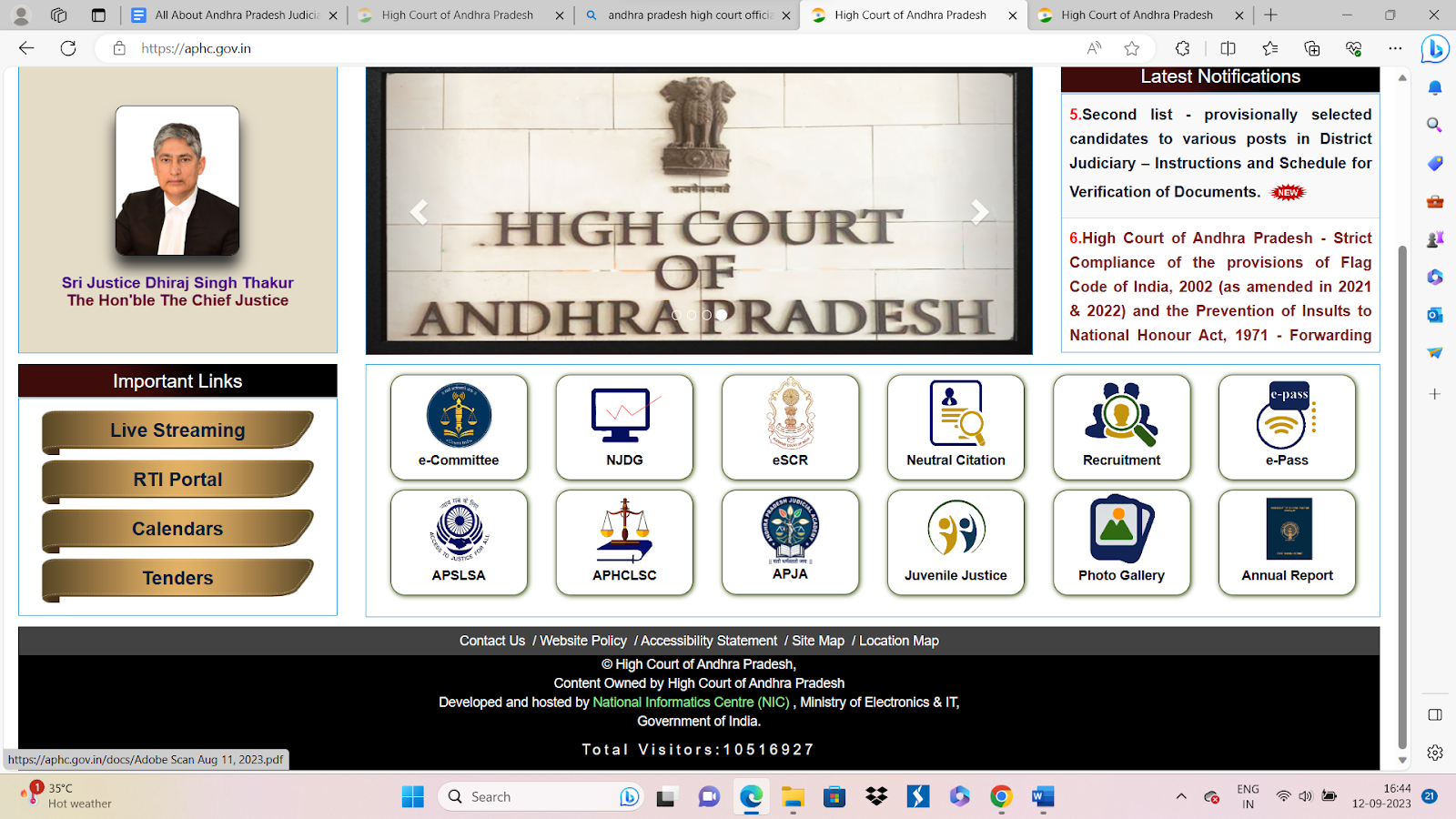
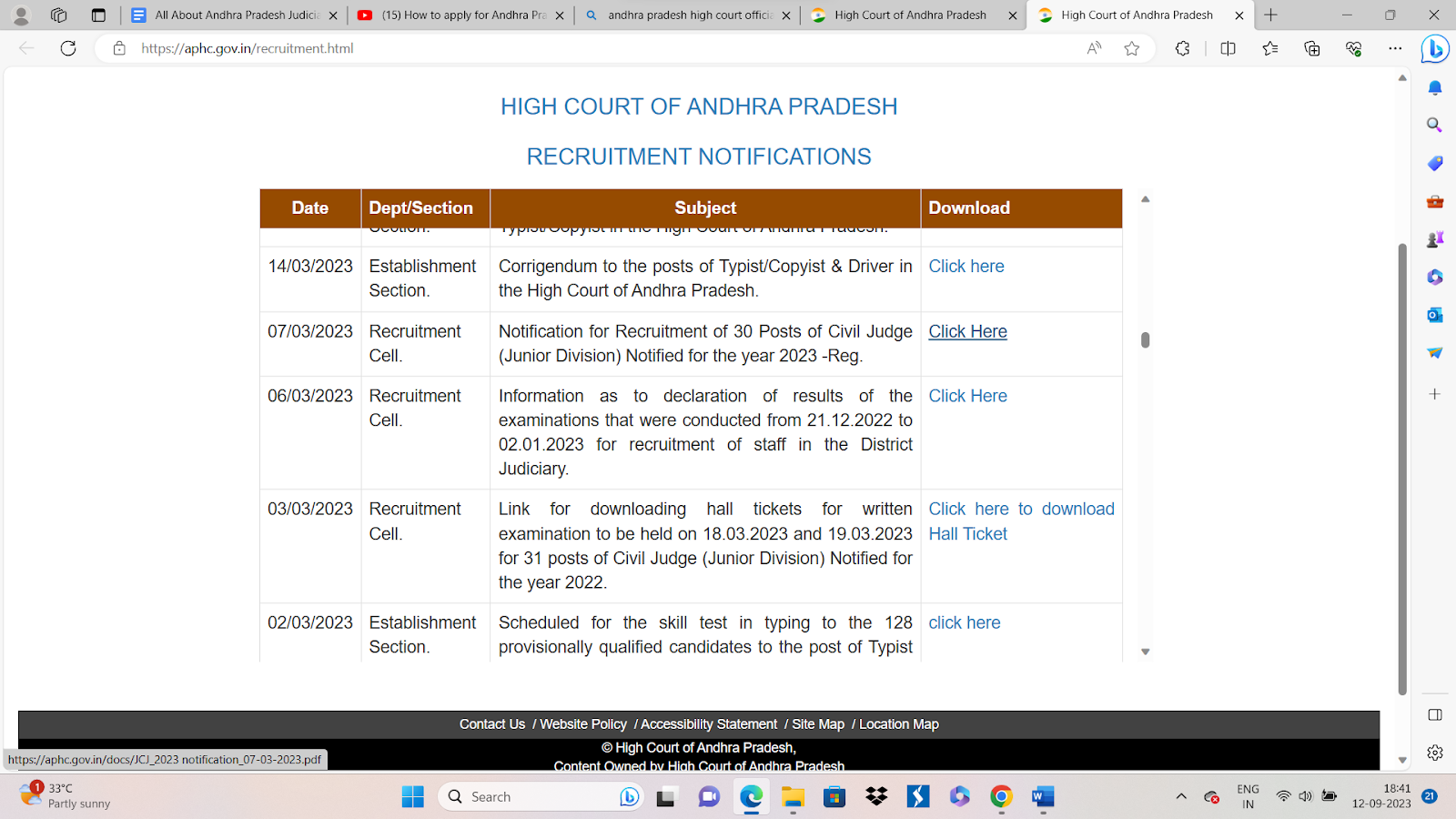
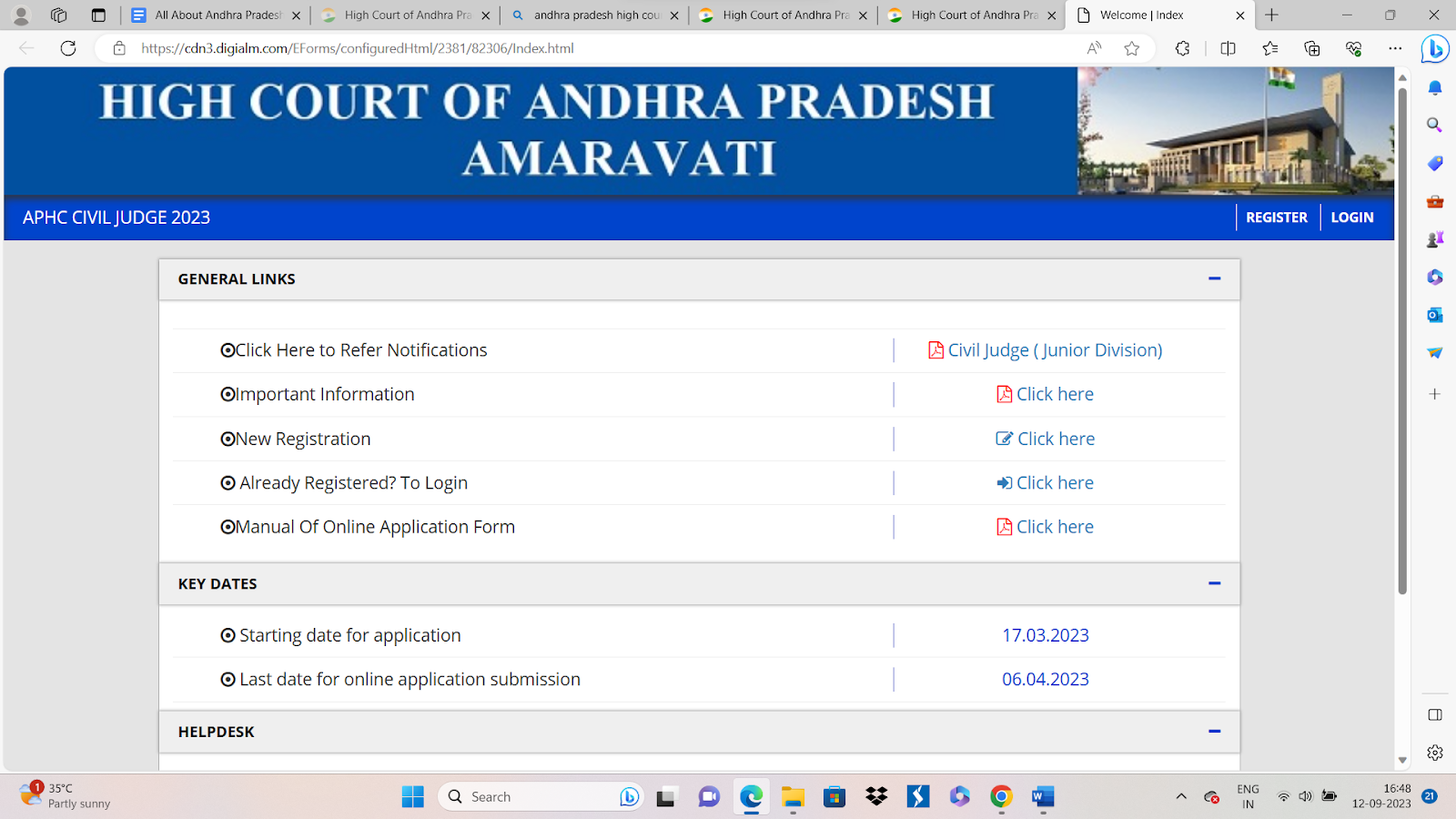


 Allow notifications





