Download Now
Home Blog Page 1516

How to crack your first job interview

0
job interview

In this article, Kunal Ahuja of Vivekananda Institute of Professional Studies discusses how to crack your first job interview.

Job interviews are like first dates. Good impressions count, awkwardness occurs. Outcomes are unpredictable.

How to crack your first job interview

There are some ground rules which one need to follow to crack their first job interviews.

Remember the interview is a one-shot exam one never gets an opportunity to have a review or take a look, in the end, answers given have been recorded by the interviewer and you cannot edit them or change your stand but after every interview you can learn from every interview and avoid same mistakes in next interview.

Proper conduct is necessary to crack your job interview as your interview is an analysis on how your professional conduct will be during the job tenure.

Let’s discuss some of them so that you don’t miss out your initial kick start of your career

Know about the company

Before attending an interview you must do some homework i.e. research about the company and the employer for whom you are going to work for a very long period of your professional life.

By having proper knowledge about the company you can answer well to questions scuh as,

  • What do you know about the company?
  • What do you know about the company’s competitors?
  • What do you know about the products and substitutes?  

By asking these questions interviewer get to know about your seriousness for the job and your awareness about the profession you are entering in. Don’t just get an overview of the company but have a proper knowledge about company’s last 3 years achievements and downfall so that the interviewer can ask your suggestion for the same which means they know you can add value to their company.

Proper dress and professional outlook

The first impression is the best impression so better be conscious about the way you dress up and carry that professional outfit as the first impression in most of the cases depends upon your dressing sense. More or less your dressing sense and professional look tell about your hygiene, seriousness about the job and the interviewer will consider a good profile for you once you are through the technical qualifications required for the job.

For men must always shave before they go for the interview and for women it is not necessary to wear western outfits.

First impressions are lasting; give special thought to your dress, your grooming, and accessories.

-BRIAN TRACY

Walk in with confidence

I can and I will watch me, the moment you walk into the office your interviewer should get this impression about you. Your confidence is very much visible so greet your interviewer with a smile and give him a firm handshake. Respond to every question by looking into the eyes of the interviewer let him watch what you are answering is right and you are very much confident about yourself. Don’t just say yes to every opinion if you got one, say it if you are confident about it as the interviewer might trick you into giving some wrong opinion. Confidence is what imprints in the other’s mind so never lose it.

Punctuality counts

Arrive early at the venue it helps you settle down and relax, interviewer always expects you to be punctual and with this habit, the interviewer gets more impressed as one who is early to work will definitely add on to the value of their company and tells about the seriousness of the interviewee towards his job.

Listen carefully, Don’t argue

To answer correctly you must first listen, be attentive to whatever interviewer is saying as your presence of mind is one of the most important characteristics which he requires in his company. If you are not able to connect or understand his questions and rather than asking him to pardon you directly answer to his question which he finds even a little bit vague he is never going to like it.

Respect his experience and position because there must be some quality that he is on the other side of the table therefore never get into an argument with the interviewer. Be willing to clarify his questions and learn from him whatever he has to tell you about his experience this quality of yours will make him feel like a mentor and he will be comfortable in mentoring someone like you in future.

Try to fit in

Always think that if you need this job you have to prove them that you deserve it. The organization requires the candidate who has the required set of skills for this particular job for which you have to show them that you have all of them or most of them and the rest is easy for you to adapt as per their requirement. Before proving them you should understand the job requirement and tell them what are you bringing to the table. Make yourself worth their investment and teachings, they will be willing to hire you only if they see some benefit to the organization and are sure that you will be an asset to the company.

Honesty is the best policy

Yes, this moral value plays a major role in creating an impression in your interview. Be honest about yourself and the answers you are giving, the interviewer is fine if you don’t know the answer and you are ready to accept it but he will not like any wrong or faulty answer. Learn to say ‘ Sorry! Sir, I don’t know’, may I know what would be the best source for the answer to this question?’

Any wrong answer delivered with hastiness will create a negative impression on the interview which is bad for your professional start.

Pen down your strength and weakness

By telling them about your strength and weakness the interviewer gets to know your attitude of how much you know about yourself. You can share the incidents or object on which you worked and got to know about your strengths and weaknesses. Don’t forget to add on that you are working on your weaknesses by doing this you tell them how flexible and self-aware you are.

Don’t be afraid to lose your job interview

Understand that why you fear interview. You don’t fear the interview but fear the thought of rejection so to overcome the fear of interview it’s important that you overcome the fear of rejection.

Ask few questions to yourself before attending interview-

  • What if you don’t get this job?
  • What will be worse if you don’t crack this interview?
  • How important is this interview, is it the last one of your life?
  • Where will you be after you get this job and even if you don’t get it will that future change?
  • What will you do if you fail in the interview?

Enter into the interviewer’s room with one perspective ‘ you don’t need this so badly ‘ yes you heard right. If you need something you will chase it and the moment you start chasing anything you will not show the right attitude it requires. It does not matter how much it is important for what matters is you took your first chance and you were so close. Remember not a single success story starts with ‘I DID’ but most of them start with ‘I failed to do this.’

End your interview on a positive note

No matter how it went ask for interviewer’s feedback, it leaves a positive impression in the mind of the interviewer and he will appreciate your positive attitude. Ask him few questions like-

  • Do I need to know something more about the work culture?
  • I would love to be in touch with you.
  • Ask something related to the job.

Your queries speak a lot about your priorities so be very professional in questions you ask, never show your concern about the salary or leave benefits. Show him the passion with which you will be working in their firm.

Now let’s have an analysis of the types of interviews which are undertaken nowadays, once we know what type of job interview do we have to undertake then only we can prepare ourselves for that interview.

Every interview is set to test some of the other qualities in an interviewee and to nail every such interview the interviewee has to have a different set of skills as well as perspective.

Telephonic interview

This kind of interviews takes place for initial screening and narrow down the broad list of the potential candidates. Telephonic interview is set as a qualifying round for personal interview to check your communication skills and your genuineness. You will be informed about the telephonic interviews in advance so be certain about your schedule and agree for a particular time period as per their requirement.

Some key tips for telephonic interviews-

  • Clear your schedule 30 minutes prior to the interview so that you can settle down and recall your resume.
  • Answer on point, don’t exaggerate.
  • Don’t interrupt unless you need to ask something important.
  • Keep a copy of your resume in front of you.
  • Maintain a list of achievements and keep it in front of you.
  • If conversation exceeds the time limit be flexible as it is a good sign
  • Before signing off, ask about the next step. This is a professional way to get a feedback.

Personal interview

When you are called to the office for the interview it is the personal interview. Get a good professional dress up and walk in with a confidence. Carry whatever is required to show your professionalism like the pen, original as well as the copy of the documents, a professional pad etc. everything is under observation during this interview so be careful about your communication, body posture or the way you carry yourself.

Video conferencing interview

In this era of global hiring, video conferencing interviews are very common so to save from the travel cost these interviews are arranged. There are many things about which you have to be more careful during video conferencing interviews.

  • The bandwidth of the internet should be good so that image and audio are clear if it is not that good at home to visit a private room in cyber cafes.
  • You should be dressed the same way as you would have during the personal interview.
  • The table in front should be clean.  
  • No disturbance or noises in your background.
  • Make sure you don’t get the feeling that you are at your home and do anything randomly like having without permission or something like that.
  • Make eye contact otherwise, the camera will be focused on your head.
  • Use picture-in-picture feature so you can see how your appear.

Stress interview

Stress interviews are set to test how you handle the stressful situations which nowadays has become important for an organisation to check how well can a candidate handle a stress. So, during stress interviews, you will ask tricky questions and the interviewer will also try to provoke you or may also become rude or loud upon you in those situations you need to be patient and don’t get furious or aggressive at all.

Campus interview

During your final semester in your college, you will be attending many on campus interviews for which they will first conduct a written examination and which if you qualify you will be eligible for the personal interview. Organisations come to your college and hire a good number of job seekers some consider it beneficial for their beginning of their professional career.

Technical interview

This kind of interviews is set to test your technical skills which are with the regard to your particular course or field you have studied in.

Apart from all of the above tips there are many other strategies which you may apply for your situation and prepare yourself for your interview and nail your dream job.

Few questions generally asked during an interview

  • Tell me about yourself?
  • Why do consider yourself as a good candidate for this job?]
  • Tell about your strength and weaknesses?
  • Where do you stay? How will you manage to commute to the office?
  • What are your top three strengths and weaknesses?
  • What do you know about the company?
  • What are your expectations from the company?
  • Are you willing to relocate to another city?
  • Where do you see yourself in five years from now?
  • What are your plans for further studies?
  • Are you a team player or wants to work individually on projects?
  • How many hours can you put into work?
  • What is my time according to you?
  • What are your expectations in terms of compensation?
  • Describe your dream job? Does this job qualify to be the one? if yes, how?

Questions you need to ask the interviewer

At the end of the interview, every interviewer gives you the time to ask some questions, these questions tell a lot about your professional concern and your priority. So, you should be asking questions which pose you as a professional for which the interviewer is willing to answer happily.

Some of them are,

  • What are future plans of the company?
  • What would be my top three deliverables if I fit in for this role?
  • May I have a look at the work area?
  • Any specific quality which suits this job?
  • Can you tell some more about the company’s work culture?
  • Who will carry out my appraisals if I am recruited?
  • When will a decision be made on the successful candidate?
  • How can I add more value to the firm beyond the job requirements?
  • May I contact you if I have other questions? Can you share your contact details?
  • How long have you been in this company?
  • How good has been your experience in this company so far?
  • Apart from the interview, it was a good experience with you.

 

Download Now

All you need to know about child custody rights

2
Child Custody Laws

This article is co-authored by Akshay Anurag of NUSRL, Ranchi and Soumya Ranjan Barwa of BVP, Pune. The article is a discussion on all you need to know about child custody rights.

The children are not mere chattels nor are they mere playthings for their parents.

Introduction

Marriage, as a social institution, has a significant role to play in the societal setup.”Marriage acts as an outlet for sexual needs and also regulates it. It also prevents individuals from becoming slave to his/her desires. Marriage is a social need because through marriage, families are established and the families are the fundamental entity of our society. It also helps in procreation of children which are the essentials of the family.

Hedaya’ has recognized marriage as a legal process by which the several process and procreation and legitimating of children between man and women is perfectly lawful and valid. However, in the recent era, The institution of marriage is collapsing. Personal difference between the spouses is increasing, also coupled with various other factors. Legal frameworks were very true speculation of such situations, therefore the concept of Divorce was well introduced. Divorce not only adversely affects the spouses but it also influences the life the children. One of the prime concern for a long pendency of divorce cases in India is, with whom the custody of the child will rest.

“Though nobility and self-denial coupled with tolerance mark the greatest features of Indian womanhood in the past and the cry for equality and equal status being at a very low stake, with the passage of time and change of social structure the same is however no longer dormant but presently quite loud.”Mothers and fathers both have a prominent role to play in supporting the growth and development of their children. Generally, the wish of the minor child and the mother is highly ignored while determining the custody of the child. This is because the earning ability of father. In India, it is well common that father earns more than a mother. But this cannot be the sole ground to entitle the father to take undue advantages. This should not entitle him to get the custody of the child in the event of a divorce. However, the Judiciary have been vigilant in this regard and this situation is changing in recent times. Now the court while awarding Child custody to the parent considers the best interests of the child.[1]

Earlier only male Hindus had the right to adopt or to give in adoption. But now it has been recognised that even Hindu women can also adopt or give in adoption. In the case of Githa Hariharan v. RBI[2], the court has very liberally interpreted the word Guardian and court has arrived to the conclusion that the Hindu women are very much entitled to adopt or take the custody of the child irrespective of that the father is alive.

This paper deals with the motivation of the parents to adopt a child and various aspects relating to adoption under the Hindu law and the Muslim law.

Child Custody And Protective Laws

Child custody is the legal terminology which is most commonly used to describe the legal and practical nexus between parents and his or her child. This includes various rights some of them are, right of the parent to make decisions for the child, and the parent’s duty to care and nurture for the child. Not only the common legal frameworks have recognised such principles rather the religion-based distinction of the personal laws is also evident and accepted fact.

Child custody can refer to where your children will live after divorce (physical custody), or who has the legal right to make decisions about their upbringing (legal custody).

Personal laws in addition to the secular laws have been zealously guarding and fiercely protecting as well as justified by the various religious communities.[3]

In re Mc Grath[4] Lindley, L.J., observed, “The dominant matter for the consideration of the Court is the welfare of the child. But the welfare of a child is not to be measured by money only, nor by physical comfort only. The word `welfare’ must be taken in its widest sense. The moral and religious welfare of the child must be considered as well as its physical well being. Nor can the ties of affection be disregarded.

Types Of Child Custody Arrangements

Physical Custody

“Physical care is the privilege to have your kids live with you after a separation. The privilege might be shared by the two guardians in a joint physical care game plan or conceded to just a single parent in a sole physical care game plan.[5]

Joint physical guardianship

“Courts, by and large, want to grant joint physical guardianship to ensure the kids will keep up contact with the two guardians. In a few expresses, this is the default determination, and may require a differing guardian to demonstrate why their youngsters ought not invest energy with the two guardians.

Joint physical guardianship expects guardians to impart time to their kids. It is not a 50-50 split, however, in the event that the guardians can’t achieve an assention, the courts may force a timetable. Normal game plans incorporate substituting weeks, months, as well as occasions at each parent’s home.

Joint physical guardianship empowers the two guardians to be fundamental parts of their youngsters’ lives. Research underpins that in low-clash divorces, kids passage preferred in joint guardianship courses of action over sole authority. In any case, for high-clash divorces with debating guardians, joint physical authority may trap youngsters amidst a passionate clash zone “

Legal Custody

“Legitimate authority is your entitlement to settle on choices about your kid’s childhood, for example, training, restorative care, and religious guideline. Like physical guardianship, legitimate care might be mutually shared between the two guardians or exclusively vested in one parent.[6] By and large in many states, the two guardians keep on having joint lawful authority after separation, which means the two guardians have parallel rights to settle on kid raising choices. Nonetheless, courts may grant sole lawful authority to one parent under some uncommon conditions. A parent with sole legitimate guardianship has the one-sided lawful ideal to settle on youngster raising choices.”

Child Custody Under Personal Laws

Under Hindu Personal Law

For Hindus, the law governing custody of a child is the Hindu Marriage Act. For Hindus, the parent law governing custody of child is the Hindu Marriage Act, 1955. In addition to this Hindu Minority and Guardianship Act, 1956 also takes care of this issue. Judiciary has manifested its activism basically in three ways in the matters related to custody of the child born out of wedlock among Hindus and they are[7]

  1. Imposition: The right of custody from time to time. While choosing the factor with respect to who will have the care of the child, child’s desire is frequently dealt with wherever conceivable. Court now and again intervene with the custodial privileges of the youngsters. The Court investigates the issue with most extreme care. Answer for the inquiry in the matter of who will have the care of the youngster after separation or legal division depends on the factor in the matter of what will be most helpful for the child and the court comes to the conclusion that,
  2. Alteration: The right of custody from time to time. If care with the father is more appreciable and encouraging then the father will have the care. If under mother’s authority child’s future is more secure then care will go to the mother or any other relatives with whom the interest of the child seems to be more secure. Here court is vigilant about the interests of the child and court alters its pronouncement in due course of time.
  3. Revocation: This scenario arises after the court has passed the order of child custody. On certain circumstances, if the finding of the court subsequent to going off the request of child guardianship, court may revoke the care and allow it to the inverse party. For instance, when a mother was given care of her child and she didn’t play out her obligations towards the child legitimately and in an efficient manner, the court denied the authority and offered it to child’s father.”

Hindu Minority and Guardianship Act

The Dharmashastras have never dealt with the law of guardianship. During the British regime, the law of guardianship was mainly developed by the courts based on the rules of equity. It came to be established that the father is the natural guardian of the children and after his death, mother is the natural guardian of the children and none else can be the natural guardian of minor children. The concept of guardianship has changed from paternal power to the idea of protection in modern times and the Hindu Minority and Guardianship Act, 1956 very well identified the necessity and codified the laws regarding minority and guardianship with the welfare of the child at the core. Custodial matters of a child are decided according to the natural guardian of the child“. Natural guardian is defined in Section 6 of HMG Act which defines only three natural guardians:

  • For a legitimate boy or a girl, the father, and after father, the mother, provided that the custody of a child less than 5 yrs of age will be with the mother.
  • For an illegitimate boy or a girl, the mother, and after mother, the father.
  • For a married woman, the husband.

Also, In divorce situations, the parent with custody is considered the natural guardian. This act also gives the will of the child paramount consideration. After analysing various judicial interpretations it can be concluded that the courts, Before deciding the issue as to whether the custody should be given to the mother or the father or partially to one and partially to the other should –

  • Take into account the wishes of the child concerned, and assess the psychological impact, if any, on the change in custody, after obtaining the opinion of a child psychiatrist or a child welfare worker.[8]
  • Also, In the case where the mother was living with a stranger, custody is awarded to the father and not the mother.

“There is an assumption that a minor’s parents would do their best to promote their child welfare and if necessary, would relinquish their own advantage and joy for the sake of their children. This assumption emerges in view of the common and natural affection anticipated from the guardians for their children. There is no division between the wellness of the father to be depended with the care and welfare of his minor child. The father’s wellness must be viewed and decided in terms of welfare of his minor youngsters with regards to all the applicable conditions. If the guardianship of the father can’t advance the child’s welfare equal or superior as compared to the authority of the mother then he can’t assert a right to their care only in light of the fact that there is no imperfection in his own character and he has the emotional attachment for his kids which each ordinary parent has. However, the father has been assumed by the statute as well as by the society that he is better fitted to care for the children, as he is the major or sole earner and leader of the family. Yet another duty has been casted upon the Court to analyse each situation as to the welfare of the kids.”

As in the case of J.V. Gajre v. Pathankhan and Ors.[9] while affirming the view of English courts, the Apex court has reiterated that, to deal with the issue of custody “The Courts have to consider, the whole of the circumstances of the case, the position of the parent, the position of the child, the age of the child, the religion of the child so far as it can be said to have any religion , and the happiness of the child. Prima facie it would not be for the welfare of the child to be taken away from its natural parent and given over to other people who have not that natural relation to it. Every wise man would say that, generally speaking, the best place for a child is with its parent. If a child is brought up, as one may say from its mother’s lap in one form of religion, it would not, I should say be for its happiness and welfare that a stranger should take it away in order to alter its religious views. Again, it cannot be merely because the parent is poor and the person who seeks to have the possession of the child as against the parent is rich, that, without regard to any other consideration, to the natural rights and feelings of the parent, or the feelings and views that have been introduced into the heart and mind of the child, the child ought not to be taken away from its parent merely because its pecuniary position will be thereby bettered. No wise man would entertain such suggestions as these.”

Under Muslim Personal Law

“The source of law of guardianship and custody are the certain verses in the Koran and a few ahadis“. In addition to this In all schools of both the Sunnis and the Shias, the father is perceived as the guardian which term extends till his death. In contrast to this, mother in all schools of Muslim law isn’t considered as the natural guardian, even after the demise of the father means that women are excluded from taking the custody. The father’s privilege of guardianship exists notwithstanding when the mother, or some other female, is qualified for the authority of the minor. Also when the father is alive, he is the sole and incomparable custodian of his minor children.[10] However, The father’s exclusive right of guardianship is only extended to the minor and legitimate childe but not to the illegitimate child. Muslim law is quite liberal towards women as the mother is although not qualified to the natural guardian yet she is qualified for his/her custody.[11]

Among the Sunnis, the father is the sole custodian of the minor youngsters. After the demise of the father, the custody passes on to the agent. Shias, have departed from such view as after the father, the guardianship has a place with the grandfather, regardless of appointment of the agent by the father. No other individual can be regular custodian, not even the Childs sibling.

Testamentary Guardian/Custodian

“Among the Sunnis, the father has full authority of making a testamentary arrangement of custodian. Without the father and his agent, the grandfather has the authority of delegating a testamentary custodian. Among the Shias, the father’s arrangement of testamentary custodian will come into force only in case of absence of grandfather. No other individual has any such power. Among both the Shias and the Sunnis, the mother has no authority of delegating a testamentary custodian of her children. It is just in two cases in which the mother can delegate a testamentary custody of her property of her minor child, First being, when she herself has been authorised by the will of the child’s father, she can name an agent by her will; and in second case, she can name an agent in regard of her own property which will decay after her passing on her kids.”

Among the Sunnis, the arrangement of a non-Muslim mother as testamentary custodian is substantial, however among the Shias such an arrangement is not legitimate, as they hold the view that a non-Muslim can’t be a custodian of the individual and in addition to the property of a minor. The Shias additionally take a similar view. It gives the idea that when two people are selected as custodian, and one of them is excluded, the other can go about as guardian. Also, a man who is famously and well known as bad character, can’t be named as Custodian.

Muslim law does not set out a particular established rules for the appointment of testamentary custodian. Infact, such Arrangement might be made in orally. However, in every situation the authority to delegate a testamentary custodian should be clear and equivocal. The agent of the testamentary custodian is assigned differently by Muslim lawgivers, showing his position and powers. He is ordinarily called, wali or watchman.

Custody Under Secular Law

The Guardians and Wards Act, 1890 was a law to supersede all other laws regarding the same. It became the only non-religious universal law regarding the custody of a child. This is a secular law which can be resorted by any religion but the recourse of this law is mainly taken by the Christians. Other religions can also in addition to their personal law can take the recourse of the same. Section 17 of the act imposes a liability on the courts for appointing a guardian. The provision is well quoted below,

The authority to name any individual as custodian is given on the District Court. The District Court may choose or proclaim any individual as the custodian of a minor as an individual and property at whatever point it thinks of it as essential for the welfare of the minor, contemplating the age, sex, wishes of the minor too.

Summing Up

Basically, the paper first tried to define, who is the natural guardian of the minor which is defined with various Personal as well as the secular laws. Further, an analysis has also been done regarding the hierarchy of two natural guardians, i.e. the father and the mother. Also, the judicial activism has also been noticed. The judiciary has always tried to break the social barrier by providing equal opportunity to the mother too, irrespective of the earning capacity of the mother. As the mother is the preferred custodial parent when the child is less than five years old.

In addition to the above points, courts have always tried not to blindly follow the statues rather they have taken the pragmatic approach. The wish of child is the paramount consideration and also the future of child too. The primary issue dealt in the paper is the interest and the custody of the child after the parents have abandoned. Although it is accepted that the spouses have to undergo mental distress but if we closely analyse the fact, the child is also the ultimate sufferer. Being mentally incapable to understand the situation, it is difficult for them to react in the situation it is difficult to safeguard their future. So to protect the interest of the children various legislations have been very well enacted. Every religion has given due importance to this issue. However, As a stark reality, this issue has not addressed, the children are still the not safeguarded completely and also it is well known that women are given less representation in the society when it comes to custody and guardianship of children after divorce.

References

[1]Child Custody & Guardianship: Indian Scenario Compared to the West, Available at : http://www.legalservicesindia.com/article/article/child-custody-&-guardianship-204-1.html( Accessed on Oct, 26, 2017).

[2] 1999 (2) SCC 228.

[3] Mulla, Principles of Hindu Law, (New Delhi, Butterworths India,2001)PP-233.

[4] (1893, 1 Ch.143).

[5] Available at: http://www.divorcenet.com/resources/divorce/divorce-and-children/legal-and-physical-custody-children. (Accessed on Oct, 24, 2017).

[6] Available at: http://family.findlaw.com/child-custody/legal-custody.html (Accessed on Oct, 26, 2017).

[7] Available at: Legal Custody of Child Born after Divorce or Seperation of Parents in India, Available at : https://blog.ipleaders.in/legal-custody-child/(Accessed on Oct, 26, 2017).

[8] Mamta v. Ashok Jagannath Bharuka, (2005) 12 SCC 452.

[9] 1970 (2) SCC 717.

[10] Imambandi v. Mutsaddi, (1918) 45 Cal 887.

[11] Gohar Begum v. Suggi, (1960) 1 SCR 597.

Download Now

Scope of Section 8 of the Arbitration and Conciliation Act, 1996. To refer or not to refer?

0
Section 8

In this article, Tarun Gaur, Advocate, Delhi High Court discusses Section 8 of the Arbitration and Conciliation Act, 1996.

Introduction

The trend of arbitration has increased tremendously over the past decade, at both national and international level. Arbitration is a mechanism whereby which the parties enter into an agreement, either in advance or after the dispute crops up, to resolve their dispute privately and expeditiously. But the key to a successful arbitration is restricted interference by judicial courts in the arbitration proceedings. When it comes to judicial intervention in arbitration proceedings, the reputation of Indian judiciary is undistinguished which has time and again proved to be a major roadblock for many things including but not limited to, getting FDI, India being chosen as a suitable seat in International Commercial Arbitrations etc.

Keeping all that in mind, the parliament, enacted the Arbitration and Conciliation Act, 1996 (hereinafter referred to as “act”) by virtue of which, the parliament made sure that the unnecessary intervention of judicial authorities in arbitration proceedings be restricted at all times. The biggest proof of which lies in section 5 of the act.

“Section 5 of the Arbitration and Conciliation Act, 1996: Extent of judicial intervention Notwithstanding anything contained in any other law for the time being in force, in matters governed by this Part, no judicial authority shall intervene except where so provided in this Part.”

This clearly stipulates that, irrespective what is mentioned in any other law for the time being in force, no judicial authority shall intervene in the matters governed by part 1 of the act, and the only exception to this is when the said intervention is provided by the part 1 of the act. Therefore, it becomes clear that the power of courts to intervene has been curtailed completely except for when it is expressly provided in the act.

Now, despite having such express exclusion of judicial intervention in the arbitration proceedings, the courts have time and again usurped more power than what is provided to them under the act which has led to unnecessary interference in the arbitration proceedings. One such example is of section 8.

Section 8 states as follows:

“8: Power to refer parties to arbitration where there is an arbitration agreement.—

Section 8 (1) – A judicial authority, before which an action is brought in a matter which is the subject of an arbitration agreement shall, if a party to the arbitration agreement or any person claiming through or under him, so applies not later than the date of submitting his first statement on the substance of the dispute, then, notwithstanding any judgment, decree or order of the Supreme Court or any Court, refer the parties to arbitration unless it finds that prima facie no valid arbitration agreement exists.”

Section 8 (2) – The application referred to in sub-section (1) shall not be entertained unless it is accompanied by the original arbitration agreement or a duly certified copy thereof:
Provided that where the original arbitration agreement or a certified copy
thereof is not available with the party applying for reference to arbitration
under sub-section (1), and the said agreement or certified copy is retained by
the other party to that agreement, then, the party so applying shall file such
application along with a copy of the arbitration agreement and a petition praying the Court to call upon the other party to produce the original arbitration agreement or its duly certified copy before that Court.

Section 8 (3) Notwithstanding that an application has been made under sub-section (1) and that the issue is pending before the judicial authority, an arbitration may be commenced or continued and an arbitral award made.”

Section 8 clearly stipulates that whenever a suit is filed in a civil court and the cause of action of said suit emanates from a contract in which the parties had voluntarily and willingly agreed to settle the dispute via arbitration, then, if the essentials of section 8 are met, it is the bounden duty of court to refer the parties to the arbitration.

The position of Section 8 of the act becomes further clear when it is compared with the Uncitral Model Law as section 8 of the act differs from Article 8 of model law. Article 8 enabled a court to decline to refer parties to arbitration if it is found that the arbitration agreement is null and void, inoperative or incapable of being performed. Section 8 has made a departure which is indicative of the wide reach and ambit of the statutory mandate.

Section 8 uses the expansive expression “judicial authority” rather than “court” and the words “unless it finds that the agreement is null and void, inoperative and incapable of being performed” do not find a place in section 8. This distinction clearly dictates that the legislature has intentionally endowed less power on judicial courts with respect to section 8 applications to make sure the arbitration process is facilitated and unnecessary intervention by courts be avoided.

Despite the position being this crystal clear, this section has been subjected to various interpretation by our courts time and again which has led to a lot of confusion.

There have been instances where Courts have adopted the literal interpretation route and hence construed the section in the way it is meant to be and has referred the matter to arbitration, when the essentials of section 8 are fulfilled, irrespective of the prevailing circumstances. Yet, there had been instances where the courts had completely neglected valid precedents and had tenuously interpreted the section in a manner it is not meant to be and has denied the reference thereby deviating from the valid line of precedents. Further, it is not just the deviation alone, in one matter the SC has actually gone to the extent whereby which it has laid down certain exceptions to this rule, which in my opinion is wholly erroneous. If there would have been some need for such exceptions, the legislature would have done that by adding such exceptions in the act itself.

Judicial Decisions

In Swiss Timing Ltd v. Commonwealth Games 2010 Organising Committee[1], the court categorically, held that even if a criminal case is pending against a party, that in itself does not disentitle said party from taking recourse under section 8 and referred the dispute to arbitration.

The dispute arose because the respondent failed to make the payment towards petitioner’s services after the commonwealth games. The petitioner tried to resolve the dispute in accordance with the procedure mentioned in clause 34 of their agreement but the respondent denied the payment and when petitioner filed petition under section 11 of the act, the respondent contended that the amount is not payable as the petitioner has violated clauses 29, 30 & 34 of the agreement as the petitioner has engaged in corrupt practices on the basis of complaint bearing, CC no. 22 of 2011 u/s 120B, 420, 427, 488 and 477 IPC R/w Ss 13(1)(d) and 13(2) of the PC Act, registered against it.

The main contention of the defendant was that since a complaint case has been filed against petitioner for corruption, hence the reference of dispute to arbitration is not tenable.

The court rejected this argument of the respondent and held that such allegations as are mentioned in the criminal case, are such which have to be proved in a proper forum on the basis of the oral and documentary evidence, produced by the parties, in support of their respective claims and existence of such allegations does not disentitle the petitioner to resort to the arbitration with respect to the dispute arose on the basis of the contract.

Further, the respondent tried to contend that since the allegations of corruption is levied on the petitioner, which is in contravention to the representations and warranties undertaken by the petitioner in the contract, the contract becomes void ab initio and hence the arbitration clause dies then and there.

To support this contention, the respondent placed reliance on N. Radhakrishnan V. Maestro Engineers[2]. In the said case, even after finding that the subject matter of the suit was within the ambit of arbitration, the court refused to refer the dispute to arbitration by holding that once the contract is held to be void ab initio, the arbitration clause dies then and there.

In response to this, the court held that, the law laid down in the Radhakrishnan runs counter to the ratio laid down in Hindustan Petroleum Corpn Ltd v. Pinkcity Midway Petroleums[3], where the court in para 14 observed that if in an agreement the parties before the civil court, there is a clause for arbitration, it is mandatory for the civil court to refer the dispute to arbitrator. In the said case, the existence of arbitral clause was not denied by either of the parties and hence in accordance with the mandatory nature of section 8, the court referred the dispute to arbitration.

The court in the present case held that, the law laid down in Hindustan Petroleum is correct law on the point and not the ratio of Radhakrishnan’s judgment. The court gave two reasons on the basis of which it invalidated Radhakrishnan’s judgment i.e. (a) the judgment in Hindustan Petroleum though referred, was not distinguished nor followed and (b) provisions mentioned under section 16 of arbitration act were also not brought before the court.

https://lawsikho.com/course/diploma-entrepreneurship-administration-business-laws
Click Above

Section 16 provides that Arbitral tribunal would be competent to rule on its own jurisdiction including ruling on any objection with regard to existence or validity of the arbitration agreement. The arbitration act emphasizes that an arbitration clause which forms part of a contract shall be treated as an agreement independent of the other terms of the contract. It further provides that the decision by the arbitral tribunal that the contract is null and void does not entail ipso jure that the arbitration clause is invalid. Hence Radhakrishnan’s judgment does not lay down correct law and hence cannot be relied upon.

Further, the court mentioned another matter i.e. Today Homes & infra pvt ltd v. Ludhiana Improvement Trust[4] in which the Punjab & Haryana High Court refused to refer the dispute to arbitration under section 8 on the basis that underlying contract is void. An SLP was filed against this decision of the Punjab & Haryana High Court in the Supreme Court and the Court held that the Ld. Judge of High Court has erred in not referring the dispute to the arbitration by going into detailed scrutiny of the agreement as at the stage of section 8, the Judge is only required to decide such preliminary issues as of jurisdiction to entertain the application, existence of valid arbitration agreement, whether a live claim existed or not for the purpose of appointment of an arbitrator. By not referring the dispute to the arbitration, the judge has sought to do more than what is required under section 11(6) of the act without any evidence being adduced by the parties. The issue regarding the continued existence of the arbitration agreement, notwithstanding the main agreement itself being declared void, was considered by the seven-judge bench in SBP & Co.[5] and it was held that an arbitration agreement could stand independent of the main agreement and did not necessarily become otiose, even if the main agreement, of which it is a part, is declared void.

In view of Today Homes & infra pvt ltd v. Ludhiana Improvement Trust, the court held that the submission of respondent that a criminal case is registered against respondent and hence court cannot refer it to the arbitration is wholly tenuous and not maintainable.

The court further held that, it is mandatory for the courts to refer disputes to arbitration, if agreement between the parties provides for reference to arbitration and the ground that a criminal case is registered with reference to the execution of the agreement is not an absolute bar to refer the disputes to arbitration.

The court held that there is no inherent risk of prejudice to any party in permitting arbitration to proceed simultaneously with criminal proceedings since findings recorded by arbitral tribunal are not binding in criminal proceedings and in an eventuality where ultimately the award is rendered by arbitral tribunal, and criminal proceedings result in conviction rendering the contract void, such conviction can be placed on record to resist the enforcement of the award. But if the criminal proceedings end up in acquittal and the dispute is not referred to arbitration, it would result in undesirable delay in the arbitration.

After Swiss Timing Ltd, in Sundaram Finance Ltd & Anr v. T. Thankam[6], the question as to ‘what should be the approach of a civil court when an application in terms of section 8 is filed before the said civil court’ again reached Supreme Court.

The court, citing P. Anand Gajapathi Raju V. PVG Raju[7] and Hindustan Petroleum Corpn. Ltd v. Pink City Midway Petroleums (Supra), held that language of section 8 of the act is peremptory in nature and therefore in cases where arbitration clause is there in the agreement, it is obligatory for the court to refer the parties to arbitration in terms of their arbitration agreement and nothing remains to be decided in the original action after such an application is made except to refer the dispute to an arbitrator. Therefore it is clear that if as contended by a party in an agreement between the parties before the civil court, there is a clause for arbitration, it is mandatory for the civil court to refer the dispute to an arbitrator.

The court further referred to Magma Leasing and Finance Ltd. V. Potluri Madhavilata[8] in which it was again reiterated that no option is left to the court, once the prerequisites of section 8 of act are fully satisfied.

In the end, the court held that once an application in due compliance of section 8 is filed, the approach of civil court should be not to see whether the court has jurisdiction, but to see whether its jurisdiction has been ousted. There is a lot of difference between the two approaches. Once it is brought to the notice of the court that its jurisdiction is barred by virtue of procedure under a special statue, the civil court should first see whether there is an ouster of its jurisdiction in terms of compliance with the procedure under the special statue.

The basic principle of our jurisprudence is generalia specialibus non derogant i.e. a general law should yield to the special law. In such a situation, the approach shall not be to see where there is still jurisdiction of civil court under general law but whether it has been ousted by the special law.

Exceptions

In A. Ayyasamy V. A. Paramasivam[9], the court though accepting the fact that provision in section 8 is pre-emptive and mandatory in nature and hence the court should refer the dispute to arbitration when existence of arbitration clause is not disputed, went a step ahead and laid down certain exceptions to this rule. The court carved out exceptions on the basis of which a court can refuse to refer the dispute to arbitration even when essentials of section 8 are fulfilled.

These exceptions are

  1. Where court finds very serious allegation of fraud that makes a virtual case of criminal offence, or
  2. Where allegations of fraud are so complicated that it becomes essential that such complex issues can be decided only by civil court on appreciation of voluminous evidence, or
  3. Where serious allegations of forgery/fabrication of documents in support of the plea of fraud, or
  4. Where fraud is alleged against arbitration provision itself, or
  5. Where fraud alleged permeates the entire contract, including agreement to arbitrate where fraud goes to the validity of contract itself or contract that contains arbitration clause or validity of arbitration clause itself.

The court carved out these exceptions after considering Radhakrishnan’s judgment and in my opinion, this judgment is not correct in the eyes of law for two reasons.

One is presence of section 16 of the act, which enables arbitrators to decide on its own, the jurisdiction and on the question of validity of arbitration clause and second, the reliance placed on the ratio of Radhakrishnan’s case is in itself not correct as in an earlier decision i.e. Sundaram Finance, the court categorically invalidated ratio of Radhakrishnan’s judgment, hence placing reliance on said judgment even after it being invalidated by Supreme Court is incorrect.

In a recent judgment, Sasan Power Ltd. vs North American Coal Corporation India Private Ltd.[10], the Supreme Court has held that:

During section 8 proceedings, the court cannot go into the question of validity of entire agreement and can only look at the question of validity of arbitration clause/agreement i.e. whether the arbitration clause/agreement is null and void, inoperative or incapable of being performed.

Arbitrability

Besides accepting objections like ‘since the contract is void hence the arbitration clause is void as well’, the courts have also started entertaining objections on the arbitrability of the dispute as well, at the stage of section 8 application. The worst part of entertaining such objections is, that the courts have even accepted such objections in certain cases and had denied reference in such cases. The courts should keep in mind that first of all, there is no such classification as arbitrable or non arbitrable disputes in the entire act and second, if based on the common law principle, the parties feel that their disputes fall in one such exception where it cannot be resolved via arbitration, then they can raise the said objection before arbitrator as the arbitrator, by virtue of section 16 of the act, is competent to rule on such objections. Therefore, the interference of courts especially on the basis of objections regarding dispute being arbitrable or not arbitrable, in my opinion, is totally unjustified.

Further Sec 8(3) stipulates that pending application under section 8 will not affect proceedings under section 11. According to this, there’s always a risk of reference being denied under section 8 on the basis that the court agreed with the objection that the dispute in question is non arbitrable, and on the flip side, arbitrator gets appointed under section 11 of the act as the court deem it fit to refer the dispute to arbitration. Now, in such a case, what will be the fate of that case? Wouldn’t it become travesty of justice then?

Conclusion

From above discussion, it can safely be deduced that after Sasan Power Ltd. judgment, the question of referring the dispute under section 8 is somewhat resolved for now but this conundrum of whether to refer or not to refer under section 8 still needs a proper ruling by a larger bench of SC on this issue so that the position will settle once and for all.

Further, in my opinion, this conundrum of whether to refer or not to refer a dispute to arbitration under section 8 of the act be put to an end and the courts should work towards fostering the arbitration by referring the dispute to arbitration when all the essentials of section 8 are fulfilled instead of halting the entire arbitration process for no reason or on unjustified reasons like accepting objections on arbitrability of dispute or existence of other proceedings against one party etc.


LawSikho has created a telegram group for exchanging legal knowledge, referrals and various opportunities. You can click on this link and join:  

https://t.me/joinchat/J_0YrBa4IBSHdpuTfQO_sA

Follow us on Instagram and subscribe to our YouTube channel for more amazing legal content 


References

[1] (2014) 6 SCC 677

[2] (2010) 1 SCC 72

[3] (2003) 6 SCC 503

[4] (2014) 5 SCC 68

[5] SBP & Co. V. Patel Engg. Ltd., (2005) 8 SCC 618

[6] (2015) 14 SCC 444

[7] (2000) 4 SCC 539

[8] (2009) 10 SCC 103

[9] (2016) 10 SCC 386

[10] SLP (c) No. 33227 of 2015

Download Now

Contract Unconscionability in India

0
Unconscionable
Image Source - http://www.coppolacomment.com/2016/09/are-inheritance-taxes-unfair.html

In this article, Nivedita Arora discusses Unconscionable Contracts under the Indian Contract Act.

Introduction

Unconscionable contracts are drafted in such a manner that they favor one party and impose, harsh, unfair, unjust conditions on the other party. An unconscionable contract is one that is so gross and unreasonable in the light of the business practices of the time and place that it should not be enforced. The doctrine of unconscionability allows the court to intervene into the contractual relations of parties and modify such agreements.

Unconscionability is a contract defense used in cases where there is combination of unfair contract terms and deficient bargaining. This paper clarifies the distinction between the forms of unconscionability and how the doctrine of unconscionability is applied in Indian Law. Also, the article identifies the issue of Unconscionability with respect to the Uniform Commercial Code and Restatement emphasising how unconscionability is used as a ground for avoiding an agreement.

Types of Unconscionability

Unconscionability is categorized into procedural and substantive unconscionability.

Procedural Unconscionability can be understood by examining how each term became a part of the contract and the actual bargaining process at the time of making the contract. This arises due to difference in the bargaining position of the parties, absence of meaningful choice, unfair surprise. In Weaver v. Am. Oil Co, the Court explained various factors that can be considered while evaluating procedural unconscionability such as real and voluntary meeting of the minds of the contracting parties, age, educational qualifications, intelligence, relative bargaining power, who drafted the contract, whether the terms were explained to the weaker party, the deceptive appearance or language to the contract.

Substantial Unconscionability can be understood by referring to the contract or few unfair terms of the contract such as unfair price of the contract, the limitations of remedies and disclaimers of warranties, which make the contract very harsh, oppressive, unworkable or one sided.

Contract Unconscionability in India

Unconscionability is not defined anywhere in any Indian Law. There have been various debates on this issue and the Law Commission of India in its 103rd and 199th Reports recommended that there should be changes in the existing laws to protect the citizens of our country against unconscionable contracts. However, we can look at various other provisions of the Indian Contract Act to understand the doctrine of unconscionability and how it is used for avoiding the contract.

Section 16 of the Act explains that a contract is obtained by undue influence if one party dominates the other party and uses this unfair position to obtain unfair advantage over the other party. According to Section 19, such contract is voidable at the option of the party whose consent was so obtained.

According to Section 23, the agreement is void if the object of the agreement is unlawful, fraudulent, immoral, or opposed to public policy.

199th Law Commission Report explained procedural and substantive unfairness in Proposed Bill and laid out guidelines to find if a contract is procedurally or substantially unfair. It proposed that courts should be vested with sou moto power to enquire into substantive unfairness even if it is not pleaded by the parties and provide reliefs to the parties if the contract is proved to be unfair and unconscionable.

Unconscionability of Contracts in India – Employment Agreement

There are plethora of case laws available on the subject of Unconscionability of contracts. Most prominent of all relates to clauses of Employment Agreement wherein the contract, in most of the cases, are poorly drafted, thus favouring the employer.

The employers provide unreasonable clauses in employment contracts and impose very unfair conditions on the employees. In Central Inland Water Transport Corporation Ltd. v. Brojo Nath Ganguly, the Supreme Court held that a clause providing for termination of the services of a permanent employee by serving a three months notice on him is arbitrary, unreasonable, opposed to public policy and thus unconscionable. In a similar case, the Supreme Court held a clause unconscionable as it conferred unbridled and arbitrary power on the authority to terminate the services of a permanent employee without recording any reasons for such termination.

The employment contracts contain clauses where one party is allowed to modify or cancel the contract at his will even though there is no breach of the contract by the other party. Such clauses are held to be unfair, arbitrary and unconscionable.

There are various other judgments where Courts have held such arbitrary and unreasonable clauses in the contracts unconscionable and held that the principle of arbitrariness should not be extended to employment contracts to safeguard the interests of the employees.

The Uniform Commercial Code (UCC) and Restatement

There was no doctrine of unconscionability in the United States till 1952. However, American courts had the equitable power to set aside a contract if it shocks the conscience of the court even in the eighteenth century.

The Uniform Commercial Code (UCC) gave courts explicit authorization to rule that a contract was unconscionable in 1952. Substantive imbalance and unacceptable conduct are the prerequisites elements of unconscionability in English law.

According to Section 2-302 of UCC, the Court can refuse to enforce a contract or few terms in a contract to avoid any unconscionable results if it thinks that such contract is unconscionable.

“The main aim of Section 2-302 is to prevent oppression and unfair surprise. The basic test of unconscionability of a contract is to find out whether the clauses involved are so one-sided so as to oppress or unfairly surprise the other party. These clauses need to be analyzed depending on the circumstances that existed at time of making of contract, general commercial background and the facts and circumstances of the particular case.”

Article 2 of the U.C.C. applies only to the sale of goods. However, various transactions other than the sale of goods such as transactions between a customer and his bank, commercial leases, the termination of dealership franchise agreements, contracts for personal services can also be unconscionable. In Section 208 of Restatement (Second) of Contracts, the doctrine of unconscionability has been broadened for protection for consumers in various types of transactions and not just limited to a provision in a UCC for sale of goods.

Though, on a plain reading of Section 302 UCC and 208 Restatement (Second), the provisions appear to be similar, however, under Section 208, unconscionability is not a vitiating factor per se. Section 208 allows the court to refuse a whole executory contract denying both specific performance and damages.

Unconscionability is still not clearly defined in either the UCC or the Restatement. Thus we look at various case laws understand the doctrine of unconscionability in UCC and Restatement.

In Williams v. Walker-Thomas Furniture Company, the court considered the circumstances surrounding the transaction and held that the rule should be set aside due to procedural misconduct. The court described unconscionability as absence of meaningful choice on the part of one of the parties together with contract terms which are unreasonably favorable to the other party. The Supreme Court of New Jersey also held a particular clause of the contract invalid because it was the against the public good, there was unequal bargaining power between the parties and the clause was hidden from the attention of the buyer.

The arbitration agreements are misused so much they allow employees to arbitrate their wrongful termination claims against the employer but not the employer’s potential claims against the employee. In Ferguson v. Countrywide Credit Industries, Inc., an arbitration provision in an employment contract was held unconscionable because it allowed the parties to arbitrate all claims, however, excluded remedies such as unfair competition, and use or disclosure of trade secrets and confidential information that the employer would likely pursue.

Conclusion

Courts have held various contracts unconscionable due to the unfair and unreasonable clauses in the contracts. Various clauses related to damages, arbitration, class action waivers, termination in employment contracts, construction contracts and real estate agreements are against public policy and give unfair advantage to the one party due to the unequal bargaining position.

Thus, it is the need of the hour to implement the suggestions proposed in 103rd and 199th Law Commission Reports. Our legal system needs to consider the provisions of UCC and enact a law allowing the courts to refuse enforceability of an unconscionable contract. The guidelines suggested in 199th Law Commission report related to procedural and substantive unfairness should be followed and a law should be enacted to safeguard the interests of the parties, to ensure more fairness in the contracts and equal bargaining position of the parties.

The law related to unconscionability should not be restricted to contracts. Some of the instances where undue influence is exercised outside contracts are influencing Pardanashin women, forcing an ill person to transfer his estate to someone. Such enacted law should be applicable to all transactions because there are various transactions apart from commercial contracts where undue influence is used.


Download Now

Inland Letter of Credit – How does a Letter of Credit works

1
letter of credit

In this article, Kunal Ahuja of Vivekananda Institute of Professional Studies discusses how Letters of Credit Work.

Limitations to international trade and role of inland letter of credit

  • With the intervention of globalisation and international trade into the import-export industry, it is not possible for the parties to meet on regular basis and do business by traditional methods of payment with which it becomes difficult for the parties to present their creditworthiness and to develop a relationship of trust amongst each other.
  • When an international business is taking place between the parties the recourse of payment becomes difficult due to the difference in their currencies which again complicates the process of payment and every party thinks twice before getting involved in such commercial transactions.
  • It is an instrument which allows the buyer and seller from different nations come together or without coming together and pursue a business of their interest without being suspicious or risk factor about the trust amongst each other which used to be a major reason in hindering the international trade.

To overcome the above obstacles in the way of international trade and to do business at global level the letter of credit plays a significant role and makes the international trade more efficient as well as credit worthy for parties.

  • Inland letter of credit is a document of commitment to make the payment by the buyer’s bank to the seller’s bank rather than from the buyer to the seller directly. It is a term which is commonly used in the transactions which are of trading nature.
  • Inland letter of credit is a modern recourse of payment applied to reduce the risk of losing the funds or not getting the payment on time or not even receiving the payment at all as it transfers the liability of making the payments from the buyer to the bank who takes the guarantee to make the payment in case the seller defaults.

Understanding Letter Of Credit

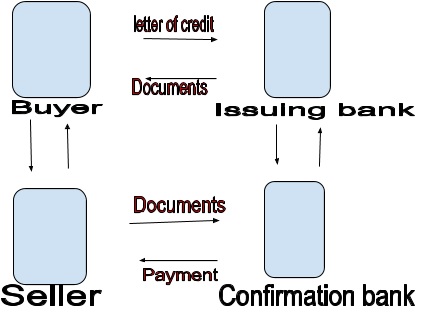
  • Commitment document – Letter of credit is an instrument of commitment issued by the buyer’s bank on the request of the buyer and handed over to the seller or seller’s bank to secure his payment once the terms agreed by the buyer and seller has been fulfilled by both the parties. It is a monetary document which entitles the seller to get his payment from the bank after submitting the required documents to the bank to prove that the terms of the deal have been fulfilled by the seller and now he has the right to get the payment.
  • Banks as intermediaries – As per the contract between the buyer and seller the buyer once receives the goods as promised by the seller, then buyer is liable to pay the amount to the seller in lieu of deal entered by both of them. It is issued by the buyer’s bank i.e. issuing bank as a payer of the amount on behalf of the buyer and seller receives the payment from his bank i.e. confirmation bank to which the letter of credit is presented and is obliged to honour the payment to the seller. Here transaction including a letter of credit is settled through the banks rather than directly between buyer and seller.
  • Secured payment – In an international business or trade between the buyer or importer and seller or exporter there is high probability of fraud and exporter does not receive the payment on time or payment at all. To curb this risk the letter of credit is issued in which bank undertakes the guarantee to make the payment to the exporter and his efforts to do a business doesn’t go in vain. Risk factor in normal course of transaction is very high which almost vanishes with the issue of letter of credit where the payment is made by the banks and letter of credit. Involvement of bank as a neutral party through letter of credit allows the seller to trust the contract and buyer which helps him to with which get his payment on time from the bank.
  • Business in any currency – Earlier when any international business used to take place the funds transfer and currency change was a bigger task but with the letter of credit this hurdle has been pulled down and letter of credit can be honoured in any country as per their currency rates as the payment is made at the place where the seller resides or has a place of business.

Essential elements of letter of credit

  1. Undertaking by a bank for the payment
  2. On behalf of the buyer
  3. Payment to be made to the seller
  4. Of certain amount
  5. Payment to be made only after submission of certain documents by the seller
  6. Within a particular time period
  7. Bank shall verify the compliance with the terms and conditions of the contract by the seller.

How does a letter of credit works

There are several steps which are followed while issuing a letter of credit and using it as a mode of the payment:-

  1. Contract – The parties i.e. the buyer and seller enter into a contract and negotiate upon the terms of the contract. This contract determines the nature of the business and mode of payment by the buyer to the seller if the buyer has received the goods for which both parties entered into the contract. Normally the letter of credit is issued in international trade or between importer and exporter.
  2. Buyer approaches for issuance of letter of credit – After the contract the buyer approaches his bank, which is also called the issuing bank, to apply for issuance of the letter of credit in the favour of seller and seller’s bank i.e. confirmation bank according to which the issuing bank undertakes the responsibility to pay to the seller on behalf of the buyer.
  3. Issue of letter of credit – It is issued by the issuing bank in the name of the buyer which is further issued to the seller as the consideration.
  4. Issued to the seller – Issuing bank issues the letter of credit to seller either by its branch or any correspondent bank in the seller’s country.
  5. Letter of credit when honoured – Letter of credit is issued to the seller and seller is entitled to the payment from the confirmation bank only on the submission of the required documents which are necessarily submitted to prove that the terms of the contract have been fulfilled by the seller, the documents can be any invoice, bill of lading, promissory note or any receipt etc.
  6. Transfer of document – The prerequisite documents are submitted to the confirmation bank and which are the later on forwarded to the issuing bank and the buyer gets the document after the payment made to the issuing bank by the buyer. Finally, the documents are transferred to the buyer only when he makes the payment to the bank and the buyer can use the documents to procure the goods.

letter of credit

Types of Letter of Credit

  • REVOCABLE CREDIT LETTER OF CREDIT – This is the letter of credit in which the issuing bank or buyer can change the terms of the contract without the consent of the seller.
  • IRREVOCABLE CREDIT LETTER OF CREDIT – This is the letter of credit in which neither the issuing bank or buyer can make changes to it unless consented by the seller.

LIMITATIONS

Although letter of credit has uplifted the international trade and business, apart from its positive interventions letter of credit also lacks in its efficacy in various strata.

  • Quality of goods not taken care of – With the issue of letter of credit banks are only responsible to check the documents and fulfillment of terms of the contract based upon what bank releases the payment but quality of the goods is not verified in this state. If the quality of the goods is not upto the mark buyer has to suffer as he cannot stop the payment.
  • More expensive – Letter of credit involves the charges which are paid to the bank as well which makes this mode of payment more expensive.
  • Complex – Issuance of letter of credit functions with certain degree of complexities the more rules and regulations to be followed by the parties as well as their banks which makes this recourse a complex one.
  • Foreign currency – Letter of credit allows the seller to receive the payment in its territory and in case of international trade factors like difference in currencies and currency fluctuations adds more risk in this.
  • Default of bank – The letter of credit transfer the creditworthiness of buyer to the bank, if bank defaults in making the payment then the risk on the seller’s payment still exists.
  • Specific time period – Letter of credit is issued with the time limit specified in it and if the letter of credit is not presented within that certain period it gets lapsed. The documents submission has to be done within that period of time only otherwise the time to receive the payment and make use of letter of credit gets expired due to which a new process has to be followed and again adds to the business cost.
Download Now

Negotiate like a leader – How to negotiate effective deals

0
negotiate
Image Source - http://empowerwealth.com.au/blog/how-to-negotiate-a-great-property-deal-out-there/

This article is written by Kunal Ahuja. The article is a discussion on how to negotiate effective deals.

“ In business as in life, you don’t get what you deserve you get what you negotiate “      

                                               Chester L. Karrass

In life, every day is a series of negotiation whether we realize it or not from deciding on who will clean up the house or who will pick up the children from school. From hiring someone to crack a deal on what terms, deciding a location while planning a trip and much more. In every relationship whether personal or professional, we need to go through certain negotiations. Negotiating skills are very important if we look at it from a commercial point of view as every deal made, contract signed, business combinations taking place, buying or selling a product, functioning in different countries etc.

But not everyone is good at discussing things or lacks convincing power or restrain themselves to talk out of fear.

Most of us face some or the other problems while negotiating with the other person.

Some major questions one frequently ask themselves while negotiating are

  • What should I start with?
  • Am I sounding too rude?
  • Is this the right time to put up this question?
  • Where will this discussion end?
  • Am I able to convey properly?
  • I hope the other side doesn’t get this statement wrong/offensive?
  • Do I need to tell him this?
  • I hope I am not sounding too selfish
  • Why is he not getting along?
  • Am I leading this negotiation on the right track?
  • Is it going to be productive?
  • What if I am not able to bargain well?

These questions are infinite as we cannot determine the mindset of the person sitting on the other side but we can work on to change it by applying proper techniques and by moving ahead through proper steps.

Not everyone is good in negotiations or getting things worked out in their favour but this does not mean we can’t build them. With the proper skills and steps anyone can become a good negotiator and no doubt it is one of the most important tool these days which help people understand each other’s needs and give what they want, we don’t realize but by giving them what they need we are one step ahead of getting what we want.

Negotiating with the right set of skills makes you a good leader

Builds trust

Building trust is the foremost step one should keep in mind while making a good relation and which helps in bringing a sense of comfort while discussing. Making the other person trust you is one thing which makes the conversation easy and lessens the probability of the opponent judging you. If the other person trusts you he/she is more likely to open up quickly and share what they want out of this deal or negotiation otherwise it takes quite long to break the ice and understand what the exactly another party is seeking out of this negotiation. Having a certain amount of transparency is quite helpful in maintaining trust but not too much.

Don’t show those cards which can pose you as weak in this discussion.

Focus on the needs of another person

In today’s era, everyone clearly knows how to further their own interest and ascertain their benefits first. During negotiation one should focus on the needs of the other person and should show how those needs can be fulfilled by this negotiation. Knowledge of the product or the deal is of no use for them if it cannot meet their needs or is not beneficial for them at all.

If the other person feels the importance of his needs in the ongoing discussion he/she will show more interest and will try to figure out ways to talk about more on same and how fast it can be done. All you have to do is to show the opponent a WIN-WIN situation out of this negotiation.

Listen more

A good negotiator should know how to listen more rather than talking as listening allows you to get the appropriate catch and let you know the whole story of the other’s side without putting too much effort. To know the needs of the other person and to play on those needs it is important that one should listen properly and to everything the other party has to share. Put a question, maintain a silence for a moment and let the other party concede.

Assert and express your needs

You should never forget your interest, one should know how to put it on the other side of the table, don’t be afraid to ask what you want. Remember successful negotiators believe that everything is negotiable or there is nothing which cannot be negotiated.

One should always know how to tell the other person what they need without being aggressive i.e. in a non-threatening way. Being assertive means putting your needs in front of the other party and showing due respect for other’s needs as well. There should be nothing which implies disregard to the needs of the opponent. Don’t forget in a negotiation you are representing yourself so the other party has to give you the thing you want and then only can take one thing from you, therefore feel free to express what you feel and what you want out of this discussion.

Look for common good not area of conflicts

When two parties have agreed to discuss then there must be some common grounds, even very less, for which they have agreed to try to settle it. One should know the seek of common interest for both of them and then proceed further. If the parties agree to take stance on the common grounds which gives the negotiation a positive start only then you should move forward to accelerate negotiation and try to talk about the things the other party needs to adjust or deal with the specific or individual needs of the parties. By looking into the common grounds and not conflicts the negotiation is seen from a positive perspective by both the parties and they become more willing to settle it further and feel productive outcome out of the negotiation.

Have the courage to walk away

Remember that both the parties have some interest in concluding and if the negotiation does not end with a positive result it’s not only your failure or you will be the one losing but the other party also has something to lose, so be careful before you agree and if you don’t feel like agreeing then don’t. Never show what will you lose if the negotiation does not end well rather show to the opponent what will they lose if they do not collude and ask them to imagine what could be the situation if they walk out from this discussion, they will realise the importance of the conclusion for their benefit and will show their inclination towards settlement. Walking away is not walking away from the solution but a way of asking the other party to negotiate more.

Don’t consider walking away as an option but never feel hesitated to walk away if the settlement is against you.

Don’t take anything personally

Negotiations often fail as the parties forget their professional responsibility and get sidetracked by their personal feelings and concerns which are not at all related to the subject matter of the negotiation. Remember you are negotiating on behalf of a very big management of your company not for your personal reasons. Don’t get affected by the other side’s behavior and never take anything personally during negotiation as the party on the other side is acting solely out of professional accountability.   

Above mentioned were the key rules to be kept in mind while negotiating.

Here are some professional tips to make the negotiations more effective and constructive

How to ask a question

  • I have something to ask if you allow me?
  • I am willing to understand this matter fully, so tell me?
  • What you have to say on this …?
  • Let me come up with this?
  • Here’s something I have been wondering about?
  • I am stuck can you help me out here?

How to avoid anything

  • This is a very interesting point it deserves a clear answer.
  • Good point! I need to gather my thoughts to answer that.
  • I am glad you brought that up.
  • Now here what the problem is.
  • You raise very interesting points.
  • I need to ponder the ramifications before I speak.

How to emphasize a point

  • Please take special note of this point.
  • I think you might understand the importance of this.
  • I have to say this as it has significant value in it.
  • Let me be very clear about this.
  • Please pay attention!
  • This seems very important to discuss.

How to convince

  • You got what you wanted and even more.
  • I think this is the best deal which you can avail.
  • Let’s get it done.
  • I think you deserve it.
  • Take a call go ahead this is best for you.
  • Leaving it will be insane.
  • This seems worth your efforts and time.

How to bargain, or open the path for a new/expanded discussion

  • There has to be a midway for both of us.
  • Meet me in the middle.
  • We can work out something better.
  • The proposal is good, but I think we should discuss more.
  • We both need WIN-WIN.
  • I have got a better deal, sorry! (makes the other party move from his position out of fear of losing out on the deal)
  • You will need to lean forward a bit.

How to reject a proposal

(You can use this to walk away or slow down the progress of the deal, especially if the other person is being overeager, asking you to skip steps or cut corners)

  • Unfortunately, this is not the best for me.
  • I can’t accept it right now.
  • I think we should not move forward with this.
  • I would love to say yes, but I can’t get it past my superior.
  • I apologize, but I can’t accept this.

How to call for a compromise

  • Compromise is the best way to go.
  • I am willing to listen to you if you do the same.
  • We have to arrive at a compromise.
  • Let’s do it together.
  • Let’s get this done once and for all.
  • Let’s not stretch it further and get over with it.
  • You need to cooperate with me, please.
  • Let’s start it from now.

Download Now

Benefits of notarizing a document

3
notarizing

In this article, Sahali Manna discusses the benefits of notarizing a document.

Introduction

Notarization is also referred as “notarial acts”. It includes a three-part process by a notary public that includes vetting, certifying and record keeping. It is basically the official process to prevent fraud and assure the parties in the transaction that the document notarized, is genuine. Mostly, documents required in banking transactions or court documents are mandatory to be notarized.

In India, a notary is done by a notary public who acts as an impartial witness in discharging fraud deterrent activities related to legal documents. Notaries Act, 1952 governs the duties of a notary public. Certifying, attesting or authenticating any instrument, carrying out translations and verifying such translation of legal documents from one language to another. He can administer oaths and witness swearing by deponents for affidavits. A notary may also function as an arbitrator.

Who can notarize?

A practising lawyer having experience of at least 10 years and 7 years for SC, ST category candidates and women candidates may become a notary public in India. A person who has served as a member of judicial services or has held office under state/central government with a position requiring special knowledge of law is also eligible to become a notary public in India.

Importance of notarization

A notarized document helps to verify that you are the one signing the document. So, the sole purpose of notarizing a document is to prevent any kind of document fraud and or identity theft by preventing someone from presenting a forged document. A notarized letter which is certified by a notary public also helps in protecting the rights of the citizens who might otherwise be exploited and also a lot of court proceedings may be avoided if the document of a transaction is certified by a notary.

Different types of notarial acts

Acknowledgements – Acknowledgements are mainly required for document of valuable assets. Example: deeds, mortgages.

An acknowledgement ensures that the signer of the document has voluntarily signed the document and for this purpose, he must appear before the court personally at the time of notarization.

Jurats – By appearing personally before the court a jurat has to be signed by the signer. By signing a jurat the signer confirms the contents of the documents to be true.

Oath and affirmation – The verbal oath or affirmation is also to compel a client to truthfulness. Affirmation and oaths are done orally.

Copy certification – Diploma, driving license, medical records, bills of sales may require copy certification. A copy certification confirms that a copy of an original document is true.

Benefits of notarizing a document

  • It is not mandatory to notarize all legal document but in some cases notarization of documents are mandatory. Because if you do not notarize the documents which need to be notarized then its legal validity will be questionable which may lead to rejection of such documents in court.
  • Rule 12 of the Notary Rules, 1956 prescribes that a notary seal should be of 5 cm, which is used for the verification of documents. The seal actually validates the fact and the identities of the people signing the documents are authentic.
  • It also helps to prevent forgery and avoid frauds in legal documents.
  • The presence of a notary seal in any document confirm for the court that the signatures in that document were placed by genuine person and it is not fabricated.

Registering a sale agreement of an immovable property

Registration of an immovable property is of utmost importance for the buyer of the property. Unless he registers the property in his name, he won’t be considered the legal owner of the of the property and the previous owner will be considered the rightful owner.

According to the Transfer of Property Act, 1882 and the Registration Act, 1908, lease of immovable property from year to year basis or a term exceeding twelve months requires a mandatory registration from the office of the sub-registrar.

If a lease agreement which is not registered by the parties, but was required to be registered will not be considered as a valid evidence of any agreed terms and conditions affecting the leased property.

It is important on the part of the purchaser or the transferee to pay the stamp duty and registration charges. Stamp duty is a kind of tax which is collected by the government under its jurisdiction for a transaction of a property.

Stamp duty is a kind of tax which is collected by the government under its jurisdiction for a transaction of property. Payment of stamp duty is important to register the new property in your name.

Sec 17 of the Indian Registration Act, 1908 mandates the documents to be registered regarding transfer, sale, lease of a property. Two witnesses and payment of the appropriate registration fees are required to be paid.

Importance of registering a sale agreement – Judicial Interpretation

Registration of a sale agreement is also backed by several various acts such as the Indian Contract Act, Specific Relief Act and various apartments act enforced by many states. Even U.P Apartment Act, 2010 also mandates all sale agreements to be necessarily registered in U.P. So it is a wise step to get a sale agreement registered.

In the case of TG Ashok Kumar vs Govindammal, it was held that “If all agreements of sale are compulsorily registered that will go a long way to discourage generation and circulation of black money in real estate matters, as also undervaluation of documents for purposes of stamp duty. It will also discourage the growth of land mafias and musclemen who dominate the real estate scene in various parts of the country.”[1]

It has been held by so many High courts and the Supreme court that a sale agreement if not registered will not be recognized in a court of law.

In the case of Vijay Kumar vs Devesh Behri Saxena in 2007, the Allahabad high court held that for immovable property the contract of sale in UP has to be registered, an unregistered agreement of sale for an immovable property will not be considered as evidence.

Summing up

On discussing throughout the article what is an act of notarization and what is registration and why is it important to execute a sale deed we can say that a notarization is a mere formality that should be followed while executing a lease agreement. Notarized documents assure legal authenticity of a person’s identity and signature whereas, without registering a sale agreement of a property a person cannot claim ownership of that particular property. Hence, notarization cannot be a substitute of registering an agreement. Both notarization and registration has importance in executing an agreement.

REFERENCES:

Web sources

  • nationalnotary.org
  • http://www.hindustantimes.com
  • http://www.indiainfoline.com
  • http://www.mondaq.com

Cases referred

  1. Vijay Kumar vs Devesh Behri Saxena
  2. TG Ashok Kumar vs Govindammal

[1] Civil Appeal No. 10325 of 2010

Download Now

How technology is changing the practice of Law

2
practice of law

In this article, Bhuvana pursuing Diploma in Entrepreneurship Administration and Business Laws from NUJS, Kolkata discusses how technology is changing the practice of law.

Technology is a process or manner with which a specialized knowledge is applied in any particular area to achieve optimum results within the possible minimal time frame. It emerged in the course of global evolution of mankind and has its own boon and bane to the universe.

Technology is at every footstep of the mankind from the stone-age era till this ultra-modern era and will go in furtherance.

How Law was practiced in prior centuries

Prior to the “type-writer” era, law practice was quite a traditional, manual, meticulous, laborious act. As the typing machine and telephone came in, it eased the manual scripting and mode of communication to some extent.

The emergence of electronic type-writers, copiers, fax machines and the desktop computers with certain applications paved faster way to the legal practice.

Mobile phones, Laptop computers and internet highway advanced the practice to next level which enabled a global link in terms of records, research materials and large voluminous data access. A paradigm shift came in disguise of Smartphones and the global legal platform is at its excellent edge of cloud computing era.

Emergence of Technology and its impact in Legal field – Global Picture

Artificial intelligence and e-discovery are the sizzling trend of modern era which is utilized optimum across the globe in all possible spheres of business and industries. Within a span of a decade from 2004 to 2014 the global scenario was reshaped and revamped with technology.[1]

Technology came in rescue to mobilize the desk oriented, pen-pushing working style of law practice. Legal practitioners need not be glued to libraries, record offices, telephones or copiers to work on their cases. With the help of advanced computing, storage systems, internet, search engine tools, smartphones, tablets, kindles, there emerged a migration from conventional desktop working mechanism to mobile operations.

Prior to the techie era, the simplest research work for a case may be time consuming which involved manual inquiries in person, library visits, record references, calls, meetings and consumed several days to achieve the required result. The situation in the court halls were more intricate, time-consuming lengthy process. This is one amongst the major setbacks in the litigating system and a branch of root cause for piling pendency of cases.

As the technology evolved, the legal field across the countries quickly switched and adopted it into their practices to link worldwide to stay state-of-art in currency with modern times and remain tuned to the latest information. The work which took laborious days together to accomplish in earlier era is completed within hours now in the modern world.

Law Practice Vs Clients

Change is an inevitable, impermeable, permanent organism in the world. Emergence of electronic discoveries and artificial intelligence advanced the practice of law in all countries to keep pace with the growing demands and piling litigations. Courts started relying on the e-data, search engines, storage devices, recording systems to minimize the labor, time, efforts to administer and adjudicate.

Law firms and client relationship improvised and expanded the role functions of a normal law firm to multi-dimensional, dynamic phase. The e-data availability enables a law firm to analyze the requirement of its clients in far better way to meet up the client’s expectations and gives a superior competitive edge in the field.

Mass departure from manual recording system to electronic data management, case histories, and reports, utilization of video conferencing, evidence analysis, legal search and analyses of global scenario for a given situation, genetic determinations, and psycho-analytical techniques has advanced not only the process of practicing law but also the products of law.

In the emerging trend, the Legal Processing units connect the globe by addressing the issues of various countries by de-centralized operative system. Advanced mechanisms are experimented and adopted for the ‘replaceable’ and ‘non-replaceable’ law practices such as online solutions providing legal templates, forms, drafting on various situations.

A forecast from American Bar publication reports as follows

“The key to our future success as legal service providers lies in our ability to identify the specific lawyering areas in which we can be replaced and those in which we cannot be replaced. The most prosperous law practices in 2020 will be those that are able to successfully adjust their business models to use artificial intelligence–type tools while at the same time promoting and delivering the part of the legal service value proposition that the machines are not able to provide.

Consider for a moment the success of non-lawyer legal service providers such as Rocket Lawyer and LegalZoom. Both of these online services provide the ability for legal service consumers to create their own legal documents and forms. Both services proclaim that they do not provide legal representation, are not law firms, and are not a substitute for an attorney or law firm. Yet they essentially provide the same deliverable that many of us do: contracts, wills, business formation documents, bankruptcy filings, and the list go on. They provide consumers with the ability to create documents that are intended to accomplish a specific legal purpose.”

According to this report, an influx of non-law service providers entering the legal market, some of which will be exclusively consumer focused, some lawyer focused, and others will sell their wares to both consumers and lawyers.[2]

Technology in Indian Courts

In 1990, the National Informatics Centre of Ministry of Information Technology, under Courts Informatics Division initiated the computerization of applications in the Supreme Court and the High Courts.[3]

The listing of business information system (LOBIS) provides schedule of the cases to be heard by the courts on the following day which eliminated the manual process of cause list generation. The fundamental skeletal back-office operation of a court came to a total re-vamp by adopting this system.

This streamlined the chronological order of filing dates, automatic generation of cause lists, grouping and posting of cases with similar law points, speedy recall of dismissed cases for reviews, instantaneous statistical reports, computerized filing of records.

Computerization of filing counters in the Apex court eased the lengthy queues of advocates, removed the difficulties by instant defect detection, speedy rectification, calculation of court fee, time limitation, etc.

The digital advancement in Indian judiciary enabled the litigants to get their queries answered online about their pending cases. A complete text of all reported judgment of Supreme Court cases from 1950 till date is available online. An interactive voice response system (IVRS) is provided for the litigants and advocates finding their case status.

In pursuance to the proposal forwarded by the then Chief Justice of India in the year 2004 to the Union Government, an E-Committee was constituted to formulate a National Policy on computerizing Indian Judiciary and for advice in technology, communication and management related requirements. Accordingly, a report was submitted and the purpose of this project was to help the judicial administration of the courts to streamline their daily activities, reduce the pendency of cases, provide transparency of information to the litigants, and provide access to legal and judicial databases to the judges. This project was scheduled to execute in 3 phases to have an ultimate output of having e-courts in Indian judiciary to expedite the litigation system eliminating the lengthy pendency of cases.[4]

Technology brings in a paperless environment. Filing FIRs online, examining witnesses, criminals, recording evidences etc by video-conferencing saves time, travel, costs, risk of handling hard-core offenders and enables speedy disposal of cases. The judges are in better position to analyze and determine the cases with readily available precedents and legal prepositions online.

With the dynamic technological advancement across the globe, the Indian judicial scenario insofar as the e-courts are concerned, traversing towards a silver-line which is subjected to the question on the strength of well-balanced IT support and back up mechanism preventing the operations from hacking terminals worldwide.

Pros and Cons

As the technology advances, there evolves a refined system in place with speedy disposal of cases, client consultations and legal analyses. A paperless system contributes to save trees. In a way also enables employment.

Nevertheless, there remains a question as to the replaceable element with regard the legal practitioners in certain aspects and a threat as to the cyber hacking of web portals.

Conclusion

Technology has not only changed the practice of law, but also the basic legal education system. Learning law is no more a classroom process exclusively. Though the element of practical approach, court hall exercises, clinical methods are involved, technology overtook the educating methods to the legal applications, online learning, web seminars, paperless moot court exercises etc. The field of law inevitably pulled into the fast pace of emerging trends practiced worldwide and compelled to move forward with the technology to meet the ends of justice with optimum speed. Amidst the technology being a boon as well as a bane, it has uncontrollably become a part and parcel of system in practice and therefore, it is ideal to adopt the recommended aspects to equip in accordance with the demands to meet up the social, economical and legal expectations to remain and maintain the core competency to obtain the essentially required outcome.

References

[1] https://www.mycase.com/blog/2014/07/10-technologies-changed-practice-law/

[2] https://www.americanbar.org/publications/gp_solo/2014/may_june/how_technology_changing_practice_law.html

[3] http://indiancourts.nic.in/courts/itinjud.html

[4] http://www.kamrupjudiciary.gov.in/documents/ecourts.pdf

Download Now

Best Alternative to a Negotiated Agreement (BATNA)

0
batna

In this article, Ashita Chawla pursuing Diploma in Entrepreneurship Administration and Business Laws from NUJS, Kolkata discusses what is BATNA and why is it important.

Understanding BATNA

BATNA or Best alternative to a negotiated agreement is the most advantageous alternative course of action a party can take if negotiations fail and an agreement cannot be reached.

BATNA can be explained with the following example. Suppose there is only one supplier of steel, the seller, in this case, dictates the price. The buyer, in such condition will have no say in this. On the other hand, if there were multiple sellers, then the buyers would suddenly be in a negotiating position. You have a BATNA!

BATNA is seen by negotiators not only as a point of safety net by the negotiators but rather as a point where they can seek a leverage in a negotiation. For example, A shopkeeper quotes me eggs for INR 20. I know the shopkeeper in the adjacent block sells it for 18. Therefore, instead of totally giving up the deal, I would rather renegotiate it with this shopkeeper telling him about the options available to me elsewhere.

However such simple BATNAs as above rarely exist in real life. Often the deals aren’t as plain, specially at large business platforms.

Therefore it is important to analyse one’s BATNA while making decisions or negotiating an agreement. For example, if I were to negotiate selling of the shares of my firm, following an ongoing litigation, it would be a good idea to analyse my BATNA at this point. I can make an estimation of the amount fetched by selling the shares of the company. Say its 10 million, the money I’ll lose in litigation is 2 million. The chances of me winning is 70%. I can now reach a rough estimate of my BATNA. But as mentioned above calculating BATNA is not easy, since there are a number of practical uncertainties associated with each decision and the way they’ll play out.

Broadly one can list these steps to calculate one’s BATNA

  1. Assessing your BATNA
  2. List your alternatives
  3. Evaluate your alternatives
  4. Establish your BATNA
  5. Calculate your reservation value

An awareness of our BATNA can help us move away from a Sub Par case. Even though BATNA is a common sense idea, reaching one in real life isn’t an easy option. For example, I already have an option to continue my internship in the present law firm, but in the meanwhile, I have also applied to another better law firm. Figuring out my best odds here are to find out what are the odds of my internship being confirmed in that law firm.

A few practical steps to reach the BATNA

  1. Translate your BATNA to the current deal

It is very important that one does not assume his/her BATNA. Only when one is completely sure that the deal is as attractive as it looks and that it has the potential to turn out the way it looks on paper should one leave the option at hand. For example, I might feel that changing my son’s school from school A to school B is a better option since school A charges more fee. I exercise this option, only to realize that school B had hidden charges. The new deal, in this case, turns out to be worse off than the older deal. Here, in this case, I had not analysed my BATNA properly.

  1. Assess your BATNA with care

Like the examples mentioned above, one may not always analyse the choices available very well. For example, i had a plot of land in an area which is now sanctioned for commercial development. I was running a low revenue generating grocery store on that land. On having done an estimation of my business I decide to sell it for 20 lakh rupees. The offerer offers 30 lakh for the land. I quote 40 lakh and the deal finally settles at 35 lakh. Here even though I have got more than what I expected, it wasnt the best deal I could negotiate. I completely missed out calculating the value of that piece of land from the buyers perspective. That the area is now soon going to be a commercial hub and that it would yield huge profits to the buyer. That the value of that land was very high now after the announcement was completely missed by the seller.

  1. Think through two level BATNAs

Most often when big negotiations are going on, one often comes across an individual’s negotiating on behalf of an organisation. It is important to analyse the BATNA at both these levels, the individuals and institutions. Often people dealing on behalf of such organisations have their individual egos and performance at stake. It is important to look at what an individual is looking at apart from the organization. An example of this case be seen from a case study shared in the Harvard Law School Journal few years later, the manufacturer held its annual meeting of top managers at the resort to show off its installations and celebrate the deal. The two organizations held a panel discussion to reflect on the dynamics of their negotiation. At one point, the moderator asked Frank to reveal his BATNA. He responded with a textbook analysis: “Our BATNA was to look around for some other major contract in which to powerfully demonstrate our capability.” When pressed, he continued, “Well, my BATNA, as a new hire, was probably to look around for another job if I didn’t get the deal.”

 “The reason you negotiate is to produce something better than the results you can obtain without negotiating. What are these results? What is that alternative? What is your BATNA – your best alternative to a negotiated agreement? That is the standard against which any proposed agreement should be measured” (Fisher, Ury, and Patton 1991:104)

A very interesting example of a negotiation can be taken from Kashmir. Here are the extracts of Ambedkar’s thoughts on Kashmir. One can see how well the then kingdom of Kashmir negotiated despite facing severe security threats from Pakistan and facing extremely tight existential crisis. The interesting point to note here is the deal is still kind of not sealed. The negotiations on the issues are still on.

“You wish India should protect your borders, she should build roads in your area, she should supply you food grains, and Kashmir should get equal status as India. But Government of India should have only limited powers and Indian people should have no rights in Kashmir. To give consent to this proposal, would be a treacherous thing against the interests of India and I, as the Law Minister of India, will never do it.

Both the parties are readily in search of their respective BATNAs to clinch the deal. This also illustrates the importance of compromising and reaching an agreement instead of negotiating for eternity and reaching a deadlock.

Another analysis of BATNA can be seen in negotiation of H1B visas with the US. US sources highly skilled labour from India and other third world country using this Visa. This labour force provides a set of highly specialized and professional workforce which sustains the US economy. But the present political regime somehow felt that this labour was eating into the US jobs. The Indian authorities are now negotiating relaxation of these visa norms on behalf of the potential Indian workforce. Let us now analyse each party’s BATNA.

US cannot ignore the contribution of these workers to their industry, but at the same time must also play to the galleries of it local voters. India on the other hand has much less to loose. It would if not US find a demand for its workforce in other upcoming markets. The firms at most will shift their base from US to other world markets. In this case, India has much less to loose, and there is much more for the US to loose. The crackdown on H1 B visas is therefore going to be much lesser than anticipated in the media.

These real life examples shows how exactly BATNA plays out in complex negotiations involving more than one players and factors.

Negotiation is therefore a very valued skill and is left to experts, specially while negotiating big agreements involving millions of dollars and affecting a lot of people. In such a situation it is important to analyse the options available before sealing a deal. Analysing the options available to oneself alone do not determine where a deal would be set. An equally important thing is to deeply analyse the other parties BATNA. It is important to analyse the strength and weaknesses of the other party. It is important to understand what a party has to gain or loose from a particular negotiation. The expectations of the opposite party, negotiator, their potential of handling an agreement, the options available to them, all form an important part of calculating ones BATNA and reaching the most optimal solution. An understanding of calculation and analysis of BATNA is extremely helpful in such cases.


Download Now

An Analysis of Bad Debt Crisis in India

0
bad debt

In this article, Akanksha Baghel does an analysis on bad debt crisis in India.

Bad Debt Problem

India’s banking industry is in the throes of a crisis. Bad debts are piling up at banks. According to the statistics provided by Reserve Bank of India (RBI), Gross Non Performing Assets (NPA) is INR 6120 Billion and the percentage of variation is 89.3 in the economic year 2015-16 as against INR 3233 billion and 22.3 percentage variation in 2014-15. The business of Scheduled Commercial Banks (SCBs) also slowed significantly during 2015-16. The Gross Non-Performing Advances (GNPAs) ratio increased sharply to 7.6 percent from 5.1 percent between September 2015 and March 2016, largely reflecting a reclassification of restructured standard advances as non-performing due to Asset Quality Review (AQR). A special inspection was conducted by RBI in 2015-16 in the August-November period and was named as Asset Quality Review. The profitability of SCBs declined significantly and the public sector banks (PSBs) recorded losses during 2015-16.

Understanding Bad Debt

A bad debt is a debt that cannot be recovered. Insolvency refers to a situation where any person or a body corporate is unable to fulfil its financial obligations (often occurring due to several factors such as a decrease in cash flow, losses and other related issues). Bankruptcy, on the other hand, is a situation whereby a court of competent jurisdiction has declared a person or other entity insolvent, having passed appropriate orders to resolve it and protect the rights of the creditors. An asset becomes non-performing when it ceases to generate income for the bank. With a view to moving towards international best practices and to ensure greater transparency, \’90 days\’ overdue norms for identification of NPAs have been made applicable from the year ended March 31, 2004.

This article is a discussion on the reasons behind the bad debt problem of India, its impact on the Indian Economy, changes introduced in insolvency proceedings by the Insolvency and Bankruptcy Code, 2016 and the impact of the Ordinance to amend the Banking Regulation Act, 1949.

Reasons for compilation of bad debts in the Indian Economy

One reason for compilation of bad debts in Indian Economy is the sluggish domestic growth. During 2004-08 economic growth encouraged banks to give more and more loans. The investors wanted to scale up their projects and they expected that the economy will grow just like it did previously. The banks too freely lent to those project without carrying out proper checks. But then in 2008 as a result of the financial crisis, things went downhill.

Many of these projects which stated with extended financing stalled. Earlier in 2000 when banks were suffering from bad loans, economic growth helped banks to recover from the loss. But this time when bad loans are higher than ever and world economy is also not doing well, this has further increased the problem. Global uncertainty has led to lower exports of various products such as textiles, engineering goods, leather and gems.

Another reason is the ban on mining projects and delays in clearances that affected the power and iron and steel sector. Yet another reason in a few cases was corruption and undue influence which affected lending decisions. Some companies were involved in fraud as well. But these were minor cases compared to the bad decisions taken by the banks of not carrying out proper checks.

Also, not extending throughout support to troubles is one of the causes. Therefore there were many projects which could not be completed due to various reasons and were not able to return money lent by banks. Banks stopped lending further money to them because of further increase in NPAs, thus revival of those projects became impossible. Moreover, with projects getting delayed the investors started requesting banks to infuse more capital into the projects with the hope that the project can be turned around with the increased funding. In return for the additional funding, sometimes banks were given part ownership of the project. And the term of financing was re-negotiated. This is called as restructuring of loans. However, in these cases, the banks are the one who loses because by taking ownership of failing projects instead of walking away from them, the banks were absorbing the losses of the failing projects.

India’s bad loan problem is choking off new credit and dampening the economic growth. We have a credit market which doesn’t function very well because creditors can’t collect on their debt and credit ends up in the wrong places. Borrowing costs are high and banks don’t make money. Bad debt clogs the system. India’s robust growth slowed recently as a result of the government’s unexpected move last year to ban 86 percent of the nation’s currency in an effort to root out “black money,” currency on which taxes haven’t been paid. The move has produced widespread shortages of cash. Economic growth is expected to face challenges as long as banks here are saddled with enormous bad debts. For the corporate bond market to develop in India, we need to have jurisprudence, we need to have recourse, we need to have laws, and we need to have transparency.

Insolvency & Bankruptcy Code – Debt Restructuring in India

There are thousands of pending litigations for recovery of money, squarely due to overlapping jurisdictions of various laws governing insolvency resolutions and courts. Hitherto, there were about 12 laws concerning insolvency before Insolvency Bankruptcy Code, 2016 (IBC). Hence one consolidated law was brought in order to expedite the proceeding and resolve the matter in an efficient manner, by introducing the IBC, 2016 which got President’s assent on 28th May, 2016.

The code makes a significant departure from the existing resolution regimen by shifting the responsibility on the creditor to initiate the insolvency resolution process against the corporate debtor. If the default is above INR 1 Lakh (may be increased up to INR 1 Crore by the Government, by notification) the creditor may initiate insolvency resolution process.

The Code specifies a timeframe of 180 days after the process is initiated, plus a 90-day extension for resolving insolvency. It proposes to do so by creating a host of new institutions such as Insolvency professionals (IP), Insolvency Professional Agencies, Information Utilities and the Insolvency and Bankruptcy Board of India.

When a loan default occurs, either the borrower or the lender approaches the National Company Law Tribunal (NCLT) or Debt Recovery Tribunal (DRT) for initiating the resolution process. The creditors appoint an interim IP to take control of the debtor’s asses and company’s operation, collect financial information of the debtor from information utilities, and constitute the creditor’s committee. The committee has to then take decisions regarding insolvency resolution by a 75 percent majority. Once a resolution is passed, the committee has to decide on the restructuring process that could either be a revised repayment plan for the company, or liquidation of the assets of the company. If no decision is made during the resolution process, the debtors’ assets will be liquidated to repay the debt. The resolution plan is then would be sent to the tribunal for final approval, and implemented once approved.

Challenges Ahead

This is a progressive step but practically there are various problem too. The NCLT will face the biggest challenge in the process of transitioning existing cases to the IBC. The second concern related to the NCLT is regarding the case law that develops under the IBC. Given that it is a new law, the procedures and common practices under it need to develop independently from the case laws under the pre-IBC regime. IPs form the backbone of the IBC. Their role requires a fine balancing act, given that they are in charge of managing the debtor company and are accountable to the committee of creditors and the adjudicating authority for their actions. To ensure that the IPs perform their role without any misfeasance, well-defined entry barriers to the profession must be designed and the IPs must be closely regulated by the IBBI. The lack of IU infrastructure is going to be another challenge.

Banking Regulation (Amendment) Ordinance, 2017

On May 4, 2017, President Pranab Mukherjee promulgated the Banking Regulation (Amendment) Ordinance, 2017. This adds sections 35AA and 35AB to the Banking Regulation Act, 1949 (BRA). RBI can, under powers given to it by a new law, issue directions to any banking company to initiate insolvency resolution process. However, we must remember that the IBC is itself new. The institutional infrastructure for the IBC worked poorly as of yet. It will take time for IBC to work well. No doubt, the good news is that the government, as the owner of the country’s largely state-dominated banking system, seems eager for a solution but according to a study by professional services firm Alvarez & Marsal, a debt-recovery judge in India clears 360 cases a year on average, compared with 2.895 by his counterpart in a U.S bankruptcy court. In other words, the RBI’s efforts to ease strains in Indian corporate debt are likely to confront an already overburdened, ill-equipped, and under-staffed, inexperienced judicial bureaucracy with a history of poor productivity. Another issue with it is that the ordinance gives power to RBI to issue directions and even overrule the commercial judgements of the banker. However in true sense as a regulator the job of RBI should be to commercially motivate banks and RBI should blow the whistle when the rules are being violated. Because, commercial decision making is best done in for-profit private sector environments, not by the bureaucracies.

Adequate institutional capacity is essential to ensure that the IBC does not suffer from the predicament of earlier reform attempts such as the DRTs. Doing all of these needs time and needs proper planning. Rushing through the implementation of the new law may serve to improve India’s ranking in World Bank’s Doing Business report but may not result in a de facto improvement of the insolvency resolution framework, thereby defeating the very purpose of the IBC. The manner in which the IBC is currently being implemented seems to focus more on expeditiously operationalising the law rather than effectively implementing it. These concerns, if not addressed suitably, will defeat the purpose of enacting a new insolvency law to improve the recovery rate in order to promote the development of credit markets and entrepreneurship.

The next step after resolving the insolvency disputes is of “stressed assets”. What would happen to them? After IBC many Indian and foreign investors are interested in investing in the process of cleaning up of the stressed assets. However, there is an ongoing discussion regarding the set up of “bad bank” in order to provide India with a durable solution. The concept of bad banks and the proposed models would be discussed in my next article.

REFERENCES

  • Master Circular – Income Recognition, Asset Classification, Provisioning and Other Related Matters – UCBs, RBI (July 1, 2013).
  • Financial Stability Report, RBI (June 2016).
  • Database on Indian Economy, RBI.
  • Master Circular on Income Recognition, Asset Classification, Provisioning & Other Related Matters, RBI (July 1, 2010).
  • Anita Raghvan, India’s Bad Debt is looking better to Investors (May 29, 2017).
  • Andy Mukherjee, Indian Bad Debt’s Long Day in Court (May 7, 2017).
  • Rajeshwari Sengupta & Anjali Sharma, Challenges in the Transition to the New Insolvency and Bankruptcy Code (Dec 15, 2016).
Download Now
logo
FREE & ONLINE 3-Day Bootcamp (LIVE only) on

How Can Experienced Professionals Become Independent Directors

calender
28th, 29th Mar, 2026, 2 - 5pm (IST) &
30th Mar, 2026, 7 - 10pm (IST).
Bootcamp starting in
Days
HRS
MIN
SEC
Abhyuday AgarwalCOO & CO-Founder, LawSikho

Register now

Abhyuday AgarwalCOO & CO-Founder, LawSikho