Download Now
Home Blog Page 1518

Corporate Governance & Mismanagement

0
mismanagement corporate

In this article, Shital Darak Mandhana pursuing M.A, in Business Law from NUJS, Kolkata discusses Legal recourses to corporate governance lapses and mismanagement.

What is Corporate Governance?

Institute of Company Secretaries of India defines Corporate Governance as-

“Corporate Governance is the application of best Management Practices, Compliance of Laws in true letter and spirit and adherence to ethical standards for effective management and distribution of wealth and discharge of social responsibility for sustainable development of all stakeholders.”

Standard and Poor define Corporate Governance as: – “Corporate Governance is the way a company is organized and managed to ensure that all financial stakeholders receive a fair share of the company’s earnings and assets.”

Corporate administration is intended to run organizations morally in a way to such an extent that all partners counting loan bosses, wholesalers, clients, representatives, the general public everywhere, governments and even contenders are managed in a reasonable way. Great corporate administration should take a gander at all partners what’s more, not quite recently the investors alone. Corporate administration is not something which controllers need to force on an administration, it ought to originate from inside.

A business association needs to go after an offer in the worldwide market without anyone else inside quality, in specific on the quality of its human asset, and on the goodwill of its different partners. While its detail of-the-workmanship advances and abnormal state administrative skills could be of assistance in meeting the quality, cost, volume, speed and breakeven necessities of the exceedingly aggressive worldwide market, it is the esteem based administration and morals that the association needs to use in its administration. This would empower the association to build up beneficial association with its inside clients and enduring business association with its outside clients.

Why is Corporate Governance mechanism needed?

Notwithstanding, the inquiry arises that if the supervisors and the Board of directors are designated by the investors, and esteemed to act in light of a legitimate concern for the investors, at that point why might CG be required. This is because of the way that there is a contrast amongst control and ownership. While the administration controls the business by taking day-to-day choices and managing arrangement issues, the investors are the substance in whose name the business is conveyed and subsequently, the genuine proprietors. As indicated by the lawful hypothesis, the investor is a definitive and last specialist inside the corporate enterprise. Another reason that a sound corporate governance mechanism requirement is because of the way that investors, the majority of them owning shares in various corporate elements, are recipients of portfolio broadening which can lessen dangers engaged with putting resources into unsafe securities by building an arrangement of interests in which those securities are adjusted by others which are generally safe yet which offer a lower return, and along these lines don’t feel the need or step up with regards to focus on their interests in any one organization. And still, at the end of the day it would be in fact outlandish for a solitary investor to watch out for every one of the exercises of a cutting-edge organization inferable from the data lacks that he endures with. What’s more, regardless of the possibility that investors need to control the course an organization diagrams, the court may not permit them since they would perceive the way that a director ought to have freedom to complete his obligations, and investors can’t stop or strip an activity of the executives’ of its legitimacy since the demonstration of the director is the demonstration of the organization. Furthermore, the investors are appropriately estopped from arguing that the demonstration conferred is void. Regardless of the possibility that the energy of the investors from controlling the organization in an outright way is remembered, it may offer use to the greater part to manhandle it against minority later on.

Objectives of Corporate Governance

Corporate Governance is gone for making an association which boosts the abundance of investors. It conceives an association in which accentuation is laid on satisfying the social obligations towards the partners notwithstanding the procuring of benefits. The goals of Corporate Governance is to guarantee the accompanying:

  • Properly constituted Board fit for taking autonomous and target choices.
  • Board is autonomous regarding Non-Executive and Independent Directors.
  • Board embraces straightforward techniques and practices.
  • Board has a viable apparatus to serve the worries of the Stakeholders.
  • Board to screen the working of the Management Team.
  • Properly constituted Board fit for taking autonomous and target choices.
  • Board is autonomous regarding Non-Executive and Independent Directors.
  • Board embraces straightforward systems and practices.
  • Board has a viable hardware to serve the worries of the Stakeholders.
  • Board to screen the working of the Management Team.
  • Board stays in viable control of the undertakings of the Company.

Components of Good Corporate Governance

  • Check Role and Powers of the Board.
  • Follow proper legislation applicable to the company
  • Transparent Management Environment
  • Efficient Board Skills
  • Transparent Board Appointments
  • Regular Board Induction and Training
  • Board Independence
  • Regular Board Meetings
  • Clear Policy on Board Resources
  • Application of Code of Conduct across the Company
  • Regular Strategy setting
  • Financial and Operational Reporting
  • Monitoring the Board Performance
  • Clear Roles and Responsibilities of Audit Committee
  • Updated Risk Management
  • Framing of Whistle-Blowing Policies

Corporate Governance and Companies Act 2013

The Companies Act, 2013 enacted on August 30, 2013 envisages radical changes in the sphere of Corporate Governance in India. It is set to provide a major overhaul in Corporate Governance norms and have far-reaching implications on the manner in which corporate operates in India.

Some of the Provisions of Companies Act, 2013 related to Corporate Governance are:

  • Appointment and maximum tenure of Independent Directors;
  • Appointment of Woman Director;
  • Appointment of Whole time Key Managerial Personnel;
  • Performance Evaluation of the Directors and Board as a whole;
  • Enhanced disclosures and assertions in Board Report, Annual Return and Directors’ Report with regard to Managerial Remuneration, risk management, internal control for financial reporting, legal compliance, Related Party Transactions, Corporate Social Responsibility, shareholding pattern, public money lying unutilised, etc.
  • Stricter yet forward-looking procedural requirements for Secretarial compliances and ICSI Secretarial Standards made mandatory;
  • Enhanced compliances of Related Party Transactions and introduction of concept of arm’s length pricing;
  • Enhanced restrictions on appointment of Auditors and mandatory rotation of Auditors;
  • Separation of role of Chairperson and Chief Executive Officer;
  • Mandatory provisions regarding vigil mechanism;
  • Constitution of Nomination and Remuneration Committee;
  • Constitution of CSR Committee with minimum one Independent Director and formulation of CSR policy to spend 2% of average Net Profits during the three immediately preceding financial years in pursuance of CSR policy;
  • Secretarial Audit for the bigger companies.

Corporate Governance and SEBI (LODR)

Corporate Governance under SEBI (LODR) and Companies Act 2013
Sr. No Particulars Companies Act 2013 LODR
1 Size of the Board Section 149 (1) states that the minimum number of director as three in case of public company, two in case of private company and one in case of One Person Company. The maximum number of directors should be 15 Regulation 17(1)(a) The board of directors shall have an optimum combination of executive and non-executive directors.
2 Board Composition Section 149(4) provides that every public listed Company shall have at-least one third of total number of directors as independent directors and Central Government may further prescribe minimum number of independent directors in any class or classes of company. Rule 4 of the Companies (Appointment and Qualification of Directors) Rules, 2014 states that the following class or classes of companies shall have at least two independent directors: • Public Companies having paid-up share capital of 10 crore rupees or more; or • Public Companies having turnover of 100 crore rupees or more; or • Public Companies which have, in aggregate, outstanding loans, debentures and deposits, exceeding 50 crore rupees. Regulation 17: • At least 50% of the board of
directors shall comprise of nonexecutive
directors.
• If the chairperson of the board of
directors is a non-executive
director, at least 1/3rd of the
board of directors shall comprise
of independent directors.
• If the chairperson of the board of
directors is not a non-executive
director, at least 50% of the
board of directors shall comprise
of independent directors.
• If the regular non-executive
chairperson is a promoter of the
listed entity or is related to any
promoter or person occupying
management positions at the
level of board of director or at
one level below the board of
directors, at least 50% of the
board of directors of the listed
entity shall consist of
independent directors.
3 Appointment of Woman Director Section 149(1) and Companies (Appointment and Qualification of Directors) Rules, 2014 Rule (3) read with Section 149(1) provides that (i) every listed company; (ii) every other public company having – 1. paid–up share capital of Rs.100 crores or more; or 2. turnover of Rs.300 crore or more shall appoint at least one woman director. A company shall comply with provisions within a period of six months from the date of its incorporation. Regulation 17(1)(a) The Board of Directors of the Listed Entity shall have at least one woman director.
4 Maximum No. of directorship of IDs. Section 165
A person shall not hold office as a
director, including any alternate
directorship in more than 20
companies at the same time.
The max no. of public companies in
which a person can be appointed
as a director shall not exceed 10.
Regulation 25(1) A person shall not serve as an independent director in more than seven listed Entities. Any person who is serving as a whole time director in any listed Entity shall serve as an independent director in not more than three listed Entities.
5 Maximum tenure of IDs Section 149(10) & (11)
Subject to the provisions of Section
152(2), an independent director
shall hold office for a term up to five
consecutive years on the Board of
a company, but shall be eligible for
reappointment on passing of a
special resolution by the company
and disclosure of such appointment
in the Board’s report.
No independent director shall hold
office for more than two
consecutive terms, but such
independent director shall be
eligible for appointment after the
expiration of three years of ceasing
to become an independent director.
Regulation 25(2)
It shall be in accordance with the
Companies Act 2013 and rules made
there under, in this regard, from time
to time.
6 Separate meeting of IDs Section 149 read with Schedule IV IDs of the company shall hold at least one meeting in a year, without the attendance of non independent directors and members of management. All the independent directors of the company shall strive to be present at such meeting. Here, “Year” means Calender year as referred in SS-I. Regulation 25(3)
The IDs of shall hold at least one
meeting in a year, without the
attendance of non independent
directors and members of
management.
All the independent directors of the
Listed Entity shall strive to be present
at such meeting.
7 Familiarisation Programme for Independent Director Schedule IV specifies that the
Independent Directors shall
undertake appropriate induction
and regularly update and refresh
their skills, knowledge and
familiarity with the company.
Regulation 25(7) The Listed Entity shall familiarise the independent directors with the Listed Entity, their roles, rights, responsibilities in the Listed Entity, nature of the industry in which the Listed Entity operates, business model of the Listed Entity, etc. The points of interest of such acquaintance program might be unveiled on Listed Entity site and a web interface thereto should likewise be given in the Annual Report.
8 Code of Conduct of Board of Directors & Senior Management Section 149(8) provides that the
company and the independent
directors shall abide by the
provisions specified in Schedule IV.
Regulation17(5) The board shall lay down a code of conduct for all Board members and seniors management of the Listed Entity. The code of conduct shall be posted on the website of the Listed Entity. All Board individuals and senior administration faculty should insist consistency with the code on a yearly premise. The Annual Report of the Listed Entity might contain a statement to this impact marked by the CEO. The Code of Conduct should appropriately consolidate the obligations of Independent Directors as set down in the Companies Act, 2013.
9 Liability of ID’s Section 149(12) An independent director; a NED not being promoter or KMP, shall be held obligated, just in regard of such demonstrations of oversight or commission by an organization which had happened with his insight, inferable through Board forms, and with his assent or conspiracy or where he had not acted persistently. Regulation25(5) An independent director shall be held liable, just in regard of such demonstrations of oversight or commission by a Listed Entity which had happened with his insight, inferable through Board forms, and with his assent or conspiracy or where he had not acted persistently with deference of the arrangements contained in the Listing Agreement. Control 17(5)(b) states that the Code of Conduct should appropriately join the obligations of free executives as set down in the Companies Act, 2013.
11 Constitution of Audit Committee Section 177 read with Rule 6 of
Companies (Meeting of Board and
Its Powers) Rules, 2014 states that
the Board of directors of every
listed company and such class of
companies as prescribed under
Rule 6, shall establish an Audit
Committee.
The Audit Committee shall consist
of a minimum three directors with
independent directors forming a
majority provided that majority of
members of Audit Committee
including its chairperson shall be
person with ability to read and
understand the financial statement.
Regulation 18 A listed Entity shall set up a qualified and independent audit committee, giving the terms of reference subject to the accompanying: 1. The review BOD should have least three Chiefs as individuals. 66% of the individuals from review panel should be ID’s. 2. All individuals from review BOD might be fiscally educated and no less than one part should have bookkeeping or related budgetary administration ability. 3. The administrator of the Audit Committee might be an Independent Director.
13 Risk management Section 134(3)(n) The Board’s report as prescribed under Section 134(3) required to incorporate its Board’s Report, an announcement showing improvement and usage of a hazard administration strategy for the organization including ID in that of components of hazard, assuming any, this in the sentiment of the Board may debilitate the presence of the organization. Regulation 21
14 Disclosure of Related Party Transaction’s Section 134(3)(h) mandates that Board‘s Report shall contain particulars of agreements or game plans with related gathering as alluded in segment 188 of the Companies Act, 2013 in Form AOC-2[Rule 8 of Companies (Accounts) Rules, 2014] Regulation27(2)(a) Points of interest of every single material exchange with related gatherings should be unveiled quarterly alongside the consistence write about corporate administration. The Listed Entity might uncover the approach on managing RPTs on its site and a web interface thereto should be given in the Annual Report.
15 Disclosure of different Accounting standard Section 129(5) Where the money related explanations of an organization don’t conform to the bookkeeping principles, the organization should unveil in its monetary articulations, the deviation from the bookkeeping models, the purposes behind such deviation and the budgetary impacts, assuming any, emerging out of such deviation. Regulation 34(3) read with Schedule V Where in the planning of money related articulations, a treatment not the same as that endorsed in an Accounting Standard has been taken after, the reality should be uncovered in the budgetary proclamations, together with the administration’s clarification in the matter of why it accepts such option treatment is more illustrative of the genuine and reasonable perspective of the hidden business exchange in the Corporate Governance Report.

Legal Recourses For non-compliance of necessary requirements and disclosures as mentioned in Listing Agreement and Companies Act 2013

Legal Recourse 1: Special Courts

Establishment of Special Courts under Section 435 to 438 and Section 440 of Companies Act 2013:

To give rapid transfer of offenses culpable under the Companies Act, 2013, which are culpable with detainment of 2 years or more, the Ministry of Corporate Affairs has advised the arrangements managing ‘Exceptional Courts’ with impact from 18 May 2016. The aim behind setting up these courts is to let officer courts attempt minor infringement, and those graver offenses ought to be managed by Special Courts.

Appeals/Revisions from Special Courts

Remarkably, for the reasons for engaging interest and update, the High Court have been allowed purview, as though the Special Court inside the nearby furthest reaches of the ward of the High Court were a Court of Session attempting cases inside the neighbourhood furthest reaches of the locale of the High Court.

Sr. No Offence Punishable Personnel Section
1 False declaration of solvency by a Director during voluntary winding up Director 305(4)
2 Intentionally and fraudulently concealing material information about the company, relating to properties, debts, creditors, financial statements from the Company Liquidator during winding up or Fraudulently misrepresenting material information about the company to the Company Liquidator during winding up Officer (including any person in accordance with whose directions or instructions the directors of the company have been accustomed to act) 336(1)
3 Taking in pawn or pledge or otherwise receipt of the property, knowing it to be pawned, pledged, or disposed of wherein such property was pawned, pledged or disposed off (in 12 months preceding the commencement of the winding up) on credit and not been paid for and was not in the ordinary course of business Any person who does such act knowingly  336(2)
4 Commitment of fraud provided fraud in question involves public interest Any person found guilty of such fraud 447
5 Intentionally giving false evidence upon any examination on oath or solemn affirmation, authorised under the Companies Act, 2013 or Intentionally giving false evidence in any affidavit, deposition or solemn affirmation, in or about the winding up of any company under the Companies Act, 2013, or otherwise in or about any matter arising under the Companies Act, 2013 Any person giving such false evidence 449

Legal Recourse 2 – Compounding

Compounding of Certain Offences under Companies Act 2013:

Section 441 provides for compounding of offences punishable under the Act i.e payment of money in lieu of prosecution. The compounding provisions in an Act reflect the leniency in the administration of the Act.

Offences that can be compounded

An offence under Companies Act, 2013 can be compounded if it is punishable with-

  • Fine; or
  • Imprisonment or fine; or
  • Imprisonment or fine or both

Following offences cannot be compounded

  • Offences punishable with imprisonment
  • Offences punishable with imprisonment and fine

An offence punishable with imprisonment or fine, or both may be compounded only with the permission of the special court.

Who can apply for compounding?

Application for compounding to be made to Registrar by –

  • The Company, where offence is committed by the Company
  • Any officer of the Company, where the offence is committed by such officer

While compounding the offence, the Tribunal or the Regional Director or the officer authorized by Central Government may direct any officer of the Company to file a return or other document in question within such time, as may be specified in the order. Non-compliance of such order shall be punishable with imprisonment for term which may extend to 6 months, or with fine not exceeding Rs. One lakh, or with both.

When is Compounding not permissible?

  • If investigation against such company has been commenced or is pending under this Act
  • If an offence compoundable has been committed within 3 years from the date on which similar offence was earlier compounded.

Effect of Compounding

  • No prosecution shall be initiated in relation to that offence
  • Where an offence is compounded after the institution of any prosecution, the fact of compounding shall be brought by the Registrar in writing, to the notice of the Court in which the prosecution is pending, and on receipt of such notice of compounding, the Company or the officer concerned shall be discharged.
  • Compounding of offences does not amount to conviction by the Court.

Legal Recourse 3 – Filing applications/petition/appeals with NCLT or NCLAT

National Company Law Tribunal and National Company Law Appellate Tribunal (NCLT and NCLAT):

As per Companies Act 2013, Company law Board, Board of Industrial and Financial Reconstruction and its appellate authority has been dissolved and new mechanism in the form of NCLT and NCLAT has been established under section 407 to 434 of Companies Act 2013.

Following are few of many offences that NCLT has jurisdiction over

  • Legal action for false or incorrect information at the time of Incorporation
  • Conversion of Public to Private Limited
  • Changes in voting rights by Consolidation or sub-division of share Capital
  • Action against Company by defrauding Depositors by non-payment
  • Power to call for AGM in case of failure by the Company
  • Power to call for meetings other than AGM
  • Punishment for failure to comply with Tribunal Direction regarding Meetings
  • Removal of Directors – representation and relaxation of provisions in certain cases
  • Removal or change of Auditor before due Date and Suo Moto action by Tribunal for removal
  • Action against Prevention and Oppression and Mismanagement
  • Order for production of documents by Registrar

Corporate Governance and Foreign Exchange Management Act 1999

Following are few mandatory compliance under FEMA, 1999:

  1. Foreign Liabilities and Assets (FLA) Return is required to be submitted compulsorily by every one of the India occupant organizations which have gotten FDI as well as made ODI in any of the past year(s), including current year i.e. who holds remote resources or liabilities in their money related explanations as on 31 March
  2. An Indian Party (IP)/Resident Individual (RI) which has made an Overseas Direct Investment (ODI) needs to present an Annual Performance Report (APR) in Form ODI Part II to the AD bank by 31 December consistently in regard of each Joint Venture (JV)/Wholly Owned Subsidiary (WOS) outside India.

The due date for recording of APR has been reached out from 30 June to 31 December consistently. Further, the APR is required to be confirmed by the statutory examiner of the Indian party. Affirmation of APRs by the Statutory Auditor or Chartered Accountant might not be demanded on account of Resident Individuals and self-confirmation can be acknowledged in such case.

Non-recording of FLA Return and/or APR (as might be pertinent) prior to due date will be dealt with as an infringement of FEMA and aggravating procedures might be started for infringement of FEMA.

Penalties – (prescribed under Sec.13):

  1. Up to thrice the aggregate associated with such repudiation where such sum is quantifiable.
  2. Or up to two lakh rupees where the sum is no quantifiable.
  3. And where such repudiation is a proceeding with one, facilitate punishment which may reach out to five thousand rupees for consistently after the main day amid which the negation proceeds.

Legal Recourses

  1. Compounding

Compounding alludes to the procedure of deliberately conceding the negation, confessing and looking for redressal. The Reserve Bank is enabled to exacerbate any negations as characterized under section 13(i) of FEMA, 1999 with the exception of the contradiction under segment 3(a)ii in the same place, for a predetermined total in the wake of offering a chance of individual hearing to the contravener. It is a deliberate procedure in which an individual or a corporate looks for exacerbating of a conceded negation. It gives solace to any individual who contradicts any arrangements of FEMA, 1999 [except segment 3(a) of the Act] by limiting exchange costs. Resolute, malafide and deceitful exchanges are, nonetheless, seen truly, which won’t be aggravated by the Reserve Bank.

Who and When can one apply for compounding?

Any individual who contradicts any arrangement of the FEMA, 1999 [except area 3(a)] or repudiates any administer, control, warning, course or request issued in exercise of the forces under this Act or negates any condition subject to which an approval is issued by the Reserve Bank, can apply for intensifying to the Reserve Bank. Applications looking for aggravating of repudiations under segment 3(a) of FEMA, 1999 might be submitted to the Directorate of Enforcement. At the point when a man is made mindful of the repudiation of the arrangements of FEMA, 1999 by the Reserve Bank or the Foreign Investment Promotion Board (FIPB) or whatever other statutory expert or the evaluators or by some other means, she/he may apply for exacerbating. One can likewise make an application for intensifying, suo moto, on getting to be noticeably mindful of the negation.

  1. Adjudication

Section 13(1) of the Foreign Exchange Management Act, 1999 (‘FEMA’ for short) accommodates forcing punishments by Adjudicating Authority. The said Section gives that if any individual repudiates any arrangement of this Act, or contradicts any administer, control, notice, course or request issued in exercise of the forces under this Act, or negates any conditions subject to which an approval is issued by the Reserve Bank, he should upon mediation, be obligated to a punishment up to thrice the whole engaged with such repudiation where such sum is quantifiable, or up to ₹ 200000/ – where the sum is not quantifiable and where such contradiction is a proceeding with one, facilitate punishment which may stretch out to ₹ 5,000/ – for consistently after the main day amid which the repudiation proceeds.

  1. Appeals

Section 17 states about documenting advance against the request of Adjudicating Authority to Special Director. The Central Government might designate at least one Special Directors (Appeals) to hear offers by methods for Notification in which the Central Government additionally to demonstrate the issue and places in connection to which the Special Director (Appeals) may practice purview.

Corporate Governance and Capital Market
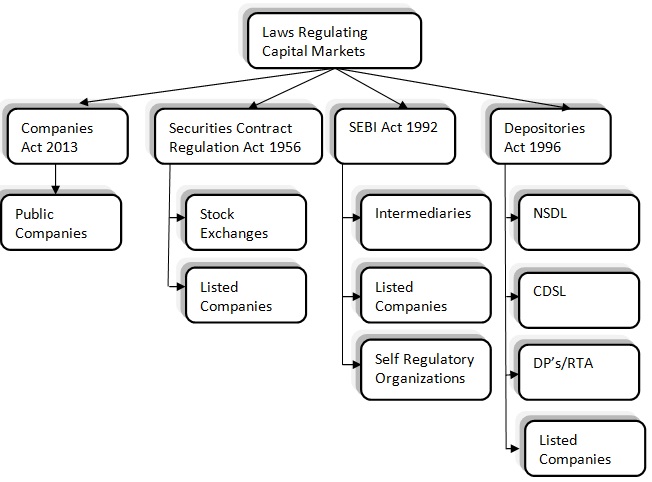
Powers and Functions of SEBI

General Powers:

  1. Promoting / Development / Regulating Securities Market;
  2. Regulating the working of Stock Exchange
  3. Registering & Regulating Intermediaries;
  4. Promoting & Regulating Self-Regulatory Organizations;
  5. Prohibiting Fraudulent and Unfair Trade Practices relating to securities;
  6. Prohibiting Insider Trading in securities;
  7. Regulating substantial acquisition of shares and takeover of the Companies;
  8. Power to make orders for :
  • Suspension of trading in any security;
  • Restraining to access the market & prohibit any person to sell, buy, deal in securities;
  • Suspend any office bearer of a Stock Exchange and Self Regulatory Organization from holding such position;
  • Impound and retain the proceeds and securities in respect of any transaction under investigation.

Relating to issue of securities and protection of investors

  • Matters relating to issue of capital, transfer of securities and other incidental matters;
  • Manner how the disclosures have to be made by companies;
  • Prohibit any company from issuing prospectus, any offer document or advertisement soliciting money from public for issue of securities. specify the conditions based on which the prospectus may be issued
  • Specify the requirements of listing, transfer of securities and other matters incidental thereto.
  • To issue directions:
  • If after making or causing to be made an enquiry, the board is satisfied that it is necessary-
  • In the interest of investors, or orderly development of securities market; or
  • To prevent the affairs which are detrimental to the interest of investors or securities market.
  • To secure the proper management of such intermediary or person.
  • It may issue such directions which are in the interest of the investors and securities market-
    • To any Intermediary, person or class of persons associated with the securities market;
    • To any company in respect of matter specified in section 11A.

Powers to investigate

Where the Board has reasonable ground to believe that:

  1. Any transaction that are dealt in a manner detrimental to the investors or securities market;
  2. Intermediary violates any provision of the Act, rules, regulations made under it or any order passed by the chairman.

It may Direct any person to investigate the affairs of such intermediaries or any other person concerned and to report thereon to the Board.

Power to Cease and Desist the proceedings

The board may pass cease & desist order in the following case:

  • Where any provision of the Act, rules and regulations has been violated or is likely to be violated.
  • In case of insider trading or market manipulation.

Adjudication Powers

For the purpose of adjudging under sections 15A – 15HB,

  • The Board appoints any of its officer not below the rank of Divisional Chief to be an adjudicating officer for holding an inquiry,
  • After giving any person concerned a reasonable opportunity of being heard for the purpose of imposing any penalty.
  • Governed by SEBI (Procedure of Holding Enquiry & Imposing Penalty by Adjudicating Officer) Rules, 1995

Types of Enforcement Actions by SEBI

  • Administrative Proceedings
  • Monetary Penalty Proceedings
  • Disciplinary Proceedings
  • Prosecution
  • Civil Litigation

Compliances to be followed by listed Companies/intermediaries under various SEBI Regulations

  • Furnish any document, return or report to the Board
  • File any return or furnish any information, books or other documents within the time specified therefore in the regulations
  • To maintain books of account or records
  • Failure to enter into an agreement with his client in case of intermediaries
  • to redress the grievances of investors, after having been called upon by the Board in writing to redress the grievances of investors.
  • Following provisions of Insider Trading Regulations and Takeover Code Regulations.
  • Not to indulge in any Fraudulent and Unfair Trade Practices.

Legal Recourse 1: Appeals to SAT

Appeals to Securities Appellate Tribunal can be made in following cases:

  • Orders passed by SEBI (after Securities Laws Amendment Act, 1999)

OR

  • Orders passed by an adjudicating officer

OR

  • Refusal, Omission or failure of Stock Exchange to list the securities

Time Limit for filing appeal

  • In case of orders of SEBI or adjudicating officer, within 45 days from the date on which copy of order is received.

AND

  • In case of Stock Exchange refusal, failure or omission within 15 days of specified date of section 73(1A) of the Companies Act, 1956

Appeals to Supreme Court

  • Aggrieved by the decision of or order of SAT or for determining any question of law arising out of the order,
  • Appeal can be filed to Supreme Court within 60 days of the date of communication of the decision or order of SAT.

Legal Recourse 2 – Compounding

Offences can be compounded subject to following conditions :

  • The offence must not be punishable with Imprisonment only or with imprisonment and fine under SEBI Act,
  • The offences can be compounded either before or after the institution of proceedings,
  • The offence can be compounded by SAT or by the Court under which the proceedings are pending,
  • The provision of SEBI Act shall be applicable notwithstanding anything stated in Criminal Procedure Code.

Legal Recourse 3 – Granting of Immunity

Special Powers to grant immunity from penalty lies with Central Government

  • Can be granted by Central Government
  • Where the alleged person gives a full and true disclosure in respect of the alleged violation
  • Central government imposes such conditions as it may think fit.
  • No immunity granted where the prosecution has already been instituted.
  • Immunity once granted can be withdrawn on non compliance of any condition imposed or giving of false evidence.

Conclusion

Corporate governance has been defined as “a set of systems, processes and principles, which ensure that a company is governed in the best interest of all stakeholders.” Its objective is to ensure commitment to values and ethical conduct of business, transparency in business transactions; statutory and legal compliances, adequate disclosures and effective decision making to achieve corporate objectives. Good governance is simply good business, but, the moot question is as to whether the Indian companies are really, in spirit, committed to corporate governance or it is only a superficial compliance in letter and cost. The regulators are forcing the corporate governance regulations on the Indian Companies without measuring its benefits and advantages commensurate the cost in terms of resources of money, man hour and paper consumption. Importance, necessity and quality of corporate governance that Indian Companies needs cannot be undermined. Indian Companies are very intelligent and comply with all requirements of corporate governance in full, in letter, without meaning it in most cases. Ministry of Corporate Affairs, SEBI or stock exchanges have not yet put any mechanism in place to weigh and measure the effectiveness, usefulness or benefits of compliance of corporate governance commensurate with cost spent on its compliance. Following few examples will support the observations:

There was a lot of hue and cry on appointment of woman directors before 31st March, 2015 in listed companies and the defaulting companies were fined very promptly and very heavily.

Listed and certain other specified companies were asked to broad base their Board of directors and appoint independent directors before the year-end.

In most cases, audit committee and nomination and remuneration committee meetings are held minutes before the Board meeting to make their affirmative recommendation on the already circulated relevant items of the Board meeting agenda, e.g. financial results, appointment of directors, etc. In some cases, Board and Committee meetings are also held simultaneously and concurrently and just the minutes are recorded separately as per mandatory requirements.

A report on corporate governance on mandatory 10 main and about 50 sub items became part of the annual report running into 10-15 printed pages.

Has any study been subsequently made as to –

  • How many of the Woman and Independent directors appointed aforesaid are worth their appointment and fulfil the spirit of Corporate Governance?
  • Are Board constituted Committees are doing meaningful desired work?
  • Do the stakeholders really need, use and become wiser with the voluminous information provided in the Corporate Governance Reports?

At least, nothing is available in public domain.

Curb on malpractices by the independent directors

Recently, Daily Financial newspaper ‘Mint’ of 7th October, 2015 published, under the caption ‘MR INDEPENDENT’, the list of 15 longest serving (for 35-52 years) independent directors on 20 companies, most of whom are also serving as advisers to and have, as such, become insiders of their respective companies. Mint questioned can such directors “really be independent”? Further, Hindustan Times of 8th October also printed similar write up on independent directors with observations, namely, ‘Prolonged association of directors with companies dilutes the spirit of the law, experts say’, and ‘Sabarad said some independent directors even have business links with companies on whose boards they serve’. Even the deterrent that a person cannot be appointed as an independent director if he or his relative “is a material supplier, service provider or customer or a lessor or lessee of the company” has not worked.


 

Download Now

Top Ten tips on Effective Negotiation of Contracts

0
negotiation of contracts

In this article, Rittika Chowdhary pursuing M.A, in Business Law from NUJS, Kolkata discusses Top Ten tips on Effective Negotiation of Contracts.

Introduction

We enter into multiple contracts everyday even without our explicit knowledge about the legal implications arising from our actions. Everywhere we are entering into contracts, whether we realize it or not, regardless of whether you are using an app-based cab or boarding a flight, one has a contract agreed to and entered in. The list of contracts will go into great detail if we start counting our day to day commercial transactions.

Essentials of a valid contract

  • Proper offer and proper acceptance, meaning that there must be a party who is making the offer, and another party who is willing to take the offer.
  • Intention to create a legal obligation, meaning that the parties entering into the contract are intending to create a binding obligation on either side that must be completed.
  • Mutual consent of parties, meaning that there must be willingness on either side to make for a contract. In this context, consent taken in unlawful manner has been cited as a reason for making it invalid, or null and void.
  • Lawful object, meaning that the contract must aim for lawful objective; simply put, signing a contract of two crore rupees for murdering a person does not make for a valid contract.
  • Lawful consideration, meaning that what one receives in exchange of the goods or service must be legal, and tenable.
  • Capacity to contract, meaning that the persons entering into the contract have the ability to enter the said contract. If we go by the legal terminology, it means that the person should have the signing authority to make the contract effective.

If we refer to the first point above on essentials of the valid contract, it calls for proper “offer” and proper “acceptance”. It calls for mutual agreement; that’s what is called as “striking a deal”! It calls for “negotiating” for reaching a consensus.

When we reach out for getting the groceries for our house, we always tend to make a price which we feel is right for the vegetables, but unless the vendor accepts our offer, there is no movement. We have to negotiate our way so as to reach to the desired result. The vendor will not sell at a loss to us, and we are always afraid of paying more than what we should have. The thin line between the offer and acceptance, is where most deals are either struck, or they never see the light of the day this “striking the deal” in common parlance is called as “negotiation”. To negotiate means to reach to an agreement, or reach agreeable terms.

Negotiation is an art. So much so, in corporate houses, there are special training sessions held for inculcating this nuance, or for enhancing this trait. And nothing can be a better character trait, than that of being an excellent negotiator. A good negotiator always finds his way through tough spots.

Negotiation is not really a skill, it is a personality trait. Some people have a knack of it, negotiating their way through a contract is a cake-walk. Whereas some people just do not have the tenacity, or the skill. So what makes for successful negotiation? We will try to analyze them in the coming sections.

Contract negotiation! No we are not talking about buying tomatoes for 70 rupees a kilo instead of 90 rupees asked by the mandiwala. We are talking about mega-deals… hundreds of millions of rupees being signed off for… iron and steel plants to be set up! Giving way to nation building and to top it up the new mantra for the business community making in India.

A famous English author and educational consultant, Tony Buzan, has made a very apt statement in his book: The Power of Social Intelligence: 10 ways to tap into your social genius: “True negotiation takes place when each side respects the other side, and their point of view, and enters into the discussion positively. If you are determined that your solution, and your particular solution only, is the correct one – to be imposed on the other side if necessary – that is not negotiation; it is dictatorship.”

For beginners, this can be called upon as the mantra for any negotiation – to listen to the other party and to respect their point of view as well.

Going forward, we will be talking about ten contract negotiation tips. As has been stressed upon, negotiation is an inherent quality, but this does not mean that one cannot learn it. With persistence, and based on the job role, one has to be equipped with all possible tricks up his sleeve. It is really no surprise that corporate houses are ready to shell out a huge sum of money for making a strong effective team as a “corporate communication team” or a “key manager” role, so that they can retain those individuals, who have this knack for having the last word in an agreement / conversation.

Negotiation of Contracts

Let us now see, what makes for effective contract negotiation.

Knowing the contract terms

The most critical thing in a negotiation is to get inside your opponent’s head and figure out what he wants. No matter how old one is in a business, it never hurts to have a thorough preparation for any contract / deal. It is always advisable to spend a considerable amount of time before every negotiation by preparing in advance, taking copious steps to understand the task that one has to approach. The first step is to understand the collective bargaining agreement, for which it is very helpful to have a legal background. One has to understand what is at stake, what is the terminology involved. While there is hardly any scope for negotiation when one is dealing in the public sector, there is always some scope while one has some opportunities in the private sector. Yet it is always necessary to know what all the deliverables, and the pre-requisites for the contract. A deal for setting up an iron and steel factory will be different from a spares order; it will still be a different ball game when one is dealing with a service order for maintenance of an iron and steel plant. One has to again have different mindset when one is trying to set up a green field project versus a brown field project. Small things like spares for the business are also handled differently even in case of green field project vis-a-vis a brown field project. These are tiny little things which one has to be well aware when dealing with such contracts, and they can be crucial negotiation tips. There shall always be effective and clear usage of words in the contract. There shall not be any chances for the ambiguity in the usage of words in the contract which may cause potential harm in the future. The contract shall be framed in such a way that it is aligned with all the necessary legislatures that is in place. There shall be no deviations from any of the applicable law of the land.

Know what product one wants to buy/sell. Be aware of what you want to buy

Very important parameter of any contract or even for the basic transaction for that matter is having clear idea about the product one had to buy or the service one had to avail. At the time of negotiation of the contract also this point holds equally good. The buyer has to judicially judge what are his needs and shall communicate the same to the party who wants to be the part of the contract. Important point to consider is that the contract is a binding obligation on both the parties who sign to it. Hence the principle of Let buyer be aware shall be strictly adhered with. Buyer has to strictly have an idea on the parameters of the product that he wishes to procure. He had to clearly explain and seek the opinion of other party on the parameters he requires for the product he wishes to buy. Let’s explain the same with an example. If the buyer wishes to build a steel plant he has to decide on the established capacity of the plant which is proposed to be build. He had to estimate the material that he wishes to introduce, speed at which the production take place and estimated net waste from production. This shall be communicated to the other party and his assent shall be obtained. The contract shall be mutually signed and it shall hold good as legal document.

Having an apt timing for negotiation, that is market conditions/macro topics

Time is another important criterion for any normal business transaction. Contract negotiation is also greatly influenced by the timing of its signing. Any contract shall fulfill the criteria of write timing factor. The buyer shall be judicious when to enter into a contract. For example during the time of recession of industry it’s not worth doing capital expenditure or spending on expansion plans. Contract shall be compared in terms of strategical factors as well. The person who enters into an agreement shall understand and have the clear idea about the government policies and the strategical issues as well. For example it’s really unscientific and impractical to enter into a contract with the party who belongs to a country where our government has strategical issues viz. Pakistan. Party to the contract shall have a general idea about the financial impact market conditions exposure to the other macro risk factors as well for the successful execution of the contract. There are some risks which are always inherent to the contract. Person who is entering into contract shall have a clear knowledge about anticipated risk and the ways to mitigate the risks. For example any export shipments may be subject to the risk of loss during transportation. And the same can be mitigated through insurance. As another example foreign transactions are subject to the risk of currency fluctuation and the person entering into such contract shall have reasonable idea about the financial markets and the currency hedging procedures.

Knowing the last price that can be offered – negotiation margin

This is perhaps one of the most interesting tips, and this is but of course the most difficult decision making point in terms of contract negotiation. This calls for rigorous calculations, and knowing the detail cost status, and having a quick idea if something is being added or deleted from the scope in contract. The mathematics has to be ready. One does not have to be hundred percent accurate in these things; the idea is to have a rough calculation of the deal in your brain ready. That is about contract pricing, the crucial factor of negotiation margin is yet a different story. It essentially is the leverage that one has on the cost price; the discounts that can be given to the customer. Contract pricing is an important criterion to decide the profitability and the execution portion of the contract. The pricing shall be win-win situation for both the parties. Based on the type of supply and the nature of the contract pricing shall be fixed. Time factor also shall be considered while deciding the pricing of the contract. If the contract lasts for more than a year the factor of inflation shall be considered for each product under the contract. Party who wishes to sell some goods or render service shall have the clear idea of its capacity to execute any activities. There shall be no promise or contractual agreement on the performance of any activity which is beyond its capacity. Failure to consider this point may cause severe legal liability in the future.

Effective communication skills

The communication is also deciding factor for the effectiveness of the completion of the contract. There has to be clear cut communication of all the requirements of the contract. The communication shall be very clear and shall not be subject to any ambiguity in place. The communication shall be professional in nature. At any given point of time person has to strictly adhere to the professionalism in terms of the communication that he shall make with other parties. Only constructive criticism and comments shall be allowed during the course of communication. There shall be mutual consent in the documented form before concluding any topic or subject matter of the proposed contract.

Good interpersonal skills and knowing the client tastes beforehand

It always helps to know in advance who we are dealing with. The importance of having and creating a rapport with the person on the other side of the table can play as a key decider as to whether or not one cracks the deal. This again is a very crucial point; one has to be practical and appreciate the fact that a million dollar deal is at stake, and any random person trying to sell his product cannot take away the trophy. One always tries to do business with parties with whom they have been associated in the past. Therefore it is always good to have one such person in the negotiation team who has excellent rapport with the customer. The rapport with the customer shall be positive in nature. Parties to the contract shall ensure that their interests are safeguarded before doing any contract finalization. There shall not be complete any compromise on interest of one’s organization to maintain the rapport with the customer.

Trade-offs

Trade-offs are used in all businesses at some point or the other. So much so, that even the accounting guidelines provide for a journal entry where one can set-off debtors and creditors! Trade-offs are the essence of the bargaining process. One can call it bargaining, negotiating, or horse-trading. One must understand the needs and goals of your client. Does he want security? Does he want to maximize the amount of dollars protected in case he fails to reach an expected level of performance? Or does he want flexibility, so if the market changes substantially in the first two or three years of his contract, he has the ability to renegotiate as a free agent? Tradeoffs are the integral portion and very critical points in the execution of any contract. There shall proper usage of the tradeoffs by the parties.

See how this agreement can make/break future deals

This is one important decision making trait that one has to imbibe while negotiating contracts. One has to understand that some contracts are strategic. All deals that one signs may not be profit making. He might have to sign-off a deal which is not much in his favor. Yet to keep the long term goals in mind, one has to sign them. It is also important to have an indication on how the existing contracts are running, and the customer should not be in a position to open a complain box and we risk losing out on the current opportunity. This has to be taken in long term thought. The vision shall be futuristic. Concentration shall be on the future business that we may derive from the party. However the view shall be strategic and scientific in nature to safeguard the interest of the parties in the contract.

Having a negotiation strategy

Having a strategy for going into a deal signing is of utmost importance. One should not left in a clueless kind of position, where the clients’ response / reaction has left us in a baffled state. One cannot be unprepared. There shall be effective level of negotiation before promising on any portion of the contract. There shall not be outright surrender in front of the customer on any points that may form a part of the contract.

Effective use of position to exert influence and achieve organizational goals

This again is an interpersonal skill, and having such a skill set is always a win-win situation. The importance of that one phone call from the power house of the organization, which will weigh in the result in your favor! During negotiation, it would be wise not to take anything personally. If you leave personalities out of it, you will be able to see the opportunities more objectively.

Why mastering the art of contract negotiation is necessary

John F. Kennedy had said once, “Let us never negotiate out of fear. But let us never fear to negotiate”. What we are looking at, as simple contract sign off, is actually the bread and butter of a business house. It is therefore important from an entrepreneur point of view as well, meaning that while negotiating, one has to think like a business owner. An entrepreneur seeks to achieve the following if he uses negotiation to his advantage:

  • Maximize the effectiveness of negotiation in strategic, tactical, telephone and face-to-face contract issue based negotiation situations.
  • Increase profits through well-planned and executed collaborative negotiations.
  • Minimize conflict and deadlocks by using the skills necessary to handle win-win negotiations.
  • Coordinate the process of negotiation and documentation within the organization.
  • Enhance personal effectiveness as negotiators by integrating the skills with the client.
  • Change the focus from negotiation tactics to planning and strategy while reinforcing key corporate values.
  • Increase confidence of in using an established contract process.
  • Become more secure as negotiators through successful practice and extensive feedback.
  • Successfully enhance communications through the development of a common negotiation language.
Download Now

Valuation of Trademarks – How do I know what my trademark is worth

0
Trademark

In this article, Rakesh Gupta pursuing M.A, in Business Law from NUJS, Kolkata discusses  Valuation of Trademarks.

Introduction

The valuation of trademarks should follow ‘Rules on Appraisal’. However, it is highly likely that valuation may be affected by valuator’s subjective opinion because valuation criteria are not stipulated specifically in the rule. Furthermore, valuation may be made uniformly because various valuation methods are not fully utilized. The purpose of this study is to enhance the expertise and efficiency in trademarks valuation practices by providing evaluators with a basic knowledge and specific criteria in cost approach and income approach.

WHAT IS TRADEMARK?

A Trademark is a word, phrase, symbol, or design, or a combination of these that identifies and distinguishes the source of goods of one party from those of others

WHY TRADEMARKS ARE IMPORTANT? 

‘Trademarks are important because if you make a quality product, you want to make sure that customers can quickly identify your product without confusing it with other products, especially other lower quality products. Reputation is important, and trademarks help protect your reputation’.

Trademark Examples

Examples of a trademarked symbol are the Nike Swoosh and McDonald’s Golden Arches.

Pepsi’s designs are an example of a trademarked design. 

What is a service mark?

‘A service mark is the same as a trademark, except that it identifies and distinguishes the source of a service, rather than a product’.

Service Mark Examples

Some examples of service marks include: McDonald’s (restaurant services), Wal-Mart (retail business services), and AT&T (telecommunications services).

“Trademark” and “Mark”

‘Both of these terms are used to refer to trademarks (goods or products) and service marks (services)’.

Functions of a Trademark

  • Indicates the source of origin of goods or services
  • Helps guarantee the quality of goods bearing the mark
  • Creates and maintains a demand for the product
  • Used as a marketing tool to build a brand
  • Can have great value to a company

Why Protect a Trademark?

  • Trademarks are protected under federal and state law
    • Trademarks are earned not born.
    • Trademarks come into being through actual use.
  • You do not have to register a trademark to have it protected, but there are some advantages to doing so
    • A trademark registration provides:
      • Constructive notice to the public of the registrant’s claim of ownership of the mark.
      • Registrant’s exclusive right to use the mark nationwide on or in connection with the goods and/or services listed in the registration.

Policy

Trademark Policy is a marketing function. Normally the marketing personnel of an organization will take care of this trademark policy letter known as ‘ Brand Management

Protection

Trademark protection is a legal function. In small enterprises, one of the tasks of the legal department is to assure the protection of company’s trademarks. In large enterprises there is need to create a specific department known as ‘ Trademarks department’ which will look after the ‘ Trademarks Management

Since trademark protection is a legal function, the trade marks department best assure its role when it is integrated in the legal function of an organization.

The principal duty of the Trademarks Department is to protect and administer the trademark of the company i.e. by getting registration under the relevant laws of a particular country, the country of registration, the list and classes of goods and the services covered, renewals, action against the infringes and dishonest users and so on.

The trademarks department has an additional task in advising the marketing personnel in the choice of new trademarks, their protect ability and their availability, and also in the legal aspects of trademark policy.

The Trademarks Department may also be entrusted with the task to managing the licensing of trademarks, drafting license agreements and permitted user agreement for use of trademarks and also to look after other areas of Intellectual Property such as Patents, Designs, Copyrights and technical knowhow.

Functions of the trademarks department for proper trademarks department for proper trademark management

1) Advise the marketing department with regard to the choice of a new trademark.

2) Legal clearance of a new trade mark by conducting searches in the Trademarks Registry and also in the market places with regard to the availability of identical or similar marks in respect of similar goods and services.

3) Submit trademark applications and advise the company to go for registration in a country where the goods are to be exported or sold.

4) Since there is globalization of industry and trade, it is better to seek International protection of the trademarks and other Intellectual Property.

5) Advise the company for proper use of trademarks after obtaining registration in order to avoid the attack on the registered trademarks on the ground of non-use by business competitors.

6) Initiate legal action against the infringes by filing civil suits or criminal complaint against the infringes and dishonest traders.

7) To conduct search and raid the premises when the infringed or spurious goods are being manufactured or marketed with the help of local police personnel after lodging criminal complaint.

8) To maintain individual files for each and every trademark of the company for easy reference.

9) It is better to computerize the Trademarks Department by creating a software for this kind of ‘ Trademarks Management ‘.

If the creation of trademark department is not economical one of trademark department is not economical one for any type of organization, then it is better to entrust this task to a Trademark Attorney who should be properly instructed to maintain all particulars and papers with regard to trademarks either on retainer or work-to-work basis.

Current Situation

Recent economic and environmental change, depending on the proportion of the corporate intangible assets, such as trademarks greatly increased, the value of these assets reasonably, objectively assess the need is increasing.

Therefore, financing, trading, investment decisions, M and A, litigation, is to assess the value of intangible fixed assets for the purposes of such strategies would reasonably be called the most important part. However, the ability to assess properly the lack of recognition and of intangible assets on despite the importance of these intangible assets are lacking

IFRS to the valuation of trademarks at fair value but with the exception that non-marketable securities, the acquisition cost can be replaced by a well-known professional organizations calculation of the amount of trademarks that the rules are followed. In Article 29, “Rules on Appraisal” but to establish the rules relating to trademarks, including the evaluation of intangible assets has to be determined only by the goodwill of the valuation price evaluation method of revenue reduction, the evaluation criteria does not specify in detail the possibility of intervention is to be the valuator’s subjective situation is very high

Is a trademark of enterprise valuation techniques in order to solve the above problems are situations that require the establishment of valuation criteria that allow you to select a variety of valuation techniques, and get out on the subjective valuation method. In the proposed regulations, specifically with reference to the revenue reduction and valuation methods based on the case analysis and appraisal cost method performs the actual corporate trademarks are the purpose of this study is to propose a practical criterion.

Main Text

Factors affecting the value of corporate trademarks are the factors that are derived from the characteristics that are inherent to the trademark. It can be divided into right and notation, goods and services, markets, sources, etc externalities “Special Education Accounting Standards” intangible assets are exclusively and exclusive right to use a certain period of time. Category is industrial property rights, copyrights, software, software development, etc. Intangible asset has stipulated that the amount plus incidental costs for development costs or purchase value of the asset at cost.

“Municipal Rules on Accounting Standards” has been also defined as intangible assets such as industrial property, with information such as “Special Education Accounting Standards”, specifies the assessment methods for intangible assets.

This assessment has also increased the need for trademark applications in concrete. The “Rules on Appraisal” country stipulates that the evaluation of the trademark line to apply the evaluation method to assess, including goodwill, or goodwill. If this should be the principle evaluated by reduction in revenue, the method may be used to deal case comparison method or cost method if this is not fair.

In “Inheritance and Gift Tax Law” and regulations for the valuation of the trademark as one of the intangible property. The mention of a trademark that directly examine this regulation at least among the “Rules on Appraisal” and “Inheritance and Gift Tax Law”. In “Inheritance and Gift Tax Law” due to trademark and is to assess the value based on the income obtained in the future, it is unclear if that assessment based on the income of the assessment three years ago. This input costs, but it is difficult to apply in future cases if the value is difficult to obtain in the future uncertain income estimates, it has the past three years also represents the future value of income does not matter. Therefore, this case has been commissioned to complement the emotion rating agencies that are accredited by an appropriate amount. This eventually leads to ’Rules on appraisal‘ Article 29 Application of the Provisions of goodwill is connected with problems of its own assessment regulations absence of a trademark. In the case of goodwill is primarily focused on evaluating the benefits exceed its value and property values also exceed profits of the business. However, in addition to the case of a trademark can be accessed from multiple excess benefit side factors such as royalties, input costs in development, the impact of intellectual property as a factor of the nature and value of many other problems. Therefore, the evaluation method of complying with the current regulations of the goodwill that would limit the proper evaluation of its intellectual property, including trademarks that are important recently.

International Valuation Standards Committee as the International Trademark criteria; trademark evaluation of the (International Valuation Standard Committee IVSC) Standards and Assessment Foundation USA (Appraisal Foundation) established a unified professional criterion (Uniform Standard of Professional Appraisal Practice, under USPAP), etc. there. International tendency of trademarks are evaluated in recent years, interest in the trade marks evaluation attempting to simulate the new model evaluation trademarks has been increasingly spread. In utilizing such computer systems address the complexity of the valuation in accordance with the attempt has been made to raise the predictability. However, there is currently a lack of interest in spite of this general agreement with the reference method for the evaluation Trademark yet. According to a survey of UK companies associated with the trademarks valuation made in 2007 and reported that 52% of the required assessment methodology, showed that 57% not sure about the current method. USA also in accordance with GAAP trademarks are the criteria that should be further developed research results have been reported, in the case of China has conducted a study and review of the claim in accordance with the standards and the need for improved assessment and trademark intangible assets associated with the trade office.

In addition, due to the necessity associated with the tax and accounting, as well as require a rating on the company value, corporate interests are also growing increasingly concerned about the trademark in accordance with the higher rating. Since these trends are associated with the reliability of the evaluation results as an opportunity to evaluate Trademarks may be exposed shortcomings, the method and criteria relating to the evaluation is to be improved I have an international consensus has been formed.

Second, as a part of the creative economy has been increasing interest. There are increasingly becoming topics of interest related to the assessment as part of the ‘creative economy’ that has an interest in the importance of economic growth. Accordingly, the OECD has an interest in intangible assets, including trademarks held by related workshops, and the private sector and the government, academia, and that such interest improve.

Third, the valuation trademarks are influenced by changes in technology and the environment. Recently, to save time and money because of the highly-developed computer system and software, while the attention to the complexity that can be performed in model development evaluation.

Therefore, Trademarks valuation is increasingly being adequately achieved immediate, positive rating action appears to have made this tendency rather than a passive, too. This trend has had a profound impact on the assessment as a benefit of the trademarks introduction and development of new technologies. Therefore, appropriate assessment procedures and methods, standards also need to be provided regarding the use of assessment tools based on this technology are also being raised.

Discussion

The trademarks valuation is a trademark of selected functional furniture product “NEO chair” as an example, examine the contents of the marketability and feasibility of such trademarks included in aims to assess its value. “NEO chair” is a May 8, 2014 The B’s intellectual property rights established in Incheon, November 2014 is the current prototype and factory state equipment has been completed. This review is trademark “NEO chair” and assume the same company that developed prior to the relevant domestic and international trademark, by December 1, 2014 criteria to assess the fair value of its trademark.

Valuation Practice by the Cost Method

In this case study the company is committed to the development of the trademark “NEO chair” labor costs, material costs, etc. In addition to seeking the historical cost of the investment in trademark development costs, due to the cost method here on the trademark value plus a percentage of the compensation opportunities estimate.

As using the cost method to estimate the cost spent to develop the intellectual property, trademark first thing you need to evaluate the value of a trademark, it is important that the calculation of the cost of acquisition below.

  • Salary and remuneration of those who engage in trademark development.
  • Costs of project promotion.
  • Common costs for clerical staff and trademark professionals.
  • Raw material used in the development process.
  • Trademark development costs (fees, etc.).

Our product development costs are trademarks completion of the preparation of the production personnel engaged in trademark development costs incurred to develop (March 2014-October 2014), Labor costs, trademark analysis, advertising, consulting rain, costs such as fees 55.081 million the circle.

The estimated capital investment for an ergonomic chair is “NEO chair” with 50 million won. It is estimated to have been based on the actual cost to register (October 2014) from the trademark applied to 50 million won, the first outturn based on contributions (February 2014), office rent, furniture and the like costs.

Patents relating to intellectual property, such as business opportunity compensation are typically determined in the range of 1 to 10 times. In a recent valuation, but usually three times and evaluation assets. Considering that the same trademark, business opportunities compensation will be calculated at twice the cost of the investment. Thus, the business opportunity is estimated at about 100 million won compensation11.

When assessing the value of the trademark cost method by considering the overall cost is estimated to 205.081 million won,

Valuation Practice by the Income Method

Prerequisites for evaluating the trademark by the income approach are as follows.

  • The company has a manufacturing plant was completed in late 2014 began production and sales will start in 2015.
  • Sales of the total market size, market share, taking into account the product’s marketability, including one year of primary verbs are presented on the basis of estimated sales plan is assumed to increase by 10% annually (Bank of Korea, Financial Statement Analysis, 2014).
  • Estimated Income Statement is prepared based on the projections presented by the company.
  • Initial direct development (70,000,000 won) is financed by debt capital.
  • Non-operating expenses (financial expenses) are calculated using the average interest burden (10%) of the borrowed capital.
  • Head office and factory building is assumed to be a rental, machinery and equipment (useful life: 10 years Residual value: 0) are amortized on a straight-line basis.
  • The additional investment is that there is no facility since 2016.
  • Increase or decrease in working capital due to the increase or decrease of such inventories, trade receivables, trade payables are assumed not.
  • The economic life of the trademark is assumed as five years, no residual value is assumed.

The company is assumed to start selling since 2015, revenues are assumed to increase by 10% per year, based on the first year (2015) sales plan presented by the company. The sales volume and sales is calculated by the three models developed by the company based on market conditions and characteristics (price of product A: 210,000, product B and product sales in the C: 180,000).

The sales costs are applied to 45% of the total turnover on the assumption that the initial cost structure persists.

The selling and administrative expenses consist of salaries and variable costs advertising costs for the operating characteristics of the fixed nature of public relations personnel and development staff. The corporate tax rate of 25% applies.

Trademarks of the economic value of the life and value of a discounted cash flow revenue reduction of five years with five years to see the best of 270,605,000 (discount rate changes and adjustments Technical contributions from the lowest of 248,166,000 (fixed discount rate, and general technical contribution apply) applied) were evaluated in a range of up to. In summary, the results of that appraisal seems trademarks and Table 7.

Conclusion

Trademarks are the same as described for the appraisal also mentioned earlier, because it assumes the previous transaction, it is desirable to assess how fair enough deal to convince the parties. Emotion valuation results have brought a variety of discount rate changes apply one million won to 270, 205 to adjust the contribution of one million won of revenue reduction from cost method. Conservative cost method in terms of trademark holders, on the other hand, can reflect as much as possible the location of the buyer, optimistic revenue reduction may reflect as much as possible the seller’s location. Trademarks and intellectual property assessment revenue reduction generally considered a priority. However, B Company has no past performance, such as appraisal of the first companies to enter the market, there seems to require some conservative perspective. Thus, the final value of the “NEO chair” trademark is evaluated by 250 million fixed discount rate and applying the general contribution of the revenue reduction.

In conclusion, the application of the valuation method proposed to facilitate trademark valuation and assessment related to the relatively examined the measures that can be used on the hands. Through this study, the contents actively respond to the expansion of new business areas that correspond to evaluate the industry is able to enjoy the changing economic environment and look forward to being able to be leveraged by practice, provided that a systematic and consistent.

Reference

  • Trademark Act
  • IP Act
  • Journals
  • Internet columns

Download Now

A comparative analysis of winding up of a company – Companies Act, 1956, Companies Act, 2013 and the Insolvency and Bankruptcy Code, 2016

0
winding up
Image Source - http://www.arlingtonmagazine.com/arlingtons-empty-office-problem/

In this article, Harshita Punjabi of RGNUL and pursuing CS does a comparative analysis of winding up of a company under the Companies Act, 1956, Companies Act, 2013 and the Insolvency and Bankruptcy Code, 2016.

INTRODUCTION

The entire procedure for bringing a lawful end to life of company is divided into two stages. These two stages are winding up and dissolution. Winding up of company is defined as a process by which the life of a company is brought to an end and its property administered for benefit of its members and creditors. It is the last stage, putting an end to life of a company. The main purpose of winding up is to realize the assets and make the payments of company’s debts fairly. Thus, winding up is the process by which management of a company’s affairs is taken out of its directors, its assets are realized by a liquidator and its debts are discharged out of proceeds of realization.

Difference between winding up and dissolution

WINDING UP

DISSOLUTION

Winding up is a proceeding by means of which company is dissolved and in course of dissolution, assets are realized, liabilities are paid off and surplus is distributed among members.

The legal existence of company is brought to an end by dissolution
Winding up precedes the dissolution. It is the final stage where the existence of company is withdrawn by law.
The liquidator can present the company in winding up proceeding. Once the order of dissolution is made by the Court, liquidator cannot represent the company.
Winding up proceeding can be started without the intervention of the court. For the dissolution of the company, order of the court is essential.
Any person can proceed against the company which is being wound up.

No proceedings can be started against the company which has been dissolved.


Difference between winding up and insolvency

Winding up

Insolvency

It is a process by which company is dissolved. The assets are collected, liabilities are paid off out of assets or from contributions by members and if surplus left, it is distributed among members

It is inability of a debtor to pay debts as they fall due. A person is said to be insolvent when his liabilities exceeds his assets and against whom Court makes order of adjudication.
A company cannot be adjudged as insolvent  An individual can be adjudged as insolvent
A company can be wound up even if it financially sound. A person can be adjudged as insolvent when he is unable to pay his liabilities.
During winding up proceeding, the property is vested in the Company. In insolvency proceedings, the assets of person are vested in Official Receiver.
After completion of proceedings, the Company is dissolved.

After completion of proceedings, the insolvent person is discharged from liabilities.


On winding up, the company does not cease to exist as such except when it is dissolved. The administrative machinery of the company gets changed as the administration is transferred in the hands of liquidator. Even after commencement of winding-up, the assets of the company belong to the company until dissolution takes place. The company ceases to exist as a separate entity on dissolution and becomes incapable of keeping its own property, suing and being sued. Thus, the legal status of the company continues to exist between the period of winding-up and dissolution.

In Pierce Leslie & Co. Ltd. V. Violet Ouchterlony[1] the Supreme Court held that winding-up precedes the dissolution. There is no statutory provision vesting the properties of dissolved company in a trustee or having the effect of abrogating. The shareholders or creditors of a dissolved company cannot be regarded as its heirs and successors. On dissolution, its properties, if any, vest in the government.

WINDING UP AS PER COMPANIES ACT, 1956

There were three modes of winding up of the Companies registered under Companies Act, 1956.

Winding up by the Court

Winding up by the court or compulsory winding up is initiated by application by way of petition to appropriate Court for a winding up order. Section 10 of the Companies Act, 1956 deals with the jurisdiction of for entertaining winding up petition.

The High court has jurisdiction in relation to the place at which the registered office of the company is situated, or

The District Court in which jurisdiction has been vested either by the Act or by notification of Central Government.

GTC Industries Ltd v. Parasrampuria Trading[1], it was held that only High Court where the registered office is situated has jurisdiction in winding up, even if there was agreement between parties will be resolved before High Court where registered office is not situated.

https://lawsikho.com/course/insolvency-bankruptcy-code-ibc-nclt-sarfaesi
Click Above

CIRCUMSTANCES IN WHICH COMPANY MAY BE WOUND UP BY THE COURT

Section 433 of the Companies Act, 1956 provides for the circumstances in which company can be wound up-

  • If the company has resolved that the company be wound up by the Court by passing special resolution; or
  • If the company has defaulted in delivering the statutory report to the Registrar or in holding the statutory meeting; or
  • If the company does not commence its business within a year from its incorporation, or suspends its business for a whole year; or
  • The number of its members in public company is reduced below seven and in private company below two; or
  • The company is not able to pay the debts; or
  • The Court is of the opinion that company should be wound up on just and equitable grounds; or
  • The company has defaulted in filing balance sheet or annual return with the Registrar for any 5 consecutive years; or
  • If the act of the company goes against the interests of sovereignty, integrity and security of India, friendly relation with foreign states, public order, decency or morality; or

Inability to pay debts – A company shall be deemed to be unable to pay its debts when the creditor has served on the company a demand in writing for payment of the debt, which is more than Rs. 500 and company has within three weeks thereafter, neglected to pay or secure or compound for it to the reasonable satisfaction of the court.

Just & Equitable Grounds – Court has complete discretion to decide just & equitable grounds for winding up of a company. Some of the grounds on which court ordered the winding up of company under this clause,

  • When the object of the company was fraudulent,
  • When substratum of the company has disappeared i.e original object become impossible to attain;
  • The object for which the company is formed is illegal or becomes illegal by change in law;
  • The object for which company was incorporated has been completed;
  • Deadlock in management due to differences among rival group and disagreement cannot be resolved in general or board meeting;
  • There has been mismanagement and misapplication of funds by directors of private company.

Who may file petition for winding up

Section 439 of Companies Act, 1956 deals with the persons who can file the petition for winding up of a company,

  • The directors can make a petition in the name of the company with the sanction of general meeting by way of special resolution.
  • The creditors can make a petition if the company is unable to pay the debts. The creditors include assignee of debt, a decree holder, a secure creditor, a debenture holder or trustee of debenture holders.
  • A contributory can present winding up petition if number of members in case of public company is reduced below 7 and below 2, in case of private company.
  • The Registrar of companies, after obtaining prior sanction of the central government, can present a petition on winding up of company

VOLUNTARY WINDING UP (Section 488 of Companies Act, 1956)

The company and its creditors may apply to court for directions or orders but usually they are left to settle their affairs within themselves. There are two kinds of voluntary winding up, Member’s Voluntary winding up and Creditor’s voluntary winding up.

Resolution for Voluntary winding up

Voluntary winding up can be passed with an Ordinary Resolution (When the time span fixed in the AoA has expired) else with a Special Resolution (In all other cases).

Members’ Voluntary Winding up

When the company is able to pay its debts, its Board of Directors makes a Declaration of solvency stating that company would be able to pay debts within three years from the date of commencement. Any false declaration made by director will be punishable up to 6 months or fine up to Rs. 50000 or both. In Shri Raja Mohan Manucha v. Lakshminath Saigal[2], it was held that where the declaration of solvency is not made the resolution for winding up and all subsequent proceedings will be null and void. Such a declaration msut be made within five weeks immediately preceding the date of passing of resolution for winding up of company and be delivered to Registrar before that date. The declaration must be accompanied with auditor’s report on balance sheet and profit and loss account as at latest practicable date.

Creditors’ Voluntary Winding up

When declaration of solvency is not made and delivered to the Registrar, it is case of creditors’ voluntary winding up.

Date of commencement of winding up-Section 441 of the Companies Act, 1956 lays the provision for the date of commencement of winding up

The winding up of a company by a court is deemed to commence at the time of the presentation of petition for winding up.
Where a resolution has been passed by the company, for voluntary winding up, the winding up shall be deemed to have commenced at the time of passing of the resolution.


Rishabh Agro Industries Ltd. V. PNB Capital[3], it was held that the words “shall be deemed to have commenced” shows the intention of the legislature that although the winding up of company does not in fact commence at time of presentation itself, but it shall be presumed to commence from that stage

Distinction between Members’ voluntary winding up and creditors’ voluntary winding up

Members’ Voluntary Winding up

Creditors Voluntary Winding up

Where a company is solvent & declaration of solvency is made by the directors, it is called members’ voluntary winding up

Where a company is solvent, the declaration of solvency is not made by the directors, it is called as the creditors’ voluntary winding up.
Dominant control remains in the hands of the members of the company. In creditors’ winding up, dominant control remains in hands of the creditors.
There is no meeting of creditors and the liquidator is appointed by the company. In creditors’ winding up, meetings of creditors have to be called at the beginning and subsequently the liquidator is appointed by the creditors.
The liquidator can exercise some of his powers with the sanction of a special resolution of the company.

The liquidator can do so with the sanction of the court or the Committee of inspection or of meeting of creditors.

Winding up subject to supervision of the Court (Omitted)

In this winding up process, court can only supervise the procedure. In a general meeting, the resolution for winding up is passed and court may put some general terms. It must be proved by petitioner that winding up cannot continue with fairness and then an additional liquidator along with existing liquidator may be appointed by the Court. A report regarding the progress of liquidation must be filed every 3 months with the Registrar by the Liquidator. The court has power to appoint and remove the liquidator. The court also has the power to enforce calls made by Liquidator as if order for winding up the company has been made by court itself. The Liquidator can do all such acts as he thinks best in the interest of the company.

WINDING UP UNDER COMPANIES ACT, 2013

There are two modes of winding up under the Companies Act, 2013 provides for the provisions relating to commencement of winding up.

Winding up by Tribunal

  • National Company Law Tribunal can be initiated by an application by way of petition for winding up order.
  • It should be resorted to only when other means of healing an ailing company are of absolutely no avail.
  • Remedies are provided by the statute on matters concerning the management and running of the company.
  • It is primarily the NCLT which has jurisdiction to wind up companies under the Companies Act, 2013.
  • There must be strong reasons to order winding up as it is a last resort to be adopted.

Grounds on which a Company may be wound up by the Tribunal

Under Section 271[1], a company may be wound up by the tribunal if-

  • Company is unable to pay the debts;
  • If the company has, by special resolution, resolved that the company be wound up by the Tribunal;
  • If the company has acted against the interests of sovereignty and integrity of India, the security of the State, friendly relations with foreign States, public order;
  • If the Tribunal has ordered the winding up of the company under Chapter XIX;
  • If on an application made by the Registrar or any other person authorized by the Central Government by notification under this Act, the tribunal is of opinion that affairs of the company have been conducted in a fraudulent manner or the company was formed for fraudulent or unlawful purpose or the persons concerned in formation misfeasance or misconduct in connection therewith and that it is proper that company be wound up;
  • If the company has made default in filing with the Registrar its financial statements or annual returns for immediately preceding five consecutive financial years;
  • If the tribunal is of the opinion that it is just and equitable that the company should be wound up.

Inability to pay debts – A company is deemed to be unable to pay the debts under Section 271 (2) of the Companies Act, 2013 if a creditor to whom company has to pay an amount exceeding Rs. 1 lakh has served a notice at the registered office of the company by registered post or otherwise, which requires the company to pay the due amount and the company has failed to pay the sum within 21 days or If any execution or other process issued by decree of court or order in creditor’s favour is returned unsatisfied in whole or in part or if the tribunal is satisfied that the company is unable to pay its debts and the Tribunal shall take into account the contingent and prospective liabilities of the company while determining whether the company is unable to pay its debts.

Who may file petition for winding up

A petition for winding up may be presented by any of the following persons under Section 272 of The Companies Act, 2013-

  • The company; or
  • Any creditor or creditors, including any contingent or prospective creditor or creditors; or
  • Any contributory; or
  • All or any of the above three specified parties; or
  • The Registrar; or
  • Any person authorised by Central Government in this behalf;
  • By the Central Government or State Government in case of Company acting aginst the interest of sovereignty and integrity of India.

As per Section 272 of the Companies Act, 2013, within the meaning of creditor comes a secured creditor, holder of debentures, trustee for holder of debentures.

A contributory can present the petition of winding up of company even if he may be holder of fully paid up shares or that company may have no assets or no surplus to distribute among shareholders after the satisfaction of its liabilities and some shares were originally allotted to him or have been held by him and registered in his name for 6 months during immediately preceding 18 months before commencement of winding up.

A petition for winding up shall be admitted by the Tribunal only if it is accompanied by statement of affairs in such form and in such manner as may be prescribed.

Under this section, a copy of the petition shall also be filed with the Registrar who shall submit his views to the Tribunal within 60 days of receipt of petition.

Powers & Functions of the Tribunal

As per Section 274 of the Companies Act, 2013 on the filing of petition for winding up by any person other than the company, if the tribunal is satisfied, it shall direct the company by an order to file objections along with statement of affairs within 30 days, which could get extended by another 30 days in special circumstances.

As per Section 275 of the Companies Act, 2013 an official liquidator or a liquidator from panel shall be appointed by the Tribunal at the time of passing of winding up order. A panel consisting of CS/CS/Advocates and other notified professionals with at least 10 years experience in company matters is maintained by the Central Government.

As per Section 281 of the Companies Act, 2013, a report shall be submitted by Liquidator within 60 days to the Tribunal, containing details such as-

Nature and details of assets of company with their location and value; amount of capital issued, subscribed & paid up; the existing and contingent liabilities of the company including names and other details; the debts due to company and names, address; list of contributories with amount details; details of trademark, intellectual properties, if owned by company; details of contracts, joint ventures and collaborations, if any; details of holding and subsidiary company, if any; details of legal cases filed by or against the company; any information which the tribunal may direct or liquidator may consider necessary.

On consideration of the report of Liquidator, Tribunal shall fix the time limit within which entire proceedings shall be completed and company be dissolved. The Tribunal may also order a sale of Company as a going concern or its assets or part thereof[2]. After passing of winding up order by the Tribunal, the Tribunal shall settle list of contributories, cause rectification of register of members in all cases where required and shall cause assets of the company to be applied to discharge its liability[3].

Voluntary Winding up

In voluntary winding up, Company and its creditors settle their affairs without going to Court. One or more liquidators are appointed by company in general meeting for purpose of winding up. A voluntary winding up commences from date of passing of resolution for voluntary winding up, a petition is presented for winding up by the Court. Section 304[4] deals with the circumstances in which a company may be wound up voluntarily-

CHANGES IN WINDING UP AFTER THE INSOLVENCY AND BANKRUPTCY CODE, 2016

The Insolvency & Bankruptcy Code, 2016 consolidate and amend the laws relating to insolvency of companies, partnership firms, limited liability partnership into a single legislation. It aims to provide time bound resolution and empowered the creditors to initiate the insolvency resolution process if default occurs.

After the MCA wide notification no. S.O. 3453 E of November 15th, 2016, section 255 of Insolvency & Bankruptcy Code, 2016 amended following sections of the Companies Act, 2013

In the definition of Winding up, new insertion was made which makes it as winding up means winding up under this Act or liquidation under the Insolvency & Bankruptcy Code, 2016 as applicable.

Section 270 of the Companies Act, 2013 regarding the Modes of winding up, has been deleted after the enforcement of this Code. It has been substituted by Winding up by Tribunal

Section 271, companies Act, 2013 which deals with Circumstances in which company may be wound up by Tribunal has been substituted namely- A company may be wound up by the Tribunal, on petition under Section 272, if the company has resolved by special resolution that company be wound up by the Tribunal; if the company has acted against sovereignty, integrity, security of India friendly relations with foreign states, public order, decency, morality; if the tribunal is of opinion that acts of the company are fraudulent or the object for which it was formed was fraudulent or unlawful or persons concerned in formation and management have been held guilty of fraud, misconduct and it would be proper for it to be wound up; if the company defaulted in filing financial statement for the immediately preceding last financial years with the Registrar; if Tribunal is of opinion that company should be wound up on just and equitable grounds.

The sub-section has been substituted in Section 275 of the Companies Act, 2013 as Section 275(2) which deals with Company Liquidators and their appointment as per which Tribunal shall appoint the provisional or the Company Liquidator from amongst the insolvency professionals registered under the Insolvency & Bankruptcy Code, 2016.

Section 304 of the Companies Act, 2013 that deals with the circumstances in which company may be wound up voluntarily has been omitted by the Insolvency & Bankruptcy Code, 2016 along with other sections relating to voluntarily winding up under the Act

Transfer of proceedings – On December 7th, 2016, the MCA issued Companies (Transfer of Pending Proceedings) Rules, 2016 for transfer of pending legal proceedings from High Court to National Company Law Tribunal bench

Subject Matter

Transferred to NCLT

Retained with High Court

Winding up under supervision of court No Yes
Voluntary Winding up

New cases to be filed with NCLT w.e.f 1st April, 2017

Provisions relating to voluntary winding up under Companies Act, 2013 has been omitted.

For cases filed up to 31st March, 2017
Winding up for inability to pay Where petition has not been served, it has to be treated as an application under IBC. Where petition has been served on the Respondent.
Winding up by the Court Only those cases where petition has not been served on Respondent Where petition has been served on Respondent.

On March 31st, 2017the Insolvency and Bankruptcy Board of India has notified the Insolvency and Bankruptcy Board of India (Voluntary Liquidation Process) Regulations, 2017. The voluntary winding up of companies was governed by Companies Act, 1956 as the mentioned provisions in Companies Act, 2013 had never been notified. Now the Voluntary Liquidation in both the Companies Act 1956 and Companies Act, 2013 has been repealed by Government.

Chapter V of Part II of the Insolvency and Bankruptcy Code contains Section 59 that deals with voluntary liquidation. Moreover, the distinction between members’ voluntary winding up and creditors’ voluntary winding up has been eliminated.

As per Section 59 of the Code, the voluntary liquidation process can only be initiated by a corporate person, which has not committed any default. Default here includes those debts that are not repaid and has become due and payable. The compliances of some requirements are necessary.

  • Declaration by directors that winding up is not to defraud any person;
  • Liquidator can be insolvency professional who fulfils criteria under the regulations;
  • Registers to be maintained and preserved in prescribed manner;
  • Liquidators to receive claims of stakeholders only in specified forms;
  • Within twelve months from commencement of voluntary winding up, the affairs of corporate person to be wound up;
  • Reports by Liquidator to be submitted to corporate person, Registrar of Companies and Insolvency and Bankruptcy Board of India.
  • The time period to comply the requirements has also been reduced to expedite the process.

PROCEDURE FOR WINDING UP UNDER NEW REGULATIONS

STEP 1: One has to submit a declaration to Registrar of Companies, stating that company will pay its dues and liquidation is not to defraud any person;

STEP 2: Within 4 weeks of such declaration, special resolution has to be passed for approval of proposal of voluntary liquidation and appointment of liquidator;

STEP 3: Within 5 days of such approval, public announcement in newspaper and website of company has to be made for inviting claims of stakeholders;

STEP 4: Within 7 days of such approval, intimation should be given to ROC and Board;

STEP 5: Submission of preliminary report containing capital structure, estimates of assets and liabilities, proposed plan of action within 45 days to a corporate person;

STEP 6: Verification of claims within 30 days and preparation of list of stakeholders within 45 days from the last date of receipt of claims;

STEP 7: For receipt of money due to corporate person, bank account needs to be open in name of corporate person having words ‘in voluntary liquidation’ after its name.

STEP 8: Sale of assets and recovery of due money, uncalled capital is realised;

STEP 9: The proceeds from realization to be distributed within 6 months from receipt of amount to the stakeholders;

STEP 10: The final report by the liquidator has to be submitted to corporate person, ROC, the Board and application to NCLT.

STEP 11: The order of NCLT regarding dissolution to be submitted within 14 days of receipt of order.

Conclusion

In the year 1999, as per Justice Eradi Committee Report, 473 winding up cases were pending for more than 25 years and in 2015, there were 1479 winding up cases pending for more than 20 years, as per data furnished by the Department of Financial Services. The Insolvency and Bankruptcy Code, 2016 was passed to ensure time bound settlement of insolvency which would in turn help in solving India’s bad debt problem.

To expedite the process of voluntary winding up, Government had introduced New Regulations as the procedure of voluntary winding up under Companies Act, 1956 was time consuming and there was no prescribed qualification for liquidator. The Code mandates that insolvency professionals are to be appointed as Liquidators, such a move is welcome by corporates and professionals.

The Code and Regulations provide a favourable framework for companies and limited liability partnerships. Though the process remains almost similar to previous regime, but the major change has taken place in initiation of winding up process. Earlier, company or any of its creditors could file a voluntary winding up petition but now company, directors, designated partners or persons responsible for exercising its corporate powers can initiate the winding up process. Moreover, approval of creditors representing two thirds of corporate debt is mandatory under the Code for initiating voluntary winding up proceeding.

To sum it up, now every company who proposes to wind up is required to follow Insolvency and Bankruptcy Code, 2016. The Code is quite comprehensive and wider as against Companies Act, 1956. It is expected that Code would help in overcoming delays and complexities involved in the process due to presence of four adjudicating authorities, High Court, Company Law Board, Board for Industrial and Financial Reconstruction and Debt Recovery Tribunal. It would also lessen the burden on courts as all the litigation will be filed under the Code.


LawSikho has created a telegram group for exchanging legal knowledge, referrals and various opportunities. You can click on this link and join:  

https://t.me/joinchat/J_0YrBa4IBSHdpuTfQO_sA

Follow us on Instagram and subscribe to our YouTube channel for more amazing legal content 
 
 
References:

[1] Sec. 271(1), the Companies Act, 2013

[2] Section 282, the Companies Act, 2013

[3] Section 285, the Companies Act, 2013

[4] Section 304 (1), the Companies Act, 2013

[5] (1999) 34 CLA 380 (ALL HC)

[6] (1963) 33 Comp. Cas 719

[7] (2000) AIR SCW 1753

[8] 1969 SCR (3) 203

Download Now

The Insolvency And Bankruptcy Process In India

1
insolvency
Image Source http://www.civilsdaily.com/story/insolvency-and-bankruptcy-code-2016/

In this article, Raghav Vaid pursuing M.A, in Business Law from NUJS, Kolkata discusses The Insolvency And Bankruptcy Process In India.

Insolvency is a situation when an individual or a company is unable to repay its outstanding financial loan to its lender in due time. A solution to such a situation is by modifying the repayment method or by writing the loan off. In the event such a situation is unresolved, then insolvent’s assets are sold off in order to pay off or to recover the outstanding debts. This is done by way of a legal action in Court of law. The Court appoints an official liquidator whose primary job is to liquidate all the assets of the insolvent and pay off the proceeds to the creditors.

Although the term sounds similar to insolvency, Bankruptcy is a different concept. Bankruptcy is a concept which is like voluntary surrender. It this case, the person voluntarily goes to the Court and officially declares that he is unable to pay any further debts. In such a scenario, the Court takes the responsibility of liquidating a person’s assets and distributes the proceeds to his creditors. The primary difference between an insolvent and a bankrupt is that a bankrupt can post the distribution of proceeds to creditors can have a new lease of life.

BACKGROUND

The research shows that India has about 11% of bad debt records out of the total lending and it is increasing day by day. Mr Vijay Mallya is one such example. The time taken to resolve a case of insolvency is very high as compared to many other countries of the world. Due to this issue, India ranks 130th in ease of doing business in the world. More than 50% of bad debts are that of Corporates who have taken such loans from nationalised banks. The recovery from such defaulters is generally next to impossible because of a number of reasons like overlapping jurisdictions etc. Hence, these cases continue for years and years but the recovery remains zero. Previously there were about twelve laws which dealt with insolvency. Basis on those twelve laws, it took more than four years to wind up a corporation in our country.

Due to lack of required institutional and legal setup, the defaulters started considering India as a safe haven for such activities which clearly depicted incompetence on the part of our country when compared to global standards. Although India had numerous acts in place to punish the defaulters like the Indian Contract Act, the Recovery of debts due to Banks and Financial Institution Act 1993, the Securitizations and Reconstruction of Financial Assets and Enforcement of Security Interest Act, 2002, the Sick Industrial Companies (Special Provisions) Act, 1985 (SICA) and so on has failed miserably to recover to the outstanding dues from the defaulters. The aforesaid laws had many loopholes which kept the defaulters fear free and safe. If there is no fear of law, this scenario is likely to happen.

Based on the abovementioned increasing issues, the government finally decided to take some stand. The Government decided to replace the existing insolvency laws with new stringent laws which would take care of the existing defaulters in a time bound manner and also set an example for the people of the country who considered this activity of wilful defaulting as a gag. It was on 11th of May, 2016, when the Insolvency and Bankruptcy Code, 2016 was passed by both the houses and received the assent of the President on 28th of May, 2016.

Insolvency and Bankruptcy Code – An overview

The primary motive of launching the Insolvency and Bankruptcy Code, 2016, was to amend and consolidate the laws relating to insolvency resolution from a number of acts into one single code. The key emphasis of this Code is to provide revival and resolution in a time bound manner thereby maximizing the value of defaulter’s properties. This legislation clearly provides a structure to aid sick companies to either wind up their business or come up with a modified plan in order to revive. It also aims to safely depart the investors from such companies without making them lose their investments. This new Code has also vested the operational creditors like suppliers and workmen with the power to initiate insolvency proceeding against a company if the default takes place.

Another great feature about the code is that it considers no difference between the rights of domestic and international creditors or among the varied classes of economic organizations. The Code has a hit the nail on the head by balancing the interest of the involved shareholders including modification in the order of primacy of payment of Government dues. This new law is drafted keeping in mind the international standards bearing a broad philosophy that any future insolvency proceedings must be professionally and commercially driven rather than Court driven. The intention is to ensure that the role of the adjudging authorities is to ensure the due procedure rather than refereeing on the merits of the insolvency resolution.

The new Insolvency and Bankruptcy Code, 2016 has repealed a number of outdated acts like the Provincial Insolvency Act, 1920, the Presidency Towns Insolvency Act, 1909 and the Provincial Insolvency Act, 1920. It further amends certain legislation like the Indian Partnership Act, 1932, the Companies Act 2013, Securitization and Reconstruction of Financial Assets and Enforcement of Security Interest Act, 2002, Limited Liability Partnership Act 2008 and Sick Industrial Companies (Special Provisions) Repeal Act 2003. In order to sidestep any further litigation in insolvency proceedings, this new Code shall overrule all other laws and Acts. The Code clearly states that the Courts shall not have the authority to grant any injunction as it shall not be a part of their jurisdiction. The new law in the form of Code has replaced a number of laws which were earlier prevailing thereby proving to be an important step in developing the procedure of recovery of bad debts. With the launch of this new law, there is a sudden surge in economic growth because of the unbending timeframe prescribed in the Code in order to resolve the insolvency and liquidation proceedings.

STEP BY STEP INSOLVENCY RESOLUTION PROCESS

The new Code makes a departure from the typical outdated regime by shifting the onus on the creditor in order to initiate the insolvency resolution procedure against a corporate defaulter. Whereas in the earlier Code, the responsibility to initiate a proceeding was with the debtor and the creditor was to pursue parallel actions for recovery of debt.

PROCESS OF LIQUIDATION FOR CORPORATES

In case the default is for an amount over and above Rs. 1 lakh, the creditor has the authority to initiate insolvency process as per the new Code. The Code recommends two autonomous stages:

  1. Resolution Process for Insolvency: Under this stage, the financial creditors make an assessment of whether the debtor’s business is worthy of continuing or not. The creditors come up with options for restructuring the business model to avoid any further losses.
  2. Liquidation: In the event the abovementioned Insolvency Resolution Process fails, the creditors make a unanimous decision to wind down and sell the debtor’s assets in order to recover their dues.

RESOLUTION PROCESS FOR INSOLVENCY

In case a corporate debtor makes a default in repayment of dues of the creditors, a financial creditor/s, an operational creditor or a corporate debtor through Corporate applicant or any authorised member, a person who has the controlling capacity over the financial affairs of the corporate debtor has the power to start the insolvency resolution process. In order to initiate the resolution process, an application has to be made to National Company Law Tribunal (NCLT). A ten days demand notice has to be given to the corporate debtor by the operational creditor before he approaches the NCLT. However, an operational creditor can directly approach the NCLT if the corporate debtor does not repay the outstanding dues or fails to show any existing difference.

The new Code states that the insolvency process of a Corporate must be concluded within 180 days from the date of initiation by the NCLT. The claims of the Creditors shall be frozen for a period of six months on admission of application by NCLT. During this time, the NCLT shall listen to the options to revive and decide the future course of action. It is further clarified that unless a resolution plan is made or liquidation process is initiated, no legal claim shall be sought against the corporate debtor in any other forum or Court. When the application for insolvency is accepted, the NCLT within fourteen days appoints an Insolvency Professional (IP) on receiving a confirmation from Board of Insolvency and Bankruptcy. The appointed IP then takes up the responsibility of the debtor’s properties and functioning. He also collects all the information that is relevant with regard to the financial condition of the debtor from information utilities. IP is appointed for a term of thirty days only within which he does all the necessary scrutinization.

The next step is to make a public announcement about the commencement of corporate insolvency process so that claims from any other creditors can also come forward, if any. A creditor’s committee is constituted by the IP post receiving any claims by public announcement. In the event any financial creditor is a related party of the defaulting debtor, such a creditor will not have the right to represent, participate or vote in the committee of creditors so constituted by the IP. In order to be a part of the Creditor’s Committee, the average dues of the operational creditors must be at least ten percent of the debt. The Committee of Creditors shall first seven days of its incorporation decide through seventy five percent votes whether the interim IP should be used as a Resolution Professional or should be replaced with someone else. After the Committee finalizes the Resolution Professional, he is appointed by the NCLT. The Resolution Professional so appointed can be replaced anytime by the Creditor’s Committee with a majority of seventy five percent votes. In the interim, i.e. till the appointed of any new Resolution Professional, the Creditor’s Committee can take decisions with regard to insolvency resolution by seventy five percent majority voting.

In the event majority (75%) of the financial creditors are of the view that the case is very complex and more time extension is required, the NCLT may grant a one-time extension of up to a maximum of 90 days over and above the pre decided tenure of 180 days. It shall be the sole responsibility of the Resolution Professional to manage and conduct the corporate insolvency resolution procedure during such a term. To enable the resolution applicant for preparing a resolution plan, the Resolution Professional shall compile a statistics note. A resolution applicant can be defined as an individual who has the duty and responsibility to submit a resolution plan to the Resolution Professional. The Creditor’s Committee further receives the plan from the Resolution Professional for its approval.

On the resolution being approved, the next step by the Creditor’s Committee is to come up with options on restructuring which can be either coming up with a modified repayment plan or to simply liquidate the properties of the company in order to recover dues. If the Creditor’s Committee fails to take any binding decision with regard to the repayment by the debtor, the debtor’s assets are liquidated in order to pay back the creditors. If there is a plan prepared for resolution, the same shall be sent to NCLT for approval and implementation.

LIQUIDATION

The liquidation process commences only if:

  1. The Committee fails to submit the resolution plan with the provided time frame to the NCLT.
  2. The Resolution Plan is rejected because of non-adherence to the Code.
  3. The Creditor’s Committee takes a decision for liquidating the assets by a majority vote.
  4. The resolution plan is flouted by the debtor.

As mentioned above, no suit can be instituted by or against the corporate debtor during liquidation process. The only exception, in this case, can be through the liquidator representing the corporate debtor based on the permission of the NCLT. The liquidator shall be the same person as the Resolution Professional lest replaced. The liquidator so appointed shall constitute the liquidation estate which shall comprise of all the properties, whether financial or immovable, of the corporate debtor. The claims of the creditors may be received, verified, admitted or rejected based on the final decision of the liquidator within a prearranged time. In order to appeal to the adjudicator, the creditor gets a total of fourteen days.

Based on the priority, a security creditor may receive the proceeds from sale of assets or realize the security interest by enforcing or dealing with the secured asset as per the applicable laws related to him. He may either relinquish his security interest or realize it based on his intent. Any supplementary sum so realized shall be submitted to the liquidator. Although the security creditors will be paid by the liquidator on priority basis out of the corporate debtor’s assets, his claim shall be considered subordinate to the unsecured creditors to the extent of deficit. The distribution shall be in manner laid down in the Code. All those persons who have any sort of individual rights over the assets of the debtor shall also form a part of the liquidation procedure. There are certain funds which cannot be attached to the estate of the debtor for recovery of debts. Such funds are provident fund, gratuity fund and the pension fund because this amount belongs to the employees and workmen and hence they are given the priority with regard to these funds. Once all the assets of the corporate debtor are liquidated, the NCLT passes an order to finally liquefy the corporate debtor.

FAST TRACK INSOLVENCY RESOLUTION PROCESS

Nowadays the government is providing fast track procedures in a number of divisions like passport etc. The new Insolvency and Bankruptcy Code also provides a similar feature wherein the process shall be concluded in ninety days with a maximum extension of forty-five days. This fast track insolvency provision applies to the process of insolvency. This particular feature is made with an intention to woo the start-ups of our country so that they can complete the resolution process as soon as possible and move on.

VOLUNTARY LIQUIDATION BY CORPORATE PERSON

The Insolvency and Bankruptcy Code also provides a section wherein the corporate person can take a decision of liquidating itself if it has not committed any default and has the capacity to pay its creditors through liquidation of its assets. In order to proceed with such a liquidation process, it is mandatory for majority of the directors of the said corporate to give a declaration stating that such activity is not taking place in order to defraud any person. Such a resolution shall be approved the creditors of the company who are signifying at least two thirds value of debts of the company. The commencement of voluntary liquidation takes place on approval received by the creditors. Even in case of voluntary liquidation, provisions of liquidation process apply. On the assets being totally liquidated, NCLT passes an order for dissolution of the corporate.

BANKRUPTCY AND INSOLVENCY RESOLUTION IN CASE OF INDIVIDUAL AND PARTNERSHIP FIRMS

In case of individuals and partnerships, the Code does not provide any specific time frame within which a resolution decision has to be structured. The reason behind this leniency is that individual businesses are of diverse types and there are no set rules for functioning of their activities. Also, it is a fact that corporate person is an artificial legal entity, hence can be liquidated. But an individual is a real person, there is no way the term liquidation will fit him, he has to be declared a bankrupt. The Code applies to all those individuals and partnerships that make a default above Rs. 1000.

DISTINCT FEATURES AND EVALUATION OF THE NEW CODE

The new Code clearly demarcates the commercial facets of insolvency proceedings from that of judicial facets. The role of the Insolvency Professionals is to deal with commercial aspects i.e. to manage the affairs of the corporate debtor, facilitate formation of committee of creditors, to organise their meetings, to examine the resolution plan etc. Whereas, judicial aspects are taken care of by the National Company Law Tribunal. This helps in reducing the burden on judiciary thereby eliminating delays.

The very basis of the new Code is that, in case of default by a corporate person, the control of the said person must shift to the creditors. This Code also emphasises to do things in a time bound manner. The idea behind this is if the things are done in a time frame, there are greater chances to save a corporate from liquidation and the assets of the corporate entity can be used to best use before they are exhausted.

CONCLUSION

As India is at the bottom of the list of countries as per the World Bank’s Index on ease of resolving issues, this Code shall make a definite difference in the overall ease of doing business in our country. The Code aims at giving the power to the creditor in case of default by the debtor. It is exactly the opposite of the earlier acts and laws which is a welcome move. The stringent procedure if the Code will definitely bring a wave of positivity among the individuals and corporates. It will, in turn, attract foreign capital as most of the foreign firms have a set standard which shall be met with the help of such Codes.

The Code also covers provisions with regard to cross-border insolvency through various types of reciprocal and bilateral arrangements with other countries. The unified Code envisions an organized and time-bound procedure for insolvency resolution and liquidation, which should significantly improve debt recovery rates and revive the ailing Indian corporate bond markets. Although the changes are a welcome move, too many changes have also caused apprehensions. But in the end, there is no doubt it is one of the best moves by the lawmakers and a wish come true for better economy.


Download Now

National Intellectual Property Rights (IPR) Policy 2016

0
IPR policy new

In this article, Raghav Gupta pursuing M.A, in Business Law from NUJS, Kolkata discusses the National Intellectual Property Rights (IPR) Policy 2016.

Understanding IPR (Intellectual Property Rights)

IP stands for intellectual property. Intellectual property (IP) refers to creations of the mind, like inventions, literary and creative works, designs, and symbols, names and pictures used in commerce.

IP is protected in law by, as an example, patents, copyright and trademarks that modify individuals to earn recognition or monetary benefit from what they invent or create. By striking the correct balance between the interests of innovators and also the wider public interest, the information science system aims to foster an atmosphere within which ability and innovation will flourish.

Some types of IPs are

  1. Patents
  2. Trademarks
  3. Copyrights
  4. Plant varieties
  5. Trade secrets
  6. Trade dress
  7. Industrial design rights

Indian IPR regime

Intellectual Property Rights (IPR) refer to rights provided to individuals or organizations concerning specific innovation or invention in products or processes for a certain amount of time. They exist in the form of patents, trademarks, Geographical Indicators (GIs), copyrights, etc.

IPR intends to spur and incentivize creativity and innovation and facilitate access to information so as to attain social and economic welfare. In 1994, member countries of the world Trade Organization (WTO) signed the Trade-Related Aspects of intellectual property Rights (TRIPS), that established the world standards for IPRs.

Republic of India has the Patent’s Act, 1970 beneath that the patent system operates in the country along with the Indian Copyright Act, 1957. As a signatory to the trips agreement, Republic of India introduced the Patent amendment Act of 2005, that signaled a shift from method patents to product patents; to create the act visits compliant. Republic of India has primarily based its law on the dual principles of encouraging protection of IPR and safeguarding public interest through a “pro-public health” and “pro-access” stance. However, India’s name with regards to recognizing and imposing IPRs has been removed from satisfactory.

Republic of India was ranked twenty ninth out of thirty countries within the International ip Index 2015 free by the world material possession Chamber of the United States Chamber of Commerce. The U.S.A additionally raised issues over the IPR regime of the country once it placed Republic of India on the ‘priority watch list’ in a very report free by the United States Trade Representatives (USTR) in 2014.

Further, the judiciary too has been sceptical in recognising IPRs, particularly those relating to prescribed drugs. This was highlighted by the Supreme Court refusing to grant patent protection to Gilvec, a cancer drug factory-made by Novartis. In light of such developments, the govt. adopted associate assertive approach to draw a roadmap for IPRs within the country. The National material possession Rights Policy was enacted to enhance investment climate, promote innovation and facilitate business exploitation of IPs. The Policy is in correct with India’s declaration of the current decade because the ‘Decade of Innovation’ during this context the temporary analyzes the Policy with regards to its potential impact on innovation and also the overall economy, with a special specialise in the Pharmaceutical and data Technology sector.

Features of the National IPR Policy

The Policy acknowledges the importance of innovation and creativeness in the growth and development of a knowledge economy. It equates innovation with generation of IPs the dual focus of the policy is enabling commercialisation of IPs through awareness generation, and easing administrative bottlenecks by easing procedures. Copyrights, presently administered by the Ministry of Human Resources, are sought to be brought within the purview of the Department of business Policy and Promotion (DIPP) to form them uniform with the opposite IPs.

So as to boost commercialisation and value for IPs, the policy proposes a study to look at the feasibility of an IPR exchange. Such dedicated ip exchange might facilitate investment in ip driven industries by transferral together investors and ip owners/users. The policy additionally urges the govt to explore the likelihood of expedited examination of patent applications to push producing in Asian country. The Policy additionally takes note of the agricultural and marginalized economy.

It states that providing financial backing to the less sceptered cluster of ip house owners or creators, such as farmers, weavers, artisans, craftsmen etc., through rural banks or co-operative banks, ought to be a priority. so as to expedite the adjudication of disputes, and guarantee enforcement of IPR, the Policy suggests the putting in of dedicated business courts to touch upon ip connected matters.

It additionally suggests that the likelihood of resolution ip disputes through various Dispute Resolution Mechanism ought to be explored. Strengthening of social control mechanism is one more focus purpose of the Policy. This might be achieved by enhancing co-ordination among numerous agencies of the govt in addition as non-government players (such on produce awareness, concerning the economic, social and cultural edges of IPRs and to stimulate the generation of IPRs to own a robust and effective legislative framework to balance the rights of the IPR holders with those of the general public at massive.

To modernize and strengthen IPR administration and management. to push commercialisation of IPR. To strengthen the social control and assessment mechanism for combating infringements. To strengthen and expand human capital. through coaching, analysis and ability development. three Pharmaceutical trade in Asian country at a look the personal sector and NGOs); and by encouraging application of technology based mostly solutions within the social control of IPRs.

Numerous alternative measures planned by the policy embrace legislation of unauthorized repeating of films, encouraging company Social Responsibility (CSR) funds into open innovation and increasing capability building in IPR through coaching, teaching, analysis and ability building. However, the Policy seeks to push ip as Associate in Nursing finish in itself instead of putting it inside the larger context of the innovation scheme.

It suggests that publically funded analysis establishments should convert their discoveries into ip assets, by linking career progression of the researchers in such establishments with the generation of IPs. this might impede the free flow of data in the longterm.

IP laws governing Pharmaceutical and Information Technology sector

Pharmaceutical Industry

Pharmaceutical Industry India is one of the world’s biggest exporters of pharmaceutical items and is regularly alluded to as the ‘Drug store of the World’ as it supplies minimal effort life-sparing meds to the creating countries; the UNICEF’s Supply Annual Report 2012 remembered it as the biggest provider of non specific meds.

The accessibility of bland drugs has enhanced access to quality medicine with ease for many needy individuals from everywhere throughout the world. The Policy recognizes the significance of this monetarily fundamental and socially applicable non specific medication industry and recommends that solid measures be taken against endeavors of duplicating non specific medications.

The Patents Amendment Act of 2005 enhanced the lawful structure encompassing licenses in the pharmaceutical area by taking into consideration item licenses. Be that as it may, a similar demonstration accommodates measures to secure the interests of general society and guarantee that the demonstration is not abused to make a financial imposing business model for an item.

Segment 3(d), keeps the “evergreening” of licenses i.e. drawing out the life of the patent by making minor adjustments that don’t really enhance the restorative adequacy of the first protected item. It additionally takes into account Compulsory Licensing of medications to guarantee accessibility of reasonable pharmaceuticals to people in general under Section 84. Be that as it may, the judgments go by the legal permitting Compulsory Licensing of the medication Nexavar by NATCO under Section 84 in the Bayer versus NATCO case, or the choice to not concede a patent augmentation to Novartis for its blockbuster tumor sedate, Gleevec under Section 3(d) has welcomed feedback from worldwide pharmaceutical organizations, the United States and EU which gripe of a remiss IPR law in the nation. In our perspective, this feedback is baseless as India has a hearty IPR law and has over and over exhibited an extraordinary level of development with regards to managing security of licensed innovation.

 In addition, the Doha Declaration stresses the significance of actualizing and deciphering the TRIPS Agreement in a way that backings general wellbeing. Besides, the application for CL has been dismissed on different events; most as of late, in the BDR versus Bristol-Meyers Squibb’s (BMS) where the controller dismissed BDR’s application for CL of Dasatinib. Accordingly, tragically that despite the fact that the arrangement features the requirement for incorporating the perspectives encompassing open enthusiasm into the law, it misses the mark regarding proposing any solid measure to do likewise.

Besides, while the record tries to draw a connection between’s solid IP security and a suitable financial biological system, it merits featuring that the Parliamentary Standing Committee on Commerce had in its 110th Report on FDI in Pharmaceutical Sector watched that 100% FDI in the division hadn’t brought about expanded work opportunity, innovation exchange to residential organizations or a considerable increment in R&D spending. Basically, any weakening in the current legitimate system in the nation could antagonistically affect the local pharmaceutical industry; specifically, the to a great degree solid and quickly developing generics portion. The most extreme effect would be felt in the conditions of Telengana, Andhra Pradesh, Himachal Pradesh, Punjab, Gujarat, Madhya Pradesh and Maharashtra, which have existing pharma groups. Specifically, Hyderabad, representing 20% of all fares would be influenced if assembling of non specific medications endures a shot. In light of the same, the Policy doesn’t propose to weaken the current legitimate system as to necessary authorizing and hostile to evergreening.

Information Technology Industry

Information Technology Industry India has an extremely solid and all around prestigious data innovation and business process outsourcing division with sends out touching USD 82 billion1 of every 2014-15. To the extent IPR encompassing IT part is concerned, the Patents Act, 1970 accommodates prohibition of a PC program fundamentally other than its specialized application to industry or a mix with equipment under Section 3(k). Be that as it may, around 64% of programming utilized as a part of India is pilfered, which is a gigantic reason for worry for programming organizations.

Also, India does not allow unadulterated programming licenses and rather ensures programming under the Copyright Act. Indeed, the administration has favored open guidelines and the Department of IT had finished its Policy on Open Standards for E-Governance in 2010. The approach specifies that the proposed IPR administration would profit the Digital India activity of the GoI as the trademark of “Inventive India; Innovative India” is to be interlinked with the future IPR guide.

It has talked broadly on 1 Data Source: Reserve Bank of India (RBI) 5 the need to control robbery and has proposed more grounded requirement to guarantee the same. Further, it has underlined the advancement of Free and Open Source Software alongside appropriation of open guidelines. 2 Role of States in securing IPR and advancing advancement States are a vital and vital piece of the India development story and it is in this regard they are relied upon to assume a proactive part in supporting the national IPR administration and empowering development through an institutional set-up. The National Innovation Council (NInC) has encouraged the setting up of State Innovation Councils (SInCs) to supplement its endeavors to drive the advancement motivation. In like manner, 31 SInCs have been set up in the nation. Strikingly, Andhra Pradesh, Telengana, Uttarakhand and West Bengal are yet to set up a SInC in their individual states. Besides, states, for example, Gujarat have led the pack in making an IP amicable condition; Gujarat has done as such by propelling the State Innovation Portal and in addition the Center on IPR under the aegis of Gujarat Council of Science and Technology (GUJCOST) at the Gujarat National Law University. A few states have likewise made IP cells in the police office under the Economic Offenses Wing. In this manner, it is essential for the states to effectively take part in making the correct condition for IPR through deliberate measures.

The new Intellectual Property Policy, undraped by the minister of finance is in compliance with TRIPS

Finance Minister Arun Jaitley in 2016 released India’s National intellectual property Rights (IPR) Policy recently. The Policy which is in compliance with WTO’s (World Trade Organisation) agreement on journeys (Trade connected aspects of IPRs), aims to sustain entrepreneurship and boost Prime Minister Narendra Modi’s pet theme ‘Make in India.’ Here are the some points:-

  1. The Policy aims to push IPRs as a marketable monetary asset, promote innovation and entrepreneurship, whereas public interest is protected.
  2. The plan is going to be reviewed every 5 years in consultation with stakeholders
    so as to own robust and effective IPR laws, steps would be taken as well as a review of existing IP laws — to update and improve them or to get rid of anomalies and inconsistencies.
  3. The policy is entirely compliant with the WTO’s agreement on trips.
  4. Special thrust on awareness generation and effective social control of IPRs, besides encouragement of IP commercialisation through varied incentives.
  5. India can engage constructively in the negotiation of international treaties and agreements in consultation with stakeholders. The govt can examine accession to some multilateral treaties that are in India’s interest, and become a signatory to those treaties which India has factual enforced to modify it to participate in their decision-making process, the policy aforesaid.
  6. It suggests creatingthe department of businesspolicy and promotion (DIPP) the nodal agency for all IPR problems. Copyrights connected problems will return below DIPP’s range from that of the Human Resource Development (HRD) Ministry.
  7. Trademark offices are modernized, and also the aim is to scale back the time taken for examination and registration to merely one month by 2017 the govt has already employed around one hundred new examiners for trademarks. Examination time for trademarks has been reduced from thirteen months to eight months, with the new target being to bring the time right down to one month by March 2017.
  8. Films, music, industrial drawings are all lined by copyright.
  9. The Policy conjointly seeks to facilitate domestic IPR filings, for the complete worth chain from IPR generation to exploitation. It aims to market analysis and development through tax advantages.
  10. Proposal to form an efficient loan guarantee theme to encourage start-ups.
  11. It conjointlysays “India canstill employ the legislative house and flexibilities accessible in international treaties and also the journeys Agreement.” These flexibilities embrace the sovereign right of nations to use provisions of Section 3(d) and CLs for making certain the supply of essential and life-saving medicine at cheap costs.
  12. The policy left the country’s patent laws intact and specifically didn’t open up Section 3(d) of the Patents Act, that sets the quality for what’s thought of associate degree invention in Asian country, for reinterpretation.
  13. On obligatory licencing (CL), Asian country has issued solely CL for a antineoplastic drug. Mr. Jaitley aforesaid, “We seldom exercise this power.” The statement assumes significance as developed countries, as well as the USA, have raised issues over Asian country supply the CL. As per the World Trade Organization norms, a CL may being revoked by a government permitting a corporation to supply a proprietary product while not the consent of the patent owner in public interest. under the Indian Patents Act, a CL may be issued for a drug if the medication is deemed unaffordable, among alternative conditions, and also the government grants permission to qualified drug manufacturers to manufacture it.

Importance of IPR in the current global legal system – With special focus on Indian IPR regime

Intellectual property rights (IPRs) will turn into a critical column in India’s future development story. By giving a catalyst to nearby research and development, IPR could give a lift to monetary movement in all areas of the economy. In any case, similarly significantly, a national IPR administration needs to adjust the interests of outside producers and trailblazers with those of indigenous trend-setters especially growing business visionaries and little and medium ventures.

It additionally needs to guarantee that the interests of the weakest and most denied segments are not imperilled particularly in social segments like well being. These clashing pulls and weights can be overseen just through a steady and unsurprising IPR strategy. The National IPR Policy is a huge stride toward that path. The arrangement seeks to adjust the objectives of financial development and social equity, and makes vital suggestions towards the same, as noted in this brief.

Be that as it may, there are a few regions where the record could have made more exhaustive suggestions. Specifically, it is imperative to guarantee that India’s rich vault of customary learning, especially in ranges like medication, is offered an indistinguishable level of licensed innovation assurance from different items and procedures. The strategy recommends a few measures in such manner, for example, extending the ambit of the Traditional Knowledge Digital Library (TKDL) to likewise incorporate fields other than Ayurveda, Yoga, Unani and Siddha; and a nonexclusive recommendation to advance India’s rich conventional information, something more particular would have been more impactful.

It is similarly vital for state governments to assume the part of useful accomplices in making and keeping up a hearty, fair and unsurprising IPR administration. They have to do this by setting up State Level Innovation Councils and reinforce them through monetary and other help. They additionally need to arrange mindfulness drives to sharpen their kin about the significance of IPR. In this, advanced education foundations should assume a urgent part. The Policy mentions that the Union should work intimately with the state governments for controlling IP offenses, and to incorporate them in the wide discussion process, it misses the mark concerning recommending anything concrete for a more dynamic association of the states in the proposed IPR guide. By and large, this arrangement report is a critical, however not so much sufficient, stride forward towards advancing an all encompassing, just and reasonable IPR approach administration.

To conclude it is necessary that people have intellectual property rights because the world is changing and technology is taking over every aspect of life and technology can harm us as well as help us, therefore, it is necessary that people are protected by such laws.

Download Now

Dishonour of a negotiable instrument – Legal steps to take

0
Cryptocurrency trading

In this article, Premvati Dhaka pursuing M.A, in Business Law from NUJS, Kolkata discusses legal steps to take when a Negotiable Instrument is dishonoured.

Definition

The Negotiable Instruments Act was in force in India in the year 1881. Prior to this legislation, the provision of the English Negotiable Instrument Act was in force in India. And, the present Act is also like based on the English Act with the modification. Later the Act operates on subject provision of Section 31 and 32 of the Reserve Bank of India Act 1934.

Negotiable Instrument is an inclusive term and it includes a promissory note, bill of exchange or cheque payable moreover to order or to bearer. If such practices may be omitted by any words in the body of the tool, which designates and purpose that the legal relations of the parties thereto shall be governed by this Act.

  • Negotiable tools are allocated to order which is expressed to be so payable or which is specified to be payable to a specific, and does not include disputes barring allocation or signifying an purpose that it shall not be convenient.
  • Negotiable Instruments to bearer which is articulated to be so allocated.
  • Negotiable tools, also initially or by consent, is articulated to be payable to the order of a specified individual, and not to him or his demand, it is however billed to him or his instruction at his possibility.

A negotiable tool may be made allocated to two or more recipients together, or it may be made allocated in the substitute to one of two, or one or some of numerous recipients.

Revised Negotiable Instruments Bill, 2015

The government has strategic the negotiable instruments (Revision) Bill, with an opinion to revising the act. It has been elevated by numerous investors like Creditors, Industry, Associations, Financial Institutions. And would also disregard the current authenticities of Cheque clearance with new system indication of Cheque Truncation System (CTS). In new system of Cheque Truncation system clearance occurs only through glance at copy in electronic form and cheques are not moved physically to the delivering branch, but are established between the facility branches of the drawee and recipient banks.

New provision positions that the holder of the cheque can file an illegal grievance before a judge where he be inherent in and offered the cheque. For him it’s not necessary to go where the cheque was delivered.

The Rule – Introduction Section 142(2) in the principal act,

The Offence under section 138 shall be questioned into and tried only by a court within local jurisdiction.

  1. Cheque is distributed for gathering over an account, the recipient bank in due course, as the case may be, upholds the account is situated.
  2. If the cheque is prevailing by receiver or holder in due course over his form, the branch of the drawee bank upholds the account is positioned.

Structures of Negotiable Instrument

Relaxed Transferability: On every occasion, we handover any stuff to somebody, we need to have the on-paper allocation deed, get it listed, pay the stamp duty etc. But for Cheque such regulations are not compulsory to do while relocating a negotiable instrument. The allocation of rights is altered when allocated to the deliverer by legal authorization and distribution to when allocated to order. Not compulsory to give the notice to the previous holder.

Heading: It must be complete and moral on the transferee in decent confidence and for a thought. Which means that an individual who in receipt of a negotiable instrument has a definite and clear title to the instrument. And, receiver shouldn’t have the information of the previous holder having any flaw in his heading. He is also known as holder in due sequence.

Absolute Demand: It must be a clear capacity or instruction for each sum.

Compensation: Negotiable tool must have the convinced of amount cash only and nothing else. i.e., he cannot make a capacity note on securities, properties or things.

Essential is in lettering: It must be in lettering this contains computer printout, design, script, typing etc.

The period of amount must be persuaded: Tool must be payable at a time, if the time is not stated than it is not a negotiable tool. If the period of amount is linked to the termination of a separate, however, a negotiable tool as decease is certain though the period thereof is not.

Signature: All the negotiable instrument must have the valid signature of its maker; without the signature of the maker or drawer it becomes invalid.

Distribution: Distribution is vital, any negotiable instrument such as Cheque or promissory note is not complete until it spreads to the payee. For example, if you matter a cheque in the name of your sister but it is not instrument till it is handed over to your sister.

The Recipient must be convinced individual: The period ‘individual’ includes specific, body of business, director or chairman of an institution. The payee can also be more than one person. Favor of the negotiable instrument is made must be named or described with rational inevitability.

Notice of allocation: Giving sign of allocation of a negotiable tool to the party accountable to pay is not required.

Presumptions: To all negotiable instruments certain presumptions are applied. I.e., Consideration between the transferor and the transferee. Every negotiable is presumed to have made accepted, negotiated, endorsed or consideration for transfer.

Stamping: This is required as per the Indian Stamp Act 1899, the value of Stamp depends upon the nature of transaction and value, at the time of their payment.

Payable to Order or bearer: It must be payable either to order or Bearer.

Number of Transfer: It can be transferred indefinitely till they are at maturity.

Exchange: They are considered as substitutes for money and accepted in exchange of goods because cash be gained at any point of time. It is legal tender payment of certain money

Presumptions: Certain conjectures put on to all negotiable tools, for instance thought is supposed to have accepted between the transferor and the transferee.

Method for suits: In India a distinct procedure is if for suits on promissory notes and bills of exchange.

Quantity of allocation: These tools can be moved forever till they are at maturity.

Instruction of indication: These tools are in script and employed by the parties, they are used as evidence of the fact of ineptness because they have special instructions of indication.

Argument: These tools relate to payment of sure money in legal kind, they are careful as alternates for cash and are acknowledged in conversation off goods because money can be got at any instant by paying a small instruction.

Payable to order or bearer: It must be allocated either to order or bearer

Two kinds of Negotiable Instrument

Instrument Negotiable by Statute

Under section 13 of Negotiable Instruments Act three kinds of negotiable tools –

These are: Bills of Exchange, Promissory Notes and Cheques

Under Section 4 – Promissory note is a tool in marks covering an unrestricted responsibility, employed by the manufacturer, to recompense a positive quantity of cash only to, or to the order of, a certain person, or to the bearer of the tool.

It necessity be in writing: A mere verbal promise to pay is not a promissory note. The way of lettering is insignificant, but it must be in any arrangement that cannot be changed simply.

It must surely a prompt promise or strong considerate to recompense: There must be an express responsibility to pay. A simple salutation is not sufficient.

Under Section 5 – Bill of exchange a tool in lettering covering an unrestricted command, engaged by the maker, guiding an individual to pay a certain amount of cash only to, or to the order of, a certain individual or to the bearer of the tool.

A promise or command to pay is not “restricted”, within the meaning of this section and section 4, because of the time for sum of the quantity or any payment thereof being articulated to be on the gap of a certain period after the incidence of a stated incident which, according to the normal anticipation of manhood, is sure to occur, although the time of its happening may be undefined.

Under section Section 6 – Cheque is a bill of exchange drawn on a stated financier, and not spoken to be owed then than on request”.

A cheque is a negotiable instrument used for making the payment to payee. Account Payee and crossed cheque are issued to a payee which cannot be transferred to any other. Cheque needs to be uncashed by depositing into payee’s bank account. “Drawer” is the cheque issuer and “Payee” is the person to whom the cheque is drawn. “Drawee” is the bank who is directed to pay the amount.

However, case of cheque bounces lesser compared to earlier days due to more online payment i.e., RTGS, NEFT, IMPS etc. Sometimes large amount bearing cheques remain unpaid and are returned by banker on which they are drawn.

A cheque is bill of exchange with two more experiences, namely,

It is always drawn on a stated financier, and (ii) it is always owed on request. So, all cheque are bill of exchange, but all bills are not cheque. A cheque must content all the necessities of a bill of exchange; that is, it must be employed by the drawer, and must comprise.

A bill of exchange drawn on a stated financier, and not articulated to be owed then than on request

  • Contains the electronic image of a truncated cheque
  • Comprises a cheque in electronic form
  • Delivered on a stated banker only
  • The sum stated is always sure, and must be clearly declared
  • The recipient is always certain.
  • Must stand a date

Negotiable tools by Practice or Technique

There are sure other tools which have established the appeal of negotiability by the usage or custom of trade.

Circular notes, Bearer debentures, Dividend warrants, share records with blank transmission deeds, Exchequer bills, Bank notes, share permits, etc.

Models of Non-negotiable tools

  1. Currency orders
  2. Deposit receipts
  3. Share certificates
  4. Dock warrants
  5. Postal orders

Discredit of a negotiable tool

When the negotiable tool is violated; the holder must give a sign of dishonor to all the earlier parties to make them accountable. A negotiable instrument can be violated any by nonacceptance or by non-payment. A cheque and a promissory note can only be violated by non-payment but a bill of exchange can be violated any by non-acceptance or by non-payment.

Dishonor by non-acceptance (Section 91)

A little kind of negotiable tools, i.e., bill of exchange, promissory note, or cheque may be desecrated by non-payment by the acceptor thereof. But a bill may also be despoiled by non-acceptance because bill of disagreement is the only negotiable instrument which supplies its presentment for acceptance and non-acceptance thereof, can sum to disgrace.

Dishonor means failure to honor a negotiable instrument. This may be by non-acceptance, when a bill of argument is accessible for receipt and this is declined or cannot be obtained or by non-payment, when the bill is presented for payment and payment is refused or cannot be obtained.

A negotiable tool is made-up to be violated any by non-acceptance or non-payment.

Dishonor by non-payment (section 92)

An instrument is dishonored by non-payment when the party mainly answerable e.g., the acceptor of a bill, the maker of a not or the drawee of a cheque, make default in sum. A tool is also violated for non-payment when a formal presentation of information to a court for payment relieved and the instrument, when overdue, remains unpaid, under section 76 of the Act.

Distinction between dishonor by non-acceptance and by non-payment. If a bill is dishonored by non-acceptance, there is no right of action against the drawee as he is not a party to the bill. The holder of the bill can proceed only against the drawer or endorser, if any, on Dishonor by non-payment the drawee can be sued.

LEGAL ACTION IF CHEQUE DISHONORED

A cheque is a negotiable tool. Crossed and account payee cheques are not accessible by any individual other than the recipient. The cheques have to be placed into the recipient’s bank account.

Lawfully, the writer of the cheque is called ‘drawer’, the individual in whose service, the cheque is drawn is called ‘payee’, and the bank who is focused to compensation the amount is recognized as ‘drawee’.

However, cases of cheque spring back are common these times. Rarely cheques bearing big amounts continue unpaid and are repaid by the bank on which they are drawn.

As presently as a cheque is violated, the drawee bank straight queries a ‘Cheque Return Memo’ to the banker of the payee upholding the purpose for non-payment. The payee’s banker then gives the violated cheque and the memo to the payee. The holder or payee can resubmit the cheque in three months of the date on it, if he faiths it will be delighted the second time. Though, if the cheque issuer flops to make an amount, then the payee has the exact to prosecute the drawer lawfully.

The payee may legally litigate the nonpayer/drawer for discredit of cheque only if the sum specified in the cheque is towards release of an obligation or any other responsibility of the nonpayer towards recipient.

If the cheque was delivered as a skill, towards advancing a loan or for illegal drives, then the drawer cannot be impeached in such cases.

Lawful act

As per Section 138 of the Act, the disgrace of cheque is an illegal crime and is disciplinary by custody up to two years or with financial forfeit or with both.

If payee chooses to continue lawfully, then the drawer should be given a chance of recompensing the cheque sum directly. Such a chance must be given only in the form of notice in writing.

The recipient must show the sign to the drawer with 30 days from the date of in receipt of “Cheque Return Memo” from the bank. The notice must be positioning that the cheque sum must be remunerated to the recipient within 15 days from the date of receiving of the notice by the drawer. If the cheque issuer discontents to make a new sum within 30 days of receiving the sign, the payee has the exact to file a banned grievance under Section 138 of the Negotiable Instruments Act.

Though, the grievance should be listed in a judge’s court within a month of the termination of the notice period. It is vital in this case to refer a supporter who is well experienced and accomplished in this area of practice to proceed additional in the stuff. It’s very important to follow the rules and regulations as per the act.

The cheque should have been reimbursed or despoiled because of inadequate assets in the drawer’s account.

After in receipt of the notice, if the drawer doesn’t make the sum within 15 days from the day of in receipt of the notice, then he obligates a wrongdoing disciplinary under Section 138 of the Negotiable Instruments Act.

Penalty & forfeit

On getting the complaint, along with an affirmation and relevant paper track, the court will matter order and get the substance. If found mortified, the debtor can be disciplined with financial consequence which may be double the quantity of the cheque or custody for a term which may be long to two years or both. The bank also has the correct to stop the cheque book ability and close the explanation for replication crimes of bounced cheques.

If the drawer makes sum of the cheque quantity within 15 days from the date of receiving of the sign, then drawer does not obligate any crime. Then, the payee may continue to file a grievance in the court of the jurisdictional judge within one month from the date of finish of 15 days agreed in the sign.

In the case of Dalmia Cement(Bharat) Ltd. V Galaxy Traders and Agencies Ltd.5, the Apex Court referred to the article of Section 138 of the Act. The court detected that the Act was passed and section 138 thereof combined with a stated object of making a distinct capability by counting a strict responsibility so far as the cheque, a negotiable instrument, is concerned. The law connecting to the negotiable instruments is the law of commercial world passed to ease the actions in trade and commerce making founding of giving sanctity to the instruments of credit which could be estimated to be redeemable into cash and effortlessly drivable from one person to one more.

The wrongdoing under section 138 is not a usual crime like offended or killing. It is an offence shaped by a lawful fiction in the law. It is a public obligation altered into an illegal obligation, under limited circumstances by way of an alteration to the Act, which is carried into force only in 1989. Till then, the criminal acts mentioned to in section 138 established only a pure civil obligation. Legally, the legislature thought it fit to deliver for passable protections in the Act to defend truthful drawers from unnecessary annoyance.

Though, the sections 138 to 142 of the alleged Act were, originally missing in dealing with disgrace of cheques. According to this, the Negotiable Instruments Act, 2002, put in the ground, modified sections 138, 141 and 142 and offered new segments 143 to 147 in the said Act.

Conclusion

A negotiable instrument is supposed to be dishonored when the drawee declined to receive it or to make sum upon it. In both cases the holder is entitled to sue in contradiction of the drawer and endorser. Notice of dishonor is given to all parties except maker of note, acceptor of bill or drawee of cheque. Notice of dishonor designates that the instrument has been dishonored and that the person served with the notice will be held liable. Notice of dishonor is not necessary to give where it is distributed with by the party entitled to it, or where the party charged could not suffer damage for want of notice.

References

http://www.indiacode.nic.in/acts-in-pdf/2015/201526.pdf

https://indiankanoon.org/doc/891368/

http://www.investopedia.com/terms/n/negotiable-instrument.asp

http://vle.du.ac.in/mod/book/print.php?id=8403&chapterid=10723

http://ecourts.gov.in/sites/default/files/negotiable%20instruments%20act.pdf

http://ecourts.gov.in/sites/default/files/negotiable%20instruments%20act.pdf

http://thelawstudy.blogspot.in/2015/03/dishonour-of-negotiable-instrument.html

http://www.mondaq.com/india/x/433334/trials+appeals+compensation/Section+138+Negotiable+Instruments+Act+1881+An+In+Depth+Analysis

https://www.mbaknol.com/mercantile-law/features-of-negotiable-instruments/

http://mercantilelaws.blogspot.in/2013/01/essential-features-of-negotiable.html

http://www.preservearticles.com/201104065104/5-characteristics-of-a-negotiable-instrument-with-examples.html

http://www.business-standard.com/article/opinion/the-negotiable-instruments-amendment-bill-2015-115080900761_1.html


Download Now

Right To Freedom Of Religion under the Indian Constitution

0
religion

In this article, Pradeep Raja Ravipalli pursuing M.A, in Business Law from NUJS, Kolkata discusses the Right to freedom of Religion under the Indian Constitution.

Introduction

India is a multi-religious society and the survival of such a general public has been conceivable just it, all religions are given equivalent treatment with no support or separation. The separation of the nation was clearly in light of religion and this was an eye-opener for the creators of the Constitution when they were occupied with the errand of giving a solid shape to the constitution of our nation. The framers of the Indian Constitution did not, explicitly opted for the concept of India to be a secular state.”Secular” was not there in our constitution when it came into the being. It was in this manner joined into the prelude of the Constitution by the 42nd Amendment Act of 1976. The formal consideration of the descriptive terms “Secular” is, for the most part, the consequence of meeting out the exigencies of the predominant conditions, the necessity of gathering legislative issues and ideological window-dressing. To some degree, it likewise mirrors the obliviousness and disregard of the ideologues that they added it just to the introduction, and did not take think to achieve reasonable changes in the Constitution. It can be called attention to that the term utilized after “Socialist” is repetitively used as a communist vote based state has fundamentally to be common. In the perspective of the different articles showing up to some extent III of the Constitution, one might say that India was at that point a secular state and there was no need of such expansion. It gave a rather false impression that beforehand India was not a secular state.

Religious Freedom and Right to Equality in India

One of the rights ensured by the Indian Constitution is the privilege of Freedom of Religion. As a secular country, each national of India has the privilege to the opportunity of religion, i.e. ideal to take after any religion. As one can discover such many religions being practiced in India, the Constitution assurances to each national the freedom to take their preferred religion. As per this essential right, every citizen has the chance to practice and spread their religion peacefully. What’s more, if any occurrence of religious narrow mindedness happens in India, it is the obligation of the Indian government to check these frequencies and take strict activities against it. The right to freedom of religion is all around depicted in the Articles 25, 26, 27 and 28 of Indian constitution.

The Indian Constitution guarantees certain fundamental rights which were described in articles 12 to 35, which shape Part III of the Constitution. Among these articles, art., 25 and 26 are the two key articles ensuring religious freedom.

Articles 14, 15 and 16 of the Constitution of India deal with the right to equality. Article 17 is the unique arrangement that nullifies “untouchability” and precludes its training in any frame. Right to equality to correspondence under the steady gaze of the law and equivalent assurance of the law to all residents regardless of religion, race, sex and place of birth is one of the fundamental estimations of a secular popularity based State. Article 14 of the Constitution gives the two parts of uniformity to all people, including outsiders who reside inside the region of India.

There are in the meantime a few arrangements of the Constitution that perceive exemption to the general rule of equality on different sensible grounds. These are given in conditions (3) and (4) of article 15 and in clauses (4) and (5) of article 16. Special cases to the general government of uniformity allowed under condition (4) of article 15 and clause (4) of article 16 would be of enthusiasm for our thought.

Article 15 of the Constitution accommodates a specific utilization of the general standard of balance encapsulated in Article 14. Clause (1) of article 15 coordinates the State not to oppress any resident on the ground just of religion, race, standing sex or place of birth or any of them. The forbiddance contained in this provision applies to the State in managing nationals. clause (2) of the article 15 forbids the private individual and in addition the State from causing any segregation or handicap as to the subject’s entrance to shops, lodgings, and so forth., and all spots of open excitement and resort. The social and religious effect of this proviso is to be found with regards to the loathsome history of the alleged ‘untouchable individuals’ who, for quite a long time before, were liable to social isolation and embarrassment in many parts of the nation. Likewise, provisos (1) and (2) of article 16 typify the rule of fairness set down in article 14 with reference to the arrangement and work under the State.

Give us now a chance to investigate and see the basis of the special case conditions to the general precept of uniformity, which is known as arrangements of “Protective discrimination” or “compensatory discrimination.” Clause (3) of article 15 gives immunity for women and youngsters, clause (4) of article 15 gives immunity for some backward classes of Indian citizens and for Scheduled Castes and Scheduled Tribes for their progression in the field of education. Essentially, clause (4) of article 16 gives an exemption for any backward class of citizens in the area of appointment of jobs under the state, on the off chance that they are not satisfactorily spoken to in such administrations.

The religious freedom of unique individuals of India guaranteed by the Indian constitution by clause (1) of article 25, which can be interpreted precisely the Constitution makes it clear that the rights provided in clause (1) of article 25 are subject to “morality”, “public order”, and health and to the other, Articles of Part III of the Constitution that lays down the fundamental rights. Clause (2) of article 25 is a “saving clause” for the country so that the religious rights guaranteed under clause (1) are further subject to any “existing law” or a law which the State deems it fit to pass that:

(a) controls or lays constraint on any financial, economic, political or other secular activity which may be linked with religious practices, or,

(b) offers for social welfare and reform or the throwing open of Hindu religious institutions of a public character to all Hindu sections.

Correspondingly Article 26 is the fundamental article that gives “the corporate freedom” of religion overseeing the connection between the State and Subject to open request, ethical quality and well-being each religious group or any area thereof should have the privilege, (a) to set up and keep up organizations for religious and magnanimous purposes; (b) to deal with its own particular undertakings in issues of religion; (c) to possess and obtain portable and ardent property; and (d) to regulate such property as per law. Proviso (b) of article 26 assurances to each religious category or any segment thereof the privilege to deal with its own issues in issues of religion and condition (d) gives them the privilege to oversee their property (organizations) as per laws go by the State. It is clear from the dialect of the conditions (b) and (d) of article 26 that there is a fundamental distinction between the privilege of a section to deal with its religious undertakings and its entitlement to deal with its property.

https://lawsikho.com/course/certificate-course-in-advanced-civil-litigation-practice-procedure-and-drafting
Click Above

Judicial Perception of the Right to Freedom of Religion

The expression “religion” has not been characterized in the Constitution and it is not helpless of any unbending definition. The Supreme Court has characterized it in several cases. A religion is positively a matter of confidence and is not really mystical. Religion has its premise in “an arrangement of the convictions or conventions which are respected by the individuals who pronounce that religion as helpful for their profound prosperity”, however, it would not be right to state that religion is nothing else except for a teaching or conviction. A religion may not just set out a code of moral principles for its devotees to acknowledge, it may endorse customs and observances, services and methods of love which are viewed as a fundamental piece of religion and these structures and observances may degree even to issues of sustenance and dress. Subject to specific confinements, Article 25 presents a major ideal for everyone, not only to engage such religious convictions as might be affirmed by his judgment or soul yet, in addition, display his convictions and thoughts by such unmistakable acts and practices which are authorized by his religion. Presently what rehearses are secured under the Article is to be chosen by the courts regarding the convention of a specific religion and incorporate practices viewed by the group as a feature of its religion. The courts have gone into religious sacred texts to find out the status of a training in question. In various cases, the courts have remarked upon, clarified a translated the arrangements of the Constitution on uninformed, non-separation, and religious opportunity. The choices in the greater part of these cases have been given is the settings of the privileges of specific religious groups or under spend; laws identifying with such groups. A brief on real choices takes after.

In India, the need to characterize religion was raised interestingly by Dr.B.R. Ambedkar when the issue relating to individual law and its connection to religion desired dialog in the Constituent Assembly. He called attention to: The religious originations in this nation are vast to the point that they cover each part of life from birth to death. There is nothing which is not a religion and if the individual law is to be spared I am certain about it that in social issues we will grind to a halt… There is nothing uncommon in saying that we should endeavor from now on to constrain the meaning of religion in such a way, to the point that we might not expand it past convictions and such ceremonies as might be associated with ceremonials which are basically religious. It is redundant that the kind of laws, for example, laws identifying with occupancy or laws identifying with progression ought to be represented by religion… I for one don’t comprehend why religion ought to be given this huge broad ward in order to cover the entire of life and to keep the governing body from infringing upon that field.

On the supposition of Dr. B.R. Ambedkar, what constitutes a “religion” or ‘matters of religion’ is to be found out by restricting to religious convictions and ceremonies, which are held as basically religious in a specific religion, which is under legal audit. The Indian Constitution has no unequivocal meaning of “religion” or ‘matters of religion’. Under the order of article 32 of the Constitution, which gives the privilege to protected cures, it is left to the Supreme Court to settle on the legal importance of such terms. In the mid-1950s of every various case, the Courts in India had been confronted with the issue of characterizing “religion” as given in article 25 (1) and ‘matters of religion’ as gave in article 26 (b). The specialist should now continue to analyze some of those cases, which were bid under the steady gaze of the Supreme Court of India for legal grouping.

Some landmark cases in the matter of Right to religion under Indian Constitution

  1. Ratilal Panachand Gandhi v. Territory of Bombay. (Hereafter the Ratilal case)

The Ratilal case, the Supreme Court was by and by engaging settle on the legal use of “religion” and ‘matters of religion’ as suggested morally justified to exercise of religion ensured under articles 25 and 26 of the Constitution. The case emerged out of the Bombay Public Trust Act, 1950, go to the Bombay State Legislature. Like the Madras Act of 1951, the question of the Bombay Act as expressed in its preface was to control and to improve arrangement for the organization of open religious and beneficent trusts in the State of Bombay.

Section 18 of the Bombay Public Trust Act, 1950, pronounced that it was mandatory upon the trustee of each open trust to which the Act connected, to make an application for the enrollment of the trust. Like section 21 of the Madras Act of 1951, Section 37 of the Bombay Act likewise approved the Charity Commissioner and his subordinate officers to enter and review any property having a place with an open trust. Section 44 of the Act given that the Charity Commissioner may be selected by a Court of competent jurisdiction or by the creator of the trust to go about as a sole trustee of an open trust. Section 74 offered forces to the Court to select other trustee or trustees and the Court, in the wake of making a request, could name the Charity Commissioner or whatever other individual as a trustee to top of the opening.

The Manager of a Jain Public Temple and Trustees of Parsi Panchayat Funds and Properties in Bombay challenged before the Bombay High Court the constitutional validity of the Bombay Public Trust Act of 1950. It was done on the ground that the provisions of the Bombay Act of 1950 contradicted opportunity hone religion as ensured in article 25 (1) and flexibility to oversee matters of religion as secured by article 26 (b) of the Constitution. The Bombay High Court denied the appeal to in the light of sub-provision (c) and (d) of article 26 of the Constitution, which gives the State expert to authorize the enactment as given in the Bombay Act, Therefore, the Bombay High Court settled the case for the State on the premise of the definition that the Court provided for religion in the momentous case. This definition decreased religion to otherworldly and moral viewpoints just and wiped out mainstream exercises, similar to the property proprietorship and is related to religious practices, from the assurance ensured in the Constitution. The Chief Justice, Mr. M.C. Chagla who conveyed the judgment of the Bombay High Court stated: “Religion” as utilized as a part of expressions. 25 and 26 must be translated in its strict and etymological sense. Religion is what ties a man with his Creator, however, Mr. Sommaya for the benefit of his customer (Panachand) says that to the extent Janise are concerned, they don’t have confidence in a Creator and that qualification would not have any significant bearing to the Jains. Be that as it may, even where you have a religion which does not have confidence in a Creator, each religion must trust in a heart and it must have faith in morality and good statutes. Consequently, whatever ties a man to his own heart and whatever good and moral standards manage the lives of men, that by itself can constitute religion as comprehended by the Constitution. A religion may have numerous mainstream exercises, it might have common viewpoints, yet these common exercises and perspectives don’t constitute religion as comprehended by the Constitution. There are religions which bring under their own shroud each human movement. There is nothing which a man can do, regardless of whether in the method for garments or sustenance or drink, which is not viewed as a religious movement. In any case, it is ridiculous to recommend that a Constitution for a mainstream State at any point expected that each human and unremarkable action was to be secured under the pretence of religion, and it is in this way in deciphering religion in that strict sense that we should approach articles 25 and 26.

  1. Durgah Committee, Ajmer v. Syed Hussain Ali. (Henceforth the Durgah Committee case)

In the Durgah Committee case, an appeal was made by and by to settle on “the issues of religion” which is ensured under statement (b) of article 26. The historical backdrop of the present case is as per the following: In 1955, the Parliament had passed the Durgah Khawaja Saheb Act, to regulate the Durgah and the blessing of the Durgah Khawaja Moinuddin Christi at Ajmer. This Durgah, which is a Muslim pioneer focus worked at the tomb of Khawaja Moinuddin Saheb who is a Christi holy person, has been gone to by both Muslim and Hindu travelers.

Section 4 and 5 of the Durgah Khawaja Saheb Act of 1955, accommodated the arrangement of a Durgah Committee by the Central Government to control and deal with the Durgah endowment According to the terms of Section 4 and 5 of the Act, the individuals from the panel designated by the Government were to be Hanafi Muslims. Section 15 of the Act set out the direction that the Committee ought to take after the Muslim guidelines and precepts of the Christi holy person in performing and leading the setup rituals and functions at the tomb of the Christi holy person.

The Khadims (the traditional caretakers of the tomb) tested the legality of the Act on the ground that it encroached upon their rights ensured in article 26(b), (c) and (d). Their test prevailing in the High Court of Rajasthan. In issuing the judgment, the Rajasthan High Court watched that the arrangements for the arrangement of the Committee individuals were ultra vires to the degree that the arrangement of the Committee individuals kept away from individuals from the Chisti arrange who have the confidence in the religious practices and customs related with the Chisti holy person altar. Different arrangements of the Act influencing the benefits and obligations of the functionaries of the place of worship were likewise proclaimed violative of articles 19 and 25 of the Constitution.

On appeal, the Supreme Court found that the provisions of the said Act were not violative of the Constitutional rights ensured to religious groups. The Court watched that the Act managed just the common practices related with religion, which was not a fundamental or vital piece of religion. Mr. Equity P.B.

Gajendragadkar who conveyed the consistent judgment of the Court stated: Whilst we are managing this point it may not be strange by chance to strike a note of alert and watch that all together that the practices being referred to ought to be dealt with as a piece of religion they should be viewed by the said religion as its fundamental and vital part; generally even simply mainstream hones which are not a basic or a necessary piece of religion are well-suited to be dressed with a religious shape and may make a case for being dealt with as religious practices inside the importance of article 26. Thus, even practices however religious may have sprung from just superstitious convictions and may in that sense is superfluous and unessential accumulations to religion itself. Unless such practices found to constitute a fundamental and basic piece of a religion their case for the security under Article 26 may be precisely examined; as such, the insurance must be kept to such religious practices like a basic and a necessary piece of it and no other.

In conveying the judgment of the moment case, Mr. P. B. Gajendragadkar, J., who represented the Court, focused on that ‘matters of religion’ secured under article 26 (b) are those demonstrations which are dealt with as fundamental and essential part by the religion. He advised that generally things that are not of religious concern can be brought under its ambit such that religion can be utilized or controlled to true blue superstitious convictions and practices which may hurt as opposed to empowering human prosperity. This is the purpose behind the scholarly judge to strike a note of alert to separate ‘matters of religion,’ whose insurance is ensured by the Constitution of India, from common exercises appended to religious practices.


LawSikho has created a telegram group for exchanging legal knowledge, referrals and various opportunities. You can click on this link and join:  

https://t.me/joinchat/J_0YrBa4IBSHdpuTfQO_sA

Follow us on Instagram and subscribe to our YouTube channel for more amazing legal content 


References:


Download Now

Ten most important law subjects taught in law schools

0
important laws

In this article, Parthapratim Das pursuing M.A, in Business Law from NUJS, Kolkata discusses ten most important law subjects taught in law schools.

Introduction

There are so many laws in India which passed during pre and post-independence period that are in vogue at present. Most of the Indian Laws are constituted and passed during the pre and post independence period and they are still very effective and Active and are in use in the modern legal system of India. Indian legal system is structurally a hybrid system of civil law, common law and customary law. Those laws are made keeping in mind the British colonial regime and influenced by that era and such the Indian legal framework is basically inherited from the British ruler and they are still continued and functional in some modified versions or same as it was. Indian legal system has a great adherence to the Guidelines of United Nations and as a result, various laws are adopted from the guidelines of the international platforms especially in the domain of Human rights law, Environmental law, International trade laws and intellectual property law etc.

The Constitution of India

The 26th January 1950 is a red letter day in the long history of India because the Constitution of India came into effect. The Indian Constitution is the lengthiest and the most detailed of all the written Constitution of the world. The Indian Constitution originally consisted of 395 Articles divided into 22 Parts and 8 Schedules. Since 1951 several Articles and Parts have been added to and several Articles have been omitted from the Constitution. At present, there are, 448 articles in 25 parts, 12 schedules, 5 appendices in the Indian Constitution. As of September 2016, there have been 101(latest by GST Act) amendments made in the Indian Constitution.

The framers of the Indian Constitution have gained experiences from the working of all the known Constitutions of the world like the American Constitution, UK Constitution, Ireland Constitution, German Constitution etc. This was the reason that they sought to incorporate good provisions of those Constitutions in order to avoid defects and loopholes that might come in future in the working of the Indian Constitution. The vastnesses of the country and peculiar problems relating to the language have added to the bulk of the Constitution.

The Indian Constitution lays down the structure not only of the Central Government but also of the States. The American Constitution leaves the States to draw up their own Constitutions.

The Indian Constitution contains a long list of fundamental rights and also a number of directive principles, which confer no justifiable rights upon the individual. Through these directives by their very own nature could not be made legally enforceable yet the framers incorporated them in the Constitution with a view that it would serve as constant reminder to the future Governments that they will have to implement them in order to achieve the ideals of the welfare State as envisaged in the Preamble of the Constitution.

The preamble of the Constitution declares India to be a “Sovereign, Socialist, Secular and Democratic Republic”. Sovereign power is that which is absolute and uncontrolled. The word ‘Sovereign’ emphasizes that India is no more dependent on any outside authority. In a ‘Democratic’ state, it may have an elected or a hereditary head. But it is ‘republic’ because the head of the State is not a hereditary monarch. It envisages not only a democratic form of government but also a democratic society, infused with the spirit of ‘Justice, Liberty, Equality, and Fraternity’. The following are the objectives which the Preamble secures to every citizen: Justice – social, economic and political;

Liberty – of thought, expression, belief, faith and worship;

Equality – of status and opportunity; and to promote among the all;

Fraternity – assuring the dignity of the individual and the unity and integrity of the Nation.

Part III of the Indian Constitution contains a long list of fundamental rights which can be classified under the following six groups:-

  • Right to equality (Articles 14-18)
  • Right to Freedom (Articles 19-22)
  • Right Against Exploitation (Articles 23-24)
  • Right to Freedom Of religion (Articles 25-28)
  • Cultural and Educational Rights (Articles 29-30)
  • Right to Constitutional remedies (Articles 32-35)

The 44th Amendment has abolished the right to property as a fundamental right as guaranteed under Article 19(1)(f) and Article 31 of the Constitution, and hence Article 19(1)(f) and Article 31 have been omitted.

Last week Supreme Court of India upholds Right to Privacy as a Fundamental Right. Recently in a unanimous judgment by all nine Honourable Justices of Supreme Court of India endorsed Privacy as a Fundamental Right to the citizen of India in the case of Retd. Justice K.S. Puttaswamy vs. Union of India. The finding comes against a petition questioning the Constitutional cogency of Aadhaar. The right to privacy is judged under the scanner of Constitutional fundamental right as follows:

“The right to privacy is protected as an intrinsic part of the right to life and personal liberty under Article 21 and as a part of the freedoms guaranteed by Part III of the Constitution”.

Code of Civil Procedure, 1908

Code of Civil Procedure, 1908 (C.P.C.) contains elaborate and exhaustive provisions for dealing with executability of a decree in all its aspects. The numerous rules of Order 21 of the Code take care of different situations, providing effective remedies not only to judgment-debtors and decree-holders but also to claimant objectors as the case may be. The remedy under C.P.C. is of superior judicial quality than what is generally available under other statutes. It is difficult to find a case where interference in writ jurisdiction for granting to a judgment-debtor or a claimant objector can be justified – Ghanshyamdas vs. Anant Kumar (1991)4 SCC 379.

The preamble of the Code indicates that it is Act to consolidate and amend those laws relating to the procedure of the court of civil judicial. The C.P.C. is a Procedural Law regarding the administration of Indian civil procedure. No doubt it also deals with certain substantive rights. But as the preamble vouchsafes, the object essentially is to consolidate the law relating to Civil Procedure. At the same time this procedure is in a subordinate position and the handmaid of justice and not its mistress – Prem Lata v Chandi Prasad (2007)2 SCC 551. As to the nature of a consolidating statute it is also made clear that the very object of consolidation is to collect the law bearing upon the particular subject in bringing it up to rule. A consolidating Act is to be construed by examining the language of such a statute and by giving it natural meaning uninfluenced by considerations derived from the previous state of law.

The Civil Procedure Code is a law relating to procedure and procedural law is always intended to facilitate the process of achieving ends of justice. The courts normally favour the interpretation which would achieve the object. The provisions of procedural law which do not provide for penal consequences in default of their compliance should normally be construed as directory in nature and should receive liberal construction. The court should always keep in mind the object of the statute and adopt an interpretation which would further such cause in light of attendant circumstances.

Section 3 of this Procedural Law administers the Subordination of courts for the intention of this Act and described as the High Court is subordinate to the Supreme Court, the District Court is subordinate to the High Court, and every other Civil Court of a grade inferior to that of a District Court and every Court of Small Causes is subordinate to the High Court and District Court.

Neither ‘suit’ nor ‘proceeding’ has been defined in the Code. They are not used interchangeably.

The Code of Civil Procedure, 1908 was originally aimed to employ to Civil Courts of India. But, it is often enforced in different tribunals and revenue courts.

The Code of Criminal Procedure (CrPC), 1973

The Code of Criminal Procedure (CrPC), 1973, has come into effect from April 1, 1974. It received the assent of the President on January 25, 1974. There was at first no uniform law of criminal procedure for the whole of India. There were separate Acts. mostly rudimentary in their character, to guide the procedure of the Courts. The Code of Criminal Procedure (CrPC), 1973 is an Act to consolidate and amend the law relating to Criminal Procedure.

Ordinarily, the Code does not affect (1) any special law (s.41, Penal Code), (2) any local law (s.42, Penal Code), (3) any special jurisdiction or power, or (4) any special form of procedure (s.5). the Criminal Procedure Code is mainly an adjective law of procedure. Object of a Code of Criminal Procedure is to provide machinery for the punishment of offenders against the substantive criminal law, e.g., the Indian Penal Code. In fact, the two Codes are to be read together. Some terms are specially defined in the Criminal Procedure Code, but in the absence of such definition, the definitions set out in the Indian Penal Code are to be adopted [s.2(y)]. The Code also provides machinery for the punishment of offences under other Acts.

Enactments regulating the procedure of courts seem usually to be imperative and not merely directory. In other words, the rules of procedure are enacted to be obeyed. The object of these rules is to simplify and shorten proceedings. The provisions are procedural, where the violation of any provision does not cause prejudice it has to be treated as directory despite the use of the word ‘shall’. So interpreting s.202 (2) (proviso), the court said examination of all the witnesses cited by the complainant was not mandatory.

Laws of limitation – Limitation Act, 1963

The fundamental principle of the law of limitation is that the rules of limitation are intended to induce claimants to be prompt in claiming relief and unexplained delay or laches – AIR 1966 Raj 213, 218: ILR (1965)15 Raj 543: 1965 Raj LW 201: 1966 Cr LJ 1062.

If any period is to be excluded from the prescribed period of limitation, the party necessarily has to satisfy any of the appropriate provisions of Sections 4 to 24 of the Limitation Act. 1963. (P.K. Kutty Anuja Raja & Anr. v. State of Kerala & Anr. JT 1996(2) S.C. 167)

The law of limitation is an artificial mode of terminate the justiciable disputes and it is construed strictly, always leaning on benefits of the suitor – AIR 1966 Pat 1, 5 (FB): ILR 45 Pat 393: 1966 BLJR 359.

The object of the law of limitation is to prevent disturbance or deprivation of what may have been acquired in equity and justice by long enjoyment or what may have been lost by a party’s own inaction, negligence or laches – AIR 1973 SC 2537, 2542: (1973) 2 SCC 705. Statues of limitation are designed to effectuate a beneficent public purpose, viz. to prevent the taking away from one what he has for long been permitted to consider his own and on the faith of which he plans his life, habits and expenses – AIR 1961 SC1704, 1706: (1962)2 SCR 324.

Object of fixing time-limit not meant to destroy rights but founded on public policy fixing a life-span for legal remedy for general welfare – N. Balakrishnan vs. M. Krishnamurthy (1998)7 SCC 123.

The provisions of the statute of limitation cannot be construed in a pedantic manner. It is no doubt true that in terms of section3 of Limitation Act, 1963 as also the provisions of the said Act, a suit must be filed within the prescribed period of limitation. The civil court has no jurisdiction to extend the same.

Limitation Act bars the remedy but not the right. The right remains, but it cannot be enforced by judicial process. The Act does not in terms apply to claims against the State in respect of violation of fundamental rights.

Sale of Goods Act, 1930

Initially, the commercial transactions relating to sale and purchase of goods was governed by section 76 to section 123 of Chapter VII of Indian Contract Act, 1872 till the year 1930. Those sections of the Indian Contract Act, 1872 were repealed in 1930 and a new law had been introduced namely The Indian Sale of Goods Act,1930. The Indian Sale of Goods Act is enacted on 1st July 1930. And further, the word ‘Indian’ was excluded from the name of the Act on 22nd September, 1963. At present the Act is named as ‘The sales of goods act, 1930’.

Indian Sale of Goods Act, 1930 is a Mercantile Law that means it is the body of rules applied to commercial transactions; derived from the practices of traders rather than from jurisprudence. The Sale of Goods Act is to some extent like Indian Contract Act. It is a contract whereby the seller transfers or makes an agreement to transfer the title or ownership of the property in the goods to the buyer against a fixed price and at a given period of time.

This act deals with: Formation of contracts of sale, Goods and their classification, parties, price, time period, Conditions, and warranties, Transfer of property in goods, Performance of the contract of sales, Unpaid seller and his rights. This act does not deal with ‘mortgage’ or ‘pledge’ of goods; those are subjects to the purview of Transfer of Property Act, 1882.

The word ‘sale’ is a nomen juris. It is the name of a consensual contract. The law with regard to chattels is embodied in the Sale of Goods Act. A contract of sale is different from an agreement to sell and unlike other contracts, operates by itself and without delivery to transfer the property in the goods sold. The word ‘sale’ connotes both a contract and a conveyance or transfer of property.

The essential ingredients of the ‘sale’ are agreement to sale movables for a price and property passing therein pursuant to an agreement – Association of Leasing and Financial Service Co. v Union of India (2011)2 SCC 352. A sale may be complete without effecting immediate delivery or immediate payment- AIR 1968 Punj 289.

Partnership Act, 1932

This Act lays down to define, govern and amend the law regarding partnership.

Earlier, ‘Partnership Firm’ was regularized by the provisions of the Indian Contract Act, 1872. S.239 – 266 of Chapter XI of the Indian Contract Act, 1872, which originally regulated Partnership were repealed in 1930 and a new statue, the Indian Partnership Act, 1932, was introduced. This Indian Partnership Act, enacted on the 1st October 1932. A Partnership is a special kind of contract and Partnership Act does not perform comprehensively and completely; the provisions of Indian Contract Act, 1872 also apply to a partnership where there is no definite provision available regarding a matter.

A partnership is a tie-up of two or more persons who have common aims and goals. According to the Section 4 of the ‘Indian Partnership Act, 1932’ ‘partnership’ is “relation between persons who have agreed to share the profit of a business carried on by all or any of them acting for all”. Anyone who entered into a contract and constitutes a partnership firm is called ‘partner’ individually each of them and collectively a ‘firm’ altogether.

A partnership firm is not an independent legal entity. Though the Code of Civil Procedure enables the firm to sue or be sued in its name, really the partners are the actual owners of the assets of the partnership firm.

The concept of partnership is to embark upon a joint venture and for that purpose to bring in as capital money or even property including immovable property. Once that is done whatever is brought in would cease to be the exclusive property of the person who brought it in. It would be the trading asset of the partnership in which all the partners would have interest in proportion to their share in the joint venture of the business of partnership. The person who brought it in would, therefore, not be able to claim or exercise any exclusive right over any property which he has brought in, much less over any other partnership property. He would not be able to exercise this right even to the extent of his share in the business of the partnership. As already stated his right during the subsistence of the partnership is to get his share of profits from time to time as may be agreed upon among the partners and after the dissolution of the partnership or with his retirement from partnership of the value of his share in the net partnership assets as on the date of the dissolution or retirement after a deduction of liabilities and prior charges – Addanki Narayanappa vs. Bhaskara Krishtappa, AIR 1966 SC 1300.

Dissolution Of Muslim Marriage Act, 1939

“This Act lays down general principles of justice, equity and good conscience” – Satgunj vs. Rahmat, AIR 1946 Sind 48.

The non-judicial conception of Muslim law on divorce is talak, while judicial conception is faskh.

Section 125 of CrPC has conferred right on Muslim wife, including a divorced wife, to obtain maintenance from the husband. But the husband alone enjoys the unilateral right to giving talak. Only on some insignificant situations the wife enjoyed the right by way of Khula or Mubaarat. In other words, in spite of various matrimonial drawbacks of the husband, the wife was forced to continue with such conjugal life. This Act has given some relief to such aggrieved wives.

Spirit of the Act – small misunderstandings or quarrels may be adjusted with passage of time in the matrimonial life. But there may be some situations which the parties cannot reconcile. To avoid further damages in the married life, the dissolution of marriage is left with the only option to come out of the unhappy married life.

The Supreme Court of India on 22nd August, 2017 held instant triple talak unconstitutional as it violates the fundamental rights of Muslim women as it is irrevocable and struck it down by a 3:2 majority of a bench constituting 5 Honourable Justices, led by Chief Justice of India.

Instant triple talak is a Muslim practice which is a verbally announced divorce which is used by the husband to divorce their wives instantly by pronouncing the word “talak” three times at a go.

Hindu Marriage Act, 1955

It is an Act to amend and codify the law relating to marriage among Hindus. So, if a party to such marriage is not a Hindu, the marriage itself would be void notwithstanding the rituals of a Hindu marriage having been followed – Gullipilli Sowria vs. Bandaru Pavani (2009) 1 SCC 714: AIR 2009 SC 1085. This marriage Act contemplates marriage between two both of whom professing Hindu faith. Act applies to all Hindus by religion in any of its forms or developments including Virashaiba, Lingayat, Bramha, Prarthana, Arya Samaj – AIR 1968 AII 412, 414.

Hindus refined the institution of marriage and idealized it. In this process they have laid down detailed rules covering practically all aspects of marriage. While maintaining some continuity with the past, the Hindu Marriage Act has simplified the law of marriage. The Act has also added a chapter on matrimonial causes.

According to the law the custom of a Hindu marriage must be ancient, certain and reasonable. Necessary conditions of a Hindu marriage are invocation before sacred fire and saptapadi (seventh steps). Provisions of this Act do not infringe Article 25 of the Constitution of India – AIR 1957 AII 411; AIR 1961 AII 334. Customary right of divorce is not affected by this Act – AIR 1965 AP 455. Proof of ingredients of marriage as required in a criminal proceeding is not necessary in a civil suit. If marriage, in fact, performed it will be presumed that necessary ceremonies have been duly performed- AIR 1979 Ori 51:46 Cut LT 545: 1979 Mat LR 280; AIR 1974 Ori 107: (1973)2 Cut WR 1108. At the time of marriage the age of the bride should be 18 years and above and the age of the groom should be 21years or above. But marriage of minor bride under the Hindu Marriage Act is not void ipso facto. In the absence of any other valid ground, she cannot be detained in State Home for Girls instead of allowing her to live with her husband – Kokkula Suresh vs. State of Andhra Pradesh, AIR 2009 AP 52; and Makemalla Sailoo vs Supdt. Of Police, Naigonda Dist. 2006(2) ALT 283 (DB). A second marriage by the husband while the first wife is living is null and void – AIR 1964 SC. Similar provision is applied to a wife marrying second time without having a lawfully end of the first marriage. Registration of marriage under section 8 is optional. Registration furnishes proof of marriage. If marriage has not been solemnized according to section 7, registration itself does not make the marriage complete and binding – 86 CWN 1088: (1982) 2 CHN 193.

Hindu Succession Act, 1956

The Hindu Succession Act, 1956, bases its rule of succession on the basic Mitakshara principle of propinquity, i.e., preference of heirs on the basis of proximity of relationship. The Mitakshara limited the effect of the principle by the twin rules of exclusion of females and of agnatic preference. The rule of exclusion of females has been done away with, while the rule of agnatic preference has been considerably modified so far as it concerns the nearer relations. The Dayabhaga principle of religious efficacy has been abrogated. The modern Hindu law of succession is essentially a secular law. Religious or spiritual considerations figure nowhere.

The Hindu Succession Act, 1956 is a socio-economic legislation and it deserves to be interpreted with widest possible connotation. Our Constitution prescribes equality status among equals and abhors gender bias.

The Hindu Succession Act is a prospective law. Under the provisions of the Hindu Widows Remarriage Act, the life estate enjoyed by the widow would come to an end on her remarriage. But under the Hindu Succession Act, such limited estate matured into absolute ownership. The widow’s subsequent marriage would have no reflection on her ownership.

The Hindu Succession Act, 1956 has undergone a lot of change by virtue of the Hindu Succession (Amendment) Act, 2005. The section 6 of the said Act has been totally replaced by a new provision.

This amendment is based on the 17th Report of Law Commission of India on “Property Rights of Women: Proposed Reforms under Hindu Law” in 2000. This Commission recommended for the removal of anomalies and ambiguities with regard to property rights of Hindu women under the Act of 1956. As per the view of the Law Commission of India, the exclusion of daughters from participating in coparcenary property ownership merely by reason of sex was unjust. Therefore, this Amending Act gives full fledged property rights to daughters I ancestral property along with sons.

Sons and daughters both have equal rights to inheritance in their father’s property according to Hindu Succession (Amendment) Act, 2005. But it does not have retrospective effect; it means if a man died before this amendment his daughters do not have equal right to inheritance.

Also the Mitakshara dual mode of devolution of property has also been done away with. According to section 6(3) of the Act of 2005, the interest of a deceased Hindu dying after commencement of the Act of 2005 shall devolve by testamentary or intestate succession, as the case may be, under this Act and not by survivorship.

Income Tax Act of 1961

The Indian Constitution has elaborately described about which Authority will collect which type of tax and has allocated the power to impose several taxes between the Centre Government of India and the State Governments. But this power is restricted somehow to the authorities with the provision in Article 265 of the Indian Constitution; according which “No tax shall be levied or collected except by the authority of law.” That means any type of tax can only be imposed and collected through distinct laws for that particular type of tax which must be passed by the Parliament for the centrally imposed and collected taxes or by the State Legislatures for those taxes which are imposed and collected by the State Governments.

In India ‘Income Tax’ is imposed and collected by the Union Government of India with the provisions under one of the direct taxes in India namely the Income Tax Act 1961. State Governments have no power to collect Income Tax from the citizen of India under the provisions of the Constitution of India.

Income Tax Act of 1961 had come into force on the 1st day of April, 1962. This is an Act to consolidate and amend the law relating to income-tax and super-tax. The Income-tax Act, 1961 is the charging Statute of Income Tax in India. It provides for levy, administration, collection and recovery of Income Tax of individuals and corporations.

According to u/s 4 of this Act, Charge of income-tax :

“4. (1) Where any Central Act enacts that income-tax shall be charged for any assessment year at any rate or rates, income-tax at that rate or those rates shall be charged for that year in accordance with, and subject to the provisions (including provisions for the levy of additional income-tax) of, this Act in respect of the total income of the previous year of every person :

Provided that where by virtue of any provision of this Act income-tax is to be charged in respect of the income of a period other than the previous year, income-tax shall be charged accordingly”.

This Income-Tax Act, 1961 levies taxes on income from the following:

  • House and Property;
  • Business and Profession;
  • Salaries;
  • Capital Gains; and
  • Other Sources.

According to the report of income tax department of India, in the year 2011-12, among the registered returned files, approximately one lakh people showed ‘zero’ income and 17,515 person declared their salary which range from Rs 1 crore to 5 crores, only 6 persons has come in the highest earning bracket of Rs 50-100 crore of salary income. According to this report only 1% of the total population paid tax for assessment year 2012-13. Five crore population has filed their tax return in the year of 2014-15 which is an increase from four crore tax payers three years back. Maharashtra ranked top among all states and union territories in regards to collection of income tax followed by Delhi.

After demonetization income tax collection has been increased dramatically for the latest year. Budget of the year 2017-18 by Union Government of India has predicted 25.4% yearly increase (which is highest growth in this decade) in income tax collections over income tax collected for 2016-17. Income tax collected for 2016-17 showed 23.3% increase over 2015-16. Though, ITR e-filing data from income tax department shows that number of ITR filings increased from 43.3 million to 52.9 million between FY16 and FY17. This increase is not significantly more than what was achieved between FY15 and FY16.

Conclusion

All of the above laws are enacted during pre and post independence of India and are equally effective and appropriate today. Those laws are playing even more and more important role in the Indian judiciary system and are very much in trend in application with their necessary amendments and modifications.

Download Now

Legal Framework on Illegal Refuge Infiltration

0
Image Source: https://www.nytimes.com/2017/09/13/world/asia/myanmar-rohingya-muslim.html

In this article, Sachin Vats of RGNUL discusses Legal Framework on Illegal Refuge Infiltration.

Illegal Immigration: The Guests of Destiny

Can we ever imagine that the time has come when people are also considered as “illegal”?How can we conclude that a particular person is illegal when we believe in the philosophy of natural law thinkers for welfare of the world?

Does it not totally negates the idea of universal brotherhood which was preached by different eminent thinkers of the world?

These questions become relevant when the world is discussing the refugees or asylum seekers or illegal immigrants. When a person or a group of persons illegally live in a country without the permission of the government, it is known as Illegal Migration. They violate the immigration laws of the destination country and live in the country with an intention to remain in the country. The illegal refuge infiltration has become a major concern for all the countries due to rise in global terrorism and over-exploitation of resources.

According to an International Convention on Status of Refugees in 1951 and the 1967 Protocol, defines refugee as, “…a person owing to well-founded fear of being persecuted for reasons of race, religion, nationality, membership of a particular social group or political opinion, is outside the country of his nationality and is unable or, owing to such fear, is unwilling to avail himself of that protection of that country; or who, not having a nationality and being outside a country of his former habitual residence as a result of such events, is unable or, owing to such fear, unwilling to return to it.”

Illegal refuge infiltration has become a global problem now. In order to secure the rights of the refugees, the United Nations approved the Convention on 28th July, 1951 and it came into force on 22nd April, 1954. The Protocol of 1967 removed the geographical and temporal curbs. It also set out the rights of asylum seekers. But, the problem of illegal immigrants is major concern for the whole world.

Illegal Migration in India

Countries like India believe in peace, harmony, and global brotherhood, it becomes a natural haven for refugees. India’s geostrategic location and liberal democratic approach acts as a magnet to attract the people of it’s neighbouring countries.

                                        [“Udaar Chartinaam Tu

                                        Vasudaiv Kutumbkam”]

The whole world is our family and we believe in this idea. India is neither the signatory of the 1951 convention nor the 1967 protocol but it is among top 20 countries of the world in terms of hosting refugees from almost 70 nations. But, due to lack of natural resources and security reasons, we must think about the practical aspect of refugees. Refugees or Illegal immigrants from Tibet, Sri Lanka, Myanmar, Pakistan, Bangladesh have got shelter in Indian territory. The infiltration from Tibet, Sri Lanka and Afghanistan had been done in a systematic manner to a great extent but the infiltration from Bangladesh is totally unaccounted due to many political and administrative reasons.

There has not been any recent census to count the number of illegal migrants in India. According to the Census of 2001, there were 3,084,826 people in India who came from Bangladesh. Illegal refuge infiltration has now become a major concern for the Government. It has increased the burden over the Government and security of the nation is at risk.

Infiltration From Bangladesh

India shares boundary with Bangladesh on three frontiers with the states like Tripura, West Bengal, Assam, Meghalaya, Mizoram. The hostile situation in the country forced people to leave their homeland and they shifted to their neighboring country. Illegal refuge infiltration from Bangladesh includes two sets of people, they are refugees and economic migrants. They have settled either in the states along the border of Bangladesh or moved to different parts of India. They are also engaged in different jobs in metropolitan cities like Kolkata, Delhi, etc.

There is great challenge before the Government to deal with the serious concerns like national security and resources. The demographic pattern and the way of life of the people of the northeastern states have been significantly transformed due to illegal refuge infiltration. Some states are also facing the problem of insurgency in different border areas. The Government of both the sides have taken up this issue at diplomatic and political level many times but no concrete decisions have been taken so far. The Government of Bangladesh had neither acknowledged the case of illegal immigration nor taken any decision regarding this issue.

Rohingyas are Illegal Immigrants

The Home Ministry has stated that the Rohingyas are illegal migrants and not refugees because they have not followed the proper procedure. There are around 40,000 Rohingyas Muslims in the country and the Government has stated that they can not be given the status of refugees. It has been stated that the Rohingya Muslims have links with the terrorist organizations and the burden on the natural resources of the country will increase. Actually, no Rohingya has received the asylum status and they have not either applied for it.

The Chairman of the National Human Rights Commission, Justice H.L. Dattu stated that NHRC is helping Rohingyas because they face threat in Myanmar. Rohingyas are also human beings and if their rights have been violated then we must take steps to protect them.

Legal Framework and Policy

India has very liberal policy towards refugees. India is neither a party to the 1951 International Convention on Status of Refugees nor to the 1967 protocol but the refugees are protected under the Constitution of India. There has not been any domestic legislation passed with respect to the entry and status of refugees in India. There is no any word like “refugee” mentioned in Indian Laws. The refugees are considered as “aliens” under Indian laws. The word “alien” has been referred Article 22 of the Constitution of India, Section 83 of the Indian Civil Procedure Code, Section 3(2) of the Citizenship Act, 1955 and in some other statutes.

The Foreigners Act, 1946

The Act deals with the regulations regarding all the foreigners due to absence of any specific law dealing with refugees and illegal immigrants. It governs the stay, entry and exit of the governors. The Section 2A of the Foreigners Act, 1946 defines “Foreigner” as a person who is not a citizen of India. The Act neither distinguishes between refugees and illegal migrants nor does it talks about the protection of refugees on humanitarian grounds. It does differentiate even the people willingly visiting India.

In absence of any specific regulation regarding refugees, they are dealt according to the undefined administrative decisions. The asylum seekers from Tibet and Sri Lanka were given status of the refugee by the administration. The asylum seekers from Afghanistan and Myanmar also knocked the doors of the UNHCR (United Nations High Commissioner for Refugees) in Delhi. But, the Bangladeshi nationals have neither approached to any Government office nor to any administrative institutions. They are illegal immigrants and not refugees.

Illegal Migration Detection by Tribunal (IMDT) Act, 1983

The UPA Government on 15th October, 1983 passed an Ordinance to set up a tribunal in order to determine the person is an illegal migrant or not. The Ordinance was introduced and passed in the Parliament on 12th December, 1983. This Act was applicable only in the state of Assam. In other states, the detection of illegal migrant would be done under the Foreigners Act, 1946. The irony of the Act was that the burden of proving one’s nationality was on the complainant instead of the accused. Unfortunately, there was no member in the Lok Sabha from the Assam’s Brahmaputra Valley, when the Act was passed.

The Constitutional validity of the IMDT Act was continuously challenged since its inception in 1983 before the Court on the ground of unreasonable classification under Article 14. Finally, in the case of Sarbanand Sonowal v. Union of India (2005) 5 SCC 665, the Supreme Court struck down the Illegal Migration Detection by Tribunal (IMDT) Act, 1983 on the ground that it is biggest hurdle and main barrier in the identification and deportation of illegal migrants.

The Hon’ble Supreme Court has stated that the Government’s right to deport or expel foreigners is absolute and unlimited. The Constitution does not consist of any such provision which can challenge the discretion of the Government. The refugees living in India has only UNHCR card as an identity due to absence any domestic law concerned with it. The GOI has allowed refugees to apply for long term visas. That will help refugees to have a proper status in India.

Conclusion

Illegal refuge infiltration is a global problem now. As on January 01, 2014 there are 6.7 million global refugees, 1.2 million asylum seekers, 33.3 million internally displaced people in the world. The developed, as well as the developing nations, are facing with the problem of illegal immigrants. Illegal immigration has been a perennial problem for India since independence. India lacks resources as well as concrete legal framework for their sustenance. The global figure for refugees have crossed the 52 million mark since World War II in 2013. It is a human catastrophe and should be dealt effectively by the global community.

References

  • The report of UNHCR.
  • Home Ministry websites.
  • Documentary on Rajya Sabha TV.
  • SCC online.
  • The Hindu Newspaper.


Download Now
logo
FREE & ONLINE 3-Day Bootcamp (LIVE only) on

How Can Experienced Professionals Become Independent Directors

calender
28th, 29th Mar, 2026, 2 - 5pm (IST) &
30th Mar, 2026, 7 - 10pm (IST).
Bootcamp starting in
Days
HRS
MIN
SEC
Abhyuday AgarwalCOO & CO-Founder, LawSikho

Register now

Abhyuday AgarwalCOO & CO-Founder, LawSikho