Download Now
Home Blog Page 1528

All you need to know about Medical Devices Rules, 2017

1
Medical Devices

In this article, Namratha Narasimha Krishnan pursuing M.A, in Business Law from NUJS, Kolkata discusses important provisions of Medical Devices Rules, 2017.

The industry manufacturing medical devices in India was governed under the stringent laws of The Drugs and Cosmetics Rules, 1945, up until recently, when the government decided to heed to the industry’s plea for a separate regulation. The defect in the prior regulation was that the medical devices listed in the Schedule C of The Drugs and Cosmetics Rules, 1945, was governed being considered same as the drug manufactures in India. This defect was considered as a major turnoff by the medical device manufacturers who believed strongly that medical devices be considered separate from the drugs.

The Medical Devices Rules aim to ease the rules regarding medical devices, including but not limited to obtaining licenses, clinical trials etc. This measure of the government seems to have received positive reaction from the industry, thus encouraging the domestic manufacturers. The following section deals with analysis of the Medical Devices Rules, 2017.

Definition of Medical Devices

The term medical device has been defined under the Rules of 2017 and includes specific devices that help in diagnosis and treatment, specific substances that affect the human body, surgical dressings, bandages, blood collection bags etc. or any other substance or device used in diagnosis or treatment of any disease or disorder of any human being or an animal. These devices and substances defined under the rules will be notified by the government from time to time.

One needs to note that the Drug and Cosmetic Act, 1940 defines ‘drug’ and this definition contains the term medical devices. Thus, the Drug and Cosmetic Rules, 1945 will continue to govern the manufacture of medical devices. Though many may consider this as a hindrance, the government seems to have thought through the possibility of conflict or overriding effect and has provided for a clarification in the Medical Rules 2017, which states that, in the event of any conflict between the Drug and Cosmetic Rule 1945 and Medical Devices Rules 2017, the Medical Devices Rules 2017, shall have effect.

Classification of Medical Devices

The Medical Devices Rules notified by the Ministry of Health and Family Welfare has been formulated to be in conformity with the Global Harmonisation Task Force framework and the international practices.

The new rules classify medical devices based on risk, as is done by the Global Harmonisation Task Force. Accordingly, the medical devices are categorised as Class A having low risk, Class B having low to moderate risk, Class C having moderate to high risk and Class D having high risk.  The regulation deals with detailed description of the method of classification in Schedule 1 of the Medical Devices Rules 2017.

The ministry in its press release regarding the Medical Devices Rules, 2017 states that, in the interest of professionalism, the rules introduce third party conformity and certification through notified bodies. These notified bodies are to be accredited to the National Accreditation Board for Certified Bodies, wherein accreditation shall be accorded based on the bodies competence of human resources and other prescribed requirements. These notified bodies are required to assess, verify quality management of the medical device manufacturers who belong to Class A and Class B of the categorisation.

License of Medical Devices Manufacturers

The Medical Devices Rules 2017 has been formulated with an aim to simplify the rules regarding medical devices in India. In light of the same aim, the rules have provided for self-assessment/ self-certification of compliance for manufacturers belonging to Class A of categories prescribed under Medical Devices Rules 2017.

The Medical Device Rules 2017 state that, all those manufacturers belonging to Class A category may be granted licence upon self-certification of compliance submitted by such a manufacturer. Upon receiving such a license, the notified bodies shall carry on an audit at the manufacturing site of such a manufacturer and certify the quality management system of the manufacturer at his manufacturing unit is up to the mark.

The Medical Devices Rules 2017, has provided that the licenses to be granted for manufacturers belonging to Class A and Class B shall be granted by the State Licensing Authorities after certification by the notified bodies regarding the quality management system. The licenses to be grated to manufacturers belonging to Class C and Class D shall be granted by the Central Licensing Authorities, which may call upon the notified bodies to assist them in the process. The Medical Rules 2017 states that the quality management system of all manufacturing units must be in conformity with ISO 13485.[1] In the event that the appropriate licensing authority figures out that the applicant manufacturer has provided any false information or details for obtaining the license, the appropriate licensing authority has been granted the power to debar such an applicant from carrying out business in India.

The Medical Devices Rules 2017, also provides for specific time period within with the licensing authorities are expected to provide their decisions with respect to the license to be granted to the applicant manufacturer. The Drug and Cosmetic Rules 1945 provided the licensing authorities, an option to extend this timeline, which has been done away with in the Medical Devices Rules 2017. The appropriate licensing authority, as the case may be, is expected to communicate its decision with respect to the license to the applicant manufacturer, within forty- five days (45 days) in case of medical device manufacturing and within sixty days (60 days) in case of import of medical devices. In the event that the appropriate licensing authority, i.e. the central licensing authority or the state licensing authority, as the case may be fails to communicate its decision to the applicant manufacturer within the stipulated time period as mentioned above, then such approval of license shall be deemed to have been granted. This provision of assumption of license grant was found to be absent in the Drug and Cosmetic Rules 1945. This change can be viewed as a welcomed decision of the government.

Rule 26 of the Medical Devices Rules 2017 states that the license granted by the appropriate licensing authority under the Medical Devices Rules 2017, is perpetual. This means to say that, any license granted to an applicant manufacturer shall remain valid, until it is cancelled. For retention of the license granted by the appropriate licensing authority, the applicant manufacturer is required to pay a retention fee, as may be specified, every five years (5 years). The Rules obligates every manufacturer to inform the appropriate licensing authority, should such a manufacturer stop manufacturing in his manufacturing unit for a period of 30 days or more.

Rule 26 also states that in the event that the manufacturer makes any minor change in the constitution of the activity for which the license is granted, the manufacturer is obligated to inform the appropriate licensing authority of such change in writing, within thirty days (30 days) from the date of such change being adopted. The Rule is specific about one aspect, i.e. no applicant manufacturer can bring in or adopt any major change in the constitution of activity for which a license has been granted to him, unless the same is authorized by the appropriate licensing authority, as the case may be.

One major defect in the Drug and Cosmetics Rule 1945 was that it failed to deal with what “constitution change” meant. The Medical Devices Rules 2017 seems to have been successful in eradicating the inherent defect of the Drug and Cosmetic Rule 1945. The Medical Devices Rules 2017 details as to what amounts to constitutional change. It goes a step ahead and details as to what change amounts to minor constitutional change and what amounts to major constitutional change. For example, any change in the address of the applicant manufacturer is considered as a major change according to the Medical Devices Rules 2017.

Product Standards to be maintained by manufacturers

Rule 7 of the Medical Devices Rules 2017 provides for the product standards to be maintained by the manufacturers. They may be categorised as follows:

  1. Every manufacturer must follow a standard notified/ prescribed by the Central Government for the Medical Device specifically or which has been laid down by the Bureau of Indian Standards (“BIS”).
  2. In the absence of the above, every manufacturer shall be obligated to adhere to the standards laid down or prescribed by the International Organisation for Standardisation or the International Electro Technical Commission or any other pharmacopoeial standards.
  3. In the absence of the above- mentioned categories for standards, every manufacturer shall adhere to self- prescribed validated manufacturers standards.

Up until the formulation of Medical Rules 2017, the Drugs and Cosmetic Rules 1945 provided that, the manufacturers and importers of medical devices must conform with the Bureau of Indian Standards and in absence of Bureau of Indian Standards, adhere to any international or such other standards, as may be specified. The default in this was that the manufacturers were clueless about which standard to follow and adhere to in the absence of any Bureau of Indian Standards. With the formulation of the Medical Rules 2017, this confusion of the manufacturers as to which product standard to adhere to, seems to be clarified.

Risk to health and recalls

The Medical Devices Rules 2017 obligates the applicant manufacturer to recall any product that, to the knowledge of the applicant manufacturer can cause any damage to the health of the patient and is known to be dangerous or harmful and the applicant manufacturer is required to provide reasons for such recall or withdrawal of the product. This is envisaged under Rule 89 of the Medical Devices Rules 2017. The Drugs and Cosmetic Rules 1945 fails to obligate the manufacturer to withdraw the product and state reasons for such withdrawal.  While this can be considered as a dangerous and inherent defect in the regulation, the Medical Devices Rules 2017 seems to have made efforts to correct the defect present in the Drug and Cosmetic Rules 1945.

Clinical Investigations

The Medical Devices Rules 2017 has envisaged separate provisions for regulation of clinical investigations or trials of medical devices that are considered to be in par with the international practices. Similar to the clinical trials, the clinical investigations or trials of medical devices shall be governed by the Central Drug Standard Organization. The conduct of clinical investigations or trials, according to the Medical Devices Rules 2017 must be carried out with a twin objective, i.e. to protect and uplift patient welfare and safety and must be carried with an intention to invent a new medical device.

The Medical Devices Rules 2017 has also envisaged a specific time period wherein the appropriate licensing authority has to within a period of ninety days (90 days) has to communicate to the applicant manufacturer, its decision regarding the application of the manufacturer to conduct the clinical investigations or trials. The Medical Devices Rules 2017 obligates the manufacturer to get enrolled within one year of obtaining permission to conduct clinical investigations or trials. The Medical Devices Rules 2017 also introduces the concept of pilot study and pivotal study, which was absent in the Drug and Cosmetic Rules 1945.

Shelf-life of the products

The Drug and Cosmetic Rules 1945 had prescribed that any medical device intended to be imported must have a shelf life of atleast sixty percent (60%) on the date of import, unless the importer/ manufacturer has obtained express permission stating otherwise.

The Medical Devices Rules 2017 has envisaged new threshold for shelf lives of the products. The Medical Devices Rules 2017 provides that

  1. If a medical device, whose shelf life is less than ninety days (90 days) may be allowed to import, if the residual shelf life of such a product is forty percent (40%) on the date of import.
  2. If a medical device, whose shelf life is more than ninety days (90 days) but less than one year (1 year) may be allowed to be imported, if its residual shelf life is more than fifty percent (50%) on the date of import.
  3. If a medical device, whose shelf life is more than one year (1year) may be allowed to or permitted to be imported, if the residual shelf life of such a medical device is more than sixty percent (60%) on the date of import.

Labelling of products

The Medical Devices Rules 2017 has provided for labelling of the products to be undertaken by the manufacturers. The Medical Devices Rules 2017 states that every applicant manufacturers

  1. Provide a date of manufacture which may be the sterilization date for any and all sterile devices.
  2. Need not provide expiry date for raw materials such as stainless steel and non sterile products.
  3. Need not provide date of expiry for active medical devices that are of the nature of instruments, equipment, apparatus etc. which may be used for the purpose of diagnosis or therapy.
  4. Must provide sterilisation method and sterile state, if the medical device is a sterile product.
  5. Must indicate “FOR CLINICAL INVESTIGATION ONLY”, if the medical device is for investigation purpose.
  6. Must indicate on outer shelf package, if the medical device is not being sold to the customer or patient directly and is only meant to be sold to the hospitals or clinical labs or diagnostic centres directly.
  7. Must indicate unique device indicator containing device identifier and product identifier including serial number, batch number or lot number, manufacturing date, expiry date, software as a medical device version etc.

Conclusion

The Medical Devices Rules 2017 is to be promulgated under an Act which is required to be placed before the Parliament for its approval. In the event that the houses of the Parliament decide to bring in changes to the Medical Devices Rules 2017, then the said Rules will have effect only with those changes approved by both the houses of the Parliament.

It is pertinent to note that those manufacturers who have been granted licenses by the appropriate authority under the Drugs and Cosmetic Rules 1945, shall have validity until the date of its expiry or 31st July 2018, whichever is later. This period of validity of existing licensed manufacturers is called the Grace Period. These license holders are required to apply for new license under the Medical Device Rules 2017, upon expiry of the old license held by them under the Drugs and Cosmetic Rules 1945.

The Medical Devices Rules 2017 does not provide for new or fresh provisions for the sale of medical devices. It is pertinent to note that the rules regarding sale of drugs under the Drugs and Cosmetic Rules 1945, has been inserted into the Medical Devices Rules 2017.

The Medical Devices Rules 2017 has also forgone the requirement of registration of foreign manufacturers and their manufacturing unit, which was provided for under the Drugs and Cosmetics Rules 1945. The Medical Devices Rules 2017 has simplified this hassle and has provided for a requirement wherein such manufacturers must appoint a local authorized agent and must apply for import of the medical devices through such an authorized agent. The Medical Devices Rules 2017 also mandates that where an authorized agent is licensed to import a particular device from a particular manufacturing site, all other medical devices manufactured by such a manufacturing site must be imported only through the authorized agent and no other agent. Thus, the Medical Devices Rules 2017 limits the authorized agent to one for every foreign manufacturer and his manufacturing unit.

Though the government has made a commendable effort in simplifying the rules and regulation governing the manufacture and import of medical devices, the very fact that the term “drugs” under the Drugs and Cosmetics Act 1940 contains the term medical devices, makes the Drugs and Cosmetics Rules 1945 still applicable to the medical devices. Though the Medical Devices Rules 2017 is given the effect to prevail, there is no stopping of confusion. One would not be completely wrong if it is said that the government could have avoided many confusions and loopholes if the government had amended the term “drugs” in the Drug and Cosmetic Act 1940, prior to promulgating the Medical Devices Rules 2017.

This action of the government leaves many players in the industry disappointed. As the implementation of the Medical Devices Rules 2017 is expected to happen in the year 2018, the industry still hopes for changes to be brought in for betterment of the industry.

The government seems to be positive about the effects of the regulation brought about by them and believe that the outcome will be positive. In the press release given by the Ministry of Health and Family Welfare, the Ministry has stated that the Medical Devices Rules 2017 aims at providing a conducive environment to help promote innovation and improve accessibility and affordability of medical devices across the globe by providing cost advantage of manufacturing in India. This shows and proves that the government through these Rules aims at promoting the government’s Make in India campaign. It is believed that the Medical Device Rules 2017 is a transparent framework that will promote and boost the investors, thus paving way for improved range of quality products in the market. It is also believed by the government, as stated in their press release that, this is likely to reduce business risks.

The government has stated in its press release that “these Rules coupled with other measures, taken by the Government in the recent past, are expected to sharpen the competitive edge and provide incentives to firms to become more efficient, innovative, and competitive. All this will support entrepreneurship, market entry and economic growth that, in turn, would produce high-paying, high-quality jobs.”[2]

As seen throughout the research and analysis of the Medical Devices Rules 2017, the government has been very positive about these Rules, but many news reports suggest that a big portion of the players in the industry still remain unsatisfied with the efforts put forward by the government and are still in the hope that some changes as suggested would be introduced when both the houses of the Parliament debate over it, before the Medical Devices Rules 2017 come into implementation. Though the draft seems to be decent, only its implementation over time can reveal the practical difficulties and confusion that come along with the Rules.

References

[1] http://pib.nic.in/newsite/PrintRelease.aspx?relid=157955

[2] http://pib.nic.in/newsite/mbErel.aspx?relid=157955

Download Now

Implementation of Indian Accounting Standards (Ind AS)

0
Ind-as

In this article, Lakshmi C.M pursuing M.A, in Business Law from NUJS, Kolkata discusses Implementation of Indian Accounting Standards (Ind-AS).

Indian Accounting Standards (Ind-AS)

The Ministry of Corporate Affairs (MCA) by way of notification dated February 16, 2015 notified the Companies (Indian Accounting Standards) Rules, 2015 effective 1st of April 2015 in pursuance of the provisions of Section 133 read with Section 469 of the Companies Act, 2013 and Section 210A (1) of the Companies Act, 1956 providing roadmap for implementation of Ind-AS, which stipulates the implementation of Ind-AS in a phased manner beginning from the Accounting period 2016-17 (MCA Roadmap). Subsequently, the MCA notified the Companies (Indian Accounting Standards) (Amendment) Rules, 2016 to amend the 2015 Rules. These standards are issued in consultation with the National Advisory Committee on Accounting Standards.

The Indian Accounting Standards also known as Ind-AS are modelled on the International Financial Reporting Standards (IFRS). The nomenclature for the naming and numbering of Ind-AS is same as that of IFRS.

These standards have introduced several changes in the way companies report financials, including how they account for income and expenditure and items in the balance sheet. In effect the impact becomes visible on the profit and loss account and on the balance sheet will be visible later. Ind-AS is different from the existing Indian GAAP framework in three key aspects i.e. Fair valuation; Substance over legal form; Emphasis on the Balance Sheet. Also, the new framework is principle based, rather than rule based.

Applicability of Ind-AS

The provisions of the Ind-AS are made applicable as per the notifications issued by the MCA. As per the notification of the Ministry of Corporate Affairs, the applicability of IND-AS shall be in phased manner – Phase I & Phase II.

Phase I

Ind-AS shall be mandatorily applicable to the following companies for periods beginning on or after 1 April 2016, with comparative figures for the period ending 31 March 2016 or thereafter:

  • Companies whose equity and/or debt securities are listed or are in the process of listing on any stock exchange in India or outside India and having net worth of 500 crore INR or more.
  • Companies having net worth of 500 crore INR or more other than those covered above.
  • Holding, subsidiary, joint venture or associate companies of companies covered above.

Phase II

Ind-AS shall be mandatorily applicable to the following companies for periods beginning on or after 1 April 2017, with comparative figures for the period ending 31 March 2017 or thereafter:

  • Companies whose equity and/or debt securities are listed or are in the process of being listed on any stock exchange in India or outside India and having net worth of less than rupees 500 Crore.
  • Unlisted companies other than those covered in Phase I and Phase II whose net worth are more than 250 crore INR but less than 500 crore INR.
  • Holding, subsidiary, joint venture or associate companies of the above companies.

Voluntary adoption

Companies can voluntarily adopt Ind-AS for accounting periods beginning on or after April 01, 2015 with comparatives for period ending 31 March 2015 or thereafter. However, once they have started reporting as per the IND-AS, they cannot revert.

Clarifications

The MCA had vide its notification clarified many questions, some of which have been defined below:

Net worth

  • It has been clarified that net worth will be determined based on the standalone accounts of the company as on 31 March 2014 or the first audited period ending after that date.
  • Net worth has been defined to have the same meaning as per section 2(57) of the Companies Act, 2013. It is the aggregate value of the paid-up share capital and all reserves created out of the profits and securities premium account, after deducting the aggregate value of the accumulated losses, deferred expenditure and miscellaneous expenditure not written off, as per the audited balance sheet, but does not include reserves created out of revaluation of assets, write-back of depreciation and amalgamation.

Standalone and consolidated financial statements

  • The provisions of Ind-AS shall apply to both consolidated and stand-alone financial statements of a company covered by the roadmap. Hence, companies need not have to maintain dual accounting systems.

Foreign operations

  • In the case of overseas subsidiary, associate or joint venture of an Indian Company, the preparation of stand-alone financial statements need not be as per the Ind-AS, and instead, may continue with its jurisdictional requirements. However, these entities will still have to report their Ind-AS adjusted numbers for their Indian parent company to prepare consolidated Ind-AS accounts.

Applicability to insurance, banking companies

  • Insurance and banking companies shall not be required to apply Ind-AS either voluntarily or mandatorily. However, if these entities are subsidiaries, joint venture or associates of a parent company covered by the roadmap, they shall report Ind-AS adjusted numbers for the parent company to prepare consolidated Ind-AS accounts.

Early adoption of standards

  • The two of the most significant standards, ie., revenue recognition and financial instruments have been notified and India will be one of the first countries to mandatorily adopt these standards from April 01, 2015 while the rest of the world will follow from 2017. These two standards will have a significant effect on entities, impacting not only their financial results but also on other organisational and business changes.

Others

  • The rules specify that in case of conflict between Ind-AS and a law, the provisions of the law shall prevail and the financial statements shall be prepared in conformity with it.

Applicability of IND-AS provisions for Listed Companies

In addition to the MCA Rules notified by the MCA, the listed companies shall be governed by the provisions of the SEBI as well. SEBI vide its Circular dated July 05, 2016 issued revised formats under Annexure to the SEBI (Listing Obligations and Disclosure Requirements) Regulations, 2015 detailing the format of the financial results. To facilitate smooth transition of during the implementation of the provisions, SEBI issued the following relaxations to the rules for both the phases:

For the first 2 quarters ending June 30 & Sep 30, 2016 –

  • the timeline for submission of results in the new format was extended by one month
  • the results of the corresponding quarter in the previous year shall be provided, but the same need not be subject to audit or limited review
  • for the quarter ending June 30, 2016, the results for the preceding quarter and the previous year ended March 31, 2016 are not mandatorily to be provided in the Ind-AS provisions.
  • for the quarter ending Sep 30, 2016, financial results and Balance Sheet for the previous year ended March 31, 2016 is not mandatory and if provided voluntarily they need not be subject to limited review or audit. In cases, where the results are not subject to limited review or audit, the same may be disclosed prominently.
  • For listed entities to which Ind-AS Rules are applicable in subsequent phases, the relaxation as mentioned above shall mutatis-mutandis apply during their corresponding first year of Ind-AS implementation

While adopting Ind-AS for the first time, the financial results shall include a reconciliation of its equity and net profit/loss, to enable the investors to understand the material adjustments to the Balance Sheet and Statement of Profit and Loss because of transition from the previous Indian GAAP to Ind-AS.

SEBI has clarified vide its Circular dated March 31, 2016 that for the companies seeking listing of securities, the applicability of Ind-AS shall be applicable as per the threshold limits provided by MCA. To align with the disclosure requirements for financial document the changes have been incorporated in the SEBI (Issue of Capital and Disclosure Requirements) Regulations, 2009. The offer document issued by the issuer companies shall disclose the financials as per the requirements of the MCA Roadmap.

Implementation of Ind-AS for Non-Banking Finance Companies

The MCA on March 30, 2016 notified the Companies (Indian Accounting Standards) (Amendment) Rules, 2016, which includes a road map for implementation of Indian Accounting Standards (Ind AS) by Non-Banking Financial Companies (NBFCs) (NBFC road map). NBFCs will be required to comply with Ind AS in a phased manner, from accounting periods beginning on or after 1 April 2018 for the first phase and 1 April 2019 for the second phase.

Phase I

From April 01, 2018, onwards, with comparative figures for the periods ending on or after 31 March 2018:

  • NBFCs having net worth of INR500 crores or more, and
  • The holding, subsidiary, joint venture or associate companies of the above, other than those companies already covered under the road map for companies issued by MCA (corporate road map) in February 2015.

Phase II

From April 01, 2019, onwards with comparatives for the periods ending on or after 31 March 2019:

  • NBFCs whose equity and/or debt securities are listed or are in the process of listing on any stock exchange in India or outside India and having net worth of less than INR500 crore.
  • NBFCs that are unlisted companies, having net worth of INR250 crores or more but less than INR500 crore.
  • Holding, subsidiary, joint venture or associate companies of the above class of companies, other than those already covered by the road map for companies issued by MCA (corporate road map) in February 2015.

NBFCs with a net worth below INR250 crores and not covered in Phase I or II will continue to comply with the existing accounting standards.

Conclusion

With the world becoming a global village and with the liberalisation and globalisation of the economy it is imperative the disclosures and reporting of companies are made in line with that the International Regulations. The MCA had come a long way with the introduction of e-filing and the XBRL filing of financial results. With the introduction of Companies Act, 2013, many sweeping changes have brought into the system which will help in ease of doing business and thwart the fraudulent web of activities hitherto followed by many companies. The reporting under the Ind-AS makes the financials easily comparable with the financials of the peers globally. Once the provisions of the Ind-AS becomes applicable or it voluntarily adopted, it shall be followed for the subsequent years even if the criteria as per the Rules are not applicable. Though the transition has serious implications on the financial reporting, it paves way for better standards and governance.

Download Now

How to register a Private Limited Company in India

2
Private Limited Company

In this article, Abhishek Mishra pursuing Diploma in Entrepreneurship Administration and Business Laws from NUJS, Kolkata, discusses How to register a Private Limited Company in India.

Private Limited Company is for the most part Start-ups and developing organizations inclined towards it on grounds that it permits External financing from angel investors and VC Firm or other speculators. The question is why? One of the most important features is constraining the liabilities of its shareholders so its shield the proprietors and financial investors from individual liability.The next Great Advantage is to offer employee stock options (representative investment opportunities) to pull in the best available resource with talent.

Before moving forward with the process of registration, let us look at the unique features of Private Companies –

  • Unique Legal Entity: A Pvt. Ltd. Co. is a legal person and a juristic individual built up under the Companies Act 2013.
  • Restricted Liability: Member’s own assets are sheltered so its a primary preferred standpoint for a private limited company and risk of individuals is constrained to the advantages of an organization so they are not paying from individual resources (personal assets).
  • Perpetual Existence: An organization has interminable existence, which mean they have no impact if a partner changes or passes away or some other circumstance.
  • Obtaining Capacity: Banks, Angel Investors, VC Firms and numerous other wellspring of funds dependably incline toward private limited companies rather than proprietorship firm or partnership firm.
  • Investment Ready: Generally, numerous thoughts require starting financing so private limited organization is the best alternative on seed funding case.
  • Tax Deduction: Sole merchants and partnerships pay income tax. Private Limited Company needs to pay corporate tax so there is parcel of commitment in contrast to partnership firm or proprietorship firm.

To know more about how to register a Private Limited Company in brief, please refer to the video below:

Minimum Requirements for form a private limited company

  • Minimum 2 Directors – As per Section 149 (3) of the Companies Act, 2013, every company shall have at least one director on its board of directors, who has stayed in India for a total period of not less than one hundred eighty two (182) days in the previous calendar year.
  • Minimum 2 Shareholders or Person – The directors and the shareholders can be the same person.
  • Minimum 2 Directors ( Directors and Shareholder can be same)
  • Minimum Share Capital shall be INR 100,000 (Rs. 1 lac)
  • Application of allotment Director Identification Number (DIN) for all the directors.
  • DSC (Director Signature Certificate) for two Directors.
https://lawsikho.com/course/diploma-entrepreneurship-administration-business-laws
click above

In India, there are around 7 lakhs enrolled organizations and consistently a large number of firms apply for enlistment every month. A Company is a legal substance. As indicated by Companies Act, an organization implies a lawful entity shaped and enrolled under Companies Act. There are some official strategies a startup or an organization needs to follow so as to enroll them in Indian authority records. This influenced the MCA (Ministry of Corporate Affairs) to make the enrollment process online.

The complete procedure for registration is divided into 8 steps.

Step 1: – Application for DIN in form DIR-3 and DSC

DIN is a unique number issued by the Ministry of Corporate Affairs (MCA), for an existing director or a person intending to become director of a company.

Documents required for DIR-3 application

For Indian National

  • Identity Proof
  • Address Proof
  • Passport Sized Photograph (latest)
  • Current Occupation
  • Email Address of Applicant
  • Mobile/Cell Number
  • Educational Qualification
  • Verification to be signed by Applicant

In case of Foreign National

  • Identity Proof
  • Address Proof
  • Passport Sized Photograph (latest)
  • Current Occupation
  • Email Address of Applicant
  • Mobile/Cell Number
  • Educational Qualification
  • Verification to be signed by Applicant

Important Notes

  1. All documents require ‘Self Attestation’
  2. In case the director is dwelling outside India, the joined supporting reports ought to be validated by the Consulate of the Indian Embassy, Foreign Public Notary. If the instance of directors, supporting records can be validated by Company secretary in full time business/CEO/Managing Director of the Indian Company in which he/she proposed to end up noticeably as a director.
  3. DIR-3 should be digitally marked by the same individual, i.e. the one who is documenting the application and by both of the accompanying:
  4. a) Company Secretary (in full time business) or Chartered Accountant (in full time practice) or Cost Accountant (in full time business)
  5. b) Company Secretary in full time business or Director of the organization in which the individual is to be selected as a director.
  6. While making DIR-3 Application following subtle elements are obligatory:
  7. First Name, Middle Name, Last Name, Details of father of an individual (even if there should be an occurrence of a wedded lady)
  8. In instance of a Married lady, a photocopy of the Marriage Certificate is required (If DIN should be in the “Changed Name”)
  9. There could be occasions of DIR3/DIN Rejection.

What is a Digital Signature Certificate (DSC)?

Digital Signature Certificate (DSC) is the digital equivalent (i.e. electronic format) of physical or paper certificates. Examples of physical certificates are driver’s license, passport. Certificates serve as proof of identity of an individual for a certain purpose; for example, a driver’s license identifies someone who can legally drive in a particular country. Additionally, a digital declaration can be exhibited electronically to demonstrate one’s identity, to get to data or administrations on the Internet or to sign certain reports digitally. Since MCA acknowledges electronic accommodation of Forms on its site the DSC is obligatory for every one of the clients.

Documents required for obtaining DSC

  1. Digital Signature Certificate application Form (duly signed by an applicant). An applicant is required to sign across the photo.
  2. Download the DSC Application Form (Class II Individual Certificate)
  3. All other documents are same as required for the DIR-3 Application
  4. Note: All the documents require “Self-attestation” and identity proof and address proof should be attested by either a Gazetted officer (Class I) or Bank manager or Post Master.

Step 2 :- Search for the Company Name availability

The Promoters need to give no less than 6 names in the request of their preference/need. The Promoters would themselves be able to search for the accessible names by going to the MCA Website: Check Name Availability.

It is also advised to check any pre-existing Trademarks already registered with the Company name being suggested, since Registrar of Companies generally scrutinizes the same & may reject the Proposed names on that basis (if similar TM Name is already registered). Promoters should search for any existing Trademark using http://ipindia.nic.in/ website Check Trademark.

Step 3 :- Application for the Name availability

In the wake of drafting of Main Object of the proposed organization, one needs to file e-Form INC-1 (Application for reservation of name) with Registrar of Companies for name accessibility. The Applicant needs to give 6 proposed names in priority alongside their importance and significance of each word.

It is to be noted that the “undesirable names” rules extracts from the Companies (Incorporation) Rules, 2014 be referred before selecting names. Also reference must be made to MCA General Circular on Use of word ‘National’, ‘Bank’, ‘Exchange’, ‘Stock Exchange’ in the names of Companies or Limited Liability Partnerships (LLPs). (General Circular No. 2/2014)

Step 4 :- Drafting of Memorandum of Association (MOA) & Articles of Association (AOA)

Memorandum of Association (MOA) covers essential and fundamental provisions of the organization’s constitution. It covers the main object, essence and various objects of the company.

Articles of Association (AOA) contain rules and regulations governing and overseeing the inward administration of the organization. It is a coupling contract amongst the company and its members defining their rights and obligations.

According to Section 4(5) (i) of the Companies Act 2013, on receiving of an application under sub-segment (4), the Registrar may, on the premise of data and records outfitted alongside the application, hold the name for a time of sixty days from the date of the application.

After name has been approved from ROC, the next step is to draft MOA & AOA. The endorsers need to indicate their Name, Address, and Occupation in claim penmanship and sign the membership pages of MOA and AOA.

In the event of a subscriber being a Foreign National (residing outside India), one must refer to Chapter 2 of Companies (Incorporation) Rules, 2014 notified by Ministry of Corporate Affairs for knowing the procedure of obtaining attestation and notary while signing subscription pages of Memorandum and Articles of Association and other relevant document.

Step 5 :-Filing of e-forms with RoC (Registrar of Companies)

The following forms need to be filed/uploaded on the MCA Website –

  1. Form INC-7: For application of Incorporation of the Company
  2. Mandatory attachments to e-form INC-7
  3. Memorandum of Association.
  4. Articles of Association.
  5. Declaration by Professional in INC-8.
  6. Affidavit from the subscriber to the Memorandum in Form No.INC-9.
  7. Proof of residential address which should not be older than two months.
  8. Proof of identity.
  9. Validation of signature of the subscribers i.e. Form INC-10, in case the organization is lacks share capital.
  10. It is mandatory to attach entrenched Articles of association if any of the articles are entrenched.
  11. Optional attachments depending upon case
  12. Copy of in principle approval granted by the Reserve Bank of India or any concerned authority in case proposed company shall be conducting NBFI (Non-Banking Financial Institution) activities.
  13. NOC in case of change in the promoters
  14. Proof of nationality in case the subscriber is a foreign national.
  15. PAN card (in case of Indian national)
  16. Copy of certificate of incorporation of the foreign body corporate and proof of registered office address.
  17. Certified true copy of board resolution/consent by all the partners authorizing to subscribe to MOA.
  18. Form INC-22: For Notice of situation of registered office

Attachments to e-form INC-22

  1. Proof of Registered Office address (Conveyance/Lease deed/Rent Agreement along with the rent receipts) etc.
  2. Copies of the utility bills (proof of evidence of any utility service like telephone, gas , electricity etc. depicting the address of the premises not older than two months is required to be attached).
  3. No Objection Certificate or permission to use.
  4. Certification of e-form INC-22 by CS/CA/CWA (in Whole Time Practice)
  5. Form DIR-12: For providing information about particulars of appointment of Directors of the company and Key Managerial Personnel

Attachments to e-form DIR-12 – Following are the Mandatory attachments in case of an appointment of a Director / Manager / Company Secretary / CEO / CFO.

  1. Letter of appointment
  2. Announcements by first director in Form INC-9
  3. Announcement of the appointee director and MD in Form DIR-2

Step 6 :-Payment of RoC Fees & Stamp Duty

In the wake of filing of documents on the web, we have to make installment of RoC expenses and Stamp Duty electronically which depends on the Authorized Capital of the Company. The MCA Fee Calculator might allude or the connected “Charge Schedule”.

Step 7  Verification of documents/forms by RoC

After paying the installment of all RoC Fees and Stamp obligations, RoC confirms/investigates every one of the reports and forms and may propose few changes to be made in the connections or forms itself. We have to roll out vital improvements in like manner.

Step 8 – Issue of Certificate of Incorporation by RoC

When each one of the Forms are properly endorsed by RoC, the carefully marked “Testament of Incorporation” is messaged to the Directors. As part of the Green Initiative by the MCA (Ministry of Corporate Affairs), few Certificates including “Authentication of Incorporation” are currently issued just in the electronic format i.e. soft-copy (having computerized mark of RoC Registrar). Once the Incorporation Certificate is gotten, Company can begin its operations.

Download Now

How do families in India plan and manage succession

0
family succession

In this article, Abeer Sharma pursuing Diploma in Entrepreneurship Administration and Business Laws from NUJS, Kolkata, discusses How do families in India plan and manage succession.

India is a country where a good majority of people still live in complex joint family units. This tradition carries over into business, where 15 of the country’s top 20 business groups are family-owned and 79% of employment in the private organized sector is generated, thanks to family businesses. Family businesses have unique strengths that might not be available in other forms of business composition. Since the welfare of the family is tied into the health of the business, the people in charge tend to have a larger stake in the continued success of the business and it pushes them to give it everything they’ve got. A family business allows for a lot more flexibility in operations and allows more intra-organizational trust to foster. In fact, Indian family businesses are frequently considered “catalysts for growth” in the Indian economy. It makes sense, then, considering the proliferation of family businesses in India, that careful succession planning would be a priority for these businesses.

Succession planning is important for the long-term survival and health of the business. If there is no well-structured succession plan, then the business can devolve into squabbles between various stakeholders, each trying to grab a piece of the pie. This happens in all kinds of family businesses – whether it’s the family trying to decide what to do with the patriarch’s cloth manufacturing enterprise or whether it’s Mukesh and Anil Ambani engaging in a high-profile feud concerning the division of their father’s multi-billion dollar conglomerate.  Furthermore, while traditional “wisdom” has been to give priority in inheritance to the first-born son, reality doesn’t generally conform to archaic notions of propriety, and a good succession plan should focus on handing over the reigns to an individual in the family whose skills will be best utilized in furthering the business. As business relationships become more complex, particularly with entities such as foreign corporations or government agencies, there is a strong requirement for new dealings with regulatory bodies, vendors, clients and all sorts of intermediaries. These bodies prefer to see stability and a sense of predictability in their business relationships so that they can trust their commercial partners. When there’s no succession plan, there is a whole bunch of uncertainty regarding the future of the business. The potential for a family quarrel, while fun to gossip about, is not something that makes continued dealings with an entity very predictable or stable. Considering the fact that family businesses can also control vast amounts of assets overseas, it becomes even more imperative that they minimize the risk of multiple litigations taking place across various jurisdictions.

Unfortunately, family feuds over succession aren’t exactly a rarity in India. As per a report published by PwC, only 15% of Indian family businesses have a robust succession plan. What this means is that there is the shadow of an axe continuously looming over the heads of 75% of Indian family businesses. While it is a popular cliche to insist that “blood is thicker than water”, it is never wise to take a gamble on the strength of family unity when there is an easier way to go about succession-related matters. Below I will explore some of the ways Indian family businesses can plan and manage succession:

Family Settlement

A common-law definition for family settlement (or arrangement) can be found in paragraph 301 of Halsbury’s Laws of England, Volume 18, Fourth Edition:

A family arrangement is an agreement between members of the same family, intended to be generally and reasonably for the benefit of the family either by compromising doubtful or disputed right or by preserving the family property or the peace and security of the family by avoiding litigation or by saving its honour”.

The agreement may be implied from a long course of dealing, but it is more usual to embody or to effectuate the agreement in a deed to which the term family agreement is applied”.

As it can be inferred from the definition provided, family arrangements are generally governed by principles that don’t apply to dealings between strangers. The over-arching objective of the agreement must be an arrangement that benefits the family unit holistically. Such agreements may be oral, but it is always advisable to reduce them to writing and have them registered, as registration in line with the Registration Act, 1908 helps serve as a formal record of the settlement and helps prevent any needless litigious disputes later on. A family settlement must be bonafide, and the division of properties must be executed in a fair and equitable manner among all the members of the business family. It must be done in order to preserve peace or maintain harmony among all the family members. In all instances a family settlement should be voluntary and not be vitiated by factors such as fraud, undue influence, coercion or inducement. There are certain tax benefits in going for settlement, as a settlement which is reached so as to avoid any disputes in the family and to maintain good relations will not attract capital gains tax on transfer of assets between family members, as provided by section 47 of the Indian Income Tax Act, 1961.The precedent for this case was set down in  CIT v. AL. Ramanathan [2000].

Law of Wills

Wills are an ancient legal concept that have proliferated since the times of Roman Law. In fact, they could be considered the bedrock of all kinds of succession planning today. In india, the creation and execution process of wills is governed by the Indian Succession Act, 1925. A ‘will’ is defined in section 2(h) as follows:

“The legal declaration of the intention of the testator, with respect to his property, which he desires to be carried into effect after his death.”

It can therefore be seen that a will is effected through the intention of the owner of the property regarding how it will be treated after his death. A person who dies without leaving a will is said to have died intestate. When this happens, succession is governed by various personal laws, such as the Hindu Succession Act, 1956. Large conglomerates in India can comprise up to three living generations these days, therefore relying on intestate succession can be a bit risky and undesirable, as it can create friction and enmity among the members of the family and even harm the profitability and management of the business. If a large business group has multiple heirs, it is preferable to divide property with the help of a will and avoid any potential complications in the relations.

The person who writes the will is called the testator. In it, he names an executor who is responsible for administering the testator’s estate in accordance with the will and is so authorised by the Court. It is not enough for the will to be written, however. For it to truly be effective, it needs to first be proved in Court. Certain rules and principles are applicable in determining whether or not a will is a valid one. For instance, the testator must have possessed a sound mind while he was making the will; the testator must have made the will with free agency, and a will obtained by coercion, fraud, importunity or any other factor that infringes on said free agency is void. The will needs to be certified by the seal of a competent Court granting administration to the testator’s estate. This certification, known as a probate, proves that the will is genuine. The probate is also necessary in case one needs to claim immovable assets which are spread across various states.

If a will is found to be invalid by a court or if there is no executor or the named executor is unable or unwilling to act, then the Court will appoint an administrator to administer the estate. Depending on the personal laws governing the family, there might be certain limitations on the power to dispose of property by way of will. For example, under Hindu law or under the sanction of the Indian Succession Act, a testator has complete power to dispose of his property by way of will. If the testator is a Muslim, however, the testator can only dispose of 1/3rd of his estate by way of will. Any more than that will require the consent of his heirs.

Private Trusts

A private trust is an increasingly popular option for families to plan succession while also protecting themselves from regulatory changes and onerous taxation. A trust helps ensure the separation of ownership and management of assets. Thus it is possible to protect family interests and provide for their welfare even if the beneficiary members are unable or unwilling to take care of the day-to-day administration of the assets.

There are two kinds of trusts – public and private. Public trusts are set up to be charitable in nature, to perform some sort of public good. On the other hand, private trusts are created by individuals or families with the objective of caring for their heirs.

In order to establish a trust, the owner (also known as the settlor/grantor/donor) has to transfer the property (known as trust property) to a person (the trustee) whose duty is to hold it for the benefit of another person (beneficiary). The legal definition of a trust as per the Indian Trusts Act, 1882 is as follows:

A “trust” is an obligation annexed to the ownership of property, and arising out of a confidence reposed in and accepted by the owner, or declared and accepted by him, for the benefit of another, or of another and the owner. A private trust may be discretionary or it may be specific.

A specific trust is one where the interests of each beneficiary are already defined. In a discretionary trust, however, the beneficiaries may either all be specified or there may be an indicative list of beneficiaries which can later be changed. In such a scenario, the trustees have discretion to decide how the distribution will be made among the beneficiaries.

A trust of immovable property can be created with the help of a duly registered trust deed signed by either the grantor of the trust or the trustees. It may also be created with the help of a will. The procedure for creating a trust of movable property is similar, but ownership of the movable property must first be transferred to the trustee.

It is always advisable to design a trust carefully, so that control over group assets are guaranteed, the management control and economic interest are separated, the assets and income are diversified and distributed so as to minimmize risk, and assets are safe from potential claims by creditors.

References:

Halsbury’s Laws of England, Volume 18, Fourth Edition

Income Tax Act, 1961

PWC, (2017).The Evolving Bharat Story [online] Available at: http://www.pwc.in/assets/pdfs/services/private-and-entrepreneurial-services/family-businesses-the-evolving-bharat-story.pdf [Accessed 30 Aug. 2017].

Pandey, A. (2017). Legal issues that arise in succession planning in large conglomerates – iPleaders. [online] iPleaders. Available at: https://blog.ipleaders.in/legal-issues-arise-succession-planning-large-conglomerates/ [Accessed 30 Aug. 2017].

Rediff. (2016). In India, 15 of the top 20 business groups are family-owned!. [online] Available at: http://www.rediff.com/money/report/special-in-india-15-of-the-top-20-business-groups-are-family-owned/20160818.htm [Accessed 30 Aug. 2017].

Ffi.org. (2017). Global Data Points – Family Firm Institute, Inc.. [online] Available at: http://www.ffi.org/page/globaldatapoints [Accessed 30 Aug. 2017].

Mathur, N. (2017). Only 15% of Indian family businesses have robust succession plan: PwC report. [online] http://www.livemint.com/. Available at: http://www.livemint.com/Politics/u3sNtNjbcq98ls9ClG7vTP/Family-businesses-have-contributed-to-growth-of-every-sector.html [Accessed 30 Aug. 2017].

Businesstoday.in. (2017). India’s family businesses succession plan should be more refined. [online] Available at: http://www.businesstoday.in/magazine/focus/family-businesses-succession-in-india/story/15177.html [Accessed 30 Aug. 2017].

Articles. (2017). The Entire Law Relating To Family Settlements Explained. [online] Available at: http://www.itatonline.org/articles_new/the-entire-law-relating-to-family-settlements-explained/ [Accessed 30 Aug. 2017].

Indian Trusts Act, 1882

Download Now

Court proceedings through Video Conferencing

2
video

In this article, Kapil Mishra pursuing M.A, in Business Law from NUJS, Kolkata discusses Delhi High court’s guidelines on the conduct of Court proceedings through Video Conferencing.

Background and Genesis of the Guidelines

In a case going on in Delhi High court, in which Indian Planned Parenthood Federation (IPPF) was the Appellant and Ms. Madhu Bala Nath was the respondent. There was an appeal to allow the hearing and appearance of one of the key witness, who happens to be a resident of London, UK and requested the Honorable court to record the testimony of the sole appellant’s witness through Audio and Video conference. It was also requested that the appellant is a charitable organisation and it would not be in a position to afford the substantial expenses need for the travel and stay of the witness. Under these circumstances, it was requested to grant permission to record the deposition through video conferencing.

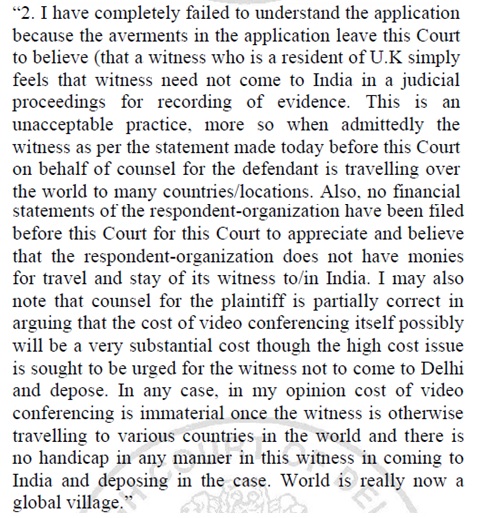
However, in this case, a single judge bench has given the order dated 02.07.2015 – where she dismissed the application holding as1

Against the court order issued by the Judge, the case was again brought to the court for review by a larger bench in Delhi High court and the bench comprising Honourable Judges – Justice Badar Durrez Ahmed and Justice Sanjeev Sachdeva heard the case from both the sides. After hearing the case the honourable Judges reserved their judgement on 28th August 2015 and the same was delivered on 07th January 2016. This judgement was a landmark, as it recited acceptance of such requests from many other courts in similar cases. Judgement stated that

“….The learned single Judge has erred in not noticing the development of law and technology that has taken place over years. The Code is a procedural Code and procedures are subservient to justice…………The learned single judge, in the impugned order, has taken a very narrow view of the matter. Merely because a witness I travelling over the world and may have the financial resources to travel to  India does not necessarily imply that the court must insist upon the witness personally coming to the court for the purpose of deposing before the Court and/or her cross-examination……….”

The bench in this judgement observed that courts in India should take pragmatic view while working with an objective to further the dispensation of justice. Court also referred to the ruling of the Honourable Supreme Court of India in State of Maharashtra vs. Dr. Praful Desai – AIR 2003 (4) SCC 601, in which it was stated that in light of section 273 of CrPC, the term ‘presence’ cannot be interpreted to only mean actual presence of a person in any court.

In this transformative judgement, Court also emphasized on the benefits of deposition through video conferencing and said that except for touching, court can see, hear and observe, as if parties and the judicial system all are under one roof. Along with this the behaviour and demeanour of the witnesses can be observed and specifically depositions can be heard and reheard through playback of recordings as many time as court or parties may wish so. This facility of playback at wish will give bring additional efficiency while doing cross-examinations. However, court clearly supported that there may be circumstances where in-person presence may be necessary and in these cases it would be obligatory for the required person to be present in court.

Guidelines to conduct Audio-Video conference

Introduction

In relation to the judgement given by the bench of Justice Sachdeva and Justice Ahmad about accepting the video conferencing request, Delhi high court has released the guidelines to conduct such video conferencing. In the guidelines, court stated that judicial system has many location which are enabled for this – which includes Delhi High court, all the district courts in Delhi such as Saket, Patiala house, Tis hazari and Prison complexes in Tihar and Rohini Prison.

In the introduction segment this guidelines states that while the facility provides capacity to participate in court proceedings without physical presence, however an overriding factor is that this facility must be furthering the interest of justice and should cause minimum disadvantage to the parties. At the end the power to decide in favour of video conferencing or not, is always vested with the Court.

General Guidelines

The annexure given as the guidelines about How to conduct proceedings through Video conference have been summarised as following –

  1. In the High court guidelines, the reference to the ‘court point’ shall mean the courtroom or other places where the court is doing its proceedings. This could also be a place an official (commissioner) appointed by court to record the evidence and statements is sitting, whereas the ‘remote point’ shall be the place where the person and/or witness to be examined via video conference is located.
  2. Person to be examined shall be the person whose deposition or statement is required to be recorded or in whose presence certain proceedings are to be recorded.
  3. As per the possibility, proceedings by way of video conference shall be assumed and conducted as typical judicial proceedings and the prescribed protocols and courtesies shall be followed exactly as if it were to be followed in a physical presence in a court. All statutory provisions applicable to such proceedings including that of Information technology Act, 2000 and Indian Evidence Act, 1872 shall be applicable at par in such video conferences.
  4. Excluding the proceedings listed under section 164 of CrPC , video conference facility can be used in numerous matters including remands, civil and criminal trials , bail applications etc , where a witness is located interstate, intrastate, or overseas.
  5. The guidelines applicable to Court will mutatis mutandis apply to a local commissioner appointed by the court to record the evidence.

Appearance by Video conference

It is provided in the guidelines that a Court may direct any person to appear before it or give evidence or make submissions to the court through video conference. Such order may either be given suo moto or on application of a party or a witness.

Preparation and Operational Arrangements

In the detailed guidelines about the conduct if video conferencing, operational aspects are covered as following –

  1. Both sides of the conference i.e. court and remote point shall have Co-ordinators.
  2. The Registrar (computers) shall be the co-ordinators in the High court, court point.
  3. In case the Court point in in the District Courts, Official-in-charge of the video conference facility, as nominated by District Judge, shall be the co-ordinator at the court point. However, any such nominated person should be working as Senior Judicial Assistant or Senior Personal Assistant or above.
  4. While in the case of Remote Point , guidelines suggests that –
    • If any person to be examined is not in in Indian and stays overseas, Court may select a co-ordinator from any of the Official of consulate/embassy of India in that country or a relevantly certified Notary public/oath commissioner in that country.
    • If the person to be examined is in another state or Union territory, Court may depute a judicial magistrate or any other officer as deem fit for the role by the concerned District Collector.
    • In case the person to be examined is in jail for a judicial or police custody, the concerned Jail superintendent or any person deputed by him may also take up the responsibility.
    • In situations where the person to be examined in in a Hospital (public or private) , this role shall be played by the Medical Superintendent or IN-charge of the said hospital or any other responsible officer as deputed by him.
    • When the person to be examined is a minor or a child who is under observation in an observation home or Special home or Shelter home; the officer in charge of the home or a person deputed by him may take up the responsibility.
    • In case the person to be examined is in Nirmal Chhaya homes, the Officer in charge of Nirmal Chhaya or a person deputed by him shall take up the responsibility.
    • In cases where this co-ordinators is to be appointed for the remote point, the concerned Court can make formal request which can be made through the District Judge concerned.
    • In exceptional situations which are not mentioned in the guidelines, the court may choose to order as appropriate in such circumstances.
  5. Co-ordinators at both the points should ensure that the minimum requirements, as specified in one of the points in the guidelines below, are in position at the respective courts and a test run has been done between both the points in advance to enable a seamless proceeding in real time.
  6. The coordinators should ensure that at the remote point, the person to be examined is available at least 30 minutes in advance. It should also be made sure that no other recording device is permitted other than the one installed for proceeding, as well as the entry to the video conference room is duly regulated.
  7. Co-ordinators are also supposed to make sure that the Court point and the Remote points, both have certified copies or soft copies of all or any relevant Court records in a sealed cover as directed or provided by the Court.
  8. In case that there is a challenge about the language or any similar disablement, Court may order the coordinators to provide a translator for the corresponding language. In case where the person to be examined has speech or hearing impairment, an expert in sign languages should be appointed.

Mandatory Technical Requirements

Guidelines given by court has appropriate mention of the minimum technical requirements to be met while preparing for such video conference based hearing. These requirements are mentioned below as-

  1. A computer with high speed internet connectivity
  2. Power back devices to ensure uninterrupted power supply
  3. Printer attached to the computer
  4. Video camera of appropriate audio-video relay quality
  5. Microphones and Speakers
  6. Display units
  7. Document visualizer machine
  8. Sitting arrangements ensuring privacy of proceedings
  9. Noise insulations as much as possible
  10. Digital signatures for the coordinators at both the points
  11. Adequate lighting for clear visibility

Cost of Video Conferencing

The contention that who will bear the cost of such set up and also the cost of personnel deployed on such duty could be high enough to be debated and disputed. However the Court guidelines clearly identify with such costs and who will bear them as per below given  directives –

  1. In criminal cases, the cost of conference facility, including all the relevant preparation of documents and fee payable to translator, special educator, and to the coordinator at the remote point as well as courts, shall be borne by the party as the Court directs taking into the account the Delhi Criminal Courts (Payment of Expenses to Complaint and Witnesses) Rules, 2015.
  2. In civil cases, as a general rule, the party making the request for conduct of hearings through Video conference, shall bear the expenses.
  3. In other scenarios, Court may make an order as it may find deem fit to the case as per the rules and instructions prevalent from time to time.

Procedural Guidelines

  1. Along with the guidelines that gives a framework around how to set up an appropriate system that enables a health and conducive environment for Court proceedings, the Court has given Procedural guidelines as well. Such guidelines are summarised as following –
  2. Identity of Person: The identity of a person who is appearing for the proceedings shall be confirmed by the court with the assistance of the co-ordinator at the remote point at the time of recording an evidence.
  3. In civil cases, the party, which is requesting for recording of statements through video conference, shall have to confirm the court location of the person and his express willingness to appear into a particular facility/place for video conferencing.
  4. In criminal cases, where the person to be examined is a witness from prosecution side or a Court witness, the Prosecution; while if the person to be examined is a defendant witness, the Defence counsel will confirm the Court about the willingness and location for such video conferencing.
  5. In case where the person to be examined is an accused, prosecution will confirm his location at remote point.
  6. General timings of the video conference to take place shall be ordinarily routine Court hours. However the Court may pass suitable time schedule as per the prevailing circumstances.
  7. Proceeding records including the transcription of statement shall be prepared by the authorised personnel at the Court point as per routine rules and regulations of recording the court proceedings. While this will get authenticated at the Court point, a soft copy of the transcript digitally signed by the co-ordinator at the court shall be sent by email to the remote point – where the deponent will sign a printed copy of the same. A scanned copy of the signed letter by the deponent shall be digitally signed by co-ordinator at the remote point and the same shall be sent by email to the Court point. This will be followed by a hard copy sent by courier/mail preferably within three days of the recording.
  8. The court, after the request of a person to be examined or by itself also, in best interest of the person to be examined, can direct to have appropriate measures to protect privacy of the person keeping in mind his age gender and other conditions.
  9. In case a party or a lawyer requests that during the course of video conferencing some privileged communication may have to take place, Court will pass appropriate directions in this regards.
  10. The copy of the audio video recording shall be archived as an encrypted master copy with hash value in the Court as part of the records, whereas another copy shall also be stored at any other safe location for backup to avoid any emergency data loss situation or serve failure. Transcript of the evidence recorded by the Court shall be given to the parties as per applicable rules. Any party may be allowed to view the master copy of the recordings through an application which shall be decided by the Court subject the interest of justice of that case.
  11. Person who is bearing the responsibility of the co-ordinator at the remote point shall be paid an honorarium as may be decided by the court in consultation with the parties.
  12. In a scenario where a party or its representative wants to be present in person for the hearing at the remote point, the party shall be free to make the arrangements at party’s own cost including appearance, however subject to contrary orders by the Court.

Putting and sharing of Documents during hearing

During the course of examination of a person at a remote point by the video, if it is necessary to put a document to him , then the Court may permit the presentation of document in the following manner –

  1. If such document is at Court point, then such document will be share with the remote point electronically including through a document visualizer.
  2. If the document is at the remote point then the same method will be used for sharing the document i.e. through document visualizer, however remote point shall have to send the hard copy to the court point by mail afterwards.

Unconnected persons during proceedings

Parties may be allowed by the court to have third parties present during the video conferencing subject to the condition that such persons shall be identified by the co-ordinator at the remote point at the start of the proceedings and the objective of such person being present should also be explained to the Court.

Control of Proceedings

Court shall have full control over the start and finish or disconnection of the link to conduct the video conferencing. The court shall make sure that Court is able to see and hear the person to be examined at the remote point as well as the remote point is clearly able to see and hear the Court point.

The court at all the time shall have control of the camera to have an uninterrupted view of all the persons present at the remote point , the Court shall have clear view of all the deponents to observe their behaviour.

It is stated in the guideline that covering every possible aspect of such proceeding run through video conference may not be possible, and any other residual issue and circumstances which may not have been observed and guided in this guidelines shall be governed by the court in the spirit of furthering the justice.

Conclusion

While this particular judgement from Delhi High court is considered a game changer, there are few previous cases where video conferencing was accepted by court for proceedings, such as the case2 in 2003 when Supreme Court upheld the judgement of Maharashtra Trail court to allow the video conferencing for recording of deposition.

The judgement given by Delhi high court, which was followed up by detailed guidelines have been followed by numerous courts in numerous cases afterwards. However the precedence goes back to the Supreme Court ruling in State of Mahrashtra vs Dr. Praful B Desai where court has stated that the term ‘Presence’ cannot always be interpreted as Physical presence.

Even in the case3 of terrorist Kasab , proceeding were conducted through video conferencing.

Furthering the guidance to the one issued by Delhi High court, as recent as in March, 2017; in yet another case while hearing a transfer petition, Honourable Supreme court bench, comprising Justice UU Lalit and AK Goel, has ordered4 lower courts to adapt latest technology and start proceedings through video conferencing if required.

According to an analysis, if all the judges in our country were to close 100 cases per hour without sleeping and taking any break it would take 35 years to catch up with the pending cases!!  In such scenarios, video conferencing is a very welcome move that can make the cases move faster.

Few Suggestions that should be considered to make judicial system work much faster while deposing the cases are also dependent upon use of technology like video conferencing. It has been suggested from experience in many countries that technical supports and software built around artificial intelligence can take care of a lot of formalities and data gathering steps that eat up half of the court’s time in most of the cases. Such as, in China nine of their prominent research institutes came together and developed a software that helped their 300 judges to handle 150,000 cases and reduced the workload to one third.

In the concluding remark an editorial article published in Paris Innovation review5 dated 9th June 2017, is worth mentioning, it talks about how Algorithms can pervade the law and Artificial Intelligence tools may help in great deal to speed up the Judicial system.

Video conferencing is a big step in the right direction that Indian sytem has taken, however this article leaves a very large topic of discussion as open ended with reference of another great article published6 in LexisNexis (as mentioned in the snapshot above) about future technology amalgamation with Law and how it may change course of legal justice systems across the world.

References:

  1. Excerpts from the court order, source : FAO(OS) 416/2015.
  2. Excerpts from the court order as published in Newspaper [Link]
  3. Excerpts from the court as published in India today [Link ]
  4. Excerpts from the court as published in Mail today [Link]
  5. Paris Innovation review [link]
  6. Lexis nexis article [Link]


Download Now

How will the introduction of Lokpal at national and state levels impact businesses and Indian economy

2
lokpal

In this article, Ishita Roy discusses How will the introduction of Lokpal at national and state levels impact businesses and Indian economy.

CONCEPT OF  LOKPAL

“Corruption and hypocrisy ought not to be inevitable products of democracy, as they undoubtedly are today.” Corruption is deep-rooted and all-pervasive in the modern Indian Society. Earlier people would have to use a bribe to right a wrong but today a bribe is used even to do the right thing at the right time. Infact, any person who does not pay a bribe or use some contact in any filed is unable to get his or her work done in time, irrespective of whether such work is legal or illegal. There is not a single forum or organization, department or office whether government or private which unaffected from the prongs of Corruption. Such rampant corruption throughout the system is what gave birth to the idea of Lokpal, which literally translates to “lok” meaning people and “pala” meaning protector/caretaker. Hence, when coined together the word Lokpal means an office / organiastion / institution that checks and/or curb corruption.

A 2005 study conducted by Transparency International in India found that more than 62% of Indians had first-hand experience of paying bribes or influence peddling to get jobs done in public offices successfully. In its 2008 study, Transparency International reported 40% of Indians had first-hand experience of paying bribes or using a contact to get a job done in public office. In 2012 India was ranked 94th out of 176 countries in Transparency International’s Corruption Perceptions Index. Clearly, by looking at the statistics we can conclude that corruption and maladministration is a big problem in India.

History of Lokpal

The basic tenet of Lok Pal in India is borrowed from the practice of the office of ombudsman, which is in turn well embodied in Scandinavia, where it has played an effective role in checking corruption and wrong-doing since its establishment in 1809. Encouraged by the huge success of ombudsman in Sweden similar organisations were established in many democratic republican countries as a means to check the corrupt practices of government officials and functionaries.

Lokpal was envisaged in India on the lines of Ombudsman, an indigenous DanishNorwegian and Swedish term, which is etymologically rooted in the Old Norse word umboðsmaðr, essentially meaning “representative” a more elaborate meaning is “a public official who acts as an impartial intermediary between the public and government or bureaucracy, or an employee of an organization who mediates disputes between employees and management”.

The Ombudsman acts as a watchdog of the government in power and functions to investigate and resolve complaints by citizens against acts/s of corruption by government officials. In modern times, the office of the Ombudsman comes within the framework of the government but with a certain degree of independence.

Ombudsman in India

The idea to establish an ombudsman and an anti-corruption body which will to look into charges of corruption against government officials has been around for almost fifty years. The said thought of ombudsman got a definite shape and structure with the passing of the Lokpal and Lokayuktas Bill, 2013, in Lok Sabha on December 18, 2013.

Ombudsman is known as the Lokpal or Lokayukta. Being a welfare state the Indian government performs a plethora of functions and with population of 1.42 billion, it is a mammoth task to fulfil the expectations of its citizens. It was our former Law Minister, Shri Ashok Kumar Sen who first introduced the concept of a constitutional ombudsman in the early 1960s in the parliament whereas it was Dr. L. M. Singhvi, who coined the terms ‘Lokpal’ and ‘Lokayukta’ as a part of the Indian model of Ombudsman.

The Indian Model of the Ombudsman i.e. Lokpal is a forum where the citizens can lodge a complaint against a public official, which would then be inquired into and the citizen would be provided with some redressal.

Dr. L.M. Singhvi was a firm advocate of the concept of Ombudsman and therefore he moved a resolution in the Lok Sabha on 3 April 1964, reiterating his demand for setting up an officer of Parliament known as People’s Procurator, the same was discussed in the parliament and the government had assured him that the Government constituted a Special Consultative Group of Members of Parliament on administrative reforms and accordingly, an Administrative Reforms Commission (ARC) was appointed in January 1966, for making recommendations on the reorganization of the administrative system of the country. First Administrative Reforms Commission in its report submitted in 1966 had three ends in view:

  1. Establishment of system for the common people to lodge complaints of maladministration;
  2. To create such a structure which would help reduce maladministration and
  3. Setting up a mechanism which would take cognizance of complaints of favouritism and nepotism against Central and State Ministers.

The First Administrative Commission further opined such a forum which will delve into checking corruption can be successful if it operates on a two-tier structure. The first tier shall deal with complaints against the acts of government at the center and in the states and the second tier dealing with complaints against the administrative acts of other officials at the centre and the states. However, the report only stated the setting up of such a structure but not its functioning. Also the presence of such institutions does not at all absolve the government from fulfilling its obligations to the citizen for administering its affairs without generating, as far as possible, any legitimate sense of grievance. Thus, the administration itself must play the major role in reducing the area of grievances and providing remedies wherever necessary and feasible. Finally, it took months of protests led by activist Anna Hazare coupled with public and media pressure that the bill was passed.

Historical Aspect of the LOKPAL Bill

Post-independence there was widespread corruption, maladministration and the prevalent laws i.e. Indian Penal Code, 1860 and the Prevention of Corruption Act, 1988 proved unsuccessful in curbing and/or checking the same. There was need for an agency independent of the executive, legislative and judiciary, check corruption and provide redress to the citizens so affected by it.

The Lokpal Bill was first presented by Mr Shanti Bhushan, in the Lok Sabha in 1968, and was passed there in 1969, when it went for ratification to the Rajya Sabha the same was pending there for some time in the mean while, the Lok Sabha dissolved, and so the bill was not passed at that time. Time and again the Lokpal bill was placed before the parliament for consideration yet it was never passed. Each time, after the bill was introduced to the house, it was referred to some committee for improvements — a joint committee of parliament, or a departmental standing committee of the Home Ministry and before the government could take a final stand on the issue, the house was dissolved again and in this process the enactment of this essential bill was deferred time and again. Come to think of it seems that bowing down to public pressure the incumbent government introduced the Lokpal bill in the parliament but keeping in mind the repercussions if it were enacted they postponed the same for almost 4 years.

It is pertinent to mention in this respect that a 2002 report of the National Commission to Review the Working of the Constitution strongly recommended that the Constitution should provide for the appointment of the Lok Pal and Lokayuktas in the states but suggested that the Prime Minister should be kept out of the purview of its authority. Again in the year 2004 the then incumbent government promised to enact the Lokpal and Lokayukta Act and in that path the Second Administrative Commission was formed in 2005, which also recommended that the office of the Lok Pal be established without any further delay.

But it was only in January 2011, that the government formed a Group of Ministers, chaired by Shri Pranab Mukherjee to suggest measures to tackle corruption, including examination of the proposal of a Lok Pal Bill. Finally, after much deliberation The Lokpal and Lokayuktas Act, 2013 was enacted by the parliament.

Salient features OF The Lokpal and Lokayuktas Act, 2013

The Lokpal and Lokayuktas Act, 2013 provided for Lokpal at the centre having jurisdiction of trying cases of corruption against all Members of Parliament and central government employees. The Lokayuktas have functions similar to the Lokpal, but they function on a state level.

The office of the Lokpal and Lokayuktas deals with charges of corruption against any public official and includes the office of the prime minister of the court but with reasonable safeguards. Both the Lokpal and the Lokayukta deal with charges of corruption against the government and its employees, infact they even conduct investigations and based on the findings from such investigations they conduct trials.

The act lays down the provision to set up a Lokayukta and its set of powers for each state without clearly defining the extent of the same, this has led to various different Lokayuktas being setup, some with more power than the others. In order to create uniformity a proposal to implement the Lokayukta uniformly across Indian states has been made. The Act provides that all states set up office of the Lokpal and/or Lokayukta within one year from the commencement of the said Act.

On the other hand, Lokpal will consist of a chairperson and a maximum of eight members, of which 50% will be judicial members 50% members of Lokpal shall be from SC/ST/OBCs, minorities and women.

The newly enacted Lokpal Act provides for confiscation and attachment of any property of any government official which he or she has come to own through corrupt practices and the same can be done during pendency of proceedings against the said official.

The Lokpal Act mandates that all public officials should furnish the assets and liabilities of themselves as well as their respective dependents. Infact the said Act even guarantees protection to any government official who acts as a whistleblower and as an ancillary a Whistle Blowers Protection Act has also been enacted.

Powers Of Lokpal

Under the new Act a Lokpal during the investigation of any cases which fall within its ambit has exercised the power of superintendence and direction over of any investigating agency.

Lokpal has been authorized to call for and/or question any government official where the Lokpal is satisfied that there exists a prima facie case against the person. Any officer of the CBI investigating a case referred to it by the Lokpal, shall not be transferred without the approval of the Lokpal.

The act provides for a maximum time period of six months to complete investigations and proceedings of any complaint, however, the same can be extended for a further period of six months provided the Lokpal or Lokayukta are satisfied with reasons in writing stating such delay. Special courts will be instituted to conduct trials on cases referred by Lokpal. This provision has been enacted to reduce the pressure from the judiciary and also to provide fast remedy to the victim.

If after completion of proceedings it is found that the person who instituted the complaint has done so with a malafide intention, such person can be fined by the Lokpal for upto a sum of Rs.2,00,000/-

Other significant features of the Act

Some other significant features of the Lokpal and Lokayuktas Act,2013 are as follows:-

  1. Lokpal is free to prosecute any case and it does not require any prior.
  2. The Act provides for confiscation of any property obtained by corrupt means even while the complaint on which the Lokpal has acted is pending.
  3. With respect to matters of corruption and redressal of grievances the Lokpal is the appellate authority.
  4. Lokpal to have power of superintendence and direction over any investigation agency including Central Bureau of Investigation (CBI) for cases referred to them.

LOKPAL IN INDIA

Despite passing of the Lokpal Act in 2013 not a single appointment has been made in that direction. In fact, when the Supreme Court asked the incumbent government as to why no appointment was made to the office of the Lokpal. The government blamed the Act which for a selection committee for appointing a Lokpal one such member of the committee is the leader of opposition of the Lok Sabha and since presently there is not Leader of Opposition to sit on the selection panel appointments have been deferred. Infact amendment has This unique situation called for an amendment to the existing Lokpal Act which is pending before the parliament. Upon hearing this the Hon’ble Supreme Court directed the government that the remaining incumbent members of the said committee can appoint a Lokpal.

LOKPAL AND THE ECONOMY

Both jurists and economists study the socio-economic effects of any new piece of legislation on the economy of the country where such legislation has been enacted and/or implemented. This goes to show us that the economy and legal system are interconnected and interdependent. Infact with the enforcement of the Lokpal and Lokayuktas Act, 2013 Indian Economists are optimistic that it will facilitate tripling of Indian GDP by 2025. While such numbers make us optimistic about the said Act, we must not forget some key factors, like, how exactly id the GDP of the nation linked with corruption or how far will the Act go to check corruption.  One way of interlinking GDP and lokpal is by linking decline in corruption indicators of economic development.

The Lokpal and Lokayuktas Act, is a relatively new Act which requires many modifications, firstly this act applies to those states which gives it their assent. Secondly, the act mandates the authorities to report to the Lokpal. However, we must remember the RTI Act, too was considered a weak law but it turned out to be an effective and important piece of legislation.

On a bare reading of the said Act one can come to the conclusion that even though the said Act might reduce and/or check corruption but it cannot eliminate corruption from the very root and therein lies a problem.

Now by giving a hypothetical situation let us how the said Act shall work at the grass root level in the informal sector which accounts for a whopping 91% of the total workforce. The informal work sector consists of farmer and their helpers, labours, domestic staff, drivers, chaiwallah and sabziwallah.

In a hypothetical situation where lokpal is strictly imposed without simultaneous changes in the corresponding laws the informal sector will be the biggest losers. Firstly the aid sector is mostly illegal because they are not contractual workers hence they are not protected under relevant laws like labour laws, licenses etc. also they do not pay any taxes to the government.

The local chaiwallah in order to set up shop has to bribe the local police officer, local gang and/or political party officials, which he happily does to avoid paying a lump sum amount to the municipality to obtain the proper licenses. If there are stringent lokpal laws it would become impossible for such chaiwallah to set up shop and perhaps even drive him and his family to destitution, or take up a life of crime in order to sustain himself and his family. As a result of Lokpal his customers ranging from working people to day laborers, maid and drivers would suffer as well as they cannot afford to get their caffeine fix from Coffee Café Day of Starbucks.

Hence, from the aforesaid example we see that corruption is intricately webbed in the social strata. A study conducted by economists Nabamita Dutta, Saibal Kar and Sanjukta Roy, wherein they combined the information on corruption with official data on employment in the informal sector, whose results confirm the intuition that, corruption leads to a larger informal sector.

This in turn suggests that reducing corruption via the Lokpal Bill without eliminating its sources would likely reduce the size of the informal sector. It cannot be deny the existence of a causal relationship between corruption and the informal sector in India even though there are difficulties in measuring the proportion and equation between corruption and the informal sector. Studies such as this point to the potentially harmful consequences of cracking down on petty corruption while doing nothing to address its root causes. The advocates of Lokpal must bear in mind that laws must change with changing times and keeping with the unique situation of the society under scrutiny. In India, there is a huge informal sector which propagates corruption. Hence, in order to tackle corruption through Lokal one must at first re-examine the socio-economic structure and factors which gives rise to such corruption. After identifying such causes the same must be eliminated in order to achieve parity.

Conclusion

The motive behind two decades of struggle to implement the Lokpal and Lokayuktas Act, 2013 is to provide a forum to the citizenry where they can raise their voice against corruption without any fear. Keeping this view in mind Lokpal is kept outside the clutches of the executive and the office of the Prime Minister has also been kept within the purview of the Lokpal. In the past governments had enforced Institutions like Central Vigilance Commission and Central Bureau of Investigation but despite a few historic cases these institutions have mostly failed to prevent and/or curb the widespread corruption which has become a part and parcel of the daily lives of the citizens. Such rampant corruption has necessitated the creation of Lokpal and Lokayukta.

Therefore, there is a need for a mechanism that provides for simple, independent, speedy means of delivering justice by redressing the grievances of the people without succumbing to the clutches of the executive. But if our past history is any proof India has several laws covering a plethora of subjects and area but has failed to execute the same effectively and in a timely manner and as we all know justice delayed is justice denied. Any new piece of legislation even when implemented becomes lengthy and time consuming and stretched over years. It is rightly said by Publius Cornelius Tecitus that “the more corrupt the state, the more laws”.

Download Now

FDI In Indian Telecom Sector

0
telecom

In this article, Binayak Ransingh pursuing M.A, in Business Law from NUJS, Kolkata discusses FDI In Indian Telecom Sector.

India is the second largest telecommunication market and third highest in terms of number of internet users in the world. During FY07-16, telephone subscribers increased at a CAGR of 19.96%, reaching 1058.86 million. The tele-density was at 83.36% by 2016.

According to GSM Association in collaboration with BCG has expected that the Indian mobile economy will grow rapidly and will contribute substantially to India’s GDP. India has become the fourth largest app economy in the world. Government has also enabled easy market access to telecom equipment and framed a proactive regulatory framework which ensures availability of telecom services to consumer at affordable prices. Government has deregulated Foreign Direct Investment norms, which further had made the sector one of the fastest growing and top five employment opportunity generator in the country. According to International Data  Corporation (IDC) predicts India will be overtaking U.S. as the second largest smart-phone market globally. It is expected that the mobile industry will create a total economic value of Rs 14 trillion by the year  2020 and would generate around 3 million and 2 million direct and indirect job opportunities respectively by 2020. The year on year growth of the mobile user has crossed 11% in September to December quarter of 2016. The Erricsion mobility has expected a fourfold growth of smart-phone subscription by 2021.

The growing trend has also motivated foreign investor to invest money in the sector. The industry has fetched FDI worth $23.95 billion during the period April 2000 to March 2017 (Data released by Department of Industrial Policy and Promotion (DIPP).

Some of the key development in the industry:

  1. Reliance Industries Limited plans to invest additional sum of Rs. 18,000 crore which will add up to a total investment of Rs1.9 trillion on its telecom arm, Reliance Jio to expand its fibre network.
  2. Nettle Infrastructure Investment Ltd. Subsidiary of Bharti Airtel plans to acquire 21.63 % in Bharti Airtel Ltd for a sum of Rs. 12,400
  3. Bharti Airtel Ltd. Decide to buy Tikona Digital Networks Pvt Ltd’s 4G business for approximately Rs.1,600 crore. This will also includes its broadband wireless access spectrum and 350 cellular sites in five telecom
  4. Bharti Airtel will buy Telenor’s India operation in seven circles to receive 43.5 MHz spectrum in the 1800 MHz band.
  5. Apple produces its iPhone SE at new facility in Bengaluru owned by its partner
  6. Ortel communication invested around Rs 300 crore for upgrading its infrastructure in
  7. Reliance Communication Limited (RCom) has signed a binding agreement with Brookfield Infrastructure Partners to sell a 51% stake in Reliance Infratel, RCom’s tower unit for Rs 11000 crore.
  8. Oppo and Vivo planned to invest Rs4000 crore to setup a manufacturing capacity at Uttar Pradesh.
  9. Samsung India has expanded its service network to over 6000 talukas across the

Government Initiative:

It has fast tracked reforms in the telecom sector and continues to be proactive for the growth of the telecom sector. Some of the key initiatives taken are as follows,

  1. The Telecom Regulatory Authority of India (TRAI) identifies issues that makes difficult to do business in Indian telecom sector, like sector allotment, license acquisition and review them regularly.
  2. Of India has planned to auction 5G spectrum in bands like 3300-3400 MHz to promote Internet of Things, machine-to-machine communication, instant high definition audio transfer, as well as to promote smart cities.
  3. The government has launched a phased manufacturing program (PMP) under which components of mobile will be manufactured under the Make in India initiative, which will further give a push to domestic manufacturing of mobile
  4. The government of India has allocated Rs.10000 crore for rolling out optical fibre cable and procuring equipment for the Network for Spectrum project 2017-18.

Foreign investment in the telecom sector

  1. Vodafone received the highest ever foreign investment i.e Rs. 47000 crore from its parent company at U.K. In last 15 years the sector has received $18.4 billion as FDI equity inflow, making it the fourth highest sector attracting foreign investment. Mauritius topped the list of the highest FDI source in India with the amount of $12 billion in these 15
  2. Swedish telecom equipment maker Ericsson announced the introduction of a new system in the Indian
  3. Foxconn has signed a memorandum of understanding with the Maharashtra government to invest $5 billion in next three years for setting up manufacturing between Mumbai and

Total inflow of FDI in telecommunication sector

Year Total FDI in India (Rs.  In Ten million) Total inflow of FDI in telecommunication sector (Rs. In ten million) Growth rate of inflow (%) Percentage of FDI inflows                 in

Telecommunication sector over total FDI

2005-06 90154.44 2751.45 3.05
2006-07 94065.95 2149.58 -21.87 2.28
2007-08 151462.58 5099.56 85.34 3.37
2008-09 202502.66 11684.81 324.68 5.77
2009-10 172570.14 12269.66 345.93 7.11
2010-11 162665.79 7542.04 174.11 4.64
2011-12 248754.05 9011.53 227.52 3.62
2012-13 218381.22 1654.30 -39.87 0.76
2013-14 246447.58 7987.28 190.29 3.24
2014-15 183869.03 17371.82 531.37 9.45
Avg. 177087.3 7752.20 4.33

Subscriber of telecommunication sector

Year Telecom (wireless) Internet Broadcasting and cable services Total of telecommunication sector
GSM CDMA Total Narrowb and Broadband Total
2005-06 69.19 20.95 90.14 5.59 1.35 6.94 66.01 163.09
2006-07 120.47 44.64 165.11 6.93 2.34 9.27 75.5 249.88
-183.17 -133.57 -114.38 -153.22
2007-08 192.7 68.37 261.07 6.68 3.87 10.55 80 351.62
-289.63 -152.02 -121.19 -215.6
2008-09 297.26 94.5 391.76 6.62 6.22 12.84 84 488.6
-434.61 -185.01 -127.25 -299.59
2009-10 478.68 105.64 584.32 6.45 8.77 15.22 88 687.54
-648.23 -219.31 -133.31 -421.57
2010-11 698.37 113.22 811.59 5.84 11.89 17.73 92 921.32
-900.36 -255.47 -139.37 -564.91
2011-12 814.06 105.11 919.17 5.7 13.81 19.51 94 1032.68
-1091.71 -281.12 -142.4 -633.21
2012-13 794.03 73.77 867.8 6.56 15.05 21.61 97.1 986.51
-962.72 -311.38 -147.1 -604.81
2013-14 847.41 57.1 904.51 190.72 60.87 251.59 102.01 1258.11
-1003.45 -3625.2 -154.54 -771.42
2014-15 901.26 42.75 944.01 198.03 61.76 259.79 110.01 1313.81
-1047.27 -3743.4 -166.66 -805.57
Avg. 521.34 726.05 5939.48 43.91 18.59 62.51 88.86 745.32


Number of subscriber for major telecom companies

Year BSNL MTNL AB  

Vodafone


RC


Idea


TD


Aircel


UT


Others

2005-06 17.65 2.05 19.58 15.36 17.31 7.37 4.85 2.61 3.36
2006-07 30.99 2.94 37.14 26.44 28.01 14.01 16.02 5.51 4.05
2007-08 40.79 3.53 61.98 44.13 45.79 24.00 24.33 10.61 5.91
2008-09 52.15 4.48 93.92 68.77 72.67 38.89 35.12 18.48 7.28
2009-10 69.45 5.09 127.62 100.86 102.42 63.82 65.94 36.86 4.26 7.99
2010-11 91.83 5.47 162.20 134.57 135.72 89.50 89.14 54.84 22.79 19.49
2011-12 98.51 5.83 181.28 150.47 153.05 122.72 81.65 62.57 42.43 19.66
2012-13 101.21 5.00 188.20 152.35 122.97 121.61 66.42 60.07 31.68 18.30
2013-14 94.65 3.37 205.39 166.56 110.87 135.61 63.00 70.15 35.61 19.30
2014-15 99.41 5.14 211.25 174.62 110.17 140.72 66.58 76.71 39.61 19.40
Avg. 69.56 4.39 128.86 103.41 89.90 75.82 51.30 39.84 29.40 12.47

Subscriber of telecommunication sector

Year Populatio n             of

country (million)

Total        subscriber       Of telecommunication sector Subscriber of telecommunication sector
Million Growth rate            in percent Rural (million) Urban (million) Public Private
2005-06 1117.73 163.09 40.17 122.92 42.99 57.01
2006-07 1134.02

(101.46)

249.88

(153.22)

53.21 36.14

(89.97)

213.74

(173.88)

34.68

(80.67)

65.32

(114.58)

2007-08 1150.20

(102.9)

351.62

(215.60)

115.60 62.28

(155.04)

289.34

(235.39)

36.47

(84.83)

73.13

(128.27)

2008-09 1166.23

(104.34)

488.60

(299.59)

199.59 111.63

(277.89)

376.97

(306.68)

20.84

(48.48)

79.16

(138.85)

2009-10 1186.00

(106.11)

687.54

(421.57)

321.57 190.88

(475.18)

496.66

(404.05)

17.28

(40.19)

82.72

(145.1)

2010-11 1210.57

(108.31)

921.32

(564.91)

464.91 273.54

(680.95)

647.78

(526.99)

14.89

(34.64)

85.11

(149.29)

2011-12 1213.37

(108.56)

1032.68

(633.2)

533.20 323.27 (804.75) 709.41

(577.13)

13.69

(31.84)

86.31

(151.39)

2012-13 1223.58

(109.47)

986.51

(604.89)

504.88 342.50

(852.63)

644.01

(523.93)

14.49

(33.71)

85.51

(150.0)

2013-14 1238.89

(110.84)

1258.11

(771.42)

671.42 377.78

(940.45)

880.33

(716.18)

12.87

(29.94)

87.13

(152.83)

2014-15 1254.02

(112.19)

1313.81

(805.57)

705.57 398.73

(992.61)

915.08

(744.45)

10.85

(25.24)

89.15

(156.38)

Avg. 1189.46 745.32 215.69 529.62 21.90 79.10

Players in the market

  1. BSNL is the market leader in the Indian telecommunication market with a market share of more than 65% followed by MTNL with 11.5%. Bharti Airtel, Tata and Reliance have a market share of 10.9%, 5% and 4.1%
  2. As of 2014, BSNL has the revenue of $4.5 billion and is serving more than 120 billion people in the country. It also acts the catalyst to check the price point of telecom
  3. BSNL is a 100% Central Government entity and the employees of the company are paid with salarie and incentives decided by the government not the
  4. Both BSNL and MTNL are witnessing a declining revenue associated with high cost. BSNL has the massive telecommunication infrastructure and 80% of landline and 90% of broadband connections in India are operated by
  5. Vodafone, the parent company situated at U.K. is investing a huge amount nearly $ 3 billion to gain a bigger market share in the
  6. Blackberry had also setup enterprise solution centre to educate corporate customers about various BlackBerry Enterprises
  7. Tata teleservices plans to setup nearly 4,000 wi-fi hotspot in nine cities across the country in next two

The telecommunication sector has supported the socio economic development of India and has played a significant role to narrow down the rural urban digital divide to some extent. The exponent growth witnessed by the telecom sector in past decade has further developed the telecom equipment manufacturing and other supporting industries. From being an import-centric industry, it is slowly steadily moving towards becoming a global telecom equipment manufacturing hub.

As per the Times of India Business report, the government is planning to reach the telecom products and services exports to $10 billion in next 5 years. At present the telecom exports touches Rs32000 crore, in which Rs 20000 crore is product and the rest is contributed by the services.

Government initiatives for the growth of the sector

  1. The ministry of communication and information technology has launched Twitter Seva, for registration and resolution of user complaints in the telecommunication and postal
  2. The telecom regulatory authority of India has released a constitution paper which aims to offer consumers free internet services within the net neutrality framework. It has also further proposed three models for free data delivery to customers without violating the regulations.
  3. The government of India liberalised the payment terms for spectrum auctions by allowing two options of payments to telecom companies for acquiring the right to use spectrum such upfront and instalment based
  4. The department of telecommunication amended the Unified Licence for telecom operations which will allow sharing of active telecom infrastructure like antenna, transmission system, feeder cable between operators, which further reduces the cost of operations and leading to faster rollout of
  5. The telecom regulatory authority of India (TRAI) recommended a Publi-private partnership model for BharatNet and the Central government ambitious project to set up broadband connection in rural
  6. The ministry of skill development and entrepreneurship signed a memorandum of understanding with department of telecommunication develop and implement National action plan for skill development in telecom sector with the objective of providing the sector with skilled manpower and providing job opportunities in the
  7. The telecom regulatory authority of India has directed the players to compensate the customer for the dropped

Telecom subscriber as on 31st October 2016 Wireless

  1. Total telephone subscriber (million): 1078.42 Net Addition in October 2016 (million): 28.68 Monthly growth rate: 73%
  2. Urban telephone subscribers (millions): 621.77 Net Addition in October 2016 (million): 17.96 Monthly growth rate: 97%
  3. Rural telephone subscriber (Million): 456.66 Net Addition in October 2016 (million): 72
  4. Monthly growth rate: 2.40%
  5. Overall tele-density: 84.34 Urban tele density: 155.35 Rural tele density: 98
  6. Share of urban subscribers: 57.66% Share of rural subscribers: 42.34%
  7. Broadband subscribers (millions): 49

Wireline

  1. Total telephone subscriber (million): 24.52 Net Addition in October 2016 (million): 0.02 Monthly growth rate: 10%
  2. Urban telephone subscribers (millions): 20.61 Net Addition in October 2016 (million): 0.03 Monthly growth rate: 17%
  3. Rural telephone subscriber (Million): 3.91 Net Addition in October 2016 (million): -0.01 Monthly growth rate: -0.26%
  4. Overall tele-density: 1.92 Urban tele density: 5.15 Rural tele density: 45
  5. Share of urban subscribers: 84.04% Share of rural subscribers: 15.96%
  6. Broadband subscribers (millions): 93

Total (Wireless + Wireline)

  1. Total telephone subscriber (million): 1102.94 Net Addition in October 2016 (million): 28.70 Monthly growth rate: 67%
  2. Urban telephone subscribers (millions): 642.37 Net Addition in October 2016 (million): 18.00 Monthly growth rate: 88%
  3. Rural telephone subscriber (Million): 460.57 Net Addition in October 2016 (million): 10.71 Monthly growth rate: 38%
  4. Overall tele-density: 86.25 Urban tele density: 160.50 Rural tele density: 43
  5. Share of urban subscribers: 58.24% Share of rural subscribers: 41.76%
  6. Broadband subscribers (millions): 42

Policy initiatives

FDI Policy

100% FDI is allowed in telecom sector, in which 49% is allowed through automatic route. This is applicable for basic, unified license, cellular, national/international long distance, commercial V- sat, public mobile radio trunked services, global mobile personal communications services, all types of ISP licenses, resale of international private leased circuits, voice mail/ audiotex/ unified messaging services, mobile number portability services, etc. FDI in telecom sector is subject to observance of licensing and security conditions by license as well as investors as notified by the department of telecommunications from time to time, except other service providers which are allowed 100% FDI on the automatic route.

FDI Inflow

FDI jumped $4.2 billion from $1.61 billion in 2014-16. FDI of $10 billion was received in first  8 months of the financial year 2016-17 which is approximately 2.6 times growth from 2014- 16.

Fiscal incentives

  1. Basic customs duty and special additional duty have been
  2. The importers of mobile handset components such as chargers, batteries, adopters, and wired headsets need to pay only the countervailing duty of 5%
  3. Advantage of 10.5% exists for the local manufacturers of mobile speakers and

Major foreign investments done since April 2014

Foreign collaborator Country Indian company FDI(USD million)
Prime metals limited Mauritius Vodafone India 1500.79
NTT Docomo Inc Japan Tata teleservices Ltd 1457.66
Videocon                           Mauritius Energy Ltd. Mauritius Videocon International electronics Ltd 719.76
ATC Asia Pacific PTE Ltd. Singapore Viom Networks Ltd 881.08
Federal     Agency                     for state property manage Russia Sistema                                 Shyam Teleservices Ltd. 451.83
Telenor Asia Pte Ltd Singapore Unitech                              wireless tamilnadu pvt ltd 298.75
Telenor     South                     Asia investment pte ltd Singapore Telewings communication services pvt ltd 274.40
QIB class Mauritius Bharti Infratel Ltd 240.37
Axiata Investments 2 Ltd Mauritius Idea Cellular Ltd 123.22
NTT               communication corporation japan Netmagic Solutions Pvt Ltd 85.79
Omega FII Investment pte ltd Singapore Tata sky ltd 53.89
Tiger       Global                 Eight Holdings Mauritius Hike Pvt ltd 50.80
Essel International Ltd Mauritius Siti Cable Network ltd 48.17
International                                finance corporation U.S. Tikona                     Digital Networks Pvt ltd 46.39
Anchor Investors Mauritius Bharti Infratel Ltd 32.59
Essar telecom ltd Mauritius Agc Networks Ltd 29.13

Network                Digital Distribution Services FZ UAE Tata sky limited 23.77
Tower vision Mauritius limited Mauritius Tower Vision India Pvt Ltd 23.71
EGN B.V Netherlands Orange                             Business Services India Network P, Global One Pvt ltd 19.39
GS                        Investment Partners I Lim Mauritius Tikona                     digital Networks Pvt ltd 16.17
South                          Asia

entertainment holdings ltd

Mauritius Sun direct TV Pvt ltd 16.17


Download Now

Top Places in Delhi to intern for Event Management

2
event management

In this article, Abhishek Naharia of Rajiv Gandhi National University of Law, Punjab discusses, top Places In Delhi to intern for event Event Management.

Organising big events is a challenge. Either it is a glossy big fat wedding or live band performance. Learning the art of event management is not an easy road to take. Ranging from chair to decors, every arrangement requires proper understanding of what the event is about, event’s theme and thousands of other technicalities. In this article, we tried to sort things out for learners of event management by bringing an exhaustive list of best places for learning the art of event management in Delhi as an intern.

Armaans Event (P) LTD

It is engaged in providing 360 degrees solutions in event management, Armaans Events is an Top Event Management Company in Delhi, India that came into existence to bring the best from all event management companies in Delhi and to present out-of-box entertainment by the artists and celebrities of Bollywood, Hollywood, International and local talent in front of the peoples. It supports local artists and help them to launch their careers in the competitive world of event and entertainment. It is among the few top event management companies in Delhi, India respected by our clients and contributing to our peoples and community.It is located in Sant Nagar, East of Kailash, New Delhi. It has been associated with Big Banners in the Entertainment and Corporate Industry. It goes an extra mile to satisfy the client with an experience of high quality with a difference.

How to apply

Contact: 011-41327866, 9312743286.

Email: [email protected]

Website: http://www.armaans.com/

Allure Events and Weddings Pvt. Ltd

 Located in Hari Nagar, Delhi NCR, Noida, Gurgaon based Big Corporate Event Management Company offers all types of top management services. One of the top event management companies sin New Delhi, they are famous for their strategical ways of planning and implementing of customized ideas. With more than 20 years of experience in this industry, it beats top-most contenders of its kind. The customers are at an edge if they have been handled the task of event management as the customer will have complete details of everything happening at their end with proper details. An open book way of organizing and conducting the event must be learnt from them. They are hardcore specialization International Destination Wedding Management. They calmly listen, plan and deliver the products and hence are able to satisfy the customer’s ego. It is considered as s formula for managing happy clients.

How to apply

Contact: 011-25403029.

Email: [email protected]

Website: http://www.allureeventsindia.com/

Show makerz

They were founded in 2006 and are based in New Delhi. They are based in Sant Nagar, East of Kailash, New Delhi. They have their territorial jurisdiction over Delhi, Gurgaon and whole of the NCR region. They are also known to cover whole of the North Indian region according to their excellent functioning capabilities. “To project the standards, integrity and image of clients in all that we do” is the main ideology that they follow while serving their clients. They have an enthusiastic group of members working for them. With a perfect in-house team to conceptualize and fabricate the event with a highly rooted network of pan India vendors, they are known for their quality, work ethics, and finesse of their product. They have specialized in Designing and Executing wide range of Unique and Creative themes for the events. Offering clients with their money value is their sole aim.

How to apply

Contact: 9811173792, 9311173792.

Email: [email protected]

Website: www.showmakerz.com/get.html

Witchcraft

Another topmost contender in the list of top event managers, Witchcraft provides one of the finest services in their jobs. They are well recognized by the people of Delhi for high quality professional services for Corporate events, Wedding and Private Parties. From the Concept Development to Technical Planning to event production in final implementation, they cover all the aspects of event management. Located exactly Janta Market, Rajouri Garden, New Delhi. They are contested among the topmost contenders and considered as one of the top-most go getters of their business. Their speciality is in Corporate, Social, Celebrity, Parties etc. They have been financially stable from the beginning and this has been a point to be noted for them. They are those group of men which will sew every thread finely to make it a glamorous cloth.

How to apply

Contact: 8826898950.

Website: http://www.witchcrafts.in/

Cox And Kings Ltd

A talented bunch of people, Cox and Kings Ltd is an India-based Travel & Event Management Company, which was established in 1758 and is headquartered in Mumbai, Maharastra. This company is on top in the list of Top 10 Event Management companies in Delhi. It is the most trusted event management company that offers all kinds of events management services as live concerts, exhibitions, seminars and product launches etc.

Contact: 18002090400, 9867565599.

Website: www.coxandkings.com

E-Factor

Known for their etiquettes and specialized customer services, it is one of the New Delhi based Event Management Company seeded in late 2000 and early 2001. E-Factor is famous among the consumer for their awe-inspiring setups and formats with a personalized service for their clients. Whether it be any type of work, corporate or social, they have a solution for all. They are always willing to take up big assignments from mega concerts to corporate events. They also cater to entertainment and promotional needs of the consumers. Located in Sector 67, Noida, it has been crowned as the winner of EEMA Awards 2011, Gold for the Mittal Wedding.

How to apply

Contact: 9810298423, 9810398666.

Website: www.efactor4u.com/contact-us/

Lalvis International

It is considered as one of the hardcore event management companies as it comes out be one of the most reliable ones in the eyes of its customers. They provide event logistics, audio-visual services, and event production and communication solutions for all the events. Customer’s needs first and foremost, is their mantra. Situated near PVR Plaper from Incentive Designs, Awards and Gala dinners, production, Stage Making, Stage Craft and Audio Visual Management, Wedding Planning, Dance Choreography to Dance troupe and Entertainment, Photography, Tours and Travels, Graphic and Web Design. Located in Connaught Palace, New Delhi, Their speciality is in High Class Event management with media Services. They cater to the different class of the society and makes them available one of the finest catering services in Delhi.

How to apply

Contact: 9873498222.

Website: eventmanagementcompany.co.in/contact.html 

Creative-Inc

They are well recognized people in Event design, Fabrication and Management of Gala launch events, customizing large exhibition stands and lastly above all, organizing conferences throughout India. The best thing about them is that they have an able team to work and as a result of that they can work from start to end without anyone’s help. No obstruction is caused between the events when they are conducting any event. Their motto while working is to provide the customers with a complete package of happiness. The company has been a recipient of many awards and honors, and enjoy doing work together. They believe in making the events memorable for their clients. They have been through many challenges and opportunities while emerging as one of the finest event management countries in New Delhi. They are not only specialized in vent management in Delhi, but have also made their name in one of the versatile event managers in Delhi. The reason being that they can also function easily in sectors like Automation, electronics, FMCG”s tourism etc. They have their specialization in print events, exhibition design and management, both design and fabrication, as well as corporate film production. Breaking old stereotypes to specialize in only one field has been the thing which they strive for. It stands apart from other Event managers as their aim is to create a Brand Environment, one that creates and defines you in the best manner.

How to apply

Contact: 011-41324306, 011-41625477.

Email: [email protected]

Website: http://www.creative-inc.biz/index.php

Aura Event Managers

They believe in creating a suitable, dedicated and safe event environment. They keep in mind the safety and cultural issues involved when they provide the best of their services. They are known for completing an event safely and precisely according to the needs of the audience. They guarantee the ideal venue, theme, layout, décor, lighting, music, food and beverage and much more. The event planners flexible, spontaneous, and always full of life, even at the time of crisis. They are considered specialized in classic, traditional or a modern-day setting.

How to apply

Contact: 01140571566.

Email: [email protected]

Website: http://www.auraeventmanagers.com/contact.html

Download Now

Law on Company Directors’ Self-Dealing

0
self dealing

In this article, Avijit Datta Choudhury pursuing M.A, in Business Law from NUJS, Kolkata discusses Law on Company Directors’ Self-Dealing.

INTRODUCTION

Self-managing is the lead of a trustee, a lawyer, a corporate officer, or different guardians that comprises of exploiting his position in an exchange and representing his own particular advantages instead of for the interests of the recipients of the put stock in, corporate investors, or his customers. Self-managing may include misappropriation or usurpation of corporate resources or openings. Self-managing is a type of irreconcilable circumstance.

In the event that an executive manages an organization of which he or she is a chief there is a danger of irreconcilable circumstance and in addition rupture of the obligation to act genuinely for the benefit of the organization or to advance its prosperity. This is supplemented by the govern against mystery benefits. The law has embraced a confounding number of ways to deal with address this issue and the standards, notwithstanding, when transformed and rehashed in the statute, are a free pluralistic. The run against self-managing has been reached out to managing by related gatherings of an executive and this has prompted auxiliary legitimate and bookkeeping rules. Again the law has embraced a befuddling number of ways to deal with address this. One has the feeling that essential perplexity of thought has blurred change discusses in many purviews and quite a bit of this disarray emerges as a result of obliviousness of the intricate history of this range of law and the standards and approaches supporting that law. The law bargains and has managed distinctive classes of contentions in a wide range of courses, with approaches changing throughout the years. A refinement is regularly drawn between self-managing and reasonable managing.  Self-managing is basically an offer of property by a trustee to him or herself. Reasonable managing is a type of self-managing where no favorable position is taken, full exposure is made and the exchange is reasonable and genuine. Related gathering exchanges can reach out to incorporate conduct, for example, remuneration understandings for executives, corporate open door cases and exchanging of organization shares by chefs utilizing value touchy data.

SOLUTIONS

Self-Dealing and the Voting Mechanism

Voting is ordinarily acknowledged as the best strategy for separating bunch accord from the unique subjective evaluations of the gathering’s individuals. The voting instrument depends on the supposition that the lion’s share sentiment communicates the “gathering inclination,” that is, the ideal decision for the gathering in general.” Voting, nonetheless, must be powerful in detailing. the gathering’s position from the different individual places of its individuals if every party’s vote depends on a fair evaluation of her best advantages as an individual from the gathering (“earnest voting”). At whatever point voters consider how different individuals from the gathering will vote (“vital voting”) or vote as per an individual enthusiasm clashing with the enthusiasm of the gathering (“irreconcilable circumstance voting” or “self-managing”), the voting system stops to work as a pointer of value-based proficiency. This spotlights on the self-managing issue, which emerges when the individual interests of a few voters struggle with the gathering’s advantages. In a clashed circumstance, voting does not really express the “gathering inclination.” This issue is very normal when an exchange between the gathering and one of its individuals is slated for a vote.

Possible Solutions to Self-Dealing

The topic of whether exchanges, including clashing interests, are productive or wasteful is at the base of the self-managing issue. Consequently, a satisfactory answer for the issue requires components that can recognize effective and wasteful arrangements. Any answer for the issue of irreconcilable situation voting ought to augment the execution of effective arrangements and limit the execution of wasteful ones. From this point of view, this Segment assesses the scope of arrangements that corporate law has put forward to address the self-managing issue.

Prohibition on Self-Dealing

Toward one side of the range is an inside and out disallowance on self-managing exchanges. This arrangement comes from an on a very basic level negative perspective of exchanges spoiled by an irreconcilable circumstance. Verifiable, courts have embraced this view: Any arrangement conceived of an irreconcilable situation vote was avoidable and could be renounced by the partnership, paying little heed to its terms or its attractive quality to the organization. Practically speaking, this approach is indistinguishable to a prerequisite of consistent endorsement for exchanges including an irreconcilable circumstance.’ A necessity of unanimity takes out the issue of clashing interests since the whole gathering must maintain the exchange. At the point when the whole gathering assets, there is no danger of damage to any person in the gathering. Apparently, this approach “fathoms” the issue: Self-managing will probably not happen under an administration restricting it. “In the event that self-managing is viewed as vindictive, an out and out forbiddance is a basic arrangement. Such a lead would be anything but difficult to apply since it hinders the need to perform entangled assessments. What’s more, it would be successful in avoiding a large portion of the wasteful arrangements. Then again, if our underlying position is that a noteworthy number of self-managing exchanges are effective regardless of the nearness of an irreconcilable situation, an out and out denial will correct too substantial a value the loss of excessively numerous proficient exchanges.

The Majority-of-the-Minority Vote

 Instead of totally precluding self-managing exchanges, most of-the-minority arrangement utilizes the voting instrument to decide the gathering’s assent by barring those investors with an irreconcilable situation from taking an interest in the vote. This arrangement accepts that lone the votes of the unbiased individuals from the gathering are important to decide the “gathering inclination.” If the rest of the members in the tally (the minority) frame a vast gathering, it is sensibly expected that the vote does, truth be told, mirror the gathering inclination. This prohibition on irreconcilable situation voting has two essential advantages. To begin with, it keeps a self-merchant from forcing an exchange on an unwilling minority. Second, since such an approach depends on assent, it is pointless to bring the exchange under the steady gaze of the courts for a goal assessment. Putting the basic leadership in the hands of the minority may, in any case, block effective exchanges in specific circumstances.

The Fairness Test

Another approach allows the self-merchant to vote yet gives that these exchanges will in this manner be analyzed by a free body, commonly the courts, on a target valuation premise to decide whether they meet certain benchmarks forced by law. The most pertinent standard for our motivations is the decency test. Under the reasonableness test, the courts make a substantive assessment of the exchange at issue. Assume, for instance, that a controlling investor has sold the organization an advantage for $100 and that the exchange is maintained. A minority investor can guarantee that the exchange damaged the reasonableness test. A court made a request to lead over this case should decide unbiasedly whether the benefit is, in fact, worth $100, maybe by naming a free appraiser to influence such to an assurance. Under the decency test, the court assesses the terms of the exchange in contrast with showcase parameters.

Nonintervention

At the inverse end of the range of an aggregate restriction against self-managing exchanges is the no-activity alternative, which leaves the issue to the unconstrained powers of the market to determine. To support its, it may be contended that noninterference permits showcase powers to create proper answers for self-managing circumstances on an individual premise. This approach, it has been asserted, is more productive than working in reverse from a general, law-forced arrangement. To represent the operation of a strategic distances approach, assume that no enterprise in the market utilizes an assurance against irreconcilable situation voting. Under this situation, financial specialists considering whether to join a corporate gathering as investors would know that self-managing may debilitate their venture. In this manner, unless certain assurances were willfully acquainted with keeping the danger of finish misfortune, securities would be rendered useless, and financial specialists would essentially quit the securities advertise inside and out. The market, nonetheless, would react by giving such securities. For instance, a company that is not inspired by stripping the financial specialists of their venture would incorporate unequivocal insurance construct either with respect to a reasonableness test or on a greater part of-the-minority necessity as a term of the agreement by which the security is offered to general society. The financial specialists, as far as concerns them, would pay a fitting cost for a security that included such assurance and little or nothing for one that did not. To be sure, in an impeccably proficient market (one without exchange costs), the costs of securities will mirror the estimation of the distinctive barriers they convey. Inside such a market, every partnership can give its securities the assurance most suitable for its needs, and every speculator can pick the sort of insurance she requires.

CHARACTERISTICS OF THE PREFERRED SOLUTIONS

Property Rules Versus Liability Rules

Applying the qualification between obligation standards and property tenets to the answers for self-managing” gives a more profound comprehension of their belongings. A risk lead is a legitimate decision that enables an exchange to be constrained upon a gathering, gave that equitably reasonable payment is made. A property governs, then again, blocks the completing of, any exchange to which the proprietor of a benefit has not assented. The decency test answer for self-managing is best comprehended as an obligation control, and most of-the-minority arrangement is best comprehended as a property run the show. This arrangement is constructed both in light of the kind of valuation that describes each control and on the implications of its distributive impact. Under the reasonableness test, the greater part can drive the exchange on the minority, subject to the installment of an equitable decided reasonable cost.

Subjective Versus Objective Valuations

A property manager can be recognized from an obligation run by the way in which the gatherings esteem an exchange. That is, in a market economy, deliberate exchanges depend on common assent and show the subjective finish of each of the gatherings that the exchange is beneficial. Then again, automatic exchanges, for example, seizures, are non-consensual and in this way require a target assessment to decide the proper “value” (pay) for such an exchange. An answer in view of the reasonableness decides to accept that, once irreconcilable circumstance voting is allowed, the lion’s share can compel an exchange upon the minority. The security stood to the minority guarantees just that a reasonable cost is gotten, which is controlled by assessing the target estimation of the exchange. The reasonableness lead sets up an administration of automatic exchanges, and, along these lines, replaces subjective valuations of the battling gatherings of investors with a goal measure. On the off chance that the ability to decide if an exchange will be endorsed is given to the minority, the greater part can’t compel an arrangement upon the minority. Accordingly, an exchange will just come to pass if the minority, or all the more correctly, a larger part of the minority, has agreed to it. This game plan guarantees the minority more than a base reasonable cost, in any case. It enables the minority to care for its own advantages and to endeavor to get the greatest value it can accomplish.

The Division of the Surplus

A property governs can likewise be recognized from an obligation decide by the impact that each administer has on the division of the surplus coming from the self-managing exchange. Before introducing the impact of the standards in the corporate self-managing setting, it will be useful first to display the general case. An intentional exchange between people produces an excess, because of the distinction in subjective esteems the gatherings append to the arrangement. The contrast between the valuations of a purchaser and a vendor speaks to the surplus from the exchange.

The Direct Surplus Division

The obligation manages approach gives preference to the larger part, while the property-control approach gives the minority additionally dealing power. Assume that a gathering of voting investors has an advantage that it esteems at $100, and the greater part amass is keen on buying the benefit since it esteems the benefit at $200. In an administration based on the reasonableness regulation, the larger part can compel the exchange upon the minority, dependent upon its commitment to guarantee a reasonable cost. The dominant part can offer a cost in the lower scope of conceivable surplus esteems, for example, $101, and still satisfy the decency standard. For whatever length of time that the real value falls amongst $100 and $200, the minority will have supported no significant off-base. Since a similar exchange could conceivably occur even under the administration of entirely willful exchanges, it can’t be esteemed out of line. The insignificant actuality that the surplus has been partitioned unjustly does not exhibit essentially that the exchange is uncalled for. ” A property decide that requires the minority’s endorsement for an exchange in which an irreconcilable situation emerges engages the minority to request a bigger part of the overflow (in the last case $199) than it would get under the obligation run the show. However, damaging holding out by the minority may likewise prompt the loss of advantageous exchanges. In this manner, in the above case, assume that the dominant part offers a cost of $180 and the minority requests $201. This apparently silly request is possible since the minority would have no chance to get off knowing absolutely what esteem the benefit has for the dominant part and may erroneously request excessively. For this situation, the greater part would not continue with the exchange and the minority will hold a benefit worth $100 (by its own evaluation) rather than the $180 which it may have gotten. A productive exchange will accordingly have been thwarted.

The Frequency of Transactions

Under a property run, the dominant part knows already that the minority can, by requesting a high cost, coerce a sizeable segment of the excess of any proposed exchange started by the lion’s share. Along these lines, the greater part will avoid starting exchanges with the minority and search out less extortive options. Just when the minority has a one of a kind resource will the lion’s share be compelled to address the minority’s unnecessary requests, and even in such conditions, some such exchanges will neglect to occur in light of holding-out endeavors. The exchange of the choice energy to the minority upgrades the minority’s capacity to request a bigger offer of the surplus in those exchanges that are performed yet lessens the aggregate number of exchanges including the minority that will in truth be performed. The reasonableness test, then again, does not ensure the minority a vast part of the excess, however, it guarantees that productive exchanges are done. The dominant part is not prevented by holding out and can push through any exchange it wishes, gave dependable that the minority gets a reasonable cost. The decency test in this manner diminishes the minority’s benefit on every exchange except guarantees the greatest number of exchanges.

FACTORS DETERMINING THE RIGHT SOLUTION

Which of the options talked about above is the favored arrangement? As such, is there “one productive run the show”? Having grouped the reasonableness test as an obligation control and most of-the-minority lead as a property run, this inquiry can be drawn closer to a decision between a risk run and a property run the show. The examination will continue in two stages. Initially, the transaction costs chaperone upon a property run and the arbitration costs related with a risk run will be broken down. Second, the market instruments influencing the relative weight of the arrangement and arbitration expenses will be investigated.

Negotiation Costs

Albeit the two sorts of principles include arrangement costs, these expenses are considerably more extreme under a property-administer framework. An obligation manages measures a self-managing exchange on a target non-consensual premise, and thusly, does not principally require arrangement. In any case, the gatherings can arrange “in the shadow” of the obligation govern to keep away from lawful meditation. Such arrangements appreciate the advantages and expenses of being casual. The expenses of these arrangements rely upon the nearness of complex financial specialists and the adequacy of the legal framework. The more powerful and exact the courts, the less demanding it is for refined financial specialists to suspect courts’ decisions and to maintain a strategic distance from any requirement for a genuine plan of action to them. A property governs, which exchanges the choice with regards to the legitimacy of a self-managing exchange under the control of the minority, likewise, includes arrangements between the dominant part and the minority. In any case, not at all like the obligation control situation, the expenses of this sort of transactions can be significant.

To begin with, there are regulatory costs, which incorporate dispatching a notification of an approaching poll and giving all the voting investors with foundation data on the exchange, each of whom restores an intermediary shape showing her vote. Be that as it may, such expenses surely don’t keep the transaction from occurring, and, in fact, for investors, such a course of action is standard.

Second, the voting procedure requires that the voters ponder the material, receive a position, and vote. This procedure can be costly for the voters, and regularly many will forgo voting or will indiscriminately bolster administration’s position. The nonparticipation of a few voters will bring down the nature of the basic leadership. A minority’s visually impaired help of the administration, which is for the most part intrigued by the exchange, obstructs the motivation behind having the issue voted on by the unengaged minority. Where institutional speculators are associated with the responsibility for the organization, the cooperation of educated and capable financial specialists in the basic leadership process enhances the nature of the basic leadership. Lamentably, be that as it may, now and again these financial specialists act, specifically or in a roundabout way, in intrigue with the administration or the controlling proprietor against the rest of the investors.

Third, the voting procedure is powerless to key voting. A portion of the voters can embrace a holding-out procedure and turn down a proficient exchange so as to raise the cost of their assent. The defender of the arrangement can receive a system of “motioning”: By declining to bow to coercion, the advocate gains the notoriety of a staunch moderator and accordingly demoralizes future holding-out endeavors. In the event that the minority comprises of a huge gathering of voters among whom coordination is unrealistic, a holding out procedure won’t be sought after. Assuming, be that as it may, the minority is comprised of a couple of people who may effortlessly combine, at that point holding out will again turn into a critical hazard. The nearness of institutional speculators could fuel the issue of waiting since these financial specialists can convey among themselves without any difficulty to frame a coalition. Notwithstanding, it is sensible to accept that their exercises won’t surpass the limits of extreme arranging. They won’t request a blackmailer value that will make the exchange fail to work out since they can accurately survey the benefit to be picked up from its execution.

Adjudication Costs

Arbitration costs emerge under both property principles and obligation rules. The property governs predicates the execution of an exchange on the capacity to secure the assent of the uninvolved individuals from the gathering. This accent mirrors a scope of subjective evaluations with respect to the voters. As a rule, court mediation to assess the nature of the exchange is superfluous since the exchange will happen under economic situations. The voting procedure itself, be that as it may, is powerless to bends. For instance, voters might be given deceiving or inadequate data; administration or the controlling proprietor regularly holds intermediaries from the “unengaged” voters; voters might be guaranteed advantages and in this way never again be “impartial”; terrorizing of voters with dangers of retaliatory conduct may happen; or there might be covered up or obscure business or individual ties amongst voters and administration or amongst voters and the controlling proprietor. The danger of a defective ticket includes the court in deciding if legitimate strategies were taken after and whether those voting were, for sure, unengaged gatherings. As differentiated to assessing the exchange’s benefits, here the court’s part is generally uncomplicated. The court ought to have no trouble in looking into the systems took after and also the data that was given to the voters.

By a similar token, while it is hard to decide if a given voter is surely intrigued, it by and by won’t involve high expenses, since the courts are acclimated to fighting with issues of double dealing. Furthermore, the likelihood of countless occurring in the voting procedure is little. Since substantial voter interest enormously expands the odds that inconsistencies are found, abnormalities are demoralized. Thus, a property control ought to include low settling costs. A risk run, then again, rests upon an assurance that requests routine mediation by the courts. Courts will be called upon as per usual to choose whether a given self-managing exchange is unbiasedly reasonable. This does not imply that all exchanges where an irreconcilable circumstance emerges will involve prosecution since as a rule, the minority will consider the proposed exchange to be reasonable while in different cases arrangement will yield a settlement. In any case, those cases that do achieve the courts will require an examination of the benefits of the arrangement in a procedure that will create extensive arbitration costs. It will be important to evoke master sentiments with regards to the estimation of the exchange, and the courts will be constrained to settle on the unavoidably contrasting suppositions that will be offered keeping in mind the end goal to settle the “right” estimation of the exchange.

An obligation run in view of legal decisions, accordingly, depends on the presence of expert foundations fit for giving exact appraisals and also able courts having the important level of mastery to manage adequately in such zones. The expert norms of these foundations and courts decide the immediate settling costs. The roundabout arbitration costs are additionally affected by the productivity of the mediating procedure. Aberrant mediation costs rely upon the recurrence of wrong choices in a given framework. Any deviation from financial proficiency the endorsement of an out of line exchange or the dismissal of a reasonable one-implies expanded expenses. The utilization of target models streamlines the errand of assessments since it is less demanding to put a target an incentive on an advantage than to decide a subjective esteem. It is essential to recollect, be that as it may, that where no market value exists, a “target” esteem is the result of subjective appraisals,’ and the danger of oversights is in this way not disposed of. The quantity of flawed choices is diminished if proficient establishments are more reliable and unprejudiced, and the courts are more capable. At the point when, then again, the expert organizations incline their assessments to the advantage of those requesting them, or when the courts are awkward, overburdened, and additionally degenerate, the quantity of wrong choices is considerably bigger, and their orderly expenses are substantially more noteworthy.

High circuitous arbitration expenses can exact a serious hit to financial proficiency. In the first place, they influence the readiness of financial specialists to put resources into partnerships as a minority gathering. Second, they put pointless weights on the lion’s share to make solid and savvy selective safeguards to secure potential financial specialists. Third, they baffle compelling transactions that may have generally happened in the shadow of the run the show. The reserve funds in data costs picked up by the presence of administratively forced security will be exceeded by the settling costs, as the market will, regardless, be compelled to give its own particular arrangements. Critically, here as well, the normal recurrence and nature of self-managing exchanges will influence the relative expenses in light of the fact that a reasonableness test just applies to tested cases while a greater part of-the-minority govern applies to every controlled case.

 A comparison of adjudication costs to negotiation costs may indicate that one rule is more appropriate than the other in a given context, but these considerations alone do not complete the picture. As described below, market mechanisms also influence these costs.

Market Mechanisms

Market components working pair with the lawful framework can possibly battle the issues emerging from self-managing. The adequacy of these components might be a determinative factor in guaranteeing financial effectiveness in view of their impact on medication and transaction costs. Subsequently, if the legitimate framework creates restrictive mediation costs, these components are probably going to deliver more affordable methods for implementation or to decrease arrangement expenses to an indication where response the courts is superfluous. In this manner, the decision between a risk lead and a property run should likewise consider these components.

The Market for Corporate Control

One component which has produced a lot of consideration as a solution for the office issue and the related issue of self-managing is the market for corporate control. At the point when a partnership is botched, it offers to lose esteem, and the organization turns into a potential focus for a takeover. Detecting a chance to turn a benefit by utilizing more productive administration, a delicate offered secures shares at a rate that enables him to supplant the administration and raise the organization’s an incentive to effective measures. The market for corporate control in this way remedies wastefulness both by forcing a potential danger of a takeover as a hindrance to poor administration and by finding a way to enhance proficiency after a takeover has really been executed. Self-managing exchanges with out of line sticker prices, a sort of bungle, may cause an organization’s offer cost to fall, and minority investors’ worry over losing their speculation may cause a drop in share esteem, expanding the organization’s introduction to the danger of a takeover. In this way, even under a risk lead administration, the quantity of cases in which it is important to have a plan of action to the courts is low, paying little mind to medication costs.

The Capital Market

Enterprises looking to raise money to fund their business exercises frequently swing to the capital markets. Among those dynamic in the capital markets are proficient speculators, for example, guarantors and venture banks, which go about as merchants amongst enterprises and potential financial specialists. Ventures are assessed by the enterprise’s past execution and its feasible arrangements. Effective organizations can raise capital on great terms, while wasteful partnerships discover capital accessible to them just on costly terms, if by any stretch of the imagination. Organizations in which the lion’s share misuses the minority experience issues raising extra capital; under such conditions, financial specialists are unwilling to enter the enterprise as a major aspect of the minority. By differentiate, companies organized to secure the minority will raise capital effectively and efficiently.

Sophisticated Investors

The creation of the minority investors likewise influences the decision of proper assurance. At the point when the minority comprises chiefly of modern speculators, for example, institutional financial specialists, the market works as a successful defensive instrument. Modern financial specialists put resources into the gathering and assessment of data and act as per their discoveries on a steady and expert premise. Such financial specialists are fit for valuing securities in order to consolidate the danger of self-managing. These speculators are dynamic in the market on a long haul premise, carry on reliably, and would thus be able to appropriately welcome a decent notoriety and rebuff an awful one. It is anything but difficult to regulate educated votes, and the dangers of mistakes and holdouts in such votes are low.

Thus, in such a market, transaction costs under a property run are low. To the degree that the nearness of refined speculators hinders the event of misuse through self-managing, arbitration costs diminish also, because of the lessened need to fall back on the courts. It ought to be underscored, in any case, that a powerful legal framework is more essential than the nearness of complex financial specialists.

Corporate Reputation

The market systems examined above depend on the financial assets confronting a controlling proprietor who hurts the minority. For example, the market for corporate control debilitates administration’s employments, while the capital market rebuffs manhandle by evaluating shares as indicated by the ability of speculators to put resources into the organization as a minority. Once in a while, nonetheless, a social, instead of a financial, endorse assumes a part in anticipating misuse of the minority. The part of notoriety in the business group is a non-legitimate factor that decreases the danger of seizure of minority investors. A controlling proprietor who is keen on accepting the open endorsement and keeping up a positive picture as a genuine and good merchant will cease from manhandling the privileges of the minority-notwithstanding when no financial authorize is debilitated. Notoriety, to put it plainly, decreases the commonness of wasteful self-managing exchanges. Therefore, in a business group where the individual notoriety of controlling proprietors assumes a huge part, a risk run can deliver compelling outcomes because of the lessened need to fall back on the courts. In total, the property-control/risk manage examination of the relative expenses of the diverse tenets controlling self-managing prompts the conclusion that there is nobody proficient arrangement reasonable to all cases. The best arrangement will rely upon the particular financial, legal, and social attributes of a given ward.

CONCLUSION

Corporate self-managing can be controlled by various means. This exhibits the decision between the two most ideal alternatives is, actually, a decision between risk lead versus property-manage security. This decision additionally relies upon the aggregate exchange costs acquired in a given framework. These expenses incorporate both the transaction costs specialist upon a property manager and in addition the settling costs related with a risk run the show. The whole of these expenses is impacted by the adequacy of the legal framework and the market components, including the market for corporate control, the capital market, and the sorts of speculators dynamic in the market. The U.S., English, Canadian, German, and Italian models each exhibit that the relative weight of the distinctive factors in a given framework will influence the decision of the proper to administer for the security of the minority investors from the issue of self-managing. At last, the arrangement received must fit in with the nearby conditions (that is, to the relative quality and shortcoming of the pertinent observational components) in every purview. Without a doubt, there is nobody proficient arrangement reasonable to all.


Download Now

Legal Metrology (Packaged Commodities) Rules, 2011

1
Legal Metrology

In this article, Arjun Radhakrishnan Nair pursuing M.A, in Business Law from NUJS, Kolkata discusses the provisions of Legal Metrology (Packaged Commodities) Rules, 2011.

Introduction

Metrology is the science of weights and measures or of measurement and relates to a system of weights and measures. As per the International Bureau of Weights and Measures the same is define Metrology to include theoretical & practical problems, the realization of the units of measurement and their physical representation as well as measuring instruments & their field of application. Legal Metrology is the name given to all applied metrology subjected to regulations by law or government decree. In India the law relating to the same was initially covered under the Standards of Weights and Measures Act, 1976, but due to the need for a more comprehensive law, the same was replaced by the Legal Metrology Act, 2009 (Hereinafter referred to as “The Act”)which came into effect on 01.04.2011.

The main aim of the act as provided in the long title itself is to establish and enforce standards of weights and measures, regulate trade and commerce in weights, measures and other goods which are sold or distributed by weight, measure or number and any other matter that is connected to the same. Under the Legal Metrology Act, 2009, the Central Government was empowered to make rules in relation to the standard quantities or number and manner in which declarations, as prescribed under the said Act that are necessary to be made on pre-packaged goods, are to be mentioned. For this purpose, The Legal Metrology (Packaged Commodities) Rules, 2011 (hereinafter referred to as “The Rules”) was made and put into effect from 06.06.2013.

Pre-Packed Commodities

Pre-Packaged Commodities have been defined under The Act to mean:

“a commodity which without the purchaser being present is placed in a package of whatever nature, whether sealed or not, so that the product contained therein has a pre-determined quantity”

As the definition clearly states, a pre-packaged commodity is packed before the purchaser is present and contains a pre-determined quantity of the goods sought to be sold. In such cases, the purchaser would not be in a position to understand what the product he is purchasing and without proper declarations the purchaser would not receive what he wanted to receive. Due to the same the Legal Metrology Act, 2009 under Section 18 prescribed declarations to be made on pre-packaged commodities. Section 18 Provides the following:

  1. No person shall manufacture, pack, sell, import, distribute, deliver, offer, expose or possess for sale any pre-packaged commodity unless such package is in such standard quantities or number and bears thereon such declarations and particulars in such manner as may be prescribed.
  2. Any advertisement mentioning the retail sale price of a pre-packaged commodity shall contain a declaration as to the net quantity or number of the commodity contained in the package in such form and manner as may be prescribed.”

The particulars as are required to be declared on the packaging as prescribed in the abovementioned Section are more specifically provided for in the Legal Metrology (Packaged Commodities) Rules, 2011.

All forms of business or persons who are pre-packing goods are required to get registration of their name and complete address along with a fee of Rs. 500 to the Director of Controller.  All applications must contain the name, the address and the commodities that are pre-packed by the person or business. If all the particulars are provided, then the registration is granted within 7 days of the application.

Applicability of the Legal Metrology (Packaged Commodities) Rules, 2011

As per Chapter II of the Rules, the provisions of the said Chapter are applicable to packages intended for retail sale. Retail Sale has been specifically defined under the Rules and given a very wide ambit whereby it has been held to mean sale distribution or delivery through retail sale shops, agencies or any other mode of business to any individual or a group of individuals. Further under Rule 5, the commodities specified in the Second Schedule are to be packed for sale, distribution or delivery in the standard quantities as mentioned in the said schedule.

Even though the Rules give a wide ambit to the products that are required to be packed ad sold under retail sale certain exemptions to the applicability of the Rules have also been culled out. Under Rule 3 of the Rules, the exclusions from the scope of the said Chapter has been provided as follows:

  • Packages of commodities containing quantity of more than 25 Kg of 25 Litre excluding cement and fertilizer sild in bags up to 50 Kg; and
  • Packaged commodities meant for industrial consumers or institutional consumers.

The said definition places a restriction of the quantity of goods for which the said Chapter would as the primary purpose of the said Rules is to ensure that the proper declarations are made on the retail sale of products that are sold to the general public. In the case of Eureka Forbes Limited vs. Union of India & Others an unreported case arising out of Writ Petition No. 6547/1997 decided on 07.02.2003 by the High Court of Andhra Pradesh, held that in the case of vaccum cleaners, the outer box is not a package, and in many cases the machines in question are taken out of the package and tested before purchase. In such a situation the purchaser is aware of what he is purchasing and therefore it cannot be said he is purchasing a pre-packaged commodity. Products which may be unpackaged prior to sale for the purpose of demonstration cannot be said to be falling under the ambit of the definition of pre-packaged commodity.

Further the said rule also excludes industrial and institutional consumers who are defined under Rule 2 to mean consumers who directly deal with the manufacturer to obtain the product, and where the products are not obtained by way of retail sale in any manner or form.

General Exemptions to the said rules are also provided under Chapter V of the said Rules, wherein under Rule 26 it provides that :

“Nothing contained in these rules shall apply to any package containing a commodity if-

  • The net weight or measure of the commodity is ten gram or ten milliliter or less, if sold by weight or masure
  • Any package containing fast food items packed by restaurant or hotel and the like;
  • It contains scheduled formulation and non-scheduled formulations covered undere the Drugs (Price Control) Order, 1995 made under Section 3 of the Essential Commodities Act, 1955;
  • Agricultural farm produces in packages of above 50 kg.”

Declarations to be made on Pre-Packaged Commodities

The main purpose of the said Rules are to ensure that certain declarations as provided under Section 18 of the Act are made on the pre-packaged goods. Rule 6 prescribes the declarations that are to be made on each of the packages. As per rule 6 the following declarations are required to be made:

  1. The name and address of the manufacturer

The name and address of the manufacturer and where there is a packer, the name and address of the packer and in case the goods are imported the name and address of the importer. It is clarified vide explanation that where multiple names and address are mentioned the name and address of the deemed manufacturer shall be taken for the purpose of launching prosecution and taking any other action. Further it is explained that where packages contain foods articles the provisions of this sub-rule will not apply and instead the provisions of the Food Safety & Standards Act, 2006 and the rules  made under the said Act shall apply. ‘

In cases where the packages are of 5 cubic cm or less, then even mark or inscription that would enable the customers to identify the manufacturer would be sufficient for compliance with the said declaration. Further it is provided under Rule 10 that the complete address ought to be provided including the postal code which would enable the customer to identify to a great degree where the office of the manufacturer is. Further it has been clarified that the address of the manufacturer or the packer or importer does not specifically have to be that of the factory premises, but can also be the registered office of the said concern. This would ensure uniformity in the declarations made on the packages and separate factory or premises address need not be mentioned on products made in different places.

This is also to be mentioned in the case of wholesale packages as provided under Chapter III, Rule 24.

  1. The common and generic name of the goods

The manufacturer or packer or importer shall also mentioned the common or generic name of the goods or the name that is prevalent and used in trade circles. In the case where there are multiple goods in the package the common and generic names of each such item and the quantity of each such item in the package.

This is also to be mentioned in the case of wholesale packages as provided under Chapter III, Rule 24.

  1. Quantity of the commodity

Where the commodity is measured in some unit of weight or measure the net quantity should be declared in the said unit of weight or measure and where it is mentioned in numbers, the number of the said goods in the package should be mentioned. It is provided under Rule 11 that the weight of the wrappers and materials other than the commodity itself shall be excluded from the total weight. Further it is necessary that the quantity as mentioned on the packaging is what the customer receives. Where there is chance that the quantity that is received by the customer may differ due to the any environmental or other factors then it must be ensured that the quantity even if there is loss shall not be less than the net quantity as mentioned on the package. Except for goods specifically mentioned in the Third Schedule as being of a certain quantity when packed, it is a must that the quantity of the commodity in the package must correspond to the quantity mentioned on the package.

This is also to be mentioned in the case of wholesale packages as provided under Chapter III, Rule 24.

  1. The month and year in which the commodity is manufactured, pre-packed or imported

The month and year of manufacture, packaging or import must be mentioned on all the packages unless otherwise provided. It is once again specified that in case of food articles Food Safety & Standards Act, 2006 and in the case of seeds the Seeds Act, 1966 or rules thereunder shall apply. Further packages of bidi or incense sticks and cylinders of domestic liquefied petroleum of 14.2 Kg or 5 Kg, bottled and marketed by public sector undertaking are exempted from the said declarations regarding month and year.

  1. The retail sale price of the package

The retail sale price has to be mentioned, and the same shall be inclusive of all taxes and levies that are liable to be paid.

  1. Dimensions of the commodity

This aspect comes into play where the size of the commodity is relevant. In such cases the dimensions of the commodity and in case there are multiple such commodities the dimensions of each such piece shall be mentioned.

  1. Provision for Consumer Complaints

The packages must contain the details such as address, telephone number, email address for purpose of consumer complaints.

  1. Any other declarations as may be required in view of the product

The Rules also provide that any other declaration as may be relevant to them matter must be placed on the packaging. For example the words “GM” in the principal display panel where the commodity is genetically modified must be shown. In the case of products such as napkins which have a number of usable sheets in the packing, the packing must clearly specify that the package contains a particular number of sheets. Under rule 17 specific situations are provided such in the case of large bags, containers of various shapes, and the nature of containers to define the declarations that may be required for the same.

Manner of Declarations

In addition to making the abovementioned declarations, it is important, that the person liable to make such declaration must also declare in the manner as prescribed in the said Rules. For the purpose of understanding the manner, it is also necessary to know the meaning of principal display panel. This has been defined to mean the total surface area in relation to the package where all the information and declarations as required under the Rules are to be grouped together and given preferably in one place. As per Rule 7, where the package has a capacity of 5 cubic cm or less the principal display can be in the form of a card of tape affixed to the package that bears the necessary information. The height of the numerals as required by the principal display panel shall not be less than :

  Serial No.  

Net Quantity in weight/volume

Minimum Height in mm
Normal Case When molded, perforated, embossed, formed, blown
1  Upto 200 g / ml 1 2
2 Above 200 g  and upto  ml < 500 g / ml 2 4
3  Above 500 g / ml 4 6
  1. In the case of where net quantity is declared in terms of weight and volume
  2. In cases where the net quantity is declared in terms of length, area or number
Serial No Net Quantity Minimum Height in mm
Normal Case When molded, perforated, embossed, formed, blown
1. Upto 100 cm2 1 2
Above 100cm2 upto 500 cm2 2 4
 Above 500 cm2 upto 2500 cm2 4 6
 Above 2500 cm2 6 6

Thus in both cases the minimum height is 1 mm and in the case of blown, formed, molded embossed or perforated on container it must be 2mm. The width of the letters shall not be less than 1/3rd of the height except in case of the number “1” or letters such as “I”.

In addition it is provided under Rule 9 that every declaration made under these rules must be legible and prominent, and the numerals of the retail sale price and net quantity declaration shall be printed, painted or inscribed in the package in a color that is contrasts conspicuously with the background label. This is not required in the case where details are the case of blown, formed, molded embossed or perforated on container. The Rules also mention that in the case of packages which have an outer layer covering, the declarations as required shall be placed on the outer cover as well. This is not required where the outer covering allows for the inner cover and the declarations on the same to be visible.

Rule 12 provides for the manner in which quantities are to be declared. As per the said Rule, in cases other than ones mentioned in the 4th Schedule to the said Rules, the declaration of quantity shall be in the terms of units as specified herein:

  • Mass, if the commodity is solid, semi-solid, viscous or a mixture of solid and liquid;
  • Length, if the commodity is sold by linear measure;
  • Area, if the commodity is sold by area measure;
  • Volume, if the commodity is liquid or is sold by cubic measure; or
  • Number, if the commodity is sold by number.

Where the declarations made in relation to the quantity is not sufficient to impart the complete information with regard to the product, declarations regarding the dimensions and the number of packages or any other declaration as may be necessary may be provided. Any other declaration shall also be placed along with the declarations as made regarding the quantity. In the case of packages having less than 5 cubic cm of surface area, the declaration shall be made on a sticker or a tape and shall be placed in such a manner so as to ensure that the same needs to be removed at the time of opening the container.

Further when expressing quantity as units of weight measure or number, the same shall be expressed in he following manner where the quantity is less than:

  • One kilogram, the unit of weight shall be the gram;
  • One metre, the unit of length shall be the centimetre;
  • One square metre, the unit of area shall be the square decimetre;
  • One cubic metre, the unit of volume shall be one cubic centimetre;
  • One cubic decimetre, the unit of volume shall be the cubic centimetre;
  • One litre, the unit of volume shall be the millilitre.

In cases where the quantity is greater than the same shall be expressed in the larger form and where there is extra weight the same shall be determined in the form of decimal points. But it is also left to the manufacturer or packer to mention the smaller unit of measurement where they wish to do so.

Errors in Packaging and Inspection

Under Rule 19 read with Section 15 of the Act, the Director, Comptroller or Legal Metrology Officer, may examine the packages and carry out tests and draw samples of the same to ensure that there are not too many errors in relation to the declarations that were to be made on the packages. This shall be done in terms of the maximum permissible error as provided under Rule 22 and the 1st Schedule. When determining the maximum permissible error care shall be taken to account for errors caused due to deviation in weighing, measuring and counting, deficiency due to climate, transport storage etc, and due to the nature of the packing material. Where it appears that the average net quantity is less than what is declared in the packages or where any deficiency is greater than the maximum permissible amount, then the proper officer may allow for the person to take fresh samples on the payment of Rs. 2,000/-. Where it is found by the proper officer that no discrepancies exist then the officer may allow the goods to be sold. Otherwise, the goods would have to be repacked and proper declarations would be required to be placed on the same. In case further action is required, the officers may seize 5 samples and release the remaining so that the same may be sold after complying with any other changes to the packaging and declarations as required. Once inspection is completed the samples may be discarded as per the provisions of the CRPC. As per Rule 21, where it is ascertained that packages do not ascribe to the declaration as made with regard to the quantity, the officer shall seize the same. But where the packages bear the legend “when packed” then the officer may take into consideration environmental factors to see whether there was any proper reason for the decrease in quantity. As per Rule 23 all deceptive packages are to be seized and the manufacturer or packer shall be liable to re-pack or re-label the goods. Deceptive packaging is a case where the consumers are misled by the packaging but does not include a case where bigger dimensions are necessary for proper packaging of the commodity.

Rule 32 provides for penalty by way of fine of Rs. 4,000/- for contravention of provisions in Rule 27 to 31. Where no provision for punishment is provided the penalty shall be Rs. 2,000/-.

Every decision or order of an officer of Legal Metrology will be appealable to the next higher authority within 60 days of passing the order or decision. The Central or the State Government may call for records from its officer for examination and passing appropriate orders.

Conclusion

The Legal Metrology (Packaged Commodities) Rules, 2011 aims to ensure that the process of making declarations on pre-packaged goods is achieved in an easy manner. Even though the rules seem strict, it provides the basic parameters that are required for the purpose and manner of making declarations. The rules are specific with the requirements and as to what comes under it ambit and the exclusions to the same. Further the rule has considered many different possibilities and provided for the same. But while, the declarations and manner in which declarations are to be made are provided in depth, the penal provisions for failure to do so are rather lax. This would be the biggest weakness of the rules, as the punishments and procedure in case of incorrect declarations are not heavy and for larger companies the same are at best a mild annoyance. The major reason for the same could also be to ensure that the officer appointed under the Act for the purpose of enforcing the Act and the Rules are not powerful enough under the Act to hold companies for ransom where oversight is lax.

The Legal Metrology (Packaged Commodities) Rules, 2011 plays a major role in ensuring that the consumers are aware of what they are purchasing and are not cheated by unscrupulous manufacturers. The Act and Rules therefore serve a great purpose in the society by allowing the purchasers to have greater information into what they are purchasing and where there is an issue with the purchase also tries to provide an avenue for complaints. The said rules are part of the beneficial legislation passed along with the Legal Metrology Act, 2009 to provide an easy and modern set of rules for ensuring the protection of purchasers.

Download Now
logo
FREE & ONLINE 3-Day Bootcamp (LIVE only) on

How Can Experienced Professionals Become Independent Directors

calender
28th, 29th Mar, 2026, 2 - 5pm (IST) &
30th Mar, 2026, 7 - 10pm (IST).
Bootcamp starting in
Days
HRS
MIN
SEC
Abhyuday AgarwalCOO & CO-Founder, LawSikho

Register now

Abhyuday AgarwalCOO & CO-Founder, LawSikho