Download Now
Home Blog Page 1537

Can a society acquire a trust?

0
trust in mumbai

In this article, Geeta Menon pursuing Diploma in Entrepreneurship Administration and Business Laws from NUJS, Kolkata, discusses whether a society can acquire a trust or not.

Introduction

A society and trust are two different entities. Different laws and enactments deal with societies and Trust. In India societies are again divided into a society simpliciter governed by the Societies Registration Act, 1860 with corresponding State enactments and the other category of societies are the co-operative Societies which is now exclusively within the individual State realm. In so far as trusts are concerned the Indian Trusts Act contemplates various types of Trust which will be discussed in this article but there are other trusts like charitable and religious trusts and endowments which are governed by different laws and enactments.  This article proposes to examine whether a society can acquire a trust and will not explore or discuss the specific kinds or types of societies or trusts.

Definition and meaning

Society

The enactment of the Societies Registration Act, 1860 was primarily meant for the registration of literary, scientific and charitable societies. However, the preamble of the Act expands the type of societies covered under the said Act.[1] Section 1 of the Societies Registration Act, 1860 provides as under:

Societies formed by memorandum of association and registration

Any seven or more persons associated for any literary, scientific or charitable purpose, or for any such purpose as is described in section 20 of this Act, may by subscribing their names to a memorandum of association and filing the same with the Registrar of Joint-stock Companies 4[4]] form themselves into a society under this Act.

S.20 then provides as to which type of societies the Act applies. However, a perusal of some of the sections of the Societies Registration Act uses the term “trustees”[2].

Section 1 as extracted above indicates that seven or more persons can form a society. Since “person” is not defined under the said Societies Registration Act, one would have to fall back on the definition of person found in the General Clauses Act, 1897. Section 3 (42) defines “person” to include any company or association or body of individuals, whether incorporated or not.

A Society under the scheme of the Act has a perpetual existence, common seal and can be sued and sue.

TRUST

Trust is sought to be interpreted and explained in the Indian Trusts Act, 1882.

S.3 reads as under:

  1. “trust”: A “trust” is an obligation annexed to the ownership of the property, and arising out of a confidence reposed in and accepted by the owner, or declared and accepted by him, for the benefit of another, or of another and the owner:

Further Author of the trust, trustee , beneficiary have also been defined to mean the person who repossess or declares the confidence is called the “author of the Trust”; the person who accepts the confidence is called the “trustee”; the person for whose benefit the confidence is accepted is called the “beneficiary”. Thus author, trustee or the beneficiaries can be a person.

Section 5 and 6 of the Indian Trusts Act provides under what circumstances and conditions a trust is created. A trust can be created by any person having capacity to contract and by a minor subject to permission of the Court.[3]

Acquisition of a Trust by society

  1. The erstwhile State of Bombay had enacted the Bombay Public Trusts Act, 1950. After the formation of states of Maharashtra and Gujarat following the State Reorganisation Act, the said Act was adopted by both the States of Maharashtra and Gujarat. Under the said Bombay Public Trusts Act, a society by default is registered as a Trust.
  2. The definition of Society would contemplate that seven or more persons may form a society. If one goes by the definition of person under the General Clauses Act, it can be a company, or a body of individuals or an association whether incorporated or not. So the issue that arises is whether a Trust is a person.
  3. Various judicial decisions more particularly under tax laws have held that Trust is a juristic person and can also be considered coming within the definition of person. Thus a trust can be a member of the Society.
  4. Now the question arises whether a society can acquire a trust. Section 12 of the Societies Registration Act reads as under:
  5. Societies enabled to alter, extend or abridge their purposes.− Whenever it shall appear to the governing body of any society registered under this Act, which has been established for any particular purpose or purposes, that it is advisable to alter, extend or abridge such purpose to or for other purposes within the meaning of this Act, or to amalgamate such society either wholly or partially with any other society, such governing body may submit the proposition to the members of the society in a written or printed report and may convene a special meeting for the consideration thereof according to the regulations of the society.

But no such proposition shall be carried into effect unless such report shall have been delivered or sent by post to every member of the society ten days previous to the special meeting convened by the governing body for the consideration thereof, nor unless such proposition shall have been agreed to by the votes of three-fifths of the members delivered in person or by proxy, and confirmed by the votes of three-fifths of the members present at a second special meeting convened by the governing body at an interval of one month after the former meeting.

Thus, reading of this section indicates that the governing body of the Society has the power to amalgamate the society wholly or partially with any other society. If one takes the Bombay Public Trusts Act applicable both in Maharashtra and Gujarat, the societies get automatically registered as a trust. If we apply this principle a trust can be treated as a type of society. If trust is treated as a type of society under s.12 there is no bar for a society to amalgamate wholly or partially with any other society. Of course, the legal requirements under which it can be done as laid down in section 12 have to be satisfied.

However, the issue is whether the term amalgamation can be included to mean acquisition. In my opinion, the concept of amalgamation can be considered as a type of acquisition.

If the Trust has all the characteristics of a Society and meet all the legal criterion for a Society as contemplated either under the Societies Registration Act or State laws on Societies, there is no legal bar for a Society to acquire a trust.

As stated earlier some of the provisions of the Societies Registration Act refer to the term “trustees” to mean them as members of the Society. If the term trustees is considered synonymous with the members of the Society, it will lead to the inevitable conclusion that the trust can be considered as a kind of society. Thus, applying the principle and provision of s.12 of the Societies Registration Act, which provides for amalgamation wholly or partially with another society, it would make it possible for a society to acquire a Trust.

Moreover, the definition of author, trustee and beneficiary contemplate it being a “person”. A society is also a person being an association of individuals. Under these circumstances, a society can create a trust if it satisfies the conditions laid down for formation of a trust. If one has the ability to create or forma Trust it can be implied that it can also acquire.

In the Indian Constitution, “Societies” is found in the State List while “trust” is in the concurrent list. Similarly, “co-operative societies” is also found in the State List. Under these circumstances, the provisions of the various enactments under the Societies and Co-operative Societies made by the individual States in the Indian Union will determine whether a society can acquire a Trust.

In so far as Trusts are concerned, many States have passed individual enactments governing the law of trusts while several states have not enacted them. Under these circumstances coming to a general conclusion regarding acquisition of a trust by a society will be hazardous.

Conclusion (Whether a society can acquire a trust or not?)

Judicial pronouncements in India have held a trust to be akin to an association of persons. Moreover while defining author, trustee beneficiary etc, the term used in person. A “society” can be treated and considered as a person. Thus there is no legal bar under the general enactments for a society to acquire a trust. As discussed the provisions of the Societies Registration Act which provides for amalgamation can only imply that a society can acquire a trust.

[1] Preamble.− WHEREAS it is expedient that provision should be made for improving the legal condition of societies established for the promotion of literature, science, or the fine arts, or for the diffusion of useful knowledge, 3[3][the diffusion of political education] or for charitable purposes;

[2] See sections 5, 6 and 16.

[3] See s.7 of the Indian Trusts Act

Download Now

All you need to know about Valuation of a Shop

0
valuation

In this article, Tejaswinee Roychowdhury pursuing M.A, in Business Law from NUJS, Kolkata discusses all you need to know about Valuation of a Shop.

Introduction

Corporate valuations shape the premise of corporate back movement including capital raising, M&A and furthermore to meet administrative / bookkeeping prerequisites or for deliberate reason. The fast globalization of the world economy has made both open doors and challenges for associations promoting instability blowing crosswise over worldwide markets and raising the significance of free valuations everywhere throughout the world. Advocating the estimation of organizations has developed more perplexing and testing as valuation as its been acknowledged that valuation is not a correct science and relies on various variables like reason, arrange, financials, industry, administration and promoters’ qualities and so forth.

Business Valuation is the way toward deciding the “Financial Worth” of a Company in view of its Business Model and outside condition and bolstered with reasons what’s more, exact confirmation. In business valuation, assortment of business valuation techniques ordinarily classified into three centre Valuation approaches (discussed in detail later) are considered and Premium and Discounts connected in view of standard and preface of valuation to touch base at the Business Valuation for various purposes.

Key Facts of Business Valuation

  • Cost is not the same as esteem.
  • Esteem differs with individual, reason and time.
  • Exchange closes at arranged costs.
  • Valuation is mixture of workmanship and science. [1]

Entrepreneur’s Perspective Versus Investor’s Perspective

In short, it can be said that the Entrepreneur’s Perspective includes

  • What amount is my organization worth?
  • What are the interesting, unmistakable and elusive resources (esteem parts) we need to offer?

Meanwhile, the Investor’s Perspective includes

  • What amount would it be a good idea for me to pay for this venture opportunity?
  • Would I be able to procure a fitting quantifiable profit (ROI) to legitimize the hazard being taken? [2]

Explanation

Business people frequently begin organizations that they know will require more capital than they can give by and by. So they sooner or later go searching for financial specialists, and nowadays there are loads of people and speculation stores willing to tune in and consider purchasing a fractional enthusiasm for the new organization. The inquiry at that point is how much (cash) for how much (organization). As anyone might expect the purchaser and the merchant have distinctive suppositions on this somewhat key point, driven by their individual perspectives about valuation.

The contrast between the two perspectives is one of point of view. Since both are assessing future incentive in their transaction, nor is correct nor isn’t right. The more grounded arranging position, situated in vast part available position and capability of the plan of action, will at last decide the last valuation on which the “how much for how much” will be computed. [3]

The Perspectives of the Entrepreneur and Investor can be further Elucidated by the following Valuation Arithmetic example: 

Valuation Arithmetic of Entrepreneur

Estimation of the wander before the speculation of $2.5 million (accept this is the business person’s “pre-cash” valuation) $5 million
Estimation of the wander after the speculation of $2.5 million (pre-cash valuation + $2.5 million $7.5 million
Estimation of the financial specialist’s $2.5M regarding proprietorship rate ($2.5M/$7.5M) 33-1/3%
Percent of the wander the business visionary offers to offer for $2.5M [4] 33-1/3%

Valuation Arithmetic for Potential Investor

Estimation of the wander before the speculation of $2.5M (the speculator sees the business as requiring the venture to be really worth $5M, along these lines the financial specialist’s pre-cash valuation is significantly lower) $2.5 million
Estimation of the wander after the venture of $2.5M (pre-cash valuation + $2.5M = post-cash valuation) $5 million
Estimation of the financial specialist’s $2.5M as far as proprietorship rate ($2.5M/$5M) 50%
Percent of the wander the financial specialist needs to claim for $2.5M 50%

The Specialty of Valuation lies in recognizing the key Esteem Drivers and the key Hazard Zones after breaking down the following: 

VALUATION METHODS

There are comprehensively three ways to deal with valuation which should be considered in any business valuation work out. Various business valuation models would thus be able to be built that use different techniques under the wide business valuation approaches. Most treatises and court choices urge the person who is valuing to consider more than one strategy, which must be accommodated with each other to touch base at an esteem conclusion.[5]

Comprehension of the interior assets and scholarly capital of the business being esteemed is as essential as the monetary, mechanical and social condition. [6]

The Value Selection Process can be aptly understood from the illustrative figure below – 

COST METHOD (NAV) 

The Cost Approach, otherwise called the Asset based Approach, includes techniques for deciding an organization’s an incentive by investigating the market estimation of an organization’s resources. This valuation approach regularly fills in as a valuation floor since most organizations have more noteworthy incentive as a going worry than they would if sold, i.e., the present estimation of future money streams created by the benefits typically far surpass the liquidation estimation of those advantages. This contrast between the benefit esteem and going concern esteem is ordinarily alluded to as “goodwill”. [7] A special case to this may be a low-edge business in an aggressive industry that possesses its genuine domain, which has increased in value after some time due to its advancement esteem. For this situation, the resource esteem may surpass the going concern estimation of the business. [8]

For the most part the Net Asset Value reflected in books don’t as a rule incorporate impalpable resources delighted in by the business and are likewise affected by bookkeeping arrangements which might be optional now and again. NAV is not seen as a genuine pointer of the reasonable business esteem. In any case, it is utilized to assess the passage boundary that exists in a business and is viewed as reasonable for organizations having come to the develop or declining development cycle and furthermore for property and venture organizations having solid resource base. [9]

Adjusted Book Value Method

This technique includes surveying every advantage on the organization’s asset report and altering it to mirror its assessed showcase esteem. Contingent upon the blend of benefits claimed by the organization, other sorts of appraisers (e.g., land, hardware and gear) may require to be counselled as a major aspect of the valuation handle. Also, it is essential to consider impalpable things that may not really be thought about the monetary record, yet which may have impressive incentive to a purchaser, for example, exchange names, licenses, client records, and so forth. [10]

Replacement Cost Method

It depends on current setup cost of plant of a comparable age, size and limit. [11]

Liquidation Value Method

It depends on evaluated feasible estimation of different resources. [12]

Income Method

The Income Method for valuations depend on the introduce that the present estimation of any business is a component without bounds esteem that a financial specialist can hope to get from obtaining all or part of the business. [13]

The Income Approach includes valuation strategies that change over future expected financial advantages (e.g., income) into a single present dollar sum. Depending on the valuation strategy utilized, “Salary” may be spoken to by after-charge benefit, pre-charge benefit, EBIT (profit some time recently intrigue and assessments), EBITDA (EBIT in addition to devaluation and amortization), or other income measures. The two most regularly utilized techniques under this approach are the Single Period Capitalization Method and the Multiple Period Capitalization Method. [14]

The clear type of the strategy is an income multiplier approach (value profit proportions are utilized as a part of value share markets). Income or wage on account of property is the lease got by a proprietor when a property is rented. On the off chance that costs paid for office properties in a given area are 10 times their yearly salary (lease), at that point the valuer may sensibly gauge the Market Value of other office properties, with comparative legitimate titles of possession and building determinations in the same area, by duplicating the yearly salary by 10. Additionally, if the yield – as spoken to by the connection amongst salary and cost – is 10%, other office properties can be esteemed by partitioning the wage by 0.10 (10% communicated in decimal frame), or duplicating by the corresponding of the yield 10 (1/0.10 = 10). This procedure is named as wage capitalisation, and the yield rate is alluded to as the capitalisation rate (top rate). [15]

Single Period Capitalization Method

This strategy includes changing over agent pay for a solitary period into introduce dollar esteem through the utilization of a capitalization rate (communicated as a rate). The capitalization rate calculates the danger of accomplishing the future wage and in addition an anticipated development rate for the particular organization being esteemed. The key presumptions required to utilize this strategy incorporate stable income, a consistent development rate, and the prospect for proceeded with development for quite a while period. [16]

Multiple Period Discounting Method (Discounted Cash Flow Method)

This strategy utilizes money related projections to decide future salary for a few periods into the future including a terminal esteem and a markdown rate to change over those future esteems back to an exhibit esteem. The upside of this strategy is that it can be utilized for organizations with unsteady income and non-constant development rates. It is essential that the rebate rate being utilized is suitable for the “wage” being marked down as little changes in the markdown rate can have impressive effect on the present esteem. [17]

Market Approach

In this technique, esteem is controlled by contrasting the subject, organization or resources with its associates or Transactions occurring in the same industry and ideally of a similar size and locale. This is also known as relative valuation method. [18]

The Market Approach includes valuation strategies that utilization value-based information to offer assistance decides an organization’s esteem. These strategies may include privately owned business exchanges, open organization exchanges, and additionally open organization valuation measures utilizing current securities exchange information. The hypothesis behind this approach is that valuation measures of comparative organizations that have been sold in a safe distance exchanges ought to speak to a decent intermediary for the particular organization being esteemed. Contingent upon the wellspring of information accessible also, the fundamental organization being esteemed, an assortment of valuation measures may be utilized including Enterprise Value (EV) to Deals, EV to EBITDA, EV to EBIT, Price to Earnings, and so on. [19]

Merger and Acquisition Method (Comparable Sales)

This strategy includes looking into exchanges for organizations that are in the same or comparable line of business as the organization being esteemed and afterward applying the applicable estimating products to the subject organization to decide its esteem. Exclusive information bases of private organization deals are regularly used in this technique. Moreover, some open organization exchange information is accessible. Alterations are usually made to these valuation measures some time recently applying to the subject organization to guarantee “logical” examination. One or numerous equivalent deals may be considered under this technique relying upon the information accessible and the level of closeness to the organization being esteemed. [20]

Guideline Public Company Method

This technique includes utilizing market products gotten from showcase costs of stocks for organizations that are occupied with the same or comparative businesses as the subject organization. This can be a useful apparatus in esteeming privately owned businesses, however these open organization products for the most part should be marked down fundamentally to mirror the higher dangers (e.g., client focus, administration profundity, access to financing, and so on.) characteristic in most littler privately owned businesses too as the “absence of attractiveness” of privately owned business stock. [21]

Comparable Companies’ Multiples Method

Market products of tantamount recorded organizations are processed and connected to the organization being esteemed to touch base at a numerous based valuation. [22]

Market Value Method

The Market Value Method is by and large the most favoured strategy if there should arise an occurrence of every now and again exchanged Shares of organizations recorded on stock trades having across the nation exchanging as it is seen that the market esteem considers the intrinsic capability of the organization. [23]

Other Methods

Contingent Claim Method

Under this valuation strategy, alternative evaluating model is connected to gauge the Value. By and large ESOP valuation for bookkeeping intention is finished utilizing the dark Scholes technique. Presently even Patent Valuation is additionally done utilizing dark Scholes technique. [24]

Price of Recent Investment Method

Under this valuation strategy, the current interest in the business by an autonomous gathering might be taken as the base an incentive for the present evaluation, if no considerable changes have occurred since the date of such last speculation. By and large the last venture is seen over a time of most recent 1 year and reasonable modifications are made to land at current esteem. [24]

Venture Capitalist Method

Venture Capitalist Method is significantly utilized by investor searching for making interests in new businesses. [25]

First Chicago Method

To begin with Chicago approach thinks about three situations: Success, Failure and Survival case and partner likelihood to each case to locate the weighted normal cost of a new company. [26]

Residual Method

This strategy is utilized to survey the Market Value of land, or land and structures, where there is potential for the land to be put to a higher esteem utilize. Cases include:

  • Cultivate arrive being sold for private, business or modern improvement;
  • Existing structures which could be cleared and the land redeveloped for another utilization; and
  • Existing structures which could be changed over to another, more important utilize.

The strategy is some of the time known as the ‘advancement technique’. Advancement in this setting alludes to the most noteworthy and best use, as far as esteem, that is physically conceivable, lawfully admissible and financially practical. The financial elements that cause an adjustment in arrives utilize will generally additionally cause an adjustment in arrive esteem. [27]

Rule of Thumb

Albeit in fact not a valuation technique, a general guideline or benchmark pointer (like EV per room in inn business) is utilized as a sensibility check against the qualities dictated by the utilization of other valuation approaches. [28]

Valuation in India

For so long, valuation has been wrangled in India as a craftsmanship or science and generous some portion of the prosecution in Mergers and Acquisitions (M&A) happens on the issue of valuation as it includes a component of subjectivity that regularly gets tested. All the more along these lines, as in India, there are very little controller endorsed norms for business valuation particularly for unlisted and privately owned businesses so as a rule the valuation does not have the consistency and by and large acknowledged worldwide valuation homes. Indeed, even constrained legal direction is accessible over the subject in India. Further, non-appearance of any stringent strategy and non-direction under any statute is additionally promoting last details.

Foundation of Chartered Accountants of India (ICAI) has as of late created and suggested Business Valuation Practice Standards (BVPS) intending to build up uniform standards, practices and techniques for valuers performing valuation benefits in India. The presentation of idea of Registered Valuer (yet to be told) in the Companies Act, 2013 could now set the Indian valuation benchmarks for institutionalizing the utilization of valuation rehearses in India, prompting straightforwardness and better administration. [29] The idea currently exists in the Companies Act, 1956 [Section 391- 394]; Fairness Opinion [Regulation 37 of the LODR]; and the SEBI Notification [CIR/CFD/CMD/16/2015], dated 30th November, 2015 “Valuation is generally the Starting Point of the M&A process”, but they vaguely relate to merger only. [30]

The question arose before the Indian Judiciary as to whether valuation is required for merger. In the matter of Shreya’s India (P) Ltd. v. Samrat Industries (P) Ltd. the Regional Director (RD) raised a protest that no valuation report has been documented and that the trade proportion for amalgamation has not been worked out by a free valuer. “The Hon’ble High Court of Rajasthan overruled this complaint and endorsed the plan of amalgamation by holding that there was no lawful or true obstacle to concede authorize to the plan of amalgamation.”

Guidelines for Valuation of Immovable Properties, 2009

These guidelines have in them incorporated certain valuation methods of immovable properties in the Indian economy but these are specifically for calculations of Income Tax. However, they give an insight into the accepted methods of valuation that can be adopted by one in scenarios such as one in hand. The Chapter 5 of the Guidelines states that valuation ought to be practical relying upon the idea of property, its utilization, potential and every single other trademark.

A valuer of land and structures needs the learning of –

  • Purpose, time and place of valuation;
  • Laws identifying with valuation;
  • Building industry including technique for development, auxiliary game plans, determinations, sort of establishments completing and benefits given and so forth;
  • Plant and apparatuses introduced. The Valuation Methods for determination of cost of construction of a building include – Accounts method; Plinth Area Rate and Cost Index method; Detailed or item wise method; Material and labour contract method; Comparable method.

The Valuation Methods for determination of Fair Market Value of the property include – Land and building method; Rent capitalisation method; Development method; Profit method; Comparable method; Combination of more than one method for partly owner occupied and partly tenanted property; Guidelines rates issued by local Authorities for relevant period and location in respect of rates of land, construction, flats commercial properties etc.

Conclusion

The valuation techniques talked about above speak to probably the most generally utilized by business valuation experts to produce a supposition of significant worth. Despite the fact that impressive time and exertion is included in get ready formal business valuations, shockingly the outcomes could conceivably mirror “this present reality” estimation of a particular organization in the event that it was formally offered for deal. [30]

“True” or “Real” Value

Genuine estimation of an organization is what a genuine, live purchaser would pay in the event that it was formally offered available to be purchased. Depending on the one of a kind parts of every person organization, the genuine esteem may fluctuate altogether from a valuation decided by any of the techniques talked about above. Counselling an expert venture broker can best enable you to survey the genuine estimation of your organization. These experts will evaluate your organization’s qualities and shortcomings and utilize a few of the normally utilized valuations strategies utilized by business valuators. They will likewise use their understanding into the current commercial centre to help decide financing accessibility and survey numerous different variables to decide your organization’s potential esteem in the commercial centre. [31]

Concluding Remarks

Valuation is a greater amount of a craftsmanship in light of the expert experience of the valuer rather than a science in view of experimental investigations and rationales. In spite of the fact that Internationally Business Valuations are administered by extensively different gauges like: Valuation Standards of American Institute of CPAs (AICPA), American Society of Appraisers (ASA), Institute of Business Appraisers (IBA), National Association of Certified Valuation Analysts (NACVA), The Canadian Institute of Chartered Business Valuators (CICBV), Revenue Administering 5960 (USA), ICAI Valuation Standard (recommendatory) however keeping in see the developing pertinence and significance of valuation in business and speculation choices and additionally in administrative consistence forms the advancement of routine with regards to valuation as a train and calling in the present setting has turned into a need in view of complex monetary markets, rising worldwide economy, and evolving system of bookkeeping and monetary announcing. [32]

Footnotes

[1] Chander Sawhney, “Business Valuation: How much is your Business worth?” The Economic Times, Oct 18, 2015

(http://economictimes.indiatimes.com/small-biz/legal/business-valuation-how-much-is-your-business-worth/articleshow/49267628.cms)

[2] Ibid 1

[3] Gene Siciliano, “The Business Valuation Dance – Entrepreneur vs. Investor”, May 6, 2016

(http://www.cfoforrent.com/the-business-valuation-dance-entrepreneur-vs-investor/)

[4] Ibid 3; Arithmetic example taken from “Finance for Nonfinancial Managers”, Second Edition, McGraw-Hill Education, 2015, p. 228.

[5] Ibid 1

[6] Ibid 1

[7] RICS Practice Standards, India, “Valuation methods for the Indian market”, 1st edition, Information Paper, 2011, Published by Royal Institution of Chartered Surveyors (RICS), UK

[8] Gary Parker, “Valuation: Getting the Right Price When Selling Your Business”, Corporate Finance Associates, 2007

[9] Ibid 1

[10] Ibid 8

[11] Ibid 1

[12] Ibid 1

[13] Ibid 1

[14] Ibid 8

[15] Ibid 7

[16] Ibid 8

[17] Ibid 8

[18] Ibid 1

[19] Ibid 8

[20] Ibid 8

[21] Ibid 8

[22] Ibid 1

[23] Ibid 1

[24] Ibid 1

[25] Ibid 1

[26] Ibid 1

[27] Ibid 7

[28] Ibid 1

[29] Ibid 1

[30] Corporate Professionals, “Business Valuation in India & Emerging Opportunities”, Dec 6, 2016

(https://www.slideshare.net/corporateprofessionals/business-valuation-in-india-emerging-opportunities)

[31] Ibid 8

[31] Ibid 8

[32] Ibid 1


Download Now

The role of independent directors in a takeover transaction

0
Liabilities Of Directors

In this article, Gitanjali Balakrishnan pursuing Diploma in Entrepreneurship Administration and Business Laws from NUJS, Kolkata, discusses The role of independent directors in a takeover transaction.

Who is an independent director?

According to NASDAQ “Independent director” means a person other than an executive officer or employee of the company or any other individual having a relationship which, in the opinion of the issuer’s board of directors would interfere with the exercise of independent judgment in carrying out the responsibilities of a director.[1]

Independent directors form a key part of the Corporate Governance of a company. Various scandals and problems have shaken the corporate world, and the need for Independence and objectivity in corporate governance has grown. For eg. In the Satyam case, the $1.6 billion bid for two Maytas companies i.e. Maytas Infrastructure Ltd and Maytas Properties Ltd had been advised against by some independent directors who raised concerns regarding the plan. Nonetheless, the Board adopted a unanimous resolution to proceed with the proposed acquisition which was one of the most significant events in the Satyam case. The Satyam episode has brought out the failure of the present corporate governance structure that hinges on the independent directors, who are supposed to bring objectivity to the oversight function of the board and improve its effectiveness.[2] It also revealed the independent directors failure to strongly question management’s strategy and to act when it was already clear that the company was in financial distress.

 What was formerly existent but only as a mere formality is seen as a necessity today. The aforesaid corporate issues The Companies Act, 1956 does not expressly provide for Independent Directors except Clause 49 which mandates the appointment of Independent Directors on the Board of every listed company.

The New Companies Act, 2013 seeks to consolidate and strengthen the role of Independent Directors. Under the Act, every listed public company must have at least one – third of its directors as independent directors. Independent directors have been made mandatory for unlisted large public companies i.e., if their Paid-up share capital exceeds 10 Crores; if their turn- over exceeds 100 crores; or if the aggregate of all the outstanding loans, debentures and deposits exceeds 50 Crores.

What is the role of an Independent Director?

It is mandatory for all Independent Directors to meet once annually without the presence of non- independent members and members of the management. They are required, during this meeting, to evaluate holistically, the Company’s position, the performance of its members and take decisions pertaining thereto in an impartial manner including the performance of the chairperson, non- independent directors and the Board as a whole.

Schedule IV of the Companies Act, 2013 lays down the Code of Conduct for Independent Directors:

Role and functions:

The independent directors shall:

  1. Help in bringing an independent judgment to bear on the Board’s deliberations especially on issues of strategy, performance, risk management, resources, key appointments and standards of conduct;
  2. Bring an objective view in the evaluation of the performance of board and management;
  3. Scrutinise the performance of management in meeting agreed goals and objectives and monitor the reporting of performance;
  4. Satisfy themselves on the integrity of financial information and that financial controls and the systems of risk management are robust and defensible;
  5. Safeguard the interests of all stakeholders, particularly the minority shareholders;
  6. Balance the conflicting interest of the stakeholders;
  7. Determine appropriate levels of remuneration of executive directors, key managerial personnel and senior management and have a prime role in appointing and where necessary recommend removal of executive directors, key managerial personnel and senior management;
  8. Moderate and arbitrate in the interest of the company as a whole, in situations of conflict between management and shareholder’s interest.[3]

Therefore, the Independent Director’s role in a Takeover transaction is also implicit in the Code which lays down that the Independent Director must bring an independent judgment even in terms of strategy. They are required to represent all the stakeholders and to balance the interests of the stakeholders.

What is a Takeover Transaction?

A takeover is the acquisition of a business by another through purchase, exchange of capital stock, or any other device. [4] Acquisition means, directly or indirectly, acquiring or agreeing to acquire shares or voting rights in, or control over, a target company[5] Acquisitions may be via an acquisition of existing shares of the target, or by subscription to new shares of the target[6].

Audit Committee

In order to understand the role of Independent Directors it is pertinent to note that the Act requires that the Board of every listed company & such other companies as may be prescribed shall constitute an Audit committee which shall consist of a minimum of three directors with independent ones forming a majority.

The Audit Committee is one of the main pillars of the corporate governance system in public companies. The Audit Committee is entrusted with the principal oversight of financial reporting and disclosure. The Audit Committee aims to enhance the confidence in the integrity of the company’s financial reports and announcements, the internal control processes and procedures and the risk management systems.

The focus of the Audit Committee has shifted specifically on new committee dynamics, financial reporting, risk oversight, oversight and evaluation of performance and effectiveness of the audit process, rotation of the statutory auditor, interaction with the statutory auditor and the internal auditor, oversight and evaluation of internal financial controls, related party transactions, vigil mechanism, and more importantly for the first time on the monitoring of the end use of funds raised through the public offers. The natural implication of the new set of responsibilities is that investors and stakeholders would now place greater reliance on the judgment of the Audit Committee to appropriately oversee.[7]

Listing regulations

Furthermore, the key functions of the Board under the Listing Agreement by Securities Exchange Board of India states the following:

As per Clause 49 I.D.2 of Listing Agreement:

  1. Reviewing and guiding corporate strategy, major plans of action, risk policy, annual budgets and business plans; setting performance objectives; monitoring implementation and corporate performance; and overseeing major capital expenditures, acquisitions and divestments.

Clause 49 I.D.3 of the revised Listing Agreement sets out the “other responsibilities” of the board, which is a mixed list of duties as well as powers. This list has the following items, among others:

  1. The Board should provide the strategic guidance to the company;
  2. the Board should have ability to ‘step back’ to assist executive management by challenging the assumptions underlying: strategy, strategic initiatives (such as acquisitions), risk appetite, exposures and the key areas of the company’s focus.[8] As Independent Directors have the same general legal responsibilities to the company as any other Director, the aforesaid duties apply to them.

Therefore, the role of an independent director as a critical evaluator of strategy and management plans is clearly defined. As seen in the case of Satyam, it becomes imperative that the affairs of a company are not handled in an autocratic manner as that is harmful to the long term sustainability of the business, the company, and the stakeholders.

Takeover code

Although the aforesaid provisions provide a general understanding of the duties of the Independent Directors in a Takeover Transaction, their duties have been specifically embodied in SEBI’s Takeover Code, i.e., SECURITIES AND EXCHANGE BOARD OF INDIA (SUBSTANTIAL ACQUISITION OF SHARES AND TAKEOVERS) REGULATIONS, 2011 which applies to listed public companies.

Under the Chapter on the Obligations of the Target Company:

As per Regulation 26 (6) & (7): Upon receipt of the detailed public statement, the board of directors of the target company shall constitute a committee of independent directors to provide reasoned recommendations on such open offer, and the target company shall publish such recommendations: Provided that such committee shall be entitled to seek external professional advice at the expense of the target company. The committee of independent directors shall provide its written reasoned recommendations on the open offer to the shareholders of the target company and such recommendations shall be published in such form as may be specified, at least two working days before the commencement of the tendering period, in the same newspapers where the public announcement of the open offer was published, and simultaneously, a copy of the same shall be sent to,— (i) the Board; (ii) all the stock exchanges on which the shares of the target company are listed, and the stock exchanges shall forthwith disseminate such information to the public; and (iii) to the manager to the open offer, and where there are competing offers, to the manager to the open offer for every competing offer.[9]

It is one of the primary duties of any Independent Director to safeguard the interests of all stakeholders especially the minority stakeholders, and to balance the interests of the stakeholders. It is his duty to see that any transfer of shares takes place in conformity with the articles of association and that the interests of all parties are represented adequately and taken into consideration. In its recommendations, it may question the basis of such an offer and challenge the presumptions underlying such a strategic initiative.

Conclusion

The role of Independent Directors has evolved in the Indian context, and it is paramount that in all cases, the interest of the minority stakeholders be represented.

[1] NASDAQ RULE 4200 A(15)

[2] HTTP://SHODHGANGA.INFLIBNET.AC.IN/BITSTREAM/10603/43939/11/11_CHAPTER%206.PDF; CHAPTER 6 EMERGING ROLE OF INDEPENDENT DIRECTORS IN INDIA

[3] SCHEDULE IV- CODE FOR INDEPENDENT DIRECTORS, COMPANIES ACT, 2013

[4] RAMANATHA AIYER, CONCISE LAW DICTIONARY, FOURTH EDITION 2012

[5] SECURITIES AND EXCHANGE BOARD OF INDIA (SUBSTANTIAL ACQUISITION OF SHARES AND TAKEOVERS) REGULATIONS, 2011

[6]HTTP://WWW.NISHITHDESAI.COM/FILEADMIN/USER_UPLOAD/PDFS/RESEARCH%20PAPERS/MERGERS___ACQUISITIONS_IN_INDIA.PDF

[7]HTTPS://WWW2.DELOITTE.COM/CONTENT/DAM/DELOITTE/IN/DOCUMENTS/RISK/CORPORATE%20GOVERNANCE/IN-CG-ROLES-AND-RESPONSIBILITIES-OF-AUDIT-COMMITTEE-NOEXP.PDF

[8]INDEPENDENT DIRECTORS- A HANDBOOK HTTPS://WWW.ICSI.EDU/WEBMODULES/COMPANIESACT2013/INDEPENDENT%20DIRECTOR.PDF-

[9] SECURITIES AND EXCHANGE BOARD OF INDIA (SUBSTANTIAL ACQUISITION OF SHARES AND TAKEOVERS) REGULATIONS, 2011

Download Now

Legal Framework for Hedge Fund Regulation

0
hedge

In this article, Faraz Salat pursuing Diploma in Entrepreneurship Administration and Business Laws from NUJS, Kolkata, discusses Hedge fund regulation in India.

STRUCTURE AND TRENDS

The Securities and Exchange Board of India (Alternative Investment Funds) Regulations 2012 (AIF Regulations) are regulations which were issued in May 2012 by the SEBI and they govern the establishment as well as the operation of various types of alternative funds in India. The AIF Regulations were introduced, among others, category III AIFs which are essentially hedge funds. These are funds traded only to make returns within a short term. These regulations allow the category III funds to be either open-ended funds or close-ended funds. Prior to the Regulations, laws that governed such types of open-ended funds and any business of a similar nature were absent and were carried out by portfolio managers. These were covered under the SEBI (Portfolio Managers) Regulations issued in 1993.

As of 30 June 2016, 33 these alternative funds have been registered as category III AIFs from the beginning of the AIF Regulations. A total of about INR62.4 billion worth of commitments from 30 June 2016 have been received by registered category of these funds.

LEGISLATION

SEBI (Alternative Investment Funds) Regulations 2012 (AIF Regulations)

REGULATOR

Securities and Exchange Board of India

The category III funds (AIFs) are subject to a necessary requirement to disclose risk management tools so that the investors are placed in the memorandum. Additionally, all category III funds are also required to provide disclosure as regards to the risks and how they will be managed:

  • The risk at the funding level.
  • Risk of foreign exchange at the funding level.
  • Leveraging the risk at the funding and the investee levels.
  • The change in environment at the exit stage relative to funding and the investee levels.
  • The change in or divergence from business relative to funding and the investee levels.
  • The risk of the investee’s reputation
  • Political, Environmental, Social and Technological changes

PRICING

 Category III funds must ensure that calculation of the net asset value (NAV) is not dependent and is regardless of the fund management of the alternative funds and such NAV has to be disclosed to the investors quarterly. Such disclosures for investors are to released quarterly for both open ended funds and close ended funds.

INSIDER TRADING AND MARKET ABUSE

 Financial intermediaries, mutual funds, hedge funds are all subject to regulations namely –

  • SEBI (Prohibition of Insider Trading) Regulations 2015.
  • SEBI (Prohibition of Fraudulent and Unfair Trade Practices relating to Securities Market) Regulations 2003.

OPERATIONAL TRANSPARENCY

SEBI Regulations require these alternative funds disclose the several of the information to the investors to ensure transparency, which are listed as the following –

  • Financial, risk management, operational, portfolio, and transactional information relative to the investment funds and therefore they are to be disclosed in a periodical way to the investors.
  • As far as fees are ascribed to the manager or any fees, which are charged to the alternative funds or any such investees by associate, manager or such persons, are now critical to the investor and must be disclosed to the investors.
  • With regards to inquiries or any legal actions by legal or regulatory concerns, as and when they occurred relative to any jurisdiction.
  • Liability of any material kind arising during the alternative funds’ tenure are to be disclosed, as and when they occurred.
  • A breach of such provision of the placement memorandum, or such agreement with the investor or any other fund agreements, if any, as and when they occur.
  • Change in the control, manager, sponsor of the investee company.

ANTI MONEY LAUNDERING

There is a legislation, which governs money laundering in India by the Prevention of Money Laundering Act 2002.

SHORT SALE

There isn’t a regulation particularly governing the short sale of securities, the SEBI has notified through its circulars relative to the short selling of securities in lending and borrowing. Further, the provisions of the following laws are also applicable in few specific circumstances:

  • SEBI (Prohibition of Insider Trading) Regulations 2015.
  • SEBI (Prohibition of Fraudulent and Unfair Trade Practices relating to Securities Market) Regulations 2003.

THE SALESMAN (MARKETING)

Under the aforesaid legislations, the funds have to be marketed by a private placement. There is a person who is characterized as investment advisor, and thus such a person is registered. These are provisions of SEBI and the managers of these funds are also exempt from the registration requirements under the aforesaid regulations.

Restriction per se is not specifically mentioned under Indian laws on the investors who are subject to these alternative funds. These funds can be marketed to such sophisticated investors like institutions and high net individuals. However, foreign hedge funds cannot be marketed in India.

RESTRICTIONS

In the local investors’ scenario investing in a hedge fund, there are no restrictions on local investments that are to invest in an alternative investment fund (AIF). However, such funds are not targeted at retail investors. Accordingly, these regulations require an investor to invest at least INR10 million in the AIF. Moreover, employees and directors of investment managers to the alternative funds have to invest at least INR2.5 million in the AIF. However, for any performance fees, the employees and directors of the investment managers are exempted from the investment in the AIF.

PORTFOLIO

These regulations need that a custodian’s appointment is made by the sponsor or manager of such category of funds. This must maintain the portfolio of assets and of such category of funds. This custodian is governed by the SEBI (Custodian of Securities) Regulations 1996.

CONSIDERING THE REQUIREMENTS

The key disclosure in the filing requirements, which must completed by the hedge fund are

Disclosure: All alternative funds have to issue a placement memorandum. This should contain all the material information about:

  • The fund and the manager
  • The background of the team and the manager
  • Targeted investors.
  • Expenses and related costs to be charged.
  • Tenure of the fund
  • Conditions or limitations on redemption.
  • The strategy.
  • Risk management
  • Service providers.
  • Conflicts of interest and procedures to address them
  • Disciplinary actions and history.
  • The terms and conditions
  • Its affiliations with other intermediaries.
  • Winding up procedure
  • Other information deemed necessary

Filings: The Regulations require such category to submit a report to the Regulator on a quarterly basis in a form prescribed by the Regulator themselves. Further, the manager of an alternative fund is supposed to submit a compliance report at the end of each financial year. The managers of such category funds are exempted from registration under the Regulation. Such a foreign manager may manage a category of alternative fund in India. Nevertheless, foreign exchange regulations in India are subject to certain restrictions on the investments. This can be made by an alternative fund which is controlled by a foreign manager or a manager in the country, which is accordingly owned or controlled by expatriates.

LEGALITY OF THE FUND VEHICLE AND THE STRUCTURE

The Regulations provide for a category of such funds to be established as a trust, company, partnership or any such corporation. Such categories of these alternative funds are established as trust, and they have a limited partnership. The interest of the participants is best represented by unit or partnership interest. The Indian Trusts Act 1882 governs a trust. These laws let the settlor to draft their own constitution as compared to other bodies corporate. There are no restrictions on the beneficiaries that a trust can have and moreover there are no restrictions on the redemption of units. Further, there are also no restrictions on the distribution and there is no dividend tax payable. Beside the main and one of the concerning main advantages of a trust structure for investors and are that taxation is only in the hands of the investors with no restrictions on the quantum. We also note that the trust also doesn’t serve the purpose of taking an escape from the corporate veil. These trust structure could also substantially be of disadvantages.

Let us now look at a variant of secondary market, which is the forward market. Here, the securities are traded for future delivery and payment. Further, Pure forward is not inside the formal market. Moreover, these versions of forward in formal market are futures and options. Accordingly, in the futures market, there is also a standardized securities and are therefore traded for future delivery and settlement. We must also note that these futures can be on a basket with a range of securities such as index or security. Moreover, in case of options, securities are traded for future delivery conditionally.

Therefore, we note that there is no standard meaning of hedge fund. These funds are broadly to be private investment partnerships, funds or pools that may invest and trade in different markets. Certain characteristics of these funds are to be identified. The following are the few categories of the funds –

  1. Private investment partnerships or offshore corporations;
  2. Trading strategies in a range of markets;
  3. Trading techniques and instruments, such as short selling, derivatives and leverage;
  4. Performance fees; and
  5. Investor base comprising with high net income.
Download Now

All you need to know about Qualified Institutional Placement

0
QUALIFIED INSTITUTIONAL PLACEMENT

In this article, Divya pursuing Diploma in Entrepreneurship Administration and Business Laws from NUJS, Kolkata, discusses Things you should know about Qualified Institutional Placement.

QUALIFIED INSTITUTIONAL PLACEMENT

Introduction

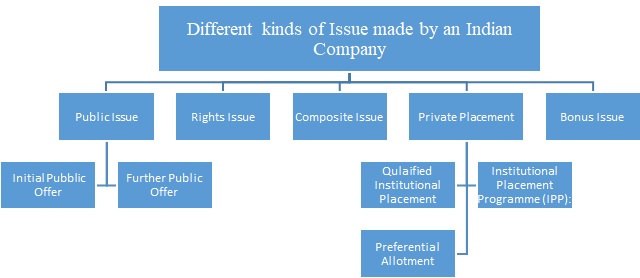
The table above provides the manner in which every Indian Company issues securities. The concept of QIP comes from Private Placement where a Company registered under the Companies Act, 2013 issues to certain Qualified Institutional Buyers. However, this issue can be only made by the companies that have been listed with the Securities and Exchange Board of India. Only they are authorized to make such issue term Qualified Institutional Buyers has been defined under Securities And Exchange Board Of India (Issue Of Capital And Disclosure Requirements) Regulations, 2009

“Qualified institutional buyer” means:

  1. A mutual fund, venture capital fund[, Alternative Investment Fund]9 and foreign venture capital investor registered with the Board;
  2. A 10[foreign portfolio investor other than Category III foreign portfolio investor], registered with the Board;
  3. A public financial institution as defined in section 4A of the Companies Act, 1956;
  4. A scheduled commercial bank;
  5. A multilateral and bilateral development financial institution;
  6. A state industrial development corporation;
  7. An insurance company registered with the Insurance Regulatory and Development Authority;
  8. A provident fund with minimum corpus of twenty five crore rupees;
  9. A pension fund with minimum corpus of twenty five crore rupees;
  10. National Investment Fund;
  11. Insurance funds set up and managed by army, navy or air force of the Union of India;]

Conditions relating to Private Placement have been defined under Chapter VII of the Securities And Exchange Board Of India (Issue Of Capital And Disclosure Requirements) Regulations, 2009.

  • A special resolution which approves the Qualified Institutional Placement mjust be passed by the Shareholders in their respective company.
  • The shares that have to be issued to the Qualified Institutional Buyers must belong to the same class and must be listed by a recognized National Stock Exchange.
  • Their listing must have been done at least one year prior. This is mandatory as only if the condition is fulfilled can a company pass the special resolution as is required and mandated by the provisions of Companies Act, 2013 and 1956.
  • Special provisions have been mentioned in regard to a transferee company that might have undergone Merger or Amalgamation or any such related transaction that might have a similar effect otherwise. This shall be in reference to Section 391 -394 of the Companies Act, 1956.

Appointment of Merchant Banker

Guidelines also make it necessary that a merchant banker shall be appointed who will be registered with the Board and shall exercise due-diligence.

  • The merchant banker shall, issue a Due Diligence Certificate mentions that all the requirements under Chapter VIII of the ICDR have been complied with.[1]
  • Issue of Placement Document: This document shall contain all the necessary information that the buyer must be aware of so that they make an informed choice. In furtherance of this objective, SEBI passed the Issue of Capital and Disclosure Requirements, Amendment Regulations, 2012, with effect from 30th January 2012. The information to be disclosed is mentioned in the Schedule XVIII which was introduced as Issue of Capital and Disclosure Requirements, Amendment Regulations, 2012, with effect from 30th January 2012 and is in para Materia to the Disclosures Mentioned in Part G of Schedule VIII.
  • The copies of the document shall be circulated only to selected investors after proper numbering.
  • For obtaining approval from the Securities Exchange Board the Placement document shall be submitted and shown along with the due-diligence certificate for obtaining due permission from the Stock Exchange.
  • This document shall also be then published on the website with a specific mention in regard to the offer, and its validity which does not extend to the general public or any other category of Investors, other than those specified.
  • Schedule XVIII: This shall contain information relating to The Financial Statements of the Company, a summary of the offer and the eligible securities along with the Risk factors that might be associated.
  • Adding to, it makes mentions to make disclosures regarding the project in which the money shall be invested, its break up cost and the break up. It also makes it necessary to have Audited Financial Statements prepared by An Independent Auditor. The ultimate objective is to ensure that the Investors make a real choice

Pricing of the QIP

It shall be based on the price which cannot be less than the average of the highest price of the equity shares and the lowest prices on the stock exchange in the week, two weeks prior to relevant date. The term relevant date has been defined under Regulation 81(c) of the ICDR Regulations.[2]

  • The Qualified Institutional Placement is subject to certain conditions wherein it has been mentioned that:
  • It is necessary that 10% of the Eligible Securities are allocated to any Mutual Fund and if no subscription is made by any Mutual Fund House it can be allotted to any other Qualified Institutional

Restrictions on Allotment

Certain restrictions have been imposed wherein it is mentioned that in any whatsoever, the Qualified Institutional Placement cannot be made to the Promoter or any of his relatives or to any manner who may be related to the promoter in any way. For the said purposes any person who by lending has acquired the status and capacity as that of Promoter is excluded from the purview of this Section. However, exceptions have been created where certain persons like those who have been persons who have been granted certain rights under the Shareholders Agreement or have voting rights or have certain veto powers or have certain rights in respect to nominate a director or a board

Minimum number of allottees

The number of QIBs to whom shares are allotted shall not be less than

  1. Two, in cases where the issue size is <= Rs.250 crores
  2. Five, where the issue size is >= Rs.250 crores[3]

Also once The applicants in qualified institutional placement have made their bid and the issue process has been closed they cannot withdraw their bids after the Closure.

  • Timeline for the process: Regulation 88 of the ICDR regulations mentions that once a special resolution has been passed the allotment to the buyers has to be made within a time frame of 12 month which is effective from the date the Special resolution.
  • These Regulations also pose a restriction wherein not before the expiry of six months from the date special resolution was passed the Company was authorized to further undergo Qualified Institutional Placement.
  • A limit has been placed on the amount for which securities can be made in a financial year must be less than five times the net-worth of the company in the previous financial year. The investment through QIP cannot be made more than five times the net-worth as per the audited Balance Sheet in the preceding financial year.
  • Tenure: The tenure of the convertible or exchangeable eligible securities issued through qualified institutions placement shall not exceed sixty months from the date of allotment.

Restriction on Selling: Restriction is placed in respect of the eligible securities which cannot be sold by the allottee for at least a period of one year from the date of allotment, except otherwise on a Stock Exchange.

Advantages

  • Speedy process –  This mode of qualified institutional placement is essentially the most expeditious method by which capital can be raised without undergoing any cumbersome process. Generally, by other methods, it takes a lot of time and money to undergo the documentation and approval.[4]
  • Saves Cost: It saves ancillary expenses which otherwise are involved when securities rae issued by some any other mode. The Floatation Costs are minimised.

Advantages for the QIBs

Potential for buying large stakes in Market: Today this method has become a useful key and is being used by large Business Houses and Banks. In cases where a company cannot directly buy from the market a large stake as it might create market volatility, in this way issuing shares by increasing capital is one of the ways to attract investors.

Better bargains take place by means of QIP, as it gives the opportunity to raise and purchase as well at better-bargained costs.

Recent Updates on QIP

  • SEBI has recently expressed its concern over the declining QIP and mentioned the following “As a markets regulator, one of Sebi’s mandates is market development. They have been concerned why QIP as a product has lost attraction with listed companies and to discuss the same, they had called investment banks for a meeting last week,” [5].
  • As per the records of 2016, only four or five companies have undertaken QIP, which is a growing issue for the SEBI as the entire purpose for which it was enacted is not being fulfilled. This was essentially done with an aim to reduce External Commercial Borrowings on the lines of the American Depository System.
  • SBI plans to issue its largest QIP, breaking its own record. It plans to raise its capital base launched at a price of Rs 287.58 per equity share. This might be followed by other Public Sector Banks who might take up a similar path so that they are able to implement the Basel III norms. This is supposed to be the Largest QIP that has been issued across the nation. [6]

References

[1] while seeking in-principle approval for listing of the eligible securities issued under qualified institutions placement, furnish to each stock exchange on which the same class of equity shares of the issuer are listed, a due diligence certificate stating that the eligible securities are being issued under qualified institutions placement and that the issuer complies with requirements of this Chapter.

[2] (c) “relevant date” means:

(i) in case of allotment of equity shares, the date of the meeting in which the board of directors of the issuer or the committee of directors duly authorised by the board of directors of the issuer decides to open the proposed issue;

(ii) in case of allotment of eligible convertible securities, either the date of the meeting in which the board of directors of the issuer or the committee of directors duly authorised by the board of directors of the issuer decides to open the issue of such convertible securities or the date on which the holders of such convertible securities become entitled to apply for the equity shares. Conditions for qualified institutions

[4] http://www.blog.sanasecurities.com/what-is-qualified-institutional-placement/

[5] Sebi seeks inputs from investment bankers to reverse slump in QIP

activity Fri, Aug 19 2016. 04 07 AM IST http://www.livemint.com/Money/XxD6KjvIbAB9DjA96yC9zM/Sebi-seeks-inputs-from-investment-bankers-to-reverse-slump-i.html

[6] http://www.businesstoday.in/sectors/banks/sbi-launches-largest-qip-will-more-companies-take-qip-route/story/253809.html (June6,2017.)

Download Now

Five things that prevent you from getting your dream job and how to break those barriers

0
dream job course from iPleaders

This article is written by Ramanuj Mukherjee, Co-Founder and CEO at iPleaders and LawSikho.

“Work hard and you will get what you want”.

This is the mantra we were taught since we were kids.

One of our professors wanted us to remember all the citations of case laws he taught us and he gave marks only if you could write the exact citations in the answer paper. When students questioned him on this strange evaluation criteria, he said “how will you do well in life unless you work hard?” One of the student got up and said “great, I will go down to the university grounds and dig it up. I will work very hard. I hope you will give me top marks for my hard work.”

I understood it quite late into my academic career that hard work is not really the key to success. It was a breakthrough from that day. I worked less and performed better. If hard work was the key to success, the day labourers who carry bricks on their back or maybe farmers will be most successful. But no, they live in poverty.

The problem is that if it is not hard work then what the heck is it? What will make you successful?

There is no one simple answer. Determination helps. Resources help. So does many other factors.

However, one common theme in the life of unsuccessful people, very often, is that they sabotage themselves. One way or the other. It could be through addiction, lethargy, lack of initiative, fears and insecurities, or something else altogether.

Identifying those patterns and eliminating them often produces miracles.

Here are 9 common reasons why young, hard working, intelligent lawyers do not land the jobs they deserve. If they identify these patterns and teach themselves to break the patterns, they can certainly land those jobs. It is not easy though. You will probably need help from mentors and coaches to break them. Read on to know more.

(By the way, if you are a law graduate and struggling to find the kind of job that you want, especially corporate law jobs/jobs at top notch litigation chambers that pay well, please apply to this program which helps law graduates to find their dream jobs. It will prepare you for even the most difficult interviews, help you to get the right interviews and recommendations as you will expand your professional network. As you will learn the science of cracking the job you want, never in your life again you will struggle to bag the jobs you really want.)

You need to defend yourself and prove yourself right

When you graduate out of your law school, and begin to work somewhere, in reality you know nothing. Nothing at all. Even if you know something assume that you know nothing and be willing to learn from people who are successful. It is a huge problem when young lawyers are not coachable. Nobody wants to hire such lawyers.

This tops the list because I was like this for a very long time. I didn’t face hiring problems, in fact, I will always get more offers than I needed. However, it was a big barrier when it came to performing once I got the job. Even as an entrepreneur it was a big drawback I suffered from.

It was several years into my career that I realised what a blunder I am doing, obsessively defending myself. It certainly worked a lot of times if I calculated short term gains, but it always slowed down learning and growth. And it really compromised my very best relationships.

Do you have a mentor? Do you often learn from other people who show you how to do things better, even when your own original work was not necessarily indefensible? If the answer is not yes, you might be suffering from the same syndrome. Do people around you complain that you do not listen? Then you might be in this category.

You need to break free from it to get to the next orbit of growth. And getting a job is going to be very difficult if this trait shows through in your interview.

I myself, and many interviewers I know, will throw around a few questions just to check if the person giving the interview is coachable, how they take correction and if they can work with the inputs given by others. If you are failing at those tests in your interviews, odds are really stacked against you getting a job.

You do not have integrity and your story doesn’t add up

Most experienced hiring managers are very sensitive about integrity issues. It is not only about lying about yourself, but even if there is any mismatch between what you project about yourself and who you actually seem to be, you are likely to get rejected. If they discover any incongruity between how you have projected yourself through your CV or even in the interview, and who you actually seem to be after some probing, then you are toast. Therefore, the story your CV tell, your personality, your actions, your responses to their questions – all of it needs to be aligned and not contradictory.

Let me give you an example. I was hiring for a sales position recently, and I had to hire a lawyer for that position. One of the lawyers I was interviewing vouched that she always wanted to do sales and is very glad to finally get an opportunity around sales. It is a little shocking – as lawyers rarely want to do sales as their first choice. So I asked her if she ever did any sales, or explored or tried anything about sales in the past. She didn’t have any experience. Then I looked at her CV – she seemed to have done a lot of things related to academics – and none of those had anything to do with sales, even remotely. This was an incongruency. I liked the candidate otherwise, but had to get to the bottom of this.

When pressed further it turned out that she wanted to practice law in the court but didn’t have much luck with that. Hence she wants to go for an LLM in a year and wanted to work with us as a stopgap job.

Had she said these things transparently from the beginning, I would have had no problem with that fact. In fact several of our sales people who are lawyers indeed joined us for similar reasons. However, this kind of lack of integrity, if discovered, will destroy a perfectly good interview.

It is not necessary for the interviewer to know for sure that you are lying or hiding something. Even if they have a feeling that you are doing so, you will be rejected without any explanation. Or maybe some other lame reason will be offered.

This is why it is very dangerous to lie to interviewers. They are likely to detect even the remotest uneasiness, behavioural tic or change in voice tonality, and feel uneasy about hiring you. They would often say “I just don’t have the right feeling about this person”. The source of these feelings are almost always some sort of incongruity, even if they can’t place a finger on it.

You are highly sensitive to criticism

Many people are extremely sensitive to criticism, which usually stems from some insecurity or the other. In the modern workplace, if you are not able to deal with some criticism, and sometimes even hostility (from customers, competitors or even co-workers) you are doomed. If you shut down or fire up or just get triggered by some criticism, do not expect to get hired. I have come across such employees and consequently, try to weed them out in the interview process.

To be honest everybody is sensitive to criticism to some extent. The degree is what is most important here. If people can’t criticize you without having to enter a full verbal match then you will find it difficult if the interviewer gets a hint of that in the interview.

You come across as a troublemaker or attention seeker

Many people have strong ideological belief systems that they show off during the interview process. It is a terrible idea. Recently a friend was being interviewed by a top notch media house. She pointed out in the interview how she believed some recent coverage they have been doing is sexist. It is a very legitimate point, but wrong one to make at an interview, if you want that job. Nobody wants ideological conflicts after hiring. If it doesn’t suit your conscience, don’t appear for the interview. However, do not expect to turn around the policy by convincing an interviewer. You may come across as trouble, and you will not get hired.

It is actually not that uncommon. Recently, while hiring for an open position, someone told me how she feels the hiring process is “exploitative”. This is because any person who wants to be selected was required to write an article first, based on which I decide if they should go to the next round of interview. I had specified that the article needs to be at least 2000 words. She felt that I cannot ask for a trial of more than 600 words as sample. Well, I do not quite agree! I am trying to hire someone I will be paying several lakhs per year, and had to select that one person from over hundred applications I received. How do you reckon I can judge them better without seeing their work? If they cannot write a 2000 words article, why should I spend my time on them? And I am certainly not going to hire someone who calls my hiring practice exploitative. Will you?

The other similar issue is of attention seeking through name dropping and fantastic claims. There are others who love to create drama out of nothing. Drawing attention to your strengths is one thing, but if you come across as someone just boasting, gloating or seeking attention – you may not get hired.

You are not sure that you can do the job

If you are going to say in your interview “I will try” please don’t apply and waste everyone’s time. There are too many people who will not confidently say what they can do and what they cannot but come up with a lame “I will try my best”. I will try is always the wrong answer. Nobody hires a professional to try.

If your surgeon says he will “try” will you be willing to go under his knife? We need those who know how to do it. If we can’t find someone who knows it, we will hire someone who is willing to be trained but at least is clear that they don’t know how to do it.

If you don’t have the confidence that you are fit for the job, don’t apply. Spend time preparing yourself for it, instead. Get a course, hire a coach, or find an internship.

You cannot take instructions

There are many good people, who are good at their work – but they have a problem with taking an order/instruction. Somehow it hurts their self-image to take an instruction and they get triggered by it. Some of them will not visibly react to the instruction, but ignore it and try to do things in their own way anyway. If you can’t take instructions from others, you will not succeed at a workplace. Try finding a profession where you don’t have to take anyone’s instructions, and good luck. Else, get very good at taking instructions and actually following them.

You are not spontaneous and cannot deal with the unpredictable

There are many cookie-cutter academic successes who know all the right things to say, till the questions are predictable. Unfortunately, in most jobs, you don’t always deal with the predictable, and you need to apply your creative mind. Given the Indian schooling system, many graduates turn out to be people who are at a loss when they need to deal with something outside the “syllabus”.

Everytime I take an interview, I make it point to ask a question that is related to the field/expertise of the interviewee, but just outside what he or she will already know. It requires some logical deduction. Something that requires them to think a little. For example: So you have been doing contract management for 5 years. Can you tell me what are the top 3 qualities of a contract manager? Alright, let’s say, hypothetically, we ask you to draft a training course on contract management and there can be only 5 modules. What will be the heading of these 5 modules?

Of course, there are no perfect answers here. Even I don’t know what is the right answer. I am just watching out for a streak of logical thinking and ability to come up with an answer which makes sense. If it doesn’t make sense to me I may ask you questions to learn more. But it gives me a way to see if you can think creatively, outside the box.

Many of the interviewees simply can’t do it and comes up with an answer that they can’t think of anything. Some people take it as a challenge and enjoy the intellectual stimulation.

It is not that there are no jobs for those who can’t think creatively, but the best ones are reserved for those who can do that thinking. If you can’t process a new set of information, or engage in a thought experiment, how will you resolve the out of syllabus questions that organizations have to face and resolve almost every day?

You may leave the job soon

We are in a world where new opportunities open up every day. However, recruiters want to hire those whose interests are aligned with that of the organization, and therefore, who may stay in the organization for a long time. If any of the things you say or do or project make them think that you are looking for a stopgap job and not going to stay in this for a long time (think many years) they would have less interest in you unless the other good candidates are also looking for stopgap jobs only. For some positions it is ok to hire people who may stay for a year or two only, and in some cases entire industries are like that. However, as a general rule, people who may leave a job in some time are kept at the bottom of priority list.

Hence, if recruiters think that you might shift cities soon, or going to have a baby or such similar life event which may take you off the job market, or that you are going for higher studies soon, they may pass over you even if you are otherwise a very good candidate.

In some cases it may feel like an unfair disadvantage (especially when you are a woman and planning to have a baby or get married etc.) but that’s how it works. If there is such a situation, make sure you dispel apprehensions by sharing an authentic plan about how you will not discontinue work despite the life event and would not let work get affected.

You do not relate to yourself as a performer

When people talk about candidates who do not have confidence, this is the kind of people they are talking about. If you are scared about the work, if you have a low opinion of yourself, if you have a negative self-image, and if any of this is uncovered in an interview, you may not get hired.

You may think getting a job is about a qualification which entitles you to a job. You may think that it is about having a certain skill which you possess. If you think these things, you will be misguided. In reality, those who are most likely to succeed at the job profile long term are the ones that the recruiter wants to hire. That is why all these personality traits, and especially how you see yourself, become very important to recruiters.

Your career is a result of many years of consistent work, efforts, sleepless nights, accomplishments, failures and a lot of luck. Those things are usually obvious. However, there are these silent career killers – the ones described above. We have told you about 9 – you could discover more.

It may be difficult to identify and then work on the kind of traits discussed above. Here is a full fledged training program for those who want to prepare themselves for the best jobs: the dream job course from iPleaders.

If you can think of any other such impediments that cause self-sabotaging when people are trying to get a job, share in the comments below.

Download Now

Tortious liabilities of Companies

0
Tortious liabilities of Companies

In this article, Dipti Khatri pursuing Diploma in Entrepreneurship Administration and Business Laws from NUJS, Kolkata, discusses Tortious liabilities of Companies.

Tortious liabilities of Companies

Law of tort forms a part of English common law. An act which injures someone in some way, and for which the injured person gets the opportunity to sue the wrongdoer for damages is called as law of tort. Some acts do not arise out of a contract or statute such as negligence and intentional civil wrong. Intentional civil wrong includes battery or defamation, and tort of negligence. In other words, when there is a duty of care but when that is breached it causes damage and that makes tort of negligence.

The definition of tortious liability is as follows,

“Tortious liability is when it arises from the breach of a duty which is primarily fixed by law. This duty is required to be towards persons generally and its breach should be redressable by an action for unliquidated damages.” As per W.V. H. Rogers in contract there is an agreement required between two or more parties, however, in case of tort there is no agreement required between the parties. Thus, the main difference between which lies between tortious liability and contractual liability is the nature of duty. The duties in the torts are more fixed by the law where as the duties in case of contracts are fixed by the contractual parties.

A company in most of the cases can both commit torts and have torts committed against it. As company is an artificial person, therefore in order for the companies to be held personally liable there is both need of humanitarian assistance and that of an individual. Liability will arise from either an individual committing an act or its wrongful omission. But in certain cases directors can also be simultaneously liable as he authorized the wrongful act or omission.

Director’s tortious liability

A director will be liable for tortious liability if he actively participates in the act or authorises or instructs anyone to commit such an act. The exact extent of liability, however, does not happen to be clear. It is generally held that the company will be held liable whereby company imposes the third party to damage/loss by reason of breach of his general duty with ordinary skill and care.

Identification and Agency approaches

Generally, the question arises for the act whether the company or director should be held liable. To appropriately answer this question generally two main approaches are applied: These include agency approach and Identification approach.

The Identification Approach suggests that based on the separate legal entity principle and separate legal entities, the director should be treated as the company whether he or she is acting in the course of business.

However, the Agency Approach alleges that the director is only acting as an agent of the company, which is a separate entity and therefore should be made personally liable only for his or her own wrongful acts. These two conflicting approaches clearly reflect the fundamental conflicts that exist between the company law and tort law in deciding director’s tortious liability. On one hand, tort law has long accepted that an individual is only responsible for his or her own tortious acts. Making directors liable in these circumstances would arguably damage the doctrine of separate entity and limited liability which are considered to be the foundation of company law.

There is yet another approach i.e. when directors act as the trustees as they are generally allotted the Companies assets over which they have control. Therefore, they are expected to exercise the powers honestly and not for their own personal advantage. And, if they misuse they will be rendered liable as trustees and in case of his death even his legal representatives can be made liable.

The two main approaches in Director’s Tortious Liability are as follows:-

  1. The Agency Approach- The Agency Approach recognizes a director as an agent of the company and their liability would be assessed accordingly. Under the Agency Approach, as the director is viewed as an agent of the company, therefore normally liable for all tortious act committed by him or her. In addition, the company will be taken as principal and would also be vicariously liable for the tort which has been committed by their director. This approach is generally taken as a creature of the tort law principle. In essence, the Agency Approach requires director’s direct liability in tort, without any alteration made by company law principles. Nowadays, agency approach seems to be more preferable then identification approach. It was held in the case of Williams v. Natural Life Ltd. That generally we should aim at adopting agency approach. In order to further explain, the facts of the case stated plaintiffs were earning profit. But successfully running after 2 years, they found that Company was running into losses. Thereby, it was found that the director was not acting for the interest of Company. Therefore, in the eyes of his Lordship, the company should be treated as the principal of the director.
  2. The Identification Approach- In case of identification approach, the act of director is considered as the act of company itself. Therefore, the director’s act is generally considered as the company’s act. This would generally exempt company from the personal liability. The identification approach was adopted in the most important case of Trevor Ivory Ltd v Anderson decided by the Court of Appeal of New Zealand. By adopting Lord Reid’s idea in Tesco Supermarkets Ltd. to the present case, Hardie Boys J. stated that “…in appropriate circumstances the directors are to be identified as the company itself so that their acts are taken in truth the company’s acts. Indeed it is considered that the nature of corporate personality requires that identification should be the basic premise…” Although the Hon’ble Judge agreed that the personal liability can still be imposed on a director based on the “assumption of personal liability test”. However, it can rightfully be said that in most circumstances the directors can most of the time escape their liability under this test.

Liability in tort

As a general principle of law, it is generally possible for the directors to have joint tortious liability along with their company. The circumstances in which this may occur are difficult to define precisely. Therefore, the courts have tried to strike a balance between the legal principles as

  1. An incorporated company is to be considered as a separate and distinct from its shareholders, directors and officers, and
  2. Everyone is to be made liable for their tortious acts.

The case of Williams and another v Natural Life Health Foods Ltd ([1998] 2 All ER 577) considered whether a company director should be personally made liable for a negligent misrepresentation. The House of Lords held that, in accordance with the norms of normal tortious principles, a director would only be held liable if the assumed personal liability for a representation and the other party reasonably relies on that assumption of responsibility. Equally however, the courts have tried to make clear in the plethora of cases such as Contex Drouzhba v Wiseman ([2007] EWCA Civ 1201) that where a fraud is involved, a director who has tried to make fraudulent misrepresentations will not be able to raise limited liability and separate legal personality of the company as a defence. Although, as noted above, in the context of tortious liability it involves a smaller degree of misfeasance then others.

In the High Court decision in Contex Irwin J commented: “In my view, there is no necessary contradiction between a foolish optimism that something will turn up and dishonesty. Specifically, it is possible for a businessman to practice deceit in order to keep the business alive, in the unreasonable hope that things will come right in the end”. The key representation which was noticed in the Context case was agreeing to a contractual provision within 30 days after shipment when the defendant always knew that company would not be able to pay for those goods at all. The Court of Appeal has also given judgment clarifying that the potential right of a liquidator to make a claim under s.213 (Fraudulent Trading) or s.214 (Wrongful Trading) of the Insolvency Act, 1986 against a director on the similar facts does not prohibit a creditor from bringing a claim directly against a director in the tort of deceit.

As far as torts are to be concerned, generally, a company has some degree of liability which is to be fulfilled for the torts committed by its directors and/or employees during the course of their employment, depending upon the nature and effect of the tort.

Conclusion

At last, the liability has to be determined on the basis of agency theory or identification theory. The intentional tort if foreseeable by the corporate directors or by the corporations then as per the theories they will be accordingly held liable. However, Corporations will generally not be held liable for the punitive damages based on a tort committed by the employees. The corporations will generally be held be liable for a tort committed by a corporation. However, if the intentional tort was foreseeable to the corporate directors or if the corporation accepted the benefits of the commission of the tort, the corporation will generally be held guilty even for a tort committed intentionally by an employee.

Download Now

Arguments to establish that Gambling is a Trade

0
Gambling is a Trade

In this article, Swati Shukla pursuing M.A, in Business Law from NUJS, Kolkata discusses Arguments to establish that Gambling is a Trade.

“The market is a no-called-strike diversion. You don’t need to swing at everything – you can sit tight for your pitch. The issue when you’re a cash director is that your fans continue hollering, “Swing, you bum!” – Warren Buffett

At first glance, numerous brokers have a solid aversion to being contrasted with the card sharks in Las Vegas, Macau, Dubai or some other assigned betting goal on the planet. Be that as it may, the likenesses are mind blowing and can likewise enable you to get profoundly of exchanging achievement. Exchanging is basically a vehicle to create income simply like a business, however, understanding the matter of betting can enable you to comprehend the matter of exchanging. Exchanging Is like Gambling. The level headed discussion of whether speculators and dealers can play at a similar table has caused heat waves of contention as far back as the coming of the Indian Gaming Regulatory Act in 1988. So we couldn’t miss on a chance to bounce comfortable consuming center of the two apparently conflicting cash methods of insight.

As per an old definition from the 1500s, exchanging securities keeping in mind the end goal to deliver cash is called “playing the market”. Indeed, even by the standard of the circumstances, ventures included the dangers of a round of high stakes. At last, in genuine contemplating over the contrasts between betting, exchanging, and wagering and following an extremely difficult film marathon (from the irritating American Psycho to the methodic Hard Eight) that left us potbellied with popcorn and green dollars signs for eyes, we hit a surprising conclusion.

Is Exchanging the same as Betting

One take a gander at their shared objective and the appropriate response inclines towards a reverberating YES. Hazardous business or on the other hand the quest for prompt delight. Settled annuities and government bonds held to development are practically the main safe ventures merchants can bargain in. In every other regard, contributing and club gaming both seek after a similar objective: to minimalize chance while boosting benefit. One distinction between exchanging, betting, and wagering would be the unwillingness of the broker to bet everything while the speculator can stand to cut him some slack and give in his accounts to a self-destructive all in.

The guideline of irregularity. How about we give the floor to Matthew McConaughey and, individually, Matt Damon. The previous accomplished amazing status by beating his trunk to the mood of an Indian rainmaker (demonstrate to me the cash style) while the last dealt with another Good Will Hunting execution, this time his virtuoso spilling in spades around a reserved alcove betting table.

“Alright, first manage of Wall Street – Nobody – and I couldn’t care less in case you’re Warren Buffet or Jimmy Buffet – no one knows whether a stock’s going up, down or sideways, in particular stockbrokers. Be that as it may, we need to imagine we know.” – Mark Hanna, Wolf on Wall Street

Would you be able to see the main control of Wall Street instilled in the arbitrariness of a clubhouse pick up that is the characterizing standard of betting? On the off chance that yes, we trust the jury to decide wisely. Arbitrariness can be the wellspring of how your life turns out. You’re spilled into this world with an unplanned determination of qualities and advised to make the best of them. Outfitted with whatever DNA – ammo nature offered on them, some attempt their fortunes on Wall Street; others take the street to Nevada. Furthermore, it seems every one of the streets prompt Rome-or the guideline of irregularity.

As indicated by the irregular walk speculation, the share trading system’s benefit costs develop legs heedlessly and advance capriciously. Connivance scholars will be disillusioned to realize that economy is not an apparatus that can be controlled by a Reptilian first class, however substantially nearer in definition to a lottery diversion.

Opening machines, which produce around 70% of a clubhouse’s pay, work under a comparative Random Number Generator (RNG). The microchip cerebrum of the pokie, the RNG, spins like a dervish murmuring top to a few billion several times each second. While you get a kick at each one of those close misses turning the hallucination of a big stake, the gambling club administrators get affluent.

Cash never rest in Monopoly town

Neither does the stream of money, Visas, checks, stocks, and bitcoins stop in Wall Street or Las Vegas, Dubai, Macau, Monte Carlo and other club hotbeds of the world.

“I’ve regularly observed these individuals, these squares at the table, short stack and one in a million chances against them. Every one of their outs gone. One final card in the deck that can help them.” – Mike McDermott, Rounders

Mike McDermott’s words in “Rounders” send to a picture of society’s nighttime creatures, the untouchables, nonconformists and unconventionality that populate both the sweat-soaked private cabins of betting scenes, the boisterous lines filling before a horse race wagering stall, and the positively trending market where subordinates are detonating and everyone is profiting nobody can manage.

Henceforth, Occupy Wall Street, that sanctum of glass structures and teary looked at merchants, credited with having pushed the US (and, subsequently, the world) not far off of money related destroyed by method for its infamous bailouts (unreliable bank administrators being offered a raft from the legislature), the American psycho mindset, and sheer love for the diversion. The worldwide development that flourished in Zuccotti Park in 2011 didn’t vanish off the dissent graph once the last occupiers left for their homes.

Actually, echoes and turn off still pay tribute today to the 1% who experiences monetary imbalance. As a major aspect of her presidential crusade, Hillary Clinton contrasted money markets with a betting scene, proclaiming that “the deck is as yet stacked for those at the top.”

The theory of cash is the extension that binds The Strip to Wall Street, Atlantic City to Macau, card sharks to financial specialists.  In her book, Lean In, Sheryl Sandberg sees the sexual orientation aberrations on Wall Street. Young ladies won’t get an indistinguishable mentorship and openings from men, she contends. In support of her claim stands the Charging Bull on Wall Street, seen as a forceful image of hyper masculinity, the bellicose cries on the eager for blood stadium that is the share trading system, and Christian Bale in American Psycho.

A current report with a snappy title, “When Harry Fired Sally: The Double Standard in Punishing Misconduct”, demonstrates that the monetary counseling industry’s oppressive position against ladies is not a short lived impression. Venture organizations, dependably in a patriarchal temperament, will rebuff ladies who take part in offense a great deal more cruelly than men, despite the fact that the last class is more inclined to venture out of line. The distinction is one of sexual orientation recognition. While men escape with unfortunate behavior since they are viewed as “driven warriors”, ladies are named “insubordinate awful young ladies.”

Presently move the sex segregation contention into the gambling club scene, and you’ll have officially populated it in your inner beings with men. Betting settings aren’t seen as a lady’s reality. In the eighteenth century, diversions of chance, for example, faro or poker conveyed a lamentable shame. They were accepted to make awful well being pregnant ladies and aggravate their posterity in the early advancement stages.

Just a couple of hundreds of years after the fact did the prevalence of web based betting open entryways for ladies who had been beforehand continued the edges of the gambling club, either as hot merchants at the poker table or environment creators. And keeping in mind that the female sexual orientation is a section of significant worth in the gaming business, you’ll just need to leaf through the arrangements of gambling club official chiefs and other abnormal state employments. The chances of a lady making it in a kid’s club keep running as high as in the furious positively trending market.

Be that as it may, shouldn’t something be said about the chances of a man? Betting everything on the chances. What are the chances? The Fates, Schrödinger’s feline, Karma, a coin hurl, a gamble, a Californian diversion, or just a proportion of probabilities and positive to ominous results? A case can be made for every one of them.

Where chances are concerned, anything can happen. A similar guideline goes through money markets and the betting scene. “A venture is essentially a bet in which you’ve figured out how to tilt the chances to support you.” Peter Lynch said.

On the off chance that that is the situation, merchants succeed where speculators come up short. They can decipher exchanging examples and diagrams, old maps and digitized figures. Then again, the coin hurl can be said to govern on Wall Street as much as in the clubhouse.

Speculation organizations can’t foresee prospects, cataclysms, and political changes. A totally justifiable folly unless you claim a time travel machine. Also, brokers will either undercut, get harmed on commissions or conjecture past their methods.

And keeping in mind that contributing and exchanging can be a losing wagered, betting could skim over to be a triumphant dice. You can hand the chances over your support by tallying cards (inconspicuously, maybe?) or perusing into the brain research and characteristics of your kindred poker players. Likewise, there are gambling club recreations that offer the punter better chances. Craps, blackjack, and baccarat make it to the main three.

The House dependably takes its cut. In this regard, is contributing the same as betting or wagering? Both exchanges share a family relationship that focuses on free market itself. People on both sides of the clubhouse and securities exchange businesses are a dream created by this exceptionally same market.

Once in, you can’t exist outside it.

This market is the house. It might, from time and time and to its greatest advantage, remunerate its players with the “enormous fish” that charming huge catch that dealers and speculators alike look for to increase money related lifetime security.

The house will chip a touch of its edge just to keep the hot shots moving billion-dollar entireties in their club. They require a constant flow of punters. Be that as it may, the house/showcase dependably wins the edge. It can’t bear the cost of those high misfortunes so it likes to heap them up as inadvertent blow-back on its players. Or, then again, as Karl Marx once stated, “Free enterprise will dependably create its own undertakers.”

  • Urgent exchanging, addictive betting.
  • Betting habit has gotten official recognition.

This market is the house. It might, from time and time and to its greatest advantage, compensate its players with the “huge fish”, that charming enormous catch that brokers and card sharks alike look for so as to increase monetary lifetime security. The house will chip a touch of its edge just to keep the hot shots moving billion-dollar holes in their gambling clubs. They require a constant flow of punters. Notwithstanding, the house/showcase dependably wins the edge. It can’t manage the cost of those high misfortunes so it likes to heap them up as inadvertent blow-back on its players. Or, on the other hand, as Karl Marx once stated, “Private enterprise will dependably create its own undertakers.”

Habitual Exchanging, Addictive Betting

Betting fixation has gotten official acknowledgment in the 1980s, a status that likewise converted into the introduction of a genuinely necessary association, Gamblers Anonymous.

At the intersection of Wall Street, in any case, you won’t go over an assistance work area of the Investors Anonymous. There isn’t one in the Yellow Pages, not one or the other. Yet, society’s headstrong visual impairment doesn’t mean merchants don’t bargain in a particular brand of medication decrepit and merciless aspiration.

Certain signs will point to a Dependent Merchant

  • The speculator can’t quit submitting capital. He will show certain characteristics, for example, an expanded hunger to invest hours before a PC, a sleeping disorder, and dull discussions where the main point within reach is the good and bad times of a stock.
  • On the other hand, the dealer may be subtly keeping that ever vigilant gaze on his exchanges without telling his family and companions. The individual will be concealing his exchanging movement while enjoying ever more hazardous, here and now wagers. Apologies, we intended to state speculations.
  • Obsession and dissent. Mystery and isolation. What’s more, to wrap things up, withdrawal side effects. Make an exchange stop and see what happens. It’s a definitive enslavement test. In the event that the individual shows a reactionary state of mind, has a fit, communicates desires, poor concentration, episodes of outrage and disdain, lastly discouragement, he probably been a dependent dealer on his path now to recuperation.

When it comes down to exchanging any market, you’re managing chances. We’ve taken a gander at circumstances like the Canadian Dollar or Emerging Markets which had an ideal financial picture with which you could purchase more grounded money like the British Pound or Euro. By taking that straightforward case of frail product monetary standards or developing markets in mid 2014, the chances were tilted, yet not ensured, for an exchange that exploited that lopsidedness in the market.

As you may know, whether you’ve bet yourself, many individuals who visit club’s progression up to a table to play a diversion with cash on hold and attempt and gain back their expenses for the inn or flight. In any case, the huge clubhouse that they’ve ventured into was worked with the cash lost by individuals before them who didn’t comprehend the chances that the gambling club that has the diversion ensures the chances are tilted to support them. Accordingly, to change from a broker that loses cash, you should take a gander at how to tilt the chances to support you like the club accomplishes for their advantage.

Enhancing Your Odds to Trading, Just Like a Casino does

On the off chance that you strolled up to two individuals and asked, is betting a productive business? You’d likely find two unique solutions.

The individual who questioned that betting was a profitable and long haul technique to manufacture riches, in this case, is somebody with dollar signs in their eyes. They may have assumed if they could locate a decent framework with which to put down wagers; they could take some cash from the club, be that as it may, after a couple of visits to a few betting houses ended up down a couple of more thousand than anticipated after expenses for the flight and lodging.

Exchanging and betting are comparative in that they both endeavor to make a capital increase, over a moderately brief timeframe, without making new riches. On the off chance that I am a shoemaker, at that point my endeavors make a couple of shoes that another person can wear (new riches), while I procure a salary from cobbling. When I am a broker or card shark, I may win a wage; however there is no extra riches made. A few markets specialists would guarantee brokers make showcase liquidity to the regale of long haul speculators, and that this in itself has esteemed, like “new riches” creation. But since exchanging and betting include capital exchange without capital creation they are seen distrustfully, particularly when their results are capricious. Society by and large inclines toward the shoemaker-sort attempt since it makes something others discover profitable.

Exchanging and betting are both in a general sense stochastic, that is flighty, and as a result of this they are regularly seen contrarily. We feel a “legitimate exertion” has greater consistency to it, and we may hold the individuals who go out on a limb in despise. Be that as it may, numerous who have attempted their hand at another business will bear witness to noteworthy fortunes when effective. The objective of new riches creation, and the time expected to build up an effective business, act to relieve the dangers included. Be that as it may, at that point, brokers and card sharks will frequently portray numerous times of training before getting to be plainly effective.

Exchanging and betting both happen in light of the fact that, in any event at their begin, the members have gathered riches in an overabundance of what they have to live. This is like the financial specialist who has overabundance capital (and commonly substantially more than the normal dealer or player).

Contributing has an essence desirable over exchanging in light of the fact that the speculator is seen as empowering new riches creation and on the grounds that it includes deferred satisfaction – the advantages of a sound venture may take numerous years to acknowledge – simply those properties portrayed.

Previously, there is by all accounts an inborn regard for a long haul speculation that turns out well: The effective financial specialist is viewed as patient and insightful. Then again, exchanging and betting have a get-rich-speedy quality to them and are frequently seen with despise as a result of it. Indeed, an expert broker or player may not get rich rapidly, but rather just gain pay gradually after some time.

At the point when present day human progress empowered a few people to gather riches in abundance to what was required promptly to survive, theoretical exchanging and betting normally developed, and dealers and card sharks might be seen adversely on the grounds that they are utilizing cash that others don’t have. Since nobody has yet decided fair methods for uniformly disseminating riches, exchanging and betting ought not to be considered inalienably abhorrent. Nobody articles to a representative retirement finance putting resources into the share trading system: The capital has been amassed and should be some way or another oversaw.

Effective dealers and card sharks are ordinarily very talented and invest years getting to be noticeably capable. Achievement frequently implies an unfaltering general salary and not a one-time bonanza occasion. Since society esteems most exercises that require an exceptionally created expertise, the effective merchant or card shark will be seen in a positive light, while the fizzled member is just observed as one more “washout.”

Both exchanging and betting have seen the advancement of various scientific (and pseudo-numerical) systems with a specific end goal to build their odds of progress. Since the science of exchanging and betting can be made exact and add to our comprehension of normal occasions, there is new riches creation from the individuals who have added to characterizing beneficial exchanging and betting strategies. Regularly these people are held in regard while the professionals of the strategies are definitely not. For instance, the Nobel Economics Prize was granted to the designers of the Black-Schools alternatives evaluating model, while the individuals who day by day utilize the model’s yields are seen just as dealers.

Likenesses amongst Betting and Exchanging

  • Uncertainty encompassing a theoretical choice by merchants/card sharks.
  • Quest for benefit through hypothesis.
  • An advertiser offered by showcase producers.
  • Speculators are value takers, as opposed to value producers.
  • Demand influences costs.
  • Demand is driven by chance/remunerate variables.

In the expressions of a familiar adage, “It’s twofold the laughs and twofold the smiles, and twofold the inconvenience in case you’re honored with twins.”

The monetary condition of the present day has cleared the floors and accounted for both blended endowments: the experts and the troublemakers, the wins and the misfortunes, betting and exchanging alike.

To the untrained eye, the two enterprises may make unusual partners, yet prepared and devoted punters will depend on judgment and specialized examination to bring home the bacon from sports wagering while foolhardy brokers will know no second thoughts in taking a chance with their vocation and others’ capital on an insane morning hunch.

In this light, cutting over the token contrasts between betting, exchanging, and wagering, these cash focused businesses exist on a shared objective stage. To challenge hard-won cash a blustering. To wager on the income sans work. Also, to unreservedly concede, in the expressions of a Japanese author, to “the anonymity of cash, it’s stunning compatibility.”


 

Download Now

Can an Indian or a foreign company be a partner in an LLP?

0
an LLP

In this article, Dibyendu Roy pursuing Diploma in Entrepreneurship Administration and Business Laws from NUJS, Kolkata, discusses whether an Indian or a foreign company can be a partner in an LLP or not.

To give a satisfactory reply to the question we need to know about Limited Liability Partnership (LLP), how it can be incorporated and the role of partners in an LLP.

By definition, a Limited Liability Partnership is a body corporate formed and incorporated under The Limited Liability Partnership Act, 2008 and is a legal entity separate from that of its partners. An LLP is having a perpetual succession and any change in partners does not affect the existence, rights or liabilities of LLPs. [1]

Every LLP needs to have at least two partners and the partners could be an individual or a body corporate as per the Limited Liability Partnership Act 2008. An LLP should have two designated partners, one of them should be a person resident in India. In case of a body corporate as a partner of LLP, the designated partner would be a nominee of the body corporate. Thus, an Indian company incorporated under the Companies Act 2013 or the previous version of 1956 can be a partner of an LLP and is required to be incorporated under the Limited Liability Partnership Act 2008.

Incorporation of an LLP

Incorporation of an LLP is to include name of two or more persons associated for conducting a lawful business with a view of profit. It is to be registered in the state in which its registered office is situated. A statement of an advocate or Chartered Accountant or a Company Secretary is required stating all requirement of the LLP Act 2008 and Rules has been duly adhered to. On incorporation of an LLP the persons who subscribed their names in the incorporation document shall become partners.

The following elements are required during incorporation of an LLP-

  • Name of the limited liability partnership;
  • Proposed business of the limited liability partnership;
  • Address of the registered office of the limited liability partnership;
  • Name and address of each of the persons who are to be partners of the limited liability partnership on incorporation;
  • Name and address of the persons who are to be designated partners of the limited liability partnership on incorporation;
  • Contain such other information concerning the proposed limited liability partnership as may be prescribed.

Partners’ agreement

Generally, after incorporation of an LLP a Partnership agreement is made among the subscribers, who become partners of the LLP and they are bound by the agreement made. New partners shall be admitted as per the Provisions of LLP agreement. The mutual rights and duties of the partners of LLP and the mutual rights and duties of LLP and its partners shall be governed by LLP agreement between the partners or between LLP and its partners.

In the absence of such agreement relationship of Partners and LLP would be governed as per Schedule 1 of LLP Act, 2008.

Extent and Limitation of LLP and Partners

Responsibility and limitations of Partners and LLP has been described in the Limited Liability Partnership Act 2008 and salient points are discussed below:

  • Partner is the agent of the LLP and not of the partners;
  • LLP is not bound by the acts of partners if the partner has no authority to act for LLP;
  • LLP is liable if a partner is liable to any person because of wrongful act or omission on his part during the business of LLP or with its authority;
  • Obligations of LLP shall be solely obligation of LLP and not the obligation partners;
  • Partner is not personally liable, directly or indirectly for an obligation of the limited liability partnership whether arising in contract or otherwise; and
  • Unlimited liability of LLP and Partners in case of fraud.

It can be noted that the regulation refers to two terms ‘Person’ and “person resident in India. Let us elaborate who is a ‘Person’ and what does it mean “person resident in India”. There is a definition available for ‘Person’ in the Section 2(u) of the Foreign Exchange Management Act, 1999 which includes: (i) an individual, (ii) a Hindu undivided family, (iii) a company, and (iv) a firm,

“Person resident in India” means—a person residing in India for more than one hundred and eighty-two days during the preceding financial year but does not include a person who has gone out of India or who stays outside India for employment or business etc. A person who has come to or stays in India for or on taking up employment or business in India is not eligible as ‘person.

Any person or body corporate registered or incorporated in India is considered “person resident in India”. Also, an office, branch or agency in India owned or controlled by a person resident outside India or an office, branch or agency outside India owned or controlled by a person resident in India is considered as “person resident in India”.

It can be inferred that a foreigner can be a partner or even a designated partner in a Limited Liability Partnership, and this includes foreign companies as well. A person resident outside India or an entity incorporated outside India shall be an eligible investor of foreign investment in Limited Liability Partnership. However, the following persons shall not be eligible to invest in an Indian LLP:

  • A citizen/entity of Pakistan or Bangladesh;
  • A SEBI registered Foreign Institutional Investor (FII)
  • A SEBI registered Foreign Venture Capital Investor (FVCI);
  • A SEBI registered Qualified Foreign Investor (QFI) and
  • A Foreign Portfolio Investor registered in accordance with Securities and Exchange Board of India (Foreign Portfolio Investors) Regulations, 2014 (RFPI).

Eligibility of an LLP for Foreign Investment

Foreign Direct Investment (FDI) in LLP was first permitted in Indian Foreign Investment Regulations in 2011. However, such FDI was limited with many restrictions such as needing prior Government approval for investment into LLP or conversion of an existing FDI invested company to LLP, prohibition on downstream investments or on availing External Commercial Borrowings (ECBs or Foreign Loans), requirement to have a resident designated partner, etc.

In November 2015, the regulation was relaxed to bring FDI in LLP under the automatic route in sectors where 100% FDI is allowed and where there are no FDI-linked performance conditions. Further, it also permitted downstream investments by a LLP having FDI into another Company / LLP, in sectors where 100% FDI is allowed under the automatic route and there are no FDI-linked performance related conditions (for example, minimum capitalisation norms applicable to ‘Non-Banking Finance Companies’ or development of townships, housing, built-up infrastructure and construction-related projects). Also, LLPs with FDI will not be allowed to operate in agricultural or plantation activity, print media or real estate business.

Per the latest Foreign Exchange Management (Transfer or Issue of Security by a Person Resident outside India) (Second Amendment) Regulations, 2017 Foreign Direct Investment in LLPs is permitted, subject to the following conditions: An Indian company or an LLP, having foreign investment, will be permitted to make downstream investment in another company or LLP engaged in sectors in which 100% FDI is allowed under the automatic route and there are no FDI linked performance conditions. Onus shall be on the Indian company / LLP accepting downstream investment to ensure compliance with the above conditions. FDI in LLP is subject to the compliance of the conditions of Limited Liability Partnership Act, 2008.

Designated Partner

A designated partner(DP) is mandatory requirement in an LLP under the LLP Act, 2008, however such DP could be an individual or other person such as another LLP, Company, Trust etc. The erstwhile FEMA 20 permitted a designated partner which was a Company registered in India under the provisions of the Companies Act, as applicable and did not permit such DP to be any other body such as a Trust or a LLP. Further, it was necessary that if an individual was appointed a DP he also needed to be a ‘person resident in India’ under FEMA.

These conditions have now been relaxed and now a Foreign Company can also be a designated partner. Further, if an individual is appointed as DP, he need not satisfy the residency test under FEMA. Such DPs would however continue to need to comply with conditions prescribed for them under the LLP Act, 2008.

External Commercial Borrowings by LLP with Foreign Investment

Schedule 9 of FEMA 20 earlier restricted any LLP with FDI to avail External Commercial Borrowings (ECB). This has reduced the potential of FDI in an LLP and so in the revised schedule it has been taken care of. In the Revised Schedule 9 of FEMA 20, this provision has been omitted, which means that ECB is permitted in an LLP where FDI is there. It is now expected that Reserve bank of India will now amend External Commercial Borrowings regulations to permit LLP with Foreign investment to avail External Commercial Borrowings.

Reporting requirements

The revised Schedule 9 does not currently prescribe detailed reporting requirements. It is expected that Reserve Bank of India may issue an AP DIR Circular prescribing reporting requirements of foreign investment in LLPs and disinvestment / transfer of capital contribution or profit shares between a resident and a non-resident in LLPs.

Download Now

Advantages and Disadvantages of Incorporation of a company

0
company law

In this article, Cheshta Jetly pursuing Diploma in Entrepreneurship Administration and Business Laws from NUJS, Kolkata, discusses Advantages and Disadvantages of Incorporation of a company.

The term company, in its general sense, can be defined as a group of persons, associated together to achieve some common objective. In its legal sense, the term company, as per the Companies Act, 2013, under section 2(20), is defined as “a company incorporated under the Companies Act 2013 or any previous company law.”

The term only emphasises on the registration and the formation of the company and does not further look into its meaning, nature and characteristics. Therefore, the legal meaning to the term company can be summed up as;

https://lawsikho.com/course/diploma-entrepreneurship-administration-business-laws
Click Above
 
  1. Any association, under the Companies Act, 2013 or any previous Companies Act shall be termed as a company.
  2. The misconception that it is a fictitious person is not true. It in reality is an artificial or a legal person, recognised by law, once it is registered and it owes similar rights and duties that a natural person has.
  3. In V Javali v Mahajan Borewell, it was held that a company can be held liable for a statutory violation like an individual, but it cannot be imprisoned. Thus, any violation, as stated under the Companies Act attracts penalty and not imprisonment of the company.

Advantages of Incorporation of a Company

  1. Creates a Separate Legal Entity: This states that a company is independent and separate from its members, and the members cannot be held liable for the acts of the company, even when a particular member owns majority of shares. This was held in the case of  Salomon v Salomon & Co. Ltd. (1897) AC 22. Salomon transferred his business of boot making, initially run as a sole proprietorship, to a company (Salomon Ltd.), incorporated with members comprising of himself and his family. The price for such transfer was paid to Salomon by way of shares, and debentures having a floating charge (security against debt) on the assets of the company. Later, when the company’s business failed and it went into liquidation, Salomon’s right of recovery (secured through floating charge) against the debentures stood prior to the claims of unsecured creditors, who would, thus, have recovered nothing from the liquidation proceeds. The claims of certain unsecured creditors in the liquidation process of Salomon Ltd., where Salomon was the majority shareholder, was sought to be made personally liable for the company’s debt. Hence, the issue was whether, regardless of the separate legal identity of a company, a shareholder/controller could be held liable for its debt, over and above the capital contribution, so as to expose such member to unlimited personal liability. The House of Lords held that, as the company was duly incorporated, it is an independent person with its rights and liabilities appropriate to itself, thus, making Salomon & Co. Ltd liable, and not Salomon.
  2. Company has Perpetual Succession: The term perpetual succession means continuous existence, which means that a company never dies, even if the members cease to exist. The membership of a company changes from time to time, but that has no effect on the existence of the company. The company only comes to an end, when it is wound up according to law, as per the provisions of the Companies Act, 2013. Re Noel Tedman Holdings Pty Ltd (1967) Qd R 56 stated that a  companies  members may come and go but this does not affect the legal personality of the company
  3. Can own Separate Property: Since a company is termed as a separate legal entity in the eyes of law, it can hold property in its own name and the members cannot claim to be the owner of the companies property(s). The Supreme Court, in the case of Bacha F. Guzdar v CIT Bombay stated that a company being a legal person, in which all its property is vested and by which it is controlled, managed and disposed of a member cannot, ensure the companies property on its own name. In Macaura v. Northern Assurance Co. Ltd., a shareholder of a timber company, held all shares of the company but one. He also insured the timber (asset of the company) on his own name, which was destroyed in fire. When he sought compensation, it was held that they were not liable to pay any money to the shareholder, in lieu of the timber since he did not own the timber and that timber, which the company owned was not insured.
  4. Capacity to sue and be sued: The company has the capacity of suing a person or being sued by another person in its own name. A company, though can be sued or sue in its own name, it has to be represented by a natural person and any complaint which is not represented by a natural person is liable to be dismissed in the same way in which an individual complaint is liable to be dismissed in the absence of the complainant.
  5. Easier access to Capital: Raising capital is easier for a corporation, since a corporation can issue shares of stock. This may make it easier for your business to grow and develop. If the in the market for a bank loan, that’s another reason to incorporate, since n most cases, banks prefer and easily lend money to incorporated business ventures.

Disadvantages of Incorporation of a Company

  1. Cost – The initial cost of incorporation includes the fee required to file your articles of incorporation, potential attorney or accountant fees, or the cost of using an incorporation service to assist you with completion and filing of the paperwork. There are also ongoing fees for maintaining a corporation.
  2. Double Taxation – Some types of corporations such as a C Corporation, have the potential to result in “double taxation.” Double taxation occurs when a company is taxed once on profits, and again on the dividends paid to shareholders.
  3. Loss of Personal “Ownership” – 
If a corporation is a stock corporation, one person doesn’t retain complete control of the entity. The corporation is governed by a board of directors who are elected by shareholders.
  4. Required Structure – 
When you form a corporation, you are required to follow all of the rules outlined by the state in which you filed. This includes the management of the corporation, operational requirements and the corporation’s accounting practices.
  5. Ongoing Paperwork – Most corporations are required to file annual reports on the financial status of the company. The ongoing paperwork also includes tax returns, accounting records, meeting minutes and any required licenses and permits for conducting business.
  6. Difficulty Dissolving – While perpetual existence is a benefit of incorporating, it can also be a disadvantage because it can require significant time and money to complete the necessary procedures for dissolution.
  7. Lifting of Corporate Veil – From the juristic point of view, a company is a legal person distinct from its members [Salomon v. Salomon and Co. Ltd. (1897) A.C 22]. This principle may be referred to as the ‘Veil of incorporation’. The courts, in general, consider themselves bound by this principle. The effect of this Principle is that there is a fictional veil between the company and its members. That is, the company has a corporate personality which is distinct from its members. But, in a number of circumstances, the Court will pierce the corporate veil or will ignore the corporate veil to reach the person behind the veil or to reveal the true form and character of the concerned company. The rationale behind this is probably that the law will not allow the corporate form to be misused or abused. In those circumstances in which the Court feels that the corporate form is being misused, it will rip through the corporate veil and expose its true character and nature.
 
https://lawsikho.com/course/diploma-companies-act-corporate-governance
Click Above

LawSikho has created a telegram group for exchanging legal knowledge, referrals and various opportunities. You can click on this link and join:

https://t.me/joinchat/J_0YrBa4IBSHdpuTfQO_sA
Follow us on Instagram and subscribe to our YouTube channel for more amazing legal content 


Download Now
logo
FREE & ONLINE 3-Day Bootcamp (LIVE only) on

How Can Experienced Professionals Become Independent Directors

calender
28th, 29th Mar, 2026, 2 - 5pm (IST) &
30th Mar, 2026, 7 - 10pm (IST).
Bootcamp starting in
Days
HRS
MIN
SEC
Abhyuday AgarwalCOO & CO-Founder, LawSikho

Register now

Abhyuday AgarwalCOO & CO-Founder, LawSikho