Download Now
Home Blog Page 1539

Legal framework and regulations governing financial inclusion in India

0
financial inclusion

In this article, Rituraj Singh Bhati pursuing M.A, in Business Law from NUJS, Kolkata discusses Legal framework and regulations governing financial inclusion in India.

Financial inclusion refers to injection of financial, banking and other necessary facilities to the minor sector of the society which is deprived of the said facilities. The major factor of the financial inclusion is that the services provided under the head of financial inclusion should be affordable to the people belonging to low-income segment group. As it can be understood by the name, “financial inclusion” refers to every practice such as savings, credit, transfers etc. The financial inclusion is a basic need for sustainable growth of the country. The sustainable growth of the country is depended upon the stability of the lower income group of the country. More stable the lower income group of the country; the country is understood to be in a better flourishing state than the country whose lower income group society is not stable and growing. The motto of financial inclusion is to provide the services to the people who are deprived of such services and are unreached. Hence, banking is the key factor of the inclusion, as it tends to open branches in the remote sectors, rural areas and the backward areas of the country that are deprived of the ways to financially plan their income and save it up in the banks for further usage and also the credit of that saved amount with an ease, wherever and whenever required at utmost affordable costs. Whereas, the backward sector of the country is least aware about the financial literacy and this is the major factor hindering the steady as well as sustainable growth of the country. Sustainable development demands participation from a vast sector of the economy; in fact as much as sections of the society to perform. Pertaining to these lacunas, the government as well as the Reserve Bank of India planned and provided Automatic Teller Machines (ATM’s), internet banking, cashless cards (credit and debit cards) etc. to a vast number of population but still the most benefited sector out of these services is the urban population and the rural population still lacks general information about these facilities or on the other hand the rural and backward communities of the economy still prefer the ages old techniques of financial transactions due to lack of awareness, lack of education, lack of safety in the rural areas pertaining to these modern techniques.

The goal of the Financial Inclusion is to create a mass that is self-dependent and self-sustained people knowing enough and competent to take their own financial decisions which in turn allows maximal investments in government schemes, educational schemes, entrepreneurial projects, businesses, retirement plans, banking schemes, insurances; which in turn can benefit the mass at large and also can provide the economy a steady inflow which acts as a backbone of any healthy economy and ensures growth. The lack of supply in the inclusion sector pertains to the low demand from the zone where it desires the most to expand. People in rural zones do not prefer this type of banking services due to language barriers, typical and twisted procedures, non-availability of bank branches in the remote areas of the country, low income generation amongst the rural population, no steady income, financial illiteracy and numerous of such factors due to which there is no healthy demand of financial inclusion in the backward sections of the country and society.

Financial inclusion introduces the lower income group with the banking sector, which helps to protect the income of the people for the times they need it the most. It also safeguards the people from the independent and un-regulated money lenders who implement such rates of interests as regulated by them and also trouble the debtors with every means possible. The financial inclusion has helped put a stop on such practices by the money lenders as there are banks opening in remote areas of the country and the banks are allowing the backward areas of the country to attain loans on low, steady and government regulated interests.

The government as well as the Reserve Bank of India has undertaken various innovative steps to increase the demand of the Financial Inclusions is the rural areas by launching easy KYC(Know Your Customer) schemes, Kisan Credit Cards and special benefits on it only for farmers, buying of the produce on Special Supported Price by the Government, payments to the farmers re done directly to their bank accounts, subsidies are granted directly to the bank accounts, bank accounts are made necessary to obtain special benefits and schemes regulated by the government, use of bank information and ‘aadhar’ information of the fair price shops, linking of aadhar cards to the bank accounts to assure that the benefits are allocated to the right person, banks and governmental bodies now a days educate the rural people about their rights and benefits which are given to them by the government and what benefits they are missing out on by not having bank accounts, opening of bank accounts of small children to teach them about savings, Jan-Dhan accounts, handing of Gas subsidy directly to the bank accounts, Zero Balance accounts for people falling under Below Poverty Line, Adhar Scheme, payment to the people under Rural Employment Guarantee Scheme only by the way of bank accounts, payment of insurance claims are to be done directly to the bank account, any relief granted by the government id transferred directly to the banks, scholarships are transferred directly to students bank accounts, compulsory Bank Account for every salaried employee whether government employee or private employee etc. through these changes and schemes the government is trying to create a subtle demand or Financial Inclusion which can be in turn fulfilled.

Despite of these efforts, some of which are carried out after 2002 the growth of financial Inclusion in India is quite sluggish. As per the stats provided by The Government of India 51.4% of the total population which is into farming is still deprived of accessing their formal credit; which shows the indebtedness of the economy at large. As per this rate the present situation of the general indebtedness have decreased which is a good sign in favour of the schemes and regulations passed by the government as well as Reserve Bank of India but it may be still lacking the quantum of growth India requires to keep on the pace of the rising economy.

Financial Inclusion in India – 2002


State/Region

Non-indebted

Farmer

Households


State/Region

Non-indebted

Farmer

Households

Lakh % Lakh %
Northern 53.21 48.7 West Bengal 34.53 49.9
Haryana 9.11 46.9 Central 158.29 58.4
Himachal Pradesh 6.03 66.6 Chhattisgarh 16.50 59.8
Jammu & Kashmir 6.43 68.2 Madhya Pradesh 31.09 49.2
Punjab 6.38 34.6 Uttar Pradesh 102.38 59.7
Rajasthan 25.26 47.6 Uttaranchal 8.32 92.8
North Eastern 28.36 80.4 Western 47.92 46.3
Arunachal Pradesh 1.15 94.1 Gujarat 18.20 48.1
Assam 20.51 81.9 Maharashtra 29.72 45.2
Manipur 1.61 75.2 Southern 44.11 27.3
Meghalaya 2.44 95.9 Andhra Pradesh 10.84 18.0
Mizoram 0.60 76.4 Karnataka 15.52 38.4
Nagaland 0.51 63.5 Kerala 7.82 35.6
Tripura 1.19 50.8 Tamil Nadu 9.93 25.5
Sikkim 0.36 61.2
Eastern 126.39 60.0
Bihar 47.42 67.0
Jharkhand 22.34 79.1
Orissa 22.09 52.2 All India 459.26 51.4[1]

Major changes in Financial Inclusion in India were seen from the year 2005 and onwards as the result of the fact findings of the Khan Committee, which was setup in 2004 by The Reserve Bank of India urging recommendations regarding the betterment of Financial Inclusions in the deeper parts of the country where the banking system had still not been established. As the result of the recommendations of the Committee many changes were brought into the inclusion system of the country which starred simplifying the procedure and availability of Banking Sources in rural and untouched parts of the country.

POLICIES UNDERTAKEN BY RBI

Basic Saving Bank Deposit (BSBD)

Reserve Bank of India advised all the nationalised banks to open accounts with Basic Saving Bank Deposits; meaning such type of accounts featuring basic saving and transacting features such as no minimum balance clause, cash deposit and withdrawal feature from the branches as well as ATM’s, credit/debit cards, access to electronic payments channels etc. This policy resulted in increased number of general accounts across the country. The rural population reacted positive to this policy as the accounts were featured with zero balance limit, ATM Cards were allotted; helping in easy transaction of money etc.

KYC Norms to be simplified

Reserve Bank of India directed the banks to simplify its norms to register a person as a customer of the bank for the sake of simplicity in process for opening a bank account especially for bank accounts to contain amount of Rs. 50,000/- and credit up to Rs. 1,00,000/-. A large proportion of the population of India is either financially illiterate or totally illiterate which caused difficulty in opening the account and filling the formalities required to be filled in form. The RBI directed the banks to accept Aadhar Card as a proof of identity as well as address of the customer.

Branch Authorization Policy simplified

For increasing the density of branches per capita in India the Reserve Bank of India authorised and gave liberty to the Scheduled Commercial Banks to open Branches in Tier-2 to Tier-6 cities/centres under the general permission as subjected to reporting of the newly opened branch or the branch to be opened. Further liberalizing the policy RBI authorised the domestic scheduled commercial banks to open its branches in tier-1 cities/centres upon general conditions subjected to specific conditions. This step resulted in increasing number of bank branches per capita; especially in tier-2 to tier-6 cities which largely includes rural areas.

Compulsory opening of branches in Un-banked Villages

Reserve Bank of India directed the banks to compulsorily open 25% of the total number of its branches opened in a year in tier-5 and tier-6 centres which generally consists of villages. This step resulted in increased branches in rural areas which further resulted in increasing the number of people connected to accounts for regular transactions.

Establishment of Financial Literacy Centres

Reserve Bank of India revised the guidelines in 2012 which stated opening of Financial Literacy Centres which should conduct Financial Literacy Campaigns once a month in rural areas and if possible more than once. Though one campaign a month is compulsory. Through these campaigns the banks make it definite that people are well educated about their rights and duties related to banking regulations and encourage them to opt for financial inclusion services.

Licensing of new banks

Reserve Bank of India has started licencing new banks for properly implementing the Financial Inclusion scheme throughout the country. This new licencing emphasises upon new and innovative business models targeting rural and those areas which are still out of reach of banking sectors.

Kisan Credit Cards

Government of India and Reserve Bank of India have with collaborated directions started issuing Kisan Credit Cards to farmers of the country. The scheme was started in 1998-99 and till date numerous of farmers are equipped with kisan credit cards which are issued keeping in mind the necessities and benefits of farmers.

Rural Infrastructural Development

National Bank for Agriculture and Rural Development (NABARD) provides loans and deputes amounts to the state governments for the development of infrastructure, agriculture sectors, rural connectivity and social frontiers. These loans have been gradually increasing with every financial year.

Cheap e-commerce transactions

Government has initiated e-commerce sites and mobile apps to encourage banking transactions rather than cash transactions which result in regulated and easy money transfer which can be accessed anytime and anywhere.

Establishment of Financial Stability and Development Council

The government established this regulation body upon recommendations of Raghuram Rajan committee in 2008. The council looks after and nurtures the financial regulations and acts as well as macro prudential regulations which refer to the regulations to be enacted in rural or tier- 5 & 6 centres. The committee was the first of the regulatory bodies to look after the rules and regulations regarding the financial inclusion which is the major demand for the economy to grow at this rising rates. The council looks after the maintenance of financial stability, financial literacy amongst the rural class of the economy, development of the financial sector at root levels as well as inter regulatory coordination for a stable and easy to use financial prudent.

Relaxation in provisions of Prevention of Money Laundering Act

The Government revised some of the provisions of the Prevention of Money Laundering Act and relaxed some of its provisions for the special class of the economy which were rightly benefitted by the changed provisions. The provisions were relaxed to increase the bank in flow and financial transactions through a channelized route i.e. through a bank. Some provisions were relaxed for better and fluent transactions whereas some other provisions were also revised keeping in mind the availability and accessibility of the bank accounts and services. The change in these provisions provided an easy way and relaxed regulations to open small accounts with basic amenities and features to all. The revision allowed the banks to easily and hassle freely provide ATM cards to the account users, instant opening of small savings accounts, increased transaction limit through e-banking or cards etc.

Pradhan Mantri Jan Dhan Yojna

This is the most recent advancement to encourage financial inclusion in India by our Present Prime Minister Shri Narendra Modi, launched on 15th of August 2014 on his first Independence Day speech further enabling the financial prudence and independence of citizen of India. The yojna (scheme) was launched with a goal to provide the banking facilities to all, at all times. This universal availability of banking solutions would, in turn, help the economy to grow at a better pace as the transactions through a channel recognized by the government will increase and increase with a rapid speed. This will also let the government track the movement of the money which will help in curtailing the flow of black money in the economy which slowly degrades the economy by stealing and converting the white money into cash which is totally tax exempted as it is out of notice of the authorities and regulatory bodies.

The major benefits provided by the scheme are:

  1. Basic Savings Accounts: General savings accounts with zero balance limit (no frill accounts) and an overdraft facility of Rs. 5000/-.
  2. “RuPay” Debit Card: A debit card available on easy terms and covering a term insurance of Rs. 1,00,000/- as accidental damage fund inbuilt with the card.
  3. “RuPay” Kisan Card: A credit card specially built keeping in mind the needs of financial transaction as by the farmer community of the country. The card embeds inbuilt crop insurance subjected to notification which helps the farmers in case of crop damage and the card is also allowed to make more free transactions than a normal commercial card.
  4. Micro Finance: The scheme provides micro finance or the household utilities and betterment of infrastructure in Rural Areas as well as Semi Rural areas. The finance is available on businesses as well as crops and building bathrooms with subsidy.

The scheme was launched as a national priority.

Gaps and Lacunas

The financial inclusion in India though growing gradually is still insufficient as compared to the size and complexity of the nation. Financial inclusion is a concept new to the context of India arising in the late 60’s but gaining a steady and sustainable growth since 2005 onwards; things have changed after 2005 and the government of India as well as Reserve Bank of India have undertaken various steps to conquer the weak inclusion in the rural parts of the country. Despite of certain good and favourable changes recommended by distinct committees since a decade, pure implication of the recommendations advised was not possible in such a vast terrain and this further makes it typical and difficult for the people of rural background to connect with the schemes and regulations launched for their sole benefit.

Some of the major drawbacks in the line of Financial Inclusion in India are as follows:

No codified context

The government of India as well as The Reserve Bank of India has launched numerous schemes benefiting and advocating the motive of financial inclusion in the country and have also taken measures to educate people and institutions about the importance of the sectors of inclusion but still have lacked in creating and implementing a codified and written context on the reference. By making the rules and regulations rigid and written, the goal of financial inclusion can be achieved with a steady and sustainable way. The regulations passed by the different committees are not to be found in a single place and that makes it difficult for the authorities and officers working in the financial sectors to follow the regulations and avoid the conflict and clash between different regulations passed by different notifications.

Suitability

The suitability of the regulations and rules are quit rigid and universal across the country; whereas with such a vast terrain of the country in context the schemes should be handed over to the states to apply, procure and implement as per the conditions and the needs of the areas to be encountered and covered under the schemes. The universality of the regulations makes them a little less benefiting to the context of the sector or the zone where it is applied.

Awareness

Though directing the banks to conduct councils and camps one a month in rural districts; the efforts are not resulting in the way they should. People of maximum states are unaware by the working of the banks and where there is unawareness for the banks there is no point in talking of the benefits to the public. The public should be made aware and educated about the schemes provided for their benefits in very simple way and in regional languages. It is seen that the authorities whom the work of the awareness of the schemes is given are negligent towards the work and often do not explain the proper benefit of the schemes and quite often it is also seen that the people hired by the government for the promotions of these schemes in rural areas are themselves un-educated and un-aware about the benefits and disadvantages of the schemes. India is ranked the lowest in the Asia-Pacific region amongst the 16 countries. For a country so rapidly growing this result matters and is unacceptable for a hinder less and steady growth of the economy as well as population.

Conclusion

The following steps are necessary for the betterment of financial inclusion.

  1. Further expansion of the bank networks whether through branches, through ATM’s, through Kiosks etc.
  2. Focus of the Banks on credit rather than saving accounts opening. India has surpassed the barrier of the savings accounts, the govt. and the RBI should emphasize upon the expansion to the credit facilities to the rural parts of the country.
  3. To set the “priority sectors” such as weaker section of the economy, farmers, as the lending targets in next few years.
  4. Provide a codified ceiling to the interest rate; putting barriers to the allowance of interest rate to be provided and to be collected in context of loans.
  5. To allow different business models in the banking sectors which are driven as per the work schedule rather than a full proof profit schedule.

The government has realised that the financial inclusion is not something which we just need it is the need of the hour. Every sector whether low or high of the country needs to grow at the same pace, which is still a long seen prospect, as growth cannot be said to be complete if only the highs get higher.

[1] Government of India (2008).

Download Now

Implementation issues in GST

1
Implementation issues in GST


In this article, Rittika Chowdhary pursuing M.A, in Business Law from NUJS, Kolkata discusses Implementation issues in GST.

GST – the next big thing!

We are standing at the brink of the biggest change in the taxation structure in one of the strongest economies of the world now; the whole business community is waiting with baited breath as to how this change is going to impact one and all in the times to come. Analysis of possible losses on account of higher tax rates; presentations on how the working capital requirement is going to shoot up in the coming few months!

Yes! We are talking about the much talked of, much looked forward to – Goods and Service Tax, more commonly known as GST, and its implementation in India.

GST – brief overview

Just a brief heads-up on the tax that is aimed to make way for the integrated tax structure in the Indian economy, the following is an excerpt from the “Concept Paper” published by the Government of India on Goods & Service Tax.

The salient features of GST are as under:

  1. GST is applicable on “supply” of goods or services. Earlier the provisions stated that tax was applicable on the manufacture of goods or on sale of goods or on provision of services; GST is based on the principle of “destination based consumption” taxation vis-a-vis the existing origin based taxation.
  2. GST is a dual charge, with the Centre and the States simultaneously levying it on a common base. Centre would levy Central GST (CGST) and States (including Union territories with legislature) would levy State GST (SGST). Union territories without legislature would levy Union territory GST (UTGST).
  3. In place of CST, Integrated GST (IGST) would be levied on inter-State supply of goods or services. IGST would be collected by the Centre. This is to ensure that the credit chain is not disrupted (Manufactureràwholesaleràretaileràconsumer)
  4. Import of goods would be treated as inter-State supplies and therefore, IGST will be applicable on it. Additionally applicable customs duties will also be leviable; import of services would be treated as inter-State supplies and will attract IGST.
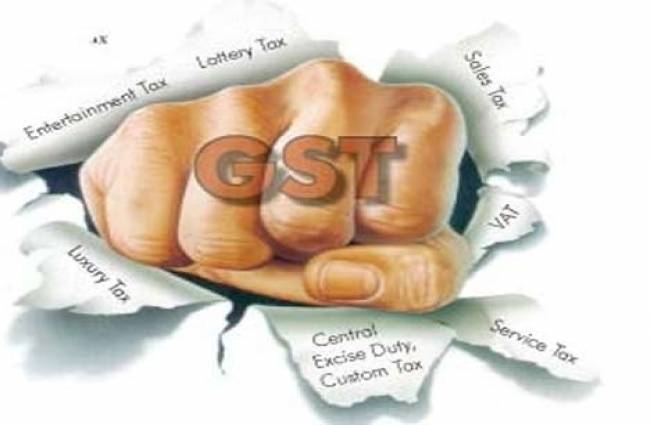
  5. Some of the taxes that are currently levied by the Center which GST would replace are:
    • Central Excise Duty;
    • CVD;
    • Special Additional Duty of Customs(SAD);
    • Service Tax;
    • All cess and surcharge;

These taxes are collected by the Centre.

  1. State taxes that would be subsumed within the GST are:
    • State VAT;
    • Central Sales Tax;
    • Purchase Tax;
    • Luxury Tax;
    • Entry Tax (All forms);
    • Entertainment Tax; Taxes on advertisements, lotteries, betting and gambling;
    • Cess and surcharge that are related to supply of goods or services.
  • Exports would be exempted, that is zero-rated.
  • Credit of CGST paid on inputs may be used only for paying CGST on the output and the credit of SGST/UTGST paid on inputs may be used only for paying SGST/UTGST. In other words, the two streams of input tax credit (ITC) cannot be cross utilized, except in specified circumstances of inter-State supplies for payment of IGST. The credit would be permitted to be utilized in the following manner:
    • ITC of CGST allowed for payment of CGST first and then IGST;
    • ITC of SGST allowed for payment of SGST first and then IGST;
    • ITC of UTGST allowed for payment of UTGST first and then IGST;
    • ITC of IGST allowed for payment of first IGST, then CGST and then can be adjusted for SGST/UTGST.
    • ITC of CGST cannot be used for payment of SGST/UTGST and vice versa.

The Input Tax Credit (ITC) will be made on a broader base; it will be made available in respect of taxes paid on any supply of goods or services or both used or intended to be used in the course or furtherance of business.

GST – what it means for the common man?

One of the benefits of GST is that there are no more hidden taxes, and a consumer is being made more aware of what all taxes he is actually bearing. Instead of just the sales tax or the service tax that he sees in the invoices that he gets in his hands for the restaurants or malls, what are the other taxes that are making way out of his pocket, without him realizing the same!

However, the more basic questions which are still cropping in the minds of common man is whether GST good for the economy; whether it is going be good for a common man? How does it affect the common man, what difference does it make for him?  Why is it that everyone seems to be scared of GST? Will it lead to inflation?

“Change” is something which we try to avoid as long as possible, which is why there is a study to that effect as well, which is more popularly known as “Change Management”.

With India moving towards GST, what the entire industry is facing is effect of Change Management. We are all very comfortable and used to the idea of “Excisable Goods” / VAT / octroi; and here we have another tax to capture – a new tax to adhere to. So there are bound to be hiccoughs in the same.

Implementation issues in GST

Let us see what all are the potential implementation issues in GST. Summarizing them in no particular order:

Transitional procedures

GST is undoubtedly a revolution. A country like India which comprises of more than 30 states shall come under one tax law. However, integration of the different tax laws in one bracket is a huge challenge for the government as well.  Initially several states were opposing inclusion of products via.  Alcohol, tobacco etc. under GST as they may cause loss of major revenue to the State Government.  Compared to the other existing provisions there is lot ambiguity in the definition and meaning of many transactional terms. Altogether new procedures are followed on all transactions on every day basis; still we have a long way to go. Government must focus on effective superseding GST with existing tax laws of d country

Lack of clarity on provisions

GST is coming up with a set of provisions which are much similar to the existing guidelines, as because the fundamentals of taxation are still the same. GST is aimed at making the “extremely complex” tax structure of India into a simplified one. So it is obvious that there will be some points which the lawmakers are unable to see from an execution point of view. Some of these are discussed below:

Tax Returns for GST

From the preliminary discussions on the tax returns, the number of returns to be submitted seemed to have grown manifold, as the provisions requires separate returns for each of the state where a assessee is registered. If one makes a unbiased judgement, then adding all the returns prepared under all the taxes prevalent in the country, the number of returns under GST seem to be same. But what is important and what is different from the older returns is the nexus that is drawn between two assessees. The tax credit which say Mr. A is claiming (as the tax charged by Mr. B), must reflect in the return of Mr. B as payable tax, in order for Mr. A to take benefit of the input credit. This requires a robust infrastructure with appropriate nomenclature for identification of invoices / vouchers is enabled (in the least), so that no credit is lost in the value chain. It also requires huge preparedness for the industry as well to adhere to the strict time lines for availing credit.

Forms related to sales tax

As per the Central Sales Tax law, for availing the concessional rates of sales tax (in case of inter-state sales), certain forms were issued by the dealers. Such forms have been done away with. It effectively means that there is no “concessional” sales tax rate now. The absolutely positive part of it is that the extra burden of this sales tax (CST was non-cenvatable), has been done away with. So at one hand, there is some breathing space, but there is always another side to the coin as well. The transitional provisions do not specifically talk about the manner in which the Forms for the pre-GST period will be dealt with.

Road permit issuance

This is a rather interesting clause, as there are states like Haryana, Maharashtra where there is no requirement of a road permit for movement of goods in those States, and then there are states like Jharkhand, Andhra Pradesh where strict guidelines for Road permits are in place. There is ample ambiguity as to how the state wise check-posts will be functioning in the absence of the road permits for states where they were earlier a necessity. An entrepreneur will actually have to be on their toes in the first few weeks, as we are in a country where there are unscrupulous characters trying to take advantage of the ignorance of the transporters on various fronts. We have seen ample number of such cases when Andhra Pradesh was split into 2 States.

IT infrastructure preparedness for implementation

Government

Another key implementation issue could stem from the proposed technology backbone of the GST system. GST system will be the aggregate of seamless documentation, recording of debits, and dispersal of credits, in addition to the already existing IT system which is in place for the existing tax laws. The Goods and Services Tax Network (GSTN) is the information technology platform that will be used in order to record all GST-related transactions. An ambitious endeavor, the platform aims to hold up to 70 million user accounts.

Industry

For manufacturers and traders, GST requires an extremely robust accounting system where there is minimum gap between receipt of invoices and their subsequent booking. Earlier the concept of taking credit was based on the receipt of goods from the vendors; now the concept will shift drastically to “booking” of invoices. Where a seller has booked his sales invoice and made payment of the taxes on the same to the government, it is equally important for the buyer to book his purchase in order to claim the credit. The knock-off has to happen in the government records in order to have the benefit of the tax credit. It requires huge discipline on the part of the entire industry to enjoy the maximum benefit of this ambitious tax structure.

Consensus on tax rates between Centre and States

There were lots of talks of the revenue neutral tax rates which were to be decided between the Centre and the States. For all states which are high on manufacturing capacity, the revenue loss for them is going to be huge. For GST to be a success, all hands must come together to make the push.

Carry forward of Input tax credit from old regime to GST regime

The GST regime begins from 1st July 2017 at midnight. It subsumes a whole net of taxes, both cenvatable and non-cenvatable. For the stock of goods lying with the traders/manufacturers as on 30-Jun-2017, there is a Input Tax Credit of Excise Duty, Input Tax Credit of Service Tax, et al which would seemingly become cost to them overnight. In order to mitigate the loss, the lawmakers gave the option to take credit of excise duty and service tax for all possible invoices till 30-Jun-17. The result of this clause has been that manufacturers are trying to push maximum material so as to reduce their stock, and the corresponding costs. The manufacturers are taking credit for all material received till such date.

Makeshift arrangement for revenue loss for States

GST has the significant effect on the revenues of the state. Each State had the full authority to use the amount collected through local sales tax without any further sharing formula or subject to the approval from Central Government.  This was a major tussle in the implementation of GST in the past. Several State Governments has restrained their support in the implementation of GST due to this fear of potential revenue loss.  State Governments were demanding compensation from Center as they foresee major dent in revenue due to GST.  The demand for compensation was for 5 years however nod was given Central Government only for 3 years and the debate is still ongoing.

Settlement of old taxes dispute cases

As all are aware there are several running issues with the existing tax system of the country. Issues might be the results of improper drafting of legislation, incorrect understanding and interpretation of statue or may be even the benefit of doubts due to the facts of the law. With the effect of all these several cases are running at the various levels of tribunals or courts at present.  Introduction of new tax law may help in overcoming the legal issues under one legislation, however there has to be proper alignment of the existing cases with the new tax law.  Accurate planning of managing and closing the existing disputes at the earliest will be required from the government authorities, in order to prevent administrative burdens and confusions.

GST provision pertaining to “taxable event”

This is a totally practical problem which users will face one the GST regime is in place, and till such time there are adequate rules and guidelines issued as to where the sales is to be declared. GST is a destination based tax. So for a user who is providing services for commissioning a plant in Visakhapatnam, even though he is registered in the state of Maharashtra, for this one service, his tax liability actually arises in the state of Andhra Pradesh, even though he has no registration in that state. Invoices are required to be booked within a fixed tenure after providing the services; in the industry, we have several instances where the customers do not act in good faith to acknowledge the services so received. This calls for direct loss to the service provider. Other instances pertaining to supply of goods has yet another implication on whether IGST is applicable for movement of goods within the same state, but just that the consignee and the buyer are different entities, and based in different states. Rules, notices on clarity for the same are required to be issued by the government for these.

Shortening of the list of exempted goods & services

Since the objective of GST is to reduce the complexity of the plethora of taxes and the exemptions thereupon, and also to increase the tax net, several of thebenefits/concessionss that were available to assessees in the older tax regime have been done away with, or so to say. The list of exempted goods and services has been left to bare minimum, thereby taxing almost everything. Furthermore, the limits for mandatory registration for assessee has been lowered from the old tax schemes, thereby increasing the base on which tax will now be applicable.

Increase in Working capital requirement

GST comes with a rate which is seemingly on the higher side. Earlier excise duty was chargeable on manufacture of goods, but was paid when goods moved from the manufacturer premise. There was a timing gap nonetheless. Now even stock transfer is taxable. Nothing goes out from the GST net. One potential issue that could arise as a result of the administrative shift is the non-payment of taxes by the supplier. In that case, the buyer will end up having to pay for not only her share of the tax, but also for the supplier’s share of the tax under the proposed tax code. Further, problems could arise, if for some reason there are inconsistencies found in the supplier’s documentation at some later stage. Under this scenario, the buyer will be forced to pay back the tax reimbursement to the government with interest. This problem is usually fixed by market forces, however, as any non-compliant suppliers will soon find themselves losing customers as a result of their negligence. The government has also put in place a mechanism to help with the issue, by providing a publicly available compliance rating system which will allow consumers to pinpoint defaulters as the system starts to take effect over the coming years.

Anti-profiteering Clause

GST is being sold as a concept that aims to bring down costs for the consumer. How this benefit is to be passed, is something which has not been adequately addressed in the legislation so far. The clause included in the GST legislation requires that businesses pass any benefits from the change in tax systems to the end consumer; but it does not provide any mechanism for the monitoring of anti-profiteering activity. There is no way to capture the savings made by the user. As has been suggested by the authorities, the clause, and any subsequent investigation, will instead be triggered by “credible complaints”. How does one really ensure the credibility of the complains?! In a way, this is like giving the tax officials a free hand regarding what is savings and what is not! This kind of situation will give rise to yet another plethora of court cases in front of the various appellate authorities and like.

GST – blessing or not

The GST Scorecard will be out shortly. But for the real result of whether GST is actually the tax which unifies India under one tax head will be evidenced in the coming days.

GST is a much-needed tax reform, and if implemented correctly, can do wonders for India’s economy. Not just that it will eliminate double taxation and lower the product prices, GST will also assimilate the informal sector into the greater Indian economy and provide a much needed boost for India’s flagging export market. Yet there are implementation issues that could be problematic for India’s small businesses and, perhaps more importantly, undermine public trust in GST.

The documentation requirements and their subsequent effects on cash flow and small businesses are difficult to sort out. It is something that one has to live with, given the fact that GST is but the future of the indirect taxes of India.

The GST is an ambitious plan, and government has set similarly formidable benchmarks for its implementation. If not implemented correctly, this version of the GST can have adverse-negative affect the Indian economy for years to come.

This was all on Implementation issues in GST. Hope tha article added value to your knowledge. What are your views on Implementation issues in GST? Comment below and let us know.

References

  1. http://www.cbec.gov.in/resources//htdocs-cbec/gst/gst-concept-status-ason05Apr2017.pdf
  2. http://www.cbec.gov.in/htdocs-cbec/gst/index
Download Now

Corporate Social Responsibility – An Overview For Companies to Opt for Effective Framework

0
Corporate Social Responsibility

In this article, R. Anupam Pillai pursuing M.A, in Business Law from NUJS, Kolkata discusses Corporate Social Responsibility: An Overview For Companies to Opt Effective Framework.

Introduction

In the recent years, business environment has seen a dynamic change in the market when it comes to brand positioning and creating goodwill amongst the customers. Corporates have been more conscious and aware regarding the stakeholders’ rights.[1] As corporates have been viewed as establishments that pander to the business sector request by giving items and administrations, and have the onus for making riches and employments, their business position has customarily been a capacity of money related execution and benefit. Notwithstanding, over the past few years, as a result of climbing globalization and pressing natural issues, the observation of the part of corporates in the more extensive societal connection inside which it works, has been changed. Stakeholders (workers, group, suppliers and offer holders) today are redefining the part of corporates considering the corporates’ more extensive obligation towards social order the earth, past investment execution, and are assessing whether they are leading their part in a moral and socially dependable way.

As an aftereffect of this movement (from simply monetary to ‘financial with an included social size’), numerous discussions, establishments, and corporates are embracing the term Corporate Social Responsibility (CSR). It has been observed that with such changes, companies have pulled up the strings in order to have better image in the global market [2]. In order to do the same Corporate Social Responsibility, has played a vital role in remodeling the company’s brand value and position. It is not a mere business practice but rather phenomena to show respect towards the society which has always stood up to serve the essential needs of the company, straight from the nascent stage of production to that of ensuing route for market stability and sustainability.

Corporate Social Responsibility does not have any concrete definition but it has been evolved as a concept based on the principle of “to give back from where we take”. It is a  commitment to  improve community well-being  through discretionary  business practices  and contributions  of corporate resources.[3] In the recent years there has been a lot of change in the corporate scenario in India and now this concept finds its place in the legislations to make Indian counterparts understand the need of the same.

This paper shall explain the necessity of legal framework for implementation of CSR and when, why and how any company does needs to implement the same.

Emergence Of Csr Spending As A Legal Compulsion

As a result of cross-outskirt exchange, multinational undertakings and worldwide supply chains, there is an expanded mindfulness on CSR concerns identified with human asset administration rehearses, natural security, and well-being and security, in addition to everything else. Investigating the CSR exercises by corporates is in this manner progressively getting required.[4]

In an increasingly fast-paced global economy, CSR initiatives enable corporates to engage in more meaningful and regular stakeholder dialogue and thus be in a better position to anticipate and respond to regulatory, economic, social and environmental changes that may occur.

Financial investors are increasingly incorporating social and environmental criteria when making decisions about where to place their money, and are looking to maximise the social impact of the investment at local or regional levels. [5]

Arguments against CSR spending as a matter of legal compulsion

Theoretical and Jurisprudential Argument

There are many objections that could be made to mandatory CSR spending, both theoretical and pragmatic. These arguments fall into two categories: those that argue that mandatory CSR spending goes too far, and those that argue that mandatory CSR spending does not go far enough.

Those, similar to Friedman, Hannsman, or Macey, who might contend that required CSR spending goes too far, would demand that the proposition makes advertise wasteful aspects that may harm the economy over the long haul. India, all things considered, has been doing great under its liberal monetary administration. Unfathomably, its GDP has been expanding at a rate of very nearly eight percent for each year.

It is one of the fastest-growing economies in the world, and the rising tide has, to at least some extent, lifted all ships. Even the lower classes have benefited from privatization and globalization. Although millions of Indians remain in poverty, millions more have broken past the poverty line and are edging closer to a middle-class existence.[6]

Perhaps the most salient argument against mandatory spending is that it might put India at a competitive disadvantage in the global marketplace and might slow or reverse the country’s near-miraculous growth. Those who already have little might, contrary to the proposal’s aims, fall farther away from the prospect of a middle-class lifestyle. Even if we were to accept Greenfield’s premise that inequality is a market imperfection. Others would contend that the market does require intervention, and perhaps quite rightly, that the proposal is not developed or regulatory enough. Without a coercive enforcement mechanism, it is unlikely that the law would garner sufficient compliance.

In the Western nations, laws do not stipulate mandatory CSR quantum; they only make disclosure of CSR spending mandatory in the annual reports. Thus, with the enactment of Companies Act, 2013 India has become the first country to have CSR spending mandated by the law.

Criticism against Such Mandate

The Planning Commission has been of the view that CSR should not be made mandatory; rather companies should take up CSR voluntarily. Making CSR mandatory will lead to corrupt practices and meddling by high-handed implementing authorities. Some members believe that making CSR mandatory would encourage companies to reduce wages, fudge accounts, or indulge in unfair practices. The best way would be to make them more accountable to the system and the society by rewarding good behaviour, and the way do that is to empower SEBI to move towards global standards and enforce them strictly.[7]

Earlier, Planning Commission Deputy Chairman Montek Singh Ahluwalia has said that making CSR mandatory would amount to “privatizing taxation.” He said if the Government wants it can increase the rate of corporate tax to 32 per cent from the current 30 per cent rather than making it mandatory for companies to spend 2 per cent on CSR and add complications.

Experts also agree with the Planning Commission and ask when companies are already paying taxes, why the Government is not able to use that money effectively for social welfare activities? They also feel politicians and political parties too will be able to pressure the corporates if CSR becomes compulsory.

Corporates’ Reaction over such spending

Section 135 of the Companies Act, 2013 is seen with suspicion by the corporate houses, although the government position was clarified by Veerappa Moily, the then Union Corporate Affairs Minister,“We are not interested in micro-management of a company. Section 135 is just an oversight clause.” While the Minister of Corporate Affairs indicated that some executives were supportive of the two percent mandate, most of India Inc. was immediately up in arms.[8]

The Confederation of Indian Industry asserted, “The law should not specify any amount to be spent on CSR activities. It should be left to the decision of the board.”[9] Infosys Technologies CEO Kris Gopalakrishnan, the Managing Director of Sonata Software B. Ramaswamy, Wipro Chairman Azim Premji, and Piramal Group Chairman Ajay Piramal, all openly spoke out against the measure.[10] But corporate India feels that it would lead to unwarranted intrusion into its affairs as well as harassment through vexatious inquiries by government inspectors to verify the mode and extent of compliance with the law. It has been vociferously claiming the right to decide its CSR for itself and according to its own enlightened self-interest and conscience.

Arguments favoring CSR spending as a legal mandate

The major standpoint of mandating CSR spending, instead of imposing extra charges, would be the safeguarding of the organization’s self-rule in choosing how its assets are utilized. To some degree, the organization would be “free” to put its assets in the group straightforwardly or in a neighborhood non-benefit or national NGO. Organizations could utilize the cash to additionally limit externalities, past the prerequisites of natural law, or they could make positive externalities by building schools or giving specialists more far reaching benefits. [11]

Additionally, companies may invest their money more efficiently than the government would, and in ways that will inure to their long-term benefit. An explanation for the prominence of education spending, for example, may be that investing in schools promises to have direct returns for the company. A more educated local workforce is certainly a boon to any industry, especially the information technology sector, which continues to grow in India. Given the level of corruption that persists in many developing countries, corporations may actually produce more impactful public goods than governments at a lower cost.

The second major argument for mandatory CSR spending is that countries like India are desperately in need of funding for development. However, if hampered by a liberal and competitive global economy, it is difficult for them to impose steep taxes or comprehensive regulation. Although as per Greenfield’s contention that corporations really are public enterprises, it makes good sense to require them to contribute to the public good—primarily by making money, but secondarily by spending some portion of it on development. Two per cent CSR spending would simply bring India in line with CSR expenditures in the United States,[12] and the money for development is certainly more desperately needed in India, where at least one-fifth of citizens live in poverty and where the public health and education systems are famously dysfunctional. Hence it would help in better funding for the welfare of poor and needy.

Legal Provisions Pertaining To CSR Activities Amongst Various Corporates

International Legal Instruments and Guidelines

In the recent past, certain indicators and guidelines such as the SA8000, a social performance standard based on International Labour Organization Conventions have been developed. International agencies such as United Nations and the Organization for Economic Co-operation and Development have developed compacts, declarations, guidelines, principles and other instruments that set the tone for social norms for organisations, though these are advisory for organisations and not mandatory.[13]

One of the United Nations Millennium Development Goals calls for increased contribution of assistance from country states to help alleviate poverty and hunger, and states in turn are advising corporates to be more aware of their impact on society. In order to catalyze actions in support of the MDGs, initiatives such as Global Compact are being put in place to instrumentalize CSR across all countries. As the world’s largest, global corporate citizenship initiative by the UN, the Global Compact, a voluntary initiative is concerned with building the social legitimacy of business.

The Global Compact is a framework for businesses that are committed to aligning their business operations and strategies with ten universally accepted principles that postulate that companies should embrace, support and enact, a set of core values in the areas of human rights, labour standards, the environment, and anti-corruption.[14]

Voluntary Guidelines, 2009: An attempt to answer few calls regarding CSR

With a specific end goal to help the organizations to embrace capable administration hones, the Ministry of Corporate Affairs has arranged an arrangement of deliberate rules which demonstrate a portion of the center components that organizations need to concentrate on while leading their undertakings.

These rules have been set up in the wake of considering the administration challenges confronted in our nation and in addition the desires of the general public. The profitable recommendations gotten from exchange and industry chambers, specialists and different partners alongside the universally predominant and rehearsed rules, standards and principles in the range of Corporate Social Responsibility have likewise been considered while drafting these Guidelines.[15]

Each business entity should formulate a CSR policy to guide its strategic planning and provide a roadmap for its CSR initiatives, which should be an integral part of overall business policy and aligned with its business goals. The policy should be framed with the participation of various level executives and should be approved by the Board.

Core principles of Voluntary guidelines are as follows:

  • Care for all stakeholders.
  • Ethical functioning.
  • Respect for human rights.
  • Respect for workers rights and their welfare.
  • Respect for environment.
  • Activities for social and inclusive development.

Implementation Guidance under Voluntary Guideline, 2009

  1. The CSR approach of the business substance ought to accommodate implementation steps which ought to incorporate distinguishing proof of activities, setting quantifiable physical focuses with time allotment, hierarchical system and obligations, time lines and observation. Organizations may band together with nearby specialists, business affiliations and civil society/non-government associations. They may impact the production network for CSR activity and spur representatives for willful exertion for social improvement. They may advance an arrangement of appraisal and effect evaluation while undertaking CSR exercises in a specific zone. Independent assessment may likewise be embraced for chosen ventures/exercises now and again.
  2. Companies should allocate specific amount in their budgets for CSR activities. This amount may be related to profits after tax, cost of planned CSR activities or any other suitable parameter.
  3. To share experiences and network with other organizations the company should engage with well established and recognized programmes/platforms which encourage responsible business practices and CSR activities. This would help companies to improve on their CSR strategies and effectively project the image of being socially responsible.
  4. The companies should disseminate information on CSR policy, activities and progress in a structured manner to all their stakeholders and the public at large through their website, annual reports, and other communication media.[16]

In spite of these guidelines there was a sole need to include CSR spending as a mandate provision under Companies Act, 2013 for the reason being changing scenario of business environment in India.

CSR vis-à-vis Companies Act, 2013 and Companies (Corporate Social Responsibility) Rules, 2014

According to Section 135 (read with Schedule VII), of Companies Act, 2013 (“Act”), “Every company with a net worth of Rs. 500 crore or more, or turnover of Rs. 1,000 crore or more, or net profit of Rs. 5 crore or more in a financial year will have to form a corporate social responsibility (CSR) committee, consisting of three or more directors, of which at least one would be an independent director.”[17]This committee has to ensure that the company spends, in every financial year, at least two per cent of the average net profits made during the three immediately preceding years, towards CSR activities. Secondly, Schedule VII of the Act enumerates various activities to be covered under CSR. The Act also makes it compulsory for the company to specify reasons if it fails to spend the amount.[18]

In 2014, the rule making committee of MCA has published the draft CSR rules and uploaded the same on MCA website for public discussion and debate. Later on the said rules came into effect as Companies (Corporate Social Responsibility) Rules, 2014(“Rules”). Highlights of the Rules are mentioned herein[19]:

  1. Under the Rules, net profit is defined to mean ‘net profit before tax’ as per books of accounts and shall not include profits arising from branches outside India.
  2. While the reporting framework under the Rules suggest that the unspent amount of the specified CSR spend to be rolled over to the succeeding financial years, it does not clarify whether the excess spend of over and above 2 percent mandatory CSR spend in any particular financial year can be carried forward in succeeding financial year or not.
  3. The Rules provide the format in which all qualifying companies shall report the details of their CSR initiatives in the Director’s report and in the company’s website.

For better clarity to the procedural aspects of CSR implementation, the Rules enlightens following points.

Definition of the term “CSR”– The term CSR has been defined under the CSR Rules which includes but is not limited to:

  • Projects or programs relating to activities specified in the Schedule; or
  • Projects or programs relating to activities undertaken by the Board in pursuance of recommendations of the CSR Committee as per the declared CSR policy subject to the condition that such policy covers subjects enumerated in the Schedule.[20]

CSR Policy: As per Rule 6 of the Rules, CSR policy of a company;

  • Shall enlist all the activities covered by the company pursuant to Schedule VII and not covered by the activities done in due course of business;
  • Shall also monitor the process of such program or projects. and
  • Shall specify that the surplus arising out of the CSR projects or programs or activities shall not form part of the business profit of a company.[21]

CSR Committee: Pursuant to Rule 3 of the Rules, the Committee shall be constituted as per Rule 5, which stipulates;

  • For unlisted public company or private company, in case there is no independent director then it is not necessary to have one in the CSR Committee;
  • For private company with only two directors, the CSR Committee shall only comprise with those two;
  • For foreign company the constitution shall be pursuant to Section 380(1) of the Act.[22]

CSR Expenditure: It is the expenditure pertaining to CSR activities including contribution to corpus for projects or programs as approved by the Board.

CSR Reporting: The company shall report the CSR activities at the end of Financial Year ending on 1st April of every year, in the Board’s Report as per Annexure mentioned in the Rules. In case of a foreign company, the reporting shall be done in the balance sheet as per Section 381(1)(b) of the Act.

Hence the Act and Rules describes the manner and scope of such CSR spending by the Companies. There is another peculiar issue of how to implement and manage CSR under the said garb of regulations, which has been described in next paragraph.

Steps in implementation of CSR framework in a company

Understanding threshold for applicability of CSR provisions to a Company

As per applicable provisions of Act and Rules, every qualifying company as per Section 135 (read with Schedule VII), of Companies Act, 2013, “Every company with a net worth of Rs. 500 crore or more, or turnover of Rs. 1,000 crore or more, or net profit of Rs. 5 crore or more in a financial year will have to form a corporate social responsibility (CSR) committee, consisting of three or more directors, of which at least one would be an independent director.”[23] Furthermore the appointment of committee and policy eventually comes into play once a company ensures that it is covered under the said ambit.

Role of CSR Committee

  1. Every qualifying company needs to constitute a CSR committee of the Board consisting of 3 or more directors.
  2. Though the CSR provisions under the Act required minimum 3 directors for constitution of CSR committee, the issue that needs to be clarified is whether qualifying private companies (which requires minimum two directors only) would be required to appoint one more director only to constitute CSR committee and comply with the CSR provisions.[24]
  3. The mandate of the said CSR committee shall be:
  4. To formulate and recommend a CSR policy to the Board;
  5. To recommend amount of expenditure to be incurred on CSR activities;
  6. To monitor the CSR policy of the company from time to time.

Guidelines regarding spending in CSR activities by companies

The company can set-up a not-for-profit organisation in the form of trust, society or non-profit company to facilitate implementation of its CSR activities. However, the contributing company shall specify projects/programs to be undertaken by such an organisation and the company shall establish a monitoring mechanism to ensure that the allocation to such organisation is spent for intended purpose only.

Company may also implement its CSR programs through not-for-profit organisations that are not set up by the company itself.  Such spends may be included as part of company’s prescribed CSR spend only if such organisations have an established track record of at least 3 years in carrying on activities in related areas. Companies may also collaborate or pool resources with other companies to undertake CSR activities.  Only CSR activities undertaken in India would be considered as eligible CSR activities.  CSR activities may generally be conducted as projects or programmes (either new or ongoing), however, excluding activities undertaken in pursuance of the normal course of business of a company. CSR projects / programs may also focus on integrating business models with social and environmental priorities and processes in order to create shared value. CSR activities shall not include activities exclusively for the benefit of employees and their family members.[25]

How to implement CSR effectively?

The following checklist shall be mentioned for effective implementation of CSR program or project;

  1. CSR Policy to be implemented as per the special resolution by the Board meeting.
  2. Projects/Programs for implementation of CSR activities shall be compliant with Schedule VII of the Act
  3. CSR Committee shall be constituted pursuant to Section 135(3) of the Act and Rule 3 of the Rules.
  4. CSR fund shall be made pertaining to the CSR expenditure.
  5. Average net profit to be calculated pursuant to Section 198 of the Act for the purposes of contribution to be made as per Section 135 of the Act.
  6. Annual Board Report shall be made as per Annexure of the Rules.
  7. Auditing report shall mention about the CSR expenditure.

For better understanding of CSR framework and its applicability we shall discuss a case study on how a well-known company has implemented CSR and carries CSR activities for inclusive growth and development.

Case Study for implementation of CSR under Companies Act and Rules

The case study referred herein has been conducted for the purpose of understanding how CSR has been implemented and what CSR activities come under the ambit of Rules. For the purpose of this article the following illustration elucidates how CSR activities are carried by Bhilai Steel Plant, SAIL, India.

CSR department, BSP was established in October, 2006 but the initiatives related to CSR were practiced by the BSP since its inception. Earlier the CSR related work were managed by Peripheral Department, BSP. There are 17 members including both executive and non-executive posts in the CSR department. The office of CSR, BSP is located at Sector-6, Bhilai, Durg, Chattisgarh. The vision of CSR department, SAIL is “Making a meaningful difference in people’s lives” explains the SAIL’s initiatives to be directed to the better welfare of the people. While implementing various initiatives the department has changed its perspective of doing work for mere philanthropic motives and has taken care of the very concept of CSR in mind by strictly working for the benefit of the society in which the plant operates and not for employee welfare as there has been a separate Employee’s Welfare Association. The area of action for CSR activities have been defined within a periphery of 16 kilometers, surrounding the BSP which includes a total of 136 villages. Directorate of Public Enterprise,2013 guidelines are followed that explains the procedure for doing activities related to Corporate Social Responsibility. The Corporate Social Responsibility Policy of SAIL is as follows:

SAIL recognizes that its business activities have direct and indirect impact on the society. The Company strives to integrate its business values and operations in an ethical and transparent manner to demonstrate its commitment to sustainable development and to meet the interests of its stakeholders. The Company is committed to continuously improving its social responsibilities, environment and economic practices to make positive impact on the society.

Guiding Principles

Toward this commitment, the Company shall:

1) Create a positive footprint within the society to make a meaningful difference in the lives of people by continually aligning its initiatives to the goals for sustainable development.

2) Maintain commitment to quality, health and safety in every respect of the business and people.

3) Undertake ethical business practices across the supply chain.

4) Make positive impact on the environment and promote good environmental practices.

5) Promote equality of opportunity and diversity of workforce throughout its business operations

On account of following CSR policy, CSR dept., BSP has undertaken various initiatives as a part of CSR in the defined area of 16kms periphery surrounding BSP. These initiatives can be further divided into following heads:

Education

  1. BSP offers subsidized education to children belonging to weaker section and Below Poverty Line (BPL).
  2. BSP has joined hands with Akshay Patra Foundation for providing free midday meals to 25,000 under-privileged children in and around Bhilai, with the support of State Govt. of Chhattisgarh. An MOU was signed between SAIL & APF and as part of the undertaking the Chhattisgarh State Govt. will be providing subsidy and food grain etc. for 5 years and BSP will provide 50% of the cost of the meal i.e. Rs. 3/- per meal. The program was started on 27th January 2009 and by 1st April 2009 the scheme was covering 25,000 children. Currently a temporary centralized kitchen set-up by BSP is supplying midday meal to 123 Govt. schools, including both primary & upper primary, and covering more than 30,000 children enrolled in these schools.
  3. BSP has ensured high literacy levels above than the national average at these schools so that it has made efforts to fulfill Minimum Development Goals of Achieving universal primary education (Goal 2) and Promoting Gender equality and Empowerment (Goal 3).

Infrastructure

  1. 21 Model Steel Villages have been identified out of which 19 have been completed.
  2. Infrastructure activities include construction of community halls, public toilets, road pavements, bore wells, cultural halls, bus stands, playgrounds, additional classrooms, health centre etc. have been constructed at these villages with an annual expense of 25 lakhs per annum on rotational basis.

Health and medical care

  1. 248 medical camps have been done and more than 14000 patients were treated.
  2. Special camp for physically disabled was conducted on January 15,2013 for distribution of artificial limbs/ aid to 263 patients.
  3. A mega medical camp took place at Marra village, Patan block, Durg, that benefitted about 4200 patients.
  4. 16 medical camps were organized at Rowghat mines covering 6409 patients.
  5. 14 medical camps were organized at Rajharah mines covering 5232 patients.
  6. With the help of Muskan, an NGO a rehabilitation centre has been created for treatment of children with mental disabilities.

Sports and Culture

  1. Khel mela was organized on November 12, 2012 at Narayanpur.
  2. All India Football Tournament was organized at Narayanpur.
  3. Lok Kala Mahotsav was organized at Bhilai for 3 days as well as at Rajharah, Rowghat an Nandini in May,2012.
  4. 5 Gramin Lokostova were organized in 5 MSV’s.

Income Generation

  1. Vermi Compost Scheme launched in 3 MSV’s, covering over 30 villages as well.
  2. SWAYAM SIDHA, a self help group comprising of women in rural areas help in income generation by selling handmade agarbattis and papads.

Skill Development

  • Vocational Training to 483 youths were provided in 44 courses.
  • A new training course of 4 months duration for training nursing aid/ bedside attendant has been started.
  • Bahu Kaushal Bal Vikas Prashikshan Shivir has been conducted for development of different skills of school children.

Women Empowerment

  • A seven member small group has been formed namely Sapta Bahna to propogate CSR activities in Piperchedi and nearby villages.
  • Adoption of 16 girls from Rowghat village for training them with nursing course has been done.

Access to proper water resources

Water harvesting has been done by constructing a pond at Sector-7, near Siyan Sadan, Bhilai, Durg.

Environment

  • More than 3,20,000 trees have been planted.
  • Smokeless Chullah have been provided to 4000 families in 21 MSV’s.
  • Awareness initiative had been organized to ban use of polythene.
  • Solar lanterns have been distributed in the villages.
  • With the help of INSDAG, Kolkata, 8 bullock carts made up of steel have been distributed.

Steps in which CSR activities are carried on are as follows

  1. Base line Survey is carried for the need assessment of the beneficiaries in a sample area with the help of an NGO. In BSP, Society for Rural Industrialization (SRI), Ranchi conducts the base line survey.
  2. This need based assessment is carried against the allotted budget which comprises of 2% of Profit After Tax (PAT) by SAIL.
  3. Impact Assessment is done by third party to check whether the scheme/ program has been properly implemented or not. In BSP, NABARD conducts then impact assessment.
  4. (Audit, both internal as well as external is done at regular intervals.

Some issues and challenges faced by CSR, BSP

  1.  With coming up of DPE guidelines the CSR department is very open to get all sort of questions pertaining to fund and budget allocation under Right to Information Act,2005, this makes the department to work more accountable and responsible.
  2. There are instances were there is chance of theft of construction materials in villages as there’s lack of supervision.
  3. Sarpanch’s tenure is for 5 years and it seems to be a hectic job to get clearance or NOC on time.
  4. There are instances when there is a need for further assistance required or demanded by the village community regarding maintenance of roads or buildings which is not viable at times.

The above mentioned case study explains what are the points which a company needs to keep in mind while implementing CSR activities and how to ensure it complies with all regulations per se.

Conclusion

CSR has seen paradigm shift from philanthropic event to legal mandate. With coming up of Rules and Section 135 of Companies Act, 2013, there has been plethora of issues pertaining to its applicability and scope of implementation.

The proposed mandatory 2 per cent CSR spending is actually unnecessary for two reasons: One, its proper implementation is impractical and two, social pressures and adoption of voluntary operational norms are more effective. International bodies also prophesize “soft norm” rather than legal binding “hard” rules. There is another reason against mandatory CSR spending. It is the changed nature of today’s world. The widespread penetration of Internet around the world has turned it as a powerful platform for information dissemination and expressing concerns. This has increased pressure on companies to mind their conduct and heed public opinion.

Finally, more and more companies are discovering that integrating CSR strategies make their operations more profitable and sustainable. This presents an opportunity for NGOs and social organization. They can expect greater partnership with the corporate world in the coming future. It is in their interest to gear up for such collaborations and utilise core competencies of the business houses.

References

[1] Robyn Lansdowne, Jillian Segal, ‘The Social Responsibility of Modern Corporations’, 2 U.N.S.W.L.J. 336 (1977-1978), p.338.

[2] C.V. Baxi, Ajit Prasad, Corporate Social Responsibility: Concepts and Cases,[1st edn, Excel Books 2005], p. 8.

[3] Phillip Koetler & Lee Nancy,  Corporate Social Responsibility: Doing the Most Good of Your Company and  Your

Cause, (2005) at  21, John Wiley & Sons Inc..

[4] Harsh Shrivastava, Shankar Venkatasweran, The Business of Social Responsibility: The Why, What and How of Corporate Social Responsibility in India, [New Delhi, 2005], p.24.

[5] N. Balasubramanian, Corporate Boards and Governance, [Sterling Publishers, 1998], p.158.

[6] C.V. Baxi, Ajit, Supra note 2, p.5.

[7] Companies spending 2 pc on CSR will have a multiplier effect: Finance Minister, The Economic Times,(2013), available at  http://articles.economictimes.indiatimes.com/2013-11-11/news/43930407_1_csr committee-csr-activities-new-companies-act,

[8] CSR   clause   just   “an   oversight”    provision,    says   Moily,    Moneycontrol,   available   at, http://www.moneycontrol.com/news/wire-news/csr-clause-just-quotan-oversightquot-provision-says-moily_635048.html,

[9] Akhila Vijayaraghavan, Indian Industries Oppose Mandatory CSR Reporting, Just Means (2010), available at http://www.justmeans.com/editorials?action=readeditorial &p=26759

[10] IT   CEOs   back   Premji   against   mandatory   CSR,   TIMES   OF   INDIA,   (2011),   available   at  http://articles.timesofindia.indiatimes.com/2011-03-26/software-services/29191926_1_csr-azim-premji corporate-social-responsibility,

[11] C.V.Baxi, Supra note 2, p.5.

[12] Viji Sundaram, Vinod Khosla To Donate Half His Fortune to Charity, New America Media (2011),  available

at http://ethnoblog.newamericamedia.org/ 2011/05/vinod-khosla-to-donate-half-his-fortune-to-charity.php,

[13] KPMG, Whitepaper on CSR, (2006), available at http://www.kpmg.com/in/en/services/advisory/risk-compliance/documents/whitepaper%20on%20csr.pdf

[14] Ministry of Corporate Affairs, Corporate Social Responsibility Voluntary Guidelines, 2009.

[15] Ibid.

[16] Corporate Social Responsibility Voluntary Guideline,2009, Taxmann Online, available at  http://www.taxmann.com/datafolder/Flash/Flashbn22-12-09_2.htm,

[17] Section 135, Companies Act, 2013.

[18] Company Act 2013: CSR and Corporate India, DNA India, available at,  http://www.dnaindia.com/analysis/column-company-act-2013-csr-and-corporate-india-1949600,

[19] Companies (CSR) Rules, 2014, Ministry of Corporate Affairs, also available at http://www.mca.gov.in/Ministry/pdf/CompaniesActNotification2_2014.pdf

[20] Corporate Social Responsibility – Indian Companies Act 2013, Mansukhlal and Co., (2015) available at

http://www.mondaq.com/india/x/366528/Corporate+Governance/Corporate+Social+Responsibility+Indian+Companies+Act+2013

[21] Rule 6, Companies (Corporate Social Responsibility) Rules, 2014

[22] Rule 5, Companies (Corporate Social Responsibility) Rules, 2014

[23] Section 135, Companies Act, 2013.

[24] New Rules for Corporate Social Responsibility, available at http://www.nishithdesai.com/information/research-and-articles/nda-hotline/nda-hotline-single-view/article/new-rules-for-corporate-social-responsibility-in-india-its-effectiveness-and-legality.html?no_cache=1

[25] Ashima Chachara, Corporate Social Responsibility- Highlights, CAclubIndia, available at  http://www.caclubindia.com/articles/corporate-social-responsibility-highlights-18846.asp#.UzMSO_mSx65,

Download Now

Rivers as Juristic Persons

0
juristic persons

In this article, Mitakshara Goyal gives the jurisprudential answer on the status of Indian Rivers as juristic persons.

Recently, the Supreme Court has stayed the decision of the Uttarakhand High Court in the petition, Mohd. Salim v. State of Uttarakhand. The Court distinctly took the initiative to hold rivers Yamuna and Ganga as juristic persons (legal entities) capable of enjoying all legal duties, obligations, and rights as a living being. Subsequently, this legal personality along with the corresponding rights was extended to the Ganga Yamuna glaciers in a follow-up order, that fed into these holy waters.

It is the first time that Indian courts have ever recognized any part of natural environment as a legal person. This decision wasn’t restricted to these two holy waters, but all their tributaries, streams, every natural water body flowing simultaneously flowing into these rivers. But the question arises what extraordinary condition as to what triggered such an extraordinary decision? Moreover, the extent to which this radical judicial decision will amend the depleting health of the water bodiess is to be analyzed.

FACTS

It has been widely identified that the ecological state of the rivers with respect to excessive water pollution and illegal constructions has led to their destruction. The above-mentioned judgment was triggered was the ineffective application of the judicial decision on a petition of protection of Ganga and Yamuna banks from illegal constructions in 2005. A local resident, Salim had filed a petition due to encroachment at the banks of Shakti canal in the Dehradun district of Uttarakhand and asked the Court to initiate the Central government to manage the water resources accordingly.

The Court in this petition dealt with issues of federalism regarding the extent to which State could order the Central government through its judiciary. However, Justice Rajiv Sharma and Alok Singh upheld it to be well within the scope of the judiciary to pass such a guiding order considering the state individual supremacy as a character of federalism.

In December 2016, it was held that the people eviction of individuals involved in the encroachment of banks of Yamuna, and the Central government is required to clarify the division of jurisdiction of the state governments of Uttarakhand and U.P. It further directed a constitution of Ganga Management board, under Section 80 of the Act, effective within three months. Moreover, it prohibited any mining activity on the riverbed and flood plain of Ganga. However, as the Court analyzed the progress regarding the situation of the river in the disputed land, it was alarming. The encroachments and constructions were untouched and the State settlements were stalled. Additionally, there seemed a lack of sense of the alarming destruction of the waterbodies by the State actors who did not bother to constitute a management board as previously directed by the Court.

This regrettable insouciance and inability of the State to make necessary actions for the protection of the natural waterbodies was recognized as an ‘extraordinary situation’ for the Court to make a radical intervention for the well-being of these depleting natural resources. It was observed that most of the agrarian society of India has been dependent on these enormous water bodies for physical sustenance and wellbeing of the community. India’s majority population rely on the lands irrigated by the Ganges and Yamuna for daily livelihood as these holy waters intersect more than fifty cities. The alarming gallons of garbage and sewage dumped in these waters have made these two holy

The alarming gallons of garbage and sewage dumped in these waters have made these two holy waters, the two most polluted water bodies in the world. The several failed attempts to clean these rivers due to the enormity of the task has been a constant concern of environmentalists and ecologists all over the world. The Court recognized the callous human activity that was not only depleting the sacred waters of Yamuna and Ganga, but also risking the potential future of the Nation. To expedite the protection of the depleting water resources, it declared the waterbodies as juristic person in the Indian legal framework, with all corresponding rights, duties and liabilities of a living person. The following sections would elucidate the different parameters adjudicated upon by the Court to come to this conclusive decision to impose a ‘juristic’ personality to the two waterbodies, Ganga and its tributary Yamuna.

NEW ZEALAND’S INSPIRATION

This adventitious unprecedented decision was inspired by the prior decision by the government of New Zealand in 2012 (came into effect in 2017). A recent Bill named Te Awa Tupua (Whanganui River Claims Settlement), passed on March 15, 2017, settled the 140 years long dispute and negotiation based on historical claims by the Maori tribes relating to the Whanganui river and declared it to be a living person with legal rights. The legislation provided two officials, one from the one from the Whanganui iwi and one government representative, to represent the interests of the river as a legal entity. It was observed that the wellbeing of the river was linked to the sustenance of the people, that makes river’s identity equivalent to that of a person. This recognition was made to enhance the ability to enforce legal environmental protections that it is entitled to, along with claiming compensations for the abuses it suffers by mankind.

SIGNIFICANCE OF ‘MAA GANGA’

Further, the Court highlighted the significance of the Ganges along with its largest tributary Yamuna, to derive its juristic personality in the Indian legal system. Ganges (referred to as Maa Ganga) originates from Gangotri in Uttarakhand and travels 2500 kilometres stretch through several states including 52 cities and 48 towns and the nation of Bangladesh before discharging into the Bay of Bengal. The Yamuna is its largest tributary and emanates from Yamunotri in Uttarakhand. The Court reinstated the existence of these water bodies as vital to the physical and spiritual sustenance to maximum communities cohabiting from mountains to the sea. The Court stated “ All the Hindus have deep ‘

The Yamuna is its largest tributary and emanates from Yamunotri in Uttarakhand. The Court reinstated the existence of these water bodies as vital to the physical and spiritual sustenance to maximum communities cohabiting from mountains to the sea. The Court stated “ All the Hindus have deep ‘astha’ in rivers Ganga and Yamuna and they collectively connect with these rivers. The rivers are central to the existence of half of Indian population and their health and wellbeing.”

Furthermore, The Court recognised the ‘startling revelation’ made by the senior joint commissioner, Ministry of water resource & Ganga rejuvenation, that “despite long correspondence, neither the state of UP nor the state of Uttarakhand is cooperating with the central government for the constitution of Ganga Management Board”. Along with the discussion on the inaction of the State government, the laxity of the Central Government to implement a cleansing program worth 20000 crores for the water bodies in 2014 has been stressed upon. The Court gave the Centre eight weeks to set up Boards for cleaning the rivers. Thirteen out of 20 existing or proposed treatment plants were in Uttarakhand. These were to be either set up or upgraded. The central government had planned to start implementation with 40 villages that it had marked for development. The Court gave a three-month period to the Uttarakhand state government to form a state Ganga Management Board. Moreover, The Court authorized the suspension of the District Magistrate if he failed to clear the government land within seven days from the date of the order.

Highlighting the severity of the extraordinary situation of loss of existence of the Ganges and Yamuna, the Court additionally stated that “there is utmost expediency to give legal status as a living person/legal entity to Rivers Ganga and Yamuna (citing) Articles 48-A and 51A(g) of the Constitution of India”

“PARENS PATRIA”!

Using the above-mentioned fact situation, the first order majorly held a valid jurisdiction of the state of Uttarkhand to do direct the Central Government for essential actions to protect the endangered nature, recognizing the rivers as juristic person within the Indian legal system. However, the recent most comprehensive order declaring glaciers too have a legal personality, focused on the concept of ‘parens patriae’ as a juridical concept for the states within a federal structure as an aid to protect their natural environment. ‘Parens Patria’ is recognized as the guardianship of the state of the rights of entities which are unable to fight for their own rights. This empowers the states within a federal structure, to assert the rights of rivers on their behalf, against being polluted, or diverted, or their environment being violated within several human activities. It highlights the inherent role of the sovereign as parents of the country, to claim protection for the entities that are impaired to claim their rights themselves. Though on the face of the decision, it seems to be an ideal solution to the emerging environmental issues regarding the natural living entities, however, it is imperative to dwell into the implementation of the order and the impact of the same.

IMPLEMENTATION OF THE ‘LEGAL STATUS’ OF THE RIVERS:

The Courts designated the authority of representation of the rivers to file all complaints about any violations of the rights of the rivers. After the two orders, the Chief Secretary, State of Uttarakhand, Director NAMAMI Gange Project, Mr. Praveen Kumar, Director (NMCG), Mr. Ishwar Singh, Legal Advisor, NAMAMI Gange Project, Advocate General, State of Uttarakhand, Dr. Balram K. Gupta, Director (Academics), Chandigarh Judicial Academy and Mr. M.C. Mehta, Senior Advocate, Hon. Supreme Court, have been provided with the status of loco parentis as the human face to protect, conserve and preserve all the Glaciers including Gangotri & Yamunotri, rivers, streams, rivulets, lakes, air, meadows, dales, jungles, forests wetlands, grasslands, springs and waterfalls in the State of Uttarakhand. Moreover, they are meant to ensure the preservation and maintenance of the juristic persons against the individuals exploiting it for personal errands. Along with these negative rights, they must carry on schematic programs for the cleansing and rejuvenation of the water bodies and get the required funds sanctioned for the same. This includes the protection of the universal character of the river of free flow which can be maintained by regulating the obstructions and commercial constructions such as dams and hydropower projects. However, the extent to which these custodians will be successful their exercise of power to mitigate the depletion of natural resources seems questionable.

EFFECT OF THE LEGAL STATUS

The effect of the legal status can be derived from the New Zealand decision that upheld the legal status of the river which wasn’t supposed to be used interchangeably with ‘legal rights’. This status of the river highlighted that the law would make no differentiation between harming the tribe and the river in case of exploitation of the river, because they are one and the same.

Similarly, in the Indian context, it implies that earlier, to bring a claim against an industry for pollution of a water body, the complainant had to prove violation of its legal and vested interest in the river. The damage cause by the challenged activities should have a direct nexus to the hampering of the livelihood and the cohabiting communities around the river. Once proven, a certain amount of damages and compensation was to be paid to the affected parties. However, after the High Court’s order, rivers are treated as living individuals accorded with same fundamental rights. Thus, any lawsuit against the exploitation or damage to the river, would include the river as a party through the Court designated representatives. The burden of proof would be on the accused party to prove either that it lacked participation in any prohibited activities against the river or the challenged activities were legally justifiable.

INCONCLUSIVENESS IN THE CONCLUSION OF THE DECISION

Though the New Zealand case has several similarities with the present case on protection of the natural resources, there is a distinct difference in the personhood between the holy waters Ganga and Yamuna as opposed to Whanganui river in New Zealand. The decision majorly recognized the river as a juristic person with the aim to determine power distribution agreement about the management of a protected restricted area with its limits and boundaries being distinctly clear. However, in India, Ganga and Yamuna have no limited scope of boundaries as they seem to diverge into to everlasting tributaries. Being trans boundary rivers, there are several tributaries merging in the holy waters, not only from Indian states but also from Bangladesh and Nepal. In such a case, it is difficult to visualize the official of Uttarakhand representing all the states where the holy waters pass and have tributaries merging into them.

Secondly, though the Uttarakhand High Court decision depicts judicial activism and the uniqueness of such an unprecedented decision, its effectuality can be disputed on its limited scope of enforceability that extends only to Uttarakhand. The issue of territorial jurisdiction crops up, due to the recognition of the entire river basic as a living person. There seems to be excessive exercise of powers beyond the jurisdiction of the Court., Though matters regarding water come under the State list, however, through Entry 56 of the Union List, the Union government can legislate on inter-state rivers like the Ganges and its tributaries. This decision might amount to inter-state conflicts, as each state will have its own territorial claims over the living person that is the Ganges.

Additionally, the Court has not thrown light on as to who exactly will be prosecuted in case of compromise of the rights of the entity? This seems to provide unfettered discretion in the hands of the government analyzing the causes of the violation of the rights that tends to move against the poor and marginalized. Since there have been no guidelines formulated by the Court to recognize the offenders in such cases, it is most likely to target the unaided underprivileged community that have the least to add to the violations of the rivers and other natural resources. It seems very unlikely that the officers will hold the great industries contributing carbon dioxide or other greenhouse gasses to the atmosphere, as liable. One of the instances based on which this prediction is based is the Courts statement about the protection if holy waters in Haridwar. It directed the District Magistrate in Haridwar to ensure the restriction on accessibility of beggars near the Ghats, myopically viewing beggars and the underprivileged communities responsible for depletion of the holy rivers.

Furthermore, the concept of parens patria was also deployed by the Indian government, in the Bhopal Gas tragedy case to represent the claims for compensation for the victims. However, the district court denied India the right to exclusively represent the plaintiffs and never provided whether India had proper standing to sue under parens patriae. This was viewed as a “disaster” for the case causing continued failure.

Moreover, there is an evident logical inadequacy in the present decision. There seems to be no reason to distinguish one inanimate object from other. Recognizing only the objects related to the Ganga and Yamuna, denying the same juristic personality of the other distinct rivers seems problematic. It’s a slippery slope to literally anything being granted personhood status, so long as someone believes it has value. There seems to be decisive factor to determine the extent the imposition of such artificial legal personality can restricted in the case of inanimate subjects. Will soon trees, forests, rocks, hill be recognized as juristic persons and how viable will such a situation be?

These questions triggered from the indeterminate and superficial decision of the Court that though seems to be a rich legal decision, but lacks efficacy in actual applicability of the same. There seems to be a need to identify the to ascertain standards and measures for the protection of the natural resources and whose violation would have harsh implications that must be well implemented. Environmentalists and lawmakers should collectively provide legislations of regulating and harmonizing the human activities and the ecological development of natural resources simultaneously.

Download Now

All you need to know about Right To Information in India

1
Right to information

In this article, Parthapratim Das pursuing M.A, in Business Law from NUJS, Kolkata discusses All you need to know about Right To Information in India.

Right to information is the sign of advancement of human civilization

The right to information as propounded in the Right to Information (RTI) Act, 2005, is the culmination of a stage in the advancement of human civilization. It is the embodiment of one of the mature facades of the democracy flourishing in the country. This right is also an index of growth of human rights and liberties in their vital palpitations, spontaneously flowing from the democratic credentials of the Country.

With the mental growth and advancement of science, technology and industry the growing consciousness of human rights and liberties paved way for democratic form of governance. Freedom is an inbuilt desire in almost every animate being. Therefore the growing consciousness for various liberties resulted in revolutions against the autocracies and monarchies in the various parts of the world and the political scenario was visited by democracy, growing and flourishing in a big way, in many countries of the world. The one of the major endeavors of democracy was to accord growth of human liberties and dignity.

Since our independence was the result of centuries old struggle and sacrifice, the people cherished high hopes and aspirations from the new setup. Accordingly, the Constitution of India provided befitting provisions in the form of fundamental rights and directive principles of the State Policy.

Movement and development of Right to Information and its place in the Constitution of India

The Constitution of India does not explicitly grant a right to information. However, the Supreme Court of India has held in several cases that the right to information is implicit in the constitutionally enshrined Right to Life and Liberty in Article 21 supported by the Right to Constitutional Remedies in Article 32 which provides the right to approach the Supreme Court and High Court in case of any of these rights. Dynamic interpretation of these Articles by the Supreme Court over the years has lead to the development of the Rule of Law in India. The legal position has develop over a period of time through several court decisions.

In the absence of clear legislation on the right to information, the only resort left to the citizens was to knock at the doors of the courts every time they wanted to enforce this right.

In 1993, the Consumer Education and Research Council, Ahmedabad proposed a draft RTI Law. The Press Council Of India headed by Justice P.B. Sawant presented a draft model law on the right to information to the Government of India in the year 1996.

The first Legislation  in India enacted as the ‘Freedom of Information Act,2002’ which enabled a citizen of India to secure access to information under the control of public authorities, died in womb as the infrastructure required to make it operational could not be fully established. The Freedom of Information Act,2002 was repealed and replaced by a new legislation “The Right to Information Bill, 2005” which was introduced in Lok Sabha on 23.12.2004.

Right to Information (RTI), 2005 received the assent of the President on 15.06.2005 ( published in the Gazette of India Ext. Pt. II, S.1 dated 21.06 2005 ) and came into force on 12.10.2005 though some sections like Secs. 4(1), 5(1), 5(2), 12, 13, 15, 16, 24, 27 and 28 came into force with immediate effect. It extends to the whole of India except the State of Jammu & Kashmir. “Right to Information” means the right to information accessible under RTI, 2005 which is held by or under the control of any public authority. Any citizen is entitled to obtain information under this law, inspect work, documents, reports held by Public Authorities or even information relating to private authorities under the control of the Public Authorities. Citizen are entitled to take notes, extracts, certified copies of records and documents as also obtain information in the form of diskettes, floppies or in any other electronic mode or through print-outs where such information is stored in a computer or in any other device [sec. 2(j)].

It has been realized that RTI Act, 2005 will be in the interests of both the stake holders of the political system, that is, information providers viz., the government and all the other public organizations and the information seekers, viz., the members of the public. It is expected to promote transparency and accountability in public administration and thus help in improving the decision making process, as also in reducing corruption, nepotism and casteism. This will enhance manifold the credibility of the government. On the other hand, it will provide an empowering tool in the hands of the public through which they will secure access to information which enable them to make informed choices and thus facilitate individual participation in public affairs and also enable them to assert their democratic rights more effectively. In other words, RTI act,2005 has given due recognition to the fact that the right of access to information is the life-blood of a democracy since paucity of information stunts the development of a people as it deprives them of the opportunity to grow up to their optimum potential.

The Right to Information Act harmonizes the public interest

The Act envisages the harmonization of public interest with the right to information. In spite of all things said and done in favour of right to information, there are some areas where the public interest demands some element of secrecy. It has been felt that certain areas of Governance have to be kept outside the purview of the RTI Act, the same have been exempted under the specific provisions envisaged under the Act. Thus, a harmonious balance has been tried between the two.

As a matter of statutory provisions, the Act provides for imparting information being held by the public authority and it does not provide for redressal of grievances or entertaining suggestions for doing or not doing something. Though it aims at reforming the public administration by ensuring transparency and accountability and thus eliminating corruption, it does not provide for the remedy within its purview. It simply helps in unveiling what is happening within the system of governance through the public authorities. Therefore, there is no scope in the RTI Act to either make suggestions or to seek redressal of grievances.

Followings answers of some questions about right to information should be needed to know by every citizen of India:

What is the meaning of the word “Information”?

The concept of information under the Act has been given a wide scope. It has been defined in detail including the various modes and forms of information which can be accessed under the right to information. Since it is the key theme of the Act, its various connotations, forms and dimensions have been incorporated in the Act.

“Information” means any material in any form, including records, documents, manuscripts, files, memos, e-mails, opinions, advices, press releases, circulars, orders, logbooks, contracts, reports, papers, samples, models, data material held in any electronic form and information relating to any private body which can be accessed by a public authority under any other law for the time being in force.

What is the meaning of the word “Right to Information”?

“Right to Information” means the right to information accessible under this Act which is held by or under the control of any public authority and includes the right to inspection of work, documents, records, taking notes, extracts or certified copies of documents or records, taking certified samples of material; obtaining information in the form of diskettes, floppies, tapes, video cassettes or in any other electronic mode or through printouts where such information is stored in computer or in any other device.

It is the right to obtain information from a public authority which is held or controlled by such authority. This right extends to every piece of information which has a public nature. Such as :-

  • Inspection: means to see a work document or record closely, carefully and purposefully.
  • Taking notes: may mean noting down certain information from the documents inspected.
  • Certified samples of material: since it is to ensure transparency and to contain corruption, it authorizes the citizens to take samples from the material being purchased or used by the Public Authorities.

What is ‘public authority’?

A ‘public authority’ is any institution or authority or body of government established or constituted by or under the Constitution, or by any other law made by the Parliament or State Legislature, or by notification issued or order made by the Government of India or the State Government. The bodies owned, controlled or substantially financed by the Government of India or the State Government and non-Government organizations substantially financed by the Government of India or the State Government.

What is the method of seeking information?

Citizen, who desires to obtain any information under the RTI Act, should make an application to the Public Information Officer (PIO) concerned of the Public Authority in writing in English or Hindi or in the official language of the area in which the application is made. The application should be precise and specific. He should make payment of application fee at the time of submitting the application as prescribed in the Fee Rules. The applicant can send the application by post or through electronic means or can deliver it personally in the office of the public authority. The application can also be sent through an Assistant Public Information Officer.

This application may be written or in electronic form and it could be in writing or printed or may be sent through electronic means i.e. through e-mail or fax etc. As per circumstances and the conveniences of the applicant he may choose any mode. The choice of the language would be that of the applicant and the SPIO and ASPIO concerned cannot force the applicant to use a particular language. However, the SPIO may decide the mode of supply of information as per availability of the resources.

Whether it is required to give any reason for requesting the information?

An application making request for information shall not be required to give any reason for requesting the information or any other personal details except those that may be necessary for contacting him.

This provision tries to give a force and absoluteness to the right. This takes the right away from the purview of reasoning and justification. It is an absolute right to this extent and to obtain information under the Act, no reasoning or justification is required. Once the application is duly filed under the provisions of the Act, the SPIO has to give the information except when it is otherwise exempted under the Act. Once it is there that he is a citizen of India, he has the right to obtain information and beyond that he is not required to disclose any further details.

What are the fees prescribed by the Right to Information Act for seeking information?

A person seeking some information from a public authority is required to send , along with the application, a demand draft or a bankers cheque or an Indian Postal Order (IPO) of Rs.10 (Rupees ten) , payable to the Accounts Officer of the Public Authority as fee prescribed for seeking information. The payment of fee can also be made by way of cash to the Accounts Officer of the Public Authority or to the Assistant Public Information Officer against proper receipt. The application may also be required to pay further fee towards the cost of providing the information, details of which shall be intimated to the appellant by the Public Information Officer (PIO) as prescribed by the Right to Information (Regulation of fee and Cost) Rules, 2005. Rates of fee as prescribed in the Rules are :-

  • Rupees two (Rs.2/-) for each page (in A4 or A3 size paper) created or copied;
  • Actual charge or cost price of a copy in larger size paper;
  • Actual cost or price for samples or models;
  • For information provided in diskette or floppy, rupees fifty ( Rs. 50/-) per diskette or floppy; and
  • For information provided in printed form, at the price fixed for such publication or rupees two per page of photocopy for extracts from the publication.

For inspection of records, the public authority shall charge no fee for the first hour, but a fee of rupees five for each subsequent hour or fraction thereto shall be charged. If the application is a BPL Card holder, and submits a proof in support of his claim, he is not required to pay any fee.

Retention of record

The Act does not require the public authorities to retain records for indefinite period. The records need not be retained as per the record retention schedule applicable to the concerned public authority. Information generated in a file may survive in the form of an OM or a letter or in any other form even after destruction of the file/record. Section 8(3) of the Act requires furnishing of information so available after the lapse of 20 years even if such information was exempt from disclosure under sub-section (1) of section 8.

Transfer of the application

Where an application is made to a public authority requesting for an application, which is held by another public authority; or the subject matter of which is more closely connected with the functions of another public authority, the public authority to which such application is made, shall transfer the application or such part of the application as may be appropriate to that other public authority and inform the applicant immediately about such transfer.

Once the application is duly transferred to the public authority under the provisions of the RTI Act, it is the liability and responsibility of the concerned public authority, to which the application is transferred, to provide the information which is in its possession or custody. If such public authority fails, it is not the responsibility of the transferring public authority.

Third party information

Third party in relation to the Act means a person other than the citizen who has made request for information. The definition of third party includes a public authority other than the public authority to which the request has been made.

Disclosure of third party information

Information including commercial confidence, trade secrets or intellectual property, the disclosure of which would harm the competitive position of third party, is exempt from disclosure. Such information should not be disclosed unless the competent authority is satisfied that larger public interest warrants the disclosure of such information. The third party should be given full opportunity to put his case for non-disclosure if he desires that the information should not be disclosed.

Time limit for disclosing information

Section 4(1) prescribes a time limit of 120 days for certain information to be disclosed suo motu at the level of the public authority. This is regarding the board information pertaining to functioning of an organization. The items mentioned in cl.(i) to (xvii) contain a comprehensive detail of establishment, procedure, duties, norms, rules, documentation, formulation of policy statement, staff pattern, salary structure, budget allocation, programmes concessions, permits, status of record, facilities available to the public and beneficiaries and the steps taken for the enforcement of right to information etc. It is basically to allow an insight to the citizens and without any specific request by an individual the detailed facts are notified to the public at large. Thus after such details are disclosed the basic purpose of the Act regarding transparency is achieved to a great extent.

Disposal of request

Subject to the proviso to sub-section (2)  of the section 5 or the proviso to sub-section (3)  of section 6, the Central Public Information Officer or State Public Information Officer as the case may be, on receipt of a request under section 6 shall, as expeditiously as possible, and in any case within thirty days of the receipt of the request, either provide the information on payment of such fee as prescribed or reject the request for any of the reasons specified in sections 8 and 9 : provided that where the information sought for concerns the life or liberty of a person, the same shall be provided within forty-eight hours of the receipt of the request.

Under the provisions of the Act, either the information is to be granted on payment of the prescribed fee, if any, or the application may be rejected on the grounds mentioned in sections 8, 9 or 24. There is no third option. Application means a valid application under the Act along with the payment of prescribed fee. However the information regarding corruption and violation of human rights cannot be declined even under section 24 of the Act.

Deemed Refusal

If Central Public Information Officer or State Public Information Officer, as the case may be, fails to give decision on the request for information within the period specified under the sub-section (1), the Central Public Information Officer or State Public Information Officer, as the case may be, shall be deemed to have refused the request.

What is the process of filing of an appeal?

An applicant can file an appeal to the first appellate authority if information is not supplied to him within the prescribed time of thirty days or forty-eight hours, as the case may be, or is not satisfied with the information furnished to him. Such an appeal should be filed within a period of thirty days from the date on which the limit of 30 days of supply of information is expired or from the date on which the information or decision of the Public Information Officer is received. The appellate authority of the public authority shall dispose of the appeal within a period of thirty days or in exceptional cases within 45 days of the receipt of the appeal. If the appellate authority fails to pass an order on the appeal within the prescribed time period or if the appellant is not satisfied with the order of the first appellate authority, he may prefer a second appeal with the Information Commission within ninety days from the date on which the decision should have been made by the first appellate authority or was actually received by the appellant.

Information concerning his or her right with respect to review the decision as to a number of fees charged or the form of access provided, including the particulars of the appellate authority, time limit, process and any other forms.

Any person who, does not receive a decision within the time specified in sub-section (1) or clause (a) of sub-section (3) of section 7, or is aggrieved by a decision of the Central Public Information Officer or State Public Information Officer, as the case may be, may within 30 days from the expiry of such period or from the receipt of such a decision prefer an appeal to such officer who is senior in rank to the Central Public Information Officer or State Public Information Officer, as the case may be, in each public authority:

Provided that such officer may admit the appeal after the expiry of the period of 30 days if he or she is satisfied that the appellant was prevented by sufficient cause from filing the appeal in time.

The Information Commission

The Central Government shall, by notification in the official Gazette, constitute a body to be known as the Central Information Commission to exercise the powers conferred on, and to perform the functions assigned to, it under this Act.

Whether the RTI Act has overriding effect on the other Acts?

Right to Information had been held as implicit in the right of free speech and expression guaranteed under the Article 19(1)(a) of the Constitution. However, the free flow of information was restricted by legislations like the Official Secrets Act, the culture of secrecy within the bureaucracy and the low level of literacy and awareness of rights among the people. The Act aims at bringing total transparency. The preamble clearly states that it intends to harmonize the need to keep certain matters secret but at the same time reiterating the paramountcy of the right to know. Thus the Act intends to bring in a total change in the mindset of secrecy generated by the colonial legislations such as the Official Secrets Act and the Law of Evidence. This Act has been given an overriding effect on the other Acts including the Official Secrets Act, 1923. If any provision of the Official Secrets Act prohibits the publication of particular information and the same is allowed under the Right to Information Act, the information shall be published notwithstanding the provisions otherwise provided under the Official Secrets Act. Therefore section 22 when read together with the provisions of section 8(1) of the Act, would mean that it may overrule the conflicting provisions of Official Secrets Act, 1923 but the orders passed by courts and tribunals regarding the dissemination of information will have to be honored.

Right to Information and Right to Privacy

Section 8(1)(j) – information which relates to personal information disclosure of which has no relationship to any public activity or interest, or which would cause unwarranted invasion of the privacy of the individual unless the Central or State Public Information Officer or the appellate authority, as the case may be, is satisfied that the larger interest justifies the disclosure of such information; provided that the information which cannot be denied to the Parliament or a State Legislature shall not be denied to any person. The information which is purely personal nature and which has nothing to do with public interest. It may relate to an individual. This information may have strictly personal contents which may result in invasion to individual’s privacy, if disclosed. Broadly speaking it may be confidential report of an official, Income tax returns of an individual, Bank Account, Property statement etc. this is an attempt to keep the private life separate from public life. If the Information pertaining to a private individual has no connection with the public interest, it cannot be disclosed under the Act in normal course.

However, if the concerned SPIO or the appellate authority is satisfied that greater public interest would be served in the disclosure of the information and it is desirable to do so, such information may be disclosed. But such decisions are not taken in routine by concerned authorities. The interest of the individual would have to be balanced against the public interest.

Download Now

Is it a criminal offence to default on loans? Case Study of Vijay Mallya

0
Vijay Mallya

In this article, Padamasre Manoj pursuing M.A, in Business Law from NUJS, Kolkata discusses Is it criminal offence to default on loans – Case Study: Vijay Mallya.

Vijay Vittal Mallya: Jack of all trades!

Mallya is the child of Vittal Mallya and Lalitha Ramaiah, from Bantwal, Karnataka. Vijay Mallya was taught at La Martinière Calcutta, where he was delegated House Captain of Hastings house in his last year, and at St Xavier’s College, Calcutta, where he graduated with a Bachelor of Commerce degree in 1976. While in school, Mallya interned in his privately-run companies. Subsequent to graduating, he interned at the American division of Hoechst AG in the United States. Vijay Mallya became the Chairman of United Breweries Group in 1983 at 28 years old, after his dad’s passing away. Vijay married an airhostess and had a boy; he then married his school girlfriend Rekha and had 2 children. Rekha was divorced and already had 2 children of which one is adopted by Vijay Mallya. He also seem to have had multiple interests and an exhuberant lifestyle that made him the “King of good times”.

Mallya was known for his pompous and diverse interests build into a lavish life style and had a hand in almost all types of industries, recreation and sports including motor racing, football, cricket and made the most of his money from the beverage industry.  We will look at the rise and fall of Mallya and most importantly if such entrepreneurs who cause huge debts to the country’s economy should be treated as ‘criminals’ and more serious actions to be taken against them.

Assets & Liabilities

Mallya’s assets had developed into a multi-national combination of more than 60 organizations, with a yearly turnover which expanded by 64% more than previous 15 years to US$11 billion in 1998–1999. He solidified the different organizations under an umbrella gathering called the “UB Group”, spun off non-core and revenue loss making organizations and concentrated on the center business of hard beverages. Over the years, he had differentiated and procured Berger Paints, Best and Crompton in 1988; Mangalore Chemicals and Fertilizers in 1990; The Asian Age daily paper and the distributer of film magazine, Cine Blitz, Bollywood magazine in 2001.

Vijay Mallya has to his credit the bringing back the sword of Tipu Sultan over an auction for Rs.1.7 crores and many other weapons that belonged to India which was captured by the British when they ruled India.   He also bid and purchased Gandhi’s glasses, sandals, pocket watch etc for Rs. 1.8 Mn from New York auction.

He is luxury personified and sports more than 250 vintage cars; yachts; private jets; Boeing planes, 200 horses et al.  He published the Kingfisher Calendar every year that had top model such as Deepika Padukone and Katrina Kaif modeling in swim suits. He was also the owner of Royal Challengers, team of Indian Premier League. He joined politics in year 2000 and was part of the Janata Party and later became member of Rajya Sabha.

United Kingfisher Beer has more than a half piece of the overall industry in India’s brew segment. This brand was accessible in 52 nations outside India and leads among Indian brews in the worldwide market.

United Spirits Ltd, the leader organization of the UB Group, accomplished the memorable point of reference of offering 10 crore (100 million) cases, turning into the second-biggest spirits organization on the planet by volume under Vijay Mallya’s chairmanship. In 2012, Mallya surrendered administration control of United Spirits Limited to worldwide spirit group Diageo, in spite of the fact that he held a stake in the business. In February 2015 Mallya was compelled to leave as Chairman of United Spirits, and he contracted to get a $75 million severance installment as a feature of that arrangement, however, the courts in India have obstructed that settlement. Kingfisher Airlines, built up in 2005, was a noteworthy business propelled by Mallya. It in the end wound up noticeably ruined and needed to be shut down. As of October 2013, it had not paid wages and salaries to its workers for 15 months, had lost its permit to work as an aircraft, and owed more than US$1 billion in bank advances. By November 2015 the sum owed to the banks had developed to $1.35 billion, and there were multiple levels of obligations owed to various parties.

Charges filed against Vijay Mallya

Vijay was an all-powerful body of business, economic and political power and led the life of a “King”.

Mallya is named and as a “resolute defaulter” under Indian law, including allegations of illegal tax avoidance, shell companies; money laundering, misappropriation, etc.

During July 2015, Central Bureau of Investigation filed a case against IDBI Bank officials and Vijay Mallya alleging that the loans that were sanctioned to Mallya were way above the limit and the right approval processes were not followed by the IDBI officials while granting the loan.

During March 2016, a local Hyderabad court issued a non-bailable arrest warrant against Mallya due to cheque payment default, where cheque issued for Rs.50 lakh  to the Hyderabad International Airport was dishonored by the Bank due to lack of funds.

During March 2016, another case against Mallya was filed by the Enforcement Directorate for transfer of funds abroad, to the value of Rs.900 crores. This was filed under the Prevention of Money Laundering Act (PMLA).

During July 2016 there were notices issued to the 17 public sector banks and financial institutions that had loaned money to Mallya. The Serious Frauds Investigation Office (SFIO) sent these notices and questioned the banks on documentation that was validated prior to granting loans for a loss making airline company. Kingfisher airlines was asked to furnish details of source of funds.  There was severe malfunction in administration of the airline and poor governance that led to this state of affairs.

There have been multiple cases filed against Vijay Mallya for overall default in payment amounting to about Rs. 9000 crores issued as loans by around 17 different public sector banks. Over a period of 6 years commencing 2012, there have been defaults in repayment of loans. The group of public sector banks that were impacted, including State Bank of India approached the Supreme Court on March 8, 2016, seeking for court order to ban Mallya from leaving the country without paying back the loans. However, Mallya had left the country before this order was issued.

The Mumbai court during July 2016 issued one more non-bailable warrant to Mallya based on the case filed by the AAI.  The Airports Authority of India claimed that 2 of the cheques issued by Mallya was not honored by the Banks and its value was Rs.100 crores.

On 11 June 2016, the Enforcement Directorate (ED) detailed it had attached ₹1,411 crore (US$220 million) rupees worth of Mallya’s Indian properties against unpaid credits totaling to ₹807 crore (US$130 million) provisionally. On 3 September, it issued a notice  for a further ₹6,630 crore (US$1.0 billion) worth of Mallya’s properties, including a farmhouse, shares in United Breweries and numerous other items  in Bengaluru esteemed at ₹565 crore (US$88 million). By December 2016, the ED had appended an aggregate of Rs 9661 crore worth of assets of Mallya and Kingfisher in India. This is one of the biggest notice of claim made by the ED in a Prevention of Money Laundering Act case till now. The ED additionally chose to send letters to the US, the UK and Europe asking for them to help in connection with Mallya’s case.

Mallya has charges against him under IPC 120 B and 420 as well as IPC 13 (1D) and 13 (2) part of Prevention of Corruption Act of Cheating, Conspiracy and Corruption. This case was investigated by a Special Investigating team (SIT) of officers in Delhi while the case was registered in Mumbai.

During the investigation, it was revealed that IDBI officials had a significant hand in enabling the fraudulent transactions and had approved loans amounting to Rs.1300 crores without adequate source of funds or appropriate documentation to Kingfisher Airlines.  Except for about Rs.260 crores, which was paid towards staff salaries and payment of loan outstanding the remaining amount of the Rs.1300 crores was used by Mallya for his lavish life style.

Kingfisher airline is charged for cheating Banks, despite being fully aware of the financial situation and fully knowing that the company was a non performing institution.  CBI investigations reveal that the Banks have also failed in their due diligence and have been approving high value loans inappropriately.

Is loan default a criminal offense?

Loan defaulters are being viewed as criminals due to the increase of awareness around the non -performing assets of banks and this is seen as corruption and criminal misconduct.  Basically, any non-repayment of loan, attributes towards breach of contractual agreement between the bank and the company. The first step in such cases is to take the situation to NCLT for redressal.

Any breach of contractual agreement will not qualify for a criminal offence. Parties impacted by this should file cases at the civil court for investigation and recovery of lost amounts. In such cases the most important aspect is if the defaulter had actually malicious planned for such a default.  If the intention of the defaulter was known at the time of commencing the action, then it can be classified as criminal misconduct and cheating.

WILLFUL DEFAULTERS

The Banking industry is carrying around Rs.66190 crores belonging to PSBs and 6816 suits have been filed against 1669 cases while the total number identified is around 7686 willful defaulters.

Such instances of willful default refers to, intentionally not disclosing complete assets, any act of misappropriating funds or misuse of one’s authority etc. falls under frauds category as per the latest amendment in The Companies Act, 2013. The Serious Fraud Investigation Office has been institutionalized under this Act and is empowered to investigate cases and any deviation or finding by this SFIO could lead to imprisonment upto 10 years as per Sec.447 of the Companies Act.

The new ‘willful defaulter’ category that was brought in by the Reserve Bank of India classifies the following :

  • Any individual or company not paying dues or loans despite having the financial ability to pay
  • If the intention is to divert funds thereby showing a loss situation or inability to repay loans
  • Sales or transfer of the assets provided to the Bank as security without informing the Bank.

This ‘willful default’ falls under criminal proceedings against the loan defaulters. This can be initiated after providing sufficient time and notice for the borrower to repay so that the laws of natural justice is adhered to.

Some of the willful defaulters  list compiled recently by the Government and the public sector banks shows diamond merchants, airline services, media house, mining companies, realty developers and individual proprietors managing garment companies.

In most cases, borrowers of loans commence the business with positive intent of making profits and diversifying the business. It is when the business does not yield profit over a recurring period of time that companies go into bankruptcy and unable to repay loans. There are also situations when the asset that is being provided as security to the bank is not appropriately assessed.  For example, In Mallya’s case, his brand that was pledged for loan was for a value of Rs.6000 crores. However, the value that is now available when banks are trying to sell the brand and remaining assets is hardly Rs.6 crores.

The Directors of companies give their personal assets towards guarantees and this is treated as security for loans to be granted. Banks have the liberty to deal with these assets if the agreement is clear that the asset is pledged in lieu of the loan to the Bank and may be recovered in case of loan default. Indian Company law needs to be tighter in limiting the liability and thereby curtailing the amount of exposure especially in companies such as of Vijay Mallya where the entire business was solely owned by him.

IMPACT

The loan defaults made by Mallya has a significant impact on the following aspects :

Irresponsible behavior by a powerful citizen causes disruption to the socio-economic conditions and tampers the reputation of the country in the world forum on ‘ability to control loan defaults’.  This creates a ripple effect on investors wanting to enter India as they hear of the poor governance structure in the country and thereby have low confidence in the ability to do a corruption free business.  India is growing as an innovative and promising emerging market and such instances of bad loans weigh down the overall progress.  India’s total stressed loan value in February 2016 was around INR 8 Trillion, ie. USD 116 Billion.  While Prime Minister Modi is striving to improve the ‘ease of doing business’, the World Bank report released recently shows a movement by only 1 point for the nation.  Our country has responded to the World Bank that the 14 step process to commence business has come down to just 5 step process and therefore the ‘ease to do business’ in India has significantly improved. Having said this, the ease to do business rating also takes into account factors such as these, ie in the event of a default or fraudulent transaction, what is our capability to upfront identify, reprimand and curtail further losses. Does our judiciary system show strong action on such default.

The economy and financial sector of India runs centered at the banking industry.  There are a large number of public sector banks spread across the nation that lends to the poor and middle class through the profits obtained from the large scale business accounts, such as Kingfisher / UB group.  Any default by big ticket owners causes a significant drop in the lending capability and increases the bad debt for loan waivers in Bank books. There is improvement in this segment though. Around year 2000, India had 12.5% of stressed non-performing loans against overall loans granted, during 2016, it has improved to 4.3%. However, China has moved from 22% to 0% during the same period. So there is definitely room for us to tighten our laws and control such non-performing loans across the country’s bank books.  When loans are granted to companies without appropriate due diligence there is a false economic situation that is created and this causes sharp imbalance upon identifying default situations.

In Mallya’s case there is also cheating involved in not paying salaries to staff for a prolonged period of time causing living issues for the families and potential debts to pay bills, that those families underwent due to non-payment of money rightfully due to them.  There are a number of issues such as repayment of mortgage or personal loans that those staff may have, which is be paid depending on the salary that they get.

IPC classifies criminal cases as those pertaining to security threats; woman related harassment and abuse and any case of violence, armed forces related. Case such as Mallya’s is largely Corruption and exploitation of the system; cheating and fraudulent transactions; manipulation of public money causing loss to investors and shareholders. While it does not directly fall under criminal offence the law needs to be tightened to give higher punishment to such defaults.

While the case does not have loss of life or national threat involved, it has a detrimental and long lasting impact on a far wider population apart from the accused, Vijay Mallya.

In such cases, the system should severely penalize the Bank authorities who have sanctioned loans and failed to monitor payments in a controlled manner. Clearly there is poor process controls and lack of review and governance mechanisms that needs immediate focus.

My view is that our laws should modify and take such large scale, fraudulent and intentioned cases of default for review under the criminal offences category and order high severity punishments, in addition to ordering a tight window for repayment of the defaulted amounts.

Government action to curb the situation

One of the recent reports in the news showed that the Finance Minister Arun Jaitley had named 12 big companies that have joined the defaulters list on account of inability to pay dues and RBI will be initiating Bankruptcy proceedings on these companies.

These cases will be reviewed on priority by the NCLT, as the amounts put together of these 12 companies forms about 25% of the total non-performing assets in the Banking Sector. Each company owes more than Rs.5000 crores each to the Bank. The NCLT is being strengthened to be able to quickly review bankruptcy and insolvency cases.

Public sector banks holds about Rs.6 lakh crore of the total Rs.8 lakh crore non-performing assets in the Banking industry.

RBI should bring in robustness in tracking and resolving the issues with non-performing assets.

Prime Minister Modi, the Finance Ministry and legal body of India has been in discussions to bring in a 180 day timeframe by when defaulters should regularize.  In the event of non-compliance legal action will commence immediately towards imprisonment, penalties and recoveries based on the Bankruptcy and Insolvency code.

The new law around insolvency that has been made effective will resolve stressed assets issue by empowering banks to issue action notice against cases. This law also allows for change in leadership and removal of all ownership and rights in the company.

This will largely mitigate unnecessary investigation into banks and will tighten controls over defaulters.

Conclusion

Media plays a key role currently in exposing such cases both through private investigations and information leakages from the Banks themselves.  However, this results in blow up of the issue significantly higher than the reality and tarnishes the image of the individual and severely impacts the ability for the individual to restore the situation.

Responsible reporting by the media, honesty and integrity by Banking staff while conducting thorough due diligence prior to granting loans and individual borrower acting with integrity  fully understanding the implications of loan defaults; strengthened laws and deployment by NCLT; faster investigation and judgement will all enable move the needle on our capability as a nation, in this area.

References :

www.Indiatoday.in

www.economictimes.in

Article: King of good times

Article: Rise and fall of Kingfisher


Download Now

Can class action be effective in stopping oppression & Miss-management in Companies?

0
Family members under money laundering act


In thsi article, Noopur Kalpeshbhai Dalal pursuing M.A, in Business Law from NUJS, Kolkata discusses Can class action be effective in stopping oppression & Miss-management in Companies.

INTRODUCTION

Class Action Suit given in the Companies Act, 2013 is a successful instrument for the security of retail shareholders. While examining the different remedies accessible to minority shareholders under the Companies Act, 2013, the centre of this section is to investigate the reasonability of class activity in securing retail shareholders against securities misrepresentation by drawing correlations with the US Securities Class action structure.

SHAREHOLDER’S ACTIVISM

Absence of shareholder activism particularly among retail shareholders is the inherent shortcoming in the Indian corporate governance structure.[1] Considerately despite the fact that shareholders are the real owners of a Company, yet they cannot have control over the working and management of the Company unless they hold a major stake in the Company. Ownership Model in majority of the Companies in India, including Listed Companies, is majorly family oriented and promoter controlled[2]. This ceases the ownership structures of the corporate entities and leaves the power of control in the hands of insider’s who controls the management and administration of the Company[3].

While shareholders are entitled to many rights by virtue of the shareholders agreement, Retail shareholders due to their minor stake in the company are restricted to any detailed information. In spite of the fact that they have a the right to vote against any decision of the Company in the General meetings, they prefer to “vote with their feet” and exit the Company, by selling their stake, instead of challenging the decisions of the directors or major stake holders of the Company who have controlling power.

ADDITION OF REGULATORY FRAMEWORK FOR INCREASE IN SHAREHOLDER INVOLVEMENT

Shareholders enjoy the rights, individual as well as collective rights. Any shareholder of a Company limited by shares and holding equity share capital has a privilege to vote on each decisions made by the Company through passing of Resolutions.[4] For more involvement of scattered shareholders, recent changes in the Indian regulatory framework have accommodated elective strategies for voting on issues influencing the interests of shareholders by method for a postal ticket or through electronic means[5]. SEBI revised the listing agreement directing major 500 listed Companies to give e-voting window to its shareholders in regard of those businesses, which were executed through postal ballot[6]. While it stays to be observed that upto what extent the e-voting facility would collect more shareholder involvement, postal ballot facilty has however not given the coveted outcomes attributable to its limitations[7].

Small Shareholder’s representation of interest should be made through a person selected as their elective representative on the Board of the Company as mentioned in the Appointment of small shareholder’s director Rules, 2001 under the erstwhile Companies Act, 1956 has also remained ineffective[8]. The Companies Act 2013 has constrained its relevance only to the listed Companies. The draft rules issued by MCA stipulate that such Company may suo moto or on a notice by at least 500 or one tenth of small shareholders, choose a representative from the small shareholders who can be appointed as an independent director on the Board of the Company[9].

RULE OF THE MAJORITY

The general standard of Company law is that each shareholder holds equal rights with other shareholders in a similar class and any distinctions among the shareholders is chose by a vote of majority. The control of majority shareholders was maintained on account of Foss V. Harbottle[10]. It is currently a settled decision that, if there should be an occurrence of damage endured by any company, the remedy can be looked for by the Company itself in the limit of being the offended party.

Protection of rights of the minority shareholders the most important part is not accessible when the majority share does anything in exercise of the forces for the inner administration of the Company. The said rule was additionally emphasized in the case of Burland V. Eagle[11] and Pavildes V. Jemsen[12], conserve the right of majority shareholders to decide on any resolution. The Honourable Supreme Court of India in Rajahmundry Electric Supply Co V. Nageshwara Rao[13] stated that

“The courts won’t by and large meddle, at the example of the shareholders, in the matters of internal management and the administration of the Company by its directors insofar as they are acting inside the powers entitled to them under the articles of association of the Company. Also, if the directors are bolstered by majority of the shareholders in what they do, the minority shareholders can, when all is said in done do nothing about it.”

While this standard of non-interference by the courts in issues of internal administration of the Company has been acknowledged, an opposite view[14] has likewise been taken challenging that, the outright utilization of this method of reasoning in the Indian setting would not be attractive considering that Indian Companies don’t include countless small individual shareholder specialists yet have  money related establishments subsidizing 80% of the fund however they hold just a small ratio of shares. Henceforth it was held that barring them or rendering them voice less by applying the guideline of non-interference would be out of line and low. The contention that streams from this judgment is that control is not supreme but rather subject to certain exemptions. Perceiving the need to secure minority shareholders against the conceivable seizure by the controlling larger part, certain shields have been given in the precedent-based law and under the past Companies Act, 1956.

These incorporate assurance to the minority shareholders under Ultra vires acts, Fraud on minority, miscreants in charge, Breach of obligations and cases of oppression and mismanagement.

Rights of Minority Share Hodlers

Shareholder rights & remedies can be looked for either through individual actions or subordinate actions. Individual actions are accessible to minority shareholders on the grounds of Oppression and Mismanagement[15] wherein the imperative number of shareholders[16] may apply to the Honourable National Company Law Tribunal (NCLT).

More prominent protection to minority shareholders is presently given operation & Mismanagement under section 242 wherein NCLT is engaged to pass orders for the evacuation of the Managing Director, Manager and Directors of the Company, restricting any transfer or allotment of shares[17] and interestingly statutorily accommodating the recovery of undue increases made by any Managing Director, Manager or Director amid the time of his arrangement. The cash so recuperated can either to reimbursed to identifiable victims or credited to the Investor Education and Protection Fund. This extra powers of NCLT to expel the undue increases from the people responsible for the Company and reimbursement to identifiable casualties is proposed to give pay to speculators against misfortunes, which was heretofore inadequate.

CLASS ACTION SUIT

A class action suit, or an agent activity is a type of claim in which a large group of shareholders altogether convey a case to court as well as in which a large group of litigants are being sued.

This is the new arrangement embedded under the Companies Act,2013. The Companies Act,2013 accommodates class‐action claims, which can permit countless number of shareholders with common interest for an issue to sue or be sued as a group. Section 245 and 246 of the Companies Act, 2013 provides these provisions.

Under these, speculators might record class‐action suits if they are of the feeling that the issues of the Company are being directed in a way biased to the common interest of the Company, its shareholders or investors.

Class suits have a few points of interest, the financial aspects of conglomeration. Apparently, class suits limit prosecution by maintaining a strategic distance from various suits. The measure of pay being asserted by each inquirer might be too little to warrant singular interest.

CLASS ACTION IN OTHER COUNTRIES

  1. Class activity gone for financial settlements begun in the USA is still overwhelmingly a US wonder, however a few European purviews have, recently, established a few arrangements allowing class action.
  2. Outside of USA, Australia is a nation where securities class case is broadly pervasive, as courts have held prosecution subsidizing by legal counselors as admissible.

European wards permit class activity to be sought after by purchaser affiliations as it were also, not by people. This has been considered sensible as the goal is to limit entrepreneurial interest by firms.

WHO ARE ENTITLED TO FILE CLASS ACTION

Section 245 of the Companies Act, 2013 has been placed in the Chapter managing oppression and mismanagement, which accommodate class action. According to the said section, the accompanying might be dealt with as imperative number of shareholders or, on the other hand investors for documenting a suit under this Section:

Class of companies Requisite number of

members

Requisite number of

Depositors

In case of company not

having share capital

one‐fifth of the total

number of its shareholders

At least 100 depositors or 10% of

total number of depositors

whichever is lower or any

depositor or depositors to

whom the company owes 10%

of total deposits

In case of companies

limited by shares

At least 100 shareholders or 10% of

number of shareholders whichever is

lower or any shareholders or shareholders

holding 10% of the issued share

capital of the company[18]

At least 100 depositors or 10% of

total number of depositors

whichever is lower or any

depositor or depositors to

whom the company owes 10%

of total deposits

The JJ Irani Committee has in its report[19] expressed that,

“In the event of misrepresentation on the minority by cheats who are in charge and control the Company itself acquiring an activity its own particular name, subsidiary activities in regard of such wrong non-rectifiable decisions have been permitted by courts. Such subordinate actions are brought out by shareholders in the interest of the Company and not in their own person capacity, in regard of the wrong done to the Company. So also the standards of “Class Action” by one shareholder for at least one of the shareholders of a similar kind have been permitted by courts on the grounds of people having some locus standi. Despite the fact that these standards have been maintained by courts on many events, these are yet to be reflected in law. The Committee communicates the requirement for acknowledgment of these standards”.

In light of these suggestions, the Companies Act 2013, while getting numerous arrangements upgrading the protection of minority shareholders likewise cleared a path for the incorporation of class activity under Section 245 of the Companies Act, 2013[20] for the assurance of small investors through a lawful premise.

PROCEDURE FOR FILING A CLASS ACTION SUIT AS PER SECTION 245(5) IS AS UNDER:

The essence of class action is involvement of all affected members in a solitary response to keep away from duplication of suit. For this reason, an open notice is issued to every one of the shareholders/ members from a class by the Tribunal on permission of an application for class action. A representative can be enacted by the members from the class suo moto, coming up short which the tribunal delegates the representative speaking to the members/ shareholders. The cost or costs are to be settled by the Company or, on the other hand some other member in charge of any oppressive action.

LIABILITY FOR MISSTATEMENT IN PROSPECTUS

CRIMINAL LIABILITY

Sec 34 of the Companies Act, 2013[21] provides that where a prospectus, issued, distributed or circulated under this section, incorporates any explanation which is false or deluding in the frame or setting in which it is incorporated or, then again where any incorporation or oversight of any issue is probably going to misdirect, each person who apply for the issue of the purchase of shares offered through the said prospectus might be liable under Sec 447 of the Companies Act, 2013.

CIVIL LIABILITY

Section 35 of the Companies Act, 2013[22] provides that where a man has subscribed for securities of a Company following up on any prospectus included, or the incorporation or oversight of any issue, in the outline which is deluding and has supported any loss or harm as an outcome thereof, the Company and each shareholder who is said in that under condition (a) to (e) might be liable to pay compensation to each shareholder who has incurred loss or harm because of the misstatement of the prospectus.

Inside the importance of this section, the Directors of the Company at the time of the issue and who is named in that as the promoter, director or any other person who has approved the issue of prospectus including a specialist under section 26(5) of the Companies Act 2013 will be held liable to pay compensation to each shareholder who has incurred such loss or harm.

Section 36 of the Companies Act, 2013[23] states that any individual who either purposely or neglectfully puts forth any expression, guarantee or information which is misleading, deceptive, false, intentionally disguises any material realities, to incite someone else to go into or to offer to go into:-

  1. Any understanding for, or with a view to gaining, discarding, subscribing for or guaranteeing securities or
  2. Any understanding the reason or the pretended intention behind which is to secure a benefit to any of the parties from the yield of securities or by reference to fluctuations in the share valuations or
  3. Any contract for or with a view to getting credit facilities from any bank or any other financial institution;

In the above stated situations the Company and all its executives, directors & promoters as mentioned in the prospectus might be liable under Sec 447 of the Companies Act, 2013.

Section 447 of the Companies Act, 2013[24] accommodates discipline for misrepresentation which is detainment for a term which might not be under six months which might be reached out to 10 years and should likewise be subject for fine at the very least the sum involved in the fraud, yet which may reach out to three times the sum required in the misrepresentation.

Fraud as per this section can be explained as below:

  1. “Fraud” in connection to undertakings of a Company or anyone corporate incorporates any concealment of any fact, exclusion, disguise of any reality or mishandle of position committed by any person of the Company or any other individual with the intrigue in any way, with plan to deceive, to increase undue advantage from, or to harm the interests of, the Company or its members or its creditors or any other individual, regardless of whether there is any fraudulent gain or fraudulent loss;
  2. “fraudulent gain” implies the gain by unlawful methods for property to which a man gains is not legitimately entitled;
  • “fraudulent loss” implies the loss by unlawful methods for property to which the individual losing is legitimately entitled”

The Companies Act, 2013 now accommodates particular provisions identified with any situation of fraud and in every single such occasion of misrepresentation, class action can be filed.

CONCLUSION

Thus from the above we can derive that Class Action is not some provision which is new for the Indian Legal Framework, as the same was already available in statutes including Civil Procedure Code, 1908 and the Consumer Protection Act 1986.

The Interest and rights of the all group of shareholders will now be protected as the these rules provide for filing of class-action suit in the Honorable National Company Law Tribunal (NCLT) for the misconduct done not only by the directors, promoters or majority of the shareholders of the Company but also against the Auditors, consultants and advisors who are involved in the said misconduct.

While many class-action suits were effectively documented in the US by holders of ADRs of Satyam, nothing should be possible here in India as the Companies Act 1956 did not allow this class action. Along these lines, the lawmaking body included particular class-action arrangements in the new Companies Act 2013.

Section 245, which applies to a wide range of Companies with the exception of banks, meets this shortfall. The section gives that a specific number or percentage of members/ shareholders and investors or any class of them’, whichever is less, can file an application before the NCLT under Class Action Suit for any matter related to Oppression & Mismanagement.

The aggrieved shareholders or investors can seek to restrict a Company from conferring an act which is ultra vires or is in breach of the Companies stated objects in the articles, announcing a resolution modifying the articles of association as void if such resolutions are passed by superseding material realities or through a misquote; limiting the Company from doing any business or activity which is in opposition to the Companies Act or any other law; controlling the Company from making a move in opposition to any resolutions passed by the shareholders; or granting damages, demand compensation or any reasonable activity from or against the Company, its directors, Auditors and at times even from consultants, experts or advisors.

On account of a Company & its directors, such damages or compensation can be requested for any unlawful, wrongful or fraudulent act or oversight by them; the Auditors, then again, can be considered responsible for any misleading or improper proclamation in their Audit report.

The Auditor’s obligation will be joint, i.e., of both the Auditor’s firm and the Partner who has prepared and signed the Auditor’s report.

To file a class-action suit, the depositors or shareholders should set up that the Management of the Company is misleading and the issues are biased to their or the Company’s advantages.

While Section 245 lays the substantive law and gives that any at least 100 shareholders or depositors, all things considered, can file a class action suit, different perspectives, for example, the minimum percentage of shareholders or depositors that would be required for documenting class-action as specified in the Rules led down by the Ministry of Corporate affairs.

Curiously, the arrangements for class-action are contained in the chapter of Oppression and Mismanagement under the Companies Act 2013; in this manner, an inquiry emerges what is the need a different provision for class-action when they can be secured under the legally existing provisions of Oppression and Mismanagement.

The remedies which are sought for from class-action are altogether different from the remedies received from the general provisions of Oppression & Mismanagement.

While, in the class-action, petitioners seek for a request restricting the Company and its directors from passing certain resolutions; remedies under general provisions of Oppression & Mismanagement could be the securing of allotment & transfer of shares as well as common interest of shareholders, restriction on change in the voting rights or class of shares.

The decree or order passed by NCLT in the case of class action suit will be restricting not just on the depositors or shareholders who filed the class action suit but on every one of its shareholders, investors, Depositors, Auditors, Directors and others.

Thus, a class action suit filed by shareholder or class of shareholders is effective in stopping oppression & miss-management in Companies.

References

[1] Varottil, U. (n.d.). The Advent of Shareholder Activism in India. SSRN Electronic Journal.

[2] Varottil, U. (2010). Evolution of Independent Directors in the Indian Corporate Governance. 6 Hastings BUS.L.J 281.

[3]  Sarkar, J., Sarkar, S. and Sen, K. (n.d.). A Corporate Governance Index for Large Listed Companies in India. SSRN Electronic Journal.

[4] Section 47 of the Companies Act, 2013

[5] Section 110 of the Companies Act, 2013; corresponding section 192 A of the Companies Act, 1956 gives the power to the central government to declare the items of business that can be transacted

only through postal ballot

[6] SEBI vide Circular no.CIR/CFD/DIL/6/2012 dated 13th July, 2012

[7] Upadhyay Payaswini, The Firm: Welcome to the world of E-Voting dated July 12, 2012

[8] Jaleel Kishore Tania, ‘As a small shareholder your path to the Company’s Board is blocked” The

Business Standard dated 21st August, 2012

[9] Section 151 of the Companies Act, 2013 provides for the appointment of Small shareholder’s

director in case of listed companies as against Section 252 of the Companies Act,1956 which limited

it to public companies having paid up capital of Rs 5 crore or more or 1000 small shareholders.

[10] Foss V.Harbottle 67 E.R.189;(1843)2 Hare 461

[11] Burland V. Earle, (1920) A.C 83

[12] Pavlides V. Jensen (1956) Ch. 565

[13] Rajahmundry Electric Supply Co V. Nageshwara Rao AIR1956 SC 213

[14] Delhi High court in the case of ICICI v.Parasrampuria Ltd, SSL July 5, 1998

[15] Under section 241 of the Companies Act, 2013; Corresponding sections 397 &398 under the

Companies Act, 1956 have been combined under sec 241 of the Companies Act, 2013 and relief

sought under Oppression and mismanagement shall be sought through the Tribunal

[16] Under section 244, in case of a company having a share capital, not less than 100 members or not

less than 1/10 th of the total members or members holding not less than 1/10 th of the issues share

capital

[17] Sec 242(2)(d) of the Companies Act, 2013

[18] Section 244 of Companies Act, 2013

[19] The J.J Irani Report on Company Law (2005)

Available at http://www.mca.gov.in/Ministry/chapter1.html last accessed on 19.03.2014

[20] in Chapter XVI under Prevention of Oppression and mismanagement of the Companies Act, 2013

[21] Section 34 of the Companies Act, 2013

[22] Section 35 of the Companies Act, 2013

[23] Section 36 of the Companies Act, 2013

[24] Section 447 of the Companies Act, 2013

Download Now

Everything HR Managers need to know about Employees’ State Insurance Corporation (ESIC)

2
ESIC

In this article, Nidhi Shetty pursuing M.A, in Business Law from NUJS, Kolkata discusses Everything HR Managers need to know about Employees’ State Insurance Corporation (ESIC).

Introduction to Employees State Insurance Corporation (ESIC)

Employees’ State Insurance or ESI is a self-financing social health and security scheme providing insurance to Indian employees and workers. The Employees State Insurance was constituted to regulate a comprehensive insurance system which would help in safeguarding the needs of the employees in emergency situations like terminal illness, maternity, death, physical or mental disability or long term sickness. This act also extends the reasonable health care benefits to the immediate dependants of the employees and workers. The ESI i.e. Employees State Insurance is governed and administered by the Employee State Insurance Corporation (ESIC). ESIC is constituted in accordance with prior the rules and regulations stipulated in the Employees’ State Insurance Act, 1948.

ESIC is a corporation or an autonomous structure by a statutory creation made under the Ministry of Labour and Employment of the Government of India. The benefits that are bestowed by the ESIC to the workers are in accordance with the International Labour Organization (ILO) Conventions.[1] As the corporation is a legal entity on its own, it can raise loans and take the needful steps and measures for discharging funds and loans with the prior sanction of the central government. Further, it can acquire both movable and immovable property and all incomes derived from the said property shall vest with the corporations.[2]

Background of ESIC

The Government of India appointed Mr. B. P. Adarkar on March 1943, to create a report on health insurance scheme for industrial workers.[3] The report became the basis for the Employment State Insurance (ESI) Act of 1948.[4] The Employees SI Act was enacted in 1948 and came into effect on 24 February 1952.[5] The ESI Act was initially formulated for the factory workers. However, later the Act became applicable to all the establishments which had 10 (Ten) or more workers. As of 2011-12, the total number of beneficiaries is approximately 65.5 million.[6]

ESIC and ESI in Brief

The ESI fund is applicable to all the corporate bodies and establishments which engage a minimum of 20 workers. It is to be noted that these establishments must be covered only in the case where the establishment is located in the area which is tagged as ‘Notified Area’ under the ESI scheme. The ESI scheme which is maintained by ESIC, was initially applied only to the employees or workers who earn Rs. 15,000/- (Rupees Fifteen Thousand Only) or less per month as wages. This included all basic, DA and all allowances payable by cash. However, under a notification issued by Employees’ State Insurance Corporation (ESIC) Authorities, the wage limit of the employee covered was increased under the ESIC scheme from the existing limit of Rs.15, 000 to Rs.21, 000 with effect from January 1st, 2017. This new amendment aimed to bring an estimate of 50 lakh workers under the social security scheme of ESIC and also to bring affordable medical and health care benefits to not just for the workers and employees but also to their immediate dependent family members. The financial aspect need for this scheme is drawn mainly from the employees and the employer. ESI is basically a contributory fund in which both the employer and employee contribute 4.75% and 1.75% respectively to make it a total of 6.5%[7].  Percentage of the contribution of employee’s wage is less than that of the contribution of the employer. As per the norms, the government also contributes in expenses that are incurred during provision of health care. The employer who is payable of contributions in relation to any worker or employee shall make the payment of that contributions within a period of 21 (Twenty One) days of the last day of that particular calendar month in which the contributions fall due;

Contribution Period  

Corresponding Benefit Period


1st  April  – 30th September 1st January – 30th June (of following year)
1st  October – 31st March  1st July – 31st December

In case of any disputes or troubles that is related to the ESI scheme, it is heard in ESIC Court.

Advantages to the Employers

  1. The Employer is absolved from the very liability of providing the health care and other medical allowances, reimbursement of any actual medical expenses or any insurance policies related to health.
  2. The Employer is not needed to provide any sick leave, separately to his workers or employees
  • The Employer’s Contribution towards ESI Scheme is stated to be qualified as expenses under the Income Tax Act.

The Relation between ESIC and Human Resources

 “Human resources are like natural resources; they’re often buried deep. You have to go looking for them, they’re not just lying around on the surface. You have to create the circumstances where they show themselves.” [8] the aforementioned quote correctly and clearly defines the aim and purpose of a Human Resource Manager. A Human Resource Manager is defined as ‘a person who in charge of the department that deals with the employment, training, support, records, etc. of a company’s employees’.[9] A Human Resource Manager is rightfully a link between the employer or the company and the employee. Companies put their best efforts to hire the best possible HR Manager for their company as an organization or a company works efficiently only if the Human Resource Team or Manager is sincere and dedicated towards their work, therefore, one needs to find the best possible person to be an HR in Company. The HR Manager’s work is not just limited to dispensing the monthly salary or to manage leave applications or being just the medium between the top management and employers and the lower management for the reasons of communication. The aforementioned duties are definitely vital but are only a part of their job. An HR Manger must be mindful of all the laws and acts made by the Legislation and interpreted by the Judiciary that are related to the benefit of the company and the employees.

As mentioned earlier a Human Resource Manger must be in par with all the legislations and regulations related to the company or the employees. Thus, it is needless to say that every HR Manger should be aware with the ESIC and the ESI funds, as it provides the needy employees the benefits that are bestowed to them by the Government of India.

The Human Resource Managers of every establishment under the ESI scheme are required to firstly identify all the workers and the employees who has an aggregate salary is up to Rs 21,000/- (Indian Rupees Twenty One Thousand Only) per month. Then as per the identification the employees’ CTC is to be carefully restructured. This restructuring shall include the contribution by both the employee and the employer under the scheme. With the help of this new CTC restructuring done by the HR Manager, the ‘Net Take Home’ monthly salary of the workers shall be contemplated. This restructuring of entire CTC and the changes in the monthly net take home salary must be intimated to all employees of the establishment by the HR Manager. Further, the HR Manager must also get IP numbers enrolled of any new employees who shall be covered under the ESI Act and the scheme as soon as possible. Post such enrollment it must be linked with the Aadhaar credentials of the employee.

Under the section 46 of the Employees State Insurance Act, the employees who fall under the bracket of beneficiary of the Act shall receive the following six (6) social security benefits:-

  1. Health care and Medical Benefits: the workers and their family members get entire medical care benefits from the day the worker enters insurable employment. There is no upper limit on the expenditure on the treatment and cure of the Insured worker or his/her immediate family member. Medical and health care is also given to the retired and permanently disabled insured persons and their spouses. However, the retired or the disabled person must comply with rule of paying off a token of Rs.120/- (Rupees One Hundred and Twenty Only) as annual premium
  2. Sickness Benefit: A person insured under the scheme shall be qualified to claim the sickness benefit for any sickness occurring during any benefit term in the case of contribution in respect of him or her which is payable for not less than 78 (Seventy-Eight) days in the corresponding term of contribution and the worker shall also be entitled to receive such benefit at the daily standard benefit rate for the period of his sickness. This form of benefit is provided in mode of cash compensation. The compensation is at the rate of 70% (Seventy Percent) of wages which is then payable to the insured persons. Such compensation is payable during the tenure of the sickness certified. The period of which shall be for a maximum of 9) (Ninety –One) days in one year. The insured employee or worker must contribute for a minimum of 78 (Seventy- Eight) days in a contribution term of 6 months in order to qualify for this sickness benefit.

There are following two Sickness Benefits:

  1. Extended Sickness Benefit: this benefit is extendable up to a period of two (2) years. It is given in the case of listed 34 long-term and malignant sickness or diseases at an enhanced rate of 80% of wages.
  2. Enhanced Sickness Benefit: this Sickness Benefit is equal to a full wage which shall be payable to the sick insured worker who is undergoing a sterilization for a period of 7 day for male and 14 days female workers respectively.

Maternity Benefit for insured female workers

Maternity Benefit fund for pregnancy or confinement shall be payable to the insured worker for a period of three months. This shall be extendable by further maximum of one month. However, this shall only be on medical advice at the rate of full wage and the same shall be in accordance to the contribution for a term of 70 (Seventy) days in the preceding year.

  1. Dependants’ Benefit (DB): the Dependants’ Benefit as the name suggests is the benefits provided to the immediate dependants of the insured workers and employees. This is payable at the rate of 90% (ninety percent) of wage in manner of a monthly payment to the immediate dependants of a deceased Insured worker in the situation where death had occurred due to an injury during his employment or any occupational hazards. Dependants’ benefit shall be paid to the dependents of the insured person who dies as a result of an employment injury, in the following manner:–
  2. In the event of demise of the insured worker, the dependents’ benefits shall be payable to the widow, children of the deceased in the following manner:–
  • Benefit provided to the widow of the deceased insured worker during the term of life until she remarries shall be an amount which shall equivalent to the three-fifths of the full wage rate and, in the event where, there are two or more widows of the deceased worker, the total sum payable to both the widows are as aforesaid and shall be divided equally between the widows;
  • Benefits given to each legitimate or adopted son shall be an amount equivalent to two-fifths of the full wage rate until the son(s) attain the age of eighteen (18) years:

PROVISO:  in the case where a legitimate or adopted son who is infirm, incapable and is completely dependent on the earnings of the deceased insured worker at the time of his death, the dependents’ benefits shall continue to be paid while the infirmity or incompetency lasts;

  • Benefits in case of each legitimate or adopted unmarried daughter shall be a sum which shall be equivalent to two-fifths of the full wage rate until the daughter(s) attain the age of majority i.e. eighteen years (18) or until she gets married, whichever case is earlier:

PROVISO:  In the event where the legitimate or adopted unmarried daughter of the deceased insured person who is infirm, incapable and is completely dependent on the earnings of the insured worker at the time of his demise, the dependants’ benefit shall continue to be paid while the infirmity or the incompetency lasts and till she continues to remain unmarried:

PROVIDED FURTHER: If the total sum of the dependants’ benefit that shall be distributed among the widow(s) and legitimate or adopted children and widowed mother of the deceased person as aforesaid exceed at any time the limit of full wage rate, the share sum of each of the defendants, individually shall be reduced proportionately. This would lead to the total amount payable to the individual descendants to not exceed the amount limit of disablement benefits at the full rate of the wages.

  • Benefit provided to the widowed mother of the deceased insured worker during his/her life term, an amount equivalent to two-fifth of the full rate shall be payable to her as compensation.
  • In the event where the deceased insured worker does not leave behind a widow or legitimate or adopted child/children or a widowed mother, the benefits of immediate dependant shall be payable to remaining dependants as in the following manner:
  • It can be given to a parent of the deceased insured worker other than the widowed mother as mentioned above or also to grand-parent, for their entire life term, at a sum which is equivalent to the three-tenths of the full rate of the wage. In an event, there are two or more parents which shall not include the widowed mother or grand-parents the total amount which shall be payable to the parents or grand-parents as mentioned earlier shall be equally divided between them; to any other–
  • Any male dependant of the deceased insured worker, till he attains the age of eighteen years.
  • Any female dependant, until she attains the age of eighteen years or until marriage, whichever is earlier or if widowed, until she attains the majority age i.e. eighteen years of age or remarries, whichever case is earlier;

Disablement Benefit

There are two types of Disablement Benefits, which are as following

  1. Temporary disablement benefit (TDB): TDB is applied from the first day of entering insurable employment and the same is irrespective of payment of any contribution in any incident of an employment injury or any occupational hazard. This Temporary Disablement Benefit is payable to the insured worker so long as the disability of the insured worker continues at the rate of 90% (Ninety percent) of wage.
  2. Permanent Disablement Benefit (PDB) : The Permanent Disablement Benefit shall be payable at the rate of 90% (Ninety percent) of wage in the manner of a monthly payment which shall depend upon the extent of loss of earning capacity of the insured worker as certified by a designated Medical Board

Other Benefits provided to the insured workers

  • Expenses on Confinement: An Insured worker women or an I.P. in respect of his wife in situation of any confinement which shall occur at a place where the emergency and necessary medical and health care facilities under the ESI Scheme are unavailable or absent.
  • Funeral Expenses: An amount of Rs.10, 000/- (Rupees Ten Thousand Only) is payable to either the immediate dependents or to the responsible person who shall be performing last rites from the first day of entering into the insurable employment.
  • Vocational Rehabilitation to the insured worker: This benefit is provided to insured worker who are permanently disabled and are undergoing Vocational Rehabilitation Training at VRS.
  • Physical Rehabilitation of insured workers: this benefit id given in the event of any physical disablement which occurs due to employment injury during its term.
  • Medical and Health Care during Old Age: This form of benefit is given to Insured worker retiring on attainment of the age of superannuation or under VRS/ERS. It also applies to a person who is forced to leave their service due to any permanent disability of an insured worker and the spouse of the insured worker. However, he/she must pay a token amount of Rs. 120/- (Rupees One Hundred and Twenty Only) per annum for such benefit.
  • Rajiv Gandhi Shramik Kalyan Yojana: This scheme (Yojna) is formulated for aiding in Unemployment allowance. • Rajiv Gandhi Shramik Kalyan Yojana was introduced w.e.f. 01st April 2005. An Insured worker under the ESI Scheme who becomes unemployed after being insured for minimum three or more years, in event of closure of the establishment or the factory, retrenchment or permanent invalidity are entitled to the following allowances:
  1. An Unemployment Allowance which is equal to 50% (Fifty Percent) of the total wage for a period of maximum of one year.
  2. Medical and Health care for the insured worker and the immediate family members from the Hospitals or Dispensaries established under the ESI Scheme during the term IP receives unemployment allowance.
  3. Vocational Rehabilitation Training shall be given for upgrading the skills –
  4. Incentive to employers in the Private Sector for providing regular employment to the persons with disability :
  5. A Minimum wage limit for Physically Disabled Persons for availing the ESIC Benefits under the scheme is Indian Rs. 25,000/- (Rupees Twenty Five Thousand Only).
  6. An Employers’ contribution which shall be payable by the Central Government of India for a term of 3(Three) years.

Conclusion

The work of an HR Manager is vital in smooth functioning of any company or a corporate establishment. Only a company with happy workers and Employees can reach the heights of success the government of India continuously strive hard to bring benefits to the workers of India and bring their skills to the optimum level. The ESIC is one such step towards it. Such insurance benefits brings confidence in workers with lower wages. However, it is not possible for every worker to know their rights under the law of India. Here comes the work of the Human Resource Managers. They must efficiently make aware the worker of their rights of insurance benefits, in case of any mishaps or accident.
References

References

[1] BibleHR.com. what is ESIC? ESIC FAQ. Retrieved 1 January 2016

[2] K.M.Pillai. Labour & Industrial Laws (Fourteenth Edition, 2012 ed.). Allahabad Law Agency. ISBN 81-89530-71-2

[3] C M Abraham. Sociology for Nurses: A Textbook for Nurses and Other Medical Practitioners.

[4] Ibid.

[5] “Employee State Insurance: For a handful of contribution, a bagful of benefits24 February 2011

[6] Annual Report 2008-2009″,  Employees’ State Insurance Corporation

[7] Rule 51, The Employee State Insurance Act, 1948

[8] Ken Robinson, TED Talk

[9] Cambridge Dictionary

Download Now

Valuation of Start-ups

1
valuation of a startup

In this article, Arijit Bhowmick pursuing M.A, in Business Law from NUJS, Kolkata discusses Valuation of Start-ups.

Introduction

Young companies are hard to value for a number of motives. Some are start-up and idea agencies, with very little revenues and running losses. Even the ones young companies which might be worthwhile have short histories and maximum younger companies are structured upon private capital, to start with owner savings and assignment capital and private fairness afterward. As an end result, many of the same old techniques we use to estimate cash flows, increase quotes and discounts both do no longer paintings or yield unrealistic numbers. In addition, the truth that younger companies do now not live to tell the tale must be considered someplace inside the valuation. In this paper, we observe how first-class to fee young corporations. We use an aggregate of facts on more mature companies inside the commercial enterprise and the agency’s personal traits to forecast revenues, income and coins flows. We additionally set up tactics for estimating discounts for private capital and for adjusting the value these days for the opportunity of failure. In the manner, we argue that the challenge capital method to valuation that is widely used now’s mistaken and ought to be replaced.

Valuing corporations early inside the lifestyles cycle is tough, partly because of the absence of operating history and partly because maximum younger firms do no longer make it thru those early tiers to fulfilment. In this article, we will have a look at the challenges we are facing when valuing young corporations and the quick cuts hired by many who have to estimate the fee of these businesses to arrive at fee. While a number of the guidelines for valuing young groups make intuitive sense, there are different regulations that necessarily cause erroneous and biased estimates of fee.

Young companies in the economy

It can be a cliché that the entrepreneurs provide the energy for economic increase; however it is also genuine that colourful economies have a huge quantity of young, concept companies, striving to get a foothold in markets. In this segment, we will start via taking a have a look at in which young agencies fall within the business lifestyles cycle and the function they play within the usual financial system. We will observe up via looking at a few traits that younger businesses generally tend to share.

A Life cycle view of young companies

If each commercial enterprise starts off evolved with an idea, young organizations can range the spectrum. Some are unformed, at least in a commercial experience, in which the owner of the commercial enterprise has an idea that he or she thinks can fill an unfilled need amongst customers. Others have inched a little further up the dimensions and feature converted the idea into an industrial product, albeit with little to expose in phrases of revenues or income. Still others have moved even further down the street to business achievement, and feature a marketplace for their service or product, with revenues and the capability, at least, for some earnings.
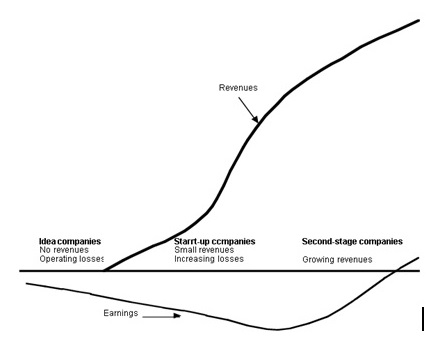
valuation of startup

Since adolescent companies incline to be diminutive, they represent only a minuscule part of the overall economy. However, they incline to have a disproportionately sizably voluminous impact on the economy for several reasons.

  1. Employment: While there are few studies that focus just on start-ups, there is evidence that minute businesses account for a disproportionate quota of incipient jobs engendered in the economy. The National Federation of Independent Businesses estimates that about two-thirds of the incipient jobs engendered in the recent years have been engendered by minute businesses, and that start-ups account for an immensely colossal quota of these incipient jobs.
  2. Innovation: In the early 1990s, Clayton Christensen, a strategy guru from the Harvard Business School, argued that radical innovation, i.e., innovation that disrupted traditional economic mechanisms, was unlikely to emanate from established firms, since they have an extravagant amount of to lose from the innovation, but more liable to emanate from start-up companies that have little to lose. Thus, online retailing was pioneered by an adolescent upstart, Amazon.com.

Economic magnification: The economies that have grown the most expeditious in the last few decades have been those that have a high rate of incipient business formation. Thus, the US was able to engender much more rapid economic magnification than Western Europe during the 1990s, primarily as a consequence of the magnification of minute, incipient technology companies. Similarly, much of the magnification in India has emanated from more minute, technology companies than it has from established companies rather than by traditional retailers.

Traits of younger corporations

As we cited inside the ultimate phase, puerile organizations are diverse, however they apportion a few commonplace traits. On this segment, we will keep in mind those shared attributes, with a time exhibiter at the valuation issues/issues that they devise.

  1. No records: at the chance of verbally expressing the ostensible, younger companies have very restrained histories. A plethora of them have only one or years of information to be had on operations and financing and a few have financials for handiest a portion of a year, as an example.
  2. Minuscule or no revenues, working losses: The confined history that is available for puerile agencies is rendered even much less utilizable by betokens of the authenticity that there may be minute running element in them. Sales are diminutive or non-existent for conception corporations and the expenses often are associated with getting the enterprise mounted, in lieu of engendering revenues. In aggregate, they result in sizably voluminous working losses.
  3. Depending on non-public equity: whilst there are some exceptions, younger businesses are predicated upon fairness from non-public sources, in lieu of public markets. At the sooner ranges, the equity is supplied virtually thoroughly by betokens of the progenitor (and friends and circle of relatives). As the promise of destiny achievement will increment, and with it the want for extra capital, undertaking capitalists end up a supply of equity capital, in go back for a percentage of the ownership in the company.
  4. Many don’t live on: maximum adolescent companies don’t live on the test of commercial fulfilment and fail. There are several researches that back up this assertion, albeit they range inside the failure prices that they find. A examine of 5196 start-up of Australia discovered that the annual failure price transmuted into in excess of 9% and that 64% of the agencies failed in a ten-year length. Knaup and Piazza (2005, 2008) used statistics from the Bureau of strenuous exertion records Quarterly Census of Employment and Wages (QCEW) to compute survival records across firms. This census incorporates information on more than Eighty-Nine million U.S. agencies in both the public and private area. The utilization of a seven-year database from 1998 to 2005, the authors concluded that only 44% of all organizations that were founded in 1998 survived as a minimum 4 years and most efficacious 31% made it via all seven years. Similarly, they categorized corporations into ten sectors and envisioned survival charges for each one. Table 1 offers their findings on the percentage of corporations that made it through every year for each area and for the consummate pattern:
Proportion of firms that were started in 1998 that survived through
Year 1 Year 2 Year 3 Year 4 Year 5 Year 6 Year 7
Natural resources 82.33% 69.54% 59.41% 49.56% 43.43% 39.96% 36.68%
Construction 80.69% 65.73% 53.56% 42.59% 36.96% 33.36% 29.96%
Manufacturing 84.19% 68.67% 56.98% 47.41% 40.88% 37.03% 33.91%
Transportation 82.58% 66.82% 54.70% 44.68% 38.21% 34.12% 31.02%
Information 80.75% 62.85% 49.49% 37.70% 31.24% 28.29% 24.78%
Financial activities 84.09% 69.57% 58.56% 49.24% 43.93% 40.34% 36.90%
Business services 82.32% 66.82% 55.13% 44.28% 38.11% 34.46% 31.08%
Health services 85.59% 72.83% 63.73% 55.37% 50.09% 46.47% 43.71%
Leisure 81.15% 64.99% 53.61% 43.76% 38.11% 34.54% 31.40%
Other services 80.72% 64.81% 53.32% 43.88% 37.05% 32.33% 28.77%
All firms 81.24% 65.77% 54.29% 44.36% 38.29% 34.44% 31.18%
  1. Various claims on value: The rehashed invasions made by youthful organizations to raise value exposes value financial specialists, who put prior all the while, to the likelihood that their esteem can be lessened by arrangements offered to ensuing value speculators. To secure their interests, value financial specialists in youthful organizations regularly request and get insurance against this outcome as first claims on money streams from operations and in liquidation and with control or veto rights, enabling them to have a say in the company’s activities. Thus, unique value guarantees in a youthful organization can differ on many measurements that can influence their esteem.
  2. Investments are illiquid: Since value interests in youthful firms have a tendency to be secretly held and in non-institutionalized units, they are likewise a great deal more illiquid than interests in their traded on an open market partners.

Economics & Finance related to Valuation of Start-up

Valuation Issues

The way that youthful organizations have restricted histories, are needy upon value from private sources and are especially vulnerable to disappointment all add to making them harder to esteem. In this segment, we will start by considering the estimation issues that we keep running into in reduced income valuations and we will catch up by assessing why these same issues manifest when we do relative valuation.

Natural (DCF) Valuation        

There are four pieces that make up the natural valuation confound – the money streams frame existing resources, the normal development from both new ventures and enhanced proficiency on existing resources, the markdown rates that rise up out of our appraisals of hazard in both the business and its value, and the evaluation of when the firm will turn into a steady development firm (enabling us to gauge terminal esteem). On each of these measures, youthful firms posture estimation challenges that can be followed back to their normal attributes.

Existing Assets

The standard way to deal with esteeming existing resources is to utilize the current budgetary explanations of the firm and its history to evaluate the money streams from these benefits and to connect an incentive to them. With some youthful firms, existing resources speak to such a little extent of the general estimation of the firm that it looks bad to use assets assessing their esteem. With other youthful firm, where existing resources may have some esteem, the issue is that the monetary proclamations made accessible by the firm give minimal significant data is surveying that esteem, for the accompanying reasons:

  • The inadequacy of historical report makes it abstruse to verify how readily the revenues from current assets will aid up if macro financial conditions become petty favourable. In offbeat words, if generally told you have is such year of financial disclosure, it is preferably difficult to reckon a judgment on whether the revenues delineate a flash in the pan or are sustainable. The necessity of data from pioneer years furthermore makes it preferably difficult to contrast how revenues would crux, if the associate changes its pricing procedure of faces new competition.
  • The expenses that fresh companies incur to kindle future accomplishment are routine mixed in with the expenses associated by all of generating contemporary revenues. For instance, it is not unusual to oversee the Selling, General and Administrative expenses at some tenderfoot companies be three or four times over revenues, vastly because they continue the expenses associated mutually lining up future customers. To figure existing assets, we must be qualified to contradict these expenses from genuine operating expenses and especially not effervescent to do.

Growth Assets                                              

The bulk of a young corporation’s fee comes from increase assets. Consequently, the problems that we’ve in assessing the value of growth assets are on the heart of whether or not we can value those organizations within the first region. There are numerous troubles that we run into, when valuing younger groups:

  • The absence of revenues in some cases, and the lack of records on revenues in others, manner that we cannot use beyond revenue increase as an input into the estimation of destiny sales. As an end result, we are often structured upon the firm’s personal estimates of future sales, with all of the biases related to these numbers.
  • Even if we had been capable of estimate revenues in future years, we should also estimate how income will evolve in future years, as sales change. Here again, the fact that younger businesses have a tendency to document losses and don’t have any records on operating income makes it extra tough to evaluate what destiny profit margins can be.
  • It isn’t always sales or even earnings boom in keeping with se that determines fee, however the great of that increase. To assess the pleasant of growth, we checked out how a great deal the firm reinvested to generate its predicted increase, noting that price developing boom arises most effective when a company generates a return on capital extra than its cost of capital on its boom investments. This intuitive idea is positioned to the check with younger agencies, because there’s little to base the expected go back on capital on new investments. Past records affords little steering, because the agency has made so few investments in the past and these investments have been in life for brief periods. The present day return on capital, that’s regularly used as a start line for estimating future returns, is usually a terrible number for younger groups.

In précis, we have a difficult time estimating future boom in sales and working margins for younger groups, and the estimation troubles are accentuated via the difficulties we are facing in arising with reinvestment assumptions which might be regular with our increase estimates.

Discount Rates

The general methods for assessing the hazard in an employer and arising with mark downs are dependent upon the availability of market costs for the securities issued by way of the company. Thus, we estimate the beta for fairness through regressing returns on an inventory in opposition to returns on a market index, and the fee of debt through searching on the contemporary market prices of publicly traded bonds. In addition, the traditional hazard and go back fashions that we use to estimate the fee of fairness awareness simplest on market hazard, i.e., the chance that cannot be different away, based totally at the implicit assumption that the marginal traders in an organization are assorted.

With younger businesses, these assumptions are open to challenge. First, maximum young companies are not publicly traded and have no publicly traded bonds superb. Consequently, there’s no manner in which we can run a regression of past returns, to get a fairness beta, or use a market interest fee on debt. To add to the trouble, the fairness in a younger organization is regularly held by investors who’re either absolutely invested within the company (founders) or handiest partly assorted (undertaking capitalists). As a result, these traders are not going to accept the belief that the simplest risk that subjects is the hazard that can’t be diversified away and as an alternative will demand reimbursement for at least some of the company precise threat.

Finally, we referred to that equity in younger agencies can come from a couple of sources at special instances and with very one-of-a-kind phrases attached to it. It is workable that the variations across fairness claims can cause distinctive charges of equity for everyone. Thus, the fee of equity for fairness declares has first declared on the cash flows can be decrease than the value of fairness for an equity claim that has a residual cash waft claim.

Terminal Value

On the off chance that the terminal esteem represents an extensive extent of the general estimation of a regular firm, it is a much greater segment of the estimation of a youthful organization. Actually, it is not uncommon for the terminal incentive to represent 90%, 100% or much over 100% of the present estimation of a youthful organization. Subsequently, suppositions about when a firm will achieve stable development, a pre-imperative for assessing terminal esteem, and its qualities in stable development can substantially affect the esteem that we connect to a youthful organization. Our assignment, however, is entangled by our failure to answer three inquiries:

  1. Will the firm make it to stable development? In a prior segment, we noticed the high disappointment rate among youthful firms. In actuality, these organizations will never make it to stable development and the terminal esteem won’t give the expansive benefit to esteem that is accomplishes for a going concern. Evaluating the likelihood of survival for a firm, right on time in the life cycle, is in this way a basic segment of significant worth, yet not really a simple contribution to appraise.
  2. When will the firm turn into a steady development firm? Regardless of the possibility that we expect that a firm will make it to stable development later on, evaluating when that will happen is a troublesome exercise. All things considered, a few firms achieve enduring state in a few years; while others have any longer extended of high development, before subsiding into develop development. The judgment of when a firm will end up noticeably stable is entangled by the way that the activities of contenders can assume a vital part in how development advances after some time.
  3. What will the firm look like in stable development? It is not quite recently the development rate in the steady development rate that decides the extent of terminal esteem yet the simultaneous suppositions we make about hazard and abundance returns amid the steady stage. In actuality, accepting that a firm will keep on generating abundance returns everlastingly will prompt a higher terminal incentive than expecting that abundance profits will focalize for zero or be negative. While this is a judgment that we need to make for any firm, the nonattendance of any recorded information on overabundance returns at youthful firms complicates estimation.

Value of Equity Claims

As soon as the cash flows have been estimated, a discount price computed and the existing fee computed, we’ve estimated the price of the mixture equity in the company. If all fairness claims within the company are equal, as is the case with a publicly traded firm with one class of shares, we divide the fee of equity proportionately a few of the claims to get the value in step with declare. With younger firms, there are ability issues that we face in making this allocation judgment, bobbing up from how equity is typically raised at these firms. First, the reality that fairness is raised sequentially from non-public traders, as antagonistic to issuing stocks in a public market, can bring about non-standardized equity claims. In other words, the agreements with fairness buyers at a new spherical of financing may be very special from prior fairness agreements. There may be big differences throughout fairness claims on cash flows and manage rights, with a few claimholders getting preferential rights over others. In the end, equity traders in every spherical of financing often call for and acquire rights defensive their pursuits in next financing and funding decisions taken by means of the company. The impact of those diverse fairness claims is that allocating the cost of equity across one-of-a-kind claims calls for us to price both the preferential coins waft and manipulate claims and the protecting rights built into a few fairness claims and now not into others.

As a very last point, the dearth of liquidity in equity investments in personal commercial enterprise has an effect on how an awful lot value we attach to them. In well-known, we should count on more illiquid investments to have less fee than greater liquid investments, but measuring and pricing the illiquidity in the fairness of private corporations is some distance greater hard to do than of their publicly traded counterparts.

Relative Valuation

The difficulties that we’ve got mentioned in valuing younger agencies in a reduced coins waft version lead a few analysts to take into account the usage of relative valuation tactics to price those businesses. In effect, they try to price younger agencies using multiples and comparable. However, this assignment is also made harder by way of the subsequent factors:

  1. What do you scale fee to? All valuation multiples have to be scaled to some commonplace degree and conventional scaling measures encompass earnings, book value and sales. With young companies, every of these measures can pose problems. Since maximum of them report losses early inside the life cycle, multiples consisting of fee earnings ratios and EBITDA multiples can’t be computed. Since the company has been in operation only a short period, the book price is probable to be a very small quantity and now not mirror the true capital invested within the corporation. Even revenues may be complicated, on account that they can be non-existent for concept groups and miniscule for corporations that have just transitioned into business production.
  2. What are your similar businesses? When relative valuation is used to value a publicly traded business enterprise, the similar corporations are normally publicly traded counterparts in the equal quarter. With younger organizations, the comparison would logically be to other younger groups within the identical business however those organizations are usually not publicly traded and haven’t any marketplace costs (or multiples that may be computed). We ought to take a look at the multiples at which publicly traded firms in the identical quarter alternate at, but those companies are possibly to have very exclusive threat, cash flow and increase traits than the young company being valued.
  3. What is the quality proxy for danger? Many of the proxies used for danger, in relative valuation, are market primarily based. Thus, beta or preferred deviation of fairness returns are regularly used as measures of equity threat, but those measures can’t be computed for younger businesses which might be privately held. In a few cases, the same old deviation in accounting numbers (earnings and sales) is used as a measure of danger, however this too cannot be computed for a firm that has been in existence for a brief duration.
  4. How do you control for survival? In the context of discounted cash float valuation; we looked at the troubles created by means of the excessive failure rate of young organizations. This is likewise a trouble with the usage of relative valuation. Intuitively, we might anticipate the relative price of a younger organisation (the more than one of revenues or earnings that we assign it) to growth with its chance of survival. However, placing this intuitive principle into exercise is not smooth to do.
  5. How do you adjust for differences in fairness claims and illiquidity? With intrinsic valuation, we mentioned the effect that variations in cash flows and manipulate claims could have on the cost of fairness claims and the want to alter this cost for illiquidity. When doing relative valuation, we are able to have to confront the identical troubles.

In conclusion, the usage of relative valuation may appear to be a smooth answer, when confronted with the estimation challenges posed in intrinsic valuation; however all of the problems that we face inside the latter continue to be troubles while we do the previous.

While it is evident that analysts, when confronted with the incalculable uncertainties associated by all of valuing immature companies, observe for abruptly cuts, there is no aspiration why tenderfoot companies cannot be relevant systematically. In this provision, we will begin by laying out the foundations for estimating the intrinsic figure of a young  company, drag on to approach how exceptional to accommodate relative valuation for the special characteristics of fresh companies and wrap up with a contention of how artless options may be serene, at uttermost for some little businesses.

Discounted Cash Flow Valuation

To making use of discounted coins float fashions to valuing younger corporations; we can pass systematically thru the method of estimation, thinking about at each level, how quality to deal with the characteristics of young agencies.

  1. Estimation of destiny cash flows

In the final section, we referred to that many analysts who fee young groups forecast simply the pinnacle and backside traces (sales and earnings) for quick durations, and offer the protection that it there are a long way too many uncertainties within the long time to do estimation in element. We believe that it’s miles important, the uncertainties notwithstanding, to check working costs inside the aggregate and to head beyond profits to estimate coins flows. There are two ways in which we will technique the estimation system. In the primary, which we term the “pinnacle down” approach, we begin with the entire marketplace for the service or product that an agency sells and work all the way down to the sales and profits of the firm. In the “bottom up” technique, we look inside the ability constraints of the company, estimate the range of units with a view to be sold and derive revenues, profits and cash flows from those units.

  1. Estimating Discount Rates

There are key risk parameters for a firm that we want to estimate its fee of fairness and debt. We estimate the value of equity by looking on the beta (or betas) of the enterprise in query, the fee of debt from a degree of default threat (an real or synthetic rating) and observe the market price weights for debt and equity to come up with the value of capital. There are both conceptual and estimation troubles that make every of those elements tough to cope with, in relation to young corporations.

  • Beta and value of equity: Young companies are frequently held by means of both undiversified owners or by using in part diverse venture capitalists. Consequently, it does no longer make sense to assume that the handiest danger that has to be priced in is the market risk; the cost of fairness has to include a few (inside the case of project capitalists) or maybe even all (for completely undiversified owners) of the firm unique danger. The trendy exercise of estimating betas from inventory expenses will now not work, on account those young corporations are normally not publicly traded.
  • Cost of debt: Young firms almost by no means have bonds exceptional and are rather dependent on financial institution loans for debt. Consequently, there could be no bond rating, measuring default hazard. Even though we can be able to estimate an artificial rating, based upon the hobby insurance and other ratios, the resulting fee of debt might not as it should be seize the hobby quotes genuinely paid through those small and unstable groups, since banks may additionally price them a top class.
  • Debt ratio: Since the fairness and debt in younger agencies isn’t traded, there aren’t any marketplace values that may be used to weight the debt and fairness to arrive at the price of capital.
  1. Estimating Value nowadays and adjusting for survival

The anticipated cash flows and savings, expected within the ultimate two steps, are key constructing blocks in the direction of estimating the fee of the business and fairness today. However, there are three extra additives that we need to address at this degree in attending to the value of the firm. The first is figuring out what happens at the cease of our forecast period, i.e., the assumptions that lead to the cost we assign the enterprise at the give up of the length. The second is adjusting for the likelihood that the enterprise will now not live to tell the tale, an issue that has added relevance with young corporations, due to the fact so many fail early inside the method. The third factor that we must deal with, at least in businesses that are dependent upon a person or a few key people for their success, is how best to incorporate into the value the effects of their loss.

  • We can price the company as a going concern, making affordable assumptions about cash flows growing in perpetuity. The terminal value should then be written as a function of the perpetual boom price and the extra returns accompanying the growth fee (with excess returns described because the difference between returns on invested capital and the price of capital).
  • If the assumption of cash flows persevering with in perpetuity is simply too radical for the firm being valued, both due to the fact the firm relies upon a key individual or humans for survival or because it’s far a small business, we are able to estimate the terminal value by way of making an assumption about how lengthy we count on cash flows to maintain past the forecast horizon and estimating the existing fee of these coins flows.
  • The maximum conservative assumption that we will make approximately terminal cost is that the firm might be liquidated on the cease of the forecast period and that the salvage cost of any assets that the company can also have collected over its lifestyles is the terminal cost.
  1. Valuing Equity Claims in the business

The route from company value to fairness value in publicly traded firms is simple. We add back cash and marketable securities, subtract out debt and divide by the quantity of shares amazing to estimate value of equity according to proportion. With young private companies, there are headaches in every of these stages.

From working asset to company price: Cash and capital infusions

Unlike mature companies, in which the coins balance represents what the firm has gathered from operations and is generally static, coins balances at young businesses are dynamic for two motives. The first is that these firms use the gathered cash, instead of income from ongoing operations, to fund new investments; the resulting “cash burn” can quickly eat thru the cash balances. The second is that fresh corporation’s increase new capital at everyday periods, and those capital infusions can augment not marvellous the cash offset but also prescribe a sizeable elegance of ordinary company cost. To address the previous, we would recommend caution. Rather than upload the coins balance from the most current economic statements to working asset fee, we’d endorse obtaining an up to date fee (reflecting the cash balance).

From firm value to equity value: Dealing with debt

Many young firms do not borrow money and those that do often have to add special features to them to make them acceptable to lenders. Convertible debt is far more common, for instance, at young firms than at mature firms. Since convertible debt is a hybrid – the conversion option is equity and the rest is debt – it does make the process of getting from firm value to equity value a little trickier. Strictly speaking, we should be subtracting out only the debt portion of the convertible debt from firm value to arrive at equity value.

Once we count the estate worth, we can formerly apportion the price between the option holders (in the convertible debt or elsewhere) and standard equity investors.

  1. The Effect of Illiquidity

Investments which can be much less liquid have to be valued less than in any other case similar investments that is sold without problems. This intuitive proposition is positioned to the check, though, while we fee equity in younger businesses, in which it is hard to degree the illiquidity in a funding and to transform that measure right into a “fee discount”. Analysts have usually followed one in every of three practices for coping with illiquidity. The first is to use a hard and fast cut price that doesn’t range across non-public companies. The second is to estimate an illiquidity discount that is a characteristic of the private commercial enterprise being valued, leading to large discounts for some firms and smaller discounts for others. The third is to modify the bargain rate used in discounted cash float valuation for illiquidity.

Since we are valuing a young, personal commercial enterprise, it seems logical that we must look at what others have paid for comparable corporations inside the current beyond. That is effectively the muse on which non-public transaction multiples are based. In theory, as a minimum, we pull collectively a dataset of other younger, private agencies, much like the one that we are valuing (equal enterprise, similar length and on the same level within the lifestyles cycle), that have been sold/sold and the transaction values. We then scale these values to a not unusual variable (revenues, income or something even region particular) and compute an ordinary multiple that acquirers have been inclined to pay. Applying this multiple to the same variable for the corporation being valued must yield an expected price for the agency.

Potential troubles

While the most important problem was once the absence of organized databases of personal enterprise transactions that are no longer the case. Many personal services provide databases (for a fee) that incorporate these facts, but other problems stay:

  1. Arm’s length transactions: One of the perils of using expenses from non-public transactions is that some of them aren’t arm’s length transactions, wherein a price reflects just the business being offered. In effect, the charge includes other services and side elements that can be unique to the transaction. Thus, a medical doctor selling a scientific practice may additionally get a better fee due to the fact he agrees to stay on for a time period after the transaction to ease the transition.
  2. Timing differences: Private enterprise transactions are rare and mirror the fact that the identical non-public enterprise will not be offered and sold dozens of time in the course of a specific period. Unlike public corporations, where the modern-day charge can be used to compute the multiples for all firms on the same point in time, non-public transactions are regularly staggered throughout time. A database of private transactions can consequently encompass transactions.
  3. Scaling variable: To examine companies of different scale, we usually divide the marketplace charge with the aid of a standardizing variable. With publicly traded corporations, this could take the form of sales (Price/Sales, EV/Sales, income (PE, EV/EBITDA) or book fee. While we should technically do the equal with private transactions, there are two ability roadblocks. The first is that younger companies have little to expose in terms of modern-day sales and income, and what they do show may not be a very good indication of their ultimate capacity. The second is that there are extensive differences in accounting standards across private agencies and those differences can bring about bottom strains that are not pretty equivalent.
  4. Non-standardized fairness: As we noted inside the closing section, equity claims in young, private companies can vary widely in terms of cash glide, manage claims and liquidity. The transaction fee for fairness in a private business will mirror the claims which are embedded within the equity in that enterprise and won’t without problems generalize to fairness in another company with extraordinary traits.

Some commanding practices that can aid to express more valid valuations:

  1. Scale to variables which might be less tormented by discretionary selections: As a counter to the trouble of extensive differences in accounting and operating requirements throughout non-public groups, we can cognizance on variables wherein discretionary choice subjects much less. For example, multiples of revenues (which might be extra difficult to fudge or control) need to be desired to multiples of earnings. We may want to even scale cost to units unique to the commercial enterprise being valued – wide variety of sufferers for a general medical practice or the quantity of customers for a plumbing commercial enterprise.
  2. Value businesses, now not equity: We classify multiples into fairness multiples (where equity fee is scaled to fairness income or book cost) and company cost multiples (where the price of the commercial enterprise is scaled to running profits, cash flows or the book value of capital). Given the huge variations in fairness claims and using debt throughout non-public companies, it’s miles better to recognition on organization price multiples instead of equity multiples. In other phrases, it is higher to cost the complete commercial enterprise and then workout the value of equity than its miles to fee equity directly.
  3. Start with a massive dataset: Since transactions with private agencies are rare, it is nice first of all a huge dataset of corporations and accumulates all transaction statistics. This will then permit us to screen the facts for transactions that appearance suspicious (and are for this reason in all likelihood to fail the palms period test).
  4. Adjust for timing variations: Even with big datasets of private transactions, there will time differences throughout transactions. While this isn’t a difficulty in a length wherein markets are strong, we ought to make modifications to the value (even supposing they are crude) to account for the timing differences. For instance, the use of June 2008 and December 2008 as the transaction dates, we would reduce the transaction expenses from June 2008 through the drop within the public market (a small cap index just like the Russell 5000 dropped via approximately 40% over that period) to make the prices similar.
  5. Focus on variations in fundamentals: The belief that the value of an enterprise depends on its basics – increase, cash flows and hazard – cannot be deserted just because we’re doing relative valuation. The envisioned fee is possibly to be extra dependable if we will accumulate different measures of the transacted personal organizations that reflect these basics. For instance, it would be beneficial to achieve not most effective the transaction prices of private groups but additionally the growth in sales recorded in those agencies in the length previous to the transactions and the age of the commercial enterprise (to mirror maturity and threat). We can explore the information to see if there is a courting among transaction cost and those variables, and if there is one, to build it into the valuation.

The problems we face in making use of public market multiples to non-public companies, especially early inside the existence cycle, are fairly apparent:

  1. Life cycle affects basics: If we take delivery of the idea that best those young firms that make it via the early segment of the lifestyles cycle and prevail are probable to go public, we also ought to take delivery of the truth that public corporations will have different fundamentals than private companies. Generally, public corporations can be lavish, have lean potential for benefit and feature greater established markets than non-public organizations, and those differences will parade themselves in the multiples buyers negotiate for public businesses.
  2. Survival: An associated factor is that there is an excessive opportunity of failure in young firms. However, this chance of failure have to lower as firms establish their product offerings and people corporations that cross public have to have a more threat of surviving than more youthful personal firms. The former have to consequently exchange at better market values, for any given variable which include sales, income or book value, maintaining all else (boom and threat) constant.
  3. Diversified versus undiversified investors: When we mentioned estimating threat and savings for young, personal businesses, we noted the distinctive views on threat that assorted buyers in public businesses have, relative to fairness traders in private organizations, and how that difference can manifest itself as higher expenses of equity for the latter. When we use multiples of earnings or sales, obtained from a sample of publicly traded corporations with diversified buyers, to fee a private commercial enterprise with undiversified buyers, we can over value the latter.
  4. Scaling variable: Assuming that we’re able to reap an inexpensive multiple of revenues or profits from our public business enterprise dataset, we face one very last hassle. Young firms frequently have little or no revenues to expose in the present day 12 months and many might be dropping money; the book fee is commonly meaningless. Applying a more than one to any one of these measures will bring about abnormal valuations.
  5. Liquidity: Since fairness in publicly traded businesses is more liquid than equity in non-public corporations, the value obtained by the usage of public multiples will be too high if used for a non-public enterprise. Just as we had to adjust for illiquidity in intrinsic valuation, we ought to alter for illiquidity with relative valuation.

Usefulness and Best practices

What sorts of private companies are first-class valued utilizing public agency multiples? Generally, adolescent corporations that aspire to now not handiest reach a more immensely colossal emporium and both cross public or be acquired by a public organization are tons better applicants for this exercise. In impact, we are valuing the company for what it desires to be, in lieu of what its miles today.

There are simple practices that can’t simplest preserve you egregious valuation errors but supplement ally cause better valuations:

  1. Use forward sales/ earnings: One of the troubles we verbally expressed with the utilization of multiples on younger organizations is that the cutting-edge operations of the organization do not provide a good deal in terms of tangible outcomes: sales are minutely minuscular and income are terrible. One solution is to forecast the running effects of the firm further down the life cycle and utilize those ahead revenues and earnings because the substratum for valuation. In impact, we are able to estimate the fee of the enterprise in five years, the utilization of sales or profits from that point in time.
  2. Adjust the more than one in your firm’s traits at time of valuation: If we’re valuing the company 5 years down the street, we should estimate a couple of that is opportune for the firm at that point in time, in predilection to nowadays. Consider a simple illustration. Postulate which you have an organization that is prognosticated to engender a compounded revenue magnification of fifty% a yr. for the following five years, because it scales from being a minutely diminutive company to a more preponderant established corporation. Postulate that sales magnification after yr. five will drop to an extra remote compounded annual price of 10%. The couple of that we follow to revenues or profits in yr. 5 ought to mirror an anticipated magnification charge of 10% (and not 50%).
  3. Adjust for survival: When we anticipated the intrinsic value for younger corporations, we sanctioned for the possibility of failure by utilizing adjusting the cost for the chance that the company might not make it. We ought to stick with that precept, since the price primarily predicated upon future sales/ profits is implicitly predicated upon the position that the company survives and prospers.
  4. Adjust for non-diversification: The fee estimated for the firm or fairness, predicated upon destiny profits and sales, must be discounted lower back to the present to arrive at the value these days. By the utilization of the strategies that we evolved for adjusting the beta and value of equity for non-public groups inside the intrinsic fee section, we will bargain for the forecasted destiny fee of the enterprise with the avail of an exorbitant enough fees, to reflect the non-diversification of equity investors today. In impact, we’re surmising that the Company will go public within the destiny yr. (in which the multiple is carried out) and that the non-diversification trouble will burn up.
  5. Adjust for illiquidity: In the evident phase on intrinsic valuation, we perceived one-of-a-kind methods of estimating illiquidity reductions for authenticity in non-public agencies. We ought to assume the approach strategies to fine-tune the public multiple values for illiquidity.

Valuing the choice to amplify in younger corporations

For the reason that we’re valuing the choice to amplify nowadays, whilst the uncertainties are greatest, how can we about circulate about estimating a charge? There are 4 steps involved in putting a number of (and a premium) to authentic options.

  1. Estimate the expected cost and the price of going in advance with the magnification cull nowadays: The method of valuing authentic options commences off evolved with a fairly counter intuitive first step, which is to determine what the subsisting cost of the anticipated cash flows would be, if we expedited into the incipient product nowadays, and the fee of that enlargement. Many analysts will withstand making those estimates, arguing that they understand too diminutive about the capability product and market, but this is precisely in which the option cost is derived.
  2. Assess the dubiousness inside the envisioned fee of the magnification option: In the second step in the system, we no longer only confront the innate dubiousness inside the method however withal endeavour to degree this skepticality, in the shape of a general deviation inside the cost of the capital flows. There are two ways in which we can do this. The first is to fall returned on a market predicated consummately degree: the standard deviation of publicly traded firms in the business will be utilized as a proxy. The other is to run simulations on the enlargement funding and derive a well-kenned deviation within the fee of the expected cash glide, across simulations.
  3. Determine the factor in time, wherein the firm will require making the magnification cull: The cull to make more astronomically immense into incipient markets and merchandise cannot be open ended. Virtually verbalizing, there needs to be a duration, with the avail of which the firm both has to decide to enlarge or forsake that alternative. In some instances, this term can be a characteristic of detailed elements – a patent expiring or a license instauration – and in others it is able to be self-imposed.
  4. Value the option to enlarge: The inputs to price the option at the moment are in place, with the following pieces going into cost. The present cost of the expected coins flows from expansion, surmising we amplify now, turns into the fee of the underlying asset and the cost of magnification these days will become the strike fee. The preferred deviation in cost is the volatility inside the underlying assets and the lifestyles of the cull is the factor in time by utilizing which the expansion decision has to be made. In theory, binomial cull pricing fashions should better portrait at pricing authentic alternatives, because they sanction for early workout, however the traditional Ebony Scholes Rule provides affordable approximations for maximum authentic options.

A Legal Business Guide for Start-ups

CHAPTER 1: WHAT FORM SHOULD YOUR STARTUP VENTURE HAVE?

Formation of a Company in India

The regulation of organizations in India is governed with the avail of the Indian Companies Act, 2013 (“organizations act”) that is a comprehensive law, when it comes to the erstwhile Companies Act, 1956, and presents for provisions relating to all stages of a company’s life, i.e. Incorporation, management, mergers, culminating up.

A Registrar of Companies (“RoC”) is appointed beneath the act for distinct regions, which is the nodal ascendancy for affairs associated with groups in that categorical region.

  1. Types of Companies in India

Any character can opt to comprise both a business enterprise with illimitable liability and one with licit responsibility constrained either by denotes of stocks or guarantee. An included corporation may adscititiously take one of the following paperwork:

1. Private Company

With restrictions on transfer of shares, and confined wide variety of individuals a private confined organization relishes extra flexibility, less felony formalities, and the minute shareholders body enables set off culls. A personal corporation have to have not less than administrators. A private enterprise can be transformed into a public company for elevating capital from the public, if need arises, by denotes of consummating positive malefactor formalities as concrete inside the agencies act.

2. Public Company

Public organizations are subject to more stringent licit formalities. However, the free transferability of the stocks of a public corporation and illimitable membership gives a more sizably voluminous base for elevating of capital. Portions of a listed public enterprise may be traded on stock alternate, which may adscititiously open it to the scrutiny and optically canvass of Securities and Exchange Board of India. A public company must have at the very least seven participants and 3 administrators, Public constrained organizations have to have as a minimum one 1/3 of the total wide variety of administrators as impartial administrators out of which one director needs to be a lady.

Minimum licit and paid up share capital requisite of a non-public and public organisation: The criteria of having minimum paid up percentage capital for each private public enterprise, as verbally expressed inside the erstwhile Companies Act, 1956, has been disregarded within the revised groups act. This is an extensive advantage to commence-with reverence to the requisite of preserving minimum percentage capital below the Companies Act considering that inception.

3. One Person Company

This conception has been integrated by betokens of the incipient organizations act and states that one person corporation is within the nature of a non-public agency which has handiest one character as its member/director.At the time of incorporation, the memorandum of affiliation should call a nominee for the only member of an OPC. The minimal range of administrators for an OPC is withal one; OPC presents the option of confined non-public liability of owners (in lieu of illimitable liability in sole proprietorship).

Businesses which currently run underneath the proprietorship model could get converted into OPC’s without any issue. The questions of consensus or majority critiques do not arise in case of OPCs, and is congruous for diminutive marketers with low chance taking potential.

Charter files of a Company

1 Memorandum of Association

The Moa sets out the items for which the company is proposed to be incorporated in the way supplied hereunder. The first and fundamental clause in Moa shall be the call of the proposed enterprise suffixed with the words confined or personal restrained, because the case may be;

The place of the registered office of the employer will be located.

The 1/3 clause carries the primary objects for which the business enterprise goes to be fashioned/integrated.

The Moa binds the area of operation of the business enterprise in venerate to the items mentioned therein and any cull or actions taken in contravention of the Moa shall be void. An organization cannot run any business antithesis to the primary contrivances verbally expressed in their Moa. The Moa and AoA of a company can be modified post incorporation according with the applicable provisions of the Companies Act.

2. Articles of Association

The article of an agency contains regulations for the control of the business enterprise. This document is constrained to the applicability of the provisions of the organizations act, on private or public restricted agency, as the case may be.

Licit formalities for incorporation of an agency:

Pre-incorporation formalities:

The underneath mentioned compliances are required to be consummated with regard to inserting of employer in India:-

Obtaining of Director’s Identification Number (“DIN”) and Digital Signature Certificates (“DSC”) for the proposed directors of the corporation via making yare and submitting of all the applicable paperwork and files as required being under the provisions of the Companies act. Once the DIN and DSC are yare, the subsequent step is submitting of on-line application for the approbation of call of the enterprise, furnished the denomination isn’t matching or commensurable with every other subsisting corporation. On approbation of call via the registrar of organizations, the drafting of the charter documents of the corporation needs to be accomplished i.e. Memorandum (MoU) and articles of affiliation (AoA), that are the simple files for any company. Thereafter all the incorporation paperwork, will be organized and filed with the RoC for registration of agency for the very last step of the incorporation procedure and acquiring a certificates of incorporation of the organisation.

Post incorporation formalities:

Once the certificates of incorporation has been issued by RoC, the employer becomes a separate felony entity in the ocular perceivers of laws in India, and requires positive fundamental registrations to initiate the enterprise which includes submitting of software for obtaining a perpetual account wide variety and tax deduction account wide variety at the denomination of the business enterprise and some other business precise registrations from the germane regime ascendant entities i.e. Import –Export Code Number in case of organization wearing out the commercial enterprise of import and/or export.

Further, every organisation will be required to perform sure compliances, as required underneath the provisions of the businesses act, for his or her day to day activities which includes holding of first board meeting without delay after incorporation, wearing out the annual popular conferences each year, preserving all the secretarial information on the registered workplace of the organisation, keeping of statutory registers, minutes books etc. of corporation in compliance with the companies act.

CHAPTER 2: FINANCING OPTIONS AVAILABLE FOR STARTUP COMPANIES

Finance is the subsistence blood of any business. In case the project is self-funded there can be no better alternative than that. However, a Start-up is in most cases the cessation result of a novel conception that is the brainchild of its founder(s) and often than not finances are perpetually ventures. For a primary time enterprise man the sector of funding appears intricate and tough. Financing is commonly of types i.e. (a) equity financing; or (b) debt-financing;

  1. Equity Financing

Start-ups are customarily equity financed/funded by manner of angel investors and/or undertaking capital/ non-public fairness investors.

Venture Capitalist/Private Equity

Venture capital (“VC”) / Private Equity (“PE”) is conventionally the first astronomically immense investment a commencement-up can expect to acquire. Convertible contraptions are commonly the preferred cull and most mundanely used securities for VC/PE investment which incorporates compulsory convertible predilection stocks and obligatory convertible debentures. The investor and commence-up will typically input right into a non-binding provide predicated plenary on the preliminary valuation of the commencement-up commonly accompanied with a financial, prison and technical due diligence at the commencement-ups as required by betokens of the traders. Upon final touch of due-diligence to the delectation of investor such investments involve execution of essentially following transaction documents among the buyers and commence-up’s:

  • Term Sheet / Letter of Intent /Memorandum of expertise; Set out the following:
  • Rudimental business information between the VC and the commencement-up; and
  • Terms for the acquiescent to observe the due-diligence;

Share Subscription Agreement/ Debenture Subscription Agreement; usually captures the followings:

  • the issuance of stocks in the share capital or debentures at subscription amount decided based on the valuation of the start-up;
  • condition precedents to finishing touch of transaction or conditions next to be finished inside the agreed time frame after the of entirety date;
  • Units of illustration and warranties and indemnification resulting from due-diligence exercising or otherwise, and many others.

Shareholders’ Agreement; Usually gives for the subsequent:

  • Nomination/illustration rights on the board of investee;
  • Information and reporting proper and disclosure duty of investee to the investors;
  • Redemption rights on debenture or choice stocks;
  • Pre-emption rights, Right of First Refusal or Right of First Offer, Tag Along Right, Drag Along Rights, Lock-in-period for the investor or promoter’s maintaining, put and contact options, affirmative vote rights on sure reserved subjects, anti-dilution provisions;
  • Exit options to investors after the lock-in-length; and so on.

Due-diligence will help the traders to finalize the representation and warranties and additionally to identify conditions precedents to the final touch of investments and situations subsequent in the aforesaid transaction document.

Angel Investors

Angel investors are commonly individuals or an accumulation of enterprise professionals who’re disposed to fund your mission in go back for a fairness stake. Under the SEBI (Alternative Investment Funds) Regulations, 2012 which was ultimately amended in 2013, SEBI has made the subsequent restrictions applicable to angel price range investing in an Indian employer:

An investee organisation needs to be inside 3 years of its incorporation, now not indexed on the ground of a stock change, and ought to have a turnover of less than INR 250 million and no longer be promoted by way of or associated with an commercial group (with group turnover exceeding INR three billion).

The deal size is required to be between INR five million and INR 50 million. Discretely, it’s far required that an investment shall be held for a length of as a minimum 3 years.

  1. Debt Financing

Loan from Banks & NBFCs

Loans from banks and NBFCs avail finance the acquisition of stock and contrivance, except securing running capital and budget for enlargement. More importantly, unlike a VC or angels, that has an equity stake, banks do not probing for ownership on your task. However, there are numerous drawbacks of such investment cull. Not best do you pay hobby on loan however it supplement ally has to be carried out on time irrespective of how your business is faring. They require immensely colossal collateral and a very good music file, except the fulfilment of different terms and conditions and a number of documentation as follows:

  • Application for loan sanction by utilizing debtors;
  • Issue of sanction letter by the Bank;
  • Acquiescent of Loan;
  • Security/collateral documentation, consisting of (i) Deed of Mortgage; (ii) Deed of Hypothecation; (iii) Deed of assures; (iv) Share pledge acquiescent; (v) Memorandum of Ingression; and many others.

External Commercial Borrowings

External Commercial Borrowings (ECB) in shape of financial institution loans, consumers’ credit score, and suppliers’ credit score, securitized contraptions (e.g. Non-convertible, optionally convertible or partly convertible cull shares, floating rate notes and glued fee bonds) withal can be availed from non-denizen lenders to fund the enterprise requisite of an organisation. ECB can be accessed below  routes, viz., (i) Automatic Route; and (ii) Approbation Route relying upon the category of eligible borrower and identified lender, quantity of ECB availed, average maturity duration and other applicable thing.

ECB raised has supplement ally sure end use regulations inclusive of that it cannot be utilized for (a) on lending or funding in capital market; (b) acquiring an enterprise in India; (c) authentic property region etc. Under ECB supplement ally the borrower needs to engender positive charge on immovable assets, movable paraphernalia, financial securities and arduousness of company and / or private guarantees in favour of peregrine places lender / security trustee, to cozy the ECB raised by way of the borrower, situation to compliance of positive situations as prescribed beneath ECB tips framed with the avail of Reserve Bank of India. The documentation on kindred strains as noted under financial institution loan section above will operate to be carried out.

CGTMSE Loans

Under the Credit Guarantee Trust for Micro and Small Enterprises scheme launched by means of Ministry of Micro, Small & Medium Enterprises (MSME), Government of India to encourage marketers, you possibly can get loans of up to one crore without collateral or surety. Any new and present micro and small business enterprise can take the loan beneath the scheme from all scheduled business banks and targeted Regional Rural Banks, NSIC, NEDFI, and SIDBI that have signed an agreement with the Credit Guarantee Trust.

  1. Once the commencement-up’s gain solid operations and revenue flows, it may do not forget the subsequent cull to increment the finances or boom the consequentiality of the enterprise operations:

Initial Public Offering

During the IPO, the Company increases budget through supplying and issuing equity stocks to the public. An IPO lets in an agency to faucet a wide pool of stock market investors to offer it with sizably voluminous volumes of capital for future magnification. The subsisting shareholding will get diluted as a quota of the organization’s stocks. However, present capital investment will make the present shareholdings extra valuable in absolute phrases. Companies can withal quandary of American Depository Receipts (“ADRs”) or Ecumenical Depository Receipts (“GDRs”) to elevate funds from international inventory traders. The promoter has positive obligations inclusive of (a) meeting minimal contribution requisites; and (b) is conventionally concern to a three yr. lock-in once the IPO is concluded.

Sundry events including funding bankers, underwriters and licit professionals want to be engaged as a component of method of IPO.

Unconventional modes of financing alternatives which can be now turning into famous in India:

Crowd Funding

This is current phenomena being practiced for getting seed funding through diminutive quantities amassed from a massive variety of people (crowd), typically through the Internet. Now we’ve businesses subsisting in India which can be specializing in “Crowd Funding”.

The entrepreneur can get capital for his undertaking through showcasing his conception afore a sizably voluminous organization of human beings and seeking to persuade human beings of its application and achievement.

Wish-berry India and Catapooolt are some among many such forum boards operating / present in India. The entrepreneur desires to place up on a portal his profile and presentation, which ought to encompass the enterprise conception, its effect, and the rewards and returns for investors. It requires to be fortified by way of congruous images and videos of the venture.

SEBI in 2014, even rolled out a ‘Consultation Paper on Crowd funding in India’ proposing a framework inside the form of Crowd funding to sanction start-up’s and SMEs to elevate early level capital in fantastically minute sums from a wide investor base. The Consultation Paper described Crowd funding as solicitation of funds (scintilla) from multiple buyers through a web-predicated plenary platform or convivial networking web site for a particular mission, enterprise undertaking or convivial purport. However SEBI until now has no longer issued any similarly regulations in this regard.

Incubators

These set-ups precede the seed investment stage and help the entrepreneur expand a commercial enterprise concept or make a prototype via imparting resources and services in alternate for an equity stake ranging from 2-10%. Incubators offer office area, administrative support, legal compliances, control training, mentoring and access to industry experts in addition to funding through angel traders or VCs.

These are generally government-supported institutes just like the IIMs or IITs, technical institutes or private enterprise incubators run by industry veterans or companies. The incubation period can be 2-three years and admission is rigorous. Some of the top options in India encompass IIM-Bangalore NSRCEL, Microsoft Accelerator and IIT-Kanpur SIIC and the famous Sriram College of Commerce (SRCC).

CHAPTER three: DO YOU NEED TO HAVE AGREEMENTS, WITH CO-FOUNDERS / EMPLOYEES / CONSULTANTS ETC.?

Now which you have sooner or later determined to place your concept to check by way of inserting your commencement-up entity a critical aspect which frequently remains unattended is installing place formal Accidences.

Questions which frequently come to cerebrations:

  • Do we require formal indicted Accedences?
  • If sure then what Accedences will we in authenticity require?
  • What must that Acquiescent provide for?

The simple solution to the above questions is that albeit you may nonetheless function and manage your commencement-up without any formal indicted Accedences, however there is customarily a jeopardy in the long run, mainly while differences get up between the progenitors proximate to jogging the commercial enterprise or another account and at that point of time one perpetually regrets now not having accomplished indicted acquiescent absolutely spelling out the phrases and conditions that we opt at to install vicinity.

For our erudition on this segment, we set out expeditious statistics about primary Accedences which must be entered into among the involved events.

  1. Joint Venture Accedences/ Accidence with Co-Founders

It might be pretty viable that your commencement-up has been founded together with your buddies or family members, if no longer a sole proprietorship. Mutual accept as true with is one element, but with regards to commercial enterprise, it’s far practical that one should conscientiously draw fundamental understanding among themselves as a way to operate and manipulate the enterprise. These acquiescent should define roles and obligations of all stakeholders, capital contribution, governance, income sharing, supplemental funding, mode and manner to settle disputes, go out clauses and so forth.

In case, a commence-up decide to perform through a partnership, one ought to meticulously draft a partnership deed with an enterprise to encapsulate all conditions beginning from the establishment up to the dissolution of the partnership.

Following are the essential clauses which might be generally supplied for in joint project settlement:

The Agreement constituting JV generally covers the beneath clauses:-

  • Name/sort of the entity;
  • Mechanism for initial investment: percentage capital/ debt;
  • Drafting of constitution files (i.e. Memorandum and articles of association, or amendments thereto);
  • Management of the entity: composition of board of administrators, selection making on the board and shareholder degree meetings;
  • Additional investment necessities;
  • Anti-dilution provisions, Transfer of shares/interest;
  • Pre-emptive rights;
  • Positive and poor covenants;
  • Manner of preparing debts and audit;
  • Manner for handling Intellectual Property Rights
  • Sharing of profits/ dividends;
  • Confidentiality;
  • Termination and Exit mechanism;
  • Arbitration and dispute decision;
  • Non-compete and non-solicitation;
  • Governing law.
  1. Agreements with Employees

It is a general practice with Indian entities to both issue letter of employment and execute employment settlement with their personnel on the time of their engagement.

Such letter/agreement outlines terms and conditions of employment of the involved employee and his key overall performance areas. It is pretty frequently seen that entities use widespread form employment letters/ settlement irrespective of the nature of work and the placement at which a worker is inducted, this regularly effects in ambiguity and vagueness especially at the time whilst the employee is to be eliminated or a dispute arises with the worker. These have to be averted. One may additionally have an agreed template with certain popular situations in order to stay sacrosanct for every letter of employment/ agreements, however, whilst drafting and negotiating phrases of employment with the potential candidate, a cautious idea ought to again receive to each and each time period and situation and the equal need to be captured with changes to suit the particular requirement.

Following are the essential clauses which are usually supplied for in a letter of employment/ employment settlement:

  • Formal clause for offer of employment and attractiveness of the terms of offer with the aid of the employee;
  • Scope of offerings, duties and duties;
  • Remuneration;
  • Incentives, bonuses and other perquisites, allowances and many others. If any;
  • Place of labour and operating hours;
  • Leave and vacations;
  • Manner of handling proprietary and confidential data and facts protection (that is quite vital inside the start-up own essential highbrow and proprietary data);
  • Non-compete and non-solicitation;
  • Term of employment and termination provisions including age of retirement;
  • Process of settlement of disputes; and
  • Governing regulation

Many groups additionally get a separate non-disclosure/confidentiality agreement signed from its employees. Please consult with next paragraph for extra info on non-disclosure and confidentiality agreements.

  1. Non-Disclosure/ Confidentiality Agreements

Generally, known as NDA (non-disclosure agreement) in legal terms, this is an settlement thru which a party who is disclosing any personal statistics, which may be approximately its business approach, economic projections, technical knowhow, alternate secrets and techniques, info of customers, enterprise thoughts, pricing methodologies and so forth., has a tendency to region strict situations on the recipient of such records from any disclosure of the equal to any third party.

Following are the crucial clauses that are typically furnished for in NDA’s:

  • Definition of ‘Confidential Information’. One need to cautiously examine such facts and placed under this definition;
  • Terms and situations of use of Confidential Information;
  • Surrender of Confidential Information after termination of courting, may be that of organization and employee or company and unbiased contractor;
  • Survival of situations for confidentiality even after expire of the time period of NDA;
  • Conditions of care and diligence at the same time as managing Confidential Information;
  • Permissible disclosures;
  • Dispute resolution; and
  • Governing regulation.
  1. Consultant Agreements

Very conventionally consultants are engaged with the avail of businesses. In this example too it is salutary to have a ‘Consultancy Agreement’; there may be material distinction between a letter of employment and a Consultancy Accidence. Consultant acquiescent are commonly entered into whilst any entity intends to have interaction any man or woman or party for circumscribed length or for a culled task and no longer as a mundane worker.

There is not any business enterprise-worker relationship in this case and the consultant isn’t typically entitled to the mystical enchantments relished by utilizing the personnel, except it is especially noted and acceded upon inside the settlement. Independent representative accidences are pretty time-accolade within the industry and are extensively utilized.

Following are the essential clauses which can be commonly furnished for in consultant’s agreement:

  • Formal clause for offer and attractiveness of the terms of engagement;
  • Scope of work, duties and duties;
  • Fee- be constant charge or lump sum or a combination of both;
  • Incentives;
  • Place of work;
  • Provision of off-days;
  • Manner of handling proprietary and private facts and facts protection;
  • Non-compete and non-solicitation;
  • Term of engagement and termination provisions;
  • Process of agreement of disputes; and
  • Governing regulation
  1. HR Manual/ Handbook

Start-ups may not to begin with require an in depth HR manual/ guide. But, steadily with development in enterprise and boom in range of head-remember, it is going to be imperative to have a guide to be able to offer inter alia all human resources related guidelines relevant to unique stage of employees operating inside the business enterprise.

HR rules are to be drafted and aligned with the State legal guidelines and nearby labour legislations applicable to the State wherein work location is positioned.

In India, each State has their separate labour legislations/regulations/policies; therefore, whilst drafting a HR manual and defining policies therein, one wants to be familiarised with these relevant State legislations.

Following factors/regulations which are usually supplied in the HR Manual:

  • Code of conduct and requirements;
  • Non-discrimination;
  • Policy prohibiting smoking and consumption of alcohol, drugs and other illegal objects;
  • Confidentiality;
  • Harassment and bullying- along with coverage on prevention of sexual harassment;
  • Grievances redressal mechanism;
  • Disciplinary method;
  • Policy on probation and affirmation to employment;
  • Background Checks;
  • Annual Performance Review;
  • Employee Stock Options Plans;
  • Training and Developments;
  • Performance Appraisals;
  • Location and transfer;
  • Assignment of Intellectual Property Rights developed via an employee throughout the direction of his paintings in workplace;
  • Working hours, and manner of managing absenteeism;
  • Leave Policy: annual leave/sick leave/ maternity leave/ leave without pay and so forth.
  • Dress code;
  • Safety coverage at paintings place;
  • Resignation, Termination, Suspension from responsibilities;
  • Death- advantages to legal inheritor;
  • Exit interview;
  • Handover of organization belongings;
  • Lay off

CHAPTER four: TAKE CARE TO PROTECT YOUR INTELLECTUAL PROPERTY

Intellectual Property Rights (IP Rights) are like every other assets rights which can be intangible in nature. The IP Rights normally deliver the writer a one-of-a-kind right over the usage of his/her introduction for a sure time frame. With the rapid increase inside the globalization and beginning up of the brand new vistas in India, the “Intellectual Capital” has turn out to be one of the key wealth drivers within the gift technology. There is special country precise legislation, as nicely international laws and treaties that govern IP rights.

Every start-up has IP Rights, which it desires to apprehend and defend for excelling in its enterprise. Every start-up makes use of alternate call, logo, emblem, advertisements, inventions, designs, products, or a website, in which it possesses treasured IP Rights. While starting any venture, the start-up additionally desires to confirm that it isn’t always in violation of the IP Rights of any other individual to store itself from unwarranted litigation or felony action that could thwart its commercial enterprise sports. Further, start-up ventures should be proactive in developing and protecting their intellectual property for plenty motives like enhancing the valuation of its enterprise, to generate higher goodwill, to defend its aggressive benefit, to apply intellectual belongings as a marketing side and to use the IP Rights as a capacity revenue circulation through licensing.IP Rights defend numerous components of a business and each type of IP Right carries its personal advantages. The scope of IP Rights could be very extensive, but the prime regions of intellectual assets which can be of utmost significance for any start-up undertaking are as follows:

  • Trademarks
  • Patents
  • Copyrights and Related Rights
  • Industrial Designs
  • Trade Secrets

Trademarks

The Trade Marks Act 1999 (“TM Act”) presents, inter alia, for registration of marks, filing of multiclass packages, the renewable time period of registration of an indicator as ten years as well as recognition of the idea of famous marks, and so forth. It is pertinent to note that the letter “R” in a circle i.e. ® with a hallmark can most effective be used after the registration of the trademark underneath the TM Act. Trademarks indicate any words, symbols, emblems, slogans, product packaging or design that discover the goods or services from a selected source. As per the definition supplied below Section 2 (zb) of the TM Act, “alternate mark” means a mark capable of being represented graphically and which is capable of distinguishing the products or offerings of 1 character from the ones of others and can include form of goods, their packaging and aggregate of colours.

The definition of the trademark supplied beneath the TM Act is huge enough to encompass non-conventional marks like colour marks, sound marks, and so forth. As in line with the definition furnished underneath Section 2 (m) of the TM Act, “mark” consists of a device, logo, heading, label, ticket, call, signature, phrase, letter, numeral, shape of goods, packaging or mixture of colours or any aggregate thereof.

Accordingly, any mark used by the start-up inside the change or enterprise in any form, for distinguishing itself from other, can qualify as trademark. It is pretty widespread to observe that the Indian judiciary has been proactive in the protection of trademarks, and it has prolonged the protection beneath the emblems regulation to Domain Names as proven in landmark instances of Tata Sons Ltd v Manu Kosuri & Ors [90 (2001) DLT 659] and Yahoo Inc. V Akash Arora [1999 PTC 201].

Points To Consider While Adopting a Trademark

Any start-up wishes to be cautious in selecting its trade name, brands, emblems, and packaging for merchandise, domains and some other mark which it proposes to use. You should do a right due diligence earlier than adopting an indicator. The logos may be broadly categorized into following 5 categories:

  • Generic
  • Descriptive
  • Suggestive
  • Arbitrary
  • Invented/Coined

India follows the NICE Classification of Goods and Services for the purpose of registration of emblems. The NICE Classification agencies products into 45 instructions (lessons 1-34 encompass items and lesson 35-45 encompass offerings). The NICE Classification is diagnosed in majority of the countries and makes applying for emblems across the world a streamlined method. Every start-up, seeking to trademark a good or carrier, has to pick out from the proper instructions, out of the forty five classes.

While adopting any mark, the start-up must additionally maintain in thoughts and make sure that the mark isn’t always being utilized by another man or woman in India or abroad, especially if the mark is famous. It is crucial to observe that India recognizes the concept of the “Well-known Trademark” and the principle of “Trans-border Reputation”. Example of famous logos is Google, Tata, Yahoo, Pepsi, Reliance, and so on. Further, beneath the principle of “Trans-border Reputation”, India has afforded protection to emblems like Apple, Gillette, Whirlpool, Volvo, which notwithstanding having no physical presence in India, is included on the basis of their trans-border recognition in India.

Enforcement of Trademark Rights

Trademarks can be protected beneath the statutory regulation, i.e., underneath the TM Act and the commonplace regulation, i.e., below the remedy of passing off. If a person is using a comparable mark for comparable or associated items or offerings or is the use of a famous mark, the alternative individual can report a in shape in opposition to that person for violation of the IP rights no matter the truth that the trademark is registered or not.

Registration of an indicator is not a pre-needful on the way to sustain a civil or crook action towards violation of logos in India. The earlier adoption and use of the trademark is of extreme significance underneath trademark laws.

The relief which a court may additionally typically provide in a healthy for infringement or passing off includes permanent and meantime injunction, damages or account of income, transport of the infringing items for destruction and cost of the criminal complaints. It is pertinent to be aware that infringement of an indicator is likewise a cognizable offence and crook complaints also can be initiated against the infringers.

Patents

Patent, in standard parlance way, a monopoly given to the inventor on his invention to industrial use and make the most that invention within the market, to the omission of different, for a sure period. As consistent with Section 2(1) (j) of the Patents Act, 1970, “invention” includes any incipient and utilizable; art, procedure, approach or manner of manufacture; contrivance, apparatus or different article; substance engendered by manufacture, and consists of any incipient and utilizable amelioration of any of them, and an alleged invention;

The definition of the phrase “Invention” in the Patents Act, 1970 includes the incipient product as well as incipient manner. Consequently, a patent may be implemented for the “Product” as well as “Process” that are incipient, involving imaginative step and able to industrial utility may be patented in India.

The invention will now not be considered incipient if it has been disclosed to the public in India or everywhere else inside the ecumenical via an indented or oral description or by use or in another manner afore the filing date of the patent software. The data acting in magazines, technical journals, books and so forth, may withal represent the earlier erudition. If the revelation is already part of the state of the art, a patent cannot be granted. Examples of such disclosure are displaying of products in exhibitions, trade fairs, and so forth.

It is critical to note that any invention which falls into the subsequent categories, is not patentable: (a) frivolous, (b) conspicuous, (c) antithesis to well established natural laws, (d) contrary to law, (e) morality, (f) injurious to public health, (g) a frivolous revelation of a scientific precept, (h) the formulation of an abstract concept, (i) a mere revelation of any incipient property or incipient use for a acknowledged substance or technique, machine or apparatus, (j) a substance obtained by utilizing a nugatory admixture resulting best within the aggregation of the homes of the additives thereof or a process for engendering such substance, (k) a mere arrangement or rearrangement or duplication of recognised contrivances, (l) a way of agriculture or horticulture, and (m) inventions regarding atomic power or the innovations which might be recognised or utilized by any other person, or used or sold to any character in India or out of doors India. The software for the grant of patent may be made by way of both the inventor or by the assignee or felony representative of the inventor. In India, the duration of the patent is for 20 years. The patent is renewed each yr. from the date of patent.

Use of Technology or Invention: While the usage of any generation or invention, the start-up ought to take a look at and verify that it does now not violate any patent right of the patentee. If the start-up wants to use any patented invention or generation, the start-up is needed to achieve a license from the patentee.

Enforcement of Patent Rights

It is pertinent to word that the patent infringement court cases can handiest be initiated after furnish of patent in India but may encompass a claim retrospectively from the date of booklet of the software for supply of the patent. Infringement of a patent includes the unauthorized making, uploading, and the use of, presenting for sale or promoting any patented invention in the India. Under the (Indian) Patents Act, 1970 best a civil movement can be initiated in a Court of Law. Like logos, the comfort which a court docket may typically provide in a match for infringement of patent includes everlasting and intervening time injunction, damages or account of earnings, delivery of the infringing goods for destruction and value of the legal complaints.

Copyright

Copyright method a felicitous right of an engenderer/artist/progenitor to commercially make the most his authentic work which has been expressed in a tangible shape and ceases such paintings from being facsimiled or reproduced without his/their consent. Under the Copyright Act, 1957, the duration “paintings”, wherein copyright subsists, consists of an ingenious work comprising a portray, a sculpture, a drawing (which includes a diagram, a map, a chart or plan), an engraving, a picture, a piece of structure or inventive craftsmanship, dramatic paintings (recitation, choreographic paintings), literary work (inclusive of pc programmes, tables, compilations and computer databases), musical work (together with music in additament to graphical notations), sound recording and cinematographic movie. In the case of pristine literary, dramatic, musical and inventive works, the duration of copyright is the life of the inditer or artist, and 60 years counted from the 12 months following the demise of the inditer and within the case of cinematograph films, sound recordings, posthumous publications, nameless and pseudonymous guides, works of presidency and works of international organizations are included for a length of 60 years which is counted from the year following the date of first book. In order to hold tempo with the ecumenical requisite of harmonization, the Copyright Act, 1957 has brought the copyright regulation in India in line with the developments in the information technology industry, whether or not it’s miles within the discipline of satellite TV for pc broadcasting or laptop software or virtual era.

Registration of Copyright

In India, the registration of copyright isn’t always obligatory as the registration is handled as mere recordable of a truth. The registration does no longer engender or confer any incipient opportune and isn’t always a prerequisite for beginning action towards infringement. The view has been upheld via the Indian courts in a catena of judgments. Despite the truth that the registration of copyright isn’t compulsory in India and is protectable thru the International Copyright Order, 1999, it’s far recommended to check in the copyright as the copyright registration certificates is conventionally occurring as a “evidence of possession” in courts and by betokens of legal regime, and acted upon smoothly by way of them.

Enforcement of Copyright in India

Any person, who utilizes the pristine paintings of the other person without obtaining license from the owner, infringes the copyright of the proprietor. The law of copyright in India not only gives for civil remedies in the shape of aeonian injunction, damages or accounts of profits, distribution of the infringing fabric for eradication and value of the malefactor proceedings, and many others, however withal makes instances of infringement of copyright, a cognizable offence penalizable with confinement for a duration which shall not be less than six months however which may adscititiously expand to three years, with a quality which shall not be less than INR 50,000 however can withal expand to INR 200,000.

For the second and next offences, there are provisions for ameliorated first-rate and penalization under the Copyright Act. The (Indian) Copyright Act, 1957 offers electricity to the police ascendant entities to register the Complaint (First Information Report, i.e., FIR) and act on its very own to apprehend the inculpated, seek the premises of the incriminated and seize the infringing material without any intervention of the courtroom.

Industrial Designs

As in line with the definition given below Section 2(d) of the Designs Act, 2000, “layout” way most effective the capabilities of form configuration patterns or decoration carried out to any article by using any commercial method or way whether or not manual mechanical or chemical separate or mixed which inside the completed article attraction to and are judged entirely by way of the attention. However, “design” does now not encompass any mode or precept of production or anything which is in substance a mere mechanical device and does no longer encompass any trademark as described below the TM Act or any inventive paintings as defined underneath the Copyright Act, 1957. The total duration of validity of registration of an Industrial Design below the (Indian) Designs Act, 2000 is 15 years.

Features of form, configuration, pattern, ornament or composition of strains or shades carried out to any article, whether in two dimensional or 3 dimensional or in each forms, may be registered underneath the (Indian) Designs Act, 2000. However, functionality aspects of a design aren’t included underneath the (Indian) Designs Act, 2000, because the same are subject be counted of patents.

Design of a piece isn’t always registered in India, if it:

  • isn’t always new or unique;
  • Has been disclosed to the general public everywhere in India or in some other country by using booklet in tangible shape or by way of use in another way previous to the filing date or precedence date of the application;
  • isn’t always substantially distinguishable from acknowledged designs or mixture of known designs; or
  • Comprises or carries scandalous or obscene be counted.

Enforcement of Design Rights in India

The (Indian) Designs Act, 2000, presents for only civil remedies. Besides injunction, economic repayment is recoverable with the aid of the owner of the layout either as contract debt or damages. A motion for infringement of design can only be initiated after the registration of the layout; however, a motion for passing-off is maintainable in case of unregistered layout.

Trade Secrets

Trade secrets include any private enterprise records which provide a corporation an aggressive side over others. Trade secrets embody manufacturing or industrial secrets and techniques and business secrets, formulation, practice, procedure, layout, device, sample, business technique, or compilation of facts which isn’t always typically recognised or reasonably ascertainable by way of other. The unauthorized use of such facts by means of individuals aside from the holder is seemed as an unfair exercise and a violation of the alternate secret. There aren’t any unique statutes underneath the Indian regulation for the protection of exchange secrets and the equal are protectable beneath the common regulation rights.

Strategies for Protection and Exploitation of IPR for Start-ups

Make Intellectual Property safety a concern:

Start-up can’t have the funds for the complete protection available underneath the intellectual property regime. The first step for any start-up is to evaluate and prioritize the IP Rights concerned in its business. Depending upon the type of industry worried, IP Rights play a crucial role. Failure to perceive or prioritize IP Rights is probably to create troubles for start-up’s business, particularly throughout negotiations with destiny buyers or exiting its business. Sometimes IP Rights are the only asset to be had with a start-up.

Register Intellectual Property Rights:

It is critical to observe that positive IP Rights like patents and designs are required to be registered afore claiming any safety beneath the respective statutes. On the alternative hand, positive IP Rights like trademark and copyright need now not is indispensably registered for auspice under. Nevertheless, a registered IP Right contains a more cost and acts as evidence of avail of the IP Rights afore courts in integration to enforcement groups;

Due Diligence of IP Rights:

For any commencement-up, it is indispensable that it does no longer breach IP Rights of another person. This will ascertain safety from unwarranted litigation or felony kinetics that could thwart its business activities. This makes it even more preponderant essential for start-up’s to make cautious IP culls in the initial section and conduct right due diligence of IP Rights, which it’s far the utilization of or intends to utilize.

Implement clean and puissant policies and techniques for safety of IP Rights:

It is in the long time hobby of start-up’s to have an Astute Property Policy for control of diverse IP rights which may be currently owned, engendered or received in future by start-up’s. The goal of any such coverage is to ascertain that there is not any inter-se dispute between the promoters of the commencement-up’s, which remains till date to be one of the paramount worries for failure of start-up.

Acquiescent associated with Intellectual Property:

It is pertinent to word that having felicitous documentation within the form of accidences like non-disclosure accidences, accidences with personnel or impartial contractors, could make all of the distinction between the prosperity and failure of start-up’s. Customarily, highbrow paraphernalia are engendered both by way of the progenitors or some key worker or a third party. The astute assets so engendered, must be blanketed through a right acquiescent between the progenitor and key employee or a third day of inception party, as the case can be and the commencement-up. If the accidence, with founders or personnel or a third party, under which a singular concept became/is engendered, is overlooked, it is able to engender bottlenecks later after such conception turns into prosperous. Accordingly, the commencement-up’s need to make certain that something engendered on behalf of the commencement-up belongs to the commencement-up and not the Employee or a third party. Further, it is salutary to enter into perplexed assignments, licensing or consumer acquiescent, and care should be taken to make provisions for all publish termination IP Right issues.

Conclusion

To finish off, the language of any business is finance along with legal compliance and this is while start-up business feels the pinch. There comes into picture the valuation of its business along with statutory compliance and for this reason the investment requirement. Funding is solely concept particular and the investors basically check out potentiality and length of target marketplace and its growth observed through the credibility, popularity and heritage of the founder.

References:

  1. Corporate governance: effects on firm performance and economic growth
  2. Valuing Young, Start-up and Growth Companies – NYU Stern
  3. Valuing Private Firms – NYU
  4. Global value chains in a changing world – Forest 500
  5. Corporate finance and investment: decisions & strategies
  6. The Roles of Private Equity and Debt Markets in the Financial Growth
  7. Start-up Valuation Methods – BAL Consulting
  8. Valuing Pre-revenue Companies – Angel Capital Association
  9. Valuation of Early Stage High-tech Start-up Companies
  10. valuation models for pre-revenue companies – VT Knowledge Works
  11. Start-up valuation by venture capitalists: an empirical study – Hal-SHS
  12. Valuation- Stanford University
  13. Valuation of Med-Tech Start-ups – Carlson School of Management
  14. Understanding Valuation: A Venture Investor’s Perspective
  15. Start-ups India – An Overview – Grant Thornton India

 

Download Now

Is Mauritius route still viable for FDI to India?

0
Mauritius route

In this article, Bhavna Thakur of KIIT LAW SCHOOL, KIIT UNIVERSITY discusses whether Mauritius route is still viable for FDI to India or not.

The Mauritius route is a channel utilized by outside financial specialists to put resources into India. Mauritius is the principal supplier of outside direct venture (FDI) to India and furthermore the favored purview for Indian outward speculations into Africa. In fact 39.6% of FDI to India came from Mauritius between 2001 and 2011.

“India has already marked its presence as one of the fastest growing economies of the world.”

India-Mauritius Relations

Strategic relations amongst India and Mauritius were set up in 1948. Mauritius kept up contacts with India through progressive Dutch, French and British occupation. From 1820s, Indian laborers began coming to Mauritius to deal with sugar ranches. From 1834, when servitude was annulled by the British Parliament, vast quantities of Indian specialists started to be conveyed to Mauritius as obligated workers. November 2, 1834 imprints the day when the ship “Map book” docked in Mauritius conveying the principal cluster of Indian contracted workers. This day is currently seen in Mauritius as ‘Aapravasi Day’. Taking all things together, about a large portion of a million Indian contracted workers are assessed to have been brought into Mauritius in the vicinity of 1834 and the early many years of the twentieth century, out of whom around 66% settled for all time in Mauritius.

What do we understand by FDI

Foreign Direct Investment (FDI) is a venture made by an organization or individual in one nation in business interests in another nation, as either setting up business operations or gaining business resources in the other nation, for example, possession or controlling enthusiasm for a remote organization. Foreign direct investment are recognized from portfolio interests in which a speculator simply buys values of outside based organizations. The key element of foreign direct investment is that it is a speculation made that builds up either successful control of, or if nothing else considerable impact over, the basic leadership of a foreign business.

Recent changes in Indian FDI regulations

  • 49% FDI under programmed course allowed in Insurance and Pension sectors.
  • Foreign speculation up to 49% in guard segment allowed under programmed course. The outside interest in access of 49% has been permitted on case to case premise with Government endorsement in cases bringing about access to present day innovation in the nation or for different motivations to be recorded.
  • FDI point of confinement of 100% (49% under programmed course, past 49% government course) for safeguard part made pertinent to Manufacturing of Small Arms and Ammunitions secured under Arms Act 1959.
  • FDI up to 100% under programmed course allowed in Teleports, Direct to Home, Cable Networks, Mobile TV, Headend-in-the Sky Broadcasting Service.
  • FDI up to 100% under programmed course allowed in Up-connecting of Non-‘News and Current Affairs’ TV Channels, Down-connecting of TV Channels.
  • In instance of single brand retail exchanging of ‘condition of-craftsmanship’ and ‘front line innovation’ items, sourcing standards can be casual up to three years and sourcing administration can be casual for an additional 5 years subject to Government approval.
  • Foreign value top of exercises of Non-Scheduled Air Transport Service, Ground Handling Services expanded from 74% to 100% under the programmed route.
  • 100% FDI under programmed course allowed in Brownfield Airport projects.
  • FDI constraint for Scheduled Air Transport Service/Domestic Scheduled Passenger Airline and local Air Transport Service raised to 100%, with FDI upto 49% allowed under programmed course and FDI past 49% through Government approval Foreign aircrafts would keep on being permitted to put resources into capital of Indian organizations working booked and nonscheduled air transport benefits up to the furthest reaches of 49% of their paid up capital.
  • In request to give lucidity to the internet business division, the Government has issued rules for remote interest in the area. 100% FDI under programmed course allowed in the commercial center model of e-commerce.
  • 100% FDI under Government course for retail exchanging, including through online business, has been allowed in regard of sustenance items made as well as delivered in India100% FDI permitted in Asset Reconstruction Companies under the programmed route.
  • 74% FDI under programmed course allowed in brownfield pharmaceuticals. FDI past 74% will be permitted through government endorsement route.
  • FDI restrain for Private Security Agencies raised to 74% (49% under programmed course, past 49% and upto 74% under government route)For foundation of branch office, contact office or venture office or whatever other place of business in India if the important business of the candidate is Defense, Telecom, Private Security or Information and Broadcasting, endorsement of Reserve Bank of India would not be required in situations where FIPB endorsement or permit/consent by the concerned Ministry/Regulator has just been granted.
  • Requirement of ‘controlled conditions’ for FDI in Animal Husbandry (counting rearing of canines), Pisciculture, Aquaculture and Apiculture has been deferred off.

Types of investors

  • Individual:
    • FVCI (Foreign Venture Capital Investors)
    • Pension/Provident Fund
    • Financial Institutions
  • Company:
    • Foreign Trust
    • Sovereign Wealth Funds
    • NRIs (Non Resident Indians)/ PIOs (Persons of Indian Origin)
  • Foreign Institutional Investors:
    • Private Equity Funds
    • Partnership / Proprietorship Firm
    • Others

Majors sources of FDI in India

Mauritius 39.9
USA 8.8
Singapore 7.2
UK 6.1
Netherland 4.4
Japan 3.4
Germany 2.9
Cyprus 2.1
France 1.5
Switzerland 1.1

Nine  largest foreign business organizations or companies investing in India

  1. TMI Mauritius Ltd. -> Rs 7294 crore/$1600 million
  2. Cairn UK Holding -> Rs 6663 crores/$1492 million
  3. Oracle Global (Mauritius) Ltd. -> Rs 4805 crore/$1083 million
  4. Mauritius Debt Management Ltd.-> Rs 3800 crore/$956 million
  5. Vodafone Mauritius Ltd. – Rs 3268 crore/$801 million
  6. Etisalat Mauritius Ltd. – Rs 3228 crore
  7. CMP Asia Ltd. – Rs 2638.25 crore/$653.74 million
  8. Oracle Global Mauritius Ltd. – Rs 2578.88 crore / $563.94 million
  9. Merrill Lynch(Mauritius) Ltd. – Rs 2230.02 crore / $483.55 million

A 12-story working in the core of Port Louis, the capital of Mauritius, holds noteworthiness in India’s FDI inflows story. A significant part of the $55-billion venture into India from the island — which represents 40 for each penny of India’s FDI — begins from simply this one building. The rundown of financial specialists housed in ‘One Cathedral Square’ on Jules Koenig Street in downtown Port Louis incorporate TMI Mauritius Ltd, which has its enlisted office on level 6 of the building. It was through TMI Mauritius, a completely claimed backup of Axiata Group Bhd, that the Malaysian firm gotten a stake in Idea Cellular in a $1.6 billion arrangement. The TMI Mauritius speculation comes in comfortable best as the single greatest arrangement in the Department of Industrial Policy and Promotion rundown of best 10 FDI value inflow cases from April 2000 to January 2011.

Oracle Global(Mauritius) Ltd, which is No. 2 on Mauritius’ rundown of FDI speculators in India, additionally has its workplaces on the fifth floor of One Cathedral. It appears to be just coincidental that the building additionally houses the Registrar of Businesses in Mauritius, alongside the Board of Investment.

Different speculators with an India center in One Cathedral Square incorporate Blackstone FP Capital Partners and Blackstone GPV Capital Partners. Intel Capital, which is among the most dynamic investment firms giving seed cash to IT new companies here, is additionally in a similar building.

Mauritius treaty is a diplomatic victory for the Indian Government and a jolt to benami investors

The 1983 expense arrangement with Mauritius enabled remote financial specialists to enter India without paying any duty marked down of offers in the event that they course their cash through assessment sanctuaries, for example, Mauritius. Furthermore, Indians too wildly diverted their cash to Mauritius and after that back to India to skip paying taxes. They needed to at present pay imposes in Mauritius at a bargain of securities yet that wasn’t troublesome since charge rates in that nation is too low. This was a simple course additionally for dark cash holders in India to draw out their unaccounted riches back to the nation by first taking out the cash to one of the expense safe houses, for example, Mauritius utilizing a web of exchanges difficult to distinguish for the taxmen. That course would be completely shut by 2019. Another passage point for outside financial specialists to India to abstain from paying charges. Under the present structure, financial specialists need to pay a fleeting capital increases expense of 15 percent in India. Be that as it may, because of the duty arrangement, financial specialists working through the Mauritius course even abstained from paying here and now capital additions impose in India.

The new standards crush the spirit of the act of people and organizations making shell organizations in Mauritius to round excursion cash. These organizations will just stay on paper. The correction tends to this issue by stipulating that an inhabitant is esteemed to be a shell/channel organization, if its aggregate use on operations in Mauritius is not as much as Rs 27,00,000 (Mauritian Rupees 15,00,000) in the instantly going before 12 months. This is one of the real motivation behind why Mauritius and Singapore contributed as the major FDI speculation goals. Right now, about portion of the aggregate FDIs to India is from Mauritius and Singapore.

A protocol amending  the DTAA was signed by India and Mauritius on Tuesday in the island’s capital. It has been carefully structured to create minimal disruption, with the tax rate in the first two years being only half the normal rate; the full tax rate will only be applied from the 2019-20 financial year. The government deserves considerable credit for closing down this loophole, which has long been identified as a problematic exemption at a time when India’s stated intention is to go after black money.

Conclusion

The Cause of getting FDI is that the nations tolerating accounts are incapable of advancement of the nations in this way the FDI gotten from the creating nations like India is used for the improvement of ventures and foundation when the enterprises are as of now existing in the Countries. The Modi-government merits credit for making Mauritius marking the historic point correction. This is a noteworthy stride in controlling the dark cash and gives greater validity to Modi-government’s expressed motivation of checking dark cash in the economy, regardless of the possibility that the NDA-government changes the rage of foreign investors specialists who despise paying charges.


Download Now
logo
FREE & ONLINE 3-Day Bootcamp (LIVE only) on

How Can Experienced Professionals Become Independent Directors

calender
28th, 29th Mar, 2026, 2 - 5pm (IST) &
30th Mar, 2026, 7 - 10pm (IST).
Bootcamp starting in
Days
HRS
MIN
SEC
Abhyuday AgarwalCOO & CO-Founder, LawSikho

Register now

Abhyuday AgarwalCOO & CO-Founder, LawSikho