

This article on how Indian government can help your startup has been contributed by Himanshu Jain CEO at LegalRaasta, an online portal for GST Registration in India.


This article on how Indian government can help your startup has been contributed by Himanshu Jain CEO at LegalRaasta, an online portal for GST Registration in India.

In this blog post, Meet Kachy, pursuing M.A. in Business law from NUJS, Kolkata, opines upon if it makes sense for the Indian entrepreneurs to incorporate their holding company in another country.
India is rapidly turning into one of the world’s leading entrepreneurial hotspots and it is not difficult to see why. In an increasingly slow-growing world economy, India’s demographics and low base provide a large market with a potentially long growth runway making it one of the standout economic destinations.
The above mentioned macro-economic factors coupled with a largely young and fairly educated workforce and a growing aspiring consumer class make India an attractive market to experiment with new ideas, launch new products and create new businesses.
All these factors create a fertile environment for a new generation of Indian businesses to emerge.

In this blog post, Meenal Nasa, pursuing M.A. in Business law from NUJS, Kolkata, interprets the term “consumer” with reference to beauty services.
A bad hairdo, a cosmetic surgery gone wrong: all you need to know about the legalities involved in enforcing your rights as a consumer.
In this modern era, where it has become indispensable to look good and presentable, a large number of people are spending a considerable amount of money on fashion and maintenance of their looks. This is also because of factors such as improved affordability and greater access. People today spend money on procuring a variety of beauty products and services such as hair styles, makeups, spas, facial & hair treatments and even cosmetic surgeries, which is now moving beyond the exclusivities of the rich and famous.
The consumers of these services expect value for their money in the form of efficient and good quality services. However, quite often they suffer at the hands of unscrupulous service providers through their various acts and omissions such as deficient or negligent services, high prices and misleading advertisements exaggerating the quality of their services or products.
To protect the interest of the consumers from the exploitative and deceptive acts of the service providers and suppliers, the government of India has enacted The Consumer Protection Act 1986 (The Act) which was later amended in 2002. The objective of the Act is to provide a simpler, speedier and cost effective mechanism to address the grievances of the consumers.
It is pertinent here to note that the Act does not protect every “consumer” in the literal sense of the term. The protection is meant only for those persons who fall within the definition of ‘consumer’ as defined in the Act. The interpretation of term “consumer” has been an issue of many legal disputes and debates since the commencement of the Act.
This article aims to resolve whether deficiency or negligence in the performance of beauty services (as described above) fall within the ambit of that Act and also on the remedies and forums available to a consumer who is aggrieved as a result of such deficiencies.
 In this article, Anubhav Kumar Pandey talks about the legal fee one can expect to pay for divorce cases in India and factors on which a lawyer’s fee will depend.
There are more than 2.18 crore cases pending in district courts across the country. 12 states have more than 5 lakh cases to decide while a little more than one case, on an average, is awaiting conclusion for at least 10 years. Cases for divorce is not an exception. In India, divorce cases take years before they are finally settled. The court process is tedious and requires money at every step. For every draft of application, appearance in court your lawyer will charge with some or the other amount. Therefore, it becomes important for us to know what exactly can be the lawyer’s fee one can expect to pay for divorce cases in India. Here is a detailed report on factors on which a lawyer’s fee depends when it comes to cases relating to divorce in India. What are the different procedure or a layman may say checkpoints at which money has to be paid?
It is understood and expected of a good lawyer to charge more fee compared to any other decent lawyer. When I say a good lawyer and a decent lawyer, one can assume the difference between the two. A well-established lawyer might even take fees per hearing which he will make in the court. For every draft, every application, he might charge a hefty amount. And there is a reason too for this.
A well-established lawyer knows how to turn your case and lift it from barren land to a fertile plain. Letting the secret out, even a judge respects and listen more closely to the points made by experienced lawyers.
One might even find lawyers wandering around the premises of any family court in any city who guarantees you a win-win situation that too in a lump-sum amount of INR 10,000 to 15,000. Beware of such lawyers. Such advocates often play with the clients. They initially say the case will get settled within lump-sum amount but later ask for money to facilitate court proceedings and other miscellaneous charges. They intentionally delay the procedure and there have been situations in the past where the couple seeking divorce left the very idea of it due to the heavy amount of money flowing through their pocket. Thanks to these lawyers! They saved a marriage but looted the party.
It will not be incorrect to say that, one of the factors which a lawyer considers while deciding his fees is the financial status of the party who wants a divorce. In the practical arena, it is often found that the same lawyer might charge a poor farmer less when compared to big businessmen. There are veteran lawyers, like Sri Ramjethmalani who makes all his asset through 10% of his cases only, rest 90 % of the cases he does for free! Therefore, a lawyer’s fee also depends upon the financial status of the party fighting the case.
In India, there are different and separate enactments for every personal law. For Hindus, the matter relating to marriage and divorce are dealt with the Hindu Marriage Act. In the same way, Indian Muslim are governed by their personal Shariah law and Quran. In Hindu-dominated cities, it is often difficult to find good lawyers who can fight Muslim divorce cases and ultimately they charge a good amount for their consultation.
This is the point which plays a decisive factor in deciding the lawyer’s fee. A divorce case through a contest, that means when either of the parties is not willing to give the divorce, takes long years to get finally settled. One party to a marriage wants a divorce and other wants to remain in the bond of marriage. Therefore, lawyers charge more in cases where the divorce is through a contest. In cases of mutual divorce, the lawyer charges fewer fees compared to what he charges for divorce through a contest.
The reason lies in the procedure. Therefore, to understand the reason as to why a divorce case requires a hefty amount of investment in terms of money, it is important for us to understand the procedure involving divorce cases.
If any party is not available, any such family member of such party may file the statement on his behalf. Once this is done, ‘First motion’ is established.
If the case is withdrawn or the parties do not move to court at the given date(s), the petition stands cancelled. After hearing to the parties and on being satisfied, the court may pass a decree of divorce declaring the marriage to be dissolved.
Paper Requirement

A thumb rule, the cost of litigation is directly proportional to the time duration of the litigation.
| Consultation fees | Depends on the reputation and experience of the lawyer |
| Jurisdiction (place where case will be filed | If the hearing is to take place in Supreme Court, the fees will automatically rise. Different lawyers in different cities have different fee according to their High Court or Civil Court practice. |
| Appearance fee | Lawyer might take fees on the basis of per hearing also. |
| Drafting fee | At different steps the court procedure requires certain documents. A Lawyer also charges for drafting notices, affidavit, settlement, agreement etc. |
Here is a link providing a good legal solution for cases relating to divorce in NCR. http://cliklawyer.com/index.php/service/avail_service
Being the financial capital of India, Mumbai is litigation expensive city.
For mutual consent divorce → INR 15,000 – 30,000 (for complete process) Lawyers with experience of 1-3 years.
Divorce through contest → This is the real deal. Lawyer charges in Mumbai from a minimum of INR 3000-7000 per hearing (Experience of 3-5 years). Going for a veteran lawyer can eves cost you around INR 35,000 per hearing.
In Bengaluru, litigation expenses are less when compared to other metros like Delhi or Mumbai. The consultation fee of lawyers with experience of 1-3 years can start from INR 1000.
Again the upper cap cannot be stated by anyone as there is no law which limits the fee charged by lawyers in India.
Apart from consultation fees, the charges per appearance may vary. There might even be decent lawyers who can relieve you from all the daily payments and fix a lump-sum amount.
Here is a link where you can find lawyers in Bengaluru https://www.urbanclap.com/bangalore-divorcelawyers?p=1
In Hyderabad, the litigation expenses are again high and similar to Delhi, Mumbai. An average consultation fee can be around INR 2000 and per appearance fee even be higher. Here is a link which might help you http://lawrato.com/divorce-lawyers/hyderabad
When it comes to Chennai, the litigation expenses is not as exorbitant as it is in Delhi, Mumbai or Hyderabad. Owing to the history of legal practice the old and shining Madras High Court, the price of a consultation is minimal as the profession of lawyer is quite common in Madras.
Here is a link which might help you if you are looking for divorce lawyer in Chennai https://www.urbanclap.com/chennai-divorcelawyers?p=1
http://lawrato.com/divorce-lawyers/chennai
Like any usual metro city, seeking divorce in Kolkata is expensive. Here is a link which might help you finding a good divorce lawyer in Kolkata http://lawrato.com/divorce-lawyers/kolkata
http://www.pathlegal.in/DivorceConsulting/Kolkata/
http://lawrato.com/divorce-lawyers/jaipur,
http://lawrato.com/divorce-lawyers/agra
https://www.urbanclap.com/pune-divorcelawyers
http://lawrato.com/divorce-lawyers/ranchi
https://www.hg.org/law-firms/divorce/india/patna.html
http://lawrato.com/divorce-lawyers/patiala
http://lawrato.com/family-lawyers/itanagar
http://lawrato.com/divorce-lawyers/Dispur
https://www.justdial.com/Raipur-Chhattisgarh/Lawyers-For-Divorce-Case/nct-10296165
https://www.justdial.com/Goa/Lawyers-For-Divorce-Case-%3Cnear%3E-Panjim/nct-10296165
https://www.justdial.com/Gandhinagar-Gujarat/Lawyers-For-Divorce-Case/nct-10296165
http://lawrato.com/divorce-lawyers/chandigarh
http://lawrato.com/divorce-lawyers/shimla
http://lawrato.com/divorce-lawyers/trivandrum
http://lawrato.com/divorce-lawyers/bhopal
LawSikho has created a telegram group for exchanging legal knowledge, referrals and various opportunities. You can click on this link and join:
https://t.me/joinchat/J_

In this article, Anubhav Kumar Pandey explains the common problem in hiring an advisor in exchange for equity or money.
Let us understand equity by reviewing our environmental classes lessons which we all learnt at school. Steps required to grow a plant!
The same concept applies to equity too. It is an ownership in the business. If you own 200 shares of company X which has a total of 1000 share in public domain. You are 20% owner of company X.
To an alternative to borrowing money, a company can raise capital by selling equity. As an equity advisory, a person or a firm gives independent financial advice to companies issuing equity via the market. Advisors, who are mostly veterans in their field advise start-up companies and in return takes a certain share of the equity of the company. The work of an advisor involves, advising, bringing funds, providing solutions to the problems the company is facing. This is equity advisory.
Good equity advisors have great network, reputation, and skills required to boost the growth of any company. Having an advisor in exchange for equity or money has its own pros and cons. Bringing funds, hiring a person, solving issues are few of the jobs which an advisor does.
Incentives are a crucial part of doing any business. It is a tricky part when it comes to dividing the equity between the founders, team members, directors, investors and advisors. Diving equity poses a challenge to the founder. Typically a start-up allocates 1/10% – ½% of equity for the advisors vested (explained below) for 3 or 4 years. Keeping the grant small is the key. 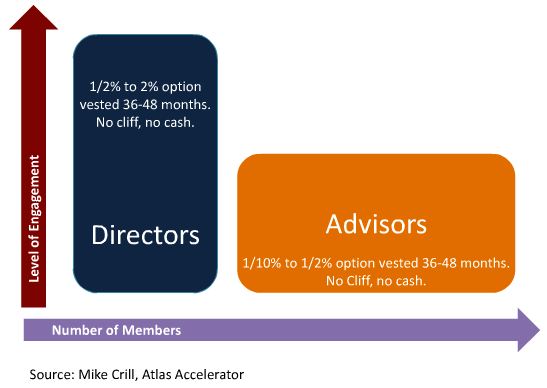
Pic courtesy https://www.linkedin.com/pulse/how-divide-equity-among-startup-founders-investors-advisors-kazanas
There are various models too which are helpful in dividing the equity in a company. One such model is Slicing pie model.
Different kinds of equity available are as follows.
These equities are issued to exceptional employees or directors or officers for performing considerably well and adding to the Intellectual Property Rights of the company in any form. Sweat equity is governed by section 54 of the Companies Act 2013. Sweat Equity is a grant of shares at discount or without monetary considerations. A company can only issue sweat equity if it fulfils the following conditions.
ESOP is a grant of an option to purchase shares at a predetermined price given to employees. It is in the form of incentive and can be issued only to employees and officers. It is a form of remuneration given to employees. ESOPs can be in the form of Stock Option Plans, Phantom Equity Plans and Stock Purchase. Different companies have their different eligibility criteria for ESOP schemes but there is statutory condition which needs to be followed.
There are two things.
In the practical arena, it is very hard to find advisors who can continue to maintain their performance same for the whole time span of 3 or 4 years, whichever is in the advisory agreement. Therefore, it is advised by most veterans that, the advisory agreement should have the following structure, One year of NSO shares, monthly vesting, no cliff. (Cliffs basically allow you to “trial” a hire or partnership without an immediate equity commitment.)
The technicalities are the same just in place of equity, the advisor will be facilitated with money either on a monthly term or in whichever manner their agreement facilitates it. Most advisors do not look for money as equity is what makes them rich. Equity gives you the power to own a part of the company. All the big billionaires in the world derive their wealth from the equities which they have in big companies.
Cash flow Vs equity. Cash might help you to receive a permanent flow for a short duration of the agreement, but equity helps to own partnership stake in a particular company.
The solution to this problem is related to the first problem. There can be situations where your advisor might break some confidential obligations imposed upon him. The solution to this is to have a strong Confidentiality clause in your advisor’s agreement.
These are the following ways to have a strong confidential information clause in your advisor’s agreement.
It is recommended to have a strong ‘No conflicting obligations’ in the advisor’s agreement.
The clause may read as follows.
Fundraising – Capital is the biggest requirement for any business to grow. The founder and members of any company depend on their advisor when it comes to fundraising. One of the most important duties of any advisor advising a company is to advise them on places from where funds can be raised. Every company have different expectations from their advisors depending on the field of work of the company.
Here are few general representations to take from the advisor.
Not all advisors are created equally. All those who are looking for an advisor need them as they add value to their business. Advisor tends to lose interest when the company’s performance is not on par with the expectations. When availability, desire and priorities of an advisor change, it is an indication that your advisor won’t add much to value to the company.
How to tackle such situations? What to do when, after taking equity advisors do not add much to value to the company?
First, try to talk it out. Try to resolve the difference between a company and the advisor as the relation between an entrepreneur and his advisor depends upon trust. If things do not work out, the only solution left is, terminating the advisor’s agreement.
An advisor’s agreement may get terminated on the account of any reasonable reason such as,
A time limit to terminate the agreement between company and advisor exists, which generally is of 3 years. This time period is subject to certain conditions such as,
The advisor will take an exit when the advisor’s agreement will come to a conclusion. As specified in the agreement, the advisor will take an exit with his allotted equity or money at the fulfilment of the time period mentioned in the agreement. If there is a mutual consensus between the advisor and the company, the agreement might get extended for a further duration of time. The advisor may also take an exit when he does not conform to the agreement clauses of the agreement.
This was all about the common problems in hiring an advisor in exchange for equity or money. Do comment and share with your friends and family.

In this blog post, Shantanu Pandey, from Rajiv Gandhi National University of Law Punjab, discusses various aspects concerning visa bulletins.

In this blog post, Shantanu Pandey, from Rajiv Gandhi National University of Law Punjab, describes the different types of US Visa and the procedure which is needed to be followed in order to apply for them.

In this blog post, Shantanu Pandey, from Rajiv Gandhi National University of Law Punjab, describes the procedure for applying for a Green Card in the USA.

In this blog post, Shantanu Pandey, from Rajiv Gandhi National University of Law Punjab, describes and details the laws prevalent in India that help to prevent and control water pollution.

In this blog post, Gourav Khatri, pursuing M.A. Business law from NUJS, Kolkata, talks about John Doe Orders and the situations when they are granted.






 Allow notifications

