Download Now
Home Blog Page 1623

Utkarsh Kumar, a Legal Associate with SourceHOV on how the NUJS diploma course helped him

0

unnamed

We recently happened to speak to Utkarsh about his experience with the NUJS Diploma in Entrepreneurship Administration and Business Laws, and he shared some very nice insights that we thought we should share with you all.  Over to Utkarsh.

I’m currently working with SourceHOV, it’s into global Transaction Processing Services (TPS) and Enterprise Information Management (EIM). SourceHOV provides services and solutions for organizations seeking to drive efficiency in their business processes. I work for WCW project allotted by our client Thomson Reuters, a leading legal service provider around the world.

I came to know about the NUJS Diploma in Entrepreneurship Administration and Business Laws through Facebook, I saw a post on my newsfeed regarding this course and instantly consulted about this with the counselors over the phone. During that time I was about to apply for the LLM program but I found this course more beneficial because it helped me specialize in particular areas of law and enhanced my knowledge too. The best part about this was, I could pursue the course from anywhere and could study as per my convenience.

I was already aware of most of the topics covered in the course as I had studied them during my LLB days but I wanted to enhance my knowledge in upcoming areas of law. I learned a lot from the course in terms of startups and legal issues they face, IPR, and especially Information Technology laws.

Franchise Agreement, NDA, Shareholder Agreement all this are few topics which I found very beneficial. In India, it’s an era of new startups even the Govt is encouraging startups. One can easily get good clients if they are aware of all the laws related to startups and this diploma course covers all that.

In future, I plan to start up an online venture as I’m fascinated with online startups and all that I learned in this Diploma course would come handy then.

Whenever I meet people from a similar background as mine, I always mention this course and its benefits, I always recommend this course to others.


Download Now

WHAT ARE THE PROBLEMS IN TAX STRUCTURE AND ADMINISTRATION IN INDIA

0
PROBLEMS IN TAX STRUCTURE AND ADMINISTRATION

In this blog post, Vaisakhi Muddana, a student at Damodaram Sanjivayya National Law University and pursuing a Diploma in Entrepreneurship Administration and Business Laws from NUJS, Kolkata, describes the problems in tax structure and administration in India.   

Download Now

The Tyranny of Triple Talaq – System of Divorce In Islam

1
divorce in islam

In this blog post, Rishabh Rai, a CS Executive and a 2nd Year Law Student from National Law University, Odisha describes the ill effects of the system of divorce in Islam or triple talaq.

Download Now

Service Tax: When and How is it Paid

0
Feel free to use this image, just link to www.SeniorLiving.Org

In this blog post, Trishna Menon, a B.Sc. LLB student at Gujrat National Law University and pursuing a Diploma in Entrepreneurship Administration and Business Laws from NUJS, Kolkata, details how and when service tax is payable in India.

What is Service Tax?

Service tax is an indirect tax levied by the Central Government of India on services provided or to be provided, excluding services covered under negative list, and considering the Place of Provision of Services Rules, 2012 and collected as per Point of Taxation Rules, 2011 from the person liable to pay service tax. Persons liable to pay service tax are governed by Service Tax Rules, 1994. Such a person may be a service provider or service receiver or any other person so made liable. Generally, the service provider collects the tax on services from service receiver and pays the same to the Government of India.

Brief History of Service Tax

Service Tax was introduced from July 1, 1994, with only three services being covered in the organised sector, i.e., telephone, general insurance and stock-broking. Since then, it has been amended every year to tax more services.

Service Tax was introduced since it was felt that this sector should not go untaxed, given its increasing role and its contribution to the country’s GDP. It was expected that, in time, service tax would reduce the tax burden on international trade (customs duties) and the manufacturing sector (excise duty).

Approaches to Service Tax

There are two approaches to taxing services: comprehensive and selective. In the comprehensive approach, all services are taxable and a negative list of services which are not to be taxed is provided. In the selective approach, a list of taxable services is provided. In India, it is the comprehensive approach that is followed.

Basic Features of Service Tax

There is no separate act governing the imposition and collection of service tax. It is imposed by amending Chapter V of the Finance Act, 1994 (“Act”, in this article). The Central Government further has the power to make rules to carry out the provisions of the Act. It is administered by the Central Board of Excise and Customs.

The Basis of Charge on Service Tax

Service tax is normally required to be paid by a service provider, except where he is located outside the taxable territory.

The point of taxation is generally the date of issue of invoice of the date of receipt of payment, whichever is earlier.

Rate of Charge of Service Tax

There is a uniform rate of taxation on all services. It was 14 per cent of the value of the service. With effect from November 15, 2015, it was increased by the Swachh Bharat Cess, imposed at the rate of 0.5 per cent of the value of the taxable service. With effect from June 1, 2016, it was further increased by the Krishi Kalyan Cess, which is also imposed at the rate of 0.5 per cent of value of the taxable service. The effective rate of taxation now is 15 per cent.

General Procedure of Taxation of Services: An Example

A person providing a taxable service should charge service tax in his invoice. Assume, for example, that the value of taxable service is INR 20,00,000. Service tax at the rate of 14 per cent (INR 2,80,000) should be shown separately in the invoice. After the issue of the invoice, he is required to deposit service tax within a specified time. However, he can claim credit of input tax (also known as CENVAT Credit). This credit of input tax is available in respect of tax paid on inputs (that is, excise duty paid on input goods), tax paid on input services and tax paid on input capital goods (that is, excise duty paid on capital goods), if such input goods, input services or input capital goods are utilised for providing the taxable service. Assume that such tax on inputs borne by him is INR 90,000. In that case, he will deposit only INR 1,90,000 to the Government. If in this case, the service is provided outside India, it is not chargeable to tax. In such case, he can claim a refund of input tax subject to a few conditions. The provisions pertaining to deposit of service tax by utilising CENVAT credit are governed by the Cenvat Credit Rules, 2004.

Determination of Point of Taxation: General Rule

The point of taxation is determined in terms of the Point of Taxation Rules, 2011. In a normal situation, the point of taxation will be as follows:

  1. Date of invoice or payment, whichever is earlier.
  2. Date of completion of service or payment, whichever is earlier.

General Procedure to Pay Service Tax

Registration is the first step towards the payment of service tax. Every person liable for paying the service tax must apply to the concerned Superintendent of Central Excise in Form ST-1 for registration within a period of thirty days from the date on which the service tax under section 66 of the Finance Act, 1994(32 of 1994) is levied.

Service tax is administered by the Central Excise Department. The government website www.exciseandservicetax.nic.in gives the details of the jurisdictional offices of the Central Excise Department, State-wise, District-wise as well as Commissionerate-wise.

There are 67 Central Excise & Service Tax Commissionerates, 7 exclusive Service Tax Commissionerates and 5 Large Taxpayer Units administer Service tax collection in India.

Steps for Registration

  1. Fill the Form ST-1 (available on the departmental website) in duplicate. A photocopy of PAN card, proof of address to be registered and copy of constitution/partnership deed etc. of the firm, if any are to be enclosed.

Copy of PAN card is necessary as a PAN based code (Service Tax Code) is allotted to every assessee.

  1. These forms are required to be submitted to the jurisdictional Central Excise office (in case of seven Service Tax Commissionerates, to the jurisdictional Division office). There are separate service tax commissionerates in Mumbai, Chennai, Delhi, Kolkata, Bangalore and Ahmedabad.
  2. A person liable to pay service tax should file an application for registration within thirty days from the date on which the service tax on particular taxable service comes into effect or within thirty days from the commencement of his activity.
  3. The registration under sub-rule 2 of Rule 4 of the Service Tax Rules,1994, shall be granted by the Commissioner of Central Excise in whose jurisdiction the premises or offices, from where centralized billing or accounting is done, are located.
  4. A single registration is sufficient even when an assessee is providing more than one taxable services. However, he has to mention all the services being provided by him in the application for registration and the field office shall make suitable entries/endorsements in the registration certificate.
  5. An assessee should get the registration certificate (registration number) within 7 days from the date of submission of Form ST-1, under normal circumstances.

A fresh registration is required to be obtained in case of transfer of business to another person. Once any registered assessee ceases to provide the taxable service, he or she must surrender the  registration certificate immediately.

In case a registered assessee starts providing any new service from the same premises, he need not apply for a fresh registration. He can simply fill in the Form ST-1 for necessary amendments he desires to make in his existing information. The new form may be submitted to the jurisdictional Superintendent for necessary endorsement of the new service category in his Registration certificate.

The assessee is also to maintain certain records including computerized data. Every assessee is required to furnish to the Superintendent of Central Excise a list of accounts maintained by him in relation to service tax. This list is to be submitted once at the time of filing his first S.T.3 return. )(e.g. books of account, viz. sales register, purchase register, cash book, petty cash book, general ledger, etc.)

References

  • Dr. Vinod K Singhania and Dr Monica Singhania, Students’ Guide to Income Tax (Taxmann 55th edition).
  • CBEC, Service Tax Procedures accessible at http://www.cbec.gov.in/htdocs-servicetax/st-proc-home.
Download Now

What to do if street lights are not working in your locality

3

Non functioning street lights is a challenge to infrastructural boost to modern India. In Urban area like Delhi, Bombay and other metros, statistics shows, non functioning street lights have resulted in increase of crime rate. Whereas in rural areas people can still be found walking with a torch at night. Nagpur Municipal Corporation (NMC) has over 93,511 street lights under its area, of which around 10,000 were continuously out of order. The problem of non functioning of street lights has its legal implication too. Here is a detailed procedure on how to and whom to complaint if the street lights next to your home or anywhere else is not working, written by Anubhav Kumar Pandey, from RGNUL Patiala.

Whose liability arises on non functioning of street lights and where to complain

With decentralisation of powers the load of governmental functions have further  bifurcated. Now at the local level  in every state governing bodies called Nagar Panchayat  (for area transforming from rural to urban setup), Municipal Council ( for smaller urban area) and  Municipal Corporation ( for larger urban area) functions. State government empowers these municipal bodies with powers and authorities so that they can function as a self governing body and imposes upon them duties such as preparation of plans for economic development and social justice.


Out of all the duties imposed upon these local bodies these are few obligatory duties which they ought to perform, providing for safe and potable drinking water, construction and maintenance of public street light and watering of public streets, cleaning of public streets,  and sewers,  maintenance or support of public hospitals,  establishment and maintenance of primary schools,  registration of births and deaths, removing obstructions and projections in public streets, bridges and other places,  naming streets and numbering houses. In rural area it is the duty of the village panchayat or zila parishad as the case is, to take care of basic infrastructural growth and maintenance of the area and this also includes similar duties as, providing safe drinking water and even proper lighting of streets as well as  responsibility to maintain street lights.


Property Tax (Municipal Tax)→ It is the inherent duty of the municipal body to take care of proper functioning of street lights as people pay appropriate tax for this.  Property tax is a levy charged by the municipal authorities for the upkeep of basic civic services and amenities in the city like roads, sewer system, parks, and other infrastructure facilities like lighting, as well as for maintenance of the existing infrastructure.

In case of non-functioning of street light one can write to municipal corporation, call and submit their application and even register an online complaint. You can find links as to where to register online complaints.


Complaining by writing a letter → Old but still works.  Problems of poor roads and street lights in your locality can be resolved by writing a letter to the Municipal Corporation or Panchayat by complaining about the issue. Soon after complaining about the problems of poor condition of streets lights, the officials of Municipal Corporation will come into action and do the needful.

https://lawsikho.com/course/certificate-criminal-litigation-trial-advocacy
click above

A sample letter is attached here →


To

The Chairman,

Date: – _____________


Sub:- Complaint letter for the poor condition of streets lights.


Dear Sir,


We, the residents of ……………………(Place) would like to draw your kind attention towards the poor upkeep of street lights in our region.


The street lights in our region have not been repaired for quite a while. There are wear and tears all over the wiring mechanism. The state of the street lights is more terrible amid the stormy season. During the evening individuals frequently stagger down. Additionally, non availability of proper lighting across the streets increases a further chance of accident and other mishaps.


Also, this has added to dimness in the area. It has brought about a spurt in the frequency of wrongdoing in the region. There are regular episodes of chain grabbing at night hours. Especially women are in danger in leaving their homes at night. Grabbing, thievery and robbery have turned into the order of the day. The criminals in the wake of perpetrating law violations exploit the obscurity and securely flee.


I, accordingly, request you to kindly take necessary move to mend the ways so that people of the region have proper street lights.


Thanking you,

Yours faithfully,


(Your signature here)

(Your name here)

(Your address here)

(Your contact number)


Few municipalities like Kolkata have issued E-forms for such issues and their redressal. One such E- form can be downloaded from this link. →

https://www.kmcgov.in/KMCPortal/ComplaintFormAction.do

Complaining through phone- call → It is the most prefered and convenient way. One can call the respective municipal authority or village panchayat and register a formal complaint. Each municipality is further divided into their area of work and is known by different names in different cities. The department concerned with proper upkeepment of street light is mostly known as Lighting department. The complaint after being registered  will be forwarded to the respective ward, ward authorities will inform the technician and the process will further continue. In Delhi and various other metro’s, PWD along with Municipal corporation work on improving basic infrastructure which includes monitoring of functioning of street light. 

For Delhi, BSES Rajdhani Power Limited (BRPL), supplying electricity in South and West Delhi has recently launched a dedicated 24 x 7 toll-free number  → 1800-10-39707.

North Delhi Municipal Corporation 1800-200-8701

South Delhi Municipal Corporation 24331942

East Delhi Municipal Corporation 22144125

For Kolkata → 25302513

Howrah Municipal corporation 033 2638-3211

For Mumbai Greater Mumbai → 022-2618 4027

South Ward BMC →022- 24305031

Navi Mumbai Municipal Corporation →022- 27567070

Ahmedabad Municipal Corporation → 79-25391811

Visakhapatnam Municipal Corporation → 0891 2746301

Guwahati Municipal Corporation → 918811007000

Patna Nagar Nigam → 0612 309 5555

Ranchi Municipal Corporation → 0651 221 1215

Goa Municipal Corporation → 9403687453

Gurugram Municipal Corporation 1800 180 1817

Panchkula Municipal Corporation → 0172-2583794

Jammu Municipal Corporation 1800 180 3333

Bangalore Municipal Corporation→  022 2222 1188

Online complaint → Now it is even easy to complain about non-functioning street lights through internet. Complaint is registered and duly entertained on time. In Delhi PWD along with Municipal corporation have started online portals for non-functioning street lights complaint. https://www.pwdsewa.pwddelhi.gov.in/Home/SubmitComplaint

Kolkata → https://www.kmcgov.in/KMCPortal/jsp/KMCStreetLight.jsp

Panchkula http://www.complaintboard.in/complaints-reviews/municipal-corporation-panchkula-l411340.html

Bangalore Municipal Corporation  →

http://www.complaintboard.in/complaints-reviews/bangalore-municipal-corporation-l87840.html

Jammu Municipal Corporation →  http://www.jmcjammu.org/OnlineGrievances.aspx

Gurugram →

http://www.complaintboard.in/complaints-reviews/municipal-corporation-gurgaon-l62045.html

Goa → http://complaint.org.in/index.php/2016/09/08/goa-government-online-complaint/

Patna→ Municipal corporation http://www.complaintboard.in/complaints-reviews/patna-municipal-corporation-l130144.html

Vishakhapatnam → https://gvmc.gov.in/gvmc/index.php/complaint-registration

Mumbai Municipal Corporation →

http://www.mcgm.gov.in/irj/portal/anonymous?NavigationTarget=navurl://aa8bfeaec45dfd196603bed791d407fe&NavMode=3

Thiruvananthapuram →

http://www.bookcomplaints.com/India/consumer-file-complaint/Thiruvananthapuram-Municipal-C-online-reviews-complaints/company-product-list/company/thiruvananthapuram-municipal-corporation_i9061#.WGNxrlN97Dc

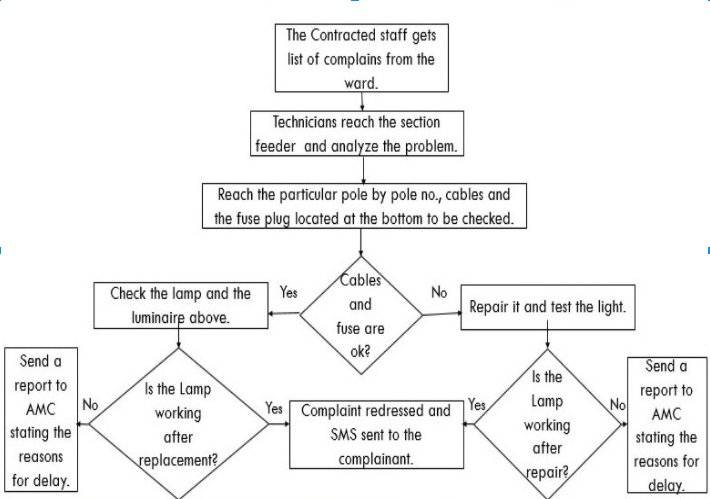
Street light operation and maintenance process involves the following steps


how to complain if street lights are not workingPic courtsey http://portfolio.cept.ac.in/municipal-street-light-management/

Court intervention on the issue regarding non functioning of street lights

Indian courts have been particularly strong on non functioning street lights and the deteriorated condition of rural lighting infrastructures. In various decisions, courts have slammed municipal corporation for their inability to act on complaints lodged by residents of localities. In one of its decision regarding provision of separate lanes in roads for non-motorised vehicles (‘NMVs’) and, the decongestion of the main Chandni Chowk thoroughfare, Delhi High Court took a stand on implementation and maintenance of streetlights and reminded MCD that, it has been decided to implement the scheme by making all services underground, up-gradation of the footpath using rich specification, providing street light of heritage type and carpeting of the road and part development of plazas on the road. In yet another judgment, Orissa High Court slammed the municipal authority for their inability and reminded them of the cyclone which caused blunder to  state and led to non functioning of street lights which was  not resolved after years of disaster.  The courts have entertained various PIL to direct the concerned authorities attention towards the action plan and time bound programme of implementation for the promotion of simple infrastructural advancement like street lights, drinking water etc. In one such PIL, High court of Karnataka dealt with  Improvement of roads, public health and infrastructural facilities in Bangalore, laying roads and sidewalks, improving street lighting, co-ordination among agencies regarding digging footpaths and road cutting, prevention of dumping of debris and hospital waste, etc.

Privatisation of street lights and shifting of legal liability

Patiala city municipal corporation gave the contract for maintenance of street light on contract basis. Privatisation is proving to be beneficial and cost effective as these contractors are held responsible for non functioning of street light. In most of contracts it is duty of the contractor to ensure that the street lights do not remain out of order for more than 24 hours. On breaking of clauses these contractors are penalised also. Both Municipal corporation and private contractor can be made a party to the PIL. The High Court  may issue a writ of Mandamus(Under Article 32 of Indian Constitution). The writ of mandamus is thus an order by a superior court commanding a person or a public authority (including the Government and public corporation) to do something in the nature of public duty.


LawSikho has created a telegram group for exchanging legal knowledge, referrals and various opportunities. You can click on this link and join:

https://t.me/joinchat/J_0YrBa4IBSHdpuTfQO_sA

Follow us on Instagram and subscribe to our YouTube channel for more amazing legal content.


Download Now

Three Major Challenges To Become a Successful Criminal Lawyer

0
Successful Criminal Lawyer

Having a successful criminal law practice requires overcoming several challenges. Are you considering being a successful criminal lawyer or have started a criminal law practice already? If yes, then reading this will certainly be useful.

What are the initial challenges faced by a young criminal lawyer? A knowledge of these will help you in tackling them and advance in your criminal litigation career.

To establish a practice in criminal law, three major challenges should be conquered:-

  1. Getting clients
  2. Understanding the criminal judicial machinery
  3. Ability to build strategy to get relief for your clients

Getting Clients

I have heard a lot of people saying that there is a dearth of clients in criminal litigation. On the contrary, the fact is that more than 46 lakh criminal complaints were filed in India in 2015. There are hundreds of start-ups and SMEs that have been accused of regulatory offences even before they could make their first profits. Fortune 500 have been troubled with socio-economic offences like insider trading. Such people and companies are constantly looking for criminal lawyers who would provide them with swift justice. Keep pushing yourself to expand your network to get new clients. For this, use the following self assessment questions:-

  1. How many people outside your friend/peer/colleague circle know that you specialize in criminal law?
  2. On a scale of 1 to 10, how will you rate yourself as a criminal lawyer? What new actions did you to take to improve your rating?
  3. When did you last speak to your first few clients?
  4. What actions are you taking to get referral clients? If you are good, then why not spread the word through your existing contacts?

Reach out to as many people as you know. Reconnect with them and find out whether you can fight cases for them or get contacts of people who need the help of a criminal lawyer. You will be surprised to find out how many people need the advice of a criminal lawyer! Go ahead, get rid of your inhibitions and connect with people!

Understanding Criminal Judicial machinery

Knowing criminal law is one thing but understanding how the criminal judicial machinery works is quite another. Knowledge of both is necessary to become a successful criminal lawyer. Criminal Procedure Code very holistically covers the procedure of a criminal case but that does not help in understanding it in a way that will help you pursue your case. To be an effective and efficient criminal lawyer, understanding the court setup and investigative machinery of your state and the lawyer’s responsibility in connection with those is imperative. For instance, if your client is a victim of cyber crime, the criminal machinery will be initiated through filing a report at a cyber crime cell of your city, if there is a cyber cell in your city. This can be done only if you are updated with the latest amendments in the law and introduction of new laws. Similarly, it is important for you to keep yourself updated with the criminal machinery working in your state with respect to specific crimes like corruption, money laundering, misappropriation of employee’s provident fund etc. Drafting and understanding key criminal documents (FIR, complaint, bail, protest petition, SLP, etc.) play a crucial role in setting up a case powerfully. The fact situation and the laws applicable should be accurate. A very effective way to keep yourself updated with the latest changes in criminal law is by studying short online courses which don’t interfere with your work. You can study for them at your own pace and in your own time. Please check out the Certificate Course in Criminal Litigation and Trial Advocacy to have a comprehensive knowledge about criminal law, procedure of criminal law and the courts, drafting, client management and to update yourself with the latest changes in law and procedure.

Ability to build strategy to get relief for your clients

Ram Jethmalani, or for that matter, any renowned criminal lawyer, study the same law as other lawyers do, but the difference lies in the way they apply it to their cases. Most cases that Ram Jethmalani argued in, resulted in conviction but his success lay in the fact that he strategized each case in a way that got his clients bail even in clear conviction cases. It is important for you to understand that it is not important that every case should result in prosecution or acquittal for your client. For example, actions like impounding of passport or freezing of bank accounts have the potential to give relief to your client. For success in criminal cases, you need to understand the stand of prosecution and then strategize your actions accordingly. For instance, sometimes all that works in a criminal trial is planting a seed of doubt that  makes conviction improbable. This can be done while the cross-examination and examination are conducted.

If you are facing these challenges in your quest to become a top criminal lawyer, don’t worry. Keep working on those areas and map your progress daily. Take actions on improving upon anything that is stopping you from becoming an extraordinary criminal lawyer.

Please share your feedback, queries and suggestions by emailing to [email protected]

Download Now

What Are SEBI Guidelines On Disclosures, Reporting And Clarifications Under AIF Regulations?

0

In this blog post, Sudipta Ghosh, a student at Surendranath Law College, Calcutta University and pursuing a Diploma in Entrepreneurship Administration and Business Laws from NUJS, Kolkata, discusses SEBI guidelines on disclosures, reporting and clarifications under AIF regulations.


Before we discuss about the SEBI guidelines on disclosure , clarification ,reporting under the AIF regulation , it is important for us to know what SEBI is, its functions and a bit of its historical background .

What is SEBI ?

The Securities and Exchange Board of India  (SEBI) was established on 12th April ,1992 and was given statutory power by the Government of India in accordance with the Securities and Exchange board of India Act , 1992 which was passed by the Indian Parliament . The Sebi is a Regulatory body for securities market in India . The SEBI has its headquarters at Bandra Kurla Complex in Mumbai and also has regional offices at Eastern ,Western , Northern and Southern parts of India located at Kolkata , Ahmedabad , New Delhi and Chennai respectively . It also has certain other local offices in parts of India such as in Jaipur and Bangalore . The basic functions of the Securities and Exchange Board of India has been mentioned in the preamble of the Securities and Exchange Board of India Act , 1992 as – “ to protect the interests of investors in securities and to promote the development of, and to regulate the securities market and for matters connected therewith or incidental thereto” .

SEBI is managed by its BOARD of members consisting of –

  1. A full time chairman to be appointed by the Union Of India
  2. Two members from amongst the officials of Union Ministry dealing with finance and administration of the Companies Act , 1956 to be nominated by the central government
  3. One member from amongst the officials of the Reserve Bank of India to be nominated by the Reserve Bank of India
  4. Five other members to be appointed by the central government .

Some of the functions of the board as mentioned in sec11 of the SEBI Act , 1992 are as follows –

  1. Regulating the business in stock exchange and other security markets
  2. Promoting and regulating self regulatory organizations
  3. Prohibiting unfair and fraudulent trade practices relating to security market
  4. Promoting investors’ education
  5. Prohibiting insider trading in securities
  6.  regulating takeover of companies
  7.  levying fees or other charges for carrying out the purposes of this section
  8. Conducting research
  9. Performing such other functions as may be prescribed etc

Now before dealing with the guidelines under AIF (alternative investment fund) rules, let us have a brief concept of Alternative investment fund (AIF) .

WHAT IS ALTERNATIVE INVESTMENT FUND (AIF) ?

The term Alternative Investment Fund has been defined in Regulation 2(1)(b) of Security and Exchange Board of India ( Alternative Investment Funds) Regulation 2012 . It means any fund established or incorporated in India in the form of a trust or a company or a limited partnership , or a body corporate which is a privately controlled investment vehicle responsible for the collection of funds from investors , whether Indian or foreign , for investing in accordance with the defined investment policy . AIF’s may also be defined as private funds which are otherwise not coming under the jurisdiction of any regulatory agency in india .

The definition of Alternative Investment Funds also includes venture capital funds , commodity funds , private equity funds , hedge funds, debt funds and excludes mutual funds , family trusts , collective investment schemes , gratuity trusts , funds managed by securitization company and reconstruction company which is registered under sec 3 of Securitization and Reconstruction of financial assets and Enforcement of Security Interest Act , 2002  with the RBI .

Alternative investment funds may be divided into the following three categories based on their impact on the economy :-

  1. Category I Alernative Investment Fund – These may been defined as those AIFs which have positive effects on the economy . for which certain incentives or concessions may be considered necessary by the SEBI or the Govt of India. Such funds generally invest on sectors which the Government or regulators consider as socially or economically desirable . Example – Venture Capital Funds, infrastructure funds etc
  2. Category II Alternative Investment Funds – These may be defined as those AIF’s for which no specific incentives or concessions are considered to be given either by the SEBI or the Government of India . Example – Debt fund etc .
  3. Category III Alternative Investment Funds –  These funds trade with the view to make short term returns from the their investments . These funds may also be allowed to invest in Category I and II AIFs .


GUIDELINES ON DISCLOSURES , REPORTING AND CLARIFICATIONS UNDER AIF REGULATIONS –

SEBI ( ALTERNATIVE INVESTMENT FUNDS) WERE NOTIFIED ON 21ST MAY 2012 . CIRCULAR NUMBER – CIR/IMD/DF/10/2013  dated 29th July ,2013 also issued for reporting , prudential requirements of AIF regulations .

SUBMISSION OF INFORMATION TO SEBI UNDER SUB REGULATION (1) OF RREGULATION 3 OF AIF RULES .

As per circular number CIR/IMD/DF/10/2013 dated 29th July 2013 all category III AIFs are required to report to the custodian on a daily basis regarding the amount of leverage at the end of the day , based on the closing prices and whether there has been any breach during the day in limits .

As the AIFs are dependent upon various parties in order to submit to the custodian the amount of leverage at the end of the day and just because these parties provide information at varied time periods to the AIFs , it becomes difficult for them to report to the custodian the amount of end of day leverage on the same day . Therefore certain modifications were made in the aforesaid circular dated 29th July 2013 thereby resulting in the reporting of all category III AIFs to the custodians the amount of leverage at the end of the day , based on prices(closing) , by the end of the next working day .

DISCLOSURES IN PLACEMENT MEMORANDUM

As the fee structure applicable to the investors in an AIF is generally complex in nature . Therefore for better understanding every AIF shall in its placement memorandum , add an annexure of detailed tabular example of how the fees and charges shall be applicable to the investor including the distribution waterfall .

In addition to the tabular distribution of fees and charges in the placement memorandum , details of disciplinary action shall also be there .  Regulation 11(2) states that an AIF shall include details of disciplinary actions/history in its placement memorandum such as disciplinary history of

  1. sponsor ,partners, manager and their Directors/ AIF /promoters and associates
  2. If applicant is a trust, Trustees or trustee company and its directors.

      The disciplinary actions in the placement memorandum shall include details of outstanding/pending and past cases of litigations , criminal or civil prosecution , disputes , non payment of statutory dues , default against banks , disputed tax liabilities ,penalties levied , economic offences and proceedings initiated against them . It may also include any disciplinary action taken by the board or any other regulatory authority .

If Any further litigation / case , arises in the course of activities of the AIF , the litigations in the form of disciplinary actions shall be correctly incorporated in the placement memorandum and intimated to the investors .

Furthermore the annexure for fees and details of disciplinary actions shall be sent to all the investors in addition to the existing placement memorandum within 30 days of this circular .

CHANGES IN PLACEMENT MEMORANDUM

If there is any change relating to sponsor or fees in the placement memorandum , then the same  should be highlighted in the placement memorandum as well as the covering letter at the time of final submission of the placement memorandum . The holders shall also be intimated of the change within 7days of making the change .

In case of dissenting investor with respect to material changes made in the placement record , proper exit opportunity in accordance with the procedure as prescribed in the guidelines shall be provided to the investors .


CLARIFICATIONS MADE IN THE AIF REGULATIONS

The clarifications made in the AIF regulations are listed as follows

  1. It has to be ensured by every AIF that the corpus of  an open ended scheme is to be maintained to 20 crores . The AIF should intimate SEBI within 2 days if by any chance any client requests for redemption . and thereafter should take necessary steps to bring back the corpus within 3 months .
  2. Only the following persons may be called as joint investors for the purpose of investing not less than 1crore rupees : –
  1. An investor and his /her spouse
  2. An investor his/her parent
  3. An investor his/her daughter /son
  1. An investment made in real estate or infrastructure projects by an investee company shall not hold less than 1 project .
  2. Every investor , as mentioned in the regulation , has to invest minimum amount in the AIF .
  3. If the AIF fails to submit registered trust deed or partnership deed within stipulated date , as prescribed , after grant of an in-principle approval , then fresh application has to filled for registration .
  4. Anti-money laundering and outsourcing of activities shall be applicable to all AIF s and the manager of such AIF shall be responsible to obey such guidelines and run the AIF in accordance with it .

Compliance Test Report

Every manager has to make a CTR by the end of the financial year  and shall submit the same to the trustee and sponsor within 30 days in the prescribed format . If an observation comment is made in the CTR , it shall be revised within 15 days  .


REFERENCES


  • vinodkothari.com
Download Now

Compare Tax Planning, Tax Avoidance and Tax Evasion

0

In this blog post, Saurodeep Mukhopadhyay, a student at Rajiv Gandhi National University of Law, Punjab and pursuing a Diploma in Entrepreneurship Administration and Business Laws from NUJS, Kolkata, compares and contrasts between tax planning, tax avoidance and tax evasion,


Introduction

The terms tax planning, avoidance and evasion are closely connected and sometimes used interchangeably, though in legal parlance, these terms are distinct in their meaning as well as their effects. The term tax planning simply refers to structuring any business transaction, the income and the expenses, in a manner so as to incur least or no tax liability on the transaction. It is the art of reducing a person’s tax liability by utilising various provisions of law. This is perfectly legal and wise. In fact, the government promotes such tax planning since it prescribes ways of income utilization which, if used, will lead to reduced tax liability on the person employing such means. Tax avoidance is the use of loopholes in the taxation laws and conducting transactions so as to avoid tax liability or at least reduce the liability as far as possible. Tax avoidance, though perfectly legal, is not advisable since it is contrary to the intention of lawmakers and the taxation statute.

On the other hand, however, tax evasion is the act of avoiding the payment of taxes illegally or by means not specifically allowed under law. This contains in it an element of deceit or an intention to commit fraud on the State by not fulfilling the prescribed obligations of tax payment to the government. The result is that tax evasion leads to further liability on the evader and may even invite criminal liability in most jurisdictions.

Tax Planning

The concept has already been described briefly which clearly indicates that tax planning refers to the use of tax saving measures allowed by law to reduce the tax burden of a person. It is defined by the OECD as “arrangement of a person’s business and /or private affairs in order to minimize tax liability”. This may include certain investments or expenditures which have been specifically declared to be tax-exempt by the government. The idea is to conduct business transactions in a manner so as to fully utilize tax exemptions provided by law. One of the most important provisions in this regard is S.80C which exempts income invested in the form of certain PPF accounts, tax saving fixed deposits, national saving certificates (NSC), infrastructure bonds, provident fund (PF), voluntary provident fund (VPF), principal amount of home loan, life insurance premium, mutual funds, etc. Currently, investments made in the aforementioned avenues are tax exempt till the total amount of Rs.1.5 lacs per person irrespective of the tax bracket the person falls in.

The reason behind such exemptions is the government’s desire to incentivize and channel funds in certain directions. For instance, money collected through infrastructure bonds is utilized in infrastructure development in the country like in the making of roads, water lines, etc. Similarly, provident funds and national saving certificates are encouraged to increase savings of the people and maximize social welfare. These incentives also go a long way in reducing inflation by curtailing the liquid money supply in the economy. Tax planning is encouraged by the government since it not only leads to savings, but also fulfils other governmental needs. Thus, following sound tax planning measures is not only legal but also very prudent, though the limit of savings is rather low.

Tax Avoidance

This refers to the use of loopholes in the tax laws to get exemptions over and above what is legally prescribed, usually by the means of conducting transactions in a particular manner. Thus, even though tax avoidance lowers the tax liability, it is not against the law. Justice Reddy, thus, succinctly put forward that tax avoidance is the “art of dodging tax without breaking the law”.

The Organisation for Economic Cooperation and Development states that it is- “an arrangement of taxpayer’s affairs that is intended to reduce his liability and that although the arrangement could be strictly legal is usually in contradiction with the intention of law it purports to follow.” For example, the S.80C of the Income Tax Act, 1961 prescribes several tax exempt saving instruments as discussed hereinabove. However, a maximum limit of Rs.1.5 lacs is prescribed to the benefits of such investments. Nevertheless, a person may transfer some money to his non-earning wife or minor child and invest in the S.80C prescribed instruments on their behalf. The transfer to such relations is free from gift tax and this effectively allows the person to seek exemption of taxes to the total extent of Rs. 4.5 lacs as compared to the individual limit of Rs.1.5 lacs. One may also transfer a part of their income to their adult children who are not yet earning and claim a further tax exemption for Rs.2.5 lacs since every person, upon reaching 18 years of age, is treated as a separate individual for taxation purposes.  Similarly, one may transfer money to their parents who are not earning and enjoy a tax exemption upto Rs.2.5 lacs per parent if they are below 60 years of age, upto Rs. 3 lacs in case the parents are above 60 years of age, and upto Rs.5 lacs in case the parents are above 80 years of age. The clubbing rules do not apply to parents and there is no gift tax in case of money transfers to parents. Another common way of tax exemption is taking of loans from relatives and friends since gift tax does not apply on the same and the loan may be paid back with a nominal interest rate. Another common means through which corporate giants generally avoid tax liabilities, especially from capital transfers is by routing their investments through shell companies incorporated in countries with favourable tax laws, also known as tax havens. Though the Government enters into several tax treaties with countries to prevent the exploitation of this loophole, the practice is still widely popular.

Thus, there are several ways to exploit the loopholes of the laws to achieve maximum tax benefits and this is what tax avoidance is all about. However, unlike tax planning, tax avoidance is not supported or intended by the government and thus, the laws are regularly rectified through the yearly-finance acts presented with the budget in the parliament. One of the biggest proposed changes in the law to rein in tax avoidance was the General Anti-Avoidance Rules (GAAR) proposed in 2010 along with the Direct Tax Code, 2010 by the then Finance Minister, Pranab Mukherjee. This set of regulations was directed specifically at tax avoidance transactions and significantly restricted the means available to avoid taxation. One of the most controversial aspects of the same was that it sought to tax overseas transactions retrospectively. However, the implementation of the rules remains suspended currently and in 2015, the Finance Minister announced that it would continue to remain suspended for at least 2 more years. Recently, the Income –Tax Rules have been amended to clear the uncertainty over the implementation and implications of GAAR and it has been clarified that it will not apply to Foreign Institutional Investors (FIIs) with respect to income from investment transfers before 1st April, 2017. Thus, to make use of tax avoidance methods, one must be very careful since there is a very thin line between tax avoidance and tax evasion.

Tax Evasion

The term Tax Evasion is usually used to mean any illegal arrangement where tax liability is hidden or ignores, i.e., the tax payer knowingly pays less tax than what he is legally obligated to pay, either by hiding income or information from tax authorities or by simply not paying the requisite taxes to the authorities within stipulated time. The OECD defines it as “A term that is difficult to define but which is generally used to mean illegal arrangements where liability to tax is hidden or ignored, i.e. the taxpayer pays less tax than he is legally obligated to pay by hiding income or information from the tax authorities.”

Thus, it refers to the reduction of tax liability by illegal or fraudulent means. In case of tax evasion, there generally exists an intention, or a presumed intention, on part of the taxpayer to not pay the requisite taxes. The Indian tax system is based on voluntary disclosure and compliance and as such, the simplest way of tax evasion is simply not paying the taxes as per the law within the due date of payment of obligations. Many people get away with this since it is not possible for tax authorities to scrutinize every earning individual in the country. Other means include-

    • Submitting false tax returns: This refers to misrepresenting facts or submitting false information in the tax returns filed to the authorities to lessen the tax burden.
    • Inaccurate financial statements: The taxes that are payable by an individual or an organisation may be decided on the financial dealing that have taken place during the assessment year. If false financial documents or accounts books are submitted, ones that show incomes less than what was actually earned, the tax liability may be considerably lowered.


  • Using fake documents to claim exemption: The government often provides certain exemptions or privileges to certain strata of society or persons of a specific category to give these persons financial benefits or freedom. This may include senior citizens, socially backward communities, etc. However, persons who do not qualify for such privileges or tax exemptions often produce false documents to this regard and claim the exemptions, which is for all means and purposes, tax evasion.


  • Not reporting true income: This is, perhaps, the most common way of evading taxes in India wherein individuals do not disclose their true income to the tax authority during a financial year. For instance, a seller may be able to sell goods worth Rs.50 lacs in a year while showing that he sold goods worth only Rs.30 lacs. Similarly, the owner of an apartment or some other immovable property may give out his property on rent without informing the same to the authorities and in this way, the entire income from rent is kept under wraps and tax liability does not accrue.
  • Smuggling: Certain taxes or charges accrue when goods or services cross international or state borders. These taxes are often hefty and significantly raise the market prices of the goods. Thus, evading these taxes by means of smuggling the goods into the requisite territory becomes a lucrative way of transporting goods without paying taxes for the same.

The above is merely an illustrative list of common ways in which taxes are evaded and are not nearly comprehensive. However, despite the various ways in which taxes may be evaded, one of the most distinctive features of tax evasion is that it invites penalties on persons found to be indulging in such evasion. The penalty ranges from taxing in the range 100%-300% on income not disclosed as per law as well as penalties and fines due to late filing of tax returns. In case a person or a company fails to follow the various provisions of the statutes, for example, failing to maintain accounts as per S.44AA, Income Tax Act, 1961, the penalty which may be levied may be up to Rs. 25000. If a company fails to get itself audited or fails to provide a report of the said audit, a penalty of up to Rs. 1.5 lakhs or 0.5% of the sales turnover, whichever is lesser, may be charged.

Summary Comparison

The distinction between tax planning, avoidance and evasion has been a long discussed topic in the field of taxation law and one of the foremost Indian case in which the discussion was taken up was in the landmark case of McDowell & Co. Ltd. v. Commercial Tax Officer, wherein Justice Reddy stated- “Much legal sophistry and judicial exposition, both in England and India, have gone into the attempt to differentiate the concepts of tax evasion and avoidance and to discover the invisible line supposed to exist which distinguishes one from the other.” The distinction between the two arose in the early 20th Century England where the perception arose that tax avoidance was legitimate since it did not expressly violate a law even though it may have been the exploitation of a lacunae in law. However, as it was observed by the SC in the aforementioned case, the distinction between the two began to waiver as tax avoidance led to widespread profiteering and fall of government revenue. Currently, the stance is that tax avoidance is as bad as tax evasion, though penalties may not be prescribed yet for the same. However, as has been discussed, GAAR has been adopted by several countries and India too is all set to adopt the regulations so as to prohibit transactions with the sole purpose of avoiding tax liabilities. Tax planning on the other hand, refers to the use of tax saving avenues like investments in provident funds, national saving certificates, etc. which are specifically exempt from taxation by law.

It may be concluded that while the object of all the three is the same, i.e. to reduce the liability of taxes on a person, the three are distinguished based on the means they entail. The methods involved in tax planning are sanctioned by law and the actions taken are not only envisaged by law but supported by it. On the other hand, tax avoidance implies the exploitation of the loopholes in the laws so as to reap benefits which were not intended by the law. Finally, tax evasion refers to the illegal actions to reduce tax burden which invite stringent legal penalties and punishment. Out of the three, tax evasion is the only means which is illegal though tax avoidance rules to prevent common means of tax avoidance are in the pipeline and upon their implementation, the fine line between evasion and avoidance will further disappear into ambiguity.

Download Now

Corporate Governance and Compliance Requirements for Selling a Business Unit

0
Business meeting

In this blog post, Souradeep Mukhopadhyay, a student at Rajiv Gandhi National University of Law, Punjab and pursuing a Diploma in Entrepreneurship Administration and Business Laws from NUJS, Kolkata, discusses the role of Corporate Governance and Compliance Requirements for selling a business unit.  

What is a business unit?

A business unit may be defined as “a part of a company that operates as a separate part of the whole business”. It may also be defined as “a logical element or segment of a company (such as accounting, production, marketing) representing a specific business function, and a definite place on the organizational chart, under the domain of a manager”. Thus, a business unit may be considered as a part or whole of a business entity which has independent business functions and works with some independence with respect to the business entity. Thus, a company may have several divisions and departments engaged in different businesses. A conglomerate may contain diverse business units functioning in largely separate fields or targeting distinct markets. For instance, ITC Ltd. is a conglomerate with varied business interests and is one of India’s foremost multi-business enterprise with a market capitalization of US $ 40 billion and a turnover of US $ 8 billion. Now, ITC has several divisions and brands. So, while it owns several cigarette brands like Wills Navy Cut, Gold Flake, etc, it also owns major food brands like Aashirwad, Sunfeast, Bingo!, etc. Each such brand or division in the company may be considered a business unit. The selling of a business unit is, thus, different from selling the entire business entity itself. However, one may sell the entire business entity which is a business unit as a whole. So, the selling of a business unit entails the sale of an independent part or the whole of a business entity to some other person, natural or artificial. The term ‘business unit’ may be thought of as synonymous to the term ‘business undertaking’ as used in S.180 of the Companies Act, 2013.

Now, a business unit may be a sole proprietorship, partnership, LLP, or a company. It may also function as a Hindu Undivided Family (HuF), in which case, the sale of the unit will be largely governed by Hindu personal laws. The various requirements for selling a business unit and the compliance obligations will differ depending on the business structure it follows and while the requirements are the lowest and the procedure the simplest in case of sole proprietorship, it become progressively complex through partnership, LLP and finally, a company.

Sole Proprietorship:

In case of a sole proprietorship, a business unit is considered as the personal property of the individual who owns and operates the business. The property of the business is the personal property of the individual and the business itself has no identity separate from the owner. A business unit may be sold to any other person by the owner of the business following the general laws in the regard. For instance, the property of the business, which may include warehouses, land holdings, shops, machinery, furniture, etc, may be sold by the owner through a simple contract of sale without any general compliance requirements though the sale may be subject to registration as per the Indian Registrations Act, 1908 or governed by laws specific to the particular sale or item which is being sold. The provisions of Indian Contract Act, 1872 and the Transfer of Property Act, 1882 are generally applicable to such sales. Over and above all this, the goodwill of the business as well as any intellectual property like trademark, patent, etc. used in the business and lying with the owner of the business may be sold through contract.

Partnership:

In case of a partnership, the business unit itself has no separate identity except for special purposes as provided for in the Income Tax Act, 1961. The partnership is nothing but an association of persons who come together to collectively conduct a business with the intention to share the profits arising out of the business. The ownership of the property of a business, including its goodwill and other intangible properties, lies with the partners of the firm collectively and no one person or entity owns all the property. Thus, when a property belonging to the firm is sold, it is sold on behalf of all the partners and only such a partner may sell such property, if he has the consent of the other partners or is allowed to dispose of the property on behalf of all the partners as he deems fit by the partnership deed or some other agreement. The property right vests on all the partners collectively. Thus, in case a business unit belonging to the partnership firm is to be sold, the provisions of the partnership deed must be followed or consent of all the partners must be taken before it may be sold and usually, the proceeds of the sale are distributed amongst the partners. Just like sole proprietorship, however, there exist no general compliance requirements in case of sale of business unit by a partnership firm.

Limited Liability Partnership (LLP):

Unlike a partnership firm or a sole proprietorship concern, an LLP is a separate legal entity which needs to be incorporated and once that is done, it is given an identity separate from the LLP partners by the concerned statute, that is the LLP Act, 2008. An LLP is much like a company in several aspects, and it is regulated by the Ministry of Corporate Affairs, Government of India and some of the provisions of the LLP Act, 2008 bear semblance to provisions of the Companies Act. Being an incorporated body having separate legal entity, it is not only capable of being vested with rights independent of partners, in fact, the rights over the property owned by the business devolves on the LLP and not on its partners. Thus, the property of the business belongs to the LLP. Now, in case an LLP consists of several business units functioning separately, it is possible to sell a business unit by the consent of all the partners of the LLP as provided for by the partnership deed and the laws of the land. This would entail a contract between the LLP and the purchaser which will transfer the rights associated with a business unit from the LLP to the purchaser. This may include property, movable or immovable, as well as tangible or intangible and is likely to include the goodwill of the business and other intellectual property rights like trademarks of the business, if any. This is a simple contract, however, regulated by the general laws as well as the provisions of the partnership deed and the LLP Act, 2008.

However, if the sale involves the sale of the entire business of the LLP, the scenario is different. Technically, it is not possible to sell and purchase an LLP itself. What can be bought and sold however, is the interest of the partners in the LLP firm. The transfer of a partner’s rights, however, is not unlimited and only certain rights are transferable as provided for in the statute.

S.42 of the LLP Act, 2008 provides-

“The rights of a partner to a share of the profits and losses of the limited liability partnership and to receive distributions in accordance with the limited liability partnership agreement are transferable either wholly or in part. (2) The transfer of any right by any partner pursuant to subsection (1) does not by itself cause the disassociation of the partner or a dissolution and winding up of the limited liability partnership. (3) The transfer of right pursuant to this section does not, by itself, entitle the transferee or assignee to participate in the management or conduct of the activities of the limited liability partnership, or access information concerning the transactions of the limited liability partnership.”

This clearly lays down that what is transferable is the partner’s right to have a share in the profits or losses of the LLP. This transfer itself does not allow the transferee or assignee to participate in the management or conduct of business of the LLP. Thus, they do not become a partner of the LLP but only wield certain rights of a partner, which are generally financial in nature. Thus, even if the transferable rights of each and every partner of an LLP are purchased by a single person, this person does not become the owner of the LLP or even a partner. He simply remains a person with rights over the profits or losses of the business. For one to become a partner, he must enter the firm as per the partnership deed or an agreement between the partners must be entered into to inculcate the person as a partner. If all the partners are removed and only the purchaser remains as a partner, the LLP stands dissolved due to lack of minimum number of partners necessary to form an LLP. The LLP Act, 2008 however, provides for amalgamation of LLPs and restructuring in Chapter XII of the Act. The Act provides that any such amalgamation or compromise leading to restructuring of the LLP must occur with active involvement of the National Company Law Tribunal which sanctions the compromise or the scheme of amalgamation, as the case may be, and has wide powers to pass requisite orders in this regard which is binding on the concerned parties like the partners of the LLPs and the creditors.

Thus, it is not possible to sell an LLP, but the business unit belonging to an LLP may be sold to any person by contract between the LLP firm and the purchaser governed by general laws relating to sale and transfer as well as the LLP Act and the Partnership Agreement.


Company:

Corporate governance in case of companies has for long been much more stringent and detailed as compared to any other business structure. Thus, it comes as no surprise that the compliance requirements of selling a business unit is also more complex and detailed case of companies as compared to all other business structures discussed so far. Much like an LLP, a company too cannot be sold or purchased itself, at least technically. So, the sale of a company would mean the acquisition of a majority shareholding stake in the company by some other person. This can happen in case of private companies through transfer of shares to a person as per the Companies Act and other rules governing the same, as well as per the provisions of the Memorandum of Association and the Articles of Association of the company, which must include provisions restricting free trade of shares of the company as per the Companies Act, 2013. In case of public companies, the sale of shares, equity as well as preferential, are regulated by a plethora of provisions contained not only in the Companies Act, but also in the various rules by the Central Government or other authorities like SEBI. However, this is not the same as the sale of a business unit. It has already been discussed that a company or a business entity may have several business units (For example, ITC Ltd.) and these units may be independently sold by the company without any change in the shareholding of the company itself. This sort of sale, however, is heavily regulated and is subject to certain restrictions and compliance requirements.


  • Provisions of S.180 of the Companies Act, 2013


S.180 of the Act enumerates the restrictions on the power of the Board of Directors (BoD). It states-

“1. The Board of Directors of a company shall exercise the following powers only with the consent of the company by a special resolution, namely:-


  • to sell, lease or otherwise dispose of the whole or substantially the whole of the undertaking of the company or where the company owns more than one undertaking, of the whole or substantially the whole of any of such undertakings.


Explanation.—For the purposes of this clause,—


  • “undertaking” shall mean an undertaking in which the investment of the company exceeds twenty per cent of its net worth as per the audited balance sheet of the preceding financial year or an undertaking which generates twenty per cent. of the total income of the company during the previous financial year;
  •  the expression “substantially the whole of the undertaking” in any financial year shall mean twenty per cent or more of the value of the undertaking as per the audited balance sheet of the preceding financial year…”


The SC in Rustom Cavasjee Cooper v. U.O.I discussed the extent of the word ‘undertaking’ and held that it means the entire organization and that the provision of the Act indicate that the company is considered as one whole unit and the entire business of the on-going concern is embraced in the work ‘undertaking’ and it would mean a going concern with all its rights, liabilities and assets-as distinct from the various rights and assets which compose it for the purposes of the stated Act. An ‘undertaking’ is not defined comprehensively in the Companies Act, however, in the Income Tax Act it is stated that an ‘undertaking’ shall include any part of an undertaking, or a unit or division of an undertaking or a business activity taken as a whole, but does not include individual assets or liabilities or any combination thereof not constituting a business activity.

The HC of Madras further stated that the business or undertaking of the company must be distinguished from the properties belonging to the company and thus, the Karnataka HC in International Cotton Corporation (P) Ltd. v. Bank of Maharasthra held that the properties belonging to the company that were dealt with by the board of directors in the case under the deeds of hypothecation and mortgage in favour of the bank were distinct from the business of the company and thus, no part of the undertaking of the company was disposed of in favour of the bank in the case. Thus, not all property of the company may be considered a business undertaking or a business unit, but only the properties which together form a business concern as a whole. This distinction between company property and undertaking is important since only the sale of business undertakings requires a special resolution as per S.180, Companies Act, 2013.

Thus, in case a company intends to sell a business unit or sale any substantial part of the same, the Board of Directors do not have the power to do the same unless sanctioned by a special resolution of the company at a general meeting. However, the section also provides for certain exceptions to the restrictions and the requirement of special resolution is not necessary in case the selling of property is part of its ordinary business. Thus, in case a company associated with selling residential complexes built by it sells a completed complex, it does not require a special resolution of the company and such sale may be authorized by the board of directors. Also, in case a buyer buys some undertaking from a company in good faith without knowing that the sale has not been authorized by a special resolution necessary for the purpose, then the title of the buyer is not affected by the fact.

Further, since the sale of undertaking(s) is crucial and of concern to the members of a company, section 110(1)(a) of Act, 2013 read with Rule 22(16)(i) of the Companies (Management and Administration) Rules, 2014 provide that the said item of business has to be transacted only by means of voting through postal ballot. This is in order to encourage wider participation of the members in the matter. It must be noted here that in Companies Act, 1956, a an ordinary resolution by the shareholders was sufficient for the sale of a business undertaking, however, the Act of 2013 requires a special resolution. It must also be noted that the provisions of Section 293(1)(a) of Act, 1956 was applicable to public and deemed public companies while section 180(1)(a) was initially applicable to all companies. However, the Ministry of Corporate Affairs vide exemption notification dated 5 June 2015 rendered section 180 inapplicable to private companies.

These provisions exist so as to ensure that the major concerns of a company are not sold off by the board of directors while keeping the shareholders in the dark. Also, the sale of a substantial part or whole of a business unit has implications for the company and as such, on the interests of the shareholders. Thus, corporate governance requires that the shareholder’s consent be taken through a special resolution at a general meeting.


  • Mandatory Disclosure by Directors:


S.184 of the Companies Act, 2013 provides that the director must disclose all his interests, if any, in any contract or arrangement with any entity in case the same is to be decided upon by the board. This includes contracts or arrangements with any entity where the director or such director in association with any other director owns more than 2% of the shareholding, or is a promoter, manager, CEO, or a partner, owner or member, as the case may be. He can also not take part in discussions and decisions regarding relations with such entities. This is to ensure that a conflict of interest does not result in a director failing to perform his obligations towards the company, whose best interest must be his only consideration while conducting business on its behalf. Thus, any contract entered into by the company without disclosure by the director or with participation of the said director is voidable at the instance of the company. S.184 also provides for personal liability of directors contravening the provisions and imposes up to 1 year of imprisonment and fine ranging from Rs. 50,000 to Rs. 1 Lakh.


  • Related Party Transactions:


There also exist certain provisions with regard to related party transactions which are meant to ensure that personal interests do not undermine the company’s interests in any business transaction. The Companies Act, 2013 defines a ‘related party’ in S.2 (76) of the Act and S.188 imposes certain restrictions on related party transactions. The provisions mandates that certain related party transactions must not be entered into by a company except by resolution passed by the board of directors to that effect. This ensures that all the directors are made aware of the transaction and a majority supports such action. However, an important exception to this requirement is a transaction made in the ordinary course of business entered into in an arm’s length basis. Thus, if a business unit is to be sold to a related party, the board must pass a resolution to that effect. It may be noted here that as per S.180, in case the whole or substantial part of a business undertaking is to be sold, a special resolution of the shareholders is required. However, this does not include sale of a business unit less than the substantiality threshold of 20% of the interest. These transaction, however, will be covered by S.188 in case it is being sold to a related party and by S.184 in case the directors of the company have some interest in the transaction. These transactions to which S.184 or/and S.188 apply, however, are to be recorded in a special register made for this very purpose along with the particulars of the contracts or arrangements and should be made available for inspection by any member of the company at the registered office of the company during working hours. However, the   sale, purchase or supply of any goods, materials or services need not be recorded if the value of such goods and materials or the cost of such services does not exceed five lakh rupees in the aggregate in any year.


Conclusions:

Thus, a business unit may be sold either by selling the entire business entity or all the properties, tangible as well as intangible, as a whole belonging to one or more business undertakings of a business entity. The sale of the entity itself cannot be done in case of incorporated entities like LLPs and Companies since one may only obtain position as a partner or shareholder respectively, nothing more. Even if all the shares of a company are bought by an individual, he remains the controlling shareholder of the company and not the owner. The company always continues to remain an entity separate from the shareholders. The sale of business units or undertakings, however, is regulated in case of companies through corporate governance rules. Further, corporate governance and compliance requirements for the sale of business units are most complex and stringent in case of companies, while such requirements are much lower in case of other business structures. The need for such strict corporate governance requirements in case of sale of business units has been made so that the management of a company cannot misuse its position of power with regard to actions of the company to act in a manner prejudiced in favour of their own personal interests and cause substantial prejudice to the interests of the company and its shareholders. The most important provision in this regard is contained in S.180 of the Companies Act and means to ensure that a special majority of shareholders are taken into confidence before a substantial part or whole of an undertaking is sold.


 

Download Now

Happy New Year – Here’s Your Permission to Publicly Ridicule Me

0
Happy New Year - Here's Your Permission to Publicly Ridicule Me

Any new year resolutions? Tell me in the comments!

Should you make a resolution before the new year?

Many people do not, and would not.

For many people, it does not make any sense to make resolutions. What difference will another year make?

How is it different from any other year? Why do you need a new year to decide something?
For others, the new year is an opportunity to start things afresh. It’s a reminder that times are changing, that one more year of our limited time is just beginning. It is an occasion to introspect. It is time to make one more attempt at doing something good and difficult.

To some people, the new year is a psychological boost. It is a reminder that they have much more to achieve and experience. These are the people who will make resolutions and struggle to achieve their goals.

People who make resolutions are optimistic that in the new year they will make a difference to their lives. I like those people – optimism is infectious. I want to share optimism with them. I have my resolutions too – I will work hard and consistently to make these a reality.

Share your resolutions, share your optimism, share your struggle to achieve your personal goals. It is inspiring for the rest of us.

In that spirit, I’ll share my resolutions with you:

  • Wake up early to go for running/ walk/ work out every single day.
  • Meditate everyday
  • Write a lot about e-learning, legal education, accelerated learning and education in general

Right now these are merely resolutions, but I want to convert these into habits in the first couple of months itself. If we practice something regularly for 14 days, apparently it forms a habit – at which stage one has to try hard to deviate from the practice. A mere resolution is not strong enough – we need good habits!

Do share your resolutions with me too – and help me to achieve mine J

If you want to earn my greatest respect and gratitude, please ask me throughout the year if I am sticking to my resolutions. If you find that I am not sticking to my resolutions, please publicly ridicule me.

Share your resolutions in the comments. I would love to make a post soon about the resolutions of the readers of this blog! Your resolutions and success stories will inspire me too and make it easier for me achieve my goals.


Download Now
logo
FREE & ONLINE 3-Day Bootcamp (LIVE only) on

How Can Experienced Professionals Become Independent Directors

calender
28th, 29th Mar, 2026, 2 - 5pm (IST) &
30th Mar, 2026, 7 - 10pm (IST).
Bootcamp starting in
Days
HRS
MIN
SEC
Abhyuday AgarwalCOO & CO-Founder, LawSikho

Register now

Abhyuday AgarwalCOO & CO-Founder, LawSikho