Download Now
Home Blog Page 163

All about Kerala Judicial Service exam

0

This piece of informational article on the Kerala Judicial Service exam (KJSE) is written by Ashutosh. This is an exhaustive article covering all the aspects of Kerala Judicial Service exam, and consists of all the valuable information about the Kerala Judicial Service exam, such as its syllabus, exam pattern, qualifications, important books, selection process, and several important tips and tricks. It also covers some of the most common and frequently asked questions and doubts related to the Kerala Judicial Service exam.

It has been published by Rachit Garg.

Table of Contents

Introduction

Are you a Kerala Judicial Service exam aspirant who wants to get all the valuable insights about the Kerala State Judiciary exam? Then don’t worry, as you have come to the right place. In this article, we are going to exhaustively deal with all the aspects of the KJSE exam, and that includes all the important information that a KJSE aspirant must know about, which will make his journey easier towards clearing the KJSE exam. So it is necessary that you read this article till the very end to get all the valuable insights on the Kerala State Judicial Services exam.

Kerala Judicial Service exam : a brief overview

Every year, the Kerala High Court conducts the Kerala Judicial Service exam for the post of munsiff magistrates and the Kerala State Higher Judicial Services exam for the post of district and sessions judge.

The Kerala High Court invites online applications from eligible candidates every year for the posts of munsiff magistrates and district and sessions judges. This year, the Kerala High Court has released a total of 69 vacancies for the post of munsiff magistrates and a total of 5 vacancies for the post of district and sessions judge.

The Kerala Judiciary exam is conducted in three parts namely, Preliminary exam, Mains exams, and viva voce (the interview round). The first stage is the Preliminary exam in which only objective type questions are asked, second stage is the Mains exam which is a written exam. After you clear the first two stages, you will be shortlisted for an interview round. We will be dealing with all these stages in detail further in this article, so keep reading.

Pay scale

The Munisff- Magistrates who will be selected in the Kerala Judicial Service exam 2023 will have a pay scale of (Rs.77840-  Rs.128680).

Tabular representation of comparison of Munsiff- Magistrates pay scale in 2022 and 2023

PostYear 2022Year 2023
Munsiff-Magistrates 27700- 4477077840- 128680

Reservation of appointment for the regular vacancy candidates

According to the official notification of the Kerala Judicial Service exam 2023, 4 percent of the total vacancies shall be reserved for disabled persons. But these vacancies will be given to only those candidates who will be deemed fit by the medical board. And if the medical board thinks that these candidates are fit to perform all the duties of a judicial officer with the help of assistive technologies, then only those candidates will get the reservation.

Tabular representation of Kerala Judicial Service exam, 2023

KJSE conducting bodyKerala High Court
Official website of Kerala High Courthttps://hckerala.gov.in/
Stages of Kerala Judiciary examPreliminary exam, Mains exam, and Viva-Voce (interview)
Date of KJSE Preliminary exam 202314th May 2023
Result date of KJSE Preliminary exam27th June 2023
Total number of vacancies in KJSE exam69
Date of official notification issued for KJSE1st February 2023
Application fee of KJSE exam for General categoryRs. 1250 
Application fee of KJSE exam for SC/ST/ Unemployed Candidates with DisabilityNil
Final results of KJSE examYet to be declared
Pay scale of Munsiff-Magistrates (who have qualified KJSE) in 202377840- 128680
Application process Online mode
exam processOffline mode

Eligibility criteria for Kerala Judicial Service exam

There are two types of recruitment under the KJSE exam:

  1. Direct recruitment, and
  2. Recruitment by transfer.

Qualifications for direct recruitment

A candidate must possess all the below- mentioned qualifications to be appointed as a Munsiff-Magistrate by direct recruitment:

  1. A candidate must be a citizen of India.
  2. He/she must hold a degree in law from a college that is recognised by the Bar Council of India.
  • He/she must be of good character.
  • He/she should not have any bodily infirmities and be in sound health.

Age limit for Kerala Judicial Service exam

The candidate must be under 35 years of age on the first day of January 2023. 

Upper age limit relaxation for people belonging Scheduled Castes and Scheduled Tribes

There must be a relaxation of 5 years in the age of candidates belonging to any Scheduled Castes and Scheduled Tribes.

Upper age limit relaxation for people belonging to Other Backward Classes

There must be a relaxation of 3 years in the case of candidates belonging to any of the Other Backward Classes in India. The same is provided in Rule 10(c) of the second part of the Kerala State and the Subordinate Services Rules, 1958.

Please note

A candidate must make sure that he/she is complying with all the eligibility criteria and other various norms mentioned in the notification of the Kerala Judicial Service exam. Non-compliance with any of the norms and conditions can result in the rejection of their application.

Qualifications for recruitment by transfer

  • Candidates must hold a degree in law from a Bar Council of India recognised college, be enrolled as an advocate, and he/she should also be approved probationer in any of the feeder categories. You can check the list of feeder categories via this link

Age limit for recruitment by transfer

The candidate must not have crossed the mark of 54 years of age on the date that is fixed for the closure of the second step process of filling out the online applications.

Kerala Judicial Service exam pattern, syllabus and mode of selection

The Kerala High Court conducts the KJSE in three parts namely the Preliminary exam, Mains exam, and an interview round. The Preliminary exam is an objective type screening test that consists of 100 multiple choice problems. 

Whereas, the Mains exam is a written exam that consists of 4 papers, each paper contains 100 marks. And lastly, there is an interview round, or viva voce, which contains 50 marks. We will be dealing with all these stages in detail further in this article.

Kerala Judiciary Preliminary exam (200 marks)

The first stage of the Kerala Judicial Service exam had been conducted by the Kerala High Court on 14th May 2023. 

Procedure of Preliminary exam

The Preliminary exam consists only of one paper, which consists of 100 questions, where each question carries 2 marks. Preliminary exam holds 200 maximum marks, and there is also negative marking for all the wrong answers, one mark will be deducted for each wrong answer. Total duration given to a candidate to solve the Preliminary paper will be two and a half hours. 

The Preliminary exam is also known as a screening test, which is done to check the knowledge of a candidate and also for the purpose of selecting the best candidates and shortlisting them for the Mains exam. 

The ratio of the notified candidates to the number of successful candidates shall be 1:10 in the Preliminary exam. If multiple candidates obtain the same amount of marks, then all such candidates who have scored the same amount of marks will be treated as qualified for the written main exam. A list of all the selected candidates for the written Mains exam will be published on the Notice Board and also in the Kerala High Court recruitment portal. Click here to check the list of selected candidates for the KJSE 2023 Preliminary exam. 

Frequently Asked Questions about Preliminary exam

Mentioned below are some of the most frequently asked questions that are being asked by several candidates about the prelims exam.

Does the Kerala Judiciary Preliminary exam also consist of negative marking?

Yes, the Kerala Judiciary Preliminary exam consists of negative marking, and for each wrong answer, one mark will be deducted from your overall total marks.

How many questions are there in the KJSE Preliminary exam?

The KJSE Preliminary exam consists of 100 objective type questions.

What is the weightage of the Kerala Judiciary Preliminary exam?

 The Preliminary exam contains a weightage of 200 total marks, each question carries 2 marks.

Is the Kerala Judiciary Preliminary exam very difficult?

No, if a candidate has properly prepared for it and has covered the whole syllabus of the Preliminary exam, it will be an easy task to qualify for this exam. 

Tutorial on how to view the list of selected candidates in Kerala Judiciary Preliminary exam

  • The first thing that you need to do to view the list of selected candidates is to click on this link.  After clicking on this link, you will be redirected to the page of the recruitment portal of the High Court of Kerala that looks like this.
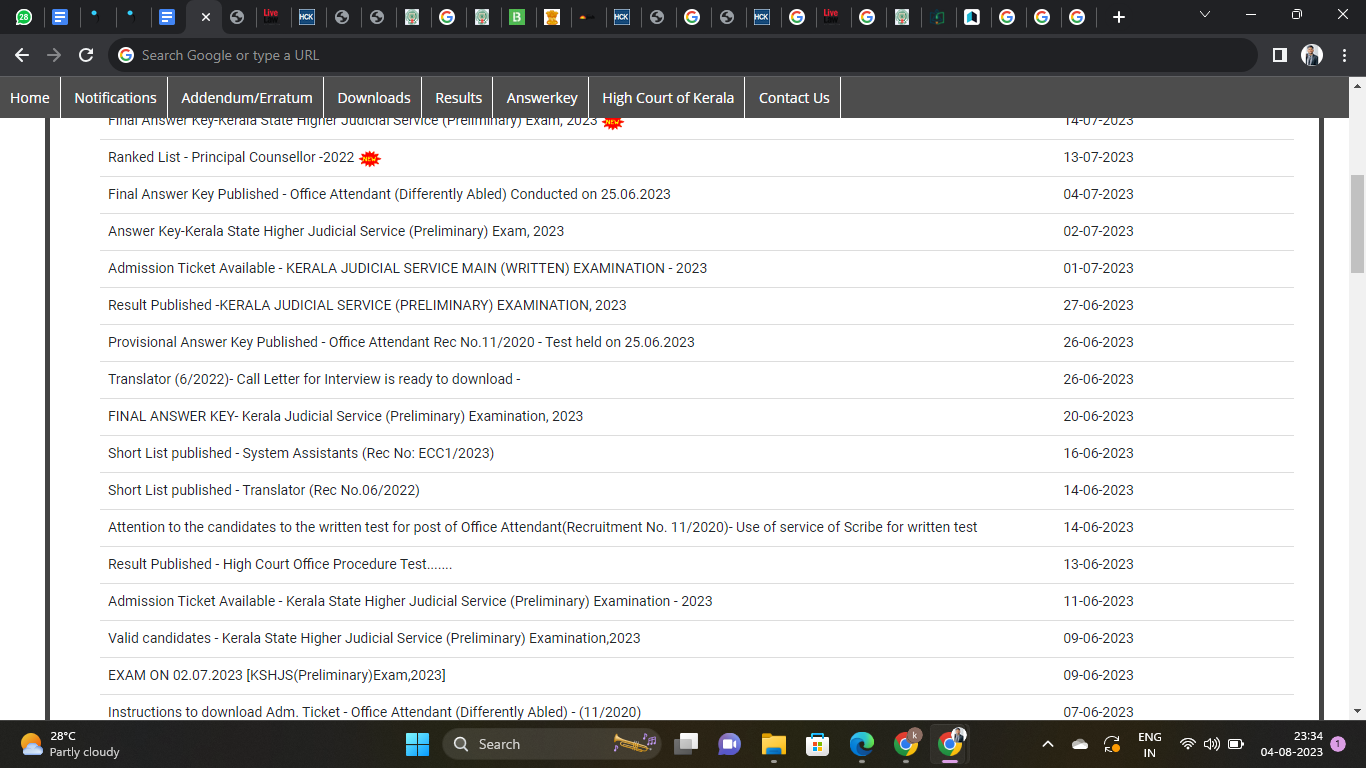
  • After this, on this particular page, you will have to look for this title- Result Published, Kerala Judicial Service (Preliminary) exam, 2023.
  • Tap on this title and download the PDF. You will get the names of all the candidates who are selected in the Preliminary exam.

Syllabus for the Kerala Judicial services Preliminary exam 

The syllabus for the KJSE Preliminary exam has been divided into three parts namely Part A, Part B, and Part C. All these parts consist of different topics and subjects, let us have a look at all the parts in a detailed manner.

PART A

  • The Indian Contract Act
  • The Negotiable Instruments Act
  • The Specific Relief Act
  • C.P.C (the Code of Civil Procedure)
  • The Act of Transfer of Property
  • The Act of Kerala Building (Lease and Rent Control) Act

PART B

  • The Indian Penal Code
  • The Indian Evidence Act
  • CR.P.C (the Code of Criminal Procedure) 

PART C

  • The Indian Constitution
  • Mental Ability and Reasoning
  • Legal General Knowledge

Kerala Judiciary Mains exam (400 marks)

The Kerala Judiciary Mains exam consists of 4 papers, and all four papers carry 100 marks each. Which means that the written exam is of 400 marks.  And the duration given for each candidate to solve each written paper is three hours in total. The candidates who qualify in the written exam are further shortlisted for the Viva-Voce round. The number of candidates qualifying for the viva round should not increase by more than three times the number of notified vacancies.

Viva-Voce (interview round)

After clearing the first two stages of the Kerala Judicial Service exam, the candidates are shortlisted for the Viva round. The maximum marks that this round contains is 50 marks. And the cutoff marks that a candidate should obtain in this round is fixed at 40 percent for the General and  OBC candidates and it is fixed at 35 percent for those candidates who belong to Scheduled Castes and the Scheduled Tribes. The marks obtained by the candidates in the Viva round is added to the overall total marks obtained by such candidates in the written Mains exam.

Syllabus of Kerala Judiciary Mains exam

Here is the tabular representation of all the important papers and subjects you need to cover for qualifying in your KJSE Mains exam.

PAPER IGeneral Essay writing (two)
English Grammar subject
Document translations from malayalam to english language and vice-versa
Precis writing
PAPER II (Part A)Act of Transfer of Property
The Indian Contracts Act
The Limitation Act
The Specific Relief Act
Act of Easements
Lease and Rent Control Kerala Building Act
The Hindu Succession Act
Act of Indian Succession- parts VI, X, and V
The Dissolution of Muslim Marriage 
PAPER II (Part B)Kerala Suits Valuation and Court Fees Act
The Kerala Stamp Act
KSLSA Act (Kerala State Legal Services Authorities Act)
Kerala Panchayat Raj Act- Chapter X, XXIA, XI, and XXV
The Kerala Municipality Act- Chapter IX, XXIV, X, nad XXV
The Negotiable Instruments Act (except chapter XVII)
The Registration Act
PAPER III (Part A)The Indian Evidence Act
IPC
The Abkari Act
NIA (Negotiable Instruments Act) Chapter XVII
The Protection of Women from Domestic Violence Act
PAPER III (Part B)J.J Act (The Juvenile Justice Act)
The Kerala Police Act
The Probation Of Offenders Act
The Forest Act
The N.D.P.S Act (the Provisions relating to trial and bail by the Magistrates).
PAPER IV (Part A)C.P.C (Code of Civil Procedure)
The Civil Rules of Practice
Act of Kerala Civil Courts
Interlocutory Application Orders/ Framing of Judgement Writing (Civil)
PAPER IV (Part B)CR.P.C (the Code of Criminal Procedure)
The Criminal Rules of Practice
Judgement Writing ( Criminal )
Framing of Order and Charges in Criminal Miscellaneous Petitions

Tabular representation of the schedule of 2023 KJSE Mains exam

Paper I22/07/23Saturday 9:30 AM to 12:30 PM
Paper II22/07/23Saturday 2:00 PM to 5:00 PM
Paper III23/07/23Sunday 9:30 AM to 12:30 PM
Paper IV23/07/23Sunday2:00 PM to 5:00 PmM

Most Frequently Asked Questions (FAQs) about Kerala Judiciary Mains exam

These are some of the most asked questions that are being asked by several candidates about the Mains exam.

How to qualify for the Kerala Judiciary Mains exam?

To qualify for the Kerala Judiciary Mains exam a candidate must qualify first in the Kerala Judiciary Preliminary exam, and he/she should score the minimum marks required to qualify for the Mains exam.

What is the weightage of the Kerala Judiciary Mains exam?

The Kerala Judicial Services Mains exam carries a weightage of 400 marks.

How many papers are there in the Kerala Judiciary Mains exam?

The Kerala Judicial Services Mains exam comprises of four papers, and each paper carries 100 marks.

How many marks does the Kerala Judiciary interview round hold?

The interview round carries 50 marks.

How many marks should an OBC candidate score in the Viva-Voce round?

An OBC candidate must secure 40 percent marks in the interview round to get qualified.

Tabular representation of Kerala Judicial Service exam papers, duration and maximum marks

SubjectTotal Time (Duration)Total Marks
Preliminary examTwo and a half-hours200
Mains exam (Paper 1)Three hours100
Mains exam (Paper 2)Three hours100
Mains exam (Paper 3)Three hours100
Mains exam (Paper 4)Three hours100
Viva-VoceNot Notified50

Kerala Judiciary 2023 selection process for the post of Munsiff-Magistrate

Eligible candidates for Kerala State Judiciary will be selected after giving a competitive exam at two successive stages. The first stage is a screening test which is the Preliminary exam. Under the Preliminary exam a candidate has to solve 100 questions and get the required marks in order to qualify for the Kerala Judiciary Mains exam. There is also a criteria of negative marking in the Preliminary exam, so if any candidate gives a wrong answer then one mark will be deducted for all the wrong answers.

Those candidates who secure the required marks needed to qualify for the Mains exam will be shortlisted for a written Mains exam. Under the Mains exam there are a total of four papers and each paper consists of 100 marks. A candidate will be given a duration of three hours to solve each of these papers. These papers are subjective and consist of lengthy questions and answers.

After a candidate has successfully cleared both the Preliminary and Mains stages of the Kerala Judicial Service exam he/she will be selected for a Viva-Voce round. The Viva-Voce round is an Interview stage where the candidate’s communication skills, knowledge and Reasoning is checked. If a candidate successfully clears the Viva-Voce round then he will be selected for the post of Munsif-Magistrate and will be sent for the training. 

Kerala Judiciary training process

Every individual who has been selected for the post of Munsiff- Magistrate will have to go through a training process of not less than one year, the duration of the training period can also extend up to two years. This training process is being conducted every year for the qualified candidates by the Kerala Judicial Academy.

State Training durationConducting body
Kerala One year (extendable up to two years)Kerala Judicial Academy

Kerala Judiciary probation period

Every candidate who has been appointed for the post of Munsiff- Magistrate will remain on a probation period for two years on duty within the continuous period of three years, from the date the candidate has joined the office. 

Kerala Judiciary tests for Munsiff-Magistrates

Candidates who are appointed as the Munsiff-Magistrates, shall during the period of probation pass the account test for the executive officers of the kerala state or the lower account test.

Pre-exam training for the candidates of SC/ST class

A free of cost short duration pre-exam training will be given to the  candidates belonging to the SC/ST class. This test will only be given if there are a sufficient number of candidates of such class qualified in the Preliminary round.

The candidates will not be getting any kind of salary or allowances from the Kerala High Court, the candidates will also have to manage all their lodging and travelling expenses on their own.

How to prepare for Kerala Judicial Service exam from scratch

There are three stages in Kerala Judicial Service exam

  • Preliminary stage
  • Mains stage
  • Interview round

Now let us understand in a detailed manner on how to start Kerala Judicial Service exam Preparation from the scratch/basics or from the beginning. Read further to know more about it.

Steps to prepare for Kerala Judiciary Preliminary exam

  1. The first thing that a candidate needs to do while preparing for the Preliminary exam is to become best friends with the bare act.
  2. Candidates must develop a habit of reading bare acts, that will give them a better understanding of all the legal concepts.
  3. Candidates must go through all the subjects and the syllabus of Kerala Judiciary Preliminary exam and start reading bare acts of those subjects.
  4. Analyse the whole syllabus of Preliminary exam and start with the main subjects of each part.
  5. Candidates can start their preparation from any of the substantive subjects of the Preliminary syllabus and then move towards the procedural subject, but make sure that the part chosen should be read properly and with full concentration.
  6. Similarly start moving towards other parts and reading all the subjects bare acts one by one.
  7. Once the candidates are done reading a particular bare act of any subject, they should start practising objective types questions of that subject.
  8. Once the candidates have started practising questions, they should check their speed and try to answer at least 100 questions in two and a half hours. By doing so candidates will not face any difficulty with time issues during the exam.
  9.  Follow all the above steps diligently then you are good to go.

Please Note : Bare acts are considered as one of the most important sources for preparing any Judicial services exam, thus it is very important for an individual to develop a habit of reading bare acts daily. Neglecting the use of bare acts can cause a huge loss in judiciary exams.

Tips to prepare for Kerala Judiciary Mains exam

  1. Once the candidates have cleared their concepts by reading the bare acts it’s time to move towards the preparation of Mains exam
  2. Start reading Bare Acts and Reference and commentary books of all those subjects that are mentioned in the Syllabus of Kerala Judiciary Mains exam.
  3. After the candidates have cleared their legal concepts by reading bare acts for the Preliminary exam, they should also start practising writing answers for their Mains exam.
  4. Candidates must solve as many mock tests and test series as they can. 
  5. Candidates must solve as many previous year papers as they can to increase their writing speed.
  6. Candidates must try to solve previous year question papers of multiple states, it is not necessary to stick only to the Kerala Judiciary previous year question papers. By doing this candidates will be able to learn more about the most commonly asked questions from all the subjects.
  7. In Mains exam also candidates must start practising subjective questions from substantive law subjects and then move towards procedural law subjects.
  8. Search and get a good judiciary course which provides multiple mock tests and other previous question year question papers. We have mentioned One such course available online that is full of test series below in this article. 

Please Note : Whenever a candidate starts his/her Kerala Judiciary preparation, they should never just focus on the Preliminary part neglecting the Mains part. They should always prepare for both the stages together, for example, if a candidate has read the bare act of a particular subject and his/her concepts are clear. They should start making exhaustive notes of that particular subject and start solving subjective questions too. Both should go hand in hand. This is a common mistake that most of the judiciary aspirants make which we don’t want you all to make. 

Tips to prepare for Kerala Judiciary viva voce round

  • A candidate should start reading various books and novels to develop their speaking skills
  • A candidate should remain updated with all the legal general knowledge trending topics
  • A candidate should remain confident when they meet the interview panel
  • A candidate must dress in a formal manner and avoid any kind of casual wear when they go for the Viva-Voce round
  • Don’t panic, look into the eyes of the interviewers and answer all the questions with confidence.

List of Books that can help you in your Viva-Voce Round

  • What to say when you talk to yourself, by Shad Helmstteter
  • The Ten Days to Self-Esteem – David D. Burns
  • What’s Right With Me: Positive Ways to Celebrate Your Strengths, by authors Carlene DeRoo and Carolyn DeRoo
  • Power of Your Subconscious Mind, by Joseph Murphy

Some pro tips and tricks for Kerala Judicial Service exam

These are some of the best tips and tricks that a candidate must follow to excel in their Kerala Judiciary exam.

  • A candidate must connect with their seniors and relatives who have prepared for KJSE and get their notes. This will help them in getting a better hold on all the subjects.
  • Always Start preparing for the Mains exam along with the Preliminary exam.
  • Solve previous year judiciary question papers of multiple states.
  • Buy mock tests and test series of various coaching institutes and exchange it with those  friends who are preparing for KJSE.

Books to refer for Kerala Judiciary exam

These are the list of books which a candidate should refer for clearing Kerala Judicial Service exam.

List of books for Kerala Judicial Service exam

SubjectsName of the Author or publisherBooks
Indian ConstitutionMP JainThe Indian Constitutional Law
Indian Constitution Bare act by universalBare act
J N PandeyBare act
The Indian Penal CodeK.D GaurA textbook on the Indian Penal Code
The Indian Penal Code, 1860Bare act
The Code of Civil ProcedureCK TakwaniThe Civil Procedure with Limitation Act
Avtar singhC.P.C book
CR.P.C (The Code of Criminal Procedure)RV KelkarCriminal Procedure Lectures
Ratanlal and DhirajlalCode of Criminal Procedure by ratanlal and Dhirajlal
The Code of Criminal Procedure, 1973 by UniversalBrae act
The Indian Evidence LawAvtar singhThe Law of Evidence Principles by Avtar singh
Batuk LalEvidence Law Paperback
Universal Publications Indian Evidence bare act 1872Bare act
Specific Relief Act and Indian Contract ActAvtar SinghSpecific relief and the Law of Contract by Avtar Singh
RK BangiaSpecific relief and the Law of Contract by RK Bangia
TPA (Transfer of Property Act) Universal Publications TPA Bare Act
Poonam PradhanProperty Law Book
RK SinhaTransfer of Property Book By RK Sinha
NIA (Negotiable Instruments Act)The Universal PublicationBare act
The Limitation ActJD JainThe Limitation Act
The Universal PublicationsBare act
The Indian Registration ActThe Universal PublicationsBare act
Muslim LawAkhil AhmedThe outlines of muslim law
Hindu LawParas DiwanModernHindu Law
NDPS ActUniversal Publications NDPS book, 1985Bare act
Protection of Women from the Domestic Violence ActNK AacharyaThe Act of 2005 protection of women from domestic violence (commentary)
JJ ACT (Juvenile Justice)The Universal PublicationsBare act
The Probation of Offenders ActKamal Publication (Lawman Series)Bare act
The Kerala Police ActNY VenkitKerala police Act
The Kerala Civil Courts ActN Ajith1957, The Kerala small cause act
(Lease and Rent Control) Kerala Building ActBobby Mani Thannickal(Lease and Rent Control) Kerala Building Act, 1965
The Indian Easements ActUniversal PublicationBare act
Kerala Suits Valuation and Court Fees actPRS India Online Bare Act PDF
The Kerala Stamp ActKerala GovernmentBare act
KSLSA ActKSLSA Online editionBare act
The Kerala Panchayat Raj ActKerala Government Bare act

Kerala Judiciary Munsiff Magistrate vacancies

Every year Kerala judiciary takes out vacancies for the post of Munsiff- magistrates. These vacancies also consist of NCA vacancies along with the regular vacancies. So now let us have a look at the vacancies of Kerala Judiciary for the post of Munsiff- Magistrate in 2023 and in previous years.

Munsiff-Magistrate vacancies for 2023

Serial No.Recruitment No.Number of vacancies Eligible categories
11/20233 NCA VacanciesScheduled Tribes are given one vacancy. Candidates belonging to both the ST and SC community can apply for this vacancy. But the people of Scheduled caste can only apply for this vacancy if there is no candidate from the Scheduled Tribes.People of Scheduled caste who convert to christianity – also have one vacancy
One Vacancy is given to Hindu Nadars
22/202310 NCAScheduled Tribes are given Four vacancies. Candidates belonging to both the ST and SC community can apply for this vacancy. But the people of Scheduled caste can only apply for this vacancy if there is no candidate from the Scheduled Tribes
People belonging to Other Backward Classes have Two vacancies.
Vishwakarmas- two vacancies
Anglo Indians- two
33/202356 regular vacanciesAvailable for all categories
469 total vacanciesNCA + Regular

Munsiff-Magistrate vacancies for 2022

Serial No.Recruitment No.Number of vacanciesEligible categories
11/20221 NCA VacanciesNADARS belonging to the non-creamy layer category are alone eligible for this vacancy
22/20227 NCA VacanciesScheduled Tribes are given Five vacancies. Candidates belonging to both the ST and SC community can apply for this vacancy. But the people of Scheduled caste can only apply for this vacancy if there is no candidate from the Scheduled Tribe in the merit list.
People of Scheduled caste who convert to christianity – also have one vacancy
One Vacancy is given to Hindu Nadars
33/202242 Regular VacanciesFor regular categories
450 vacanciesNCA + Regular

Munsiff-Magistrate vacancies for 2019

Serial No.Recruitment No.Number of vacanciesEligible categories
1
3/20191 NCA VacancyScheduled Tribes are given one vacancy. Candidates belonging to both the ST and SC community can apply for this vacancy. But the people of Scheduled caste can only apply for this vacancy if there is no candidate from the Scheduled Tribe in the merit list
24/20193 NCA VacanciesPeople of Scheduled caste who convert to christianity – also have one vacancy
One Vacancy is given to Hindu Nadars
One Vacancy is given to Nadars (which are included in SIUC-1)
35/20191 NCA VacancyOne Vacancy is Given to Anglo Indians and Latin Catholics 
46/20193 NCA VacanciesOne vacancy is given to the people of Other Backward Classes
Two Vacancies is Given to Anglo Indians and Latin Catholics 
57/201937 Regular VacanciesAvailable to all the Candidates
645 Total VacanciesNCA + Regular

Most Frequently Asked Questions (FAQs) about Kerala Judiciary vacancies

These are some of the most asked questions that are being asked by most of the candidates about the Kerala Judiciary.

How many vacancies will there be for regular candidates in Kerala Judicial Service exam2024?

There is no official notification released by the Kerala High Court about regular vacancies for KJSE 2024, but after analysing all the previous year vacancies we can say that there will be more than 56 vacancies. Because every year the Kerala High Court is releasing more number of Vacancies as compared to the previous years.

How many regular vacancies were there in KJSE 2023?

A total of 56 regular vacancies were released by the High Court of Kerala in 2024 for all the candidates.

Does Kerala High Court also release NCA vacancies?

Yes, every year the Kerala High Court releases several NCA vacancies for (sc/st/nadar/hindu nadars and OBC candidates)

How many NCA Vacancies were there in KJSE 2023?

The Kerala High Court in the year 2024 released a total of 13 NCA vacancies for the candidates belonging to Scheduled Castes, Scheduled Tribes, Hindu Nadars, Nadars and Other Backward Classes.

Application process for KJSE:

Candidates may apply for KJSE, online through their website, www.hckrecruitment.nic.in. The application process broadly consists of two stages and only after completion of both the stages and payment of application fees, the application process is deemed complete. But before starting the application process, there are certain points that a candidate must keep in mind so that the application process is carried out smoothly. 

Important points to be kept in mind before applying online

  • The candidates who wish to apply online must keep their scanned photograph and signature ready before starting the application process. 
  • The specification of the scanned photograph and signature are given in the table below:
Serial No. Type of ImageFile size Required Dimension
Height Width 
Photo20 KB to 40KB200 px150 px
Signature10KB to 20 KB 100 px150 px
  • Applicants must have a valid phone number or a valid email id before they start filling out their online application. The phone number/mail id must be kept active during the application process as the High Court will send notifications on the same. 
  • Any request for change in Phone number/mail ID will not be entertained by the authorities, so it is advised to have a valid number/mail Id before hand.
  • Candidates must keep their valid documents related to age, qualification, caste, marks etc ready. 
  • Candidates must keep in mind that after the photograph and signature is uploaded on the portal, it cannot be changed. So, they should be careful while uploading the same. 
  • Candidates who wish to apply for more than one Recruitment number, are advised to apply through one form itself. If they apply separately, they will have to pay separate fees for each recruitment. Also, they would lose their “common candidate” status. 
  • The application form for NCA Recruitments and Regular recruitments is the same. 

Steps to be followed to complete application

In order to complete the application procedure, the candidates must follow the following easy steps:

  • As already mentioned in the article before, the candidates will have to go through a 2-stage process in order to complete their application. Firstly, the candidates must visit the website, ‘www.hckrecruitment.nic.in’. Next, they can either click the link, ‘Step- I/ New Applicant’ or they can click the option that says ‘Apply online’. This option will take the applicant to the page where ‘POSTS’ is mentioned. Further, the applicant can click the option ‘Munsiff Magistrate’ to get to the main application form page.
  • In the first stage/step, ‘Registration of New Applicants’, the applicants are only required to fill in the basic details, like name, age of the candidate etc. 
  • When all the details required in Step I are complete, the applicant will be asked to create a Key number which will be used as password in the next step. The Key Number must contain ‘8 digits’ including a minimum one of each, upper case letter, lower case letter, numerical digit and special character. 
  • The applicant must keep the Key Number securely as it will be required at the time of login. 
  • Once Step I is about to be completed, the applicant must ensure that the religion and Caste category (SC/ST or OBC) is displayed correctly on the screen. 
  • After Step I is over, the applicant will be provided with an ‘Application Number’. This is also an important number and must be kept securely by the candidate as it might be required further. 
  • Once Step I is over, the applicant may choose to complete the second step by clicking on the option ‘Proceed’, or the applicant may exit the page as per his/her wish. 
  • If the applicant opts to exit the page, he/she will be required to login again using the Application Number and Key Number and click on Step-II/Registered Applicant. 
  • In this step the applicant will have to upload his/her scanned copy of photograph and signature as per the dimensions given above. 
  • Further, the applicant will be required to fill in information such as, Employment details, Service particulars, etc. 
  • Once all the details are filled in, candidates can complete the process by clicking on ‘Final Submission’. The candidates must keep in mind that the details filled in by them cannot be changed after ‘Final Submission’ is clicked, so they must make sure that all the details filled in by them are correct. 

Payment of application fees

The applicants must keep in mind that clicking on ‘Final Submission’ does not make the application process complete. The application process is only complete once the application fee is paid and the payment link becomes inactive. The following steps must be followed and the points must be kept in mind during payment of fees:

  • Payment of application fees can be done by online as well as offline method. The amount of application fees to be paid by the applicants is given in the table below:
Applicant’s CategoryApplication Fees
SC/ST/Unemployed Persons with Disability Nil
Applicants belonging to All Other categories (including Regular and NCA vacancies)Rs 1250/-
  • The candidates who wish to pay the application fees online itself can click the ‘Fee Payment’ link there itself and they can use Credit Card, Debit Card or Net Banking option to make the payment. 
  • Candidates who wish to make online payment can do so in one go, or if they desire they can close the home page and log in again using their application and key number to complete the process.
  • The candidates must use a web browser which is compatible with the bank, so that the fee payment is hassle free.
  • Candidates will be able to make the payment from the date of commencement of Step 1 and Step 2. they shall have to click on the link, “fee payment” which is given on the profile of the candidate. 
  • In case the amount has been debited from the account of the applicant he/she must not register again. Clearing of payment may take 2-3 days.
  • The payment is successful if the payment link becomes inactive. In case the payment link does not become inactive and the amount has already been debited from the account, the candidate must not worry as some times clearing of the amount takes 2-3 days. In some cases the amount is even sent back into the applicant’s account.
  • If online payment is unsuccessful candidates can make offline payment by showing the system generated challan at SBI branch
  • If by chance both online and offline payments become successful for a single application, the applicant must send an email stating the same.
  • In case of failed online payments, the applicants must download and save a copy of the Challan generated by the system to make offline payments. 
  • Those candidates who wish to make the payment offline, must visit SBI branch and pay cash using the copy of system generated fee payment Challan. 
  • Payment through Demand  Draft/ Cheque/ Money Orders/ Postal Order etc. is not accepted. Thus, applicants must refrain from making payments through these methods. 
  • Payment of fee can only be made once the final submission is completed by the applicant.
  • Once the fee is paid it will not be refunded back nor will it be used for any other exam.

Note

  1. Challan can be downloaded from the fee payment page itself but only till the closure of step II i.e., 03/03/2023. After such a date challan won’t be available for downloading.
  2. Candidates must note that the application process is only complete on successful payment of application fees. If the payment is not successful within the cut off date the application will be deemed incomplete.
  3. Candidates must get a printout of their application and keep it safely for future reference. 

Important Dates for submission of Online Application:

The candidates must go through the following dates with regards to application form.

Commencement of Application Process (Step I and Step II) and payment of Application fees01/02/2023
Closing Date of Step I Application Process23/02/2023
Closing Date of Step II Application Process (    –  This date will be last date for online payment of application fees and downloading of system generated Chalan for offline payment. Candidates who had made online payment, must ensure that their Payment Link has become inactive by this date, otherwise the payment will not be deemed complete. )08/03/2023
Commencement of payment of Application fees through offline mode. (Last date for downloading of chalan for candidates who wish to pay offline fees is 03/03/2023)08/03/2023
Last date for offline payment of Application Fees17/03/2023

Total Number of attempts for Kerala Judicial Service exam

Till date the High Court of Kerala has not released any official notification regarding the total number of attempts that a candidate can make in the Kerala Judicial Service exam. But yes, the Kerala High Court has mentioned several norms and eligibility criterias in their 2023 official notification  that a candidate needs to follow in order to appear in the KJSE 2023 exam. 

If any candidate fails to comply with any of the norms and criterion as specified by the Kerala High Court then the application of such candidate will be directly rejected. Thus, if you are a KJSE aspirant then you must keep in mind all these norms and guidelines while filling up your application. 

How to check the results of Kerala Judicial Service exam, 2023

The Kerala High Court has already conducted both the Preliminary and Mains exam for 2023. All the candidates who appeared in the Kerala Judicial Services exam 2023 can check their Preliminary and Mains exam result from the official website of High Court of Kerala recruitment Portal.

Steps to view the 2023 KJSE Preliminary and Mains exam result.

Follow the below mentioned steps to check the results of Kerala Judicial Service exam.

  • First step-  tap on this link 
  • Second Step- After you tap on this link you will be redirected to the official website of Kerala High Court recruitment Portal. Where you will get to see a window like this.
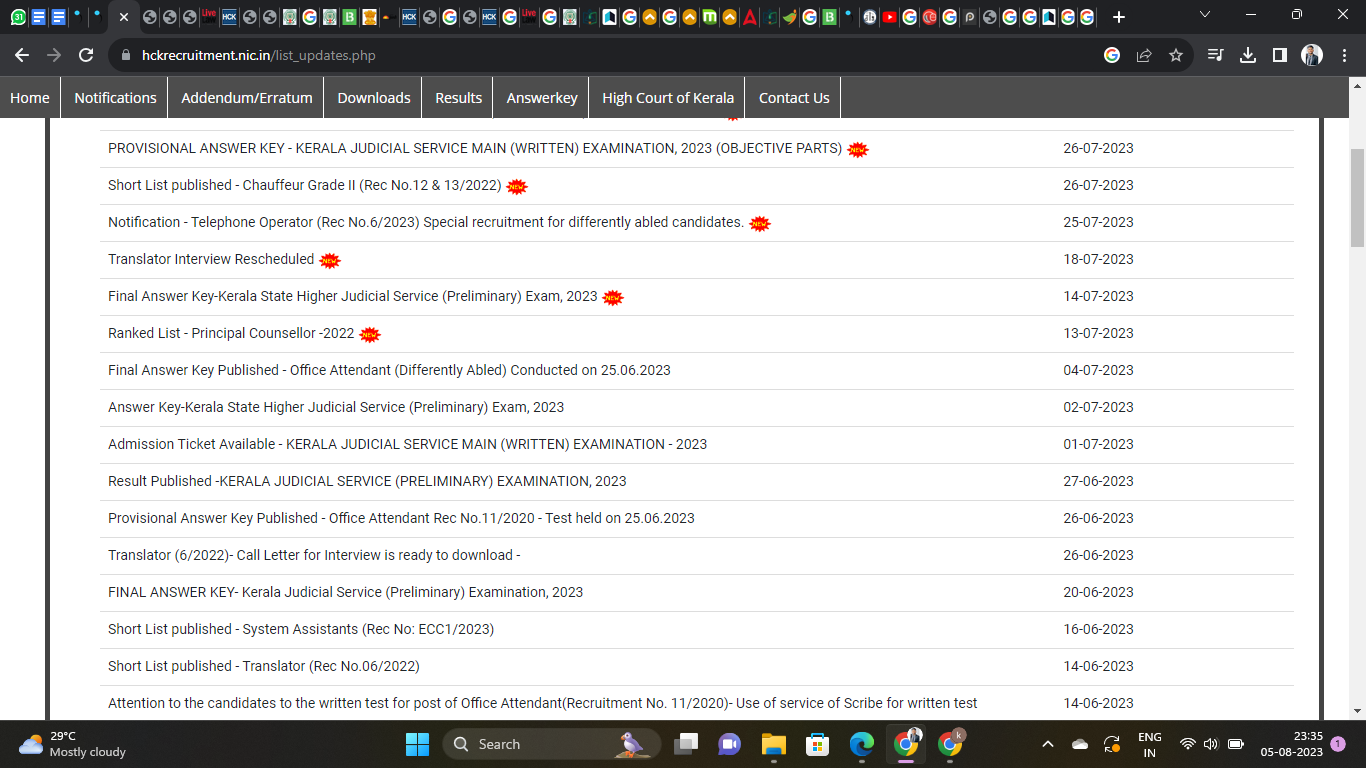
  • Third step- Find and Tap on the title on Preliminary exam result dated 27/06/2023
  • Fourth Step- Once you tap on the title of Preliminary exam result, a Pdf will be downloaded. Once the PDF is downloaded you can open that PDF and check the result. It will look somewhat like this.
  • Fifth step- Similarly to check the Mains exam result, you need to tap on the title of Mains exam result. And the above process will be the same as it was for viewing the Preliminary exam result. 
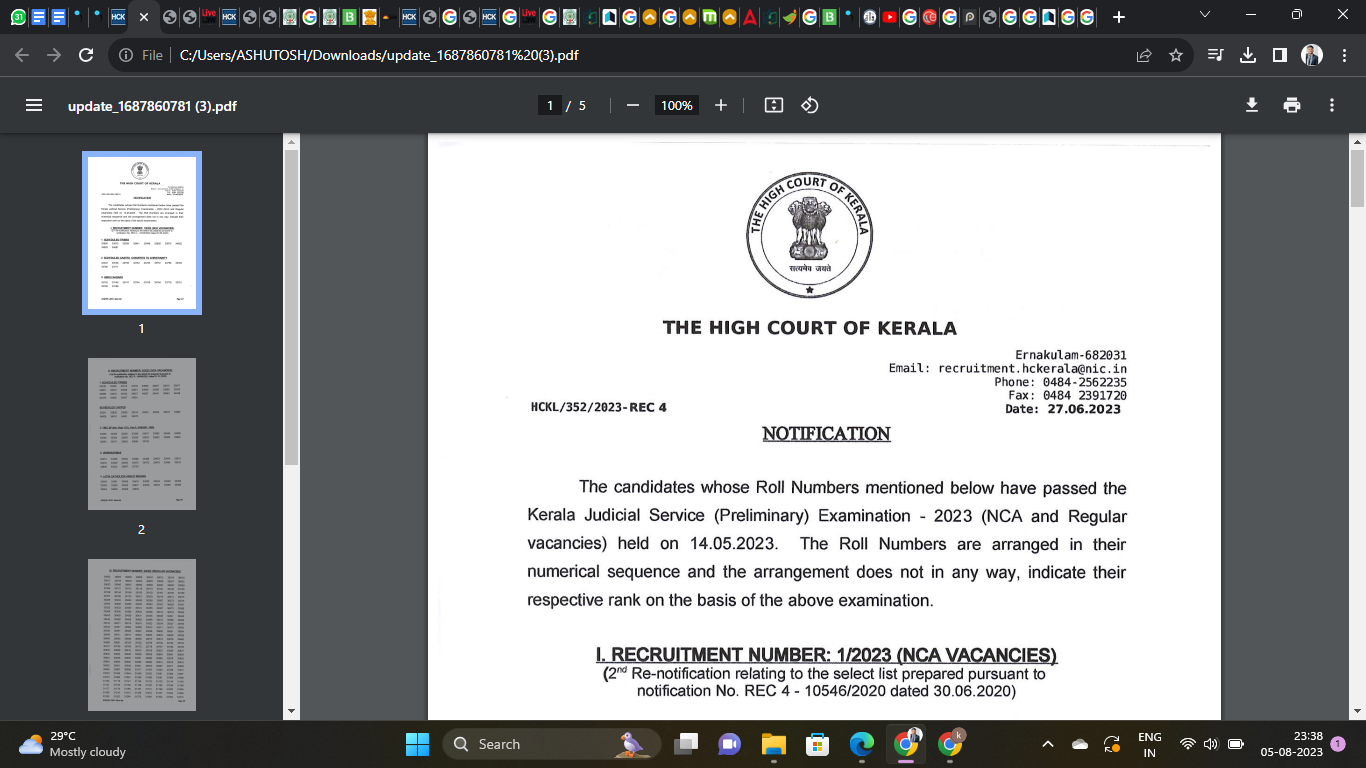
Please Note : The result of Kerala Judiciary Mains exam 2023 has not been released by the Kerala High Court. Stay tuned to know about the Mains 2023 KJSE result.

How to check the answer keys of Kerala Judiciary Preliminary and Mains exam, 2023

The process of checking the answers keys of Kerala Judicial Service exam 2023 is similar to viewing their results. Read the below-mentioned steps to learn more about it.

Step 1– Open the Official website of Kerala High Court Recruitment Portal.

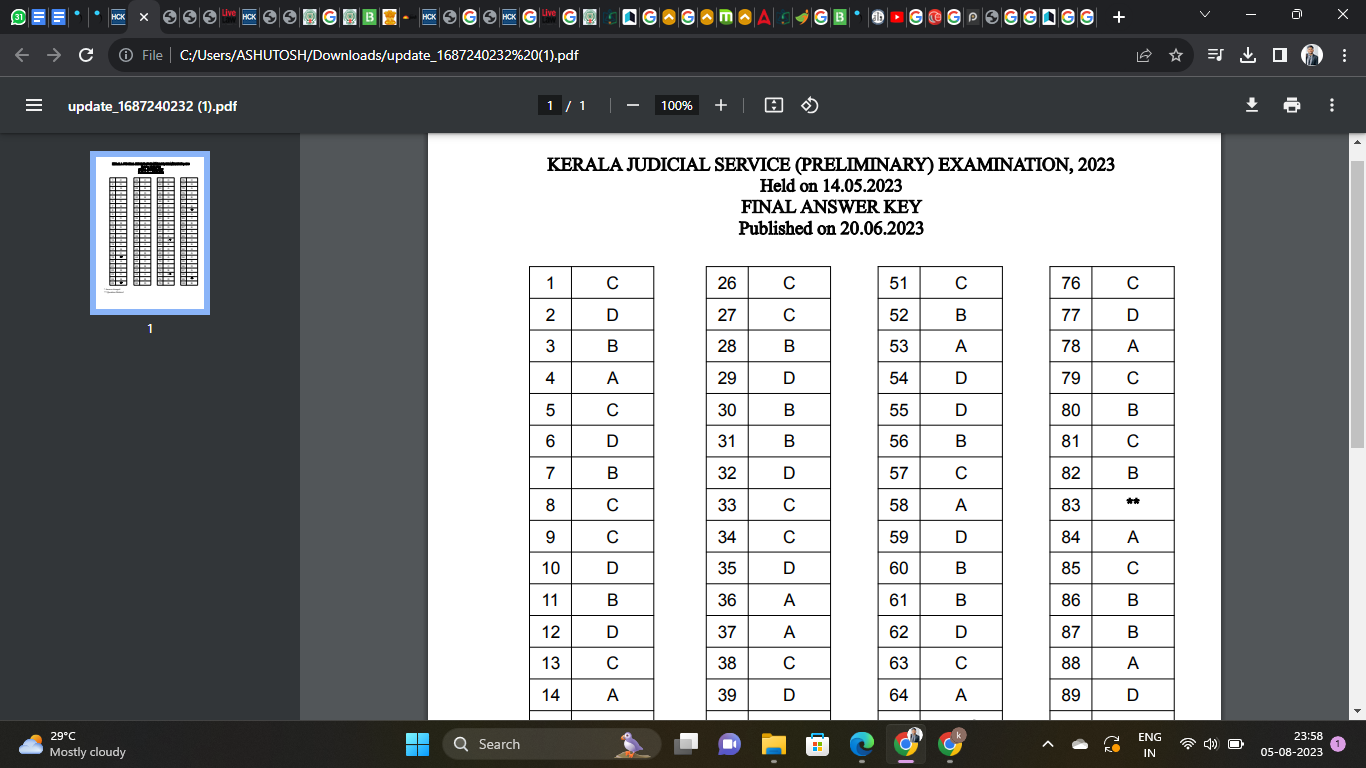
Step 2– Tap on the title of Final answer key for Preliminary exam 2023.

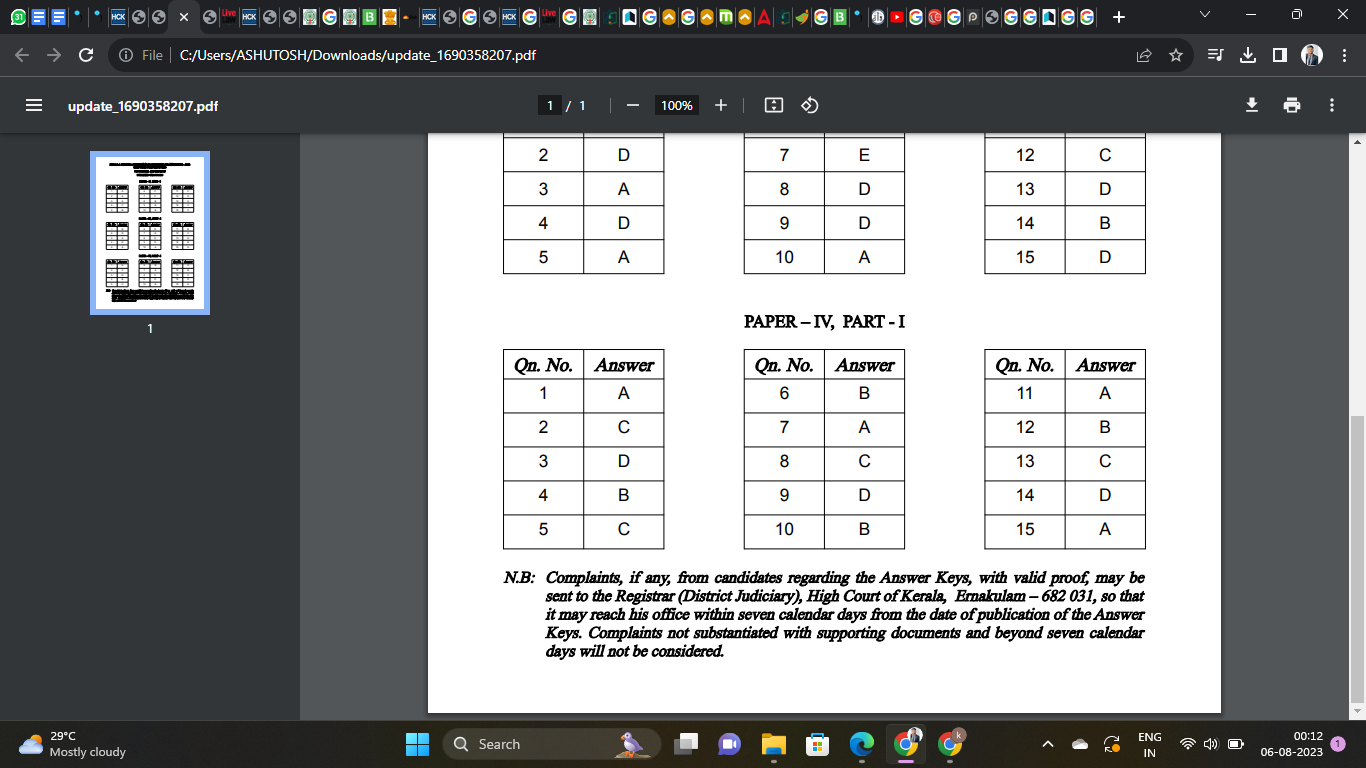
Step 3– Download and open the PDF, you will be able to check the final answer key. This is what it looks like.
How to check the answer keys of Kerala Judiciary Mains exam

Follow the same steps as mentioned-above for viewing the Preliminary exam answer keys.

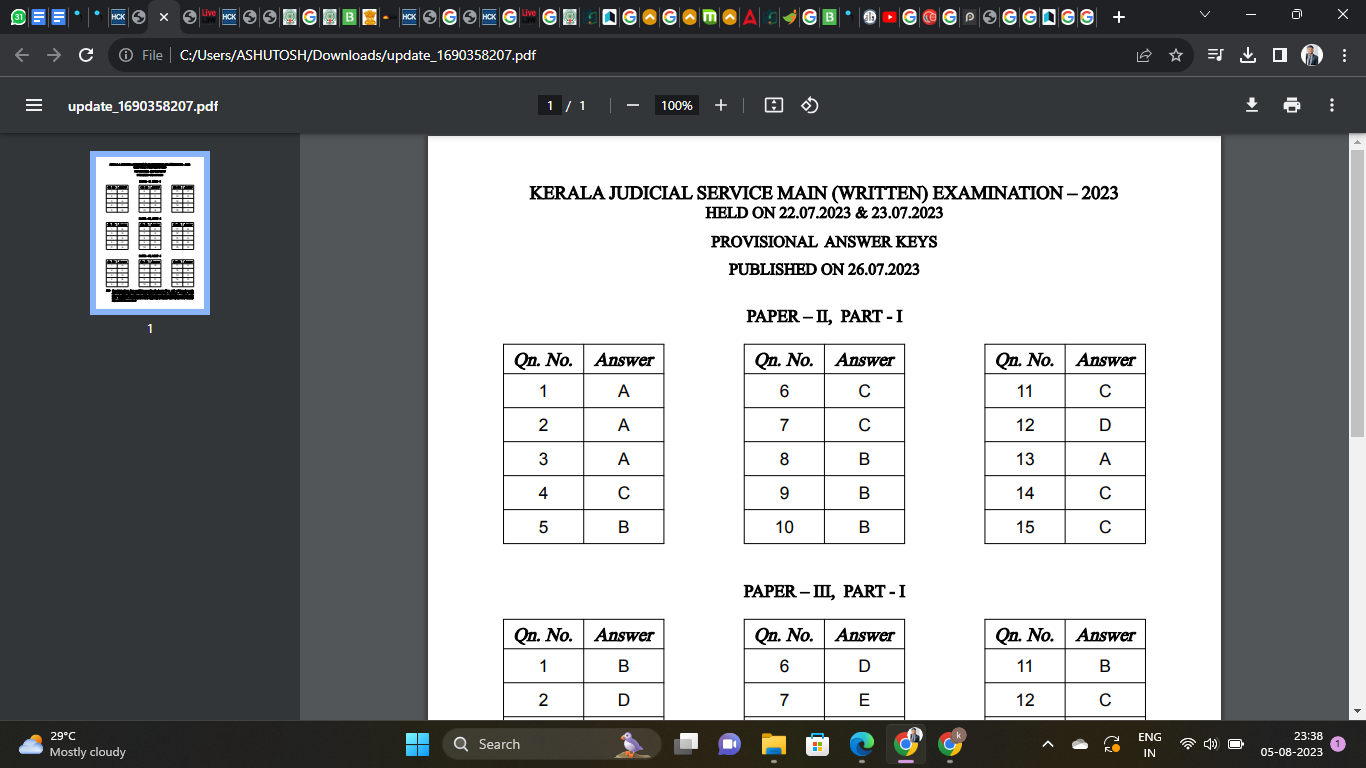
Once a candidate has downloaded the PDF they can simply open it and then they will be able to check the Provisional answer keys for Kerala Judiciary Mains exam 2023. 

Visual Representation Of Kerala Judiciary Mains exam 2023 Provisional Answer key
How to get hall tickets for Kerala Judiciary exam, 2023

The hall tickets for the Kerala Judicial Service exam 2023 will not be sent by post to the candidates. To get their hall tickets the candidates must log in to the recruitment portal of the Kerala High Court and download their ticket in a PDF format from the official website. The hall tickets will be made available before three weeks of conducting the Kerala Judiciary exam.

How will the candidates receive their call letter for viva voce round

The eligible candidates can login to their profile and download their call letters from the official website of the High Court of Kerala recruitment portal before two weeks of the Viva-Voce round. It is suggested that every candidate must visit the official website once in a week to get all the essential information related to the Kerala Judicial Service exam 2023.

What is better – online or offline judiciary courses 

Here we have discussed online and offline judiciary classes, and what a candidate should opt for.

Why to choose online judiciary course

After the pandemic most of us are habituated to stay at home and work, study, learn from the comfort of our home. We have learned the value of online teaching and have witnessed its benefits. 

Nowadays most of the candidates prefer online teaching mode other than the offline mode and there are several reasons behind this. Because online classes are hassle free, candidates can simply log in from their device and start their preparation. There is no struggle of travelling, spending extra money, carrying lunch boxes and many more.

Whereas one extra benefit that online coaching provides is of recorded classes, which means the candidates can access the recordings of a particular lecture at any time. So there is no stress of losing a single class or running here and there for notes of that particular class. Thus, nowadays most people advise a sincere candidate to opt for online judiciary classes.

Why to choose offline judiciary course

If a student is unable to focus on his studies when he/she is in their home, or if they face a lot of disturbances in their home. Then for such candidates it is suggested to go for an offline judiciary coaching. So that the candidate is able to deviate his mind from all kinds of disturbances and put all his concentration on studies.

Analysis of Kerala Judicial Service exam question paper 2022

It is very necessary for every candidate to solve several previous year question papers, because this will help the candidates to know more about the questions pattern and which subjects carry the maximum weightage.

Analysis of Kerala Judiciary 2022 Preliminary question paper (200 marks)

The 2022 Kerala Judiciary Prelims question paper consisted of 100 objective questions and each question had a weightage of 2 marks, there was also a negative marking of 1 mark for every wrong answer. The duration given to solve this question paper was two and a half hours.

The Preliminary question paper was divided into three parts:

  • Part A- This part consisted of questions related to civil law subject.
  • Part B- This part consisted of questions related to criminal law subject.
  • Part C- This part consisted of questions related to constitutional and general legal knowledge.

Analysis of Part A

  • Dealt with only Civil law questions.
  • Consisted of 40 questions, from number 1 to 40.
  • Questions in this part were asked from Indian Contract Act, Specific Relief Act, Transfer of Property act, Limitation act, Kerala (Building lease and rent control Act), Code of Civil Procedure, Partnership Act.
  • Specific Relief Act and the Code of Civil Procedure were the main two civil law subjects from which maximum questions were asked (more than 5-6 questions were asked from Code of Civil Procedure and for Specific Relief Act).
  • Least amount of questions were asked from the Indian Contract Act and Partnership Act.
  • Overall marks- 80

Analysis of Part B

  • Dealt with only Criminal law questions
  • Consisted of 40 questions, from number 40 to 80
  • Questions were mostly asked from two subjects which were Indian Penal Code and the Code of Criminal Procedure
  • Few questions were also asked from the Indian Evidence Act
  • Overall marks- 80

Analysis of Part C

  • This part dealt with questions related to constitutional and general legal knowledge
  • Consisted of 20 questions, from number 80 to 100
  • Questions were asked from several landmark Judgements
  • Basic questions related to Indian Judiciary was also asked
  • Overall marks- 40

Tap here, to get the Kerala Judiciary 2022 Preliminary exam question paper.

Analysis of Kerala Judiciary 2022 Mains Question paper (400 marks)

The Kerala Judiciary Mains exam consists of four papers

  • Paper I (100 marks)
  • Paper II (100 marks)
  • Paper III (100 marks)
  • Paper IV (100 marks)

Analysis of Mains Paper I

Paper I of the Kerala Judiciary Mains exam was a general English paper.

  • This question paper carried 100 marks
  • First 30 questions were basic grammar questions consisting of fill in the blanks type questions. Each question under this part carried one mark.
  • Then there was the essay writing part
  • Candidates were given 6 essay topics and they were asked to write essays on any of the two topics. This part consisted of 40 marks
  • After essay writing the next question was related to Precis writing. Candidates were given a passage and they were asked to do a precis writing for the same.This part consisted of 15 marks
  •  Last question was related to translation. Candidates were asked to convert malayalam passages to english language. This part also consisted of 15 marks.

Tap here, to get the Kerala Judiciary 2022 Mains Paper I question

Analysis of Mains Paper II

Paper II of the Kerala Judiciary Mains exam was a Civil Law paper.

  • This question paper also carried 100 marks and consisted of three parts
  • This paper dealt with objective and subjective type questions related to Civil law
  • In the first part 15 multiple choice based questions were asked. Questions in this part were mainly asked from Contract, Transfer of Property, Family law and Limitation Act). Each question of this part carried 1 mark.
  • In the second part subjective questions were asked. Candidates were asked to solve 15 subjective type questions related to civil law. All the answers in this part were to be written under 120 words and each question of this part carried 3 marks.
  • In the last part candidates were asked to write 5 subjective type questions related to civil law within the limit of 250 words and each question carried 8 marks. 
  • Subjective type questions were asked from all the Civil law subjects mentioned in the Mains exam syllabus.

Tap here, to get the Kerala Judiciary 2022 Mains Paper II question

Analysis of Mains Paper III

Paper III of the Kerala Judiciary Mains exam was a Criminal Law paper.

  • This question paper also carried 100 marks and consisted of three parts
  • This paper dealt with objective and subjective type questions related to Criminal Law
  • In the first part 15 multiple choice based questions were asked. Questions in this part were mainly asked from Indian Penal Code, Indian Evidence Act, and NDPS act. Each question under this part carried 1 mark.
  • In the second part subjective questions were asked. Candidates had to solve 15 subjective type questions related to criminal law. All the answers in this part were to be written under 120 words and each question of this part carried 3 marks.
  • In the last part candidates were asked to write 5 subjective type questions related to criminal law within the limit of 250 words and each question carried 8 marks
  • Subjective type questions were asked from all the Criminal law subjects mentioned in the Mains exam syllabus.

Tap here, to get the Kerala Judiciary 2022 Mains Paper III question

Analysis of Mains Paper IV

Paper IV of Kerala Judicial Service exam consisted of questions relating to framing of charges and Issues

  • This question paper also carried 100 marks and consisted of three parts
  • In the first part 15 multiple choice based questions were asked. Each question under this part carried 1 mark.
  • In the second part subjective type questions were asked. Candidates had to solve 11 subjective type questions related to framing of charges and issues. All the answers in this part were to be written under 160 words and each question of this part carried 5 marks. 
  • The last part of this paper consisted of Judgement Writing. Under this part candidates were asked to write two judgements on the given facts, each judgement writing consisted of 15 marks.
  • Questions under this paper were mainly asked from Code of Civil Procedure, the Kerala Civil Courts Act, Act of Civil Rules of Practice, Code of Criminal Procedure, and the Criminal Rules of Practices.

Tap here, to get the Kerala Judiciary 2022 Mains Paper IV question

How to excel in judgement writing part of the KJSE Mains exam

Judgement writing is one of the toughest parts of the KJSE Mains exam, only few candidates are able to score good marks in the judgement writing part, because the candidates do not know how to write judgements correctly. And to stand out in this exam it is very essential to know all the aspects of judgement writing.

To improve the judgement writing a candidate needs to regularly practise writing judgements on various facts and they also need to solve judgement writing questions from previous year papers. There are also several online courses for judgement writing and drafting that a candidate can avail to improve their judgement writing skills. These judgement writing online courses will not only improve their judgement writing skills but it will also enhance their reasoning capabilities.

One of the best online judgement writing courses available at the moment is the  LawSikho Judgement writing and drafting course.  This is a very exhaustive and modern judgement writing course that consists of 12 modules and all these modules are designed especially to cover all the aspects of Judgement writing. 

Some important instructions to the KJSE candidates

These are some of the important instructions that every candidate must follow in their Kerala Judiciary exam.

  • Candidates should always write their roll number in the question booklets at the given space
  • Candidates should always thoroughly check their question booklets and check whether everything is correct or not
  • Candidates should always use black or blue ballpoint pen for answering the questions
  • Candidates should always make sure to comply with all the norms and guideline of KJSE
  • Candidates should keep checking the official website of the High Court of Kerala for important notifications
  • Candidates should reach their exam centre approx one hour prior, so that you get enough time to figure your seat and other stuff.
  • Candidates should Keep several Photocopies of their admit card, in case if they lose their admit card they will have the photocopies.
  • Candidates should always practise time management before going for their exam.
  • Candidates should always keep their key number and application number securely with them, because these details will be required every time they log in to their account.

Kerala Higher Judicial Service exam 

Every year the Kerala High Court also announces some vacancies for the post of District and Sessions Judges through online application by the direct recruitment process. In 2023 the Kerala High Court announced 5 vacancies in the Kerala State Higher Judiciary exam. Read below to know more about the Kerala State Higher Judiciary exam.

Eligibility criteria for the Kerala Higher Judicial Service exam

A candidate who wishes to apply for Kerala State Higher Judicial Service exam must fulfil the following criteria in order to apply for the position:

  • He/she must be an Indian citizen.
  • He/she must have a good character.
  • He/she must not have any bodily deformity or defect that would make him/her unfit for the position. 
  • He/she must not have more than one living spouse at the time except if the same is exempted by the government on any special ground.
  • He must have attained minimum 35 years of age but shall not be more than 45 years of age as on 1st January, 2023.
  • He/she must be a practising Advocate with a minimum experience of 7 years (as on 1st January 2023).
  • Till the time of appointment, he/she must continue his /her practice. 
  • He/she must not already be in service under any other State Government or Union Territory (Central Government).
    • Important Note- As per sub rule (c) of Rule 10 of Part II of the Kerala State and Subordinate Services Rules, 1958, the raise of upper age limit of, candidates belonging to SC, adult SCs, and wards of the adults who have been converted to other religion, ST or OBC, is applicable.

Pay scale

District and session judges who will be selected in the Kerala state higher judicial services exam will have a pay scale of (Rs. 144840- Rs. 194660).

Pattern for Kerala State Higher Judiciary Preliminary and Mains exam:

  • The Preliminary paper shall consist of 75 multiple choice questions. The questions will be divided in the following number:

                      – 30 questions from Civil Law

                      – 30 questions from Criminal Law

                      – 15 questions from Constitutional Law, English Language, General                

                                     Knowledge and Legal Aptitude.

  • The Main exam consists of a written exam as well as Viva Voce. Candidates who qualify the Preliminary exam shall be allowed to take the Main exam. The Main exam shall consist of two written exams, each of 150 marks, thus, the written part of the main exam carries 300 marks. 
  • Viva Voce is the last stage of the exam. In ordinary circumstances, the number of candidates appearing for Viva Voce must not be more than 3 times the number of notified vacancies. If more than one candidate acquires the same marks, all such candidates shall be considered as qualified for Viva Voce. Viva Voce shall be a total of 50 marks. 

Duration of exam

  • The duration of the Preliminary exam is two hours.
  • The Main exam shall consist of two papers and duration of each paper is three hours. 

Kerala State Higher Judiciary Selection Process 

The eligible candidates for KSHJSE are required to give a two stage exam. The first stage is called Kerala State Higher Judicial Service (Preliminary) exam and the second stage exam is Kerala State Higher Judicial Service (Main) exam. Only after qualifying these exams, a candidate will be selected for the post of District and Sessions Judge. Thus it is important that the candidate must be well versed with the pattern and marking scheme of both stages of paper. 

Marking Scheme of Kerala State Higher Judiciary exam 

  • In case of Preliminary exams, candidates will be awarded a total of 2 marks for one correct answer and one mark will be deducted for one wrong answer. If a candidate darkens a wrong option or darkens half or a part of the correct answer, such a darkened answer shall be considered as a wrong answer. 
  • The marks obtained by a candidate in the Preliminary exams shall not be added in the final marks for determination of selected candidates. 
  • In case of Viva Voce, a general or OBC candidate must score at least 40% marks and a SC/ST candidate must secure at least 35% marks. 

Final selection

The qualification of a candidate will be based on the aggregate of his/her marks secured in Main exam and Viva Voce. The authorities shall prepare a list of all the successful candidates. If more than one student scores identical marks, the one who is older in age shall be preferred to the younger one. In case, the age of candidates is also the same, then the candidate with more years of practice shall be considered as qualified. If this is also identical, the decision will be left on discretion of the Committee. 

Important pointers to note on Kerala Higher Judicial Service exam

  • The candidates can pay their application fee through debit card/ credit card/ net banking etc.
  • The candidate must be a practising advocate from seven years as of January 2023 in order to be eligible for Kerala State Higher Judiciary exam.
  • The candidate must create a valid email ID before filling the application form of Kerala State Higher Judiciary exam.
  • The candidate must visit the official website of the Kerala High court once in a week to get all the essential information.
  • The candidate must also keep all the essential documents ready before filling the application form.

Tabular representation of Kerala State Higher Judiciary exam

Availability of admission tickets for KSHJSE Preliminary exam11th June 2023
Availability of admission tickets for KSHJSE Mains exam 20231st July 2023
Result date of KSHJSE Preliminary exam26th July 2023
Total number of vacancies in KSHJSE exam05
Application fee of KSHJSE examRs. 1500 (general category)
Final results of KSHJSE examYet to be declared
Pay scale of District and sessions judges (who have qualified KSHJSE)144840- 194660

Frequently Asked Questions (FAQs) on Kerala Judicial Service exam

Candidates usually have many questions in their mind related to the judicial service exam. Some are confused about the syllabus, while some need answers as to how many months prior one should start preparing. We have answered all such common questions. Keep reading to clear your doubts related to Kerala Judicial Service exam.

Are online judiciary classes helpful for preparation of KJSE?

Yes, online classes are just as effective as offline coaching classes. In the end it all depends on the focus and attention students pay in class.

Frequently Asked Questions (FAQs) on KJS Preliminary exam

What is the total marks of KJSE Preliminary exam?

The maximum marks of KJSE Preliminary exam is 200. It consists of 100 MCQs which hold 2 marks each.

Are only MCQs asked in KJSE Preliminary exam?

Yes, KJSE Preliminary exam consists only of MCQ questions. A total of 100 MCQs are asked in this level.

Is there negative marking in KJSE Preliminary exam?

Yes, there is negative marking in the KJSE Preliminary exam. For every incorrect answer, one mark is deducted. Two marks are awarded for every correct answer. 

How much time prior a candidate should start preparing for the KJSE Preliminary exam?

There is no hard and fast rule as to how much time prior a person should start preparation. It all depends on the candidate’s calibre and the number of hours dedicated on a daily basis for preparation. Although it is advised that candidates studying in a 5 year course should start their preparation from the beginning of their fourth year. And students in 3 year courses must start their preparation by the end of first year and beginning of second year. Also, students must prepare for mains and Preliminary together. 

Does taking Mock Tests help with preparation of KJSE Preliminary exam?

Mock tests really take preparation of Preliminary exam to the next level, because candidates don’t only get well versed with the potential questions but they also get to learn time management. So, candidates must not skip on taking Mock tests.

Frequently Asked Questions (FAQs) on KJSE Mains exam

How much marks does KJSE Main exam carry?

The KJSE Main exam is held for a maximum mark of 400. The Mains exam consists of four papers and each paper carries 100 marks. 

What is the duration of KJSE Mains exam?

The KJSE Mains exam consists of four papers and the duration of each paper is 1 hour each. 

Is it necessary to know Malayalam for writing the KJSE Mains exam?

Yes, candidates appearing for KJSE must be well versed with Malayalam language as paper I consists of translation from Malayalam to English. And even after selection in the exam, vernacular language will be required in the court. 

What are some tips and tricks that a candidate must follow to ace the KJSE Mains exam?

Although different tips may work for different candidates, but all the candidates must go consider the following tips and tricks while preparing for KJSE Mains exam:

  • Candidates must be very well erased with the bare acts of all the subjects of Mains exam. 
  • The mains question paper is very lengthy, so the candidates must practise mock tests to learn time management. 
  • Candidates must focus on case laws as it gives credibility to the answers. 
  • It is very important for the candidates to stay updated with the current affairs even for the Mains exam as many times questions are based on the latest updates.
  • Practise answer writing as much as possible before the main exam to understand the pattern, appropriate length required etc. Get the answers checked by a mentor.  

Frequently Asked Questions (FAQs) on Kerala Judiciary Viva Voce

What is the maximum marks of Kerala Judiciary Viva Voce?

The Kerala Judiciary Viva Voce carries a total of 50 marks. 

What kind of question can one expect during the Viva Voce?

Questions may vary from candidate to candidate depending on the choice of the panel members, but some common areas from which questions are regularly asked include:

  • Current Affairs
  • Legal Issues
  • Recent Amendments
  • Any new bill passed in the Parliament
  • Local Laws (here local laws of Kerala)
  • Questions on personality

Apart from questions from above areas, some common questions are also asked by the panel members. The plausible general questions could be:

  • Why do you aspire to become a magistrate?
  • What is your practice area?
  • Apart from law, what are your other interests?
  • What are your strengths and weaknesses?

What are the points that a candidate must keep in mind while giving viva voce?

A candidate must focus equally on preparation of viva voce as well as other 2 papers. There are certain areas that a candidate must work on for passing with flying colours in their viva voce. These important points are given below:

  • Candidate must make sure that there is clarity in their speech even if the pronunciation is not that good, because the panel members must be able to easily understand the answers given by the candidate. 
  • Candidates must sound humble and calm rather than aggressive or arrogant. 
  • Listening is also a very important attribute for a candidate. Candidates must listen patiently to the questions of the panel members and try to construct the best possible answer while listening to the question itself. If there is any confusion regarding the questions, candidates must not refrain from clearing their doubt. 
  • Body language gives out the first impression, so make yourself look confident (but don’t overdo it). Keep a smile on your face while entering the room and greet all but not one panel member. 

What is the appropriate dress to be worn in viva voce?

Candidates must keep in mind that they have to look professional during the interview, so they must avoid any casual dress. A good formal option for men is, a pant shirt with a blazer, and women can go with a simple saree or pant shirt. 

How to improve communication skills before the viva voce?

Candidates can take classes to improve their communication skills. In addition to that, taking mock viva voce would be very useful. 

FAQs on Kerala Judicial Service exam age criteria

What is the age limit for the KJSE exam?

There is no minimum age limit for writing KJSE exam, but the upper age limit is 35 years. This means that the candidate writing this exam must not be more than 35 years of age. Additionally, age relaxation of 5 and 3 years has been given to candidates of a specific category. 

Is the age limit the same for all categories of students?

No, a relief on the upper age limit has been provided to students belonging to a specific category. This specific category shall include candidates belonging to Scheduled Caste, adult members of SC, children of such adult members when converted to other religions.

A relaxation of three years is given to  candidates belonging to OBC. 

FAQs on number of vacancies

How many regular vacancies were released for KJSE 2023?

A total of 56 regular vacancies were released for KJSE 2023, including one reserved vacancy for Persons with Disabilities. 

General FAQs on Kerala Judicial Services

Which is the best online judiciary preparation course in India?

According to the reviews of several students, one of the best online judiciary courses in India is provided by LawSikho by the name of Lord of the courses. This is a very exhaustive course that deals with all the angles of a Judiciary exam.

What is the ideal time to start preparing for KJSE?

As per industry experts, the ideal time to start preparation for a candidate in a 5 year course is by 4th or 5th year and for a student in a 3 year course it is by the end of 2nd year. 

Is it important to study all subjects in the syllabus?

Yes studying all the subjects is equally important and skipping even one subject might be detrimental to the candidate. 

Are marks of all three stages i.e. Preliminary, mains and viva voce added in the end to make the merit list?

No, the marks of the Preliminary exam are not added. Only the marks of Mains (written exam) and Viva-Voce round are considered in the merit list.

Can a candidate withdraw its Kerala Judiciary application?

No, the application once submitted can’t be withdrawn under any circumstance.

What should a candidate do with the fee payment challan?

The fee payment challan should be retained by the candidate, and must be produced if asked to do the same.

How many applications can a candidate submit?

A candidate can submit only one application. 

Words of motivation

Nothing is difficult if you have the passion and discipline within yourself, and each and every individual has the capacity to achieve their dreams. Just keep focusing on your goal and start your preparation. 

Most of the time the ordinary candidates achieve extraordinary things. All they have is determination and sheer will towards their goal. No matter when you start your preparation or how late you are, give your hundred percent and you will thank yourself for the rest of your life.


Students of Lawsikho courses regularly produce writing assignments and work on practical exercises as a part of their coursework and develop themselves in real-life practical skills.

LawSikho has created a telegram group for exchanging legal knowledge, referrals, and various opportunities. You can click on this link and join:

https://t.me/lawyerscommunity

Follow us on Instagram and subscribe to our YouTube channel for more amazing legal content.

Download Now

Importance, issues and challenges of corporate social responsibility : an insight

0

This article has been written by Divyani, pursuing a Diploma in Advanced Contract Drafting, Negotiation and Dispute Resolution from LawSikho and edited by Shashwat Kaushik.

It has been published by Rachit Garg.

Introduction

“A company should have in its DNA, a sense to work for the welfare of the community. CSR is an extension of individual sense of social responsibility. Active participation in CSR projects is important for a company”. – Ratan Tata, Chairman, Tata Group

In today’s present time, businesses have a duty to care more about society while conducting their operations.

It is the responsibility of businesses to shape the future and contribute to the progress of the country for which they need to raise their awareness of ethical values.

The most recent COVID-19 pandemic is a reminder of how interdependent humans are on each other, which was not realised before.

The pandemic also gave businesses a chance to aid in CSR by tackling the urgent social and environmental issues facing the world at the time.

Advocates of corporate social responsibility (hereinafter referred to as “CSR”) believe that in the process of making enormous profits at social costs, businesses and corporations have a moral obligation to give back to society. This implies handling their commercial operations while considering the rights of individuals and the societal, financial and environmental impacts.

What is corporate social responsibility

A quote by Peter Drucker fits the model of CSR, which states:

“Human beings need community. If there are no communities available for constructive ends, there will be destructive, murderous communities… Only the social sector, that is, the non-governmental, non-profit organisation, can create what we now need, communities for citizens… What the dawning 21st century needs above all is equally explosive growth of the non-profit social sector in building communities in the newly dominant social environment, the city.”

The concept of CSR is complex by nature and has a diverse value system.

CSR can be linked to improving the environment and the community in which a business operates. It is a philanthropic endeavour on the part of corporate personalities. 

CSR stands for uplifting the lives of the people, the society they live in and the environment rather than having any negative impact on them.

According to the United Nations Industrial Development Organisation (UNIDO) (2022), a company sets a balance between the three aspects of vital importance, i.e., economic, environmental and social, by using a “Triple-Bottom-Line-Approach” simultaneously attending to the demands of its stakeholders and shareholders.

In addition to the primary objective of making profits, the aim of the company should also be to utilise its distinct abilities to support and aid social causes and boost its competitive edge.

One of the most prominent models of CSR is Carroll’s pyramid. According to this model, the concept of CSR is composed of four aspects of social responsibilities. They are economic, ethical, legal and philanthropic.

What is the importance of CSR

The model of CSR portrays the accountability of a business to different groups, such as its stakeholders, its employees, its customers, the general public, the environment and itself. 

Over the years, consumers worldwide have moved more towards sustainable living, setting a higher standard for the companies they want to be associated with.

Companies should always strive to build a positive rapport with their clients, as they are a company’s major assets. CSR can help create a positive brand image. Customers are more likely to support businesses that uphold moral values, which strengthens the relationship between the general public and corporations.

Consumers now prioritise a company’s philanthropic efforts when evaluating it, in addition to the quality of the goods and services it offers.

Narayana Murthy, Founder, Infosys, states that: “Investors, customers, employees and vendors have all become discerning and are demanding greater transparency and fairness in all dealings”

The World Economic Forum has labelled this movement as “eco-wakening” and companies are prioritising it. For example, climate change activism is particularly prominent among Generation Z and Millennials.

Given that India has one of the rapidly growing economies in the world, there are many social issues that need to be addressed by the government, such as illiteracy, poverty, healthcare facilities, upliftment of the weaker sections, etc. This in turn has made the businesses participate, contribute to social causes and help make developments in them.

Most of the top corporate bodies in India are engaged in CSR projects. Some of the areas under the project include education, employment generation, health, the upliftment of weaker sections of the society and skill development. 

Among others, significant efforts have been made by the Tata Group, Infosys, Bharti Enterprises, ITC Welcome Group, and Indian Oil Corporation. 

The importance of CSR can be summarised into the following categories:

Gain in morale and trust of employees

CSR helps create a positive depiction of the company in the eyes of its employees, which helps build and develop their morale and loyalty towards the company. This leads to a workforce that is dedicated, has a sense of purpose and is proud of its employer and, in turn, the organisation as a whole.

Strengthen loyalty of its customers

Companies that work towards CSR have found that they attract greater customer loyalty as they value what CSR stands for.

Greater advantage amidst its competitors

Companies that work towards CSR are found to stand apart and have a competitive edge in the market as they are able to have higher brand recognition and are able to attract and engage top talents. 

CSR emphasises accountability to investors

The main goal of investors is to make profits from the money they invest. Businesses that work towards social causes gain attraction from investors. A report from 2016 by Aflac showed that investments made in CSR are looked into by investors from a rather positive perspective as an “indicator of a corporate culture less likely to produce expensive missteps like financial fraud.”

CSR can lead to saving money

The majority of consumers are willing to support social causes and, in turn, pay more for goods produced by brands that are socially responsible and can aid in attracting and retaining talent, as mentioned above. As turnover can prove to cost companies a large sum of money. 

Role of different bodies in contributing towards CSR

Role of the government

The willingness of the government and private sector to work together is one of the most efficient strategies to raise national CSR standards among businesses.

Governments are, to an increasing extent, showing their support with respect to international standards.

In the year 2001, an international standard was created by ISO (International Organisation for Standardisation) which set out guidelines as regards social responsibility. The goal of ISO 26000 is to set a consensus that is internationally recognised as to what CSR stands for and what problems it needs to work on. It promotes commitments ranging from purely voluntary actions to collaborative organisational initiatives involving the public, commercial and civil society. In India, the concept of CSR was legally introduced under Section 135 of the Companies Act, 2013, which also significantly increased transparency by demanding disclosure from businesses.

CSR activities are listed in Schedule VII of the Act and remain focused on communities. India is marked as the first ever country to statutorily mandate corporate social responsibility (CSR) for companies within the territory of India as of April 1, 2014. Companies, including foreign firms whose minimum net worth is Rs 500 crores or a turnover of Rs 1,000 crores and a net profit of a minimum of Rs 5 crores, are mandated to spend a minimum of 2% of their profit on CSR.

The government commits itself to the regulation of CSR because its principles align with the policy of the nation.

For example, the Directive Principles of State Policy (DPSP) enshrined in Part IV of the Indian Constitution state that the state shall strive to achieve socio-economic justice amongst its citizens in a democracy like India.

The government, by laying down a minimum CSR standard for businesses to work towards attaining and even surpassing this mark, can lead to the adoption and enforcement of appropriate CSR standards.

Role of financial institutions

A special mention also needs to be made about the role of financial institutions such as banks in contributing to CSR related activities and the significant role they play in a country’s economic operations.

According to the Reserve Bank of India (RBI), there is an absence or minimum cognizance on the issue in the country. RBI encourages Indian banks to support the cause in every possible manner, whether it be through funding for health, sanitation, education, or other initiatives that help fight poverty.

Rana Ashutosh Kumar Singh, DMD & CDO (SBI), states, “SBI is the country’s most trusted bank since more than 200 years, we believe that is the accountability of the bank to contribute towards the betterment of the society.”

Both private and public banks participate in working towards CSR, and Indian banks do well in these activities. Thus, banks in India are making significant contributions towards the upliftment of backward communities and giving back to society in the best manner possible.

Role of NGOs

A non-governmental organisation, as implied by its name, does not function under the government and is not a company whose main aim is profit.

Depending on the type of organisation and the situation, it can be backed by the government, corporations, businesses or private individuals.

NGOs contribute tremendously to work towards the betterment of the environment and society. Some of the areas of work include the education of children, women’s empowerment, contributing to afforestation by planting trees, and poverty alleviation programmes, to name a few.

They hold a pivotal role in society because of their role in helping implement various goals for businesses and other financially assisted programmes.

Given their contribution, it is critical to acknowledge the role of NGOs and their contribution to the implementation of CSR.

Therefore, NGOs have the requisite personnel, outreach, determination, and expertise to aid in bringing about progressive social change.

Role of individuals/volunteers

Volunteer efforts are always appreciated when it comes to working for the development of society.

Corporate volunteerism, also known as employee volunteer programmes, gives employees an opportunity to volunteer themselves to work for non-profit organisations by putting in their time and expertise.

Mr. Ramveer Tanwar, also known as the Pondman of India, deserves special mention for his ongoing efforts to revitalise and restore water bodies throughout the nation, which include ponds, lakes, and wetlands, with the aid of local groups and environmentally friendly or sustainable methods.

Recently, Coca-Cola India has collaborated with Mr. Tanwar and his organisation, Say Earth, to revive the Jalalabad lake situated in Jalalabad, Ghaziabad.

Issues and challenges faced

The companies have to maintain a balance between smooth internal functioning and accountability for their actions externally. Thus, it can be stated that corporate governance goes hand in hand with CSR.

Much work remains to solve the myriad CSR-related challenges and take action rather than just strategising for them.

There is a significant gap between the strategy, implementation, and measurement of the initiatives taken under CSR. In contrast to other industries like marketing or finance, there is no institutional framework to direct or require enterprises to comply with. This requires the business to develop its own plan of action, which could cost both time and money.

Some of the issues and challenges being faced by the corporate bodies are discussed below: 

A decrease in the role of the government

There was a dependency of the government in the past on legislation to address different goals of the business sector. As a result of limited government resources and a lack of faith in the government’s ability to function and regulate, alternative voluntary and non-governmental initiatives have emerged.

The way companies view CSR is very limited. They are unable to see the holistic view of its contribution towards sustainable living. It is the responsibility of businesses to embrace CSR in all its aspects and make their investments in a responsible manner.

Lack of expertise

There seems to be a lack of expertise and specialised skills in CSR. It is high time to constitute such an efficient team that can contribute to the progress of the mission.

Relationships with shareholders and suppliers

Stakeholders hold an important position for any organisation, and businesses are making sure that their partners behave responsibly towards society. Some companies have even introduced guidelines with respect to their suppliers to prevent a blemish on their reputation in society.

Lack of sufficient funding, infrastructure, and local capabilities

The CSR project necessitates significant investments in order to be implemented and operated effectively, which means that the organisation must plan and prioritise its investments in accordance with the demands of the project. Also, there is a need to work on infrastructure building and the coming together of various organisations, be they governmental, non-governmental or other local bodies, to contribute to the development of CSR.

Lack of participation from local communities

A major factor in their lack of participation is the fact that the local populations are largely uninformed about what CSR actually stands for. This is also due to the fact that no attempt or effort has been made to bring the program’s awareness to the grassroots level and that it is only limited to urban areas. The communication gap needs to be bridged in order to make progress under the programme.

Non-transparent nature

Many businesses fail to show transparency in their CSR activities, such as the concealment of data, reports on finances, and other evaluations regarding the same, because of which they fail to develop trust and engagement with the public.

Involvement of media

Media should be given importance as they have a significant impact on connecting the public to corporate bodies. They can inform the public about CSR programmes by showcasing examples of projects that have been effective in doing so. It then encourages the advertisement and publicity of the organisation, which attracts non-governmental organisations (NGOs) to take part in their projects and even work in remote locations since these areas are frequently ignored.

A dearth of sound organisational structures of NGOs

There is a dearth of well-organized non-governmental organisations (NGO’s) that can commit to meeting the requirements of the community in remote areas. This can be accomplished by incorporating local communities into projects designed to benefit them and, in turn, draw investment. 

Inadequate CSR guidelines

There are no adequate CSR directives or guidelines to direct commercial organisations on the right path. The guidelines should apply irrespective of the size of the organisation so that they can participate equally in the program’s efficient execution.

 Lack of proper consensus

There is no formal agreement among the commercial organisations engaged in CSR work, which results in the performance of similar activities, the inability to compare progress results, a competitive rather than a cooperative spirit, and other problems.

Measures which can be undertaken to overcome the hurdles 

Challenges and issues are part and parcel of every project undertaken but we need to look for solutions to overcome the barriers to the successful implementation of CSR. Measures that can be undertaken to deal with the challenges are discussed below:

  1. Businesses need to come together to collaborate, create explicit guidelines, and make sure they are followed diligently.
  2. They have to take an honest and transparent approach to their efforts. For which setting up a system for giving an account for and reporting CSR methods becomes of crucial importance.
  3. They must be transparent about their social, environmental, and economic implications, as well as the steps they take to counteract any negative effects.
  4. Business organisations can interact and take suggestions from their stakeholders, which include communities, customers, employees, government or trade associations, investors, suppliers and shareholders.
  5. To formulate plans that align with the objectives and priorities of key stakeholders.
  6. Companies can also make efforts to engage their stakeholders for long term partnership goals to create a stronger image and brand in society.
  7. Efforts made should be towards sustainable goals. The organisation must focus on organisational learning and innovation, which prioritise sustainability for present and future endeavours.
  8. Companies are required to work together with non-governmental organisations (NGOs) that have gathered experience working with local communities and are experts in dealing with location specific issues related to society and environment.

Conclusion

In the last few years, CSR has been seen in the context of environment and sustainability because society, NGOs and the government constantly put pressure on corporations for not contributing enough to tackle the burning issue of climate change and other environmental aspects. Because of this, CSR has often been associated with ESG (environmental, social and governance).

Initiatives made with respect to CSR benefit society and, in turn, the organisation as well. Companies are aware that a successful CSR project necessitates ethical business conduct and strong leadership. Although it is pertinent that a company’s primary goal is to generate revenue, corporations may simultaneously perform their obligations to society and the environment by integrating CSR as one of their crucial business investments.

References   


Students of Lawsikho courses regularly produce writing assignments and work on practical exercises as a part of their coursework and develop themselves in real-life practical skills.

LawSikho has created a telegram group for exchanging legal knowledge, referrals, and various opportunities. You can click on this link and join:

https://t.me/lawyerscommunity

Follow us on Instagram and subscribe to our YouTube channel for more amazing legal content.

Download Now

India invokes emergency laws to ban BBC Modi documentary : an analysis

0

This article is written by Supriya Gill, pursuing a Diploma in Advanced Contract Drafting, Negotiation and Dispute Resolution from LawSikho and edited by Shashwat Kaushik.

It has been published by Rachit Garg.

Introduction 

This is a comprehensive article that deals with an analysis of the banning of the BBC documentary by the Indian government, invoking emergency laws. We will discuss the reasons for the ban, its impact on freedom of expression in India, the Gujarat riots, and the BBC documentary India: The Modi Question.

A BBC documentary on Prime Minister Narendra Modi, India: The Modi Question was banned in January 2023 by the Indian government. The BBC documentary was mainly about PM Narendra Modi’s role in the Gujarat riots in 2002. Such a ban by the government brought criticism from various journalists, human rights activists, and opposition politicians who openly condemned such action by the government and called it censorship and suppression of freedom of expression.

The reasons given by the government for such a ban are inaccuracy and bias in the documentary and spreading misinformation about Prime Minister Modi’s role in the Gujarat riots. The BBC took the defence and claimed the documentary to be well-researched and balanced.

Such a ban on the BBC documentary can be understood as a move by the government to restrict freedom of expression in India. Besides this ban, in recent times there have been more laws passed by the government that are widely criticised for stifling dissent, such as the 2019 Citizenship Amendment Act, which was criticised for discrimination against Muslims, and the 2021 IT Rules, which provide the government with enormous powers to censor online content.

The 2002 Gujarat riots

The 2002 Gujarat riots were inter-communal violence that continued for three days in Gujarat. The reason behind the riots was the burning of a train in Godhra, Gujarat, carrying Hindu pilgrims, leading to the deaths of 58 Hindus returning from Ayodhya. The riots resulted in the deaths of around 1000 people, and approximately 150,000 people were displaced.

When riots took place in Gujarat, Narendra Modi was the Chief Minister of Gujarat. As the then CM, Modi faced many accusations of not acting diligently to control the violence. Even police and government officials faced such accusations.

In 2012, the Special Investigation Team (SIT) was appointed by the Hon’ble Supreme Court of India, and it concluded that there was no involvement of Narendra Modi in the riots. However, it was alleged in 2013 that the SIT had hidden the facts. Followingly, the Hon’ble Supreme Court in April 2014 was satisfied with the investigation conducted by the SIT relating to nine violence cases and even rejected pleas claiming the SIT report to be baseless.

The BBC documentary

The BBC documentary, India: The Modi Question, was made by BBC Two and is about the involvement of PM Narendra Modi in the 2002 Gujarat riots. It is a two-part documentary that emphasises Modi’s involvement in the Gujarat violence as the Chief Minister of Gujarat and all the allegations that were made against him for his failure to control the violence and also for sparking the riots.

What are the allegations made in the documentary

There are a number of allegations made in the documentary against Prime Minister Modi during the 2002 Gujarat riots, which form the content of the first part of the documentary. The second part of the documentary is mainly about the administration of Modi’s government after his 2019 re-election. It emphasises controversial laws that were criticised and even resulted in the 2020 Delhi riots, such as the Citizenship (Amendment) Act, 2019 and the revocation of the special status of Jammu and Kashmir.

The documentary has featured some interviews with survivors of the riots, lawyers, journalists, and politicians, footage from the riots, and speeches delivered by the then CM of Gujarat, Modi, at the time. 

Some of the allegations made in the documentary are:

  • The then CM, Modi, deliberately refrained from taking action to stop the Gujarat riots.
  • He was involved in sparking and inciting violence, which resulted in 1,000 deaths.
  • He was involved with other officials to cover up the riots.
  • He has used the privilege of his status as Prime Minister to further his Hindu nationalist agenda.

All the allegations made in the documentary have been denied by the Indian government and the supporters of Modi. The government claimed that the documentary was inaccurate, biassed, and based on misinformation.

The government’s response

The BBC documentary, India: The Modi Question, was banned by the government invoking the IT (Intermediary Guidelines and Digital Media Ethics Code) Rules, 2021, which are a set of guidelines to regulate content on the internet. The Ministry of Information and Broadcasting ordered Twitter and YouTube to delete any posts sharing links to the BBC documentary.

The documentary was banned under Rule 16 of the rules, which deals with blocking information in case of emergency. Using this rule, the Indian government asked YouTube and Twitter to take down links to the BBC documentary. The government denied all the allegations made in the documentary and claimed that it was biassed and lacked objectivity. The government said that it was based on misinformation about Modi’s role in the 2002 Gujarat riots.

What did the government say about the documentary

The government has straightforwardly denied all the allegations made in the documentary, which depicted PM Modi’s involvement in the Gujarat riots. The government further accused the BBC of being biassed against PM Modi and said that the BBC has a colonial mindset.

However, many journalists and human rights activists criticised the actions taken by the government and called them censorship and a move by the government to curb the criticism of Modi. Such a ban on the documentary raises questions about the future of freedom of expression in India.

Why did the government ban the documentary

The Government of India has not given any official statement yet concerning the reasons for blocking the BBC documentary. These reasons are based on media reports and the government’s track record of blocking critical content.

Banning the BBC documentary could be due to the following reasons:

  1. The documentary could incite communal violence in the nation. The documentary can be a reason to re-spark the Hindu-Muslim tensions, which could lead to further violence.
  2. The other reason could be that the documentary is biassed and inaccurate. The facts on which the documentary is based are vague and based on misinformation.

What are the implications of the ban

There are certain implications for freedom of expression in India from the ban on the BBC documentary by the government.

  1. The ban on the documentary is described as a move to curb freedom of expression in India by many journalists. This could create questions in the minds of journalists, filmmakers, or critics of the government while speaking out against the government for fear of being censored.
  2. Such action by the government could harm India’s democratic reputation.

Laws invoked by the government to ban the BBC documentary

The government banned the BBC documentary on Modi’s role in the 2002 Guajart riots, invoked emergency laws of the IT (Intermediary Guidelines and Digital Media Ethics Code) Rules, 2021, Section 69A of the Information Technology Act 2000, and issued restraining orders from the Court.

The laws invoked by the government to ban the BBC documentary in India are discussed below:

IT (Intermediary Guidelines and Digital Media Ethics Code) Rules, 2021 

The Central Government of India, along with the Ministry of Electronics and Information Technology (MeitY) and the Ministry of Information and Broadcasting (MIB), introduced a set of guidelines to regulate content on the Internet, called the Information Technology (Intermediary Guidelines and Digital Media Ethics Code) Rules, 2021.

India: The Modi Question was banned by the Indian government invoking Rule 16 of the  Information Technology (Intermediary Guidelines and Digital Media Ethics Code) Rules, 2021, which is the provision about blocking information in case of emergency.

The government used this rule to ask YouTube and Twitter to take down links to the BBC documentary. The government argued that the documentary lacked objectivity and showed a continued colonial mindset.

Rule 16 has given power to the Ministry of Information and Broadcasting to invoke emergency powers to disable or block content from the internet. It lays down the Union Government’s power to block information in case of an emergency. It allows the government to order the immediate removal of content in the interest of India’s sovereignty, security, and friendly relations with other countries and to maintain law and order.

The rule says that in case of an emergency where no delay is acceptable, the Ministry’s Secretary may, as an interim measure, issue directives to identifiable persons, publishers, and intermediaries to block public access to certain content upon satisfaction that it is necessary, expedient, or justifiable to do so. While doing so, the Ministry can block the content without providing the intermediary with an opportunity to be heard.

Section 69A of the Information Technology Act

Section 69A of the Information Technology Act is a provision under which the government can issue directions to block public access to any information that could be a threat to a country’s sovereignty, integrity, security, friendly relations with foreign states, or public order.

What are the challenges to freedom of expression in India

The Constitution of India guarantees some fundamental rights. And freedom of expression is one of the fundamental rights. But there are some challenges to this fundamental right.

Censorship: The government has a long list of censoring media that criticise the government. This censorship can take many forms, including banning books, films, and websites, withdrawing newspaper licences, and arresting journalists. For example: In 1988, the Indian government banned the book Midnight’s Children by Salman Rushdie as it was seen to be critical of the Indian government; the film Fire by Deepa Mehta was banned in 1998 due to being offensive to Hindu sensibilities; and in 1975, during an emergency, the licence of the renowned newspaper The Hindu was withdrawn by the government.

Self-censorship: Self-censorship i.e., refraining from writing about a certain topic or expressing a viewpoint due to fear of reprisal, is practised by many journalists or writers. The reason behind self-censorship can be putting up censors by the government or the avoidance of controversies.

Social media abuse: In the era of digitalization, social media serves as a major platform for the spread of misinformation in India. This can hinder people from accessing accurate information and contribute to social unrest.

Conclusion

The recent decision of the Indian government to ban the BBC documentary in India is likely to give rise to worrying developments in the future of freedom of expression in India. The ban signifies the government’s willingness to silence dissent.

The decision to ban the BBC documentary has been criticised by journalists, human rights activists, and opposition politicians. They made accusations against the government for censoring and moving to silence criticism of PM Modi. The ban was also condemned by the international community.

Such a ban shows the government’s willingness to suppress criticism of it. It is necessary to defend freedom of expression. And in the long run, such a ban could have a negative impact on the democratic reputation of the country. Steps should be taken to protect freedom of expression in India.

References


Students of Lawsikho courses regularly produce writing assignments and work on practical exercises as a part of their coursework and develop themselves in real-life practical skills.

LawSikho has created a telegram group for exchanging legal knowledge, referrals, and various opportunities. You can click on this link and join:

https://t.me/lawyerscommunity

Follow us on Instagram and subscribe to our YouTube channel for more amazing legal content.

Download Now

Stages of a criminal trial in California

0

This article has been written by Pooja Agrawal, pursuing a Diploma in US Corporate Law and Paralegal Studies from LawSikho and edited by Shashwat Kaushik.

It has been published by Rachit Garg.

Introduction

Examining the trial length is necessary since a quicker trial saves time and money while increasing overall court productivity. There are sufficient causes for concern over trial duration. Trials take up the largest single chunk of the available judge time, the most valuable resource in the court, even though only a small percentage of cases submitted require a trial. Trials that go on longer than they should and monopolise the use of the judge, clerk, reporter, bailiff, and courtroom are forever lost to other litigants waiting for their turn in court. 

An excessively drawn-out trial punishes even parties that settle disputes without going to trial. Whether the dispute is civil or criminal, the majority of cases are settled without going to trial. “There’s nothing like the sound of jurors’ footsteps entering the courtroom to produce a settlement or guilty plea, said the observer.  

Although the trial is arguably the most well-known aspect of criminal proceedings, it is merely one of many phases. The fact-finder in a criminal trial decides whether the defendant committed the offence. “Beyond a reasonable doubt” is the standard that is used most frequently in criminal cases, which means that the defendant committed the crime for which the judge and the jury have no reasonable doubt. 

The criminal justice system in California is intricate and replete with complex, detailed regulations and processes. An investigation and arrest are the first steps in the criminal prosecution process, which progresses through several stages before, during, or after trial. The majority of criminal cases only come to an end when the defendants accept the prosecution’s offer of a plea deal. In a plea agreement, the defendant decides to admit guilt to the alleged crimes or to lesser accusations before trial in exchange for lenient punishments or the dismissal of associated charges. 

A brief overview

The process of California’s court specifically describes the steps taken in a criminal case, including the report, investigation, arrest, sentencing, and, if necessary, an appeal. 

The process can be perplexing and opaque for people who have previously gone through the unfortunate process of being arrested and charged. In addition, it is a fallacy that a claimed victim has the legal right to “press charges” against anyone. It is vital to remember that police do not file criminal charges. The prosecuting attorney just receives reports and evidence from the police and determines whether to bring charges and what kind of charges to pursue. 

The parties filed a case through a variety of motions, including bail reduction, serna (a speedy trial motion), and pre-trial motions. A fair trial begins with the selection of a fair jury, which enables the prosecution and the defendant to present their respective cases. 

There are various alternative prosecution systems that allow a defendant to obtain the dismissal of criminal charges for many first-time offenders or someone charged with a minor offence. 

The results of defending are most disastrous for an inexperienced defendant. The best chance of a successful outcome is to hire or engage an experienced defence attorney who is familiar with the laws, regulations, codes, and common defences and can use the judicial system in their client’s favour. 

Types of crimes

When an infraction, misdemeanour, or felony offence is charged, the trial process in California slightly differs. 

Infraction- An infraction is a legal infringement that is subject to fines. The majority of infractions in California involve traffic violations, such as speeding. 

Felony offence- It is a criminal offence that carries a potential punishment of more than one year in custody. The death penalty, or perhaps life in prison without the possibility of parole, are the penalties for the most heinous felonies. If the judge finds that there is reasonable cause to believe that the accused has committed the alleged crime, felony cases may be transferred from lower courts to superior courts. 

Misdemeanor- A misdemeanour is a crime that is less serious than a felony and does not carry the possibility of a California state jail sentence. It is a crime that carries a maximum one-year sentence in a country jail. Without taking the cases to the superior court, this offence is often handled in the lower court. 

Criminal offences are more serious than infractions, including misdemeanours and felonies. 

Phases of a criminal trial in California

Depending on the type of criminal trial, the different phases of a criminal trial in California are discussed more in detail below:

Investigation and arrest  

The conduct of an investigation is specified in Section 939(i), and the grounds of arrest are specified in Sections 1185-1188 of the California Criminal Penal Code of 2010.

The claimed offence must be looked into before a criminal prosecution is started. Some reports start the investigative process. 

In many criminal situations, the arrest of the party comes after the party is supposedly caught by the police for breaching the law. In other situations, the police suspect criminal activity on the part of the party only after an investigation has been completed. 

The investigative phase of the case is crucial because it offers a chance for preemptive intervention. Before official charges are filed, the case may be dismissed if the investigator is given a strong defence argument. 

Police frequently question witnesses during criminal investigations and carry out search warrants. 

The police will occasionally contact the parties to conduct an interview. Invoking the privilege against self-incrimination and hiring a criminal defence lawyer on a pre-file basis are advocated in this situation. The lawyer can then represent the party in a conversation with the police. 

When prosecutors see that there isn’t enough evidence to make an arrest, the defence counsel may even be able to convince them to end the investigation. A detective is usually tasked with conducting an investigation when no arrests were initially made, the suspected offender was detained, or they were released on bail. 

If the accused party is inadvertently found guilty, the police will arrest them and file a case or process. 

In California, the police have the following grounds for making an arrest:

  • For misdemeanour crime- If the police have reasonable suspicion to believe the suspect committed the crime and they saw it happen in front of them, or if they have a judge’s signed arrest warrant. 
  • For felony crime- the police can only arrest if they have solid evidence that the suspect committed a crime, testimony from a witness, or a judge’s approved arrest order. 

Note that it’s a popular misperception that the Miranda warning must be read by the police right away following an arrest. Before being questioned by the police and given a Miranda warning, the party is not required to hear it. It is recommended to be quiet and allow the attorney to speak if you are being questioned. 

Filing the compliant

Criminal litigation

Section 853.9 of the California Criminal Penal Code 2010 indicates the filing of compliance after citation. 

The District Attorney (D.A.) office will decide whether to file charges after an appeal or not. If it does not file charges, the case is dismissed, the party is freed from custody (if they are in the custody of the police), and if not, the court will schedule a date for their arraignment. It is necessary to make this choice before the court date. 

The defendant can be granted proof of appearance and notified that no case has been filed at the first hearing. The decision to press charges, however, must be made by the prosecuting agency before the applicable statute of limitation. 

Citation instead of arrest

According to Sections 806 to 810 of the California Criminal Penal Code 2010, if the police feel there is little chance the defendant won’t appear in court for arraignment (as explained below), they may decide to issue a citation (notice to appear in court) rather than make the arrest. The outcome is the same as an arrest, but the offender can remain free until their arraignment as long as they appear in person. The judge will probably issue an arrest warrant if the defendant does not show up for their scheduled arraignment. The police will then search the community for the defendant and take them into custody. 

Bail

First, the courts based their decisions on the source of authority that governs establishing bail. Typically, the prosecutors’ request for bail is included in the bail schedule. The topic of bail may come up at the arraignment or a separate bail hearing. 

A judge’s decision to issue bail will depend on several variables, such as the severity of the charge, the defendants’ past, and whether the judge believes that they are likely to run. 

Release without Bail, also known as “Own Recognisance,” is a bail that is issued after the court has taken into account the nature of an offence, the suspect’s criminal history, and the suspect’s ties to family and work. A suspect who has been released on his own recognisance must promise in writing to appear at all scheduled court hearings but need not deposit bail. 

Set bail- In this scenario, the judge determines the bond amount, and the person remains in custody until they pay it. 

Deny bail- If bail is denied, the offender remains in custody while the case is heard in court. 

Arraignment

The stages of a criminal trial begin with the arrest. The judge ensures that you are aware of the charges and the possible consequences at an arraignment, which is a formal hearing. In essence, it is a hearing that is conducted in front of a judge. At the time of the bail hearing, there is also a chance to ask for an increase or decrease in bail. The court hearing during which the D.A. reads the charges against the party that were previously mentioned. 

The defendant must make a plea at this stage, which might be either guilty, non-guilty, or no contest.

If you plead guilty or no contest: If you enter a guilty or no contest plea, the judge may immediately sentence you or schedule a sentencing hearing (more on that below). On the day of arraignment, very few defendants enter a plea of guilty, and a felony case nearly never does so. 

If plead not guilty: If you plead not guilty, the pre-trial procedure will start. The judge will decide on bail and the terms of release. 

The parties have the right to counsel at this stage, and in the unlikely event that they are unable to pay for one, the court will designate one. 

Pre-trial process

The pretrial process in California criminal procedure is the period of time following arraignment and ending just before a trial. In this situation, the defence has the opportunity to ask for more evidence or a report. 

Negotiations between the Attorney and the Prosecutor, readiness hearings (known as pre-trial hearings in other countries), a preliminary hearing (in felony cases), and may be other motion hearings are all part of the pre-trial procedure. 

The judge determines at preliminary hearings whether there is probable cause that a crime was committed and then if there is cause to think that the defendant committed the offence. 

Basically, it refers to all the proceedings that take place before a trial, which include:

  • court appearances,
  • discovery issues (that is, the exchange of relevant evidence),
  • motion practise (a request by the defence or prosecution for the judge to take a desired action), and 
  • plea bargains and negotiations.

Attorneys exchange documents, pictures, and a list of any tangible evidence found at the crime scene as part of the discovery process. 

Motion practise is the process through which a prosecutor or defence attorney asks the court to rule on specific issues in a criminal case. Motions to dismiss, motions to suppress, and motions to change venue are the most frequent motions. 

If the search or surveillance violates any of your rights, the judge can decide that the prosecution cannot use any evidence collected via the unlawful search or surveillance. This might weaken the prosecution’s case and result in the dismissal or reduction of your charge. 

At this point, many of the cases were settled without moving on to the trial process. 

Trial

The fact-finder in a criminal trial decides whether the defendant committed the crime. The “beyond a reasonable doubt” standard is employed in criminal proceedings where there is no reasonable possibility that the defendant committed the crime in the eyes of the judge or jurors. 

Defendants are entitled to a jury for misdemeanours and felonies, though they can choose a bench trial instead, in which case the judge will make a final decision. 

However, the majority of defence attorneys never give up their right to a jury trial because, with twelve jurors rather than just one judge, the odds of at least hanging a case grow dramatically. Contested criminal infractions are decided by a judge. 

Stages of a criminal trial in California

Selecting a jury

The jury members are chosen as the first phase of the trial process, barring unusual circumstances. The judge, the plaintiff’s attorney, and the defendant’s attorney participate in the selection process. 

In a jury trial, 12 members of the community serve as the jury, which hears the prosecution’s and defence’s evidence. The jury then decides whether the prosecution met the highest legal standard of proof, establishing its case beyond a reasonable doubt. Following the presentation of all the evidence and facts, the jury evaluates the testimony and determines whether the defendant is guilty or not. 

They question potential jurors extensively about the case, including inquiries about their ideologies and past experiences. 

A potential juror might not be chosen for one of the following reasons:

  • The court disqualified the potential juror because of their responses. 
  • A person may be excluded by the defence or the prosecution using “peremptory challenges” and “challenges for cause”. 

The prosecution or defence may ask that a person not be used in the trial if a potential juror provides responses that appear biassed or unjustly favour one side over another. A fixed percentage of jurors are subject to exclusion, for example, if the jury has pre-determined notions about the defendant’s guilt or innocence, is physically capable of sitting through a trial, and is intelligent enough to comprehend the judge’s instructions. 

The trial will begin after the impartial jurors have been chosen and both parties are satisfied. 

Opening statements 

The prosecutors and defence make opening statements to start the trial. In most cases, this is the time when witnesses and evidence are not presented. 

The government’s burden of proof rests on the prosecutors to establish the defendant’s guilt. Because of this, the opening statement from the prosecution is frequently made first. The goal of the prosecution’s opening statement is to establish the facts of the case and demonstrate how and why the defendant committed the crime. 

The opening statement is used by the defence to dispute the facts presented by the prosecution and cast doubt on the defendant’s guilt beyond a reasonable doubt. The opening statements are the only time for discussion. 

Witness testimony and cross-examination

The testimony of witnesses is a significant piece of evidence in a criminal trial. Cross-examination determines whether a case is won or lost. Cross-examination is seen as the only way to truly discover the truth and is one of the constitutional rights. Both the defence and the prosecution call on their witnesses to bolster their case.

The witness is sworn in after being called to the stand in the witness testimony process, which goes as follows:

  • The questions were posed by the party who called the witness to the stand. Information supporting the party’s viewpoint is gathered through direct examinations. 
  • The opposing party has the opportunity to cross-examine the witness after the examination to undermine their credibility. To do this, the attorney will make an effort to find flaws in the witnesses. 
  • Following the conclusion of the cross-examination, the original party has the option to re-direct in order to undo any harm done during the cross-examination.

Each party can offer and dispute evidence. Both sides “rest,” and the trial advances into closing arguments when neither party has any additional evidence to present or dispute. 

Closing arguments

Both the prosecution and the defence are permitted to make remarks that summarise the case and the evidence, very much like the opening remarks. It is their last opportunity to make arguments that will sway the jury in their favour. 

During the course of arguments, either attorney may bring up a few particular topics.

  • a summary of the law or the case’s elements; 
  • an explanation of the “beyond a reasonable doubt” standard of proof;
  • a summary of the evidence;
  • interferences that are logically supported by the evidence;
  • the veracity of the testimony or other evidence;
  • the prosecution’s case’s strengths and weaknesses or the defendant’s response;
  • requesting that the jury uphold the law and declare the defendants guilty or not guilty;

The attorney may not produce any evidence that was not referred to in the trial or even make any inflammatory comments.

Jury instruction

The judge teaches the jury the law, the components they must take into account for each accusation, and the standard of proof that the prosecution must meet to establish guilt. For instance, if the jury accepts the state’s account of the facts, the instruction might direct them to find the prisoner guilty; however, if the jury believes it is as likely that the defendant did not commit the crime, they would be instructed to find the defendant not guilty.

Jury instructions are frequently adapted from federal or state models. The pattern instructions for the judge considerations are frequently revised by each party, although they may draft their own. Jury instructions are particularly crucial during appeals, when mistakes could lead to an excessive conviction.

Jury deliberation and announcement of the verdict

Jury deliberation is the most excruciating phase of the trial process, other than waiting for the trial to start. 

The judge gives the jury instructions, and they deliberate throughout the final stage. The jury deliberates the case in secret while applying the law to the facts and available evidence. The jury tries to come to a consensus on whether the defendant is guilty or not.  They decide on a verdict and provide it to the judge in a signed jury verdict. 

In California, a retrial will take place with a different joy if the jury is unable to reach a unanimous decision regarding guilt or innocence (this situation is known as a “hung jury”). 

The following are grounds on which the defence attorney may ask the court for a new trial:

  • Legal errors made by the judge,
  • Prosecutorial misconduct,
  • The judge allowing certain contentious or illegally obtained evidence to be heard,
  • Improper jury instructions.

Post-conviction appearances

When a probationary period is granted, whether for a misdemeanour or a felony, the offender frequently has some affirmative obligations to fulfil. 

These can include performing community service, going to counselling, learning how to control your anger, paying fines and fees, or any other reasonable conditions the judge imposes. Usually, judges wish to set deadlines for the defendant to fulfil their commitments. At these times, many defendants opt to represent themselves, although some do so instead, particularly if they are not strictly compliant. The judge may conclude that the offender violated the terms and conditions of their probation and sentence them to additional punishment. The government has the burden of proving that a defendant violates probation at a formal hearing where a defendant is accused of violating probation. 

Sentence hearing

After a guilty judgement, the sentence may be given right away or delayed until a hearing at a later time. If the defendant is found guilty, both sides present evidence to the judge and discuss the proper punishment in the circumstances. Each side’s proposal may be backed up by evidence and testimony. The judge has the final say on the matter of sentencing. The judge’s discretion is constrained in cases where the law specifies the sentence in detail. The judge has a lot of leeway in deciding the appropriate sentence for other offences. The most 

Common forms of punishment are fines, probation, detention, and community service, among others. When a sentence’s application to a particular case changes, the sentence is modified.

Conclusion

The entire court process, starting from the creation of the report to the conclusion of the case, is very lengthy and may take months or years to resolve/ complete the trial. It is always advisable to effectively and legally monitor each stage of the trial to find a better result. 

When someone is alleged to have committed criminal charges in California, it is better to appoint a qualified California defence lawyer who has a competent and trained defence attorney that develops a successful defence strategy depending upon the circumstances of the case. 

If there is a trial procedure, then it is important to hire a trial lawyer who understands how to win a case and will naturally have a higher probability of convincing the prosecution to provide a favourable agreement.

Meanwhile, people are more aware of the trial presently as compared to earlier days. Sometimes, it should make it easier for the judges, attorneys, researchers, and other legal advocates involved in the justice system to ascertain what additional information needs to be learned, what questions relating to the case need to be asked, and what additional work needs to be done.

References


Students of Lawsikho courses regularly produce writing assignments and work on practical exercises as a part of their coursework and develop themselves in real-life practical skills.

LawSikho has created a telegram group for exchanging legal knowledge, referrals, and various opportunities. You can click on this link and join:

https://t.me/lawyerscommunity

Follow us on Instagram and subscribe to our YouTube channel for more amazing legal content.
Download Now

Industrial relations and labour laws 

0

This article is written by Nimisha Dublish. This article discusses the analysis and relationship between industrial relations and labour laws. The article aims to provide an understanding of and efficient implementation of Industrial relations and labour laws. The article also gives an overview of the changing trends of industrialisation and labour policies. It also unravels the history and present development in the Industrial sector.  

It has been published by Rachit Garg.

Table of Contents

Introduction 

An organisation works with the joint efforts of its two main elements, i.e., technology and human resources. There’s a fundamental trait of widespread wage employment that is shared by all industrial civilisations. In a country like India, there are numerous people who are looking for wage employment and better industrial standards. 

It is very difficult and tricky to manage people and make them work for your organisation. At present, managing manpower and people at the workplace has become a major challenge and a key aspect of running an organisation healthily. Mismanagement of the employee-employer relationship often leads to misunderstanding and toxic work culture in an organisation. As a result of which labour turnover increases, indiscipline increases, a decline in output is seen, and increased cost production is associated with various other problems in the marketplace.

Industrial relations, in a broader sense, is the relation between various unions, states, employers, and the government. Industrial laws and labour laws collectively make employment laws. Employment law is the body of law that governs the administrative rulings and precedents related to working people and their organisations. Labour law covers Industrial relations and related things. 

Industrial jurisprudence

A new branch of jurisprudence began to emerge during the evolution of the 20th Century called ‘Industrial Jurisprudence’. The development in industrial relations began back during the Industrial Revolution and was at boom during the post-independence period. Increased labour and industrial legislation are proof of the growth and evolution of industrial jurisprudence. The judiciary has also played a significant role in deciding upon the matters of industrial relations. The jurisprudence has shaped and shifted the belief of master-servant to industrial relations. Restraints have been laid down on the employer’s sole will to remove an employee. The hiring and firing process of employees is now subjected to many conditions to safeguard the interests of employees as well. The revolution has been seen in the concept of, the one who invests money is no more a master and the one who puts in the labour is no more a servant. The employer may hire the employee but cannot fire solely on his will. The laws are aimed at protecting the rights of the labour and workers. The industries are moving from the contract to status and status means the political, social, and economic juristic status. 

It was after independence that industrial jurisprudence took its shape and changed the attitude of the government towards the working class. Industrial jurisprudence plays a vital role in shaping the developed and developing country’s industries. It contains an exhaustive study of human relations and problems arising from the large-scale development of factories. Since independence in 1954, the need to bring the labour policy was highly felt. The policy shall focus on the self-reliance of workers. On the other hand, the Industrial Revolution was also taking place resulting in the growth of the factory system and varying circumstances of the labour system. 

Industrial relations defined 

The term Industrial relations is made up of two separate terms, i.e. industry and relations. Industrial relationships are between the employees and employers of an organisation. Industry means any productive activity in which individuals or a group of individuals are engaged. In an economic sense, the industry is the secondary sector of the market influencing production, i.e. land, labour, capital, enterprise, men, material, money, and machines. Relations means the connection and bond between the employer and workmen within the industry. Therefore, the relationship between the employees and the management of an organisation is known as industrial relations. These relations are a direct or indirect result of the management-trade union relationship in an organisation. 

Generally, it is seen that in an organisation, certain relationships arise, these include relationships between workers and their employers, employees themselves, and employers themselves. These relationships are created to grow and promote the healthy growth and expansion of the organisation at all levels. There are certain parties that are associated with the mechanism of industrial relations. Those parties are employees, employers, the government, employers associations, trade unions, and courts and tribunals. Industrial relation acts as a medium for all these parties to interact with each other under the professional setup on established terms and conditions. 

Many authors have defined the term differently and according to their approach and views of the industry. But one thing that remains common is that industrial relations include all types of employer-employee relations at the workplace that are influenced by the government and other economic as well as social institutions. 

According to V. Agnihotri, “industrial relations explains the relationship between employees and management, which stem directly or indirectly from the union-employer relationship.” As per Bethel, industrial relations is the management of the relationship between the employees and employers of an organisation, taking into account the possible interaction and dynamics between them. 

Evolution of industrial relations in India

Before getting into the current scenario of how industrial relations work and what is its significance let’s see and understand the scenario prior to British rule and the post-independence era along with the emerging business scenario and changing dynamics of industrial relations in India. 

Pre-independence era

India was inherently an agricultural land and, during its mediaeval and ancient times, had an agrarian economy. The relationship between employer-employee was that of master and slave or servant. Slavery was dominant in India. Craftsmen and workers of those times formed the unions. They used to believe that if men are united, then nothing can deter them. At the time of the foreign invasion, Indian handicrafts were severely damaged. Due to this, many craftsmen fled and sought refuge in distant villages. Their condition turned into the worst scenario and they started losing their skill and there remained no difference between an artisan and a slave. It was during the Mughal era when the situation improved. Under the rule of Akbar, industries were set up in Agra, Lahore, Fatehpur, and Ahmedabad where the workers could regain their artisan skills. 

Industrial relations during the colonial period were mostly the master-servant relationship. The government imposed policies of laissez-faire and later imposed the penalty for breach of contract by them. The First World War had a great impact on India. It was for the first time that workers saw their potential and realised that if they weren’t able to produce goods for war, it couldn’t be fought successfully. Other events like the Russian Revolution in 1917, the establishment of the International Labour Organisation (ILO) in 1919, the influence of British liberal thoughts, the formation of the Indian Trade Union Act of 1926, the Trade Dispute Act of 1929, etc. helped in the acceleration of the pace of industrial relations during the colonial period. 

After the Second World War, the two-fold action was implemented. Firstly, Statutory regulations: to make sure that there remains an uninterrupted flow of goods and services during the war scenario and a free flow of operations, the government implemented certain regulations. Some of these rules included the mandatory adjudication of industrial disputes, and the tripartite deliberation system helped the enactment of the Industrial Disputes Act of 1947

Secondly, a tripartite consultative system was established during the war. This consultative system comprised two organisations, the Indian Labour Conference (ILC) and the Standing Labour Committee (SLC). These are the advisory body and responsible for the discussion of matters that are of all India importance in labour relations. Three major laws were passed by this tripartite system i.e. the Minimum Wages Act of 1948, Employee State Insurance Act of 1948, and the Employees’ Provident Funds Act of 1952. These laws still continue to govern industrial relations in India. 

Post-independence era

Industrial relations norms and mechanisms were inherited from the colonial rulers. During the independence era, the leaders promised and took pledges to make such norms that would restore the worker’s pride and dignity. Industrial Policy Resolution was formed in 1956 and it focused on the growth of public undertakings at both state and central levels. Followed by voluntary schemes for workers to educate them about management and worker relations. As a result of the whole effort taken by the government, the first National Commission on Labour was formed in 1969. 

The emergency at the time of Indira Gandhi had a huge impact on industrial relations in 1975. Then the Prime Minister made certain amendments to the constitution to provide for workers’ participation and added Chapter 5B to the Industrial Disputes Act 1947. Unprecedented judicial activism was seen in the late 1970s and 1980s. There was a tremendous impact on the industry relation. 

Need and importance of industrial relations

A lot of changes have been seen in the past few decades. These changes made us give more attention to the industrial relations within the organisation. Globalisation has played a very significant role in this and has changed the way an organisation or enterprise is managed and work is performed. The major goals of an organisation remain productivity and quality. 

Technology has also shifted attention to workplace relations because the technology is managed by people and trained employees. Technology has replaced the jobs of various traditional skilled labour and requires newly acquired skills to operate it. 

Economic progress

To help boost the nation’s economy, industrial relations play a very significant role. In order to maintain peace and harmony at the workplace, it’s important to have these relations settled so that they do not hamper the productivity of an organisation. Diverse people work in an organisation and many of them face difficulty settling into the complex setup of an organisation. The relationship between an employee and employer is one of the most significant relationships in an organisation as they collectively contribute to the industry’s growth. Healthy relationships are beneficial for employees and employers, and for the industry as well. 

Uninterrupted production

To ensure uninterrupted production it’s essential to maintain healthy industrial relations. The resources are fully utilised in this manner, resulting in the maximum possible production. The smooth running of the organisation results in a smooth inflow of income. 

Reduced industrial disputes

If an industry has its industrial relations maintained then it will result in reduced disputes. Disputes reflect the number of failures that an organisation has seen due to a lack of proper industry relations. Reduced industrial disputes would help in increased production and more harmony within the organisation. Industrial relations have the inherent machinery to resolve the arising disputes or issues faced by the management and employees via mutual agreement. Both parties are bound by these decisions. 

Maintain industrial democracy

To establish and maintain true industrial democracy, one of the main objectives of labour relations is to uphold the socialist approach during the course of business. The socialist approach is the maintenance of collective resource ownership and centralised decision-making. Every single person contributing to the organisation has a say in the decision-making. Let it be shareholders, management, workers, customers, society, etc. This makes sure that the stakeholders have a voice to mould and shape the company’s action in order to benefit all the parties involved. 

Collective bargaining 

Steps are taken to improve the collective bargaining strategies in an organisation. By doing this the relations between the management and the workers remain balanced and unharmed. The aspect of self-regulation is made familiar to the worker via collective bargaining itself. This makes it necessary for an employee to project their suggestions and insights on how they will act. In layman’s terms, Collective Bargaining is a process of negotiation between the employers and employees. In general, the interests of the workers or employees are represented by the trade unions to which the respective workers or employees belong. Under this the workers and employees make agreements and settlements to safeguard and promote industrial productivity. The main aim of collective bargaining is to address the concerns of the employees in the workplace. The issues may include compensation, working conditions, working environment, benefits, company policies and procedures. 

Maintaining the discipline and morale of the employees

Good industrial relations make it possible for the employees to understand the work dynamics of an industry along with its functioning. The employees are in a better position to perform well when they know what is expected of them and the benefits they’ll be getting by performing as per expectation. A disciplined workforce would always be able to give better results and output to achieve the goals of the organisation. Hence, good industrial relations will lead to enhanced morale and a motivated workforce.

Reduced and optimised wastage

Maintaining industrial relations creates an environment full of cooperation and recognition for each and every department. This reduces the wastage of material, men, and production costs. This leads to the efficient functioning of the organisation and helps achieve the goals more effectively and efficiently. 

Mental revolution

The organisation has the objective of making a complete mental revolution in the minds of workers and employees. Ultimately, industrial peace lies in a transformed and updated outlook of the employees and workers. The role of the workers should be recognised in the partnership between the employer and worker. At the same time, the workers should acknowledge the employer’s authority. By recognising each other’s interests, the organisation’s production will perform exceptionally well. 

Objective of industrial relations 

  1. To improve and enhance the economic status of the workers. 
  2. To establish peace and harmony within the organisation. 
  3. To safeguard the interest of the workers and management by attaining a mutual understanding between them. 
  4. To enhance productivity resulting in high turnovers by regulating production and promoting harmonious industrial relations.
  5. To improve the economic conditions of both workers and employees.
  6. To establish industrial democracy.
  7. To secure the social, economic, and political interests of the workers. 
  8. To establish a situation of full employment and contribute to the economic growth of the country by maximised and efficient productivity. 
  9. To develop friendly labour-management relations.
  10. To encourage the growth of trade unions in order to improve the worker’s strength.

Nature and scope of industrial relations

Industrial relations aims to safeguard the interest of employees and their relationship with management. It enables the organisation’s capacity to maintain the balance between and among employee expectations, trade unions, economic societies, and other issues. 

The term industrial relations is a broad term that has been expressed in different ways by different scholars. As per the International Labour Organisation (ILO), industrial relations include the relationship between the state and employers and the relationship between trade unions and employer associations. The different functions that are performed by the industrial relations department of an organisation are public relations, labour relations, management of policies and programs, maintaining employment records of employees, etc. 

Functions of industrial relations

There are several functions of industrial relations that are performed to help the organisation achieve its goals efficiently and effectively. Some of the functions are as follows:

  1. To build a healthy and harmonious relationship between the workers and management. 
  2. To encourage innovation, creation, and cooperation to improve industrial standards as well as worker engagement. 
  3. To make sure that the trade unions peacefully contribute to the resolution of disputes and avoid the unhealthy, unethical and undisciplined working environment in the organisation. 
  4. To achieve the organisational objectives by maintaining the organisational relationship and efficient productivity.
  5. To make and formulate such policies that promote understanding, creativity and cooperation within the organisation along with enhanced productivity. 
  6. To ensure better working standards and workers’ participation in organisational activities.

Industrial relations and human relations

S. No.ContentIndustrial RelationsHuman Relations 
1.MeaningIndustrial organisations use the term industrial relations very widely. It refers to the relationship between the employers and employees or workers in an organisation.Human relations are more concerned with the interpersonal relationships among individuals and their behaviour as individual members of groups.
2.RelationIt covers human relations and relations between employers and employees or workers regulated by law.It is related to the behaviour of an individual on the basis of moral and social elements. They are personal in nature. 
3.ObjectiveThe main objective of industrial relations is to maintain peace and harmony along with effective dispute settlement.The main objective of human relations is to create and develop a sense of belongingness among the workers by improving their efficiency and treating them as human beings.
4.Applicability scopewidernarrower

What are the different types of industrial relations 

There are four types of industrial relations:

Employer-employee relations

The employer-employee type of industrial relations consists of the working relations between the workers and employers of an organisation. There is a mutual relationship between both of them to achieve beneficial results for the organisation. It is very important for these two to develop a strong relationship, failing which will lead to an inability to achieve goals. This relationship between the employer and employee is known as employment relations. If the relationship works successfully then it will result in increased economic growth and increased productivity. If an employee has a positive and healthy relationship with the employer, then he tends to perform more effectively and give their best to ensure the success of the organisational goals. Having a good employer-employee relationship is the core foundation of any organisation. If the employees feel valued, they’ll make the most out of their talents and expertise. 

Group relations

Group relations are the relations between various workmen, supervisors, technical persons, etc. The group relations theory gives an opportunity to learn about groups and social dynamics along with the interplay of tradition and innovation. It governs the relationship between the organisation and its social, political, and economic environment. 

Labour relations

Industrial relations also have an aspect that is governed by labour law, collective bargaining, agreements, and arbitration procedures. This is the relationship between the union and management also known as labour management relations. 

Public relations

The interaction that an organisation has with society and external bodies is known as a public affair. To survive in the industry for a longer duration, the organisation must maintain a healthy and cordial relationship with the public. So basically it’s a relationship between the industry and society. 

Factors affecting industrial relations

Internal Factors

  • The authoritative attitude of the management towards the workers and the union members.
  • The inferior or revolting attitude of workers towards the management and union members.
  • Conflicting attitudes of the unions, workers, and employers within themselves.
  • Rivalries between the various departments or levels of the organisation. 
  • Differences of opinion and misunderstandings between the management and workers.
  • Problems faced by the authorities.
  • Policies and Plans- obeyance and implementation. 

External factors

  • Militancy of unions whether locally or nationally.
  • Bargaining at national and local levels.
  • National and Local procedure’s implementation and effectiveness.
  • The legal framework governing the industrial relations within an organisation. 

Different models and approaches to industrial relations 

Industrial relations cover a wide spectrum and are perceived differently by different people. HRs are required to understand each aspect of industry relations because they are the ones who are expected to provide viable solutions for every HRM problem. Mainly there are three popular approaches i.e. unitary approach, pluralistic approach, and Marxist approach. However there’s no right or wrong approach, these approaches can be used either individually or collectively for understanding the complex and diverse situations between the actors and players of industrial relations. 

Unitary approach

This approach revolves around the concept that there is only one single source of authority. This source of authority of the management controls the factors influencing the decision-making in issues related to negotiation and bargaining. The conflicts arising at the workplace are seen as a result of poor management, from employees who don’t coordinate well with the organisation’s culture. The employer is deemed to be the leader and the sole decision maker while the employees act as passive recipients of the decisions. Unions also tend to cooperate with the management and their right to manage is accepted because of the underlying assumption that whatever the management does is for everyone’s benefit and harmony is promoted. This approach follows the reactive industrial relations strategy and direct negotiations with employees are sought. Many critics have criticised the unitary approach as being manipulative and exploitative. They say that this approach is unrealistic as it ignores the inherent power imbalance between employers and employees.  

Pluralist approach

This approach identifies the inherent conflict between the management and employees. It recognises the diversity of thoughts and perspectives within the workplace. This approach focuses on the resolution of conflict rather than its generation. The social environment is an important and essential factor in organisation conflicts. The main aim of the pluralistic approach remains to promote mutual respect and understanding between employers and employees. The employer-employee relationship is seen as a dynamic relationship that is affected by political, social and cultural factors. However, there are certain criticisms of the pluralistic approach as well. It gets difficult to make decisions and reach a consensus where the pluralistic approach is followed. The organisation believes that the conflict between the management and workers is inevitable and gets lost on the track to be followed. The theory evolved during the mid-1960s and early 1970s.

Marxist approach

This is also known as the radical theory. Just like the pluralists, Marxists also acknowledge the conflict between employers and employees is inevitable. However, Marxists believe that conflicts arise not because of the division between societies but because of the division between society and those who manage it. They believe that if a social change is required to take place then it’s essential to have a class conflict prior to that. This leads to strong worker reactions and bridges the gap between the owners and workers of the organisation/production. They see trade unions as a weapon to bring revolution in social change as well as labour reaction to exploitation by capital. The main focus of trade unions is to improve the condition of the workers within the capitalist system. Marxists used to believe that all the strikes were a result of political factors. The Marxists’ at various points contradict the pluralist approach. The target of the Marxist approach remains to promote greater democracy and social justice in the employment relationship. 

Psychological approach

The psychological approach focuses on the individual’s notions and concerns within the organisation. Individual behaviour and perspective of both employer and employee are the main highlights of this approach. It is believed that the success of an organisation depends on the interaction between the employee and management. These interactions are highly influenced by the motivation, attitudes, and personality of the people. There are three theories i.e. motivation theory, personality theory, and organisational behaviour theory that are highly used to understand and improve industrial relations. 

Sociological approach

Criminal litigation

The focus of the sociological approach is to build the social structures within industrial relations. This approach emphasises the power relations and broader societal factors that affect the relations between employers and employees amongst themselves. In order to understand the dynamics of the broader social context, industrial relations must go beyond the immediate workplace. It also recognises that it is the social, economic, and political factors that play a huge role in shaping industrial relations.

There are various theories that are used to better understand the workplace dynamics. These are conflict theory, systems theory, and institutional theory. The conflict theory focuses on the resolution of conflict via collective bargaining and worker mobilisation. Systems theory focuses on the importance of learning the fact that changes in one part of a system can affect the entire system. It recognises industrial relations as a complex system of individual interdependent parts. The institutional theory recognises the changes that institutions can bring into industrial relations. All in all, the focus of the sociological approach is on collective action and social mobilisation to achieve the goals of social justice in the workplace.

Human relation approach

The main focus of the human relations approach is on communication and job satisfaction along with a positive working environment. Industrial relations shouldn’t be just about implementing rules and regulations, but also about making a supportive work culture within the organisation that promotes employee productivity and motivation to work. 

This approach considers employees as human beings with certain emotional needs and desires, and not merely a medium of getting the work done. The employees must be treated well and must be respected in the workplace. They shall be involved in the decision-making of the organisation. They shall be given various opportunities within the organisation to grow and develop both in their personal and professional sphere. The main aim of the human relations approach remains to promote a healthy and positive working environment for the employees. The organisation through this approach should recognise the well-being, productivity, and job satisfaction of the employee.

Giri approach

The Giri approach was introduced by the Indian scholar D.R. Giri and it was based on the Gandhian principles of non-violence, mutual understanding, social justice and the importance of collaboration. Industrial relations were seen through the scope of collaboration, mutual understanding, and social justice. Industrial relations must be based on cooperation and mutual respect between employees and employers. To resolve a certain conflict, the organisation must follow the process of dialogue and negotiation. This promotes mutual understanding within the organisation. Getting social justice in industrial relations is one of the key factors of this approach. The focus of the organisation shall be on the welfare of the workers. 

Gandhian approach

The approach is based on the Gandhian principles of non-violence, social justice and mutual respect. The approach was adopted by the leader of India’s independence movement Mahatma Gandhi. He was in support of a non-violent, just and fair society. There shall be mutual respect and cooperation within the industrial relations in this approach. The focus shall be on building the foundation of relationships based on trust and collaboration. 

The conflicts shall be resolved through the medium of dialogue and negotiation. The organisation has a social responsibility to create an inclusive and healthy workplace to promote the well-being of the employees. There shall be community empowerment in the industrial nature and the focus shall be on developing the local industries by promoting self-sufficiency. The approach focuses on promoting an equitable society for all. 

Advantages and disadvantages of industrial relations

Advantages 

  • There is increased productivity as a result of positive employee-employer relationships. Good employee-employer relation leads to growth in productivity.
  • The retention rates get higher. The people would like to stay and work in an organisation where they are valued and their abilities are recognised. 
  • People who work get motivated and are driven by the common goal of the organisation. If the workers are provided with the technology they want, a good working environment, a highly motivated team and personalised feedback, then they tend to achieve their goals more efficiently. 
  • Due to the motivation and drive to work, it reduces absenteeism from the workplace. 
  • The revenues are increased in return for good industrial relations. There exists no major disputes within the organisation and minor conflicts are resolved by the negotiation mechanism of the organisation to maintain good industrial relations. 

Disadvantages 

If the relations are good, then peace and order will be maintained in the organisation and outside the organisation as well. However, poor industrial relations will lead to the following circumstances:

  • In some industries, the workers face loss of wages, physical injuries, bitter relations, adverse effects on careers, etc.
  • In some industries, the industrialists face less production, less profit, bad human relations, damaged machines, the burden of fixed expenditure, etc.
  • There are also certain effects on the government such as loss of revenue, lack of peace and order in the society, blame-shifting on different political parties, etc. 
  • Consumers are also affected by bad industrial relations leading to high prices, scarcity of goods, and the effect on the quality of goods. 
  • Huge impact on the international trade and economic development of the country.
  • Uncertainty in the economy. 

Application of industrial relations in India

The industrial relations in India are of a tripartite nature. The government of India plays a huge role in the administration of labour. However, with the advent of the IT industry, the system is changing towards a bipartite system. The following are the changing systems in India and their role in the application of industrial relations in India.

Trade Union

The formation and evolution of trade unions began back in the independence era. In the 19th century when industrialisation was taking place, workers faced poor working conditions and even their basic rights were not protected. This led to the initiation of the worker’s movement and protests at various workplaces. The first organised strike in India was that of Express Mill in Nagpur in 1877. After independence in 1947, growth in the public sector was seen and this led to increased employment. The labour movement was controlled and guided by the government at that time. Soon, the era of industrial stagnation and inter-union rivalry came, leading to unfair terms of trade, oil prices, reduced employment, reduced labour productivity, etc. This led to an increased number of strikes and inter-union rivalries. 

Later on in the 1980s India had to face an imbalance in the balance of payment and took huge loans from the International Monetary Fund (IMF). After this economic reforms were seen in India. These reforms brought about changes in industrial relations and gave greater employment flexibility and reduced government intervention. In 2008, at the time of the global recession, job losses in huge numbers were seen. The tertiary sector was especially affected by the recession in 2008. This led to a gradual decline in the power, unity and influence of trade unions. 

Management 

With the passage of time, trade unions started to lose track of and pace of growth. It was at this time that management became powerful and took command of workplace management. Management is better able to get control of the workplace with the advent of an open market system. There are times when the management and trade unions have joined hands and entered into mutual arrangements to benefit a business. However, this arrangement was not much appreciated because it was the trade union that had to bear the concessions like wage cuts, etc. After all the possible permutations and combinations, it was found that it was the management who was able to balance the power and maintain the industrial relations. Downsizing, subcontracting, and outsourcing gave the management more control over the workplace. This power and authority in return helped the management make its decisions independently and implement them without unnecessary opposition from any union.

Still, there are many industries that operate on the model of trade unions. There are certain places that prefer trade unions and others prefer management. The tug of war between the both remains to continue even today. It is very complex yet essential to maintain the balance between the management and trade union in an Industrial setup in India. 

Government

Labour rights were ignored in the British era before independence. Workers used to face a lot of suppression at the workplace where their needs were also not taken care of. After independence, the Indian government tried to protect the workers and their interests by introducing various legislations. These legislations promised to safeguard the basic rights and protect their interest in relation to wages, working environment, etc. Huge growth and expansion were seen in the Public Sector Undertakings (PSUs). At that time the government sector started dominating the market leaving behind the private sector. The private sector had to seek permissions and was dependent on the government a lot. But now, with the passage of time, the government’s dominant role has been sidelined and bipartite is seen. The government continuously puts effort into maintaining a healthy relationship between workers and employers through Indian Labour Conferences. Though various legislations have been introduced to date to cope with the crisis faced by workers in the workplace, there still remain certain untouched areas. Protection of the interest of workers in informal and non-regular forms of employment is yet to be covered fully. 

Five-year plans and industrial relations 

Five-year plans were made from 1947 to 2017 and their emphasis was on bringing the integrated national economic programs. Indians were focused on the planning and execution of these programs by the way of introducing new targets every five years. These plans were made, executed, and monitored by the Planning Commission of India (1951-2014) and NITI Aayog (2015-2017). India was able to launch its very first five-year plan soon after its independence under the tenure of India’s first Prime Minister Jawaharlal Nehru. 

First 5-year plan (1951-1956)

The main emphasis of the first 5-year plan was on agricultural activities and their development. The government was more focused on growing the already set-up industries rather than setting up new industries. The goal for the industrial sector was to renovate and modernise the industry to make better utilisation of the existing capacity. 

Second 5-year plan (1956-1961)

The second 5-year plan saw the development and growth of heavy industries and transportation. The heavy industries were to be set up on the P.C. Mahalanobis model. The main light was cast upon the iron and steel industry, fertiliser industry and heavy engineering industry. Along with this, the second industrial resolution policy was announced in 1956 and Durgapur Steel Plant was set up in West Bengal along with Bhilai Steel Plant in Chhattisgarh. Rourkela Steel Plant was also set up in Odisha in 1959. Many well-known steel plants were set up and expanded during this plan only. 

Third 5-year plan (1961-1966)

Major expansion of basic industries like iron and steel, power, etc. was seen during the third 5-year plan. Bokaro Steel Plant was set up in 1964 in Jharkhand. Capital goods industries were also in the limelight at that time, and certain developments were done to build them. 

Fourth 5-year plan (1969-1974)

Again, in the fourth 5 year plan the focus was on the agricultural-based industries. These included cotton, jute, sugar, etc. Progress was seen in the alloys and aluminium sectors. There were certain efforts made to boost the process of Industrial dispersal. The coal sector was also nationalised in 1972 by the government of India. 

Fifth 5-year plan (1974-1979)

The rapid growth of iron and steel plants, export-oriented products and goods of mass consumption was the main focus of the fifth 5-year plan. Oil refining, chemical and heavy engineering industries were making steady progress.

Sixth 5-year plan (1980-1985)

Village handicraft products were at boom at this moment and more focus was on exploiting the domestic as well as international market. The aim of the sixth 5 year plan was to attain balanced regional development. Many industries like commercial vehicles, cement, coal, etc. achieved the targets. 

Seventh 5-year plan (1985-1990)

Electronic industries were the main focus during 1985-1990. Industrial dispersal, exploitation of local resources, self-employment, and proper training were given more importance during these 5-year plans. Focus was laid on the development of the domestic markets for export potential. A major change in the industrial policy of the Indian government was seen during the annual plan period of 1990-92. New Industrial policy came into being in 1991 leading to the liberalisation of industrial trade and foreign investment policies.

Eighth 5-year plan (1992-1997)

The regional imbalances were removed after the implementation of the liberalisation policies. The plan motivated the growth of small-sector employment growth. 

Ninth 5-year plan (1997-2002)

The emphasis was laid upon the development and steady growth of the cement, coal, consumer goods, oil, infrastructure, and quality steel industries. 

Tenth 5-year plan (2002-2007)

The main objectives of the plan were to reduce transaction costs and increase exports. Also, to achieve increased global competitiveness and balanced regional development. The government adopted the Special Economic Zones (SEZs) Policy to remove regional inequalities in 2005. 

Eleventh 5-year plan (2007-2012)

The focus of the plan was on faster growth and that the benefits of the development shall reach various sectors of the population. Rapid industrialisation and development was done to generate employment and reduce poverty.  

Twelfth 5-year plan (2012- 2017)

The theme of this plan was faster and more inclusive sustainable growth. Infrastructural projects and electricity supply in villages were emphasised. New opportunities for the non-farming sectors were created under this plan. 

After the twelfth 5-year plan, there were no further plans made as the Planning Commission was disbanded in 2014. 

Industrial relations and labour laws : an overview of the current situation in India

Developments and expansion in the industrial sector of the nation have opened the prospects of employment laws in India. There are economic effects on the workers and their relation with the organisation due to the labour regulations in being. Creating an understanding of these laws is not a straight-jacket formula. One needs to go through the empirical and statistical data to understand labour policies. Every industry has its specific rules and regulations which need to comply with the national and regional laws and policies. 

Recently Industrial Relations Code, 2020 received the president’s assent on 28th September 2020. The government made an attempt to amalgamate the Industrial Disputes Act of 1947, the Industrial Employment (Standing Orders) Act of 1946, and the Trade Unions Act of 1926. The main purpose of this code was to benefit both employers and employees in the following manner-

  1. Streamlining the mechanism of dispute resolution. It will help the disputes to be solved amicably without hampering the employer-employee relationship. 
  2. Protection of the employees who work for a fixed term and have been contracted for a specific period of time. 
  3. Making sure that the industrial establishments abide by the standing orders made. 
  4. To deal with non-compliance, strict penalties have been imposed on the concerned authorities. 
  5. Promoting a business-friendly environment and more flexibility amongst the employers to make decisions smoothly. 

The re-framing of Indian labour laws was the need of the hour and it has been delayed for such a long time. India stands on the verge of where it can grow and expand industries if legal support and protection are given to the concerned people. It’s the country’s labour law that has been stopping various foreign clients from setting up industries in India. There is a dire need to rectify and maintain compliance and regulatory barriers.

Overview of various labour reforms introduced in 2020

The subject of labour in India comes under the concurrent list. The subjects falling under this list can be taken up by both the Parliament and the State legislature in order to enact laws. There were more than 40 central laws and more than 100 state laws on labour matters. The Codes were introduced to amend and amalgamate these laws into codes. The Second National Commission on Labour (2002) recommended that the labour laws should be integrated under the following categories-

  1. Industrial Relations
  2. Social Security
  3. Safety
  4. Welfare and working conditions
  5. Wages

The recommendation was made keeping in view that the existing labour laws were complex and had inconsistent definitions. To promote transparency and uniformity there was a need for simpler labour codes. 

Industrial Relations Code, 2020

The Industrial Relations Code 2020 was prepared after the amalgamation and simplification of the Trade Unions Act of 1926, The Industrial Employment (Standing Orders) Act of 1946, and the Industrial Disputes Act of 1947. The Code aims to provide a broader framework for the protection of the rights of workers to make unions, reduce friction between employee and employer, and provide a regulatory framework for amicable settlement of industrial disputes. 

The key subsequent areas that are regulated by the Code are as follows-

  1. Trade Union registration
  2. Trade Union cancellation
  3. Trade Union Name alteration
  4. Formation of Work Committee
  5. Incorporation of registered Trade Unions
  6. Standing Order registration
  7. Standing Order preparation
  8. Constitution of Industrial Tribunal
  9. Compensation to workers
  10. Retrenchment and Re-employment of retrenched workers
  11. Prohibition of lay-off
  12. Closure and shutting down of an Industrial establishment

The Code aims at safeguarding the interests and rights of employers and employees by providing reforms and ease of doing business. The objective behind this is to promote peace and harmony, and resolution of industrial disputes. This will in turn bring up the cordial relations between the employers and employees. 

The key highlights of the Code are as follows-

  1. Gratuity for the fixed-term employee.
  2. Many definitions have been modified and have been made more inclusive.
  3. Certain statutory benefits like ESI, PF, bonuses, and wages are made for fixed-term employees.
  4. The threshold limit has been increased from 100 workers to 300 workers.
  5. A mandate 14 days advance strike notice to be served by the Trade Union.
  6. Dispute Resolution tribunal and a better mechanism have been introduced.
  7. Establishment of re-skilled fund for the workers.
  8. Better provisions and conditions for the hiring and firing procedure.

Social Security Code of 2020

The Social Security Code of 2020 is brought to amend and consolidate the laws that are related to social security. The code aims at providing and extending social security to all the employees and workers of both organised and unorganised sectors. The Code is to ensure that safety measures are taken to safeguard healthcare and income security in cases of old age, maternity, accidents, etc. 9 central labour laws have been amalgamated to make the Social Security Code. 

Key highlights of the Code are as follows-

  1. The scope of the definition of employee has been expanded and now includes inter-state migrant workers, platform workers, and film industry workers as well.
  2. The gratuity period has been reduced from 5 years to 3 years for working journalists. 
  3. Social security funds are set up under the provision of the Code for unorganised workers, gig workers, and platform workers. 
  4. The contribution of employer or employee towards PF or ESI, is to be decreased or deferred by the central government in case of a pandemic, epidemic, or national disaster. This can be done for up to 3 months. 
  5. The schemes shall be formulated on the recommendation of the National Social Security Board that has been set up under the Code. The Central government shall take up recommendations and suggestions from the board while formulating the policies and schemes for various sections of unorganised workers, gig workers, and platform workers. 

Occupational Safety, Health, and Working Conditions Code of 2020

The Occupational Safety, Health, and Working Conditions Code, 2020 aims to subsume the legislation related to the working conditions of the workers and amalgamate them into one comprehensive code. The Code consolidates the laws that regulate the occupational safety, health and working conditions of the employees in an establishment. The Code consolidates 13 Acts which cover the factories, mines, dock workers, contract labour, etc. 

The key highlights of the Code are as follows-

  1. The definition of factory has been expanded and has been described as a premise wherein at least 20 workers work for a process with power and 40 workers for a process without power. 
  2. The daily working hour limit has been set to a maximum of 8 hours.
  3. The manpower limit has been removed for hazardous working conditions. It is made obligatory for the contractors to recruit 50 or more workers, earlier it was 20.
  4. The formalisation of employment has been made compulsory wherein the employer is required to issue an appointment letter.
  5. Journey allowance has also been included in the Code. This is a lump sum amount that is to be paid to the worker for the travel expenses from his native state to the state of employment. 
  6. Portability benefits are given to inter-state migrant workers. 

Old reforms and new reforms

The following is a comparative analysis of the provisions that have been changed or introduced for the betterment of the labour sector in India. The old reforms include all the Acts that have been incorporated into different Codes.

S. No.Old ReformsNew Reforms
1.The definition of employee wasn’t clear and didn’t encompass the scope of fixed-term employment.A new definition of employee, fixed-term employment is introduced and the term workman is renamed as workers.
2.As per Section 9(c) of the Industrial Disputes Act, the workers were not allowed to raise their grievances to the committee before moving to a conciliation officer.As per the Industrial Relations Code, it is mandatory to set up a Grievance Redressal Committee for workers.
3.No recognition was given to the Negotiating Union.Recognition is given to the Negotiating Union and it is mandatory to recognise every organisation
4.The threshold limit for the applicability of standing orders was 100 or more workers.The threshold limit is increased to 300 workers. 
5.There was no time limit given for completing the disciplinary proceedings against the workers.The time limit of 90 days from the date of suspension has been prescribed by the Code to carry out the investigation and inquiry.
6.There existed no concept of a worker re-skilling fund.Chapter XI introduced the concept of worker re-skilling and as per this provision, the employer is required to deposit an amount equal to 15 days last drawn wages of every retrenched worker. 
7.Penalties were not strict and were very minimal.The penalties have become more stringent and up to Rs. 2,00,000 plus Rs. 2000/day for continuous contravention.
8.Earlier only one member of the tribunal under the Industrial Disputes Act was used to resolve the industrial dispute.Now, a mechanism has been made under the Industrial Relations Code, as per which, there shall be two members out of which one shall be a judicial member and the other shall be an administrative member.

Role of National Law Commission in labour law reforms

The Colonial period is the ancestor of the labour law system that the majority of countries are following in today’s era. However, there are several inconsistencies present in these laws. India has seen a trend of raising demand by increasing labour movements and their demand for uniform labour laws. Many decades before, the National Law Commission in its report of 1947 suggested cosmetic changes including the change of the Industrial Disputes Act to the Industrial Relations Act in order to encourage smooth working industrial relations. They also made a suggestion of compiling and consolidating the Trade Unions Act, Industrial Employment (Standing Orders) Act and the Industrial Disputes Act. However, even after so many years, there were no serious attempts taken to simplify and consolidate laws. It was in 1978 when the Janata Party government introduced the Industrial Relations Bill in the Parliament. However, it was dropped by the Parliament at a later stage. Then again in 1982, an attempt was made by the Congress government to introduce another Industrial Relations Bill. Yet again it failed to pass in the Parliament. It was only after the National Law Commission Report of 2002, that serious attempts were taken to implement the Code.

Suggestions were made by the Second National Law Commission in 2002 that the labour codes of India should be on similar grounds as those of Russia, Germany, Hungary Poland and Canada. There were several changes suggested by the Commission, which are as follows-

  1. There shall be no prior permission given with respect to lay-off retrenchment or shutdown of an establishment as prescribed by law.
  2. In case of retrenchment or lay-off, a prior notice of 2 months is mandatory for the establishment.
  3. There must be an increase in the rate of compensation in case of retrenchment.
  4. Certain establishments having more than 300 workers are required to obtain post facto approval from the government as prescribed.
  5. To protect the interests and rights of the workers of an organisation, Chapter V-B must be followed for the closure of the establishment. Chapter V-B is pertaining to the permission for the closure of the establishment (in case of 300 or more workers).
  6. There must be tougher laws for strikes. A strike ballot must be conducted to take the necessary votes of the workers. There shall be at least 51% of the workers supporting the strike.
  7. The laws on labour management relations must include the gender-neutral expression ‘worker’ instead of ‘workman’. 
  8. The law should be applicable in uniformity to all the establishments that come under the purview of the law. 
  9. Collective negotiations and bargains were encouraged.
  10. The disputes must be settled by the way of arbitration as long as possible and where there is a need for adjudication there should be no interference by the government.
  11. There shall be provisions to identify and determine the negotiating agents on behalf of workers. Appropriate authorities must be established for the process of determining the negotiating agent.
  12. Both organised and unorganised sectors must be governed by the laws and must be given adequate laws for better and smooth functioning.

Judicial trends in labour and industrial relations in India

After the recommendations by the National Law Commission several suggestions were challenged in the High Courts. The amendment that was challenged was regarding the raising of the limit of retrenchment by the government in the Amendment Act of 1976. The Courts also held these violative rights guaranteed under Article 19(1)(g) of the Constitution of India. These imposed unreasonable restriction on the right of the employer to retrench workers and was thus held invalid. These provisions were also arbitrary and unconstitutional from the point of view of employers as held in the case of Workmen v. Meenakshi Mills Ltd (1994). There were several regulations set by the higher judiciary in the matter of retrenchment to ensure that it was fair and just. The Allahabad High Court in the case of Umesh Chandra v. Nagar Nigam, Allahabad (2005) held that the termination of a worker who has worked for more than a year and has given his continuous service will be considered illegal if, the notice or retrenchment compensation is not paid to him on time. Hence, it was observed that compensation must be given at the time of retrenchment of the worker and if not given then it will be set aside and considered invalid.  

In the case of Permanent Magnets Ltd. v. Umashankar Pandey (2005) it was held that if an employee who has served for 25 years and has not absented himself unnecessarily throughout his tenure then he shall not be removed if he gives justifiable reasons for his absence due to some medical reasons. The court here sees the past tenure of the worker to judge the current decision of the employer to remove the employee on unfair grounds. The employer cannot remove an employee if he has served for so many years without any absenteeism and had good conduct during his tenure. There must be a fair reason to remove him and if he is genuinely in some trouble then it must be taken into account.  

In the case of North Eastern Karnataka RTC v. Ashappa (2006), It was held by the court that continuous absence from work is not a minor misconduct and that too without any reasonable justification. The worker must be able to prove the reasonable grounds to justify his absence from work for such a long period and that too without intimation to the employer. It was in this and many other cases that there were certain judicial shifts seen in judging the case of continuous absence from the workplace. In the case of DTC v. Sardar Singh (2004), it was held by the Supreme Court that if an employee is absent from his workplace without sanctioned leave then it can be prima facie seen that he’s not interested in the job. The employer can, on his previous record, take some action against the employee if he has done this before in his tenure. 

In the infamous Daily Rated Casual Labour Case, the workers filed a petition raising the issue that they have been working for ten years as casual labourers and there is no increase in their wages and their wages are very low as well. They were much less than the regular employees of the Post and Telegraphs Department. Union of India prepared no such scheme for them to protect their interest with respect to low wages and regularising their income. They demanded the same salary allowances as those of the regular employees of the Union of India. The court discovered that the workers were subjected to hostile discrimination. It was also observed that the government cannot take undue advantage of its dominant position in the market and cannot compel the workers to work for such low wages. The workers agree to do the work at such low wages only because they are poverty-stricken and have no other better source of income. Also, they believe that instead of earning nothing they are at least getting some amount to merely fulfil their basic needs. This is the reason why the workers agree to work for such low wages and not that they are satisfied. 

In the case of Viveka Nand Sethi v. J&K Bank Ltd (2005), it was held that if the employee of a bank remains habitually absent from the job and also fails to report to the management even after continuous notices, it can be presumed by the management that he has abandoned the job. It can also be established by the bipartite settlement that if an employee absent himself for more than 30 days without giving any notice then it can be presumed that he has no interest in doing the work and that he has abandoned the job. 

It can be seen from the above-mentioned judicial trends that the judiciary was much more sensitive towards the needs and wants of the workers in the pre-liberalisation era. The judgments were given on the basis of equity and justice along with taking into account the socialist nature of Indian democracy. The poles of labour laws were based on the principles of social justice and the social welfare of the labourers. This was done to acknowledge the efforts, interests and rights of the workers along with ensuring that they get ample facilities to contribute to industrial growth. Industrial productivity and growth were thought to be the main goals of industrialisation. The courts used to get swayed away by the emotions and good causes of the workers. The trends then began to shift with the changing labour policies. The judiciary which was more emotional became more objective and practical. Earlier most of the decisions were given in favour of workers but with changing trends, the decisions also began to come in favour of the industries. 

Conclusion 

Indian Industrial relations are still developing and do not fall under any specific pattern like tripartite, bipartite, etc. The Indian Industrial system has the characteristics of almost all the systems. Initially, India faced various internal and external factors that affected industrial relations. But later on, India managed to develop and gradually improve industrial relations. Whenever any issue arises in the organisation, the management tends to adopt one of the approaches or a combination of approaches to resolve the issue. It is not easy to maintain industrial relations but it is an art of management who manages to maintain these relations effectively. Conflicts, misunderstandings, and rivalries do arise in various organisations, but that’s not an issue. But how the management manages to cope with these is the game changer. An organisation grows with the growth in industrial relations. Bad industrial relations could become a major reason for its fall or decline. Labour and workers play an essential role in building an organisation. Their contribution leads to the growth and expansion of the organisation. Society has shifted from status to contract, wherein the worker’s rights are equally protected. The reforms are being made to promote the growth and transparency in the procedure of acquiring and employing the workers. As long as we have fewer laws, it will be better to monitor, and comply with and it will benefit both the employers and employees. To make the public as well as industrialists understand the labour and industrial laws, it is apt to make shorter, compiled and simplified codes and policies. This will make the laws less cumbersome to understand and will make them more employment-friendly. A simpler, less cumbersome, employment-friendly friendly and effective law will help India attract more investments in the Industrial sector globally. This will promote India on a global stature and give a push to the Make In India scheme as well. 

Frequently Asked Questions (FAQs) 

What is the role of trade unions in industrial relations?

The rights of the workers are protected by the trade unions. They make sure that no worker becomes the victim of the management’s behaviour. For example, random suspension, wage cut, unreasonable transfer, etc. 

What is the role of Industrial relation unions?

Industrial Relations unions are like the labour unions that help to protect and advance the interests of workers at the workplace. These are the laws, conventions, and institutions that help to regulate the workplace. Support is provided for economic and social issues such as wages, working hours, etc. 

Who is the father of the concept of industrial relations?

John R. Commons is institutionally the first person who first created a program for industrial relations at the University of Wisconsin in 1920.

What are the examples of industrial relations?

The most basic examples of industrial relations are union organisation, collective bargaining, and strikes. These need the active participation of both the labour and the management of the organisation. 

What are the laws related to Industrial relations in India?

Some of the significant laws are the Minimum Wages Act of 1948, the Maternity Benefits Act of 1961, the Factories Act of 1948, Payment of Bonus Act of 1965. These laws aim to safeguard the workers and their interests in both organised and unorganised sectors. 

References 


Students of Lawsikho courses regularly produce writing assignments and work on practical exercises as a part of their coursework and develop themselves in real-life practical skills.

LawSikho has created a telegram group for exchanging legal knowledge, referrals, and various opportunities. You can click on this link and join:

https://t.me/lawyerscommunity

Follow us on Instagram and subscribe to our YouTube channel for more amazing legal content.

Download Now

All you need to know about smart cities in light of sustainable development

0
Image Courtesy : http://nourishtheplanet.com/2016/03/how-to-turn-your-passion-into-a-sustainable-business/

This article has been written by Ketaki Telkar and edited by Shashwat Kaushik.

Introduction

The most significant global difficulty of our time is sustainable development, which is an outcome of our intrinsic need to survive. The ability for people to live sustainably in the environment would require ideas from architecture and urban planning. The quality of life for humans and other creatures, such as animals, birds, our flora and fauna, and forests, is negatively impacted by degradation of the environment in a number of ways. Many nations are adopting sustainable development due to issues including the melting of ice caps and glaciers, health risks, and severe water stress.  There is a huge global trend towards the development of smart cities as the global population rises and urban migration increases. A natural way of reducing the issues caused by fast urbanisation is to create smart cities. Once they are in place, smart cities may reduce their consumption of energy, water, and trash. Though the difficulty of creating smart cities comes with costs, safety hazards, and difficulties with communication, smart cities are quite varied and intricate. This article will focus on environmental sustainability as well as the concept of smart cities.

Meaning of sustainable smart city

The concept of smart city is relatively new, though it has been used frequently since 2013, when it exceeded the frequency of citations of other terms, including sustainable city. A smart, sustainable city is one that makes use of information and communication technology (ICT) and other techniques to improve societal well-being while also ensuring the demands of both present and future generations. The major objective of a smart city is to encourage economic development and raise the standard of living of its inhabitants. Smartphones and other sensors are part of the network of things that make up a smart city.

The Internet of Things (IoT) is used in conjunction with a range of software, user interfaces, and communication networks in smart cities. Alongside IOT solutions, smart cities use application programme interfaces, artificial intelligence, cloud computing services, dashboards, machine to machine communications, mesh networks, etc.

The ability of a smart city to forge strong ties between the public and private sectors, including with regard to bureaucracy and rules, is essential to its success. This connection is essential since the majority of the work required to establish and sustain a digital, data-driven environment is carried out outside of the government. A smart city is also called an eco-city or sustainable city. Many cities have already begun the process of becoming sustainable and intelligent. They rely on ICTs, for instance, to improve waste management and energy efficiency, to maintain high standards of water and sanitation, to enhance housing and health care, to streamline traffic and increase safety, and to monitor air quality and traffic flow.

According to UNECE and ITU, smart sustainable cities are defined as “A smart sustainable city is an innovative city that uses ICTs and other means to improve quality of life, efficiency of urban operation and services, and competitiveness, while ensuring that it meets the needs of present and future generations with respect to economic, social, environmental as well as cultural aspects”.

Emergence of smart and sustainable city

There are ongoing efforts to create job opportunities alongside the provision of basic necessities like clean drinking water and sanitary facilities, conducive living conditions, and the minimum necessary infrastructure. These efforts aim to improve the environment and quality of life while also supporting socio-cultural infrastructure that promotes the mobility of people, goods, and services. However, as said in the preceding paragraphs, the situation is not at all satisfactory. When compared to villages, cities are seen as better and more desirable locations to live due to their innovative and modern ways of leading lives, enjoying meaningful living, and working. The adjective “smart” appears to be a reflection of how people perceive these hopes and expectations. Natural resources are believed to be made available through public choice and participatory action. To improve or increase the quality of one’s life. There are three crucial qualities.

  1. Ecological sustainability and energy efficiency
  2. The use of digital information and communication technology
  3. Sustainable growth of various economic sectors Sustainable development that is highly technologically responsive to resource conservation and climate change is what a “smart city” is all about.

Opportunities and challenges with solutions

Smart infrastructures- Nowadays, people work more than in earlier times; therefore, developers and owners are transforming workplaces into tech- heavy workplaces that are focused on technologies for a better experience. For example- installing solar panels on buildings that generate power, automatic windows that regulate heat, and facial recognition technology to access the buildings makes the building more secure and safe. Also, having real time data in the hands of people makes people informed, enabling them to make efficient choices about where to live and work. Sensors are being fixed to notify the public if there is any leak in the buildings, which might reduce the cost and be a boon to the workers.

Smart transportations- People who live in cities need effective transportation systems. To reduce traffic and congestion, several towns are focusing more on technology. Informing drivers about traffic or providing them with a traffic prediction based on real-time updated data or current data based on local information can save them a lot of time, allowing them to base their decisions on accurate information and reducing the number of commuter roads. When no one is on the street, the streetlamps are dimmed to conserve electricity.

Smart utilities- Sensors within the utilities can direct power, and hence they can be used to provide real time data. Cameras connected to the software can detect crime, which can lead to emergency services. Smart sensors can signal when the garbage is full, and that’s how people can know when to collect it.

Projects may face barriers related to procurement, public policy, regulation, and standards, as well as access to physical assets and data. Data and personal information are connected to smart cities. Data used for the detection of crime, emergencies, and personal movements (GPS). Mass data is gathered and stored by IOT devices. As smart cities develop, the legal framework regarding data privacy and security needs to be updated and innovated. Personal data needs to be protected at any cost, as it will be critical to know who owns the data at a given time. Is it necessary for individuals to give consent when their personal data is being used? is one of the tricky questions. Hacking, data theft, and software malfunctions have greater potential to cause inconvenience, personal injury, and damage to property. Despite such concerns, smart cities have great potential with the right planning and a proper legal framework and can also bring up the standard of living for human beings, increase the quality of life of human beings or well- bring of humans, and promote economic growth at sustainable costs.

Additionally, it is necessary to cope with the increasing volume, variety, and velocity of data, as well as the growing number of devices, networks, and applications. Lastly, cities must assess the economic, social, and environmental impacts of IoT solutions in order to find sustainable and equitable funding and business models.

The risk is that the potential benefits of the smart city may not be experienced equally by rural and urban communities. Increasing digitalisation can separate these two groups and widen inequalities between them. Digitalisation can be deployed in rural areas as well, but most of the projects are focused on urban cities. Digital systems have the potential to exclude people who do not have access to them or who do not have the skills to operate them, such as smart phones.

IoT solutions offer some prospects for smart cities, despite the challenges involved. For instance, using cutting-edge tools and methodologies, data analytics and AI can be used to optimise processes and decision-making by drawing insights, patterns, and predictions from data. Additionally, while encouraging collaboration among stakeholders, citizen-centric and co-creative techniques can involve and empower citizens in the design, implementation, and assessment of IoT solutions. The performance, dependability, and security of IoT solutions can be improved by distributing data processing and storage across many locations and levels using edge and cloud computing. To ensure transparency, accountability, and fairness of IoT solutions while respecting citizens’ rights, values, and choices, ethical and responsible standards should be embraced.

Need for smart and sustainable cities

A smart city’s main objective is to develop a metropolitan area that offers its citizens a good quality of life while simultaneously fostering general economic growth. Therefore, a key benefit of smart cities is their capacity to provide increased service delivery to citizens while requiring less infrastructure and spending less money. The need to handle the expanding population in urban areas arises from the need for these communities to utilise their infrastructure and resources more effectively. Smart city apps can make these advances possible, progress city operations, and enhance the standard of living for locals.

Benefits of a smart city

  1. Smart city projects can raise productivity, create jobs, increase safety, and improve environmental benefits
  2. Economic benefits can come from job creation and efficiency
  3. Making services more convenient to use by reducing traffic congestion by using technologies
  4. Increasing public safety by street smart lights
  5. It helps to manage waste and usage of resources in an appropriate way
  6. Smart city technologies are used to support progress towards sustainable development goals
  7. Using digital mapping to coordinate roadworks and reduce traffic disruption
  8. Public participation is used to in local decision making by using QR codes and the public can state their opinion on a particular matter on the website, internet, social media platforms, etc.

How are smart cities sustainable

Smart cities promote sustainability through smart and eco- planning of the cities. Eco-friendly projects that respect the environment and increase the standard of living and quality of people’s lives Smart cities use information and communication technology to collect the data of the people, make improvements, give people solutions to their problems, and improve the social, economic, and ecological challenges of the city by reducing the cost. A smart city can claim that it is sustainable when its goal is to improve the quality of lives people lead while simultaneously protecting the environment and using resources in a way that does not impact the present as well as future generations. For example- using recycling garbage to form compost, or nowadays, waste plastics are turned into shoes and bags that can be used for a longer period of time.

Smart sustainable cities

Singapore- Singapore is the smart city leader. Singapore was awarded as a smart city in 2018. Singapore’s smart traffic solutions helped Singapore to be in the top position. In the healthcare industry, Singapore was recognised for its focus on using technology to serve the elderly in a better way. Singapore was ranked number one for its use of digital services as well as technological innovations.

Alanta- Although you will not find Atlanta at the top spot like Singapore, its way of adopting smart solutions has been grabbing quite a bit of attention. Alanta uses the latest technology and adaptive traffic signals, which are pedestrian friendly and promote safety as well. Adjusting traffic light timings to be adjusted so that the cars can move easily at the time of congestion is a newly created travel safety app that can be downloaded on the phones of people easily and gives warnings of danger.

London- Even before becoming a smart city, London was Europe’s centre of tech-driven companies. London is a hub for artificial intelligence. Along with becoming a smart city, it emphasised sustainability and the conviction that “green” development is essential. Buildings are designed with green roofs and access to outdoor green space. London has more green certified buildings than any other European city.

Oslo- Oslo is a smart city focused on developing eco- friendly environment. Oslo has also made a commitment to having only electric vehicles in the city by the year 2025. Oslo is a large city. With 670,000 residents, they have made a significant commitment to smart technology and sustainability, and they are now on schedule to do so. Free parking, the use of bus lanes, lower taxes, and toll rates are just a few of the incentives now in place for zero-emission vehicles. 

New York- It is regarded as one of the world’s smartest cities. As part of its smart city pilot project in 2020, New York City has dispersed hundreds of intelligent sensors around the various neighbourhoods. Huge volumes of data are gathered by the software to aid in more effective garbage management and collection, one of the city’s critical services. By substituting Wi-Fi-enabled charging stations for phone booths, the city is enhancing connections for its residents. For many years, car sharing has been well-liked in the city, and it has continued to expand and change. In addition to assisting in the control of traffic congestion, car sharing reduces emissions within and around the city.

Mumbai as one of the smart cities of India

Mumbai has been actively engaged in the world and has seen continuous development for more than 150 years. Mumbai, India’s financial centre, attracts visitors from all over the world for a variety of reasons, and as the population of the city rises, so does the burden of that growth. Due consideration must be given to problems like air and water pollution. The concept of a smart city for Mumbai fits well with urban planning that makes use of current technological developments. Smart technologies, which are simply electronic devices connected to other devices or networks, are used by smart cities together with other strategies to enhance liveability and support a sustainable environment. A city with internet access has installed cameras and sensors, and it makes the best use of real-time data collection based on supply, demand, and resource utilisation.

A smart city would need to prioritise mobility and robust infrastructure in addition to necessities like internet connection, water, sewage, and electrical delivery. Mumbai is a city that aims to raise living standards and is characterised by institutional, physical, social, and economic infrastructure based on information and communications technology (ICT). This metropolis demands governance through the use of technology for communication (ICT).

A smart city can be an ideal city for solving the challenges that arise in various fields with the use of technological tools for e-government, which develop energy and mobility sustainable projects and empower citizens with ICT. With the implementation of Mumbai as a smart city, transparency, flexibility, and automation of the administration process between the government and citizens are possible, and responses to different issues can be faster on a real time basis. The survey of Mumbai as a smart city was carried out by ICT to analyse the vision and feasibility study of Mumbai as a smart city.

Conclusion

The idea of “smart cities” is essential and vital for the world. Safety, security, sustainability, and energy efficiency are the main goals of smart cities. A growing number of cities are becoming sustainable, smart cities with solutions to urbanisation, traffic congestion, and environmental problems. With effective bus, auto, train, and bicycle rental programmes, several modes of transportation make it easier for residents to commute while minimising their negative environmental effects. Supporters of smart cities welcome the efficiency, optimisation, and convenience they provide. People benefit greatly from smart city technology, including hassle-free shopping and electricity generated by solar panels. The speed with which we can receive information and keep track of resources will determine how effective smart cities will be. Information is what has enabled generations to advance over time. Smart cities can improve several aspects of urbanisation in a variety of ways while taking a sustainable approach. Due to population growth and the majority of people now living in cities, sustainability has taken centre stage for smart cities. A solution for meeting the aims of global sustainability is provided by smart city technology.

References

Download Now

Classical theory of international trade

0
International Trade Law

This article is written by Khyati Basant, a student at Symbiosis Law School, NOIDA. This article talks about the classical theory of international trade and its essentials.  

It has been published by Rachit Garg.

Introduction 

Trade is the concept of exchanging goods and services between entities. International trade, thus, means the concept of exchange between two separate countries. Entities trade because they believe that they will benefit from such a trade/exchange. In other words, this seems like a very simple concept, but in reality, it has many procedures in terms of theory, policy, and business strategies. In this article, we shall discuss the theories of International trade, especially the classical theory.

What is international trade

If you walk into a supermarket and you find yourself with a packet of Lays, or even our favourite Cadbury chocolate, or a can of Coca-Cola, you have experienced international trade. International trade allows you to get goods and services that you might not get domestically. As quoted by Wasserman and Haltman, “Trade can be connoted as transactions among the citizens of different nations. Global economic activities are aided by International trade and are a catalyst of economic growth for various developed countries and also for the developing nations.  Differences in various conditions, like resource availability, natural climatic conditions, cost of production, etc., act as the motive behind trade between the countries. International trade has provided the opportunity for employment services in the developing nations. International trade is the reason for the rising living standards of people all over the world.

The concept of international trade emerged as a sub-part of economic study that deals with the patterns, causes, and effects of global trade. Since the 18th century, the topic has been debated to assess its effect and consequences. 

Different theories of international trade

One of the earliest subfields of economic theory is that of global trade and commercial policy. Government officials, thinkers, and economists have debated the factors that influence international trade from the time of the ancient Greeks to the present. They have questioned whether trade benefits or harms a country and, more importantly, have sought to identify the best trade policies for various nations.

Since the time of Greek philosophers, the only tension in international trade has been that domestic businesses, workers, and the economy will be affected by foreign competition. Philosophers analyse the gains from such trade and compare them to the losses of domestic business, thus comparing them to the conclusion of such trade. The tensions caused by this dual perspective on trade have never been resolved. The theories of International trade are – 

  1. Classic or country-based theory of International trade

The classical theory of trade states that goods are exchanged against one another according to the relative amounts of labour embodied in them. It is based on the labour cost theory of value. Goods that have equal prices embody equal amounts of labour. The classic or country-based international trade theory has the following division – 

  • The Mercantilism theory was developed in the 16th century, and it was one of the earliest efforts to develop an economic theory. 
  • The Absolute Cost Advantage was introduced in  1776 by economist Adam Smith. He questioned the leading mercantile theory of the time in his publishing – The Wealth of Nations. 
  • The Comparative Cost Advantage challenged the absolute advantage theory that some countries may be better at producing both goods and, therefore, have an advantage in many areas. 
  • The Heckscher-Ohlin theory introduced by Smith and Ricardo didn’t help countries determine which products would give a country an advantage. Both theories assumed that free and open markets would lead countries and producers to determine which goods they could produce more efficiently.
  1. Modern or firm-based theory of International trade 

The modern or firm-based theory emerged after World War II. It evolved with the growth of multinational firms and their expansion. The theory incorporates other products and factors like customer loyalty and technology. The modern or firm-based theory of International trade has the following theories – 

  • Country similarity theory was given by Swedish economist Steffan Linder in 1961, as he tried to explain the concept of in-train industry trade. His theory proposed that consumers in countries that are in the same or similar stages of development would have similar preferences. 
  • The Product life cycle theory by Raymond Vernon, a Harvard Business School professor, developed the product life cycle theory in the 1960s. The theory, originating in the field of marketing, states that a product’s life cycle has three distinct stages namely new product, maturing product, and standardised product. 
  • Global strategic rivalry theory was introduced in the 1980s and was based on the work of economists Paul Krugman and Kelvin Lancaster. Their theory focused on multinational companies and their efforts to gain a competitive advantage against other global firms in the same field. 
  • Porter’s National Competitive Advantage Theory was part of the continuing evolution of international trade theories, Michael Porter of Harvard Business School developed a new model in 1990 to explain national competitive advantage. His theory stated that a nation’s competitiveness in an industry depends on the capacity of the industry to innovate and upgrade.

Classical theory of international trade 

Adam Smith and David Ricardo developed the classical theories of international trade. According to the theories given by them, when a country enters into foreign trade, it benefits from specialisation and efficient resource allocation. The foreign trade also helps to bring new technologies and skills that lead to higher productivity.

Mercantilism theory

The Mercantilism theory is the first classical country-based theory. It was put forward in the 17th and 18th centuries. The main contention of this theory was that a country or nation should focus on its welfare and exports rather than imports. The theory focused primarily on strengthening the treasure of the nation and the accumulation of wealth in the form of silver and gold. The 15th century marked the rise of a few nation-states that wanted to strengthen their nations through the development of armies and defence. These nations promoted the export of goods and put restrictions on imports. This is called protectionism. The British colony is one of the most successful examples of this theory, where nations expand their wealth through exports and control trade. They used raw materials from other nations by ruling over them, and then exported the same goods at a higher price to generate wealth for their own nation. France and Spain were a few nations that were successful in building large colonies and generating wealth from governing nations. According to this theory, the government should play a role in the economy by encouraging exports and discouraging imports by using subsidies and taxes. Even today, we can see a few nations, like Japan and China, that still believe in this method and allow limited imports and exports. Supporting perfectionist policies comes at the cost of high taxes and other disadvantages. Mercantilism and protectionist policies only benefit selected nations, whereas the policy of free trade helps in the development of every nation.

Absolute Advantage theory

The economist, Adam Smith in 1776, criticised the theory of mercantilism and gave the theory of absolute cost advantage. He was the father of the modern economy. He supported the necessity of free trade as the only assurance for the expansion of international trade. In this theory, he stated that the countries should only produce those products in which they have an absolute advantage. He focused on the production of those goods that they can produce at a lower cost than other countries and should export those products to countries in which they have a cost advantage. 

In his words, if a foreign country can supply us with a commodity cheaper than we can make it, we should better buy it with some part of the production of our own industry, employed in a way in which we have some advantage. Adam’s theory stated that with an increase in efficiency, people in both countries would benefit, and trade should be encouraged. He stated that nations’ wealth should not be judged on how much gold or silver they have but rather on the living standards of their people. Market factors determine trading in a country, not the government. According to him, trade in a nation must flow according to market factors. He also denied the promotion of trade by the government and the restriction of trade. 

Comparative Advantage theory

The economist David Ricardo gave the theory of comparative cost advantage in 1817 through his book called ‘The Principle of Political Economy and Taxation’. This theory was later polished by J.S. Mill, Marshall, and others. This theory states that the country should focus on the production of those goods that it has in abundance. A country should import more goods that have the least disadvantage of production and export the surplus of what they produce in their nation. 

The theory suggests that a nation should export goods for which its relative cost advantage is greater than its absolute cost when compared with other nations. A country that effectively produces goods may still import them if there is a relative advantage. And a country may still export even if it is not very efficient at importing certain goods from another country. This theory encourages trade to be mutually beneficial. This theory assumes that labour is the only factor of production and that there are no trade barriers between the countries. 

Heckscher-Ohlin theory

This theory is also known as factor proportion theory. Heckscher and Ohlin in the 1900s, dealt with the concept of advantages that a country can gain by producing those goods on the basis of factors that are present in abundance in their country. The main basis of this theory was the production factors of a country, like land, labour, and capital. They stated that the cost of any factor of production depended on supply and demand. For example, China and India have cheap labour and they have become the locations for labour intensive industries. This theory explains that there is an imbalance in resources throughout the world, and thus nations should export the resources that they have in abundance. 

Essentials of classical theory 

The classical theory provides guidance on the question of national policy. The classical economists were mainly concerned with two questions. First, which products must a country import and export? Second, the ratio of the exchange of goods between the countries. The economists answered the first question by saying that the goods that the country needs to produce for production must be those goods whose production suits the climate, the quality of the soil, and the natural resources available for them. Each country should focus on the production of these goods, keep with themselves the necessary amount, and export the excess/surplus to other countries. The classical theory of international trade is mainly focused on the labour cost theory of value. It states that goods must be traded in respect of the labour that is embodied in them. Adam Smith gave an example to explain this, he states that if with the same expenditure of labour one can kill either one beaver or two deers, then one beaver will always be exchanged in the market for two deer. Through this, he meant that the exchange or price in the market must be determined on the basis of labour costs and their influence on supply and demand.

Criticism of the classical country-based theory

There was a shift from the classical theory of international trade to the modern theory, as these theories assume that labour is the only factor for production. It ignores other factors such as land, capital and enterprises. Labour is not perfectly mobile in a country, especially a country like India with its diverse languages, cultures, and working environments. In this dynamic world, technological advances are increasing productivity efficiently. A theory cannot be based only on constant returns. The theory assumes no such change and seems to be very unrealistic. It is based on the assumption of full employment and free trade. The movement of goods from one country to another involves transportation costs and storage facilities, but ignores the interest cost. Classical theory is based on the assumption of trade between two countries and two products, which realistically involves dimensions of two products or more and involves multiple countries. It also fails to state that some nations are endowed with similar productive resources and produce large quantities of the selected goods. These assumptions of the classical theory may be alright for static economies, but they do not represent the now changing and growing economies. 

Conclusion 

The classical theory has helped economists, the government, society, and industries comprehend international trade in a better way. The mercantilist’s views dominated the seventeenth and eighteenth centuries. They assumed only two commodities, that is factor and country. Whereas the new theories that consist of product life theory are based on more assumptions and also talk about changes in factors. Each nation must focus on the production of the goods that it manufactures the most. Adam Smith focused on the importance of free international trade to increase the prosperity of nations. He also states that it is beneficial not only to nations but also to individuals. Even during the period of economic growth, international trade has hampered the domestic markets of various countries. The economists have provided a specific and systematic framework for the issues of international trade. They stated that international trade can be harmful to groups of domestic competitors. They failed to realise that a few trade policies can be for the benefit of the nation as a whole. 

Frequently Asked Questions (FAQs) 

What is the theory of classical and neoclassical trade?

The classical theory states that a worker’s satisfaction is based on their physical and economic needs, whereas the neo-classical theory is based on worker’s job satisfaction and their social needs. 

What are the branches of classical theory? 

The three main branches of classical theory are scientific management, bureaucratic management, and administrative management.

What is the difference between classical and modern theory? 

The classical theory states the differences in comparative advantage of producing commodities in two countries due to their production efficiencies, and the modern theory states the differences in comparative advantage due to the differences in factor endowments. 

What are the criticisms of classical theory? 

There are various criticisms of the theory of international trade; a few of them are that the theory is fully based on assumptions, which are therefore unrealistic. Most of the theories ignore the other factors of production, such as land and capital, and mainly focus on labour.

References 


Students of Lawsikho courses regularly produce writing assignments and work on practical exercises as a part of their coursework and develop themselves in real-life practical skills.

LawSikho has created a telegram group for exchanging legal knowledge, referrals, and various opportunities. You can click on this link and join:

https://t.me/lawyerscommunity

Follow us on Instagram and subscribe to our YouTube channel for more amazing legal content.

Download Now

Chandra Kumar vs. Union of India (1997) : a constitutional analysis

0

This article has been written by Pooja Agrawal, pursuing a Diploma in US Corporate Law and Paralegal Studies from LawSikho and edited by Shashwat Kaushik.

It has been published by Rachit Garg.

Background

The three elements of judicial review in India are judicial review of administrative activities, judicial review of legislative activities, and judicial review of judicial decisions. The primary problem with the judicial system is the length of time it takes to conclude trials, which causes a backlog of a large number of cases that ultimately burden the Court/ and authorities. The establishment of a tribunal for a specific purpose is recommended by various commissions and reform committees as a way to integrate that mechanism with the judiciary. 

The Law Commission recommended in 1958 that tribunals be set up, which consist of judicial and administrative members, to handle disputes related to service matters. Thereafter, the Administrative Reform Commission in 1969 recommended that a Civil Service Tribunal be established to handle the matter for state and federal public officials. The Constitution (42nd Amendment) Act, 1976, which took into consideration and introduced Part XIV-A through Article 46 of the Constitution and included Article 323A and Article 323B providing for the establishment of tribunals dealing with matters related to administrative action and other problems, was passed by the Parliament.

The constitutionality of Articles 323A and 323B was largely disputed because they were analysed against the spirit of the Constitution. The introduction of Articles 323A and 323B presumes that they exclude the jurisdiction of the High Court as provided in  Articles 226/ 227 and also the jurisdiction of the Supreme Court as provided in Article 32 of the Constitution.

The question that arises is whether the judicial oversight vested in the High Court in Articles 226/ 227 of the Constitution and the Supreme Court in Article 32 form part of the fundamental structure of the Constitution. The doctrine of the basic structure of the Constitution has been elaborated and deliberated in detail in many of the similar rulings in the case of Kesavananda Bharati’s. A thorough discussion or analysis of the case of L. Chandra Kumar will help to clarify the position of the Administrative Tribunal/ Court with respect to judicial oversights and the basic structure of the Constitution. 

Introduction

Part IVA-A of the Constitution of India introduces two articles that deal with and are entitled to tribunals, as are detailed below:

  • Article 323-A deals with administrative tribunals. 
  • Article 323-B deals with the Tribunals for other matters. 

The details of the above-mentioned articles are fully explained hereunder. 

Article 323 A- Establishment of an administrative tribunal for service matters:

In order to adjudicate disputes, cases, and complaints involving the centre, the cantons, the cooperative bodies, the municipal bodies, and other public authorities, the Parliament established an administrative tribunal in Article 323A. Simply put, the Parliament has granted the administrative tribunal the power to hear cases and decide disputes involving public service issues from all types of tribunals.

The law introduces provisions that deal not only with jurisdiction but also with the authority and power exercised by tribunals, the procedures to be followed, and the exclusion of the jurisdiction of all courts save for the authority granted to the Supreme Court of India as provided in Article 136 of the Indian Constitution.

Article 323 B- Establishment of an administrative tribunal for matters other than service matters:

The introduction of Article 323B of the Constitution empowers the establishment of an administrative tribunal by the Parliament and State Legislature to deal with cases other than those covered in Article 323A. This Tribunal assesses and evaluates the cases that relate to industrial and labour disputes and complaints, import and export, foreign exchange, the right to rent and lease, ceilings for urban real estate, elections in Parliament and state legislatures, and food. 

The Administrative Act 1985 was passed by the Parliament in pursuance of the power exercised as provided in Article 323A of the Constitution. It empowered the centre to establish three tribunals to execute public affairs quickly and effectively and provide justice to the public authorities. The details are as follows:

  • Centre Administrative Tribunal (CAT)
  • State Administrative Tribunal (SAT)
  • Joint Administrative Tribunal (JAT)
aCentre Administrative Tribunal (CAT)This Tribunal shall be established by the Central Government having jurisdiction to deal with the matters of obligation concerning employees of the Central Government, or of Union Territories, or of local or other form of government under the authority or control of the Government of India, or of any company owned or controlled by the Central Government.This tribunal consists of a president, a vice-president and other members.
bState Administrative Tribunal (SAT)This Tribunal is established for state employees by the Central Government upon receipt of a request to do so from any of the state governments. The President, after consultation with the Governor of the State, appointed the Chairman, Vice Chairman, and Members of the Tribunal. 
cJoint Administrative Tribunal (JAT)This Joint Tribunal may require two or more states to exercise the powers of the administrative tribunal over those states.The President, after consultation with the Governor of the State, appointed the Chairman, Vice Chairman, and Members of the Tribunal.

Facts of the case

There are several applications for special leave, civil appeals, and writ petitions, which together constitute a series of questions concerning the constitutional validity that have been originated in separate decisions of different High Courts from each other and numbers of provisions of different enactments that are the subject matter of the dispute.   The subject matter of the challenge is whether the establishment of Article 323A and Article 323B under Part XIVA of the Constitution of India can substitute the power of the High Court under  Articles 226/ 227 in discharging the power of judicial oversight. 

The Parliament enacted the Administrative Tribunal Act, 1985, in view of the authority provided in Clause 1 of Article 323A of the Constitution, and accordingly, the Central Administrative Tribunal was established on November 1, 1985, which consists of five (5) benches. 

However, before the establishment of Tribunal, several petitions for the order were filed before the various High Court as well as the  Supreme Court, as the case may be, challenging the Constitutional validity of subclause (d) of Clause 2 of Article 323A  and subclause (d) of  Clause 3 of Article 323B of the Constitution of  India,1950 and also relating to the Constitutional effect of the provision of the Administrative Tribunal Act, 1985 as well , on the grounds that it contradict the spirit of the Constitution because it excludes the jurisdiction of the High Court as provided in  Article 226/ 227 of the Constitution as well as the jurisdiction of the Supreme Court as provided in the Article 32 of the Constitution of India. 

Issues involved

Several distinctive questions of law arise, which have been grouped together and broadly classified under the three main facts;

  1. Whether the power vested under sub-clause (d) of Clause 2 of Article 323A to the Parliament or under sub-clause (d) of Clause 3 of Article 323B to the state legislature completely excludes the power of “all the courts” except that of the Supreme Court under Article 136 of the Constitution of India for dispute and claim under Article 323B as opposed to the judicial review vested in the High Court under  Article 226/ 227 and the Supreme Court under Article 32 of the Constitution of India. 
  2. Whether the Tribunal established in terms of Article 323A or either Article 323B of the Constitution has the authority to check the constitutional validity of a statutory provision or rule?
  3. Whether the Tribunal, with its current functions, should be considered an effective substitute for High Court in exercising judicial oversight If not, what changes are needed to make them align with their founding goals? 

Verdict of the Court

  • In accordance with the power exercised in Article 32 and  Article 226/227 of the Constitution, the Supreme Court and the High Court have the authority to examine the legislative action. The authority provided in this article is a fundamental component of the constitutional architecture.
  • Part of the inviolable fundamental framework of the Constitution is the jurisdiction granted to the High Court under  Article 226/227 and to the Supreme Court under Article 32 of the Constitution. Other courts and tribunals may exercise the powers granted by  Article 226/Article 227, and Article 32 of the Constitution in a complementary rather than a substitutive capacity while this jurisdiction cannot be overthrown. 
  • It is important to avoid taking away the High Court’s authority to exert judicial supervision over all court and tribunal decisions that are subject to their jurisdiction. This authority is a fundamental component of the Constitution. To the exclusion of High Court or Supreme Court, judicial review authority over legislative action must not be exercised by the sub-ordinate judicial system or tribunals. The Court, in its numerous decisions, held that exclusion of court as stated in Section 28 of the Administrative Tribunal Act, 1985, and in other legislation specifically enacted under aegis of Article 323A and Article 323B would exclude the jurisdiction of High Court as power provided under  Article 226/227 and Supreme Court as power provided under Article 32, which ultra-bored the Constitution. The Tribunal will serve as supplementary instructions to support the High Court in performing its job. However, the Tribunal cannot be treated as independent organisation, and its fundamental role is to provide support or to supervise the High Court. 
  • The objective for which the tribunals were established would not be served by ruling due to lack of authority to handle cases involving constitutional issues. The decision of the Tribunal will be heard by a Division Bench of the High Court, as power is vested in  Article 226/227 of the Constitution, in whose territorial jurisdiction the High Court as well as the Tribunal fall.
  • However, the tribunals for which they have been established will continue to function as first- instance courts in certain areas of law. Even when a situation arises where the validity of the statutory obligations is questioned (except in circumstances where the legislation that established the specific tribunal is challenged), it is not possible for the litigants to directly approach the Hon’ble High Courts. As a result, no appeal would directly lie to the Supreme Court under Article 136 of the Constitution; instead, the party who was wronged will be able to file a petition with the High Court under  Article 226/227 of the Constitution, and from the Division Bench of the High Court, an appeal may be filed with the Supreme Court under Article 136 of the Constitution. 
  • The Administrative Tribunal members consist of mixed composition, i.e., judicial and administrative streams, and would be able to bring a variety of experiences to bear on the service matters that are brought to it for adjudication.
  • Section 5(6) and Section 5(2) of the Administrative Act, 1985, must work together and be construed harmoniously as dictated by the Court, and it was determined that Section 5 (6) is lawful and constitutional. When the question regarding the interpretation of a statutory provision or rule of construction for consideration arises on a single-member bench of the Administrative Tribunal, the proviso under Section 5 (6) will apply, and the concerned member or chairman will refer the matter to a bench consisting of at least two members (out of which one must be a judicial member).
  • The Law Commission needs to conduct a thorough investigation into the statutes under which tribunals are established in order to guarantee their independence, boost public confidence, and enhance the calibre of their performance. All of these tribunals must immediately fall under the supervision of a single nodal ministry that can oversee their operations until a fully autonomous body is established to handle their administration. Many of the problems with the current structure will be resolved by the establishment of a single umbrella organisation.

Critical analysis (related case discussion)

However, only a few of the overturned judgements and the related provisions are mentioned, to the extent necessary to assess the policy conflicts and lay out the specifics of the controversy. In this series of cases, more general issues are raised without addressing the specifics of each case. The Division Bench will then use the general guidelines provided in this decision to settle the disagreement pertaining to each of the specific cases.  

In the Drafting Committee of the Constitution of India, Dr. Ambedkar said that Article 32 is the essential article and is the heart and soul of the Constitution. The following cases demonstrate the importance of “Judicial Authority and Judicial Review” as one of the fundamental features of the Constitution and the power of the Constitutional Court in India in respect of judicial review of legislative actions. 

In the case of Kesavananda Bharati, it was decided that even though the Parliament has been given the power to amend the Constitution under Article 368 of the Constitution, that power cannot be used to undermine the Constitution’s core values or dismantle its structural foundation.  The Court’s ability to exercise judicial review does not just limit itself to determining whether the Central or State Legislatures acted within the benchmark of the legislative list designated for them.  It also allows the Court to address the issue of whether the laws are made in accordance with and not in violation of the Constitution. The power of judicial oversight must also ensure that protection of such rights is upheld as long as some fundamental rights exist and are protected by the Constitution. 

In S.P. Sampath Kumar vs. Union of India and Ors. (1987), in this case, the tribunal must follow the Court’s instructions in order to function in accordance with constitutionally sound principles. In its final decision, the Court ruled that judicial oversight is a fundamental part of the Constitution and that the authority should be transferred from the High Court to a different institutional mechanism in order to uphold the legality of Section 28 of the Act without violating the fundamental framework. This is true even if it cannot be demonstrated that the different institutional mechanism is a true and efficient replacement for the High Court.

Conclusion

The creation of the Administrative Tribunals not only helped to reduce the volume of cases, but it also gave judges more time to handle them quickly and address complaints. The fundamental foundation of the Indian Constitution could not be compromised following the 1973 verdict of Kesavananda Bharati v. State of Kerala (1973), and any breach of laws, actions, or regulations will be regarded as null or void. The decision should be susceptible to court review if the government establishes a new Quasi-Judicial entity to accelerate justice in specific instances and lessen the burden on the High Court and the Supreme Court.

In this case, the Supreme Court reversed its earlier stance on the Tribunals and ruled that judicial review is a fundamental, integral, and necessary aspect of the Constitution. The power of the High Courts’ and the Supreme Courts under Article 226/227 and Article 32 of the Constitution cannot be repealed by the constitutional provisions. In light of the aforementioned, the courts and tribunals may play an additional role in exercising the rights granted under Article 226/227 and Article 32 of the Constitution of India.

References


Students of Lawsikho courses regularly produce writing assignments and work on practical exercises as a part of their coursework and develop themselves in real-life practical skills.

LawSikho has created a telegram group for exchanging legal knowledge, referrals, and various opportunities. You can click on this link and join:

https://t.me/lawyerscommunity

Follow us on Instagram and subscribe to our YouTube channel for more amazing legal content.

Download Now

Critical synopsis of Advocates (Protection) Bill, 2021

0

This article has been written by Anshita Arora, pursuing a Diploma in US Contract Drafting and Paralegal Studies from LawSikho and edited by Shashwat Kaushik.

Introduction

July 2, 2021, witnessed the inception of a momentous event as the Bar Council of India, cognizant of the escalating wave of violence and intimidation directed towards advocates within the Indian legal system, unveiled the draft Advocates (Protection) Bill, 2021. In response to these concerns, the bill proffered an array of comprehensive safeguards, entailing shielded fortification from physical assault, criminal intimidation, and property desecration.

Subsequently, in September 2021, the Bill made its grand debut in the Lok Sabha, the lower house of the Indian Parliament. The former Minister of Law and Justice, Kiren Rijiju, spearheaded the introduction of the bill, underscoring the government’s commitment to addressing this grave issue. Progressing further, October 2021 marked a pivotal juncture as the bill was entrusted to the Parliamentary Standing Committee on Law and Justice for meticulous review and scrutiny and the formulation of pertinent recommendations. March 8, 2022, a date that remains etched in the annals of legislative chronicles, witnessed the submission of the Standing Committee’s comprehensive report on the bill to the Lok Sabha. This meticulous report, borne out of painstaking deliberation, advocated for several key amendments to the bill. Notably, the committee recommended the deletion of the “assault on court premises” provision and the reduction of the punitive measures for lawyers found guilty of abusing the Act from a three-year term to a two-year term. Adding to this, March 22, 2023, unfolded as a moment of triumph as the Advocates Protection Bill was successfully passed by the Rajasthan Assembly, thereby becoming the maiden state legislature to endorse this groundbreaking legislation. April 2023 signalled the arrival of a new chapter in the pursuit of advocate protection as the Lok Sabha demonstrated its support for the bill, incorporating the amendments proposed by the diligent standing committee.

Important provisions of the Advocates (Protection) Bill, 2021 

The pertinent need for this Bill lies in the intermingled series of incidents happening against advocates nationwide. The Bill has several provisions, which are as follows: 

Classification of violent acts

The Bill encompasses a comprehensive framework consisting of 16 sections that serve its core objectives. Section 2(1)(b) of the Advocates Protection Bill aligns the definition of “advocate” with the one stated in Section 2(1)(a) of the Advocates Act of 1961. Furthermore, within the same section, acts of violence are precisely delineated. These acts encompass a broad range of intentional actions committed against advocates, aiming to obstruct or undermine the process of fair, unbiased, and fearless litigation. These acts encompass various forms of misconduct such as threats, harassment, coercion, assault, malicious prosecution, criminal force, harm, injury, and other offences that significantly impact advocates’ living and working conditions. Additionally, the bill designates these offences as cognizable and non-bailable.

Sanctions and restitution

Sections 3 and 4 delve into the realm of penalties and compensatory measures. The punitive measures for these offences commence after a minimum of 6 months and may extend up to 5 years. In the case of subsequent offences, the penalties may reach a maximum of 10 years. Correspondingly, fines range from Rs. 50,000 to Rs. 1 lakh, and for repeat offences, fines can escalate up to Rs. 10 lakh. Moreover, the Bill empowers the court to grant compensation to advocates who have suffered harm or wrongdoing.

Investigation by senior police officer

The Bill proposes that investigations regarding these offences be conducted exclusively by officers holding the rank of Superintendent of Police or higher. Furthermore, these investigations must be concluded within 30 days from the date of filing the First Information Report (FIR). Additionally, the bill emphasises the entitlement of advocates to police protection, subject to a thorough investigation by the courts. 

Safeguard against arrest and prosecution

Section 11 stipulates that no police officer shall arrest or investigate an advocate without explicit orders from the Chief Judicial Magistrate. When an advocate reports the commission of an offence to the officer-in-charge of a police station, the police officer must register the information and forward it, along with other relevant materials, to the nearest Chief Judicial Magistrate. The Chief Judicial Magistrate conducts a preliminary inquiry into the case, ensuring the advocate’s right to be heard or represented. If the Chief Judicial Magistrate determines that the FIR is malicious and pertains to the discharge of official duties, bail shall be granted to the advocate.

Grievance redressal committee

An integral provision of the Bill is the establishment of a redressal committee. Each level, including the district, high court, and Supreme Court, will have a three-member committee responsible for addressing the grievances of advocates and bar associations. The head of the respective judiciary at each level, such as the district judge, chief justice, or their nominees, will lead this committee. The president of the Bar Council will also serve as a special invitee during committee meetings.

Social security measures

A noteworthy provision in the Bill is the inclusion of social security measures. Both the state and Central governments are required to establish provisions for offering financial assistance to advocates in need during unforeseen circumstances like natural disasters or epidemics. A minimum of Rs. 15,000 per month is to be provided to eligible advocates. Additionally, offences can be compounded with the permission of the court when an act of violence is committed against an advocate.

Police protection

Advocates facing potential acts of violence are entitled to seek police protection by submitting an application to the High Court in their registered state. The High Court, before issuing any orders under Section 7(1), thoroughly scrutinises the advocate’s personal background, including criminal records and any other relevant material, to ascertain their character and conduct. The decision to withdraw, reduce, or discontinue police security must be referred to the Registrar of the District Court or the Registrar General of the High Court, depending on the advocate’s usual jurisdiction. Additionally, the advocate must be provided with a notice of one week before any such decision is implemented.

Advocates recognised as institution officers

While representing a party before a court, tribunal, or authority, including the police, an advocate is considered an officer of that institution and is afforded the same treatment as other officers.

Protection of advocates in the course of duties

Irrespective of any contrary provision in existing laws, no lawsuit, prosecution, or legal proceeding can be initiated against an advocate for any act performed in good faith and in the due discharge of their duties under this Bill or any associated rules, orders, or court directives that empower advocates.

Malicious prosecution of advocates

If a court determines that any suit, prosecution, or legal proceeding instituted against an advocate by an individual is vexatious or motivated by malicious intent to hinder fair, impartial, and fearless litigation, the court may dismiss such proceedings with costs. The person initiating the vexatious or malicious proceeding is liable to pay compensation determined by the court, with a minimum amount of Rs. 100,000.

Authority to establish rules

In consultation with the Bar Council of India, the Central Government holds the power to establish rules necessary for the effective implementation of this Bill. These rules are to be published in the Official Gazette. Each rule made under this Bill must be presented before both houses of Parliament within a session period of thirty days. If both houses agree on modifying or annulling the rule during this period, it will be enforced accordingly or deemed ineffective. This modification or annulment does not invalidate any actions taken based on the previous rule.

Loopholes and intersections with other laws

Some provisions in the Rajasthan Advocates Protection Bill, 2023, and the Advocates Protection Bill, 2021, are in conflict with the provisions of the Indian Penal Code (IPC), 1860, and the Criminal Procedure Code (CrPC), 1908, so there exists a nexus between state laws and the IPC, which is generally governed by the doctrine of legislative competence. As per this doctrine, if there is a conflict between a state law and a provision of the IPC, the state law may prevail insofar as it falls within the state’s legislative competence.

However, there are certain limitations to the state’s legislative powers. State laws cannot contravene or be inconsistent with the laws enacted by the Parliament of India, including the IPC, in matters that fall within the exclusive domain of the central government. If there is a conflict between a state law and a provision of the IPC in such matters, the provision of the IPC will generally prevail. So although it is explicitly mentioned in the bill that those provisions are notwithstanding anything in the IPC or CrPC, this opens a door for conflict in many instances because advocates are also humans like any other, so this creates a diaspora between the rights of advocates and normal civilians. 

Fundamental appendages or integral enhancements 

There are several other ways that can be further included in the bill in the future; they are as follows: 

  • Personal protection measures: Advocates shall be endowed with the prerogative to avail themselves of an array of personal protection measures along with their families, encompassing the deployment of trained security personnel, implementation of panic devices, and the establishment of other pertinent security arrangements as determined by the competent commission. These measures are expressly designed to fortify the physical well-being and overall security of advocates while they diligently discharge their professional duties, thereby firmly situating them within the purview of the redressal and protection framework.
  • Confidentiality protection (non-disclosure of facts and evidence): Any act of disclosure or breach concerning the sacrosanct realm of confidential information proffered by a client to an advocate shall be met with stringent legal repercussions. This will indisputably assume a pivotal role within the redressal and protection framework, assiduously upholding the trust of clients in their advocates and buttressing advocates’ unwavering commitment to professional responsibilities.
  • Specialised fast-track tribunals : A specialised tribunal will help in expeditiousness and shall be meticulously instituted to accelerate the investigative and prosecutorial processes vis-à-vis offences perpetrated against advocates. The establishment of these specialised fast-track tribunals represents an additional pivotal component within the expansive spectrum of complaint and reporting mechanisms, furnishing a judicial mechanism uniquely tailored to efficiently address and resolve offences against advocates.

Apart from these, provisions for methods of recovery of compensation and protection from sexual harassment by female advocates should be encompassed in the Bill.  

Conclusion

After a thorough examination and exploration of pertinent factors, the parliament meticulously crafted this Bill by delving into intricate accounts of recent gruesome incidents involving assault, criminal coercion, harassment, and explicit threats specifically targeted at advocates while they discharge their professional duties. These incidents not only impede advocates’ ability to provide effective legal services to their clients but also instill profound fear and terror in their hearts for their families and themselves. Additionally, the Bill seeks to counteract the pernicious practice of malevolent and baseless prosecutions orchestrated by opposing parties, which aim to disrupt the Advocates’ performance of their duties and undermine the very fabric of justice administration. Advocates also face the arduous task of representing detainees and high-profile criminals, which further increases the impending risk. Furthermore, the Bill acknowledges the need to address concerns surrounding privileged communications between advocates and their clients during trials and investigations of alleged misconduct. The Bill will now provide effective remedies for all the aforementioned challenges and hurdles faced by advocates around the nation. The need of the hour is to imperatively strengthen the process and core structure of the judiciary and legal arena nationwide. 

References


Students of Lawsikho courses regularly produce writing assignments and work on practical exercises as a part of their coursework and develop themselves in real-life practical skills.

LawSikho has created a telegram group for exchanging legal knowledge, referrals, and various opportunities. You can click on this link and join:

https://t.me/lawyerscommunity

Follow us on Instagram and subscribe to our YouTube channel for more amazing legal content.

Download Now

International opportunities for Indian CA/ CS

0

This piece of information has been written by Ashutosh. This article deals with the various opportunities and scopes that an Indian CA and CS can get in foreign countries. It also deals separately with international opportunities for Chartered Accountants (CAs) and company secretaries.

It has been published by Rachit Garg.

Table of Contents

Introduction 

Most people want to move out of their country after completing their education to explore better opportunities to earn more money and get good exposure. Similarly in India, there are two very popular courses, namely Chartered Accountants (CAs) (CA) and company secretaries (CS) which people do to get better exposure in their lives and add some extra zeros to their salary. 

Someone who pursues these degrees also wants to grab international opportunities because people who complete their CA and CS studies are in great demand worldwide. So if you are also a CA or CS looking for some amazing international opportunities then stay connected and read this whole article, because here we are going to exhaustively and separately deal with different international opportunities available for Indian CA and CS.

A brief overview of the chartered accountancy (CA) course

The course of chartered accountancy is a distance learning course provided by the ICAI Institute of Chartered Accountants of India (ICAI). It is a very popular and reputed course that most of the commerce students pursue. This course is also considered a very professional course which has its demand in India and as well as several foreign countries such as the United Kingdom, Canada etc. 

The ICAI provides extensive growth and platform to its members by signing a mutual recognition agreement and memorandum of understanding with various international bodies which gives the Indian CA’s opportunities to explore more in the outside world.

Details of the CA course

The chartered accountancy course consists of three parts:

  1. The foundation programme
  2. Chartered accountant intermediate programme 
  3. Chartered accountant final programme

It takes 4-5 years for a CA aspirant to complete all these stages. The eligibility to pursue this course is that an aspirant who has scored 50 per cent marks in class 12th can pursue this course. During the five years, the aspirant will get a vast knowledge of auditing, taxation, accounting and corporate laws and many more things.

Brief of how to become a CA in India

To become a CA in India a candidate has to go through five steps:

  • First step- The first step to begin with the chartered accountancy course is to register and fill out the application for the CA foundation exams.
  • Second step- After the first step is done, in the second step the applicant is required to clear the CA intermediate examination, which is the second part of the CA course.
  • Third step-  Once the student has successfully cleared his intermediate examination, he needs to do Articleship training for three years.
  • Fourth step- After completing the Articleship training the student needs to clear exams of both the groups of the CA final examination.
  • Fifth step- In the last and final stage once the student clears both the groups of the CA final examination he/she needs to apply for the membership of ICAI. After getting the membership of ICAI he/she will be considered as a CA.

Scope of CA in India

Chartered accountancy is a very reputable and one of the most demanded jobs in India. In India CA’s mostly get hired by big private companies and also by the government and they earn a decent amount of money in India as well. There are many Chartered Accountants (CAs)  in India who start their own practice and make a good amount of money.

Here we will be discussing the opportunities and the scope that CA’s have in India. So basically in India, there are a lot of opportunities for Chartered Accountants (CAs). Companies hire CA’s as financial advisors, financial managers, financial controllers or even directors to manage the company’s accounts.

Indian job opportunities for CAs

The job of CA is a very professional job that provides many career opportunities and options along with a decent salary in hand. Here we have listed some of the best Job opportunities that Indian CA’s can get in India.

  • Internal audits– The increase of strict regulatory norms for companies has rapidly increased the demand for skilled auditors to examine the records of companies. Because of this, several big private and other companies are recruiting CA’s with good salary packages. As a result of this several internal audit firms are also developing in India.
  • GST service provider– After the implementation of GST in India the job of GST service provider has been emerging at a very great speed. Because of this also CA’s who have good knowledge of taxation are getting very good opportunities in India. 
  • International Taxation– Currently there are a lot of cross-border transactions happening and the demand for CA’s having professional expertise has been increasing in the field of international taxation. CA’s are hired by various organisations to take care of foreign remittances and also to calculate the foreign tax credit.
  • Mergers and Acquisitions– Nowadays a lot of companies are going through the process of mergers and acquisitions because of this the demand for CA’s who can handle client-specific M&A processes is in great demand. 
  • Lecturer or professor– There are many CA’s who set up their own coaching institutes to help other students become CA. These coaching institutes in India are also earning a huge amount of money because in India there is a craze for the chartered accountancy course and many students take the aid of coaching institutes.

Other Job opportunities in India

Other than the above-listed job opportunities in India there are some more opportunities which Indian CA’s can look for. Read below the list of job opportunities

  • Chief Accountant
  • Chief financial officer
  • Head- training
  • Government advisor
  • Freelancer

International opportunities for Indian CAs

In spite of having several job opportunities and career options, many CA’s want to explore the outside world and want to work abroad in foreign countries. ICAI  provides ample opportunities for Indian CA’s to work in foreign countries.

The ICAI has entered into several memorandum of understanding and mutual recognition agreements with various other countries because of which Indian CA’s can easily work in those countries with which India has entered into an agreement. So we will be reading in detail about all those foreign opportunities that Indian CA’s have got because of ICAI.

Let’s now discuss all international opportunities available in different countries for Indian CAs and what are the eligibility criteria to get those opportunities. We will also be discussing certain other important details related to these opportunities.

Memorandum Of Understanding (MoU) between ICAI and Chartered Accountants- Australia and New Zealand (CAANZ)

The ICAI has entered into an agreement with New Zealand and Australia by signing a memorandum of understanding on 10th of September 2021 for a time limit of three years. The purpose of this memorandum is to mutually see the qualifications and take the members in a decent standing by prescribing a bridging mechanism between the two prominent institutes.

Eligibility criteria 

The members of the ICAI or CAANZ must fulfil these essential criteria:

  • The members must have at least five years post membership with relevant work experience which should also include a period of senior position in their career to become eligible to apply to different institutes programmes.
  • Other than the five years of post-membership work that is mentioned above, ICAI and CA ANZ will also consider those applicants on a case-by-case basis the members who have achieved a minimum of three of the five-year post-membership work experience requirements so long as they meet all other requirements set out in this clause 3 of the MoU, including role seniority to accept admission respectively to their Institutes

How can an Indian CA become a CAANZ member

Indian CA’s who have successfully completed their course in chartered accountancy will have to qualify for the international pathway program to become eligible for the membership of CAANZ.

Interested individuals can click on this link to have full knowledge about the international pathway program. Following are some more links in this regard:

IPP – 2023 Overview

IPP – FAQs

IPP – Terms and Conditions

How can CAANZ members get ICAI membership

The CA’s of Australia and New Zealand who have qualified for their chartered accountancy exam through the CA ANZ will have to complete the relevant Indian law Taxation and the ethics modules of the ICAI course to become qualified and eligible for recognition as a CA.

Mutual Recognition Agreement between ICAI and the Institute of Chartered Accountants of Nepal (ICAN)

The ICAI entered into a Mutual Recognition Agreement with ICAN on October 22, 2020 in New Delhi for a period of five years. The agreement between these countries was done with the objective of determining the basis upon which the admission of the qualified members will be taken by either of the institutes.

How can Indian CA become ICAN members?

The ICAN says that any qualified Indian CA can become a member of ICAN if he/she qualifies in the final exam papers of ICAN relating to taxation laws such as taxation and corporate law.

How can ICAN members get ICAI membership?

Membership in ICAI will be available to all the qualified members who successfully qualify for some of the papers of the ICAI final examination relating to the laws and taxation. Those papers are:

  • Corporate laws and other Economic Laws
  • International Taxation and Direct Tax Laws
  • Advanced Indirect Tax Laws

Mutual Recognition Agreement between ICAI and Malaysian institute of certified public accountants (MICPA)

The ICAI entered into a Mutual Recognition Agreement with MICPA on December 4th 2020 to recognize the qualifications and merits of the members and also to admit in good positions by introducing a bridging mechanism. 

Both accountancy institutes have come together to address the new challenges lying in the profession in an environment of globalisation. This agreement between the two regulatory institutes of India and Malaysia was brought to increase visibility and wider acceptance among all the stakeholder communities thus creating an easy way for augmentation of the rise of increased professional opportunities.

How can Indian CA’s get MICPA membership

If any Indian CA wants to get membership in MICPA then he/she needs to fulfill all the below listed criteria.

  • The member should obtain the membership of ICAI through the original ICAI qualification process and not through any kind of alternative direct membership process. They should also have the necessary experience, qualifications and ethics to admission into the membership of MICPA
  • Should have at least three years of experience after first getting registered with the ICAI
  • Should not have any kind of disciplinary sanctions upon him or in the period of past five years.
  • The member should qualify for the examination of MICPA consisting of taxation and business and company laws papers.

For  more details see- Eligibility Criteria for the Members of ICAI to become the Member of MICPA.

How can members of ICAI apply for registration with MICPA

Members of ICAI, if they want to apply for membership in MICPA, they will need to fill out the application form for registration of MICPA. The applicants must fill out the application form along with all the essential documents to the mail ID[email protected] for processing.

How can the members of MICPA get ICAI membership

If any Malaysian CA wants to get membership in ICAI then he/she needs to fulfil all the below-listed criteria.

  • The member should obtain the membership of MICPA through the original MICPA qualification process and not through any kind of alternative direct membership process. They should also have the necessary experience, qualification and ethics to admission into the membership of ICAI
  • Should have at least three years of experience after first getting registered with the MICPA.
  • Should not have any kind of disciplinary sanctions upon him in the period of the past five years.
  • The member should qualify for the examination of ICAI consisting of papers such as taxation and corporate allied laws.
  • For more information refer Eligibility Criteria for the Members of MICPA to become the Member of ICAI

The members of MICPAI, if they want to apply for membership of ICAI, will need to fill the application form of registration with ICAI with all the necessary documents. Click here to get the registration form.

MoU between ICAI and Institute of Chartered Accountants in England and Wales (ICAEW)

The ICAI on the special day of 2nd October 2019 renewed its memorandum of understanding with ICAEW in London, United Kingdom. This was done to recognize the qualifications of members and to admit them in good standing by introducing a bridging technique. This renewal of the memorandum between these institutes indicates a strong bond and further commitment of both prestigious institutes to work more rapidly and closely to create a place with strong economies and exceptional skills.

How can Indian CA become ICAEW members

The ICAI members who want to get membership of ICAEW are required to fulfil some of the criteria of ICAEW which are mentioned below.

  • All the members who have appropriately passed the ICAI examination can apply for the membership of ICAEW if they pass the advanced level examinations of ICAEW such as (strategic business management, case study and corporate reporting) and they also need to qualify in the ICAEW’s programme of ethics learning or any other alternative ethics programme that is offered by the ICAEW.
  • To facilitate the above criteria the institute of ICAEW will provide credit to all those candidates who are qualified ICAI members for every paper of ICAEW’s certificate and also for the ICAEW’s professional development requirements and practical work experience for membership.
  • Any of the ICAI members who is an ICAI member through an advanced credit MRA or MOU with any other body will not be eligible to get the membership of ICAEW under this agreement until and unless it is approved by ICAEW.

What are the practising rights for Indian CA’s joining the ICAEW membership

All the ICAI members who join the ICAEW membership are eligible to get an ICAEW practising certificate just like the members of ICAEW if they hold the experience of more than two years of membership with their homebody and they have sufficient experience of the work and they are also ethically qualified.

Tabular representation of fee structure for ICAI members for ICAEW membership

Registration fees180 euros
Examination fees for strategic business management and corporate reporting175 euros per paper
Case study examination fees 267 euros
Learning materials 86 euros per module
Membership fees300 euros
Annual fees180 euros

How can ICAEW members get ICAI membership

  • ICAI provides its membership to all the appropriately qualified ICAEW members if they qualify for all the necessary examinations which are prescribed by ICAI. such as Direct tax laws, Indirect tax laws, Auditing and assurance, Strategic management and information technology.
  • To facilitate the above criteria the institute of ICAI will provide credit to all those candidates who are qualified ICAEW members for every paper of ICAI professional competency course, common proficiency test and also for the ICAI’s professional development requirements and practical work experience for ICAI membership.

What are the practising rights of ICAEW members becoming members of ICAI

The members of ICAEW who join the ICAI membership through the Memorandum of Understanding will be eligible to get the ICAI certificate of practice and they will also get to perform several other statutory tasks.

Fee structure for ICAEW members

Registration fees 180 euros
Case study examination fees 267 euros
Learning materials 86 euros per module
Membership fees300 euros
management175 euros per paper

How to register for ICAI membership as an ICAEW member

Here all the necessary steps are mentioned that every ICAEW member must follow to register for ICAI membership.

Step 1– tap on this link and download the registration form.

Step 2– Once you tap and download the application form, you will get to see a form like this.

Step 3- Carefully fill in all the details in your application form along with all the essential documents.

Step 4– submit your application.

Memorandum Of Understanding between ICAI and Chartered Professional Accountants of Canada (CPA Canada)

The ICAI has entered into a memorandum of understanding with CPA Canada. According to the membership pathway arrangements. Both institutes have entered into this agreement to check the qualifications of each other members and provide opportunities to them through a bridging technique between the two institutes.

This memorandum of understanding applies to all those members who have attained a good position and have gained membership in ICAI or any of the bodies of CPA by meeting their essential requirements. This memorandum of understanding between these two institutes was approved in August 2018  by the Prime Minister of India. The CPA and ICAI  have the same strong interests in the accountancy profession and other educational standards in all different sectors.

Under this agreement, the members of the ICAI are exempted from the CPA practical training as well as from the Professional education programme of CPA. 

This agreement does not provide any kind of right to access public accounting or any other regulated services which require a provincial licence.

How can ICAI members get CPA membership

The ICAI members who want to get the membership of CPA are required to fulfil some of the criteria of CPA which are mentioned below.

  • The members need to complete the modules of Capstone 1 and Capstone 2
  • Members of ICAI will have to clear the common final examination of CPA. To know more about the common final examination click on this link.
  • Must have a post-qualification experience of at least 5 years and also no recognized university degree are exempted from the assessment of experience
  • If any member wants to remain registered with CPA Canada as a designate of CPA after their initial admission then they need to:
    • keep their membership with ICAI
    • Should comply with CPA Canada and ICAI’S CPD obligations. 

How can CPA members get an ICAI membership

  • Members who have a post-designation experience of at least 2 years and those members who meet the general membership criteria will be eligible for the ICAI non-voting membership.
  • Members who don’t have a post-designation experience of two years will have to get their practical experience reviewed that is obtained either during post or pre-designation
  • Members of CPA who have qualified the above criteria will also be required to qualify in the taxation and corporate allied laws paper of ICA
  • If any member wants to remain registered with ICAI as a Chartered Accountant (CA) designate  after their initial admission then they need to:
    • keep their membership with CPA
    • Should comply with all the obligations of ICAI and CPA

Mutual Recognition Agreement between ICAI and Certified Public Accountants of Ireland (CPA Ireland)

The ICAI has entered into a memorandum of understanding with CPA Ireland, according to the membership pathway arrangements. Both institutes have entered into this agreement to check the qualifications of each other members and provide opportunities to them through a bridging technique between the two institutes.

In the year 2018, the Union Cabinet of India which was chaired by the Prime Minister of India approved this memorandum of agreement between ICAI CPA Ireland. The CPA Ireland and ICAI  have the same strong interests in the accountancy profession and other educational standards in all different sectors.

How can ICAI members get CPA Ireland membership

The Indian CA’s who want to become a member of CPA Ireland must fulfil all the below-listed criteria.

  • Should hold a degree from a recognized place, or if not then
  • The member should hold at least five years of experience in professional accounting, and
  • The member should have also completed the examinations of ICAI, practical experience requirements of ICAI, and
  • The member should also have a good standing position and no disciplinary action must have been taken against him, and
  • The member should also have completed these tests of overview Irish taxation and law, and the strategy course.
  • If any member wants to remain registered with CPA Ireland as a CA designated by CPA after their initial admission then they need to:
    • keep their membership with ICAI
    • Should comply with all the obligations of ICAI and CPA
    • Must also comply with the code of conduct of CPA Ireland.

How can CPA Ireland members get ICAI Membership

The members of CPA Ireland who want to become a member of ICAI must fulfil all the below-listed criteria.

  • Should hold a degree from a recognized place, or if not then
  • The member should hold at least five years of experience in professional accounting, and
  • The member should have also completed the examinations of CPA Ireland, practical experience requirements of ICAI any other requirement that is mentioned by the CPA Ireland, and
  • The member should also have a good standing position and no disciplinary action must have been taken against him, and
  • The member should have completed the examinations of ICAI, examinations of direct and indirect taxes, corporate and allied laws, and a few other examinations. 
  • If any member wants to remain registered with CPA Ireland  as a Chartered Accountant (CA) designated by CPA after their initial admission then they need to:
    • keep their membership with ICAI
    • Should comply with all the obligations of ICAI and CPA
    • Must also comply with the code of conduct of CPA Ireland.
  • Click here to get the registration form for ICAI membership. Click on this link and you will get to see a window like this.

Mutual Recognition Agreement between ICAI and South African Institute of Chartered Accountants (SAICA)

The ICAI has entered into a Mutual Recognition Arrangement with SAICA in accordance with the membership pathway arrangements. Both institutes have entered into this agreement to check the qualifications of each other members and provide opportunities to them through a bridging technique between the two institutes.

In the year 2018, the Union Cabinet of India, chaired by the Prime Minister of India approved this MRA between these two institutes, to build a mutual-cooperation framework for increasing accounting knowledge, and intellectual development, and to work for the interests of members of both Institutes.

With the help of this agreement, both institutes will build strong working relations and increase the mobility of CA’s at both ends and will provide them with maximum opportunities in India and South Africa.

How can ICAI members get SAICA membership

The members of SAICA who want to become members of ICAI must fulfil all the below-listed criteria.

  • The members need to get the membership of ICAI by qualifying all its education, training and examination requirements.
  • To obtain a letter of good standing from ICAI to support their application. This letter must be obtained before three months of making the membership application. It must confirm that the member has obtained full membership status by completing his normal training and that he is also up to date with the ICAI CPD requirements.
  • The members have a post-qualification experience of two years and it’s the first time registering with ICAI.
  • Has to pass the APC examination of SAICA
  • If any member wants to remain registered with SAICA as a Chartered Accountant (CA) after their initial admission then they need to:
    • keep their membership with ICAI
    • Should comply with all the obligations of ICAI and SAICA
    • Must also comply with the code of conduct of SAICA

Mutual Recognition Agreement between ICAI and CPA Australia

The ICAI has entered into a Mutual Recognition Arrangement with CPA Australia in accordance with the membership pathway arrangements. Both institutes have entered into this agreement to check the qualifications of each other members and provide opportunities to them through a bridging technique between the two institutes.

According to the Mutual Recognition Agreement reached between both the institutions, the members of ICAI who are graduates will be eligible for the membership of CPA Australia on clearing one paper on leadership and business strategy. Whereas on the other hand the members of CPA Australia will be given the ICAI membership only if they clear two papers on Allied Laws and taxation & Corporate Law and two extra papers on Financial Reporting and Professional Ethics and Advanced Auditing, if they have not already cleared their CPA Australia programme.

The papers under the bridging mechanism will be administered by both the institutes and the Mutual Recognition Agreement is likely to show a rise in mobility of the individuals in both the countries. This Mutual Recognition Agreement will provide various professional opportunities to the members of ICAI in Australia and will strengthen the bond between both the countries.

Bilateral co-operations of India

Other than the Memorandum of Understanding and the Mutual Recognition of Arrangement the ICAI has entered into bilateral cooperation with several countries to provide ample opportunities for Indian Chartered Accountants (CAs) to work in foreign countries. And those bilateral co-operations are.

Types of Jobs for Indian CAs in foreign countries

Here, we will be discussing several job opportunities that Indian Chartered Accountants (CAs) can get in foreign countries.

Job of an IT auditor

One of the advantages of doing the job of IT Auditor is that you have ample opportunities with no boundaries if you are good at it. As you do the job of an IT auditor you can explore the field of technology from different angles such as system controls, software coding, app development, and software review. But if you are an IT auditor then the main area where technology combines with finance is when the IT auditors prepare financial audits in huge IT companies.

At the start of this job, a pro-level skill is not required but it is very crucial for an IT auditor to have a very good knowledge of the working of a software development cycle, and how it is being supported by its structure.

IT auditors should also understand how financial IT systems controls work to make sure that the financial statements for audit are accurate and complete. 

How to land an IT Auditor job in a foreign country

These are the steps a Chartered Accountant (CA) needs to follow to land an IT auditor job in a foreign country (New Zealand).

Step 1-  There are three ways to land a job in a different country. The first one is the intra-company transfer, the second method is directly approaching the company abroad and the last method is to study in that country and get a job with your post-study work visa.

Step 2- The second most important step is research. If you are moving to a new country and want to get a job there, then your first step should be to check the immigration website of your country. And see what kinds of work visas are present, and what are the different terms and conditions for applying for a work visa.\

Step 3– Make an outstanding CV. use normal-sized text, and also use bullet points to make it more understandable and clear. Keep your CV in a simple manner showcasing all your skills and expertise.

Step 4– Getting a work visa is the next step after you are selected. Only after getting your work visa should you resign and begin with your notice period.

Jobs related to tax and regulations

The tax and regulatory services are the most relevant jobs for the Chartered Accountants (CAs). There is a wide range of tax and regulatory services that Chartered Accountants (CAs) can provide in foreign countries.

Here we have mentioned some of the best tax-related services across the USA, UK, UAE, Singapore etc.

  • Tax filing and registration- Chartered accountants outside India helps businesses to complete their tax regulation and to get the correct documentation. Further, these people also advise the businesses in matters related to necessary tax filings.
  • Services related to transfer pricing– The Chartered Accountants (CAs) assess the documents of transfer pricing and help the businesses in making a transfer pricing strategy and they also help the businesses with the requirements of reporting in the respective jurisdiction.
  • Tax-related advisory- They provide assistance with regard to international taxation, risk management and cross-border transactions. They also assist global businesses in carrying out their transactions in the most effective way.

Jobs related to legal services

It is not necessary that a CA must always do a reporting or auditing job; they can also try their hands in the field of legal services as well in foreign countries. The CAs can easily diversify their portfolio and provide several legal services such as:

  • Commercial contract drafting– CAs can help businesses in making their commercial drafts and agreements and also in complying with procedural things.
  • Corporate law advisory service CAs can easily provide assistance and advice to their clients in any foreign country such as the USA, UK, UAE, Singapore, Hong Kong etc. on matters related to corporate law.
  • Succession Planning and Family Office– The CA can provide advice to their clients to protect their wealth and assets by building a family office through succession planning.
  • Fundraising and start-up advisory– The CAs also advise their clients on all kinds of matters related to fundraising and the laws which they should keep in mind.
  • Structural Advisory- They advise the businesses on their corporate structuring keeping in mind the vision and vision of their company and all the regulatory landscapes of different jurisdictions.
  • Licensing and Approvals- The CAs provide advice to the businesses with regard to regulatory approvals and licensing approvals. 
  • Regulatory compliances- The CAs provide assistance to the businesses in complying with the corporate laws and also in exchange control regulations and all other laws which govern their business in the relevant jurisdiction.

Jobs related to financial reporting

There are different jobs in the field of financial reporting in which Chartered Accountants (CAs) can land a good job, such as:

  • Virtual CFOs- Chartered accountants can become the virtual CFOs of a company and they also act as the financial advisor of such a company.
  • Bookkeeping and Accounting– Chartered accountants provide different services such as preparing balance sheets, income statements, financial analysis reports, statements of cash flow, operation analysis reports etc.
  • Reporting and regulatory filings– The Chartered Accountant assists the companies with important filings and reportings and also keeps compliance with the International Financial Reporting Standards.

International freelance opportunities for Indian Chartered Accountants (CAs)

There are various other opportunities as well for all the CAs who want to explore more, other opportunities such as content writing, contract drafting and freelancing are some of the jobs which are very easy to get if you have the required skills.

There are various platforms such as freelancer, Fiverr and Upwork which provide an ample number of opportunities which can be grabbed by Indian CAs. In all these freelancing works the CA can find a foreign client from the U.S., UK or any other country and earn the desirable amount of money for doing their job. 

Don’t worry if you don’t know much about freelancing and don’t know how to apply for these freelancing jobs. Further in this article, there is a detailed visual explanation of how you can apply for these freelancing jobs.

How can Indian Chartered Accountants (CAs) apply for freelancing jobs

Here is a detailed visual explanation of how CA’s can easily apply for a freelancing job, go carefully through each step to get your doubts cleared. For example, here we have chosen the Upwork freelancing website, the steps are the same for most of the freelancing websites.

  • Open the Upwork website through this link. Once you tap on this link you will be redirected to their official page which looks like this.
  • Once you open the website, tap on the login option present in the top corner of your right side.
  • Once you tap on the login option you will be directed to the login page.
  • Fill in your credentials and create your account if you do not already have an account.
  • Once you sign up and log in to this website, you will get to see a page like this.
  • On this page, you will see a search option on the top right side. Go to the search option and type the kind of freelancing job you are searching for. For example, we have selected the job of a CPA accountant.
  • Once you type and click on the search option you will get to see a number of jobs on your screen.
  • Now go through all the jobs listed on the website and choose according to your preference.
  • For example, here we have selected the job of financial controller.

  • Once you select the job you want to apply for, you will get to see an apply now option on the right side of your page.
  • Click on the apply now option and you will be redirected to a page where you will get to know everything about your job and you will also need to fill out your form. And you also need to tell them about your hourly rate and make a bid.

  • Once you are done with all the above-mentioned things, submit your form. And wait for the client’s response. If they find you suitable for the job they will accept your rate and you will get your freelance work.

Current of international jobs available for Indian CAs

Here we have listed some of the international job opportunities for Indian Chartered Accountants (CAs) which have been recently posted on the internet.

CPA, Accountant in Austin

A growing CPA firm named Hubber and Associates is searching for an experienced accountant for its office in Austin. Hubber and Associates is a growing electronic and automated firm. This firm has been working for 29 years and now it is trying to expand into various different locations. For this purpose they are searching for a talented accountant who has sufficient knowledge of private and public accounting experience and must also know how to multitask easily.

Click here to apply for this job. 

Senior Internal Auditor in Houston

Air Liquide is a leading company in the field of gases, services for heath and industry, and technology in 80 countries and consists of almost 66000 employees in the company and serves more than 3 million patients and customers. The core companies of the activities are hydrogen, nitrogen and oxygen.

They want to hire a senior internal auditor for their Houston office to do the correct implementation of codes, policies, guidelines and several other laws and regulations. And also to control all the functional and operational processes.

Senior Analyst, Global Tax Strategy in the United States

The Royal Caribbean Group in the United States is looking to hire a senior analyst to support the directors and the managers of the global tax strategy of the Royal Caribbean Group of companies. 

They need a senior analyst to make a calculation of all the assigned companies’ income tax forecasts and also to perform various analyses on a monthly basis.

To apply and to know more about this job, click on this link.

Audit Manager in Jacksonville

The company assurance dimension is looking for an audit manager who can work with their team of problem solvers and can do a lot of extensive auditing and help the clients by giving them the best audit services and consulting as well. 

The role of the audit manager will be to manage the portfolio of the clients and report it to the partners, and they should also help in the financial management of the clients. 

Senior Audit Manager in California

City National Bank in Los Angeles, California is looking for a senior audit manager who will help in leading the team of auditors and also assess the operating effectiveness and design of the internal controls keeping in mind the regulatory requirements and all the bank policies.

He will also be responsible for all the audits including all the execution, planning and reporting phases. He will also be involved in all kinds of external and internal validations and also in the continuous monitoring of all the activities. Click here to apply for this job.

How to apply to these jobs

For all the above-mentioned jobs, you need to follow the same procedure as mentioned below, to successfully apply for the job.

  • First step- Start by clicking on this given link, once you tap on this link you will be redirected to this page.
  • Second step– Click on the option to apply on the company site. And once you tap on it you will get to see a window like this.
  • Third step– Sign in here by giving your credentials. (Email id)
  • Fourth step- once you sign in on this platform, you get to see a success message.
  • Fifth step- once you reach this window you will see an option of continuing to apply. Tap on that option to proceed with the application.
  • Sixth step– once you tap on the continue option you will get to see a window like this.
  • Seventh step– In the above window you will again get to see an apply option. Tap on the apply option.
  • Eighth step- Once you click on the apply option you will be redirected to this page.
  • Ninth step- When you reach this window you will get to see three options, out of these three options choose the option of applying manually.
  • Last step- Once you tap on the apply manually option you will be redirected to their official website page where you will have to log in again with your email ID, fill in all the details in the application and submit it.

Frequently Asked Questions (FAQs) about the CA course

Here we have mentioned some of the most asked questions about Chartered Accountants (CAs).

How long does it take to complete the CA course?

If you are pursuing your chartered accountancy course just after passing your 10+2 examination then it will take around 4.5 years to complete the CA course. And if you are someone who wants to pursue the chartered accountancy course after graduation then it will take around 3 years to complete the chartered accountancy course.

Does an Indian Chartered Accountant have scope to earn good money outside India?

Yes, ICAI has entered into several memoranda of Understanding and mutual recognition agreements with various other nations so that the Indian CA’s can move to those countries and explore better opportunities.

Is there any other way through which Indian Chartered Accountants (CAs) get foreign opportunities?

Yes, other than normal jobs, IndianCA’s can also explore freelance and content writing opportunities online and they can get hired by any foreign client. 

Do Indian CAs get more money in foreign countries than in India?

Yes, if we compare the salaries of Chartered Accountants (CAs) working in India to those Chartered Accountants (CAs) who are employed outside India then yes they get more salary than the Indian CA.

How many exams does a CA student need to clear?

To become a qualified CA a student needs to clear all three stages of the CA and those three stages are CA foundation, CA intermediate and CA final.

What is the salary of a Chartered Accountant in India? 

Chartered accountants are in great demand worldwide and their great demand leads to great salaries. A CA in India gets a minimum of 6-7 lakhs per year which can go up to 45 lakhs per year.

Can a non-commerce student pursue the course of chartered account?

Yes, the course of chartered accountancy is not only restricted to commerce students, any student who has qualified for the 10+2 exam is eligible to pursue the course of chartered accountancy irrespective of the stream they are in.

Brief overview of the Company Secretary (CS) course

CS, also known as the Company Secretary (CS), is a very reputable and well-known course in India. It is one of the most prestigious and highly salaried jobs that an Indian can do. This job also provides a great level of job satisfaction along with a good salary. 

The Company Secretary (CS) is considered an in-house legal expert person, a compliance office person for the company, and also an experienced person in the field of corporate law, capital market legislation, corporate governance, and securities law. To know more about company secretaries, details of the course and how to become one please keep reading this article.

Details of the Company Secretary (CS) course

This course consists of three stages namely the foundation course being the first stage, the executive course being the second stage and the professional course being the third stage. Depending upon your eligibility criteria you need to choose between them. If you are someone who is preparing for the Company Secretary (CS) course just after completing your school then you will have to go for the foundation programme. 

Those students who have completed their graduation can directly apply for the executive programme. Once the executive stage is completed the candidates can move forward to the professional course where they will have to go for practical training for fifteen months. 

The Company Secretary (CS) examinations are conducted by ICSI (Institute of Company Secretaries) in the months of June and December every year. This program is mainly offered by ICSI in different cities of India such as Jamshedpur, Bhubaneswar, Mumbai, Pune, Dehradun, Bangalore, Coimbatore, Jaipur, Allahabad, Agra, Chennai and Kolkata.

Steps to become a Company Secretary (CS) in India

There are three stages which a candidate needs to clear to become a Company Secretary (CS) in India. 

  • The first step is to clear the foundation exam. Any candidate who has cleared his 10+2 examination with 50 per cent marks is eligible to sit in the foundation exam.
  • The second step is the toughest of all and that is the executive stage.
  • The last and final step is the professional exam, any candidate who clears all these stages will be sent for training, and after the completion of their training, they will be considered as a Company Secretary (CS).

Click here, to get all kinds of in-depth knowledge on how to become a Company Secretary (CS) in India.

Scope of company secretaries in India

The course of the Company Secretary (CS) in India is being taken care of by the ICSI. This course was designed by ICSI with an aim to teach the students about corporate matters of finance and also to give them all the necessary knowledge about the legal affairs of our country.

Company secretary has a very diverse role to play during their job such as the role of a compliance officer, strategic manager and corporate planner, the company secretaries also act as a link between the company, shareholders, the Board of Directors and different regulatory agencies. Other than these things a Company Secretary (CS) also manages different kinds of financial, legal, administrative and personnel functions. The company security also has a job to handle matters which are related to state/central state tax, excise laws, labour laws and corporate laws.

In India, the company secretaries are mainly recruited at public and private companies. In India company secretaries are mainly hired in business organisations, knowledge outsourcing firms, different multinational companies, ONGC, BHEL, Airport Authority of India, etc are some of the main organisations here in India which hire company secretaries. There are various other laws in India such as SEBI, Labour laws, Service tax, International law, and VAT. Where the company secretaries can check their expertise and grow their careers.

Scope of CS abroad

There is a lot of scope for CS in foreign countries as compared to the scope in India. CS in foreign countries earn more salary than that of company secretaries working in India. However, an Indian Company Secretary (CS) with an Indian qualification of CS can not directly work in foreign countries.

To work as a CS in foreign countries the CS will have to get authorization by clearing the exams of that particular country. But still having an Indian CS degree can help you out in many ways. If you have an Indian CS degree you will be given certain tax exemptions and benefits.

There are many CS working in countries such as Canada, the USA, the UK, Thailand, Malaysia, New Zealand, MENA etc after globalisation the scope of company secretaries has drastically increased. India has also entered into several bilateral comprehensive cooperation treaties with countries such as Mauritius, Singapore, Malaysia and Thailand which helps the Indian CS to a very large extent. 

International opportunities for Indian CS

All of us know that the course of Company Secretary (CS) is a very highly reputed course and it is also one of the most prestigious and highly paid jobs as of now. The Company Secretary (CS) is an in-house legal expert, he also works as a compliance officer and he is also a specialist in securities laws, corporate laws, corporate governance and capital markets.

After the period of globalisation of jobs, the job of a Company Secretary (CS) is flourishing in various foreign countries. India has also entered into various mutual agreements with different countries such as Malaysia, Singapore, Thailand and many other countries as well. These agreements help the company secretaries to get free passage of the Company Secretary (CS) professionals beyond the borders of other countries.

Opportunities in the United Kingdom

There is a collaboration between ICSA– UK and ICSI, because of which the Indian company secretaries can get a job in London after clearing some essential papers. This Memorandum of Understanding enables the company secretaries of both countries to work in either of the countries. The method of globalisation and the methods of economic cooperation that are adopted by India have set a mutual agreement between both these institutes.

Memorandum of Understanding (MoU) with ICSA (London)

After meeting all the standards of a Company Secretary (CS) examination and after appreciating the activities of each other the ICSI and the Institute of Chartered Governance in Ireland and the UK have signed a Memorandum of Understanding that allows for reciprocal exemptions mutually to both.

Members of the ICSA are exempted from giving and passing 14 of the 17 papers and they must qualify in these three papers to become a member of chartered government of Ireland, and those three papers are corporate law, corporate secretaries and corporate administrations.

This memorandum of understanding is available for only those Indian company secretaries who have been in a good position in India for at least a period of 2 years.

Memorandum of Understanding with CISI (London)

Institute of Company Secretaries in India and CISI (Chartered Institute for Securities and Investment) in London have together signed a Memorandum of Understanding under which the ICSI will provide certain CISI units in the capital markets, wealth management, commodity market, investment banking and fund management as electives to its members and also to its students. This will give exposure to the investment and securities industry to its students.

The students of ICSI who have qualified in their executive program are given specific recognition by the CISI which will greatly help them in obtaining the Internal Investment Administration qualification. CISI has also approved ICSI to get automatic membership of CISI at the associate level. People who are senior ICSI practitioners in the investment and securities industry are entitled to apply for membership in MCSI.

Job Opportunity in Singapore

As we all know, in Singapore, it is mandatory for each company to appoint a Company Secretary (CS). There is a lot of scope for Indian company secretaries in Singapore. Individuals who are interested in working in Singapore can visit the website of SAICSA ( the Singapore Association of the Institute of Chartered Secretaries and Administrators).

Job opportunities in Australia

In Australia, the course Company Secretary (CS) is known as the governance professional and their institute is called the Governance Institute of Australia. To get all the information about the Governance Institute of Australia and what are the eligibility criteria to get there you can check out this link.

Other international opportunities for Indian CS abroad

There are various other opportunities as well for all the CS who want to explore more, other opportunities such as content writing, drafting charter documents and freelancing are some of the jobs which are very easy to get if you have the required skills.

There are various platforms such as truelancer, freelancer, fiverr and upwork which provide ample number of opportunities which can be grabbed by Indian CS. In all these freelancing works the company secretaries can find a foreign client from the U.S., UK or any other country and earn the desirable amount of money for doing their job.  

Here we have listed some of the freelancing Jobs that an Indian CS can easily get in foreign countries.

  • Filing trade name or DBA
  • Drafting charter documents and contracts
  • Recording the decisions of the management
  • Assisting in the appointment of the officers in the company
  • Convert an S-corp or LLC into a C-corp etc.

Tabular representation of current freelancing CS jobs

Here some current freelancing jobs have been listed which are available on freelancer websites, these jobs can be easily obtained by Indian CS. Go through the list of these freelancing jobs and check if any job is suitable for you. 

PositionCompany namelocation
Company managerManpower ProfessionalDubai
Company Secretary (CS)Al haramain perfumesAjman 
Company Secretary (CS)Varista designsAbu Dhabi
Manager for a consulting companyConfidential Ajman 
HR recruiterCutting edge searchSharjah 
Company formation sales executiveIncorporators internationalSharjah 
Company Secretary (CS)Guildhall Dubai 
Corporate service specialist Alpadis group Dubai 
Export managerJobtrack management servicesDubai 

List of international jobs for Indian CS

Here we have listed some of the international job opportunities for Indian CS which have been recently posted on the internet.

Company Secretarial Consultant in London

LRI Invest is looking for a Company Secretary (CS) in their London office who can manage the portfolios of UK companies, and also give a broad spectrum of all company secretarial services covering a variety of responsibilities and regulatory compliance.

The Company Secretary (CS) will be asked to competently carry out all the duties in a very professional style and compliance with all the necessary regulatory requirements. 

Skills required for this job

Person applying for this job-

  • must have strong communication skills
  • must have a desire to work with great speed in a fast-paced environment
  • must be a team player
  • must be able to think commercially and should have a want to contribute their best to the business
  • must have experience in giving company governance and secretarial support to the board of directors.
  • must have enough technical and business knowledge.
  • must be able to understand all the relevant regulatory and legal requirements.

How to apply 

Here all the steps are mentioned that an individual needs to follow to apply for this job.

  • Click on this link and go to the website of Indeed Jobs because the job is posted on this particular website. Once you click on this link you will get to see a page like this.
  • Once you reach here, scroll down to the end of this page and you will get to see an option to apply on the company site. Click on that very link.
  • Once you tap on the apply option, you will be redirected to another page where you will get to see two options apply now or save a job for later.
  • Click on the apply now option, you will be redirected to the page of apex group careers where you will be asked to choose your residence and language.
  • Once you are done choosing your location and language, you will be able to see a consent form. Go through the consent form carefully and if you are satisfied with it then proceed by selecting the “I Accept” option. 
  • Once you select the I Accept option you will be redirected to a page where you will have to fill in all your details and submit some additional files.
  • Once you get to see this page, submit all the required files and enter all the details which are necessary to complete your application.
  • Once you have done all the things which are mentioned above then submit your application and wait for the response from the other side.

Assistant Company Secretary (CS) in London

Cyrus company is looking for an assistant CS to help the deputy group secretary in helping the Cyrus committee meeting process and to make sure that the legal entities in the group are in compliance with the legislation of the companies.

Responsibilities of the assistant CS

  • Supporting the distribution and production of committee papers and plc board as required.
  • Managing and drafting the dividend documentation and timetable
  • Updating the terms of reference and various other governance documentation in compliance with the external best practices.
  • Reviewing the accounts of the subsidiary company
  • Managing the agendas of the company and also looking after the production of subsidiary board packs for the primary UK operating boards.

Click here to learn more about this job. You can also apply for this job through this link. The procedure for applying will be similar to the one which we have mentioned above. Just follow the above-mentioned steps and you are good to go. 

Company Secretary (CS) officer in London

Alter Domus is a leading supplier of integrated solutions for the alternative investment industry. They are looking for a CS officer for their London office who will have to carry out daily responsibility for a varied portfolio containing a mixture of private equity corporate entities and real estate. And will also need to act as a liaison and the point of contact for all the secretarial matters of the company that are related to the client.

Responsibilities of the Company Secretary (CS)

  • The secretary will have to work on the system and check and administer all complex international structures.
  • He will need to help in the preparation, collation and ongoing monitoring of the clients
  • The secretary will have to interact with the clients, third-party intermediaries, and board of members through telephone or written communication.
  • He will have to prepare different kinds of documents for different kinds of company secretarial transactions and he will also need to help in the arrangement of files.

Click here to learn more about this job. You can also apply for this job through this link. The procedure for applying will be similar to the one we have mentioned above. Just follow the above-mentioned steps and you are good to go.

There are various other jobs also available for Indian company secretaries in foreign countries. If you want to have a look at all the available positions then tap on this link

Frequently Asked Questions (FAQs) about the Company Secretary (CS) couse

Here we have mentioned some of the most asked questions and queries related to the company secretaries.

Is mathematics compulsory to become a Company Secretary (CS)?

No, mathematics is not at all a compulsory requirement to become a Company Secretary (CS). It is a course in which any student who has passed his 10+2 examination can get enrolled. 

Which organisation conducts the Company Secretary (CS) exam in India?

The organisation which deals with the Company Secretary (CS) exams in India is the Institute of Company Secretaries in India.

Is the course of a Company Secretary (CS) easier than the course of a Chartered Accountant?

If we compare both these courses together then yes, the course of Company Secretary (CS) is easier than the course of Chartered Accountant. In general, the course of Company Secretary (CS) is also tough but it is still not as tough as the course of chartered accountancy.

If I complete my Company Secretary (CS) course from India will I be able to get a job in other nations?

Yes, you can get a Company Secretary (CS) job in foreign countries, there are ample opportunities available for people who have an Indian Company Secretary (CS) degree. But for that, you will have to get an ICSI CS degree and should have prior experience of 3-4 years.

What are some of the most demanding jobs after completing the Company Secretary (CS) course?

There are various high-salary jobs that you can get after completing your Company Secretary (CS) course, and some of those courses are:

  • Company registrar
  • Principal Secretary
  • Legal advisor
  • Corporate policy maker
  • Corporate planner
  • Company registrar
  • Chief administrative officer
  • Member of board of directors

What are the most important skills that a Company Secretary (CS) must possess?

These are some of the skills which a Company Secretary (CS) must have:

  • Communication skills
  • Research abilities
  • Judgment skills
  • Commercial awareness
  • Analytical abilities
  • Strong administrative abilities
  • People skills
  • Creativity

What are the best degrees to do along with the Company Secretary (CS) course?

The Company Secretary (CS) course in itself is very prestigious but you can make it even more prestigious if you do your Company Secretary (CS) course along with the courses in chartered accountancy MBA or Law.

How many stages do we need to clear to become a Company Secretary (CS)?

To successfully qualify for the job of a Company Secretary (CS) we need to clear three stages, the first stage is the CSEET exam, the second stage is the executive programme, and the last stage is the professional programme.

Is there any age limit for pursuing the Company Secretary (CS) course?

According to the Institute of Company Secretaries of India, any student above the age of 17 years can enrol for the Company Secretary (CS) exam in India. 

Is there any maximum age limit to take the Company Secretary (CS) exam?

No, there is no such criteria for the maximum age limit prescribed by the Institute of Company Secretaries of India.

Does the Company Secretary (CS) course consist of any caste reservation?

No, there is no such caste-based reservation for any student belonging to any caste, The Institute of Company Secretaries of India provides equal opportunities to every student, but yes there is a fifty per cent fee concession for all the students belonging to the SC/ST class.

Can an Indian Company Secretary (CS) become successful in foreign countries?

Yes, there are ample opportunities for an Indian Company Secretary (CS) to become successful in foreign countries, all you need to do is do a little bit of research and fix the area of your expertise.

Does Indian CS get more salary in foreign countries?

Yes if we compare the salaries we can say that in foreign countries the Indian company secretaries are paid a better amount than what they are paid in India.   

Conclusion

Most of the students in India pursue the course of CA or CS both these courses are highly reputable and highly paid in India. However, some of the students who want to explore more in this field look for international opportunities because the conducting bodies of both these exams have entered into agreements with various nations to provide opportunities to explore their skills in the outside world.

References

  1. https://www.taxmann.com/post/exam/what-is-the-scope-of-indian-chartered-accountants-abroad/#2222
  2. https://www.thefinancestory.com/a-career-in-the-middle-east-or-vietnam-the-latter-offered-a-promising-career-growth-and-this-finance-professional-went-for-it
  3. https://www.icai.org/post.html?post_id=5617
  4. https://uniqueacademyforcommerce.com/ca-in-abroad/
  5. https://www.taxmann.com/post/exam/faqs-chartered-accountant-ca-general-questions
  6. https://www.indiastudychannel.com/resources/175856-The-scope-of-CS-in-India-and-abroad.aspx
  7. https://eduly.in/blog/scope-of-company-secretary-cs-outside-india/
  8. https://academy99.in/blog-detail/scope-of-company-secretary-course-outside-india
  9. https://www.kopykitab.com/blog/company-secretary-salary/
  10. https://www.vsijaipur.com/ca-course-guide/#CA-Course-Details
  11. https://www.indeed.com/q-chartered-accountant-foreign-jobs.html?vjk=c329a41a3b6df134
  12. https://www.collegedekho.com/careers/company-secretary-cs
  13. https://www.upwork.com/ab/proposals/job/~01e1fa8f965ab2ed10/apply/ 

Students of Lawsikho courses regularly produce writing assignments and work on practical exercises as a part of their coursework and develop themselves in real-life practical skills.

LawSikho has created a telegram group for exchanging legal knowledge, referrals, and various opportunities. You can click on this link and join:

https://t.me/lawyerscommunity

Follow us on Instagram and subscribe to our YouTube channel for more amazing legal content.

Download Now
logo
FREE & ONLINE 3-Day Bootcamp (LIVE only) on

How Can Experienced Professionals Become Independent Directors

calender
28th, 29th Mar, 2026, 2 - 5pm (IST) &
30th Mar, 2026, 7 - 10pm (IST).
Bootcamp starting in
Days
HRS
MIN
SEC
Abhyuday AgarwalCOO & CO-Founder, LawSikho

Register now

Abhyuday AgarwalCOO & CO-Founder, LawSikho