
Download Now
Home Blog Page 326

Using Fair Competition in Industrial, Economic, Social, Scientific and Technological Spheres to Maintain IPR Ecosystems

0

This article has been written by Anjali Baskar, currently enrolled in Lawsikho’s 1 Year Diploma in IP, Media, and Entertainment Laws.  

It has been published by Rachit Garg. 

Introduction

On 5th October, 2021, the Union Minister of State for Commerce and Industry, Som Parkash, made an announcement with respect to how the Union Government would work towards boosting IP ecosystems, so that innovation and R&D would increase, contributing to the economy and the idea of a “self-made India”. Intellectual property (IP) refers to the human mind having a unique idea and executing it, inclusive of symbols, names, and images.  The right conferred upon the creator is intangible and prohibits others from deriving the advantages of such a non-corporeal asset. IP is divided into 2 sectors: copyright, which grants protection over literary, musical, dramatic and artistic works, and industrial property, which looks at the more technical aspects like patents and designs. IPR ecosystems comprise more of the latter, such as trademarks and geographical indications. Its relationship with competition law is quite a tumultuous one, at least at the surface level, due to the fact that their objectives are diametrically opposite to one other. 

The philosophy behind IP is to maintain “boundaries”, so that competitors gain exclusivity over their innovations;  whereas competition rules dictate that there should be restrictions on horizontal and vertical restraints, in order to increase competition and avoid concentration of power in one industry. The reason why IP encourages monopoly is because creators use their intellect, skill and efforts to make something new, and thus they should be able to earn commercial benefits from those. They can only gain such recognition if their work is not allowed to be used by someone without authorisation or claimed by others as their own. Though this might protect original creations from monetary exploitation, it may lead to non-competitive practices such as monopoly. Example: Monu has created an invention, which has helped many people. He generates plenty of commercial benefits from such  work, but he starts exploiting his creation in such a way that he abuses his dominant status, which leads to market power. At this point, the underpinnings of competition law cannot allow such unfair trading practices, which are inherently derogatory to consumer welfare.
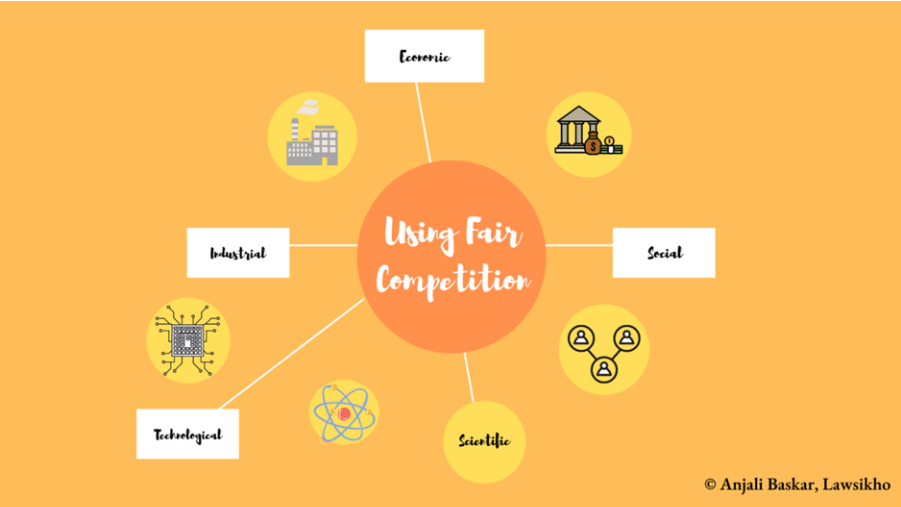
Industrial Standards

These are parameters laid down with respect to the standard working and operational procedures in an industry, depending on the specific manufacturing sector. This concept mostly applies to the rule of patents. When an invention has a valid patent subsisting on it, it is hard to differentiate between several effects vis à vis the market while it is incorporated into the industry standard. The reason why people demand more products that are in accordance with the invention is because it comes with some technical benefits, such as convenience and efficacy. Although the patent holder doesn’t get royalties based on this demand, it is hard to ascertain whether the public demands that particular product on a stand-alone basis or only because of its compliance with the standard. This confusion creates inequity between producers in the market, motivating them to work harder to gain an edge over their competitors. People with patents at times use unfair practices to get illegitimate returns by extending their reach to a related market which has already been leveraged, rather than a leveraging one where they are supposed to utilise. This is known as patent misuse, which  competition law as well as IP law tries to reduce. 

The whole point of IP protection is to ensure that a person gets justly enriched, and once they stop following that, it is not about recognition anymore. Competition Rules also dictate that a person cannot be following unfair trade practices to enrich themselves. In Polaroid Corp. v. Eastman Kodak Co., the US District Court stated that the patentee can only benefit from their contribution towards the invention and not from other factors. In order for the court to ascertain this, the burden of proof is on the plaintiff to show that they had the marketing prowess to generate valid sales, such as evidence of sales staff and set distribution channels. Elasticity of demand depends on external variables. If demand for the product is relatively inelastic, this increases the credibility of the invention as it stands amongst one or both of the leveraging and leveraged markets. 

The relationship between an organisation which sets the industry standard and the patent holder included into such a standard is carefully watched by patent authorities, because it can lead to antitrust liability if they have internal negotiations or if two separate patentees combine their negotiating power. Members of such standard-setting organisations tend to negotiate as a single entity for a patent license and this demand for better industry standards comes as a by-product of the request. In Sony Electronics, Inc. v. Soundview Technologies, Inc., another US District Court case, an organisation refused to acquire a license for a patent supposed to abide by industry standards. The members of the organisation seemed to justify their actions in favour of the standard set, rather than their own personal gains. The court held that antitrust claims would not be dismissed because  they had  tried to manipulate the market to drive licensing fees.

The Free Riding Problem in Economics

The influence of economic theories of tangible property is evident in IP-related judicial decisions. These judgments usually involve two conflicting ideas: the notion that IP is actual property and the principle that the right-holder mainly utilises its social value, rather than a more tactile benefit. Some argue that if IP is considered equivalent to real property, they also carry the risk of being mismanaged if the property is transferred to the wrong hands. Thus, IP law, like property law, should also aim to minimise externalities and account for transaction costs. 

Patentees think that they have absolute rights after becoming the owner, but since patents do not arise from a vacuum isolated from the flow of history, this results in them appropriating resources others have put their skill into developing. Thus, even those  who excessively analyse any instance of unauthorised use of their patented entity or skill don’t realise that they may leech off of  others’ efforts as well without paying them or asking for permission. This results in shifting from the main object of IP, which is recognition for one’s application of intellect, to obsessively trying to find out ways to eliminate the free-rider problem. 

Some patent holders also wrongly think that if they acquire a patent to recognize a new invention, they can start exploiting it for monetary benefits even if laws stay silent or do not explicitly deem that product as valid. The solution is to not only give the benefit of exclusivity in exchange for what these private parties produce, but also to lay down specifically what the rights entail and how they can utilize the rights to seize maximum social gain from their invention. 

Adopting Ramsey optimal pricing mechanisms would allow IP owners to fix rates that attract more customers, which would result in conceptualizing, executing and commercializing more expressions of novel ideas. Trademark law has also evolved from the initial object of avoiding consumer confusion to allowing owners to restrict varied uses of their registered marks, even if customers won’t associate the product with them or if search costs have risen. Trade secrets are  now considered more of a property right and are governed by contract laws informally, instead of rights that maintain business ethics standards. There should be a balance maintained between absolute protection of rights, which actually hinders creativity and disincentives  people, and the other extreme which lets others unjustly get enriched. Thus, law has also become useful in removing the free-riding problem for copyright right-holders, by increasing the terms of protection for copyright, making more works eligible for copyright protection and giving broader rights to control who uses their work.

The Climate Change Struggle

The major problem is that patent law, even in the U.S., is very restrictive towards inventions related to green technology, which is an additional problem stacked on top of the fact that inventors are finding it hard to catch up to the climate change crisis. This is mainly because unlike copyrights and trademarks, patent law does not recognise the defence of fair use. This is especially pertinent in this context because mass expansion of technological advancements would reduce the insufficiencies and balance the increasing demand in the market. Patent recognition allows the owner to exclude others from using their product, even if its contents are public information. The law also allows owners to refuse to license to people and sue them for infringement if they go ahead anyways. Some argue that this clashes with antitrust philosophy intending to prevent a patentee’s full market control over their inventions, as discussed earlier. 

This is related to the “Green Patent Paradox”, where useful and timely devices which try to mitigate long-term implications of global warming and the greenhouse effect are not able to come to fruition and be effectively applied, because owners of existing patents are not willing to license their products to create  something better for  society. To combat this problem, compulsory licensing would be necessary. This gives the general public the authority to use any patented invention for the good of society in exchange for a license fee to the owner. Some US statutes like the Atomic Energy Act allows for the government to grant licenses for nuclear and atomic patents, even if the government is not the actual patentee, to enhance public development.  Parallels can be drawn to the public health sector, where there has been debate for the past two years as to whether the TRIPS Agreement should be waived for the greater social good so that developing countries can get equitable access to medicines and vaccines, especially with the havoc the 2nd wave wreaked, even on developed countries.

Cultural Influences and Social Factors

Team owners have spent a lot of time and efforts in preventing people from viewing sports matches without buying a ticket or from a rooftop, but the free-riding problem exists as the games are not copyrightable per se as the athletic performance of players falls outside the ambit of what we consider “property”. Copyright only exists in the recording or broadcasting of the games, which the public is careful not to do. The nature of copyright law is such that it encourages collaboration from the get-go, and treats each co-owner as an entity getting independent rights, except in a commissioning agreement. Patent law is much more flexible surprisingly, given its many other restrictions in regards to the criteria of what qualifies as an invention. Example: Yvonne and Indya did not work together on a patent. They can still file a joint patent application before the concerned office. If Yvonne refused to join the application or cannot be reached, they can still be considered co-owners. 

Copyright law would have made Yvonne ask for consent from Indya before deriving profits from their patent and both would’ve had to actively contribute to developing the invention for them to acquire the status of joint owners. Even though traditional knowledge and GIs do protect cultural expressions to an extent, most cultural products, like music, dance, healing practices, language, cuisine, do not satisfy the agency and originality tests, which are present in virtually all IP-recognised works. Since they are practiced and modified as a result of social interaction, no one knows how it originated or who “owns” the most recognised form of an ancient tradition. Some argue that even if logistically we found a way to protect them and trace the owner (by considering all members of that community as joint owners), it would result in financial burden and loss of social and cultural exchange of ideas. On the flipside, there is no commercial benefit in transferring a tangible religious product within the same society across generations.

Pharmaceutical Sector

This area is often entrenched with antitrust probing, because national IP and pharma regulations, especially in the EU, are not compatible with common market goals. Fixed costs can include regulatory compliances like conducting clinical drug trials to minimise the degree of error. Thus, after patenting the drug, the inventor does not incur much variable costs and even altering molecule composition of drugs if needed is easier, just like tech industries. To recover fixed costs, the patentee usually charges a hefty fee over the marginal amount. Product patents on the molecule is the kind of patent most relevant to the pharma field and acts as a barrier to entry against competitors in the market. Unlike other fields, there is no way to invent around the molecule or cast doubt on the patent’s execution capacity here. Government regulation in pharma is extensive and relates to intervention in entry and price. Apart from this issue, “originator” medicines have more hurdles to cross to be authorised for sale as compared to generic drugs. 

IP laws also make sure that originator drugs do not shift to the status of generic drug for a long time after its entry, but provide them with some market power. At this point, IP clashes with national price regulations, especially within the EU, because they want to limit market power of originators as much as possible. Instead of balancing rights, the EU has adopted an approach wherein IP can be exhausted to allow free movement of medications beyond borders, even if prices are different across different member states. Applying competitive law to the pharma industry degrades total and consumer welfare, because the fixed costs of development are more than the variable ones. This is because patent strategies delay generic entry and authorities have identified compromissory patent agreements between originator and generic firms to circumvent increased examination and limitations. 

Conclusion

Thus, from this article, we can observe that there are two elements needed for the success of IPR ecosystems: collaboration and competition. The word “ecosystem” obviously comes from biology, where nature indicated that healthy competition is important even in the food chain. Too many deer would lead to overgrazing, leading to an imbalance in the ecological surroundings, and thus a few wolves need to breed in order  to bring back stability. Even though IP and competition are contradictory concepts, some creators have managed to strike a balance between collaboration and competition. If we go a couple of decades back, JVC competed against their own VHS technology because they allowed other companies to utilise them at a cheaper rate, which led to more hardware being invented complementing this technology, beating Sony’s Betamax even though Sony was the first mover in the market and technically superior when introduced. In fact, natural monopolies are not as harmful as artificial monopolies, because it is caused by one entity bringing something new to the market that no one else has done. A name that comes to everyone’s mind in this case is Apple, because they were able to create a convenient and better customer experience while pioneering competition at the right time between application providers and their applications, enabling them to put price pressure on others in the same market.

References

Susan Scafidi, Intellectual Property and Cultural Products, 81 B.U. L. REV. 793 (2001).


LawSikho has created a telegram group for exchanging legal knowledge, referrals, and various opportunities. You can click on this link and join:

https://t.me/lawyerscommunity

Follow us on Instagram and subscribe to our YouTube channel for more amazing legal content.

Download Now

All about the 73rd Constitutional Amendment

0

This article is written by Shreya Pandey, pursuing LLM from RamSwaroop University, Lucknow. The article deals with the changes brought by the 73rd Amendment Act and analyses the three-tier structure.

This article has been published by Shoronya Banerjee.

Introduction  

The 73rd Amendment Act was passed in 1992 and came into effect on 24th April 1993 which inserted Part IX consisting of Article 243 to 243-O, and the Eleventh Schedule enumerating 29 functional items. The Act gave certain powers to the state government to constitute gram panchayats at a local level and provide them with all the necessary assistance to operate as a unit of self-governance. The panchayat system was prevalent in India before the Amendment Act was enforced. The problem with that system was that it was not well organised, had inadequate financial resources, irregular elections, no proper representation of weaker sections, i.e., SCs and STs, and the government was not giving any support to the local authorities. So to address these issues and strengthen the local self-government bodies, this amendment was introduced by the central government to provide the local panchayats with legal support. 

The provisions under Part IX can be divided into 2 groups: compulsory group and voluntary group. 

Evolution of the Panchayati Raj System

Article 40 of the Indian Constitution obligated the state governments to constitute panchayats and provide them such powers and functions so that they can work as a unit of self-government. Executing its obligations certain committees were constituted by the government of India to give recommendations upon the implementation of self-governance on the rural level.

Following are the committees that were constituted:

  1. Balwant Rai Mehta Committee, 1957: This committee was appointed to monitor the functioning of the Community Development Program, 1952, and National Extension service, 1953 and to recommend ideas to improve their efficiency. The committee suggested democratic decentralisation that came to be known as the “Panchayati Raj System.” The committee also suggested the three-tier system at the village, block, and district levels.
  2. Sadiq Ali Committee, 1964: This Committee was constituted to report on the working of gram sabha in Rajasthan. The Committee reported the following weaknesses: 
    1. The main problem was the illiteracy of villagers, 
    2. Poor representation of women, 
    3. Avoidance of meetings by the Sarpanch to escape questions, 
    4. Meetings not being properly publicised, 
    5. The villagers used to be unaware and didn’t attend the meetings.  
  3. G.L. Vyas Committee, 1973: This Committee stated in order to rectify the dysfunction in the system recommended compulsory attendance of Sarpanch in every meeting, statutory recognition of gram sabha, meetings should be in May-June and January-December, compulsory attendance of patwari.
  4. Ashok Mehta Committee, 1977: The Committee recommended a two-tier system in panchayats, regular social audit, regular elections, reservation of SCs and STs.
  5. G.V.K. Rao Committee, 1985: This Committee was the first committee to recommend providing constitutional status to Panchayati Raj Institutions.
  6. L. M. Singhvi Committee, 1986: This Committee recommended the establishment of Nyaya panchayats, enhancing the financial resources of panchayats. The Committee also recommended the establishment of a separate judicial tribunal to deal with the cases regarding elections or any other matters of panchayats.

In September 1991, 73rd Constitutional Amendment Bill was introduced by the Lok Sabha and was passed by the same on 22nd December 1992. Rajya Sabha passed the Bill on 23rd December 1992 and it received the President’s assent on 20th April 1993 and came into force on 24th April 1993.   

Constitutional provisions of the Amendment

  1. Panchayati Raj Institutions (PRIs) were made constitutional bodies.
  2. Every state had an obligation to establish panchayats in their territories. (Article 243-B)
  3. The State has the responsibility to develop powers, responsibilities, and authorities to the panchayats. (Article 243-G)
  4. The panchayats are elected for a tenure of 5 years.
  5. The amendment provides for a mechanism for the state election commission to conduct independent elections for the village panchayats.
  6. The amendment provides for an adequate representation of women, SCs, and STs in the village Panchayati Raj Institutions.
  7. It is the duty of the State Finance Commission to evaluate the financial position of the village panchayats.

Objectives of the 73rd Constitutional Amendment Act, 1992

  1. The main objective of the 73rd Constitutional Amendment Act, 1992 was to provide constitutional status to the panchayats.
  2. It aimed at democratic decentralisation of power and resources among the central government and local bodies such as PRIs. This will create more engagement of the public in governance.
  3. Article 40 of the Indian Constitution states that it is the duty of the government to establish village panchayats and give them adequate power and authority so that they can function as a unit of self-government. The government came up with this amendment to provide an implementation of this Article.
  4. The Amendment was based upon the Gandhian principle that advocates for 3-tier governance where the third level of government can directly deal with the public and solve their issues and problems at the grass-root level.

Essential features of the 73rd Constitutional Amendment Act, 1992

1. Gram Sabha

Gram Sabha is defined under Article 243(b) which states that a gram sabha is a body that consists of persons registered on the electoral rolls relating to the village that falls under the area of Panchayat at a village level. It is the foundation of the Panchayati Raj Institution. Article 243A of the Indian Constitution empowers the Gram Sabha to perform the functions at its village level as is provided by the law or State Legislature.

2. State Election Commission 

State Election Commission is constituted in every state for the superintendence, maintenance, control, and preparation of electoral rolls. The Commission also handles the elections of panchayats.

3. Three-tier system

Article 243B of the Indian Constitution provides for a three-tier system in the Panchayati Raj Institution where panchayats shall be constituted at the village, intermediate, and district levels in every state. 

4. Composition of the panchayats 

According to Article 243C, the composition of the panchayats shall be as decided by the State legislature. The number of seats at any level of a panchayat shall be according to the population of that territory. 

5. Manner of election 

The election of members of panchayats of village, intermediate, and district levels shall be done through direct election by the people. The elections of chairman of the intermediate and district level panchayat will be elected indirectly by the elected members of the panchayats.

6. Reservation of seats 

Article 243D provides for the provision of reservation of seats which specifies the reservation of seats for SCs and STs according to the proportion of their population. The Article also provides for one-third of the total seats to be reserved for women that belong to the SCs or STs. This Article empowers the State Legislature to make any provision relating to the reservation of backward class.

7. Duration of Panchayats 

Article 243E specifies the duration of panchayats to be for a term of 5 years if it does not get dissolved before the completion of its tenure. If the panchayat gets dissolved then the other panchayat which was constituted would function till the remaining period of the dissolved panchayat.

8. Duties and power of the panchayats 

Article 243G puts State Legislature under an obligation to make laws so as to provide such power and authorities to the panchayats so that they can function as a unit of self-government. It is the duty of the panchayats to prepare a plan for economic development and social justice for the people. The Article provides authority to the state government to give power and authority to the panchayats on all the 29 subjects prescribed under the Eleventh schedule for local planning and implementing schemes, i.e., implementing Mahatma Gandhi National Rural Employment Guarantee, 2006, MGNREGA, which is one of the largest employment generating schemes. Panchayats implement the schemes made by the central and state governments for the betterment of people at the ground level. Panchayats have the authority to increase employment facilities and work upon the development of the area.  

9. Finance Commission 

Under Article 243I, the Finance Commission is constituted by the Governor of the State to review the financial position of the Panchayats, to recommend the principles for the distribution of taxes between the state and panchayats. The finance commission also determines the taxes, duties, tolls, and fees that will be assigned or appropriated to the panchayats.  

10. Audit of accounts 

Under Article 243J, the State Legislature is empowered to make provisions for the panchayats to maintain and audit the accounts of panchayats.

11. Finance 

The State Legislature by law may authorise the panchayats to levy and collect tax, duties, tolls, or fees. The panchayats may be assigned with the tax, duties, fees, or tolls that are collected by the state government to carry out specific work. The panchayats are provided with a grant-in-aid from the Consolidated Fund of the State. The state legislature may also constitute a fund for crediting and withdrawal purposes by or for the panchayats. 

Compulsory and voluntary provisions

Compulsory provisions of the 73rd Constitutional Amendment Act,1992

  1. Establishing the State Elections Commission for 5 years to conduct elections of PRIs.
  2. Constituting Gram Sabha in villages.
  3. Establishing panchayats at three levels: village, intermediate, and district level.
  4. To conduct a direct election for all members of panchayats and an indirect election for the chairman at the intermediate and district level. 
  5. The minimum age to contest elections of panchayats is decided to be at 21 years of age and the reservation of seats for SCs and STs will depend upon the population and the reservation of seats for women is one-third of the total seats.
  6. State Finance Commission is to be established after every five years for reviewing the financial position of panchayats.
  7. The tenure of panchayats is for five years and a fresh direct election is to be arranged within six months of the suspension of the panchayat.

Voluntary provisions of the 73rd Constitutional Amendment Act, 1992

  1. Providing representation to the MPs and MLAs in the Panchayats at different levels.
  2. Reservation for backward classes.
  3. Granting financial powers to the panchayats.
  4. Providing autonomy to the panchayats to function as a unit of self-government.
  5. Giving power and responsibility to panchayats to prepare plans regarding economic development and social justice and to perform all the functions specified in 29 subjects of the Eleventh Schedule.

The subjects are specified in the Eleventh Schedule and not in the Seventh Schedule for the reason that the states are free to determine the activities of PRIs.

The three-tier structure

The Union Government established a three-tier structure for the Panchayati system for a period of five years through direct election. The three tiers are Gram Panchayat, Panchayat Samiti, and Zila Parishad.     

1. Gram Panchayat 

The main functions of gram panchayats are sanitation, cleaning public roads, public toilets, supplying clean drinking water, primary healthcare, and education. Eg: Implementing programs like Jal Jeevan Mission, Pradhan Mantri Awas Yojna, etc for the betterment of the villagers. Jal Jeevan Mission is a program that aimed to provide functional water taps in all households. Pradhan Mantri Awas Yojna is a program that aims to provide shelter to all Below Poverty Line (BPL) families.

2. Panchayat Samiti 

Panchayat Samiti is the second tier of the Panchayati system that links the gram panchayat with the Zila Parishad. The members of Panchayat Samiti are elected directly. Sarpanch of Gram Panchayats are ex-officio members of Panchayat Samiti.

3. Zila Parishad 

It is the highest tier of the system where the members are elected directly by the people. Chairperson of Panchayat Samiti are elected ex-officio members of Zila Parishad and Members of Parliaments, Legislative Assemblies, and Councils of the districts are nominated members of Zila Parishad. 

Flaws in the Amendment

  1. The biggest flaw in the Amendment was the absence of funds for PRIs so the local government has to rely upon the local taxes or intergovernmental transfers to fund their activities.
  2. The intervention of MPs and MLAs in the activities of PRIs hamper their efficiencies.
  3. The Amendment Act provides constitutional status to PRIs but it gives discretion to the state legislature to delegate powers, responsibilities, and money to the panchayats.
  4. In the PRI system, there are structural flaws that lack secretarial support and technical competence.
  5. The presence of PanchPati and Proxy representation of women and SCs and STs dilutes the objective of reservation of seats of women and SCs and STs.

Conclusion

Panchayati Raj Institution was established after 45 years of independence despite many efforts made by the government. The reason behind this could be illiteracy, lack of funds, and political will. Panchayats are the best institutions for the people in villages to solve their issues and put their voice upfront before the government. Therefore the panchayats are the best institution to deal with the issues arising at the grassroots level. However, there are many flaws in the system but this Amendment was a huge step by the government to give constitutional status to the panchayats.

References

  1. https://byjus.com/free-ias-prep/this-day-in-history-apr24/
  2. https://prepp.in/news/e-492-73rd-amendment-act-indian-polity-upsc-notes 
  3. https://www.handlebar-online.com/guidelines/what-are-the-main-features-of-73rd-constitutional-amendment-act/#What_was_the_aim_of_73_and_74_Amendment 
  4. https://www.soolegal.com/roar/panchayati-raj-system 
  5. https://www.yourarticlelibrary.com/constitution/73rd-amendment-of-the-constitution-of-india-1992-summary/46681 

LawSikho has created a telegram group for exchanging legal knowledge, referrals, and various opportunities. You can click on this link and join:

https://t.me/lawyerscommunity

Follow us on Instagram and subscribe to our YouTube channel for more amazing legal content.

Download Now

Section 353 IPC : assault or criminal force to deter public servant from discharge of his duty

0

This article has been written by Ayush Tiwari, a student of Symbiosis Law School, Noida. This article aims to provide you with all the information regarding criminal force and assault on public servants and its punishment which is given under Section 353 of the Indian Penal Code.

This article has been published by Shoronya Banerjee.

Introduction

In a country like India, we always come across news about crimes like battery, assault, discharge, and so on; such crimes are very common in our country and occur almost every single day. Nowadays the same is the case with public officers, public servants are frequently exposed to significant hazards in the performance of their official responsibilities, and the law provides them with particular protection by imposing highly deterrent sanctions on those who violate the law. Section 353 of the Indian Penal Code, 1860 (IPC) deals with this problem and this article elucidates the same, before understanding Section 353 we should understand what is force and assault due to which public servants are not able to carry out their duty.

Force

Force is defined under Section 349 of the IPC. It does not constitute an offence; rather, it clarifies the meaning of the term force. It indicates that whenever a person causes motion, change of motion, or cessation of motion to another, that person is considered to use force. In addition, the individual who initiates the motion use one of the three methods described below:

  1. First,  must be with his own physical strength.
  2. Second, by disposing of any material in such a way that motion, change, or cessation of motion occurs without any additional action on his or any other person’s part.
  3. Finally, by causing an animal to move, adjust its motion, or stop moving.

A person is said to use force in any of the three methods listed above, even if a person inspires an animal to move or influences the other person’s feelings. The accused would be the one who induces the animal. It is not required to make direct contact with the individual who is doing the crime; it may be done without it.

The exertion of energy or power that causes a movement or change in the external environment is known as force. The term “force” as defined in this section refers to force exerted by a person on another human. It excludes the use of violence against inanimate objects. The usage of the term another throughout the section demonstrates this. As a result, a motion, change of motion, or cessation of motion-induced to property without harming a human being is not considered the use of force under this provision.

Criminal force

When a person uses force on another individual without their permission in order to conduct an offence and with the aim of inflicting harm to that individual in the form of injury, fear, or irritation, that person is said to be employing criminal force on the other person. It is punishable under Section 350 of IPC.

Essentials of criminal force

The force that has been specified in Section 349 changes into a criminal force when the essentials of Section 350 are satisfied, which are as follows:

  • Intentional use of force against anyone : Use of force must be deliberate.
  • Without consent : A person who does not understand the nature of the act being performed cannot be regarded to have agreed simply by submitting. When the claimed assault involves illegal conduct, consent cannot be used as a defence. There are a few exceptions to this law, such as strikes delivered during friendly sporting competitions, but these are not recognised under the exceptions.
  • The force has to be utilised in order to conduct an offence or to cause hurt, fear, or irritation to another person.

Assault

Assault is defined in Section 351 of the Indian Penal Code as anyone who makes any gesture or preparation with the intent or knowledge that such gesture or preparation would then cause any person present to suspect that the person making the gesture or preparation might be about to use criminal force against that person.

According to the Oxford Dictionary assault is “An act that threatens bodily damage to a person (whether or not actual harm is done)”. It’s a word that’s simple to grasp yet complex to define. A simple threat might be seen as an attack. The essence of the crime is the psychological effect that the threat has on the victim.

Words alone do not constitute an attack. However, the words a person says might give his actions or preparations such a meaning that they become an assault.

Ingredients of assault

  • Gestures or planning: the accused must make a gesture or plan to use unlawful force.
  • Such preparations or gestures should be done in the presence of the person in whose respect it is made.
  • The conduct was done with the goal of causing fear of damage or injury;
  • The conduct made the victim fearful that he might be hurt as a result of another person’s actions.

Assault is a non-cognizable offence that can be charged, bailed, and compounded. Any Magistrate can hear the case.

Punishment for assault and criminal force

When there are no aggravating circumstances such as specified in Sections 353 to 358 of the IPC, assault or use of criminal force is punishable under Section 352.

When someone assaults or uses criminal force on another without being provoked, then that person may be punished to three months in jail, a fine of up to INR 500, or both. Section 352 defines it.

Section 353 IPC

This Section applies when public workers are assaulted while conducting their legally mandated official duties.

Who is a public servant

While executing any function or executing any duty under this Act, the competent authority, every arbitrator, and any officer authorised by the Central Government or the competent authority will be regarded to be a public servant within the meaning of Section 21 of the Indian Penal Code.

What is Section 353 IPC

Section 353 tells us that, anyone who assaults or uses criminal force against a public servant in the performance of his or her duties as a public servant, or with the intent to prevent or deter that person from performing his or her duties as a public servant, or as a result of something done or attempted to be done by these people in the lawful discharge of his or her duties as a public servant, shall be punished.

A public employee is frequently exposed to significant dangers in the performance of his official tasks, and the law protects him by providing exceptionally deterrent punishments for those who violate the majesty of law, of which he is a minister. However, only an officer who is obliged to perform official tasks is entitled to protection. A commissioner seeking to surrender possession under a time-expired warrant also does not have the jurisdiction to enter land owned by the party resisting the execution. This clause exempts those who offer resistance from prosecution. A public worker cannot plead Section 353 while operating under an unlawful instruction from a superior, although he is unaware of the illegality.

Essentials of Section 353 IPC

To use this Section, one must meet the following requirements:-

  1. A public servant must be assaulted or subjected to criminal force; and
  2. It had to have been made on a public servant –
  1. when he was carrying out his responsibilities, or
  2. with the goal of preventing or discouraging him from doing his duties, or
  3. as a result of anything he has done in the course of his duties.

Punishment under Section 353 IPC

It is a non-cognizable, bailable, and non-compoundable offence and can be tried by any magistrate. An accused who is found guilty under this provision faces a sentence of up to two years of imprisonment, a fine, or both.

Procedure for trial under Section 353 IPC

If an offence under Section 353 is committed, the trial will proceed in the same way as any other criminal offence specified in the IPC. There are various phases to the procedure for the trial of an offence under Section 353, beginning with the filing of an FIR under Section 353 and ending with the court’s judgment. Let’s have a look at how a case brought under this section is handled in court by following the stages outlined below.

Filing of the FIR

An FIR must be filed once the accused is apprehended by the police, and the accused must be produced before a Magistrate within 24 hours of his or her arrest.

Final report by the police

Under Section 173 of the Criminal Procedure Code 1974, the police are required to file a final report with the court when they have completed their investigation of the crime (CrPC). This report serves as the investigative agency’s final submission of the investigation. If a case is brought under Section 353 of the IPC, the final report will include all on-the-spot evidence acquired by the police, which will aid the court in determining whether the offence’s elements have been met or not.

The charge sheet contains the facts of the case as well as all of the specifics of the police investigation. Any comments made by the accused during the inquiry are also included in it, and a copy of the FIR is attached to the charge sheet. The Magistrate takes cognizance of the issue under Section 190 of the CrPC when the charge sheet is filed. The court has the option of rejecting the charge sheet and discharging the accused or accepting it and framing the charges in order to set the case for trial.

Actions to be taken by the prosecution

To begin, the prosecution will declare that the allegations against the accused in the charge sheet include verbal abuse and deliberate insult as defined by Section 353 of the IPC. The prosecutor is required to back up his comments with evidence obtained against the accused and testimonies recorded from witnesses in order to establish the accused guilty of the act under the relevant rule. However, under Section 227 of the CrPC, a person arrested under Section 353 has the right to request for discharge by establishing that the accusations leveled against him are false and/or extremely weak in order to continue the trial.

Final arguments

According to Section 314 of the CrPC, any party in a proceeding could address concise oral arguments after the close of his proof, and then before he wraps up the oral arguments, he may submit a memorandum to the court declaring the arguments in support of his case clearly and under distinct headings, and each such memorandum shall form part of the record. The opposite party must be given a copy of the same right away.

The judgment

After considering both sides’ arguments, the judge rules on the case and issues a verdict of conviction or acquittal, as the case may be.

Case laws

Durgacharan Naik and Others v. the State Of Orissa, (1966)

In this case, a decree against the accused had been secured by the complainants. They acquired an attachment of the movable property in execution of that order in the event that the decretal sum of Rs 952.10 was not paid. When the court peon arrived with the attachment warrant and was going to seize a few of the movable property, the accused resisted with lathis.

Following that, the complainants sought an order for police protection and went to the accused’s home on the same day. The accused was not there. The accused’s father, who was also a judgment debtor, paid Rs 952.10 in restitution. When the complainant’s entire group returned, the accused arrived with ten or twelve persons and asked that the money be given over to him. The accused then departed the scene when some others intervened. The accused was found guilty under Section 353, IPC, but acquitted under Section 186, IPC, due to the lack of a written complaint under Section 195, the Code of Criminal Procedure, 1973 (CrPC). The charge under Section 353, IPC was founded on the identical facts as the charge under Section 186, IPC, it was argued on behalf of the accused.

Since no cognizance of crime under Section 186 may be obtained without first completing the procedure set forth in Section 195 of the CrPC, a conviction under Section 353, IPC, based on the identical circumstances, would constitute an attempt to get around the restrictions of Section 195, CrPC. This argument was rejected by the Supreme Court. It was decided that the offences under Sections 186 and 353 of the Indian Penal Code constitute two separate offences. Section 353 is a criminal offence, while Section 186 is not. In a case when the accused willfully obstructs a public servant in the exercise of his official responsibilities, Section 186 applies. However, the element of attack or use of criminal force while the public official is doing his duties is required under Section 353, IPC. The Supreme Court determined that the two offences were of a significantly different character. As a result, Section 195 of the Criminal Procedure Code does not preclude an accused from being tried for a separate offence based on the same circumstances but beyond the scope of that provision. As a result, the accused was found guilty under Section 353 of the IPC.

P. Rama Rao v. State of Andhra Pradesh, (1983)

The core of Section 353 is the attack aimed against a public official in order to dissuade him, according to the Andhra Pradesh High Court. In this case, a sub-inspector requested the accused to pull over to the side of the road. He rushed away while appearing to halt the automobile, colliding with the mudguard of the motorbike on which the sub-inspector was a pillion. The court determined that the facts of the case did not justify the application of Section 353 of the IPC. It isn’t necessary for the assault to take place while the public worker is doing his official duties. Even if he is injured “in consequence” of whatever he does in the course of his responsibilities as a public worker, Section 353 may apply.

Conclusion 

Assault is defined as the fear that the other person may be injured. It is committed to another person with the intent to damage the other person by using criminal force. People, including public officials, confront plenty of issues as a result of this. As a result, it was unavoidable that stringent regulations surrounding assault and criminal force be enacted and adequately executed, so that anybody who faces criminal force while doing official duties is protected by the law. According to the Indian Penal Code, anybody who assaults another person with criminal force may be punished or fined, or both.

References


LawSikho has created a telegram group for exchanging legal knowledge, referrals, and various opportunities. You can click on this link and join:

https://t.me/lawyerscommunity

Follow us on Instagram and subscribe to our YouTube channel for more amazing legal content.

Download Now

All you need to know about the Ashgabat Agreement

0

This article is authored by Ms. Kishita Gupta, a student of Unitedworld School of Law, Karnavati University, Gandhinagar. The article is a summary of the Ashgabat Agreement which India became a part of on 1st February, 2018. The article will further analyse the Agreement’s impact and significance for India.

This article has been published by Sneha Mahawar.

Introduction

The Islamic Republic of Iran, Turkmenistan, the Sultanate of Oman, and the Republic of Uzbekistan entered into an agreement on April 25, 2011, regarding the establishment of an international transport and transit corridor. India was later added to the Agreement which is known as the Ashgabat Agreement on 1st February 2018. On  23rd March 2016 the Union Cabinet, chaired by the Prime Minister of India Shri Narendra Modi, approved India’s accession to the Ashgabat Agreement, an international trade and transit corridor that will ease the movement of goods between Central Asia and the Persian Gulf. 

In this article, the author has analysed the significance of India’s joining the Ashgabat Agreement along with its key provisions.

Background of the Ashgabat Agreement

The Ashgabat Agreement, which envisions the development of an International Transport and Transit Corridor between Central Asia and the Persian Gulf, was recently signed by India in the year 2018. The Gulf countries and Central Asian Republics (CARs) will be benefited from this corridor, which is said to improve communication, cargo, trade, and transit. India has taken a step further in its efforts to improve connectivity with Eurasia by joining the Agreement.

Since Central Asia is a landlocked territory, all five CARs must pass through at least one state to reach the open seas. Because most of the old trade routes travelled through this territory, it played a crucial role in ancient trade and commerce. CARs, on the other hand, began to fall behind with the introduction of maritime trade. During the Soviet era, and even after the CARs gained independence in 1991, the majority of their trade was routed through the borders of their neighbours, such as Russia and China, which was time-consuming, inconvenient, and expensive.

The CARs gradually realised that Iran and the Persian Gulf could play an important role in easing access to the free seas. The proposal for a transit corridor connecting Central Asia and the Gulf dates back to a bilateral meeting in October 2010 between the then Uzbek President Islam Karimov and his Turkmen colleague Gurbanguli Berdimuhamedov. As a result, in November 2010, delegates from Uzbekistan, Turkmenistan, Iran, and Oman convened in Tehran to form a working group to examine the creation of such a corridor.

Nature of the Ashgabat Agreement

On April 25, 2011, in Ashgabat, Turkmenistan’s capital, an agreement was signed between Turkmenistan, Iran, Uzbekistan, Oman, and Qatar to build a new international trade and transit corridor. The ‘Ashgabat Agreement,’ as it is called, laid the groundwork for the development of the shortest commercial route which connects the CARs with Iranian and Omani ports. A Memorandum of Understanding (MoU) on various components such as the legal, procedural, and infrastructural of the agreement, was signed on August 6, 2014, in Muscat.

Kazakhstan applied for membership in the same year that Qatar withdrew from the pact. In 2015, the Coordination Council Meeting in Tehran authorised its membership. The agreement’s importance was boosted by Kazakhstan’s membership, as it is the region’s largest economy. Pakistan’s desire to join the Agreement was also announced by Prime Minister Nawaz Sharif, who appealed to the member-states for approval of Pakistan’s participation at the Global Sustainable Transport Summit in Ashgabat in November 2016. It has not, however, been able to secure the agreement of all four original members.

During Prime Minister Modi’s visit to the five CARs in July 2015, India’s ambition to join the Ashgabat Agreement received a boost. On March 23, 2016, the Union Cabinet approved India’s accession to the Ashgabat Agreement. “Accession to the agreement would enable India to use this existing transport and transit corridor to shoot trade as well as commercial interaction with the Eurasian region,” said an official statement from the Cabinet Meeting. Additionally, this would align with our attempts to establish the International North-South Transport Corridor (INSTC) for improved connectivity.” 

Turkmenistan, as the repository state of the Ashgabat Pact, informed India on February 1, 2018, that “all four original members have accepted India’s admission (to the agreement).” India will now provide the Coordinating Committee with all relevant information on taxes, fees, tariffs, and other payments assessed at ports and checkpoints. Following that, in April 2016, India deposited the Instrument of Accession. India’s admission to the Ashgabat Agreement went into effect on 3 February 2018 after getting approval from all four founding countries.

Key highlights of the Ashgabat Agreement

Article 1 – Definitions

Article 1 of the Agreement gives the definitions of certain terms that were used in the Agreement for a better understanding. Some of them are as follows:

The term ‘investment’ as per Article 1 of the Ashgabat Agreement refers to any type of asset established or acquired in compliance with the national laws of the Contracting Party on whose territory the investment is made, including changes in the form of such investment, and in particular, but not exclusively, includes: 

  1. Movable and immovable property, along with various other rights such as mortgages, liens, or pledges;
  2. Shares, stock, and debentures, as well as any other equivalent types of company participation;
  3. Rights to money or any other form of performance under contract with a financial value;
  4. Intellectual property rights, goodwill, technological processes, and know-how, in line with the relevant laws of the respective contracting party; 
  5. Concessions granted by legislation or by contract to businesses, such as concessions to search for and extract oil and other minerals;

The article defines nationals in relation to India as those who derive their status as Indian citizens from Indian law. In Turkmenistan, on the other hand, nationals are physical beings who are citizens of Turkmenistan in line with the country’s current legislation.

Further, territories are defined in Article 1 with respect of India as the Republic of India’s territory, including its territorial waters and airspace above them, as well as other maritime zones, such as the Exclusive Economic Zone and continental shelf, where the Republic of India has sovereignty, sovereign rights, or exclusive jurisdiction as per India’s current laws, the international law and the 1982 United Nations Convention on the Law of the Sea, and, whereas, with respect to Turkmenistan, its State territory along with the Exclusive Economic Zone and Continental Shelf, that is beyond the limits of its territorial waters, over which Turkmenistan’s sovereign powers and authority are recognised by international law, inter-state agreements, and national laws.

Article 2 – Scope of the Agreement

Article 2 of the Ashgabat Agreement mentions the scope of this agreement. It mentions that the Agreement applies to any investments made in the territory of the other Contracting Party by investors of either Contracting Party, acknowledged as such in accordance with the other Contracting Party’s laws and regulations, whether made before or after the Agreement’s entry into effect.

Article 3 – Promotion and protection of investment

This Article is basically the objective of the Agreement. It is about the promotion and protection of investment. It requires each contracting party to encourage and create a favourable environment for the other contracting party regarding investments in its territories as per the law. Further, each contracting party’s investments and returns shall be treated fairly and equally in the territory of the other contracting party at all times.

Article 4 – National treatment and Most-Favoured-Nation treatment

This Article is very important from the International Trade Law point of view. Members must grant the most favourable tariff and regulatory treatment to any one Member’s product when importing or exporting ‘similar products’ to all other Members under ‘Most-Favoured-Nation’ (MFN) treatment. This is one of the WTO’s founding principles. 

The WTO’s national treatment principle ensures that foreigners and locals are treated equally. Imported and domestically manufactured commodities should be treated similarly, at least after they have entered the market. Foreign and domestic services, as well as foreign and domestic trademarks, copyrights, and patents, should all be treated the same.

Article 4 of the Ashgabat Agreement mentions the following with respect to National treatment and Most-Favoured-Nation treatment:

  1. Each contracting party must regard investments made by investors from the other contracting party in the same way that it treats investments made by its own investors or investments made by investors from any third country.
  2. Furthermore, each contracting party must treat investors from the other contracting party in the same way that investors from any third country are treated, including in terms of investment returns.
  3. The provisions of paragraphs 1 and 2 above are not intended to obligate one contracting party to extend to the investors of the other any treatment, preference, or privilege resulting from any existing or future customs union or similar international agreement to which it is or may become a party, or any matter relating solely or primarily to taxation.

Article 5 – Expropriation 

Article 5 deals with expropriation. In law, it means taking over private property or assets by the government for compensation only when it is for a public purpose. As per the agreement, Investments of either Contracting Party’s investors in the territory of the other Contracting Party shall not be nationalised, expropriated, or subjected to measures having the effect of nationalisation or expropriation (hereinafter referred to as “expropriation”) unless for a public purpose in accordance with the law, on a non-discriminatory basis, and against fair and equitable compensation.

The agreement also gives the affected investor the right, under the law of the contracting party making the expropriation, to have his or her case and the valuation of his or her investment reviewed by a judicial or other independent authority of that party in accordance with the principles set forth in this paragraph.

Later, the contracting party expropriating the assets has to ensure that the provisions of paragraph (1) of this Article are applied to the extent necessary to ensure fair and equitable compensation in respect of their investment to such investors of the other Contracting Party who are owners of those shares.

Article 6 – Compensation for Losses

According to Article 6, investors from one contracting party whose investments in the territory of the other contracting party suffer losses due to war or other armed conflicts, a state of national emergency, or civil disturbances in the latter contracting party’s territory receive treatment no less favourable than that which the latter contracting party accords to its own investors or to investors from any third country in terms of restitution, indemnification, compensation, or other remedies. As a result of the procedure, payments will be freely transferable.

This article will ensure that there is fair and equitable treatment of both the contracting parties’ investors and they don’t suffer losses due to internal disturbances in either of the party’s nations.

Article 7 – Repatriation of investment and returns

This Article ensures free and fast transfer of funds between the contracting parties. The funds can be of the following categories:

  1. Amounts of capital and more capital used to maintain and grow investments;
  2. In proportion to their holdings, net operational profits, including dividends and interest;
  3. Repayments of any loan connected to the investment, including interest;
  4. Royalties and service fees related to the investment are paid;
  5. Profits on the selling of their stock;
  6. Investors’ proceeds in the event of a sale, partial sale, or liquidation;
  7. Earnings of people of one Contracting Party who work in connection with an investment in another Contracting Party’s territory.

Article 8 – Subrogation

When one Contracting Party or its designated agency has assured indemnification against non-commercial risks in relation of investment by any of its investors in the territory of the other Contracting Party and has paid such investors in relation of their claims under this agreement, the other Contracting Party or its designated agency is empowered to enforce the rights and assert the claims of those investors by virtue of subrogation. The subrogated rights or claims cannot exceed the investors’ original rights or claims.

Article 9 – Settlement of disputes between an investor and a contracting party

  1. Whenever a dispute arises between an investor and a contracting party, it is encouraged that the dispute is settled amicably by resorting to negotiations between the two parties.
  2. But if in case, amicable negotiation fails within six months of its starting date, then with the consent of both the parties, international conciliation or a resolution can be adopted.
  3. If the dispute procedure mentioned in para 2 also fails, then the parties have an option to choose arbitration.

Article 10 – Disputes between contracting parties

  1. The disputes arising between the contracting parties over the interpretation or application of this Agreement should be resolved through negotiation as much as feasible.
  2. If negotiation also doesn’t solve the problem then within 6 months, the parties can choose arbitration through an arbitral tribunal.
  3. The contracting parties, within two months of the receipt of the request for arbitration, shall appoint one member each, who will then choose a third member from a different State within 2 months.
  4. But if the arrangement mentioned in para 3 is not made then, either of the contracting parties may, in the absence of any other agreement, invite the President of the International Court of Justice to make any necessary appointments.
  5. By a majority of votes, the arbitral tribunal will make a ruling that is binding on both Contracting Parties.

Article 11 – Entry and sojourn of personnel

A Contracting Party shall permit natural persons and personnel employed by companies of the other Contracting Party to enter and remain in its territory for the purpose of engaging in activities related to investments, subject to its laws governing the entry and sojourn of non-citizens as they apply from time to time.

Article 12 – Applicable laws

Unless otherwise specified in this Agreement, all investments will be regulated by the laws in force in the Contracting Party’s territory where they are made.

Article 13 – Application of other rules

If there are provisions of either Contracting Party’s law or obligations under international law currently in effect or to be established between the Contracting Parties that oblige investment by investors of other Contracting Party towards a more favourable treatment than what is provided for by the present Agreement, such rules shall, to the degree that they are more favourable, prevail over the present Agreement.

Article 14 – Entry into force

This Article mentions that the present Agreement is subject to ratification and will take effect on the date of the exchange of Ratification Instruments.

Article 15 – Duration and termination

This Agreement will be in effect for ten years, after which it will be automatically extended unless either Contracting Party gives the other a written notice of its decision to cancel the Agreement. The Agreement will be cancelled one year after such notification is received. Regardless of whether this Agreement is terminated pursuant to the condition above, the Agreement will remain in effect for a period of fifteen years from the date of termination in respect of investments made or acquired prior to the date of termination.

Importance of the Ashgabat agreement to India

International North-South Transport Corridor (INSTC) and the Central Asian Regions

India’s participation in the Ashgabat Agreement will allow it to take advantage of the existing transportation and transit corridor to facilitate trade and commercial relations with the Eurasian region. This will also be in line with India’s efforts to build the International North-South Transport Corridor (INSTC), a multi-modal trade transportation network that runs from Mumbai, India, through Bandar Abbas, Iran to Moscow, Russia. The INSTC would lower the cost of shipping commodities from India to Eurasia and the neighbouring regions significantly.

The Ashgabat Agreement aims to establish a commerce and transportation corridor connecting the CARs and the Persian Gulf. The corridor will be multi-modal, with road, rail, and sea transit options. It must also involve the removal of trade obstacles and the establishment of simplified processes for the transfer of commodities between member countries. Rail links go via Kazakhstan, Uzbekistan, Turkmenistan, and Iran as part of the agreement’s land transport component. The Iran-Turkmenistan-Kazakhstan (ITK) railway line, which opened in December 2014, is a crucial link in this corridor. It will also establish a connection with the Omani ports of Salalah, Duqm, and Sohar, as well as the Iranian ports of Bandar Abbas, Jask, and Chabahar. The region’s current transportation and connectivity linkages will be beneficial to India’s trade.

CARs have the potential to serve as a land bridge between Europe and Asia, as well as between Asia’s diverse regions. These countries’ strategic locations can further help India’s land connectivity with the rest of the Eurasian area. Direct access to CAR will help India establish itself as a major participant in the region while also undermining China’s much-hyped Belt and Road Initiative flagship projects.

India’s decision to join the Ashgabat Agreement was motivated by a desire to align India’s Look West policy with its Connect Central Asia agenda. India’s ratification of the Agreement would broaden India’s connectivity choices with Central Asia and have a significant positive impact on India’s trade and commercial connections with the area.

Connection with the Chabahar port

India’s inclusion into the Ashgabat Agreement comes a month after the first phase of the Shahid Beheshti terminal at Chabahar port, which is financed with $85 million, was inaugurated on December 3, 2017. With the completion of the Shahid Beheshti terminal and India’s joining of the Ashgabat Agreement, the possibility of expanding Chabahar’s operational and practical scope to become a vital gateway and the shortest land route to Central Asia has increased. 

India has relied on Chabahar to connect to Afghanistan, and it has already transferred wheat shipments to the country through the port. India’s proposal to build a 610 km north-south railway from Chabahar to Zahedan, as well as the operation of a multi-purpose terminal at Chabahar, could not have been achieved unless India joined a Central Asian-led transport network.

Conclusion

This Agreement comes as a ray of hope to India which wishes to improve the trade policies of the region with the nearby countries. Since India did not have direct access to the Eurasia region, being a member of the Ashgabat Agreement, India has opened gates to get a clear rail and road route for trade to the Eurasian nations.

References


Students of Lawsikho courses regularly produce writing assignments and work on practical exercises as a part of their coursework and develop themselves in real-life practical skills.

LawSikho has created a telegram group for exchanging legal knowledge, referrals, and various opportunities. You can click on this link and join:

https://t.me/lawyerscommunity

Follow us on Instagram and subscribe to our YouTube channel for more amazing legal content.

Download Now

Contract Labour (Regulation & Abolition) Act, 1970

0
Contract Labour (Regulation and Abolition) Act, 1970
Image source - https://bit.ly/2pY5xOA

This article is written by Abanti Bose, studying at Amity University Kolkata, India. The article gives a detailed overview of the objective, applicability, significant provisions and constitutional validity of the Contract Labour (Regulation & Abolition) Act, 1970.

This article has been published by Sneha Mahawar.

Introduction

Contract labour is the system of employing labourers through a contract by a contractor for a specified period. A workman is known as a contract labourer when they are assigned to a work of an establishment for a specific period through a contract by a contractor with or without the knowledge of the principal employer. Contract workmen are indirect employees; a contract worker is a daily wager or the daily wages are accumulated and given at the end of the month. It is the responsibility of the contractor to hire, supervise and remunerate contract labourers.

In India, contract labourers are used in various industries varying from skilled to semi-skilled jobs. Before and after independence the status and condition of contract labour were analysed by numerous commissions, committees, Labour Bureau Ministry of Labour, etc. and it was found that the major characteristics of contract labour are poor economic conditions of the workers, casual nature of employment, lack of job security, etc. Therefore the legislature enacted the Contract Labour (Regulation & Abolition) Act, 1970 (which came into force on 10th February, 1971) to regulate the adequate functioning of the contract labourers and to prevent the exploitation of contract labourers by the hands of management. 

Objective and scope of the Act

The objective and scope of the Act are:

  • To prevent exploitation of contract labour. 
  • To provide proper and habitable working conditions.
  • To regulate the functioning of the advisory boards.
  • To lay down the rules and regulations regarding the registration procedure of the establishments employing contract labour.
  • To state the necessary requirements and the procedure of licensing of contracts.
  • To provide the penal provisions in case of violation of offences under the Act.

Applicability of the Contract Labour (Regulation & Abolition) Act, 1970

Section 1(4) mentions the establishments where the Act will be applicable:

  • Any establishment where twenty or more workmen are employed or were associated as contract labour on any day during the preceding twelve months.
  • Any contractor who employs or employed twenty or more workmen as contract labour on any day of the preceding twelve months.
  • The Act is also applicable to every establishment if the workmen are employed in the establishment as ‘contract labour’. Section 2(b) of the Act states that a workman is deemed to be employed as contract labour when he is hired in or in connection with such work by or through a contractor with or without the knowledge of the principal employer.
  • The Act does not apply to any organisation or establishments where any work of intermittent or casual nature is performed. The Act states that a work is deemed to be of intermittent nature if it is performed for less than 120 days in the preceding twelve months or it is of non-seasonal character and is performed for less than 60 days in a year.
  • The Act is not applicable to a person who is appointed in an advisory or managerial capacity. 

Essential provisions of the Contract Labour (Regulation & Abolition) Act, 1970

The essential provisions of the Contract Labour (Regulation & Abolition) Act, 1970 are stated below.

Composition of the advisory boards

Chapter 2 of the Contract Labour (Regulation & Abolition) Act, 1970 mentions the establishment and composition of the Central and State Advisory Boards. The functions of these boards are to advise the Central and state governments respectively on the matters concerning the administration of the Act, and also to carry out all the necessary functions assigned under the Act.  

Central Advisory Board

The Central Advisory Board consists of a Chairman appointed by the Central government, the Chief Labour Commissioner, and the Central Government may nominate eleven to seventeen members to represent the government, railways, coal industry, mining industry, contractors, workmen and members from any other fields which, in the opinion of the Central Government ought to be represented on the Central Advisory Board. 

Furthermore, Section 3 of the Act also states that the number of members nominated to represent the workmen shall not be less than the number of members nominated to represent the principal employers and the contractors.

State Advisory Board

Section 4 of the Contract Labour (Regulation & Abolition) Act, 1970 states the composition of the State Advisory Board. It consists of a Chairman appointed by the state government, the Labour Commissioner of that state and in their absence, any other officer will be appointed by the state government and the state government may nominate nine to eleven members to represent that government, industry, contractors, workmen and members from any other fields which, in the opinion of the state government, ought to be represented on the State Advisory Board. However, the number of members nominated to represent the workmen shall not be less than the number of members nominated to represent the principal employers and the contractors.

Both Central and State Advisory Boards have the power to form committees under this Act as they may think fit. The committees will function according to the provisions of the Act and will carry out all the necessary duties and responsibilities.

Registration procedure of establishments employing contract labour

The Act lays down the appropriate method for registration of the establishments employing contract labour. The appropriate government by an order notified in the Official Gazette will be appointing such persons being Gazetted Officers of the government as it deems fit to be registering offices under Chapter 3 of the Act. It further mentions the limits, within which a registering officer shall exercise the powers and functions as conferred upon them under the Act.

Registration of certain establishments

Section 7 of the Contract Labour (Regulation & Abolition) Act, 1970 states the registration procedure of the establishments falling under the Act. The principal employer of such an establishment must make an application to the registering office in the prescribed manner. By the appropriate government notification in the Official Gazette must be made within the stipulated period for registration of the establishment. In cases of expiration of such stipulated period, the registering office will only accept applications if the registering officer is satisfied that the applicant was prevented by sufficient cause from making the application in time.

After completion of the application of registration, the registering office will register the establishment and grant the registration certificate to the principal employer. 

Revocation of registration

The registering office has the power to revoke the registration of an establishment with the approval of the appropriate government if it is satisfied that the registration of the establishment was received through misrepresentation, suppression of any material fact, or any other reason which renders the registration ineffective. However, before revoking the registration the registering office must give an opportunity to the principal employer of the establishment to be heard.

Prohibition of employment of contract labour

The Central or state government after consultation with the appropriate advisory boards may prohibit the employment of contract labour in any process, operation or other work in any establishment as stated under Section 10 of the Act. 

Licencing of contractors

Chapter 4 of the Contract Labour (Regulation & Abolition) Act, 1970 states the significant requirements and the procedure of licensing of contracts. This Chapter lays down the required steps for granting, revoking, suspending and amending a licence. 

Appointment of licensing officers

The appropriate government by an order in the Official Gazette may appoint Gazetted Officers of the government as licensing officers and state their powers and functions under Section 11 of the Act. 

Grant, revocation, suspension and amendment of licences

Any application for granting a licence under this Act must contain the particulars regarding the location of the establishment, the nature of the process, operation or work for which contract labour is to be employed. The granted licence will be valid for the specified period and may be renewed from time to time.

However, if it comes to the attention of the licencing officer that a licence has been obtained through misrepresentation, suppression of any material fact or the holder of the licence has failed to comply with the conditions subject to granting of the licence or contravened any provision of the Act then the licensing officer after giving reasonable opportunity to be heard to the licence holder may revoke, suspend or amend the licence as the case may be.

Procedure for appeal

Section 15 of the Act states that any person aggrieved under any provision of the Act may appeal to an appellate officer appointed by the appropriate government within thirty days from the date on which the order is communicated to them. 

Payment of wages

It is the responsibility of the contractor to pay the required wages to each worker employed under contract labour before the expiry of the stipulated period. If the contractor fails to make the payment within the stipulated period then the principal employer shall be liable to make payment of wages in full or the unpaid balance due. The wages are to be fixed by the Commissioner of Labour.

Welfare and health of contract labour

Under Chapter 5 of the Act, it is the duty of the principal employer to ensure that the contractor provides the following facilities adhering to the rules laid down by the appropriate government. 

  • If the contractor is employing more than one hundred workmen by contract labour then one or more canteens shall be provided and maintained by the contractor for the use of such contract labour.
  • Concerning the work of an establishment where contract labour is required to halt at night, the contractor must provide and maintain restrooms or other suitable facilities which shall be sufficiently lighted, ventilated, clean and comfortable.
  • The contractor is liable to provide other facilities such as drinking water, latrines and urinals (separate for men and women), washing facilities, first-aid, etc.

Infringement of provisions concerning employment labour

Section 23 of the Contract Labour (Regulation & Abolition) Act, 1970 regulates the proper functioning of the provisions of the Act, it states that if anyone violates any provisions or any rules concerning the employment of contract labour or contravenes any condition of a licence granted under this Act will be punished with imprisonment for a term that may extend to three months or with fine which may extend to one thousand rupees or both.

The Act further states that if any offence is committed by a company infringing any provisions of the Act then the company, as well as every person responsible during the time of the commission of the offence, will be held liable.

Cognizance of offences

Under Section 26 a court of law can take cognizance of an offence only when a complaint is made by an inspector, and no court inferior to a Presidency Magistrate or a Magistrate of the First Class shall try any offence punishable under this Act.

Constitutional validity of the Contract Labour (Regulation & Abolition) Act, 1970

The application of this Act does not violate any Articles of the Indian Constitution. In the case, Gammon India Ltd. Etc. Etc vs. Union Of India and others (1974). the constitutional validity of the Act was challenged; it was stated that Section 28 of the Act conferred arbitrary and unguided power thus violating Articles 14 and 15 of the Indian Constitution. It was also contended before the Court that Section 34 of the Act which empowers the Central Government to make any provision for removal of difficulty is unconstitutional on the grounds of excessive delegation. The Supreme Court held that Section 34 of the Act is an application for the internal functioning of the administrative machinery and gives effect to the provisions of the Act, therefore does not amount to excessive delegation. The Court dismissed the petitions and held that the Act does not violate the Constitution and it is constitutionally valid.

Recommendations

The Contract Labour (Regulation & Abolition) Act, 1970 is an essential legislature when it comes to the protection of the rights of workers who are appointed based on a contract by a contractor. However, the Act has several drawbacks which should be taken into account by the legislature and the Act should be amended accordingly. 

  • The Act fails to state a distinction between core and peripheral activities which have led to non-implementation.
  • The Act states that it applies to every organisation employing 20 or more contract labourers, thus it enables the establishment or contractor to avoid their responsibility regarding the welfare of the workers by employing less than 20 workmen.
  • Often the establishments take advantage of the provisions by taking licences in different names. Therefore, to curtail this problem there should be a single window for issuing licences and there should be a licensing authority to deal with the situation in every state.
  • The penal provisions of the Act are not deterrent enough, so it enables the principal employer to rather face prosecution instead of following the provisions of the Act.
  • Under the Act, the education scheme of contract labourers should be extended as most workers are unskilled, illiterate and ignorant of their rights.
  • There is no direct or independent provision under the Act for filing claims or short/non-payments; illegal deductions etc. these claims are filed under the Payment of Wages Act, 1936 or the Minimum Wages Act, 1948 that create problems regarding the applicability of these Acts. Hence these provisions should be included for better functioning of the Act.

Conclusion

The Contract Labour (Regulation & Abolition) Act, 1970 was enacted to prevent exploitation of contract labourers as there was no existing legislation that dealt with contract labour. However, certain shortcomings of the Act must be taken into consideration by the legislature and necessary changes should be made and implemented. Furthermore, the Act should also be made easier and less complicated for principal employers and contractors and with better safeguards and amenities to contract labourers.

References


Students of Lawsikho courses regularly produce writing assignments and work on practical exercises as a part of their coursework and develop themselves in real-life practical skills.

LawSikho has created a telegram group for exchanging legal knowledge, referrals, and various opportunities. You can click on this link and join:

https://t.me/lawyerscommunity

Follow us on Instagram and subscribe to our YouTube channel for more amazing legal content.

Download Now

Constitutional monarchy : everything you need to know

0

This article is written by Ishan Arun Mudbidri from Marathwada Mitra Mandal’s Shankarrao Chavan Law College, Pune. This article talks about the concept of constitutional monarchy and also discusses various constitutional monarchies in the world.

This article has been published by Abanti Bose.

Introduction

God save the Queen!”- Britain and its monarchy have come a long way. At 95 years old, Queen Elizabeth holds the crown with dignity and honour. But, Britain is also a democracy and has a Constitution. So you might ask where does the Queen come in this whole picture? This concept is known as Constitutional monarchy.

Constitutional monarchy and its history

Monarchy is the oldest form of government. Monarchs, i.e., Kings and Queens ruled the country and were called heads of the State. King Sargon of Akkad in Mesopotamia was the first emperor this world had ever seen. He ruled for almost 50 years between 2334-2284BC. Since then the concept of monarchy has not remained the same. Earlier, the kings had absolute power and authority over the State. Some respected this power and ruled their kingdom honestly and efficiently like Alfred the Great or Emperor Ashoka, while others ruled for the sake of money, power, and other selfish motives like Henry VIII of England. The third category of monarchs were the incapable ones who, due to circumstances were not fit enough to rule, like the French King Louis XVI. 

Irrespective of this fact, absolute monarchy was the only form of government that prevailed during the late 17th and early 18th centuries. The “divine right of Kings” concept was adopted by Kings, which meant that the Kings derive their power from God, hence deserve to rule their kingdoms. Gradually people started getting tired of this authoritarian regime which led to the birth of new ideas like secular, republican, liberty, and freedom. The first incident that comes to mind is the French Revolution in 1789. Which started as a treacherous and oppressive monarchical regime of Louis XIV who described himself as the State, and ended with the storming of the Bastille prison by thousands of French people under the helpless rule of Louis XVI. After the French Revolution, the majority of the world’s absolutism started declining. The ideas of enlightenment and capitalism started flourishing. Various social reformers started questioning the authority of the monarchs. In the famous words of reformer John Locke “direct democracy is the best form of government”, the king’s power and authority were reduced and republicanism came into the picture. However, some countries like Oman, Brunei, Qatar, Switzerland, etc. are ruled by monarchs.

Constitutional monarchy is that form of government wherein kings and queens are called heads of state, but cannot exercise policy-making powers. The monarch has limited roles extending mainly to civic responsibilities while the governing and policy-making is done by the parliament. 

Succession

In most countries, monarchs are chosen by hereditary succession, meaning they inherit the title of a monarch on the death of their ancestors. If there are multiple siblings in the family, the monarchs are chosen by order of eldest to youngest, first males and then females(rule of primogeniture). This system is followed in countries like Spain, whereas in countries like the UK, Sweden, Belgium, women are treated equally to men. So succession entirely depends on heredity. In some countries, monarchs were also chosen according to military leadership (early German and Roman tribes). In countries like the Arab States, monarchs are nominated by consulting a family council.

So to sum up, the succession of monarchs varied from country to country depending on historical and traditional considerations.

Functions of constitutional monarchs

Despite having no executive or governing powers, constitutional monarchs do perform certain functions which are as follows:-

Ceremonial powers

The monarchs don’t play any political role in the country, but they do have to perform ceremonial functions. It is the monarchs who usually welcome or receive esteemed dignitaries or ambassadors from other countries. In certain democracies monarchs even appoint the Prime Minister and other high-level officials of the country. In some countries, it’s only their presence that matters.

Maintaining neutrality

As monarchs are heads of state and not the government, they help in maintaining political neutrality. Further, it is the duty of the monarch to ensure that the ruling party and the institutions of the State are well balanced and stable.

Civic duties

Being free from the burden of governing the country, monarchs can devote their time to civic activities like spending time with the local communities, promoting art and culture, and understanding the problems of the people. However, monarchs must ensure that while performing such civic roles, they don’t do or speak anything that is politically controversial.

Religious powers

As the concept of “divine right of kings” is associated with monarchy right from the beginning, in certain countries they do have authority over the religious institutions. This can in many ways ensure that religious extremism is prohibited.

Comparing the role of the President and the monarch in a parliamentary system

Now in a parliamentary set-up, both monarchs and presidents co-exist. Both are called heads of state and both cannot be politically affiliated. So what’s the difference? A monarch is the head of state in a constitutional monarchy, whereas the president is the head of state in a republic. Further, a monarch is appointed according to hereditary succession and cannot be removed from power otherwise, whereas the President is appointed by the people and has a fixed tenure. Further, in both cases, the governance is handled by the Prime Minister and the Parliament.

Britain and the Crown : an eternal affair

The oldest constitutional monarchy in the world is the British Crown. Queen Elizabeth II has ruled more than any other English monarch. But how did she get there? The English monarchy has had a rich history right from the time of the Romans. In the 10th century, Alfred the Great conquered most parts of the country and began the Anglo-Saxon Chronicles, which was continued by his successors who built the kingdom now known as England. In the 12th Century, John Lackland, Henry II’s successor was compelled to sign the Magna Carta which granted fundamental rights and privileges to the people. In the late 18th century, Scotland and England were joined by Ireland to form the United Kingdom of Great Britain and Ireland. In the 1920s the Commonwealth of Nations(association of former territories of the British Empire) was formed. After the Second World War, in 1952 Elizabeth II succeeded the throne and became the head of the Commonwealth. She also became the head of state of 15 Commonwealth Realms. Each realm is an independent state and has the Queen as the monarch.

“For better or worse, the crown has landed on my head”

In November 2021, Queen Elizabeth marked 70 years of her time on the throne. She has earned tremendous respect from the people during her reign. Born in a humble background in 1926, no one from her family had expected that one day they would live the royal life. It all changed when her father George VI became king. In 1952 King George VI died of prolonged illness. Princess Elizabeth II succeeded him. She married the Duke of Edinburgh Prince Phillip, who died in April 2021. She is survived by her 4 children, 8 grandchildren, and 12 great-grandchildren.

The crown prerogative

The Queen of England might not be having governing powers, but she definitely has an important role to play in Britain’s administration. The Queen’s powers are assigned in what is known as the Royal prerogative. This prerogative grants certain rights, privileges, powers, and immunities which the Queen of England has. However, the Queen exercises her powers through the government, i.e., the Prime Minister.

The Parliament

Buckingham Palace, the home of the Crown, is the hub for all English ceremonies. The Queen invites the soon-to-be Prime Minister to form the government. The Queen also has the power to dissolve and open a parliament session.

Assent to bills

Every Bill passed in the UK parliament has to go through the assent of the Queen to become a law. This is known as the Royal Assent.

Queen’s speech

Before the start of the first parliament session of the year, the Queen addresses both houses of Parliament in the Queen’s Speech. The speech is drafted by the government. The session starts only after the Queen finishes her speech.

Relationship with the Prime Minister

The Queen has a special relationship with the Prime Minister. Every week the Queen meets the Prime Minister to give a weekly audience. Here the Queen has a right to express her views on the functioning of the government. The discussion between the Queen and the government must remain strictly confidential. The Queen must ensure that she is politically neutral while expressing her views. The Queen can exercise her powers mentioned in the prerogative against the advice of the government only in exceptional circumstances.

The Queen is supported by her family members in all her matters. Elizabeth II has had an eventful term as a monarch. She has travelled overseas more than any monarch before her. She has been a prominent figure in the British administration. It was Queen Elizabeth who advised the Labour Government in 2003, whether or not to go to war with Saddam Hussien. It is said that the longer the reign as a monarch, the greater is the experience one has. Such is the tenure of Queen Elizabeth II who continues to shine as brightly as the jewels in her crown. 

The concept of constitutional monarchy in other countries

When discussing the concept of constitutional monarchy, the British crown comes to mind. So not many people might be knowing some of the other countries which are constitutional monarchies. Some of them are mentioned below:

Belgium

Belgium got its Constitution in 1831. Inspired by the British model, Belgium is also a hereditary parliamentary constitutional monarchy. The laws are made by the Parliament but are signed by the king. The king signs all the laws which are approved by the Prime Minister. The king is also commander-in-chief of the Belgian armed forces. The king is exempted from arrest, cannot be prosecuted, and cannot be held accountable. The monarch also has the right to be informed about the day-to-day functioning of the government. Philippe Leopold Louis Marie has been the crowned Belgian King since 2013.

Australia

Many might find it difficult to believe but, Queen Elizabeth is the queen of Australia too. Earlier I mentioned something about the Commonwealth Realm. Australia is one of the 15 commonwealth realms that have the Queen as their monarch. So just like in the UK, the Queen performs certain ceremonial functions in Australia. However, she is not involved in their day-to-day activities.

Japan

Japan is a constitutional monarchy with Emperor Naruhito at the forefront. It is a parliamentary system, so the Prime Minister who is currently Fumio Kishida derives his powers from the Japanese Constitution. The emperor became a symbol of the Japanese State in 1946 when the Constitution came into effect. Hence the sovereign power rests with the people, and the emperor is the head of the state. There are three branches of the government namely, the executive, judiciary, and the legislature. The emperor has ceremonial powers like appointing the Prime Minister, the members of the judiciary including the Chief Justice, approving laws, and conferring various awards and honors. The legislative powers are vested in the Diet which consists of the House of Representatives and the House of Councillors.

Bhutan

Bhutan, like other countries mentioned above, is a democratic constitutional monarchy, with a population of around 786,000. Bhutan is a landlocked country between India and China. It has three branches of government, i.e., the legislative, the judiciary, and the executive. The monarch is the head of state and the Prime Minister is the head of the government. The king is chosen according to hereditary succession. He appoints the majority leader in the parliament as the Prime Minister. The hereditary rule in Bhutan was started by the Wangchuk dynasty in 1907. It was in 2008 when absolute monarchy was abolished and democratization was introduced. Currently, King Jigme Khesar Namgyel Wangchuk also known as the Dragon King is the head of state.

Monaco

Monaco has been a constitutional monarchy since 1911. The legislative powers are jointly exercised by the prince and the parliament. The Prime Minister is the head of the government and is appointed in consultation with the monarch. The monarch also has the power to change the government. The monarch has the power to shape foreign policies, enact laws, frame the budget, etc. but the final approval is given by the freely elected parliament. Monaco has a single legislative chamber known as the National Council. Its members are chosen through elections, however, the monarch has a veto power towards the Council. The members of the judiciary are also appointed by the Prince. Currently, Prince Albert II is the head of state.

Pros and cons of having a constitutional monarchy

Pros

The advantages of having a constitutional monarchy as the head of state are as follows:

Stability

A monarch provides political stability in a government. Being politically neutral, the government can always rely on the head of state. Further monarchs have the power to declare emergency, wars, dissolve parliament, etc. which generally helps governments to remain stable.

No political involvement 

During the 17th and 18th centuries, monarchs had absolute control and power over their kingdom. However, the current scenario is different. Monarchs have no involvement in political or day-to-day government matters. Further, they are not even allowed to choose sides.

Change in leadership

In a constitutional monarchy, the people are given the power to choose their representatives to form the government. This change in leadership becomes easy because monarchs allow the government to do so.

Giving assent

Every Bill passed in the parliament requires the monarch’s approval. This helps to ensure that only the laws abiding by the Constitution shall be passed.

Cons

Let us look at some of the disadvantages:

Succession

All monarchs are appointed according to hereditary succession. This can be a problem as even children can become monarchs. Further monarchs who are incapable cannot be removed from their tenure. Currently, King Oyo of Uganda is the youngest monarch in the world at 29 years old. However, he became the monarch at the age of 3.

Cannot guarantee neutrality

Monarchs are supposed to be politically neutral. But there is no guarantee of this. It may so happen that a monarch has given his/her assent to a legislation that is benefiting the political leadership and not the people.

Religion

Monarchs are the head of the religious institutions in the country. Hence this can be a ground for the oppression of the people. This can prove to be harmful as religious extremism can be used by the monarchs to gain control. This might also harm the policies of the government as religion and politics cannot be separated.

Conclusion

The question as to whether the system of constitutional monarchy is effective or not is actually of no use because either way monarchs cannot be removed from power. However, what can be done is to ensure that the monarch strictly adheres to his/her powers and does not misuse them. It is also important to ensure that the monarchs don’t interfere with the functioning of the government because if they do, then no one will be able to guarantee good governance.

References


LawSikho has created a telegram group for exchanging legal knowledge, referrals and various opportunities. You can click on this link and join:

https://t.me/joinchat/J_0YrBa4IBSHdpuTfQO_sA

Follow us on Instagram and subscribe to our YouTube channel for more amazing legal content.

Download Now

All about the National Employment Policy

0

This article is written by Jagriti Sanghi, an Advocate practising in the Courts of Telangana. This article discusses the National Employment Policy.

Introduction

​​It is undisputed that one has to be employed in order to have a stable source of income which can help them have a minimum standard of life. Employment can be defined as a relationship between the service provider who is called an employee towards an employer that might be a corporation, organisation or an individual. The employee is to be remunerated appropriately for the service that he does.

Subsequently, unemployment is a state where one is unable to find any means of employment even after actively being in search of the same. According to the data of CMIE, the unemployment rate in India had been between 7-11 % in the year 2021. India has been afflicted with the issue of unemployment for a long time. The primary reason for this is that there are not enough opportunities equal to the workforce in India. Other reasons for this are illiteracy, lack of skilled labourers, inadequate state support, an ineffective system of education etc. It is surprising that India has only come to formulate a national employment policy in the year 2021 in spite of a desperate need for the same.

Unemployment directly or indirectly creates a negative impact on the standard of life of individuals and also on the economy as a whole. As unemployment advances, the borrowing burden on the government keeps on increasing. Also, when people are not able to make money in the right ways, they turn to wrong or illegal ways which raise the crime rate in the country. In short, it can be said to disrupt the stability of a society and its beings.

Origin of the policy

A National Employment Policy can be defined as a strategic plan to address and resolve the issue of unemployment. The origin of the National employment policy was in the year 2008 when the United Progressive Alliance regime happened. However, there was no development on the same until the year 2016 at the first meeting of the BRICS {BRICS is an acronym for Brazil, Russia, India, China, and South Africa} employment working group where the NDA government started working on it but no significant progress was made. It was then in 2021 that the government started an effort to set up a committee as part of the National Employment Policy. The committee is said to have representatives from different sectors like academics, trade unions, stakeholder ministries etc.

About the National Employment Policy

India’s first National Employment Policy aims to increase the generation of employment in the country through its twin objective of instituting an environment for the establishment of new enterprises in order to generate more employment opportunities and also improve the skills of the already existing employees. A large portion of the country’s workforce is engaged in the informal unorganised sector; the policy will also include this sector thereby providing them with job security, humane working conditions and other basic necessities unlike earlier. It further wishes to match the skill set of the workforce to international standards and also increase the percentage of females in the workforce. This was sought after the current situation of a pandemic that caused mass unemployment which depreciated the unemployment to alarming levels.

The National Employment Policy draft is expected to be presented by FY 22-23. It will take into account the number of jobs to be created across a number of sectors and will also include freelancers. The policy will be mainly based on the results of a number of employment surveys by the labour bureau and 5 other labour market surveys too. A few of the former are:

  • All-India Quarterly Establishment-based Employment Survey (AQEES),
  • All-India survey of migrant workers,
  • All-India survey of domestic workers,
  • All-India survey of employment generated by professionals,
  • All-India survey of employment generated in the transport sector,

AQEES was conducted during April-June 2021 quarter and its results are out too. According to the survey, the manufacturing sector accounted for 41% of employment, the education sector was at 22%, the trade and IT sector at 17% and the health sector at 8%. By sourcing information from these surveys, the government aims to frame an evidence-based National Employment Policy.

E-shram Portal

E-shram is a portal instituted by the Ministry of Labour in the month of August to create a National Database of Unorganised Workers (NDUW). It facilitates the registration of employees aged between 16-59 years in the unorganised sector like street vendors, workers in construction, freelancers, domestic, migrant, agricultural workers and so on. The data emerging from this portal will also be taken into account while drafting the policy as it is important that the benefits of this policy reach every person for whom it is targeted. The database can also aid other ministries as well especially in securing social security and welfare benefits during the pandemic.

Why is a National Employment Policy necessary

  1. Structural Change

With development, there have been structural changes in the country. It means that people who were earlier engaged in say-agriculture have now shifted to manufacturing or other employment opportunities. Structural change can be both good and bad for the economy. Firstly, it is necessary that the training and education sector keep up with the required skill sets. Secondly, it is not guaranteed that a shift can yield a good or a higher income.

  1. The employment generation is not constant

Although there has been a significant increase in opportunities through the years, the generated employment is not sustainable or constant. That is exactly why instances like mass layoffs happen. Therefore, a policy that not only creates employment but also secures the same should be focused on.

  1. Rigid definition of the term ‘employee’

As of now, the definition of ‘employee’ or ‘worker’ is not flexible enough to include street vendors, fishermen & gig-workers etc. When there is no regulation protecting the workmen of the unorganised sector, they become more susceptible to their rights being violated. Hence, it is significant that the new policy establishes measures to regulate the wage, working conditions and facilities of the workmen of unorganised sectors.

  1. Wage inequality

The concept of wage inequality is well prevailing in India. The same qualification and similar work should attract the same incentive irrespective of whether it is a woman or a man. It is a social evil that has to be eradicated at the first instance and thereby increase the workforce of women.

  1. Working poverty

This refers to a condition where one is working but they are still poor. The reasons for this can be additional expenses like rent, transportation mode, etc. It is suggested that the new policy be drafted keeping in mind the welfare of the employed but unable to thrive category of people.

  1. Working days

In addition to employment, it is vital that a person have a balance between being employed and other personal commitments and moreover mental and physical health. Very recently. UAE reduced a working week from the normal 5 days to 4.5 days, Saturday and Sunday being mandatorily full holidays. It is very likely that an employer exploits the employee by making him/her work irrespective of the day. It is recommended that the drafters of the policy take the necessary steps to avoid the same.

Latest update about India’s National Employment Policy

On December 20, ‘Rojgar Sansad’ was held. It was a gathering of teachers, resident welfare associations and 30 student organisations including AISA, SFI, CYSS, AAP’s student wing etc. at Jantar Mantar, New Delhi to deliberate upon a National Employment Policy draft. Following this, the draft was handed over to the Prime Minister. The organisers also intend to give a memorandum on the same to the District Magistrate of every state. The draft also seeks to disagree with the opinion that unemployment is due to a large population by stating the example of China having allocated its human resources effectively and thereby having a larger economy. The gathering was held with an aim to push the government to resolve the issue of unemployment.

Other government initiatives to aid employment

  1. Pradhan Mantri Rojgar Protsahan Yojana (PMRPY)

This is a scheme where the government provides an incentive to the employers in the form of EPS Employee Pension Scheme and EPF Employee Provident Fund for generating new employment. By doing so, there are more employment opportunities and the incentive will motivate the employers to provide the same.

  1. Atal Beema Vyakti Kalyan Yojana

This scheme was introduced in 2018 for a period of 2 years but was extended considering the pandemic. It provides relief to insured persons at the instance of their unemployment. There have been 43,299 beneficiaries of this scheme since its inception.

  1. Rajiv Gandhi Shramik Kalyan Yojna (RGSKY)

Under this scheme, persons who are insured for a period of 3 or more years are eligible to gain relief when they are unemployed, medical care from ESI hospitals for self as well as family and can also engage in training programmes to upgrade skills.

  1. The National Rural Employment Guarantee Scheme (MNREGA)

This scheme was initiated under the National Rural Employment Guarantee Act, 2005 with an aim to provide security of livelihood to rural people and guaranteed to prove at least 100 wage working days. If one is not able to land a job after 15 days of application, he/she is eligible for an unemployment allowance by the government.

  1. Aam Admi Bima Yojana

The name of this scheme translates to “Common Man’s Insurance Scheme”. The scheme provides monetary aid for death or disability. The people who are eligible for this scheme are the ones who are not on payroll like fishermen, auto drivers, etc.

  1. National Career Service

This is a site ICT based portal under the Ministry of Labour and Employment that provides a platform to people for career opportunities as well as opportunities to hire people to companies and other institutions.

  1. Sampoorna Rojgar Yojana

The aim of this scheme is to provide skilled and educated but unemployed youth manual jobs with a base wage with a bonus depending on performance. The jobs are meant for youth below the poverty line and in rural areas.

  1. Aajeevika – National Rural Livelihoods Programme

Launched by the Ministry of rural development in 2011, this scheme targets rural poor households through self-managed Self Help Groups (SHGs) and other institutions to create a livelihood.

  1. Prime Minister’s Employment Generation Programme (PMEGP)

Announced in 2008, this government PMEGP scheme aims to generate sustainable and continuous employment opportunities in rural and urban areas of India. It is a credit-linked scheme and was created by merging two other existing schemes.

Conclusion

The first-ever National Employment Policy of India can be seen as a welcome move in managing the situation of unemployment in the country. However, the policy that gained traction during the beginning of this year has not set up a committee to draft the policy yet. There had been a huge ambiguity in the security of the labourers of the unorganised sector. It is hoped that this policy will fill the gaps in the earlier definitions of ‘employee’. The Industrial Relations Code, 2020 defines the word ‘employee’ in reference to an employer-employee relationship. Many jobs in the present world cannot fit into that definition. So, it is necessary that the policy be drafted keeping in mind the newest jobs in the market. It is suggested that the government should focus on the policy itself rather than its by-product as the employment generation ratio differs from sector to sector and therefore, expecting similar outcomes for all sectors is impractical. Therefore, a sector-wise strategy or a multi-faceted approach for the implementation of the policy is suggested. Although surveys are scientific data, it is of utmost importance that the policy is drafted keeping in mind the societal needs. The liability of creating the policy on the Ministry of Labour and Employment alone seems like a burden. It would be ideal if the same can be spread across different sectors and thereby the respective ministries. The nation is awaiting the draft of the employment policy and it is hoped that it fills the voids in the earlier legislation.

References

  1. https://economictimes.indiatimes.com/news/economy/policy/govt-to-soon-set-up-panel-for-national-employment-policy/articleshow/87246863.cms?utm_source=contentofinterest&utm_medium=text&utm_campaign=cppst
  2. https://economictimes.indiatimes.com/news/economy/policy/govt-to-soon-set-up-panel-for-national-employment-policy/articleshow/87246863.cms
  3. https://unemploymentinindia.cmie.com/
  4. https://www.republicworld.com/india-news/education/30-student-organisations-others-to-deliberate-upon-draft-of-national-employment-policy-on-sunday.html
  5. https://vikaspedia.in/social-welfare/social-security/employment
  6. https://www.ilo.org/wcmsp5/groups/public/—ed_emp/—emp_policy/documents/publication/wcms_334913.pdf
Download Now

Debt capital : debenture trust deed and trustees

0

This article is written by Priyanka Chauhan, pursuing Diploma in M&A, Institutional Finance and Investment Laws (PE and VC transactions) from LawSikho. The article has been edited by Ruchika Mohapatra (Associate, LawSikho).

This article has been published by Abanti Bose.

Introduction

A company can either use debt or equity to raise money to fund its operations. Debt capital comes in the form of loans or debentures and equity capital comes in the form of money in exchange for ownership in the company through stock. Debenture holders receive interest on the amount lent by them and equity shareholders rely on stock appreciation or dividends for their return. 

Debt capital is also called debt funding and is a liability to the company. Debt funding is when a company borrows a certain amount and agrees to pay it back at a later date as per the terms agreed in the contract. The creditors charge interest on the amount which is paid periodically as per the terms of the contract. The most common way of raising debt capital is by taking loans from banks or raising money from the public by issuing debentures.

What are debentures?

Debentures are financial instruments through which a company raises funds in the nature of the debt. A debenture is a written instrument acknowledging the debt to the company that will be paid back along with the principal and interest at regular intervals or after a specified period. Section 2(30) of the Companies Act, 2013 defines debenture as – “debenture” includes debenture stock, bonds or any other instrument of a company evidencing a debt, whether constituting a charge on the assets of the company or not. A person or an organization that lends money to the company is called a debenture holder. Debenture holders receive interest at a specified rate and fixed intervals. 

What is a debenture trust deed?

A debenture trust deed is an instrument that a company executes in favour of a debenture trustee, thereby appointing them and defining their role and duties to protect the interest of debenture holders before debentures are offered for public subscription. A company before issuing a prospectus or a letter of offer to the public for the subscription of its debentures is required to appoint one or more debenture trustees for such debentures to look after the interest of debenture holders. A company has to execute a debenture trust deed within sixty days from the date of allotment of debentures. As per the circular issued by the SEBI, The company will have to create a charge as specified in the offer document in favour of the debenture trustee. It contains terms and conditions of debentures as well as rights of debenture holders. The terms of the creation of such security have to be mentioned in the trust deed. The format of the debenture trust deed is given in Form No. SH.12.

As per Section 71(5) of the Companies Act, 2013 when a company wants to issue debentures to more than 500 members then the company has to execute a debenture trust deed appointing trustees to protect the interests of debenture holders. 

If there is any provision in the debenture trust deed exempting it from any liability or indemnifying it against any breach of trust would be void except in cases as agreed upon by debenture holders holding at least three-fourths in value of the total debentures. 

As per Rule 8 of the Share Capital and Debenture Rules, 2014 members as well as debenture holders can inspect the deed and can also get a copy of it by paying a certain fee. The company has to forward the debenture trust deed within seven days of making the payment. 

Who is a debenture trustee?

Debenture Trustee is appointed by way of Debenture Trust Deed to safeguard debenture holders’ interests and to address their grievances. Debenture trustee is appointed before prospectus or letter of allotment is issued or within 60 days after the allotment of debentures. A company can have more than one debenture trustee. The debenture trustee should not be in any way associated with the company. Debenture holders do not get any voting rights in the company so to ensure that their money is not misused by the company, a debenture trustee is appointed to look after their interests. 

SEBI issued Debenture Trustee Regulations, 1993 to lay down eligibility criteria to become debenture trustees and regulate the conduct of debenture trustees. The company creates a charge on the movable or immovable assets of its subsidiary and holding company and this charge is created in favour of the debenture trustee. Trustees become custodians of the assets on which charge has been created. As per the Companies Act, 2013 every company issuing debentures to more than 500 members has to appoint a debenture trustee. Further, it is mandatory to appoint a trustee when debentures are issued publicly, public issue of non-convertible debentures, private placement of non-convertible debentures which are proposed to be listed, public issue of convertible debentures. This is further deliberated upon in the latter part of this article.

As per Rule 18(2)(e) of the Share Capital and Debenture Rules, 2014, debenture holders can remove a debenture trustee from the office before completion of its tenor when it is approved by the debenture holders holding at least three fourth in value of the debentures outstanding

In which cases it is mandatory to appoint a debenture trustee?

Following are the cases where the appointment of debenture trustees is mandatory:

Section 71 of the Companies Act, 2013

The appointment of debenture trustee is made compulsory under Section 71(5) of the Companies Act, 2013 when the issuer company is making an offer to the public or more than 500 members. 

Every company issuing prospectus or making an offer or an invitation to the public to subscribe to its debentures has to appoint a debenture trustee before issuing such prospectus or offer. The same rule is applicable when a company is making an offer to more than 500 members of the company to subscribe to its debentures. 

Public issue of non-convertible debentures

As per the provisions of SEBI (Issue and Listing of Non-convertible Securities) Regulations, 2021 it is mandatory to appoint a debenture trustee in case of public issue of non-convertible debentures by the company.

Private placement of non-convertible debentures which are proposed to be listed

According to Chapter IV of SEBI (Issue and Listing of Non-convertible Securities) Regulations, 2021, it is mandatory to appoint a debenture trustee for a private placement of non-convertible securities which are proposed to be listed. 

Public issue of convertible debentures

Following Regulation 10 of SEBI (Issue of Capital and Disclosure Requirements) Regulations, 2018 it is mandatory for every publicly listed company to appoint a debenture trustee for issuing convertible debentures.

Who can become a debenture trustee?

Only entities registered with SEBI can become debenture trustees. Regulation 7 of SEBI Debenture Trustee Regulations, 1993 lays down the eligibility criteria for becoming a debenture trustee. Any person willing to be a debenture trustee should be:

  1. a scheduled bank carrying on commercial activity; or
  2. a public financial institution within the meaning of Section 4A of the Companies Act, 1956; or
  3. an insurance company; or 
  4. a body corporate

SEBI while considering the grant of application of Debenture Trustees considers the following conditions:

  1. Whether the applicant is willing to become a debenture trustee should have the necessary infrastructure to conduct its activities, 
  2. Whether the applicant has any prior experience as a debenture trustee, 
  3. Whether the applicant or any of the director/principal officers of the debenture trustee were at any time convicted for any offense involving moral turpitude, or economic offenses, 
  4. Whether the applicant is a fit and proper person as per Schedule II of the SEBI (intermediaries) Regulations, 2008.
  5. Whether the applicant has a legal professional,
  6. Whether the applicant has a net worth of at least two crore rupees. 

Regulation 12 of the SEBI (Debenture Trustee) Regulations, 1993 mandates the debenture trustee to pay the fees as mentioned in Schedule II of the SEBI (Debenture Trustee) Regulations, 1993 once SEBI has granted the certificate of registration. Failure to pay the fees will lead to suspension of the registration.

The company has to take written consent from the debenture trustees indicating their willingness to be appointed as the debenture trustee of the company. The name and details of the debenture trustees have to be mentioned in the offer letter of the debentures. 

Duties of debenture trustees

Duties of debenture trustees are set out in the SEBI (Debenture Trustee) Regulations, 1993. Duties of debenture trustee, inter alia, includes:

  1. To ensure that the trust deeds contain all provisions given in Schedule IV; 
  2. Call for periodical reports from the company;
  3. Take possession of trust property as per the provisions of the trust deed;
  4. Resolve grievances of debenture holders;
  5. Comply with the provisions of the Companies Act, 2013 for dispatch of allotment letter and debenture certificate after registration of charge;
  6. To ensure security in the interest of debenture holders;
  7. To carry out independent due diligence ensuring that the assets which are charged to the debenture are available and adequate at all times to pay the interest of the debenture holders;
  8. To make sure that the assets charged to the debentures are free from any encumbrances except those as agreed by the debenture trustee;
  9. To ensure that the interest warrants for interest due on the debentures have been dispatched to the debenture holders on or before the due dates;
  10. To take appropriate measures for protecting the interests of the shareholders;
  11. The debenture trustee shall call a meeting of debenture holders, on the happening of an event which constitutes a default or in the opinion of debenture trustee affects the interest of debenture holders, by a requisition in writing which is signed by at least one-tenth of debenture holders in value
  12. To ascertain that debentures have been converted or redeemed as per the terms under which they were offered;
  13. Obtain reports from the lead bank regarding the progress of the report;
  14. Monitor the funds raised from the issue by obtaining a certificate from the issuer’s auditor;
  15. A debenture trustee shall maintain its net worth as specified in Schedule II at all times;
  16. Appoint compliance officer for monitoring the compliance of the Companies Act, 2013 along with the rules and regulations, guidelines, circulars, notifications issued by SEBI or Central Government.

Grounds for disqualification from appointment

The Companies (Share Capital and Debenture) Rules, 2014 lays down the grounds on which a person would be ineligible to be appointed as a debenture trustee of the issuer company. Following are the seven grounds:

If the debenture trustee,-

  1. beneficially holds shares in the company;
  2. is a promoter, director, key managerial personnel, any other officer or employee of the issuer company;
  3. is beneficially entitled to money other than remuneration;
  4. is indebted to the issuer company or its associate, holding or subsidiary company or a subsidiary of such holding company;
  5. has furnished any guarantee in respect of the principal debts secured by the debentures or interest thereon;
  6. has a pecuniary relationship with the company amounting to two per cent of gross revenue or any amount as may be prescribed, whichever is lower during the preceding two financial years or during the current financial year;
  7. is a relative of any promoter or any employee of the issuer company.

Conclusion

Since debenture holders do not have voting rights in the company, debenture trustees are appointed to protect the interests of debenture holders. A debenture trustee has to be independent and unattached to the issuer company. A debenture trustee addresses the grievances of debenture holders and carries out necessary due diligence to keep a check on any misuse of the debenture holders’ money and keep the company’s assets charged against debentures to pay the interest and principal amount of debenture holders. If a debenture trustee commits any breach of trust, fails to show a degree of care and diligence as expected, commits a breach of any terms of the trust deed, contravenes any provision of the Companies Act, 2013 or any rules and regulations made thereunder would be liable and action would be taken against the debenture trustee under Chapter V of the Securities and Exchange Board of India (Intermediaries) Regulations, 2008.

References:


Students of Lawsikho courses regularly produce writing assignments and work on practical exercises as a part of their coursework and develop themselves in real-life practical skills.

LawSikho has created a telegram group for exchanging legal knowledge, referrals, and various opportunities. You can click on this link and join:

https://t.me/lawyerscommunity

Follow us on Instagram and subscribe to our YouTube channel for more amazing legal content.

Download Now

All you need to know about the father of Indian Constitution

0
constitutional amendment

This article is written by Sarthak Kulshrestha, a BA LLB student of Jagran Lakecity University, Bhopal. In this article, the reader will learn about B.R. Ambedkar’s inclination to support the untouchables and his efforts in making the Constitution of India which ultimately made him the father of the Indian Constitution.

This article has been published by Sneha Mahawar.

Introduction

A personality who plays an elemental role in the genesis of a remarkable breakthrough or a subject of huge importance and who is said to be the Father of that sphere. The Constitution of India is the lengthiest and the most deliberate in the world. The formation of the Supreme law of our nation can be largely attributed to the exhaustive efforts and insight of Dr. Bhimrao Ramji Ambedkar, who is acknowledged as the ‘Father of the Indian Constitution.’

He was a great intellectual in the capacity of an outstanding academician, a research scholar, economist, jurist, philosopher, orator, anthropologist and political scientist. He explains our nation ‘India’ as a society very deeply and dug into the evil roots of caste discrimination. He was born in a family of untouchables and raised his voice to vehemently oppose casteism. He was a proponent of democracy, and after analysing the Indian society, he fixed upon making India a democratic nation that could help achieve the objective of protecting the rights of weaker sections of the society and recognising them as citizens of equal importance.

He had the proper understanding of the people of India and he knew exactly what our country required to flourish as a modern developing power. Therefore, he incorporated democratic principles into the Constitution of India. This article thoroughly discusses the ideas and philosophy of Ambedkar that ultimately led this great man to become the Father of the Indian Constitution.

The early life and education of Ambedkar 

Dr. B.R. Ambedkar was born on 14th April 1891 in a low caste family. When he was a child, he had to face so many instances of caste discrimination that he was not even able to study like the children of upper castes. He was treated very badly and this corrupt castigation induced him to fight against it in the future.

Dr. Ambedkar was an ambitious, determined, and courageous leader. He was very hardworking as despite having unfavourable circumstances, he completed his education distinctively. He got an opportunity to study at Elphinstone College in Mumbai and there he was graduated with a Bachelor of Arts course having two language subjects i.e. English and Persian. Further, the Maharaja of Baroda offered him the opportunity of studying in the USA. He welcomed this opportunity and in July 1913, he joined Columbia University in the United States as a Gaekwad scholar. In 1914, he obtained his M.A. degree for his thesis on “Ancient Indian Commerce”. In 1915, he presented a paper “the Castes in India, their Mechanism, Genesis and Development” in an Anthropology seminar. 

In 1916, Ambedkar submitted his thesis for a PhD entitled “National Dividend of India- A Historic and Analytical Study”. In the same year, he went to the London School of Economics & Political Science where he studied Economics and Political Science. At the same time, he was enrolled for the Bar course in Gray’s Inn where he studied law. In 1923, he completed his D. Sc. (Doctorate in Science) in Economics and published his thesis on “the Problem of the Rupee – Its Origin and Its Solution”. He also completed his L.L.D. (Doctor of Law) and D Lit. (Doctor of Literature) doctorates in 1952 and 1953 respectively.

Ambedkar’s support for the depressed classes

Dr. B.R. Ambedkar realised the necessity of laying the foundation of independent India on egalitarian and humanitarian principles. India was divided into various classes and he wanted to design the Constitution in such a way that the rights of all the people belonging to different religions or castes can be protected. Certainly, it was not an easy task as it required true statesmanship, a proper understanding of social situations in different parts of the country, and an intellectual vision to ensure the working of the Constitution by democratic means. He held the firm resolution of helping the downtrodden and marginal sections of the society as in his early life, he himself witnessed the injustice that was prevailing in India against the lower castes. Along with his learned mindset and scholarly mind, kept up his revolutionary attitude in support of the untouchables to protect them from discrimination. The other leaders of the Indian National Congress focussed mainly on the actions and movements directed towards the banishment of British rule in India. On the other hand, Ambedkar argued for the same along with the demand of granting rightful social recognition to the untouchables. 

The Round Table Conference

The Round Table Conferences (1930-1932) were very significant from the perspective of Indians as they were held for the purpose of consultation with the Indian leaders on the matter of forming the Constitution for India. It was the first time when the representation of depressed classes of India was allowed in such a conference. Dr. B.R. Ambedkar and R. Srinivasan were the two representatives of the depressed classes. In 1930, the first session of the Round Table Conference was held in the Royal Gallery House of Lords in London where Ambedkar put forth the demands of Dalits in India and emphasised their pathetic position.

On the behalf of the Dalit community, he spoke against the bureaucratic rule of the British in India and he clearly stated his requisition of replacement of British Government with the Government of the people, by the people, and for people of India. Further, he justified the point at the issue of the marginalised sections by substantiating it with the general scenario prevailing in our country at that time. He stated that the Government of India failed to realise that the landlords were using force to exploit the peasants and the labourers were not getting enough wages and were forced to work in improper working conditions.

Ambedkar spoke on the issue in the Round Table Conferences so courageously that he even articulated his resentment of the British Government of India. He said that the reason why the Government was not intervening on the issue stated above was its fear of facing strong resistance. With the existing passive governance of the Government in this aspect, it was very unlikely to have reforms in the socio-economic condition of India. Ambedkar had said that these grievances could only be addressed if India got the political power in its own hands. “It is only the Swaraj Constitution that we stand any chance of getting the political power in our own hands without which we cannot bring salvation to our people”, Ambedkar said.

Majorly, he emphasised on two notions which are;

  • First, depressed classes were supporting the freedom struggle exactly like the other countrymen were doing. They were not having any different approach towards the British. The Hindu orthodox oppression of Dalits had no meaning concerning their perspective on British rule.
  • Second, the Dalit problem was not only a social problem but largely a political problem. This notion of Ambedkar was not agreed upon by many INC leaders. Ambedkar strongly advocated the connection of the Dalit problem with the political sphere. He supported his argument that in order to ameliorate the conditions of the marginalised section, political power was much needed. Without political hold, their condition could not be improved. But the INC never considered it a political issue other than a social evil.

Considering the fact that after Muslims, the Dalit community was the largest minority in India, Ambedkar, in 1931, set up the Minority subcommittee in which the rights of minorities were discussed. Following the efforts of Ambedkar, a scheme of political safeguards for the protection of the Depressed Classes in the future Constitution of a self-governing India was prepared and attached in the report of the Minority subcommittee. It called for equal citizenship, fundamental rights, protection against discrimination, etc. Ambedkar described the Indian society as divided into three distinct sections — Hindus, Muslims and the depressed classes. He further stated that India can be truly independent only if these classes elect their own representatives to take part in the process of government. Dr Ambedkar broadly categorised SC/ST as the depressed class, as almost all of them had the same socio-economic situation.

Poona Pact

The Poona Pact is one of the most significant events of India’s freedom struggle. It was an agreement signed between Dr. Ambedkar and Mahatma Gandhi in 1932. It marked the beginning of the social justice movement in our country under the leadership of Dr. Ambedkar.

Both Gandhi and Ambedkar wanted the upliftment of the vulnerable classes of the society but the two big leaders had different ideologies to achieve this common aim. The Poona Pact was a negotiation in this aspect by which the objective of betterment of the underprivileged section came into being.

In August 1932, the British government announced the communal award through which 71 seats were reserved for the depressed classes. It paved the way for a separate electorate for different classes living in British India. Gandhi was absolutely against the separate electorate as he felt that the British were trying to divide the Hindus. Initially, Ambedkar favoured the idea of a separate electorate but because he had differences with Gandhi, a series of negotiations took place and arrived at a solution through the Poona Pact, repealing the communal award.

In the settlement negotiated with Mahatma Gandhi, Ambedkar agreed for depressed class candidates to be elected by a joint electorate. The Poona Pact emphatically pervaded Ambedkar’s leadership of the depressed classes across the country and he made the Indian National Congress and every citizen of India morally responsible for the welfare of the depressed classes. He was successful in making the depressed classes a formidable political force for the first time in India.

The political party of Ambedkar

In 1936, Dr. Ambedkar founded a political party named Independent Labour Party (ILP). It was one of the major steps of Ambedkar in his political career. His party strongly opposed the Brahmanical and capitalist structures in India, supported the Indian working class and had the primary objective to dismantle the caste system. In 1938, the ILP organised a march of thousands of tenants to Bombay, making it the largest peasant mobilisation of that region. It also joined with the Communists to organise Bombay textile labourers in opposition to a bill intended to control strike actions by the labourers.

Role of Ambedkar in Viceroy’s Executive Council

Being a member of the Viceroy’s Executive Council (VEC) used to be a great matter of fact in those times. Ambedkar joined the VEC as a Labour member in July 1942. He truly represented the working class of India by being the responsible member in charge of the Labour industry. He successfully led the struggle for reducing working hours from 12 hours a day to 8 hours in 1942. He contributed to the idea of setting up Employment Exchanges in India. When Ambedkar joined the British Executive Council, he was lauded for his rise as a great leader.

Role of Ambedkar in drafting the Indian Constitution

Dr. Ambedkar was one of those intellectual statesman-politicians who pondered upon every aspect of independent India. He played a very important role in framing the Constitution and thus, he is also known as the ‘Chief Architect of the Constitution’. On August 3, 1947 Dr. Ambedkar was appointed the 1st Law Minister of our country. As a law minister, he was the main person behind writing the Constitution of India and passed many laws pertaining to religious, gender and caste equality during this period. 

During the last decades of colonial rule in India, Ambedkar was considered to be the messiah of the depressed classes because he was actively working for the welfare of the untouchables by putting efforts to incorporate the provisions of equality and non-discrimination into the Constitution.

After considering his social & political acumen and firm resolution to bring betterment to Indian society, on August 29 1947, the Constituent Assembly of India appointed Dr Ambedkar the Chairman of the Drafting Committee. This Committee was given the responsibility to prepare the draft of the Constitution of independent India. It consisted of seven members namely:

  1. Dr. B.R. Ambedkar (The Chairperson)
  2. KM. Munshi 
  3. Alladi Krishnaswami Iyer
  4. Mohammad Saadulah
  5. Gopala Swami Ayyangar
  6. B.L. Mitter 
  7. D.P. Khaitan

The drafting of the Constitution was completed by this committee and it was the result of the collective efforts of great leaders of the Constituent Assembly like Jawaharlal Nehru, Dr. Rajendra Prasad, B.N. Rau, Sardar Patel, and many more. There were very detailed discussions that took place in the Assembly while preparing the draft of the Constitution. Various concepts like fundamental rights, directive principles of state policy, amendment procedures, etc. were borrowed from different nations and eventually, India was established as a quasi-federal democracy.

We all know that the Constitution is the supreme law of the nation and it forms the basis for all the other laws as they ought to be consistent with the Constitution. But, according to Ambedkar, along with the feature of supremacy, the Constitution possessed the driving force of the nation’s development. It not only eradicated the evils of inequality and other negative factors that could push India away from the progressive path but also introduced certain characteristic features for the advancement of the nation. Let us individually deal with those features on which Ambedkar worked meticulously and considered them to be the driving force of developing independent India.

Fundamental rights

The Fundamental rights are guaranteed to the people in India under Part III of the Constitution from Article 12 to 35. Generally, the fundamental rights are enforceable against the state but Articles 15 (2), 17, 23 & 24 are enforceable against the individuals as well because they give protection to the people from discrimination on the grounds only of religion, caste, race, sex, place of birth, etc. Ambedkar was highly against the practice of discrimination and was publicly opposing any such unequal treatment since he gave his speech at the Round Table Conference. Now that he was appointed the Chairman of the Drafting Committee, he extensively argued for the civil liberties of the depressed classes and abolition of the practice of untouchability.

Article 17

Article 17 of the Constitution which states the provision of “Abolition of untouchability”, was incorporated by Dr. Ambedkar and we see today that following his efforts, untouchability is banned in India and is punishable under the Protection of Civil Rights Act, 1965 and Prevention of Atrocities (Scheduled Castes & Scheduled Tribes) Act, 1989. It was Ambedkar who showed the path of social equality and helped the depressed classes to gain recognition of the outer world. Apart from Article 17, Ambedkar considered the right to equal opportunity to be a very important right given to the citizens of India under Article 16 because by exercising this right, every person can exercise the opportunity given in a particular field irrespective of the religion, caste, race, sex, descent, residence, place of birth or any of them. So, this was a progressive step aimed at the upliftment of the downtrodden section.

Article 32

The Constitution guarantees the Right to Constitutional remedies under Article 32. Ambedkar regarded this provision as the “heart and soul of the Constitution”. It provides protection to the citizens of India from exploitation at the hands of public authorities and lets them enforce their fundamental rights in the Supreme Court if violated. The reason why Ambedkar considered it to be very significant was that it activated expeditious justice delivery. His acute insight on humanitarian subjects helped the Constituent Assembly to include such rights and created a permanent impact on the constitutional setup of the nation.

Directive Principles of State Policy (DPSP)

Articles 36 to 51 constitute Part IV of the Constitution and it deals with the Directive Principles of State Policy (DPSP). The DPSP are the obligations or duties imposed on both Central and State governments to establish a welfare society; Dr. Ambedkar defined it as a novel feature of the Constitution as, interestingly, it specifies the guidelines for the State to follow to provide socio-economic justice to the citizens of the country. It includes equal pay for equal work for both men & women, adequate means of livelihood, right to public assistance, uniform civil code, and many other welfare provisions for society in general. It has to be noted that the DPSP is non-justifiable in nature and the reason behind why it can’t be enforced are the practical problems that the Constitution-makers felt. India did not have enough financial resources to fulfil the needs to attain the welfare guaranteed under DPSP. Moreover, the diversity within the Indian society was a big hindrance in implementing these provisions justifiably.

Dr Ambedkar believed that Part IV was very significant in providing social justice to the people and can be proved to be beneficial for the depressed classes. For example, Article 38 provides for social order in which justice, social, economic and political, shall inform all the institutions of national life. Also, it forbids inequality in various aspects like income, status, opportunities, etc. irrespective of their place or job. Therefore, it can be said that the objective of Ambedkar to strengthen the position of depressed classes was achieved through DPSP as well as it upheld the principles of socio-economic justice. 

Parliamentary democracy

In the Parliamentary form of democracy, the Prime Minister is the real head of the state. The Monarch or the President is the nominal head only. Dr. Ambedkar strongly advocated the idea of Parliamentary democracy for India since the enactment of the Government of India Act, 1935. He believed that the Parliamentary form of government is a more stable form because it is more responsible as it lacks authoritarianism and the members of the parliament can ask questions and prevent the government from passing draconian laws. The features of the Parliamentary form aligned with Ambedkar’s principles of social democracy. His social democracy consisted of politicians with high standards of political morality, honesty, integrity and strength as well as a highly responsible Opposition party or parties committed to the welfare of the marginal and depressed classes.

Also, he was a strong supporter of the federal structure comprising the Union and independent states. He wanted to ensure public unity and national integrity, therefore in that respect, he proposed the unified judicial system and All India Civil Services for our country.

Protective discrimination

The feature of protective discrimination is closely related to Ambedkar’s objective of collective development of the individuals. It is reflected under both Part III & IV of the Constitution. Article 15 forbids the State to discriminate among individuals on certain grounds. And at the same time, it allows protective discrimination to uplift the weaker sections of the society like women and children. Article 16 calls for equality of opportunities and reservation in public sector jobs. This is considered to be Ambedkar’s major triumph as by introducing reservation policy, the depressed classes became able to exercise the principle of equality of opportunity practically on ground level and eventually served to raise the standard of living of those people.

Article 30 also deals with the welfare of the minorities and facilitates the establishment of their educational institutions. On similar lines, Schedule V & VI of the Constitution explicitly deal with the upliftment of the SCs and STs. All of it clearly shows how deliberately Ambedkar worked for the betterment of the downtrodden section of this country and today, the condition of these classes is far better than that in the first half of the twentieth century.

State socialism

State socialism is the ideology in which the government holds control over the industries and various other social service sectors. Dr. Ambedkar supported state socialism in the draft Constitution as he suggested state ownership in agriculture with modified means of cultivation. He believed that an economy with state-controlled industries would let the democratic government presuppose a democratic form of society as it would induce a sense of social conscience in the minds of citizens. There is a famous statement of Ambedkar in this regard, “‘Rights are protected not by law but by the social and moral conscience of society”. But he faced opposition from the Assembly and thereby he could not incorporate state socialism under the part of fundamental rights in the Constitution.

Ambedkar felt that democracy is not merely a political aspect but forms the root of social relations among the people within the society. All the characteristic features of democracy such as equality, morality, freedom, etc. have to be adopted by society first, only then the adoption of the democratic system in the Constitution will be successful. To deny equality in social and economic life would adversely affect democratic notions. Therefore, he emphasised the need of having the people realise the rights and duties conferred on them by the State and not just establish the organs of the state because it will defeat the purpose of making India an independent democracy.

Finance Commission under Ambedkar

In 1951, Dr. Ambedkar established the Finance Commission of India. The Finance Commission is constituted by the President of India under Article 280 of the Constitution. According to the first point of his theory of state socialism, he believed in state ownership of agricultural land as it would be a more democratic way of maintaining the economy through the farm sector. The other two points of his theory were the maintenance of resources for production by the state, and a just distribution of these resources to the population. He emphasised a free economy with a stable Rupee which India adopted not long ago. In the Finance Commission, Ambedkar opposed income tax for low-income groups and he contributed to land revenue tax and excise duty policies to stabilise the national economy.

An insight into Ambedkarism

So far we have seen the instrumental involvement of Dr. Ambedkar in reforming the social condition of the untouchables and his efforts in drafting the Constitution of India. The dedication to work for the welfare of depressed classes and move their concerns to the house of discussion form the very element of Ambedkarism. He understood the needs of the people and wanted to create social equality in every sphere of life of the untouchables. The ambition of Ambedkar to raise the social acceptance of the Dalits was complemented by his political and economic insight on the basis of which he put in efforts to move this issue coherently in the Assembly so as to incorporate the provisions into the Constitution accordingly.

Ambedkar realised that caste-based discrimination has its roots in the philosophy of Hinduism. Manu is considered to be the writer of the ancient text Manusmriti, who gave the concept of social stratification and introduced the caste system. Ambedkar criticised it strikingly and envisioned the annihilation of caste in India. In order to achieve social equality in its totality, he felt that Hinduism has to be repudiated so that the evil of casteism can be eradicated. This motivated him to adopt an alternative religion, and thus, Ambedkar renounced Hinduism and adopted Buddhism. He believed that Buddhism could render salvation to the untouchables and be socially fit for a diverse India.

Conclusion

Dr. B.R. Ambedkar aimed at transforming India into a civilised and tolerant society through non-violent and Constitutional means. He himself belonged to a depressed class and right from his childhood he realised the need to bring societal changes in the country to improve the condition of the people of his community and other marginalised sections. His strong determination enabled him to gain such a position where he could himself bring this change, and he did it when appointed as the Chairman of the Drafting Committee. It is the result of his extensive involvement in the formation of the Constitution, that the weaker sections can enjoy their freedom granted to them under the supreme law of the nation.

Ambedkar had a far-sighted vision as he kept in mind the relevance of his thoughts and notions in the future as well. His work aimed not only at improving the socio-economic condition of the weaker sections at that time but also cared to let the future generations of India thrive in a tolerant India. However, still, after several decades India is not free from exploitation of the depressed classes but whatever has been done to uplift the marginalised communities over this period, is surely the result of the relentless efforts of Dr. Ambedkar. His introduction of reservation policy, abolition of untouchability, and many such contributions in this direction have largely benefitted plenty of people till now and they served the legacy of India. His firm determination to dedicate himself to the cause of the weaker sections is an inspiration for everyone today to believe in equality and seek collective progress. The pivotal role that he played in the drafting of the Constitution is an unforgettable effort that someone has ever done for our country and indeed, it makes him the father of the Indian Constitution.

References 


Students of Lawsikho courses regularly produce writing assignments and work on practical exercises as a part of their coursework and develop themselves in real-life practical skills.

LawSikho has created a telegram group for exchanging legal knowledge, referrals, and various opportunities. You can click on this link and join:

https://t.me/lawyerscommunity

Follow us on Instagram and subscribe to our YouTube channel for more amazing legal content.

Download Now

All about law and morality

0

This article is written by Amulya Bhatia, from Symbiosis Law School, NOIDA. This article discusses the relationship between law and morality and the conflicts that arise because of this relation. 

This article has been written by Rachit Garg.

Introduction 

The world around us is a smorgasbord of different beliefs, values, rules, and norms, all of which lay down how one should behave in society. It is imperative to create distinctions between all of these to avoid confusion and ambiguity. Two such conflicts which are often talked about together are law and morality. Laws are formal rules that govern how we behave as members of a society that specify what we must do and what we must not do. These are implemented by the state and judiciary to create a basic and enforceable standard of behaviour for the welfare of society. Morality on the other hand refers to an informal framework of values, principles, beliefs, customs, and ways of living. Morals are not legally enforceable but there is societal pressure to abide by the same. 

This article aims to discuss at length the relationship between law and morality, along with the evolution of these two concepts with time and the difficulty in applying these concepts collectively to modern-day problems. 

Relationship between law and morality

Law and Morality are two systems that govern the way humans behave. Law is a body of rules and regulations that all people are mandatorily obligated to adhere to. Morals, on the other hand, refer to general principles or standards of behavior that define human conduct within society but are not compulsory to be followed.  The relationship between law and morality is a complicated one and has evolved over the years. Initially, the two were considered equivalent but with time and progressiveness, it is highlighted that the two are different concepts, but with certain inter-dependency between them.

History

In ancient times, when legal regulations were still at a very nascent stage, there was no particular distinction between law and morals. In India, Dharma was considered as law and morality. Hindu law, for example, was primarily derived from the Vedas and Smritis which were essentially values of the people. However, with time, Mimansa put forth certain principles which categorically distinguished between obligatory rules which are rules that are mandatory to be followed and are considered as law, and recommendatory rules which are suggested because they are good if they are followed and would amount to morality. Even in the middle age period, the Bible was considered as the major factor which influenced the legal regulations. Eventually, with time and new philosophies, the idea that there is a difference between these two concepts emerged. 


Morality as the basis of law

Throughout history, no clear distinction has been made between law and morality. By virtue of a lack of distinction, all laws found their origin from what was considered morally correct by the people in a society. Eventually, the state picked up what was morally correct and gave it the form of laws or rules and regulations. Therefore, the law finds its origin and is based on the values that float amongst the people, creating a similarity between the two concepts, i.e. law and morality. For example, it is morally wrong to kill someone or to rape someone. This value has taken the form of a law. Morality may with time have been distinguished with laws, but it remains an integral part of legal development. Law essentially involves certain basic principles such as the principle of fairness and equality, and these principles are derived from ethics and morals.

Morality test of law

The entire purpose of the existence of laws is to ensure justice in society and do what is best for the welfare of all the people. Since the principle of justice is well under the ambit of morality, many jurists are of the opinion that there must not be any contradiction between law and morality. Any law which does not abide by moral standards should be removed and whether a law is right or wrong can be evaluated based on whether it is in consonance with moral values. 

Morality as ends of law

As stated before, the end goal of enacting laws is to maintain a society that is based on principles of justice, fairness, and equality. The entire purpose of having certain moral standards is also to maintain some sort of order in the society which would lead to fewer conflicts. This shows that more or less, the purpose of both these phenomena is the same. It is believed by jurists that if the law is to stay involved in the lives of people, then it cannot ignore morals. If there is a law that is against moral standards, people may be hesitant to obey it which will create further conflicts within the society. 

Difference between law and morality 

Law and morality may be interdependent to an extent and have certain similarities such as the same goals, but there are certain factors based on which the two concepts can be differentiated:

  1. Law is derived from an external source which means that it is obtained through rules and regulations. Morality emerges from internal sources, i.e. it comes from the individual mind of a person.
  2. Law treats all people in the same manner and doesn’t change from person to person but morality is a subjective concept.
  3. Morality has influenced the creation of laws but morality existed in society since even before legal implications were discussed. 
  4. Disobedience of the law leads to punishment but there are no repercussions of doing anything morally wrong.
  5. Laws lay down mandatory behaviour that is expected out of the people who are governed under the said law. However, morality does not lay down strict guidelines of how one should behave but is a more personal concept. 

Philosophical alternatives 

There are broadly two theories that have aided in the evolution of law which is legal positivism and natural law theory. 

According to the natural law theory, any grossly unjust law, thereby violating standards of morals, is not a law at all. This means that law and morality are deeply connected. The term ‘natural law’ in itself comes from the idea that human morality comes from nature and takes the form of rules and regulations in a society. Legal theorists who were in support of the natural law theory were Augustine, Aquinas, Lon Fuller, and more. 

Legal positivism on the other hand states that the legal body exists devoid of any norms of morals. That being said, this theory does not entirely deny the influence of morals on laws. The theory follows the view that all laws, rules and regulations are man-made and thereby advocate the separation of laws and morals. Legal theorists who advocate for legal positivism include John Austin and H. L. A Hart. 

Hart-Fuller debate on law and morality 

The Hart-Fuller debate is one of the most interesting exchanges of ideas and opinions between Lon Fuller and H. L. A Hart on the intriguing interdependency between law and morality. This was published in the Harvard Law Review in 1958 and essentially highlighted the difference in opinions in the positivist and natural law philosophy. To understand the points put forth by both these ideologists, it is important to analyze their beliefs and the reasoning behind them separately.

H. L. A Hart

Hart is a positivist and is thereby of the opinion that while there may be a close relationship between law and morality, the two are most definitely not interdependent. That being said, Hart does believe that law has been heavily influenced by the morals that prevail within the society. According to him, a clear distinction needs to be made between what law should be and what it ought to be. This is where Hart brought in the problem of penumbra which refers to determining meaning where the law is ambiguous. Fuller in opposition to this stated that in situations where the law is uncertain, the judges make decisions based on morality, basically from what ought to be. To this Hart responded by saying that determining what ought to be must be understood from a legal sense, and not from a moral one. Essentially, interpretation of the law cannot come from outside of the legal world. 

The law has primary rules and secondary rules. Primary rules impose certain regulations on the citizens and secondary rules provide power to the state to make and implement these rules. This means that the law doesn’t have to align with moral standards. Despite making a clear demarcation between law and morality, he also believes that the two are bound to intersect at some point. 

Lon Fuller

Fuller is a naturalist who believed that there exists a strong necessary connection between law and morals. According to him, all legal norms are based on moral norms. In simplest terms, no law can be deemed as valid if it does not pass the test of morality which is based on ethical ideas that people have. Fuller has further categorized morality into two aspects; Morality of aspiration and morality of duty. The former is concerned with moral norms that are followed by a person for their individual best interest. The latter on the other hand is more relevant to the smooth functioning of society by prescribing standards that all people must follow. Fuller also elaborated on two concepts which are “Internal morality of law” which deals with the procedure of framing laws and “External morality of law” which is more about the essence of law which is used to make decisions. 

Analysis of Hart-Fuller debate

Both these legal philosophers aimed at achieving justice but their way of achieving it was different. Their ideologies can be better understood with the help of real-life examples. Let’s say the law says that it is prohibited to park a vehicle in a particular place. Now parking your vehicle in that place is obviously not morally wrong, but is still against the law. This means that law can exist exclusive of any moral obligation of interference or dependence which is what has been established by Hart. 

On the other hand, let’s take a look at the Nazi regime when the laws enacted by Hitler were devoid of concepts of morals and ethics. The Nazi regime, we would all agree, was unfair and cruel to humanity, and the result of that was not justice. When laws were not in conformity with morals, it led to injustice and that, in a nutshell, is Fuller’s opinion.

Upon careful examination of their opinions, it can be understood that the ideas of the two philosophers can definitely be met halfway. Morality and law don’t need to be two far-fetched ideas and can have a certain amount of overlap between them. However, the legal world will have to prevail over what people might believe since morality is subjective. 

Trolley Problem

The trade-off between making a deliberate choice to save five people by killing one sums up the idea of the trolley problem. The trolley problem is a fictional scenario in which an individual who is witnessing the entire situation has the option of saving five people from being hit by a trolley. However, these gestures come at the price of diverting the trolley towards one person and thereby killing them. Whether one must do something despite not being legally obligated or understanding if certain sacrifices are acceptable are questions brought forth through the trolley problem. A lot of law jurists when thinking about this issue have observed that it must be morally permissible to avoid five deaths when the alternative is one death. But imagine, what if there was no way to divert the trolley but you can stop it by pushing a person in front of it.  Is it still morally correct because the outcome remains the same? This is a different case since in this one a person is being used as means to an end for doing something legally wrong. There are two schools of moral thoughts, namely the utilitarian perspective and the deontological perspective. The former says that any action which achieves the greatest good for a greater number of people is morally correct. The latter on the other hand says that killing an innocent person in any circumstance is wrong. 

Dudley and Stephen case 

One of the most famous cases that deals with the age-old debate between law and morality are R v Dudley and Stephens (1884). Whether cannibalism, which was considered a highly immoral act could be committed when there is a question of necessity and helplessness was discussed in the case. The facts of the case involved four men who were stranded in a boat, in the middle of the sea, far away from land. The men had no way of contacting any person and were stuck in the boat without any food and water. After torturing themselves for seven days without food and water, the captain of the ship, Thomas Dudley, found an immoral solution. He suggested that one of the four men would have to make a sacrifice so that the other three could survive by eating his flesh. Edward Stephens agreed while Ned Brooks refused to go ahead with this plan, and Richard Parker, the cabin boy was not consulted. Eventually, the boy was killed by Dudley and Stephen following which the three men fed on the boy’s flesh. 

When the men were rescued, the two men were tried for committing the grave offence of murder. While prima facie it appeared that a crime was committed, the case discussed whether, at that moment, the man being morally right for saving his own life could be excused from the shackles of law. However, a clear distinction was made between law and morality and it was observed that personal inconvenience or an attempt to save your life by killing another cannot be used as a justification. 

Challenges due to interlink between law and morality 

The two concepts of law and morality may be different for a lot of reasons, but the one thing that they have in common is that the two affect the way we live our lives. Both morality and law are ambiguous concepts without any definite meaning. Both of these notions have evolved with new ideas that emerged with time. Nowadays, it has appeared that the idea of morality has started to differ from one person to another. This means that morality in itself has become subjective; what may be morally incorrect for one could be morally correct for the other. When there is no fixed standard of what may be morally right, how exactly can the lawmakers base laws on morals? The modern world is witnessing a clash between law and morality and there are multiple issues where these two concepts must not overlap, and the new laws must entirely depend on the existing legal framework. A progressive outlook, which may not be entirely in line with morals, is required to enact laws that will ensure justice. The following issues can be analyzed to understand the struggle between law and morality from a practical perspective:

LGBTQ+ rights

There is a constant conflict within our society regarding the rights of the LGBTQ+ community. Not everybody thinks that same-sex marriage or being transgender is morally correct. However, this cannot take away from the fact that when you disallow same-sex marriages or refuse to give to this community rights that every citizen deserves, you are violating basic principles of the Indian Constitution such as the Right to Equality and the Right to live with dignity enshrined in Article 14 and Article 21 respectively. Basically, there is a clash within the society regarding what is morally correct and incorrect when it comes to the rights of the LGBTQ+ community. It took India a long time but the Hon’ble Supreme Court on September 6, 2018, decriminalized Section 377 of the Indian Penal Code. Had the Supreme Court continued to base law on what people in the society believe to be moral instead of principles of the Indian Constitution, it never would’ve been able to take such a progressive stance in this field. 

Live-in relationships

Live-in relationships have often faced a lot of scrutiny from society. Despite it being legal, there are a lot of moral judgments that follow. The Hon’ble Supreme Court in the case of S. Khushboo v. Kanniammal (2010) held that live-in relationships are legally recognized as ‘domestic relationships’ and thereby protected under the Protection of Women from Domestic Violence Act, 2005. It was observed that a live-in relationship comes within the ambit of the right to life enshrined under Article 21 of the Constitution of India. Live-in relationships can continue to be scrutinized on a moral ground by certain people in India as much as one wants, but they are legal because law and morality are not equivalent to each other.

Abortion

The complexities around abortion are multifaceted. Some reasons why abortion is justified and legalized include the rights of a woman and the protection of a woman’s health. Abortion, however, has always been considered morally incorrect because it is believed that it involves taking away the life of another, which at that particular stage is only a foetus. Unfortunately, women are shamed for taking this step, especially if the pregnancy is unwanted. Abortion in India has been legal under various circumstances for the last 50 years with the introduction of the Medical Termination of Pregnancy (MTP) Act in 1971 and has seen amendment in the year 2021 as well. The legal battle has been won, but unfortunately, the moral one is still ongoing. 

Luckily, the law is not based on the moral beliefs of those who refuse to recognize the rights of women in such situations. Had morals been considered, this would most certainly be a regressive move in the area of women empowerment and the spirit to achieve equality between all genders. 

Conclusion 

It is clear that law and morality have a long history and it is believed that law is heavily influenced by morality. While that is true, it can also be observed that rules and regulations also have a great impact on the moral standards that exist in society. For example, when voting rights were not given to women, the majority of people believed that it is morally incorrect to give women a voice due to multiple reasons. It is only when this voice took the form of a law that people slowly started accepting the agency of a woman and their moral ideologies on the issue began to change. Law has a lot of power to change the way people view things and must be used as a right tool as opposed to morality. It is essential to understand that there isn’t supposed to be a competition between these two concepts in terms of analyzing which is more productive for the welfare of the society, but for law and morality to walk hand in hand for the evolution of the legal world in the most fruitful manner. 

References

  1. https://web.nmsu.edu/~dscoccia/376web/376lpaust.pdf
  2. https://www.lawteacher.net/free-law-essays/jurisprudence/legal-positivism.php#:~:text=In%20the%20legal%20positivists%20point,cease%20to%20be%20legal%20rules.
  3. https://www.lawteacher.net/free-law-essays/judicial-law/hart-and-fuller-debate-9262.php
  4. https://lawcirca.com/law-and-morality-the-never-ending-debate/
  5. https://legalstudymaterial.com/relationship-between-law-and-morality/#Relationship_between_law_and_morality
  6. https://www.grin.com/document/1038415

LawSikho has created a telegram group for exchanging legal knowledge, referrals, and various opportunities. You can click on this link and join:

https://t.me/lawyerscommunity

Follow us on Instagram and subscribe to our YouTube channel for more amazing legal content.
Download Now
logo
FREE & ONLINE 3-Day Bootcamp (LIVE only) on

How Can Experienced Professionals Become Independent Directors

calender
28th, 29th Mar, 2026, 2 - 5pm (IST) &
30th Mar, 2026, 7 - 10pm (IST).
Bootcamp starting in
Days
HRS
MIN
SEC
Abhyuday AgarwalCOO & CO-Founder, LawSikho

Register now

Abhyuday AgarwalCOO & CO-Founder, LawSikho