Download Now
Home Blog Page 587

Environment, energy and all things societal with Infosys

0
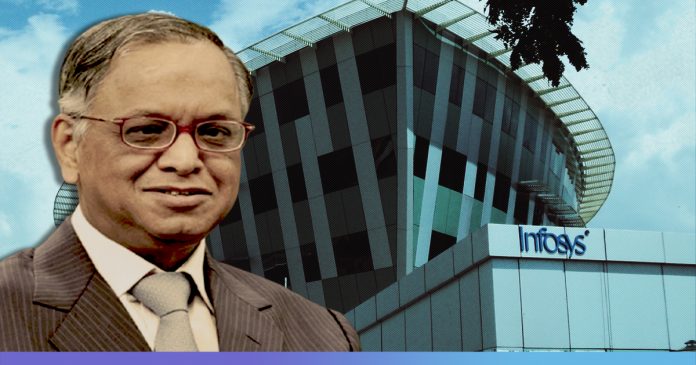
Image source: https://thelogicalindian.com/news/infosys-third-best-forbes/

This article has been written by Sneha Asthana, pursuing the Diploma in Business Laws for In-House Counsels from LawSikho.

Introduction

Corporate Social Responsibility is an idea whereby companies utilize a certain sum of their profits to build a better world including society, environment, and infrastructural development for the country. Society is a very crucial part of any business in terms of market, resources, etc. Giving back to society should be an important function of these industries. Therefore, the Indian Company law mandated Corporate Social Responsibility as a part and parcel of any company’s functions. This was done through Section 135 of Companies Act, 2013 which makes it mandatory for the companies to invest a minimum of 2% of their profits earned during the three financial years immediately preceding the year of creating the Corporate Social Responsibility Policy, in social welfare activities. Most of these activities are to be focused on the eradication of poverty, hunger, gender inequality, and working towards rural development. 

Following the mandate of Section 135 of the Companies Act, 2013, Indian companies making the required amount of profits/net worth have to participate either financially or physically, in activities that are for the betterment of society. The Indian government has mandated such social welfare activities for companies, however, several of the big companies had already dipped their hands in doing the same. Section 135 of the Companies Act not only talks about partaking in such activities but also talks about the creation of CSR-specific Committees appointing said people to manage such CSR affairs. However, this case study will focus more on the CSR Policy and major CSR activities of the companies which have benefitted millions of people standing true to its name.

Infosys and its Corporate Social Responsibilities

Infosys was one of the few companies that demonstrated responsibility towards their society early on, even before it was mandated by the law and therefore, after doing a thorough study about the various ways their functioning can cause problems to the society, they devised and initiated several programs primarily focusing on environmental sustainability, preserving and developing culture and heritage, spreading more awareness and giving education to the underprivileged sections of the society and promoting health care measures through the Infosys Foundation which was established in 1996. The company continues to work with several partners like the Indian Institute of Technology, Bombay, Lawrence Berkeley National Laboratory, and 3M for collaborations in regards to research, publications, trials, etc. In collaboration with diverse partners from across the world, Infosys always comes up with the most innovative plethora of programs that target simple issues at their roots and benefit society greatly. Under its 2021 Policy, the Company declares that its main areas of focus will remain:

  1. Hunger, poverty, malnutrition, and health
  2. Education.
  3. Rural development projects.
  4. Gender equality and empowerment of women.
  5. Environment sustainability.
  6. National heritage, are, and culture.

The Company has decided to partner with several NGOs to benefit society with various programs. Some of those are discussed below. 

What are the initiatives taken by the company? 

  • Environment sustainability 

The company focuses on problems such as water conservation, carbon emissions, use of plastic, and climate change. One of the major goals for the company was to become carbon-neutral in its functioning. As the company has more than 3 lakh employees, they are more vulnerable to have huge carbon prints. Their efficiently constructed buildings with sensors and energy-saving algorithms enable them to function in auto-pilot mode. The artificial intelligence used in these buildings thoroughly integrates water and energy consumption which allows authorities to keep the user in control by providing on-the-spot data and other details of regular usage. Most of these outlets are connected to Sensors placed in their countrywide offices and have such independent characteristics attached that their maintenance doesn’t require physical personnel. 

Their key monitoring areas include temperature, water consumption, energy usage, indoor air quality, critical assets, alerts, and warnings, etc. In addition to the same, Infosys also prefers purchasing their offset products from the local markets, thereby promoting and developing rural areas instead of purchasing it from the sharks as the big fish generally tend to ignore the harm caused to the environment. Further research also showed the huge quantities in which plastic is being used in the several offices they have. Having several offices spread across the country that employs more than 3 lakh people, huge amounts of waste is generated from these offices. 

After understanding the unfortunate contributions that lead to dangerous environmental conditions, Infosys decided to change its ways of functioning. It decided to cut down the use of plastics by ensuring that steel cutlery is used in their canteens and paper water cups are replaced with steel bottles for each individual. In addition to plastic waste and carbon prints, Infosys also focuses on conserving water. Certain significant changes in the plumbing system, water usage leaks, unequal distribution of water went a long way for Infosys in ensuring that water is conserved and not used unnecessarily. Waterless urinals without any risks to a person’s health have been introduced in many of their offices. Some of the washrooms had key-valve plumbing done to fill any possible leaks and ensure the least amount of water is consumed without taking a toll on people’s health. Small devices known as Pressure Compensation Aerators that are used on taps have also been installed all around their campuses to ensure that water flows in a consistent force thereby making sure it’s not wasted. Another feather to its cap is the Infosys EcoWatch which is a software that readily delivers all possible alternatives and solutions to carbon emissions, water wastage, etc. Infosys partnered with Bharat Petroleum for the same making it one of the biggest organizations that target highly intrinsic environmental problems which have been camouflaged in lengthy processes.   

Findings:

Their long-stretched efforts in compliance with the Environment Sustainability 2020 practice are made to seek long-term results out of the efforts invested by the company. Fortunately, these efforts worked well in their favor and today Infosys has about 40,000 assets connected to the Center Command ensuring that usage patterns are identified and loopholes are rectified immediately. As per their expectation, Infosys has also successfully started eight community-based offset long-term projects in the states of Maharashtra, Tamil Nadu, Karnataka, etc. 

Infosys has been recognized by the United Nations in 2019 for their efficiently made building using AI for the best of its use and maintaining good environmental health. According to statistics, the automated buildings allowed the company to function efficiently even when the staff wasn’t present physically. To top it all, these buildings helped the company reduce the connected load by 33 MegaWatts. 

As the company has more than 3 lakh employees, they are more vulnerable to have huge carbon prints and great usage of plastic. After understanding the unfortunate contributions that lead to dangerous environmental conditions, Infosys decided to change its ways of functioning. It decided to cut down the use of plastics by ensuring that steel cutlery is used in their canteens and paper water cups are replaced with steel bottles for each individual. This reduced their generated waste by 23% in just a year which also helped them cut costs and use their resources more efficiently. What helps them further is the Infosys EcoWatch because not only does it provide solutions, it reads in all data entered to device new strategies. All of the above-mentioned efforts have contributed significantly to helping the environment and helped it to cut costs on avoidable expenditure. 

  • Public healthCare

The Infosys Foundation was created with a mission to help introduce health care programs for the people of the society. The Foundation has partnered with Sankara Netrayala, Swami Vivekananda Integrated Rural Health Centre, and National Institute of Mental Health and Neuro Sciences for treating the blind, eradication of leprosy, and offering comprehensive care service for patients suffering from psychiatric and neurological problems respectively. 

While Public Healthcare has always been a key issue that companies focus on, Infosys has picked certain very important health problems that don’t seem to be getting the aid they require. Additionally, Infosys has also collaborated with the National Cancer Institute (NCI) of the All India Institute of Medical Sciences (AIIMS), Jhajjar, and the government to make an 800 bed Dharamsala which could be used by cancer patients and their treatment and also to accommodate their families during the treatment. The hospital is said to have about 1500 rooms, around 700 beds, and dormitories for the family. The construction costs for the same are to be borne by Infosys and the rest of the cost is to be looked after by the government. 

Infosys also focuses on women’s health in Jaipur through Jan Chetna Manch, Bokaro. One of the key factors of Infosys’ CSR is women empowerment which aligns itself to the healthcare initiatives taken by Jan Chetna Manch, Bokaro. Therefore, Infosys has partnered with the same to ensure hospital services are easily accessible to women, especially those who are pregnant or mothers already. 

Findings:

According to the latest reports, Infosys has been quite successful in helping the people of our society. Infosys has successfully converted hospitals into Ophthalmic Centers and is beginning a project to make a hospital for serving the blind particularly and offering around 12,000 surgeries for free. The SVIRHC has also been successful in eradicating leprosy by treating 3,747 leprosy patients, 11,083 tuberculosis patients, and conducting free eye operations for 16,869 patients. Patients with psychiatric and neurological problems receive regular funding for treatment and stay costs. The Jharkhand initiative turned out to be very fruitful for the women of Jharkhand who mostly worked in Self Help Groups. They were educated about their physical body, menstruation, pregnancy, and maternal care while being offered the same services at healthcare centers for minimum costs. 

  • Education

Another one of the most important issues of India is the lack of education. Most of the Indian population is rural and doesn’t have access to the high standards of education that urban citizens receive. In addition to this, the widely accepted concept of ‘rote learning’ opens up the problem of the lack of employability skills in a student. Regardless of how much a person has studied, they remain unemployable until they receive extra training. To tackle this issue, Infosys partnered with Avanti fellows who use a different approach to teaching which is analytical thinking skills, problem-solving orientation, creativity, debates and practical testing. 

Their unique pedagogy ‘peer learning’ allows them to move past the regular rote learning and exposes these students to the many skills that they have. This initiative ensures that children who have received basic education receive good job opportunities in the STEM fields. One more catch that the rural people of India face is hunger. Most of the students studying in government schools cannot afford to have three meals a day. Therefore, Infosys has partnered with Sri Ramakrishna Vidya Kendra in the Bannerghatta Forest area in Bengaluru to provide free meals to children belonging to BPL (Below Poverty Line) families and hence promote education among them. 

Findings:

Both these initiatives have had very high success rates. According to studies, Avanti fellows-Infosys has helped about 40,000 students from marginalized communities in getting a good quality education in the STEM fields. Post the success of the same, STEM also introduced medical courses and training for AIIMS which, yet again, helped more than 1000 students to appear for the exam. Their second initiative of eradicating hunger in classrooms has ensured that the drop-out rate has decreased leaving more people to continue their education. Accurate statistics of the same haven’t been recorded, however, Karnataka is pleased with the initiative as more students join in each year.

Conclusion

While Infosys didn’t leave any leaf unturned in regards to giving back to society, it appears that most of their CSR activities are way too scattered and may also appear unapproachable to people who could benefit from the same. It is clear to us that Infosys has a plethora of initiatives for environment conservation which is the need of the hour but focusing its major resources on one thing and not equally distributing resources to other key issues gives birth to a problem. In partnering with various NGOs, Infosys has successfully participated in CSR activities mainly by supporting them financially. However, a few more initiatives that require human communication, to understand the need of humans and give it a personal touch would appeal to society more than to majorly just be a dormant partner. 

References

  1. https://www.infosys.com/about/corporate-responsibility/environmental/emission/solutions-enable.html.
  2. https://thecsrjournal.in/infosys-csr-report-india-2020/.
  3. https://www.infosys.com/about/corporate-responsibility/environmental/emission/carbon-neutral-program.html.
  4. https://thecsrjournal.in/infosys-csr-report-india-2020/.
  5. https://www.infosys.com/infosys-foundation/initiatives.html.
  6. https://www.infosys.com/investors/corporate-governance/documents/corporate-social-responsibility-policy.pdf.

Students of Lawsikho courses regularly produce writing assignments and work on practical exercises as a part of their coursework and develop themselves in real-life practical skills.

LawSikho has created a telegram group for exchanging legal knowledge, referrals, and various opportunities. You can click on this link and join:
Follow us on Instagram and subscribe to our YouTube channel for more amazing legal content.

Download Now

All about the Constitution (One Hundred and Third Amendment) Act, 2019

0
Federalism

The article is written by Harmanpreet Kaur from Amity University, Kolkata. The article will provide an overview of the Constitution one hundred and third amendment Act, 2019.

Introduction

The Constitution has been amended numerous times to keep pace with the changing developments in society. The Constitution was fabricated to create an egalitarian society wherein social, economic, political justice is maintained, the equality of status and opportunity is made available to all. The amendments in the Constitution are also made with the corresponding aim and objective. The legal history of India states that whenever the Supreme Court pronounced its judgment with respect to reservations, the parliament would either repudiate or bridle the inconvenient judicial pronouncement, and make amendments to the Constitution. One such instance is the enactment of the Constitution (One Hundred and Third Amendment) Act, 2019, which was ratified with the aim to provide reservation to the economically weaker sections of society. 

The Constitution Amendment Act, 2019 made amendments to Article 15 and Article 16 of the Constitution of India. These two articles are the backbone of reservation in areas related to education and government jobs. The act by adding two new clauses to Articles 15 and 16 of the Constitution has empowered the state to provide a maximum of 10% reservation for “economically weaker sections” of the society. As a result, the total reservations over and above the existing scheme have increased to 59.50 percent.

The Constitutional Amendment Act, 2019 would benefit 190 million people of India. According to the report published by UNDP 2018, the poverty rate in India has reduced to 27.5 percent. According to the Niti Ayog’s report of 2018, it was stated that more Indians have been victims of poverty, hunger issues, and economic inequality. So, this Act was actually introduced to alleviate poverty and provide economic equality to people from all spheres.

The article will deal with the necessity of amending the provisions of the Constitution and will give a synopsis of the 2019 Act i.e, Constitution 103rd Amendment Act.

The necessity of amending provisions in the Constitution 

The Constitution is amended for the social and economic development of society. It was observed in the case of Keshavanada Bharati v. The State of Kerala (1973) that if no provisions were made for the amendment of the Constitution, the people would have recourse to extra-constitutional methods like a revolution to change the Constitution. It has been the nature of the amending process in a federation that has made the politicians classify the federal constitution as rigid. The procedure of amendment in the American Constitution is very difficult. The common criticism of the federal Constitution is that it’s too conservative and is too difficult to alter.

So, in order to prevent rigidity, the Indian Constitution was written in such a way that it could adapt to the changing demands and conditions of a growing population. But the framers even did not want to make the Constitution too flexible which would be a play on the whims and caprices of the ruling party. Thus, the Constitution is neither too rigid nor too flexible for the changes. Willis had stated for the Constitutional Law of the United States that “If no provisions for the amendment were provided, there would be constant danger of revolution. If the method of the amendment were too easy, there would be the danger of too hasty action all the time. In either case, there would be a danger of the overthrow of our political institutions”.

Hence, the purpose for amending the Constitution under Article 368 was made with an intention to make social changes. The amendment of the Constitution acts like a safety valve, which is devised in order to give protection to the provisions of the Constitution and to amend it whenever necessary. The constitution-makers have thus maintained the balance between the danger of having a non-amendable Constitution and a Constitution that is too easily amendable.

The Constitution One Hundred and Third Amendment Act, 2019 – An overview

The Constitution Amendment Act, 2019 was amended with a view to advance the reservations for the economically weaker sections of the society. The Act made amendments to Article 15 and Article 16 of the Constitution of India.

Legislative antiquity of the Bill

The Bill for the Constitution One Hundred and Third Amendment Act, 2019 was introduced in the Lok Sabha on January 8, 2019, by T.C.Gehlot, a minister of the Department of Social Justice and Empowerment. The Bill was introduced with the aim to amend Articles 15 and 16 of the Constitution of India, and the Bill received approval from the lower house on January 8, 2019. The Bill was then passed and approved by the Rajya Sabha on 9th January 2019. After the bill was passed by the Lok Sabha and the Rajya Sabha, the passage of the bill was described as the “landmark movement in the nation’s history” by Prime Minister Narendra Modi. The Bill was passed to set into motion the process to achieve an effective measure ensuring social justice for all the sections of society. It was stated by Prime Minister Narendra Modi,  “It is our endeavor to ensure that every citizen or poor person irrespective of caste, creed or religion gets to lead a life of dignity and gets access to all the possible opportunities”. Thus, the bill was obligated to the principle of ‘Sabka Saath, Sabka Vikas’. The Bill finally received assent from the President and came into effect on January 14th, 2019.

Article 15 and Article 16

Article 15 states that: 

  • No person should be discriminated against on the basis of religion, race, caste, sex, or place of birth, or any of them.
  • The states should not discriminate against the citizens of the nation with regard to access to shops, hotels, etc, and all places of public entertainment, of public resorts, wells, tanks, roads, etc.
  • The state should make provisions related to the protection of women and children for their welfare and safety.
  • The state can or may make special provisions for the protection of the interests of the  backward classes.

Article 15(6) was introduced by the Constitution(one hundred and third Amendment) Act, 2019 which states that:

  1. Economically weaker sections should be considered as a prime factor;
  2. The provisions related to their advancement should be taken up by the state;
  3. Economical weaker sections of the society should be given a reservation of a maximum of ten percent;
  4. The reservations should be made with respect to educational and private educational institutions;
  5. The respective reservations should be made by the state after taking into consideration the family income and other economic factors.

Article 16 states that:

  • There should be equal opportunity for all the citizens in the interests of employment or appointment to any post under the state;
  • There should be no discrimination on the basis of religion, race, caste, sex, descent, place of birth, or residence in terms of employment or office;

Article 16(6) was introduced by the Constitution(one hundred and third Amendment) Act, 2019, which states that:

  1. No government authority or any other person or authority shall prohibit the state from making any laws related to the reservations of economically weaker sections;
  2. The laws made for their reservation should not exceed ten percent. 

The amendments made in the Articles 15 and 16 were made with an aim to uplift the economically weaker sections of the society, who are of the general category, and to provide ten percent reservation in the jobs and educational institutions in the center, state or union territories to economically weaker sections of the society for social and economic development.

Does the act violate the Doctrine of Basic Structure of the Constitution 

The Public Interest Litigation was filed under Article-32 of the Constitution of the Supreme Court by the non-profit organization named Youth for Equality alleging and stating that the legislation’s decision to grant reservation of ten percent with respect to private and governmental educational institutions to the members of economically weaker sections in the society is going against the basic structure of the Constitution and it also overrides the previous decisions of the Supreme Court. 

The question that arises first is that can the fundamental rights be amended? This can be explained through the case of Shankari Prasad v. Union of India (1951), in which the validity of the Constitution First Amendment Act, 1951 was challenged that inserted Article 31 A and Article 31 B. The Amendment was challenged on the ground that it contravenes the rights conferred by Part-III which fell within the prohibition of Article 13(2) and hence was void. It was argued that the ‘state’ in Article 12 includes Parliament and the word ‘Law’ in Article 13(2), therefore, must include a constitution amendment. The Supreme Court rejected the argument and held that an amendment under Article 368 was enacted by parliament in the exercise of its constituent power, while the term “law” used in Article 13 referred to the exercise of the ordinary legislative power conferred on Parliament by the provisions of the constitution other than Article 368.

The next question that arises is whether the Act violates the basic structure of the Constitution? The answer to this can be attained by first explaining the concept of basic structure and then coming to the conclusion. The courts have not defined the concept of the basic structure in the Constitution, but have passed several judgments in the context of the same.

The concept was discussed in the very famous Kesavananda Bharati Case, wherein the petitioners had actually challenged the power and validity of Article 368 stating that it had no limited powers, which was acting as a contravening factor to the basic doctrine of the constitution. The court held that Article 368 has the power to amend the constitution, but should not contravene with the basic structure or framework of the constitution. Hence, the court stated the essential features of Basic Structure, which would include:

  • Supremacy of the Constitution;
  • Republican and democratic forms of the government;
  • The sovereignty of the country;
  • Republican and democratic forms of the government;
  • Secular character of the Constitution
  • Separation of powers between the Legislature, Executive, and Judiciary;
  • Federal character of the Constitution;
  • Rule of law;
  • Individual freedoms secured to the citizens.

 In the case of M.Nagaraj v. Union of India (2006), the Court held that the provisions under Article 15 and 16 apply to SC and ST and do not obliterate constitutional requirements such as 50 percent ceiling limit in the reservation, creamy layers rule, and post based roster subclassification between other backward classes, scheduled castes, and scheduled tribes, and these provisions are made for the welfare of the backward classes and hence do not alter the basic structure of the equality code. Thus, it can be stated that the doctrine of the basic structure acts as:

  • A safety valve against the concepts of majoritarianism and authoritarianism, and
  • As a custodian and safeguards the rights and liberties of the citizens, thereby maintaining the ideals of the Constitution and abiding by the concepts of Constitutionalism.   

It can be hence conferred that the Act in no way violates the basic structure of the Constitution, as it is amended to provide upliftment to the economically backward classes, and is subdued under the basic rule of law and to the basic principles of the right to equality under Article 14 of the Constitution of India.

Relevance of the doctrine of Basic Structure in the reservation

Dr. B.R.Ambedkar and Gandhiji in the Poona Pact, 1932, stated the relevance of the reservation of the social backwardness of the classes, in order to ensure social justice and economic peace. The amendment to Article 15(4) was made in the year 1951 through the First Amendment Act, 1951 which empowered the states to make provisions for the advancement of the socially and educationally backward classes, and subsequently, Article 16(4) provides the directive for reservation for the backward classes of the society, if they are not adequately represented in services under the states. Thus, it can be hence stated that even though a reservation is not a guaranteed right under any of the articles, it is still guaranteed to the various sections and classes for their welfare and upliftment thereby abiding by the principles of Right to Equality under Article 14 of the Constitution.

How will the Court decide if the economic reservation violates the basic structure?

The Supreme Court has already explained the concept of the Doctrine of basic structure in its various precedents, but now the question arises as to how the courts will decide the violation of basic structure in respect of the economic reservation. 

In the case of M.Nagaraj v. Union of India (2006), the court applied two tests to examine the affirmative action concerning reservation, which can also be applied to examine the decision concerning the economic reservation. The two tests that were applied in the case were:

The Width Test

The width test can be applied in order to check the violation done to the basic structure by examining and assessing the four issues i.e.:

  1. Violation of fifty percent canopy for all the reservations to the scheduled castes and scheduled tribes;
  2. Exclusion of the creamy layer;
  3. compelling reasons for which such reservation was made, such as the backwardness of the economically weaker sectors;
  4. That the administrative efficiency should not be destroyed due to the reservations made.

The Identity Test

The Supreme Court will use this test to determine whether the Constitution’s identity has changed as a result of the amendment.

Equality has always been the pillar of democracy and the courts have pronounced judgments on the principles of equality and rule of law. The equality permits reasonable classifications thereby expressing that the judgment should not be arbitrary and capricious. So, in the case of deciding the economic reservation, courts should consider and examine the equality code of the Constitution. The government should also specify the ‘compulsory reasons’ that go beyond the limit of fifty percent.

Economic criteria – an exclusive basis of reservation or a violation of the Basic Structure

The various provisions in the Constitution of India i.e Articles 14, 15, 16, 29, and  46 are introduced in the Constitution for the social and economic upliftment of the people of the backward classes and the minority class thereby securing a stable and stout lifestyle. The Constitution One Hundred and Third Amendment Act, 2019  would mitigate the hardships of the people who are left behind because of their economic backwardness. The contentions were raised upon the Act because the politicians and the debaters were of the opinion that the Act is violating the fundamental principles of the already introduced articles i.e, Article 14, 15, and 16 stated that the ‘economic backwardness’ should not be considered as a basis of amendment. 

In order to determine the economic criteria for reservation, the reference can be made to the Indra Sawhney judgment. It has been cited by the Supreme Court in the case of Indra Sawhney v. Union of India,1993,  that the backwardness of the class of the citizens cannot only be determined on the basis of the economic status, and it is not only aimed at economic upliftment and alleviation of poverty but also have been made to give a due share in the state power to the scheduled caste, scheduled tribes, and other backward classes.

Further, in the case of M. Nagraj v. Union of India, 2006, the Supreme Court held that in order to determine a case related to the reservations in promotions to the employees, three conditions should be imposed i.e., identification of backwardness, quantitative limitations such as violation of 50 percent ceiling for all reservations, exclusion of creamy layer. 

Thus, it can be stated that Articles 14 and 15 are based on the principle of equality, thereby ensuring equality to the citizens on the basis of caste, class, or creed. So, it can be stated that the Constitution One Hundred and Third Amendment Act, 2019 has been for the citizens that have a weak economic background.

Conclusion

The amendments in the Constitution have been made and introduced to keep pace with the developments in society. The Constitutional Amendment Act, 2019 has also been introduced and enacted with the aim to ensure economic upliftment to the people and to provide benefits to the people who suffer from unemployment and who are unable to afford their educational expenses. The Act in no way conflicts with the other fundamental rights and with the other provisions of the Constitution. It can be stated that the government by amending the Act has provided equal rights and privileges to the citizens on the economic forefront and has in fact acceded to the provisions of the Constitution of India.

References

  • Constitutional Law of India, 2018, Dr.J.N.Pandey.

LawSikho has created a telegram group for exchanging legal knowledge, referrals, and various opportunities. You can click on this link and join:
Follow us on Instagram and subscribe to our YouTube channel for more amazing legal content.

Download Now

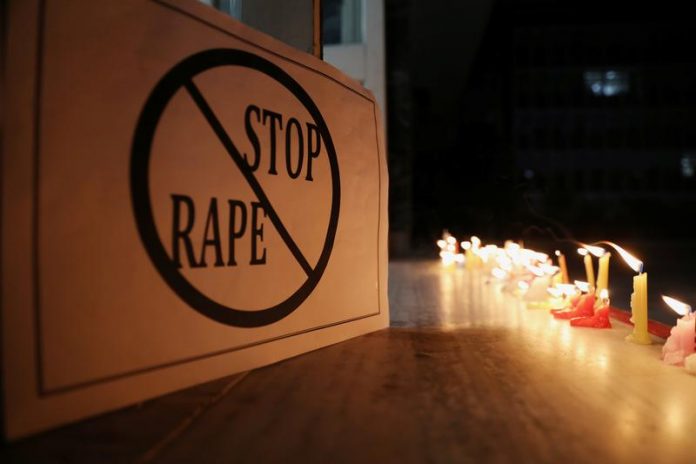
Rape laws in India : no means no

0
Indian rape laws
Image Source: https://rb.gy/h95nem

This article is written by Smaranika Sen from Kolkata Police Law Institute. This article exhaustively deals with the rape laws in India.

Introduction

“No means No” had been a viral dialogue when the movie Pink was released. So many articles, columns on social media were written regarding the importance of the term “No means No” especially in the lives of women. But have people realized the value of the term? The answer still lies in the negative. Sexual harassment is one of the heinous offences that are prevalent in society and complaints about the same are raised almost every day. The National Crime Records Bureau released a report regarding sexual offences in the year 2019. The report showed that almost 4 lakh sexual offences had taken place in 2019. 

Definition of rape

Before defining the term “rape”, we must understand what sexual offences mean. Sexual offences comprise rape, attempt to commit rape, assault on women with intent to outrage her modesty and insult to the modesty of a woman.

The definition of rape is stated in the Indian Penal Code, 1860. Section 375 of the Indian Penal Code defines rape as:

  • Whenever a man penetrates his penis into the vagina, mouth, urethra, or anus of a woman or even makes her do the same with him or any other person; or
  • Whenever a man inserts any object or a part of the body into the vagina, urethra, or anus of a woman or makes her do the same with him or any other person; or
  • Whenever a man manipulated any part of the woman to cause penetration or makes her do the same with him or any other person; or
  • Whenever a man applies his mouth to the vagina, anus, urethra of a woman or makes her do the same with him or any other person.

Provided that the above has been done: 

  • Against the woman’s will;
  • Without the woman’s consent;
  • With the woman’s consent, such consent has been obtained by putting her or any other person whom she is interested in fear of death or hurt;
  • With the woman’s consent but the man has the knowledge that he is not the husband of the woman. However, the woman believes that he is her husband whom she is lawfully married to, and has given consent in this regard;
  • With the woman’s consent but such consent has been obtained in the intoxication of mind, unsoundness of mind;
  • With or without the consent of the woman, when she is below eighteen years of age.
  • In such cases where the woman is unable to communicate consent;
  • It has to be also kept in mind that a woman not showing any physical resistance to the act of penetration does not indicate it to be consent. This clause is important as previously, the absence of this law manifested certain judgments which proved to be a failure to safeguard a woman’s rights. In the case of Mohammed Habib v. State (1988), the Delhi High Court held that there were no such marks on the genital parts of the victim which showed resistance. Even the hymen was completely ruptured and there were bite marks and an eye-witness to the entire incident did not amount to rape. The accused was acquitted. 

If a man commits any of the above acts he is said to have committed rape.

However, a medical examination procedure or intervention and sexual intercourse committed by a man with his wife who is or above fifteen years of age will not constitute rape.

In the case, Deepak Gulati v. the State of Haryana (2013), an issue was raised that whether intercourse under a promise to marry constitutes rape or not. The court held that intercourse under the promise to marry can only amount to rape if the accused from the initial stages had no intention to marry the woman. The court further added that the accused can be only convicted of rape if it was observed that the intention was mala fide and the accused had clandestine motives.

Amendment in 1983

The amendment in 1983 took place due to an infamous rape case also known as the Mathura rape case. The case was regarding a custodial rape case of a young tribal girl in Desaiganj police station. The Sessions Court held that the policeman was not guilty as there were no such alarms raised by the girl. The Nagpur Bench of Bombay High Court set aside the judgment and sentenced the police officer to imprisonment. However, the Supreme Court acquitted the accused on the grounds of lack of evidence. This created huge protests and various amendments were made to the existing law system. The major changes were that custodial rape was identified as a sexual offence, the onus of the burden of proof rests on the accused as soon as the act of sexual intercourse was established, the victim’s identity was not disclosed, rape trials started to conduct in-camera proceedings. Also, several amendments were made in the Indian Penal Code, Code of Criminal Procedure, 1973, and the Indian Evidence Act, 1872.

Amendment in 2013

Before 2013, the definition of rape in the Indian Penal Code was not quite widely described as it is now. 16th of December, 2012 is considered a black day in the history of India. On this day 16th of December, 2012, a gang rape took place which severely shook the entire nation. This led to huge nationwide protests and it was also observed that the rape laws in India are not quite sufficient. The definition of rape, before 2013, was limited to the act of penetration. This clearly showed that the definition is hugely lacking to constitute several heinous offences as rape, thereby leading the victims not to get justice. The case was also covered by the international media because radical reforms were required to save the women of the country. The United Nations Entity for Gender Equality and Empowerment of Women informed the Government of India to make reforms in the required sections to make the life of women safer and secure. 

On the 23rd of December 2012, the Justice Verma Committee was formed whose main aim was to review all the existing laws that were there for sexual offences and to suggest the amendments. The Committee also aimed to suggest measures for speedy trials in such grave and heinous offences and harsh punishments for such criminals who commit such heinous crimes. The Committee was headed by honourable Justice J.S. Verma, former Chief Justice of the Supreme Court. The Committee also welcomed the point of view of various eminent jurists, legal professionals, the public, etc. 

The Committee submitted its report with the suggestion of bringing several changes in the following areas:

  • Punishment of rape;
  • Punishment for other sexual offence;
  • Registering complaints and examination; and
  • Bill of Rights for Women.

This inclusive report of 630 pages was a landmark suggestion. It was appreciated globally. This eventually led to the passing of the Criminal Law (Amendment) Act, 2013. The amendment defined the term rape widely so that no one lies outside the realm of justice. The Act also recognized the rarest of rare cases and the police will also face penal charges if they refuse to take any FIR. Further, it criminalized offences like sexual voyeurism and stalking. Moreover, various amendments were made in the Indian Penal Code, Code of Criminal Procedure, and the Evidence Act to give effect to the same.  

Amendment in 2018

In the years 2017 and 2018, the nation again witnessed two unfortunate rape cases that led to amendments in the existing laws:

  • Unnao Rape Case: A 17-year-old girl was the victim of a gang rape that took place in Unnao, Uttar Pradesh. The main accused here was a politician who was sentenced to life imprisonment.
  • Kathua Rape Case: A very young girl of 8 years was the victim of this immoral act and was murdered. It was also observed that she was kidnapped and kept in a place. 

These two cases deeply shook the minds of the people. Nationwide protests began for their justice. This led to amendments in the Indian Penal Code, POCSO Act, 2012, Code of Criminal Procedure, and the Evidence Act.

Various statutes for rape

Indian Penal Code, 1860

Punishment for rape is mentioned in Section 376 of the Indian Penal Code. It states that anyone who has committed rape will be punished with rigorous punishment for a term of not less than ten years which might extend to life imprisonment and be liable to a fine. If a-

  •  Police officer,
  •  Public servant, 
  • Member of the armed forces of State or Central Government,
  • Member of the management staff of a jail or remand home or other places of custody, 
  • Member of the management staff of a hospital,
  •  A relative of the victim or guardian or teacher or a person who is in a position of trust towards the victim.

Commits rape then the above shall be punished with rigorous imprisonment for a term of not less than ten years which might extend to life imprisonment and be liable to fine. 

If someone commits rape-

  •  During communal violence;
  •  Knowing the woman to be pregnant;
  •  Who is Incapable of giving consent;
  • On a woman suffering from both mental and physical disability;
  • Causes bodily harm endangers the life of a woman or disfigured;
  • Repeatedly then the person shall be punished with rigorous imprisonment for a term of not less than ten years which might extend to life imprisonment and be liable to fine. 

Anyone who commits rape on a woman who is below sixteen years of age shall face a punishment of rigorous imprisonment for a term of not less than twenty years which may extend to life imprisonment, and be liable to pay a fine. 

The provision of Section 376 has allowed the courts to award a lesser sentence than the minimum prescribed for rape where there are any “special and adequate reasons”. In the case of Gopi v Karnataka (2013), it was observed that the appellant was sentenced to 10 years of imprisonment. An appeal was made on compassionate grounds. The Apex Court allowed the appeal by taking into consideration that the appellant’s two daughters were of the age of marrying.

Zero tolerance policy in case of child-rape

Increasing cases of child rape led the Supreme Court to suo moto register a PIL and take it up for hearing and address the issues. The court considered that special investigations are required to look into the matter of child rapes. The court also stated the need for special courts for speedy trials. 

  1. Section 376A states the punishment for causing the death of a woman or causing such harm while committing rape which leads to a persistent vegetative state of the victim. The person committing such crime shall face a punishment of rigorous imprisonment for a term of not less than twenty years which may extend to life imprisonment.
  2. Section 376AB states the punishment for those persons who commit rape on a woman who is below 12 years of age. The person committing such crime shall face a punishment of rigorous imprisonment for a term of not less than twenty years which may extend to life imprisonment, be liable to pay a fine, or can also be given the death penalty.
  3. Section 376B states that any person who commits sexual intercourse with his wife while a decree of separation is given and living separately without the consent of the woman shall face imprisonment for a term of not less than 10 years which may extend up to 7 years or be liable to fine. 
  4. Section 376C states that if-
  • Public servant, 
  • Member of the management staff of a jail or remand home or other places of custody, 
  • Member of the management staff of a hospital,
  • Someone who is in a fiduciary relationship.

Uses his position to induce or seduce any woman for sexual intercourse and such intercourse does not amount to rape then that person will be punished with rigorous imprisonment for a term of not less than 5 years and be liable to fine:

  1. Section 376D states the punishment for gang rape. Whenever a woman is raped by one or more persons constituting a group having a common intention then each of those persons will be deemed to have committed rape and will face a punishment of rigorous imprisonment of not less than 20 years which may extend to life imprisonment and be liable to pay a fine.
  2. Section 376DA states whenever a woman who is below 16 years of age is raped by one or more persons constituting a group having a common intention then each of those persons will be deemed to have committed rape and will face life imprisonment and be liable to pay a fine.
  3. Section 376DB states whenever a woman who is below 12 years of age is raped by one or more persons constituting a group having a common intention then each of those persons will be deemed to have committed rape and will face life imprisonment and be liable to pay a fine or with death.
  4. Section 376E states that whoever has been previously convicted of any offences falling under the purview of any other previous sections and further convicted of any offence falling under the previous sections then he/she will face imprisonment for life or with death.
  5. Section 228A states no persons are allowed to disclose the name of the rape victim and if someone discloses it, then he/she shall face imprisonment for 2 years and be liable to a fine. 

Indian Evidence Act, 1872

Section 114A states that certain presumptions can be made as to the absence of consent in certain prosecution of rape. 

Code of Criminal Procedure

  1. Section 53A states about the procedure of examination of a person accused of rape by a medical practitioner.
  2. Section 164A states the procedures for medical examination of the rape victim.
  3. Section 327 states that in rape cases, trials will take place in-camera proceedings. 

Protection of Children from Sexual Offences (POCSO) Act, 2012

This Act mainly recognizes sexual offences against children. Another significance of this Act is that it acknowledges sexual offences committed against a boy. 

The reason behind such heinous crimes

This is quite a debatable issue. However, to answer this question we can analyze the angle of different reactions that a crime might generate against a criminal. It is observed that among the punitive approach, therapeutic approach and preventive approach, rape is associated with the therapeutic approach. In this approach, the main goal is to cure the criminal tendencies which were the product of such an immoral mentality. It considers criminals as sick persons. In countries like the United States, sex offenders undergo psychotherapy. However, in India, there are no such treatments available in jail but it is believed that if such offenders are treated psychologically, they may not repeat the same.

Conclusion

Rape is one of the heinous crimes that has happened to mankind. It creates a huge trauma in the victim’s life. Often the victims are observed to undergoing therapy to overcome the trauma and apprehension. A lot of reforms have taken place regarding the penal provisions for rape. But is it adequate? Are the procedures outdated for rape trials? Various queries such as these come to mind while reading the newspapers or watching news channels. Marital rape is still not included in the penal provisions of India. However, it has also been observed that a huge percentage of rape cases had come out as false. It has to be kept in mind that registering false cases is only leading the real victims to be treated as false cases.

References


LawSikho has created a telegram group for exchanging legal knowledge, referrals, and various opportunities. You can click on this link and join:

Follow us on Instagram and subscribe to our YouTube channel for more amazing legal content.

Download Now

Fall of Jet Airways due to poor corporate governance

0
Image source: https://www.google.com/url?sa=i&url=https%3A%2F%2Fblog.ipleaders.in%2Faviation-industry-emerging-trends-and-challenges%2F&psig=AOvVaw3c06LdZp2bLzs3ZjwLq6YN&ust=1628152647811000&source=images&cd=vfe&ved=0CAwQjhxqFwoTCIis1bX7lvICFQAAAAAdAAAAABAK

This article has been written by Tejas Geetey, pursuing the Diploma in Business Laws for In-House Counsels from LawSikho.

Introduction

A corporation is managed by the Board of Directors which oversees the day-to-day functioning of the business activities. The activities performed involve many stakeholders, including promoters, shareholders, employees, consumers, and any other community impacted by the actions of a corporation.  A corporation is obligated to protect the rights of every stakeholder. But, in reality, are the rights and choices of the other stakeholders considered? In a promoter-centric corporation often the rights of other stakeholders are ignored if the same affect the interest of the promoter & majority shareholders.

Corporate Governance is needed to create an effective framework within a corporation so that the rights of other stakeholders are not disregarded. After Satyam’s failure, many provisions and amendments were introduced in the Companies Act and SEBI Regulations. Despite many amendments, corporations have failed in one of the most fundamental issues which is the Independence of the Board. In this article, the case study of Jet Airways shall be provided which faced similar governance issues. Jet Airways was one of the top companies in the aviation sector which later became bankrupt. Jet Airways’ failure can be attributed to the mismanagement and irregularities that occurred in a promoter-centric company. The purpose of the article is to provide insight into what led to the downfall of Jet Airways and how it is trying to recover from that stage.

Overview of Jet Airways

Jet Airways was considered one of India’s leading companies in the aviation sector. The company was incorporated by the Founder & Promoter Naresh Goyal and commenced its business operations in 1993. The initial investment in Jet airways was around $20 million. In respect of the ownership structure, the promoter Naresh Goyal owned 60% and Gulf Air and Kuwait Airways held the remaining 40%. 

Having the first-mover advantage, post-liberalization, Jet Airways built a strong and reputed image in the aviation market and was a preferred airline in the country.  The company dealt with all the major activities in the aviation sector which include carriage of passengers & transportation of goods and other related services. Thereafter, the company became a public company & issued its IPO in 2005. With the aim to increase its brand value and become the top private airline in the country, Jet Airways acquired Air Sahara. The acquisition took place in 2006, which many experts termed as the start of the downfall of Jet Airways.

After a few years, Jet Airways started facing huge losses as various other low-cost carriers such as SpiceJet started entering the aviation market.  Jet Airways tried to incorporate low-cost and customer-friendly airlines through Jet Lite but the same stopped its operations after some time as the other competitors had already captured the market.  In order to revive the losses of the company, Tata Group had offered to acquire a stake in Jet Airways. Even after the suggestions of the Independent directors and other board members, the company did not consider the offer made by Tata’s relating to the infusion of capital in Jet Airways. In April 2019, due to lack of funds, carriers were grounded & the services of Jet Airways came to a halt.  

What led to the downfall of Jet Airways?

From one of the most successful airlines in the country to being bankrupt, the fall of Jet Airways can be attributed to the mismanagement and unfettered powers which were given to the promoters. Reasons for the governance failure are provided below:

  1. Unfettered Powers are given to the Promoters: The Board of Directors (BOD) are formed to oversee the day-to-day functioning of the company. But many times, the Board’s independence is questioned as the Board is acting in the interests of the promoter-led board. In the family business of Jet Airways, the Promoter held more than 50% of the shareholding in the company thereby having dominant power in the decision making. The promoter disregarding the interest of the other shareholders has taken decisions for the company and has violated. Regulation 4(2)(c) of the SEBI (Listing Obligations and Disclosure Requirement) Regulations, 2015, provides that the company shall ensure equitable treatment of all shareholders, including minority and foreign shareholders. In the acquisition of Air Sahara in 2006, experts had suggested acquiring a loss-making Sahara is not a viable decision but the same was not considered by the promoters. 
  2.  The plight of Independent Directors: Independent Directors assist a company in implementing corporate governance policies. As per Section 149 of the Companies Act, 2013, every listed company should have at least one-third of the total number of directors as independent directors (ID). The position of Independent directors is filled in the company in accordance with provisions of the Companies Act, 2013 and SEBI Regulations, but in a promoter-led company, the suggestive measures of the Independent Directors are side-lined.  Schedule IV of the Companies Act, 2013 defines the Code to be followed by Independent Directors. As per the Code, Independent Directors perform a crucial role in overseeing the affairs of the company. In 2018-19, Jet Airways was facing severe losses, and to overcome the same Tata had offered a deal to acquire Jet Airways. The Independent Directors had suggested that the deal was essential for the revival of Jet Airways but the Board did not consider the same. Many independent directors resigned over the approach followed by the company as the deal did not reach its conclusion stage.
  3.  Protection of other stakeholders: A corporation consists of various stakeholders which aid in the business activities and impact its overall growth.  The stakeholders can be in the form of suppliers who aid in the process of sales of the products or employees who provide services to the company’s clients. The Board and majority shareholders of the company are therefore responsible to protect the interest of other stakeholders. The promoter-led board by Mr. Goyal did not consider the interests of other stakeholders involved in the business operations of Jet Airways. Even when Jet Airways was near bankruptcy and the board had the chance to revive Jet Airways, the same was ignored. Due to lack of funds in 2019, services of the airlines were stopped & the services of many employees were terminated. 

The Board violated the rights of stakeholders given under Regulation 4(2) of the Securities and Exchange Board of India (Listing Obligations and Disclosure Requirement) Regulations, 2015, and failed to give effective redress to them. The failure to protect the employees and other stakeholders could have been stopped if the promoter instead of protecting his interests & the Board instead of being “Yes Sir” considered the collective interests of all the other stakeholders.

Revival of the airlines

Due to poor management and bad financial decisions, Jet Airways worsened its financial position and officially shut down its services in April 2019 due to a lack of funds. With the aim to change this position of the company, the board tried approaching various investors for reviving the company. The Government also assisted in attracting investors so as to protect the company from completely shutting down its operations. The creditors thereafter to recover their dues approached National Company Law Tribunal (NCLT). In order to reduce debts and revive the company, the creditors ratified the revival plan by UK-based Kalrock Capital and UAE-based Murari Jalan Consortium which has been recently approved by NCLT. It is important to note here that the National Company Law Tribunal (NCLT) has provided that the slots relating to the passenger carriage shall be based on the discretion of the Directorate General of Civil Aviation (DGCA). Under the revival plan, the ownership of Jet Airways shall be under the ownership of the Kalrock-Jalan Consortium.

Conclusion  

Jet Airways is one of the oldest private airlines in the country. The mismanagement that occurred in Jet Airways is a lesson for all the big corporations that in the pursuit of achieving new heights, the corporation should not leave behind the stakeholders who helped in reaching those heights. A corporation in which a promoter is holding the majority of shares often affects the rights of other stakeholders in order to increase the market value of the products & services. Promoters should understand that the governance of companies should be given to the Board of Directors so that they have the power to make the decisions for the company.

A Promoter-led company shall lead to mismanagement and irregularities if it does not consider the advice of experts and the board members of the company.  In the case of Jet Airways, the promoter-led Board did not have independence of its own due to which many bad decisions were taken by the company. Though the company has learned from its past failures and is hoping for a revival, the execution of the same will be far from easy. It is believed that the revival of the company is difficult considering the current economic situation posed by the pandemic. Also, the company shall have to face a lot of hindrances such as the availability of premium slots and stiff competition from other low-cost carriers. 

References

  1. https://www.thehindu.com/business/Industry/explained-what-are-the-challenges-jet-airways-faces-before-it-can-take-off-again/article34993417.ece.
  2. https://www.hindustantimes.com/cities/mumbai-news/jet-airways-2-0-boarding-cleared-take-off-to-be-scheduled-101625598496454.html.
  3. https://www.livemint.com/companies/news/tatas-may-be-waiting-in-the-wings-to-buy-jet-airways-1555874536921.html.
  4. https://www.business-standard.com/article/opinion/misgovernance-of-family-business-119051200748_1.html.
  5. https://economictimes.indiatimes.com/jet-airways-india-ltd/infocompanyhistory/companyid-4374.cms.

Students of Lawsikho courses regularly produce writing assignments and work on practical exercises as a part of their coursework and develop themselves in real-life practical skills.

LawSikho has created a telegram group for exchanging legal knowledge, referrals, and various opportunities. You can click on this link and join:

Follow us on Instagram and subscribe to our YouTube channel for more amazing legal content.

Download Now

Protecting museums and architectural monuments in times of the pandemic with respect to the case of Madhu Singh v. the State of UP

0
Image Source: https://rb.gy/9ct0xm

This article is written by Vivek Maurya from ICFAI Law University, Dehradun. The article deals with the need to protect the museum and architectural monuments in the time of the  pandemic.

Introduction 

Throughout the world, museums and architectural monuments are facing the effect of COVID-19, as populations are requested to remain at home, and social events are cancelled. Since the flare-up of the virus, the historical centres, big or little, public or private, have needed to close their entryways. An expected 90% of the world’s around 60,000 historical centres are confronting full, halfway, or possible conclusion. Notwithstanding the size, area, or status, exhibition halls are confronting extreme difficulties, including securing their collections, paying their employees, etc. They add to our society, propose inventive thoughts, and rouse everybody in this troublesome and questionable time. 

The need to protect museums and architectural monuments in times of the pandemic from falling down

Among the most affected sectors, museums and architectural monuments are those whose survival is now in danger. The historical centres have seen the greatest monetary loss during the pandemic period. The galleries have begun to move to online exhibitions. Most of the museums can’t pay the employees their wages. Subsequently, the partners need to take unique supporting exercises regarding the architectural conditions to survive in the post-COVID-19 era.

Impact of COVID-19 on museums and architectural monuments

With the nationwide lockdown, all general places are shut, including museums and historical architectures across the globe. With the closing of museums for visitors and the government asking its citizens to stay inside and maintain social distance, a large number of museums have suffered economically. These mainly include private museums whose primary wellspring of income is ticket deals. A ton of these private museums have laid off half of the workers. Private as well as public museums get awards and help from the government, and different establishments also acquire a lump of their pay through visitors or travellers. 

In India, museums were asked by the government to close their entrance for guests during the pandemic and the effect of this can be seen not just on revenue but also on the collection of the historical centre, which requires everyday support and preventive protection measures. With exhibition halls shutting and employees being asked to work from home, it’s the assortment that is enduring the most and our past is disintegrating with our present.

Because of this pandemic, various art presentations and Museum Biennale have been facing uncertainty around the world. For example, in India, Bihar gallery facilitated India’s first Museum Biennale exhibiting collections from 14 public and private historical centres from March 25, 2020, till June 25, 2020, which today stands delayed. This Biennale was a chance for our country to grandstand our personality, collection, and real estate at an International level. Likewise, Kiran Nadar museums too deferred their Indian Contemporary Workmanship Show in Moscow till sometime later 2021. Cancelling and rescheduling such trades and other preplanned gallery occasions unquestionably astonished the human and financial assets of the museums. Since the Indian Health Ministry has warned citizens that they may have to live with the infection for the rest of their lives and the WHO has stated that the infection may never go away, it is unclear whether such large-scale displays and Biennales will be hosted again.

How museums responded to be resilient during the COVID-19 pandemic

The museums responded to the COVID-19 quickly. Due to the COVID-19 emergency, the exhibition halls moved a huge piece of the activities to advance online galleries. For instance, the Bangabandhu Museum in Bangladesh enjoys the most noteworthy benefit of having a computerized stage. The online collection, 360° visits, online distributions, computerized shows are important for the web museum.

Despite the fact that a large portion of the historical centres previously had a venture to foster online presence before the lockdowns, during the lockdown, web-based media exercises have expanded more. Recently, museums arrange exhibitions, conferences on digital platforms i.e. Facebook, Twitter and Instagram. Now and then, the galleries have coordinated a variety of unique exercises like games, shading exercises, tests, instructive exercises to enhance the COVID-19 difficulties (UNESCO, 2020). GAMeC (Gallery of Modern and Contemporary Art) in Italy coordinated an online public broadcast, the MUO (Museum of Arts and Crafts) in Croatia dispatched online drives (UNESCO, 2020). The Children’s Museum of Houston and the Children’s Museum of Manhattan have coordinated virtual learning habitats. Museum Computer Network (MCN) has arranged a rundown of many virtual assets from historical centres.

Museums are more on the beat than any other time in recent time; many have shifted their archives online to a multimedia format. One of the defenders for this shift is Google Arts and Culture (GAC), which features a couple of Salar Jung Museum’s displays, for example, ‘1601 — 1900: Textile Treasures: Shawls and Sarees’ and ‘501 AD — 2019: A Game of Thrones — How Chess Conquered the World. Nagender Reddy, Chief of Salar Jung Museum, Hyderabad, discloses that from June to August, they got an average of 500 online visits each day. Before the lockdowns, there were only single digit views.

In another display, a packed material shows a clamouring Indian commercial centre where officers assemble before a hookah stall. Online, the commotion takes the form of an auditory experience as one sweeps the cursor across the work. Everything from overlapping voices of loud vendors to the ambient hue and cry of the crowd is heard. Elements — like detailing on the face of a woman at the stall — can be magnified on screen and through speakers.

Fighters in the hookah stall and commotion in the bazaar, dated somewhere in the range of 1775 and 1800 and accepted to have been from the school of the acclaimed craftsman Nainsukh, is one of numerous from the great assortment of National Museum, Delhi, that Google Arts and Culture makes effectively available. 

In its as of late dispatched Life in Miniature show, admirable yet in any case unnoticeable enumerating in Indian little canvases waked up through artificial intelligence and augmented reality. 

The National Museum houses probably the biggest assortment of small-scale works of art in India. Says Simon Rein, program director, Google Arts and Culture, “When we saw the little artistic creations at the National Museum, we were flabbergasted at the degree of detail and accuracy, notwithstanding their size. We figured it is incredible to utilize innovation, such as superior quality automated cameras, to assist individuals with liking thrives that you wouldn’t have the option to see well with the unaided eye.” 

Google utilizes AI to recognize minute subtleties like ponies, studs, and blossoms, from the data set of smaller than expected works of art. With these subtleties, we can discover associations among craftsman ships that are many years separated. You can inundate yourself in Indian miniatures while hearing traditional music or sounds identified with the scenes.

Government funding for the revival of museums and architectural structures 

The Ministry of Culture provides monetary help under the “Museum Grant Scheme” to the state governments and societies, autonomous bodies, local bodies, and trusts enrolled under the Societies Act, 1860 for setting up new museums and to reinforce and modernize the current museums at the regional, state and district level. For monetary help, the proposition is needed to be submitted to the Ministry in the recommended proforma along with all pertinent reports for consideration of the Expert Committee established for this reason.

new legal draft

The museums granted financial assistance under the scheme would be required to send a yearly report on the number of visitors for five years after the completion of the project. A Project Monitoring Committee will screen the work progress of the recommended monetary help under the plan. The Scheme will have three segments as given underneath: 

  1. Advancement and establishment of museums at the territorial, state, and district level 
  2. Digitization of museum collections 
  3. Limit building and training of museum professionals

The maximum amount of monetary help which might be given would be 80% of the absolute venture cost. In the event of historical centres in the North-Eastern region, including Sikkim, the monetary help would be 90% of the complete task cost. The leftover sum for example 20% of the task cost (if there should be an occurrence of North Eastern area, 10% of the venture cost), should be borne by the association. The association may orchestrate the equilibrium sum either from its assets or may get help through Corporate Social Responsibility. There is no condition in the plan for getting help through CSR.

An analysis of the case of Madhu Singh v. the State of UP, 2014

Facts and issue of the case

  • The petitioner brought up the significance and importance of the museum under the steady gaze of the court and presented that the Allahabad Museum is one of the four public historical centres set up by the Government of India. The museum is halfway situated in the Civil Lines space of the city in the lavish green Chandra Shekhar Azad Park. At the museum-directed exhibition visits, free cooperation in talks, classes, and other instructive exercises are accessible. 
  • The museum is likewise open for analysts and understudies and is additionally having a few publications. Mortar cast and fibreglass copies of stone and earthenware objects, different keepsakes are additionally sold at the business counter of the gallery. It has additionally been brought up by the candidate that Allahabad Museum isn’t just a store of material culture. Rather, it’s a centre for instruction and scattering of information. 
  • The Museum has endeavoured to engage with the public on enhancing a better visitor experience and offering freedoms to researchers through colloquium, symposia, addresses for exchange, and examination in the field of craftsmanship, antiquarianism, culture, and history.

Findings of the court 

  • The Allahabad High Court has requested the start of an entryway in the Chandra Shekhar Azad Park to permit guests admittance to the Allahabad Museum inside the recreation centre in Madhu Singh v. the State of UP. Thusly, the court has altered its own 2014 decision, which restricted guests/vehicles’ entrance to the recreation centre and requested the recreation centre’s doors to be shut. 
  • The request came after a Bench of Chief Justice Govind Mathur and Justice Saurabh Shyam Shamshery took the note of a letter from the previous Chairman of the Allahabad Museum Society that brought up to a conclusion that denying senior residents and the other people who experience difficulty in strolling the admittance to the museum. 
  • Therefore, the letter requested that the court permit vehicles/guests into the recreation centre, as the museum’s footfall had fundamentally diminished. 
  • Appropriately, the court chose, in light of the realities expressed in the letter and the meaning of the museum, that an opening is needed for the section to the National Museum, which was already open from 9.30 a.m. to 5.30 p.m. 
  • While keeping up that the limitation of section into the recreation centre (otherwise called Company Bagh) was influenced to keep up the recreation centre, the court noticed that while saving the Chandra Shekhar Azad Park (Company Bagh), it is additionally similarly important to guarantee advancement and complete utilization of public exhibition hall. The absence of an entryway is getting an enormous number of vacationers far from the historical centre. Historical centres of public notoriety can’t be permitted to pass on essentially because they don’t have adequate opening times. 
  • The court additionally mentioned that the specialists consider giving a parking spot close to the entry point. Allahabad High Court coordinates the opening of Chandra Shekhar Azad Park entryway for passage to Allahabad Museum.

Conclusion

Culture never stops, and museums must continue to go on as well, particularly even with COVID-19. Museum halls are something other than places where humankind’s legacy is safeguarded and advanced. They are likewise key spaces of education, motivation, and exchange of information. At a point when billions of individuals throughout the planet are isolated from each other, museums can unite us. Not surprisingly, the communities served by the museums have become more resilient, resourceful, and innovative. From virtual visits to Facebook and Instagram content, from podcasts to open online access platforms, museums and cultural institutions are getting creative as they cope with this unprecedented situation.

Most museums are concocting their adapting methodologies during the COVID-19 pandemic, and these fluctuate generally. Galleries are looking to an assortment of sources including nearby and public government, general society, and different sponsors. Sometimes, significant establishments and magnanimous substances are dispatching new assets to help social associations.

References 


LawSikho has created a telegram group for exchanging legal knowledge, referrals, and various opportunities. You can click on this link and join:

Follow us on Instagram and subscribe to our YouTube channel for more amazing legal content.

Download Now

Process and benefits of a trademark license in India

0

This article has been written by Arkadyuti Sarkar, pursuing the Diploma in Intellectual Property, Media and Entertainment Laws from LawSikho.

Introduction

Raghav owns a restaurant at Connaught Place in New Delhi. His business is doing good and has become immensely popular with time. Now he wants to expand his restaurant to other regions of New Delhi. But there is a little problem. He cannot afford the funds to establish a new setup. Sattel is a world-known toy manufacturer. It is planning to launch a new product in India that will be based on an Indian superhero by the name of Z Man. Hence, they are looking for some Indian company that would manufacture the products solely in the Indian market. Ronda, a famous Japanese automobile manufacturer is looking for an engagement in the Indian market for launching its motorcycle range. Mero accepts Ronda’s call and they decide on jointly manufacturing the motorcycles. All these are just a few examples of business engagements where trademark licensing shall come into play. In this article, we will elaborate upon the concept of trademark licensing and its process and benefits from the Indian perspective.

Trademark license

The term trademark license is undefined in the Trademark Act, 1999. A license generally permits the licensee in doing an act. By the process of trademark licensing the trademark owner, i.e. the licensor can permit another person or party, i.e. the licensee to use the trademark owned by him, on the basis of mutually agreed on terms and conditions. Trade Mark licensing is a form of merchandise agreement where the licensor receives a certain monetary amount or royalties, a percentage of all sales, etc. in exchange for sharing the trademark he owns. These considerations are also known as compensation. The licensee usually creates a trademark licensing agreement, however, the licensor is also capable of such creation. Both the parties generally agree upon the agreement terms before agreeing.

Issues involved with trademark licensing in the past

Trademark licensing was supposed to be impossible at one point in time. Because the prime function of a trademark is indicating its origin. The fact that a commodity is produced or delivered by a licensee (a person authorized to use the trademark by its owner/proprietor) means that such commodity is originating from a source other than the owner. Hence, it would create a false or deceptive representation to the consumer since the actual source of the commodities involved. However, trademark licensing became acceptable where the trademark owner (the licensor) retained control over the nature and quality of the commodities sold in association with the trademark. Therefore, quality control is the core of trademark licensing. It provides the means to guarantee that the licensee’s use is at par with the licensor’s interest in the mark. Also, licensing ensures that the buyer will essentially receive the same quality good or service irrespective of where it is purchased or the service is availed by him.

Different types of trademark licensing

Franchising

This is a form of specialized license permitting a franchisee (the licensee) to use a particular business model and license a bundle of IP rights in return for a fee. Franchisees are provided trademark licenses and supported by training, technical support, and mentoring from the Licensor. When a business model is successful and replicable at other locations, then it permits the interested 3rd parties to establish independent businesses. Such businesses are based on a proven business model, alongside its attendant trademarks, know-how, and other intellectual property rights (like designs, patents, and copyright). Franchising has proven to be a highly successful and rapidly emerging trend. The key factor in franchising involves licensing of IPR, especially trademarks. Raghav’s situation mentioned in the introduction is a perfect example of prospective franchising.

Merchandising

Merchandising broadly encompasses the licensing of artworks, designs, trademarks, including fictional characters (protected under these rights) and real personalities. Permitting manufacturers of ordinary consumer goods including plates, mugs, towels, caps, clothes, to inscribe the trademark of another on their products.

This immediately increases the appeal of an otherwise commonplace object and distinguishes them from other similar products in the marketplace. Sattel’s scenario in the introduction fits the example of merchandising perfectly.

Co-branding

In this case, two or more reputed trademarks may join together in one product to create a new appeal to the same consumer base or enter a new market. The Ronda and Mero collaboration mentioned in the introduction is a perfect example of co-branding 

Standards

A business owner whose products comply with certain technical or other standards while adding value and increasing customer appeal can license the right to use the trademark of the certifying entity. There may be government standards-setting organizations, quality control institutions, and testing organizations certifying that a product meets that standard, quality, or requirement in question. Such certification is issued if a particular product satisfies the standard, quality, or other requirements, This conveys to the purchaser through the use of a particular logo or mark belonging to that approving institution and licensed for such use. For eg: FSSAI certification, FPO mark, ISO Certification, ISI mark, etc.

Component or ingredient branding

An owner may license the right to use the trademark of an ingredient. Using the trademark of such an ingredient in the packaging, advertising, or on the host product itself influences the consumer behaviors towards that product. The reputation of the trademark of an ingredient adds value and appeal to the host product. Example: Personal Computers using Intel Processor or NVIDIA Graphics card marks, Audio devices with Dolby Surround Sound and Digital D3 marking, Teflon marks in cooking utensils.

Brand Extension

In this scenario, a company may agree with another company, provided with the right to use the former’s trademark on a new product. Example: Monaco Coach, a manufacturer of luxury recreational vehicles entered into a licensing agreement with Dodge, a manufacturer of trucks, to use the Dodge trademark and logo on their trailers. By this agreement Dodge successfully extended their product (trucks) into (trailers)

Person to be granted a trademark license

The holder/proprietor/owner of a registered trademark is authorized to grant a trademark license. However, under Indian law, both the registered and unregistered trademark can be transferred, either through licensing or through an assignment. Trademark licensing in India can happen either through a simple license agreement concerning permissive use, or a registered user agreement where the license agreement is registered with the Trade Marks Registrar. The trademark license can be granted to any person or a third party of whom the proprietor is desirous of letting the exploitation or use of the trademark.

Difference between trademark assignment and trademark licensing

  1. Trademark assignment refers to the absolute selling of the trademark, whereas trademark licensing refers to the renting of the trademark through mutual agreement.
  2. Assignment deeds must be in written form, but the license may either be oral or written.
  3. Trademark assignment is permanent. However, the trademark license is temporary and time-specific.
  4. Once a trademark is assigned to another person the owner loses his/her rights over the trademark. Whereas, trademark licensing does not involve any loss of the right of the owner over the trademark.

Process for registration of a trademark license

By registering the license agreement, the licensee becomes a “registered user” under Section 49. For registering a registered user, a joint written application needs to be filled to the Registrar under TM-28 Form within 6 months from the date of the licensing agreement. The following is the step by step elaboration of the registration procedure:

1. Filling under TM-28

The form TM-28 needs to be filled in triplicate endorsed by the following documents:

  • The license agreement between the registered user and the licensee or a duly authenticated copy thereof.
  • Any available document and correspondence, or a copy thereof.
  • Affidavit in support.
  • Such other documents and evidence/information as required by the Registrar.

2. Drafting Supporting Affidavit

The supporting affidavit should include the following:

  • The exact relationship existing between the registered proprietor and the proposed registered user.
  • Particulars depicting the degree of control by the licensor.
  • Commodities in respect of which registration is proposed.
  • Imposed conditions or restrictions under the license.
  • Period of permitted use of the licensed mark.

3. Ensuring that the license agreement includes:

  • All particulars are mentioned to endorse the affidavit.
  • The terms concerning royalty and other remuneration.
  • The means terminating the permitted use.

4. Filling of the application

The applications under Form TM-28 can be filed either online or offline to the Registrar.

5. Acceptance

The Registrar may subject the application to either complete or conditional acceptance. A conditional acceptance is made when the conditions/restrictions/limitations are imposed on the permitted use under the license. In such a scenario, the registrar will notify the applicant.

6. Hearing in the case of conditional acceptance

Upon the issuance of the notice by the Registrar, the parties may go for a hearing. Upon receiving the application for hearing, the Registrar may appoint time within 2 months.

After the hearing, the Registrar may accept completely or conditionally, or entirely reject the application. The Registrar must communicate the same in writing. It is noteworthy that if the party fails to apply for a hearing within 1 month of the notice issuance, the Registrar may accept the agreement with the conditions and limitations he has imposed.

7. Entry in Register

Upon acceptance, the Registrar enters the proposed registered user as a registered user in the register.

8. Notifying other registered users

After entering in the register, the Registrar has to ensure the issuance of such entry to every other registered user of the trademark (if any). The Registrar must also guarantee that this fact is published in the Trade Mark Journal.

Benefits of  a  trademark license

The following are some of the advantages or benefits of licensing a trademark.

  1. Sharing instead of shouldering

Running a business is a heavy burden on the shoulder. This becomes an issue for the small to medium traders. With a trademark licensing agreement, these small or medium trade persons team up with a professional partner who can share the burdens. There are additions of new pressures, such as monitoring the trademark use and compliance with the license agreement. But with someone in the assistance having the common goals, the level of liability distribution evens up.

  1. Gaining experience

A trademark owner may lack the essential skills, capital, or commitment required for the commercial exploitation of such trademark. Such an owner may have limited but not all and every expertise. Therefore, this is part of the reason for selecting an appropriate licensee. This type of licensing agreement can offer a partnership with experience in the areas that the proprietor still requires some time to learn.

  1. Reaching new markets

Consumers usually build their purchasing decisions on either or both of these 2 aspects:

a) Brand reputation; and

b) Personal experience with a certain brand.

Newer licensors, therefore, have an opportunity to build partnerships that can leverage an existing reputation. The business should expand through the licensee’s existing marketing and distribution channels, increasing awareness for the proprietor, and automatically surging the trust in his mark due to the association with the better-known brand. This can benefit both the owner and the licensee in the long term.

  1. Earning passive revenue

Each of the previously mentioned advantages is finally an attempt for boosting the financial returns for the trademark owner. Regardless of where the owner is positioned in the branding process, a licensing agreement may allow him a relatively passive income without losing any ownership rights. On one side, the manufacturers are often willing to pay significant royalty rates for the indemnification rights of their goods with an established and widely recognized trademark. On the other hand, increasing awareness of the owner’s brand by associating with another well-known brand generates additional revenue for the owner too.

  1. An effective mitigation tool 

Trade Mark infringement can result in a huge shock to the Trade Mark owner. The first thing that pops up in the mind at such a moment is filing an infringement suit. However, for companies lacking extensive legal resources, such suits can be an expensive deal. Sometimes a better solution lies in mitigating the damage and quite possibly improves the business too – by proposing a trademark licensing agreement to the infringer rather than threatening a suit. This approach is great for forming relationships, supporting goodwill, and fostering consumer confidence.

Grounds for cancellation of trademark license

Cancellation of registered user status may be made in the same Form TM-U. A cancellation could be initiated either by the proprietor or the registered user or any other registered user of the same trademark. The circumstances permitting for the cancellation are as follows:

  1. Violating the written agreement
  2. Using the mark purporting to cause confusion/deception.
  3. Misrepresentation or concealment of some material facts by either of the parties.
  4. The change of circumstances, since the date of registration, in such a way that at the date of such cancellation application that they would not have justified registration of the registered user.
  5. That the registration ought not to have been affected per the applicant’s rights, by a contract, in the performance of which he is interested.

Any cancellation or any omission which the Trade Mark Office might make shall be notified to the other registered users who are likely to be affected by such cancellation and also to the registered proprietor.

Conclusion

Therefore, a trademark license can only be granted by the owner/proprietor of a registered/unregistered trademark to any other person. It can be done through franchising, merchandising, co-branding, brand extension, etc. The trademark licensing can bring in benefits like heaving commercial burdens, expanding to new markets, gaining new experiences, earning passive revenue, etc for the proprietor of the mark. Trademark licensing agreements, although non-mandatory, can always come in handy for any future dispute that may arise. A trademark license can also be canceled on violation of the license agreement, using such mark for confusion, or deception, change of circumstances post-registration, non-execution of the mark under the applicant’s rights, etc.

References

  1. https://www.wipo.int/export/sites/www/sme/en/documents/pdf/ip_panorama_12_learning_points.pdf.
  2. https://www.vakilno1.com/legal-news/licensing-of-trade-marks-in-india.html.
  3. http://www.bizandlegis.com/in/trademark/faq/trademark-licensing-assignment-of-in-india.
  4. http://www.marksgray.com/the-pros-and-cons-of-trademark-licensing/.

Students of Lawsikho courses regularly produce writing assignments and work on practical exercises as a part of their coursework and develop themselves in real-life practical skills.

LawSikho has created a telegram group for exchanging legal knowledge, referrals, and various opportunities. You can click on this link and join:
Follow us on Instagram and subscribe to our YouTube channel for more amazing legal content.

Download Now

Residual doubt theory for capital punishment in India

0
Residual doubt theory for capital punishment in India

This article is written by Ms Kishita Gupta from the Unitedworld School of Law, Karnavati University, Gandhinagar. This article discusses the residual doubt theory, which is used for capital punishment in India.

Introduction

When choosing whether to pursue the death penalty, should prosecutors examine the strength of the case for guilt? Should jurors take this into account while considering whether or not to impose the sentence? When asked this question, most people would answer “of course” and wonder how the question was even posed. The ultimate miscarriage of justice is the execution of an innocent person. Although “beyond a reasonable doubt” is the standard for conviction, the truth is that evidence is a sliding scale with varying degrees of certainty.

Meaning and scope of the residual doubt theory

The term “residual doubt” refers to any remaining or lingering uncertainty a court has about the defendant’s guilt despite being convinced “beyond a reasonable doubt” and “absolute certainty” Residual doubt may be considered by the judge as a non-statutory mitigating factor in several states.

William S. Geimer & Jonathan Amsterdam defines residual or lingering doubt as: 

  1. Actual, reasonable doubt about the guilt of any crime;
  2. Actual, reasonable doubt that defendant was guilty of a capital offence, as opposed to other offences;
  3. A small degree of doubt about (1) or (2), sufficient to cause the juror not to want to foreclose (by execution) the possibility that new evidence might appear in the future.

Origin of the theory

The theory of ‘residual doubt’ was first introduced into Indian criminal law in 2014, however, its origins may be traced back to the United States of America. “One of the most fearful aspects of the death penalty is its finality,” Justice Thurgood Marshall wrote in his dissent in 1984. He added, “the belief that such an ultimate and final penalty is inappropriate where there are doubts as to guilt, even if they do not rise to the level necessary for acquittal, is a feeling that stems from common sense and fundamental notions of justice.”

Despite being recognized as a mitigating element in capital punishment, ‘residual doubt,’ a principle born in the United States, has been mired in controversy over its constitutional validity and mandatory application at the time of sentencing in the case of Lockett v. Ohio (1973). The United States Supreme Court questioned the future relevance of residual doubt as a mitigating factor in the case of Franklin v. Lynaugh (1988). The issue in Franklin was whether a Texas sentencing jury’s examination of two “Special Issues” without taking into account the defendant’s explicitly requested instructions violated the defendant’s Eighth Amendment right to have mitigating evidence presented at capital sentencing. The jury was told to answer two “Special Issues” at the conclusion of the sentencing hearing: 

  1. Whether the murder was deliberate and with the reasonable expectation of death;
  2. Whether the murder was committed with the reasonable expectation of death.

The American Supreme Court ruled that ‘residual doubt’ was not a part of the American Constitution’s Eighth Amendment, and so did not justify a necessary jury instruction to consider it.

This observation of its mandatory applicability was further exemplified in Oregon vs. Guzek (2006), a case in which the Supreme Court of the United States of America was debating the admissibility of additional evidence at the sentencing stage. The Supreme Court defined “reasonable doubt” and “residual doubt” during sentencing in this decision, stating that sentencing is concerned with ‘how’ rather than ‘if’ a person committed a crime. The Supreme Court of the United States of America’s contrast between Eighth Amendment rights and ‘residual doubt’ has tipped the scales against the mandatory application of ‘residual doubt’ under American law.

Position of its application in India

‘Residual doubt’ has been accepted as a mitigating element in capital punishment in India. In Ashok Debbarma vs. the State of Tripura (2014), the Supreme Court stated that decision-mind makers could roam between ‘reasonable doubt’ and ‘perfect confidence,’ resulting in lingering doubt. The death sentence was commuted to life in prison with a minimum sentence of twenty years, citing that while the prosecution’s evidence proved guilt beyond a reasonable doubt, there was still doubt whether the offence was committed solely by the accused, especially given the prosecution’s claim that multiple offenders were involved.

Sudam Alias Rahul Kumar Kaniram Jadhav vs. the State of Maharashtra (2019), where the death sentence was remitted to life imprisonment based on the circumstantial character of the evidence, was the first use of the theory. In Ravishankar vs. State of Madhya Pradesh (2019), the Supreme Court upheld its decision in Ashok Debbarma vs. the State of Tripura, saying that “these ‘residual doubts,’ while not relevant for conviction, would tilt towards mitigating circumstances to be taken into account while considering whether the case falls under the ‘rarest of rare’ case category.”

The Supreme Court of India’s acknowledgement of ‘residual doubt’ shows the court’s determination to offer protections against lethal punishment. Despite the fact that it is impossible to formulate a clear policy for the imposition of death sentences, it has worked to establish safeguards to protect an individual’s constitutional rights in light of the inevitability of a death sentence.

Rarest of rare case test

Bachan Singh vs. the State of Punjab (1982), a landmark Supreme Court decision, heralded the beginning of constitutional restriction of the death penalty. The constitutional bench determined that Section 354(3) of the Code of Criminal Procedure 1973 respects due process “resistance to taking a life through the instrumentality of law is predicated on a genuine and lasting concern for the dignity of human life. This should only be done in the most extreme of circumstances when there is no other viable option.” As a result, the Court established the ‘rarest of rare’ doctrine, declaring that life imprisonment is the rule and death sentence is the exception.

The theory was later implemented in Macchi Singh vs. the State of Punjab (1983) and Sushil Murmu v. the State of Jharkhand (2003), which defined ‘rarest of rare’ to encompass considerations of whether the offence is uncommon enough to warrant life imprisonment and if there is no alternative despite giving mitigating elements considerable weight. The Supreme Court established a ‘hybrid special category’ (used in Swamy Shraddananda@Murali vs the State of Karnataka 2008) to handle the dilemma of a death sentence versus a comparatively modest sentence of fourteen to twenty years. This type of sentencing replaces the death penalty with the specific instruction that the convict not be released from prison for the rest of his or her life.

This type of sentencing replaces the death penalty with the specific instruction that the convict not be released from prison for the rest of his or her life. In Union of India v. Sriharan alias Murugan & Ors (1947), a constitution bench upheld this classification. In Shankar KisanRao Khade vs. the State of Maharashtra (2013), the Supreme Court mandated the use of the “crime test,” “criminal test,” and “Rarest of Rare test,” rather than the “balancing” test, in determining the proportionality of the penalty.

It was determined in Mohinder Singh v. the State of Punjab (1963) that life imprisonment is wholly worthless only where the sentencing goal of reformation is impossible. As a result, the Court will have to produce clear proof as to why the offender is unfit for any kind of reformatory or rehabilitation scheme in order to meet the second part of the “rarest of rare” theory. The Court, while applying “rarest of rare test” has also considered the past records of the accused and whether this not given a death penalty would create a menace to the society in the cases of Amit v. the State of Maharashtra (2003) and Surendra Pal Shivbalakpal v. the State of Gujarat (2003).

Residual doubt test

The ‘residual doubt’ test in India could be directly linked to the principles of evidence appreciation. The Supreme Court of India has established and affirmed that the quality of evidence is a crucial circumstance in sentence analysis. In Shatrughna Baban Meshram vs. the State of Maharashtra (2020), the Supreme Court emphasized that in circumstances of circumstantial evidence, a higher bar must be insisted upon for imposition of a death sentence, citing Kalu Khan vs. the State of Rajasthan (2017)

While differentiating the origin and application of the notion of ‘residual doubt’ in American jurisprudence from Indian jurisprudence, it defined the relevant question of whether the evidence on record is strong and persuasive enough to preclude the possibility of a sentence other than death. The Court has crystallized its approach of putting the quality of evidence to a higher bar for issuing a death sentence than passing a conviction by recognizing the principle of ‘residual doubt’ and explaining its applicability.

The case of Ravishankar vs. State of Madhya Pradesh 2019

While noting that the possibility of a death sentence cannot be fully ruled out in circumstances where conviction is based on circumstantial evidence, the Supreme Court in Ravishankar vs. State of Madhya Pradesh (2019) used the principle of ‘residual doubt’ to set a higher bar for death sentences. According to this theory, a higher level of proof than that used at the time of conviction is applied to determine if the criminal is deserving of the death penalty.

“This Court has increasingly become aware of ‘residual doubt’ in many recent cases, which effectively creates a higher standard of proof over and above the ‘reasonable doubt’ standard used at the stage of conviction, as a safeguard against routine capital sentencing, keeping in mind the irreversibility of death,” it wrote.

The Court traced the evolution of the rarest of rare doctrine from the Supreme Court’s Constitution Bench decision in Bachan Singh v. the State of Punjab, (1980), through Machhi Singh and others v. the State of Punjab, (1983), and up until Swamy Shraddananda @ Murali Manohar Mishra v. the State of Karnataka, (2008), observing that, in accordance with Section 354(3) of the CrPC, the courts have gradually narrowed the conditions under which the death sentence may be imposed and increased the burden of proving extraordinary grounds before imposing the death penalty.

Finally, the court stated, “Because death is irreversible, the Court bears a larger burden of responsibility for a thorough examination of all evidence. Furthermore, the sentence imposed by death is qualitatively different from that imposed by incarceration, both for the individual and for the state. As a result, a similar distinction in the required standards of proof by noting ‘residual doubt’ in a sentence would not be unjustified”.

In Ravishankar vs. State of Madhya Pradesh (2019), the Supreme Court encapsulated the essence of ‘residual doubt’ in India, saying, “We are aware that using ‘residual doubt’ as a mitigating factor would effectively raise the standard of proof for imposing the death penalty, with the benefit accruing to everyone, not just the innocent. Making a cost-benefit assessment between the expense to society of acquittal of one criminal person vs the loss of life of a believed innocent person is a mistake.”

A conviction may have ‘residual doubts’ even if it has been established ‘beyond a reasonable doubt’. As evidenced by precedents, it is critical to consider mitigating factors carefully and flexibly when imposing a death sentence, a group crime may not be attributed to one individual, a lack of medico-scientific evidence, a broken chain of circumstantial evidence, and discrepancies in important links may prove a crime ‘beyond reasonable doubt’ but still not warrant a death sentence.

Conclusion 

In death punishment, residual doubt is not universally acknowledged as a mitigating circumstance. The Supreme Court has refused to consider lingering doubt as a constitutionally necessary mitigating element, leaving the decision to the states. Residual uncertainty is explicitly rejected as a mitigating factor in some states. In other states, judicial rejection to instruct on residual doubt reflects a reluctance to recognize residual doubt as a mitigating factor, even if the concept is not explicitly rejected. The fact that residual doubt does not meet the traditional definition of a mitigating factor appears to be the reason for this lack of acceptance.

References


Students of Lawsikho courses regularly produce writing assignments and work on practical exercises as a part of their coursework and develop themselves in real-life practical skills.

LawSikho has created a telegram group for exchanging legal knowledge, referrals, and various opportunities. You can click on this link and join:

Follow us on Instagram and subscribe to our YouTube channel for more amazing legal content.

Download Now

Mask or no mask : the dilemma of the Indian courts during the times of COVID-19

0
Supreme court of India

This article is written by Bhumika Dandona, from the School of Law, Sushant University (erstwhile Ansal University), Gurgaon. In this article, she deals with the necessity of wearing masks and judicial pronouncements by the Indian courts. It concludes by analyzing the effectiveness of wearing masks, now that the vaccines have arrived on the scene. 

Introduction

With the advent of the novel coronavirus, there has been a change in the ways people lead their lives. The sporting of masks is one of such changes that has been met with a lot of debate. The government and medical authorities have been time and again urging people to wear masks every time they step out of their houses. But some don’t seem to understand the significance of this practice. Several incidents of individuals engaging in arguments on roads and other places with the police over this matter have come to light in the past few months. 

As we have seen, wearing masks has become a problem to such an extent that people are taking it to the courts. While some have expressed their discontent regarding the same, others have argued in favour of it. Hence, even a thing like it, small and simple to apprehend, is no exception to judicial intervention. The second wave of the coronavirus is having a devastating impact on the country, yet a problem like it continues to exist. This article begins by talking about why masks have become the ‘new normal’ and then proceeds to the judgments given by the courts in this respect. It concludes by discussing the changes in the position of wearing masks, now that the vaccines have entered the scene. 

Necessity of a mask in the era of COVID-19 

Masks work as a shield against the virus. It may be a nuisance to several people, but it is necessary to protect oneself and others from getting infected by the deadly disease. According to medical experts, whenever a person who is possibly a victim of the virus sneezes, coughs or even breathes, they can transmit the virus through respiratory droplets to others. What is here to understand is that experts earlier used to claim that these droplets can travel up to six feet from their source. It means that close contact with the infected individuals can spread the virus from person to person. 

But with the recent changes in the SARS-CoV-2 transmission guidelines made by the US Centre for Disease Control and Prevention (CDC), the experts have updated that the virus can also transmit through air. If an infected person, for example, goes out undetected and sneezes, the particles of the virus can survive in the open atmosphere for some time. Healthy people might inhale those particles and not only fall victim to the virus, but can also pass it on to others. Wearing a mask breaks this transmission chain, preventing the virus from spreading any further, pretty much explaining why it is crucial to wear them. 

Coronavirus is a highly contagious disease and can cost people a lot, even their lives. It is particularly true for elderly individuals, for they are at risk of contracting the virus the most. One of the few reasons that support this statement is that older people tend to already have other existing health issues, such as diabetes, blood pressure problems, cancer, etc. As a result, they have lower immunity than the youth, which makes them more vulnerable to the deadly effects of the virus. Doctors also say the same for children and young adults with any morbidity, for they too do not have the potential immunity to ward off the disease. Apart from that, many people have been, and are being, affected by what is called the ‘Black fungus’ and the ‘White fungus’. These are vicious afflictions that occur during the period of recovery from COVID-19. Black fungus and white fungus, in most cases, cause blindness or death. So, simple practices like wearing masks can help prevent all of it and save millions of lives. 

Significant judicial pronouncements concerning wearing of a mask

When the pandemic hit India last year, the Central Government made it necessary for people to wear masks while venturing out of their homes. The government went a step ahead and furnished an order making it compulsory to wear masks even when travelling in vehicles, alone or along with others. It is these specific issues that caused the involvement of courts in the matter. Over the past few months, there have been several cases wherein the courts addressed the same in different ways. But more or less, all of them gave similar verdicts. Following are the most recent and significant ones in this context:-

The State of Gujarat v. Vishal S. Awtani (2020)

Facts of the case

In this case, the Supreme Court dealt with a petition against the judgment of the Gujarat High Court. Shri Vishal S. Awtani, the petitioner in person, had filed a petition in the Gujarat High Court to direct the State Government to increase the fine for not wearing the mask in public places. It was primarily because of the increasing number of coronavirus cases in Vadodara, Ahmedabad, Surat and Rajkot. He prayed that the Court increase the fine to Rs.2000 in these cities and Rs.1000 in the rest of Gujarat, to ensure that people do not violate the rules. However, despite this order of the court, there was no improvement in the prevailing situations. 

new legal draft

Thus, Awtani filed public interest litigation, requesting the court that in addition to the fine imposed, issuing such instructions that require those breaching the rules to perform community service would be appropriate. He submitted that it would undoubtedly work as a deterrent and ensure a stricter implementation of wearing masks. The court, upholding the petitioner’s submission, stated that individuals found breaching rules have to do community service. The government has to come up with a policy mandating the same. The State Government then appealed against this decision to the Supreme Court by Special Leave Petition. 

Decision of the court 

The Supreme Court stayed the order of the High Court. It stated that it would harm the health of the violators, exposing them to the virus and, in turn, worsening the already grim situation. The court, however, also asserted that wearing masks is compulsory and any violations would attract penal consequences. 

Deepak Agarwal v. Union Of India & Ors. (2021)

In this case, the High Court of Delhi decided on four writ petitions in a single judgment. Although filed separately, they had similar facts and issues, with just a few differences. 

Casewise Single-judge facts

W.P.(C) 6595/2020

In September 2020, Saurabh Sharma, a lawyer based in Delhi, filed a petition in the Delhi High Court over a fine of Rs.500 for not wearing the mask while he was driving to his office. He stated that a police constable stopped him and demanded that he pay the fine for not following the protocol. The petitioner challenged the imposition of such a fine, stating that his car was not a public place and, therefore, wearing or not wearing the mask was to his discretion. He further submitted that the authorities were levying penalties without any force of law and requested the Court for compensation. 

W.P.(C) 8455/2020

The petitioner was driving his way to the Tis Hazari Court when the police stopped him near the Civil Lines. The police asked him to pay Rs.500 fine not wearing a mask since it was dangling from his ear and, thereby, violating the Delhi Epidemic Diseases (Management of COVID-19) Regulations, 2020. The petitioner sought quashing of the same, stating that a private vehicle does not constitute a public place.  

W.P.(C) 8588/2020

While crossing the Vikas Marg locality near Laxmi Nagar Metro Station in his car, the petitioner, a practising advocate, was stopped by the police officials who asserted that he had to pay a fine of Rs.500 for not wearing the mask. The petitioner stated that charging people for not following the rules when in their private space is unjustifiable. Accordingly, he appealed to the court for a refund. 

W.P.(C) 9408/2020

In October 2020, the petitioner was travelling in his car with his wife when civil defence personnel forced him to stop the vehicle. The personnel told him that he was wearing just a scarf over his mouth and nose instead of a mask. Henceforth, he was liable to pay a fine of Rs.500 for breaching the safety regulation enforced under the Regulations of 2020. Apart from a refund, the petitioner also sought compensation of Rs.10,00,000 for the alleged harassment and humiliation caused to him.

Issues involved 

Primary issues that the court came across in all the petitions were as follows:-

  1. Whether wearing a mask in private vehicles is compulsory or not.
  2. Whether the fines imposed on petitioners were valid or not. 
  3. Whether or not compensation or refund is to be granted.

Observations and final decision of the court

The single-judge bench of the High Court, comprising Justice Pratibha M. Singh asserted that a private vehicle moving in public space constitutes a ‘public place’. It referred to the interpretation of the term by the Supreme Court in the case Gaurav Jain v. Union of India (1997). The Apex Court stated therein that ‘public place’ does not restrict itself to just public properties. It can also include private properties within its ambit. Thus, the single bench held that even while travelling alone in cars, people are at risk of contracting the virus. They may exit the car for visiting hospitals, marketplaces, streets, etc. They may roll down the windows or buy things while waiting at the red light. Also, there may be other persons present along with them. 

Even if just one individual occupies it, wearing a mask is compulsory. It is a necessary measure for containing the spread of Covid-19, and one cannot deem their vehicles to be private space since they can easily expose themselves to the virus, although they are lone travellers. The single bench further asserted that the fines imposed on petitioners, issued by the duly authorised officers, were valid. Henceforth, it dismissed all the writ petitions in this light. Accordingly, it turned down the pleas for compensation or refund as well.

Conclusion

Although the medical departments have successfully developed vaccines for treating the Coronavirus, they have also warned that it is just a preventative measure. Vaccines can only reduce the chances of having grave health consequences as a result of the dreaded infection. Thus, it means that people can still contract the virus even after getting vaccinated. They will have to perform all the cautious practices they have been carrying out all along. 

But there has been a slight change in the same, that is people are now advised to double mask themselves, keeping in view the dangerous second wave of the coronavirus that has also brought with it the epidemic of fungus. It is why the courts have been making decisions favouring those who pleaded for strict actions against individuals not wearing masks. The only problem they have faced regarding the same is what and how to execute the measures for ensuring that people obey the protocol. It is so much so that the courts have had to interfere in each other’s verdicts. Either this or they took too much time to conclude the cases pending before them. The previously mentioned judgments support this statement quite clearly.

References 


LawSikho has created a telegram group for exchanging legal knowledge, referrals, and various opportunities. You can click on this link and join:

Follow us on Instagram and subscribe to our YouTube channel for more amazing legal content.

Download Now

Regulatory framework : Income Tax Amendment (18th Amendment), Rules 2021

0
LODR
Image Source: https://bit.ly/35C3f6R

This article is written by Vaibhav Sachde, pursuing an Introductory Course to Legal Writing from Lawsikho.

Background

In India, the Income Tax Act became applicable from 1st April 1962, and as a supplement to the Act is the Income Tax Rules 1962. Under this Act, the authority responsible to make rules for carrying out the purpose of the Act is CBDT (Central Board of Direct Taxes). The rules can’t overrule the provisions of the Act made and are within the ambit of the Act. CBDT has made numerous changes to these regulations and these amendments are made in response to the need for the new growing society. For filling of details regarding the amount attributed to capital assets remaining with the specified entity and proper implementation of newly substituted Section 45(4) of the Income Tax Act 1961, an amendment was brought in Income Tax Rules 1962 by the Central Board of Direct taxes on July 2, 2021, through a notification by the Ministry of Finance.

The amendment was made under the powers conferred by Section 48 and Section 295 of the Income Tax Act 1961 (43 of 1961), and the new set of rules will be called as e Income Tax Amendment (18th Amendment), Rules, 2021. For the official government notice click here The details of the amendment to the Act are as follows- 

Official notification of amendment            

Addition of sub-rule to Rule 8AA

In the Rule 8AA of Income-tax Rules,1962 which specifies, method of determination of the period of holding of capital assets in certain cases, after the Sub-rule (4) a Sub-rule (5) has been added, namely:

8AA(5)-

  1. Under the head of “capital gains” as per Section 45(4) if the amount chargeable to income tax is as income of a specified entity (hereinafter referred only an “entity”) then the whole amount or its portion shall be considered to be from the transfer of short-term capital asset if it is attributed to the following categories of capital asset: 

a) Under Section 45(4) is a short-term capital asset at the time of taxation of amount; or 

b) If it is a component of a block of assets; or

c) As defined in clause (ii) of Explanation 1 to Section 45(4) asset being a self-generated asset and self-generated goodwill; and 

  1. The whole amount or its portion shall be considered to be from the transfer of long-term capital asset if it is attributed to the capital asset which under Section 45(4) is a long-term capital asset at the time of taxation of the amount and capital asset which is not covered by the above clause (i).
  • The “explanation 1” given above is as follows- “For the purpose of this rule, the amount chargeable to tax under Section 45(4) shall relate to the revaluation of any capital asset or valuation of a self-generated asset or self-generated goodwill, of the specified entity, if the revaluation is based on a valuation report obtained from a registered valuer as defined in clause (g) of rule 11U.”

Introduction of Rule 8AB

After the Rule 8AA of Income-tax Rules,1962, Rule 8AB has been added which stipulates, the attribution of income taxable under Section 45(4) to capital assets still held by the specified entity under Section 48. Namely:

  1. “8AB. Attribution of income taxable under Section 45(4) to the capital assets remaining with the specified entity, under Section 48.”
  2. 8AB(1)- Where an amount is chargeable to income-tax as income of an entity under Section 45(4), the entity shall attribute such amount to capital assets remaining with the entity in the manner provided in this rule for clause (iii) of Section 48.
  3. 8AB(2)- The amount attributable to the capital asset remaining with the entity for purpose of Section 48(iii) shall be the amount that bears to the amount charged under Section 45(4) the same proportion as the increase in, or recognition of, the value of that asset because of revaluation or valuation bears to the aggregate of increase in, or recognition of, the value of all assets because of the evaluation or valuation. When the sum of the value of money and the fair market value of the capital asset received by the specified person from the entity is more than his capital account balance and charged to tax under Section 45(4) relates to the revaluation of any capital asset or valuation of a self-generated asset or self-generated goodwill, of the specified entity.

The amount charged to tax under Section 45(4) shall not be attributed to any capital asset for clause (iii) of Section 48 mentioned under the following [8AB(3) and 8AB(3)]-

  1. 8AB(3)- When the sum of the value of money and the fair market value of the capital asset received by the specified person from the entity is more than his capital account balance and charged tax under Section 45(4) does not relate to the revaluation of any capital asset or valuation of a self-generated asset or self-generated goodwill, of the entity.
  2. 8AB(4)- when the sum of the value of money and the fair market value of the capital asset received by the specified person from the entity is more than his capital account balance and charged to tax under Section 45(4) relate only to the capital asset received by the specified person from the specified entity. [This will be regardless of anything present in sub-rules (2) or (3)]
  3. 8AB(5)- In Form No. 5C, the entity must provide the details of the amount attributed to the capital asset that is still with the entity.
  4. 8AB(6)- The furnishing method of form no 5C must be electronic either under a digital signature or through an electronic verification code and the person who is authorised to verify the return of income of the entity under Section 140 shall verify it.
  5. 8AB(7)- For the assessment year in which the amount is chargeable to tax under sub-section (4) of Section 45, Form No. 5C must be filed on or before the due date referred to in Explanation 2 below subsection (1) of Section 139.
  6. 8AB(8)- As the case may be, The Principal Director General of Income-tax (Systems) or the Director-General of Income-tax (Systems) will be in charge for-
  7. specifying the procedure for filing of Form No. 5C; 
  8. specifying the procedure, format, data structure, standards, and manner of generation of electronic verification code, referred to in sub-rule (6), for verification of the person furnishing the said Form; and 
  9. formulating and implementing appropriate security, archival, and retrieval policies concerning Form No 5C.
  • The “explanation 2” given above is as follows- “For the removal of doubt it is clarified that revaluation of an asset or valuation of a self-generated asset or self-generated goodwill does not entitle the specified entity for the depreciation on the increase in value of that asset on account of its revaluation or recognition of the value of a self-generated asset or self-generated goodwill due to its valuation.”
  • The “explanation 3” given above is as follows- “For this rule, the expressions self-generated asset and self-generated goodwill shall have the same meaning as assigned to them in clause (ii) of Explanation 1 to Section 45(4).”
  • The above-used terms specified entity and specified person are defined under Section 9B and the terms “self-generated goodwill” and “self-generated asset” are defined under sub-section (4) of Section 45 of the Income Tax Act 1961.
  • Also, subsection (4) of Section 45 of the activities mentioned above has been substituted with a new one as per notification on July 2, 2021. The new subsection (4) now provides that any profits or gains arising from the receipt by the specified person shall be chargeable to income-tax as income of the specified entity under the head “Capital gains’ ‘. When a specified person receives any money or capital asset or both from a specified entity, during the previous year, in connection with the reconstitution of such specified entity, further this income must necessarily be the income of the specified entity of the previous year in which such money or capital asset or both were received by the specified person. To calculate the above-mentioned profits and gains a formula is provided under the new subsection. For the official circular click here

Form no 5C to be included

Form no 5C is added to Income Tax Rules 1962, in Appendix II, after Form No. 5B. the form will be as follows:                              

                                                     Form No. 5C

Details of the amount attributed to capital asset remaining with the specified entity

  1. Name of the specified entity
  2. Permanent Account number
  3. Assessment Year
  4. Amount taxable under sub-section (4) of section 45
  5. Attribution of amount taxable under sub-section (4) of section 45 to capital assets remaining


Sr.No.

Capital Asset

Book Value

Revalued amount/valued amount for self-generated asset

Amount attributed

Short term/ long term

name

Whether self-generated yes/no


Total


  1. Name and registration number of the valuer based on whose valuation report information at serial no 5 is provided.

VERIFICATION

I, son/ daughter of

  solemnly declare that to the best of my knowledge and belief, the information given in the form is correct and complete and is in accordance with the provisions of the Income-tax Act, 1961. I further declare that I am furnishing the form in my capacity as (drop down to be provided in e-filing utility) and I am also competent to furnish this form and verify it. I am holding a permanent account number.

Place:

Date : Signature:

Analysis 

In India, the Partnership Act 1932 specifies that there is no difference between partners and partnerships which does not let the firm be a separate legal entity. Also, thus, income tax is levied on the firm but this would form an issue and confusion for taxation of gains earned by partner when he retires from the firm or while the dissolution when the firm allots share in capital assets to the partners. In the case of Commissioner Of Income-Tax vs Mohanbhai Pamabhai on 24 September 1971 under Gujarat High Court, it was said that when a partner retires from a partnership, what he receives is his share in the partnership which is worked out and realized and does not represent consideration received by him as a result of the extinguishment of his interest in the partnership asset. So, to go against this and broaden the taxation in such cases the legislature introduced Section 45(4) in the Income Tax Act 1961 through amendment in 1987. Still, the act was ambiguous and the supreme court and other courts backed their previous decision. But still for a partner or former partner when they receive any amount or property as a result of the firm’s dissolution or reconstitution, the income-tax implications in the hands of the partner or the firm had always been a contentious issue. So, The Finance Act, 2021 had addressed the aforesaid Issues by inserting Section 9B, substituting Section 45(4), and inserting Section 48(iii). And as we know the income tax rules are there for efficient implementation of the Income Tax Act. Therefore, for proper implementation of Section 45(4) of the Act, the amendment in rules was brought.

The amendment was in form of sub-rule (5) to Rule 8AA and a new Rule-8AB to prescribe the method for calculating income taxable as “capital gains” under Section 45(4) of the Act, as well as the method for attributing such income to remaining assets with the specified entity under clause (iii) of Section 48 of the Act. The amendment has successfully created a necessary structure for the amount attributed to capital assets remaining with the specified entity. The amendment has clarified and divided the issue of whether the amount chargeable to income-tax as income of a specified entity under the category of capital gains is derived from the transfer of a short-term or long-term capital asset.

Further, it has helped the specified entity to follow the manner and identify the income for attribution to remaining assets with the specified entity under clause (iii) of Section 48 of the Act. The most necessary and important part is the provision of new Form No. 5C. The Form No. 5C is very inclusive and beneficial as it is necessary for the specified entity to furnish the details of the amount attributed to the capital asset remaining with the specified entity in the form. And this form is to be compulsorily furnished electronically either under a digital signature or through an electronic verification code. This makes the data safe from being misplaced or forged. A further benefit is that this needs to be verified by the person who is authorized to verify the return of income of the specified entity under Section 140. Hence, the amendment has successfully created a necessary structure for the amount attributed to capital assets remaining with the specified entity.

Conclusion

The amendment to the rules was made by CBDT after announcing the changes in Section 45(4) and Section 48 of the act through the Finance Bill 2021. The amendments were in form of new Rule 8AA(5) which dealt with the method for determining the period of holding capital assets in cases where the amount is chargeable to income-tax as income of a specified entity under Section 45(4) of the Income-tax Act, 1961 (“the IT Act”) under the heading “Capital gains and under Section 48 of the IT Act, a new Rule 8AB was introduced that deals with the attribution of income taxable under Section 45(4) of the IT Act to capital assets remaining with the specified entity. The new form 5C has also been added in which under Rule 8AB.

References


Students of Lawsikho courses regularly produce writing assignments and work on practical exercises as a part of their coursework and develop themselves in real-life practical skills.

LawSikho has created a telegram group for exchanging legal knowledge, referrals, and various opportunities. You can click on this link and join:

Follow us on Instagram and subscribe to our YouTube channel for more amazing legal content.

Download Now

“Zanjeer” : the famous copyright infringement case

0
Image Source: https://rb.gy/0xoofp

This article is written by Sabaat Fatima, from HILSR, School of Law, Jamia Hamdard. In this article, we will be looking at the famous copyright infringement of the movie Zanjeer along with some other cases of infringement in Bollywood.

Introduction

TV, film, radio, music, press, publishing, advertising, and even the internet are regulated by various statutory and non-statutory bodies. Whereas, Article 19(1)(a) of the Indian Constitution widens the scope of the media by guaranteeing freedom of speech and expression yet the Press And Registration Of Books Act, 1867; the Cable Television (Regulation) Act, 1995; the Copyright Act, 1957; and even the Indian Penal Code lays down certain restrictions on the media industry. 

The media and entertainment industry relies upon ‘creativity’ and always comes up with something new. Due to this, it is necessary to protect such content from being copied. Here, the copyright is essentially important. Copyright is a form of intellectual property i.e., intangible property. Intellectual property is a creation that is derived by the application of mind such as art, inventions, literary work, designs, symbols, etc. For example, a physical property like a piece of land can be protected from trespassers by using different means of security, but what happens if I write a movie script or song lyrics, which was the creation of my own ‘intellect’ and I want to protect it from others copying it. In such cases, Copyright laws help in protecting such works. 

The producers of movies or legally speaking “cinematograph films” are the proprietor of the movie, intellectual property and subsequently has the right to decide whether he wants to allow others to replicate, translate, remake, copy, or adjust his intellectual property. He also can take legitimate action against anyone who, without his authorization, attempts to use, reproduce, translate, remake, copy or adjust his movie. 

Although we have laws in India to protect copyright issues, copying others’ work is still predominant, particularly in the Bollywood industry. Bollywood has confronted many accusations relating to copying stories of other movies be it the South Indian movie industry or the Hollywood industry. The legendary song, ‘Mehbooba Mehbooba’ from the movie Sholay is copied from Demis Roussos’s song Say You Love Me and David Dhawan’s Movie ‘Partner’, is a copy of Hitch and the title song of the movie ‘Dhoom’ is a copied version of an Arabic song ‘Enta Ma Oltesh’ and there are many more examples. 

The Indian film industry has raised a surge of incidents of copying encroachment with the latest trend of recreating songs and movies. The most recent incident being the release of Masakali 2.0, a song that has been recreated and composed by Tanishq Bagchi without the assent of its original owners. Its original version, Masakali, screened in the film Delhi-6 in 2009 was produced and composed by Mr A.R. Rahman and written by Mr Prasoon Joshi. Notwithstanding the existence of a copyright statute in India and the country is a part of various international treaties and conventions related to intellectual property rights, the enforcement mechanism for the same is very poor. This failure to protect gives a free hand to producers to openly violate copyrights in the Indian film industry. 

Meaning of copyright

During the reign of the East India Company, the British enacted the copyright law in India i.e., the Indian Copyright Act, 1847 for the enforcement of English copyright rules in India. This law was later repealed and was replaced by the Copyright Act, 1911 which was applied to all British colonies including India. It was then modified by the Indian Copyright Act, 1914 that remained applicable in India until it was replaced by the parliament of sovereign India by the Copyright Act, 1957.

Copyright is a form of the intellectual property giving its owners absolute rights to reproduce, publish, sell, or distribute an artistic work. Copyright identifies with literary and artistic creations, such as music, paintings, films, books, sculptures, and technology-based works (such as computer programs and electronic databases). In specific languages, copyright is alluded to as author’s rights. In India, the copyright for dramatic, artistic, literary, and musical works remains for sixty years after the author’s death, while the copyright for cinematographic films, photographs, and sound recordings persists for sixty years. Unapproved reproduction, importation, or distribution either whole or of a considerable piece of the work protected by copyright is called copyright infringement.

Section 51 of the Copyright Act, 1957 deals with the violation of copyrights. However, all unapproved utilization of copyrighted works is not an infringement as specific acts are not viewed as an infringement of copyright. They are treated as reasonable dealings of copyright work, like private and individual use, analysis or audit, and reporting of recent events and current affairs. Section 13 of the Copyright Act 1957, protects expressions of ideas as opposed to ideas themselves. It protects literary works, musical works, cinematograph films, dramatic works, artistic works, and sound recording. For example, architecture is protected under the Act as artistic works. Section 14 of the Act vests exclusive rights to the owner of the copyright and as such can be practised exclusively by the copyright owner or by any other person who is aptly licensed in such manner by the owner of the copyright. These rights include the right of reproduction, right of adaptation, right to make translations, right of publications, communication to the public, etc. Section 17 of the Act states that the author or creator of the original work is the first owner of the copyright. An exception to this rule is that in circumstances where the employee creates a work in the period of his employment the employer becomes the owner of the copyright. 

Zanjeer (Salim Khan and Another v. Sumeet Prakash Mehra And Others)

“Zanjeer” is a 1973 blockbuster Hindi film, featuring legendary actors Amitabh Bachchan, Jaya Bachchan, Pran, Ajit Khan, and Bindu. There is no doubt that this film was one of the finest dramas ever made. The sequel of this blockbuster hit was written by Salim Khan with the help of Javed Khan and was produced by Prakash Mehra Productions. But, in 2009 Mr Mehra passed away and his rights were passed on to his lawful heir, Puneet Prakash Mehra. The reason for action occurred when Malad (Mumbai) based Box Cinema channel broadcasted the film on March 12, 2020, with no prior consent or license from the producers of the film. Puneet Prakash Mehra, the present copyright holder filed a complaint claiming the violation of copyright at Juhu Police Station on October 7, 2020. 

The matter was given over to the Crime Intelligence Unit of Mumbai Police on 1st January. Upon raid, it was found that Raju Khan along with Ghanshyam Suraj Giri willfully apportioned Zanjeer film’s print to the Box Cinema. Sachin Waze, Assistant Police Inspector and his team, took over the Zanjeer copyright infringement matter and observed Prakash Mehra’s fake signature on bogus purchase and sale agreement had been used to show as copyright over the film by these accused who are main agents. This has been going on since 1998. Strangely, the owner of Box Cinema was at that point in receipt of an anticipatory bail preceding the Crime Intelligence Unit’s raid. The current dispute will be probed by the Mumbai Police Crime Branch. A clear picture can be anticipated just when the forged documents are investigated and the presumed ones are interrogated.

The Plaintiffs argued that they were the authors of the original Zanjeer and this literary work was never authorized by Prakash Mehra, it was in existence even before Prakash Mehra had proposed the Plaintiffs for the same. Additionally, Prakash Mehra was allowed one-time authorization to make the said film in 1973. Subsequently, Prakash Mehra’s rights were restricted distinctly to the movie “Zanjeer” made in the year 1973 and did not stretch out to the underlying literary work since there was no approval from the plaintiffs to this effect. Based on the literary work, the right to remake a cinematographic film in any language in the absence of any agreement under Section 18 and Section 19 of the Copyright Act continues to be with the plaintiffs and the defendants cannot remake the film without the written consent of the plaintiffs.

The Plaintiffs had also argued that they had approved the “remake rights” of the literary work concerning all South Indian languages for Mr. S.V.S Manian. An affidavit was produced by the plaintiffs of the wife of Shri S.V.S Manian dated December 31st, 2012, affirming that her husband had bought the story rights of the Hindi film “Zanjeer” from the plaintiffs for a time of 25 years for the making of the Tamil film “Sirithu Vazha Vendum”. Nonetheless, no written permit was produced. The court excused the affidavit and left its legitimacy to be checked at the phase of interrogation.

In any case, the Court concluded that Prakash Mehra had charged the work from the plaintiffs for a consideration of Rs. 55, 000 each and was subsequently the primary proprietor of the film’s underlying works, which incorporated the literary work. The defining point of the case was the accompanying succession of events:

  1. Plaintiff No.1 narrated the “story idea” of “Zanjeer” to Dharmendra;
  2. Dharmendra paid consideration for that story, even though it will involve proof whether the instalment was to purchase the story (as expressed by plaintiff No.1 in his interview to ETC organization) or as token gift money as claimed in the reply of the plaintiff No. 1; 
  3. Dharmendra narrated the story to Prakash Mehra and requested that he take script from the plaintiffs based on the said story;
  4. Dharmendra at that point charged the plaintiffs to compose a script in the interest of Prakash Mehra based on the said story.

A few interviews of Prakash Mehra and Salim Khan were examined and the court discovered clear statements that showed that the script had been purchased by Dharmendra and later by Prakash Mehra from Salim Khan and it was not an instance of simple licensing. The evaluation order of the significant year alongside the profit and loss account and the separation of the expenses of the film were also produced where it was shown that Rs. 55,000 was paid to each author as consideration for ‘script and screenplay’. The court ignored a letter composed by Dharmendra that the plaintiffs produced to prove that the script was not purchased on the grounds that the letter was created at an extremely late stage.

Based on these facts and based on the decision in the IPRS case, the court reached a prima facie conclusion that it is the maker for example Prakash Mehra who turned into the primary proprietor of the copyright in the fundamental work (the script) and subsequently had a right to remake the same (this right now vests with his heirs (the Defendants). Additionally, the court tracked down that the plaintiffs had unduly delayed in carrying the case to court. They were firmly connected with the film industry and accordingly could not take the plea that they did not know that the defendants were in the process of remaking Zanjeer, which was broadly publicized.

In the current case, the plaintiffs have delayed issuing legal notice and the filing of the suit against the defendants; however, they have declared that an amount of Rs. 6 crores would be reasonable monetary compensation. The plaintiffs are therefore not qualified for a mandatory injunction as looked for regardless of whether this Court would have arrived at the conclusion that the plaintiffs are the proprietors of the copyright as affirmed since the plaintiffs’ case falls inside the provisions of Section 38(3)(c) and not under Section 38(3)b) of the Specific Relief Act, 1963. Thusly, as expressed earlier, the plaintiffs are not qualified for a mandatory injunction regardless of whether this Court was to continue on the basis that the plaintiffs have made out a prima facie case that they are the proprietors of the copyright in the fundamental artistic work in regard of the film “Zanjeer” which was released in 1973.

Conclusion

There has likewise been a situation where a copied movie was embraced by the first producers. Something like this happened in ‘Bang Bang’ featuring Hrithik Roshan and Katrina Kaif, produced by Fox Star Studios, is a Hindi version of ‘Knight and Day’ starring Tom Cruise and Cameron Diaz, with just about a Hindi adaptation of all plot, scenes, punchlines, timings and so forth.

There is an insignificant list of such films, ‘Hitch’ into ‘Partner’, ‘What Lies Beneath’ into ‘Raaz’, ‘Phone Booth’ into ‘Knock out’, ‘Knight & Day’ into ‘Bang Bang’, ‘Nine Months’ into ‘Salaam Namaste’, ‘My Cousin Vinny’ into ‘Banda Yeh Bindas Hai’, ‘Ocean Trilogy’ into ‘Happy New Year’, ‘Reservoir Dogs’ into ‘Kaante’ and so on.

The line must be drawn between taking inspiration and really infringing other’s rights, which Bollywood has practically neglected. The milestone judgment of R.G. Anand states the test to decide whether a work is just an inspiration from others or completely copied. The Supreme Court said that an individual with common memory subsequent to watching or reading work can recognize the original and copied work.

The copyright law is considered as a fundamental law of security for a country since it advances its natural cultural heritage. Notwithstanding, the higher the degree of protection given to artistic, dramatic, musical or literary work in any country, naturally higher is the number of clever creations, i.e., higher its prestige. Accordingly, in the last analysis, we can say that it is the essential prerequisite for monetary, social, and social development.

References


LawSikho has created a telegram group for exchanging legal knowledge, referrals, and various opportunities. You can click on this link and join:

https://t.me/joinchat/J_0YrBa4IBSHdpuTfQO_sA

Follow us on Instagram and subscribe to our YouTube channel for more amazing legal content.

Download Now
logo
FREE & ONLINE 3-Day Bootcamp (LIVE only) on

How Can Experienced Professionals Become Independent Directors

calender
28th, 29th Mar, 2026, 2 - 5pm (IST) &
30th Mar, 2026, 7 - 10pm (IST).
Bootcamp starting in
Days
HRS
MIN
SEC
Abhyuday AgarwalCOO & CO-Founder, LawSikho

Register now

Abhyuday AgarwalCOO & CO-Founder, LawSikho