Download Now
Home Blog Page 81

Guardianship of a minor

0
Image source: https://calio.org/resources/trafficking-and-commercial-sexual-exploitation-of-minors/

This article is written by Adv. Dilpreet Kaur Kharbanda. It is an effort to delve into all the aspects of the guardianship of a minor in India. Moreover, secular Acts and provisions have been discussed regarding guardianship among Hindus, Muslims, Christians, and Parsis. A lesser-discussed Act, the National Trust Act, 1999, and how guardians are appointed and removed under the Act are also examined. So, there is an overview of different types of guardians and their rights and duties that are laid down by the statutes and interpreted by the courts.

Introduction 

The Black’s Law Dictionary defines ‘Guardian’ as a person lawfully invested with the power and charged with the duty of taking care of the person and managing the property and rights of another person who, for some peculiarity of status, defect of age, understanding, or self-control, is considered incapable of administering his own affairs. And ‘Guardianship’ is the relationship that exists between the guardian and the ward.

The extent of guardianship differs with different religions in India. There are separate secular laws governing the appointments, eligibility, powers, duties, rights, and removal of the guardians. There is no uniform law governing all of them, but the principle Act is the Guardians and Wards Act, 1890, from which all the other Acts draw their basis. The laws of guardianship of Hindus, Muslims, Christians, and Parsis have been discussed one by one; the law governing people with disabilities is also discussed in detail. 

The courts have complete discretion to appoint a guardian of a minor, but the paramount consideration is the welfare of the child, and what falls within the scope of the welfare of the minor is a topic of discussion. Questions like whether a single mother can be appointed as guardian and whether there can be two or more joint guardians of a minor have been answered further in the article. 

Guardianship of a minor under Hindu Law

Under ancient Hindu law, guardianship as a concept didn’t exist at all. Karta, the senior member of the family, was considered to be the caretaker in the Hindu joint family setting. The first enactment that codified the concept of guardianship came in the form of the Guardians and Wards Act, 1890. This Act is the principal enactment on guardianship. In the present time, guardianship under Hindu law is governed by the Hindu Minority and Guardianship Act, 1956, which is supplementary to the Wards Act as mentioned in Section 2 of the Act. Moreover, as per Section 5 of the Act, at the time of inconsistency, the 1956 Act will prevail over the Wards Act. 

A guardian has been defined under Section 4(b) of the Hindu Minority and Guardianship Act, 1956. An inclusive definition has been provided, wherein a guardian has been explained to be a person taking care of the person of the minor, his property, or both. But the rider here is that the property that the guardians are appointed for or have powers over does not include the undivided interest in the property. Section 4(b) itself bifurcates the guardians into:
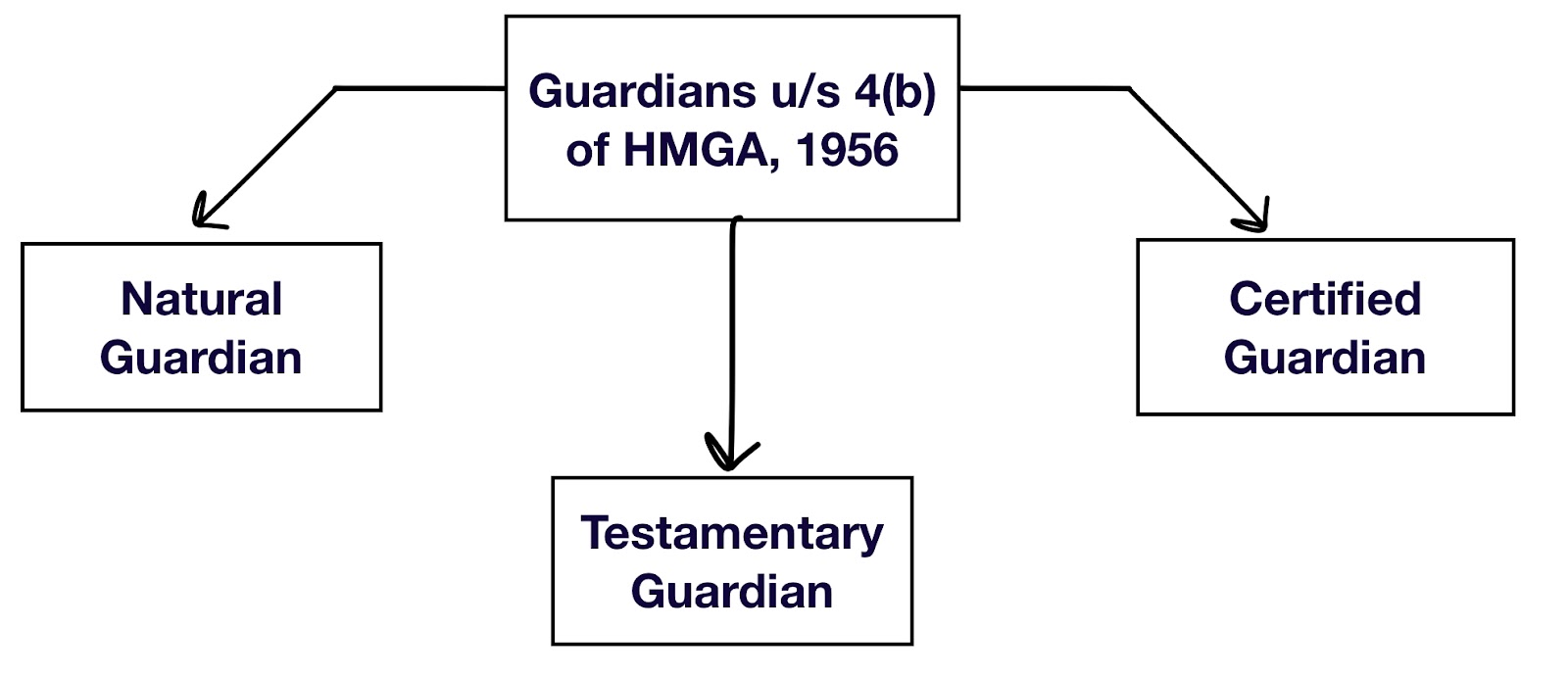
As we see, there is no express mention of de facto guardians under clause (b). But the honourable Bombay High Court in the case of Ratan and anr. vs. Bisan Ramchandra Pardeshi (1977), regarding the definition of the term guardian in the Act, categorically mentioned that the definition is inclusive in nature and a de facto guardian can be said to be a guardian under the Act as well. The reference regarding a de facto guardian can also be drawn from Order 32 of the Code of Civil Procedure, which provides that a minor can file a suit through a next friend. Moreover, Patna High Court in the case of Narain Singh vs. Sapurna Kuer (1967) discussed the de facto guardian and the fact that a next friend of the minor is somewhat like a guardian only, though limited only to the particular legal proceedings for which he has been appointed. The different types of guardians as per the Hindu Minority and Guardianship Act, 1956, are elucidated under.

Natural guardian of a minor

As per Section 6 of the Hindu Minority and Guardianship Act, 1956, natural guardians are basically those who are in a natural relationship (either blood relations or relatives out of marriage) with the minor, his property, or both, like a mother, father, or husband. Step father and step mother are not considered to be natural guardians of a minor.

Let us see who are the natural guardians in different situations:

Boy/ unmarried girl

In the case of a boy or an unmarried girl, as mentioned under Section 6(a), the father is considered to be the natural guardian, and after the father, the mother is the natural guardian of the minor. The proviso to Section 6(a) clearly provides that for a child below the age of 5 years, the mother would be the natural guardian.

The word ‘after’ used above has been interpreted time and again by the courts. The Supreme Court in the case of Jijabhai Vithalrao Gajre vs. Pathankhan (1969) considered the facts of the case that father and mother had lived separately for around 10 years, and the care and protection of the child was with the mother. The father didn’t take any interest in the life of the minor. Irrespective of the fact that the father was still alive, taking into consideration the circumstances of the case, the court considered the father to be non-existent. Thus, the court held the mother to be the natural guardian and not the father. 

Further, in the case of Githa Hariharan vs. Reserve Bank of India (1999), the honourable Supreme Court interpreted the word ‘after’ and held that after does not necessarily mean after the lifetime of the father. The absence, forsakenness, indifferentness to the matters of the minor, physically incapable of taking care of the minor, or mental incapacity, all can be considered to be part of the word ‘after’. Therefore, in the above-mentioned circumstances, even if the father is alive, the mother would be considered a natural guardian of the minor.

Now, let us take another circumstance into consideration. What if an unmarried woman gives birth to a child? Can she be the natural guardian of that child? 

The same situation came up before the honourable Supreme Court in the case of ABC vs. State (NCT of Delhi) (2015), where the court decided in affirmative that a single unwed mother can be the natural guardian of her child. Furthermore, there is no need for a mandatory notice to be given to the father of the child, as he has already left the woman alone, and hence there is nothing left. So, the mother was said to be the natural guardian in such a case.

Illegitimate boy/ illegitimate unmarried girl

Section 6(b) of the Act enunciates that the natural guardian of an illegitimate boy/unmarried girl is firstly the mother and after her, the father. The Latin term specifically used is filius matris, i.e., a mother’s child. The Bombay High Court, in the case of Dharmesh Vasantrai Shah vs. Renuka Prakash Tiwari (2020), held that, as provided under Section 6(b) of the Hindu Minority and Guardianship Act, the mother is the natural guardian of an illegitimate boy or an illegitimate unmarried girl, and the father’s claim of such guardianship comes only after hers. The court, at the same time, put forth two exceptions to the priority rule of the mother:

  • Natural guardianship cannot be claimed if the person claiming guardianship has ceased to be a Hindu. 
  • If the person has completely and finally renounced the world, becoming a hermit (vanaprastha) or an ascetic (yati or sanyasi). 

Until and unless the exceptional circumstances mentioned above exist in the case, the mother of the minor has an indefeasible claim to guardianship of her illegitimate child. The father cannot claim the right to guardianship or custody of the minor over that of the mother.

Married girl

As provided under Section 6(c), the husband is considered to be the natural guardian of the married girl. Section 12 of the Wards Act also has a reference to the guardianship of a married girl being with the husband, but there is a rider imposed wherein the consent of the parents of the minor girl must have been taken at the time of marriage.

The Hon’ble Gujarat High Court had a similar situation before them in the case of Patel Verabhai Kalidas vs. State of Gujarat (1999). There was a custody tussle between the parents of the minor and the husband of the minor. The court held that in such circumstances, the main consideration should be the welfare of the minor girl. The court exclaimed that simply because the husband is said to be a natural guardian under clause (c) of Section 6 of the Hindu Minority and Guardianship Act, 1956, he cannot be ipso-facto said to be entitled to the custody of a married minor girl. The matter has to be looked into as per the facts and circumstances of the case. 

Besides, the marriage of a minor girl cannot be said to be a legally valid marriage. And at the very same time, the marriage between the parties might also not be void or voidable. But the deeper aspects of public policy, public health, and public morality flowing from the provisions of the law have to be borne in mind while dealing with problems similar to the case at hand. The court, deciding for the welfare of the minor girl, concluded that as the girl didn’t want to go back to her parents and staying with her husband was not a viable option, the honourable court decided to give her custody to the Women’s Welfare Centre.

Adopted son/daughter

Section 7 of the Act provides that the natural guardianship of an adopted son passes onto the adoptive father and, after him, to the adoptive mother. There is no reference to the adoptive daughter under the Section. The same was pointed out by the Law Commission in their Report No. 257 on “Reforms in Guardianship and Custody Laws in India”. The Law Commission said, “The language of this Section is incongruous in nature as it refers only to the natural guardianship of an adopted son and does not refer to an adopted daughter. The Hindu Minority and Guardianship Act, 1956, came into force at a time when the general Hindu law did not recognise the adoption of a daughter. Thus, at the time of the passing of the Act, the adoption of daughters was only allowed under custom and not under codified law. This explains the reason why the drafters of the Act included the guardianship of only adopted sons and ignored the adoption of daughters. It was also enacted before the Hindu Adoptions and Maintenance Act, 1956, which corrected the legal position of adoption of a daughter statutorily”.

Thus, Section 7 should be liberally interpreted to include adoptive daughters in the provision.

Powers of natural guardians 

The powers of a natural guardian are provided under Section 8 of the Hindu Minority and Guardianship Act.

  • A natural guardian can do all the necessary, reasonable, and proper acts that are for the benefit of the minor. That act may relate to the benefit of the person of the minor or the minor’s property. There is no way that the guardian can bind the minor in his covenant.
  • A natural guardian cannot mortgage, charge, or transfer by sale, gift, or by any other means any immovable property of the minor or a part of it. If a natural guardian has to do so, he has to get the consent of the court. In the case of a lease, the guardian has the limitation that a lease for a maximum period of five years can be given. Furthermore, it cannot extend more than one year after the minor attains majority. For example, today A is 16 years old. So, A’s guardian can lease out his property for a maximum of three years. Though A will attain majority in two years, one year is given to the guardian after the minor attains majority.

Another situation that needs to be looked into is where the guardian disposes of the minor’s property in contravention of Section 8(2). Such a disposal of the property by the guardian would not be considered to be void, and the same can be referred to through the judgement of Narayan Laxman vs. Uday Kumar (1994). Such a disposal by the guardian would be voidable at the instance of the minor and not void ab initio. A minor can challenge such a disposal or alienation of the property by the guardian after he attains majority in cases where the court’s permission was not taken. Furthermore, with regards to the consent of the court, Section 8(3) clearly provides that no court shall grant such permission to the guardian, except in two circumstances:

  1. The necessity of minors, 
  2. Evident benefit or advantage to the minor. 

However, the minor also has the responsibility to make sure that he/she challenges such a disposal within the limitation period provided by the law. The Supreme Court clearly pointed out the same in the case of Vishwambhar vs. Laxminarayan (2001), where when the challenge was made by the minor after the limitation period had elapsed, the suit was said to be not maintainable. Article 60 of the Limitation Act, 1963, prescribes a period of three years for setting aside a transfer of property made by the guardian of a ward by the ward who has attained majority, and the period is to be computed from the date when the ward attains majority. The same has been reiterated by the Supreme Court in the case of Murugan vs. Kesava Gounder (2019).

Furthermore, all the powers of the natural guardians go away, if:

  • He ceases to be a Hindu. 
  • He completely and finally renounces the world. 

Testamentary guardian 

Section 9 of the Hindu Minority and Guardianship Act defines the testamentary guardian of a minor. The guardian who is appointed by the natural guardian through a will is a testamentary guardian. Earlier, only the father of the minor could appoint a guardian through his will and set aside the mother as a guardian, but that is not the case in the present law.

Appointment by father

As per Section 9(1), a Hindu father can appoint a testamentary guardian for his legitimate child for:

  • Person of the minor or
  • Minor’s property or
  • Both property and the person of the minor. 

Appointment by mother

The mothers are also given the power by the Act to appoint a testamentary guardian. Under Section 9(2), the mother of the minor can, by way of a will, appoint a guardian, provided the father dies before her. 

Let us take an example to simplify this situation. ‘A’, the father, appoints ‘X’ as a guardian through his will. If the father ‘A’ predeceases ‘B’ the mother, then ‘X’ won’t be the guardian; ‘B’ the mother would be. The reason behind this is that she is the natural guardian, and that will prevail over the testamentary guardian. Now, as per clause 2, ‘B’ can also make a will to appoint a testamentary guardian of her own, let’s say ‘Y’. So, ‘Y’ will be the guardian in such a case. But if ‘B’ dies without any will, then the will made by ‘A’ will revive, and ‘X’ will be the testamentary guardian of the minor. 

Furthermore, a mother of the minor can also appoint a testamentary guardian in case the father is unable to act as a guardian due to any physical or mental disability as provided under Section 9(3). A Hindu widow can also appoint a testamentary guardian under Section 9(3). Over and above that, a mother can also appoint a testamentary guardian for her illegitimate child through a will, as per Section 9(4)

Removal/ disqualification of testamentary guardians

The 1956 Act does not clearly specify the grounds on which guardians can be disqualified. But Section 39 of the Guardians and Wards Act, 1890, clearly lays down such grounds. The grounds are as follows:

  • abuse of trust;
  • continued failure to perform his duties;
  • incapacity to perform the duties of his trust;
  • ill-treatment or neglect to take proper care of the minor;
  • continuous disregard of any provision of the Wards Act or of any order of the court;
  • conviction of an offence implying a defect of character which unfits him to be the guardian of his ward, and the same is the opinion of the court;
  • having an interest adverse to the faithful performance of his duties;
  • ceasing to reside within the local limits of the jurisdiction of the court;
  • bankruptcy or insolvency (guardian of property);
  • guardianship of the guardian ceasing, or is liable to cease, under the law to which the minor is subject.

So, if a testamentary guardian falls under any of the grounds, that guardian can be removed or disqualified by the courts on the application of any interested person, or the court can also do so on its own motion.

Powers of testamentary guardians

Section 9(5) puts forth the powers of the testamentary guardian as bestowed by the Hindu Minority and Guardianship Act, 1956. It provides that the powers of the Testamentary Guardian are exactly the same as those of the natural guardians. But these powers are restricted by the Act as well as by the will that the natural guardians frame. They can alienate the property of the minor, but it has to be with the consent of the court and also for the benefit of the minor. But these powers and the testamentary guardianship cease to prevail in the case of a minor girl after she gets married (Section 9(6)).

Certified guardian 

There is no specific section under the Hindu Minority and Guardianship Act, 1956, that talks about certified guardians. Certified guardians are basically the guardians appointed by the court of law. Section 7 of the Wards Act clearly gives the court the power to appoint a guardian for the minor’s person, property, or both. The basis of such an appointment is the satisfaction of the court that the appointment would be for the welfare of the minor. Moreover, Section 15 provides for cases where there are separate guardians for separate properties of the minor.

Section 19 of the Act even lays down the circumstances under which the courts should not appoint guardians, and these are as follows: 

  • In cases where the husband is unfit to be a guardian, he should not be appointed as a guardian for a minor married female.
  • In a case where a father and mother who are both living but are unfit to be guardians should not be appointed as guardians for a minor female.
  • Guardian for a minor whose property is under the superintendency of the court of wards.

De facto guardian

A specific definition of de facto guardian is not provided under the Hindu Minority and Guardianship Act, 1956. But in general terms, the person who takes care of the minor out of their love and affection for a long period of time is a de facto guardian.

Before the 1956 Act, de facto guardians had the same rights to alienate property as a natural guardian. The same can be concluded from the stand taken by the court in the case of Hunoomanpersuad Pandey vs. Mussumat Babooee Munraj Koonweree (1856) 6 MIA 393, that there is no difference between a de facto and a de jure guardian.

A question that pops up is: would it be correct to say that a de facto guardian has been de-recognised by the 1956 Act? The answer is no. Section 11 of the 1956 Act does not de-recognise de facto guardians. Instead, Section 11 has taken away the property rights. Consequently, a de facto guardian can no longer manage the property of a minor.

The Kerala High Court, in the case of Essakkyal Nadar Michayel Nadar vs. Sreedharan Babu and Ors. (1991), held that if a de facto guardian alienates the property of the minor, such a transaction would be absolutely void. Alienee would be equivalent to a trespasser or interloper.

Guardian of the undivided interest of a minor in joint family property

As per Section 12 of the 1956 Act, Karta is said to take care of such a property. But if the minor is the sole surviving coparcener, then a guardian can be appointed. The same can be referred to from the judgement of Rakhmabai Kachu vs. Sitabai Kachu (1951), where the Bombay High Court held that in the case of a sole surviving coparcener of an undivided joint family property, a guardian can be appointed. Furthermore, the High Court has been given the unbridled power to appoint a guardian under Section 12.

Paramount considerations for appointing a guardian 

The basic yet paramount consideration for appointing a guardian is the well-being and welfare of the minor. The same has been provided under Section 13 of the 1956 Act. Welfare is a broad term that encompasses money, care, and the mental and emotional support of a minor. 

Guardianship is not a sacrosanct right. Guardianship of the minor, whether that is with regards to the parents of the minor or with regards to the husband of the married minor, the welfare of the minor is of utmost importance.

The Supreme Court, in the case of Rosy Jacob vs. Jacob Chakramakkal (1973), held that the controlling consideration is the well-being of the minor and not the rights of the parents. Furthermore, the Allahabad High Court held in the case of Amit Beri vs. Sheetal Beri (2002) that money is not the only concern or the only consideration. The larger picture has to be looked into. If the mother is a drunkard and has a routine of going to nightclubs. This should also be taken into consideration before the guardianship of the minor is decided.

The Supreme Court in the case of Nil Ratan Kundu vs. Abhijit Kundu (2008) held that,“In deciding a difficult and complex question as to custody of minors, a court of law should keep in mind relevant statutes and the rights flowing therefrom. But such cases cannot be decided solely by interpreting legal provisions. It is a humane problem and is required to be solved with human touch. A court, while dealing with custody cases, is neither bound by statutes, nor by strict rules of evidence or procedure, nor by precedents. In selecting the proper guardian of a minor, the paramount consideration should be the welfare and well-being of the child. In selecting a guardian, the court is exercising parens patriae jurisdiction and is expected, not bound, to give due weight to a child’s ordinary comfort, contentment, health, education, intellectual development, and favourable surroundings. But over and above physical comforts, moral and ethical values cannot be ignored. They are equally, or we may say, even more important, essential, and indispensable considerations. If the minor is old enough to form an intelligent preference or judgement, the court must consider such preference as well, though the final decision should rest with the court as to what is conducive to the welfare of the minor”

The same has been reiterated by the honourable Supreme Court in the cases of Thrity Hoshie Dolikuka vs. Hoshiam Shavaksha Dolikuka (1982), Mausami Moitra Ganguli vs. Jayant Ganguli (2008), and many more, that the paramount consideration is the welfare of the minor and nothing else.

Moreover, Section 17 of the Wards Act underlines certain considerations to be kept in mind before appointing a guardian. In appointing or declaring a guardian of a minor, the courts should be guided by or take into consideration the following factors to see if that will amount to the welfare of the minor:

  • age, sex, and religion of the minor,
  • the character and capacity of the proposed guardian and his nearness of kin to the minor,
  • wishes of a deceased parent,
  • existing or previous relationships of the proposed guardian with the minor or his property,
  • preference of the minor if he is old enough to form an intelligent preference,
  • the willingness of the guardian to act as a guardian.

Thus, the welfare of the minor is of paramount importance while deciding as to the appointment of a guardian by the courts.

Guardianship of a minor under Muslim Law

The concept of guardianship under Muslim law is not codified, like in Hindu law. It draws references from the Quran. Certain verses and Hadiths of the Prophet have the mention of guardianship. Let us understand the concept of guardianship under Muslim law by bifurcating it into two headings.
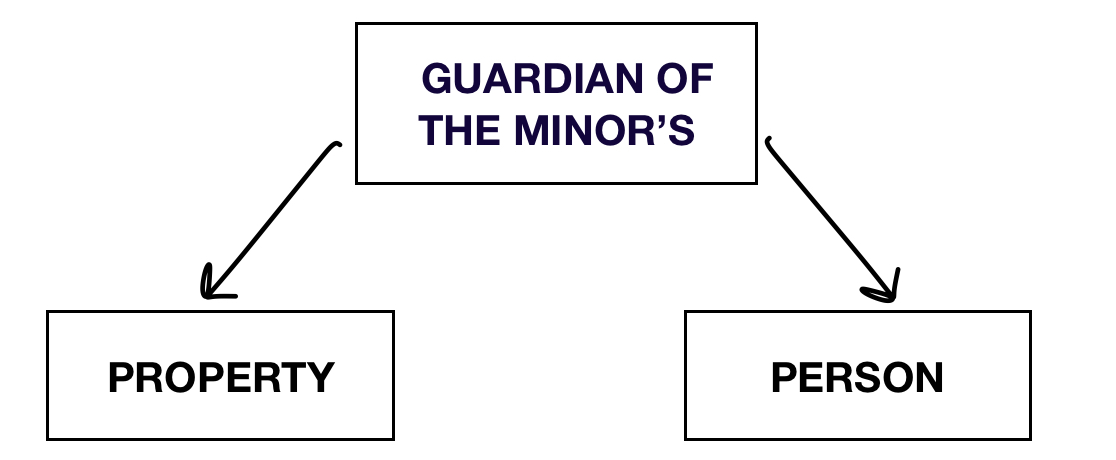
Guardian of the property of the minor

The right of guardianship over the property of the minor primarily belongs to the father. But there can be different circumstances where other guardians can either be appointed by the natural guardian himself or are appointed by the courts for the benefit of the minor. 

Guardians with regard to the property of the minor can be divided into four headings. 
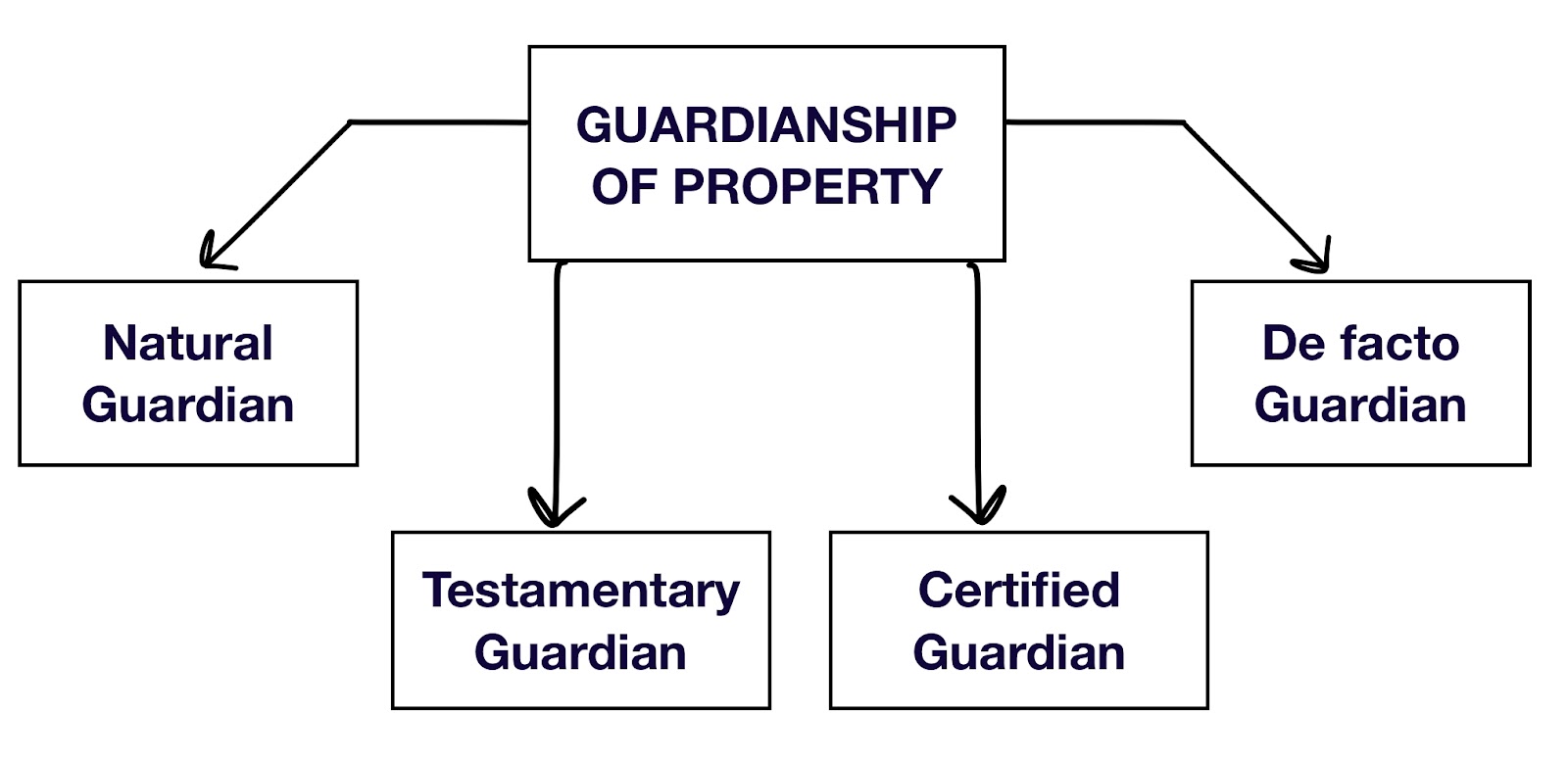
Natural guardian

As the term natural defines itself, it means the guardians that are created out of blood relations. Both Shias and Sunnis recognise ‘Fathers’ and not mothers as natural guardians for the property of a minor. Therefore, mothers cannot alienate the minor’s property. The question of a mother being a guardian is never there, at least when a father is alive. The father is considered to be the supreme guardian. However, the father’s rights extend only to legitimate children. As per ancient Islamic law, fathers are not entitled to guardianship of illegitimate children, even in cases where the mother dies prior to the father.

In Sunnis, fathers are the only natural guardians. After the father’s death, guardianship passes on to the executor appointed by him. Whereas, in Shias, after the father, guardianship passes on to the grandfather and then to the executor appointed.

Testamentary guardian

Guardians that are appointed through wills are termed as testamentary guardians. 

Appointment by father

In Sunnis, the father has the full power to appoint a testamentary guardian. If a father dies without appointing a guardian, then the grandfather has the right to make such an appointment. There is no right for the executors.

Whereas in Shias, if the father appoints a testamentary guardian and dies, leaving behind the grandfather, then, in such a situation, such an appointment would have no value until the grandfather is living. Grandfather is also bestowed with the power to make such an appointment.

Appointment by mother

In both Sunnis and Shias, a mother has no power to appoint a testamentary guardian for her children. However, there are exceptions to this. Exceptions are:

  • Where the mother herself is appointed as the testamentary guardian (executrix) and 
  • Where mother has her property, then in that case, she can appoint an executor for her personal property.
  • These are the two circumstances where a mother can appoint a testamentary guardian or be one.

In Shias, Non-Muslim mothers cannot appoint a testamentary guardian in any case. Whereas in Sunnis, a Non-Muslim mother can make an appointment for a testamentary guardian in exceptional circumstances, as mentioned above.

Who cannot be appointed as a testamentary guardian?

Chapter IV of Fatawa-i-Alamgiri provides that:

  • Minor (person who has not attained majority), 
  • Insane person. 

cannot be appointed as a testamentary guardian. If they are appointed, any act done by them would be deemed to be void in nature. Apart from that, it is accepted by the jurists that any person who is notorious (bad character) cannot be appointed as a guardian. The same applies to the testator as well. The testator should be in full possession of his senses while executing the will.

How is a testamentary guardian appointed?

The testamentary guardian can be appointed orally or by written will. The underlying element is that there must be an unequivocal intention to appoint that particular person. 

Chapter VI of the Fatawa-i-Alamgiri clearly provides that the acceptance must be there from the side of the testamentary guardian. The acceptance could be expressly or impliedly made. Once the acceptance is delivered, it cannot be renounced without the court’s permission. 

Certified guardian

The guardians that are appointed by the courts are called certified guardians. If both the natural and testamentary guardians do not exist, the Kaazi used to appoint an appropriate guardian for the minor. In modern day, Kaazis are replaced by courts. The guardians are appointed under the Guardians and Wards Act, 1890. The major considerations for appointing a guardian under the Act that are looked into by the courts are:

  • Sex of the child,
  • Religion of the child,
  • Wishes of the parents and children,
  • Situation of the father and mother.

District courts decide regarding the appointment of the certified guardian. Apart from these considerations, paramount importance is given to the welfare of the child.

De-facto guardian (Fizuli)

A de-facto guardian is a recognised type of guardian under Muslim law. People who are close friends or distant relatives or have had a connection for a long period of time are appointed as guardians of the minors.

The Privy Council, in the case of Mata Din vs. Sheikh Ahmed Ali (1912), held that a de-facto guardian is nothing but an unauthorised guardian. A de-facto guardian has all the duties to care for and be responsible for the minor, but they have no legal powers to alienate the property of the minor. The same has been reiterated in the case of Imambandi vs. Sheikh Haji Mutsaddi (1918), wherein it was pointed out that under the Muslim law, a de- facto guardian has no power of alienating a minor’s property, and if alienation is made, that would be void. The Supreme Court, in the case of Mohd. Amin vs. Vakil Ahmed (1952)categorically held that the de facto guardian has no power to convey any right or interest in the immovable property. Moreover, the right cannot be enforced against the minor, and such an alienation would be void in nature.

Powers of the natural and testamentary guardians 

The powers of natural and testamentary guardians are as follows:

Power of alienation

Guardians have different powers over movable and immovable property. In the case of movable property, the powers of alienation are much wider in comparison to immovable property. The basic reason for the difference in the extent of powers can be understood from the logic that the majority of movable properties can decay over a period of time, and by selling such commodities, they can be preserved in the form of money.

Movable property

The sale of movable property by a guardian can be justified only when:

  • The guardian receives adequate consideration in return.
  • That money received is invested in a lucrative place.
  • The risk attached to the movable property that is being sold should be reasonable and justifiable.

The question that arises here is whether a minor can avoid the sale of movable property after attaining majority. The answer to the question is that a minor can set aside the sale of movable property after attaining the age of majority in the following cases:

  • Where the sale was done fraudulently, 
  • Where there is a blatant inadequacy of consideration,
  • Where there is a clear loss to the minor or the sale is detrimental to the interest of the child.

Therefore, the sale by the guardian is voidable at the option of the child after attaining majority. However, if the guardian proves in the court of law that the alienation was bona fide in nature and made with due care, then the alienation can be protected from being termed invalid.

Immovable property 

The power of the guardian to alienate the immovable property of a minor is somewhat limited in nature. Chapter VI, Aayat 222-240 of Fatawa-i-Alamgiri, provides the cases where the sale of a minor’s immovable property is valid. These cases are:

  • When the alienation can fetch double the value of the property,
  • When the sale is clearly in the benefit/favour of a minor,
  • When income from the property is less than the expenses to maintain it 
  • Where there is an imminent danger to the property of the minor, that is, the danger of being decayed or destroyed,
  • Where the property has been usurped by a trespasser 
  • Where the testater’s debt is left unpaid
  • Where there are general provisions mentioned in the will, like payment of legacies 
  • Where the minor has no other source of maintenance

The Supreme Court in the case of Meethiyan Sidhiqu vs. Mohd. Kunju (1996), while dealing with the issue of whether the father has a right to alienate the minor’s property, the court affirmed the father’s right to alienate the property. But at the same time, she pointed out that a mother has no such right unless she is appointed as an executor.

Power to grant lease

Muslim law does not favour leasing out a minor’s property by the guardian. A lease can only be granted when:

  • It is advantageous to the minor and
  • It should not be for a long time. 

Madras High Court, in the case of Zeebunnissa Begum vs. Mrs. H.B. Danagher (1935), held that the guardian can lease a minor’s property only if it is for the benefit of the minor, and the lease should only be for a short period of time and, in no case, should be beyond the minority of the child.

Power to carry on business

Guardians have a right to carry on the business on behalf of the minors. But the important point is that he should run the business on his own with reasonable prudence. Provided that the business should not be of a speculative or hazardous nature.

Fatwa-i-Alamgiri provides that the executors have a right to invest the minor’s property in a partnership, provided such a partnership is in the favour of the minor and should not be speculative or hazardous in nature. 

The Bombay High Court, in the case of Jafferali Bhaloo Lakha vs. The Standard Bank of South Africa (1927), held that though the guardian has a right to enter into a partnership on behalf of a minor, the minor’s liability would only be to the extent of his share in the partnership, and in no case can a minor be made personally liable. If a minor and a guardian together run a business, both of their accounts should be separate. 

Power to incur debts

A guardian cannot incur debts in the name of a minor. Only in special circumstances, when a minor’s life is being affected, can a debt be contracted. If there is no necessity for the minor, any debt taken by the guardian would not be binding on the minor.

Power to enter into contracts 

A guardian can enter into a contract on behalf of the minor. The same has been held by the Bombay High Court in the case of Shri Kakulam Subrahmanyam vs. K.Subba Rao (1948). The honourable court held that a contract entered into by a guardian on behalf of the minor is enforceable specifically against the minor, provided that the guardian has entered into the contract with a view to the benefit of the minor. The minor can be sued and sue with regard to the contract when he attains majority.

Power to make partition 

The natural and testamentary guardians do not have the power to make a partition. If the guardian does so, then such a partition would be absolutely void. If the heirs to a property are both adults and minors, then the adults will be given their share, and the rest (the share of the minor) will be kept by the guardian himself.

Powers of the certified guardians

The Guardians and Wards Act, 1890, provides the general powers and obligations of the guardians appointed by the courts. Section 27 of the Act gives a thumb rule that the guardian must deal with the property as if he were dealing with his own property with reasonable prudence. The certified guardians have the power to alienate the minor’s property, but there are certain restrictions and limitations provided under Section 29 and Section 31 of the Act. Under Section 29, the guardian is not given the power to transfer the minor’s property by:

  • Sale, lease, mortgage, charge, or gift,
  • Leases cannot be made for a period longer than 5 years and more than 1 year after the child has attained majority.

Section 31 imposes a strict restriction regarding the alienation of the property, wherein the consent of the court is a must to do so. Moreover, the benefit of the minor will be looked into as the utmost priority. 

Guardian of person of the minor (Hizanat)

The Hizanat (custody) of a minor belongs to the mother. This is a thumb rule on which the guardianship of the person of the minor stands. If a Sunni man marries a Kitabiya woman and a child is born out of wedlock, the Kitabiya woman will have all the rights of Hizanat. Even if any woman is separated from her husband, she still has the right to Hizanat.

Under ancient Islamic law, apostasy led to the taking away of the right of Hizanat from the mothers. However, with the advent of the Caste Disabilities Removal Act, 1850, the concept of apostasy affecting the right of Hizanat of the mother was removed.

Hizanat is not an absolute right of the mother. However, at the same time, the mother cannot be deprived of her right to Hizanat unless she is guilty of some grave misconduct viz-a-viz the child. An example of such a situation could be when the mother is completely ignorant of a child and does not take care of him or her.

The question that comes up here is whether the right of Hizanat of the mother is equal in the case of a son and a daughter. The answer to this question is no. Mother’s right of Hizanat on a daughter is much bigger than that of a son and also in comparison to that of a father and husband.

Sons

As per the Sunnis, the Hanafis, and the Shafis, a mother is entitled to custody of a son until he is seven years old.

As per Malikis, the right of the mother extends until the son does not attain puberty.

Whereas in Shias, this right extends only until the time the son is having mother’s milk or is weaned.

Daughters 

As per Sunnis, the right of the mother extends until she attains puberty.

In Malikis, Shafis, and Hanbalis, the right of the mother of Hizanat exists until the daughter gets married.

Whereas in Shias, especially the Ithna Asharis, the right of Hizanat of the mother on the daughter is until she is seven years old.

Another question that arises here is whether the rights of the mother of Hizanat are the same for both legitimate and illegitimate children. The answer to this question is yes; the right of Hizanat of the mother is the same for both legitimate and illegitimate children. Moreover, the right of Hizanat is a non-transferable right; it can only be withdrawn in certain cases.

If the mother is dead or is insane, on whom would the right of Hizanat devolve?

As per Mulla, there are different people on whom the right of Hizanat devolves if the mother of the minor dies or is mentally unfit to take care of the child.

In Hanafis, after the mother: Mother’s Mother→Father’s Mother→Full Sister→Uterine Sister→Consanguine Sister→Full Sister’s daughter→Uterine Sister’s daughter→Consanguine Sister’s daughter →Maternal Aunts {All females}

In Shias, after the mother: Father→Grandfather 

But, as per Amir Ali, the grandfather does not have the right of Hizanat; rather, after the father, it is the grandmother and her ascendants and collaterals that have the right of Hizanat of the minor.

Father’s right of Hizanat 

The father’s right of Hizanat arises only in two cases:

  • Where the minor has attained the age only up to which, the mother has a right of Hizanat.
  • Where there is no mother or female in the family. 

This right of Hizanat with the father is strictly limited to the time until the child attains puberty. 

In Hanafis, the father does not have the right of Hizanat for the minor. After mother, the right passes on to Paternal Grandfather→Full Brother→Consanguine Brother→Full Brother’s Son and so on. {All males}

Under what circumstances does the mother lose her right to Hizanat?

  • Insanity 
  • Minority 
  • A woman (Hazina, or custodian) marries a complete stranger. All the schools are unanimous on this ground. But if a woman marries the child’s paternal uncle, the right of Hizanat remains.
  • The misconduct of Hazina is another ground. If the woman is in an adulterous relationship, the child is continuously neglected, there is sexual misconduct on the part of the mother, or there is cruelty being done to the child.
  • The removal of children by Hazina is another reason. A child has to be brought up in a marital home. If the child is removed from the marital home without any specific reason, then the Hizanat is lost. But if the mother is taking away the child for the following reasons, then these would act as an exception:
    • When the mother is working, and is impossible for her to stay in marital home
    • Where the mother has been separated from the father, and that too because of the mistake on behalf of the father.

Guardianship of a minor under Christian Law

Guardianship, from a Christian perspective, can be said to be stewardship over the lives of those who are unable to protect themselves. The Bible enunciates, “Defend the weak and the fatherless; uphold the cause of the poor and the oppressed.” This biblical mandate is considered foundational to the Christian approach to guardianship, guiding believers to act as protectors and advocates for those in need.

Unlike other religions, there is no specific personal law dealing with guardianship among Christians. They are governed by the Guardians and Wards Act, 1890 only. A landmark judgement with regards to Christian law is ABC vs. State (NCT of Delhi) (2015), where the guardianship of a Christian minor was decided and given to a single Christian mother without even disclosing the name of the father. All the appointments, rights, and duties of the guardians are derived from the Guardians and Wards Act.

Guardianship of a minor under Parsi Law

Similar to Christian law, there is no specific law that deals with the guardianship of Parsis. It is often said to be influenced by Hindu rules and customs. However, guardianship among Parsis is governed by the Guardians and Wards Act. The same can be inferred from the observations made by the courts.

The Calcutta High Court, in the case of Jahangir Manaji Mehta vs. Nina Jahangir Mehta (1970), pointed out that the Parsi Marriage and Divorce Act, 1936, and the Guardians and Wards Act, 1890, needed to be read together. The honourable court, while deciding who has the right of guardianship under Parsi law, defined the term ‘legal custody’ as custody under the orders of the court or under any personal law according to the facts of the case. The court exclaimed that no Parsi personal law provides, father or mother with the legal right to have custody of the children. On the other hand, Section 49 gives the court the sole power to pass orders with respect to the custody, maintenance, and education of the children. Section 49 is not just limited to the custody of the children but also engulfs in its ambit the powers of the courts to pass orders for maintenance and education. The court even put forth the possibility where the custody may be given by the court to the husband of the minor girl if he is financially strong enough to maintain the minor and pay for her education.

Parallelly, reading together Sections 7, 9, 10, 17, 24, and 25 of the Guardians and Wards Act, it was put forth that while appointing a guardian of a minor, the court must be satisfied that such an appointment is made for the welfare of the minor. The court observed that the members of the Parsi community are also governed by the Guardians and Wards Act, and the principles underlying the appointment of the guardian of the person of a minor should not be overlooked in deciding about the custody of the children under the Parsi Marriage and Divorce Act. When a person is appointed a guardian of the person of a minor, he naturally has the right of custody of the ward with respect to his upbringing, care and protection. The court held that “Section 49 of the Parsi Marriage and Divorce Act, 1936, gives the court wide discretion to pass orders with respect to custody, maintenance, and education, but in the exercise of such discretion, the paramount consideration of the court is the welfare of the children”.

Thus, the guardianship under Parsi law cannot be said to be a straight jacket formula that can be applied everywhere. The courts, depending on the circumstances, apply the Wards Act and the Parsi Marriage Act.

Guardianship under the National Trust Act, 1999

If we see the logic behind appointing a guardian for the minor, it is his incompetency to take care of himself and his property. Similar is the situation with people who are suffering from autism, cerebral palsy, mental retardation, and multiple disabilities. They are in a special situation as minors as well as, even after attaining 18 years of age. They are dependent on others to manage their lives and property. So, the major objective of the Act is to fill a legal vacuum that exists with regards to guardianship for people with disabilities below or above 18 years and help them make informed decisions for themselves with the help of their guardians.

Section 14(3) of the National Trust for Welfare of Persons with Autism, Cerebral Palsy, Mental Retardation, and Multiple Disabilities Act, 1999, can be said to be a need-based provision as it lays down two pointers that should be answered before a guardian is appointed:

  • whether the person with the disability needs a guardian and 
  • the purposes for which guardianship is required for a person with a disability.

How the guardians are appointed is provided under Section 14 of the National Trust Act. The procedure is explained below:

  1. Receive an application for guardianship:
  • From a parent or a relative (under Section 14(1)), 
  • For the appointment of any person of their choice as a guardian. 
  1. From a registered organisation (under Section 14(2)):
  • Application in a prescribed form, 
  • Must obtain the consent of the guardian of the disabled person. 
  1. Consider the application (under Section 14(3)):
  • Assess if the person with a disability needs a guardian. 
  • Determine the purposes for which guardianship is required. 
  1. Process and decide upon the applications (under Section 14(4)):
  • Receive applications.
  • Process the applications received.
  • Decide on the applications.
  • Recommend an appointment and specify the guardian’s obligations. 
  1. Send particulars to the board (under Section 14(5)) at intervals to be determined by the regulations. 

The Local Level Committee, headed by the District Collector, is empowered to receive the applications in Form A under Rule 16(1) & appoint guardians in Form B under Rule 16(2) of the National Trust Rules, 2000, for persons with autism, cerebral palsy, mental retardation, & multiple disabilities. It also lays down a mechanism for keeping in check and protecting the interests of such people, including their properties.

Section 17 of the Act sets forth the process of removal of the guardians and the grounds on which it can be done. The procedure is as under:

  1. Receive an application for the removal of a guardian:
  • From a parent or relative, 
  • From a registered organisation. 
  1. Appointment of an investigation team comprising of:
  • Representative of the parent organisation,
  • Representatives of the association for disabled and
  • Government official (assistant director rank or above).
  1. Investigate the complaint as to under what grounds of removal the complaint falls:
  • Solitary confinement of a person with a disability, 
  • Chaining a person with a disability, 
  • Sexual abuse, 
  • Long deprivation of basic needs (food, water, clothing), 
  • Non-compliance with rehabilitation or training programs, 
  • Misappropriation/misutilization of a person’s property, 
  • Lack of adequate facilities or trained staff, 
  • Beating or causing bruises or skin/tissue damage (excluding self-inflicted injuries). 
  1. Submit the report within 10 days.
  2. The local-level committee receives the report.
  3. The local-level committee makes a decision within 10 days.
  • Assessing the proposed guardian based on the following parameters:
    • Citizen of India,
    • Not of an unsound mind/not undergoing mental illness treatment,
    • No history of criminal conviction,
    • Not a destitute or dependent,
    • Not declared insolvent or bankrupt.
  • Assessing the Institution/Organization (if applicable):
    • Recognized by the State/Central Government, 
    • Minimum 2 years’ experience in disability rehabilitation services, 
    • Meets standards for a residential facility/hostel (space, staff, furniture, rehab, medical facilities), 
    • Complies with board-specified guidelines. 
  • The guardian is given an opportunity to be heard.
  • Then the local-level committee gives its decision:
    • Approve the removal of the guardian and record reasons in writing or
    • Reject the application and record the reasons in writing.

So, this Act of 1999 is a great step towards making the lives of people with disabilities a bit easier and focusing on their need to have a guardian in their lives too, even if they are above 18 years of age. If we compare the Guardians and Wards Act, 1890, and the National Trust Act, 1999, the restrictions regarding the appointment of guardians in the latter Act are comparatively stringent. But the major difference between the two is that under the National Trust Act, the guardians are appointed for a limited time, so that the people with special needs have help for a specific purpose or a specific time frame.

Landmark cases on guardianship of a minor

Githa Hariharan vs. Reserve Bank of India (1999)

Facts of the case

The mother of the minor filed an application with the Reserve Bank of India to buy relief bonds in the name of her minor child. But the bank refused to do so under the signature of the mother and asked for the father to be the signatory or asked the petitioner to bring proof of guardianship from a competent authority. These facts reached the Supreme Court in the form of a writ petition.

Issues of the case

The issue was whether Section 6(a) of the Hindu Minority and Guardianship Act, 1956, and Section 19(b) of the Guardians and Wards Act, 1890, are violative of Articles 14 and 15 of the Indian Constitution

Judgement of the case

The court, while deciding the issue, delved into the definition of the word ‘guardian’ and opined that it includes both the parents of the child. The same meaning needs to be attributed to the word appearing in Section 6(a); otherwise, that would tantamount to a violent departure from the legislative intent. Further, the court took note of the fact that gender equality is one of the basic principles of our Constitution, and in the event the word ‘after’ is to be read to mean a disqualification of a mother to act as a guardian during the lifetime of the father, the same would definitely run counter to the basic requirements of the constitutional mandate and would lead to a differentiation between male and female. The court opined that the word ‘after’ shall have to be given a meaning that serves the major consideration of the Act, that is, the welfare of the minor. The word ‘after’ does not necessarily mean after the death of the father; rather, it should be read as ‘in the absence of’ the father.

ABC vs. State (NCT of Delhi) (2015)

Facts of the case

The appellant mother was desirous that her son should be appointed her nominee for all her savings and other insurance policies. So, the appellant took all the necessary steps in the very same direction. However, she was asked that she must declare the name of the father of her child or get a guardianship or an adoption certificate from the court. Therefore, the appellant filed an application under Section 7 of the Guardians and Wards Act, 1890, for declaring that the appellant is the sole guardian of the son.

Issues of the case

Whether a Christian unwed mother be appointed as a guardian of her child? 

Judgement of the case

The honourable court gave some really important answers. Firstly, the court held that an unwed mother can be appointed as guardian of her child under Section 6(b) of the 1956 Act, and there is no requirement of sending a notice to the putative father. 

Secondly, the court held that it is no longer necessary to state the name of the father in an application for getting the child admitted to school as well as for obtaining a passport for the minor child. However, the court put forth that in both of these cases, it may still be necessary to furnish a birth certificate. And with regards to the issuance of the birth certificate, it can be issued to the mother, provided there is no contrary direction issued by the court.

Thirdly, like many times before in earlier judgements, the court pressed that the welfare of the minor is of utmost importance and the rights of parents can never prevail over the rights of the minor.

Madhegowda by Lrs. vs. Ankegowda by Lrs. (2001)

Facts of the case

When the respondent, Smt. Sakamma, was a minor, her sister, Smt. Madamma, acted as her de facto guardian. To collect the money for the marriage of the respondent, Smt. Madamma sold the respondent’s share of the property to the appellant, Mr. Madhegowda, by a registered sale deed dated 24.4.1961. The appellant was put in possession of the property, and he continued to be in possession. Smt. Sakamma, after attaining majority, sold her share of the property to Ankegowda. Now, the conflict arose as to who had the right to the possession of the property of the respondent.

Issues of the case

Whether or not a de facto guardian can alienate the property of the minor.

Judgement of the case

The Supreme Court in the case of Madhegowda by Lrs. vs. Ankegowda by Lrs. (2001), while dealing with Section 11 and Section 12 of the Hindu Minority and Guardianship Act, 1956, held that a de facto guardian does not have the power to alienate the property of the minor. The court held that Section 11 bars every person from dealing with a minor’s property merely on the ground of him or her being a de facto guardian. A transferee of such alienation does not acquire any interest in the property. And that is the reason why there is no need for such a transaction to be set aside. Furthermore, the honourable court observed that the minor, on attaining majority, can repudiate the transfer in any manner, as and when occasion for it arises. After attaining majority, if the minor transfers his interest in the property in a lawful manner to anybody avowing that he has complete title to the property, that means that the minor has repudiated the transfer made by the de facto guardian.

Athar Hussain vs. Syed Siraj Ahmed (2010)

Facts of the case

The appellant, Athar, married Umme Asma, daughter of respondent no.1, as per Islamic rites and customs, on 31st March, 1993. Two children were born out of wedlock: Athiya Ali and Aayan Ali. The mother, Umme Asma, died, leaving behind a 13-year-old and a 5-year-old. The appellant married again to Jawahar Sultana on 25th March, 2007. The maternal grandfather filed a petition that, for the welfare of the children, custody of the children should be given to him.

Issues of the case

Whether interim custody of a minor will be given to a person other than a father during the pendency of the proceedings for the appointment of a guardian.

Judgement of the case

The honourable Supreme Court, in the case of Athar Hussain vs. Syed Siraj Ahmed (2010), delved into the subtle difference between ‘custody’ and ‘guardianship’. Though the question in the case was regarding the appointment of a guardian of a child under the Guardians and Wards Act, the honourable court opined that a court has no jurisdiction to appoint a guardian other than a father, but interim custody can be given to another person for the time being where the proceedings for the appointment of a guardian are pending. In the case at hand, interim custody was given to the maternal grandfather.

The court put forth that the question of custody is different from the question of guardianship. There can be two situations at the same time. The father can continue to be the natural guardian of the children. However, the considerations pertaining to the welfare of the child may indicate that the lawful custody of the minor should be with another friend or relative, as it would be better and in his best interest. Moreover, the courts are not barred by Section 19 of the Guardians and Wards Act in the case of deciding on the question of custody of the minor.

Conclusion 

Herbert Hoover has rightly said, “Children are the most wholesome part of the race, the sweetest, for they are the freshest from the hand of God”. In very few words, the true essence of a child has been penned. For the welfare of the children and to make sure all their needs are met, a guardian or a caregiver is a must. 

Throughout the article, we have seen different laws regarding guardianship that prevail in India. In some places, mothers are given the right to be the minor’s guardian, and in some places, the rights are limited to the fathers or the males in the family. The interpretation of the laws has been simplified and broadened by the Honourable courts by setting precedents. But still, there is scope for improvement and amendments in the secular laws to make them more balanced and give equality to mothers and the females in the family to be guardians themselves or have the right to appoint a guardian for the minor. 

The Law Commission of India observed in its 133rd report that, “the provisions contained in Section 6(a) of the Hindu Minority and Guardianship Act are extremely unfair and unjust and have become irrelevant and obsolete with the changing times.” 

There is a need to put the observations made by the courts in cases like Gita Hariharan vs. Reserve Bank of India to practical use. The court clearly pointed out that giving preference to the fathers over the mothers is a clear discrimination on the basis of sex under Article 14 of the Indian Constitution. 

Another space for amendment could be having a uniform code for the religions dealing with guardianship. A PIL, Ashwini Kumar Upadhyay vs. Union of India (2020), is pending before the honourable Supreme Court, where the court will decide whether the laws on adoption and guardianship should be uniform in nature (whether a uniform civil code should be applied), disregarding the religion or gender of the persons involved.

Bringing uniformity may seem like a task, but there is a dire need to fill the legislative gap in the laws governing Christians and Parsis. By filling this gap, a lot of judicial confusion and technical barriers can be met.

Frequently Asked Questions (FAQs)

What is the objective of guardianship?

The main objective of guardianship is the welfare of the child. Welfare is not just limited to physical well-being but also emotional and intellectual well-being. A guardian is appointed so that the property of the minor can be taken care of. 

Is there a uniform law governing guardianship in India?

No, there is no uniform law governing guardianship in India. There are separate laws for different religions. Hindus are governed by the Hindu Minority and Guardianship Act, 1956, whereas Muslims don’t have a codified law of guardianship, but it draws references from the Quran. There are no specific statutes that govern guardianship, particularly for Christians and Parsis, but they are dealt with under the Guardians and Wards Act, 1890.

Can a minor be appointed as a guardian?

Minors cannot be appointed as guardians under any secular law. Reference can be drawn from Section 10 of the Hindu Minority and Guardianship Act, 1956. However, Section 21 of the Guardians and Wards Act provides that a minor can act as guardian for his minor wife or child, or in cases where he is the managing member of a Hindu undivided family. The two provisions may seem to be conflicting, but the court in the case of Bhudi Jainar vs. Dhobai Naik (1957) held that there is no conflict between the two provisions because Section 21 deals with the guardianship of the person, whereas Section 10 is concerned with the guardianship of the property of the minor. Thus, they are not conflicting in nature and therefore can coexist.

Is it mandatory that a legal guardian be appointed for every person with a disability?

It is not mandatory that a legal guardian be appointed for every person with a disability, but as per the National Trust Act, 1999, it is advantageous to do so for the well-being of the people who are incompetent to take care of themselves and their property. It gives a wider perspective and gives an opportunity for the person, even above 18 years to have someone to take care of them.

Are guardianship and custody the same thing, or are they different?

Guardianship and custody are two different concepts. Custody is a much narrower concept than guardianship. Guardianship is related to the rights and duties that an adult or guardian has towards the person or property of a minor. Whereas custody is limited only to the day to day care, protection, and upbringing of the child. The Honourable Bombay High Court, in the case of Tukaram Gadhwe vs. Sumanbai Wamanrao Gondkar (2007), held that the concept of custody is related to physical control, whereas guardianship is about trusteeship. A guardian acts as a trustee for the minor.

References

Download Now

Africa as a market for Indian businesses : opportunities and risks

0
trademarks

This article has been written by Sanjiv Mathur pursuing a Personal Branding Program for Corporate Leaders from Skill Arbitrage.

This article has been edited and published by Shashwat Kaushik.

Introduction

In the early part of my career span of 30+ years, out of which, towards the later part, approx. 7–8 years were spent in Africa leading businesses for some known companies. Africa was always discussed as poor, light-low income, backward and underdeveloped. The picture that flashed through our minds was of half naked tribals struggling to find subsistence and fighting the grim battle of extreme poverty and deprivation. Nothing could be more misleading.

Though true in parts as far as poverty is concerned the picture was not complete because the story of Africa had attracted early entrants into business drawn by its large reserves of agri and mineral resources and a sizable population that had the potential to become a reasonably good consumption market.

Business, however, is never a one way street. Africa has enough of its own natural resources to supply the world market, as it has the human capacity to consume them with a large number of people living in it. 

The high density urban centres are becoming a sizeable number of metropolitan cities. Therefore, providing a ready market or demand for good quality finished goods that the people living in those cities would like to consume.

The key trends are identical and tend to follow those in the growing or developed markets. Despite the economic disparities between countries and sections of people within the country, there is a growing, upwardly mobile and educated population that has a higher income and therefore aspires the same lifestyle, brands, categories and motivations to lead a better and more fulfilling life.

But before we get into drawing the full picture and unfolding the opportunities this market provides, it may be worthwhile to look at the big picture and key macros of the continent that provide the foundation of the argument that Africa, despite all its challenges, remains an attractive market for all countries that have or are building manufacturing as a key pillar of their economic policy and intend to be an origin for most of the goods, like China. 

India, without an iota of doubt, has been walking this path. Initially to serve its own population and later to serve the larger world market by developing capabilities in different spheres. So India trying to lead the global south and integrate them with the global economic powers through the G -20 SUMMIT makes a whole lot of sense.

Well, we are now poised to get into some facts to understand the macro profile of the continent.

Africa-the rise of global south and India 

African countries and India, to me appear as natural Partners with striking similarities of a colonial past of exploitation, a large, young population (average age of 23 years), high rural -urban migration, underdeveloped but bustling cities almost cracking under the pressure of the young and mobile people, weak infrastructure, cultural diversity, abundance of natural resources and the promise of a huge demographic dividend if the following areas are adequately addressed by the ruling elite of the continent;

  • Consolidation of democracy
  • Liberalisation of its economies
  • Investment in people
  • Development of infrastructure
  • Ensuring rule of law

Well, does this all sound like we are talking about India in the 1980’s? Barring the fact that  India has been a stable democracy, it has been addressing all the factors by taking some big steps in the recent past ahead of many countries, especially Africa. Therefore, it is in a position now to hand hold Africa or the global south into resolving these issues to integrate with the global process of development. Well, the G20 Summit-India’s initiative to onboard the global south and get them to centre stage was only the start.

It needs to act as a bridge between the developed economies and Africa, sharing its experiences on all fronts until economic and financial integration is complete.

Since the continent has been lagging behind on the pace of development and the rest of the world has moved forward, unlike many Asian economies, Africa is likely to leapfrog the development scale due to technology based solutions that are now possible with the proliferation of smart phones and internet penetration, making the African market and the consumer more accessible.

Current business environment

Macro-socio-economic landscape

Though global trade has been growing, Africa’s share is a meagre 3%. Exports have grown to USD 642 billion, but import dependence is equally big or higher, resulting in a trade balance deficit. In the last decade, Africa has witnessed a slowdown in GDP growth overall, as it fell from 5.1% in the preceding decade 2000-2010 to 3.2% on average, mainly due to stagnating income, demand growth and low productivity on the supply side.

Africa has high availability of arable land as the utilisation is low due to underdeveloped irrigation infrastructure and scarce capital, but it has the potential to become the breadbasket of the world to serve the global market. Mainly in the agriculture business-there is scope for an India like “green revolution.” India can share its own experience and successes where relevant.

Industrial growth has been low, but some countries are registering double-digit growth. Overall, employment generation has not met the required numbers.

The continent has a mixed picture of per capita income, as some countries have a high per capita income, but there are 33 countries in Sub Africa with a per capita income of less than $2 per person per day. Per capita income growth is either stagnant or has declined due to disruptions and closures during the pandemic years and poor corporate performance in the last 5 years. Geopolitical conflicts and Pandemic impacted the continent negatively and severely.

Most economies have a high income disparity that distorts demand to keep it largely focused on basic goods due to the low disposable income of the middle class, which, in any case, is not sizable in number. You have the super rich and the very poor, with the majority being at the lower end of the spectrum.

One of the core issues that plagues African business and trade is the integration of Africa with the global financial system to increase capital flows and access to finance and other risk management tools available to the rest of the world, such as Forex covers and rollovers de- risk business or trade from currency & price inflation related risks. 

Businesses in Africa suffer from:

  • High cost of funding-combination of country risk perception & currency related price/cost inflation. 
  • Inefficient financial systems lead to exposure to financial risks, such as sharp volatility of currencies and scarcity of forex.
  • Financial inclusion-limits banking and encourages cash trade, keeping the  larger population out of the mainstream financial & banking systems.

Post pandemic, however, the economies have started showing signs of quick recovery, as many countries registered double-digit growth. Trade activity has picked up and volumes have grown across the Africa- MEA-Asia economic corridors.

The trade balance with India has an almost even total value of approx. 100 billion and promises to grow further as trade and economic activity in the Africa-Asia corridor are likely to witness high levels of growth in the coming years (USD 14.4 trillion by 2035- SCB report for 2023).

The bilateral trade of India with Africa grew by 9.26% in FY 2022-23, reaching almost $100 billion. Total exports and imports were approximately balanced, with exports to Africa being US$ 51.2 billion and imports from Africa being US$ 46.65 billion in FY 2022-23.

African Union and potential of the continent

To highlight some of the other bright spots or indicators of the emerging potential of the continent:

  • Africa’s Pop’n is tipped to cross India ‘s and China’s individual population by 2050 to touch 2.2 billion.
  • Young people average age below 23 years; children below 15 years are almost 40% of the population.
  • Youth Tech aware, upwardly mobile & aspiring to move to cities
  • High rural-urban migration- opportunity for high density urban agglomerates, Many cities could crop up across the continent.
  • The young mobile population-early adopters of technology leading to growing Internet usage-approx.46% used broadband internet. 3g/4g availability is 82% of the population.

Despite the challenges, the continent is on the move to unify its markets and actualize its full potential in the near future. All 54 countries are now signatories and committed to the African Union (AFCTA). Many countries have submitted a tariff reduction plan to zero over the next 10 years, and 12 countries have volunteered to run pilots to test the unified tariff regime.

AFCTA has three main objectives that should radically change the economic landscape;

  • Unified tariff regimes
  • Removal of Non tariff barriers to trade
  • Free movement of people 

Africa as a single market shall provide an opportunity to existing players by opening up the continent, allowing access to new markets and also allowing companies to set up new manufacturing facilities closer to markets or raw material producing centres. Employment and mobility will increase in a significant manner.

Consolidation of regional markets into REC’s started in the last 20 years or so, Inter-Regional trade started to open up, providing export opportunities between members. Today there are 8 REC’s across the continent and there has been reasonable trade that happens regionally. But most of the interregional trade is cornered by the larger countries, such as South Africa, Egypt, Algeria, Nigeria and Morocco, creating regional imbalances.

REC’s have increased the momentum to push for localization, resulting in increased industrialisation, but it has also resulted in the tendency of local governments to provide duty/tariff protection to local industry in the interim, against the spirit of the regional trade agreements. For example, Nigeria is imposing an embargo on all finished goods imports to promote local industry. Ghana is increasing its duty on imports of almost all imported FMCG products.

Growth in telecom infrastructure and availability of 3G/4G to 86% of the population provides many opportunities since usage lags at 46% but imagine the potential once almost a billion people could access and use the internet and hand held mobility. With the increased digitization of money transfers, supply chain platforms connect the supplier- intermediaries and customers. It opens up enormous opportunities for e-commerce by creating scale and efficiency across the value chain.

Africa witnessed very disparate industrial growth concentrated in a few larger and relatively developed economies such as South Africa, Egypt, Nigeria, Morocco, Algeria. If one were to map the concentration, out of 345 large companies that generate revenues of $1 billion or more, 147 are located in South Africa, 33 in Egypt, 23 in Nigeria, 20 in Morocco and 12 in Algeria. These 5 countries account for 235 (68%) companies.  The next layer of countries that have large companies is Angola (9), Kenya (6), Ghana, Ethiopia, Tunisia, DRC (4 each), Senegal & Mauritius (3 each), Zambia, Mauritania, Ivory Coast, Libya and Cameroon-2 each). Out of 54 countries, barely seven can really claim some level of industrialisation. So there is potential to set up large manufacturing units once the AFCTA regime is fully adopted.

However, it is the SMEs who are actually driving the pace of industrialisation across most of Africa, and their contribution is 70% of the GDP of Africa. Since there are many small countries in Africa, it is the small and medium enterprises that could service these markets and the regional markets more efficiently.  

Africa’s growing urban centres -37 cities with a 5 million+ population and another 65-70 in the next tier (<5 million), so approximately 100 metropolises—potentially by 2035 could actually provide scale and consumption growth for industrial activity to grow and thrive.

Micro-level challenges and opportunities

At the micro level, issues typically range from governance to the consistency of policies that impact businesses. What is needed is a clear economic agenda and rule of law for organised companies to have a level playing field for growing their businesses.

Some of the micro level issues that must be managed are;

  • Contain price inflation and currency volatility.
  • Hefty tariffs also hinder corporate and business performance.
  • Availability of foreign currency and volatility -instruments to manage the same.
  • Protectionist policies -Protects the local industry but drive up price inflation.
  • Large corporations are on the losing side due to poor governance and issues arising out of inconsistent government policies.
  • Africa has large, disparate geography that is difficult to handle logistically and has high cost to serve.

Due to poor liquidity, high currency volatility, and corresponding price risks, the company’s customer default rate is high. A high share of open market /petty trade is difficult to organise and distribute, resulting in high finance and distribution costs.

But as stated earlier, technology based digital platforms can help overcome some of these problems through digitised supply chain financing and tech platform based distribution to integrate the full supply chain.

The core issue is an unstable and unsupported financial and banking system that is fueling inflation to drive up interest and financing costs, limiting aggregate demand growth and consumption, and also impacting productivity.

India has the opportunity to support Africa in its quest to integrate both with global supply chains and the financial system to increase investments and capital flows to its shores.

Risk mitigation instruments such as forex covers and rollover instruments and quick and efficient payment settlements are critical to empowering companies to remain profitable by managing sharp currency volatility.

Use tech platform based solutions to digitise and lend financial support and liquidity to distribute and trade in African markets through online B2B and B2C portals, bringing suppliers and customers together on a single platform.

These are probably the key to many solutions and the most impactful change for accelerating the growth rates of all major economies in Africa.

The landscape in Africa post Pandemic seems to be rapidly changing and there seems to be a resurgence of the Africa story. The world seems to have readjusted to the geopolitical conflicts in Europe and the Middle East to find new trade routes, albeit at a higher cost.

International businesses are forging ahead through the high trade corridors in Asia- ME- Africa to create new milestones.

Indian businesses can also position themselves to use this opportunity to improve India’s rank as the 5th largest trade partner in Africa and grow the $100 billion trade by 3X by 2030.

Indian presence on the continent

Indian population has been present throughout the continent in varying numbers since last century and a half. They have been there long enough and navigated the same environment.

The Indian diaspora in Africa is a diverse and vibrant community with a rich history and culture. The presence of Indians in Africa dates back several centuries, with traders from Gujarat and Mumbai settling in East Africa as early as the 10th century. Over time, the Indian diaspora in Africa has grown and diversified, with people of Indian origin now present in countries throughout the continent.

There are several distinct groups within the Indian diaspora in Africa. One group consists of those who went to Africa 150 years ago and are now practically African OCI’s. These individuals and their families have deep roots in Africa and consider it their home. They have made significant contributions to the development of their adopted countries and have played a crucial role in shaping the cultural and economic landscape of Africa.

Another group within the Indian diaspora in Africa consists of traders from Gujarat and Mumbai who settled there to build businesses and own manufacturing units. These individuals have been instrumental in driving economic growth and development in Africa. They have established successful businesses in various sectors, including manufacturing, retail, and hospitality. Their entrepreneurial spirit and hard work have earned them great respect and admiration from their African counterparts.

In addition to traders, there is a large population of Indian expats working in Africa. These individuals are typically professionals, technicians, and employees who have come to Africa on a temporary basis. They are employed in various sectors, including oil and gas, mining, construction, and engineering. Indian expats bring with them valuable skills and expertise, which contribute to the development of Africa’s infrastructure and economy.

The presence of Indians in Africa varies regionally, with a high concentration in the eastern and southern regions of the continent. Countries such as South Africa, Kenya, Uganda, and Tanzania have significant Indian populations. In these countries, Indians have played a vital role in politics, business, and culture. They have held high-ranking positions in government, established successful businesses, and contributed to the development of local communities.

Overall, the Indian diaspora in Africa is a vibrant and diverse community that has made significant contributions to the development of the continent. Their presence has enriched the cultural landscape of Africa and fostered closer ties between India and African countries.

Indian companies have established a strong presence across various sectors in Africa, contributing significantly to the economic growth and development of the continent. Here are some notable examples of Indian businesses operating in Africa:

  1. Telecom services:
    • Airtel: A leading telecommunications company with operations in 14 African countries, offering mobile voice and data services, as well as mobile money solutions.
  2. Hair care and personal grooming:
    • Godrej: A multinational conglomerate with a significant presence in Africa, offering various hair care and personal grooming products under brands such as Darling, Tura, and Rapidol.
    • Marico: Another leading hair care and personal grooming company with a strong presence in Africa, offering products such as Parachute Coconut Oil, HairCode, and Livon.
  3. Agri-processing:
    • TGIC (Tropical General Investments Corporation): A leading agri-processing company with operations in Tanzania, Kenya, and Uganda, involved in the production of edible oils, flour, and animal feeds.
    • Mount Meru Milling: A major flour milling company operating in Kenya, providing high-quality flour products to consumers and businesses.
  4. Services logistics and Distribution:
    • Multiple Indian players are actively involved in the logistics and distribution sector in Africa, offering various services such as freight forwarding, warehousing, and transportation.

Additionally, many large African businesses are owned and operated by people of Indian origin, who have made significant contributions to the economic development of their respective countries. These businesses span a wide range of industries, including manufacturing, retail, and banking.

The presence of Indian businesses in Africa showcases the strong economic ties between India and the African continent. These businesses not only bring their expertise and resources to Africa but also contribute to job creation, technology transfer, and the overall development of the region.

The point is that Indians are adept and have the perseverance and skills to manage the topicalities and highs and lows of the African markets. Also, the presence of a large number of traders provides a ready market and channel to venture into these markets.

India, with its vast potential and diverse strengths, holds immense promise for reaching the next level of development and prosperity. Here are some key actions that India and its citizens can undertake to accelerate progress:

Foster inclusive economic growth:

  • Invest in education, skill development, and entrepreneurship programmes to empower individuals and create a skilled workforce.
  • Promote policies that encourage small and medium-sized enterprises (SMEs) and startups, driving job creation and economic diversification.
  • Strengthen agricultural infrastructure and technology to enhance productivity, reduce post-harvest losses, and increase farmers’ incomes.

Enhance infrastructure development:

  • Accelerate investments in transportation, energy, water, and sanitation infrastructure to improve connectivity, reduce logistics costs, and boost economic activity.
  • Develop smart cities with sustainable urban planning, efficient public transportation, and digital infrastructure to enhance livability and innovation.

Embrace technological innovation:

  • Promote research and development (R&D) in emerging technologies such as artificial intelligence, blockchain, and the Internet of Things (IoT) to drive economic growth and address societal challenges.
  • Encourage the adoption of technology in agriculture, healthcare, education, and other sectors to enhance efficiency and access to services.

Strengthen healthcare and education systems:

  • Invest in healthcare infrastructure, medical research, and affordable healthcare services to improve the health and well-being of the population.
  • Expand access to quality education at all levels, ensuring equal opportunities for all, and fostering a knowledge-based society.

Address social and environmental challenges:

  • Implement policies and initiatives to reduce poverty, inequality, and social exclusion, promoting inclusive development.
  • Prioritise environmental protection, sustainable resource management, and climate change mitigation and adaptation measures to ensure long-term ecological balance.

Enhance global partnerships:

  • Strengthen strategic partnerships with other countries, particularly in the Global South, to foster trade, investment, and knowledge sharing.
  • Engage in international organisations and forums to advocate for India’s interests and contribute to global governance.

Cultivate cultural identity and soft power:

  • Promote India’s rich cultural heritage, arts, and traditions to boost tourism, foster cultural exchange, and enhance India’s global image.
  • Encourage educational and cultural exchanges to build mutual understanding and respect among nations.

Empower women and youth:

  • Implement policies that ensure gender equality, protect women’s rights, and provide equal opportunities for women in education, employment, and leadership positions.
  • Engage youth in decision-making processes and provide platforms for their voices to be heard, harnessing their energy and creativity for nation-building.

By taking these steps, India can unlock its full potential, address critical challenges, and emerge as a global leader in sustainable development and progress.

Key areas to target and contribute to are:

  • Education and training- EDUTECH to develop and train to build technical and managerial capabilities of the vast manpower.
  • Tech driven innovation and modern techniques in farm and non-farm sectors to increase productivity- and replicate the Green Revolution experience.
  • Build the service sector- Fintech, digitised supply chain solutions, IT-telecom & internet services expansion, e-commerce, tourism, entertainment or creative, and health care.
  • Lend technical and financial resources to drive industrial growth through SMEs to localise manufacturing in the agriculture and mining sectors in the REC’s and target regional markets, not just the local market and exports.

Current business models in Africa

Broadly, there are 3 types of business models to serve African markets;

International trading into Africa through exports:

Has a large share of Africa’s trade, as imports into Africa are > 600 billion of various origins.

This is a supply led hands off model with limited engagement from the local market. Goods are sold through direct or indirect importers. It is a low risk model and also allows companies to be more competitive and provide good quality products, but it does not engage the customer or actual user directly. It has a long lead time and a low connection with the actual players in the market. It limits the ability to engage and drive scale.

A large number of Indian exports are being driven by this model.

Local manufacturing & trade-large and SMEs

With the increase in prices and disruption of supply chains due to the pandemic and the ongoing geopolitical conflicts, the need for localisation of manufacturing capability has become very emphatic.

Pros- Local manufacturing enjoys local government support with differential tariffs, proximity to the market, hence reduced time to market, deep and meaningful strategic customer engagement, lower cost to serve and scalability.

Cons- However it also entails all risks associated with localising, Capital or financial risk, RM availability, Infiltration and price instability, stuck capital, etc.

Inter-regional trade

Provides a larger market for local players. Allows to compete with importers and expand into the larger regional markets. High cost of operations and inconsistent policies may derail the  expansion into regional markets. Concerted efforts by regional governments are being made to provide a unified and barrier -free trading bloc.

What is the recommended model

Africa is a mosaic of markets with different dynamics and different levels of performance or growth. So one has to do a deep dive and segment markets based on the key parameters of GDP growth, consumption, productivity and income growth.

There are many ports in Africa, and all coastal countries are transitory or feeder markets to the countries situated in the hinterland. Most of the countries in the hinterland have consumption markets. However, with the localisation of production at the regional level and the availability of resources, the countries in the hinterland have also become producing hubs or nodal countries, exporting to both the regional consumption markets and the coastal markets.

Market segmentation can be done therefore into- 4 Categories – 

  • High growth,
  • Low growth
  • Consistently performing
  • Turn around markets

There is no one size fits all blueprint of success that will work in Africa.

The approach must be a combination of strategies to use the 3 models to customise solutions in alignment with the local market requirements.

Mackensy’s report:

According to Mckinsey Global Institute’s study/ report published in 2023, “Reimagining Economic growth in Africa. The one thing to note and understand about Africa is that there is no ‘one Africa”. Economic growth in Africa has been slow after a promising start between 2000-2010. 

But all the vitals reinforce the potential of this continent.

  • Rural-urban migration is happening at a frantic pace, leading to slow but certain urbanisation.
  • Productivity is lower than in most regions of the world, indicative of the underlying human potential.
  • Large industrial and manufacturing base with more than 345 large companies with over $1 billion in revenue, but there is regional imbalance in industrial growth.
  • There is no one Africa, as there are many countries that have had positive growth rates for over 20 years. So a targeted approach is necessary to select target markets.
  • Growth can be reignited by increasing productivity and applying learnings and insights from other comparable but successful regions of the world.

Based on a grid of 4 compelling parameters Growth, consumption, per capita income growth and productivity, the study groups or segments the African countries or markets into four groups; 

  1. Fast growing
  2. Consistently growing
  3. Recent accelerators
  4. Slow growers

But there are riders in this segmentation. The high growth and consistently growing countries are typically smaller, more agile countries and, in absolute terms, may not offer the size and scalability, whereas the slow growers (e.g., South Africa, Egypt), who have largely been flat to marginal growth, offer size and scale so from a business standpoint, the priorities have to be matched with what the markets have to offer.

Companies foraying into Africa need to develop their strategy around segmentation or prioritisation to target potential markets. However, the grouping done in the study only provides a basic guideline, as the selection of markets depends on a more complex set of criteria; hence, a more comprehensive framework needs to be developed to make strategic choices for venturing Africa.

So selection of markets requires evaluation of markets based on parameters such as;

  • GDP Growth rates
  • Consumption
  • Income growth
  • Population growth
  • Ease of doing business
  • Governance
  • Security
  • Economic and political stability, etc.
  • Financial risks- currency availability & volatility

There are consulting companies based in Europe and Africa that provide the expertise to build comprehensive evaluation tools to prioritise markets for companies based on their portfolio and business objectives with the help of customised technology driven tools.

Opportunities

  1. Rapidly growing population:
    Africa’s population is projected to reach 2.5 billion by 2050, making it a significant market for consumer goods and services. This growth offers a substantial opportunity for Indian businesses to tap into a large and expanding customer base. With a young and growing population, Africa presents a significant market potential for various sectors such as education, healthcare, and entertainment.
  2. Economic growth and urbanisation:
    Many African countries are experiencing economic growth and urbanisation, creating a middle class with increasing disposable income. This growing middle class offers a potential market for a wide range of products and services, including consumer electronics, healthcare, and education. The urbanisation of African societies is creating new opportunities for businesses in areas such as real estate, construction, and transportation.
  3. Natural resources:
    Africa possesses abundant natural resources, such as minerals, oil, and gas, which offer opportunities for Indian companies in the mining, energy, and infrastructure sectors. The exploration and development of these natural resources can contribute to economic growth and job creation in both India and Africa.
  4. Trade and investment agreements:
    India has trade and investment agreements with several African countries, creating a favourable environment for Indian businesses operating in the region. These agreements provide a framework for trade and investment cooperation, reducing barriers and facilitating the movement of goods, services, and capital. They can also promote joint ventures and partnerships between Indian and African businesses, fostering economic growth and development.

Risks

Political instability: Some African countries face political instability due to factors such as weak governance, corruption, and ethnic tensions. This instability can lead to civil unrest, coups, and changes in government policies, which can disrupt business operations and investments. Companies operating in these countries may need to navigate complex regulatory environments, deal with security concerns, and adapt to sudden shifts in political leadership.

Infrastructure deficiencies: Africa’s infrastructure is often inadequate, posing significant challenges to businesses. Poor transportation networks, unreliable energy supply, and limited access to clean water and sanitation can increase operating costs, reduce efficiency, and make it difficult to transport goods and services. Companies may need to invest in their own infrastructure, such as generators and water treatment facilities, to ensure uninterrupted operations.

Currency fluctuations: African currencies can be subject to fluctuations due to factors such as changes in global commodity prices, political developments, and economic shocks. These fluctuations can impact the profitability of Indian businesses operating in the region. Companies may need to implement currency hedging strategies and monitor exchange rates closely to mitigate the risks associated with currency movements.

Lack of skilled Labour: The availability of skilled labour in some African countries can be a challenge, affecting the ability of Indian companies to establish and operate their businesses effectively. Factors such as limited education and training opportunities, brain drain, and cultural differences can contribute to this skills gap. Companies may need to invest in training and development programmes for local employees or bring in skilled workers from other countries to fill critical positions.

Trade barriers: Some African countries have trade barriers, such as tariffs and quotas, which can make it difficult for Indian businesses to export their products to the region.

Corruption: Corruption is a problem in some African countries, which can increase the cost of doing business and create uncertainties for Indian companies.

To mitigate these risks, Indian businesses should conduct thorough market research, understand the local business environment, and develop strategies to address potential challenges. They should also consider partnering with local companies or investors to gain a better understanding of the market and navigate the regulatory landscape.

Despite the risks, Africa offers significant opportunities for Indian businesses. By carefully assessing the opportunities and risks and implementing effective strategies, Indian companies can successfully expand their operations in the African market and contribute to economic growth and development in the region.

Conclusion

Symbolic handholding and providing a platform for visibility and projections of the issues faced by the global south is a fine gesture but countries, especially those that have seen success and development in the last 2-3 decades, must walk the talk and provide real support and assistance to African economies.

There is an opportunity for India to collaborate and share its own experience of the green revolution to help Africa increase its usage of arable land.

Support complete integration of the banking and financial systems to reduce the cost of capital and increase capital & forex flows. Financial and price risk management tools must be introduced in the banking sector across Africa to help businesses manage and prevent the erosion of investments & capital.

References

Download Now

Norms for governance in government companies

0

This article has been written by Sanjiv Mathur pursuing a Personal Branding Program for Corporate Leaders from Skill Arbitrage.

This article has been edited and published by Shashwat Kaushik.

Introduction 

India’s foray into industrialisation happened through the direct intervention of the government post independence as they started building state led enterprises to drive industrial development. 

Since these public enterprises were wholly owned by the government, the management had to be run under its control through an independent governance structure led by a board running its day to day affairs to ensure performance against the stated objectives of the company.

After the wave of liberalisation in 1991, the purpose of PSE’s has evolved over the years from being a vehicle of development to creating wealth. Hence, Government undertakings had to run profitably, stay competitive in the market and demonstrate transparent working with sound business ethics & conduct.

Corporate governance

Implementing corporate governance policy & structure within PSE’s provides the required balance of reasonable autonomy to run efficiently & profitably and ensures transparent and ethical behaviour from the executive management.

Evidently, there could be an opportunity to extract value from the company at the expense of its lenders and investors, especially the minority shareholders.

Corporate governance therefore provides the structure & framework for establishing the relationships of the management, Shareholders and all stakeholders through a set of stated guidelines to ensure the performance and achievement of the company’s objectives and protect the interests of all stakeholders.

It is a set of principles and methods of working accepted by the management and employees of the corporation to work ethically and transparently as trustees of the true owners of the organisation- its shareholders and other stakeholders.

Public sector enterprises

There are 365 PSE’s, either CPSE’s or state owned enterprises or their subsidiaries or JV’s of the centre & state owned enterprises. There are both listed and unlisted entities. Based on their size and performance, they have been classified into Maharatnas, Navratnas, Mini ratnas I &II. Most of the PSE’s are structured as government companies and have, in many cases, performed better than their private counterparts.

The role of PSE’s has evolved over the years, starting from a developmental perspective of essentially mobilising and distributing resources with social and economic objectives to operating as a corporate entity for profitability and wealth creation. Especially after the economic liberalisation in 1991, when they were suddenly pushed out of a protected monopolistic market to a competitive market led economy.

Today, the PSE’s are major contributors to the GDP of the economy. There are many PSE’s that are profitable and their total market capitalization on the national stock exchange is 43 lakh crore or 10% of the market capitalization value of all listed companies as of April 2024, as per the Upstox website.

Evolution of enactments and guidelines for PSE’s

The corporate governance guidelines for PSE’s followed the provisions of the Companies Act 1956 as they evolved through the revisions in 2006 and 2013. The Department of Public Enterprises issued guidelines in 1992 for the composition of the board of directors and further reinforced the governance framework by adding the requirement of independent directors on the board of these public companies in 2001. DPE published a comprehensive guideline institutionalised in 2010 and adopted by most PSE’s in their policy document after voluntary testing between 2008-9.

The Companies Act 2013 made stringent provisions for corporate governance that apply to the PSE’s as well. Extracts of clause 49, as stated in the stock exchange listing agreement issued by the SEBI guidelines, provide the corporate governance norms for listed companies. They were made more stringent in 2014 in alignment with the Companies Act, 2013. All PSE’s fall within the ambit of these laws as corporate entities.

The PSE’s have to not only comply with the different provisions of the Companies Act but also the statutes under which they have been formed and, hence, be accountable to their principal ministries and other governments. Bodies that are required to keep an eye on the functioning of government companies and investments. 

Non-listed PSE’s are required to follow the same guidelines for corporate governance with the objective of getting listed in due course within a reasonable time frame. In the interim, they are bound by the same guidelines on corporate governance as the listed PSE’s.

PSE’s as government companies are ultimately liable to the parliament and the President of India hence, they may sometimes be exempt from some provisions of the Company Act if decreed by the government. 

The Department of Public Enterprises has administrative control to provide policy framework and oversight to the PSE’s. They report to the respective ministries and are also monitored by several government departments, such as the Comptroller & Auditor General (C&AG)- who also carry out audits and keep an eye on their functioning and performance. The Central Vigilance Commission (CVC) deals with matters related to irregularities, corruption or fraud. 

Other nodal ministries-such as Finance, HRD, Industries, Revenue, and Agriculture, or civil supplies, may be investors , collaborating partners or PSE’s that are dealing in areas that relate to them and their performance.  

PSE’s are also covered by the RTI Act 2005 in its provisions and have to provide information as and when required. Central PSE’s are also answerable to parliamentary committees appointed on specific matters, just as  state owned PSE’s may be answerable to state legislative committees.

However, the underlying objective is to drive more accountability and transparency in their work.

Policy guidelines for PSE’s

The guidelines for Corporate governance of listed and Non-listed PSE’s issued by the DPE is provided under the following key topics defining the policy framework:

  1. Board of directors
  2. Remuneration committee
  3. Audit committee
  4. Subsidiary companies
  5. Disclosures
  6. Reports and compliance
  7. Schedule of implementation

Evidently, the corporate governance norms as stated by the Department of Public Enterprises and the various enactments are comprehensive, as they aim to put checks and balances in place through the induction of Non-Executive and independent directors through all its governance arms.

Role of independent directors

The role of independent directors is clearly reinforced within the board, remuneration Committee and audit committee to the extent that if the companies do not appoint independent directors, they do not qualify for variable pay or performance bonuses.

The focus of the governance guidelines is to ensure the interests of minority shareholders are protected and the executive management does not misuse the position to syphon off or funnel funds out of the company through related party transactions or transactions of material value through preferred suppliers or customers.

Corporate governance guidelines seek to check the misuse of provisions by appointing board committees that keep oversight of or review of transactions or management decisions.

It also stipulates a major role for the audit committee, chaired by an independent director, to proactively put controls in place and prevent such occurrences. 

The DPE guidelines actually provide a document stating a “model code of conduct” for the board and senior management of the company.

But the PSE still has challenges & issues trying to protect the interests of its primary stakeholders, particularly minority shareholders.

Challenges and limitations of PSE’s

PSE’s are already aligned to the requirements of corporate governance. The CMD is appointed independently as per the prescribed procedure. Statutory audits are also done by C&AG, which is completely independent. There are provisions in the guidelines to challenge arbitrary decisions in a court of law if required. There is a pay commission that fixes and changes the remunerations of key functionaries in senior management.

Though all the key elements of corporate governance are in place, their implementation in many PSE’s may not be proper due to several reasons:

  • Several layers of governance make it a complex governance structure to navigate.
  • The norms are pretty comprehensive but the implementation is inappropriate
  • Compliance rate of clause 49 is lower compared to private sector
  • Board experiences frequent political interference.
  • Government political goals sometimes override the interest of stakeholders/PSE

Evidently, they are limited by layers of governance structures that limit their ability to act independently and effectively with speed to compete with their private and multinational competitors.

Ways to improve corporate governance in PSE’s

Despite the push for privatisation and profit orientation of PSE’s, they may always have a development role in the economy as the welfare objective of state shall precede commercial considerations, especially for PSE’s involved in sourcing and distribution of natural resources.

Hence, India should look at relevant international models of governance structures for PSE’s to incorporate best practices and balance welfare objectives with wealth creation goals.

In order to address the issues of poor implementation and adoption:

  • Provide less complex governance by unifying the holding structures.
  • Appoint professionals with a successful track record and experience to lead these PSE’s.
  • Provide greater autonomy & empowerment to the board to run these enterprises.
  • Streamlining the process of appointing independent directors across all PSE’s.
  • Check political interference by realigning reporting to a single holding apex entity.

To improve the implementation of corporate governance norms, there seems to be a need to evaluate alternative models and best practices for PSE’s from other successful countries. Reforms must be done while keeping the local environment in perspective. 

Conclusion

Though there is a strong push by the current dispensation to privatise most of the PSE’s, their developmental role is important for a country like India, where there are constituencies seeking state support at different levels in different forms, especially in the food and civil supplies, Agricultural and energy sectors.

Whatever the shape and size of PSE, whether owned by the government or a private enterprise, the need to have robust corporate governance in order to protect the interests of all stakeholders, especially minority shareholders, shall be critical. There is also a need to have strong internal systems and controls, as well as independent oversight, to de-risk the enterprise and ensure transparent and ethical conduct of business.

References

Download Now

Understanding the relevance of group of companies doctrine in arbitration jurisprudence

0

This article has been written by Shriya Salini Routray and co-authored by Ronak Pattanaik, pursuing the Paralegal Associate Diploma from LawSikho, and edited by Koushik Chittella. It primarily delves into the relevance of the group of companies doctrine in Indian arbitration jurisprudence and whether the same is negating certain well-known principles of corporate law, such as the principle of separate legal personality & the piercing of the corporate veil.

Introduction

As a product of a contract, an arbitration agreement is subject to certain fundamental principles derived from contract law, including but not limited to the doctrine of privity. This doctrine asserts that a contract shall only bestow rights or impose liabilities on the parties to the contract. In other words, a contracting party shall not confer any right/liability arising out of the contract upon a third party. Furthermore, only the contracting parties are entitled to or bound by the contract. A person who is not a party to the contract cannot enforce the terms of the contract. The principle is reflected in the international arbitration conventions and even in the Arbitration Act.

Arbitration agreement: meaning

The UNCITRAL Model Law & Section 7 of the Arbitration & Conciliation Act, 1996 define an arbitration agreement as a mutual agreement between parties. It allows them to resolve any potential disputes through arbitration related to a specific legal relationship, whether contractual or otherwise. It is a well-established legal proposition that consent is one of the essential requisites of a valid arbitration agreement, as is the case with other contracts, and that a party can’t be compelled to submit to arbitration for disputes that they haven’t agreed to previously. This legal proposition led to the notion that non-signatories to an arbitration agreement can’t be made parties to the agreement or arbitration, as the same would contradict the principles of party autonomy and the doctrine of privity. The general rule in identifying the parties to an arbitration agreement has always been looking for the one’s named in the recital clause of the agreement and who has signed the agreement. The notion that the non-signatories to the agreement are not bound by the arbitration agreement may not always be found to be appropriate.

Express and Implied contracts

A contract may take one of two forms, i.e., express or implied. In some cases, individuals or entities who haven’t explicitly and formally signed the arbitration agreement or the underlying contract (which contains the arbitration clause) may still intend to be bound by its terms. The intention can be inferred from their conduct. In essence, the determination of whether an entity is considered a “party” to an arbitration agreement primarily hinges on the issue of consent.

The group of companies doctrine and its evolution 

The group of companies doctrine stipulates that an arbitration agreement entered into by one or more companies within a group may extend to the non-signatory affiliates. This extension happens when the circumstances demonstrate mutual intention among both the signatory and non-signatory affiliates to be bound by the agreement and submit to arbitration in case of a dispute.

A group of companies signifies a conglomeration of individual companies, each with a distinct legal identity, having a formal or informal structure, and all under the control of a common authority, usually a parent company. Companies are tied to trust-based relationships here. When applying the group of companies doctrine, the court shall look into both the presence of such a group and the actions of both signatory and non-signatory parties. This examination serves to discern an evident intention to include non-signatory entities in arbitration and compel adherence to the stipulations of the arbitration agreement. The evolution of the joinder of non-signatories as parties to arbitration proceedings can be bifurcated into two stages, i.e., before and after the Chloro Controls case. In the pre-Chloro Controls era, the ambit of the term “parties,” as defined under Section 2(1)(h) of the Arbitration & Conciliation Act 1996, was restricted only to the signatories to the agreement. 

The Chloro Controls Case

In the Chloro Controls (I) P. Ltd. vs. Severn Trent Water Purification Inc. & Others case, a three-judge bench permitted the inclusion of non-signatories in arbitration proceedings through the application of the group of companies doctrine. However, the court specified that non-signatories must base their claims on or under the parties who are signatories to the agreement. This means that arbitration can occur between a party that signed the agreement and a non-signatory making a claim under or through a signatory. Furthermore, the court emphasised that several factors should be collectively considered to determine the intentions of the parties. 

These factors include:

  • Relationships within the intricate corporate group structure,
  • Complicity of non-signatories in meeting contractual obligations, 
  • Commonality of subject matter, 
  • In Interrelated transactions where the performance of primary agreements relies on the pursuit of ancillary agreements,
  • Overall performance of the contract.

The party seeking to include a non-signatory in arbitration bears the burden of proof, presenting evidence that satisfies these factors warranting the approbation of the court or tribunal.

Observations of the Court in Cox & Kings Case

A five-judge bench in the matter of Cox & Kings Ltd. vs. SAP India Pvt Ltd. (Cox & Kings) decided the validity of the doctrine in Indian arbitration jurisprudence. The Court considered whether a balance can be maintained between the doctrine and other principles governing corporate  and contract law. Additionally, it examined whether the principle of piercing the corporate veil alone justifies invoking the group of companies doctrine. Also, the Court noted that there were no circumstances demonstrating implied consent from the non-signatory to submit to arbitration.

Parties under Section 2(1)(h) of the Act

The Hon’ble Court held that the term “parties,” as defined under Section 2(1)(h) of the Arbitration & Conciliation Act 1996, encompasses both the signatory and non-signatory parties to the agreement. It also recognised that the actions of a non-signatory can occasionally indicate their intention to be bound by the terms of the agreement. Further, the court observed that “the articulation of a contract primarily contemplates the intention of the signatories rather than non-signatories. However, circumstances may arise where a person or entity, despite not formally signing an arbitration agreement, may appear to be an indisputable participant in the agreement due to their legal ties with the signatories and involvement in the contract’s execution and its performance. Particularly in intricate transactions with multiple parties and contracts, a non-signatory may play a significant role in negotiations or performance without formally agreeing to be obligated by the ensuing responsibilities, including arbitration.”

As per the court, modern commercial scenarios often involve instances where a company signing a contract containing an arbitration clause may not necessarily be the entity negotiating or fulfilling the contractual obligations. Emphasising formal consent in such cases could exclude non-signatories from the arbitration agreement, and hence courts and tribunals should avoid a rigid approach that excludes individuals or entities intending to be bound by the underlying contract, considering their conduct and relationships with signatories. In such cases, the group of companies doctrine is employed to understand the parties’ intentions by analysing the factual circumstances surrounding the contractual arrangements. 

The existence of a group of companies or the presence of robust organisational and financial interconnections between the signatory and non-signatory entities is a crucial element for the court to consider, but it can’t be the sole criteria when assessing the consent of the parties. The test shall always be as to whether the non-signatory was directly and substantially involved in the negotiation, performance, and termination of the contract. The five-judge bench accordingly recommended a balanced approach, ensuring consistency with internationally accepted practices and principles in arbitration law, contract law, and company law. The court further held that the doctrine has an independent existence of its own and shall not be linked to the phrase “claiming through or under” under Section 8 of the Arbitration & Conciliation Act, 1996, as has been held in the Chloro Controls case. This means that the non-signatories do not claim through or under a signatory party to the agreement, and the persons claiming via or under a party who has signed it possess a right only in derivative capacity and stand as a successor to the signatory party’s interests and hence are not parties to the agreement.

Ensuring harmony with the principles of corporate law

While addressing the questions “Whether the doctrine would undermine the principles of corporate and contract law?” and “Whether the principle of piercing the corporate veil alone justifies invoking the group of companies doctrine?, the Court ruled that applying this doctrine depends on preserving the separate legal identities of group companies. Additionally, it involves discerning parties’ intention to enforce the arbitration agreement against a non-signatory. The principle of alter ego or piercing the corporate veil ought not to underpin the application of the group of companies doctrine.

The case of Salomon v. Salomon

The foundation of corporate law lies in the principle of separate legal personality, as established in Salomon v. Salomon, emphasising that a company is legally distinct from its promoters, directors, shareholders, and employees. This principle also applies to corporate conglomerates, wherein the parent company is not automatically held liable for the actions of its subsidiary. Despite common ownership or a shared board of directors, they are recognised as separate legal entities. The distinct legal personality of entities within a corporate group remains crucial, with exceptions only in cases like fraud. 

The group of companies doctrine is employed to enforce arbitration agreements across group members without undermining their separate legal status. Unlike the alter ego principle, which disregards legal separateness, the group of companies doctrine preserves corporate identity while discerning parties’ common intentions to surrender themselves to arbitration. Corporate (and contract) law serves to establish actual legal responsibilities, such as potentially disregarding the corporate structure to hold individuals liable. Conversely, arbitration law focuses on assessing if an arbitral tribunal holds authority over a dispute among parties bound by an arbitration agreement. It is in this context that the group of companies doctrine is pertinent.

Conclusion

The group of companies doctrine is valuable for discerning parties’ mutual intentions in complex transactions, especially in the Indian arbitration context. While not universally accepted, particularly in English law, it is considered essential in Indian jurisprudence. The suggestion is to uphold the doctrine within the framework of mutual consent and intent, ensuring dynamism in Indian arbitration law to address contemporary challenges. The intention of the agreement should be the resolution of disputes. By grounding the doctrine in established principles governing mutual intent, it maintains a jurisprudential bedrock in party autonomy and volitional consent to arbitrate.

References

  1. https://main.sci.gov.in/supremecourt/2020/21647/21647_2020_1_1501_48956_Judgement_06-Dec-2023.pdf
  2. https://main.sci.gov.in/jonew/judis/39605.pdf
  3. https://lddashboard.legislative.gov.in/sites/default/files/A1996-26.pdf
  4. https://main.sci.gov.in/jonew/judis/39605.pdf
Download Now

Smt Ujjam Bai vs. State Of U.P (1961)

0

This article is written by Advocate Devshree Dangi. It is an analysis of a petition filed before the Supreme Court for the enforcement of fundamental rights under Article 32 of the Constitution. It discusses the legal complexities in the case before the Supreme Court of India seeking the quashing of an assessment order of the Sales Tax Officer under the UP Sales Tax Act, 1948. Also, certain notifications issued by the UP Government regarding the exemption of certain goods from sales tax. It also discusses various legal provisions of the UP Sales Tax Act, 1948 and the Constitution of India. This article examines certain questions based on the provisions enumerated under the Constitution and their relation with the scope of judicial review of tax assessment orders. 

Table of Contents

Introduction

The present case is a petition before the Supreme Court for quashing the assessment order of sales tax under the U. P. Sales Tax Act, 1948, especially in relation to certain notifications regarding the exemption of certain goods from sales tax. The petitioner, who operated a business of manufacturing and selling handmade bidis, was issued with a tax assessment order in respect of the period from 1st April 1958 to 30th June 1958, despite there being notifications that such manufactured goods were exempted from being charged with sales tax. The core issues of the controversy were whether the legal exemptions provided by the State Government of Uttar Pradesh for various specified activities and goods had been rightly interpreted and applied by the Sales Tax Officer and whether the petitioner suffered a violation of fundamental rights guaranteed under Articles 19(1)(g) and 32 of the Constitution of India through the tax assessment. This case also raises questions as to the interpretation of the Constitution on Article 12 and also with the provision of Article 32 with the whole aspect of the judicial review of the tax assessment orders and definition of the “State”. 

Details of the case

  • Name of the case: Smt Ujjam Bai vs State Of U.P (1961)
  • Type of case: 1962 AIR SC 1621, 1963 SCR (1) 778
  • Name of the Court: Supreme Court 
  • Bench: S.K. Das, J.L. Kapur, A.K. Sarkar, M. Hidayatullah, N. Rajagopala Ayyangar, J.R. Mudholkar, J. Subba Rao
  • Name of the parties: Ujjam Bai (petitioner), State of UP (Respondent). 
  • Important statutes: U. P. Sales Tax Act, 1948, The Constitution of India 
  • Date of the judgement: 28th April 1961

Facts of the case 

  • In this case, the petitioner was a partner in the manufacturing and selling of handmade bidis. The State Government of UP vide notification dated 14th December 1957 exempted the sale of “Cigars, cigarettes, bidis, and tobacco” from sales tax liability under the U.P. Sales Tax Act, 1948. However, this exemption was subject to the condition that the dealers must pay the additional Central Excise Duty levied on such goods as of 13th December 1957. Later, the State Government of UP vide notification on 25th November 1958 exempted these goods from the sale tax without any condition from 1st July 1958.
  • The present matter occurred when the Sales Tax Officer issued a notice for assessment of tax liabilities to the petitioner during the assessment period starting from 1st April 1958 to 30th June 1958. The petitioner disagreed with the tax assessment liability, which the Sales Tax officer imposed on him, and claimed exemption from sales tax under the aforementioned notifications. 
  • The Sales Tax officer did not entertain the arguments raised by the petitioner on the notification and urged that the notification would apply to all the dealers and not just those who had paid the additional Central Excise duties at the time that business closed on  13th December 1957. Hence, the petitioner is liable to pay the sales tax as they didn’t pay such excise duties. 
  • The petitioner then appealed against the Sales Tax Officer’s decision before the appellate authority (judge) under Section 9 (appeal) of the U.P. Sales Tax Act, 1948. But the same was dismissed on 1st May 1959. 
  • After this, the petitioner’s firm moved to the High Court under Article 226 of the Constitution, challenging the order of the Sales Tax Officer.  
  • The High Court determined that there was no apparent error in the interpretation by the Sales Tax officer regarding the notification. Afterwards, the petitioner’s firm appealed before the Supreme Court under Article 133(1)(a). Initially, the appeal was dismissed due to non-prosecution, but later, the petitioner’s firm applied for restoration of appeal and condonation of delay.
  • While the appeal was under consideration by the SC, the petitioner’s firm filed a new petition under Article 32 of the Constitution, petitioning for the enforcement of fundamental rights outlined under Articles 19(1)(g) and 31
  • This petition was challenged whether this legal action could be brought directly to the Supreme Court under Article 32 of the Indian Constitution. The respondents also challenged the applicability of the earlier decision of the Supreme Court in  Kailash Nath vs. State of U.P. (1957) that the petitioner had relied on in this case.
  • In response to this, the Constitution bench referred certain questions for the final decision by a larger bench. It also included the question of whether an assessment order under tax legislation, which is valid, can be challenged under Article 19(1)(g) solely on the grounds of misinterpretation. Also, whether the validity of such an order can be questioned under Article 32 of the Constitution. 

Issues raised

  • Whether the order of assessment, which is made under a taxing statute and made intra vires, may be set aside as being violative of Article 19(1)(g) of the Constitution because it was based on a misconstruction of a provision of the Act or a notification made under it?
  • Whether the correctness of such an assessment order can be challenged with recourse to Article 32 of the Constitution?
  • Whether the remedies involved in the U. P. Sales Tax Act, like appeal or revision or any other remedy, are sufficient to redress the grievances against the said assessment order or otherwise the remedies involved are ineffectual or insufficient if the Act in question is alleged to be ultra vires [violation of law]?
  • Whether Article 265 of the Constitution, which provides that no tax shall be levied or collected save in accordance with the provisions of the law, have any bearing on the assessment orders and their compliance with the provision of the fundamental rights?
  • To what extent do the earlier case laws, which deal with the interaction of taxation laws and fundamental rights, have a bearing on the conditions under which a writ of certiorari or prohibition can be invoked in case of an assessment order?

Arguments of the parties

Petitioners 

  • The petitioner argued that the imposition and levy of the tax was a breach of the rights contained under Article 19(1)(g) of the Constitution on the exercise of the petitioner’s trade and business. They believed that the imposition of this tax inhibited their operations and hindered the organisation from operating effectively and efficiently as most of its functions were being regulated which they deemed a violation of their rights as enshrined in the constitution.
  • The petitioner proceeded to argue that the effect of the tax is as an unconstitutional removal of property without compensation, contrary to Article 31 of the Constitution. People who pay the tax argued that the tax came as a means of relieving the government of some of its responsibilities to the citizens; this they pointed out as unconstitutional since the government was in a way taking or confiscating a portion of the people’s income or property without repayment. 
  • The petitioner however claimed that he had been unjustifiably treated by the Sales Tax Officer who had misconceived a notification dated December 14, 1957. But as mentioned by the petitioner while issuing the notification, it should not be confined to the products on which additional excise duty had been paid. They argued that due to this, there was a wrong interpretation that was made, which resulted in the levy being applied to their products.
  • As such, the petitioner asserted that due to this misconstruction, the tax that is being imposed is actually unlawful. They contended that due to the effect of the misinterpretation of the notification by the Sales Tax Officer, which led to the imposition of tax which was not legally legal under the law, it amounted to violating their constitutional right of undertaking business herein without undue and unauthorised interferences.
  • The petitioner argued that the assessment order is unconstitutional as it contravenes Article 19(1)(g). They claimed that this has been a violation of their fundamental right that the Court’s jurisdiction under Article 32 is invoked to address the improper assessment thereby negating their freedom to business lawfully.
  • petitioner submitted that while tax laws are outside Part III of the Constitution and therefore protected by Article 265, an order made under the relevant statute by a quasi-judicial tribunal like the Sales Tax Officer may be violative of Article 19(1)(g) even if the statute is intra vires. They argued that infringement of fundamental rights based on quasi-judicial operations violates the constitution even where there is a misapplication of the law.
  • In favour of the petitioner by Mr. Palkhivala, a construction of a taxing statute in a manner that is unconstitutional would infringe on Article 19(1)(g). There was a constitutional point made that the distinction between jurisdictional and non-jurisdictional errors is unimportant in this context. It is possible to violate the constitutional right to trade and conduct business when any authority misconstrues a statute or any quasi-judicial tribunal misconstrues a statute or a particular provision of the statute that affects the constitutional rights of the applicant.
  • The petitioner relied on the case Kailash Nath & Anr vs State Of U.P. & Ors (1957) and argued that an erroneous order of assessment actually involves misconstruction of a notification that is under a statute by a quasi-judicial authority and even if the statute is intra vires then he has a violation of the fundamental right under Article 19(1)(g) to trade.

Respondent

It was submitted on behalf of the respondents that the petition was not maintainable in as much as it was based on facts that do not give rise to any question of enforcement of any fundamental right. The Act is valid, and all of its parts are good in law. 

The respondents submitted that the provision in the Act empowering the Sales Tax Officer to make an assessment of the tax is proper. Any such decision rendered by a quasi-judicial tribunal exercising its jurisdiction is complete, valid and legal.

They opined that the error, if any, is within the jurisdiction of the assessing authority to commit, and a decision that has been given by it is legally sound, no matter how wrong it may be.

The respondents further argued that no legally valid Act can trespass on any constitutional right. The correct course of action in rectifying an error of the type that is alleged in this case is by an appeal or, in cases where the mistake can be seen on the record, by filing a writ petition under Article 226 of the Constitution. If these remedies are not pursued, then even if the decision was wrong, there is no reason for it to be reversed.

According to them, there can be no misconstruction that results in a violation of constitutional provisions or any kind of mistake. The error complained about the concept of determination within the assessing authority, and decision-making in such a matter does not interpose the right to freedom to carry on business under Article 19(1)(g) of the Constitution.

The respondents pointed out that the term “State” used in Article 12 does not mean judicial authorities. Thus, there is no violation of the fundamental rights for reference to an order made by the assessment authority. 

The respondents denied the argument that the quasi-judicial tribunals are outside the scope of Article 12 authorities, referred to as ‘other authorities’. They have reasoned this on the ground that while performing its executive functions, the sales tax authorities are in no legal way affiliated with the judiciary. 

The respondents have dismissed the petitioner’s argument that the misconstruction of a taxing statute could constitute a violation of one’s fundamental rights under Article 19(1)(g). They argued that such an argument fails to consider the differences between jurisdictional and non-jurisdictional errors.

When asked to express their opinions about this area of the Act, the respondents also claim that appeal or revision offers enough remedies to correct an error to their satisfaction. They further submit that these remedies are adequate and that the petition under Article 32 of the Constitution is not the proper mode to challenge the threshold the Sales Tax Officer determines.

Law discussed in Smt Ujjam Bai vs. State Of U.P (1961)

Provisions of U. P. Sales Tax Act, 1948

Section 9 of the U. P. Sales Tax Act, 1948: Assessment procedures and dealer obligations

Section 9 describes the procedure for assessing taxes by sales or purchases. In case a dealer or another person disagrees with the decision made by the assessing authority, he has a right to appeal within thirty days starting from the day of receiving the decision. The appellant has a right to request a fast consideration of the appeal if the subject of dispute with reference to the amount of tax, fee, or penalty does not exceed one thousand rupees. The appeal is written in the appropriate form, and the appellant must then verify the appeal in the appropriate way. The appellate authority may either confirm the order made, modify it or even revoke the order or remand the matter back to the assessing authority for passing a fresh order. The appellate authority can also order that tax, fee, or penalty, when ordered, should not be paid until the appeal has been determined. This decision made by the appellate authority is final, and no appeal against this decision or revision is allowed. It also needs to state that if the amount of the tax, fee or penalty has been paid in full, the excess should be refunded if the initial amount has been reduced. The appellate authority stands subordinate to the Commissioner in the same way as the line department but, at the same time, cannot infringe on the discretion of the appellate authority as it is exercised for performing its functions.

Section 3 of the U. P. Sales Tax Act, 1948: Aspect of liability and tax rates

Under the U. P. Sales Tax Act, 1948, the provision of tax liability has been prescribed under Section 3. According to this Section, the business entities are subjected to tax based on their turnover relating to sales or purchases. Any taxes arising anywhere are payable at the rates as stated in the Act, subject to the provisions that there are certain instances when they are not payable by dealers. This condition, of course, does not limit the right of the State Government to adjust the specified amount insofar as tax liability is concerned. Also, it deals with the provisions related to tax liability for commission agents and approvals given by the State Government in certain circumstances, for instance, for industrial units in power projects. 

Section 4 of U. P. Sales Tax Act, 1948: Tax exemption on specific goods and sales

Section 4 of the provision, known as “Exemption from tax”, describes on what conditions no tax is payable pursuant to the Act. Nevertheless, it specifies provisions for absolute exemption on tax on the sale or purchase of water, milk, salt (other than processed or branded salt), newspapers and other goods so exempted by the State Government by notification. Further, it also states that it shall not apply to the sale or purchase of products by certain persons, for instance, All India Spinners Association, Gandhi Ashram, Meerut, or their branches. The provision also empowers the State Government to extend the relief to the sale or purchase by other persons or classes of persons, using notification in the Gazette. Nevertheless, the conditions and fees, not exceeding eight thousand rupees in a given financial year, can be placed and charged by the state government while exempting any fee. The explanation within the provision mentions that the above-exempted products are not exempt to the extent that they fall within the exclusions for mineral water, aerated water, condensed milk or baby milk.

Provisions of the Indian Constitution

Article 12: Definition of ‘State’

From a legal standpoint, a state can be defined simply as a component part of a nation which has dominion over a definite territory and has all the attributes required to work as an individual entity in a state-nation. Article 12 explains who belongs to the category of ‘State’ within the meaning of Part III of the Constitution, which concerns fundamental rights. They are the Central Government and Parliament of India, the State Government and the State Legislature of each of the States, and every other authority within the territory of India or within the sphere of the authority of the Government of India.

Article 13: Fundamental rights violation: Laws Inconsistent with or in Derogation of Fundamental Rights

Article 13(1) states that any existing law in force at the time of commencement of the Constitution in so far as it is against the provisions of part III of the Constitution shall be null and void. Article 13(2) states that the State is precluded from enacting any new legislation that extinguishes or abrogates these rights; any legislation that does so will be of no effect to the extent of the inconsistency. The meaning of the term ‘law’, as provided under Article 13(3)(a), is extremely wide, and it covers any regulation made in the form of an Ordinance, order, bye-law, rule, regulation, notice, custom or usage of a body of persons legally capable of making legal enactment within the territory of India. A law in force, as per article 13(3)(b), includes a law which may have been enacted by the legislative or any other competent authority in India prior to the commencement of this Constitution, even though no authority was in existence for enforcing such law and the same may not be in force at the commencement of this Constitution. In this article, the provisions do not relate to any amendment of the Constitution pursuant to Article 368, as is provided by Article 13(4).

Article 19(1)(g): Provisions of certain rights concerning the freedom of trade

Article 19(1)(g) provides every citizen the right to practise any profession or engage in any occupation, trade, or business. This right is nevertheless subject to restrictions that are both reasonable and necessary in the public interest, as well as other grounds as provided in Article 19(6). Article 19(6) allows the government to impose reasonable restrictions on the rights provided under 19(1)(g). It includes setting qualifications for professionals and enables state-run enterprises to operate, even if it means excluding citizens.

Article 32: Constitutional right guaranteed to every citizen to seek remedy in the Supreme Court

Article 32 gives this right to approach the Supreme Court for the enforcement of the fundamental rights provided under Part III of the Constitution. The Supreme Court has the power to give directions, orders or writs referential to the above rights of the subjects or may issue writs in the nature of Habeas corpus, mandamus, prohibition, quo warranto and certiorari. Article 32 of the Constitution of the Constitution of India is a vast provision in that it covers all the Fundamental Rights. It also allows for judicial review, thus allowing the Supreme Court to review laws and actions by the government to protect these rights. Thus, Article 32 also remains a right in itself to claim justice and protection of rights along with the prevention of violation of the democratic rights of citizens in the country by administrative authoritarianism. However, a mere mistake of law committed by a quasi-judicial entity cannot be rectified under Article 32.

Article 133(a): Appellate jurisdiction in appeals from high courts in certain cases as presented in Article 132 of the Constitution

Article 133(a) provides for the circumstances and conditions under which an appeal can be filed to the Supreme Court against any judgement, decree, or final order of a High Court in any civil case. There lies an appeal to the Supreme Court from any judgement, decree, or final order in a civil proceeding of a High Court in India if the High Court certifies under the provision of Article 134-A that the case involves a substantial question of law of general importance and that in the opinion of a High Court such question ought to be referred to the Supreme Court.

Article 226: Power of High Courts to issue certain writs

Article 226 of the Indian Constitution enables the High Court to pass such directions or orders or writs, including the writs backed like habeas corpus, mandamus, prohibition, quo warranto and certiorari for the purpose of protecting or enforcing any of the rights contained in Part III and for any other matter.

Article 265: No taxes shall be imposed without the authority of law.

This Article provides that it is unlawful for government authorities to levy taxes without sanction and proper legal authorisation, that is when there is no legal basis for their impositions. It makes it mandatory that any sort of imposition of tax has to be completely under the law, be it a direct tax like the income tax or an indirect tax like the goods and services tax (GST). 

Notification dated December 14, 1957

This notification was issued under Section 4 of the U. P. Sales Tax Act, 1948. It granted an exemption in sales tax on certain classes of goods in the state, which included bidis and many other conditional exemptions. Here’s a detailed breakdown:

Scope of Exemption: The notification specifically permitted the goods “Cigars, cigarettes, bidis, and tobacco” to be free from liability to pay sales tax under the U. P. Sales Tax Act, 1948.

Condition for Exemption: This condition was as follows: The dealers had to have cleared the additional Central Excise Duties, which were becoming payable on these goods as per the provisions of the taxation laws enacted prior to December 13, 1957. 

Effective Date: This exclusion stood from December 14, 1957, or from the date the agreement needing the drug or inoculation was signed after December 14, 1957.

Nature of Goods Covered: bidis that are hand-made cigarettes, too, were made part of the items that are exempted from being taxed under the sales tax under this notification.

The notification, therefore, framed a perceptual immunity for the identified products, including bidis, from the levies of sales tax on the condition that evidence of the payment of the relevant excise duties had been provided to the assessing authority.

Subsequent Notification dated November 25, 1958:

In the following notification, the exemption from sales tax for bidis was further explained and spread from one category to another. Here are the detailed aspects:

Unconditional Exemption: The notification suspended the provisions of the sales tax law relating to the unconditional payment of sales tax for the hand-made and machine-made bids from July 1, 1958.

Extension of Exemption: Thus, by way of this notification, the earlier condition (on this point, where the purchase was subject to proof of having paid excise duty) was eroded, and all sorts of bidis sales were exempted.

Thus, with the existence of the subsequent notification, only the bidis were completely relieved from the sales tax from July 1, 1958, in the excise duties already paid or unpaid.

Judgement in Smt Ujjam Bai vs. State Of U.P (1961) 

Scope of judicial review of quasi judicial orders 

After analysing the facts and contentions by both parties, the Supreme Court held that it is competent to set aside an order of a quasi-judicial body if its order violated the fundamental rights of a citizen. This is also where the power of the court to review the act of a quasi-judicial body acting ultra vires or lacking jurisdiction to do so corresponds to the power conferred on the court in those cases. Furthermore, the court had specifically underlined that non-compliance with the principles of natural justice and non-observance of the mandatory procedural provisions laid down in the relevant statute could warrant intervention by the court.

Relevance of remedies available under Article 32 in case of error committed by a quasi-judicial authorities 

The Apex Court also emphasised that an inadvertent error committed by a quasi-judicial forum on the point of law cannot be addressed by availing the remedy under Article 32 of the Constitution. The Court held that an order of assessment made by an authority under a ‘Taxing Statute’, which is intra vires, cannot be said to be ‘repugnant’ to Article 19 (1) (g) of the Constitution only because it is based on a misinterpretation of a provision of title Act or of a notification issued by the body. The Court held that so long as the decision of the Tribunal was within the jurisdiction and such order was not against the provision of law, the order passed by it was not liable to quash. Thus, the Court held that the petition under Article 32 deserves to fail.

Refining the ruling set in Kailash Nath vs. State of U. P. (1957)

The Supreme Court revisited the ruling in Kailash Nath vs. State of U. P. (1957) According to the ruling, the error made while exercising a power covered under an intra vires statute does not abridge the fundamental rights of an individual and, therefore, cannot be challenged in the Supreme Court through Article 32. It also helped in bringing down the litmus test of judicial review in relation to taxation and administrative discretion. The Court considered issues of differentiation to be made between orders made in intra-vires statutes where such orders fall under valid authority and, on the other hand, orders made in ultra-vires statutes that had no legal force and could be challenged under Article 32. It made references to several cases to underscore that an erroneous decision as a quasi-judicial authority in as much as it operates under a legal statute does not infringe on any fundamental right. Finally, the Court dismissed the petitioner’s argument and agreed with the Respondent, thus reiterating that an order made under a non-ultra vires statute, even if contentious, does not infringe the constitutional provisions and can be challenged under Article 32. This decision changed the law after Kailash Nath’s case and gave a new definition of the scope of the Judicial Review in the taxation and Administrative decisions.

Rationale behind this judgement

The rationale for the judgement lies in the extensive analysis of the legal position as regards the routes available for the taxpayers for aggrieving against the tax demands of the taxing authorities and their bearing on fundamental rights. The decision reaffirms the longstanding proposition that the propriety of tax assessments turns on the taxing entity’s observance of jurisdictional limits and the statutory formalities associated with the tax process rather than the mere existence of errors in the assessment process. It is this that underlies the statement that, regardless of any errors, the acts of assessment remain operative within the jurisdiction of the authority, the area of its power concerning law or procedure.

In addition, the judgement aims to differentiate and stress the contrast between measures performed by the state as administrative workflows and decisions made in quasi-judicial forums. It goes a long way in establishing the proposition that even if legal determinations made through the instrumentality of quasi-judicial tribunals are possibly incorrect, these determinations carry the imprimatur of the existing legal order and are, therefore, beyond the purview of challenge under Article 32 of the Constitution. It helps emphasise that, contrary to the business-extension interpretation, apart from its jurisdictional powers, the role of the quasi-judicial tribunal requires the Courts to protect it against certain constitutional challenges in its decision-making capacity if it makes mistakes.

Furthermore, it outlines that there are further legal remedies open for a disappointed taxpayer, including the possibility of an appeal to a higher court as a legal and proper means of contesting a juridical decision to assess taxes. Consequently, through highlighting the availability of the superior recourse, the judgement aims to stress the importance of observing proper legal processes in cases to do with tax assessment and the need to follow a set procedural framework in the event of any perceived injustices arising out of such tax assessments. It seeks to maintain the legibility of the legal rules governing tax assessments without undermining the availability of strong legal recourse in the event of disputes and cases.

Indeed, the reasoning provided in the judgement is thorough and exhaustive with one and only one goal: to maintain the relation between the executive power and the judicial authority while aiming at protecting individual freedoms without affecting the legal framework applicable in relation to the assessment and the appeal of taxes.

Views and opinions of judges 

The judgement of the Supreme Court makes it clear and reiterates that although Article 32 gives relaxed jurisdictions for the enforcement of fundamental rights, the jurisdiction for practically challenging tax assessments based upon legal or interpretational errors should ideally be sought through legal remedies such as an appeal or by filing an application under Article 226 of the constitution rather than directly under Article 32. The Court was very careful to distinguish between mistakes and errors that fall within the jurisdiction of the tax authorities and violations of articles and fundamental freedoms. The Court argued it was very important to appreciate that such matters should not be looked at in a binary manner.

Justice S.K. Das

Justice S.K. Das emphasised the importance of Article 32 of the Constitution as a fundamental right of the citizens of India to directly approach the Supreme Court for the enforcement of their fundamental Rights. He pointed out that this right is not subjected to any technicalities of procedure, and it has to be upheld without any obstacles. He addressed the issue of tax assessment by an authority under a legal taxing statute within its jurisdiction. He stated that it cannot be questioned on the basis that there has been a misinterpretation of any law. Such errors should not be directly brought before the Court for judicial review but rather ought to be taken through statutory appeals or the appeal under Article 226, where the error is self-evident from the record. 

Justice Kapur

The generally accepted Principle of construction chosen by Justice Kapur is that the statute is constitutional and valid in its entirety and not unconstitutional or invalid in part. He emphasised the constitutional dimension of statutes and the consequences which assessments made under such consequent statutes hold. He said that if any of it becomes unconstitutional, then all evaluations under this statute are equally unconstitutional. 

Justice Subba Rao

Justice Subba Rao also highlighted the preliminary significance of the Constitution, saying that it is a framework of the nation and that the court has a mission to safeguard fundamental rights and freedoms as stated in the Constitution. He also focused on the broad jurisdiction enshrined in Article 32 that gives the Supreme Court the power to protect fundamental rights without being bound by procedural formalities.

Justice Hidayatullah

Justice Hidayatullah then explained the scope of Article 32 and how it applies to cases that are associated with the violation of fundamental rights. He pointed out that while Article 32 confers upon citizens the right to come directly to the Supreme Court for redress, any relief under this provision can only be claimed on the grounds of a gross violation of the guarantee of fundamental rights – one is not entitled to seek reliefs under this Article on the basis of errors of law or fact within the jurisdiction of the authority even if the error is a manifest one. 

Justice Ayyangar

Justice Ayyangar brought out the difference between legislative competence and quasi-judicial action. He laid down that quasi-judicial actions can transgress fundamental rights if there is a manifest misinterpretation of the law so as to bring about such actions. 

Justice Mudholkar

Justice Mudholkar elucidated the legal implications of tax assessments made under valid laws and proper procedures. It was highlighted that errors of law or interpretation alone do not amount to a violation of fundamental rights unless they go beyond legislative competence or contravene constitutional provisions.

Important cases cited in Ujjam Bai vs. State of UP (1961)

Ramjilal vs. Income-tax Officer, Mohindergarh (1951) 

This case involved the two provisions of the Constitution namely Article 31 and 265. The Honourable Supreme Court admitted that since Article 265 of the Constitution has been categorical with the proposition that no tax can be levied or collected unless it is authorised by law, it can be said with certainty that provisions of clause (1) of Article 31 pertain to taking away of property in circumstances other those involving levying or collecting a tax. Besides, as the right deriving from the Article 265 does not belong to the rights stated in the Part III of the Constitution, it could not be claimed under the Article 32.

Himmatlal Harilal Metha vs. The State of Madhya Pradesh (1954)

This case arose out concerning a dispute involving sales tax under the Central Provisions and Berar Sales Tax Act. The Supreme Court reaffirmed that where legal provision under a taxing statute is ultra vires and is therefore void, anyone who takes an action thereunder is acting without the authority of law as computed under Article 265. Otherwise, Article 19(1)(g) comes into play, and the threat to collect tax by use of the force of an impugned Act is an adequate violation of fundamental rights under Article 19(1)(g).

The Bengal Immunity Company Limited vs. The State of Bihar (1955)

This was a case dealing with the validity of sales tax on inter-state commerce. The Supreme Court pointed out that no tax can be levied or collected without being the authority of law, and such words ‘authority of law’ can only mean authority of a good and valid law. Where there is substance in the argument that an Act permitting the assessment, levying, and collection of tax violates Article 286 the remedy in the form of a writ must be optimised by the party affected. It also acknowledged that the remedy under the Act cannot be adequate if the Act itself is ultra vires and void.

Tata Iron and Steel Co. , Ltd. vs. S. R. Sarkar (1960) 

This case involved the issue of double taxation under the provisions of the central sales tax act. The Supreme Court underlined it that an attempt to collect tax under a statute which was ultra vires violated the rights guaranteed under the Constitution and submission of cause of action to the High Court for protection of fundamental rights was not barred under Article 265. Nevertheless, the Court did not rule it one way or the other to implicate the decision given in the case of Kailash Nath against the case of Ramjilal.

The Parbhani Transport Co-operative Society Ltd. vs. Regional Transport Authority, Aurangabad (1960)

This case was based on an allegation that the Transport Authority’s decision was prejudicial to Article 14. The Parbhani Transport Co-operative Society Ltd. aggrieved by the decision of the Transport Authority in the matter of grant of motor carriage permit has sought the intervention of this Hon’ble Court challenging the decision as violation of Article 14 of the Constitution of India. According to the Supreme Court there could not be a violation of article 14 even if the decision of the quasi-judicial body was wrong in the fact situation akin to the Transport Authority.

Administrative actus refer to actions taken by an authority while the quasi-judicial decisions refer to actions taken by an authority that have some features of both a judicial and an administrative function. It was cognisant of the reality that when conceptual laws are used to address fact situations, quasi-judicial bodies can get it wrong. However, such errors do not mean a violation of Article 14 and the right to equality. Unlike the Article 14 right, for a violation in the infringement of Article 14 of the Act, there must prove that it was done arbitrarily, was a result of malice or that it was against natural justice. This stance maintains the quasi-judicial processes allowing for no constitutional challenge arising each time a decision is perceived to have disobeyed the equality principles while at the same time protects against inequality violation.

Gulabdas vs. Assistant Collector of Customs (1957)

The Supreme Court clarified the provision of Article 32 that in case if an erroneous order is passed under various provisions of a statute which are valid jurisdictionally, then even if the order is wrong there is no violation of any fundamental rights hence, it is to be challenged in accordance with Statute and not under Article 32.

Mohd. Yasin vs. Town Area Committee (1952) 

This case  was relied on in order to reinforce the proposition that for a law to be valid not only does a legislative enactment have to have legislative competence but it has to comply with the provisions of the Constitution particularly those that relate to bill of rights.

Kavalappara Kottarathil Kochunni Moopil Nayar vs. The State of Madras (1960)

This case also explained the extent of the power inherent in the Article 32 of the Constitution of India with regards to the Supreme Court. It reiterated that no plea could be made to the effect that there are other remedies available as the right to approach the Supreme Court under Article 32 is itself an enforceable right. The Court also found it unnecessary to make a specific ruling whether the Court could refuse to entertain a petition under Article 32 if the issues include determination of matters of fact, which the parties have disputed.

Daryao vs. State of U. P. (1960)

This case involved dealing with whether the petition which falls under article 32 can attract the doctrine of res judicata. According to the Supreme Court, if a dispute is made on merits and the petition under Article 226 is rejected and it is not appealed against then the subsequent petition under Article 32 is barred. However, the Court was very particular in listing the circumstances pertaining to this rule, for instance where the petition under Article 226 is dismissed on the grounds of acquiescence, on the premise of availability of other legal redress withinOnta or without a reasoned order.

Analysis of the case 

The facts and issues involved in the present case are crucial in pointing towards cooperation between tax assessment mechanisms and constitutionally protected rights in India. The petitioner firm, invoking state notifications as its grounds of appeal, defended its manufacture and sale of handmade bidis against the assessment by the Sales Tax Officer. The crux of the matter was whether an assessment under a voidable taxing statute could be questioned under Article 19(1)(g), the invocation of which has been based upon fault management of the provisions of the law and whether such a challenge may be initiated under Article 32.

It raises questions as to where tax authorities’ jurisdictions began/ended in the context of intra-group transactions and what interpretative latitude was open to be afforded to tax statutes. As mentioned earlier, the decision of the Sales Tax Officer to deny tax exemption for the additional Central Excise Duty included in the price after the December 1957 notification was challenged by the petitioner. The later notification in November 1958 did away with this condition, leading to the question of retrospective effect and the statutory meaning of these conditions.

One of the significant areas of this case is drawn from looking at how tax assessments impugned fundamental rights, which include the right under Article 19(1)(g) of every person to engage in any profession, occupation, trade, or business of his choice. Such interpretation of the petitioner’s argument that misinterpretation of tax notifications violated this right lets us pay more attention to the debates concerning the extent of the state action and economic liberties. 

Number of cases followed the principles laid down in the present case. The case of Kamlapati Trivedi vs State Of West Bengal (1978) was based on the taxation power and fundamental rights scale set in the present case. This particular case was also a classical conflict, power of the government to impose taxes against the right of a citizen to pursue his business. In this matter the present case played a very important role as a precedent. The court referred to it in order to highlight how the previous courts have considered the balance between the rights in Article 19(1)(g) and the state’s right of taxation.

In the case of Mehta Construction Company vs State Of Maharashtra And Another (1981) it drew a distinction between errors in tax assessments that is an issue in the present case. This case was focused on opposing a particular government tax assessment. The present case was mentioned in order to make the distinction between legal mistakes committed by the government in the assessment stage (which neither does nor necessitate an appeal) and mistakes that go beyond the jurisdiction of the government in the implementation of taxes (which can be appealed).

Applying legal reasoning, the judgement referenced the case of Kailash Nath vs. State of U.P. as an illustration of some of the aspects of tax assessments and the restrictions on fundamental rights. From this point, the situation is more favourable because the Supreme Court is working to develop new directions in jurisprudence and maintain the continuity of legal norms. The decision also clarifies the rights of the taxpayers to safeguard themselves against wrongful assessment of taxes and also provides the right steps to pursue in the case of wrongful assessment.

Conclusion 

The present petition under Article 32 of the Constitution for setting aside the tax assessment simply on the grounds of misinterpretation of the notification is held as not maintainable by the Supreme Court. The Court continued holding that the appropriate recourse for such complaints was in the statutory appeals and applications under Article 226 of the Indian Constitution. The decision effectively elucidates the doctrine applicable to quasi-judicial tribunals vis-à-vis errors of law on the one hand and jurisdictional simpliciter on the other. Thus, it is important to carefully follow the legal process in situations that occur due to the results of the tax assessment. It is noteworthy that the judgement left unanswered several questions related to Article 12, notably with the definition of the term “State” and its implications in terms of legal and judicious approaches.

Frequently Asked Questions (FAQs)

In what way does Article 32 of the Indian Constitution contribute towards the protection of fundamental rights?

According to the Indian Constitution, under Article 32 of the constitution, there are preferred methodologies for preserving and protecting Fundamental Rights. The Constitution gives every citizen the freedom to petition the Supreme Court for violation of Fundamental Rights. This right is not enclosed by any trivialities of procedure and should be implemented unrestricted. Article 32  states that the citizens of India have the right to approach the Supreme Court for the enforcement of Fundamental Rights. It allows the Supreme Court to effectively issue the common and important legal writs of habeas corpus, mandamus, prohibition, quo warranto, and certiorari to safeguard these rights. This article makes it possible for individuals to have direct legal recourse where their Fundamental Rights have been infringed. It ensures that such rights are well entrenched in the constitution and are not just mere provisions on paper but are protected and enforceable.

In what manner does Article 12 of the Indian Constitution, explaining the concept of ‘State’, influence the prospects of the fundamental rights of the citizens?

The concept of ‘State’, as defined in Article 12, is a very important factor in relation to the fundamental rights provided in the constitution of India. According to Article 12, the term “State” is very vast, and it enumerates the Central Government, State Government, and any other authority within the territory of India or within the State under the administration of the Government of India. This concept goes further in expanding the other fundamental rights to cover any of the actions of the three arms of the government, which include the quasi judicial bodies. This is so because the protection of fundamental rights is not limited to the action of the central and the state governments but also to the action of all other authorities coming within the definition of ‘State’ as provided in Article 12. Local and other authorities, the same as most such entities, are also under certain legal requirements to observe and respect fundamental rights. Therefore, the extensive meaning of Article 12 expands the protection of fundamental rights, not only by extending the subjects of acts but also by recognising actions of individuals and legal entities different from the state. It also ensures that every person can enforce his constitutional rights against different entities, which will increase the possibility of protecting fundamental rights for citizens of India.

What is the legal process that taxpayers in India can use to appeal their tax assessments, and what is this process? 

The Income-tax assessees within the Indian taxation laws possess legal rights and remedies, which are legal formalities to challenge the assessments made by the concerned assessing officer for claims of excess or wrong taxation. The methods of assessing the tax and duties of the dealer are provided in section 9 of the U. P. Sales Tax Act, 1948. According to section 12 of this Act, the dealers are required to submit their return within one month from the date of the filing. If the dealer fails to submit a return or submits a wrong return, then the revenue authorities governed under this Act have the power to do the best judgement assessment. Besides the above for forming a challenge, taxpayers have the right to statutory appeals and applications to the state under Article 226 of the constitution of India. Article 226 empowers the High Court to issue writs either to enforce them for the protection of fundamental rights or in their defence. This simply means that taxpayers can pursue their rights, which allows them to change the assessments they find inequal or incorrect.

In what manner does the decision made in the present case help demarcate between mistakes that come under the purview of tax authorities and infringement of fundamental rights?

The analysis of the above judgement established the guidelines to differentiate between cases of violating the fundamental right as against the cases that fall within the domain of the tax authority or Income Tax Act, 1961 by deciding, among others, where the tax authority is wrong on the point of law or in its interpretation of law then it could be said that such a thing is done in violation of the fundamental right; their jurisdiction is confined to the statutory remedy.

But if the tax were assessed in conformation with the provisions of Article 14 of the Constitution relating to the citizen’s fundamental rights, then this matter would, without doubt, have to be disposed of under Article 32 of the Constitution as this right has been violated. In the process of the present judgement, the High Court has also left no doubt that there is a clear distinction between legal wrongs and denial of constitutional rights in continuation with tax assessments.

How does Article 265 of the Indian Constitution control the powers to impose taxes and compel obedience to the provisions of the law?

Article 265 of the Indian Constitution is of paramount importance to prevent the centre and the states from encroaching upon the power to raise revenues and assume powers by levying taxes. Constitutional provision forbidding the levying of any sort of tax without the authority of the law is found in Article 265 of our constitution. The objective of this provision is to ban any form of taxes unless by provision of law; this reiterates the importance of legal basis or following legislative requirements in the assessment and collection of taxes. Through this limitation, Article 265 charts the legal way through which taxes can be enforced and collected so as to afford an opportunity to the afflicted persons to protect their rights and interests against the oppressive exercise of this power by the government.

What is the role of Article 13 of the Constitution of India in preventing existing laws from violating the rights conferred upon the citizens under the Constitution?

Article 13 of the Constitution of India has the crucial job of checking that no law becomes operative in India that would go against the fundamental rights enshrined in the Indian Constitution. Article 13 propounds that by virtue of which any law which is in force at the time of commencement of the Constitution and is repugnant to provisions of Part III of the Constitution is declared to be void. This provision makes certain that legislation does not infringe upon the rights enshrined in what we have in the Constitution under Part III, thus protecting the rights and freedoms of the people. Article 13 also protects the Constitution’s supremacy, for the laws inconsistent with the provisions available in the Constitution have been declared null and void, thereby making the provisions of the Constitution inviolate from any encroachment by existing laws through the enforcement of the rights contained in the Constitution.


Students of Lawsikho courses regularly produce writing assignments and work on practical exercises as a part of their coursework and develop themselves in real-life practical skills.

LawSikho has created a telegram group for exchanging legal knowledge, referrals, and various opportunities. You can click on this link and join:

https://t.me/lawyerscommunity

Follow us on Instagram and subscribe to our YouTube channel for more amazing legal content.

Download Now

Joginder Singh vs. State of Punjab (1962)

0

This article is authored by Subhashree S. It discusses in detail the case of Joginder Singh vs. State of Punjab, which is regarding the constitutional validity of the Punjab Educational Service (Provincialised Cadre) Class III Rules, 1961. It discusses the facts, issues, and arguments of the parties, the significance of the case in the present context, and the judgement. It also presents an issue-wise analysis of the judgement.

Introduction

The Supreme Court of India in Joginder Singh vs. State of Punjab (1962) rendered a significant judgement addressing the constitutional validity of the Punjab Educational Service (Provincialised Cadre) Class III Rules, 1961, on November 16, 1962. This case emerged from an appeal against the Punjab High Court’s decision, where the Court partially upheld Joginder Singh’s petition, which challenged these rules citing violations of Article 14 and Article 16(1) of the Constitution. The examination of this case encompassed intricate aspects of service integration, equality in government employment, and administrative discretion. The core questions in this case resonate far beyond the parties involved. It includes how administrative rights and fundamental rights are balanced. Moreover, the court’s decision not only affects the fate of public servants in Punjab but across India by reaffirming non-discrimination and equal opportunity in government employment as enshrined in the Constitution.

Details of the case

  • Name of the case: Joginder Singh vs. State of Punjab (1962)
  • Case No.: Civil Appeal No. 388 of 1962
  • Equivalent citations: 1963 AIR 913, 1963 SCR SUPL. (2) 169, AIR 1963 SUPREME COURT 913
  • Court: Supreme Court of India
  • Bench: B.P. Sinha, J.C. Shah, K. Subba Rao, K.N. Wanchoo, and N. Rajagopala Ayyangar, J.
  • Appellant: Joginder Singh
  • Respondent: State of Punjab
  • Judgement Date: 16 November 1962

Facts of Joginder Singh vs. State of Punjab (1962) 

On November 1, 1956, the State of Punjab was reorganised. Patiala and East Punjab State Union (Part ‘B’ State) merged with Punjab. For educational and administrative purposes, this region was maintained as a separate division with a separate cadre of teachers.

The respondent was a “junior vernacular teacher” in a District Board High School in Hoshiarpur. On September 27, 1957, the Government of Punjab issued executive instructions as communicated from the secretary to the education department to the director of public institutions for changing the status and service conditions of such teachers and by which these (District Board and Municipal cadre) teachers would become state employees. It took effect on October 1, 1957, and was ratified by legislation in 1959 having retroactive effect. Before October 1, 1957, in Punjab (excluding Patiala and East Punjab State Union), there were two types of schools: schools maintained by district and municipal boards and others maintained by states. 

The position and condition of the services of teachers employed in state schools were governed by “The Punjab Educational Service Class III School Cadre Rules, 1955,” framed under Article 309 of the Constitution and promulgated on May 30, 1957. These rules governed qualifications, recruitment authority, service conditions, and seniority. The appendices of the rules contained salary scales for teachers falling into different grades, which were revised by the government by issuing an order on July 23, 1957, under the recommendation of the pay review committee. Paragraph 3 of the scheme applied to employees in the education department, and teachers were categorised based on their qualifications into categories ‘A’ and ‘B’. Accordingly, junior teachers (Category B) were divided into three groups: 

  1. Head Master: There was no fixed number; it depended upon the number of schools in which they could function.
  2. Middle Scale: 15% of junior teachers, including head masters, although they were on a still higher scale of salary, had a salary scale of 120-5-175 (where 120 was the base salary, 5 was an annual increment, and 175 was the maximum salary achievable in this scale). 
  3. Lower Scale: The remaining 85% of junior teachers on a salary scale of 60-4-80 (where 60 was the base salary, 4 was an annual increment, and 80 was the maximum salary achievable on this scale).

And that 15% of junior teachers were to be promoted to middle scale based on seniority and merit, and the rest remained on lower sales.

As the provincialisation (which is the process by which schools previously managed by local bodies such as municipal and district boards were taken over by the state government) was executed as a result of government instruction dated October 1, 1957, the schools previously run by municipal and district boards in Ambala and Jullundur Divisions were taken over by the Government of Punjab, Department of Education. 

There were 20,709 junior teachers in the schools that were taken over. The government applied the same 15:85 ratio (middle to lower scale) used for State cadre junior teachers in the July 23, 1957, government order. As a result, 3,184 teachers were placed on the middle scale, and the rest, 17,525, were in the lower grade with a minimum salary. It was done to ensure that junior teachers in the provincialised local body schools also received the same grades of pay and allowances as their counterparts in government employment. 

Subsequent to this action, the government had three questions for consideration:

  1. Whether provincialised and state cadre teachers should be kept separate or integrated?
  2. If integrated, how would seniority be determined?
  3. If not integrated, what should be the relationship between the two cadres?

The government’s decision on these considerations was communicated in a letter as a policy statement dated January 27, 1960. Its decision was as follows:

  1. The two cadres that are provincialised and the state teacher cadres would remain distinct.
  2. The government will formulate principles for promotions within each cadre, from the lower to the middle grade. 

This decision by the government of Punjab led to this case, where the respondent challenged the decision’s validity by filing a petition under Article 226, stating that it lacked statutory force and that it was not framed under Article 309 of the constitution. To address the objection, the Punjab government promulgated the impugned rules. Eventually, these rules conformed to the formal requirement under Article 309 of the Constitution, but otherwise they were identical to the 1960 directions. Thus, the respondent’s petition was then converted to challenge the constitutional validity of the impugned rules instead of the government’s 1960 directions. 

Arguments made in the High Court in support of the challenge to the validity of these rules were:

  1. It was argued that when the order was executed in October 1957, it granted provincialised teachers the same grades, pay scales, and allowances with equal rights and conditions as state cadre teachers. This implies the complete integration of provincialised and state cadre teachers into a single class. Thus, any latter order that made both distinct was discriminatory under Article 14 of the Constitution. 
  2. The rules discriminated against provincialised teachers against promotion to the middle scale, violating Article 16(1).
  3. Due to irrational classification, there was a disparity in pensions, thus violating Article 14 of the Constitution. 

Arguments made in the High Court against the challenge to the validity of these rules were:

  1. There is a significant difference in qualification and recruitment methods, where state cadres required higher qualifications and were recruited by the public service commission, unlike the provincialised service.

The Hon’ble High Court of Punjab agreed with the contentions of the respondent in creating 2 cadres and held that they were considered to be government servants of the same class and that the impugned rules deprived provincialised cadre teachers of equality of opportunity for promotion. Moreover, it was held that treating recruitment to provincialised cadre vacancies as in the state cadre and maintaining a uniform ratio of 15% and 85% between higher and lower scale salary teachers was discriminatory. Thus, Rule 2 (definitions of 2 cadres) and Rule 3 (effect on promotion) of the Punjab Educational Service (Provincialised Cadre) Class III Rules, 1961, were declared void.

With regards to the pension, the Court rejected the contentions, finding no violation of Article 14 of the Constitution. 

It is from this judgement that an appeal was made by the state with special leave. 

When the Supreme Court commenced its hearing on this appeal, a preliminary objection was raised by the respondent. It was contended that along with Joginder Singh, 3 other similar petitions were filed before the Hon’ble Punjab High Court, namely:

  • Two junior teachers (Writ Petitions 161 and 162 of 1961).
  • A Head Master, Amrik Singh (Writ Petition 163 of 1961).

All four petitions were disposed of by the common judgement, which granted the same relief to all the petitioners. The State only appealed the decision in the petition of Joginder Singh and not in 3 other petitions. Therefore, the counsel of the respondent, Mr. Agarwal, argued that granting different relief in this appeal would create inconsistent decrees as the orders of the other  3 petitions have become final. 

However, the Court found no merit in this objection and decided that there was no bar to hearing an appeal. The Court further held that the finality of the orders of the 3 petitions by the Punjab High Court will be retained in case the state government’s appeal in this case succeeds. And thus the respondent and the general law applicable to everyone else, except the 3 petitioners, would be as laid down by the Court in this case. 

Issues raised 

  1. Whether the order dated September 27, 1957, effectively integrated the provincialised teachers with the existing state educational service members?
  2. Whether the impugned rules violated Articles 14 and 16(1) of the Constitution?
  3. Whether the government decision to phase out the provincialised cadre is unconstitutional?

Arguments of the parties

Appellant 

  • The appellant argued that the government carefully considered the precise status of the provincialised teachers and their relationship with the state cadre teachers, thus leading to the promulgation of the impugned rules. 
  • Furthermore, it was contended that the government had 3 considerations for determining the seniority of the provincialised teachers in relation to existing government staff and had 3 alternatives for integrating two services:
  1. Grouping formally, counting the full service of local body teachers for a joint seniority list.
  2. Integrating both services and counting service time from the date of provincialisation.
  3. Keeping separate groups for provincialised staff and existing government school staff.

The government opted for the third option to ensure a good education policy and protect the interests of teachers. 

  • It was argued that they were competent to make decisions regarding the service conditions of provincialised staff even after the process of provincialisation. This meant that all service rules, including rules of seniority, did not automatically apply to provincialised staff on October 1, 1957.
  • There was a reasonable classification between the state cadre and the provincialised cadre, as they form separate cadres for the purpose of promotion and thus no discrimination.
  • Counsel relied on precedents set by the Supreme Court in previous cases like All India Station Masters’ & Assistant Station Masters’ Association vs. General Manager (1959) C.R. and Kishori Mohanlal Bakshi vs. The Union of India (1961), which established that equality of opportunity as in Article 16(1) applies only within the same class of employees, not between different classes, and contended that provincialised cadre was newly created when district and municipal board schools were taken over by the government and that it forms separate grades with different employment conditions. Therefore, Article 16 does not prohibit the creation of different grades in government services, and therefore there was no denial of equality of opportunity between citizens holding posts in different grades.

Respondent  

  • There might be differences in qualifications to be recruited as teachers in the municipal or district boards and state cadre, but it becomes irrelevant as to when the provincialisation occurred as the schools in which they were formerly employed were taken over by the State. Moreover, under the order of September 27, 1957, both the cadre teachers did the same work and had the same pay scales, and there exists complete interchangeability where the provincialised teachers can be transferred to state schools and vice versa, thus showing the effect of complete integration. Furthermore, to reinforce the statement, a paragraph of the memorandum of September 27, 1957, was relied on, which stated that provincialised teachers receive the same pay scale and allowances as their counterparts already employed by the government (state cadre teachers). 
  • It was contended that the impugned rules brought the division of the united services by creating two new cadres with differences between members of services with no intelligible differential as there are similar grades and scales of pay and almost similar other conditions of service between two services, thus it is in violation of Article 14. It was further contended that Article 14 has been violated by creating or maintaining two parallel services of employees doing the same work but with differences either in their emoluments or their conditions of service.
  • It was contended that Article 16(1) was violated because both cadre teachers were subjected to the same ratio (15:85) for promotions to higher scales, due to which even the experienced provincialised teachers could be placed in lower positions compared to the new state cadre teachers because of the less number of teacher in the state cadre. As of October 1, 1957, there were only 107 teachers in the state cadre, of whom 15% would have been in the selection cadre, whereas in the provincialised cadre there were 20709 teachers, of whom 15% would have been in the selection cadre, and as the years progressed, recruitment in the provincialised cadre was barred and only conducted in the state cadre, which escalated the promotion opportunity in the state cadre against the provincialised cadre. 

Laws and provisions discussed 

Punjab Educational Service (Provincialised Cadre) Class III Rules, 1961: 

Rule 2: Definitions

Clause(d) defines “service” as “The Punjab Educational (Provincialised Cadre) Class III Service”.

Clause (e) defines “state Cadre” as “The Punjab Educational (State Service) Class III (School Cadre)”. 

The High Court struck down these definitions in their judgement.

Rule 3: Number and character of posts

The service included posts listed in Appendix ‘A’ but was a diminishing one.

New posts

Posts created for any provincialised school after it was taken over by the government became part of the state cadre or a similar educational state service, not the provincialised service. 

Existing vacancies

Headmasters and selection grade teachers 

Vacant posts on October 1, 1957, remained in the provincialised service and were not transferred, which means they stayed part of the group of teachers taken over from local authorities.

When teachers in ordinary pay scale positions were promoted to become headmasters or selection grade teachers, the vacancy created in ordinary pay scale was transferred to state cadre.

Ordinary pay-scale posts

Vacant posts of district or municipal board teachers as of October 1, 1957, on the ordinary pay scale were transferred to the state cadre.

Handling vacancies after provincialisation
  • The vacancies after provincialisation due to promotion and retirements were managed by splitting the vacant posts into blocks of 7 and 6. 
  • For each block of 7 vacancies, the first six vacancies included selection grade posts, and for blocks of 6 vacancies, the first five vacancies included selection-grade posts. These selection grade posts remained within the provincialised service. The last vacancy in each block was transferred to the state cadre. If the last vacancy wasn’t a selection grade position, another selection grade position in that block was moved instead. If this couldn’t be done in the same block, it was done in the next block, but not later.
  • Ordinary pay scale posts: An equal number of ordinary pay scale positions in each block were transferred to the state cadre. 

Rule 4: Liability of transfer

Members of the service part of the state-wise cadre could be posted to any government or provincialised school in the state, while members of the service part of the district-wise cadre could be posted within the district.

Rule 5: Confirmation

Members of the service who were confirmed before provisionalization were deemed to be confirmed in the service.

Rule 8: Method of recruitment

  • Selection Grade vacancies that remained after transferring some to the state cadre were filled through promotions from within the existing lower grade of the same cadre. 
  • Qualifications for promotion did not require junior teachers to be matriculates; instead, “junior trained,” “junior basic trained,” or “special certificate teachers” with five years of teaching experience were sufficient.
  • Promotion is not solely based on seniority; rather, it is also based on merit. 

Rule 9: Method of determination of seniority 

This rule laid down the method of how seniority of the members of the services was determined. It was determined by the dates of their continuous appointments in the service.

Issue-wise analysis of judgement

Whether the order dated September 27, 1957, effectively integrated the provincialised teachers with the existing state educational service members

To solve this question, the Supreme Court examined the terms of the order dated September 27, 1957, carefully to find out whether the order intended to be or achieved complete integration.

Firstly, the Court rejected the argument of the respondent that the memorandum dated September 27, 1957, has integrated provincialised and state cadre teachers. This is because the Court found a difference in rules regarding pensions for state cadre employees and provincialised cadres, where the state cadre pension was governed by para 11 of the Class III School Cadre Rules, 1955, and the same was not applicable to provincialised teachers. This complaint was also raised before the High Court by the respondent, but the High Court rejected the same, and no appeal against it was made by the respondent. Thus, it is agreed that the para 11 of the Class III School Cadre Rules, 1955, does not apply to the conditions and amount of pensions given to the provincialised teachers. 

Secondly, Rule 9 of the Class III School Cadre Rules, 1955, shows the distinction in both cadres. Under Rule 9, the seniority among the members of the state cadre holding the same class of posts and in the same or identical grades of pay is determined by the date of their confirmation in such posts. Thus, there was no interpretation as to whether Rule 9 is applicable for determining the seniority between provincialised teachers and state cadre employees. Moreover, under Rule 9, the date of confirmation of service is pertinent to determining the seniority; therefore, the order dated September 27, 1957, cannot be interpreted to mean that all the provincialised teachers were confirmed in the state cadre on October 1, 1957, as it was possible that many were still on probation in board schools on October 1, 1957, and had not been confirmed, and thus they cannot be considered as automatically confirmed in the state cadre for the purpose of determining the seniority of state service members. 

Furthermore, there was no specific provision in the order that explicitly shows the intention to integrate; rather, the provision specifying that the provincialised teachers should receive the same pay and allowances suggests that there was no intention to integrate, as if integration were intended, the provincialised teachers would naturally receive the same pay and allowances due to integration, making separate provisions unnecessary. 

Thirdly, for state cadre teachers, a minimum education qualification of being matriculated with five years of teaching experience was required for the purpose of promotion to selection grade, whereas out of 20,000 provincialised teachers, around 12,000-13,000 had not passed the matriculation examination. Thus, applying state cadre rules to these unqualified teachers would have caused significant hardship; therefore, this hardship and differences in qualification requirements suggest that complete integration was not intended or achieved. 

Thus, the order dated September 27, 1957, beyond proving equality in pay and grades, does not intend or provide for any further integration of provincialised teachers with the state service.

Further, the Court considered that there was a strong force in the submissions of the appellant that when provincialisation was done, there was a question about the status and seniority of provincialised teachers compared to state cadre teachers. Hence, after careful consideration, the government incorporated Rule 3, which was to maintain the separate cadres for the provincialised staff and the staff of the government schools, which creates balance in the interests of both groups while keeping them apart. This consideration was done from 1957 to January 1960, and the respondent did not deny this consideration even though they questioned the rule’s validity. 

Therefore, there was no integration of both services, and integration would have been meaningless unless it was complete; partial integration did not exist. Furthermore, it was not the impugned rules that created the distinction; rather, the distinction existed independently of the impugned rules.

Whether the impugned rules violated Articles 14 and 16(1) of the Constitution

To answer this issue, the Court observed that the respondent’s argument in the High Court regarding whether having two services with similar pay and conditions was discriminatory under Article 14 was countered by the appellant. The appellant highlighted significant differences in qualifications and recruitment methods between the two groups, noting that state cadre positions required higher qualifications and were recruited by the public service commission, unlike provincialised teachers. This contention was not rebutted by the respondent. Thus, the Court concluded that significant differences existed, providing no basis for claiming discrimination under Article 14 for treating the groups differently.

Further, this argument was based on two ideas:

  1. Equal work should receive equal pay, and
  2. If there’s equality in pay and work, there should be equal conditions of service.

The Court noted that the first idea was rejected by this Court in the case of Kishori Mohan Lal vs. Union of India, 1961, where it was clarified that having different pay scales for officers doing similar work doesn’t violate Article 14, as incremental pay scales based on service duration are allowed, and the abstract idea doesn’t apply to Article 14. Further, the court stated that, in its opinion, the second idea was unsound. For instance, the government creating a new service for the same work with different promotion prospects isn’t unconstitutional. This was because the government needs the liberty to organise its workforce effectively. There may be instances where temporary or emergency staff are needed, who may perform the same duties and receive the same pay as permanent staff but under different employment conditions. Denying this would impose unnecessary restrictions on the administration. 

While concluding, the Court held that both services started independently, with significant differences, and the government order on September 27, 1957, did not integrate them into a single service. Since they were not integrated, there was no issue of inter se seniority or comparisons for promotions between the two services. The dissimilarity in treatment between the two services does not constitute a denial of equal opportunity, and within each group, there was no denial of freedom guaranteed under Articles 14 and 16(1) of the Constitution. Therefore, the High Court’s judgement that the rules created two classes from a single class and introduced discrimination has no factual basis. 

It is pertinent to note the dissenting judgement given by J.C. Shah, where the Court highlighted the argument of the respondent on the discrimination experienced by provincialised teachers in promotions against state cadre, that due to the uniform ratio for promotion to higher scales, some provincialised teachers were continuously relegated to a junior position, even to new entrants in state cadre. The court noted that compliance with the rules would lead to a situation where new entrants in the state service could be promoted to the higher scale while many experienced provincialised teachers remained in the lower scale, despite being senior and qualified for promotions. Further, the court emphasised that the solicitor general representing the state did not dispute that this would be the consequence of adhering to the scheme, even though provincialised teachers could be placed in lower positions compared to new state cadre teachers. 

The Court also emphasised the arguments made by the appellate that Article 16 does not apply between different classes; rather, it applies only within the same class of employees. It held that there was no valid basis for classification between state cadre and provincialised cadre members regarding promotions when both cadres received the same pay, performed similar duties, and occupied the same posts. It was held that in the All India Station Master’s case, the railway employees were considered a distinct class due to distinct duties and separate rules for recruitment, pay, and promotion. The court concluded that there wasn’t sufficient justification for treating members of two cadres differently regarding promotion without violating Article 16(1). Further, highlighting Kishori Mohanlal Bakshi’s case (Supra), where income tax services underwent reconstitution, resulting in two classes of officers who both performed similar work but had different pay scales. The court found that, however, in the present case, both cadres were not in the different grades. While there might be variations in the degree of efficiency during recruitment to the service, they form part of an amalgamated educational service. Further, both cadres have the same conditions for promotions in that teachers need to be matriculated and have five years of service in the education department. Finally, the Court noted that the government initially admitted the provincialised teachers into a single unit of employment and then, through retrospective rules, introduced differential treatment between two sections, thus violating Article 16. Therefore, in the matter of promotion, there was a violation, and the appeal must therefore fail. 

Whether the government decision to phase out the provincialised cadre is unconstitutional

This issue arises because Rule 3 of the impugned rules states that vacancies in the provincialised cadre would not be filled by entrants to that cadre but would be treated as entrants to the state cadre. This results in the gradual diminishing of provincialised cadres over approximately 30 years while that state cadre expands. The Court noted that this issue was the source of prejudice.

It held that this issue can be answered by addressing the issue of whether the teachers have a fundamental right to maintain their cadre strength at its original level. The Court answered this question negatively, stating that they do not have such a right. If the cadre strength decreases naturally as a result of fewer selection posts, the predetermined proportion (15%) of selection posts must also decrease. Thus, the claim of the respondent that the government decision to phase out the provincialised cadre is unconstitutional is clearly unreasonable and cannot be supported, as the respondent would need to prove that the government was bound by law to fill every vacancy in the provincialised cadre to keep the number of teachers the same as it was in 1957. Therefore, the government’s decision to reduce the cadre’s strength was not unconstitutional.

Judgement in Joginder Singh vs. State of Punjab (1962)

The Hon’ble Supreme Court, in view of the opinion of the majority, allowed the appeal and set aside the High Court’s order striking down Rules 2(d) and (e) and Rule 3 of the Punjab Educational Service (Provincialised Cadre) Class III Rules, 1961, regarding promotion.

Rationale behind this judgement

The reason behind the majority opinion was that the two services started independently, continued independently, and were never integrated into one service. Thus, the dissimilarity in their treatment did not amount to a denial of equal opportunity.

The reason behind the dissenting opinion is that they believed that the rules provided differential treatment between the two cadres in terms of promotion, which was unconstitutional.

Significance of the case in the present context

This case has significance in the arena of administrative law and public employment. The Court’s judgement established clear boundaries regarding the authority of the state to classify and manage its workforce. The Court emphasised that when there are significant differences, then reasonable classification, which is a fundamental principle in administrative law which allows the state to classify its workforce based on relevant criteria, ensuring that the right to equality enshrined in the Constitution is not violated, is permissible. This principle safeguards administrative discretion, which is the flexibility guaranteed to officials to enforce the law by ensuring that it is enforced within the boundaries of the law.

In contemporary times, this ruling emphasises that equal pay for equal work is not an absolute principle under Article 14 when different grades and service conditions are justifiable. Moreover, it provides a clear understanding of how state policies regarding public sector employment can be designed to balance efficiency and equity. 

Moreover, it highlighted the judiciary’s role in scrutinising government policies and ensuring no arbitrary and upholding constitutional rights. The dissenting opinion is particularly notable as it brings to light the potential inequalities arising from differential treatment in promotions, and this aspect emphasises the need for vigilant judicial oversight to protect against systemic biases in contemporary times. 

Conclusion

The Supreme Court’s judgement examined service integration, classification, and equal opportunity in public employment. The majority upheld the state’s discretion to maintain separate cadres for provincialised and state cadre teachers, justifying differential treatment based on distinct recruitment and qualification criteria. However, dissenting opinions highlight the unfairness of promotion policies that disregard the service and experiences of the provincialised cadre teachers. 

Thus, the case balances administrative discretion with equality, offering insights for fair public sector employment policies. Moreover, the aspect of Article 14 that can be claimed to be violated only when differential treatment within the class is done and not otherwise is established precisely. The principle that equal work should receive equal pay and that equal conditions of service are not a necessary element of Article 14 was also clearly established in this case. Henceforth, the judiciary ensured the prevalence of justice, equality, and liberty for individuals. 

Frequently Asked Questions (FAQs)

What was the central issue in the Joginder Singh vs. State of Punjab case?

The central issue was whether the state’s decision to maintain separate cadres for provincialised and state cadre teachers, with distinct recruitment and qualification criteria, is in violation of Articles 14 and 16(1).

How did the Supreme Court justify differential treatment between the two cadres of teachers?

The Court justified differential treatment with distinct recruitment and qualification criteria for each cadre and upheld the state’s discretion to maintain separate cadres. 

What was the dissenting opinion’s main concern regarding the judgement?

It was regarding the unfairness of promotion policies that did not adequately consider the service and experience of employees from different cadres. It emphasises the judiciary’s role in preventing discriminatory practices within public administration.


Students of Lawsikho courses regularly produce writing assignments and work on practical exercises as a part of their coursework and develop themselves in real-life practical skills.

LawSikho has created a telegram group for exchanging legal knowledge, referrals, and various opportunities. You can click on this link and join:

https://t.me/lawyerscommunity

Follow us on Instagram and subscribe to our YouTube channel for more amazing legal content.

Download Now

Daryao vs. State of U.P. (1961) 

0

The article is written by Clara D’costa. This article contains the main instances of the Daryao vs. State of U.P. and Ors. Wherein the Supreme Court placed the provision of Res Judicata in a high position. The contentions discussed in this case are mentioned in detail, including the issues raised, arguments of the parties, judgement, and the rationale behind the judgement. This article speaks about the principle of Res Judicata, which was the main aspect of this judgement, along with the provisions for issuing writs under the Constitution of India by the High Court and Supreme Court, respectively.

Introduction 

The case of Daryao vs. State of U.P. & Others AIR (1961) (hereinafter referred to as “the case”) saw the Supreme Court place the principle of Res Judicata on a higher level and was considered to be a binding character of the judgement. The main issue in this case revolved around whether a petition under Article 226 of the Constitution of India,1950, which was dismissed by the High Court, would be admissible before the Supreme Court under Article 32. The principle of Res Judicata given under Section 11 of the Code of Civil Procedure, 1908, Article 32, and Article 226 of the Constitution of India,1950, are the relevant laws that proved to be essential in deciding this case. 

The principle of Res Judicata bars parties from filing a suit that has already been decided. However, it was not considered in terms of writ petitions that concerned the fundamental rights of a citizen under the Constitution, which offered limited scope to the principle.

The Supreme Court, in this case, however, held that if the writ petition filed by a party was dismissed by the High Court, a petition filed under Article 32 of the Constitution of India for the same case on the same issue would constitute Res Judicata. The party cannot file a petition before the Supreme Court for the same contentions that were rejected by the High Court unless it is modified, altered, reversed, or allowed specifically by the Supreme Court.

Details of the case 

  • Case name: Daryao vs. State of UP
  • Petition numbers: 66 and 67 of 1956, 8 of 1960, 77 of 1957, 15 of 1957, and 5 of 1958
  • Type of case: Issue Writ Petition
  • Name of the Court: Supreme Court of India
  • Bench: Chief Justice B.P. Sinha, Justice A.K. Sarkar, Justice J.R. Mudholkar, Justice K. Subha Rao, Justice N. Rajagopala Ayyangar
  • Date of the judgement: 27th March 1961
  • Equivalent Citations: AIR 1961 SC 1457, 1961 SCR (1) 362
  • Name of the Parties: 

Petitioners: Daryao and others

respondents: State of U.P. and others (connected petitions)

Facts of Daryao vs. State of U.P. (1961)

This case played a pivotal role in establishing and clarifying legal principles concerning Res Judicata, contributing significantly to the jurisprudence in this area. The petitioners and their ancestors had leased out land in the Western District of Uttar Pradesh, as was described in Annexure A, which was attached to the petition.

The petitioners and their families were compelled to flee their village in July 1947 amidst communal disturbances in the district. Upon their return in November 1947, they were dismayed to find that the respondents had taken unlawful possession of their land. Despite earnestly demanding the return of their property upon their arrival, the respondents adamantly refused to comply.

The annexure further outlined that the respondents had claimed proprietorship of the land for the past fifty years. Despite having a rightful claim to the property and attempting to regain it upon their return, they encountered resistance and rejection from the respondents, worsening their situation. Despite earnestly demanding the return of their property upon their arrival, the respondents adamantly refused to comply.

The petitioners, therefore, filed civil suits in 1948 under Section 180 of the U.P. Tenancy Act, 1939, for ejectment and to obtain possession over the said land. The Trial Court passed a decree in the favour of the petitioners and granted the ejectment of the respondents. The respondents then appealed before the Additional Commissioner, who affirmed the decree passed by the Trial Court and the petitioners obtained possession of the land through the Court. The respondents, thereafter, filed a second appeal before the Board of Revenue under Section 267 of the U.P. Tenancy Act, 1939. 

The Board of Revenue allowed the appeal filed by the respondents and dismissed the suit filed by the petitioners. The Board of Revenue stated that respondents 3 to 5 had become entitled to the possession of the land in dispute by the U.P. Zamindari Abolition and Land Reforms (Amendment) Act XVI of the year 1953.

The petitioners further filed a writ of certiorari under Article 226 of the Constitution of India before the High Court of Allahabad to quash the judgement given by the Board of Revenue. However, the Full Bench of the Allahabad High Court had interpreted Section 20 of the U.P. Land Reform Acts as amended by Act XVI of 1953. As the effect of the decision was plainly against the contentions of the petitioners, the learned advocate representing the petitioners was left with no option but to not press the petition before the High Court. Therefore, the High Court at Allahabad dismissed this petition on 29th March 1955.

Due to this, the petitioner filed a writ petition before the Supreme Court under Article 32 of the Constitution of India on 14th March 1956. The respondents further contended that the petitioners in the writ petition had relied upon grounds that were precisely the same as contained in the petition that was dismissed by the Allahabad High Court.

The limitation prescribed for filing an appeal under Article 136 against the dismissal of the petition of the petitioner before the High Court of Allahabad had already expired. Thus, the respondents urged that the petition before the Supreme Court was barred by the principle of Res Judicata.

Issues raised in the case 

The petitioners brought the petition before the Supreme Court under Article 32(1) by stating that the principle of Res Judicata does not apply to cases that are concerned with fundamental rights.

The issues raised in this case were as follows:

  • Whether a case dismissed or determined on merit by the High Court be filed in the Supreme Court on the same grounds?
  • Whether the principle of Res Judicata would apply in cases involving fundamental rights? 

Arguments of parties in Daryao vs. State of U.P. (1961) 

Petitioners 

The counsel for the petitioners, Advocate Agarwal, contended that the principle of Res Judicata is similar to the rule of estoppel, and thus, it cannot be applied against a petition that is filed for the enforcement of the fundamental rights of a citizen. It was further argued that the provision of Article 32 grants citizens the right to file a petition before the Supreme Court to safeguard their fundamental rights. Therefore, it shouldn’t be undermined or dismissed solely based on the strict application of the Res Judicata rule, which could restrict its consideration or relevance in this context.

The petitioners rejected the argument by the respondents, which claimed that Article 32 does not grant citizens the right to approach this Court through an original petition. Instead, it allegedly grants them the right to approach the Supreme Court through an appropriate proceeding, depending on the nature of the case at hand. This was considered to be an unsound argument by the petitioner, and their legal counsel stated that a proceeding could be considered appropriate depending upon the order or writ claimed by the party and the right granted to the citizen to move the Court. 

It was further argued that in a petition wherein the writ petition under Article 226 is dismissed by the High Court, the remedy that lies to the petitioner is to file a special leave petition under Article 136, which is the fair construction of the term “appropriate proceedings” under Article 32(1).

Respondents 

The counsel for the respondents argued that Article 32 does not grant a citizen the right to move this Court by an ‘original petition’ but rather grants the right to move the Supreme Court by an ‘appropriate proceeding’ according to the nature of the concerned case. The counsel further argued that the right to move, which was granted by the Constitution under Article 32(1), did not impose an obligation on the Supreme Court to grant relief as in the case of articles 226 and 32, the granting of leave is discretionary.

It was further contended that if the petition was dismissed or decided on merit by the High Court, the petitioner would be barred from filing a petition with the same issues and subject matter before the Supreme Court. 

The counsel for the respondent remained firm on their argument that unless the decision of the High Court is modified, altered, or reversed by an appeal or any other proceedings, therefore the judgement given by the High Court of Allahabad cannot be ignored by either of the parties. The judgement given by the High Court is final, and neither of the parties can ignore the judgement of the High Court of Allahabad and move the petition to the Supreme Court.

The respondents further argued that Article 32(1) grants a fundamental right that is significant in protecting the rights of citizens, and it is the responsibility of the Supreme Court to uphold the same in this case. Further, they stated that the rule of Res Judicata is based on putting the public interest at large, and thus, the decision of the High Court under Article 226 should be a bar for the petition. They stated that as the matter was decided on merits in the High Court through a competent court by appropriate proceedings, it should be compulsorily binding on the parties unless it is modified or altered due to an appeal by the aggrieved party or reversed by the High Court.

Laws and concepts involved in Daryao vs. State of U.P. (1961)

Article 32 of the Constitution of India

Article 32 gives a citizen of India the right to move the Supreme Court by proceedings that are appropriate for the enforcement of the rights conferred by part III of the Constitution of India. This Article specifically grants power to the Supreme Court to issue orders, directions, or writs. Writs here include habeas corpus, mandamus, prohibition, quo warranto, and certiorari.

The writ that was filed by the petitioners in the case was the writ of certiorari, wherein the court, with a higher authority, reviews the decision of the lower court.

Additionally, it is stated that the Parliament can authorise any other court, without prejudice to the powers granted to the Supreme Court, to exercise jurisdiction within the local area as specified in Article 32(2). Further, the rights that are given by this Article cannot be revoked or suspended unless explicitly mentioned in the Constitution of India.

Article 32 (1) of the Constitution of India 

Article 32 (1) states that citizens have the right to move the Supreme Court by an appropriate proceeding according to the nature of the concerned case. This was one of the arguments that were put forth by the counsel representing the respondents in the case.

The counsel representing the respondents stated that Article 32 does not grant a citizen the right to move this Court by an original petition but rather grants the right to plainly move the Supreme Court by an appropriate proceeding according to the nature of the concerned case. This was considered to be an unsound argument by the petitioner, and their legal counsel stated that a proceeding could be considered appropriate depending upon the order or writ claimed by the party and the right granted to the citizen to move the Court.

Article 136 of the Constitution of India 

This Article speaks about the discretionary power granted to the Supreme Court of India to grant special leave to appeal from any decree, sentence, judgement, order, or determination in any matter or any cause that was passed or made by any tribunal or court in India. It comes with an exception to any decree, sentence, judgement, order, or determination in any matter or any cause that was passed or made by any tribunal or court in India under any law related to the Armed Forces. 

In the present case, however, the right to seek leave under this Article could not be granted to the petitioners as the period of limitation had expired.

Article 226 of the Indian Constitution, 1950

Article 226 of the Constitution of India gives a citizen of India the right to move the High Court by proceedings that are appropriate for the enforcement of their legal and fundamental rights conferred by the Constitution. Article 226 expressly grants powers to the High Court to issue various orders, decisions and writs. The High Court can also issue writs such as habeas corpus, mandamus, prohibition, quo warranto, and certiorari.

The writ that was filed by the petitioners in the case was the ‘writ of certiorari’ wherein the High Court reviews the decision of the lower court. Further, the power that is conferred upon the High Court by this Article is not in derogation to the power granted to the Supreme Court by Article 32(2) of the Indian Constitution.

Section 11 of the Code of Civil Procedure,1908

This Section speaks about the rule of Res Judicata, which is the highlight of this case law. It is stated in this section that no court shall initiate or proceed with a lawsuit if the subject matter has already been raised, heard, and decided in a previous case or is currently under consideration in another competent court. Here, the subject matter means the matter referred to in a formal suit alleged by either one of the parties and denied by the other, both impliedly or expressly. The subject matter should have been directly and substantially in issue in the former suit.

It is stated in the Code of Civil Procedure,1908, that a former suit means a suit that has been decided prior to the suit in question, whether or not it was instituted before.

In cases where a court doesn’t specifically grant a relief asked for in a lawsuit, it’s considered as if the court rejected that relief. 

If people genuinely argue in court about a public or shared private right, everyone interested in that right is considered to be part of that argument for this section.

Anyone genuinely claiming a right or relief before the Court, any person that has a direct or indirect interest in such a right, shall be considered as a party to the case claiming the right. Only the decisions made by competent courts are considered when deciding and applying the rule of Res Judicata. If a Court does not have the jurisdiction to decide the matter, the rule Res Judicata cannot be applied.

Relevancy of Res Judicata in Daryao vs. State of U.P. (1961)

Res Judicata is a Latin term that translates to “a thing decided”. It is a part of the common law doctrine that bars the re-litigation of cases between the same parties in the courts. It states that once a case has been decided and final judgement has been given by appropriate proceedings and a competent court, a new case with the same issues or substantial matters cannot be filed in a different court. This rule was brought up to eliminate injustice caused to the parties of a case that had already been decided, and the parties that were not favoured by the decision attempted to bring it up again in order to create unnecessary chaos in the judicial system.

However, Res Judicata does not restrict the process whereby parties appeal to the courts of a higher authority to obtain justice. An appeal is the continuing process of a case, whereas Res Judicata bars the fresh trial of a suit that had already been decided upon. 

When a court pronounced a decision without having the authority and jurisdiction to do so, the decision can be taken up again by a competent court, and Res Judicata cannot be applied here as the court did not have the competence to decide a case yet gave a final decision.

The doctrine of Res Judicata is formed on the basis of three Latin maxims, which are as follows:

  1. Nemo debet bis vexari pro una et eadem: This maxim states that no one should be tried twice for the same cause. This maxim helps administer justice and is contained within the principle of double jeopardy to prevent the prolongment of a case. 
  2. Interest reipublicae ut sit finis litium: This maxim talks about upholding the interest of the state. This means that the state’s interest shall be the reason for ending the litigation.
  3. Res Judicata pro verita occipitur: This maxim means that a judicial decision granted by a court must be accepted to be right. A point that is judicially decided is deemed to be correct in nature.

Precedents and principles involved in Daryao vs. State of U.P. (1961)

This bench relied on multiple precedents to pronounce judgement in this case. The Supreme Court relied on several legal principles and precedents to establish that once a matter has been decided by a competent court, it cannot be re-litigated for substantially the same issue in a court again.

The Supreme Court also considered the principles derived from the English common law, which barred the re-litigation of the issues that had already been decided in a suit by the competent court.

In the Laxmanappa Hanumantappa Jamkhandi vs. The Union of India & Another (1954), the court held that due to the provision given in Article 265 of the Constitution of India, tax cannot be collected or levied by anyone other than an authority of law. It was stated by the Supreme Court that Article 265 is not a fundamental right and thus cannot be enforced under Article 32. Chief Justice Mahajan also observed that, despite peculiar circumstances, it would not be just and proper to issue any writ wherein the issue is discretionary with the Court. 

The same has been given effect to and observed by Chief Justice Mahajan in the Dewan Bahadur Seth Gopal Das Mohta vs. The Union of India & ors (1954). It is, however, to be noted that the observations stated above are obiter and thus cannot be considered a decision of the Supreme Court. 

The Court further considered the application of the Res Judicata rule in a petition that was filed under Article 32 in the Raj Lakshmi Dasi vs. Banamali Sen (1952) that the rule of Res Judicata can be invoked even against a petition that was filed under Article 226.

It was observed by the court that in the case of Bhagubhai Dullabhai Bhandari vs. The District Magistrate, Thana (1956), the decision of the High Court was binding between parties and the Supreme Court refused to grant special leave to the petitioner. In simple words, it was decided that if a conviction order is passed by a High Court, it shll be binding on the person convicted and shall have no right to file a writ petition before the Supreme Court under Article 32.

In Janardhan Reddy vs. The State of Hyderabad (1951), the bench observed that a petition for special leave had been filed against the decision of the High Court. The Supreme Court bench accepted the petitions but later dismissed them on merit, and the judgement was delivered by Chief Justice Fazl Ali. He stated that “in this case, we have not considered it necessary to decide whether an application under Article 32 of the Constitution of India, 1950 is maintainable after a similar application under Article 226 is dismissed by the High Court and reserves our opinion on the same”.

The court also relied on the decision of the High Court of Calcutta in the Gulab Koer vs. Badshah Bahadur (1909), wherein a party had unsuccessfully sought a review of their consent order on the ground of fraud, but a plea of Res Judicata was brought against it.

In this case, the court took the view that the application for review was for an inappropriate remedy, and filing a suit was the only remedy available to the party of that suit. Further, the court stated that it was not satisfied with the alternate remedies available to the parties and held that the judgement pronounced by the High Court was binding on both parties. 

Judgement of the case

The Supreme Court stated that the bench, in deciding the case, is satisfied that the change in the form of the attack by the petitioners against the impugned statute would not have an effect on the true legal position that was determined and decided by the High Court of Allahabad.

It was stated that the writ petition was directed against the same statute and same grounds that were previously raised in the writ petition brought upon at the High Court. Therefore, the decision made by the High Court on the merits of the petitioner’s writ petition under Article 226 is a bar to bring upon a petition under Article 32.

Thus, it was decided that the petition failed and was dismissed, and there was no order regarding costs.

Rationale behind this judgement

The Supreme Court, while relying on the precedents mentioned above, concluded that if a writ petition is filed by a party before the High Court under Article 226 and it stands dismissed on merit, it is binding on both parties.

The bench stated that unless the decision is reversed or modified by appeal or any other proceedings that are appropriate and permissible under the Constitution of India, it cannot be ignored by any of the parties.

The Supreme Court stated that citizens are ordinarily entitled to get relief at the hands of the Supreme Court under Article 32, when their fundamental rights are violated. Hence, the bench does not endorse the petitioner’s argument that the application of Res Judicata should be decided for the Article 32 petition under the Indian Constitution merely because it resembles the discretionary power granted to the Court by Article 226 to provide suitable relief.

The court relied on the maxim interest republicae ut sit finis litium that it is in the interest of the State and for public policy and necessity that there should be an end to the litigation process. Further, the bench relied on the maxim nemo debet bis vexari pro eadem cause, which says that an individual cannot be vexed twice for the same cause. 

The Supreme Court further added that it can cause hardships for the individual to go through the rigorous process multiple times. The bench stated that the rule of technical estoppel was different from the rule of Res Judicata as it is based on equitable principles. 

The rule of Res Judicata rests on maxims and is not a technical rule; thus, the Supreme Court cannot accept the argument that it applies to Article 32. The binding character of judgements is an essential part of law wherein judgements that are pronounced by the courts after appropriate proceedings that have competent jurisdiction are binding on both parties.

The Supreme Court further assumed that the competence of the first Court to try the subsequent suit is essential under the rule of Res Judicata under Section 11 of the Code of Civil Procedure, 1908. This is because the jurisdiction of a High Court to deal with a petition under Article 226 is substantially the same as that of the Supreme Court to deal with a petition under Article 32. The cause of action for both these applications under Article 32 and Article 226 would essentially be the same. 

According to the Constitution, Article 226 gives the jurisdiction to the High Court to entertain a writ petition, and Article 32 gives authority to the Supreme Court to entertain a similar writ petition for the same purpose.

The scope of the orders, directions, or writ petitions that the Supreme Court can issue is concurrent with the scope of the orders, directions, or writ petitions that the High Court can entertain.

The Supreme Court observed that the relief claimed in both petitions bears a similar character. The only apparent difference lies in the assertion of the existence of a fundamental right and the unlawful violation, which was used to distinguish between the two petitions.

The Supreme Court noted that the argument presented in a petition filed under Article 32 before the Supreme Court cannot be entertained by the High Court under Article 226. It was then decided by the Supreme Court that the argument that the judgement of the High Court cannot come under the purview of the rule of Res Judicata as it cannot entertain the petition under Article 32 of the Constitution of India stands rejected. 

Principles laid down by the Court

The principles relating to the application of the rule of Res judicata, discretionary power of the High Court and Supreme Court and judicial review were laid down by the Supreme Court in this case. It set a benchmark for deciding subsequent cases and was termed as a landmark judgement for cases falling in the ambit of Section 11 of the Code of Civil Procedure, 1908, in regard to petitions under Article 32 and Article 226.

Throughout the judgement, the principles laid down by the court are listed as follows:

  • The Supreme Court laid emphasis on the discretionary powers granted to the Courts under Articles 32 and 226, respectively. The Supreme Court stated that these powers shall be exercised within the boundaries of law and in accordance with the rules laid down by the Constitution.
  • The Supreme Court stated that unless the decision of the Court is reversed or modified by appeal or any other proceedings that are appropriate and permissible under the Constitution of India, it cannot be ignored by any of the parties.
  • The bench also stated that the discretionary powers granted to the High Court and Supreme Court should be exercised for public interest and welfare, ensuring fairness rather than the private or individual interests of the parties.
  • The Supreme Court also stated that for the application of Res Judicata, the decision granted by a Court has to be made through appropriate proceedings and that the Court is judicially competent to conduct the trial of the case.
  • The Supreme Court also laid down that when a court issues a decision without proper authority and jurisdiction, that decision can be reviewed by a competent court. In such cases, the principle of Res Judicata does not apply because the initial court lacked the competence to render a final decision on the matter.
  • The bench also stated that the doctrine of Res Judicata will not automatically apply to a petition under Article 32 solely because it resembles the discretionary powers granted to the Court under Article 226 to grant appropriate remedies. The citizens have the right to seek relief from the Supreme Court under Article 32 of the Indian Constitution when their fundamental rights are violated and not on the basis of similarity in the discretionary powers.

Analysis of Daryao vs. State of U.P. (1961)

The case put the doctrine of Res Judicata in a higher position and held the binding character of the judgement pronounced by appropriate proceedings by competent courts as essentials of law.

Chief Justice Gajendragadkar stated that the finality of binding judgements pronounced by courts of competent jurisdiction lies in the interest of the public at large. He also observed that an individual should not be tried twice for the same offence, which is also in the interest of the public. If these two principles form the foundation of the rule of Res Judicata, they cannot be treated as irrelevant and shall be applied in dealing with cases and petitions concerning fundamental rights filed under Article 32 of the Constitution.

The Supreme Court laid down some necessary guidelines throughout the judgement that are significant in determining cases that are similar to the subject matter as this case. It was stated that unless modified or reversed in appeal or in any other Court proceedings, a decision given by the High Court under Article 226 will continue to be binding on parties.

The judgement given in this case clarified the scope of judicial review over administrative decisions, asserting that Courts have the authority to review the exercise of discretionary powers to ensure legality, rationality, and fairness. However, it was observed by the bench that Courts should refrain from substituting their discretion for that of the administrative authority unless the decision is shown to be illegal or irrational.

The Supreme Court additionally mentioned that once a case has been decided, the aggrieved party should not be allowed to disregard it and submit a new petition to the Supreme Court under Article 32, relying on the same facts and claims.

Conclusion 

This case law truly laid down principles with regard to the applicability of the rule of Res Judicata in writ petitions and answered the question of the implementation of the rule of Res Judicata in proceedings of writ petitions.

It was stated in this case that a decision granted on merit under Article 226 would be held as res judicata if raised in a writ petition subsequently under Article 32 between the same parties. The essentials are that it should be granted by a competent Court through appropriate legal proceedings.

It is indeed essential to acknowledge that for a decision to serve as a barrier to any future filing, it must be made by a competent court through proper procedures, and the decision must be based on merits.

Therefore, this decision puts the interests of the public and the state on a higher pedestal, similar to the principle of double jeopardy under the principles of natural justice. This case truly served as a landmark case to protect an individual from physical and mental stress caused by the repetitive filing of cases, thereby leading to injustice. 

Frequently Asked Questions (FAQs)

What is essential for a decision granted by a High Court under Article 226 to constitute a bar to subsequent pleadings?

The Supreme Court laid down in the Daryao vs. State of U.P. and ors. (1961) that the decision pronounced under Article 226 of the Indian Constitution should be granted by a competent court and through appropriate proceedings. The petition shall be decided or dismissed on the merits of the petition. If dismissed in limine, the petition should be granted through a speaking order. These are the essentials that can constitute a bar to the filing of a subsequent petition.

The Rule of Res Judicata applies to which types of cases in India?

The rule of Res Judicata can be applied to bar subsequent petitions in civil suits, criminal cases and writ petitions. It ensures that a legal case, once adjudicated, shall not be reopened or filed as an original petition on the same claims and issues to prolong the process of law.

What are the exceptions to the doctrine of Res Judicata?

The exceptions to the doctrine of Res Judicata are when the decision earlier was granted by a court beyond its jurisdiction, the decision was obtained by fraud or illegal means, and the judgement was not decided on merits. The decision made by competent courts is considered while deciding and applying the rule of Res Judicata. Another exception is the decree, sentence, judgement, order, or determination in any matter or any cause that was passed or made by any tribunal or court in India under any law related to the Armed Forces. 

References


Students of Lawsikho courses regularly produce writing assignments and work on practical exercises as a part of their coursework and develop themselves in real-life practical skills.

LawSikho has created a telegram group for exchanging legal knowledge, referrals, and various opportunities. You can click on this link and join:

https://t.me/lawyerscommunity

Follow us on Instagram and subscribe to our YouTube channel for more amazing legal content.

Download Now

Understanding content marketing for e-commerce businesses : product descriptions and reviews

0

This article was written by Nisha Sharma, pursuing the Diploma in Content Marketing and Strategy Course from Skill Arbitrage, and edited by Koushik Chittella. This article provides a brief overview of different facets of e-commerce content marketing, with special reference to product descriptions and reviews. However, we will first discuss the benefits of content marketing for e-commerce businesses and how to create an effective e-commerce content marketing strategy to understand the role product descriptions and reviews can play in the whole process.

Introduction

As per a report, 54.5% of businesses plan to spend more on content marketing in 2024 than in 2023, and 51% of content consumption derives from organic search. Here is a scenario where a potential customer with some specific needs is looking for information regarding a solution-based product that can address her concerns. She finds and engages with some pieces of relevant information through the available blogs, articles, and newsletters online. After researching, she discovers a product fulfilling her requirements and eventually becomes its happy customer. This is the concept of content marketing in e-commerce businesses. 

A strategic approach that involves creating and sharing valuable, relevant, and consistent content to attract and retain a clearly defined audience to drive profitable customer action is content marketing. Content marketing plays a vital role in driving traffic, building brand awareness, engaging customers, reaching and engaging targeted audiences, and ultimately leading to increased sales in ever-vibrant e-commerce businesses. E-commerce content marketing serves as a phenomenon to promote online retail businesses by producing high-quality, informative, and engaging content customised to meet the specific needs and interests of the desired audiences. Through content marketing, e-commerce marketers can build gradual connections and trust, increase brand awareness, and gain customer loyalty by offering information and value that resonates with what prospective customers seek. The major goal of content marketing in e-commerce is to bridge the gap between the brand image and buyer personas through education, engagement, and entertainment by serving useful and relevant content, which can lead to further conversion. The consistent delivery of resourceful and valuable content for audiences can help in gaining and retaining organic traffic, maintaining customer loyalty, and leading to conversions.

Benefits of content marketing for e-commerce businesses

Content marketing for e-commerce businesses is a time-consuming process, but its invaluable advantages are heartwarming. Below are some of the recorded benefits:

  • Builds and increases brand awareness

Strategically implemented, powerful content marketing plans can build and increase brand awareness for e-commerce businesses. E-commerce companies use content like e-books, newsletters, videos, and more to make their presence visible organically. The constant flow of high-quality content resonating with the target audience can help the brand make a significant presence and thus be established as a dominant figure in the industry, leading to an increase in the customer base.

  • Completes the customer journey

Content carries the ability to hold customers in their purchasing journey from initial discovery to final sale or conversion. Informative, engaging content at every stage of the customer’s journey provides them with the insights they need to make the right decisions about buying the products. Contents like blog posts, product descriptions, visual content, user-generated product reviews, and more help new as well as existing customers access the product history, performance, and customer preferences.

  • Improved SEO performance

Effective content marketing plans and their executions can significantly enhance the website’s search engine optimisation (SEO) performance, which results in better visibility on the search engine results pages (SERPs), driving more organic traffic to the e-commerce site. Search engines like Google reward higher rankings for high-quality, relevant content (like blog posts, articles, etc.) addressing the needs and interests of the target audience. 

  • Differentiates your brand

Content like blogs, e-magazines, e-books, videos, newsletters, infographics, or podcasts can be personalised as per the values and offers of the businesses and according to the needs of their target audiences. This approach encourages uniqueness and increased engagement, which creates and strengthens the bond between consumers and businesses. 

  • Optimises your conversion funnel

The availability of relevant, targeted, and appealing content can convert casual visitors into leads and then into loyal customers of e-commerce businesses.  Every step of the customer’s purchase journey can be guided by personalised content to match the query needs of the customer after understanding their pain points and expectations.

For example, the journey can start with clicking on the link to the blog post on Google search, addressing a need of the customer, followed by product recommendations with educational tutorial videos along with customer reviews.

  • Reduces marketing costs

Quality content may enjoy a high ranking on search results pages, causing the continued attraction of other visitors for a long time. However, once it is created, it significantly decreases one’s expenditure on promotions. For example, a blog post that ranks higher attracts more readers naturally long after its publication, giving some longevity and cost-effectiveness to the effort. By investing in quality content, a sustainable marketing strategy can be created that boosts visibility and lowers expenses in the long run.

  • Amplifies brand loyalty

High-quality content draws in fresh customers and enhances the loyalty of the existing ones to a particular brand. The business maintains consistent interactions with its client base by providing captivating, informative, and fun items, including articles and blog posts. It also enables prospective buyers to identify themselves with those who recommend its products or services genuinely because it gains trustworthiness through user-generated channels like feedback as well as reviews of other users. Consistent investment in content marketing creates positive brand sentiment and consumer evangelism that leads to long-term loyalty building. Besides customer retention support, the approach also sustains business growth.

Creating an effective e-commerce content marketing strategy

For the e-commerce business to be digitally all-pervasive, implementing a robust content marketing strategy is a must. Below are some of the content marketing strategies that an e-commerce business can adopt to make a strong impact online:

  1. Creating content hubs: A content hub that tailors multimedia content specifically for your audience acts to streamline information on the e-commerce site. It includes popular articles as well as niche articles that are handpicked alongside captivating new ideas.

Examples include themed articles, video tutorials, product highlights, and guides, which increase the chances of one discovering the content as well as maintain the interest of a visitor, thus improving the effect of a content marketer.

  1. Writing SEO-Optimised Product Descriptions: Product descriptions should include feature information such as size, weight, usage, and precautions for customers to make informed choices. The use of industry keywords enhances SEO rankings and also results in increased traffic. Responding to customer inquiries using detailed explanations, keeping content concise and easy to understand, and using fresh content to avoid getting penalised by Google, and hence crafting SEO-friendly product descriptions, are some of the best practices to be adopted.
  2. Embracing user-generated content (UGC): Testimonials, reviews, and social media posts are examples of user-generated content (UGC), and they are used to improve e-commerce advertising by including customer-generated products in promotions once they have been permitted to do so. This strategy increases social proof while at the same time helping to establish strong customer relationships since it facilitates free content creation, which not only promotes stronger brand loyalty but also enhances trustworthiness.
  3. Embracing email marketing: Capturing emails, sending targeted brand promotions, and maintaining the cost-effectiveness of getting in touch over mail. In sharp contrast, broadcasting to subscribers is free, unlike paid advertising on social media. placement of brand messages within carefully selected exclusive content and deals rewards the customer while inspiring their continued subscription.
  4. Build a glossary of terms: A glossary of terms defines the terms used in a specific industry. Users are educated on the meanings of these terms in the glossary. By adding certain keywords to your e-commerce site, you may attract natural visitors, for example, by elaborating more about those terms in your glossary section. This way, you increase your organic traffic since people looking for such information will likely use those terms in their search engines.
  5. Use infographics/gift guides: Infographics as well as gift guides are the newest trends in product promotion since they help in passing information in a way that can be shared easily on various communication platforms, thereby increasing the awareness level of any product being advertised widely. For instance, one might compare features on different items here, describe how things work; and show results from surveys-all of which make these items not only visually appealing but very useful tools in marketing.
  6. Tutorial videos: Uncertain clients who require guidelines are the ones who are most suited to tutorial videos that explain how a product is used, put together, or installed. For items that have many features and are made in a complicated manner, such recordings go beyond written descriptions, thereby making their points straight, making it easier for people rather than dedicating more time to reading. This visual material serves as an assistance to those who cannot make up their minds while deciding on what they want to buy due to its ability to describe things so clearly in such few words.
  7. Update existing content: Improving prior content—videos, blog posts, and product descriptions—can boost relevance and SEO rankings. Make sure to review and rewrite blog posts if necessary in order not only to shape but also to fit today’s web requirements. Also, make sure that you include your target words in the descriptions of products and make them capture consumers’ attention. To improve the outcome, try teaming up with an expert in search engine optimisation.
  8. Reviews/comparison pages: Reviews and comparison pages help online shoppers decide what to buy by giving reviews of products. First, they inform consumers why they buy something, and after buying an item, they give feedback, which can help improve satisfaction rates before shopping.
  9. FAQ and help pages: FAQ and help sections help e-commerce brands give answers easily accessible to customers so that there are fewer calls and emails for queries. FAQs are brief questions and responses, whereas the help section contains more in-depth information and can be searched easily. When each FAQ answer is optimised for SEO, it increases its visibility, thus making sure that search queries relating to products rank highly.
  10. Customer stories: When customer stories are shown on your online store, it makes the information more trustworthy for potential customers. To this end, genuine experiences from customers themselves should be shared so that, with time, trust is established, which compels individuals visiting it to have a fonder understanding of it.
  11. Distribute your content through multiple channels: E-commerce brands should tap into multiple channels to maximise how much content goes out to consumers. For example, apart from sharing the blog posts on social media and email, think of repackaging the information across many platforms. Like converting a blog post into several Facebook posts or an explainer video. This way, they can also be seen by more people and remain more interactive with multi-channel marketing techniques.
  12. Create brand collaborations: Brands can become more visible and credible when using influencers and industry experts as partners. It’s good to choose influencers who are impartial, so they can be more related to your business and target customers. While choosing between sponsored content collaborations, product reviews, guest blogging, or co-creation, new audiences are reached via such partnerships that lead to influencers’ use of established brand loyalty and authority among their followers.

Product descriptions in e-commerce

In a physical store, we can see, touch, feel, use, and get a demonstration of the product. These are not possible in an online store and are replaced by a very well-written product description. Online customers need to rely solely on the product descriptions to decide whether to continue and complete the purchase journey with the product.

Product description: meaning

A product description is an indispensable component of the e-commerce content marketing strategy that furnishes all the important information about the particular product to the online customers who visit the product page during their purchase journey. Strong product descriptions connect the product to its customers by providing them with essential information to make decisions.

Product descriptions are powerful branding agents that stir the interest of potential customers as well as inform them so that they get motivated to make purchases. Furthermore, they are essential in developing buyer-seller relationships within e-commerce settings by affecting online purchasing behaviours like repeat buying and turnover volumes. At the same time, product descriptions can be well-written to stop customers from just browsing around their online stores, such as by converting them into actual buyers who eventually increase sales volumes in general.

Importance of product descriptions

  1. Builds connection and trust: Compelling descriptions help the customer connect well with the product. The product description, which addresses customer pain points and highlights benefits, resonates with the target audience. Detailed and precise descriptions breed confidence, which results in higher customer retention rates. Being transparent and clear helps a business gain the unwavering trust of the customer and prevents them from dropping off.
  2. Enhances the user experience: Product description is an essential tool for online sales. It significantly improves user interaction online. Detailed product information must be provided to help a potential buyer know all about it before buying. Below are the points to be considered:
    1. Brief and well explained: The customers should be able to quickly locate important facts like sizes, material lists, and user instructions. This way, they can make sound decisions without having to search extensively.
    2. Anticipating and addressing customer concerns: Detailed descriptions are a form of preemptive action where any potential inquiries or apprehensions by possible buyers are addressed beforehand, thus minimising worries and ensuring one’s confidence in purchasing.
    3. Informative and engaging content: The right descriptions can provide customers with enough information to connect with the product by visualising the to-be-derived benefits.
    4. Brand voice and messaging coherence: Aligning descriptions of products with the brand voice ensures a cohesive user experience, reinforcing brand recognition and values and making users feel more confident and familiar with the brand.
    5. Visual elements support: Detailed descriptions help increase comprehension by expounding on features and advantages that are usually absent in images, thus increasing revenue due to the increase in customer involvement leading to a boost in satisfaction.
  3. Helps build brand credibility: Embedding social proof, for instance, customer reviews and testimonials, in product descriptions is an effective method of verifying trustworthiness. Positive remarks confirm the promise of a product and also give buyers peace of mind. Trust can be built through positive ratings, reviews, and testimonials from different customers. Making detailed descriptions without errors is very important because badly written or too common content can be harmful to credibility. Descriptions, which are well written, demonstrate attention to detail and a commitment to quality, increasing credibility and encouraging customer trust.
  4. It helps online businesses stand out from the competition: Fruitful product descriptions are essential for brand differentiation within the highly competitive online realm of shopping, where many stores offer the same type of product; therefore, they must attract potential buyers and not be easily forgotten. This helps pinpoint what makes the product unique in the market by emphasising its advantages and benefits compared with its rivals. Storytelling and a distinctive brand tone can then lead to an emotional connection with customers.

Adopting a unique writing style is essential in creating a strong brand identity, which helps in distinguishing the brand from competitors, attracting like-minded customers, and offering an exceptional shopping experience. For this to happen, a powerful brand image has to be created to have an upper edge over other industry business players, thus promising customers an extraordinary purchasing experience.

  1. Boosts search engine visibility and search engine optimisation (SEO): Informing potential customers and engaging them are not the only reasons why well-written product descriptions are important; they can also significantly improve search visibility and e-commerce SEO. Here is how:
    1. Strategically utilise applicable keywords for enhancing internet visibility, which results in products appearing among search results.
    2. Unique product descriptions improve position in the search engine ranks, thereby signalling useful information to search engines.
    3. To enable search engines to match pages with user searches, specific product pages become more relevant with accurate descriptions.
    4. Engaging descriptions keep visitors on pages longer, signalling valuable content to search engines and potentially improving rankings, hence leading to a longer time on the page and lower bounce rates.
    5. Compelling descriptions can attract backlinks from other sites and thus improve SEO. These backlinks help enhance site authority, making it trustworthy.
  2. Increases revenue: Businesses improve their sales and overall revenue by having product descriptions that aim to get customers to understand the products they want to purchase. A good and elaborate description goes beyond giving the basics, as it can have the potential to attract buyers to make purchase decisions. It emphasises the unique characteristics, advantages, and worth of the product to help customers make decisions about purchases and thus distinguish it from its competitors.

Attributes of well-crafted product descriptions

In this section, we are going to refer to a product of Dessoi: Dessoi Naturals. Here are some of the attributes of well-crafted product descriptions:

  • Include product benefits

We are considering Dessoi as a brand example, as shown below:

Many e-commerce brands concentrate entirely on product features, deterring customers in the process. Even as buyers require information on features and specifications, details about how the product would benefit them are far better. It would be good if, in an entrancing product description, every benefit came right after its corresponding feature. Such a way enables one to know more than just a product’s functionality but also its impact on their lives.

Imagine that you describe how long a laptop can carry charge by saying it has a long battery life, allowing users to be off the charger for a good duration. Thus, it becomes more captivating and convincing.

  • Catering to the customer’s imagination

During online shopping, customers rely on written descriptions, product images, and videos, given the intangibility of the situation. Attempting to engage the senses through the creative use of language in product descriptions is paramount to convincing them to buy. A newly launched highly useful product with no value per se in the current market requires effective words explaining it to connect with the prospects’ demands and thus fill the gap. Bold and suggestive language enables customers to see how useful these goods might be in real life, leading them to a satisfactory purchase.

  • Enhance readability through the use of bullet points and formatting

An effective product description must be such that even hurried shoppers can easily peruse it. A list of product features should be made using bullet points or small paragraphs. Product-specific characteristics should only be concentrated on instead of having numerous bullet points; this helps in making the product more readable. This strategy guarantees the accessibility of critical information at a glance to enable potential buyers to make informed decisions. This results in an exemplary shopping experience where conversions are highly likely due to short description specificity.

Benefits of product descriptions

  1. Achieving higher SEO rankings: Search engines are such extensive web directories that evaluate thousands of websites based on search terms and rank them accordingly. The uniqueness, originality, and relevance of the webpage are evaluated by algorithms. Enhanced SEO rankings can be attributed to unique product descriptions.

Prioritising accurate, relevant, unique, and original product descriptions for the online store can lead to it appearing at the top of search engine results pages. These descriptions optimise the visibility of the online store and, in the end, attract more potential customers, which will drive conversions due to enhanced credibility and authority.

  1. Increasing organic traffic: Increasing your e-commerce site’s presence in search engine results can lead to more natural visits. Furthermore, planting relevant search engine optimisation keywords in every single product description can also help increase natural visits. Manufacturer-provided product descriptions are non-unique and might potentially damage the e-commerce business later on.

Google gives importance to distinct and not duplicated product content when ranking e-commerce web pages. Guaranteeing that the product explanations are one-of-a-kind, will not only make the online shop seem different but will also comply with the preferences of search engines, which in the end will enhance visibility and attract interested parties.

  1. Decreasing bounce rates: As the below infographic shows, an average bounce rate of 45.68% is usually experienced by e-commerce sites, which signifies that there are a lot of potential clients who leave without buying anything.

Source: https://cxl.com/guides/bounce-rate/benchmarks/

But through good product descriptions, we can make them stay longer, reducing our chances of losing them completely. Online stores could better manage to retain customers by providing captivating and useful product descriptions that would make them stay longer, hence increasing their chances of purchasing.

  1. Eliminating duplicate content: Having thoroughly researched and well-aimed product descriptions plays a vital role in avoiding duplicate content, which hinders one’s search rankings. Multiple web pages with the same content only work to compete internally, thus decreasing the chances of individual pages ranking highly. To avoid duplicate content and optimise SEO, unique and well-crafted descriptions all across e-commerce stores must be used. Visibility is improved via this approach, while at the same time increasing the chances of ranking higher on search engines represented by SERP.
  2. Attracting more returning visitors: Customers coming to the website always look for clear and concise product information. Detailed product descriptions provide such information, making customers visit again. Moreover, supplementary content, for instance, case studies, FAQs, articles, and customer testimonials, builds trust in the brand. An effective strategy is one that not only tells potential customers about the things you are selling but also gives them more trust so that they can buy from you. Detailed product descriptions and useful information on the products increase customer success rates and audience loyalty.
  3. Creating a vivid product image in the mind: The process of thinking, which affects our beliefs, views, and the way we act, is largely influenced by visual representations formed in our minds. Virtual buyers can identify themselves with items they have not physically interacted with via the use of texts attached to different goods. Thus, product descriptions play a significant role in forming a perception and emotional state towards the firm.
  4. Fostering emotional connection with buyers: Potential customers have emotional responses to well-designed product descriptions. An example would be the iPhone, which carries “luxury,” “status,” “class,” and so on. In addition, these narratives are capable of drawing clients into them.

Product descriptions, for example, can be employed in the way of narrating, such that there would be active participation by customers in it. In so doing, brands are capable of establishing stronger tie-ups with their viewers through feeling-laden product descriptions and stories that would encourage more involvement as well as long-lasting commitment. 

Strategies for building successful e-commerce product descriptions

Here are the strategies for making compelling product descriptions that, if done, can work wonders in selling the e-commerce products available online:

In this section, we are going to refer to a product of a brand: Skullcandy

  1. Knowing the audience:

Understanding the target audience is essential for effective marketing. Deliver tailored product descriptions based on their likes, wants, and drives by creating elaborate customer personas.

  1.  Using persuasive language:

Powerful phrases are persuasive in ways that can influence prospective customers’ emotions. A product, for example, may become more appealing with the use of words like “exclusive,” “guaranteed,” or “effortless.”

  1. Structuring your content:

To easily assimilate the product description, the format must include headings, subheadings, and bullet points. Items listed in bullet points that specifically describe advantages and dividends pull the audience into your content.

  1. Highlighting features and key benefits:

Instead of simply listing the features, showing the customers the value they can anticipate from the product is a well-thought-out product display idea. Giving a comparison of how the product serves customers better than their competitors in the market saves them time and thus increases credibility.

  1. Being descriptive and specific:

Customers can be engrossed in the product’s experience through vivid and descriptive language. The creation of sensory images conjures emotions and sparks desire.

  1. Focusing on the customer experience: The products that enhance lives can be shown through stories and scenarios. An emotional connection with potential buyers can be established through captivating narration and product videos.
  2. Unique Selling Proposition (USP):

USP: Sensory Bass Headphones With Personal Sound

The idea of writing effective product copy should always be based on the unique selling proposition (USP) of the product to outshine the competitors. Concentrating on unique features and converting them into a customer benefit makes the audience understand why they ought to prefer one product over another. This is indispensable for creating catchy product descriptions.

  1. Utilising compelling CTAs:

Having attention-grabbing CTAs encourages visitors to feel a sense of urgency to take immediate action.

  1. SEO optimisation: Keywords and phrases can be used to tune the product descriptions and improve search engine rankings. The inclusion of keywords more naturally leads to better results in terms of visibility and genuine traffic.
  2. Using high-quality product images:

Product descriptions complemented with high-quality images that showcase your product from multiple angles and contexts help customers visualise the product and make informed decisions.

  1. A/B testing and optimisation: Monitor the effectiveness of product descriptions and test different versions through A/B testing. Real data sources, feedback from customers, and performance indicators can be used to guide the optimisation of the descriptions towards the best results.

Product reviews in e-commerce businesses

The first thing an informed customer does to gauge the product’s efficacy after visiting an online store to buy a product of a brand is to see the product reviews section and learn the feedback and experiences of the product of the other customers who have already bought the same to make further decisions.

     Source: https://www.powerreviews.com/what-incentives-generate-reviews/

Product reviews: meaning

Product reviews are the after-sales user-generated content in the form of written commentary, video or photo testimonials, or star or number ratings on the e-commerce online store where customers share their opinions and experiences with the brand and its products, which in turn helps future customers to further their decisions.

The report titled “Effect of online reviews on local business customer opinion 2020,” published by Stacy Jo Dixon, has the below infographic depicting some data on the survey done during December 2020 on U.S. online customers. 

The data describes that 94% of the customers feel that referencing positive reviews makes them more likely to use the business, 92% of negative reviews make them less likely to use the business, and 79% trust online reviews just like personal recommendations from family and friends.

Source: Statista

In another report titled “Number of online product reviews expected by U.S. digital shoppers in 2019, by age,” published by Stephanie Chevalier, most consumers in the 18–24 age group expected more than 200 reviews per product. The average number of expected reviews was 112. Overall, younger shoppers expected more reviews than older shoppers. 

Source: Statista

Importance of product reviews

When purchasing products or services, customers prefer to ensure that they make the right choice for them. Ratings and reviews give customers useful information that helps them judge other people’s experiences against what they want or expect by looking at their qualities or properties, thus making reasonable choices.

Source: https://www.mageworx.com/blog/why-reviews-are-important

Below are some of the major reasons that explain why it is important to have product reviews on e-commerce websites:

  • Boost sales: Reviews are capable of boosting sales by enabling customers to have confidence in their purchasing decisions. High ratings given by past buyers serve to persuade potential customers of the product’s quality and dependability, contributing to more sales and client satisfaction.
  • Improves conversions: Product reviews greatly influence the decision to buy. Studies have shown that products with five reviews have a purchase likelihood 270% higher than those that have no reviews. For more costly items, favourable reviews improve conversions by 380%, whereas cheaper items have a 190% increase.

  Source: https://spiegel.medill.northwestern.edu/how-online-reviews-influence-sales/

  • Helps in creating a positive brand image: With a customer-oriented and fair approach, the brand is positioned in a way that highlights the commitment made to customer contentedness and transparency.
  • Increases customer engagement: Actively responding to customers’ feedback stimulates more customer engagement. The company demonstrates that it values customers’ opinions in this way, thereby creating a sense of bond and trust that can increase loyalty and satisfaction.
  • Problem-solving: Negative reviews are a helpful source for spotting, acknowledging, and rectifying problems by showcasing improvement areas. When these flaws are known and rectified, they improve the quality of your product or service, showing your dedication to customer satisfaction and high quality.
  • Supports in decision-making: Assists customers in making informed decisions, resulting in greater satisfaction with their purchases.
  • Reduces returns and refunds: The reason for the reduction in items returned or refunded is customer reviews. Customer reviews enable customers to make informed choices rather than guesswork.
  • Increases customer loyalty: Another contribution of online feedback to supporting customer relationships is increasing customer loyalty and trust, which in turn increases the chances of getting repeat orders.
  • SEO support: Reviews and ratings spur user-generated content, boosting SERP rankings and traffic. This cycle of feedback enhances visibility, attracting more visitors to the e-commerce site. Google acknowledges that responding to reviews can improve local SEO efforts.

Google’s algorithm gives high rankings to pages with reviews from customers, and there is also an additional word count that provides further opportunity to add related keywords.

Tactics for collecting online reviews of the sold product

  1. Automating review requests: Trust among customers can be built and enhanced by sending automated emails that ask them to review the product they bought a few days ago. Customers can be asked to share their experiences with the product.

Making the review process easier for customers to respond To have prompt responses from the customers in terms of reviews, the review process must be made easier so that they don’t have to put in much time and effort. The review-sharing process on the webpage, social media handles, business page, and other platforms should be made short and user-friendly. Incentivizing the customers

     Source: https://www.powerreviews.com/what-incentives-generate-reviews/

According to Shopify, 91% of shoppers like to receive free products, and 67% tend to purchase a future product for a discount. Giving customers freebies, discount codes, refunds on shipping costs, coupons or vouchers, or additional loyalty cards can encourage them to write reviews that will help pay off in the long run, as the benefits of having reviews are greater than the costs.

  1. Sharing customer surveys: A good way of gaining concrete feedback is through surveys, and they can provide insights that usually don’t surface. Once the items are delivered, the customer can be reached with queries like how easy it was to make the purchase, the quality of the received items, and if what was received was the same as was anticipated.

The display of these customer responses on the e-commerce site helps in earning trust as well as enhances the purchase journey of future buyers. This comprehensive strategy makes sure to receive a lot of opinions to improve the products and create a happy customer base.

  1. Engaging with customer feedback: We all like to be heard, which includes our customers as well. Acknowledging customer reviews even with a simple response plays a subtle role in connecting with the customers personally, which helps in gaining their loyalty towards the brand.

As discussed earlier, Google keeps a watch on the review process, and it was found that engaging with the customers on their reviews resulted in 33% turning around and posting a positive review, and 34% deleting the original negative review. 

So, whether the customer review is a positive one or a negative one, it must be well attended to so that the customers as well as the search engines know the e-commerce business’s commitment to customer satisfaction.

Acquiring customer reviews to boost website traffic

Below are the steps to be followed to gain customer reviews as an SEO strategy to boost website traffic:

  1. Encourage customers to leave honest reviews sharing their experience, favourite features, and how the product fulfilled their needs.
  2. Install an easy-to-use feedback system on your site to encourage customer submission and opinion.
  3. Frequently scrutinise the accuracy and relevance of the content on the e-commerce site authored by users. You can moderate where necessary and timely respond to positive and negative reviews so that the customers know that their feedback is valued and their experiences are important.
  4. Highlighting positive reviews on product pages and other relevant sections will help establish client trust and make the business credible.
  5. Customers can be asked to include relevant keywords in their reviews to boost search engine visibility and increase your product’s discoverability.
  6. Structured data and schema markup can be used for user search engines’ comprehension of customer review content. 
  7. Relevant keywords can be extracted from client comments to enhance the site’s metadata and tags. 
  8. By getting customers to share reviews on social media, a company can enhance how quickly they are found and the degree to which they are trusted.
  9. Circulating testimonials and reviews boosts credibility. Enhance engagement and increase click-through and click-per-open rates by sharing them on the website, social media, and emails.
  10. Incentivize growth and visibility with discounts, loyalty points, or other incentives when customers leave product reviews or testimonials.
  11. Frequent evaluation of the feedback system, updating it, and optimising it as necessary to improve user satisfaction and experience.
  12. Monitor the effects of user-generated content on metrics such as organic traffic and conversion rate using analytics and Key Performance Indicators (KPIs) so that strategies may be adjusted accordingly.

Elements to consider when displaying customer reviews

Here are the elements to be considered while displaying the customers’ reviews: We are going to take an example of the product in the link: Amazon

  • Review snippet: For a quick and easy guide to a product page, the top section offers reviews and ratings.
  • Review Snapshot: While going through the product page, a detailed review display is found, which consists of customers’ feedback, star ratings, and the distribution of the ratings.
  • Search and filter: Using search and filter, visitors can use preset filters or search for particular phrases to help them find what they’re looking for.
  • Information about the demography: This assists in looking for content from clients with similar features and needs.
  • Verified Buyer Badge: The verified buyer badge is a signal of trust because it confirms that the product has been reviewed by someone who has purchased it.
  • Visual content display: Visual content from the customer in their reviews shows and encourages engagement to improve the digital image and attract the attention of the user base efficiently.
  • Customer Q&A: Publishing customer questions and responses helps other customers who are looking for the same answers have points of reference.

How to respond to e-commerce reviews

There are different kinds of responses based on the reviews received. Here are some ways:

Responding to positive reviews

In response to the positive reviews, the following gestures can be adopted to derive the best out of the process:

  • Quick response to acknowledge that they are heard
  • Let the response be brief
  • Be sincere
  • Add a small call-to-action, like inviting them to like the social media pages or introduce a new product.

Moreover, positive reviews left on the product can be shared on social media stories or posts or displayed in the testimonial section of the website.

Responding to negative reviews

While receiving the negative reviews, here’s what can be considered to alleviate the situation:

  • Respond as soon as possible
  • Be honest and acknowledge your errors
  • Fix mistakes
  • Showcase your strengths
  • Give a personal touch to communication
  • Take the communication offline
  • Take responsibility if necessary
  • Give compensation, if necessary, by offering a return and refund or a free product.
  • If the issue is resolved, ask the reviewer to edit their rating or the review
  • Request loyal customers to share their experiences
  • Be consistent in your stance
  • Know the mechanics of rating and reviewing sites

Review platforms customers can use

Below are some examples of customer review sites according to Google:  

Source: Google

Conclusion

We realise that we live in the era of content marketing, which starts with uploading the product details on the e-commerce site, and finally leads to its sale after completing the entire customer journey through the purchase process. A well-crafted product description and collected product reviews are efficient content marketing tools for e-commerce businesses to leverage the benefits. A product description is a powerful asset of the brand that does the work of an efficient salesperson virtually. 

Crafting effective product descriptions involves 3 vital components: knowing your audience, optimising for SEO, and using persuasive language. These components distinguish an e-commerce brand from its competitors and thus attract more sales. In the average duration of 9 seconds on a website, if the visitor becomes inclined towards purchasing the product by just having a rough glance at the product description, it means that a lot of effort has gone into making the product look so appealing for the further steps of the sales process. A strong product description carries the power to transform a casual visitor into a loyal customer on the e-commerce platform.

In this article, we have also discussed the importance of product reviews and how they can help with efficient content marketing. We have discussed that product reviews increase purchases, develop faith, improve search engine rankings, and shape consumer decisions. The trust of the customers can be built by addressing their reviews, whether positive or negative. SEO is boosted by adding images or movies to the reviews of the products. To get more product reviews, requests could be made through email messages or social networks, assign incentives, simplify the procedure, and involve customer support in this process. Customer feedback is also possible through personalised emails.

References

  1. https://seowind.io/content-marketing-for-ecommerce/
  2. https://www.rankontechnologies.com/content-marketing-for-ecommerce-seo/
  3. https://lite16.com/blog/2024/05/11/content-marketing-for-ecommerce-product-descriptions-reviews-and-guides/
  4. https://www.mgt-commerce.com/blog/ecommerce-content-marketing/
  5. https://www.huptechweb.com/ecommerce-content-marketing-strategies/
  6. https://www.magnolia-cms.com/blog/content-commerce-content-marketing-in-ecommerce.html
  7. https://www.addwebsolution.com/blog/content-marketing-for-ecommerce-seo
  8. https://www.storydoc.com/blog/content-marketing-for-ecommerce
  9. https://www.mayple.com/blog/content-marketing-ecommerce
  10. https://bulldogdigitalmedia.co.uk/blog/content-marketing-strategies-for-ecommerce/
  11. https://statusbrew.com/insights/content-marketing-for-e-commerce/
  12. https://scriblymedia.com/blog/ecommerce-content-marketing-guide/
  13. https://blog.pics.io/e-commerce-content-marketing-2024-guide/
  14. https://www.anscommerce.com/blog/ecommerce-content-marketing
  15. https://www.helloroketto.com/articles/ecommerce-content-marketing
  16. https://writingstudio.com/blog/ecommerce-content-marketing/
  17. https://www.linkedin.com/pulse/crafting-captivating-product-descriptions-art-words-sell-eversole/
  18. https://www.websell.io/product-descriptions
  19. https://blog.miva.com/great-product-descriptions
  20. https://cxl.com/guides/bounce-rate/benchmarks/
  21. https://www.linkedin.com/pulse/importance-great-product-descriptions-e-commerce-desicity/
  22. https://www.remwebsolutions.com/blog/the-importance-of-product-descriptions-in-ecommerce
  23. https://www.enfuse-solutions.com/the-many-benefits-of-well-crafted-product-descriptions-for-ecommerce/
  24. https://rb.gy/ei9zph
  25. https://rb.gy/3bldnt
  26. https://dessoinaturals.com/products/kidney-care-tea
  27. https://www.qualtrics.com/blog/online-review-stats/
  28. https://golocad.com/e-commerce/product-reviews/
  29. https://www.statista.com/statistics/315751/online-review-customer-opinion/
  30. https://www.statista.com/statistics/1019495/online-shoppers-expectations-product-reviews-in-the-us/
  31. https://www.klaviyo.com/blog/ecommerce-reviews#what-are-ecommerce-reviews
  32. https://www.storehippo.com/topic/reviews-and-ratings
  33. https://www.mgt-commerce.com/blog/ecommerce-product-reviews/
  34. https://www.shopify.com/in/blog/15359677-why-online-store-owners-should-embrace-online-reviews
  35. https://esw.com/blog/ecommerce-customer-reviews-why-theyre-important-and-how-to-design-them/
  36. https://spiegel.medill.northwestern.edu/how-online-reviews-influence-sales/
  37. https://mailchimp.com/resources/importance-of-reviews-in-ecommerce/
  38. https://www.invespcro.com/blog/the-importance-of-online-customer-reviews-infographic/
  39. https://www.chatmeter.com/resource/blog/google-confirms-responding-to-reviews-improves-your-local-seo/
  40. https://www.bigcommerce.com/blog/online-reviews/
  41. https://www.powerreviews.com/what-incentives-generate-reviews/
  42. https://www.mageworx.com/blog/why-reviews-are-important
  43. https://smartcommerce.amazon.in/blog/ecommerce-reviews-and-why-are-they-important
  44. https://mackcollier.com/study-responding-to-negative/
  45. https://www.skullcandy.com/products/crusher-evo-sensory-bass-headphones-with-personal-sound?variant=43202619408441
  46. https://youtu.be/nvV1PFlmpjI
Download Now

How data science can help in fraud detection : an overview

0

This article was written by Gopalakrishnan Kumar, pursuing the Training program on Using AI for Business Growth Course from Skill Arbitrage, and edited by Koushik Chittella.

Introduction

Fraud is an intentional deceit, trickery, and misrepresentation of truth that results in an unlawful gain for the fraudster and harm for the victim in monetary aspects and information. Traditionally, the fraud detection process was manual, slow, and could not address the intricacies of the motive of the fraud. In the era of digital transactions and global connectivity, organisations such as financial institutions, e-commerce platforms, insurance agencies, healthcare providers, and many government organisations are under a constant threat of being cheated by fraudulent activities that may result in loss of money, damage to trust, and damage to integrity. It is highly impossible to detect fraudulent activities when there are lakhs of digital transactions happening worldwide. Data science is the only saviour in monitoring, identifying, and controlling the threats of fraudulent activities occurring worldwide.

Data science enables organisations to understand data, identify hidden patterns, spot hidden values, and detect outliers, which in turn help in predicting fraudulent behaviours in the data. As in today’s era of artificial intelligence, fraudulent activities multiply with the application of new technologies, it is mandatory for organisations to continuously evolve with data science technologies to combat fraudulent activities.

Need for data science in fraud detection

Fraud analysis is needed to protect the growth and development of the country because it prevents financial loss for organisations and customers by safeguarding the organisation’s reputation and preventing the legal liabilities associated with fraudulent activities.

In earlier times, manual inspections were adopted to detect fraudulent activities, which included checking the transactions and finding suspicious patterns, which was not economical in terms of time, money, and manpower. Moreover, it did not ensure accuracy and fairness. The primitive rule-based system of fraud detection depended on static parameters such as transaction amount, frequency, time, and geographical location. On the contrary, with the advent of technologies in data science such as machine learning algorithms, artificial intelligence, deep learning, neural networks, and NLP, it is now very dynamic and efficient to identify fraudulent activities. 

Instances of fraudulent transactions       

Victim of online credit card fraud

In 2017, one day around midnight, a person received an SMS stating that $100 had been swiped from the card account without authorization in a remote place in the USA. The next morning, a complaint was lodged by sending an email to the concerned bank and requesting to block the said card immediately. A complaint was lodged with the local police station, and a copy of the complaint was submitted to the bank with a request to investigate the issue and reverse the debit in the said credit card account. After about three weeks, the concerned bank confirmed the fraudulent transaction, and the amount was credited by the bank.

Another incident that happened a couple of months ago regarding the issue of a new credit card applied to a bank is worth mentioning. In this matter, an online application was submitted for a new credit card. A couple of days later, a person posing as a customer care executive of the credit card department of the concerned bank informed him that the card had been issued and incentives would be given on submission of the OTP received and confirming the last 4 digits of the card number. The bank was immediately informed about the said phone call and promptly blocked and cancelled the card, as no bank official would ask for any OTP or card details, thus closing the matter.

Finding anomalous behaviour in the dataset

It is mandatory to apply well-defined steps in the form of techniques and algorithms to find the anomalous behaviour of the given dataset as a data scientist. Out of various domains such as health care, life science, nutrition, social media, banking, and finance, there is a project ‘Loan Eligibility Prediction’ in the banking domain, which is worth mentioning. In this project, unsupervised machine learning algorithms, namely K-means clustering and the Gradient Boosting Regression algorithm for obtaining high accuracy percentages, and also supervised learning algorithms., namely Neural Network, LR, LDA, KNN, CART, NB, and SVM, are used to effectively verify the accuracy of the models. In this project, the data preprocessing and processing step helps in detecting the outliers that are deviating from the normal features of the loan eligibility criteria.

Basic steps in machine learning for fraud detection

To analyse the data in a systematic way and derive meaningful insights and inferences, it is mandatory to understand the nature of the data so that it is free from misconceptions. There are certain steps to be followed, and variable description data processing and preprocessing play a crucial role in making the data not only error-free but also authentic and genuine. 

Variable description

This is the first and foremost requirement of machine learning techniques. It helps in identifying the categorical and numerical variables of the independent variables. It helps in understanding and focusing on the objectives of the problem and in identifying the constraints of datasets, thus enabling the data scientist to be aware of the possible fraudulent patterns in the datasets.

Data Processing and Pre-processing 

Here are four important steps, which are:

  • Data cleaning: It involves filling in the missing data, smoothing the noisy data, resolving the inconsistency, and removing the outliers. Missing values are handled by filling the tuples when the dataset is huge and numerous missing values are present within a tuple. The missing values can be filled in manually, or they can be predicted by the regression method or by adopting numerical methods like attributes. Noisy data is data that does not have meaningful information or produces unexplained variability in the dataset, which can be smoothed by techniques such as binning, regression, and clustering. Outliers are the tuples that lie outside the clusters, which can be identified and removed by clustering techniques. 
  • Data integration: It is the process of merging data from multiple sources, which helps in the detection and resolution of data value conflicts. 
  • Data transformation: Data transformation is the process of consolidating quality data into alternate forms by changing the structure, attributes, and values by using techniques such as generalisation, normalisation, attribute selection, and aggregation.
  • Data reduction: When the dataset is too large to handle, there is a need to obtain a reduced representation of the dataset that is much smaller in volume but gives the same quality of analytical results. There are many techniques used, among which dimensionality reduction helps in feature extraction. This helps in reducing the number of redundant features by using principal component analysis (PCA).                                                           

Machine learning models for fraud detection

To avoid fraud detection, the fraudsters keep evolving their tactics. So, unsupervised learning models in machine learning should be used for fraud detection as they do not rely on pre-defined rules or labelled data and adapt to new fraudulent patterns. In this context, machine learning models such as random forest, decision tree, logistic regression, support vector machines, neural networks, ensemble methods, clustering algorithms, and anomaly detection methods are used. 

  • Logistic Regression: It is a binary classification algorithm, the outcome of which is a fraudulent or non-fraudulent transaction.
  • Decision Tree: Decision trees are graphical representations that show a complex relationship between features and target variables. It recognises the critical qualities of the system that depicts the malicious activities. 
  • Support Vector Machines (SVM): When the data is non-linear, a technique called the kernel trick is used to find a decision boundary called a hyperplane to classify the data. 
  • Neural Networks: Deep learning models such as CNNs and RNNs are used in processing unstructured data such as images, texts, and sequences to uncover intricate patterns and anomalies. 
  • Ensemble Learning: It is used for multiple learning algorithms to obtain better predictive performance for fraud detection.
  • Clustering Algorithms: Clustering algorithms such as k-means clustering and DBSCAN clustering group similar data points together based on features and identify outliers and anomalies. 

Fraud detection in industries

There are several fraudulent activities prevalent across industries. There should be appropriate models, strategies, and techniques to be adopted to prevent fraudulent activities. The following are the domains of industries where malicious behavioural patterns are prevalent at an alarming rate to such an extent that they result in financial loss and reputational damage to industries and consumers.

Finance sector

In the finance sector, credit and debit card systems are the most affected domains due to fraudulent activities. Due to the implementation of machine learning technologies, the financial sector can analyse transaction data, user behaviour patterns, and historical fraud cases by applying predictive models such as logistic regression, decision trees, and ensemble techniques. 

Insurance sector

Insurance companies face challenges in detecting fraudulent insurance claims, such as exaggerated damages, staged accidents, and false information. Insurance providers apply anomaly detection algorithms along with policyholders’ data patterns and external factors to detect fraudulent claims. 

Healthcare sector

Healthcare industries combat fraudulent activities in the area of Medicare and Medicaid programmes. Machine learning techniques such as anomaly detection algorithms and clustering techniques analyse medical claims data, provider histories, and patient information and identify fraudulent billing practices and collusion networks.

E-commerce platforms                 

E-commerce platforms face challenges in the form of malicious behaviour in online transactions such as account takeovers, payment fraud, and identity theft. Machine learning models, including neural networks and ensemble methods, can be deployed to detect fraudulent activities during checkout processes. By analysing user behaviours, transaction patterns, device fingerprints, and IP addresses, the platform identifies suspicious activities and blocks fraudulent transactions in real-time. 

Government agencies

Government agencies combat tax fraud by identifying anomalies such as inflated deductions, unreported income, and suspicious filing patterns using machine learning algorithms such as XGBoost, ANN (Artificial Neural Network), and SVM (Support Vector Machine).                 

Real-time monitoring and alerting

Real-time monitoring and alerting systems are the need of the hour for all industries to detect fraudulent activities as they occur and respond to and mitigate the fraudulent activities. Along with machine learning models, streaming data technologies such as Apache Kafka, Apache Flink, and Apache Spark and event processing engines like Apache Storm, Apache NiFi, and Amazon Kinesis are used to process a large volume of data. Graph-based algorithms detect suspicious network structures, unusual transaction flows, and fraud rings by identifying patterns of collusion and fraudulent activities. Graph-based algorithms detect suspicious network structures, unusual transaction flows, and fraud rings by identifying patterns of collusion and fraudulent activities. Real-time monitoring systems can automate responses and mitigation actions upon detecting fraudulent activities. Automated responses may include blocking transactions, flagging accounts for review, triggering additional authentication measures, and notifying fraud investigators.

Future trends in fraud detection

  • Explainable AI (XAI) is the fast-emerging trend that makes machine learning more understandable, thus creating trust, fostering collaboration between data scientists and domain experts, and enabling regulatory compliance.
  • Deep learning techniques such as CNN and RNN are used for unstructured data like text, images, and sequences to process complex data to detect anomalies.
  • Blockchain-based solutions provide a decentralised and immutable ledger that records transactions and identity-related information securely and reduces fraud risk and data integrity.
  • AI-powered fraud investigations like NLP and cognitive computing techniques automate fraud triage, evidence gathering, pattern recognition, and decision support for fraud investigators.

Conclusion

Fraudulent activities are now an integral part of the digital world in sectors such as businesses, financial institutions, and government agencies. The deceitful transactions are growing by leaps and bounds at an alarming rate. As fraud occurrences evolve with new and innovative technologies, the fraud detection domain should also evolve with new inventions in technology. To accomplish the same, the key components of data science and AI, such as data preprocessing, data engineering, machine learning models, anomaly detection techniques, real-time monitoring systems, and automated response mechanisms, should be updated with newer versions and inventions. Thus, data science with a continuously evolving system of fraud detection should be a proactive strategy to detect, prevent, and deter fraudulent activities so that organisations and the business community can nurture trust, resilience, and sustainability.

References

  1. https://www.v7labs.com/blog/data-preprocessing-guide
  2. https://www.ijert.org/support-vector-machine-based-credit-card-fraud-detection
  3. 10.22034/JAISIS.2022.377265.1057.
  4. https://www.bankofbaroda.in/banking-mantra/digital/articles/common-internet-banking-frauds-and-prevention-tips
  5. https://cxotoday.com/news-analysis/how-india-is-using-ai-ml-against-tax-evaders-and-frauds/
  6. Alsadhan, N.. (2023). A Multi-Module Machine Learning Approach to Detect Tax Fraud. Computer Systems Science and Engineering. 46. 241-253. 10.32604/csse.2023.033375
Download Now

Strategies for content marketing in the entertainment industry : film and media

0

This article was written by Krishna BHV, pursuing the Diploma in Content Marketing and Strategy Course from Skill Arbitrage, and edited by Koushik Chittella. It uncovers how we can enhance content marketing in today’s evolving entertainment landscape across films and various media platforms.

Introduction

Welcome to the world of content marketing in the entertainment field, where creativity and innovation come together to captivate audiences. Content marketing goes beyond advertising, i.e., digital marketing; it focuses on creating experiences, building connections, and fostering unwavering loyalty through marketing campaigns. Whether through engaging content, interactive social media campaigns, or compelling storytelling experiences, content marketing plays a role in engaging audiences and encouraging reflection on various topics.

Content marketing in the entertainment sector effectively adapts to changing landscapes to engage audiences and achieve desired outcomes by creating content by combining storytelling with data-driven insights and strategic planning. Mastering the core principles of content marketing is essential for staying competitive and delivering content for viewers. Above all, it is crucial to prioritise and leverage the creation of content. Join us as we explore the hurdles of content marketing in the entertainment industry by discussing strategies, best practices, and real-life examples that showcase the roadmap to success. 

Influence of content marketing in the entertainment industry

Content marketing plays a role in shaping audience interaction and brand presence within the entertainment sector. Effective content marketing strategies are fundamental for success in an industry where capturing audience attention is paramount. Whether it is launching long-awaited movie trailers or running engaging social media campaigns, these strategies significantly influence audience behaviour and actually contribute to the prosperity of entertainment businesses. Moreover, theme parks and similar entertainment venues are stepping up their content marketing efforts by blending experiences with adventures. 

Through influencer marketing, storytelling trends, analysis, and thoughtful presentation, content marketing can craft captivating campaigns that build brand awareness, captivate viewers, and boost activity within film, TV, and other media platforms. Content marketing is a way to generate interest, connect with the right audience, build brand loyalty, and engage meaningfully in the world of entertainment.

Engaging narrative creation 

Creating stories is essential for entertainment brands, as it helps capture interest and create connections with the audience. Every piece of content with a compelling narrative transcends promotion; it engrosses audiences in experiences that leave a lasting impact on product placement.

Creating content that blends emotion, suspense, and effective communication can become a tool for driving persuasion, motivating action, and cultivating brand loyalty. Through relevant content and captivating storytelling, companies can differentiate themselves in a market and cultivate deeper connections with their audience.

Strategic content dissemination in entertainment marketing

Effective content marketing in entertainment hinges on receiving insights and learning from the entertainment industry. It is vital to create engaging content and strategies for engaging with the target audience across media platforms. To start off, it’s important to grasp your audience’s demographics, preferences, and behaviours. By using analytics and data analysis, content marketers can better understand the platforms and mediums that appeal to their target audience. This helps in creating distribution channels to improve reach and engagement. Different types of content, such as articles, videos, podcasts, social media posts, and interactive experiences, serve different purposes. With the ability to cater to segments of the population, marketers can adjust the products and channels they use based on audience preferences and behaviours.

Developing a distribution strategy involves selecting the platforms and channels that align with the target audience. These can range from social media platforms such as Facebook, Instagram, Twitter, and LinkedIn to video-sharing sites like YouTube, TikTok, and Vimeo. Furthermore, expanding the content strategy can be achieved through email marketing initiatives, partnerships with influencers, and seamless content integration. Timing is crucial in content distribution. Marketers need to identify the best times to release content by analysing audience behaviour patterns and platform algorithms. 

Utilising data analysis tools and managing resources effectively can help ensure that content is shared at times to engage the audience. Strategic distribution of content focuses on delivering it to the audience when it matters most through channels. Content marketers in the entertainment industry can boost traffic. Achieve marketing goals by customising distribution strategies based on audience preferences and consumption patterns.

Fostering audience engagement

Interacting with the audience is essential in today’s world to build connections and foster brand loyalty. Content marketers employ tactics to enhance audience engagement. One effective marketing tip involves using tools such as surveys, quizzes, and user-generated content to captivate the audience, encourage participation, and create a sense of unity and inclusivity. Live streaming Q&A sessions provide opportunities for engaging with viewers. These interactive features allow brands to address audience questions, share information, and establish trust and credibility in the entertainment world.

By engaging with audiences, companies can establish a presence and develop meaningful relationships that resonate with viewers. Furthermore, incorporating storytelling into great content enhances audience engagement and emotional connection. By integrating storytelling elements into experiences, brands can pique interest, evoke emotions, and drive desired actions in the marketing world.

Ultimately, enhancing audience engagement through content experience and storytelling cultivates a sense of connection and loyalty that contributes to long-term success in content marketing endeavours.

Scaling content production

Expanding content production involves a marketing mix, i.e., increasing the volume of content while maintaining quality and relevance across platforms. Strategic planning, resource allocation, and workflow optimisation are crucial for ensuring efficiency and effectiveness in scaling content creation efforts. Expanding content production involves increasing the frequency of sponsored content to meet the growing demands of the audience for content.

  • Content creators may need to produce articles, videos, celebrity endorsements, or social media posts to cater to their audiences’ needs and stay up-to-date with industry trends. This requires streamlining content creation processes, identifying areas for automation, implementing entertainment marketing strategies, and utilising tools and technology to boost efficiency. 
  • Diversifying content types and platforms can lead to generating material. By exploring podcasts, webinars, and new ways of engaging with audiences, marketers can learn and attract eyes and ears. Marketing aims at mixing things up to help draw in markets and larger audiences.
  • Ensuring quality is crucial when scaling up content production and reaping the benefits of content marketing. Just as a filmmaker wouldn’t compromise on the quality of a sequel, content creators must maintain levels of creativity, relevance, and authenticity in every piece they produce. This may involve setting content standards, conducting quality checks, and investing in talent and resources to uphold quality benchmarks.
  • It’s known that language plays a role in expressing thoughts. Crafting sentences with structures proves beneficial when increasing the amount of content produced. Adequate preparation of content helps scale efforts; being flexible is key; upholding quality standards is essential; boosting output quantities is advisable; trying out formats can yield results; and giving top priority to high-quality content remains indispensable. This attracts social media followers.
  • By adhering to specific content formats, content and media creators can effectively cater to their audiences needs. The enduring success of the entertainment industry thrives on unwavering commitment.

Embracing continuous learning and adaptation

In today’s fast-paced landscape, content marketers working in entertainment must continually learn and adapt. Just as filmmakers explore storytelling techniques, content marketers must keep abreast of trends, specific content for customer retention, and tools to stay relevant. This entails responding to changes and predicting trends in how people consume and engage with content.

Imagine a filmmaker delving into reality with a storytelling approach. Similarly, as content marketers, we should check for options we have for content and seek out ways to captivate audiences, such as leveraging platforms or types of content. Content marketing experts can lead the way in entertainment marketing by being proactive and receptive to innovative forms of marketing.

Continuous learning goes beyond adjustments; it also involves fostering curiosity and venturing into territories through experimentation. Teams can come up with original content by trying out concepts and reflecting on both their triumphs and setbacks. 

This approach helps content creators stay imaginative and ready for any shifts that may occur. In essence, when it comes to entertainment content marketing, learning and adjusting play a role in achieving success. By staying inquisitive and flexible, content marketers can consistently produce captivating and valuable material for their viewers, irrespective of the landscape’s changes.

Conclusion

To wrap up our thrilling journey through entertainment content marketing, it resembles the finale of a narrative. We’ve delved into the realms of storytelling, decision-making based on data insights, and continuous growth, unveiling the winning formula in this industry.

Nevertheless, as the credits roll and the curtains draw to a close, there’s a call to action resonating within us. As spectators, we should apply the valuable lessons gleaned from our expedition to our endeavours. As we enter the finale stage, we hold onto the wisdom acquired, stories shared, and bonds forged. With each chapter written, we craft moments that deeply resonate with our audience, inspire change, and linger in their memories for a long time.

In the end, what we leave behind is more than the work we produce; it’s the narrative we weave into the fabric of the landscape. As we bid farewell to this phase, let us seize hold of our spirit and embark on.

References

  1. Pulizzi, Joe. *Epic Content Marketing*. McGraw-Hill Education, 2013.
  2. Smith, PR. *Marketing Communications: Integrating Offline and Online with Social Media*. Kogan Page, 2019.
  3. Themed Entertainment Association. “The Impact of Virtual Reality on Theme Park Experiences,” 2019.
  4. Simmons, Annette. *The Story Factor: Inspiration, Influence, and Persuasion through the Art of Storytelling*. Basic Books, 2006.
  5. Hemann, Chuck, and Ken Burbary. *Digital Marketing Analytics: Making Sense of Consumer Data in a Digital World*. Pearson, 2020.
  6. Chaffey, Dave. *Digital Marketing: Strategy, Implementation, and Practice*. Pearson, 2020.
  7. Deighton, John A. “Interactive Marketing: Revolution or Rhetoric?” *Harvard Business Review*, 1996.
  8. Halvorson, Kristina, and Melissa Rach. *Content Strategy for the Web*. New Riders, 2012.
  9. Johnston, Norm. *Adaptive Marketing: Leveraging Real-Time Data to Become a More Competitive and Successful Company*. Palgrave Macmillan, 2015.
  10. HubSpot. “The Future of Content Marketing: How People Are Changing the Way They Read, Interact, and Engage with Content,” 2021.
Download Now
logo
FREE & ONLINE 3-Day Bootcamp (LIVE only) on

How Can Experienced Professionals Become Independent Directors

calender
28th, 29th Mar, 2026, 2 - 5pm (IST) &
30th Mar, 2026, 7 - 10pm (IST).
Bootcamp starting in
Days
HRS
MIN
SEC
Abhyuday AgarwalCOO & CO-Founder, LawSikho

Register now

Abhyuday AgarwalCOO & CO-Founder, LawSikho