

This article is written by the iPleaders team.
Table of Contents
Introduction
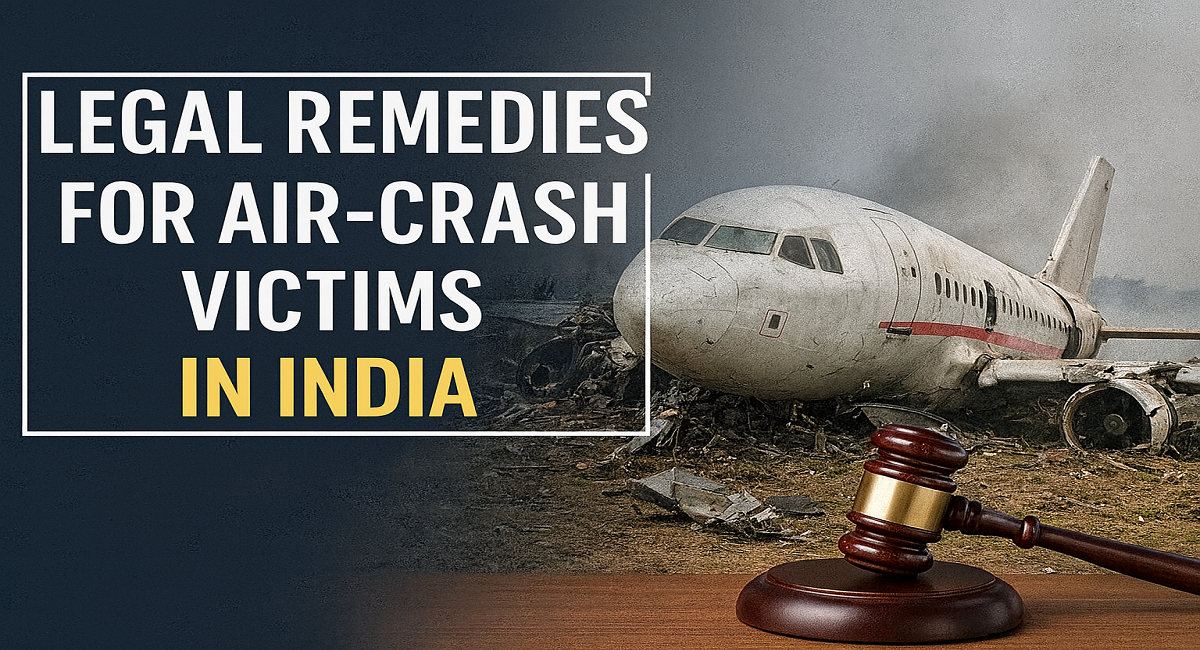
An aircraft crash is one of the most unfortunate events ever existed. Death and destruction are immediate and something that one can possibly never surpass. But the legal procedure provided is complex and extremely slow. Families of the victims have to deal with international treaties, domestic statutes, investigation, criminal processes and insurance proceedings, which is definitely tough for someone who has just faced a death. In this article, we have explained the key legal remedies that are available to victims and their families. And we have used the very recent developments (including the June 12, 2025, Ahmedabad disaster) to explain the risks and consequences.
The legal landscape
International treaty baseline
The Montreal Convention (1999): India incorporated the Montreal rules in domestic law through the Carriage by Air (Amendment) Act, 2009. This convention has two types of provisions.

- If the victim dies or gets injured, a strict liability of limited monetary compensation will be provided.
- If the carrier’s fault or negligence is proven, they will have to pay money beyond the Article 21 limit.
Domestic statute
Carriage by Air Act, 1972: This Act regulates the relationship between the carriers and passengers in international journeys. DGCA supervises the operational safety of the aircraft, and they also coordinate with the investigation agencies if an event occurs.
Investigations and enforcement
The Aircraft Accident Investigation Bureau (AAIB) conducts all the technical investigations. DGCA has regulatory functions, and it can impose administrative sanctions. If the investigators find out that the accident happened due to the fault or negligence of the carrier, criminal prosecution for culpable negligence (e.g., Section 304A IPC) may arise. As a recent example, we can consider the initial report of AAIB in the Air India AI-171 crash.
Ex gratia and temporary relief
While formal demands are pending, airlines, owners, or corporate groups often provide interim or ex gratia payments (Air India/Tata in June 2025). These payments do not replace the rights granted by domestic law or the Convention.
Third parties and victims on the ground
By its nature, the Montreal text is to protect travellers and their belongings. But injuries to third parties and damage on the ground raise different issues like tort law, statutory compensation schemes, and potential liability under domestic enactments. These are like legal blind spots.
What does the Montreal Convention actually give you, and what it doesn’t?
Two-tier liability (the practical import)
- Strict liability requires no fault. Article 21 governs the limit for monetary compensation in case of death or injury. The amount can be changed through periodic revision. After the 2024 or 2025 review, the limit of Article 21 was significantly increased. This means families can claim a base amount without any obligation to prove negligence.
- Beyond the SDR cap: claimants must establish that the carrier was at fault. It could be negligence or wilful misconduct to recover additional damages from the insurer. This is a tough battleground. To prove negligence of an airline, the claimant will need technical evidence; without that, it will be almost impossible to establish their fault. Apart from everything in litigation, it takes years to decide a case.
Convertibility and value
The current exchange rates are used to convert the SDR limit into rupees and other currencies. Presently, the article 21 limit is higher than it was in the previous review of 2024, which increases the amount of compensation the airlines must pay the victims and their families.
Tough Limitations
- Domestic flights: Montreal governs international carriage. Domestic victims rely on domestic statutes, contract law, consumer law, or tort claims, unless domestic carriage is explicitly covered by domestic implementation rules. India’s Carriage by Air Act was amended to reflect Montreal Convention rules, but there are still a lot of complexities in its domestic cases.
- Ground victims: If an air accident occurs, death, damage or injury of the people who were not on board but on the accident, the ground faces a problem in gaining legal remedy. The structure of the legal system for ground victims is really weak. The Courts have always considered it a legal blind spot. And this problem definitely requires legal reform.
Recent live example: Air India Flight AI-171 (Ahmedabad, 12 June 2025)
In the Ahmedabad Air crash, it was very clear how the legal system works in real incidents.
- Investigation
The report published by AAIB shows that both the fuel control switches moved to CUTOFF immediately after rotation, and the aircraft lost thrust. The investigation is still going on. This report works as a factual basis for civil claims, and it opens criminal and regulatory investigations into the incident.
- Interim relief
Air India and Tata announced interim payments to the victim’s family (Tata: ₹1 crore per family as a voluntary payment; Air India announced interim payments of ₹25 lakh and promised they will take care of future claims also. Interim payments help families, but they do not close legal claims under the Montreal regime or domestic law.
- Judicial scrutiny and public law
The Supreme Court accepted petitions from the family members of the victims. And the court started to conduct trials and made observations on how high-profile Air crash cases affect families, airline employees and public interest. The pilot’s father filed a petition to the Supreme Court seeking a detailed investigation and inquiry into the accident.
Why does this matter legally?
The factual findings of the AAIB have an impact on –
- The burden of proof is on the carrier according to the Montreal Article 21(2) defence, which shows the absence of negligence.
- This finding increased the chance of criminal prosecution for negligence, and
- The timeliness of final civil settlements. Records (such as tickets, correspondence, medical and death certificates, photographs, and witness statements) should be preserved by victims and their families because these documents will play an important role in establishing the loss and liability in court.
The practical routes to compensation in India
- Direct claims under the Montreal Convention or the Carriage by Air Act against the carrier are an effective route.
The victim’s family can file the claims under Article 21 for international dispute. Claimants are entitled to compensation as per the SDR limit. If the amount of the claim exceeds the maximum limit, they must prove that it was the carrier’s fault or negligence. The domestic implementation process is regulated by the Carriage by Air Act.
- Civil actions and consumer forums
Victim’s Families file lawsuits for negligence or poor service in civil or consumer courts under the Consumer Protection Act, 2019. International treaties can cause jurisdictional disputes and confusion. However, consumer forums provide broad remedies, and they are usually faster in the litigation procedure. But the case strategy will play an important role in proving liability.
Criminal prosecution and parallel civil claims
The reports of AAIB and DGCA show there is a chance of negligence, and a criminal prosecution of culpable negligence can be launched. But criminal proceedings are separate; it will not make the carrier free from civil obligations. Both the proceedings will go on in parallel.

Claims for ground victims and third parties
Ground victims can file tort claims against the airline using public nuisance or strict liability principles. But the courts have observed inconsistencies and the absence of a clear compensation framework for ground victims. Circumstantial and technical evidence will play a crucial role in establishing a strong case.
Insurance, insolvency and multijurisdictional claims
Airlines are always insured. The policy limits can affect the compensation to the victim and family. In the case where there is involvement of many different jurisdictions, the claimant will have to coordinate with different legal systems. That can be challenging sometimes. The Montreal Convention provides some procedure for claims to international carriage, but litigation in an Indian court will still be required to deal with the legal charges.
Strategic steps for victims’ families and lawyers
- Preserving tickets, boarding passes, baggage receipts, communications, medical records, photos, witness contacts, and death certificates will be helpful to make a strong case during the trial.
- File claims for interim relief immediately with the help of a legal representative to supervise all the payments. It will save the family from misconduct.
- Use multiple options: registration of customer complaints, filing a claim under the Montreal or Carriage by Air Act, and starting civil claims for further damages together will give multiple options. And going for various ways will make the process a little easier. In case one way is not working, the claimant will have another route.
- If the claimant is seeking relief beyond the Article 21 limit, using forensic evidence and the AAIB OR DGCA report will make the case stronger. You can ask the court how to preserve technical evidence.
- Working with foreign claimants can be challenging because the legal system is different in many nations. If there are non-Indians in the victim list, arranging a legal representative for them in the appropriate jurisdictions will help them.
- Be realistic about timelines: To prove negligence of the carrier and claim for compensation that exceeds the SDR limit, the claimant must go through a long legal process. This type of litigation takes years to provide a remedy. Ask for interim relief to solve immediate needs.
Gaps, reforms and policy recommendations
Ground-victim compensation framework needed
After an Air crash, the ground victims face most legal challenges. They always have a high proof burden to claim a remedy. Case commentaries and litigations have identified this gap repeatedly and have tried to solve it. Currently, India has some statutory schemes that provide faster and predictable compensation to ground victims.
Faster interim relief without waiver traps
The interim payments by carriers are humanitarian actions. But the courts and regulators should discourage small ex gratia payments. Hiring an independent legal representative can help to protect vulnerable families from being tricked by the airline companies.
The settlement process for public servants and employees is regulated by the DGCA and the Ministry of Civil Aviation guidelines.
Fast-track benches or specialised aviation claims tribunals
Aviation disasters always bring unique technical problems. Establishing an air crash claim tribunal will help to enhance technical evaluation. Adding a fast-track bench to the air crash claim tribunal will help to manage delays.
AAIB findings’ role in the public interest
The evidence gap between airlines and suffering families can be solved by making the AAIB’s findings more helpful for civil claimants. For example, if the AAIB simplifies evidence production rules or establishes legal assumptions about technical defects, it can help to fill the gaps.
Quick answers: what victims normally receive?
Baseline Montreal entitlement
Under Article 21, a strict liability limit was expressed in SDRs. Later on a revised version came in late 2024 or early 2025. The revised version significantly increased the amount of compensation being paid in strict liability cases to the victim’s families.
Interim/ex gratia in practice
In the AI-171 case, Tata announced ₹1 crore per family as voluntary aid. And Air India provided ₹25 lakh interim payments and then started processing full claims. These are immediate measures. If the negligence is proven to the court, the amount of compensation goes much higher than this.
Final words
The Montreal Convention and Carriage by Air Act provide a strong legal framework for the victims and their families to claim compensation. The airline company have to provide relief even if they have no fault in it. If it is proved that the accident happened due to the airline’s negligence, the amount of compensation goes much higher. But the system needs reforms for the ground victims. Still now there is no strict provision available for the ground victims. After an air crash, the ground victims face legal challenges to claim compensation. They always have the high proof burden on them. The AI-171 incident of June 2025 shows that there are immediate regulatory responses, but there is also a limitation of long-term legal remedies. A technical investigation can take time, so the families must go for parallel tracks like civil suits, criminal follow-ups and civil suits.
The legal system of India should guarantee that the rights of people are protected and remedies are provided without delay.
Frequently asked questions (FAQs)
- Does an interim ex gratia payment mean I lose the right to sue later?
No, but if there is a clause stating that an ex gratia payment will make you lose the right to sue in the agreement, then you will not be allowed to file a case on that matter later.
- If my family member died on an India-domestic flight, can I still use Montreal?
Montreal governs international carriage. India’s Carriage by Air Act was amended to give effect to Montreal, mainly for international flights. Domestic will proceed under domestic law, civil or consumer forum, or contractual remedies.
- Can ground victims claim compensation under Montreal?
No, not under Montreal because it provides a remedy to passengers. Ground victims can use tort law or a statutory claim to ask for legal remedies.
References
- https://www.scconline.com/blog/post/2024/01/30/compensating-ground-victims-of-aircraft-accidents-a-legal-blind-spot
- https://www.civilaviation.gov.in/sites/default/files/migration/Adoption_of_Guidelines_for_Compensation_to_victims09072019171512-3-8.pdf
- https://www.business-standard.com/article/pf/how-do-air-crash-victims-get-compensated-114072700741_1.html
- https://www.icao.int/sites/default/files/secretariat/legal/LEB%20Treaty%20Collection%20Documents/2024_Revised_Limits_of_Liability_Under_the_Montreal_Convention_of_1999_en.pdf
- https://prsindia.org/files/bills_acts/acts_parliament/2009/the-carriage-by-air-%28amendment%29-act%2C-2009.pdf
- https://i2.res.24o.it/pdf2010/Editrice/ILSOLE24ORE/ILSOLE24ORE/Online/_Oggetti_Embedded/Documenti/2025/07/12/Preliminary%20Report%20VT.pdf
- https://www.legalserviceindia.com/Legal-Articles/victim-compensation-and-aviation-laws-in-india-the-air-india-flight-ai171-crash/
- https://www.businesstoday.in/india/story/air-india-plane-crash-compensation-what-indian-law-says-about-payouts-rights-and-legal-options-480730-2025-06-17
- https://www.boomlive.in/law/air-india-crash-compensation-legal-process-victims-families-28813
 Serato DJ Crack 2025Serato DJ PRO Crack



 Allow notifications





