

Practical CPA exam study plan for Indian working professionals. Covers realistic study hours, weekly schedules, review course pricing in INR, and motivation strategies. This article is written by Medha Vinod, Senior Associate at LawSikho.
If you’re reading this while mentally calculating how to squeeze CPA preparation into your already packed schedule, you’re not alone. Indian professionals working 50 to 60-hour workweeks don’t have the luxury of quitting their jobs to study full-time, yet the CPA credential remains one of the most valuable additions to an accounting career. This guide cuts through generic advice to give you a practical framework built around Indian work realities: specific study hours you’ll actually need, weekly schedules that fit around demanding jobs, review course options with real pricing in rupees, and motivation strategies that sustain you across months of preparation.
CPA Study Time Requirements for Working Professionals
The first question every working professional asks is straightforward: how much time will this actually take? Getting this estimate right prevents both the overconfidence that leads to failed attempts and the intimidation that stops candidates from starting at all.
Section-by-Section Study Hours and Total Timeline
The CPA exam consists of three Core sections everyone must pass, plus one Discipline section you choose based on your career interests. Each section demands a different preparation time based on content volume and your existing background.

FAR, the Financial Accounting and Reporting section, requires the heaviest investment at 80 to 100 hours. This section covers everything from basic financial statements to governmental accounting and not-for-profit reporting. The breadth of material makes FAR the section where most candidates spend the longest preparing, and the 40 to 43 percent pass rates reflect its difficulty.
AUD and REG each require approximately 80 to 100 hours of study. Auditing and Attestation test your understanding of audit procedures and professional responsibilities, while Regulation covers US federal taxation and business law.
Your Discipline choice between BAR, ISC, and TCP affects both study time and pass probability. Business Analysis and Reporting extends FAR concepts and needs 100 to 120 hours, with pass rates around 34 to 41 percent. Information Systems and Controls focuses on IT audit topics, requiring 80 to 100 hours with 60 to 68 percent pass rates. Tax Compliance and Planning builds on REG, needs 80 to 100 hours, and shows the highest pass rates at 72 to 80 percent.
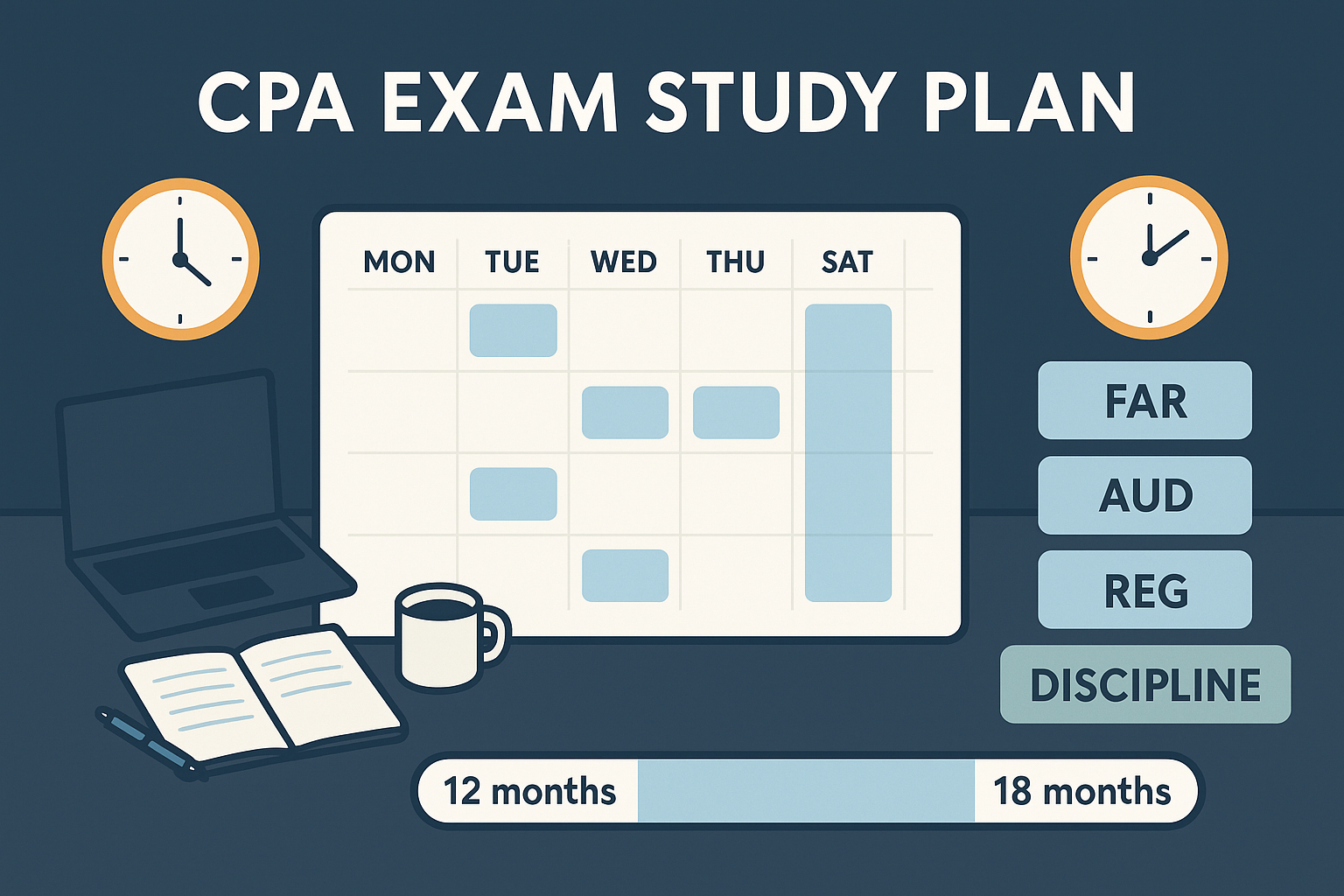
Adding these together, you’re looking at 320 to 450 total study hours across all four sections. For working professionals dedicating 15 to 20 hours weekly, this translates to 12 to 18 months of consistent preparation. Some candidates with strong backgrounds finish faster, while others with heavier work commitments take the full 18 months.
Your existing qualifications meaningfully reduce certain sections’ study times. Indian CAs typically find FAR and AUD more manageable because the CA curriculum overlaps significantly with financial reporting and audit concepts. The US GAAP specifics still require attention, but the foundational understanding accelerates learning. M.Com graduates with accounting specializations similarly benefit, though perhaps to a lesser degree than CAs. B.Com holders without additional certifications should plan for the full recommended study hours on each section.
Calculating Your Personal Study Timeline Based on Available Hours
Your individual timeline depends entirely on how many quality study hours you can realistically commit each week. Be honest with yourself here because overestimating leads to impossible schedules that collapse within weeks.
If you can commit 15 hours weekly, which breaks down to roughly 1.5 hours on weekdays plus 7 to 8 weekend hours, expect each section to take 6 to 10 weeks, depending on content volume. FAR alone might consume 8 to 10 weeks, while shorter sections like TCP could take 4 to 6 weeks. At this pace, completing all four sections takes approximately 16 to 18 months.
Candidates managing 20 hours weekly can compress this timeline meaningfully. With 2 hours on weekdays and 10 weekend hours, each section takes 4 to 8 weeks. The full exam becomes achievable in 12 to 14 months for disciplined candidates who maintain consistency.
The NASBA 30-month rolling window provides important flexibility. Once you pass your first section, you have 30 months to pass the remaining three before that initial credit expires. This window accommodates the reality that work demands fluctuate, personal circumstances change, and some sections may require retakes. Don’t feel pressured to complete everything in 12 months if 18 months better fits your life situation.
Creating a Weekly Study Schedule That Works with Your Job
A study schedule that exists only on paper accomplishes nothing. Your weekly plan must account for actual energy levels after long workdays, family dinner times, and the reality that willpower depletes as the day progresses.
Morning vs. Evening Study Sessions: Finding Your Productive Hours
The morning versus evening debate has passionate advocates on both sides, but the right answer depends entirely on your personal energy patterns and household situation.
Early morning sessions between 5 AM and 7 AM offer distinct advantages for many Indian professionals. Your mind is fresh before work stress accumulates, interruptions from colleagues or family are minimal, and completing your study before leaving home means work emergencies can’t derail your plan. The tradeoff involves earlier bedtimes that may conflict with family time or social expectations. If your household includes young children who wake early or elderly parents requiring morning attention, this window may not be practical.

Evening sessions from 8:30 PM to 10:30 PM work better for candidates who aren’t morning people or whose family dynamics favor later study. The key is allowing genuine decompression time after work. Attempting to study immediately after reaching home, while still mentally processing office issues, rarely produces quality learning. A buffer of 60 to 90 minutes for dinner, brief relaxation, and mental transition makes evening sessions far more effective.
Indian work culture often involves later office departures than Western norms, pushing dinner times to 8 PM or beyond. If this describes your situation, evening study sessions may need to start at 9:30 PM or later, making mornings more practical despite requiring earlier wake times.
The consistency factor matters more than the specific time slot. A candidate who studies every morning at 5:30 AM will outperform someone who alternates unpredictably between mornings, evenings, and skipped days. Pick one approach that genuinely fits your life and protect it fiercely.
Sample Weekly Schedule for Indian Working Professionals
Let me give you a concrete framework rather than vague advice about “finding time.” This schedule assumes standard Indian corporate hours with reasonable commute times.
Weekday mornings from 5:30 AM to 7:00 AM provide 1.5 hours of focused study before your day begins. Alternatively, weekday evenings from 9:00 PM to 10:30 PM offer the same 1.5 hours after family dinner and brief relaxation. Choose one approach, not both, as attempting two sessions daily leads to rapid burnout.
Saturday mornings from 8:00 AM to 12:00 PM create a 4-hour power block for intensive study, including practice exams or tackling complex topics that require extended concentration. Sunday mornings from 9:00 AM to 12:00 PM add another 3 hours. This weekend structure totals 7 hours, which, combined with 7.5 weekday hours, gives you 14.5 to 15 hours weekly.
For remote or hybrid workers, the eliminated commute time is pure gold. Consider adding a lunch hour session from 12:30 PM to 1:15 PM for light review or MCQ practice. This 45-minute addition, three to four times weekly, meaningfully accelerates progress without extending your total daily study commitment.
During busy work periods, reduce rather than eliminate study. Even 30 minutes of flashcard review maintains your connection to the material and prevents the regression that comes from complete breaks. Protecting abbreviated study sessions during crunch times keeps momentum alive until normal schedules resume.
Maximizing Weekends, Leave Days, and Festival Holidays
Weekends carry disproportionate importance for working professionals because they offer the only opportunity for extended, uninterrupted study blocks. Protect your weekend study time as zealously as you protect important work meetings.
Use weekend sessions for activities that benefit from longer focus periods: full-length practice exam sections, complex TBS simulations, and deep dives into challenging topics. Weekday sessions work better for video lectures, MCQ practice, and review of previously covered material.
Strategic leave usage accelerates preparation dramatically, particularly in the final stretch before each exam. Taking 2 to 3 consecutive days off before your exam date creates a focused final review period that many successful candidates credit for their passing scores. Use this time for practice exams under realistic conditions, targeted review of weak areas identified in practice, and mental preparation.
Indian calendar holidays create natural extended weekend opportunities without using leave days. Diwali breaks, Independence Day weekends, Holi, and regional festivals provide 3 to 4 day windows for intensive preparation. Planning your section exam dates around these holidays lets you leverage built-in time off. For example, scheduling a section exam for the week after Diwali allows you to use the holiday break for final intensive review.
Choosing Study Resources and Review Courses for Indian Candidates
Your review course choice affects both preparation quality and budget significantly. Understanding what each option offers at Indian price points helps you make an informed investment.
Review Course Options with Pricing in Indian Rupees
The international CPA review course market offers several established options, each with distinct strengths and price points that Indian candidates should understand before committing.
Becker CPA Review commands the highest price at approximately ₹2.6 to ₹3.2 lakhs for comprehensive packages. Becker’s reputation comes from Big 4 firm adoption globally, extensive video content, and proven methodology. If your employer offers Becker reimbursement or you’re specifically targeting Big 4 employment where Becker is standard, the premium may be justified. Self-funding candidates should carefully evaluate whether the price difference delivers proportional value over alternatives.
Gleim CPA Review offers the largest practice question bank in the industry at approximately ₹2.5 to ₹3 lakhs. With over 10,000 MCQs and 1,300 TBS, Gleim suits candidates who learn best through extensive problem practice rather than video lectures. The “access until you pass” guarantee provides valuable security for working professionals whose timelines may extend beyond initial estimates.
Surgent’s adaptive learning technology claims to reduce study time by focusing on your weak areas, priced at approximately ₹2.1 to ₹3.2 lakhs depending on package selection. For severely time-constrained professionals, the efficiency focus holds appeal, though the technology works best for candidates who trust algorithmic guidance rather than wanting to control their own study sequence.
Indian coaching institutes offer a different value proposition entirely. Miles Education’s complete pathway costs approximately ₹4.43 lakhs but includes Becker access, live instruction, application support, and placement assistance. Simandhar Education, as Becker’s official Indian partner, offers packages from ₹1.5 to ₹2.5 lakhs. Zell Education provides options from approximately ₹80,000 to ₹1.5 lakhs for coaching support.
The self-study versus guided coaching decision depends on your learning style and support needs. Candidates with strong self-discipline who can navigate application processes independently often succeed with international review courses alone. Those who benefit from structured schedules, live doubt-clearing, and hand-holding through administrative processes find coaching institute packages worthwhile despite higher costs.
Essential Tools for Mobile and Micro-Learning During Work Hours
Your smartphone represents an underutilized study resource that can convert dead time into productive learning. Most working professionals spend 2 to 3 hours daily on their phones, much of it on social media or entertainment apps that could become study time.
All major review courses offer mobile apps that sync with your main course progress. Use commute time for audio lectures, which work well even when you can’t look at a screen. Train journeys, auto rides, and even walking between meetings become opportunities for passive learning.
Lunch breaks offer 20 to 30 minutes for active study. Use this time for MCQ practice through your review course app or flashcard review using dedicated apps. The short duration suits focused bursts on specific topics rather than lengthy conceptual learning.
Flashcard apps like Anki or Quizlet allow you to create custom cards for formulas, definitions, and concepts you’re struggling to memorize. The spaced repetition algorithms these apps use optimize review timing for long-term retention. Even 5-minute sessions while waiting for meetings or standing in queues accumulate meaningfully over months.
The psychological shift from “I don’t have time to study” to “I can study in small increments throughout the day” transforms your preparation capacity. Working professionals who master micro-learning often accumulate 5 to 7 additional study hours weekly without extending their formal study sessions.
Staying Motivated Through 12-18 Months of CPA Preparation
The CPA journey’s length presents its own challenge. Maintaining motivation across 12 to 18 months requires deliberate strategies because initial enthusiasm inevitably fades.
Building Sustainable Habits and Preventing Burnout
Sustainable habits beat intense effort every time in long-duration challenges like CPA preparation. The candidate who studies 15 hours weekly for 18 months will outperform someone who studies 30 hours weekly for 3 months before burning out and quitting.
Break the overall goal into weekly milestones that feel achievable. Instead of focusing on “pass all four CPA sections,” concentrate on this week’s target: complete Chapter 4, achieve 70 percent on the practice quiz, or finish 100 MCQs. Celebrating small wins maintains momentum and provides regular confidence boosts.
Track your progress visually using a spreadsheet, app, or even a paper chart. Seeing accumulated study hours and completed topics provides tangible evidence of advancement that motivates continued effort. Progress tracking also reveals patterns, like whether your scores improve after certain types of study sessions.
Burnout warning signs include dreading study sessions you previously enjoyed, declining practice scores despite continued effort, physical symptoms like headaches or sleep disruption, and irritability that affects work and relationships. When these signs appear, take a strategic break rather than pushing through. A planned rest week prevents the unplanned months-long breaks that derail many candidates.
Physical health directly impacts study effectiveness. Sleep deprivation from late-night study sessions creates a false economy because retention drops dramatically when you’re exhausted. Exercise, even brief walks, improves cognitive function and stress management. Sacrificing health for study hours ultimately slows your progress.
Managing Work, Family, and Study Responsibilities
CPA preparation doesn’t happen in isolation. Your success depends partly on how well you manage expectations and maintain relationships with the people in your life.
Communicate your CPA goals clearly to your employer, especially your direct manager. Many Indian companies support professional development and may offer flexibility during exam periods. Even without formal support, managers who understand your commitment often accommodate reasonable requests for predictable schedules or strategic leave.
Family communication matters even more. Your spouse, parents, or roommates need to understand that your reduced availability is temporary and purposeful. Set realistic expectations: you’ll miss some social events, spend most weekend mornings studying, and may be less available for household responsibilities during intensive preparation periods. Getting buy-in upfront prevents resentment that builds when family members feel unexpectedly neglected.
Finding accountability partners among fellow CPA candidates provides motivation that self-discipline alone cannot match. Online communities, LinkedIn groups, and coaching institute cohorts connect you with peers facing identical challenges. Regular check-ins with accountability partners, whether weekly calls or daily message exchanges, create external commitment that supplements internal motivation.
The isolation of solo study wears on candidates over time. Knowing others are struggling with the same material, celebrating section passes together, and commiserating over difficult topics provides emotional support that sustains motivation through the journey’s lowest points.
Conclusion
The path from working professional to CPA holder is well-traveled by Indian candidates who came before you. They didn’t succeed because they had more time, fewer responsibilities, or superhuman discipline. They succeeded because they built realistic study plans, protected their study hours, and maintained consistency over 12 to 18 months.
Your starting point is understanding the time investment: 320 to 450 hours spread across 15 to 20 weekly hours. Your foundation is a weekly schedule that fits your actual life, whether that means early morning sessions before the household wakes or evening study after dinner settles. Your tools are review courses and apps that match your budget and learning style. Your sustaining force is a support network of family, employers, and fellow candidates who understand your journey.
Start this week by deciding which section to tackle first, typically FAR for building foundational knowledge or a section aligned with your work experience for early confidence. Create your weekly schedule template with specific time blocks you’ll protect as non-negotiable appointments. Choose a review course that fits your budget and learning preferences. Then commit to your first week of consistent study, knowing that each hour brings you closer to a credential that transforms careers.
The CPA credential opens doors across borders, commands salary premiums, and signals expertise that employers worldwide recognize. The investment you make over the coming months will pay returns throughout your career. Thousands of Indian professionals have made this journey while working full-time, and you can join them.
For more information about this, please click here.
 Serato DJ Crack 2025Serato DJ PRO Crack



 Allow notifications





