

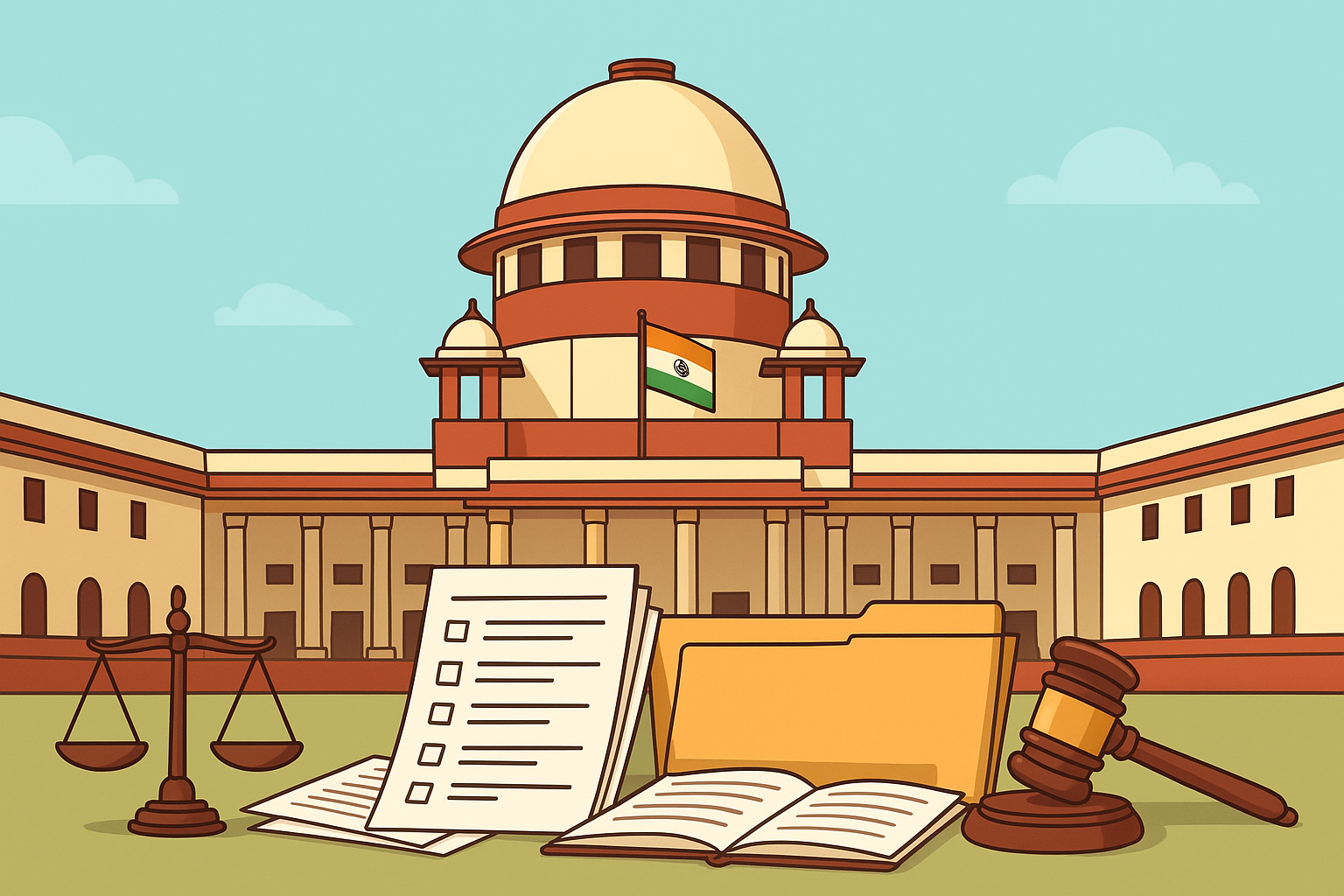
This guide walks you through an analysis of previous year papers, helping you understand the current exam structure, practice effectively for both MCQ and subjective sections, and avoid the common mistakes that cost candidates valuable marks. This article is written by Neeli Neelay Shah, Senior Legal Content Writer at LawSikho.
Table of Contents
If you’re preparing for the Supreme Court Law Clerk-cum-Research Associate Exam, previous year question papers are your most powerful preparation tool. These papers reveal exactly what the exam demands, from topic weightage to question framing patterns that textbooks simply cannot teach you. The 2023-2024 pattern shift has fundamentally changed what you need to prepare, making recent papers essential for understanding which sections now carry maximum marks and which have been eliminated entirely.
Understanding the Current Supreme Court Law Clerk Exam Pattern
Part I and Part II Mark Distribution
The Supreme Court Law Clerk Exam consists of two parts: Part I carries 100 marks for MCQs over 2.5 hours, while Part II carries 300 marks for subjective questions over 3.5 hours. This means Part II accounts for 75% of your total written exam score, making it the decisive component of your selection.

While many candidates concentrate heavily on MCQ preparation because it feels familiar from law school exams, success actually hinges on mastering the subjective paper’s case synopsis, research memo, and analytical essay components. The Part II paper evaluates skills you’ll utilise daily as a law clerk: rapidly analysing case files, preparing concise legal research, and presenting structured arguments for Supreme Court judges.
Major Pattern Changes You Must Know
The most significant pattern shift occurred in 2023 when the exam structure underwent substantial revision. English Comprehension questions were reduced from 30 questions (2018-2021) to just 15 questions in 2023-2024. Simultaneously, the General Aptitude and Awareness section carrying 20 questions until 2021 was completely removed from the examination pattern.
The 2023 pattern introduced two critical additions: Contract Law as a dedicated testing area with 10-12 questions, and Latest Developments in Law carrying 15-20 questions focused exclusively on recent Supreme Court judgments. If you’re preparing with papers from 2018-2021 without understanding this shift, you’ll be allocating study time to sections that no longer exist while missing entirely new high-weightage areas.
Subject-Wise Question Distribution in Part I of Supreme Court Law Clerk Exam
Constitutional Law (15-20 Questions)
Constitutional law has consistently carried 15-20 questions across all years from 2018 to 2024, establishing it as the single most important traditional subject for Part I preparation. Questions concentrate heavily on Fundamental Rights, particularly the right to equality under Article 14, freedom of speech under Article 19, and right to life under Article 21. The exam regularly tests your understanding of landmark judgments interpreting these rights.
Beyond Fundamental Rights, expect questions on the constitutional framework of the judiciary (Articles 124-147), parliamentary procedures, Centre-State relations, and constitutional amendments. The 2023 and 2024 papers showed increased focus on recent constitutional bench decisions, so you must prepare Supreme Court rulings from the past 2-3 years alongside foundational constitutional law principles.
Criminal and Civil Law Subjects
Criminal law subjects collectively account for 25-30 questions, distributed across IPC (10-11 questions), CrPC (10 questions), and Evidence Act (9-10 questions) based on 2023-2024 patterns. For IPC, questions focus on general exceptions, offences against human body, property offences, and offences against public tranquility. CrPC questions concentrate on arrest procedures, bail provisions, trial stages, appeals, and revision.
The Civil Procedure Code 1908 has maintained 10-11 questions in recent papers, focusing on jurisdiction, institution of suits, written statement, discovery and inspection, judgment and decree, appeals, and execution proceedings. Indian Contract Act 1872, introduced in 2023 as a dedicated testing area, brought 10-12 questions covering essentials of valid contract, consideration, offer and acceptance, breach of contract, and remedies.
Latest Developments in Law (15-20 Questions)
The Latest Developments in Law section has become the highest-weightage single component of Part I with 15-20 questions focused exclusively on recent Supreme Court judgments from the past year. This section tests whether you’re keeping current with judicial developments, covering landmark constitutional bench decisions, important criminal law rulings, arbitration law judgments, and matters involving emerging legal issues like technology, environment, and social justice.
Preparing for this section requires following Supreme Court judgments from January 2024 onwards for the 2025 exam, focusing on constitutional bench decisions, important rulings on contentious issues, and judgments that modify earlier precedents. Questions ask about the ratio decidendi, legal principles established, and practical implications rather than just case names and dates.
Part II Subjective Paper Structure and Approach
Case Synopsis (100 Marks)
The Case Synopsis question provides you with a complete case file and requires a concise 750-word summary covering key facts, legal issues before lower courts, the ratio of the impugned decision, and grounds for appeal. The official evaluation focuses on seven parameters: identifying relevant facts and legal issues, comprehensively summarising the impugned decision, stating the ratio clearly, articulating grounds before the Supreme Court, condensing information logically, and maintaining brevity.
This component evaluates your legal research assistant capabilities directly. Can you rapidly analyze a complex case file and extract what a Supreme Court judge needs to know for deciding whether to grant leave? Practice editing your drafts: if your initial synopsis exceeds the word limit, identify repetitive content, unnecessary adjectives, or marginally relevant facts that can be eliminated without losing essential legal information.
Research Memo (75 Marks) and Analytical Essay (75 Marks)
The Research Memo presents a factual dispute along with relevant statutes and precedents, requiring a 500-750 word reasoned analysis. Unlike the case synopsis which summarizes existing materials, the research memo tests your ability to formulate legal reasoning and reach conclusions based on statutory interpretation and precedent analysis. The evaluation emphasizes effective use of legal sources, precise legal language, clear exposition of law, thorough analysis of facts with proper law application, and logical structure.
The Analytical Essay provides five topic choices, and you select one to write a 350-500 word structured essay. Past patterns suggest topics cover contemporary legal issues, constitutional themes, or jurisprudential concepts. The evaluation emphasises presenting a clear thesis, developing arguments logically, supporting positions with relevant examples, demonstrating balanced analysis, and maintaining formal legal writing standards.

How to Download and Practice with Supreme Court Law Clerk Previous Year Question Paper
Official Sources and Available Papers
The Supreme Court of India’s official website hosts all previous year question papers from 2015 onwards, making it your primary authoritative source. You can download papers from 2015, 2016, 2017, 2018, 2019, 2021, 2023 (Part I and Part II separately), and 2024 (Part I and Part II separately) in PDF format. Note that 2020 and 2022 papers are not available as the exam was not conducted those years.
The Supreme Court also provides an official sample guide from May 2023 with complete sample questions and model answers for Part II. Study these model answers carefully: notice how they begin with essential case details, systematically cover facts in chronological order, explain the impugned judgment’s reasoning succinctly, and conclude with clear grounds of appeal without unnecessary elaboration.
Strategic Practice Schedule
Begin with the 2024 Part I paper as your test to assess your current preparation level, followed by the 2023 paper to confirm the current pattern. Then work backwards through earlier years for foundational practice, noting that pre-2023 papers follow the old pattern with 30 English questions and General Aptitude section.
Always simulate actual exam conditions when practicing: sit at a desk with a printed paper, use a timer set for exactly 2.5 hours for Part I, avoid referring to books or notes, and mark answers on a separate sheet. This timed practice builds the mental stamina needed to maintain focus and helps you develop an internal sense of pace: approximately 60 seconds per question that prevents you from getting stuck on difficult questions while time runs out.
Common Mistakes to Avoid During Preparation
Part I MCQ Pitfalls
The most frequent mistake in Part I is misreading questions due to rushing; overlooking words like “NOT,” “EXCEPT,” “INCORRECT,” or “CANNOT” that completely reverse the question’s meaning. During practice, develop a habit of underlining these keywords before reading options, slowing down just 5 seconds per question to ensure accurate comprehension rather than saving 5 seconds but losing the entire question’s marks.
Many candidates feel they must attempt all 100 questions, but strategic answering yields better results. Avoid attempting questions you’re completely guessing on due to negative marking. Track your accuracy during practice paper solving; if you consistently score below 65% when attempting all questions, shift strategy to attempting only questions where you can eliminate at least two obviously wrong options.
Part II Subjective Pitfalls
Word limits in Part II are strict evaluation parameters, and exceeding them demonstrates inability to condense information; a critical skill for law clerks who must provide judges concise, relevant analysis. Many candidates write 900-1000 word case synopses trying to include every detail from the case file, but the official evaluation explicitly focuses on “ability to condense information” and “brevity” as criteria.
Another frequent error is missing crucial legal issues by focusing only on the most obvious dispute while overlooking secondary issues that courts actually discussed. For comprehensive case synopsis answers, ensure you identify primary issues, secondary legal questions, procedural aspects, and evidentiary considerations that appear in the case file.
Building Your Legal Current Affairs Database for the Supreme Court Law Clerk Exam
Tracking Recent Supreme Court Judgments
The Latest Developments section requires a different preparation strategy because the content changes annually. Start maintaining a simple spreadsheet from January 2024 onwards with columns for date, case name, constitutional/statutory provisions involved, key legal principle established, and practical implications. Allocate 30 minutes daily to reading Supreme Court judgment summaries from the official website or reliable legal news platforms like Bar & Bench, Live Law, or SCC Online.
Focus on judgments where the bench size is 3+ judges, constitutional bench decisions, cases where Supreme Court modifies its earlier rulings, or matters involving conflicting High Court precedents that Supreme Court resolves. These carry higher exam relevance than routine two-judge bench decisions on standard legal questions. Recent exam relevant judgments have covered electoral bonds, constitutionality, sub-classification within reserved categories, internet shutdown legality, and privacy rights; understanding these deeply will prepare you for similar questions in 2025.
Recommended Books and Resources
Subject-Wise Reading Material
Your preparation should combine standard textbooks with primary sources. For Constitutional Law, use V.N. Shukla’s Constitution of India or D.D. Basu’s Commentary as your primary reference. For Criminal Law, Ratanlal & Dhirajlal’s IPC and C.K. Takwani’s CrPC provides comprehensive coverage with case law integration.
For Civil Procedure, C.K. Takwani’s CPC remains the standard text, while Pollock & Mulla or Avtar Singh serves well for Contract Act preparation. For English Comprehension, Wren & Martin’s English Grammar addresses the grammar and vocabulary portions. Most importantly, read recent Supreme Court judgments directly from the official website for Latest Developments preparation; no textbook can replace primary source familiarity.
Online Resources for Daily Updates
Subscribe to daily judgment digests from SCC Online, Manupatra, or LiveLaw to stay updated on significant rulings without reading full judgments daily. These platforms provide concise summaries highlighting the legal principles established, making it easier to maintain your current affairs database. The Supreme Court’s official website also publishes cause lists and judgment summaries that help track important ongoing matters.
Additionally, follow legal blogs and YouTube channels that provide analysis of significant judgments; these help you understand the practical implications and potential exam angles for recent rulings. However, always verify information against primary sources before adding to your preparation notes, as secondary sources occasionally misstate holdings or overlook important nuances.
Conclusion
Mastering Supreme Court Law Clerk previous year question papers transforms your preparation from theoretical study into strategic, targeted practice focused on what the exam actually tests. The shift from the old pattern to the current 2023-2024 structure means you must prioritize recent papers while adjusting for removed sections like General Aptitude and newly added areas like Contract Law and Latest Developments.
Remember that Part II carries 75% of your written exam marks, so allocate your preparation time proportionally. Even if MCQs feel more comfortable, invest substantial effort in developing the concise legal writing and case analysis skills that Part II demands. Start with testing using the 2024 paper as your diagnostic tool, practice consistently under timed conditions, and maintain your legal current affairs database diligently. With strategic preparation guided by previous year patterns, you can confidently approach this prestigious examination.
 Serato DJ Crack 2025Serato DJ PRO Crack




 Allow notifications





