

Table of Contents
This article is written to help aspiring law clerks understand the complete process of applying for and succeeding in the Supreme Court Law Clerkship examination. The article is written by Neeli Neelay Shah, Senior Legal Content Writer at LawSikho.
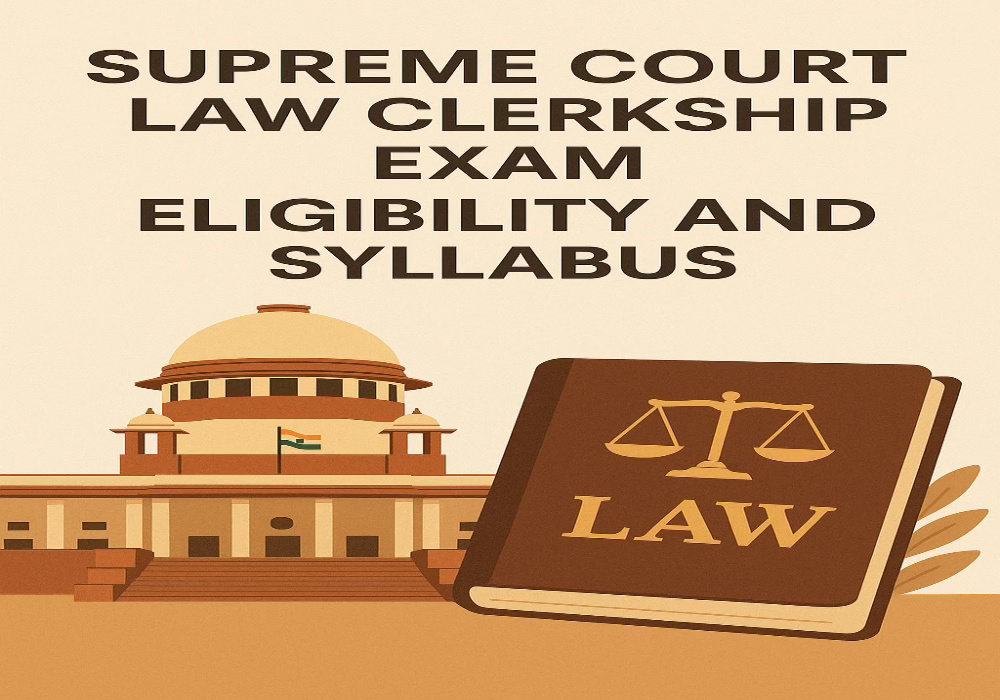
The Supreme Court Law Clerkship examination is one of the most prestigious opportunities available to fresh law graduates in India. Every year, approximately 90 Law Clerk-cum-Research Associates are recruited through a competitive examination to work directly with sitting judges of the Supreme Court of India. This one-year contractual assignment provides unparalleled exposure to India’s highest judicial institution.
For law students and recent graduates aspiring to work at the apex court, understanding the examination process, eligibility requirements, and syllabus is essential. This comprehensive guide covers everything you need to know about the Supreme Court Law Clerk examination, from application to selection.

What is the Supreme Court Law Clerkship Position?
The Supreme Court Law Clerk/Law Clerk-cum-Research Associate is a professional position where you work directly in a Supreme Court judge’s chamber. Unlike short-term internships that last a few weeks, this is a full-time engagement for one year where you become an integral part of the judge’s work.
Primary Responsibilities
As a Law Clerk, your main tasks include:
- Researching case law, statutes, and legal principles relevant to cases before the court
- Preparing briefs and summaries of facts, issues, and arguments in pending cases
- Drafting portions of judgments and notes on complex legal questions
- Preparing headnotes of judgments authored by the judges
- Maintaining the judge’s library by updating legal reference materials
- Attending court proceedings to record necessary information
- Participating in conferences between judges and counsel
Working as a Supreme Court Law Clerk provides insights into judicial reasoning that no classroom can offer. The experience gives you access to the thought process behind landmark decisions, exposure to constitutional and appellate practice at the highest level, and professional connections that can shape your entire legal career. Many former clerks have gone on to successful careers in litigation, judiciary, academia, and public service.
Difference Between SC Law Clerkship and Internship
Let us now see how this is different from a Supreme Court internship.
Long-term Clerkship (Law Clerk Position):
- Duration: 1 year (can be extended to 2 years if both judge and candidate agree)
- Paid position: ₹80,000 per month
- Full-time professional engagement
- Requires law degree completion
Short-term Clerkship (Internship):
- Duration: 4-6 weeks during academic breaks
- Usually unpaid
- For law students during their course
- Application through university to Supreme Court Registrar
Law students can apply for short-term clerkship directly under the name of their university to the Registrar of the Supreme Court. Applications should be submitted 3-4 months prior to the intended joining date.
Eligibility Criteria for Supreme Court Law Clerkship Exam
Educational Qualification
You must have a Bachelor’s Degree in Law from any school, college, university, or institution established by law in India and recognized by the Bar Council of India for enrollment as an Advocate. This includes:
- 3-year LLB program after graduation in any stream
- 5-year integrated law degree programs (BA LLB, BBA LLB, B.Com LLB, etc.)
Can final year students apply?
Yes, students in their final year can apply. If you’re in the fifth year of a 5-year integrated course or the third year of a 3-year LLB course, you’re eligible to apply. However, you must furnish proof of acquiring your law qualification before taking up the assignment.
Age Limit
Candidates must be at least 20 years old and not more than 32 years as of the last date for submission of applications. This age window accommodates both recent graduates and those who pursued law as a second career.
How many times can you attempt the exam?
There is no restriction on the number of attempts. You can apply as many times as you wish, provided you continue to meet the eligibility criteria, particularly the age limit of 32 years.
Other Requirements
Citizenship: Only Indian citizens are eligible. There is no domicile restriction within India.
Skills Required: Candidates must demonstrate proficiency in:
- Legal research and analytical skills
- Legal writing abilities
- Computer knowledge including retrieval of information from legal databases such as e-SCR, Manupatra, SCC Online, LexisNexis, and Westlaw
Disqualifications
Here is what makes you ineligible for the position of SC Law Clerk:
- Candidates enrolled as practicing advocates are not eligible
- Candidates convicted of any criminal offence cannot apply
- Those with pending criminal proceedings are also ineligible
Supreme Court Law Clerkship Exam Pattern
The selection process consists of three phases designed to evaluate your legal knowledge, analytical abilities, writing skills, and overall suitability for the position.

Part I: Multiple Choice Questions (100 Marks)
Format: 100 Multiple Choice Questions testing understanding of law, comprehension abilities, and analytical aptitude
Duration: 2.5 hours (150 minutes)
Marking Scheme:
- Each correct answer: 1 mark
- Each wrong answer: -0.25 marks (negative marking)
- Total marks: 100
Minimum Qualifying Cutoff: 40% (40 marks)
Important Points About Negative Marking
The negative marking system means four wrong answers cancel out one correct answer. This requires a strategic approach:
- Don’t attempt questions randomly
- If you can eliminate at least two options, attempting the question is generally favorable
- If you’re genuinely guessing among three or four options, the expected value is negative
Candidates who fail to meet the 40% cutoff are eliminated, and their Part II answer sheets are not evaluated.
Part II: Subjective Written Examination (300 Marks)
Duration: 3.5 hours (210 minutes), including 30-minute reading period
Minimum Qualifying Cutoff: 50% (150 marks)
Part II carries three times the weightage of Part I and tests your legal writing, analytical reasoning, and research capabilities through three questions:
Question 1: Brief Preparation (100 Marks, 750 Words)
Prepare a concise summary of a case file (Special Leave Petition, Appeal, or Writ Petition) covering:
- Key facts of the case
- Legal issues requiring determination
- Ratio decidendi of the lower court’s decision
- Grounds on which the appeal has been filed
The 750-word limit is strict, requiring you to identify the most critical facts and core legal questions while avoiding unnecessary procedural history.
Question 2: Research Memo (75 Marks, 500-750 Words)
Analyze a factual dispute using relevant statutes and precedents provided to prepare a reasoned legal memorandum. This tests your ability to apply legal sources to factual scenarios and demonstrate legal reasoning by connecting abstract principles to concrete situations.
Question 3: Analytical Essay (75 Marks, 350-500 Words)
Write one essay from five topic choices on legal issues such as constitutional interpretation, law reform debates, judicial philosophy, or contemporary policy questions. Choose a topic where you can construct a strong argument supported by relevant examples and logical reasoning.
Part III: Interview (100 Marks)
Candidates who qualify both written parts are ranked on combined marks. Approximately 270 candidates (three times the number of vacancies) with the highest scores are called for an interview.
What the Interview Assesses:
- Legal acumen and depth of understanding
- Ability to discuss complex legal questions intelligently
- Awareness of current judicial developments
- Professional demeanor and maturity
- Genuine interest in judicial work
Common Interview Questions:
- Constitutional law concepts (federalism, separation of powers, fundamental rights)
- Recent landmark Supreme Court judgments and their significance
- Your law school experiences, internships, and research projects
- Why you want to pursue this clerkship
- How you would approach researching an unfamiliar legal issue
Be honest about areas you’re still developing rather than bluffing on topics you don’t know well.
Syllabus of Supreme Court Law Clerkship Exam
The Supreme Court Law Clerkship examination tests candidates across multiple dimensions of legal knowledge, analytical ability, and professional skills. Understanding the complete syllabus is essential for strategic preparation, as it helps you allocate study time effectively and identify high-priority topics that appear frequently in the exam.
Law Subjects
Constitutional Law
Constitutional law forms the backbone of Supreme Court practice and consistently carries the highest weightage in Part I of the examination. The syllabus begins with the Preamble and its significance in constitutional interpretation, which sets the foundation for understanding India’s constitutional philosophy. You must have thorough knowledge of Fundamental Rights under Part III, with particular emphasis on Article 21 (Right to Life and Personal Liberty), which has been expansively interpreted by the Supreme Court to include numerous implied rights like privacy, livelihood, and speedy trial.
The Directive Principles of State Policy under Part IV represent the state’s policy objectives and often appear in questions testing the relationship between Fundamental Rights and Directive Principles. Understanding the judiciary provisions (Articles 124-147) is crucial, covering the appointment, qualifications, powers, and removal of Supreme Court and High Court judges. You should be well-versed in the Court’s original, appellate, and advisory jurisdiction, as these form the basis of how cases reach the Supreme Court.
Writ jurisdiction under Article 32 is another high-frequency topic, requiring you to know the five types of writs (habeas corpus, mandamus, prohibition, certiorari, and quo warranto) and their specific applications. The syllabus also covers parliamentary procedures including legislative processes, sessions, committees, and privileges. The constitutional amendment process under Article 368 and the landmark basic structure doctrine established in Kesavananda Bharati v. State of Kerala (1973 Supp SCR 1) are fundamental concepts that appear regularly.
Finally, the federal structure and center-state relations test your understanding of the distribution of legislative and executive powers between the Union and States, while emergency provisions under Part XVIII cover national emergency, state emergency, and financial emergency scenarios.
Civil Law
Civil law comprises multiple statutes that govern private disputes and civil procedure. The Indian Contract Act, 1872 is tested extensively, starting with the essentials of valid contracts including offer, acceptance, consideration, capacity to contract, and free consent. You must understand which agreements are void and voidable, the distinction being crucial for solving scenario-based questions. The Act’s provisions on performance and discharge of contracts explain how contractual obligations are fulfilled or terminated, while questions on breach and remedies test your knowledge of damages, specific performance, and injunctions available to aggrieved parties.
The Civil Procedure Code, 1908 governs the procedural aspects of civil litigation. Key topics include court jurisdiction (territorial, pecuniary, and subject-matter), which determines which court can hear a particular case. You should know the requirements for the institution of suits including the content of plaints and written statements. Understanding interim orders like injunctions and attachment is important, as is knowledge of decree execution processes. The CPC’s provisions on appeals and revisions explain how decisions can be challenged, while the doctrine of res judicata prevents relitigation of decided matters.
The Law of Torts section requires understanding of general principles of tortious liability and specific torts including negligence, defamation, nuisance, and trespass. You should know the defenses available to defendants and the principles of damages in tort law. The Specific Relief Act, 1963 covers remedies including recovery of possession, specific performance of contracts, injunctions (temporary and permanent), and declaratory decrees.
Criminal Law
Criminal law forms a substantial portion of the syllabus across three major statutes. The Indian Penal Code,1860/Bharatiya Nyaya Sanhita 2023 begins with general exceptions that excuse criminal liability under certain circumstances. You must thoroughly understand offences against the human body, particularly the distinction between murder and culpable homicide, as well as hurt and kidnapping. Property offences including theft, extortion, robbery, and cheating appear frequently, as do offences against public tranquility.
The Criminal Procedure Code, 1973/Bharatiya Nagarik Suraksha Sanhita 2023 governs criminal trial procedures. Critical topics include arrest procedures (when arrest is permissible, rights of arrested persons), bail provisions distinguishing between bailable and non-bailable offenses, and the various stages of criminal trial from charge to judgment. Understanding appellate and revisional provisions is essential, as is knowledge of the hierarchy of criminal courts and their powers.
The Indian Evidence Act, 1872/Bharatiya Sakshya Adhiniyam 2023 tests your understanding of relevancy of facts (which facts can be proven in court), the distinction between documentary and oral evidence, principles of burden of proof and presumptions, and the process of examination of witnesses including examination-in-chief, cross-examination, and re-examination.
English Language and Comprehension
English language skills are tested through three main components:
- Grammar questions assess your command over fundamental rules including subject-verb agreement, tense consistency, pronoun-antecedent agreement, correct use of prepositions, active and passive voice, direct and indirect speech, parts of speech and their usage, and commonly confused words. These questions test whether you can identify and correct grammatical errors in legal and general writing.
- Reading Comprehension forms a significant component, requiring you to demonstrate understanding of main ideas and supporting details in complex passages, draw inferences beyond what’s explicitly stated, understand vocabulary in context including legal terminology and Latin maxims, and comprehend legal passages that may be drawn from judgments, articles, or legal commentary. The comprehension section often includes passages with legal or constitutional themes, testing both language skills and legal awareness simultaneously.
- Sentence Construction questions test practical writing skills through error spotting (identifying grammatical and usage errors), rearranging jumbled sentences into logical order, filling blanks with appropriate words based on context, and selecting best sentence revisions from multiple options. These questions assess your ability to construct clear, grammatically correct sentences; a skill essential for legal writing.
The exam also covers the topics like:
General Knowledge and Current Affairs
This section has three distinct components.
- Recent legal developments is the most critical, covering significant Supreme Court and High Court judgments from the past year, legislative changes and constitutional amendments that affect the legal landscape, new legislation enacted by Parliament, and policy developments affecting the legal landscape. Stay updated through legal news portals like LiveLaw, Bar and Bench, and SCC Online Blog, as well as the Supreme Court’s official website.
- Current Affairs extends beyond legal developments to include national events such as policy announcements, international relations, and economic indicators; international developments including geopolitical events, UN activities, and major elections; etc.
- Static GK covers foundational knowledge including Indian history, geography covering Indian states, natural resources, and important geographical features and culture, and relevant aspects of world history particularly events that shaped the modern legal and political order.
Computer Knowledge
Computer knowledge for law clerks focuses on practical legal research and office productivity tools. Legal Research Databases form the core of this section. You should be familiar with e-SCR (Electronic Supreme Court Reports), Manupatra and SCC Online are widely used Indian legal databases with comprehensive coverage of Supreme Court, High Court, and tribunal decisions. LexisNexis and Westlaw are international databases with strong Indian law coverage. Understanding Boolean searches using AND, OR, and NOT operators is essential for efficient legal research, allowing you to narrow or expand search results effectively.
MS Office Tools are tested for practical workplace competence. In Microsoft Word, you should know formatting features including styles and heading hierarchy, how to insert footnotes and endnotes for legal citations, creating tables of contents automatically, and using cross-references for internal document navigation. Basic familiarity with MS PowerPoint for presentations and Outlook for professional email management is also expected, as law clerks often prepare presentation materials and communicate formally with various stakeholders.
Preparation Tips for Supreme Court Law Clerk Exam
Sharing below some tried and tested tips to crack the SC Law Clerk Exam:
General Preparation
- Read legal news daily through LiveLaw, Bar and Bench, or SCC Blog
- Familiarize yourself with legal research databases
- Improve English comprehension and grammar
- Stay updated on current affairs with legal implications
- Join test series specifically designed for this exam
For Part I (MCQs)
- Focus on bare acts: Constitution, IPC/BNS, CrPC/BNSS, Evidence Act/BSA, Contract Act, CPC
- Practice previous years’ question papers to understand exam difficulty
- Take timed mock tests to improve speed and accuracy
- Build strong conceptual understanding rather than rote memorization
- Stay updated on recent Supreme Court judgments
For Part II (Subjective)
- Practice legal writing regularly with word limits
- Read Supreme Court judgments to understand judicial writing style
- Practice case briefing: identify facts, issues, reasoning, and ratio
- Develop ability to analyse legal problems methodically
- Practice writing essays on contemporary legal issues
Important Dates for Supreme Court Law Clerkship Exam
While exact dates vary each year, here’s the typical timeline based on previous recruitment cycles:
| Sr. No. | Expected Timeline | Events |
| January | Notification Release | |
| Mid-january | Online APplication opens | |
| First/second week of February | Application dead line closes | |
| 1-2 weeks before exam | Admit card download | |
| March (typically first/second Sunday) | Written Exam (Part I and II) | |
| Day after exam | Model Answer Key is released | |
| Objection window | 1-2 days post release of answer key | |
| Final answer key | 2-3 weeks post exam | |
| Written exam results | April | |
| Interview schedule | April/May | |
| Final Merit List | May | |
| Joining Date | May/June |
Key Points:
- Part I and Part II are conducted on the same day in two sessions with a one-hour break
- The exam is held across 20+ cities including Delhi, Mumbai, Kolkata, Chennai, and state capitals
- Admit cards are released only on the official website
- The answer key objection window is very short (24-48 hours)
- Interview calls go to approximately 270 candidates based on combined written scores
Pro Tip: Follow the Supreme Court’s official website and legal news portals like LiveLaw and Bar & Bench for real-time updates on date announcements.
How to Apply for Supreme Court Law Clerkship
Step-by-Step Application Process
The Supreme Court accepts applications exclusively through its online portal. No postal or offline applications are accepted.
Step 1: Visit the Official Portal
Go to the Supreme Court of India’s official website (sci.gov.in) and navigate to the “Recruitment” section. Click on the Law Clerk-cum-Research Associate application link when the notification is active.
Step 2: Register Your Account
Create an account using a valid email ID and mobile number. You’ll receive an OTP for verification. Save your login credentials for future use.
Step 3: Fill the Application Form
Enter personal details (name as per degree certificate, date of birth, address), educational qualifications (law school, year of passing, percentage/CGPA), and other required information. Double-check spelling and dates.
Step 4: Upload Documents
You need to keep the following documents handy:
- Recent passport-size photograph (white background, 20-50 KB, JPG format)
- Signature (on white paper, black ink, 10-20 KB, JPG format)
- ID Proof (Aadhaar/PAN/Passport, PDF, under 500 KB)
- Degree Certificate or latest marksheet with bonafide certificate for final year students
- Category Certificate if applicable (SC/ST/OBC/EWS/PwD)
Step 5: Pay Application Fee
The application fee is ₹500 (plus bank charges) payable online through UCO Bank Payment Gateway. Save the payment receipt.
Step 6: Submit and Print Confirmation
Review your application before final submission. Once submitted, changes cannot be made. Download and print the confirmation page with your application number.
Career Opportunities After Supreme Court Clerkship
Litigation Practice with Supreme Court Background
Former Supreme Court Law Clerks enter litigation practice with significant advantages. They understand how the apex court functions from inside, know how judges analyze cases and what arguments they find persuasive, and have developed research and writing skills at the highest level. This makes them highly valued by senior advocates and law firms.
The professional network you build during clerkship is invaluable. You’ll interact with Supreme Court advocates, meet other clerks, and most importantly, work directly with a Supreme Court Justice. These connections can open doors throughout your career.
Advantage in Judiciary Exams
If you aspire to become a judge, there’s no better preparation than watching how judgments are crafted at the Supreme Court. You’ll understand the judicial thought process, see how constitutional questions are analyzed, and develop legal reasoning skills that judiciary exams test.
Former Law Clerks have excellent success rates in judicial services examinations because the clerkship naturally builds the substantive knowledge, analytical abilities, and legal writing skills these exams assess.
Advantage in Advocate-on-Record Examination
The AOR examination tests knowledge of Supreme Court practice and procedure – exactly what you learn daily as a Law Clerk. You’ll understand how cases move through the system, procedural requirements at each stage, and how the Registry functions.
While you’ll still need four years of practice experience for AOR eligibility, your clerkship foundation gives you a significant head start.
Higher Studies and Research Opportunities
Pursuing LLM
Supreme Court clerkship is an exceptional credential for LLM applications, both in India and abroad. International law schools recognize the prestige and rigor of this position. Many former clerks pursue LLMs at institutions like Harvard, Oxford, Cambridge, and Columbia.
Legal Academia and Teaching
If you’re interested in legal academia, clerkship provides deep engagement with doctrinal legal questions that academic work requires. Former clerks often write about their experiences or legal questions they encountered, publishing in law reviews. The combination of practical judicial experience and analytical training makes former clerks attractive candidates for law school faculty positions.
Difference Between SC Law Clerkship and Internship
Long-term Clerkship (Law Clerk Position):
- Duration: 1 year (can be extended to 2 years if both judge and candidate agree)
- Paid position: ₹80,000 per month
- Full-time professional engagement
- Requires law degree completion
Short-term Clerkship (Internship):
- Duration: 4-6 weeks during academic breaks
- Usually unpaid
- For law students during their course
- Application through university to Supreme Court Registrar
Law students can apply for short-term clerkship directly under the name of their university to the Registrar of the Supreme Court. Applications should be submitted 3-4 months prior to the intended joining date.
Conclusion
The Supreme Court Law Clerkship examination offers fresh law graduates an unparalleled opportunity to gain firsthand exposure to India’s highest judicial institution. The position provides invaluable experience that can shape your entire legal career, whether you pursue litigation, judiciary, academia, or any other legal field.
Success in this examination requires thorough preparation across constitutional, civil, and criminal law, strong legal writing and analytical skills, and genuine enthusiasm for judicial work. Start your preparation early, practice extensively, and approach this opportunity with the dedication it deserves. The experience of working in a Supreme Court Justice’s chamber is transformative and can open doors throughout your legal career.
If you’re passionate about understanding how justice is delivered at the highest level and want to contribute to India’s judicial system while building a strong foundation for your legal career, the Supreme Court Law Clerkship is the perfect opportunity for you.
 Serato DJ Crack 2025Serato DJ PRO Crack




 Allow notifications





