

Master Swayam Prabha for UGC NET. Quick guide covering 40 channels, GSAT-15, BISAG-N, INFLIBNET, and SWAYAM vs Prabha differences with exam tips. This article is written by Neeli Neelay Shah, Senior Legal Content Writer at LawSikho.
Table of Contents
If you are preparing for UGC NET Paper 1, you have probably noticed that digital education initiatives like Swayam Prabha appear in almost every examination cycle. This DTH-based educational platform is a favorite testing ground for NTA, with questions appearing in matching columns, statement-based MCQs, and assertion-reason formats. The good news? Swayam Prabha questions are scoring opportunities if you know the right facts. This guide cuts through the clutter and gives you exactly what you need to know for exam success, covering the essential technical specifications, channel details, and the all-important SWAYAM vs Swayam Prabha distinction that trips up many aspirants.
Swayam Prabha: Definition, Launch, and Purpose
Before diving into exam-specific preparation, you need a clear understanding of what Swayam Prabha actually is. This section gives you the foundational knowledge that forms the basis of most examination questions.

What Swayam Prabha Means and When Was It Started
Swayam Prabha is a Sanskrit term that translates to “self-luminous” or “self-shining.” The name reflects the initiative’s vision of empowering learners to shine through accessible education. Unlike acronym-based names, Swayam Prabha is simply a meaningful Sanskrit phrase chosen to represent the platform’s mission.
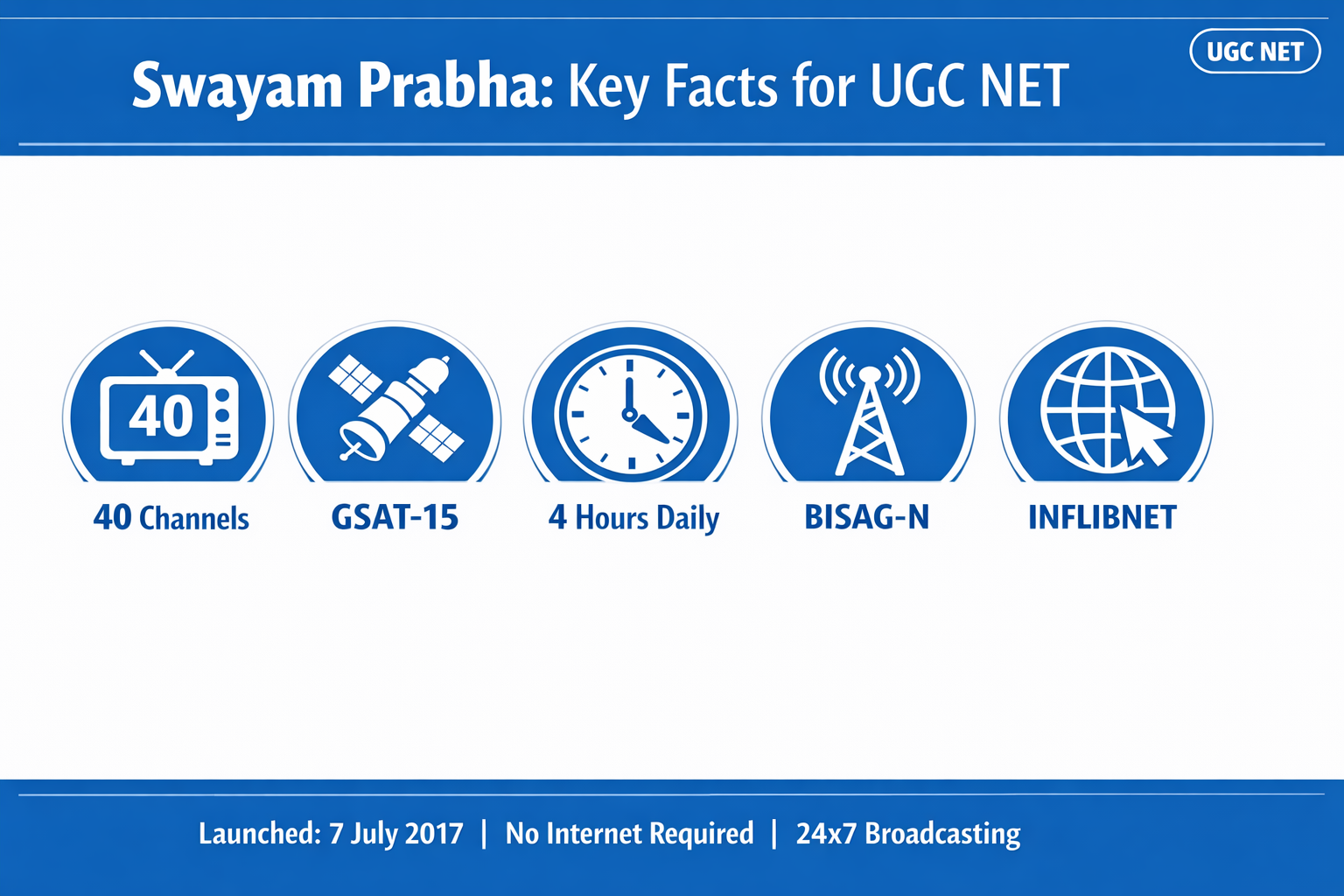
The platform officially launched on 7 July 2017 under the Ministry of Human Resource Development (now renamed Ministry of Education). This date is worth remembering because NTA has asked about launch timelines in previous papers. At its inception, Swayam Prabha operated 32 DTH channels. Over time, this expanded to the current 40 channels, making it one of the most comprehensive free educational broadcasting initiatives in the world.
The initiative falls under the broader Digital India programme and represents the government’s commitment to making quality education accessible regardless of geographical location or economic status. For examination purposes, remember these two key facts: launched 7 July 2017, and currently operates 40 DTH channels.
Core Objective: Education Without Internet Barriers
The fundamental purpose of Swayam Prabha addresses a critical challenge in Indian education: internet connectivity remains inconsistent across large parts of the country. While urban areas enjoy reliable broadband, many rural and semi-urban regions still struggle with internet access. Swayam Prabha solves this problem by using satellite-based DTH technology instead of internet delivery.
This means a student in a remote village can access the same educational content as someone in a metropolitan city. The only requirement is a television with basic DTH setup, which is far more common than reliable internet connections in rural India. The platform broadcasts curriculum-based content covering disciplines from arts to engineering, at levels ranging from school education to postgraduate courses.
For your exam, understand that the core objective is bridging the digital divide by providing internet-independent access to quality education. Questions often test whether you understand why DTH was chosen over online delivery, and the answer lies in reaching learners where internet infrastructure is inadequate.
SWAYAM vs Swayam Prabha: The Distinction You Must Know for UGC NET
This is arguably the most important section for exam preparation. Confusing SWAYAM with Swayam Prabha is one of the most common mistakes aspirants make, and NTA specifically designs questions to test whether you understand the difference.
Key Differences
SWAYAM and Swayam Prabha are two distinct initiatives launched within days of each other in July 2017. Despite their similar names, they operate on completely different models. SWAYAM (Study Webs of Active-Learning for Young Aspiring Minds) is an online MOOC platform that requires internet connectivity. You access it through the swayam.gov.in portal, enroll in courses, watch video lectures, complete assignments, participate in discussion forums, and earn certificates upon completion.
Swayam Prabha, in contrast, is a DTH television initiative that broadcasts educational content through satellite signals. No internet is required. You simply tune in to the relevant channel on your DTH service and watch the content. There are no enrollments, no assignments, no discussion forums, and no certificates. The content is purely supplementary and passive.
The critical distinctions to remember are: SWAYAM offers certificates and credit transfer (up to 20% of degree credits), while Swayam Prabha offers neither. SWAYAM requires internet, Swayam Prabha does not. SWAYAM is interactive with assessments, Swayam Prabha is passive viewing. When exam questions mention certificate provision or credit transfer, the answer is always SWAYAM, not Swayam Prabha.
Why NTA Tests This Comparison Frequently
NTA tests this comparison because it assesses whether aspirants have genuine conceptual clarity or merely surface-level familiarity with terms. The similar names create natural confusion, and distinguishing between the two requires understanding the fundamental nature of each platform.
Typical question formats include: “Which of the following provides certificates for course completion: SWAYAM or Swayam Prabha?” or “Statement 1: Swayam Prabha requires internet connectivity. Statement 2: SWAYAM offers credit transfer up to 20%.” You might also encounter assertion-reason questions like: “Assertion: Swayam Prabha can reach areas without the internet. Reason: Swayam Prabha uses DTH satellite broadcasting.”
The key to handling these questions is creating a clear mental separation between the two platforms. Think of SWAYAM as an “online course platform” and Swayam Prabha as “educational television.” This simple framing helps you instantly identify which platform a question refers to based on the context clues provided.

Technical Framework of Swayam Prabha: Satellite, Channels, and Content Providers
Technical specifications are a favorite testing area for NTA. Matching-type questions frequently ask you to connect components like the satellite, uplinking centre, and web portal manager with their correct identifications.
Broadcasting Infrastructure (GSAT-15, BISAG-N, INFLIBNET)
Three technical terms appear repeatedly in UGC NET questions, and you must memorize them with their exact functions. GSAT-15 is the satellite used for broadcasting Swayam Prabha channels across India. When a question asks about the satellite, the answer is always GSAT-15.
BISAG-N (Bhaskaracharya National Institute for Space Applications and Geo-informatics) in Gandhinagar, Gujarat is the uplinking centre. This is where the content is transmitted up to the satellite for nationwide distribution. When questions ask about the uplinking location or centre, the answer is BISAG-N Gandhinagar.
The INFLIBNET Centre (Information and Library Network) manages the web portal at swayamprabha.gov.in. While Swayam Prabha is primarily a DTH service, the web portal allows those with internet access to stream channels online and access archived content. When questions ask about portal management or digital archive maintenance, the answer is INFLIBNET.
Create a simple association: “G-B-I” for Satellite-Uplinking-Portal, mapping to GSAT-15, BISAG-N, and INFLIBNET respectively. This mnemonic helps you quickly match components in examination questions.
The 40 Channel Ecosystem and Content Providers
Swayam Prabha operates 40 DTH channels managed by different institutions. Understanding this ecosystem helps you answer questions about content providers and channel allocation. The major content providers are CEC (Consortium for Educational Communication), NPTEL (National Programme on Technology Enhanced Learning), IGNOU (Indira Gandhi National Open University), NCERT, NIOS, and IITs.
CEC manages Channels 1 to 10, covering humanities, social sciences, law, commerce, and natural sciences. These channels have distinctive Sanskrit names like VAGEESH, SANSKRITI, and KAUTILYA. IGNOU manages Channels 11 to 16 following the September 2023 reorganization. NPTEL provides engineering and technology content. IIT-PAL (Professor Assisted Learning) manages various channels, providing school-level content in Physics, Chemistry, Mathematics, and Biology.
Remember that the channel count has evolved: 32 channels at launch in 2017, expanded to 40 currently. Some older resources mention 32 or 34 channels, but for 2025 examinations, the answer is 40 channels.
Swayam Prabha: Content Scheduling and Accessibility
Understanding how content is scheduled and accessed helps you answer questions about the platform’s operational details and viewer convenience features.
Daily Fresh Content (4 Hours) and Repeat Telecasts
Each Swayam Prabha channel broadcasts at least 4 hours of fresh content every day. This new content is then repeated 5 more times throughout the 24-hour cycle, giving viewers 6 opportunities to watch the same material. This scheduling model is specifically designed for learner convenience, allowing students to choose viewing times that fit their personal schedules.
The 24×7 broadcasting combined with repeat telecasts means students are not constrained by fixed timings. Whether you prefer studying early morning or late night, you can access the content. This flexibility is particularly valuable for working professionals and students balancing multiple commitments.
How to Access Swayam Prabha
You can access Swayam Prabha through multiple platforms. The simplest method is DD Free Dish, the government’s free DTH service. If you already have a commercial DTH connection like Dish TV, JioTV or Tata Play, Swayam Prabha channels are available in the educational channels section at no additional cost.
For those with internet access, the official web portal at swayamprabha.gov.in provides live streaming of all channels. The portal requires no registration or payment, making it completely free and accessible to anyone with an internet connection and a web browser.
Archive and On-Demand Viewing Options
Beyond live broadcasts, the INFLIBNET-managed web portal maintains a comprehensive archive of all previously broadcast content. This digital repository allows students to search for specific topics, access lectures from any date, and download videos for offline viewing.
The archive feature transforms Swayam Prabha from a purely broadcast platform into a searchable educational library. For exam preparation, you can focus on specific topics relevant to your syllabus rather than waiting for the relevant content to air. This on-demand capability significantly enhances the platform’s utility for serious learners.
UGC NET Exam: Most Frequently Asked Questions on Swayam Prabha and Preparation Tips
This section focuses specifically on examination preparation, covering the facts you must memorize, the question types you will encounter, and strategies to avoid common mistakes.
Numbers and Statistics to Memorize
Certain numerical facts appear repeatedly in examinations and require straight memorization. Create flashcards for these and review them regularly during your preparation.
The essential numbers are: 40 channels (current total), 4 hours (fresh content daily), 5 times (repeat telecasts per day), 6 times (total viewing opportunities), 7 July 2017 (launch date). For channel allocation: 10 CEC channels (1-10), 6 IGNOU channels (11-16 from September 2023), IIT-PAL channels. Remember that broadcasting happens 24×7 across all 40 channels.
Use memory techniques to retain these numbers. For example, “7-7-17” encodes the launch date (7th day, 7th month, 2017). “40-4-5” represents channels-fresh hours-repeat times. Such patterns make recall easier under exam pressure.
Important Names and Technical Terms
Beyond numbers, several technical terms and institutional names require memorization. The satellite is GSAT-15. The uplinking centre is BISAG-N (Bhaskaracharya National Institute for Space Applications and Geo-informatics) in Gandhinagar. The web portal manager is INFLIBNET Centre.
Content providers include: CEC (Consortium for Educational Communication), NPTEL (National Programme on Technology Enhanced Learning), IGNOU (Indira Gandhi National Open University), NCERT (National Council of Educational Research and Training), NIOS (National Institute of Open Schooling), and IIT-PAL (Professor Assisted Learning by IITs).
Other terms worth knowing: DTH (Direct-to-Home), MOOC (Massive Open Online Course, used for SWAYAM comparison), Ministry of Education (formerly MHRD, the parent ministry). Familiarity with these terms helps you understand question contexts quickly.
Channel Names That You Must Know for UGC NET
NTA frequently tests CEC channel names and their subject areas through matching-type questions. Memorizing at least the key channels significantly improves your chances of scoring.
Important Channel Names
The CEC-managed channels (1-10) have Sanskrit names connected to their subject areas. VAGEESH (Channel 1) covers Language and Literature. The name means “Lord of Speech,” reflecting its focus on linguistic content. SANSKRITI (Channel 2) covers History, Culture, and Philosophy. The name means “Culture,” directly indicating its content domain.
PRABODH (Channel 3) covers Social and Behavioral Sciences. SAARASWAT (Channel 4) focuses on Education, Psychology, and Home Science. PRABANDHAN (Channel 5) covers Management and Information Science. The name means “Management,” making it easy to remember.
VIDHIK (Channel 6) is dedicated to Law and Legal Studies. This is particularly relevant for law aspirants. The name means “Legal,” directly indicating its content. KAUTILYA (Channel 7) covers Economics and Commerce. Named after the ancient economist Chanakya (also known as Kautilya), this channel is essential for Commerce aspirants.
ARYABHATT (Channel 8) covers Physical Sciences including Mathematics, Physics, and Chemistry. Named after the renowned mathematician and astronomer, this channel serves science students. SPANDAN (Channel 9) focuses on Life Sciences. DAKSH (Channel 10) covers Applied Sciences.
For quick memorization, focus on the channels most relevant to your UGC NET Paper 2 subject and the ones with the most memorable names: VIDHIK for Law, KAUTILYA for Commerce, ARYABHATT for Sciences, PRABANDHAN for Management.
Common Question Types in UGC NET
Understanding question patterns helps you prepare more effectively. Swayam Prabha questions typically appear in five formats.
Statement-based MCQs present multiple statements and ask you to identify correct or incorrect ones. Example: “Which statements are correct? (1) Swayam Prabha uses GSAT-15 satellite. (2) The web portal is managed by NCERT. (3) There are currently 40 channels.”
True/False questions test specific facts. Example: “Swayam Prabha was launched in 2015. True or False?”
Assertion-Reason questions test causal understanding. Example: “Assertion: Swayam Prabha reaches areas without internet. Reason: Swayam Prabha uses DTH satellite broadcasting.”
Matching the Column questions are extremely common. Example: “Match List I (Component) with List II (Identification): A. Satellite – I. INFLIBNET, B. Uplinking Centre – II. GSAT-15, C. Web Portal – III. BISAG-N.”
Fill in the blanks test specific recall. Example: “The Swayam Prabha web portal is managed by ________.”
Practice all five formats during your preparation. Pay special attention to matching questions, as they require precise memorization of associations.
Quick Revision Strategies for SWAYAM Prabha
Effective revision strategies can make the difference between vague familiarity and exam-ready clarity. Focus on techniques that maximize retention in minimum time.
Memory Techniques for Channel Details
Create category-based groupings for easier recall. Group CEC channels by subject: Humanities (VAGEESH, SANSKRITI), Social Sciences (PRABODH, SAARASWAT, PRABANDHAN, VIDHIK), Commerce (KAUTILYA), Natural Sciences (ARYABHATT, SPANDAN, DAKSH). This grouping helps you remember that CEC has “2 Humanities, 4 Social Sciences, 1 Commerce, 3 Natural Sciences” channels.
Use the first letters to create mnemonics. “VSPSPV KAS D” represents the ten CEC channel names in order. While not a meaningful word, practicing this sequence helps you recall all names quickly. Associate channel names with their meanings: Vidhik means legal, Kautilya was an economist, Aryabhatt was a scientist.
Last-Week Revision Checklist
In the final week before your exam, focus on consolidation rather than learning new material. Day 1-2: Review all numerical facts (40 channels, 4 hours, 7 July 2017, etc.) using flashcards. Test yourself by writing down all numbers from memory.
Day 3-4: Focus on technical infrastructure (GSAT-15, BISAG-N, INFLIBNET) and practice matching exercises. Create your own matching questions and solve them. Day 5-6: Review SWAYAM vs Swayam Prabha distinctions. Ensure you can instantly identify which platform offers certificates, requires internet, or provides credit transfer. Day 7: Quick review of channel names, solve 2-3 previous year questions, and relax.
Common Errors to Avoid in SWAYAM Prabha Questions
Being aware of common mistakes helps you avoid them during the actual examination. These errors cost many aspirants marks they could have easily scored.
SWAYAM vs SWAYAM Prabha: Key Differences
The most common error is confusing SWAYAM (online MOOC platform) with Swayam Prabha (DTH television initiative). When questions mention certificates, credit transfer, or online enrollment, the answer involves SWAYAM, not Swayam Prabha. When questions mention DTH channels, satellite broadcasting, or no internet requirement, the answer involves Swayam Prabha.
Remember: SWAYAM is “web-based” and Swayam Prabha is “TV-based.” SWAYAM has a full form acronym (Study Webs of Active-Learning for Young Aspiring Minds), while Swayam Prabha is simply a Sanskrit phrase meaning “Self-Luminous.” These simple distinctions help you avoid confusion during the exam.
Updated Facts and Technical Specifications
Another common error is using outdated information. Many online resources still mention 32 or 34 channels, but the current count is 40. The September 2023 reorganization assigned Channels 11-16 to IGNOU, changing the previous allocation. Using old information in answers can cost you marks.
Similarly, ensure you use the current name “Ministry of Education” rather than the older “Ministry of Human Resource Development” unless the question specifically refers to the historical context. Technical specifications like GSAT-15, BISAG-N, and INFLIBNET have remained consistent, so these are safe to memorize without worrying about updates.
Conclusion
Swayam Prabha questions in UGC NET are designed to test your factual recall and ability to distinguish between similar-sounding initiatives. By mastering the key facts covered in this guide, you position yourself to score confidently on these questions.
Remember the essentials: Swayam Prabha launched on 7 July 2017, operates 40 DTH channels, uses GSAT-15 satellite, has content uplinked from BISAG-N Gandhinagar, and its web portal is managed by INFLIBNET. Never confuse it with SWAYAM, the online MOOC platform that offers certificates and requires internet. The CEC channels (1-10) have memorable Sanskrit names like VIDHIK for Law and KAUTILYA for Commerce. With these facts firmly in your memory, Swayam Prabha questions become easy scoring opportunities rather than challenging obstacles. Focus on the distinctions, practice matching questions, and approach the exam with confidence!Want to know about this topic in greater detail? Click here to view my article on LawSikho.
 Serato DJ Crack 2025Serato DJ PRO Crack




 Allow notifications





