

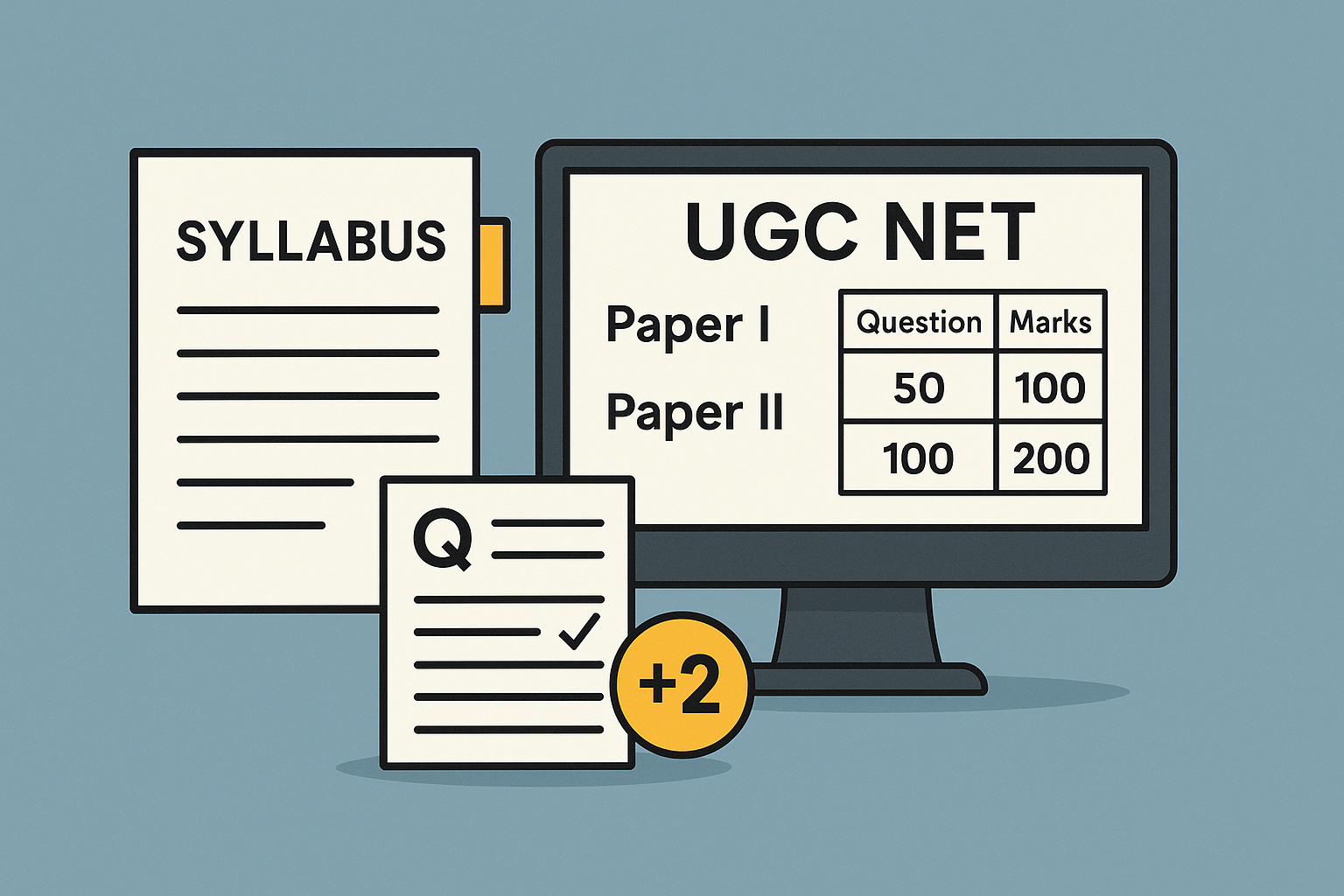
Complete UGC NET exam pattern guide covering Paper I & II structure, Law & Commerce syllabus, marking scheme, and qualifying criteria for JRF eligibility. This article is written by Neeli Neelay Shah, Senior Legal Content Writer at LawSikho.
Table of Contents
If you’re planning to build a career in academia or research, chances are you’ve already heard about the UGC NET examination. Conducted by the National Testing Agency (NTA), this national-level test is your ticket to becoming an Assistant Professor in universities and colleges across India or qualifying for the prestigious Junior Research Fellowship (JRF). The December 2025 session is right around the corner, scheduled from 31 December 2025 to 7 January 2026, and if you’re serious about cracking it, understanding the exam pattern inside out is absolutely non-negotiable. Trust me, knowing the structure of what you’re up against makes all the difference between scattered preparation and focused, strategic studying.

What is the UGC NET Exam Pattern?
Let’s start with the basics. The UGC NET examination follows a standardized pattern that has remained largely consistent since 2019. The exam consists of two papers: Paper I and Paper II, both conducted in a single session. Paper I is common for everyone regardless of subject, while Paper II tests your expertise in your chosen discipline from a list of 85 available subjects.
The entire examination carries 300 marks with 150 multiple-choice questions that you need to complete within 180 minutes. That’s 3 hours of continuous testing without any breaks. Paper I contributes 100 marks through 50 questions, while Paper II carries the heavier weightage of 200 marks through 100 questions. This structure means Paper II is twice as important in terms of marks, which should influence how you allocate your preparation time.
What makes UGC NET particularly interesting is that it serves multiple purposes simultaneously. Clear the exam with a good score, and you’re eligible for Assistant Professor positions. Score even higher and fall within the top percentage, and you qualify for JRF; a fellowship that provides financial support of ₹37,000-42,000 per month for pursuing research. The same examination, different outcomes based on your performance.
The examination is conducted in Computer-Based Test (CBT) mode at designated centres across India. You’ll be answering questions on a computer screen, selecting options with mouse clicks, and navigating through questions using an intuitive interface. If you’ve taken any competitive exam in recent years, the format will feel familiar. If not, don’t worry; we’ll cover the CBT specifics in our succeeding article. So stay tuned!
Key Features of UGC NET December 2025 Exam
Before diving into the detailed breakdown, let’s understand the key features that define the UGC NET examination. These are the fundamental aspects that every aspirant must be aware of, as they directly impact your preparation strategy and exam-day approach.
Two Papers in Single Session
Here’s something that catches many first-time aspirants off guard; both Paper I and Paper II are conducted together in a single continuous session of 3 hours. There’s no break in between, no separate time slots, and no opportunity to step out and refresh yourself midway. You sit down, the clock starts, and for the next 180 minutes, you’re navigating through 150 questions across both papers.
This format has significant implications for your preparation. You need to build mental stamina to maintain focus for three straight hours. Many candidates start strong but find their concentration wavering towards the end, especially during the more demanding Paper II questions. Practicing full-length mock tests under timed conditions is essential to condition yourself for this marathon.
The typical strategy most successful candidates follow is to spend approximately 50-60 minutes on Paper I and reserve 120-130 minutes for Paper II. Since Paper II carries double the marks and tests deeper subject knowledge, it deserves the lion’s share of your time. However, this allocation isn’t rigid; you can freely move between papers during the examination, which brings us to an important point about flexibility in the CBT format.
Computer-Based Test Mode
Gone are the days of OMR sheets and bubble filling. The UGC NET examination is conducted entirely in online mode through Computer-Based Test (CBT) format. You’ll be seated at an individual computer terminal at your designated examination centre, with the question paper displayed on your screen.
The CBT interface is designed to be user-friendly. Each question appears on screen with four options, and you simply click on your chosen answer to record your response. A question palette on the right side shows all question numbers colour-coded by status; green for answered, red for not answered, purple for marked for review, and grey for not visited. You can click on any question number to jump directly to that question.
One feature that proves incredibly useful is the “Mark for Review” option. If you encounter a question you’re unsure about or want to reconsider later, you can flag it and move on. This prevents you from getting stuck on difficult questions while easier marks slip away. After completing your first pass, you can return to marked questions with your remaining time.
For subjects involving calculations like Commerce, Economics, or Management, an on-screen calculator is available within the interface. Physical calculators are not permitted inside the examination hall. If your subject requires numerical work, I’d strongly recommend practicing with on-screen calculators during preparation; they feel different from physical ones, and exam day isn’t the time for surprises.
No Negative Marking
This is perhaps the most candidate-friendly aspect of UGC NET, and if you’re not leveraging it fully, you’re leaving marks on the table. There is absolutely no negative marking in the examination. For every correct answer, you get 2 marks. For every wrong answer? Zero marks; no deduction whatsoever.

Think about what this means strategically. In examinations with negative marking, random guessing is risky; you might lose marks for wrong attempts. In UGC NET, there’s no such penalty. If you’ve eliminated two options and are torn between the remaining two, guess! You have a 50% chance of gaining 2 marks and zero chance of losing anything.
This policy should fundamentally shape your exam approach. Never leave any question unattempted. Even if you have no clue about a question, make an educated guess based on elimination. With four options, random guessing gives you a 25% chance of being correct. That’s not nothing; over 10 completely random guesses, you’d statistically expect to get 2-3 correct, earning 4-6 marks for free.
Of course, intelligent guessing is far better than random guessing. Look for obviously wrong options, consider the logical consistency of answers, and use your general knowledge to eliminate choices. But the bottom line is clear: attempt every single question before the time runs out.
UGC NET Paper I Exam Pattern
Paper I is where your journey through the examination begins. This general aptitude paper is common to all candidates, regardless of whether you’re appearing for Law, Commerce, English, History, or any of the other 85 subjects. Its purpose is to evaluate whether you possess the fundamental skills and awareness necessary for a career in teaching and research.
Many candidates make the mistake of underestimating Paper I, focusing almost exclusively on their subject-specific Paper II. This is a strategic error. Paper I carries 100 marks: a third of the total and the questions here are often more scoring than Paper II because they test aptitude rather than deep subject knowledge. A strong Paper I performance can compensate for weaknesses in Paper II, while a poor Paper I can sink an otherwise good attempt.
The paper tests a diverse range of skills: your understanding of teaching methodologies, research processes, logical reasoning capabilities, mathematical aptitude, comprehension skills, and awareness about higher education systems in India. It’s designed to assess whether you have the well-rounded intellectual foundation that academic careers demand.
Paper I Structure and Syllabus
Total Questions and Marks in Paper I
Paper I consists of 50 multiple-choice questions, each carrying 2 marks, for a total of 100 marks. All questions are compulsory; there’s no choice or optional sections. The questions come from 10 distinct units, and while there’s no formal sectional division during the exam, understanding the unit-wise structure helps in systematic preparation.
The time you should ideally spend on Paper I is around 50-60 minutes, giving you roughly 1 minute per question. This might seem tight, but Paper I questions are generally less complex than Paper II questions. Many can be answered in 30-40 seconds if you know your concepts well, leaving buffer time for trickier questions.
One thing to note: there’s no separate timing for Paper I and Paper II. The 3-hour clock runs for both papers combined. This means you have complete flexibility in how you allocate time. Some candidates prefer completing Paper I first before moving to Paper II. Others jump straight to Paper II while they’re freshest and tackle Paper I later. Find what works for you through mock test practice.
UGC NET Paper I Major Units
The Paper I syllabus is divided into 10 comprehensive units, each designed to test a specific aspect of your aptitude for academic careers. Let me walk you through each one so you know exactly what to expect.
Unit 1 is Teaching Aptitude, covering concepts of teaching, objectives, levels of teaching (memory, understanding, and reflective), characteristics of effective teaching, and factors affecting teaching. You’ll encounter questions about teaching methods, learner characteristics, and the teaching-learning process. This unit is relatively straightforward if you study systematically.
Unit 2 focuses on Research Aptitude, testing your understanding of research meaning, types, characteristics, and methods. Questions cover research ethics, thesis writing, steps in research, and application of ICT in research. Concepts like hypothesis formulation, sampling techniques, and research design frequently appear. If you’re aiming for JRF, pay special attention here: research aptitude is your bread and butter.
Units 3 and 4 cover Comprehension and Communication respectively. The comprehension section presents passages followed by questions testing your reading and inference abilities. Communication covers verbal and non-verbal communication, effective communication principles, barriers to communication, and mass media. These units reward good English skills and general awareness.
Units 5, 6, and 7 deal with Mathematical Reasoning, Logical Reasoning, and Data Interpretation. These are the analytical backbone of Paper I. You’ll face questions on number series, letter series, coding-decoding, analogies, Venn diagrams, syllogisms, and arguments. Mathematical aptitude questions cover basic arithmetic: percentages, ratios, time and distance, profit and loss. Data interpretation requires analysing tables, charts, and graphs.
Unit 8 covers Information and Communication Technology (ICT), testing your knowledge of computers, internet, email, and digital initiatives in education. Unit 9 focuses on People, Development and Environment, covering environmental issues, pollution, and sustainable development. Unit 10 addresses the Higher Education System in India, including governance, policies, UGC, NAAC, and other regulatory bodies.
Paper I Unit-Wise Marks Distribution
Number of Questions from Each Unit
The distribution across Paper I is remarkably uniform. Each of the 10 units typically contributes 5-6 questions worth 10 marks. This means every unit carries equal official weightage, and neglecting any unit means potentially losing marks; a significant chunk when cut-offs can be tight.
High-Weightage Units to Prioritise
While marks distribution is uniform, the practical difficulty and scoring potential vary significantly across units. Let me share some insights that can help you prioritize during preparation and execution.
Teaching Aptitude and Research Aptitude are considered the most scoring units. The questions here are largely factual: definitions, characteristics, types, methods. If you’ve studied these topics systematically, you can answer most questions in under 30 seconds. These should be your confidence boosters, the sections where you aim for near-perfect scores.
On the other end, Data Interpretation and Mathematical Reasoning can be time-consuming. Even if you know the concepts, calculations take time. A data interpretation question might require reading a complex table, understanding what’s being asked, performing multiple calculations, and selecting the correct option. This could take 2-3 minutes for a single question.
My recommended strategy: Attempt Teaching Aptitude and Research Aptitude first. These are typically faster and more scoring. Then tackle Comprehension (which requires reading time), and finally approach Mathematical Reasoning, Logical Reasoning, and Data Interpretation. This sequence ensures you’ve secured easier marks before spending time on challenging sections.
UGC NET Law Paper II Exam Pattern
Now let’s move to the heart of the examination: Paper II. This is where your subject expertise is tested, and it carries double the weightage of Paper I. I’ll cover two popular subjects in detail: Law and Commerce. If you’re appearing for a different subject, the structural elements (questions, marks, format) remain the same; only the syllabus content differs.
UGC NET Exam Pattern for Law
UGC NET Law (Subject Code: 58) is designed for candidates who have completed their LLM and aspire to teach law in universities and colleges or pursue research in legal studies. It’s one of the more competitive papers, with thousands of law postgraduates appearing each session.
Total Questions and Marks in Law Paper II
Paper II for Law consists of 100 multiple-choice questions, each carrying 2 marks, totalling 200 marks. All questions are compulsory: there’s no optional section or choice between questions. The absence of negative marking applies here too, so attempt everything.
The questions in Law Paper II test multiple dimensions of your legal knowledge. You’ll encounter questions that are purely definitional (asking about the meaning of legal terms or concepts), questions testing your knowledge of statutory provisions (specific sections of laws), questions about landmark judgments (case names, holdings, and principles established), and analytical questions requiring application of legal principles to factual scenarios.
UGC NET Law Syllabus
The UGC NET Law syllabus is divided into 10 comprehensive units covering the major branches of law. Let me break these down so you know exactly what territory you’re covering.
Unit 1 is Jurisprudence, the philosophical foundation of law. This includes nature and sources of law, schools of jurisprudence (Natural Law, Positivism, Sociological School, Realist School), concepts of rights and duties, legal personality, property, ownership, possession, and liability. Questions from jurisprudence test your understanding of why law exists and how legal concepts are structured.
Unit 2 covers Constitutional Law and Administrative Law. This is a heavyweight unit covering the Preamble, fundamental rights and duties, directive principles, union and state executives, legislature, judiciary, emergency provisions, and administrative law concepts like delegated legislation, administrative tribunals, and judicial review of administrative action. Given the breadth of Indian constitutional law, this unit demands serious preparation time.
Unit 3 deals with Public International Law: definition, nature, sources, recognition of states, nationality, extradition, asylum, United Nations and its organs, WTO, international humanitarian law, and settlement of international disputes. While this might seem distant from domestic practice, it’s essential for academic careers and frequently tested.
Unit 4 is Law of Crimes, covering general principles of criminal liability (actus reus, mens rea), stages of crime, inchoate offenses, general exceptions, and specific offenses against person, property, state, women, and children.
Units 5-10 cover Law of Torts and Consumer Protection, Law of Contracts and Commercial Law (including Sale of Goods, Partnership, Negotiable Instruments, and Company Law), Family Law (Hindu and Muslim personal laws), Labour and Industrial Law, Environmental Law, Human Rights and Intellectual Property Rights. Each unit represents a distinct branch of law with its own statutes, principles, and jurisprudence.
High Weightage Topics in UGC NET Law Paper II
Based on analysis of previous year question papers, certain areas consistently carry higher weightage. If you’re pressed for time (and who isn’t?)prioritising these topics makes strategic sense.
Constitutional Law is unquestionably the most important unit, typically accounting for 20-25% of the paper. Within this, fundamental rights and judicial review are frequently tested. Recent Supreme Court judgments on constitutional matters appear regularly so stay updated with landmark decisions.
Jurisprudence is the second-highest weightage area at 15-20%. The schools of jurisprudence (especially Austin’s command theory, Kelsen’s pure theory, natural law theories, and sociological jurisprudence) are evergreen topics. Concepts of rights, duties, legal personality, and liability appear consistently.
In addition to this, you must focus on Law of Crimes as well with prime focus on criminal liability.
Commercial Law (Contracts, Sale of Goods, Company Law) and Family Law are medium-weightage areas. Environmental Law and IPR have grown in importance given contemporary relevance. Labour Law questions test knowledge of major legislations like Industrial Disputes Act, Factories Act, and recent labor code consolidations.
For success in UGC NET Law, you can adopt a three-pronged approach: master the high-weightage topics thoroughly, ensure decent coverage of all units to avoid zero scores in any area, and stay updated with recent amendments and landmark judgments.
UGC NET Exam Pattern for Commerce
UGC NET Commerce (Subject Code: 08) is among the most popular papers, attracting commerce and management postgraduates seeking academic careers. The competition is fierce, but so are the opportunities; commerce faculty is in demand across thousands of colleges.
Total Questions and Marks in Commerce Paper II
Like all Paper II subjects, Commerce consists of 100 multiple-choice questions worth 200 marks. However, what distinguishes Commerce from many other subjects is the significant presence of numerical questions. While papers like History or Political Science are entirely theoretical, Commerce blends conceptual questions with calculation-based problems.
UGC NET Commerce Syllabus
The Commerce syllabus spans 10 units covering the breadth of business and management education. Here’s what each unit encompasses.
Unit 1 covers Business Environment and International Business. This includes the economic environment (economic systems, monetary and fiscal policies), political environment, legal environment (FEMA, Consumer Protection), socio-cultural factors, CSR, globalization, and modes of international business entry. Questions test your understanding of how businesses operate within broader environmental contexts.
Unit 2 is Accounting and Auditing, arguably the core of commerce education. This covers financial accounting (preparation of financial statements, accounting standards), corporate accounting (amalgamation, liquidation, holding company accounts), cost accounting (various costing methods, standard costing, variance analysis), and auditing (auditing standards, types of audit, internal control). Expect both conceptual and numerical questions from this unit.
Unit 3 deals with Business Economics, both micro and macro perspectives. Demand analysis, production and cost, market structures, national income, monetary policy, fiscal policy, and international trade concepts appear here. While primarily theoretical, some numerical questions on elasticity, national income calculation, or monetary multiplier may appear.
Unit 4 covers Business Finance, including sources of finance, capital structure theories, cost of capital, capital budgeting techniques, dividend policies, and working capital management. This is another calculation-heavy unit; expect questions requiring NPV, IRR, payback period, or ratio calculations.
Unit 5 is Business Statistics, covering measures of central tendency, dispersion, correlation, regression, probability, and time series analysis. This is purely numerical—you need to know formulas and how to apply them quickly.
Units 6-10 cover Marketing Management (marketing mix, consumer behaviour, product life cycle, pricing, distribution, promotion, digital marketing), Human Resource Management (recruitment, selection, training, performance appraisal, compensation), Organizational Behaviour and Theory (motivation theories, leadership, organizational culture, change management), Business Law and Corporate Governance (Company Law, Contract Act, Consumer Protection, corporate governance principles), and Income Tax and GST (tax provisions, computation, and recent amendments).
High Weightage Topics in UGC NET Commerce Paper II
From previous year analysis, Accounting and Auditing (Unit 2) consistently tops the chart with 11-15 questions. Master financial statements, ratio analysis, cost sheets, and variance analysis: expect 4-6 numericals every time. Quick calculation speed is the game-changer here.
Business Finance (Unit 4) brings 10-12 questions, almost all formula-driven. Cost of capital, NPV/IRR, capital structure, and dividend decisions appear regularly; solve at least 50 problems per topic to stay safe.
Marketing Management (Unit 8) also gives 10-12 questions and remains largely conceptual. Focus on 4Ps, consumer behaviour models, STP framework, and digital marketing trends for easy, accurate scoring.
HRM and Organizational Behaviour (Unit 6) together contribute 10-12 questions. Motivation theories (Maslow, Herzberg), leadership styles, performance appraisal, and group dynamics repeat almost every year: pure theory, high returns.
Business Statistics & Research Methods (Unit 5) carries 8-10 questions. Probability, correlation, hypothesis testing, and sampling need zero calculation mistakes; daily practice of formulas is compulsory.
Legal Aspects of Business (Unit 10) holds 10-12 questions with rising focus on corporate governance. Stay updated on Companies Act, GST, Contract Act, and Competition Act; section-based and amendment questions are increasing.
Income Tax (Unit 9) delivers 8-10 questions mixing slabs, deductions, and basic planning. Never skip this unit; short preparation yields solid marks.
UGC NET Marking Scheme and Qualifying Criteria
Understanding how marks are calculated and what scores you need is fundamental to setting realistic targets and measuring your preparation progress. Let’s break down the marking scheme and qualifying criteria in detail.
Marks for Correct and Wrong Answers
The marking scheme is refreshingly simple. For every correct answer in both Paper I and Paper II, you receive 2 marks. This applies uniformly across all 150 questions; there’s no differential marking based on difficulty or paper.
For wrong answers, you receive zero marks. Not negative marks, just zero. This is worth emphasizing because many competitive examinations penalize wrong answers with negative marking (typically -0.5 or -0.25 for each wrong attempt). UGC NET doesn’t do this, which fundamentally changes optimal exam strategy.
Marks for Unattempted Questions
Unattempted questions carry zero marks; the same as incorrect answers. From a scoring perspective, leaving a question blank is identical to getting it wrong. There’s absolutely no advantage to leaving questions unanswered, and there’s potential upside to attempting everything.
One exception where questions might be left unanswered legitimately: if you’ve already decided on an answer but haven’t confirmed it (perhaps you’re reconsidering). In such cases, ensure you confirm your answer before moving on. The CBT interface saves responses automatically once confirmed.
There’s also a provision for ambiguous or incorrect questions. If NTA determines during the answer key challenge process that a question had errors or multiple correct answers, candidates who attempted that question and chose one of the correct options receive 2 marks. If a question is dropped entirely, all candidates receive 2 marks regardless of their response.
Qualifying Percentage
Now comes the crucial question: what score do you need to qualify? There are two thresholds to understand: minimum qualifying marks and actual cut-off marks.
The minimum qualifying percentage is 40% aggregate for General/Unreserved category candidates. This translates to 120 marks out of 300 (combining Paper I and Paper II). For reserved category candidates (OBC Non-Creamy Layer, SC, ST, PwD, Transgender), the minimum is 35%, which equals 105 marks out of 300.
However and this is important: simply scoring 120 marks (or 105 for reserved categories) doesn’t guarantee you’ll qualify as Assistant Professor or receive JRF. These are minimum thresholds, below which you’re automatically disqualified regardless of other factors.
In practice, actual cut-offs are significantly higher than minimum qualifying marks. For popular subjects like Commerce, English, or Political Science, General category cut-offs for Assistant Professor eligibility often range from 150-180 marks. JRF cut-offs are even higher; typically 200-240 marks for General category in competitive subjects.
The cut-off varies by subject (less competitive subjects have lower cut-offs), category (reserved categories have lower cut-offs than General), and eligibility type (JRF cut-offs are higher than Assistant Professor cut-offs). Only about 6% of candidates who appear in both papers ultimately qualify for UGC NET, so competition is genuine.
Conclusion
The UGC NET examination follows a clear, well-defined pattern that rewards systematic preparation and strategic execution. With 150 questions across two papers to be completed in 3 hours for 300 marks, understanding this structure is your first step toward cracking the examination. Paper I tests your general aptitude through 10 units worth 100 marks, while Paper II assesses your subject expertise through 100 questions worth 200 marks.
The absence of negative marking is a significant advantage that you should fully exploit; attempt every question, use intelligent guessing, and never leave anything unanswered. For Law aspirants, focus on Constitutional Law and Jurisprudence as high-weightage areas while ensuring coverage of all 10 units including the new criminal law framework. Commerce candidates should balance theoretical understanding with computational practice, particularly in Accounting, Finance, and Statistics.
Remember that minimum qualifying marks (40% for General, 35% for reserved) are just entry thresholds; actual cut-offs are considerably higher. Set your targets at 180+ marks to have a realistic shot at qualification, especially for competitive subjects. Paper I should not be neglected; it’s often more scoring than Paper II and can compensate for subject-specific weaknesses.
For more in-depth information on UGC NET Exam Pattern, please visit our LawSikho Blog by clicking on this link.
 Serato DJ Crack 2025Serato DJ PRO Crack





 Allow notifications





