

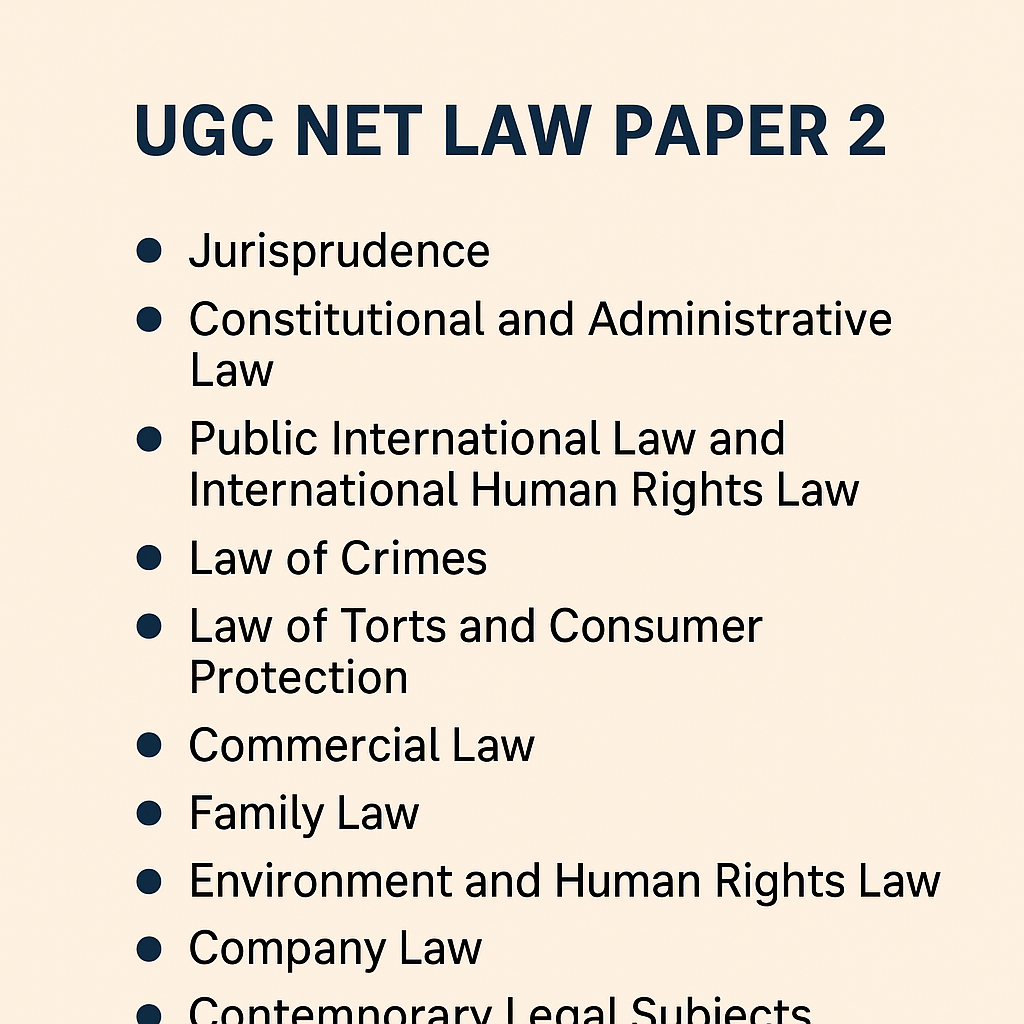
UGC NET Law Paper 2 Syllabus: Quick guide covering exam pattern, unit-wise syllabus overview, high-priority topics, best books, and preparation tips for Law. This article is written by Urvi Shah, Senior Associate at LawSikho.
Table of Contents
Preparing for the UGC NET Law examination requires a clear understanding of how the assessment is structured and what the National Testing Agency (NTA) expects from candidates. Among the two papers, Paper 2 plays a decisive role, as it directly evaluates your command over core legal subjects and significantly influences your overall score and ranking.
Paper 2 carries 200 marks out of the total 300, making it the most critical component for candidates aspiring to qualify for the Assistant Professor position or secure the Junior Research Fellowship (JRF). The paper comprises 100 objective-type questions, distributed across 10 comprehensive units that cover the breadth of legal education. Each question carries 2 marks, and importantly, there is no negative marking, enabling candidates to maximise their score through strategic attempts.

Whether you are a final-year LL.M. student, a recent graduate, or a legal professional seeking to transition into academia or research, a thorough understanding of the Paper 2 syllabus is essential. It not only helps streamline your preparation but also provides a structured path to navigate the vast subject matter effectively.
This guide simplifies the entire framework, transforming what may initially appear to be an extensive syllabus into a practical and achievable study roadmap.
Let us begin.
UGC NET Law Paper 2 Exam Pattern and Structure
Before diving into the syllabus, let’s quickly understand how the examination is structured. Knowing the pattern helps you strategize your preparation and manage time effectively during the actual exam.
Exam Structure and Duration
The UGC NET Law examination follows a computer based test (CBT) format comprising two papers conducted in a single 3 hour session without any break.
Paper 1 tests General Aptitude with 50 questions worth 100 marks, while Paper 2 focuses entirely on Law with 100 questions worth 200 marks. Both papers are available in English and Hindi medium.
The subject code for UGC NET Law is 58. Since there’s no interval between papers, you’ll need to maintain focus and energy throughout the 180 minute examination window. Time management becomes crucial when you’re tackling 150 questions in one sitting.
Minimum Qualifying Marks for Different Categories
To qualify, General/Unreserved/EWS category candidates need at least 40% aggregate marks (120 out of 300) across both papers. Reserved category candidates, including OBC NCL, SC, ST, PwD, and Transgender need 35% (105 out of 300).
Why No Negative Marking Works in Your Favor?
The absence of negative marking in UGC NET Law is a significant strategic advantage that many candidates fail to utilize.
Since there’s no penalty for wrong answers, you should never leave any question unanswered. Even educated guesses can potentially add to your score, making time management and attempting all 150 questions essential for maximizing your marks.
UGC NET Law Paper 2: Syllabus Overview
The Paper 2 syllabus is divided into 10 comprehensive units, each covering distinct areas of law. While all units carry roughly equal weightage, understanding their scope helps you plan your preparation timeline efficiently.
Core Legal Subjects
Unit I: Jurisprudence
It covers nature and sources of law, schools of jurisprudence (Natural Law, Positivism, Realism, Sociological), concepts of rights and duties (Hohfeldian analysis), legal personality, liability theories, and contemporary topics like law and global justice.
Unit II: Constitutional and Administrative Law
It is often the highest weightage unit, which includes the Preamble, Fundamental Rights and Duties, DPSP, Union and State executive/legislature structures, distribution of powers, judiciary and emergency provisions, Election Commission, and administrative law principles, including natural justice and judicial review.

Unit III: Public International Law and IHL
It examines sources of international law, state and government recognition, nationality and refugees, extradition and asylum, UN organs, dispute settlement mechanisms, WTO basics, and International Humanitarian Law conventions and protocols.
Unit IV: Law of Crimes
It covers general principles (actus reus, mens rea, constructive liability), inchoate crimes (abetment, conspiracy, attempt), general exceptions, offences against human body/state/property, women and children protection laws, drug trafficking, and punishment theories including victim compensation. Note: Study both IPC and the new Bharatiya Nyaya Sanhita (BNS) 2023.
Unit V: Law of Torts and Consumer Protection
It addresses tortious liability principles, general defenses, specific torts (negligence, nuisance, trespass, defamation), remoteness of damages, strict and absolute liability, state liability, Consumer Protection Act provisions, Motor Vehicles Act (no fault liability), and Competition Act basics.
Specialized Legal Areas
Unit VI: Commercial Law
It encompasses contract essentials including e-contracts, breach and frustration, quasi-contracts, specific contracts (bailment, pledge, indemnity, guarantee, agency), Sale of Goods Act, Partnership and LLP, Negotiable Instruments Act (especially Section 138), and Company Law fundamentals covering incorporation, shares, debentures, directors, and CSR.
Unit VII: Family Law
It requires understanding across multiple personal laws, sources and schools, marriage and dissolution under Hindu/Muslim/Christian/Parsi laws, matrimonial remedies and divorce theories, live-in relationships, foreign decree recognition, maintenance/dower/stridhan, adoption and guardianship, succession and inheritance, wills/gifts/wakf, and the Uniform Civil Code debate.
Unit VIII: Environment and Human Rights Law
It examines environmental pollution concepts, international environmental law and UN conferences, constitutional and legal frameworks (Articles 48A, 51A(g), Environment Protection Act 1986), Environmental Impact Assessment (EIA) and hazardous waste control, National Green Tribunal, human rights development, universalism vs cultural relativism, International Bill of Rights, group rights (women, children, persons with disabilities, minorities), and human rights commissions (NHRC, NCM, NCW, NCSC, NCST, NCBC).
Unit IX: IPR and Information Technology Law
It covers IP concepts and theories, international conventions (Paris, Berne, TRIPS), copyright and neighboring rights, patent law (patentability, grant procedure), trademark law and passing off, geographical indications, biodiversity and traditional knowledge protection, IT Act provisions (digital signatures, e-governance, electronic records), and cyber crimes.
Unit X: Comparative Public Law
It studies comparative methodology, government forms (presidential vs parliamentary, unitary vs federal), federalism models across the USA/Canada/India, rule of law (formal and substantive), separation of powers in different jurisdictions, judicial independence and activism, constitutional review systems, amendment procedures, Ombudsman institutions, and right to information laws.
High Priority Topics and Preparation Tips
Not all units are created equal when it comes to examination frequency. Strategic preparation means focusing your energy where it matters most while ensuring complete syllabus coverage.
Which Units to Focus on First?
Based on the previous year’s question paper analysis, Constitutional and Administrative Law consistently yields the highest number of questions and Jurisprudence, Law of Crimes, and Family Law are important areas.
Start your preparation with these high weightage units before moving to others.
Within Constitutional Law, focus on fundamental rights interpretation, basic structure doctrine, and administrative law principles.
For Jurisprudence, master the schools of jurisprudence and Hohfeldian analysis of rights. Criminal Law questions frequently test general principles, stages of crime, and general exceptions. Ensure you’re comfortable with both IPC provisions and corresponding BNS changes, given the recent criminal law reforms.
Quick Study Tips for Working Professionals
If you’re balancing job responsibilities with UGC NET preparation, efficiency is everything.
Dedicate at least 2 to 3 focused hours daily rather than sporadic longer sessions.
Use commute time for audio lectures or flashcard revision. Create unit wise summary notes during weekends that you can quickly revise during weekdays.
Prioritize previous year question papers over exhaustive textbook reading.
Understanding question patterns helps you identify high yield topics within each unit. Aim to complete at least 20 to 25 mock tests before the examination, analyzing each one to identify weak areas.
Many working professionals successfully clear UGC NET by following a 6 month structured plan with consistent daily effort rather than last minute cramming.
Where to Download UGC NET Law Syllabus?
Having the official syllabus document is essential for ensuring your preparation covers all required topics. Always refer to the authoritative NTA sources rather than relying solely on third party materials.
Official NTA Syllabus PDF Links (English and Hindi)
You can download the official UGC NET Law Syllabus PDF from the NTA official website or the UGC NET Online Portal. The syllabus is available in both English and Hindi mediums, and the current version applicable from June 2019 onwards remains valid. Save these PDFs on your device for offline reference and cross check your study materials against official topics to ensure complete coverage.
Best Books and Resources for UGC NET Law Paper 2
Choosing the right study materials can make or break your preparation. Here are proven resources that align with examination requirements.
Top Recommended Books
For comprehensive UGC NET preparation, “UGC NET Law Guide” by Rukmesh and “The Ultimate Guide to UGC NET (Law)” by Bhavna Sharma (updated for new criminal laws) cover all units systematically.
For subject specific depth, refer to M.P. Jain for Constitutional Law, K.D. Gaur for Criminal Law, Paras Diwan for Family Law, and N.V. Paranjape for Jurisprudence.
Keep Bare Acts handy many questions directly quote statutory provisions, making familiarity with exact legal language crucial for scoring.
How Many Mock Tests Should You Attempt?
Target at least 30-40 full length mock tests before the examination, with sectional tests in earlier stages and complete simulations during the final 8 weeks. Quality matters alongside quantity use tests from reputed coaching institutes that reflect NTA patterns accurately.
After each test, thoroughly analyze mistakes by categorizing them unit wise, maintaining an error log that guides your revision priorities and helps convert weaknesses into strengths.
Conclusion
UGC NET Law Paper 2 tests your comprehensive legal knowledge across 10 diverse units, but strategic preparation makes this challenge manageable. Focus on high weightage units like Constitutional Law, Jurisprudence, Criminal Law, and Family Law while ensuring you don’t completely neglect other areas.
Success in UGC NET requires consistency over intensity. Whether you’re a full time aspirant or a working professional, create a realistic study schedule, leverage quality resources, practice extensively through mock tests, and stay updated on recent legal developments, including the new criminal laws.
With disciplined preparation and the right approach, qualifying for UGC NET and beginning your journey in legal academia is absolutely within reach.
For more details on UGC NET Law Paper 2, visit this link.
 Serato DJ Crack 2025Serato DJ PRO Crack





 Allow notifications





