

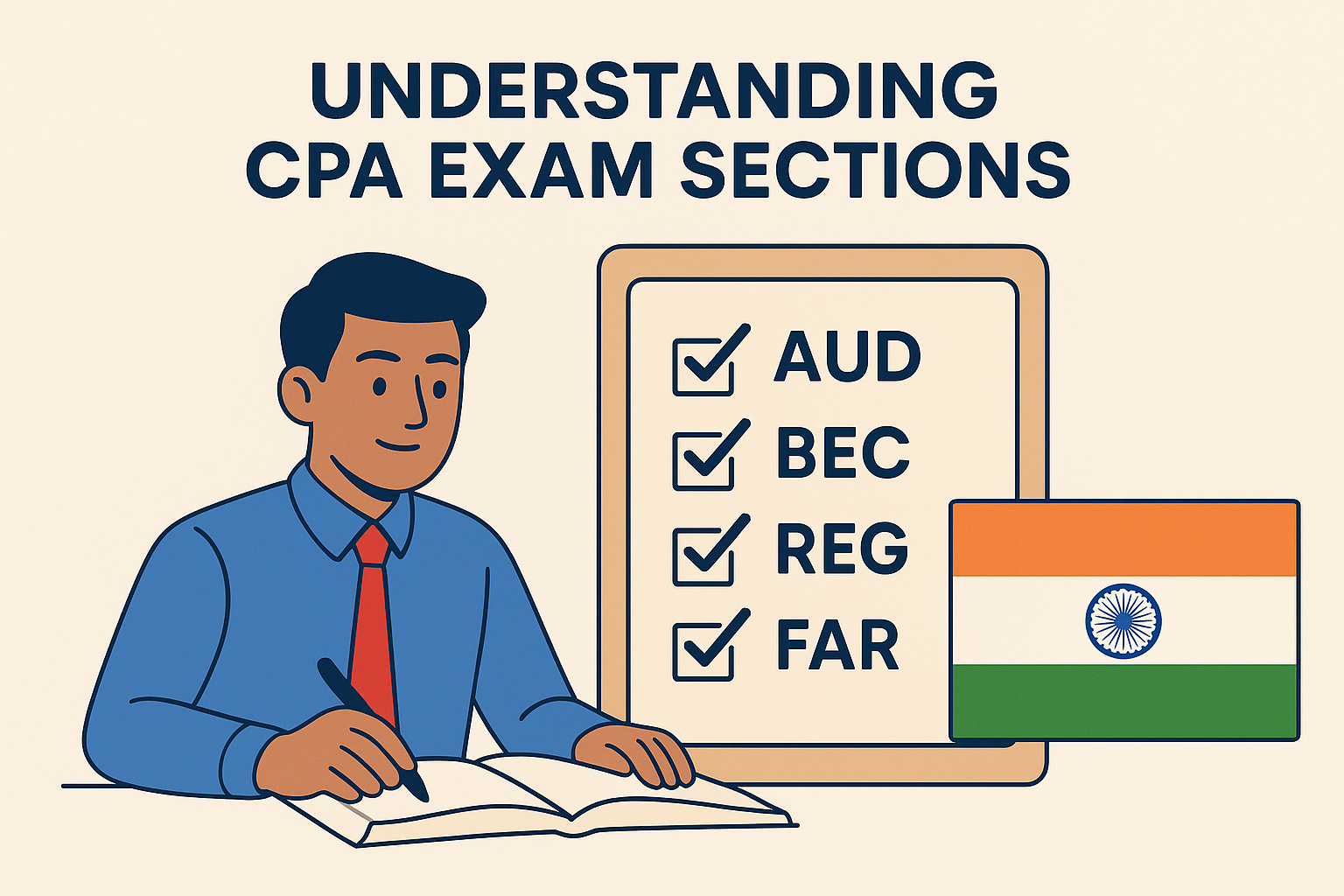
Quick guide to CPA exam sections for Indian professionals. Understand the Core + Discipline model, choose the right discipline, and plan your exam strategy effectively. This article is written by Medha Vinod, Senior Associate at LawSikho.
The US CPA exam looks completely different today than it did just two years ago. In January 2024, AICPA and NASBA launched what they call CPA Evolution, replacing the traditional four-section exam with a new Core + Discipline model that gives you more control over your path to licensure. If you’re an Indian professional researching CPA certification, you’ve probably encountered conflicting information from outdated sources still describing the old format. This guide cuts through the confusion and gives you a clear, actionable understanding of how the current exam works, what each section tests, and how to make smart decisions about your exam strategy without getting lost in excessive detail.
The New CPA Exam Structure at a Glance
The modern CPA exam requires you to pass four sections total, but with an important twist: three sections are mandatory for everyone, while the fourth is your choice from three options. This structure recognizes that while all CPAs need certain foundational skills, the profession has diversified enough that specialization matters. Understanding this basic framework is your first step toward planning an effective exam strategy.
Three Core Sections Every Candidate Must Pass
Every CPA candidate worldwide takes the same three Core sections. These aren’t optional, and you cannot substitute one for another. Think of them as the non-negotiable foundation that proves you understand the essentials of accounting, auditing, and taxation that every licensed CPA must know.

AUD (Auditing and Attestation) tests your ability to conduct audit engagements, assess risks, gather evidence, and report findings according to US professional standards. The section covers everything from planning an audit to forming conclusions and writing reports. If you’ve worked in audit roles or completed CA articleship, some concepts will feel familiar, though the specific standards and frameworks are distinctly American. AUD contains 78 multiple-choice questions and 7 task-based simulations, all completed within four hours.
FAR (Financial Accounting and Reporting) covers financial statement preparation and analysis under US GAAP. This section has a reputation as the most challenging because it spans financial reporting for businesses, not-for-profit entities, and includes various complex accounting treatments. With only 50 multiple-choice questions but substantial task-based simulations, FAR tests depth rather than breadth. Pass rates typically hover around 40-43%, the lowest of any section.
REG (Taxation and Regulation) focuses on US federal taxation for individuals and business entities, plus business law and professional ethics related to tax practice. For Indian candidates, this section requires learning an entirely new tax system from scratch since nothing from Indian tax law transfers directly. The section includes 72 multiple-choice questions and 8 simulations. Despite the learning curve, REG actually has strong pass rates around 60-64%, suggesting that structured study approaches work well here.
One Discipline Section of Your Choice
After mastering the Core sections, you select one Discipline that aligns with your interests or career goals. Each Discipline builds on concepts from a related Core section, allowing you to demonstrate deeper expertise in a specialized area. Your choice here is consequential for your study journey but not for your career options after licensure.
BAR (Business Analysis and Reporting) extends FAR’s financial reporting foundation into advanced accounting, financial analysis, and government accounting. Topics include business combinations, consolidated statements, derivatives, performance measurement, and state and local government accounting under GASB standards. This Discipline suits candidates interested in corporate finance, FP&A, or advisory roles. BAR has the lowest Discipline pass rate at 37-41%, reflecting its substantial technical content.
ISC (Information Systems and Controls) builds on AUD’s assurance concepts with a technology focus. The section covers IT audit, data management, cybersecurity controls, and SOC engagements. ISC has a unique format with 82 multiple-choice questions (the most of any section) and only 6 simulations, weighted 60% MCQ and 40% TBS. This Discipline appeals to candidates targeting IT audit, technology risk, or data governance careers. Pass rates fall in the middle range at 75-80%.
TCP (Tax Compliance and Planning) deepens REG’s tax foundation into complex compliance scenarios, entity tax planning, and personal financial planning. If you enjoyed REG and want to specialize in taxation, TCP is the natural extension. This Discipline consistently achieves the highest pass rates of any section at 72-78%, partly because candidates arrive with fresh REG knowledge and partly because the content scope is more focused than BAR’s diverse requirements.
What Each CPA Section Tests and Why It Matters
Understanding what each section actually tests helps you allocate study time appropriately and set realistic expectations. The sections differ not just in content but in how they test you, with varying emphasis on knowledge recall versus application and analysis.
Breaking Down the Core Sections
The three Core sections share a common four-hour format but differ significantly in content volume, question types, and the skills they emphasize. Knowing these differences helps you prepare effectively for each section’s unique demands.
AUD’s testing approach emphasizes professional judgment more than the other sections. According to the AICPA’s CPA Exam Blueprints, AUD is the only section that tests “Evaluation” as a skill level, meaning you’ll face questions requiring you to draw conclusions and make professional judgments rather than simply apply rules. Content areas include ethics and professional responsibilities (15-25%), risk assessment and audit planning (25-35%), evidence gathering procedures (30-40%), and conclusions and reporting (10-20%). Indian CAs often find the conceptual framework familiar since audit methodology shares common principles globally, but specific US standards like PCAOB requirements for public companies and AICPA standards for non-issuers require dedicated study.
FAR demands the largest time investment because it covers the broadest technical content. The section tests financial reporting frameworks for multiple entity types under FASB standards, SEC regulations, and AICPA guidance. Content divides roughly into financial reporting (30-40%), balance sheet accounts (30-40%), and select transactions (25-35%). What makes FAR challenging for Indian candidates is learning US GAAP’s specific requirements, which differ from Indian Accounting Standards in areas like lease accounting, revenue recognition timing, and development cost treatment. Most successful candidates dedicate 150-200 study hours to FAR alone, approaching it as largely new material regardless of their background.
REG requires fresh learning but rewards systematic study. The section covers federal tax procedures and ethics (10-20%), business law (15-25%), property transaction taxation (5-15%), individual taxation (22-32%), and entity taxation (23-33%). For Indian professionals, nothing from Indian tax law or commercial law transfers directly; the Internal Revenue Code, IRS procedures, and US business structures like S corporations and LLCs are entirely new concepts. However, this equal starting point means everyone learns together, and candidates who methodically master each concept tend to perform well. The relatively high pass rate suggests REG rewards effort more predictably than sections requiring judgment or interpretation.

Understanding the Discipline Sections
Your Discipline choice should reflect a genuine interest since you’ll spend significant time studying specialized content. Each Discipline connects to a Core section, creating natural study progressions if you plan your exam sequence strategically.
BAR suits analytical and corporate-focused career paths. The section tests business analysis skills, including financial statement interpretation, budgeting, forecasting, and performance metrics. Technical accounting topics cover advanced areas that moved from the old FAR section: business combinations, consolidated financial statements, derivatives and hedging, stock compensation, and government accounting. If you’re targeting roles in FP&A, corporate treasury, management accounting, or financial advisory, BAR’s content directly supports these functions. The lower pass rate reflects content complexity rather than poor exam design, so candidates genuinely interested in these areas shouldn’t be deterred.
ISC opens doors to technology-focused accounting careers. Content spans information systems and data management (35-45%), security, confidentiality, and privacy (35-45%), and SOC engagement considerations (15-25%). The section prepares you for IT audit roles, technology risk advisory, cybersecurity assurance, and data governance positions. Big 4 firms in India have substantial GCC operations handling IT audit and technology assurance for global clients, creating significant opportunities for CPAs with ISC expertise. The section’s unique 60/40 MCQ/TBS weighting means strong performance on multiple-choice questions matters more here than in other sections.
TCP offers the clearest path for tax-focused careers. Building directly on REG, the section covers individual tax compliance and planning (30-40%), entity tax compliance (30-40%), entity tax planning (10-20%), and property transactions (10-20%). Topics include complex individual tax situations, consolidated corporate returns, international tax provisions, and personal financial planning. The consistently high pass rate reflects focused content that builds naturally from REG knowledge. If you see yourself in tax advisory, compliance, or wealth management roles, TCP provides directly relevant specialized knowledge.
Choosing Your CPA Discipline: A Decision Framework for Indian Candidates
Your Discipline choice affects your study experience significantly, but doesn’t permanently define your career. Understanding how to make this decision helps you choose confidently rather than defaulting to what seems easiest or most popular.
Match Your Discipline to Your Career Goals
The most important factor in choosing your Discipline is alignment with your genuine interests and intended career direction. Consider where you want to be professionally in five to ten years, then work backward to identify which specialized knowledge supports that path.
Choose BAR if corporate finance excites you. This Discipline prepares you for roles requiring financial analysis, performance measurement, and complex accounting judgment. Career paths include FP&A analyst or manager positions, corporate treasury roles, management accounting leadership, and financial advisory consulting. If you enjoyed financial reporting topics and want to analyze and interpret financial data rather than just prepare it, BAR extends those interests. The lower pass rate shouldn’t discourage genuinely interested candidates; it simply means allocating appropriate study time.
Choose ISC if technology and systems interest you. This Discipline targets the intersection of accounting and information technology. Career opportunities include IT audit roles at Big 4 and mid-tier firms, technology risk advisory positions, SOC engagement specialists, internal audit with a technology focus, and data governance roles. India’s Big 4 GCCs handle substantial IT audit and technology assurance work for global clients, making ISC expertise particularly valuable for candidates seeking these opportunities. If you’re drawn to understanding how systems work, evaluating controls in technology environments, or cybersecurity assurance, ISC fits naturally.
Choose TCP if taxation genuinely interests you. This is the straightforward choice for aspiring tax professionals. Career paths include tax analyst and manager roles in public accounting, corporate tax department positions, personal financial planning and wealth management, and international tax compliance for US-India matters. The high pass rate is a bonus, but genuine interest matters more than statistics. TCP knowledge directly supports tax advisory careers and provides a natural specialization for candidates who enjoyed REG’s content.
Strategic Tips for Indian Professionals
Beyond career alignment, several practical considerations help Indian candidates optimize their Discipline decision and overall exam strategy.
Your educational background influences your comfort zone, but shouldn’t limit your choice. Indian CAs often have stronger foundations in audit and financial reporting, potentially making AUD and FAR more comfortable and suggesting BAR or ISC as natural Discipline extensions. B.Com graduates without CA may find all sections require similar effort, freeing them to choose purely based on interest. CMA holders might appreciate BAR’s management accounting elements. However, all candidates can succeed in any Discipline with proper preparation; background just affects your starting point, not your ceiling.
Your Discipline choice doesn’t restrict your licensed practice. This point deserves emphasis because many candidates worry about locking themselves into narrow career paths. Once licensed, your CPA credential looks identical regardless of which Discipline you passed. Your license won’t indicate whether you took BAR, ISC, or TCP. You’ll have full rights to practice in any area, sign audit reports, prepare any type of tax return, and advise on any accounting matter. The Discipline simply represents a path through licensure, not a permanent professional constraint.
Pairing Disciplines with Core sections maximizes efficiency. Each Discipline builds on a related Core section: BAR extends FAR, ISC extends AUD, and TCP extends REG. Taking your chosen Discipline shortly after passing the related Core section leverages fresh knowledge and reduces redundant study. The FAR-BAR path keeps financial reporting concepts active. The AUD-ISC path maintains assurance and controls knowledge. The REG-TCP path reinforces tax concepts while they’re fresh. Planning your exam sequence around these pairings creates natural momentum.
Practical Exam Planning: Order, Timeline, and Costs
Strategy matters beyond just studying hard. How you sequence your exams, manage your timeline, and budget your costs all influence your path to licensure. Practical planning helps Indian candidates navigate logistical challenges specific to testing from India.
Recommended Exam Order for Indian Candidates
No single exam sequence works for everyone, but understanding common approaches helps you choose what fits your situation. The right order depends on your background, available study time, and psychological preferences.
The traditional approach starts with FAR. Many candidates tackle FAR first because it builds foundational accounting knowledge supporting other sections, particularly BAR. Getting the lowest-pass-rate section done early, when motivation peaks, means the hardest technical challenge is behind you. If you pass FAR first, you’ve proven you can handle the exam’s most demanding content, building confidence for subsequent sections. This approach works well for candidates who prefer attacking the biggest challenge head-on.
The alternative approach starts with your strongest subject. Beginning with whichever section aligns with your recent experience or education maximizes your chance of an early pass. If you’ve worked extensively in audit, AUD might be your entry point. If you recently completed tax coursework, REG while that knowledge remains fresh makes sense. An early pass validates your study approach, creates momentum, and reduces anxiety about the process. This approach suits candidates who benefit from building confidence before tackling unfamiliar material.
Core-Discipline pairing strategies optimize knowledge retention. Once you’ve passed a Core section, consider immediately tackling the related Discipline while concepts remain fresh. FAR followed by BAR keeps complex accounting treatments active in memory. AUD, followed by ISC, maintains controls and assurance knowledge. REG followed by TCP reinforces tax concepts through their natural extension. Whichever Core section you start with, planning to follow it with the related Discipline (if that’s your chosen specialization) creates an efficient learning progression.
Timeline and Cost Considerations
Understanding the timeline constraints and cost structure helps you plan realistically and avoid expensive surprises. Indian candidates face specific logistical considerations worth addressing upfront.
The 30-month testing window gives you meaningful flexibility. Most states following NASBA’s recommendation allow 30 months from passing your first section to complete all four sections. This rolling window means each passed section starts its own clock, with credits expiring if you don’t finish within the timeframe. For working professionals in India, balancing jobs and study, 30 months provides breathing room to pace yourself appropriately. However, don’t let the extended window become an excuse for procrastination; maintaining study momentum matters for retention and motivation.
Per-section costs for Indian candidates testing in India run approximately ₹47,000-55,000. This includes NASBA examination fees (around $262 base plus international surcharge bringing totals to approximately $390-510 per section), state application and registration fees ($50-100 per section), and the international testing location surcharge. Across all four sections, exam fees alone typically total ₹1,80,000-2,20,000. Adding review course costs (₹80,000-1,80,000 depending on provider), credential evaluation fees (₹15,000-30,000), and miscellaneous expenses, the complete investment often reaches ₹3,50,000-5,00,000. Many Indian coaching providers offer EMI options, spreading this investment over 12-24 months.
Prometric India centers offer convenient testing access. You can take the CPA exam at Prometric testing centers in major Indian cities, including Hyderabad, Mumbai, Bangalore, Delhi, Chennai, Ahmedabad, and Kolkata. Core sections (AUD, FAR, REG) are available year-round with continuous testing, allowing flexible scheduling. Discipline sections (BAR, ISC, TCP) have more limited quarterly testing windows, requiring advance planning. Schedule your exam appointments early, especially for Discipline sections during popular testing periods, to secure your preferred dates and times.
Conclusion
The CPA exam’s Core + Discipline structure rewards strategic thinking alongside diligent study. You now understand that success requires passing three mandatory Core sections that establish your foundational competency, plus one Discipline that demonstrates specialized expertise in your chosen area. For Indian professionals, the practical implications are clear: select a Discipline aligning with genuine career interests, sequence your exams to leverage knowledge connections between related sections, and budget realistically for the investment required.
Your next step is getting your credentials evaluated to confirm eligibility with your chosen state board. Most Indian qualifications, including CA, CMA, B.Com with appropriate postgraduate work, and CS, can meet state requirements with proper evaluation and any necessary bridge courses. Once eligibility is confirmed, select a review course that fits your learning style, create a realistic study timeline accounting for your work commitments, and begin systematically preparing for your first section. The investment of time, effort, and money is substantial, but the career opportunities that CPA licensure creates make it worthwhile for motivated Indian professionals ready to build global credentials.
To get detailed information on CPA Exam Sections, please visit here.
 Serato DJ Crack 2025Serato DJ PRO Crack



 Allow notifications





