

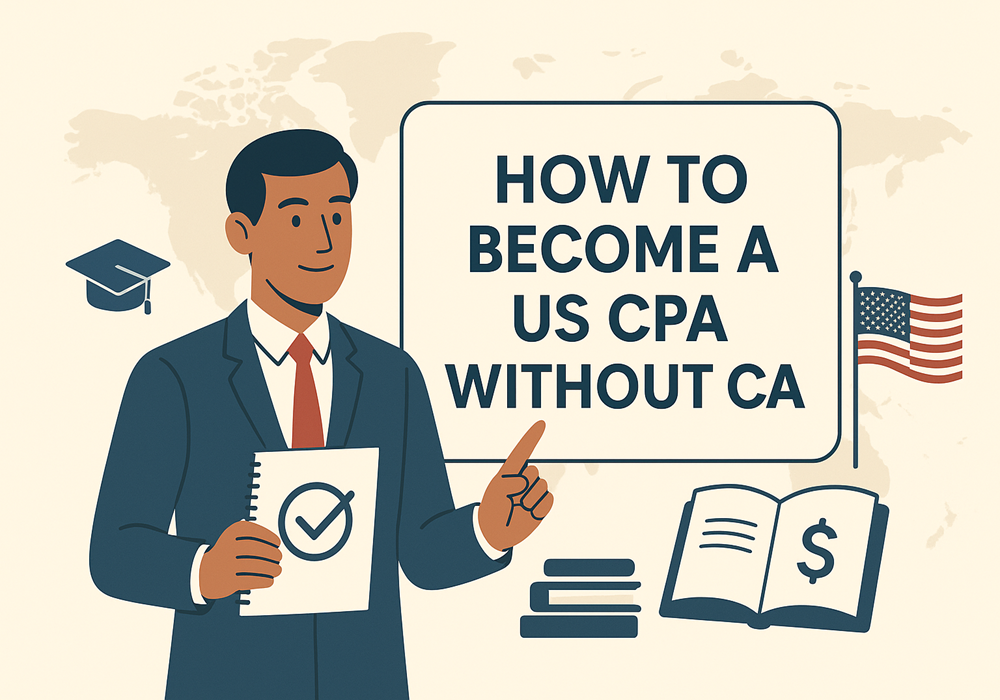
Clear roadmap to US CPA eligibility for Indian B.Com graduates. Understand credit requirements, eligibility pathways, best states, and application steps to start your CPA journey. This article is written by Medha Vinod, Senior Associate at LawSikho.
Table of Contents
You have a B.Com degree, and you are wondering if the US CPA is within your reach. The short answer is yes, it absolutely is. Despite what you may have heard about complex credit requirements and confusing state board rules, thousands of Indian B.Com graduates successfully qualify for and pass the CPA exam every year. This roadmap will show you exactly how the eligibility system works and what steps you need to take to begin your CPA journey.
Understanding CPA Credit Requirements for Indian Graduates
The CPA eligibility system runs on credits, not degrees. Once you understand how credits work, everything else falls into place. Let us break down this system in simple terms.

How the US Credit System Works
In the United States, education is measured in semester credit hours rather than years of study. Think of credits as a universal currency that measures how much education you have completed. The standard conversion is straightforward: one year of university education equals 30 credits.
This means your 3-year B.Com degree translates to 90 credits (3 years multiplied by 30 credits per year). A 2-year M.Com adds another 60 credits. The math is simple once you know the formula.
Now here is the crucial part. To sit for the CPA exam, most US states require 120 credits. To actually get your CPA license after passing the exam, you need 150 credits. These are two different milestones, and understanding this distinction helps you plan your pathway efficiently.
With 90 credits from your B.Com, you are 30 credits short of exam eligibility. That gap is smaller than most people assume, and there are multiple ways to bridge it.
Bridging the Credit Gap
The 30-credit gap between your B.Com and exam eligibility can be filled through several routes. If you pursue an M.Com, you gain 60 credits, which takes you straight to 150 credits and covers both exam eligibility and license requirements in one go. If you have completed CA, CS, or CMA alongside your B.Com, these professional qualifications contribute additional credits that may push you past the 120 threshold.
There is also a lesser-known advantage for high performers. If you graduated with first division from a NAAC A or A+ accredited university, certain US states award 30 bonus credits. This recognition effectively treats your 3-year degree as equivalent to a 4-year US degree, making you eligible with your B.Com alone.
For those who do not have postgraduate degrees or professional qualifications, bridge courses offer a targeted solution. These are short academic programs specifically designed to provide the exact credits you need without requiring years of additional study.
Here is a quick comparison of your options:
| Pathway | Credits Added | Time Required | Best For |
| M.Com | 60 credits | 2 years | Those wanting a full master’s degree |
| CA/CS/CMA | 30 – 60 credits | Varies | Those already pursuing these qualifications |
| NAAC A+ First Division | 30 credits | None (already earned) | High performers from top universities |
| Bridge Courses | 30 – 60 credits | 3 – 6 months | Fastest route to eligibility |
CPA Exam: Eligibility Pathways for B.Com Holders
Now that you understand credits, let us look at the specific pathways available to you as a B.Com graduate. Your situation determines which pathway makes the most sense.
Direct Eligibility Options
The most common pathway is B.Com plus M.Com. With this combination, you have 150 credits total, which exceeds both the exam requirement (120) and license requirement (150). You can apply to virtually any state without worrying about credit shortfalls. The M.Com curriculum also overlaps with CPA exam content, which helps your preparation.
If you are pursuing or have completed CA, CS, or CMA, you likely have enough credits when combined with your B.Com. The National Association of State Boards of Accountancy (NASBA) evaluates these professional qualifications and assigns credit values based on their coursework and examination requirements. CA typically receives the most credits, often 30 to 60, depending on the state.
For graduates from premier institutions, the NAAC A+ first division route offers the fastest path. If your university held NAAC A or A+ accreditation when you graduated and you achieved first division, certain states will recognize your B.Com as meeting the 120-credit requirement. This pathway requires careful verification because not all states accept this provision.
Using Bridge Courses to Meet Requirements
Bridge courses are purpose-built programs that help international candidates meet CPA credit requirements. Unlike a full master’s degree that takes two years, bridge courses can be completed in three to six months. They focus exclusively on subjects that count toward your accounting and business credit needs.

These courses are offered through partnerships between Indian CPA coaching institutes and accredited US universities. When you complete the coursework, you receive academic credits from the partner university that US state boards recognize for CPA eligibility purposes.
The cost of bridge courses typically ranges from INR 50,000 to INR 1,50,000, depending on the provider and the number of credits needed. While this is an additional expense, it is significantly less than pursuing a full postgraduate degree, and it gets you to exam eligibility much faster.
Bridge courses work best for candidates who want to start the CPA exam quickly without committing to lengthy additional education. If you are already working and cannot take two years off for an M.Com, bridge courses let you qualify while continuing your career.
Choosing the Right US State for Your CPA Application
Here is something that surprises many Indian candidates: you do not apply to a central CPA authority. Instead, you apply to a specific US state board, and each state has its own rules. Choosing the right state can make your journey significantly smoother.
Why State Selection Matters
The 55 US jurisdictions (50 states plus territories like Guam) each set their own eligibility criteria. Some states require 150 credits just to sit for the exam, while others let you begin with 120 credits. Some states demand a Social Security Number, which most Indian candidates do not have. Others have strict residency requirements.
For international candidates, state selection is not about where you want to live or work. It is about finding a state whose requirements align with your current qualifications. You can always transfer your license to another state later through reciprocity agreements.
The states that work best for Indian candidates share common characteristics: they accept 120 credits for exam eligibility, do not require SSN, have flexible experience verification options, and participate in international exam administration.
Best States for Indian B.Com Graduates
Guam tops the list for international candidates. This US territory does not require an SSN, accepts 120 credits for exam eligibility, and allows experience verification through NASBA’s verification service. You do not need to be a US resident, and the application process is straightforward. Most Indian CPA candidates choose Guam for good reason.
Washington offers similar advantages with flexible experience verification and no residency requirements. The state has recently streamlined its application processing, reducing wait times for international candidates.
Montana works well for candidates who cannot find a US CPA to supervise and verify their work experience. The state participates in NASBA’s experience verification program, which provides alternative pathways for experience documentation.
When selecting your state, ask yourself these questions: Do I have 120 or 150 credits? Do I have an SSN? Can I get my work experience verified by a US CPA? Your answers will point you toward the right state. If you have 120 credits, no SSN, and work in India without US CPA supervision, Guam or Montana are your best options.
Next Steps to Start Your US CPA Journey
You understand the credit system, you know your pathway options, and you have an idea of which state suits your profile. Now let us translate that knowledge into action.
Getting Your Credentials Evaluated
Before you can apply to any state board, you need an official credential evaluation. This is a mandatory step for all international candidates. The evaluation translates your Indian qualifications into US-equivalent terms and determines your official credit count.
Two agencies dominate this space: NASBA International Evaluation Services (NIES) and World Education Services (WES). NIES is specifically designed for CPA candidates and is accepted by all state boards, making it the safer choice if you are uncertain. The evaluation costs approximately INR 18,000 to INR 25,000 and takes four to eight weeks.
For your evaluation, you will need official transcripts sent directly from your university in sealed envelopes, degree certificates, and mark sheets. If you have professional qualifications like a CA, include those certificates as well. Start gathering these documents early because obtaining sealed transcripts from Indian universities can take several weeks.
Application Process Overview
Once your evaluation is complete and you know your credit count, the application process follows a clear sequence. First, you submit your application to your chosen state board along with your evaluation report and application fees. Application fees typically range from INR 8,000 to INR 16,000.
After the state board approves your application, you receive a Notice to Schedule (NTS). This document authorizes you to register for exam sections at Prometric testing centers, including centers in eight Indian cities: Ahmedabad, Bangalore, Kolkata, Chennai, Hyderabad, Mumbai, New Delhi, and Trivandrum.
From starting your evaluation to sitting for your first exam section, expect the process to take three to four months. The timeline includes evaluation processing (4-8 weeks), application review (2-4 weeks), and scheduling your preferred exam date.
Regarding costs, budget approximately INR 3.5 to 5 lakhs for the complete journey. This includes evaluation fees, application fees, exam fees for all four sections, international testing surcharges, and a review course. If you need bridge courses, add another INR 50,000 to INR 1,50,000. The investment pays off quickly, with CPA professionals in India earning INR 6 to 9 lakhs at the entry level and significantly more with experience.
Conclusion
The CPA credential is absolutely achievable for Indian B.Com graduates. Your degree provides 90 credits as a foundation, and multiple pathways exist to reach the 120 credits needed for exam eligibility. Whether you add an M.Com, leverage professional qualifications, benefit from the NAAC A+ first division provision, or complete bridge courses, you have options that fit your circumstances.
State selection matters more than most candidates realize. Choose a state like Guam, Washington, or Montana that accommodates international candidates without unnecessary barriers. Avoid states requiring SSN or 150 credits for exam eligibility unless you specifically need licensure there.
Start with credential evaluation. This single step gives you clarity about your exact credit count and confirms which pathways are viable for your situation. With that information in hand, you can make informed decisions about additional qualifications, state selection, and timeline planning.
Your B.Com degree is not a limitation. It is the starting point of a journey that can take you to one of the most respected credentials in global accounting. The roadmap is clear. The first step is yours to take.
For more detailed information, check this.
 Serato DJ Crack 2025Serato DJ PRO Crack


 Allow notifications





