


US CPA exam guide for Indians: Learn exam structure under CPA Evolution, eligibility requirements, complete costs in INR, and application process from India. This article is written by Rohit Arora, Senior Associate at LawSikho.
The US CPA exam is the qualifying examination that opens doors to one of the world’s most respected accounting credentials, and Indian professionals are increasingly recognizing its value.
Whether you’re a working accountant at a Big 4 firm, a CA looking to add global credentials, or a commerce graduate planning an international career, understanding what this exam involves is your first step toward making an informed decision about pursuing it from India.
What is the CPA Exam Structure and Sections Under the 2024 Format?
The CPA exam underwent a major overhaul in January 2024 when the AICPA introduced CPA Evolution, replacing the previous four-section format with a new Core plus Discipline model.

This restructuring reflects the changing demands of the accounting profession and gives candidates the flexibility to specialize in areas aligned with their career goals. If you’re researching the CPA exam today, everything you read about the old BEC section is now outdated.
Three Core Sections Every Candidate Must Pass
Every CPA candidate must clear three mandatory core sections regardless of their chosen specialization. These sections test the foundational competencies that all CPAs need, from auditing procedures to financial reporting and taxation.
The three core sections are:
- Auditing and Attestation (AUD),
- Financial Accounting and Reporting (FAR), and
- Taxation and Regulation (REG).
AUD focuses on audit planning, evidence gathering, and professional ethics, containing 78 multiple-choice questions and 7 task-based simulations within a 4-hour window. FAR covers US GAAP, governmental accounting, and nonprofit reporting with 50 MCQs and 7 simulations. REG tests US federal taxation and business law concepts through 72 MCQs and 8 simulations. Each section requires a score of 75 or higher on a 0-99 scale to pass.
For Indian candidates, FAR and REG typically present the steepest learning curves. FAR requires mastering US GAAP, which differs significantly from Indian Accounting Standards in areas like lease accounting and revenue recognition. REG introduces an entirely new body of knowledge since US tax law has no overlap with Indian taxation. However, candidates with IFRS exposure often find FAR somewhat familiar due to convergence between US GAAP and international standards.
Choosing Your Discipline Section: BAR, ISC, or TCP
Beyond the three core sections, you must select one discipline section that allows for specialization. Your options are Business Analysis and Reporting (BAR), Information Systems and Controls (ISC), and Tax Compliance and Planning (TCP). This choice should reflect both your career aspirations and your existing strengths.
BAR extends the financial accounting knowledge tested in FAR, covering advanced topics like derivatives, business combinations, and managerial accounting concepts. It suits candidates targeting financial analysis, controllership, or CFO-track roles. ISC focuses on IT governance, cybersecurity, and system controls, making it ideal for those interested in IT audit or technology consulting. TCP builds on REG’s tax foundation with advanced planning concepts and is popular among candidates pursuing tax advisory careers.
The pass rate data from 2024–2025 shows clear patterns across discipline sections. TCP consistently records the highest pass rates, ranging from approximately 72 to over 80 percent, reflecting the fact that many candidates opting for TCP already have strong tax backgrounds and have cleared REG.
ISC sits in the mid-to-high range, improving from around 58 percent in 2024 to nearly 68 percent in 2025, while BAR has proven the most challenging discipline, with pass rates hovering around 40 to 42 percent. However, choosing a discipline based solely on pass rates is unwise; candidates should select the option that best aligns with their professional experience and long-term career goals.
Exam Duration, Question Types, and Scoring
Each CPA exam section runs exactly four hours, giving you 16 total testing hours across all four sections. The exam format combines multiple-choice questions (MCQs) with task-based simulations (TBSs), and understanding how these are weighted helps you allocate preparation time effectively.
MCQs test your knowledge, recall, and conceptual understanding through four-option questions with no negative marking. TBSs are scenario-based questions requiring you to analyze documents, perform calculations, or complete practical tasks like journal entries and reconciliations. For most sections, MCQs and TBSs each contribute 50 percent to your final score. The exception is ISC, where MCQs carry 60 percent weight.
Your final score uses a scaled methodology that accounts for question difficulty. A score of 75 represents the minimum competency standard, not 75 percent correct answers. The AICPA uses psychometric scaling to ensure scores are comparable across different test forms and testing windows. This means a 75 earned in January holds the same meaning as a 75 earned in August.

CPA Exam Eligibility and Credit Requirements for Indians
Before investing time and money into CPA preparation, you need to confirm that you meet the eligibility requirements. Unlike Indian professional exams with standardized national criteria, CPA eligibility varies by US state, and Indian candidates must navigate this complexity carefully. The good news is that several states have requirements specifically accommodating international candidates.
The 150 Credit Hour Rule and Indian Degree Equivalence
US states measure educational qualifications in semester credit hours, with most requiring 150 credits for CPA licensure. The standard conversion assigns approximately 30 credits per year of Indian university education. This means a three-year B.Com translates to roughly 90 credits, while adding a two-year M.Com brings you to approximately 150 credits.
If you hold only a B.Com, you’ll likely need additional coursework or credentials to meet eligibility. Many states allow candidates to sit for the exam with 120 credits (enough for B.Com plus one year of postgraduate study) and complete the remaining 30 credits before licensure. Indian Chartered Accountants typically receive 30 to 40 additional credits for their CA designation during evaluation, which can bridge the gap effectively.
The key is understanding that credit requirements have two thresholds: one for exam eligibility (usually 120 credits) and another for licensure (usually 150 credits). Planning your pathway requires knowing which threshold you currently meet and what additional education you might need.
States That Accept Indian Candidates Without SSN
Not every US state accepts international candidates, and some require a Social Security Number that Indian residents don’t have. Fortunately, several states have removed this barrier, making them popular choices for Indian CPA aspirants. Montana, Colorado, Washington, Alaska, and Guam are the most commonly chosen jurisdictions.
Montana consistently ranks as the top choice among Indian candidates due to its straightforward requirements and efficient processing. The state doesn’t require US residency, accepts international credentials without excessive documentation hurdles, and processes applications relatively quickly. Colorado and Washington offer similar accessibility with slightly different fee structures and experience requirements for eventual licensure.
When selecting your state, consider factors beyond just exam eligibility. Look at the experience requirements for licensure, CPE requirements for license renewal, and whether the state participates in mobility agreements that let you practice elsewhere. Your state choice is a long-term decision, not just a tactical move for exam access.
Credential Evaluation Through WES and NIES
Every international candidate must have their educational credentials evaluated by an approved agency before applying. This evaluation translates your Indian degrees into US credit hour equivalents that state boards can understand. The two most popular agencies for Indian candidates are World Education Services (WES) and NASBA International Evaluation Services (NIES).
WES is the most widely recognized evaluation agency globally, charging $200 to $300 depending on the services you select. They require official transcripts sent directly from your universities in sealed envelopes, along with degree certificates and mark sheets. Processing typically takes 4 to 6 weeks after all documents arrive. NIES, operated by NASBA itself, offers the advantage of seamless integration with the CPA application process and charges $225 to $275.
Start the evaluation process early because document collection from Indian universities can be time-consuming. You’ll need official transcripts, degree certificates, and mark sheets from every institution you attended. If you’re a CA, include documentation from ICAI confirming your membership and qualification status.
CPA Exam Costs for Indian Candidates
The financial investment for CPA certification is substantial, and Indian candidates face higher costs than their American counterparts due to international testing surcharges. Understanding the complete cost picture helps you budget appropriately and avoid unpleasant surprises midway through your journey.
Section-wise Exam Fees Including International Testing Charges
NASBA implemented a fee increase in 2025 that significantly impacted international candidates. The base examination fee is approximately $262.64 per section, but Indian candidates must also pay an international administration fee of $390 per section. This brings your total examination cost to roughly $510 to $520 per section, translating to approximately ₹43,000 at current exchange rates.
For all four sections, your examination fees alone will total approximately $2,040 to $2,080, or roughly ₹1,71,000 to ₹1,75,000. These fees are paid through the NASBA CPA Central portal after your application receives approval and before you can schedule your exam date. It’s crucial to understand that these fees are non-refundable if you fail to appear for your exam or let your Notice to Schedule expire.
The 2025 fee increase represented a significant jump from previous years. If you’re reading older articles quoting lower fees, those figures are outdated. Always verify current fees directly with NASBA or your state board before budgeting.
Application, Evaluation, and Review Course Costs
Beyond examination fees, several other expenses add to your total investment. Application fees vary by state, typically ranging from $40 to $200. Credential evaluation through WES or NIES costs $200 to $300. You may also pay ₹500 to ₹2,000 to your Indian universities for official transcript services.
The highest variable cost is your review course investment. Quality CPA review programs from providers like Becker, Wiley, Surgent, and Gleim range from $1,000 to $4,000 (approximately ₹84,000 to ₹3,36,000). Indian coaching institutes offering CPA preparation typically charge ₹80,000 to ₹1,50,000. While self-study is theoretically possible, the unfamiliarity of US accounting standards makes structured preparation highly advisable for Indian candidates.
Additional costs include ethics exam fees ($150 to $200) required for licensure in most states, and the eventual license application fee ($150 to $400). If you need to retake any section, add approximately ₹43,000 per retake.
Total Investment Breakdown in INR
Combining all cost components, Indian candidates should budget between ₹3,00,000 and ₹5,00,000 for their complete CPA journey, assuming first-attempt success on all sections. Here’s a realistic breakdown:
| Component | Cost in INR |
| Credential Evaluation | ₹17,000 – ₹25,000 |
| Application and Registration | ₹8,500 – ₹25,000 |
| Exam Fees (4 sections) | ₹1,71,000 – ₹1,75,000 |
| Review Course | ₹84,000 – ₹2,52,000 |
| Ethics and License Fees | ₹25,000 – ₹50,000 |
| Total | ₹3,05,000 – ₹5,27,000 |
This investment is higher than Indian CA fees but comes with a significantly shorter timeline. Most candidates complete the CPA within 12 to 18 months compared to 4 to 5 years for CA. Many employers, particularly Big 4 firms and MNCs, offer partial or full sponsorship for employees pursuing CPA certification.
CPA Exam Application Process and Testing Centres in India
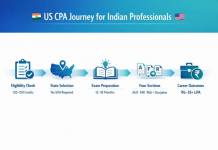
The application process involves coordinating between multiple organizations, which can feel overwhelming initially. Breaking it into sequential steps makes navigation manageable. For Indian candidates, the process has become more streamlined since international testing became available in 2020.
From Application to Notice to Schedule (NTS)
Your journey begins with selecting a state and completing a credential evaluation. Once the evaluation is complete, create an account on the NASBA CPA Central portal and submit your application with the required documents and the application fee. The state board reviews your credentials, a process that takes 2 to 8 weeks, depending on the state and time of year.
Upon approval, you receive an Authorization to Test (ATT), valid for 90 days to 6 months. During this window, pay your examination fees through the NASBA portal to receive your Notice to Schedule (NTS). The NTS is your authorization to actually book your exam date and has its own validity period, typically 3 to 9 months, depending on the state.
A critical planning consideration: only apply for sections you’re confident you can prepare for within your NTS validity window. Applying for all four sections at once might seem efficient, but if you can’t complete them before the NTS expires, you forfeit those fees. Most candidates apply for one or two sections at a time.
Prometric Test Centers and Scheduling Strategy
India has eight Prometric testing centers offering CPA exams: Ahmedabad, Bangalore, Chennai, Hyderabad, Kolkata, Mumbai, New Delhi, and Trivandrum. Once you have your NTS, schedule through Prometric’s website by selecting your preferred location, date, and time.
Book your exam 3 to 4 weeks in advance to secure your preferred slot, especially during peak periods around quarter-ends. Starting in 2025, core sections (AUD, FAR, REG) follow continuous testing with rolling score releases, meaning you can test almost any day and receive results within 1 to 2 weeks. Discipline sections have specific testing months within each quarter.
On exam day, arrive 30 minutes early with two forms of identification, one being government-issued with your photograph. Your passport is ideal for this purpose. The name on your IDs must exactly match your NTS. Late arrivals risk being turned away, and missing proper identification will prevent testing entirely.
CPA Exam Pass Rates and Career Prospects
Understanding pass rate trends helps set realistic expectations, while knowing the career outcomes provides motivation for the investment you’re making. The CPA credential delivers tangible returns for Indian professionals in terms of career opportunities and salary premiums.
Current Pass Rates by Section in Recent Years
The AICPA publishes pass rates quarterly, and the 2024-2025 data under CPA Evolution shows meaningful variation across sections. The overall average pass rate hovers around 50 percent, meaning roughly half of candidates pass on any given attempt.
Among core sections, REG consistently shows the highest pass rates at around 63 to 64 percent, followed by AUD at approximately 46 to 48 percent, with FAR recording the lowest pass rates at roughly 40 to 43 percent. FAR’s lower success rate reflects the breadth and complexity of its syllabus, which spans US GAAP, governmental accounting, and nonprofit reporting. Among the discipline sections, TCP continues to lead with pass rates ranging from about 72 to 78 percent, ISC has shown improvement from around 58 percent in 2024 to over 68 percent in 2025, and BAR remains the most challenging discipline at roughly 40 to 42 percent.
These statistics should not be discouraging but should instead inform the preparation strategy. Candidates are well advised to allocate additional study time to historically challenging sections and consider attempting FAR earlier in their exam journey, when study momentum is strongest. With structured preparation and a quality review course, many serious candidates perform well above these average pass rates.
Career Opportunities and Salary Expectations in India
The CPA credential opens doors to roles at Big 4 firms (Deloitte, PwC, EY, KPMG), US-based MNCs operating in India, and Indian companies with US reporting requirements. Common positions include US GAAP reporting analyst, international tax consultant, SOX compliance specialist, and finance manager for US subsidiaries. CPAs also find opportunities in GCCs (Global Capability Centers) that serve US parent companies.
Salary premiums for CPA-qualified professionals in India typically range from 20 to 40 percent above non-CPA accountants at similar experience levels. Entry-level CPAs at Big 4 firms can expect packages of ₹8 to ₹12 lakhs per annum, while experienced professionals command ₹20 to ₹35 lakhs or more. Those who relocate to the US or UAE often see packages exceeding ₹50 lakhs annually.
Beyond immediate salary gains, the CPA provides global mobility that Indian qualifications alone don’t offer. The credential is recognized across the US, and mutual recognition agreements extend its value to Canada, Australia, and other countries. For professionals with international career aspirations, this mobility represents significant long-term value.
Conclusion
The CPA exam represents an achievable pathway to global recognition for Indian accounting professionals willing to invest the time and resources. With three core sections (AUD, FAR, REG) plus one discipline of your choice, the exam can be completed within 12 to 18 months while working full-time. Budget approximately ₹3 to ₹5 lakhs for the complete journey, choose a state like Montana or Colorado that accommodates international candidates, and invest in a quality review course to maximize your first-attempt success rate.
The credential delivers measurable returns through salary premiums, career advancement, and global mobility opportunities that make the investment worthwhile for serious candidates.
Readers seeking a comprehensive explanation of the US CPA exam can explore the full article here.
 Serato DJ Crack 2025Serato DJ PRO Crack



 Allow notifications





