

Quick guide covering educational qualifications, age limits for JRF, State vs Central OBC rules, subject selection for Law and Commerce graduates, and common mistakes to avoid. This article is written by Urvi Shah, Senior Associate at LawSikho.
Table of Contents
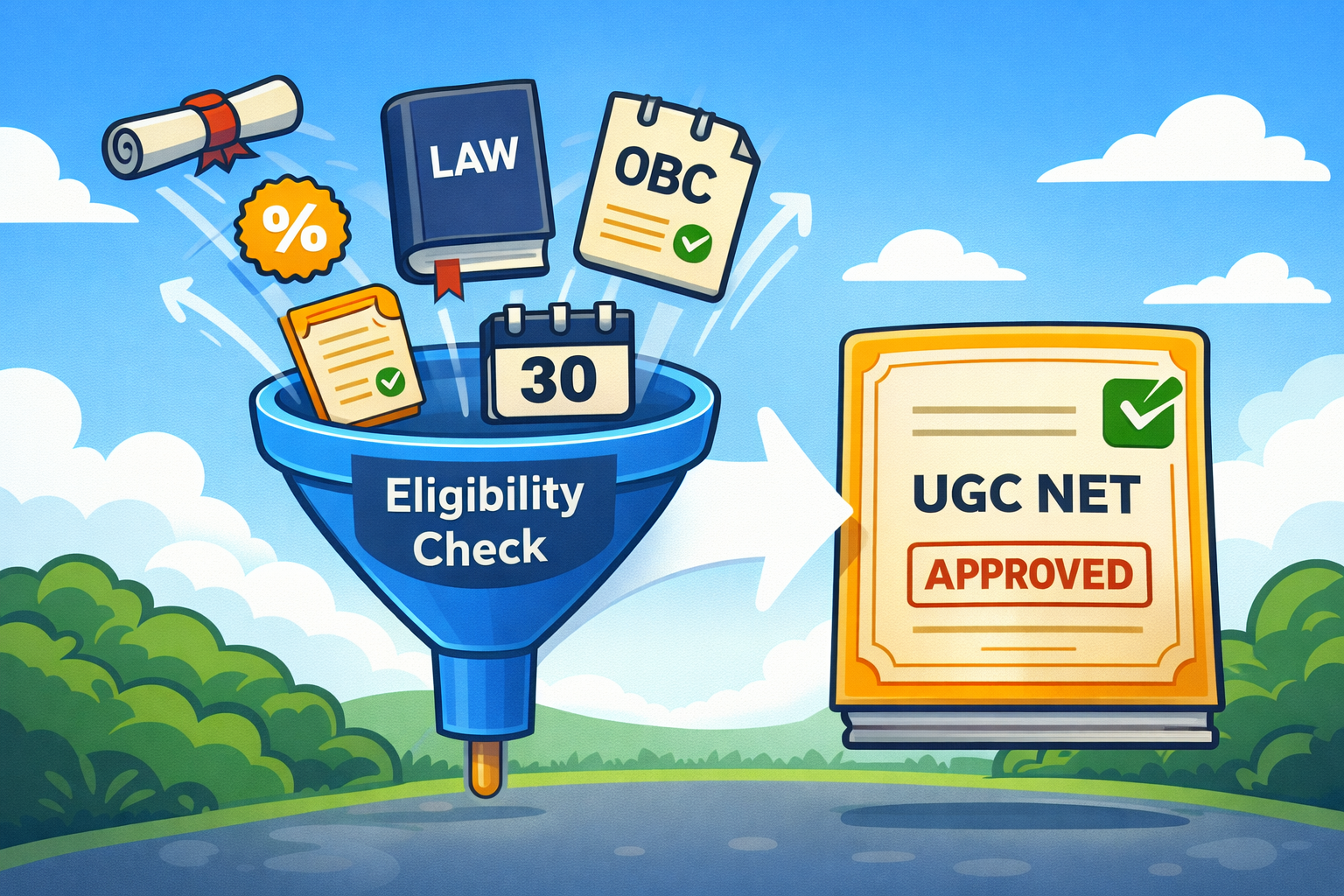
Stop right there. Before you spend the next six months preparing for UGC NET, before you buy expensive books or join coaching classes, answer one simple question: are you actually eligible to sit for this exam?
Every year, thousands of candidates discover too late that their application was never valid. Some assumed their LLB degree qualified them for UGC NET Law. Others used a state OBC certificate when only the Central list works. A few missed the 55% mark requirement by a decimal point.

Understanding eligibility now saves you from costly mistakes later. This guide cuts through the confusion and tells you exactly who can apply, who cannot, and what documents you need to prove it.
UGC NET Eligibility Check: Are You Qualified To Apply?
Before diving into detailed criteria, let’s establish whether you meet the basic requirements. UGC NET isn’t just about scoring well; it has strict eligibility gates that determine whether you can even appear for the examination.
The National Testing Agency doesn’t verify your eligibility when you submit your application. They check later, and if they find any discrepancy, your results get cancelled even after you’ve qualified.
60 Second Eligibility Test
Here’s a quick self assessment.
Do you have a Master’s degree with at least 55% marks (or 50% if you belong to SC/ST/OBC NCL/PwD/Third Gender category)?
Are you under 30 years old if you want JRF, or any age if you only want Assistant Professor eligibility?
Is your postgraduate subject available in the UGC NET subject list of 85 disciplines?
If you’re claiming OBC reservation, is your community in the Central OBC list at ncbc.nic.in?
If you answered yes to all relevant questions, you’re likely eligible. If any answer was no or uncertain, read on carefully.
Three Qualification Categories: JRF, Assistant Professor and PhD
UGC NET offers three distinct qualification pathways, each with different outcomes. The first category, JRF plus Assistant Professor, is the highest level. Qualify here and you receive a monthly fellowship of ₹37,000 for the first two years, increasing to ₹42,000 thereafter, plus automatic eligibility for teaching positions and PhD admission. This requires the highest scores and has an age limit of 30 years.
The second category grants Assistant Professor eligibility plus PhD admission without fellowship benefits. You can apply for teaching positions across India but won’t receive any stipend for research.
There’s no age limit here. The third category, introduced recently, is PhD Admission Only, designed for candidates who want doctoral admission without teaching eligibility. Choose your category wisely during application because it determines what benefits you can claim upon qualifying.
Who is Eligible to Apply for UGC NET?
The foundation of UGC NET eligibility rests on your educational qualifications. These requirements are non negotiable and applied without any rounding off or approximation.

Educational Qualification Requirements
General and EWS category candidates need a Master’s degree with minimum 55% marks from a UGC recognised university. Reserved category candidates, including OBC Non Creamy Layer, SC, ST, PwD, and Third Gender, need 50% marks.
The critical detail here is “without rounding off.” If your mark sheet shows 54.8%, you don’t meet the 55% threshold. NTA applies these percentages exactly as they appear on your official documents.
Your Master’s degree must be in a subject covered under the UGC NET subject list, which spans 85 disciplines from Humanities to Sciences to Professional subjects like Law and Commerce.
For reserved categories claiming 50% eligibility, remember that OBC means OBC Non Creamy Layer as per the Central list, not your state government’s list. This distinction trips up thousands of applicants every cycle.
Can Final Year Students Apply for UGC NET?
Yes, candidates appearing for their final Master’s examination or awaiting results can apply on a provisional basis. This allows you to attempt UGC NET while completing your degree, saving valuable time. However, provisional eligibility comes with strict deadlines you must honour.
Two Year Completion Rule for JRF and Assistant Professor
If you qualify for JRF or Assistant Professor eligibility while your degree is pending, you must complete your Master’s with the required percentage within two years from the NET result date.
Miss this deadline and your qualification becomes invalid. You would need to appear for UGC NET again after completing your degree, having lost both the earlier qualification and the time invested.
One Year Rule for PhD Admission Only
Candidates qualifying under PhD Admission Only face an even tighter deadline of one year to complete their Master’s degree. This shorter window aligns with annual PhD admission cycles at universities.
If you’re applying provisionally with only PhD admission as your goal, ensure you can realistically finish your degree within twelve months of the result.
Can You Apply for UGC NET with a 4 Year Bachelor’s Degree Without a Master’s?
Under UGC Regulations 2022 aligned with the National Education Policy 2020, candidates with 4 year bachelor’s degrees can now appear for UGC NET without a Master’s degree. This pathway offers unique flexibility in subject selection but comes with important limitations.
75% Marks Requirement
Four-year degree holders need minimum 75% marks in aggregate, significantly higher than the 55% required from Master’s degree holders. Reserved category candidates get relaxation to 70%.
This higher threshold reflects the expectation of exceptional academic performance for direct research eligibility without postgraduate qualification.
Not Eligible for Assistant Professor Posts
Here’s the crucial limitation: qualifying UGC NET based on a 4 year bachelor’s degree makes you eligible only for JRF and PhD admission, not for Assistant Professor positions. If teaching is your goal, you will eventually need a Master’s degree regardless of your NET qualification.
This pathway suits candidates focused purely on research careers who want to begin doctoral work without completing traditional postgraduation.
Which UGC NET Subject Can You Apply For?
Subject selection causes significant confusion, especially for graduates in professional disciplines like Law and Commerce.
The general rule is straightforward: appear in the subject of your postgraduation. But what if your exact subject isn’t listed, or what if you want to try a different discipline?
Law Aspirants: Why LLM Is Mandatory for UGC NET Law
This is the most common eligibility mistake among law graduates. An LLB degree, whether 3 year or 5 year integrated, does not qualify you for UGC NET Law.
The reason is simple: LLB is an undergraduate professional degree, not a postgraduate qualification. UGC NET requires a Master’s degree, and for Law (Subject Code 58), that means LLM.
Many candidates assume the 5 year integrated LLB equals a postgraduate degree because of its duration. It doesn’t. You must complete LLM with minimum 55% marks (50% for reserved categories) before applying for UGC NET Law.
Any LLM specialization works, whether Constitutional Law, Corporate Law, Criminal Law, or Intellectual Property. The specialization doesn’t matter; having an LLM does.
Commerce and Management Graduates: Your Options
Commerce graduates with M.Com should apply for Commerce (Subject Code 08), which covers Accounting, Auditing, Business Law, and related areas. MBA graduates, however, face a choice. Your MBA specialization determines whether Management (Code 17) or Human Resource Management (Code 55) suits you better. MBA holders can technically apply for Commerce, but the syllabus aligns more closely with M.Com coursework. Review both syllabi before deciding.
The key principle is academic alignment. Choosing a subject for perceived easier competition rather than genuine qualification risks rejection during verification. Stick to subjects where your postgraduate coursework provides genuine foundation.
Age Limit for UGC NET
Age restrictions apply primarily to JRF eligibility. Understanding these limits and available relaxations helps you plan your examination attempts strategically.
JRF Age Limit and Relaxations
The baseline requirement for Junior Research Fellowship is 30 years maximum age. This is calculated as on the first day of the month in which the examination concludes. For instance for the December 2025, the reference date is 1st December 2025. Born on 2nd December 1995? You’re 29 and eligible. Born on 30th November 1995? You’ve crossed 30 and need relaxation.
Reserved categories receive 5 years relaxation, extending eligibility to 35 years. This applies to SC, ST, OBC NCL, PwD, and Third Gender candidates. All women candidates, regardless of category, also get 5 years relaxation. LLM holders receive an additional 3 years, acknowledging the longer educational pathway in law. Research experience holders and defence personnel can claim up to 5 years based on their service period.
Assistant Professor: No Age Barrier
Excellent news for working professionals and career changers: there is no upper age limit for Assistant Professor eligibility through UGC NET. Whether you’re 25, 45, or 60, you can appear and qualify for teaching positions. This makes UGC NET accessible to anyone considering academic careers at any life stage.
PhD Admission Through UGC NET
Similarly, there’s no age restriction for PhD admission eligibility. Candidates of any age can qualify and use their NET scores for doctoral programme admissions across Indian universities.
Can Age Relaxations Be Combined?
Here’s the rule many candidates miss: total relaxation from all grounds cannot exceed 5 years. You cannot add 5 years for being SC plus 5 years for being a woman plus 3 years for holding LLM to claim 13 years total relaxation. Even if you qualify under multiple categories, the maximum combined relaxation remains capped at 5 years. Plan your attempts accordingly.
State OBC vs Central OBC: Mistake That Causes Application Rejection
This single issue causes more eligibility rejections than almost any other factor. Understanding the distinction between State OBC and Central OBC lists is absolutely critical for reservation candidates.
Why are State OBC Certificates not Valid for UGC NET?
India maintains two separate OBC lists: State lists managed by individual state governments, and a Central list maintained by the National Commission for Backward Classes. These lists are not identical.
A community included in your state’s OBC list may or may not appear in the Central list. UGC NET is a national examination, so only the Central list applies.
Your state issued OBC certificate proves your community’s status in the state list. But for UGC NET eligibility, your community must appear in the Central list. If it doesn’t, you must apply under General category, need 55% marks, and compete under unreserved cutoffs. Many candidates discover this mismatch only after investing months in preparation.
How to Verify If Your Caste Is in the Central OBC List
Before applying under OBC category, verify your community’s presence in the Central list. Don’t assume or rely on general knowledge. Check directly from the official source.
NCBC Portal Verification Process
Visit the National Commission for Backward Classes website and navigate to “Central List of OBCs.” Select your state from the dropdown menu. The portal displays all communities included in the Central OBC list for that state.
Search for your community name exactly as it appears in your caste certificate, noting that spelling variations matter.
If your community appears, you can claim OBC NCL benefits for UGC NET. If it doesn’t, apply under General category regardless of what your state certificate says. This verification takes five minutes but saves you from potential disqualification.
What to Do If Your Community Is Not in the Central OBC List?
If your community appears in your state’s OBC list but not in the Central list, you have two options.
First, apply under the General category for UGC NET, which means you need 55% marks in your Master’s degree and will compete under General category cutoffs.
Second, if you believe your community should be in the Central list, you can approach NCBC to check if inclusion is pending or under consideration.
However, for the current examination cycle, you must apply based on the list as it exists at the time of application.
OBC NCL Certificate for UGC NET: Income Criteria and Financial Year Requirement
The “NCL” in OBC NCL stands for Non Creamy Layer, which has specific income criteria. Your family’s gross annual income must not exceed ₹8 lakh as per current norms. The certificate must be issued based on income for the financial year immediately preceding the year of application.
Certificates older than one year from the date of application are generally not accepted. Always check the specific validity requirements in the current notification.
Key Exemptions in UGC NET Eligibility
Certain candidates don’t need UGC NET at all for Assistant Professor positions. Knowing these exemptions helps you understand whether appearing for NET is necessary for your specific situation.
PhD Holders Under UGC 2022 Regulations
Candidates with PhD awarded under UGC (Minimum Standards and Procedures for Award of Ph.D. Degree) Regulations, 2022 are exempted from NET/SET for Assistant Professor recruitment.
The rigorous doctoral training under these standards is considered adequate preparation for academic positions. However, this exemption covers only teaching eligibility, not JRF benefits.
SET/SLET Qualified Candidates: Date Based Rules
State Eligibility Tests offer an alternative pathway, but their validity depends critically on when you cleared the exam.
Before June 1, 2002: Valid Anywhere in India
SET cleared before 1st June 2002 is treated as equivalent to UGC NET without geographical restriction. You can apply for Assistant Professor positions anywhere in India based on this qualification.
After June 1, 2002: State Specific Validity
SET cleared from 1st June 2002 onwards is valid only within the state where you passed. Cleared Maharashtra SET after June 2002? You can teach in Maharashtra institutions only. For positions in other states, you need UGC NET. This distinction matters significantly for candidates planning inter-state career mobility.
When is UGC NET Not Required for Assistant Professor?
Beyond PhD holders and SET qualified candidates, those who passed UGC/CSIR JRF before 1989 are also exempted. This historical provision affects very few current candidates but remains in official guidelines.
For everyone else, NET or SET qualification is mandatory for Assistant Professor positions in universities and colleges.
Distance Education and Foreign Degree Holders
Distance education degrees from UGC recognised universities are valid for UGC NET. IGNOU, state open universities, and distance programmes from conventional universities all qualify, provided the institution holds UGC recognition.
Verify recognition status on the UGC website if uncertain.
Foreign degree holders must obtain an equivalence certificate from the Association of Indian Universities (AIU) confirming their qualification equals an Indian Master’s degree.
Without AIU equivalence, foreign qualifications don’t establish UGC NET eligibility. Start this process well in advance as it takes 10 to 30 days.
Post Graduate Diploma Holders
PG Diploma holders are generally not eligible unless AIU has granted equivalence to their specific diploma. Some premier institutions like IIMs award 2 year PG diplomas that have received AIU equivalence, making those graduates eligible.
Check the AIU equivalence list to verify if your diploma qualifies before applying.
Common UGC NET Eligibility Mistakes to Avoid
Based on analysis of rejection patterns, these four mistakes cause maximum eligibility problems. Avoiding them protects your preparation investment.
Percentage Calculation Errors
Candidates frequently round off their percentages, assuming 54.6% qualifies as 55%. It doesn’t.
UGC NET requires exact percentages without rounding. If your official mark sheet shows anything below 55.0% for General category or 50.0% for reserved categories, you don’t meet the threshold.
Calculate your aggregate exactly as it appears on documents.
Using State OBC Certificate Instead of Central
As discussed earlier, state OBC certificates don’t automatically work for UGC NET. Your community must appear in the Central list maintained by NCBC.
Using a state certificate when your community isn’t in the Central list leads to rejection of reservation claims or disqualification during verification.
Document Discrepancies
Name variations across documents, like “Rahul Sharma” in the Class 10 certificate but “Rahul Kumar Sharma” in the Master’s degree, create verification problems.
Similarly, date of birth mismatches, even by a single day, can cause issues. Ensure consistency across all your academic and identity documents before applying.
Subject Mismatch Between Degree and Application
Appearing for a subject unrelated to your postgraduation creates verification problems. Some candidates choose subjects based on perceived easier competition rather than academic alignment.
The notification clearly states candidates should appear in their postgraduate subject. Choosing an unrelated discipline risks rejection even if you score well.
Missing the Degree Completion Deadline
Provisionally eligible candidates who qualify NET but don’t complete their degree within the stipulated timeframe, two years for JRF and Assistant Professor or one year for PhD only, automatically lose their qualification.
Your NET certificate becomes invalid, requiring you to appear again after degree completion. Track these deadlines carefully if applying while your results are pending.
Conclusion
UGC NET eligibility isn’t complicated once you understand the key parameters. You need a Master’s degree with 55% marks for General/EWS or 50% for reserved categories. JRF requires being under 30 years with specified relaxations.
Your subject must align with your postgraduation. OBC candidates must verify Central list status, not rely on state certificates.
Verify every eligibility criterion against the official NTA Information Bulletin before investing in preparation. Remember, NTA doesn’t check eligibility during application; that responsibility is entirely yours.
Getting it right from the start means your months of preparation translate into a valid qualification that opens doors to academic careers across India.
If you want to read a more detailed guide on the UGC NET eligibility criteria, you can read here.
 Serato DJ Crack 2025Serato DJ PRO Crack




 Allow notifications





