

Last verified: May 2026
In November 2008, an elderly couple was attacked during a house-breaking in Delhi. The husband did not survive. The wife did, and what she saw that night became the centre of a criminal trial that would run for more than fifteen years.
Eight years and six months after the incident, the surviving witness was finally produced for cross-examination. She did not appear in person; she testified over a video-conferencing link from a court-controlled facility. The defence counsel asked her to identify the accused on screen, and she did. The trial court convicted, and the High Court affirmed.
That is where the story should have ended. It did not. By the time the matter reached the Supreme Court, every question on the brief had collapsed into a single underlying question about cross-examination procedure under BSA Sections 137-145.

But as every trial-court advocate now knows, BSA Section 137 is not where cross-examination begins; the procedure begins at BSA Section 142. The way the prior statement had been put to the witness over that video link was, in the Supreme Court’s view, fatally flawed.
On 17 November 2025, a bench of Justices Vikram Nath and Sandeep Mehta set aside the conviction in Raj Kumar @ Bheema v. State of NCT of Delhi, 2025 INSC 1322. The Court held that a dock identification recorded over video conferencing nearly nine years after the incident was unsafe and unreliable. More importantly, it used the case to lay down the first nationally binding protocol for virtual cross-examination.
Prior written statements, the Court said, must be electronically transmitted to the remote witness before confrontation. Trial courts must follow Sections 147 and 148 of the Bharatiya Sakshya Adhiniyam, 2023 “meticulously” when cross-examining over a video link. And “none of the parties should be put to a disadvantage merely because the witness is not in attendance before the Court.” That last sentence is now binding law in every trial court in India.
Why does this matter to you? Raj Kumar @ Bheema sits at the intersection of three things every junior advocate, public prosecutor and judge’s clerk in India is currently grappling with: the BSA’s renumbering of cross-examination provisions, the rapid migration of trial-court evidence onto video-conferencing platforms after Section 530 of the Bharatiya Nagarik Suraksha Sanhita, 2023, and the way Section 148 BSA’s contradiction rules now apply to a witness sitting in a different state, sometimes a different country.
This guide breaks the law down section by section, with twelve cases any trial advocate should be able to cite from memory and a step-by-step walkthrough of how to mark a contradiction the way a senior practitioner does it. Start with the keyword itself: “BSA Sections 137-145” is a numbering misunderstanding the search box has cemented. Fix that first.
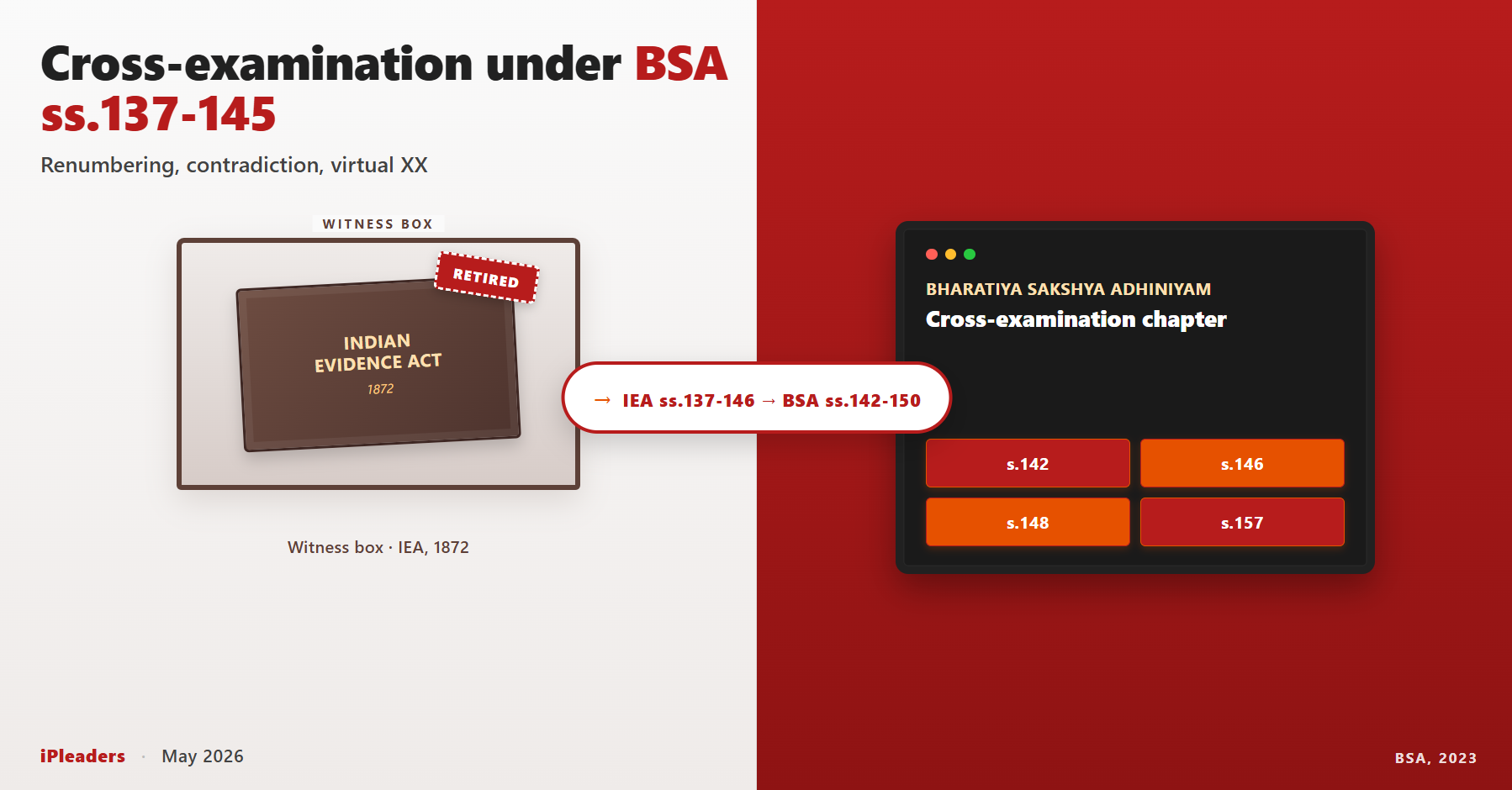
Cross-examination is the questioning of a witness by the opposing party, governed by Sections 142-150, 157 and 162 of the Bharatiya Sakshya Adhiniyam, 2023 (which replaced Sections 137-146, 154 and 159 of the Indian Evidence Act, 1872 from 1 July 2024). It tests credibility, exposes contradictions and is part of the right to a fair trial under Article 21.
The renumbering is not a footnote. It is the single most useful clarification a trial advocate can hold in their head before opening the bare act. The rest of this guide walks through the new numbers one section at a time.
1. Cross-examination under BSA: the renumbering you must know first
Almost every confused query about cross-examination procedure under BSA Sections 137-145 traces back to a single assumption: that the new code carried forward the old section numbers. It did not. The witness-examination chapter was the most conservative in the BSA: nearly every IEA provision was carried forward, but the section numbers shifted.
1.1 What “BSA Sections 137-145” actually contain
Here’s the thing. A reader opening the bare act for the definition of cross-examination at Section 137 BSA will find an entirely different provision. Section 137 of the Bharatiya Sakshya Adhiniyam, 2023 is the witness-privilege rule (no witness is excused from answering on the ground that the answer might criminate them). Section 138 BSA is the accomplice-competency rule, Section 139 covers the number of witnesses, Section 140 governs the order of production and examination, and Section 141 deals with judicial control over admissibility.
So the literal sweep of “Sections 137 to 145 BSA” mixes privilege, competency and witness-numbers in with only part of the cross-examination machinery. The actual chief, cross and re-examination definitions, the order of examinations, the document-producer rule and the character-witness rule sit at Sections 142, 143, 144 and 145.
1.2 Where cross-examination actually lives in the BSA
The full cross-examination cluster under the new code spans three discrete groups:

- Sections 142 to 150 BSA: the core procedure (definitions, order, document producer, character witness, leading questions, prior writings, contradiction, lawful questions, court’s power to compel).
- Section 157 BSA: hostile witness procedure (formerly Section 154 IEA).
- Sections 162 and 164 BSA: refreshing memory and the adverse party’s right to inspect (formerly Sections 159 and 161 IEA).
Everything else is judge-made gloss layered on top.
1.3 The renumbering map (BSA-IEA cross-examination chapter)
| Topic | IEA, 1872 | BSA, 2023 | What changed |
|---|---|---|---|
| Witness-privilege (criminating answer) | s.132 | s.137 | Renumbered; substance carried forward |
| Accomplice (competency) | s.133 | s.138 | Renumbered; substance unchanged |
| Number of witnesses | s.134 | s.139 | Renumbered; substance unchanged |
| Order of production and examination of witnesses | s.135 | s.140 | Renumbered; substance unchanged |
| Judge to decide admissibility | s.136 | s.141 | Renumbered; substance unchanged |
| Examination-in-chief / cross / re-examination defined | s.137 | s.142 | Definitions identical |
| Order of examinations | s.138 | s.143 | Carried forward verbatim |
| Cross-examination of person called to produce a document | s.139 | s.144 | Carried forward verbatim |
| Witnesses to character | s.140 | s.145 | Carried forward verbatim |
| Leading questions (definition + when allowed / disallowed) | ss.141, 142, 143 | s.146 (consolidated) | Three IEA sections collapsed into one BSA section |
| Evidence as to matters in writing | s.144 | s.147 | Renumbered; substance unchanged |
| Cross-examination as to previous statements in writing | s.145 | s.148 | Carried forward verbatim |
| Questions lawful in cross-examination | s.146 | s.149 | Renumbered; substance unchanged |
| Court’s power to compel answers | s.147 | s.150 | Cross-references s.137 BSA (privilege) |
| Hostile witness (questions by party to own witness) | s.154 | s.157 | Carried forward; identical in scope |
| Refreshing memory | s.159 | s.162 | Renumbered; substance unchanged |
| Adverse party’s right to writing used to refresh memory | s.161 | s.164 | Renumbered; substance unchanged |
That table is the single most useful piece of paper to keep in a trial-court bag during the transition years. Every High Court cause list now uses BSA numbering, and pleadings filed after 1 July 2024 citing IEA section numbers are routinely returned for re-numbering.
1.4 What stayed the same and what genuinely changed [HISTORICAL]
Most of the chapter stayed identical. Only two changes are worth flagging. First, Section 146 BSA consolidates three IEA provisions on leading questions (Sections 141, 142 and 143 IEA) into a single section with sub-clauses; the doctrine is unchanged, the packaging just cleaner.
Second, the recognition of audio-video and electronic testimony cuts across the chapter. It is enabled not by the BSA itself but by Section 530 of the Bharatiya Nagarik Suraksha Sanhita, 2023 (the statutory cover for video-conferencing) and the redesigned definitions of “evidence” and “document” in Section 2 BSA. For the broader BSA framework, see the iPleaders BSA hub.
What about pre-July 2024 trials? Trials instituted before commencement may continue under the saving clauses in Section 170 BSA and Section 531 BNSS, so the IEA framework still applies to a shrinking docket of legacy matters. Practitioners working those files should consult the historical IEA framework, which lays out the IEA-numbered procedure legacy trials continue to track.
The renumbering has also forced bar-training curricula to rewrite trial-advocacy modules around the new numbers. And junior advocates calling “Section 145 IEA” in a post-July 2024 trial court routinely get a tired look from the bench.
Topic
OLD: IEA, 1872
NEW: BSA, 2023
Definitions (chief / cross / re-examination) s.137 s.142 Order of examinations s.138 s.143 Cross-examination of person called to produce a document s.139 s.144 Witnesses to character s.140 s.145 Leading questions defined s.141 s.146(1) When leading questions must not be asked s.142 s.146(2)-(3) When leading questions may be asked s.143 s.146(4) Evidence as to matters in writing s.144 s.147 Cross-examination as to previous statements in writing s.145 s.148 Questions lawful in cross-examination s.146 s.149 Court’s power to compel answersi s.147 s.150 Question to be asked on reasonable grounds s.149 s.152 Indecent / scandalous questions s.151 s.154 Hostile witness s.154 s.157 Refreshing memory s.159 s.162 Right of adverse party to writing used to refresh memory s.161 s.164 Judge’s power to put questions s.165 s.168
2. What is cross-examination under the Bharatiya Sakshya Adhiniyam, 2023?
The short answer comes from the statute. Cross-examination is one of three stages defined in Section 142 of the Bharatiya Sakshya Adhiniyam, 2023: examination-in-chief (the calling party’s own examination), cross-examination (the adverse party’s questioning) and re-examination (the calling party returning to clarify what came up in cross). Each stage has its own rules on who may ask, what questions are permitted, and what scope is open.
Almost every procedural argument in a trial court traces back to which stage a question belongs to. Get the stage wrong, and the question draws an objection.
2.1 Statutory definition under Section 142 BSA
The statute defines the three stages in plain terms. Examination-in-chief is the examination of a witness by the party calling them; cross-examination is the examination by the adverse party; re-examination is the examination, after cross, by the party who called them. The definitions are identical to those in Section 137 IEA, which is what produces the search-keyword confusion. The section number changed, but the substance did not.
What does that mean in practice? Cross-examination cannot be taken on a fact the witness was never examined on in chief; that is the “scope” rule. The adverse party’s lawful arena begins where the chief left off, plus a wider sweep on credit and contradiction.
2.2 The four purposes of cross-examination
A clear-eyed trial advocate knows cross-examination is not one purpose but four, often in tension: test veracity (how reliable is this witness?), elicit favourable facts (what helps the client’s case?), expose contradictions (what does the witness say now that does not match what they said before?), and lay foundation for re-examination, recall or impeachment by other evidence (what door are you opening?).
Most trial-court advocates would agree the second purpose is the one juniors miss. Cross is not just an attack vector; it is also a friendly extraction of a single useful admission, asked and then dropped before the witness has time to retract.
2.3 Cross-examination as part of the right to a fair trial
The Supreme Court in Krishan Chander v. State of Delhi, (2016) 3 SCC 108 reaffirmed that the opportunity to cross-examine adverse witnesses is part of the right to a fair trial under Article 21 of the Constitution of India. Denial of cross-examination, in a trial that turns on disputed testimony, is a constitutional violation, not merely a procedural irregularity.
That framing has consequences. It means the right to cross-examine cannot be waived casually, cannot be shut out by procedural orders that lack reasons, and cannot be defeated by indefinite deferral. Worth flagging: this is the doctrinal anchor for almost every “denial of XX” argument in appellate courts. The right also extends, in calibrated form, to administrative tribunals and disciplinary inquiries that turn on disputed evidence.
3. The three stages of witness examination: chief, cross, re-examination
Trial-court practice treats the three stages as a single choreography. Each stage has its own purpose, scope and rules on leading questions; a witness who survives all three is one whose testimony the court is far more likely to rely on at the judgment stage. Knowing the difference between them is what separates a clean cross from a flailing one.
3.1 Examination-in-chief
The calling party leads. The witness gives their account. Leading questions are not permitted, except on formal or undisputed matters with court permission, because the calling party is not allowed to put words in their own witness’s mouth. Scope is whatever the calling party wants to bring out, subject to relevance.
In modern Indian civil practice, chief is largely conducted by affidavit (Order 18 Rule 4 of the Code of Civil Procedure, 1908), with the witness marking the affidavit and moving straight to cross. Criminal practice still runs oral chief.
3.2 Cross-examination
The adverse party takes over under Section 143 BSA. Leading questions are permitted as a default, and scope extends well beyond what was raised in chief, into anything bearing on credit, identity, position in life and contradiction. The witness has, on a strict reading, no choice but to answer (subject to privilege under Section 137 BSA). Cross can range wide on credit, but cannot wander into wholly collateral matters; Section 152 BSA (reasonable grounds) is the brake.
3.3 Re-examination
The calling party returns. Re-examination is confined to matters that came up in cross, and new ground requires court permission. The purpose is to clarify ambiguities or rehabilitate parts of the witness’s account that cross may have damaged. It is not an opportunity to relaunch the chief.
Here’s what most people miss: a sloppy cross often opens the door to a devastating re-examination. The mistake we see most often is asking one question too many in cross, letting the witness explain away an apparent contradiction. The right to re-examine then drives the explanation home.
So does cross-examination always weaken the witness? Not at all; sometimes it makes them stronger.
Can the same advocate handle chief and cross of the same witness? In a normal trial, no, because the calling and adverse parties are different. In a hostile-witness application under Section 157 BSA, yes (more on this in §13).
4. Order of examinations under Section 143 BSA
Section 143 of the Bharatiya Sakshya Adhiniyam, 2023 sets the default order: chief first, then cross (if the adverse party so desires), then re-examination (if the calling party so desires). The court may, with reasons recorded, vary this default. Procedural sequencing locks in admissions, fixes testimony at specific points in time, and protects the witness from being whip-sawed between the parties.
4.1 Default sequence under Section 143 BSA [HISTORICAL]
The default sequence has been carried forward verbatim from Section 138 IEA: chief first, then cross, then re. There is no skipping a stage; if the adverse party declines to cross, that fact is recorded and the chief stands. The carry-forward keeps practitioners trained under the IEA on familiar ground.
4.2 Court’s power to vary order
The court can vary the order in two main situations: where a single witness has knowledge of multiple disputed facts and the parties want each fact tested in sequence, or where the witness is hostile and the calling party seeks immediate leave under Section 157 BSA. The variation must be recorded with reasons.
Why ask for a non-standard order? To corner a witness on Fact A before they have heard the cross-examination strategy on Fact B. Trial advocacy is timing.
4.3 Effect of declining to cross-examine
The pitfall? Declining cross has consequences. Where the adverse party declines, the relevant facts in chief are deemed admitted to the extent they are not specifically disputed elsewhere.
Junior advocates often “decline cross” because they have no instructions on a particular witness, and then discover at the appellate stage that the trial court treated key prosecution evidence as admitted. The cure is to put even minimal cross on the record (three or four questions) to preserve the fact in dispute.
Can the right to cross-examine be revived later if the party initially declined? Rarely, and only with leave under Section 348 of the Bharatiya Nagarik Suraksha Sanhita, 2023 (recall) or Order 18 Rule 17 of the CPC. Both require the applicant to demonstrate good cause; a once-foregone opportunity is not lightly restored.
5. Cross-examination of a person called to produce a document
Does a subpoena to produce a document make the producer a witness? Not by itself. That is the rule in Section 144 of the Bharatiya Sakshya Adhiniyam, 2023: if a person is summoned only to produce a document, they hand it over, the court inspects it, and the producer can’t be cross-examined on its contents merely because they brought it. The rule matters because document custodians (bank officials, registry clerks, hospital record-keepers) are routinely summoned only for production; treating them as full witnesses inflates trial timelines.
5.1 The narrow rule of Section 144 BSA
Section 144 BSA carves a clean line. A person called only to produce a document is not, on that ground alone, a witness in the cross-examinable sense; they are a vessel for the document. The cross-examination right is not triggered until they testify to anything beyond mere production. The BSA carries Section 139 IEA forward without alteration: a custodian’s act of production is not, in itself, evidence of any fact about the document.
5.2 When the producer can be cross-examined
The moment the producer testifies to the document’s contents, authenticity, mode of preparation, custody chain or any other fact, they cross the line into being a witness, and full cross-examination rights attach. If the calling party wants to cross-examine the producer (say, on chain-of-custody for a digital recording), the calling party should examine them in chief on those points; otherwise the adverse party has nothing to cross on, and the document just goes in.
5.3 Electronic records and cloud-stored documents [FUTURE]
Where the document is electronic, Section 144 BSA collides with the certificate regime under Section 63 BSA. The producer of an electronic record (an IT custodian, a cloud-storage administrator) is often the only person who can speak to integrity, device, time-stamp and metadata. Treating them as a non-witness under Section 144 leaves the electronic record floating without authentication.
Early signals from 2025 trial-court practice suggest calling parties are now examining electronic-record producers in chief on Section 63 BSA matters (device particulars, integrity hash, certificate signatory), which automatically opens cross. The next litigation frontier is the foreign-jurisdiction electronic-record producer (a server admin abroad, a content-trust officer at a foreign-headquartered platform) where treaty cooperation, Section 63 BSA, BNSS s.530 and Section 144 BSA all collide. Calling parties should assume the document will be challenged and prepare the producer like any other substantive witness.
6. Cross-examination of character witnesses
Section 145 of the Bharatiya Sakshya Adhiniyam, 2023 permits cross-examination of a witness who has testified to character. The rule is short, but the doctrine around it is dense: once the calling party calls a character witness, the door swings open to a wider sweep on the very character at issue. That door-swing is what trips up junior counsel, who call a character witness to bolster their client and find the cross destroys more than the character witness adds.
6.1 What character evidence the BSA allows
The BSA’s character-evidence rules sit in two places. The substantive rules are at Sections 46 and 47 BSA (criminal cases: previous good character relevant; previous bad character irrelevant unless rebutting good character). Section 145 BSA is the procedural extension: once a character witness is called, they may be cross-examined.
Civil practice is different. Character is generally irrelevant in civil proceedings except where it is itself in issue (defamation, damages, certain matrimonial claims), and there Section 145 BSA cross-examination rights apply.
6.2 Cross-examination scope under Section 145 BSA
The scope is wide. The character witness can be cross-examined on the basis of their opinion (do they actually know the accused well enough to speak to character?), on the consistency of that opinion with known facts, and on whether their opinion would change in light of specific incidents contradicting the favourable character claim. A key qualification: cross-examination on specific bad-character incidents is permissible only as testing the character witness’s knowledge, not as substantive proof of those incidents. In practice, that distinction is honoured more in form than in substance.
6.3 Pitfall: opening up bad character
The pitfall is foundational. Calling a character witness opens the door to cross on bad character; Sections 46 and 47 BSA, which otherwise keep bad-character evidence out, no longer protect the accused once the calling party has put character in issue.
Most trial-court advocates would agree character witnesses should be reserved for cases where the character genuinely turns the dial (long-standing community standing, no prior accusation, demonstrable specificity), and never used as filler. Calling a character witness to “soften the bench” is an old habit that almost always backfires. In a corruption trial, the prosecution can cross-examine a character witness on the accused’s earlier vigilance complaints where the questions are framed as testing the witness’s knowledge of bad character.
7. Leading questions under the BSA
Section 146 of the Bharatiya Sakshya Adhiniyam, 2023 consolidates the three IEA provisions on leading questions (Sections 141, 142 and 143 IEA) into a single section. The substance is unchanged: a leading question is one that suggests its own answer, or that assumes a fact the witness has not yet testified to. The leading-question rule is the most frequently invoked objection in any Indian trial court, and knowing exactly when leading is allowed is bench-friendly knowledge.
7.1 What is a leading question
A leading question puts the answer into the witness’s mouth, either by suggesting the desired response (“Was the light red when the car arrived?”) or by assuming a contested fact (“After the accused threatened you, what did you do?”). The test is whether the question, by its form, points to one answer over another. Not every closed question is leading: “Where were you on the evening of 4 March?” is closed but not leading.
7.2 When leading questions must NOT be asked [HISTORICAL]
Section 146(2) and (3) BSA prohibit leading questions in chief and re-examination, carrying forward Section 142 IEA verbatim. The court may permit leading in chief on undisputed or formal matters (witness’s name, age, occupation, dates not in dispute) and on matters introductory to substantive testimony. The consolidation of the IEA’s three sections into one BSA section is the only structural change; the rules on when leading is and is not allowed are intact.
7.3 When leading questions MAY be asked
Section 146(4) BSA permits leading questions in cross-examination. That is the headline rule: the adverse party may, and routinely does, ask leading questions throughout cross. The court retains discretion to disallow leading where the question is improper, scandalous or so suggestive that it crosses into harassment.
What does “improper” look like? A question that assumes a fact contested in the case (“After the accused dragged you into the room, what did he do?” when the dragging is itself in issue) asks the witness to confirm a fact rather than test their account.
7.4 The court’s discretion
The Supreme Court in Sat Paul v. Delhi Administration, (1976) 1 SCC 727 held that the court’s discretion under what is now Section 146 BSA is “unqualified and untrammeled.” The trial judge can permit leading in chief, refuse leading in cross where the question is improper, and is not bound by any rigid rule.
The discretion cuts both ways. Trial judges who allow improper leading in cross are reversed on appeal far more often than those who curb it. The bench’s discretion is real, but it is supervised.
| Situation | Allowed? | Statutory hook | Practitioner note |
|---|---|---|---|
| Examination-in-chief, formal/undisputed matters (name, address, date) | Yes, with court permission | s.146(2) BSA | Routinely allowed; do not waste objections |
| Examination-in-chief, substantive/disputed matters | No | s.146(2)-(3) BSA | Object early; otherwise court may treat objection as waived |
| Cross-examination, ordinary questions | Yes, freely | s.146(4) BSA | The default; do not over-object |
| Cross-examination, improper or scandalous | No (court discretion) | s.146(4) read with s.154 BSA | Object on the specific impropriety, not on leading itself |
| Re-examination | No, unless on matter in cross | s.146(2)-(3) BSA | Tightest scope; new ground requires leave |
Should an advocate ask only “yes/no” questions in cross? The five-question rule and the broader yes/no fetish are myths; §20 returns to that.
8. Evidence on matters in writing under Section 147 BSA
Section 147 of the Bharatiya Sakshya Adhiniyam, 2023 addresses a narrow but important rule: oral evidence as to the contents of a writing is not allowed unless the writing itself is produced or its non-production is excused. The writing is the best evidence of its own contents. This rule surfaces every time a witness is asked, in cross, to recall what was in a contract, notice, receipt or letter.
8.1 The Section 147 BSA rule
The rule has two parts: no oral evidence as to contents of a writing unless the writing is produced; and the writing must be shown to the witness if they are to be cross-examined on its contents. The second part folds into the Section 148 BSA confrontation procedure and anchors the requirement that the document be before the witness when they are asked about it. Section 64 BSA permits secondary evidence in defined circumstances (loss, destruction, third-party possession, voluminous records); the Section 147 BSA bar is lifted only where one of those triggers is established.
8.2 Practical application: how to question a witness about a contract or document
The drill is simple: mark the document, hand it to the witness, ask them to identify it, ask them to read out the relevant clause if needed, and only then ask the question that turns on its contents. Skipping the marking step is the most common procedural error in document-heavy cross-examinations.
What trips up juniors is the moment when the witness denies authorship or knowledge. The right answer is not to debate authorship orally; it is to call the document marker (the registry clerk, notary, digital-signature certificate authority) as a separate witness.
Can a witness be cross-examined on a document they say they never saw? Yes, as a hypothetical and as an attack on credibility, but substantive contents go in only with proper marking. Orally recapping a contract clause to a witness without first showing them the writing is an objection waiting to happen.
9. Cross-examination on previous statements in writing: Section 148 BSA
Section 148 of the Bharatiya Sakshya Adhiniyam, 2023 is the heart of the cross-examination chapter. It is the provision under which a witness’s prior written statement (a Section 180(3) BNSS statement to police, a deposition, an affidavit, a letter, an email) is put to them in cross. The doctrine on what counts as a “contradiction” rests on the constitution-bench foundation in Tahsildar Singh & Anr. v. State of UP, AIR 1959 SC 1012. If the cross-examiner can show the bench that this witness said one thing then and another thing now, the testimony is wounded.
9.1 The two-limb structure: limb 1 (without showing the writing) and limb 2 (with showing)
Section 148 BSA has two procedural limbs. Limb 1 lets the cross-examiner question a witness about a previous written statement without first showing the writing: putting the substance of the prior statement to the witness orally and asking whether they made it. Limb 2 lets the cross-examiner, if the witness denies or hedges, produce the writing, draw the witness’s attention to the relevant portion, and confront them with it.
The second-limb requirement is the key procedural step. If the cross-examiner intends to use the writing to contradict the witness, the writing must, at some point, be shown to the witness with attention drawn to the contradicting portion. Skip that step and the contradiction cannot be marked.
What stays the same between Section 145 IEA and Section 148 BSA? Substantively, everything: the two-limb structure, contradiction doctrine, marking procedure, Tahsildar Singh gloss, Section 161 CrPC / Section 180(3) BNSS interaction. The carry-forward is verbatim.
9.2 What counts as a “contradiction”: Tahsildar Singh’s irreconcilability test
Tahsildar Singh (a 5-judge constitution bench) laid down the test that still controls. A “contradiction” exists only where the prior statement and the courtroom statement are irreconcilable: where the truth of one necessarily falsifies the other. Mere differences in wording or omissions of detail are not contradictions.
The dissent (Justices Hidayatullah and Imam) took a more flexible view, suggesting significant omissions, where they would naturally have been recorded, can amount to contradictions. Modern application (including the LiveLaw exposition by Justice V. Ramkumar in 2025) suggests the dissenting view is gaining doctrinal ground in lower courts, particularly on omissions in police statements that go to the heart of the prosecution narrative.
9.3 Omissions in Section 180(3) BNSS statements as contradictions
The Supreme Court in Ramu Appa Mahapatar v. State of Maharashtra, 2025 INSC 147 held that significant omissions in a witness’s statement under Section 161 CrPC (now Section 180(3) of the Bharatiya Nagarik Suraksha Sanhita, 2023) that contradict their courtroom testimony are usable to undermine credibility. The case is the cleanest modern restatement of when an omission becomes a contradiction.
What omissions qualify? An omission is a contradiction if (a) the prior statement, on its face, would naturally have included the omitted fact, and (b) the omitted fact, in the witness’s courtroom testimony, is now central. An afterthought adds to the case; an omission was naturally there to record. The line is fact-specific but workable.
9.4 Cross-examining a defence witness on a prior writing
Section 148 BSA applies symmetrically. A defence witness can be cross-examined by the prosecution on a prior written statement (a defence affidavit, a complaint, a prior deposition); the procedure is the same: limb 1, then limb 2, then mark and tender. Defence witnesses are less often confronted with prior writings, because the defence rarely files documents the prosecution can use to impeach, but the rule is symmetrical.
9.5 Contradiction vs corroboration: the framing distinction
Contradiction (Section 148 BSA) is inconsistency between a prior and current statement, used to attack the witness. Corroboration (Section 158 BSA) is independent confirmation by another witness, document or circumstance, used to bolster. The two work in opposite directions: contradiction wounds, corroboration heals. A trial advocate has to identify which one is in play in any given exchange. Confusing the two loses cases.
10. The 6-step procedure to mark a contradiction
The 6-step procedure derives from Section 148 BSA, the Tahsildar Singh framework and the modern LiveLaw exposition by Justice V. Ramkumar. The steps do not appear in any single section of the bare act; they are the consolidated procedural choreography that experienced advocates and trial judges follow.
Step 1: Read the prior statement closely
Before opening cross, the advocate has the prior statement (the Section 180(3) BNSS statement, the affidavit, the deposition in another proceeding) in front of them with relevant passages flagged. The reading must be careful enough that the advocate can point to the precise lines they intend to use; the most common preparation error is marking only at the top level and missing second-order inconsistencies that emerge when read against the chief.
Step 2: Lock the courtroom answer
The advocate first asks the witness, on the same fact, what their account is now; this locks the courtroom answer. Without a locked answer, there is nothing to contradict. The locking question is simple: “When the assault began, where were you standing?” That position becomes the fact-on-record against which the prior statement is tested.
Step 3: Confront with the prior statement (verbatim)
Limb 1 of Section 148 BSA. The advocate asks: “Did you not state in your statement to the police on (date) that you were standing in the kitchen when the assault began?” The phrasing is verbatim, drawn from the prior writing. If the witness admits the prior statement, the contradiction is established without limb 2; if the witness denies or hedges, the advocate proceeds to step 4.
Step 4: Show the writing if denial (second limb)
Limb 2 of Section 148 BSA. The advocate produces the prior statement, hands a copy to the witness (and to the bench, and to opposing counsel), and draws the witness’s attention to the specific portion. Skipping this step means the contradiction cannot be marked.
In BSA-era trial courts, where dockets are tighter, the advocate should have three identical copies (witness, bench, opposing counsel) ready and pre-flagged. Fumbling here kills momentum.
Step 5: Mark the relevant portion (Mark X-1, X-2)
The trial judge marks the contradicting portion of the prior writing. Conventional practice is sequential: Mark X-1 for the first contradiction, Mark X-2 for the second, and so on. The marking creates a record the appellate court can find without re-reading the entire deposition. The pitfall is over-marking; three to five well-chosen marks beat fifteen scattered ones.
Step 6: Tender in evidence; record in deposition
The marked portions are tendered as exhibits, and the deposition records the contradiction, the response and the marking. The trial court will, at the appreciation stage, weigh these against the rest of the testimony.
Common errors to avoid: tendering the entire prior statement as one exhibit (better to mark only the contradicting portions); contradicting on a collateral matter that does not go to a fact in issue; over-marking; failing to tender after marking.
With BNSS s.530 archived AV footage now standard, contradicted witnesses face an increasing perjury risk under Section 227 of the Bharatiya Nyaya Sanhita, 2023. The contradiction, once marked, becomes evidence in any subsequent perjury prosecution. The downstream effect is that witnesses now arrive better prepared, raising the bar on what counts as a “clean” contradiction.
Must every contradiction in cross be marked? No. Many contradictions are tactical, intended only for the bench’s appreciation, not for impeachment. The marking procedure is reserved for contradictions the advocate intends to rely on at the judgment stage.
11. Questions lawful in cross-examination: Section 149 BSA
Section 149 of the Bharatiya Sakshya Adhiniyam, 2023 sets out four heads of questions lawful in cross-examination: questions to test veracity; to discover the witness’s identity, position in life and antecedents; to shake credit by injuring character (subject to limits); and any question relevant to facts in issue. Cross-examiners can range wide on credit; the brakes are Sections 152 (reasonable grounds) and 154 (indecent or scandalous questions) BSA.
11.1 The four heads of permissible cross-examination
The first head: test veracity (does the witness know what they claim to know?). The second: discover identity, position in life, antecedents (who is this witness?). The third: shake credit by injuring character (subject to limits). The fourth: any question relevant to facts in issue.
The third head is the most contested. Cross-examination on character to shake credit can wander quickly into prohibited territory if not anchored to specific instances with reasonable grounds.
11.2 The “reasonable grounds” filter under Section 152 BSA
Section 152 BSA requires that questions intended to shake credit by injuring character be put only on reasonable grounds. The cross-examiner is, in effect, on their honour to have a factual basis; where the court considers the question lacks reasonable grounds, it may report the matter to the High Court or Bar Council.
The filter is invoked sparingly, but its existence prevents the worst forms of speculative character assassination. The catch? It is at the trial judge’s discretion and is rarely a ground for appellate intervention unless egregious.
11.3 Indecent or scandalous questioning under Section 154 BSA
Section 154 BSA permits the court to forbid indecent or scandalous questions, except where they relate to facts in issue or to facts the existence of which is necessary to prove. That last clause is the ambiguity. A question can be indecent and still go to a fact in issue (sexual history of a complainant in some non-POCSO contexts). The trial judge’s discretion arbitrates.
The doctrine has been tightened post-2013 by amendments to the IEA (which carry over to the BSA) restricting cross-examination of complainants in sexual offence trials on prior sexual history. Section 146(3) BSA and Section 152 BSA, read together, mostly close that door. Sections 30 and 33 of the Protection of Children from Sexual Offences Act, 2012 add further protections for child victims (more on which in §18).
11.4 When the judge will intervene
The judge will intervene where (a) the question is improper as to form (leading in chief, scope-violating, compound), (b) the question lacks reasonable grounds under Section 152 BSA, (c) the question is indecent or scandalous and not necessary to a fact in issue, or (d) the question is irrelevant or wastes the court’s time.
Most trial-court advocates would agree: a judge who intervenes too often shuts down legitimate cross; a judge who never intervenes lets cross degenerate into harassment. The balance is the trial judge’s craft.
What is the difference between impeaching credibility and discrediting evidence? Impeaching credibility goes to the witness (veracity, capacity, motive). Discrediting evidence goes to the testimony itself (internally inconsistent, factually impossible, contradicted by documents). Both are legitimate; they answer different bench-side concerns.
12. Court’s power to compel answers: Section 150 BSA (and Section 137)
This is where the keyword’s literal “Section 137” finally pays off. Section 150 of the Bharatiya Sakshya Adhiniyam, 2023 gives the court power to compel a witness to answer a question. It cross-refers to Section 137 BSA, which codifies the privilege that no witness is excused on the ground the answer might criminate them, with a corresponding immunity that the answer cannot be used in any criminal proceeding except prosecution for false evidence. Trial truth-finding requires that witnesses not hide behind self-incrimination claims, while constitutional guarantees require that they not be punished by their own truthful answers. Section 137 plus Section 150 BSA reconciles both.
12.1 What Section 150 BSA actually does
The section authorises the court, in cross-examination of a question relating to a fact relevant to a matter in issue, to compel the witness to answer. The court must be satisfied that the question relates to a relevant matter, that the witness’s claim of privilege is properly directed only to specific questions, and that compelling the answer is necessary for the trial.
The court’s discretion is structured: it cannot compel an answer to an irrelevant question, and cannot override a Section 137 BSA privilege claim where the criminating risk is genuine. But it can, and routinely does, override an evasive witness’s general refusal.
12.2 Why the cross-reference to Section 137 BSA exists
Section 137 BSA preserves the immunity-from-prosecution clause: a witness compelled to answer cannot be prosecuted on the basis of that answer, except in a perjury prosecution. The cross-reference in Section 150 ensures the court applies Section 137’s immunity calibration when ordering compulsion. And the clause is rarely invoked but is the doctrinal pillar keeping the BSA’s compelled-answer architecture constitutional. Without it, Section 150 would conflict directly with Article 20(3).
12.3 Article 20(3) and the privilege against self-incrimination
Article 20(3) of the Constitution of India prohibits the state from compelling an accused to be a witness against themselves. Section 137 BSA is the statutory expression of that constitutional guarantee, applied to all witnesses, with the added immunity-from-prosecution clause for those compelled to answer in cross.
The two regimes (constitutional plus statutory) operate together. The accused under trial can’t be compelled to take the stand at all. Other witnesses, once they take the stand, can be compelled to answer relevant questions, with the Section 137 BSA immunity protecting them from prosecution on the basis of those answers.
But the immunity doesn’t extend to perjury for false answers. A witness who lies under compulsion is still exposed.
Can a co-accused be compelled to testify against another co-accused? Generally not, because of the same Article 20(3) protection. The exceptions (approver, accomplice with pardon under Section 343 BNSS) are narrow and statutorily framed.
13. Hostile witness procedure under Section 157 BSA
Why would a party ask to cross-examine its own witness? Because the witness has been won over, gone hostile, or collapsed under pressure. Section 157 of the Bharatiya Sakshya Adhiniyam, 2023 permits exactly that, with the court’s permission.
The procedural mechanism is “declaring the witness hostile” and it’s one of the most consequential applications a trial advocate can make: get it right and you salvage a case, get it wrong and you weaken your own evidence without remedy. The doctrine has a well-developed corroboration architecture, built up over fifty years of Supreme Court jurisprudence, with a fresh restatement in 2025.
13.1 What “hostile witness” means under Section 157 BSA
The BSA does not define “hostile.” Indian courts use a working test: a hostile witness is one who, by demeanour or testimony, shows an interest adverse to the calling party, or who has been won over, or who is shielding the truth, or whose testimony departs materially from their prior statement to the calling party’s investigators or counsel. A hostile witness is not merely one who has supported part of the calling party’s case but not all; the Supreme Court in 2025 made this point sharply.
13.2 Procedure to seek leave under Section 157 BSA
The calling party makes an oral application during examination-in-chief (or after a clear demonstration of hostility in chief), seeking leave to “treat the witness as hostile” and to put cross-style questions, including leading and contradiction questions. The court records reasons for granting or refusing leave. The application is not a free pass: the court must be satisfied the witness is genuinely showing adverse interest, not just being inconvenient or imprecise. Premature applications are routinely refused, leaving the calling party to extract what they can in chief.
13.3 Bhagwan Singh, Sat Paul, Krishan Chander: the corroboration architecture [HISTORICAL]
Bhagwan Singh v. State of Haryana, (1976) 1 SCC 389 established that permission to cross-examine one’s own witness as hostile does not efface the testimony. The witness’s evidence remains on record, and conviction can rest on hostile-witness testimony if there is independent corroboration on material particulars.
Sat Paul v. Delhi Administration, (1976) 1 SCC 727 confirmed the same year that the trial court’s discretion under what is now Section 146/157 BSA is “unqualified and untrammeled.” The hostile-witness testimony is not “wiped off the record”; the credible portion is admissible. The Krishan Chander ruling (2016) added a refinement in the corruption-prosecution context: in a Prevention of Corruption Act case, hostile-witness testimony alone cannot establish both demand and acceptance of bribe; both elements need independent proof.
13.4 K.P. Tamilmaran (2025): the modern restatement
K.P. Tamilmaran v. State (Dy. SP), 2025 INSC 576 reaffirmed and crystallised the doctrine. The Court held: (a) statements made by hostile witnesses are not “washed off” under Section 154 IEA (now Section 157 BSA); (b) a witness is not hostile merely because they support some but not all of the prosecution case; (c) the credible part of hostile testimony, especially where it aligns with independent corroboration, remains admissible and can support conviction.
The case has tightened the standard for declaring a witness hostile. Trial courts after K.P. Tamilmaran are more cautious about granting leave on partial-support grounds, and more likely to hold the witness in chief and let the divergent parts of the testimony stand on their own evidentiary weight.
13.5 Hostile related witnesses [HISTORICAL]
Related witnesses (family members of the accused or victim) are treated with care. The Indian doctrine holds that relationship is not in itself a ground to discount testimony, but is a factor in assessing reliability. When a related witness turns hostile, the calling party has additional grounds for application: the family pressure inference is well-recognised.
For comparative jurisprudence, see comparative jurisprudence on hostile witnesses, which contrasts the Indian doctrine with the English, US and Australian positions. The Indian position is the most permissive: hostile-witness evidence is widely admissible with corroboration. A pitfall: the application should follow a clear demonstration of hostility, not a single answer the calling party did not like. Premature applications damage the calling party’s credibility with the bench.
14. Refreshing memory in cross-examination: Sections 162 and 164 BSA
Section 162 of the Bharatiya Sakshya Adhiniyam, 2023 permits a witness to refresh their memory by referring to a writing made by them at the time of the events, or so soon afterwards the matter was fresh. The corresponding Section 164 BSA gives the adverse party the right to inspect any writing so used and to cross-examine the witness on it. Both provisions carry forward from Sections 159 and 161 IEA without substantive change. The writing the witness used to refresh becomes a cross-examination target; anything in it inconsistent with the courtroom testimony is potentially impeaching.
14.1 Refreshing memory: the Section 162 BSA framework
The two-stage rule: a witness may refresh memory by referring to a contemporaneous writing; the writing itself becomes substantive evidence only with court permission. The default is that the writing supports the witness’s oral evidence, not that it stands in for that evidence.
What writings qualify? Police diaries, contemporaneous notes (e.g., investigator’s case diary), expert reports, ledger entries, contractual records made at the time, and similar documents. Documents prepared long after the events do not qualify under Section 162 BSA, though they may still come in under Section 164 BSA scrutiny if the witness uses them.
14.2 Adverse party’s right to inspect: Section 164 BSA
The adverse party has a non-discretionary right to inspect any writing used to refresh memory and to cross-examine the witness on its contents. This right is the procedural counterpart of Section 162 BSA: refreshing comes with the cost of inspection.
The rule prevents secretive use of writings by the witness’s side. If a witness wants to refresh from a diary, the diary is going to be in the adverse party’s hands.
Many witnesses, especially expert witnesses, do not realise this and bring privileged or commercially sensitive documents to court. Once used to refresh, those documents are inspected.
14.3 Practitioner application: police diaries, contemporaneous notes, expert reports
In criminal practice, the most common refreshing source is the investigating officer’s case diary (under Section 192 BNSS). The IO refreshes memory from the diary; the defence then has the right under Section 164 BSA to inspect the relevant entries.
In civil practice, expert witnesses commonly refresh from their own report. Once they do, the cross-examiner is entitled to the report, the worksheet underlying it, and any peer-review or quality-control records the expert relied on. Civil cross-examiners now routinely ask the expert “did you refresh your memory from your written report?” precisely to trigger Section 164 BSA inspection rights.
Can a witness refresh memory from a document not made at the time of the events? Generally no, unless the witness can satisfy the court the document fairly reflects the matter as it was fresh in memory.
15. Same-day cross-examination rule and adjournment law
What stops a defence counsel from stretching cross over months while a key prosecution witness is “managed”? Vinod Kumar v. State of Punjab, (2015) 3 SCC 220 is the controlling authority. Decided under the IEA but binding precedent under the BSA, it directs every trial court in India: if a witness is present and chief is complete, examine them on the same day; if cross can’t be completed before close of court, adjourn only to the next working day; never grant long adjournments without recording special reasons. Eleven years on, the directive is honoured more in the breach than in the observance, but it governs whenever defence counsel asks for a long adjournment of cross.
15.1 The same-day rule (Vinod Kumar v. State of Punjab, 2015)
The case arose from a 1992 murder. Examination-in-chief of a key prosecution witness was completed; cross-examination was then deferred for one year and eight months while the witness was steadily pressured by the defence. By the time cross happened, the witness had been “won over.” The Supreme Court used the case to issue a thunderous direction. Long deferrals between chief and cross are “anathema to a fair trial.”
The core directive: if a witness is examined in chief on a given day, cross should be completed the same day. Where cross cannot be completed, the court must adjourn only to the next working day, with reasons recorded. Long adjournments require special reasons, recorded.
15.2 Adjournment to the next working day: when allowed
Vinod Kumar permits next-working-day adjournments. Beyond that, the court is on increasingly thin ice. Permissible reasons include: counsel’s illness, witness’s medical emergency, court closure, and unavailability of records on the next working day for genuine reasons.
Impermissible reasons include: counsel’s general unavailability, scheduling convenience, lack of preparation. Trial courts that grant long adjournments on impermissible reasons routinely face appellate strictures.
15.3 What happens if cross is deferred indefinitely [SECOND-ORDER]
Indefinite deferral is the dangerous case. Where cross is deferred for months, the calling party can apply for a recall under Section 348 BNSS (see §16). If the deferral has materially prejudiced the trial (witness winning-over, witness death, witness disappearance), the trial court must consider whether a fair trial is still possible.
Indefinite deferrals are now flagged earlier than a decade ago, partly because Vinod Kumar is more widely cited, partly because BNSS s.530 video conferencing reduces the practical reason for many deferrals. The era of “witness management between chief and cross” is closing; defence counsel will need to do more pre-trial witness analysis and less between-the-stages persuasion. If the trial court grants a long adjournment without recording reasons, the remedy is a writ or revision to the High Court citing Vinod Kumar; the HC will frequently direct expedition or, in egregious cases, recall the witness for fresh cross.
16. Recall and further cross-examination
Section 348 of the Bharatiya Nagarik Suraksha Sanhita, 2023 (successor to Section 311 CrPC) gives the court a wide power to summon, examine and recall any person as a witness, at any stage, where their evidence appears essential to the just decision of the case. The leading authority is Mohanlal Shamji Soni v. Union of India, 1991 Supp (1) SCC 271, which held that the recall power is dictated by the “exigency of the situation” and that “fair-play and good sense” are the only safe guides.
16.1 When a witness can be recalled: BNSS Section 348
The court can recall a witness on the application of either party, or suo motu, where their evidence appears essential. The applicant must show (a) the recall is genuinely necessary, not merely useful, (b) the new questioning is on a matter that has become essential since the original examination, and (c) the recall will not unduly prejudice the witness. Tightly framed recall applications focused on a defined set of new questions are routinely granted; broad applications are routinely refused.
16.2 Right to cross-examine even without filing a written statement [Ranjit Singh]
Ranjit Singh v. State of Uttarakhand, 2024 INSC 724 is the 2024 Supreme Court ruling that clarified the civil-side right. The Court held that the right to cross-examine plaintiff witnesses survives even where the defendant has not filed a written statement. Striking out the defendant’s defence and shutting out the right to cross-examine, the Court said, violates “elementary principles of natural justice” and is “completely illegal.”
Trial courts had, for years, treated the failure to file a written statement as forfeiting the right to defend, including the right to cross. Ranjit Singh closed that door. Non-filing of a WS may have other consequences (reduced participation, no oral defence evidence), but does not eliminate the right to cross plaintiff witnesses.
16.3 Cross-examination without legal counsel: when the trial vitiates
The Delhi High Court line, developed over the last decade, holds that cross-examination conducted without legal counsel, where the accused has not been given a proper opportunity to engage one, vitiates the trial. The principle is grounded in Article 21 (right to fair trial) and Article 22 (right to consult and be defended by counsel of choice).
The doctrine has limits. Where the accused has voluntarily declined counsel or dismissed multiple counsel, the trial does not necessarily vitiate; where the accused has been compelled, by indigence or procedural default, to cross without counsel, the trial is liable to be set aside.
Legal services authority counsel are the default mechanism, and trial courts proceeding with cross without verifying counsel are courting reversal. Can an accused cross-examine in person? Technically yes, but rare and almost always strategically unwise.
17. Virtual cross-examination under BSA and BNSS Section 530
This is the section the Raj Kumar @ Bheema story opened with. Section 530 of the Bharatiya Nagarik Suraksha Sanhita, 2023 is the statutory cover for video-conferencing in trial proceedings; read with Sections 147 and 148 BSA, it governs how cross-examination is conducted when the witness is not physically present. The 2025 Supreme Court protocol in Raj Kumar @ Bheema v. State of NCT of Delhi, 2025 INSC 1322 is now the operating manual. Every practitioner conducting virtual cross needs to know its terms.
17.1 BNSS Section 530: the statutory cover
Section 530 BNSS provides that trials, inquiries and proceedings, including the recording of evidence, may be held in electronic mode by audio-video means. The provision is the high-level cover; detailed procedural rules sit in state-level High Court rules. Section 530 BNSS does not displace the BSA’s procedural requirements: Sections 142, 143, 147 and 148 BSA continue to govern order, scope and confrontation. Section 530 only enables the medium.
17.2 The Raj Kumar @ Bheema (2025 INSC 1322) protocol
The Supreme Court’s 17 November 2025 ruling laid down the first nationally binding protocol for virtual cross-examination. The four operative rules:
First, prior written statements must be electronically transmitted to the remote witness before confrontation; the witness cannot be confronted with a writing they have not been able to read.
Second, trial courts must follow Sections 147 and 148 BSA “meticulously” when cross-examining over a video link. The two-limb structure of Section 148 BSA does not get diluted because the witness is remote.
Third, “none of the parties should be put to a disadvantage merely because the witness is not in attendance before the Court.” The remote medium must not produce procedural prejudice to either side.
Fourth, long-delayed dock identifications over video conferencing are unsafe. Where identification depends on recall of features after years, the in-person dock identification remains the gold standard.
17.3 Pre-hearing checklist
Before a virtual cross begins, the cross-examining party must ensure: (a) the prior written statement has been electronically transmitted to the witness with time to read; (b) a court coordinator is present at the remote location; (c) the witness’s identity has been verified with photo identification; (d) the camera angle shows the witness and immediate surroundings to confirm no coaching; (e) audio is clear and the connection tested. The coordinator is usually a magistrate or designated court officer at the remote location, and trial courts that proceed without a verified coordinator are running unnecessary risk.
17.4 In-hearing conduct
During cross, the camera should periodically sweep the witness’s surroundings. Documents to be put to the witness should be screen-shared with the witness and the bench simultaneously. Where the prior writing is being put under Section 148 BSA limb 2, the relevant portion should be highlighted on screen and the witness given time to read before responding. Latency is not the witness’s fault; the cross-examiner must allow for transmission delay.
The cross-examiner should make a contemporaneous note of any technical interruption. Where the connection drops mid-question, the question is repeated after restoration; the deposition records the interruption. The appellate court will examine the AV recording, and unrecorded interruptions undermine the trial-court record.
17.5 When NOT to do cross-examination virtually [FUTURE]
Three categories should not be done virtually. First, long-delayed dock identifications, where identification depends on visual recall of features after a substantial time gap (Raj Kumar @ Bheema is the rule). Second, demeanour-critical witnesses, where credibility turns on body language, hesitation or tonal shift. Third, witnesses where the bench has reason to suspect coaching at the remote location.
Virtual cross is becoming the default for formal witnesses, document custodians and expert witnesses, with in-person reserved for contested credibility witnesses. The line between “essential” and “non-essential” is itself contested, and that contest will be the next litigation frontier.
Is a witness’s refusal to appear over video conferencing a ground for adverse inference? Generally no, where the witness has a legitimate reason (medical, technical access). The correct response is to schedule an in-person appearance or, where practicable, a hybrid hearing.
18. Cross-examination of special witnesses
Some witnesses come to court with statutory or judicial protections that constrain how they may be cross-examined. Children, victims of sexual offences, injured eyewitnesses, expert witnesses and hostile related witnesses each have their own procedural choreography. Each sub-category below pairs the controlling case with the key BSA provisions.
18.1 Child witnesses
Section 124 BSA (the competency provision) does not set a minimum age. A child of any age can be a competent witness if the trial court is satisfied the child understands the obligation to tell the truth and can give rational answers. The trial court conducts a brief preliminary examination (no oath; demonstration of comprehension) before chief begins.
State of Madhya Pradesh v. Balveer Singh, 2025 INSC 261 is the modern authority: a child witness is competent (no minimum age), preliminary examination is required, and minor inconsistencies under cross-examination stress do not discredit the child’s core account. The pitch and pace of cross must accommodate the child’s developmental level, and the bench has a heightened duty to protect against badgering.
18.2 POCSO and sex-offence cross-examination
Section 146(3) and Section 152 BSA, read with Sections 30 and 33 of the POCSO Act, 2012, create a special protective regime. Cross-examination of a child victim in a POCSO case is conducted in camera, with the child shielded from direct view of the accused; questions are routed through the trial judge or a special court officer, and questions on prior sexual history are largely barred. For adult sexual-offence complainants, the 2013 amendments to the IEA (which carry over to the BSA) prohibit cross-examination on prior sexual history except in narrow defined circumstances. Trial courts that allow cross to drift into prior sexual history without recording specific findings on relevance and necessity are routinely reversed; the post-2013 jurisprudence has raised the bar significantly.
18.3 Injured eyewitness
State of U.P. v. Naresh & Ors., (2011) 4 SCC 324 established the presumption: an injured eyewitness’s testimony carries presumptive credibility, and minor cross-examination contradictions cannot dislodge it. The presumption is not absolute, but it places a heavier burden on the cross-examiner to identify material rather than peripheral inconsistencies. The cross of an injured eyewitness is one of the hardest tasks in trial advocacy: the bench is naturally sympathetic, the witness has a credibility halo, and most “contradictions” identified are minor. The right strategy is usually limited cross focused on a single material point, not a wide assault.
18.4 Expert witnesses
Expert witnesses are cross-examined on three lines: qualifications (are they qualified to opine on this?), methodology (was it sound and applied correctly?) and conclusions (do they follow from the methodology?). Cross-examining an expert by rote on credentials is a waste of court time; the bench can read the CV. The useful cross attacks methodology and conclusions, particularly where the expert has departed from peer-reviewed standards or applied a methodology beyond their declared expertise.
The catch with experts is Section 164 BSA. If the expert has refreshed memory from their report, the worksheet, peer-review records and underlying data are inspectable. Most expert witnesses do not anticipate this; their cross-examiners should.
18.5 Hostile related witnesses
Where a related witness turns hostile (a family member of the accused or victim who has been won over), the hostile-witness application is treated with care. K.P. Tamilmaran (2025) clarified that partial support is not, by itself, hostility; the calling party must demonstrate adverse interest. Where the witness is a close relative, family pressure is a recognised inference and the bench is more willing to grant leave.
Once leave is granted, the cross follows the standard hostile-witness drill: contradictions put under Section 148 BSA, marked, and reliance at the appreciation stage on whatever credible portion remains. As K.P. Tamilmaran reaffirmed, the testimony is not “washed off.” Related witnesses are not inherently less reliable; the bench weighs relationship as a factor, not a presumption.
19. Civil vs criminal cross-examination procedure
The BSA applies in both civil and criminal proceedings. The procedural rule books differ: Order 18 Rule 17 of the Code of Civil Procedure, 1908 on the civil side, and Chapter XXV of the Bharatiya Nagarik Suraksha Sanhita, 2023 on the criminal side. The substantive cross-examination rules under the BSA are the same; the choreography around them changes. A habit formed in one forum is often a procedural error in the other; the cross-examiner who treats civil cross as if it were criminal cross routinely runs into objection.
19.1 What the BSA says (applies in both civil and criminal proceedings)
The BSA does not distinguish between civil and criminal in its cross-examination chapter. Sections 142 to 150, 157, 162 and 164 BSA apply equally to definitions, order, leading-question rules, contradiction procedure, hostile-witness mechanism and refreshing-memory framework. What changes is the surrounding procedure: who files what, when, in what form; how chief is recorded; what timelines apply; what consequences flow from non-cooperation.
19.2 Civil-side procedure: Order 18 Rule 17 CPC and witness-affidavit chief
In civil practice, chief is conducted by affidavit under Order 18 Rule 4 CPC. The witness affirms the affidavit in court, and cross begins. Order 18 Rule 17 CPC permits the court to recall any witness for further examination, and Commercial Courts Act timelines impose tighter deadlines in commercial suits, but the underlying mechanism is the same. The Ranjit Singh (2024) clarification applies particularly here: the right to cross-examine plaintiff witnesses survives even where the defendant has not filed a written statement.
19.3 Criminal-side procedure: BNSS Chapter XXV and same-day rule
In criminal practice, Chapter XXV of the BNSS governs trial procedure. Section 348 BNSS is the recall power; Section 530 BNSS enables video conferencing; the Vinod Kumar same-day rule is binding precedent. Chief is examined orally in most cases (some High Courts now permit affidavit chief for formal witnesses in summons cases). The criminal-side procedure is generally tighter on timing, looser on form: civil affidavit chief saves time, while criminal oral chief preserves the witness’s demeanour for the bench.
19.4 The Ranjit Singh (2024) clarification: right to cross survives non-filing of WS
Ranjit Singh is the controlling 2024 authority. The defendant in a civil suit had not filed a written statement and was, by trial-court order, denied the opportunity to cross-examine the plaintiff’s witnesses. The Supreme Court reversed: failure to file a WS may produce other consequences but does not extinguish the right to cross-examine. Striking out the defence and denying cross, the Court said, violates “elementary principles of natural justice.” The case has been read into criminal practice by analogy: failure to comply with one procedural requirement does not, without more, extinguish the constitutional right to cross-examine.
| Aspect | Civil (CPC O.18 R.17) | Criminal (BNSS Chapter XXV) | Common BSA anchor |
|---|---|---|---|
| Mode of chief | Affidavit (O.18 R.4) | Oral (with limited affidavit exceptions) | s.142 BSA (definitions) |
| Order | Plaintiff witnesses first | Prosecution witnesses first | s.143 BSA |
| Same-day rule | Less strictly applied | Vinod Kumar binding | s.143 BSA + judicial gloss |
| Recall | O.18 R.17 CPC | s.348 BNSS | s.168 BSA (judge’s power) |
| Right despite no WS / no defence | Ranjit Singh: right survives | Right is automatic for accused | Article 21 + s.149 BSA |
| Video conferencing | State HC rules + s.530 BNSS | s.530 BNSS + Raj Kumar @ Bheema | s.147-148 BSA |
A community question: which forum is “easier” for cross-examination? Neither. Civil cross is paper-heavy and turns on document control; criminal cross is timing-heavy and turns on contradiction marking. Different skills, both demanding.
20. Common errors junior advocates make in cross-examination
Cross-examination is the trial skill most often learnt by failing in court. The errors below are the ones senior practitioners most consistently identify in juniors’ cross; each fix, once internalised, raises the quality of the work. For deeper reading on the craft of cross-examination, the iPleaders piece walks through the strategic mindset that turns a procedural drill into a courtroom advantage.
20.1 Asking one question too many
The classic error. The cross-examiner has the witness on the back foot, has the contradiction marked, and then asks one more question hoping to drive it home. The witness uses the extra question to explain, and the contradiction is muddied.
The corrective: stop when you have what you came for. Re-examination cannot restore what was lost, and cross cannot recover from a witness’s clarification; knowing when to sit down is half the battle.
20.2 Cross-examining on a collateral matter
The cross-examiner spends twenty minutes on a fact that has nothing to do with any issue. The bench loses interest, the witness gains confidence, and the remaining cross becomes harder. Section 152 BSA’s reasonable-grounds filter applies: the question must relate to a matter relevant to the case, and the trial judge can shut down purely collateral cross.
20.3 Confronting before locking the courtroom answer
The cross-examiner produces the prior statement before the witness has been pinned to a specific courtroom answer. The witness sees the prior statement, recalibrates, gives a courtroom answer that aligns with it, and there is no contradiction left to mark. The corrective: lock the courtroom answer first (Step 2 of the 6-step procedure in §10), then confront. Always.
20.4 Tendering before marking
The cross-examiner tenders the prior statement as an exhibit before identifying and marking the specific contradiction. The whole document becomes the record, not the targeted marked portion, and the appellate court has to read the entire deposition to find the relevant inconsistency. The corrective: mark first, tender second. Mark X-1, X-2 are the labels; the exhibit number follows.
20.5 Declaring a witness hostile too early
The cross-examiner asks for leave under Section 157 BSA the moment a witness gives one inconvenient answer. The court refuses, the cross-examiner loses standing with the bench, and the witness becomes harder to cross.
The corrective: build the hostility record with three or four clear demonstrations, then make the application. K.P. Tamilmaran (2025) raised the bar on what counts as hostility.
20.6 Over-relying on yes/no questioning
The “yes/no rule” is a half-truth. Yes/no questions are useful for locking facts and limiting the witness’s room to manoeuvre, but weak for exploration, testing inconsistencies and getting the witness to commit before the trap closes. The corrective: yes/no for locking; open questions for exploring; structured propositions for confrontation. For more detailed preparation tips from senior advocates, the iPleaders compilation walks through the drills good juniors learn early.
What is the “five-question rule”? A schoolroom heuristic that says cross should be confined to no more than five well-prepared questions per witness. The rule is too tight for any real trial; it is best read as a discipline against over-asking, not as a literal limit.
21. Future of cross-examination: AI tools, virtual defaults, electronic records [FUTURE]
The next 36 months will shape Indian cross-examination practice more than any decade since the IEA was drafted. Three frontiers are converging: AI-assisted contradiction tools, virtual cross as default for non-essential witnesses, and the cross-examination of electronic-record producers under Sections 63 and 144 BSA. Each is in early stages; the doctrine is forming around them faster than the bar is learning to use them.
21.1 AI-assisted contradiction detection [FUTURE]
Real-time transcription with anomaly flagging, AI-driven contradiction detection across deposition statements, and predictive question-suggestion engines are already in pilot at large litigation firms. The likely BSA implication: if a contradiction is “discovered” by an AI tool mid-cross, does the second-limb requirement of Section 148 BSA still mandate physically showing the writing to the witness, or can a screen-share suffice? The Raj Kumar @ Bheema protocol points toward a flexible answer: electronic transmission is acceptable. Practitioners expect a clarifying judgment within the next 12 to 18 months.
21.2 Virtual cross-examination as default [FUTURE]
State High Court rule sets and the consolidating Supreme Court direction in Raj Kumar @ Bheema suggest that video conferencing will be the default for formal witnesses in many trial courts, with in-person reserved for contested credibility witnesses. The shift is uneven across states but unmistakable.
The catch: the line between “formal” and “credibility” witnesses is itself contested. A document custodian whose authenticity certificate is challenged becomes a credibility witness. Practitioners should not assume that a formal-witness designation in the cause list will hold for every contested fact.
21.3 Cross-examining the producer of an electronic record [FUTURE]
Section 63 BSA’s certificate regime, read with Section 144 BSA, makes the producer of an electronic record a key witness in any trial relying on emails, WhatsApp messages, server logs or cloud-stored documents. Where the producer is in a foreign jurisdiction or is held by an intermediary, treaty cooperation, BNSS s.530 and the BSA’s evidentiary requirements collide. The Supreme Court has yet to give a comprehensive judgment on cross-examination of foreign-jurisdiction electronic-record producers; practitioners building cases on cross-border electronic records should plan for substantial procedural complexity.
21.4 Witness protection and shielded cross-examination [SECOND-ORDER]
The witness protection scheme framework recognised by the Supreme Court interacts with Sections 146(3) and 152 BSA to permit shielded testimony in defined cases. Shielded cross (separate room, voice modulation, screen separation) was originally designed for child and sex-offence victims. It is now being extended to organised-crime trials, terror trials and certain anti-corruption matters where witness intimidation is a material risk.
The downstream consequence is that cross-examiners in these cases lose visual demeanour cues, and bench-side appreciation has to compensate. The shielded mode reduces but does not eliminate the cross-examiner’s effectiveness; the substantive contradiction procedure under Section 148 BSA continues to operate. The procedural craft adapts; the doctrine does not change.
22. Frequently asked questions
Q1. What is cross-examination under the Bharatiya Sakshya Adhiniyam, 2023?
Cross-examination is the questioning of a witness by the adverse party in a trial. Under Section 142 BSA, it is one of the three stages of witness examination (chief, cross, re-examination). Its purpose is to test veracity, expose contradictions, elicit favourable facts, and lay foundation for re-examination or recall. The Supreme Court has recognised it as part of the right to a fair trial under Article 21 of the Constitution.
Q2. Which BSA sections govern cross-examination?
The full cross-examination cluster sits at Sections 142 to 150 BSA (definitions, order, document producer, character witness, leading questions, prior writings, contradiction, lawful questions, court’s compulsion power), Section 157 BSA (hostile witness), and Sections 162 and 164 BSA (refreshing memory; adverse party’s right to inspect). Note: Sections 137 to 145 BSA include privilege, competency and witness-numbers provisions, not just cross-examination.
Q3. Why do people search “BSA Sections 137-145” for cross-examination?
Because under the old Indian Evidence Act, 1872, cross-examination was governed by Sections 137 to 146 IEA. When the BSA replaced the IEA on 1 July 2024, the section numbers shifted: chief / cross / re-examination definitions moved from Section 137 IEA to Section 142 BSA; Section 145 IEA became Section 148 BSA. The search query reflects the old numbering.
Q4. What is the purpose of cross-examination?
Four purposes operating in tension: to test veracity (is the witness reliable?), to elicit favourable facts (what helps your case?), to expose contradictions (does the witness’s account square with their prior statements?), and to lay foundation for re-examination, recall or impeachment by other evidence. A skilled cross balances all four; a junior cross usually focuses on only one.
Q5. Is cross-examination a fundamental right under Article 21?
Yes. The Supreme Court, including in Krishan Chander v. State of Delhi, has recognised the opportunity to cross-examine adverse witnesses as part of the right to a fair trial under Article 21. Denial, in a trial that turns on disputed testimony, is a constitutional violation, not merely a procedural irregularity, and the right cannot be casually waived or eliminated by procedural orders without reasons.
Q6. What is the difference between BSA Section 137 (witness privilege) and the keyword’s “Sections 137-145” expectation?
Section 137 BSA is the privilege provision: a witness is not excused from answering on the ground that the answer might criminate them, with a corresponding immunity from prosecution on those answers (except for perjury). Cross-examination definitions begin at Section 142 BSA. The keyword “BSA Sections 137-145” reflects the old IEA numbering where Sections 137 to 146 IEA covered cross-examination; under the BSA, those same provisions sit at Sections 142 to 150.
Q7. What is a hostile witness under BSA Section 157?
A hostile witness is one who, by their demeanour or testimony, shows an interest adverse to the calling party, who has been won over, who is shielding the truth, or whose testimony departs materially from their prior statement. The BSA does not define the term; Indian courts apply the working test built up over fifty years of jurisprudence. The calling party must seek the court’s permission (under Section 157 BSA) to cross-examine its own witness as hostile.
Q8. Is the evidence of a hostile witness wholly worthless?
No. The Supreme Court in Bhagwan Singh, Sat Paul and most recently K.P. Tamilmaran (2025) has consistently held that hostile-witness testimony is not “washed off” the record. The credible portion remains admissible, and conviction can rest on hostile-witness evidence where there is independent corroboration on material particulars.
Q9. Can a conviction be sustained on hostile-witness testimony?
Yes, with corroboration. The Bhagwan Singh / Sat Paul / Krishan Chander / K.P. Tamilmaran line holds that the credible portion of hostile-witness testimony is admissible. In a Prevention of Corruption Act case, however, hostile-witness testimony alone cannot establish both demand and acceptance of bribe; both elements need independent proof. Outside the corruption context the corroboration requirement is more flexible.
Q10. What is the 6-step procedure to mark a contradiction?
Step 1: read the prior statement closely and flag relevant passages. Step 2: lock the courtroom answer with a direct question. Step 3: confront the witness with the prior statement (limb 1 of Section 148 BSA). Step 4: if the witness denies, show the writing and draw attention to the relevant portion (limb 2). Step 5: mark the relevant portion as Mark X-1, X-2. Step 6: tender in evidence and record in the deposition.
Q11. What is the difference between contradiction and corroboration?
Contradiction (Section 148 BSA) is inconsistency between a prior and current statement, used to attack the witness. Corroboration (Section 158 BSA) is independent confirmation of the witness’s account by another witness, document or circumstance, used to bolster. The two work in opposite directions: contradiction wounds, corroboration heals. A trial advocate has to recognise which one is in play in any given exchange.
Q12. Can cross-examination be deferred to a later date?
Only with recorded reasons. Vinod Kumar v. State of Punjab (2014) directs every trial court in India to complete cross on the same day as chief, or, where that is impossible, to adjourn only to the very next working day with reasons recorded. Long deferrals are “anathema to a fair trial.” The directive is binding precedent under the BSA, even though decided under the IEA.
Q13. Can a witness be recalled for further cross-examination under BNSS Section 348?
Yes. The court’s recall power under Section 348 BNSS (successor to Section 311 CrPC) is wide. Mohanlal Shamji Soni v. Union of India (1991) held that recall is dictated by the “exigency of the situation” and that “fair-play and good sense” are the only safe guides; the applicant must show that the recall is genuinely necessary and focused on a defined set of new questions.
Q14. Can cross-examination happen on video conferencing under BNSS Section 530?
Yes. Section 530 BNSS is the statutory cover for video conferencing. The Supreme Court in Raj Kumar @ Bheema v. State of NCT of Delhi (2025 INSC 1322) laid down the protocol: prior written statements must be electronically transmitted to the remote witness before confrontation; Sections 147 and 148 BSA must be followed meticulously; long-delayed dock identifications over video conferencing are unsafe.
Q15. Can a victim of a sexual offence be cross-examined on prior sexual history?
Generally no. Sections 146(3) and 152 BSA, read with the 2013 amendments to the evidence law (carried over to the BSA), prohibit cross-examination on prior sexual history except in narrow defined circumstances. POCSO Sections 30 and 33 add further protections for child victims. Trial courts that allow cross to drift into prior sexual history without specific findings on relevance and necessity are routinely reversed on appeal.
Q16. How long can a cross-examination last?
There is no statutory cap. The same-day rule under Vinod Kumar v. State of Punjab applies: cross should be completed on the same day as chief, or at most adjourned to the next working day. A cross-examination of a key witness in a complex trial can run several days, with the trial court managing timing through the same-day-or-next-working-day discipline; long deferrals require recorded reasons.
Q17. What does the BSA actually change about cross-examination compared to the IEA?
Substantively, almost nothing; the chapter is the most conservative in the new code. Two changes are worth flagging. First, Section 146 BSA consolidates Sections 141, 142 and 143 IEA on leading questions into a single section. Second, BNSS Section 530 enables video conferencing, which the Supreme Court in Raj Kumar @ Bheema (2025) has now placed within a binding protocol under Sections 147 and 148 BSA.
23. References
Case law
- Bhagwan Singh v. State of Haryana, (1976) 1 SCC 389 (AIR 1976 SC 202)
- K.P. Tamilmaran v. State (Dy. SP), 2025 INSC 576
- Krishan Chander v. State of Delhi, (2016) 3 SCC 108 (AIR 2016 SC 298)
- Mohanlal Shamji Soni v. Union of India, 1991 Supp (1) SCC 271
- Raj Kumar @ Bheema v. State of NCT of Delhi, 2025 INSC 1322
- Ramu Appa Mahapatar v. State of Maharashtra, 2025 INSC 147
- Ranjit Singh v. State of Uttarakhand, 2024 INSC 724
- Sat Paul v. Delhi Administration, (1976) 1 SCC 727 (AIR 1976 SC 294)
- State of Madhya Pradesh v. Balveer Singh, 2025 INSC 261
- State of U.P. v. Naresh & Ors., (2011) 4 SCC 324
- Tahsildar Singh & Anr. v. State of UP, AIR 1959 SC 1012 (5-judge Constitution Bench)
- Vinod Kumar v. State of Punjab, (2015) 3 SCC 220
Statutes
- Indian Evidence Act, 1872: sections cited (historical, for the renumbering map): 132, 135, 136, 137, 138, 139, 140, 141, 142, 143, 144, 145, 146, 147, 154, 159, 161.
- Code of Civil Procedure, 1908: Order 18 Rules 4 and 17.
- Constitution of India: Articles 20(3), 21 and 22.
- Protection of Children from Sexual Offences Act, 2012: sections 30 and 33.
- Bharatiya Nagarik Suraksha Sanhita, 2023: sections 180, 181, 192, 343, 348, 530, 531; Chapter XXV (trial procedure).
- Bharatiya Sakshya Adhiniyam, 2023: sections 2, 46, 47, 63, 64, 124, 137, 142, 143, 144, 145, 146, 147, 148, 149, 150, 152, 154, 157, 158, 162, 164, 168, 170.
Secondary sources
- LiveLaw analysis by Justice V. Ramkumar (2025) on contradiction under Section 145 IEA / Section 148 BSA / proviso to Section 162(1) CrPC / Section 181(1) BNSS
- Ministry of Home Affairs Gazette Notification S.O. 849(E) dated 23 February 2024, appointing 1 July 2024 as the commencement date of BSA, BNS and BNSS
Disclaimer
This article is for informational and educational purposes only and does not constitute legal advice. Cross-examination procedure is fact-specific; readers facing live trial-court situations should consult a qualified advocate.
Citations were last verified on 1 May 2026 against publicly available primary sources (India Code, Indian Kanoon, Supreme Court of India). The Bharatiya Sakshya Adhiniyam, 2023 came into force on 1 July 2024 and replaced the Indian Evidence Act, 1872; this guide reflects the BSA section numbering. Trial proceedings instituted under the IEA before 1 July 2024 may continue under the saving clauses in Section 170 BSA and Section 531 BNSS, and readers should verify the applicable framework for their specific matter.
 Serato DJ Crack 2025Serato DJ PRO Crack



 Allow notifications





