

Last verified: May 2026
On 29 October 2025, a two-judge bench of the Supreme Court of India, comprising Justice Aravind Kumar and Justice N.V. Anjaria, took up an unremarkable special leave petition. The accused had been in judicial custody for nearly a year. His case had been committed to the Court of Session months before. And yet, despite a clear statutory mandate that charges in a Sessions-triable case must be framed within sixty days of the first hearing on charge, no charge had been framed against him. The bench wanted to know why. Then it wanted to know how often this was happening.
Counsel for the State of Maharashtra produced the answer no one in the courtroom wanted to hear. In Maharashtra alone, charge framing under BNSS 251 was pending in 649 cases. The corresponding Bihar figures were yet to be filed. Most practitioners across India will tell you the picture isn’t very different in their home states. The 60-day rule introduced by Section 251(1)(b) of the Bharatiya Nagarik Suraksha Sanhita, 2023 has, on the ground, been treated less as a deadline and more as a suggestion.
“Why take years and years to frame charges?” the bench observed. “We propose to do it. We will issue directions pan-India.” Senior Advocate Siddharth Luthra, one of the country’s foremost criminal-side advocates, was appointed amicus curiae. The matter was directed to the Attorney General for India. A list of unframed-charge cases was called for from every state. The bench was, in effect, signalling that what Section 251 hasn’t been able to do through statutory text alone, the Court would now do through binding judicial directions. The hearing in Aman Kumar v. State of Bihar, SLP (Crl) No. 8437 of 2025 is now one of the most-watched criminal-procedure dockets of the BNSS era. It’s also the reason every advocate, judge’s clerk, and law student needs to revisit Section 251 BNSS, urgently and properly.

The Aman Kumar matter sits at the intersection of three things practitioners across India are currently grappling with. First, what does Section 251 BNSS actually require, beat by beat, from commitment to plea? Second, how does the 60-day timeline interact with the discharge window in Section 250, the audio-video provision in Section 251(2), and the supply-of-papers requirement in Section 230? Third, when a charge is wrongly framed, or framed too soon, or framed without sanction, or framed without reasons, what’s the remedy? This guide answers all three, with the procedure spelled out the way it’s actually used in court.
Before the procedural detail, the foundation. Section 251 BNSS replaces Section 228 of the Code of Criminal Procedure, 1973, and only that. It isn’t the warrant-case provision (that’s Section 263). It is the Sessions trial provision. Start there.
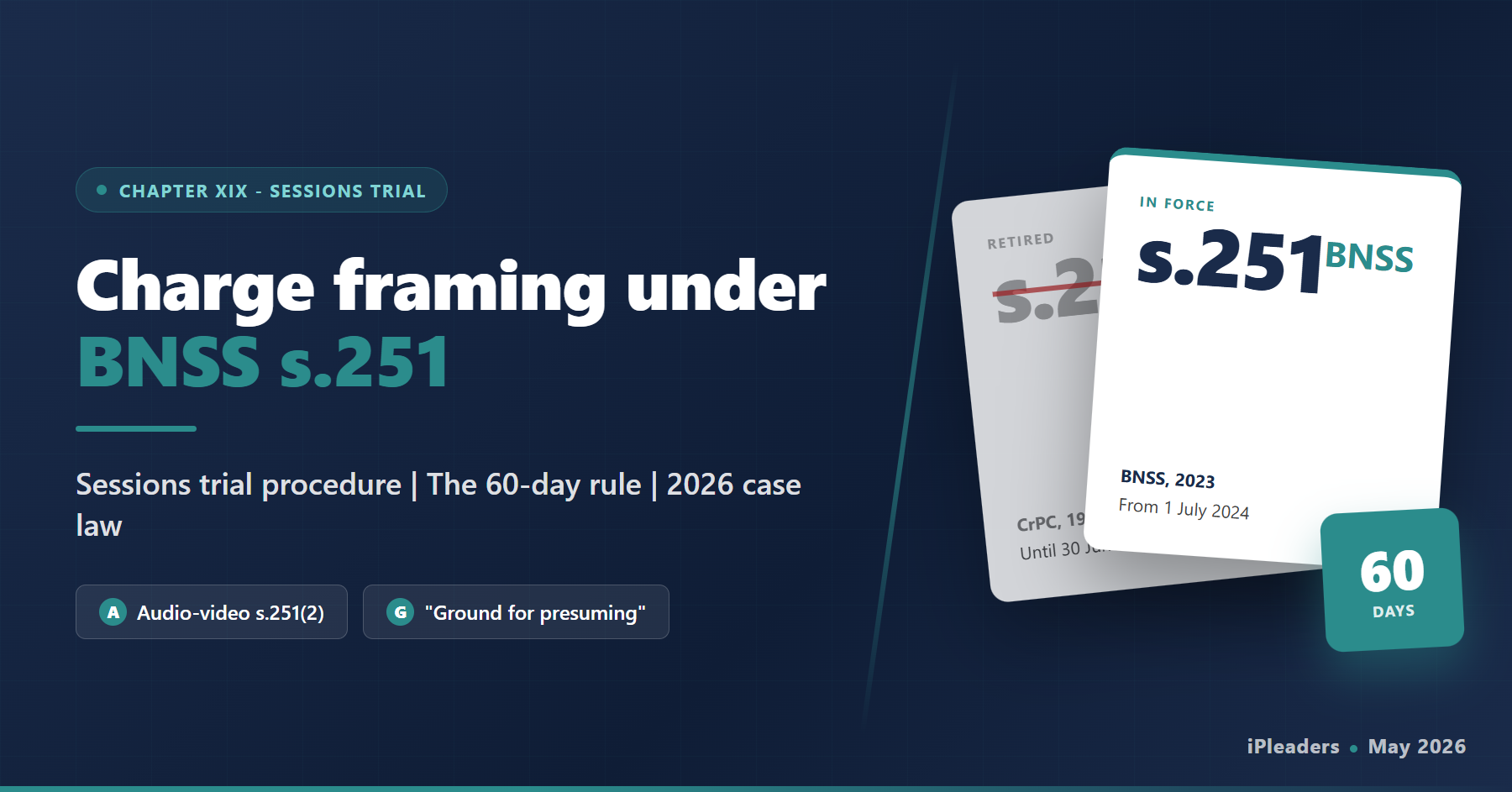
Charge framing under BNSS Section 251 is the stage at which a Sessions Judge, after hearing both sides, drafts the criminal charges against the accused if there is “ground for presuming” the accused committed an offence triable by the Court of Session. The judge must frame the charge in writing within 60 days of the first hearing, read it in person or via audio-video means, and record the plea.
Three things make this provision more contested than its predecessor. The first is what it carries over from CrPC Section 228 untouched. The second is what’s genuinely new. The third is what nobody is doing yet.
What is charge framing under BNSS Section 251?
Charge framing under BNSS Section 251 is the procedural moment at which a Sessions Judge writes down, in formal language, the precise criminal allegations the accused must answer at trial. It happens after the case is committed to the Court of Session and after the discharge stage closes. Until that moment, the prosecution’s allegations exist as paperwork. After it, they become the operative trial document.
Why does this matter? Nothing the prosecution does after charge framing can travel outside what the charge says. If a fact isn’t in the charge, the accused can’t be convicted for it (subject to alteration under Section 239). The framing stage draws the trial’s outer perimeter.
The statutory definition – what s.251(1) actually says
Section 251 of the Bharatiya Nagarik Suraksha Sanhita, 2023 sits in Chapter XIX of the BNSS, the chapter that governs every step of a Sessions trial. Sub-section (1) opens with the standard: “If, after such consideration and hearing as aforesaid, the Judge is of opinion that there is ground for presuming that the accused has committed an offence.” Three things follow: the judge must consider the record; the judge must hear both sides; the judge must reach a defined satisfaction the statute calls “ground for presuming,” which is less than proof beyond reasonable doubt and more than mere suspicion. The classic State of Bihar v. Ramesh Singh, (1977) 4 SCC 39 standard, confirmed unchanged in Dr. Anand Rai v. State of Madhya Pradesh, 2026 INSC 141.
Difference between a charge sheet and the framing of charge
A common Quora and PAA confusion. A charge sheet is the document the police file under Section 193 of the Bharatiya Nagarik Suraksha Sanhita, 2023 (formerly CrPC Section 173) at the close of investigation. It contains the prosecution’s case, witness lists, and supporting documents. Framing of charge is what the court does, much later, after committing the case to Sessions, hearing the discharge application, and taking a view on whether there’s ground to put the accused on trial. One is a police document; the other is a judicial document. Conflating them is the most common law-student error in BNSS papers.
Why the framing stage matters – the gatekeeping function before evidence is recorded
Think of charge framing as the gatekeeping checkpoint between investigation and trial. Before this point, the case is the prosecution’s. After this point, it’s the court’s. Every subsequent step (prosecution evidence under Section 254, statement of accused under Section 351, defence evidence, arguments, judgment) flows from the charge. A defective charge contaminates everything downstream.
Where Section 251 sits in the BNSS scheme – Chapter XIX architecture
Chapter XIX of the BNSS is titled “Trial Before a Court of Session” and runs from Section 248 to Section 260. Section 251 is the fourth provision. The chapter is one continuous sequence, not a collection of standalone sections.
The Chapter XIX sequence – from Public Prosecutor’s appointment (s.248) to judgement (s.260)
The chapter opens with Section 248 of the Bharatiya Nagarik Suraksha Sanhita, 2023 (Public Prosecutor conducts every Sessions prosecution). Then Section 249 (PP opens the case briefly). Then Section 250 (discharge, 60 days from commitment). Then Section 251 (framing, if discharge refused). Then Section 252 (plea). Then Section 253 (date for evidence). Section 254 onwards covers evidence, statement of accused, defence evidence, arguments; Section 260 closes with judgment.

In practice, the most disputed parts of Chapter XIX are sections 249 to 252: opening, discharge, framing, plea. Get those four right, the rest of the trial walks itself. Get any one wrong, and you’re looking at a revision, a quashing petition, or an appeal.
Where commitment ends and Sessions trial begins – the s.232 / Chapter XIX boundary
A point most practitioners breeze past. The Sessions trial doesn’t start with Section 248. It starts the moment the Magistrate commits the case under Section 232. From the date of commitment, the file moves to the Court of Session and the 60-day discharge clock starts. The timeline questions all sit on this boundary: when does the discharge window start? When does the “first hearing on charge” begin? Both answers track back to commitment under Section 232. For the broader CrPC trial framework that BNSS now replaces, iPleaders has a separate explainer.
Sessions trial vs warrant trial – one-line preview (full comparison in H2 §9)
A Sessions trial is conducted in the Court of Session under Chapter XIX. A warrant trial on a police report is conducted by a CJM or JMFC under Chapter XX. Parallel but distinct. Conflating Section 251 with Section 263 is the most common BNSS error in judiciary-exam answers.
The full text of Section 251 BNSS – clause by clause
Section 251 has two sub-sections. Sub-section (1) splits into two clauses; sub-section (2) handles the read-and-plea protocol. Bare-act sites give the text. This section gives the translation.
In substance, Section 251 of the Bharatiya Nagarik Suraksha Sanhita, 2023 reads: “(1) If, after such consideration and hearing as aforesaid, the Judge is of opinion that there is ground for presuming that the accused has committed an offence which (a) is not exclusively triable by the Court of Session, he may frame a charge and transfer the case to a Magistrate for trial as a warrant-case on a police report; (b) is exclusively triable by the Court, he shall frame in writing a charge within sixty days from the date of first hearing on charge. (2) Where the Judge frames any charge under clause (b), the charge shall be read and explained to the accused, in person or through audio-video electronic means, and the accused shall be asked whether he pleads guilty or claims to be tried.”
Section 251(1) – the gatekeeping standard (“ground for presuming”)
The opening words hold the entire test. The judge must form a reasoned opinion that there’s “ground for presuming” the accused has committed an offence. The opinion must follow consideration of the record and a hearing. Skip either step, and an appellate court will set the order aside.
Section 251(1)(a) – non-Sessions-exclusive offences (frame charge, transfer to CJM/JMFC)
Clause (a) covers a niche situation. The case has been committed to Sessions, but the offence the judge proposes to frame isn’t exclusively triable by the Court of Session. Maybe the chargesheet over-classified; maybe investigation downgraded it. The Sessions Judge frames the charge, then transfers the case to a CJM or JMFC for warrant-case trial. The court that frames isn’t always the court that tries.
Section 251(1)(b) – Sessions-exclusive offences (frame within 60 days of first hearing on charge)
Clause (b) is where the action is. If the offence is exclusively triable by the Court of Session (murder under Section 103 BNS, dacoity, rape, terror offences, certain economic offences), the Sessions Judge must frame the charge in writing within 60 days from the first hearing on charge. The 60-day mandate is the most cited and most ignored part of the new code, and the heart of the Aman Kumar matter.
Section 251(2) – read the charge to the accused, in person or via audio-video means; record plea
After framing, the charge must be read and explained in person or, if detained, through audio-video electronic means. The plea must be recorded in the accused’s own words. Plenty of trial-court orders record the plea in the third person, a lapse the CBI v. Karimullah Osan Khan, (2014) 11 SCC 538 line wouldn’t condone. Four things the judge must do: read the charge; explain it; verify the accused understands; record the plea. Skipping any one invites a revision under Section 438.
The “ground for presuming” test – what the Sessions Judge actually weighs
Of all the procedural questions Section 251 throws up, the substantive standard, “ground for presuming,” is the one most practitioners get wrong. It isn’t proof. It isn’t even prima facie satisfaction in the civil sense. It’s a defined criminal-procedure threshold the Supreme Court has been calibrating for nearly fifty years. Get this wrong, and every subsequent framing-stage argument falls flat.
The “ground for presuming” standard – lower than proof; higher than mere suspicion
The standard was crystallised in State of Bihar v. Ramesh Singh, (1977) 4 SCC 39 in 1977. At framing, the judge isn’t required to find conclusive proof. Strong suspicion suffices. Mere suspicion that doesn’t crystallise into anything concrete doesn’t. Union of India v. Prafulla Kumar Samal, (1979) 3 SCC 4 sharpened the test two years later: the judge must “sift and weigh” the prosecution material and isn’t a “post office.” If the materials disclose grave unexplained suspicion, the judge frames a charge. If only faint suspicion arises and two views are equally possible, the accused is entitled to discharge.
What material the judge can look at – prosecution material only (Padhi)
Here’s where most defence counsel go wrong. Can the accused produce defence material at the framing stage to argue for discharge? The answer, settled by State of Orissa v. Debendra Nath Padhi, (2005) 1 SCC 568 in 2005, is no. At framing, the judge looks only at what the prosecution has placed on record: chargesheet, witness statements, documents annexed. No alibi affidavits, no independent evidence. The accused’s right is to argue that the prosecution material, taken at face value, doesn’t disclose ground for presuming. Padhi remains good law post-BNSS, confirmed in Anand Rai. The iPleaders explainer on the mini-trial debate at the charge stage sits adjacent to this question.
The “two views” rule – if two views are equally possible and only suspicion arises, accused goes home
Prafulla Kumar Samal added a defence-friendly corollary to Ramesh Singh. If, on the prosecution material, two equally plausible views are possible (one of guilt, one of innocence), the judge leans for the accused and discharges. The “two views” rule is the strongest single argument a defence counsel has at framing. The trick is to demonstrate that two views are equally possible, not that the accused’s view is more probable (a trial argument). Sajjan Kumar v. CBI, (2010) 9 SCC 368 in 2010 restated the test: the court doesn’t weigh probative value, only asks whether a prima facie case is disclosed.
The court is not a “post office” of the prosecution – the sift-and-weigh duty
The “post office” phrase from Prafulla Kumar Samal captures, more vividly than any other formulation, what the framing-stage judge can’t do. No rubber-stamping the chargesheet. Active judicial application of mind. Amit Kapoor v. Ramesh Chander, (2012) 9 SCC 460 in 2012 reduced the principle to a 10-point framework that revisional courts now apply. If the framing order reads like a précis of the chargesheet with no independent reasoning, you have grounds for revision under Section 438.
The 60-day rule under Section 251(1)(b) – what does “first hearing on charge” mean?
The 60-day rule is the highest-profile reform Section 251 introduces, and the most contested. The text mandates that a Sessions Judge “shall frame in writing a charge against the accused within a period of sixty days from the date of first hearing on charge.” The phrase doing all the work is “first hearing on charge.” Nobody is yet sure what it means.
What “first hearing on charge” means – and why nobody is sure yet
Three plausible interpretations are in play. First, the date the case is committed to Sessions under Section 232. Second, the date of the accused’s first appearance before the Sessions Judge after commitment. Third, the date the discharge application under Section 250 is taken up. None is yet authoritatively settled. The Aman Kumar bench in October 2025 didn’t pick. The Orissa High Court in Narottam Prusty v. State of Odisha, CRLMC No. 1731 of 2025 (Orissa HC, 22 September 2025) hinted at the second reading for POCSO cases but didn’t extend the holding.
The Aman Kumar v. State of Bihar matter – SC’s pan-India guidelines on the way
Aman Kumar v. State of Bihar, SLP (Crl) No. 8437 of 2025 is the matter to watch. The October 2025 hearing produced three concrete moves. Senior Advocate Siddharth Luthra was appointed amicus curiae. The Attorney General was directed to assist. Every state was asked to file a list of cases where the 60-day rule has been breached. The bench has signalled that pan-India directions are coming. Expect a reporting protocol at every Sessions Court, monthly compliance reports, and a possible bail direction for accused in custody beyond the 60-day window without framing.
Action available to the accused when the 60-day window lapses – HC writ; revision; bail challenge
What does an accused do today, before the SC directions land, if 60 days pass without framing? Three routes. First, an HC writ under Article 226 framing the breach as a violation of Article 21 (speedy trial). Second, a revision under Section 438 BNSS asking the Sessions Judge or HC to expedite. Third, and most underused, a fresh bail application in custody cases, citing the breach as a changed circumstance. Several HCs have, in 2025, granted bail explicitly on the ground that the 60-day mandate had been ignored.
What happens to non-compliance going forward
The practical reality, based on the trajectory of recent SC pendency dockets, is that the pan-India directions will frontload the system. Trial courts will enter the framing date in a register; HCs will demand monthly returns; missed deadlines will trigger explanation. Defence counsel will invoke the 60-day breach as a routine trial-strategy point. Revisions will spike. Eventually, HC case law will calcify around what “first hearing on charge” means. Until then, treat the date of commitment as the baseline, but flag the discharge-application interpretation as the defence-friendly reading.
Step-by-step procedure under Section 251 BNSS – from commitment to plea
The procedural sequence runs from commitment under Section 232 to the recording of plea under Section 252. Eight steps. Each has a statutory anchor and a typical pitfall:
- Public Prosecutor opens the case under Section 249.
- Discharge window opens under Section 250 (60 days from commitment).
- Court hears both sides on the question of charge.
- Judge applies the “ground for presuming” test.
- If charge is framed, drafted in writing under Section 251(1)(b).
- Charge read and explained under Section 251(2), in person or via audio-video means.
- Accused pleads guilty or claims trial under Section 252.
- Date fixed for prosecution evidence under Section 253.
Step 1 – Public Prosecutor opens the case under s.249
The first substantive Sessions-court appearance is the PP’s opening: a brief statement of the charge and the evidence proposed. Not a mini-trial; a précis. Defence counsel should still take notes; any later expansion of the prosecution case becomes a Padhi-style argument.
Step 2 – Discharge window under s.250 (60 days from commitment)
The accused has 60 days from commitment to apply for discharge under Section 250 of the Bharatiya Nagarik Suraksha Sanhita, 2023. If the accused doesn’t apply, the window closes and framing opens. If the accused applies, the court must hear it before any framing. Framing before the discharge window has been heard is bad in law (Narottam Prusty principle).
Step 3 – Hearing both sides on charge
After discharge is denied (or after the 60-day window lapses), the court holds a hearing on charge. Both sides are heard, often on a single date. The accused isn’t required to lead defence evidence (Padhi forbids it) and argues only on the prosecution material.
Step 4 – Judge applies the “ground for presuming” test
The judge weighs the prosecution material: sift, weigh, take at face value, ask whether the ingredients are disclosed. The judge must record reasons. A bare “I find ground for presuming” is liable to be set aside on revision.
Step 5 – If charge is framed, drafted in writing
The charge is drafted in writing. Form and content are governed by Section 234 (formerly CrPC Section 211): offence, section charged, time, place, and particulars sufficient to give notice.
Step 6 – Read and explain the charge under s.251(2) (in person or audio-video)
The drafted charge is read out. If the accused doesn’t speak the court’s language, an interpreter is provided. If the accused is in custody and produced via video link, reading happens over audio-video electronic means. The judge must satisfy itself the accused has actually understood.
Step 7 – Accused pleads guilty or claims trial under s.252
Three options. Plead guilty (court may convict on plea under Section 252). Plead not guilty (case proceeds to evidence). Stand mute (court records plea of not guilty by default). Extreme caution on the plea-of-guilty short-cut: the appellate consequences are real.
Step 8 – Date fixed for prosecution evidence under s.253
If the accused claims trial, the court fixes a date under Section 253 for prosecution evidence. The trial proper begins: examination-in-chief, cross-examination, re-examination, statement of accused under Section 351, defence evidence, arguments, judgment.
Charge stands framed under BNSS s.251. Evidence stage opens under s.253.Has the case been committed to the Court of Session?
Have police papers been supplied to the accused?
Has the accused filed a discharge application?
After hearing both sides, is there ground for presuming the accused has committed an offence?
Is the offence exclusively triable by the Court of Session?
Is the accused physically present in court?
Does the accused plead guilty?
Trial begins
Practitioner notes
Audio-video charge framing under Section 251(2) – read-and-explain in person or virtually
The audio-video provision in Section 251(2) is one of the two genuinely new elements in BNSS Section 251 (the other being the 60-day timeline). Until 2024, charge framing was an exclusively physical-court procedure. Now the statute expressly contemplates VC framing. The questions: when, how, and with what safeguards?
What “audio-video means” covers under s.251(2)
The phrase “audio-video electronic means” is the same one BNSS uses across Section 530 (electronic mode of trial). It covers video conferencing platforms approved by the High Court for prison-court links. It doesn’t cover audio-only telephonic links. The accused must be visible to the court and vice versa. Most HCs have, by 2026, issued protocols specifying the platforms that qualify (typically the e-Courts Phase III VC infrastructure).
Read-and-explain protocol over VC – what trial courts are doing in practice
The protocol over VC mirrors the in-person protocol. The judge reads the charge; an interpreter, if required, translates; the judge asks whether the charge is understood; the accused responds; the plea is recorded. One extra step: a court coordinator at the prison end confirms identity and the absence of coercion. Most HCs require the coordinator to sign a verification form attached to the day’s order. Where this is missing, the framing is open to challenge.
Language and comprehension – if the accused does not understand, the framing is incomplete
A common trap. The accused hears the charge over VC, in a language not their own, and the proceedings record a plea of not guilty without an interpreter being made available. The framing is incomplete. A revision under Section 438 lies. Some HCs in 2025-2026 have set aside such VC framing orders and remitted the matter for proper read-and-explain. Defence counsel should treat the language-and-comprehension verification as the single most important checkpoint in any VC framing.
CrPC 228 vs BNSS 251 – what changed and what carried over
Most of Section 251 BNSS is Section 228 CrPC under a new chapter number. The two-scenario architecture is unchanged. The “ground for presuming” standard is identical. The form-of-charge requirement is identical. What’s genuinely new fits on a postcard: the 60-day timeline in clause (1)(b), and the audio-video provision in sub-section (2). Everything else carries over. And that means the entire body of CrPC-era jurisprudence continues to govern.
Where the text is identical – the “ground for presuming” wording, the two-scenario structure
Section 228 of the Code of Criminal Procedure, 1973 and BNSS Section 251 share, word for word, the “ground for presuming that the accused has committed an offence” language and the two-scenario architecture: clause (a) for non-Sessions-exclusive offences (frame, transfer to Magistrate); clause (b) for Sessions-exclusive offences (frame in writing, proceed to trial). None of this has changed.
What is genuinely new – the 60-day timeline in s.251(1)(b) and the audio-video provision in s.251(2)
The two new elements both serve the same goal: speed. The 60-day timeline puts a statutory cap on framing delays. The audio-video provision removes the physical-presence bottleneck that frequently delayed framing in custody cases. Whether they’ll deliver speed gains in practice is the question the Aman Kumar bench is currently testing.
The continuity rule – Dr. Anand Rai v. State of M.P., 2026 INSC 141 confirms CrPC jurisprudence still applies
The Supreme Court in Dr. Anand Rai v. State of Madhya Pradesh, 2026 INSC 141 (10 February 2026) settled the question every BNSS-era practitioner had been asking. The court held that “the established jurisprudence developed under the Cr.P.C. on the scope and limits of consideration at the stages of discharge and framing of charges under BNSS continues to hold the field.” Every CrPC charge-framing case (Ramesh Singh, Prafulla Kumar Samal, Padhi, Sajjan Kumar, Amit Kapoor, Willie (William) Slaney v. State of Madhya Pradesh, AIR 1956 SC 116, V.C. Shukla v. State (Through CBI), 1980 Supp SCC 92, Karimullah Osan) remains binding. The single most important takeaway for any practitioner working with Section 251.
Transition cases – what about FIRs registered before 1 July 2024? (s.531 savings clause)
If the FIR was registered on 28 June 2024 and the case is committed to Sessions in 2025, does CrPC 228 apply or BNSS 251? The answer sits in Section 531, the savings clause. The short answer: investigations and proceedings already underway as on 1 July 2024 continue under the CrPC; new investigations after that date fall under the BNSS. The framing stage is procedural, but practical readings vary by High Court. Read the savings clause carefully before staking out a position; the dedicated transition-rule section later in this guide unpacks the practical complications.
Continuity rule
BNSS 251 vs BNSS 263 – Sessions trial vs warrant case on police report
This is the headline differentiator. Every weak competitor in the SERP conflates Section 251 with Section 263. They aren’t the same provision. They aren’t even in the same chapter. Mixing them up in a judiciary-exam answer is an automatic deduction. Mixing them up in a real charge-framing argument is a recipe for an embarrassing court correction.
Why the confusion exists – both provisions cover charge framing; both have a 60-day window
Three roots. Both provisions are about charge framing. Both contain a 60-day timeline. Both use identical “ground for presuming” wording. To a casual reader, they read alike. They aren’t.
Where each provision sits in the BNSS – Chapter XIX (s.251) and Chapter XX (s.263)
Section 251 sits in Chapter XIX (trial before the Court of Session). Section 263 sits in Chapter XX (trial of warrant-cases by Magistrates). The CrPC equivalent of Section 251 is Section 228; of Section 263 is Section 240. Committed to Sessions? s.251 territory. Tried by a CJM or JMFC on a police report? s.263 territory. Knowing which chapter you’re in is step one of every charge-framing argument.
The court that frames the charge – Sessions Judge under s.251; CJM or JMFC under s.263
A Sessions Judge frames the charge under Section 251. A Chief Judicial Magistrate or Judicial Magistrate of First Class frames the charge under Section 263. The trigger is different. For Section 251, the trigger is commitment under Section 232. For Section 263, the trigger is cognizance on a police report and supply of papers under Section 230, with the discharge window under Section 262 preceding the framing.
The discharge stage that precedes each – s.250 (Sessions) vs s.262 (warrant case)
The discharge stage is different in each chapter. Section 250 gives the accused a 60-day window from commitment. Section 262 gives the Magistrate discretion to discharge after considering the record. Different timelines, different standards, different remedies. Citing Section 251 in a warrant-case revision gets the petition dismissed at the threshold.
These are NOT the same provision. A common error is to cite “BNSS 251” for warrant-case charge framing on a police report – that is BNSS 263.Practitioner notes
Landmark Supreme Court cases that govern BNSS 251
The Supreme Court has built, over almost seventy years, a coherent body of jurisprudence on charge framing. Every one of these cases continues to govern under BNSS Section 251, on the strength of the continuity rule in Dr. Anand Rai v. State of Madhya Pradesh, 2026 INSC 141. The iPleaders explainer on the discharge framework that precedes charge framing completes the pre-trial picture.
State of Bihar v. Ramesh Singh (1977) – the foundational test
State of Bihar v. Ramesh Singh, (1977) 4 SCC 39 is the foundational decision. The bench held that at framing, the court isn’t required to find conclusive proof. Strong suspicion suffices; mere suspicion doesn’t. Bedrock of every later test.
Union of India v. Prafulla Kumar Samal (1979) – sift, weigh, and the four-factor test
Union of India v. Prafulla Kumar Samal, (1979) 3 SCC 4 sharpened Ramesh Singh into a usable framework. The judge must “sift and weigh” the prosecution material and isn’t a “post office.” Four factors: whether the materials disclose strong suspicion; whether suspicion has been explained away; whether two views are equally possible; whether mere suspicion arises. Discharge if the test isn’t met; frame if it is.
State of Orissa v. Debendra Nath Padhi (2005) – only prosecution material at framing stage
State of Orissa v. Debendra Nath Padhi, (2005) 1 SCC 568 settled the most-litigated procedural question at framing: can the accused produce defence material? Three-judge bench: no. Defence material has its day at trial. The Padhi rule remains untouched post-BNSS.
Sajjan Kumar v. CBI (2010) – the modern statement of the prima facie test
Sajjan Kumar v. CBI, (2010) 9 SCC 368 restated the test: take the prosecution material at face value; ask whether all ingredients are disclosed; don’t test probative value. The formulation most framing orders quote.
Amit Kapoor v. Ramesh Chander (2012) – the 10-point framework for framing and quashing
Amit Kapoor v. Ramesh Chander, (2012) 9 SCC 460 is the contemporary codification. The bench laid down a 10-point framework that revisional courts apply. The threshold for setting aside framing is “even weaker than prima facie.” The framework every revision petition cites.
Willie Slaney v. State of M.P. (1956) – defects in framing not fatal unless “failure of justice”
Willie (William) Slaney v. State of Madhya Pradesh, AIR 1956 SC 116, a Constitution Bench decision, is the curative anchor. Defects in framing aren’t fatal unless they cause a “failure of justice.” Cited by the prosecution on appeal; defence counsel cite it for the contrary proposition where the defect is genuinely prejudicial.
V.C. Shukla v. State (Through CBI) (1980) – reasoned framing orders
V.C. Shukla v. State (Through CBI), 1980 Supp SCC 92 held that the court at framing must record reasons. A bare order without reasoning is deficient. Underwrites every “non-speaking order” revision argument.
CBI v. Karimullah Osan Khan (2014) – materials of doubtful authenticity
CBI v. Karimullah Osan Khan, (2014) 11 SCC 538 reaffirms Padhi. At charge stage, materials of doubtful authenticity can’t be the basis for discharge. Weight is for trial.
Dr. Anand Rai v. State of M.P., 2026 INSC 141 – the continuity rule confirmed under BNSS
Anand Rai is the BNSS-era continuity confirmation. Every CrPC-era charge-framing case continues to bind. Practitioners arguing post-BNSS start from continuity and must justify any departure on the two genuinely new elements: 60-day timeline, audio-video provision.
The Aman Kumar SC pendency – pan-India guidelines on the way
The Aman Kumar v. State of Bihar, SLP (Crl) No. 8437 of 2025 matter is the highest-profile current docket on Section 251 BNSS. The bench of Justice Aravind Kumar and Justice N.V. Anjaria has signalled that pan-India directions are being formulated. Senior Advocate Siddharth Luthra has been appointed amicus. The Attorney General has been directed to assist. Every state has been called to file lists of unframed-charge cases. This is the freshness anchor of the entire charge-framing landscape for 2026.
The 29 October 2025 hearing – what the bench observed
On 29 October 2025, the bench took up the SLP. The accused, in custody for nearly a year without charge framing, was the lead petitioner. The bench observed that the 60-day mandate in Section 251(1)(b) wasn’t being honoured. “Why take years and years to frame charges?” the bench asked. “We propose to do it. We will issue directions pan-India.” The observations, as reported by LiveLaw, LawBeat, and India Legal, are now part of the matter’s procedural history. The next listed hearing is awaited.
Maharashtra’s 649 cases – the scale of non-compliance
Counsel for the State of Maharashtra reported that 649 Sessions cases had charges pending framing beyond the 60-day window. Bihar, Karnataka, and other states were directed to file similar returns. The pan-India scale of non-compliance will shape the SC’s eventual directions. The second-order effect: directions are likely to frontload the system with monthly compliance reports, fresh bail considerations, and possibly an HC-level supervisory mechanism.
What the directions are likely to look like
Based on the SC’s recent pattern in similar high-pendency dockets, expect three elements. First, a charge-framing register at every Sessions Court, with entry of the commitment date, the first hearing on charge date, and the framing date. Second, monthly compliance returns from each Sessions Court to the High Court. Third, a possible bail direction: accused in custody beyond the 60-day window without framing should be considered for bail on a fresh application. None final. All plausible. The next hearing is the one to watch.
The Narottam Prusty rule – when premature charge framing is bad in law
Narottam Prusty v. State of Odisha, CRLMC No. 1731 of 2025 (Orissa HC, 22 September 2025), decided by the Orissa High Court, is the first reported HC ruling that gives content to the “first hearing on charge” question in the POCSO context. Its reasoning extends to general Sessions trials by analogy, and it’s a case every defence counsel should keep handy.
The facts – same-day police-paper supply and same-day charge framing
The facts are stark. The accused was produced before a POCSO Special Court. On the same day the vakalatnama was filed and police papers were supplied, the Special Court framed the charge. No opportunity to seek discharge. No s.250 application possible. No 60-day window allowed to run. The framing was, in effect, instant.
What the Orissa HC held – charge framing set aside
The Orissa High Court set the framing aside. The court held that “the date of commitment” under Section 250(1) BNSS, in POCSO trials, is the date the accused first appears before the Special Court after cognizance under Section 33(1) POCSO. The accused has 60 days from that date to seek discharge. Framing on the same day police papers are supplied denies the statutory window. Bad in law.
The takeaway for defence counsel – never let the 60-day window be cut short
The Narottam Prusty rule, read with the s.250-s.251 sequencing, gives defence counsel a clean argument: the 60-day discharge window must run in full before framing. If the trial court compresses the timeline, file an immediate revision under Section 438 citing Narottam Prusty. The HC is likely to set the framing aside and remit for proper sequencing. The principle, while POCSO-specific in formal terms, applies by analogy to all Sessions trials.
Common procedural traps in charge framing under BNSS
Six traps recur across BNSS-era charge-framing matters. They surface, again and again, in revision petitions, in HC orders, in trial-court records.
Trap 1 – framing before the s.250 discharge window expires (Narottam Prusty)
The Narottam Prusty trap. Under pendency pressure, the trial court frames the charge before the 60-day discharge window under Section 250 has run. The accused has had no opportunity to file a discharge application. The framing is liable to be set aside; remedy is a revision under Section 438 citing Narottam Prusty.
Trap 2 – framing without language compliance under s.251(2)
The accused doesn’t speak the language of the court. No interpreter is provided. The plea is recorded as not guilty. The framing is incomplete; the constitutional core of Section 251(2) isn’t satisfied. Remedy: revision pointing to the absence of an interpreter; most HCs will set such a framing aside on the spot.
Trap 3 – framing via audio-video without verifying comprehension
The accused is in custody. Framing happens over VC. The court coordinator at the prison end doesn’t sign a verification form. Comprehension isn’t tested. Karimullah Osan and Anand Rai point the same way: framing must be set aside if comprehension verification is missing.
Trap 4 – framing without prior sanction (where required)
Public-servant and certain economic offences require prior sanction before cognizance and, by implication, framing. If sanction was never obtained, framing was bad ab initio. The State of Orissa v. Debendra Nath Padhi, (2005) 1 SCC 568 line doesn’t save sanction defects (those go to jurisdiction). The remedy: a Section 438 revision or, more commonly, a Section 528 quashing petition.
Trap 5 – framing without supplying police papers under s.230
Section 230 requires police papers to be supplied before any meaningful Sessions-stage proceedings. If framing happens before supply, the framing is liable to be set aside on Narottam Prusty logic. Remedy: revision under Section 438, with a prayer for fresh framing after proper supply.
Trap 6 – framing without recording reasons (V.C. Shukla principle)
A bare framing order, just “I find ground for presuming, charge framed,” is insufficient. The V.C. Shukla v. State (Through CBI), 1980 Supp SCC 92 principle requires reasons: what material was considered, why ground for presuming was found, which sections are being framed. Remedy: a Section 438 application citing V.C. Shukla and asking for a reasoned order on remand.
How to challenge a defective charge – revision, quashing, and constitutional remedies
When a charge has been wrongly framed, prematurely framed, framed without sanction, framed without language compliance, or otherwise tainted, the accused has three principal challenge routes. The iPleaders deep-dive on the quashing petition under Section 528 BNSS covers the procedure end to end.
Is a charge-framing order an interlocutory order? Why this matters for revision
The threshold question. If the framing order is interlocutory, revision under Section 438 is barred. Since the Madhu Limaye line, the SC has held that orders that decisively affect the rights of the parties aren’t interlocutory in the strict sense. A charge-framing order, because it puts the accused on trial for specific offences, is treated as quasi-final. Revision lies. The Amit Kapoor v. Ramesh Chander, (2012) 9 SCC 460 10-point framework guides revisional intervention.
Revision under BNSS Section 438 (formerly CrPC 397)
Revision lies before the Sessions Judge or the High Court. The threshold is high: the revisional court intervenes sparingly, only where the framing order is patently illegal, perverse, or causes a failure of justice. The 90-day limitation under the Limitation Act, 1963 runs from the framing order. File within the window; delays attract preliminary objections and require condonation under Section 5 of the Limitation Act.
Quashing under BNSS Section 528 (formerly CrPC 482)
Section 528 is the inherent-jurisdiction provision. The HC may quash any order where doing so secures the ends of justice or prevents abuse of process. The threshold is higher than revision: the HC won’t quash unless the framing order is fundamentally unsustainable on the prosecution’s own material. Section 528 is the right vehicle where the defect is jurisdictional (no sanction, wrong court, no commitment) rather than discretionary.
Constitutional challenge – Articles 226 and 227
Articles 226 and 227 are residuary remedies, lying when BNSS routes aren’t available or have been exhausted. The threshold is violation of fundamental rights or gross supervisory failure. Slower and more expensive than statutory routes. Use sparingly.
Alteration of charge during trial – BNSS Section 239
Section 239 empowers the court to alter or add to a charge at any time before judgment. Not a challenge route, but a corrective device. If prosecution evidence reveals an offence not framed, the court alters the charge. If evidence shows over-classification, the court may delete the charge. Section 239 is the prosecution’s response when the original framing turns out to be off.
Practical checklist for defence counsel at the charge-framing stage
A short, scannable checklist a junior defence counsel can run through before, during, and after the framing hearing. The gap shows up, the absence of a structured workflow, even in seasoned practitioners’ files. The starting point for any defence file is FIR registration under BNSS, which sets the tone for everything that follows.
Before the framing hearing – papers received? Discharge window calculated? Sanction status?
Six checkpoints before the framing date is listed. Have police papers under Section 230 been supplied? (If not, your first preliminary objection.) Date of commitment under Section 232? (Anchors the 60-day discharge window.) Sanction on record where required? Discharge application filed? “First hearing on charge” date claimed by the prosecution? Supplementary chargesheet expanding the case? (If yes, the supply-of-papers clock resets.)
During the framing hearing – what to argue under Padhi and Prafulla Kumar Samal
Three pillars. First, State of Orissa v. Debendra Nath Padhi, (2005) 1 SCC 568: the court can only look at prosecution material. Frame the argument as: “Even on the prosecution’s own material, taken at face value, the ingredients aren’t disclosed.” Second, Union of India v. Prafulla Kumar Samal, (1979) 3 SCC 4: the court must sift and weigh; if two views are equally possible, lean for the accused. Argue the “two views” point on contested facts. Third, the V.C. Shukla principle: the framing order must record reasons. Where the prosecution’s material is thin, ask the court to record that fact in the order. A reasoned non-discharge is easier to challenge than a bare one.
After the framing – the 90-day window for revision; the s.528 option; the Article 226/227 lane
If framing happens despite the defence arguments, the post-framing playbook kicks in. Calculate the 90-day revision window from the framing date. File revision under Section 438 if the defect is procedural or discretionary. Reserve Section 528 for jurisdictional defects (no sanction, no commitment, wrong court). Reserve Article 226/227 for fundamental-rights violations. Pick the strongest, file within limitation, pursue cleanly.
Want hands-on training on framing-of-charge strategy, discharge applications under Section 250 BNSS, and the procedure of a Sessions trial as it actually plays out in court? LawSikho’s Diploma in Criminal Litigation and Trial Advocacy walks you through real charge-framing arguments, mock discharge applications, and the post-BNSS procedural landscape, taught by practising criminal-side advocates.
Charge framing and the CrPC-to-BNSS transition – the s.531 savings clause
The transition from CrPC to BNSS, effective 1 July 2024, has thrown up a procedural question touching every Sessions matter currently mid-stream. Does CrPC Section 228 apply, or BNSS Section 251? The answer sits in Section 531 of the Bharatiya Nagarik Suraksha Sanhita, 2023, the savings clause, and the Dr. Anand Rai v. State of Madhya Pradesh, 2026 INSC 141 continuity rule.
The text of Section 531 BNSS
Section 531 provides that the BNSS won’t affect the validity of anything done or any proceeding pending under the repealed CrPC. Investigations and proceedings already underway as on 1 July 2024 continue under the CrPC. New investigations after that date fall under the BNSS. Straightforward in principle; complications come at the seams.
What this means for FIRs registered before 1 July 2024
If the FIR was registered under the CrPC, the investigation continues under the CrPC. Chargesheet under CrPC Section 173. Cognizance under the CrPC. Commitment under CrPC procedure. The complication is at framing. Some HCs treat framing as procedural, follow the code in force at the time of framing (BNSS Section 251), and apply the 60-day rule. Others treat the entire trial as a CrPC continuation and apply CrPC 228 throughout. Read your jurisdiction’s most recent HC guidance.
Pending Sessions trials – which framing rule applies?
For pending Sessions trials where commitment happened pre-1 July 2024 but framing is yet to happen, the question is contested. Defence-friendly reading: BNSS Section 251 applies, because framing is a fresh procedural act post-1 July 2024, and the 60-day mandate kicks in. Prosecution-friendly reading: the trial is a CrPC continuation, and CrPC 228 applies. The Supreme Court hasn’t pronounced. The Anand Rai continuity rule cuts both ways. Watch the post-Aman-Kumar pan-India directions.
Frequently asked questions
What is Section 251 of BNSS?
Section 251 BNSS is the provision that governs the framing of charge in a Sessions trial. It sits in Chapter XIX. After hearing both sides and considering the prosecution material, the Sessions Judge frames the charge in writing if there’s “ground for presuming” the accused has committed an offence. The provision replaces CrPC Section 228 and adds two new elements: a 60-day timeline and an audio-video framing option.
What is the 60-day rule under BNSS Section 251?
Section 251(1)(b) requires the Sessions Judge to frame a charge in writing within 60 days from the date of “first hearing on charge” in cases exclusively triable by the Court of Session. This is a genuinely new mandate not present in CrPC 228. The Aman Kumar v. State of Bihar matter, currently pending before the Supreme Court, is examining nationwide compliance and pan-India directions are expected.
Is BNSS 251 the same as CrPC Section 228?
Largely yes. The text, the standard (“ground for presuming”), the two-scenario architecture, and the form-of-charge requirements are identical. The two genuinely new elements are the 60-day timeline in clause (1)(b) and the audio-video provision in sub-section (2). All CrPC-era jurisprudence on charge framing continues to apply, as confirmed by Dr. Anand Rai v. State of M.P., 2026 INSC 141.
What is the difference between BNSS 251 and BNSS 263?
Section 251 governs charge framing in Sessions trials (Chapter XIX, Sessions Judge). Section 263 governs charge framing in warrant cases on a police report (Chapter XX, CJM or JMFC). Both use identical “ground for presuming” wording and both have a 60-day framing window. The critical differences are the chapter, the court, and the trigger (commitment under Section 232 for s.251, cognizance under Section 230 for s.263).
What does “ground for presuming” mean in BNSS 251?
“Ground for presuming” is the standard the Sessions Judge applies at the framing stage. It’s higher than mere suspicion but lower than proof beyond reasonable doubt. State of Bihar v. Ramesh Singh (1977) defined it as “strong suspicion,” and Prafulla Kumar Samal (1979) sharpened it through the sift-and-weigh test. If two views on the prosecution material are equally possible, the accused is entitled to discharge.
From what date does the 60-day clock under BNSS 251(b) start?
The phrase “first hearing on charge” isn’t yet authoritatively defined. Three readings compete: the date of commitment under Section 232; the date of the accused’s first appearance before the Sessions Judge; the date the discharge application is taken up. The Orissa HC in Narottam Prusty (2025), in the POCSO context, used the second reading. The Aman Kumar SC matter may settle this for general Sessions trials.
Can charges be framed via video conferencing under BNSS?
Yes. Section 251(2) expressly permits the charge to be read and explained through audio-video electronic means, in addition to in-person reading. The accused must be visible to the court, the court visible to the accused, and the accused’s comprehension verified, typically through a prison-end coordinator. Audio-only links don’t qualify. Most High Courts have approved the e-Courts Phase III VC infrastructure for this purpose.
What is the difference between BNSS 250 (discharge) and BNSS 251 (charge framing)?
Section 250 governs discharge: the accused has 60 days from the date of commitment to apply for discharge, and the court discharges if there’s no sufficient ground to proceed. Section 251 governs framing: if discharge is denied (or not sought), the court frames the charge in writing. Discharge precedes framing. Framing the charge before the discharge window has run is bad in law (Narottam Prusty principle).
What is the difference between a charge sheet and the framing of charge?
A charge sheet is the police document filed under Section 193 BNSS at the close of investigation. It contains the prosecution’s case, witness lists, and documents. Framing of charge is the judicial act recorded by the court at the start of the Sessions trial, after hearing both sides. The charge sheet is filed; the charge is framed. One is a police document, the other a judicial document.
Can the accused produce defence documents at the charge-framing stage under BNSS?
No. The Supreme Court in State of Orissa v. Debendra Nath Padhi (2005) settled this question for the CrPC era, and the Anand Rai continuity rule extends it to BNSS. At the framing stage, the court considers only the prosecution material. The accused argues that the prosecution material itself, taken at face value, doesn’t disclose ground for presuming. Defence material has its day at trial.
Are the Supreme Court’s CrPC-era charge-framing rulings still applicable under BNSS?
Yes, with full force. The Supreme Court in Dr. Anand Rai v. State of M.P., 2026 INSC 141 (10 February 2026) held that “the established jurisprudence developed under the Cr.P.C. on the scope and limits of consideration at the stages of discharge and framing of charges under BNSS continues to hold the field.” Ramesh Singh, Prafulla Kumar Samal, Padhi, Sajjan Kumar, Amit Kapoor, all remain binding precedent.
Can the charge framed under BNSS 251 be altered later?
Yes. Section 239 BNSS empowers the trial court to alter or add to a charge at any time before judgment is pronounced. If the prosecution evidence reveals an offence not originally framed, the charge is altered. If the evidence shows over-classification, the charge may be deleted. Material alterations require the accused to be given an opportunity to recall witnesses, lead fresh evidence, or seek an adjournment.
How can a wrongly framed charge be challenged under BNSS?
Three routes. First, revision under Section 438 BNSS (formerly CrPC 397) within 90 days of the framing order under the Limitation Act, before the Sessions Judge or High Court. Second, quashing under Section 528 BNSS (formerly CrPC 482) before the High Court for jurisdictional defects. Third, constitutional challenge under Articles 226/227 for fundamental-rights violations. Pick the strongest route. Don’t run all three simultaneously.
Can a charge-framing order be quashed under BNSS Section 528?
Yes, in principle. Section 528 is the inherent-jurisdiction provision. The High Court may quash a framing order to secure the ends of justice or prevent abuse of process. The threshold is high: the order must be fundamentally unsustainable on the prosecution’s own material, or must reflect a jurisdictional defect (no sanction, no commitment, wrong court). Discretionary defects are typically dealt with via revision under Section 438, not quashing.
If FIR was registered before 1 July 2024, does BNSS 251 apply or CrPC 228?
The transition is governed by Section 531 BNSS. Investigations and proceedings already underway as on 1 July 2024 continue under the CrPC. New investigations after 1 July 2024 fall under the BNSS. For the framing stage in pending Sessions trials, HC views vary: some treat framing as procedural and apply BNSS Section 251 (with the 60-day rule); others treat the trial as a CrPC continuation. Read your jurisdiction’s most recent HC guidance.
What action can an accused take if charges are not framed within 60 days?
Three routes. First, an HC writ under Article 226 framing the breach as a violation of Article 21 (speedy trial). Second, a revision under Section 438 BNSS asking the Sessions Judge or HC to expedite. Third, a fresh bail application in custody cases, citing the breach of the statutory mandate as a changed circumstance. The bail argument has worked in several 2025 HC orders. The Aman Kumar SC pan-India directions, when issued, are likely to formalise the response.
What is the Aman Kumar v. State of Bihar case about?
Aman Kumar v. State of Bihar, SLP (Crl) No. 8437/2025, is a pending Supreme Court matter on Section 251(b) compliance. On 29 October 2025, the bench of Justice Aravind Kumar and Justice N.V. Anjaria expressed concern at non-compliance with the 60-day framing rule and signalled pan-India directions. Senior Advocate Siddharth Luthra was appointed amicus. Maharashtra alone reported 649 cases of unframed charges. The next hearing is awaited.
What if a co-accused is added later – does the 60-day clock reset?
This is an emerging interpretive question without authoritative settlement. The practical view across most HCs is that the 60-day clock for the new co-accused starts from their first hearing on charge, calculated from their first appearance before the Sessions Judge after their commitment. The original accused’s clock isn’t reset. The Aman Kumar SC matter may, when directions are issued, address this edge case in its compliance protocol.
References
Statutes
- Code of Criminal Procedure, 1973 , sections cited: 228.
- Bharatiya Nagarik Suraksha Sanhita, 2023 , sections cited: 193, 230, 232, 234, 239, 248, 249, 250, 251, 252, 253, 262, 263, 438, 528, 530, 531.
Case Law
- Amit Kapoor v. Ramesh Chander, (2012) 9 SCC 460
- Aman Kumar v. State of Bihar, SLP (Crl) No. 8437 of 2025 , matter pending; reported coverage at LiveLaw and LawBeat.
- CBI v. Karimullah Osan Khan, (2014) 11 SCC 538
- Dr. Anand Rai v. State of Madhya Pradesh, 2026 INSC 141 , reported as 2026 LiveLaw (SC) 136; LiveLaw judgment summary.
- Narottam Prusty v. State of Odisha, CRLMC No. 1731 of 2025 (Orissa HC, 22 September 2025) , reported at LiveLaw.
- Sajjan Kumar v. CBI, (2010) 9 SCC 368
- State of Bihar v. Ramesh Singh, (1977) 4 SCC 39
- State of Orissa v. Debendra Nath Padhi, (2005) 1 SCC 568
- Union of India v. Prafulla Kumar Samal, (1979) 3 SCC 4
- V.C. Shukla v. State (Through CBI), 1980 Supp SCC 92
- Willie (William) Slaney v. State of Madhya Pradesh, AIR 1956 SC 116
Secondary sources
- LiveLaw , Supreme Court Expresses Concern Over Delay In Framing Charges In Criminal Trials, Mulls Pan-India Directions (29 October 2025)
- LawBeat , Supreme Court to Tighten Timelines for Framing of Charges Under BNSS (29 October 2025)
- Bar and Bench , Delays in trial: Supreme Court moots pan-India guidelines on timeline to frame charges (29 October 2025)
- LiveLaw , S. 250(1) BNSS, POCSO Accused Can File Discharge Application Within 60 Days Of Receiving Police Papers, Orissa HC Issues Directions
Disclaimer: This article is for informational and educational purposes only and does not constitute legal advice.
 Serato DJ Crack 2025Serato DJ PRO Crack



 Allow notifications





