

Last verified: 2026-05-15
It was a morning in late April 2023 on a Varanasi pavement. A rag-picker family woke to find their four-year-old son gone from the spot beside them where he had slept the night before.
What looked like a single missing-child case unravelled, over the next twenty-three months, into an interstate trafficking network whose prosecution would test every limb of the new law on kidnapping and abduction under BNS Sections 137 to 141. The original FIRs were registered under the old Indian Penal Code, 1860 (“IPC”). But the principles the Supreme Court eventually laid down would govern every prosecution going forward, IPC-era or BNS-era alike, under the Bharatiya Nyaya Sanhita, 2023.
Investigators followed the trail through a chain of intermediaries stretching from Uttar Pradesh into Rajasthan, Bihar, Jharkhand and West Bengal. Infants and young children, the chargesheet alleged, had been taken from pavements and maternity wards, then sold, for sums ranging from about Rs 40,000 to Rs 10 lakh per child, as illegal “adoption” placements.

Some of the recovered children were under five. One was a one-year-old. The chargesheet described an organised network with brokers operating across at least four states.
On 15 April 2025, after the Allahabad High Court released thirteen accused on bail, the apex court stepped in. A two-judge Bench cancelled every one of those bail orders. It described the High Court’s approach as “casual”, faulted the State of Uttar Pradesh for not challenging the bail orders, and pulled up the High Court for failing to impose meaningful supervisory conditions, such as weekly police reporting.
The Bench then went further than the immediate facts: it laid down nationwide guidelines for every state. Every missing-child complaint must be registered and treated as kidnapping or trafficking until investigation says otherwise. Every such FIR must be routed to the district Anti-Human Trafficking Unit.
Child Welfare Committees must be established in every district with proper infrastructure. Trials must be completed preferably on a day-to-day basis within six months. Compliance was to be monitored through State Secretaries; in a later hearing, the Court summoned State Home Secretaries personally. The judgment, Pinki v. State of Uttar Pradesh, 2025 INSC 482, is one of the Supreme Court’s first sustained engagements with the kidnapping and trafficking framework following the rollout of the BNS.
Here’s why that ruling matters for any reader trying to make sense of the new code. From 1 July 2024, IPC Sections 359 to 374 stand replaced by BNS Sections 137 to 141 (and Section 143 for trafficking). The conduct caught is the same. The section numbers are different.
The procedural framework underneath, governed by the Bharatiya Nagarik Suraksha Sanhita, 2023 (“BNSS”), is sharper. And the apex court has signalled that it will not tolerate routine bail or sluggish trials in this category. That is the ground on which every Section 137 to 141 prosecution in 2026 sits.
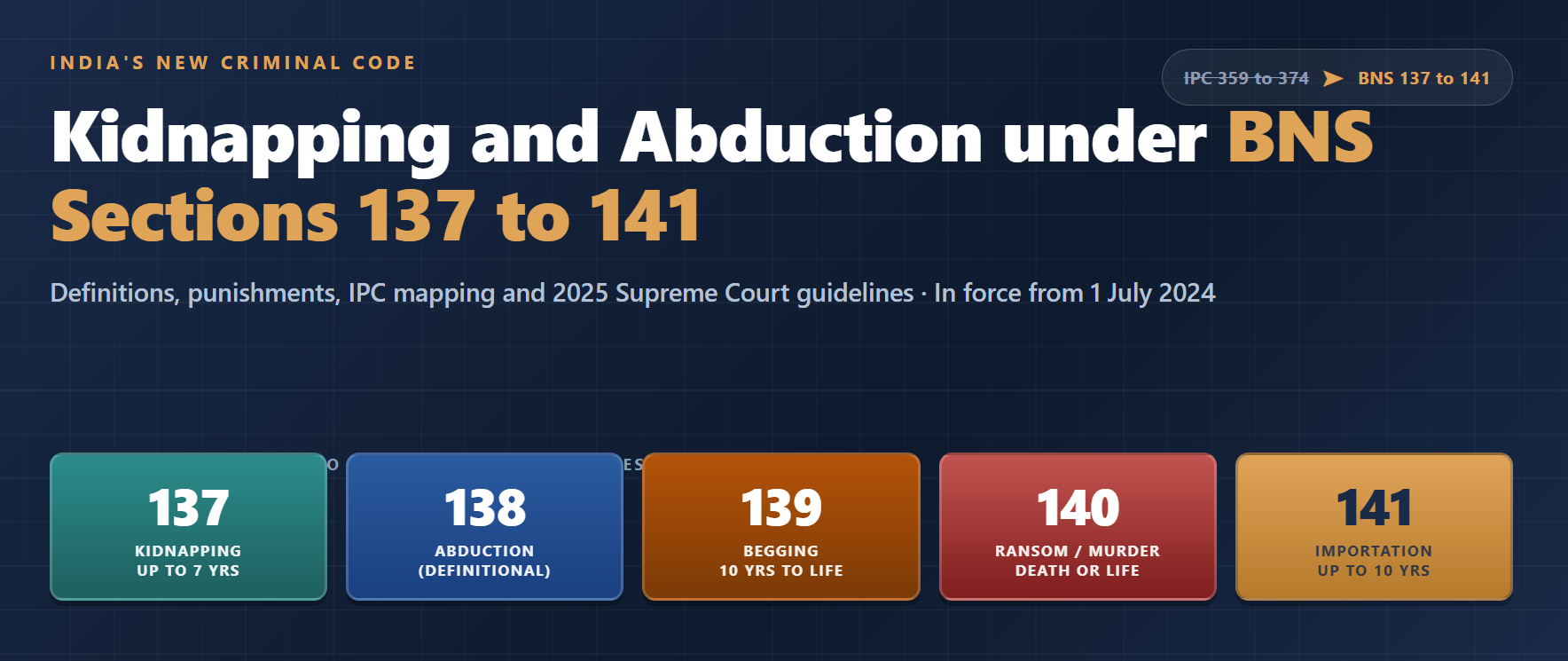
Sections 137 to 141 of the Bharatiya Nyaya Sanhita, 2023 (“BNS”) consolidate India’s law on kidnapping and abduction, replacing IPC Sections 359 to 374 from 1 July 2024. Section 137 defines kidnapping (from India; from lawful guardianship). Section 138 defines abduction. Sections 139, 140 and 141 punish aggravated forms: begging, ransom or murder, and importation of a minor from abroad.
The five sections operate as a connected scheme. Read with the procedural rules under the BNSS and the evidentiary framework under the Bharatiya Sakshya Adhiniyam, 2023, they govern every kidnapping prosecution in India today.
A new code for kidnapping: from IPC 359-374 to BNS 137-141
Quick context before we move section by section. For 164 years, the Indian Penal Code, 1860 was the spine of Indian criminal law. Kidnapping and abduction sat in Chapter XVI of the IPC, in Sections 359 to 374, a sprawling fifteen-section cluster covering everything from the bare definitions to aggravated forms involving ransom, slavery, and forced labour.
That structure is gone. From 1 July 2024, the Bharatiya Nyaya Sanhita, 2023 replaced the IPC as the substantive criminal law of India. Kidnapping and abduction now sit in Sections 137 to 141, with related trafficking conduct moved to Section 143, exploitation of a trafficked person to Section 144, and unlawful compulsory labour to Section 146.
So what does that mean for the practitioner walking into court next Monday? Here’s the thing: the conduct caught is largely the same. The section numbers are new. A handful of substantive shifts (terminology, sub-clause expansion, restructured aggravated forms) deserve attention. The procedural rules underneath have changed: the BNSS replaced the CrPC, and the Bharatiya Sakshya Adhiniyam, 2023 replaced the Indian Evidence Act, 1872. Worth noting: reading the new sections in isolation, without that procedural overlay, gives you half the picture.
Why the BNS replaced the IPC on 1 July 2024
The shift wasn’t a sudden one. The Union Government had been signalling a structural overhaul of the criminal codes for years, citing colonial-era language, scattered amendments, and procedural drag. Worth flagging: three statutes were enacted together. The BNS (replacing the IPC), the BNSS (replacing the CrPC), and the Bharatiya Sakshya Adhiniyam (replacing the Evidence Act). All three received Presidential assent on 25 December 2023 and came into force on 1 July 2024.

In practice, the substantive philosophy underneath the new code is straightforward. Keep the working architecture of the IPC where it has been tested in court. Modernise the terminology where 1860 phrasing has aged badly. Re-cluster offences that had been scattered across chapters.
And reset the punishments where Parliament wanted a sharper deterrent (Section 140(2), as we’ll see, carries the death penalty as one of its options, just like its IPC predecessor).
What stayed the same, what changed in kidnapping and abduction law
The short answer: the bones of kidnapping and abduction law carry over without disturbance. The two-limb structure of kidnapping (from India; from lawful guardianship) survives. The constitutive definition of abduction (force or deceitful means) survives. The “continuing offence” doctrine survives.
Most of the Supreme Court jurisprudence built over the last sixty years remains live authority, because the operative language of Sections 137 and 138 BNS tracks Sections 359 to 362 IPC almost word for word.
What changed? In our view, two things matter substantively. First, the expansion of Section 140(2) to cover ransom demands made to “an international inter-governmental organisation,” a clause the old Section 364A IPC did not have. Second, the structural cleanup: provisions that used to be scattered (Section 363A IPC for begging; Section 364 and 364A for aggravated forms; Section 366B for importation; Section 366B’s old girl-only formulation) now sit in a single contiguous block, Sections 137 to 141, and male minors are now expressly covered under Section 141.
Section 141 also raises the punishment ceiling under Section 139 sharply: where Section 363A IPC carried a maximum of ten years, Section 139(1) BNS now imposes a minimum of ten years extendable to life imprisonment, with Section 139(2) imposing a minimum of twenty years for maiming a child for begging.
How this post is organised: Sections 137 to 141 in sequence
Here’s the roadmap. The body that follows walks through each of the five sections in order: Section 137 (kidnapping), Section 138 (abduction), Section 139 (begging), Section 140 (ransom and other aggravated forms), and Section 141 (importation). After the section-by-section walk, we lay out the IPC-to-BNS mapping table, the BNSS procedural matrix (cognizability, bailability, trial forum), and the doctrinal comparison between kidnapping and abduction.
Then the case-law block: eleven landmark Supreme Court rulings, organised by doctrinal cluster, that you’ll see cited in any kidnapping prosecution today. And finally, the procedural roadmap from FIR to appeal, the 2025 Pinki guidelines, recent developments, common pitfalls, and an FAQ block. For readers who came searching for the legacy code, see the corresponding provisions under the Indian Penal Code, 1860 for context on what was replaced.
Section 137 BNS: kidnapping, the two limbs explained
Section 137 is the entry point of the new chapter. Every kidnapping prosecution in India today, whether the victim is a four-year-old taken from a pavement or a teenage girl walking home from school, begins with a Section 137 charge. Here’s the thing: the section codifies two distinct offences under a single heading. Kidnapping from India under sub-section (1)(a), and kidnapping from lawful guardianship under sub-section (1)(b). The punishment is in sub-section (2): up to seven years’ imprisonment plus fine.
What does that actually look like in practice? A reader who only reads the heading would miss the structure. Kidnapping isn’t one offence. It is two, packaged together because they share a victim class (a child under 18, or a person of unsound mind) and a punishment scale. Each limb has its own ingredients. And the case law has built up around each limb separately.
Section 137(1)(a): kidnapping from India
The short answer is that the first limb is straightforward in concept and rare in practice. Section 137(1)(a) criminalises conveying any person beyond the limits of India without the consent of that person or of a person legally authorised to consent on their behalf. The victim under this limb can be of any age (unlike sub-clause (b), which is age-restricted). Adults are protected.
The actus reus is the conveying across the international border. The mens rea is doing so without the legally required consent.
The provision is rarely the lead charge in domestic kidnapping. But it surfaces in cross-border family disputes (one parent removes a child to a Gulf country without the other parent’s consent), in trafficking cases where victims are routed through Nepal or Bangladesh, and occasionally in cases where adults are induced to travel for forced labour or marriage abroad. Read with Section 137(1)(b), it covers the geographical scope: 137(1)(b) handles intra-India kidnapping of minors; 137(1)(a) handles cross-border conveyance of any person.
Is the consent of the minor irrelevant under sub-clause (1)(a)? Yes, where the minor cannot give legally effective consent. The practical reality is that the consent that matters is either the consent of the person (if an adult) or of the person legally authorised to consent on the minor’s behalf. A 16-year-old crossing the border with an unrelated adult, without the parent’s consent, fits the offence.
Section 137(1)(b): kidnapping from lawful guardianship
Here’s where the section does most of its heavy lifting. Section 137(1)(b) covers taking or enticing any child (defined under Section 2(3) BNS as a person under 18) or any person of unsound mind out of the keeping of the lawful guardian, without the guardian’s consent. This is the limb behind almost every domestic kidnapping FIR you’ll see. The age threshold is 18 across both genders, a unification that already existed in the IPC predecessor (Section 361 IPC) after its 1949 amendment.
Here’s where two ingredients matter most. First, the “taking or enticing” element. The Supreme Court has repeatedly held, in S. Varadarajan v. State of Madras, AIR 1965 SC 942 and the line of cases that followed, that the offence requires some active step by the accused. Mere passive acceptance of the minor’s company, where the minor has voluntarily left the guardian, does not amount to “taking.”
The accused must have done something (active inducement, persuasion, or physical removal) that played a role in the minor leaving custody. For a deeper analysis of this doctrine, see the contours of lawful guardianship under Indian criminal law.
But the Court has also said, in State of Haryana v. Raja Ram, (1973) 1 SCC 544, that indirect persuasion counts. Sending messengers, using intermediaries, or persuading the minor to leave through a chain of intermediaries all satisfy the “enticing” element. And in Thakorlal D. Vadgama v. State of Gujarat, (1973) 2 SCC 413, the Court held that prior acts of cultivation (offering shelter, giving money, building rapport) that culminate in the minor leaving the guardian’s custody can amount to “taking” even without physical force on the day of departure.
Here’s a useful way to summarise the ingredients of kidnapping under Section 137(1)(b):
- Taking or enticing the victim
- Victim is a child under 18, or a person of unsound mind
- Out of the keeping of the lawful guardian
- Without the consent of the lawful guardian
All four must coexist. In our view, miss any one, and the prosecution shifts to abduction under Section 138, or fails altogether.
Who is a “lawful guardian” under Section 137(2)
Worth noting: the Explanation to Section 137 (carried forward from the IPC) tells you who counts. The “lawful guardian” includes any person lawfully entrusted with the care or custody of the child or person of unsound mind. That covers natural guardians (parents), legal guardians appointed by court order, and persons to whom care has been temporarily delegated (relatives during a school trip; a hostel warden; a residential care home).
A common question practitioners raise is whether a teacher, a hostel warden, or even an Uber driver assigned to drop a minor home can be the “lawful guardian” for the limited period of custody. The practical reality is that, yes, if care has been lawfully entrusted, even temporarily, the temporary custodian is a lawful guardian for that window. The protection of the section travels with the custody, not just with the parent.
The good-faith exception for the father of an illegitimate child
The Explanation also carves out an exception. The section does not extend to the act of any person who in good faith believes himself to be the father of an illegitimate child, or who in good faith believes himself to be entitled to lawful custody of such child, unless the act is committed for an immoral or unlawful purpose. In practice, the exception is narrow but consequential.
It surfaces most often in custody disputes between estranged parents. A natural-guardian parent who removes a child from the other parent’s custody is generally not committing kidnapping under Section 137(1)(b), as the apex court held in Chandrakala Menon v. Vipin Menon, (1993) 2 SCC 6. The case is short, but its principle has shaped HC jurisprudence for thirty years: parental custody disputes belong in family court under the Guardians and Wards Act, not in the criminal court under the kidnapping provisions, unless there is an immoral or unlawful purpose attached.
Frankly, this gets overlooked. Investigating officers in custody-dispute FIRs sometimes treat the parental removal as a Section 137 case and arrest the parent, only for the Magistrate to discharge or the High Court to quash. The Chandrakala Menon line of authority continues under BNS without disturbance.
The “person of unsound mind” formulation under Section 137
Section 137(1)(b) retains the IPC’s classical formulation: it protects any child and any “person of unsound mind.” Worth noting: Parliament chose not to import the more modern phrase “person with mental illness” (which appears in the Mental Healthcare Act, 2017) into the kidnapping chapter. The decision keeps the IPC-era case law intact, including the body of judicial readings on what counts as “unsound mind” in the kidnapping context.
The practical consequence: a kidnapping prosecution involving an adult victim of impaired mental capacity proceeds on the IPC’s well-worn evidentiary path. Medical evidence of unsound mind, typically from a civil surgeon or psychiatric assessment, sits alongside circumstantial evidence of inability to give informed consent. The Mental Healthcare Act, 2017’s clinical definition of “mental illness” can supply persuasive evidence in marginal cases. But the operative legal test under Section 137 remains the older “unsound mind” formulation.
What can go wrong in a Section 137 prosecution? Three pitfalls recur. First, treating a consensual-elopement case as a Section 137 offence without running the Varadarajan “active taking” test. Second, charging a natural-guardian father under Section 137(1)(b) without applying the Chandrakala Menon exception. Third, ignoring the age threshold and prosecuting under Section 137 when the victim is over 18, when the correct charge (if any) is abduction under Section 138.
Section 138 BNS: abduction and the continuing offence doctrine
Abduction is the second pillar of the chapter. Section 138 says: whoever by force compels, or by any deceitful means induces, any person to go from any place, is said to abduct that person. Here’s the catch: the section is constitutive. It tells you what abduction is, but it does not, by itself, prescribe a punishment. That punishment comes only when abduction is paired with a further criminal purpose under Section 139, 140 or 141.
Why is that structural choice deliberate? Parliament wanted to capture the act of compelled or deceitful removal, but it recognised that the act alone (without a downstream criminal purpose) often overlaps with consensual departure, marital disputes, or family arrangements that aren’t truly criminal. So the section defines the conduct, and the aggravated sections supply the punishment when the abduction is paired with murder, ransom, slavery, or importation.
The two methods: force, or deceitful means
Section 138 recognises only two methods of abduction. The first is physical force: dragging the victim, restraining and moving them, using a weapon to compel movement. The second is deceitful means: a lie or fraud that induces the victim to go somewhere they would not otherwise have gone. Worth noting: the two methods don’t overlap with kidnapping. Kidnapping under Section 137 doesn’t require force or deceit. Abduction under Section 138 always does.
The apex court in Vishwanath v. State of Uttar Pradesh, AIR 1960 SC 67 confirmed the constitutive meaning, in the context of private defence under what is now Section 36 BNS. The Court read “abduction” in Section 100 IPC (private defence) as carrying the same meaning as in Section 362 IPC (now Section 138 BNS): compelling by force or inducing by deceitful means to go from any place. And that reading carries forward unchanged under the new code.
Abduction is not punishable by itself
So what happens if someone is dragged from their home, taken three streets away, and left there? Standing alone, that conduct is abduction, but no punishment attaches under Section 138 alone. The prosecution must show a further criminal purpose: intent to murder (Section 140(1)), ransom (Section 140(2)), wrongful confinement (Section 140(3)), slavery or grievous hurt (Section 140(4)), forced begging (Section 139), or importation of a minor from abroad (Section 141).
That structural feature trips up readers who assume every removal is automatically punishable. It isn’t. In Vinod Chaturvedi v. State of Madhya Pradesh, (1984) 2 SCC 350, the apex court emphasised that voluntary accompaniment by an adult, particularly without proven force or deceit, doesn’t make out the offence under Section 362 IPC (now Section 138 BNS). In practice, the fact-finding has to focus on the means.
Why abduction is a “continuing offence”
Here’s where it gets interesting. Kidnapping under Section 137 is complete the moment the minor is taken out of the guardian’s keeping. Once that crossing happens, the offence is done. Abduction is different. It continues so long as the abducted person remains under the abductor’s compulsion or deception. Every kilometre travelled, every state border crossed, every hour the deception lasts, the offence runs.
That doctrinal feature has two evidentiary consequences most competitor explainers gloss over. First, jurisdiction: every state through which the victim is moved acquires jurisdiction to try the offence. A victim taken from Madhya Pradesh, moved to Maharashtra, then to Gujarat, can be the subject of charges in any of the three. And second, limitation: the limitation clock under BNSS Sections 514-516 does not start running until the abduction ends, because the offence is continuing. For prosecution strategy in trafficking-flavoured abductions, that is a serious advantage.
In practice, though, the continuing-offence doctrine is also a defence-side tool. An accused who can show that the victim’s compulsion or deception had ended by a certain date can argue that the offence concluded then, narrowing the temporal scope of the charge. The doctrinal feature cuts both ways.
Section 139 BNS: kidnapping or maiming a child for begging
Section 139 was inserted as Section 363A in the IPC in 1959 following India’s accession to international anti-trafficking conventions, and it carries forward into the BNS with significantly stiffer punishment. Here’s how it reads: Section 139(1) BNS punishes whoever kidnaps any child, or, not being the lawful guardian of such child, obtains custody of the child, in order that the child may be employed or used for the purposes of begging, with rigorous imprisonment for a term which shall not be less than ten years but which may extend to imprisonment for life, plus fine. Section 139(2) is harsher still: whoever maims any child in order that the child may be employed or used for begging is punishable with imprisonment which shall not be less than twenty years, extendable to imprisonment for the remainder of the convict’s natural life, plus fine.
Why does this section sit between kidnapping (137) and ransom (140)? Because forced begging is a distinct social harm that Parliament wanted to single out: not just the removal of the child, but the post-removal use of the child as a begging instrument. The provision works in tandem with the Juvenile Justice (Care and Protection of Children) Act, 2015, the Protection of Children from Sexual Offences Act, 2012 (when sexual abuse accompanies the begging), and the Bonded Labour System (Abolition) Act, 1976.
Who counts as a “minor” under Section 139
The section applies where the victim is a minor. The age threshold tracks Section 137: under 18 years. Worth flagging: the phrase “obtaining custody” is broader than “taking or enticing” under Section 137(1)(b). It catches scenarios where the accused didn’t physically remove the minor but acquired custody from someone else (a purchase from another person, a transfer of custody from a relative who had taken the child).
The enforcement context matters. The Delhi Police’s February 2025 child-trafficking bust, the Gurugram child-lifting case from September 2024, and the broader UP-Bihar trafficking network at the heart of Pinki v. State of Uttar Pradesh, 2025 INSC 482 all involve Section 139-flavoured conduct: children removed from natural custody and routed through brokers to end users, some for adoption-rackets, some for forced begging at religious sites and traffic signals, some for organised crime. Section 139 charges sit alongside Sections 137 and 140 in these prosecutions.
Section 139(3): presumption against any person not being the lawful guardian
Here’s a quiet but powerful evidentiary lever. Where a child is found in the custody of a person who is not the lawful guardian, and the child is being employed or used for begging, Section 139(3) presumes (unless the contrary is proved) that the person kidnapped or otherwise obtained custody of the child for that purpose. The burden shifts onto the accused to rebut the presumption.
That presumption is significant in trial. Without it, the prosecution would need to prove the original taking, often months or years earlier, with witnesses and circumstantial evidence. With it, the prosecution proves the present-day custody-plus-begging combination, and the accused must affirmatively explain how he came to have the child. The practical reality is that in a system where original-taking evidence often disappears between trafficking nodes, Section 139(3) is the difference between a conviction and an acquittal.
Section 139(2): maiming a child for begging attracts twenty years to life
Section 139(2) targets a specific kind of cruelty: maiming the child to make begging more lucrative. Maiming under this sub-section means disfiguring, blinding, or otherwise inflicting injury that creates the appearance of disability. The punishment, a minimum of twenty years extendable to imprisonment for the remainder of the convict’s natural life plus fine, is among the harshest in the entire chapter outside Section 140(2). What’s underappreciated is that Section 139(2) is a separate offence in its own right, not merely a sentencing escalator on Section 139(1).
In practice, the sub-section is invoked rarely, but the cases when it is invoked tend to be highly publicised. Newspaper reports of organised begging rings in Mumbai, Delhi and Kolkata, where children with visible injuries are placed at traffic signals, have repeatedly drawn judicial attention. The investigative challenge is forensic: tying the disfigurement to the accused’s deliberate act, rather than to pre-existing injury or accident.
The decriminalisation-of-begging cross-current
Here’s a tension competitors miss. Several High Courts (Delhi, Bombay) have struck down provisions of state anti-begging laws as unconstitutional, holding that begging by adults cannot be criminalised because it violates Article 21. The 2018 Delhi High Court PIL line on this question remains the leading authority. Section 139 BNS, however, doesn’t criminalise begging. It criminalises kidnapping or obtaining custody of a minor for begging. The offence is the kidnapping plus exploitation, not the begging itself.
Why does that matter going forward? Because the constitutional challenge to anti-begging legislation will keep narrowing the state’s ability to police begging as a public nuisance, but it leaves Section 139 untouched. The downstream consequence: enforcement will shift away from arrests of begging adults toward investigations of who put the child there. Expect more Section 139 prosecutions and fewer street-level begging arrests in the 2025-2027 window.
What goes wrong in Section 139 cases? Investigators sometimes book the begging child’s “handler” under Section 137 alone, missing the Section 139 escalator. They sometimes fail to invoke Section 139(3)’s statutory presumption, leaving the burden of proving the original taking entirely on themselves. And they sometimes confuse begging with broader trafficking, missing the Section 143 (human trafficking) overlay. All three errors trigger weak charges and avoidable acquittals.
Section 140 BNS: kidnapping or abduction for murder, ransom, slavery, grievous hurt
Section 140 is the densest section in the chapter. Four sub-sections, four distinct aggravated forms, and the only provision in the cluster that carries the death penalty. Every high-profile kidnapping prosecution you have read about in the last decade (the K&R ransom case, the kidnapping-for-murder case, the corporate executive abducted on the highway) eventually moves to Section 140. The short answer is that Section 137 or 138 sets the framework, and Section 140 sets the sentence.
The four sub-sections each carry a different mens rea and a different punishment. Section 140(1) handles intent to murder. Section 140(2) handles ransom. Section 140(3) handles secret and wrongful confinement after kidnapping. Section 140(4) handles slavery, grievous hurt, and “unnatural lust.” In practice, the structure is sentencing-driven: prove the underlying kidnapping or abduction, prove the further criminal purpose, and the punishment follows from which sub-section applies.
Section 140(1): kidnapping with intent to murder
Section 140(1) punishes kidnapping or abducting any person in order that the person may be murdered, or so disposed of as to be put in danger of being murdered. The punishment is imprisonment for life, or rigorous imprisonment for a term which may extend to ten years, plus fine. Worth noting: the mens rea is the specific intent to kill or expose to fatal danger. Subsequent actual murder is not a prerequisite, the section catches the kidnapping-with-intent stage, not the homicide stage.
Here’s a critical evidentiary tool: the abductor-as-presumptive-killer doctrine from State of West Bengal v. Mir Mohammad Omar, (2000) 8 SCC 382. Where multiple accused abduct a victim who is later found dead, the apex court has held that under what is now Section 109 of the Bharatiya Sakshya Adhiniyam, 2023 (formerly Section 106 of the Indian Evidence Act, 1872), the court may presume that the abductors were responsible for the death, unless they offer a credible explanation. That presumption is one of the strongest in Indian criminal evidence law and has stood for twenty-five years.
The presumption gets sharper when common intention is proved. In Sucha Singh v. State of Punjab, (2001) 4 SCC 375, the Court applied common-intention principles (now Section 3(5) BNS, formerly Section 34 IPC) to fix joint liability on multiple abductors whose victim was murdered, unless an individual accused could show his departure from the joint enterprise. In practice, Mir Mohammad Omar and Sucha Singh read together make Section 140(1) one of the most prosecution-friendly aggravated offences in the chapter.
Section 140(2): kidnapping for ransom
Section 140(2) is the headline sub-section. Here’s what it covers: kidnapping or abducting any person and detaining the person, with the threat of causing death or hurt, to compel the Government, any foreign state, any international inter-governmental organisation, or any other person to pay a ransom or to do or abstain from doing any act. The punishment is death, or imprisonment for life, plus fine.
Three features carry forward from the old Section 364A IPC, and one is new. The carry-forward features: the death penalty option, the alternative of life imprisonment, and the inclusion of demands made to the Government and foreign States. And the new element: the express inclusion of “international inter-governmental organisation” as a target of the ransom demand. That language wasn’t in Section 364A IPC. We’ll explore why it matters in the next sub-section.
When does the offence become complete? The leading authority is Malleshi v. State of Karnataka, (2004) 8 SCC 95. The apex court held that Section 364A IPC (now Section 140(2) BNS) is complete the moment a ransom demand is communicated, and the demand need not reach the family or a third party. A demand made directly to the victim suffices. That ruling resolved a recurring defence argument that the demand needed to reach the “person on whom the threat is to take effect,” and it survives the IPC-to-BNS transition.
Can the death penalty under Section 140(2) be awarded as the sentence? Yes. In Vikram Singh @ Vicky v. Union of India, (2015) 9 SCC 502, a three-judge bench upheld the constitutionality of Section 364A IPC, including the death penalty option, against an Article 21 challenge. The Court held the provision applies to non-terrorist offenders as well, that the death sentence is not mandatory but discretionary, and that the rarest-of-rare doctrine governs its imposition. And the reasoning carries forward to Section 140(2) BNS verbatim.
The new “international inter-governmental organisation” expansion
Why does the new sub-clause matter? It anticipates a category of kidnap-for-ransom case that the IPC didn’t quite cover. Where a kidnapper demands ransom from a UN agency, the International Committee of the Red Cross, the World Bank, or any similar entity, Section 140(2) now captures it directly. Under the IPC, prosecutors had to argue (often successfully, but with strain) that an international organisation fell within “any other person.” The BNS removes that interpretive gap.
Early signals suggest the clause will see use in cases involving aid workers in conflict zones, foreign nationals working in NGOs operating in India, and corporate K&R policy claims. In practice, Section 140(2) charges in such cases will be drafted with the new sub-clause expressly named, both for prosecutorial clarity and to defeat any Article 20(1) ex post facto challenge in pre-1 July 2024 conduct.
Section 140(3): secret and wrongful confinement
Section 140(3) punishes kidnapping or abducting any person with intent to cause that person to be secretly and wrongfully confined. The punishment is imprisonment of either description for a term which may extend to seven years, plus fine. Worth noting: the sub-section carries forward Section 365 IPC almost verbatim.
The case-law density on this sub-section is lower than 140(1) and 140(2), in part because the conduct often overlaps with other offences (wrongful confinement under Sections 124-127 BNS) that carry their own charges. In practice, where the conduct is one-time and the confinement short, Section 140(3) frequently runs alongside the underlying Section 137 or 138 charge rather than displacing it.
Section 140(4): kidnapping or abduction for grievous hurt, slavery or unnatural lust
Here’s what Section 140(4) targets: kidnapping or abducting any person in order that the person may be subjected (or so disposed of as to be put in danger of being subjected) to grievous hurt, slavery, or the unnatural lust of any person, or knowing it to be likely that the person will be so subjected or disposed of. The punishment is imprisonment of either description for a term which may extend to ten years, plus fine. The sub-section consolidates the old Section 367 IPC (kidnapping for grievous hurt / slavery / unnatural lust).
Its modern application overlaps significantly with Section 143 BNS (human trafficking) and Section 144 BNS (exploitation of a trafficked person), which is why prosecution strategy often pairs Section 140(4) with Section 143 in trafficking cases. In practice, where the kidnapping is followed by rape, Section 64 BNS will typically be charged separately rather than subsumed into Section 140(4)’s “unnatural lust” limb.
The case Thakorlal D. Vadgama v. State of Gujarat, (1973) 2 SCC 413 is sometimes cited in Section 140(4) jurisprudence for its treatment of the “play a part in the leaving” doctrine, which carries over into aggravated kidnapping prosecutions where the accused’s role in the original departure is contested.
Section 364A IPC to Section 140(2) BNS: what survived, what changed
A practitioner reading Section 140(2) for the first time after years on Section 364A IPC will see immediate familiarity. The structure tracks. The death-penalty option carries over. The seven-day-detention element (under old Section 364A) has been removed, and the new section reads cleanly: kidnap or abduct, detain with threat, demand from one of the listed targets. But the “international inter-governmental organisation” target is the genuine substantive addition.
A common question is whether Vikram Singh and Malleshi still apply. They do. The carry-over language ensures that the Supreme Court’s interpretation of Section 364A IPC governs Section 140(2) BNS until and unless a future bench reads the new sub-clause differently. And for the moment, the legacy jurisprudence is live authority on every Section 140(2) charge in the country.
The Section 140 sub-clause comparison can be set out side by side:
| Sub-clause | Conduct | Mens rea | Max punishment | Bailable |
|---|---|---|---|---|
| 140(1) | Kidnap/abduct + put in danger of murder | Intent to murder | Life or up to 10 years + fine | Non-bailable |
| 140(2) | Kidnap/abduct + detain + threat + ransom demand | Intent to extort ransom from listed target | Death or life imprisonment + fine | Non-bailable |
| 140(3) | Kidnap/abduct + secret and wrongful confinement | Intent to secretly and wrongfully confine | Up to 7 years + fine | Non-bailable |
| 140(4) | Kidnap/abduct + grievous hurt / slavery / unnatural lust | Specific aggravated intent or knowledge | Up to 10 years + fine | Non-bailable |
What goes wrong in Section 140 prosecutions? Three pitfalls. First, framing a multi-accused kidnap-murder as Section 137 plus Section 103 BNS (murder), missing the joint-liability advantage of Section 140(1) plus Section 3(5) BNS. Second, dropping Section 140(2) when the ransom demand was made to a corporate employer or insurance carrier, on the mistaken assumption that the sub-clause requires a familial recipient. Third, failing to invoke the abductor-as-presumptive-killer doctrine under BSA Section 109, leaving the prosecution to prove murder from scratch when the presumption could have done much of the work.
Section 141 BNS: importation of a girl or boy from a foreign country
Section 141 is the chapter’s quiet section. Here’s what it covers: importing into India, from any country outside India, a girl under the age of twenty-one or a boy under the age of eighteen, with intent that the imported person may be, or knowing it to be likely that the person will be, forced or seduced to illicit intercourse with another person. The punishment is imprisonment up to ten years and a fine. The provision carries forward Section 366B IPC almost verbatim, with the addition of male victims.
Why is this section in the kidnapping chapter at all? Because the act of importation involves an element of removal and transport across an international border for an illicit purpose, conceptually adjacent to the abduction structure of Section 138. The provision overlaps significantly with Section 143 BNS (human trafficking), and in practice, charges run parallel in most prosecutions.
The 21-vs-18 asymmetry
Why is the age threshold different for girls and boys? The 21-year threshold for girls is a carry-over from the IPC’s Section 366B, which dated to a colonial-era concern about the import of girls for prostitution. The BNS retains that 21-year threshold for girls. For boys, the BNS uses the standard minor threshold of 18. The asymmetry is a known anachronism and will likely be revisited in future legislation, but for now, the gap is what the statute says.
The 21-year threshold matters for prosecution: a young woman of nineteen or twenty, imported from abroad for sexual exploitation, falls within Section 141’s protection even though she would not qualify as a minor under Section 137(1)(b). But the threshold also cuts the other way for defence: a male victim aged 18 to 21 is outside Section 141’s coverage and must be brought, if at all, under Section 143 (trafficking) or a different provision.
What “foreign country” means and the internal-trafficking gap
The section is limited to importation “from any country outside India.” In our view, it does not cover trafficking within India, and the textual constraint is meaningful. That internal-trafficking gap is filled by Section 143 BNS (human trafficking), which catches the recruitment, transportation, harbouring, and transfer of persons by force, fraud, or coercion for the purpose of exploitation, regardless of whether the route is cross-border or intra-India.
The downstream consequence is one that competitors often miss. In a multi-jurisdictional trafficking case where minors are routed from Nepal into India and then onward within India, the prosecution will typically charge Section 141 for the cross-border leg and Section 143 for the internal-trafficking leg. And the two sections aren’t redundant; they cover different geographical scopes.
IPC Section 366B to BNS Section 141: refreshed punishment
The short answer is that the substantive change between the old and the new is minor. Section 366B IPC had a punishment of imprisonment up to ten years and a fine. Section 141 BNS retains the same range. Bottom line: the provision was kept largely intact because the conduct it captures (cross-border importation for sexual exploitation) hadn’t shifted substantially since the IPC era, and the broader trafficking machinery now sits in Section 143.
A practising criminal lawyer in India will rarely encounter a pure Section 141 prosecution. The practical reality is that the conduct almost always coexists with Section 143 (trafficking), Section 64 BNS (rape), or POCSO offences when the victim is a minor. Section 141 typically anchors the charge sheet, with the bulk of the punishment coming from the parallel charges.
In practice, Section 141 cases are also where the Pinki v. State of Uttar Pradesh, 2025 INSC 482 guidelines bite hardest. The Pinki Bench specifically directed that missing-child cases involving suspected cross-border routing be treated as kidnapping-and-trafficking presumptively, and that AHTUs (not the local police station alone) take charge. Section 141 prosecutions live or die on the quality of cross-border investigation, and that is exactly where the Pinki framework reinforces existing procedural law.
| Section | Offence | Imprisonment | Fine | Cognizable | Bailable | Triable by |
|---|---|---|---|---|---|---|
| 137(2) | Kidnapping (base punishment) | Up to 7 years | Yes | Yes | No | Magistrate First Class |
| 138 | Abduction (definitional only) | As per linked section | As per linked | Yes | No | As per linked section |
| 139(1) | Kidnapping a child for begging | 10 years to life (minimum 10) | Yes | Yes | No | Court of Session |
| 139(2) | Maiming a child for begging | 20 years to natural life (minimum 20) | Yes | Yes | No | Court of Session |
| 140(1) | Kidnapping or abduction with intent to murder | Life or up to 10 years | Yes | Yes | No | Court of Session |
| 140(2) | Kidnapping or abduction for ransom | Death or life imprisonment | Yes | Yes | No | Court of Session |
| 140(3) | Kidnapping or abduction for secret and wrongful confinement | Up to 7 years | Yes | Yes | No | Court of Session |
| 140(4) | Kidnapping or abduction for grievous hurt, slavery or unnatural lust | Up to 10 years | Yes | Yes | No | Court of Session |
| 141 | Importation of a girl under 21 or boy under 18 from abroad | Up to 10 years | Yes | Yes | No | Court of Session |
Practitioner notes
- Every offence in the cluster is cognizable and non-bailable. The police can act on the FIR without a magistrate’s order; bail is at the court’s discretion.
- Section 138 standalone does not carry a punishment; it must be paired with Section 139, 140 or 141 to attract a sentence.
- Section 139 was sharply re-scaled by Parliament: the IPC 363A maximum of 10 years is now a minimum, with maiming attracting a minimum of 20 years.
IPC 359 to 374 to BNS 137 to 141: complete section-mapping table
For practitioners migrating from the IPC to the BNS, the single most useful artefact is a clean mapping table. Every old IPC section, set against its new BNS counterpart, with a note on what changed. In our view, the table below is the mapping that no competitor produces in full.
Direct one-to-one transitions
The following table maps each IPC section in the kidnapping cluster to its BNS counterpart:
| IPC, 1860 | BNS, 2023 | What changed |
|---|---|---|
| Section 359 (kidnapping head) | Section 137 (head) | Re-numbered; structure intact |
| Section 360 (kidnapping from India) | Section 137(1)(a) | Re-numbered; language intact |
| Section 361 (kidnapping from lawful guardianship) | Section 137(1)(b) | Re-numbered; substantive language preserved; “minor” replaced with “child” |
| Section 362 (abduction) | Section 138 | Re-numbered; constitutive definition unchanged |
| Section 363 (punishment for kidnapping) | Section 137(2) | Re-numbered; punishment scale unchanged (up to 7 years + fine) |
| Section 363A (kidnapping for begging) | Section 139 | Punishment ceiling raised sharply: 10 years to life for kidnapping for begging; 20 years to life for maiming for begging |
| Section 364 (kidnapping for murder) | Section 140(1) | Re-numbered; punishment intact (life or up to 10 years + fine) |
| Section 364A (kidnapping for ransom) | Section 140(2) | Carried forward + new “international inter-governmental organisation” target |
| Section 365 (kidnapping for secret confinement) | Section 140(3) | Re-numbered; punishment intact (up to 7 years + fine) |
| Section 366B (importation of girl from foreign country) | Section 141 | Carried forward + expanded to cover boys under 18 |
| Section 367 (kidnapping for grievous hurt/slavery) | Section 140(4) | Re-numbered; punishment intact (up to 10 years + fine) |
| Section 368 (concealing kidnapped/abducted person) | Section 142 | Retained as a standalone offence, not subsumed |
Provisions that moved out
Several IPC sections that historically sat in the kidnapping cluster have been moved to different BNS chapters:
| IPC, 1860 | New BNS location | Note |
|---|---|---|
| Section 366 (kidnapping for marriage) | Section 87 BNS plus Section 137(2) | Marriage-related kidnapping reorganised under “Offences against women” |
| Section 370 (trafficking of persons) | Section 143 BNS | Trafficking moved to its own provision |
| Section 370A (exploitation of trafficked person) | Section 144 BNS | Now standalone “exploitation of a trafficked person” offence |
| Section 372 (selling minor for prostitution) | Section 143 BNS | Subsumed under trafficking |
| Section 373 (buying minor for prostitution) | Section 143 BNS | Subsumed under trafficking |
| Section 374 (unlawful compulsory labour) | Section 146 BNS | Re-located as a standalone “unlawful compulsory labour” offence |
What disappeared entirely
A narrow set of IPC provisions has been absorbed without a one-to-one BNS successor. Section 369 IPC (kidnapping a child under ten with intent to take dishonestly any movable property) has not been retained as a standalone offence: the conduct is now charged as Section 137 plus the relevant property offence under Chapter XVII BNS. Section 371 IPC (habitual dealing in slaves) survives in Section 145 BNS, with the language modernised. Section 368 IPC (wrongful concealment of a kidnapped or abducted person) was not dropped: it has been retained as Section 142 BNS, virtually verbatim, just outside the 137-141 numerical cluster.
What is genuinely new in BNS 137-141
Here’s what is genuinely new in the cluster. First, the expansion of Section 140(2) to cover ransom demands made to “international inter-governmental organisations.” Second, the bringing-in of male victims under Section 141 (boys under 18, previously not covered by Section 366B IPC). Third, the sharp upward revision of the Section 139 punishment scale: a minimum of ten years extendable to life under Section 139(1) for kidnapping for begging, and a minimum of twenty years extendable to natural-life imprisonment under Section 139(2) for maiming a child for begging. Bottom line: everything else, including the entire body of Supreme Court jurisprudence built around the old sections, carries forward as live authority.
| IPC Section | Title | BNS Section | What changed |
|---|---|---|---|
| s.359 | Kidnapping (head) | s.137 | Re-numbered; structure intact |
| s.360 | Kidnapping from India | s.137(1)(a) | Re-numbered; language intact |
| s.361 | Kidnapping from lawful guardianship | s.137(1)(b) | Retains “child or person of unsound mind” formulation |
| s.362 | Abduction | s.138 | Constitutive definition unchanged |
| s.363 | Punishment for kidnapping | s.137(2) | Punishment scale unchanged (up to 7 years + fine) |
| s.363A | Kidnapping or maiming a minor for begging | s.139 | Restructured into sub-sections (1)(2)(3)(4); punishment sharply raised |
| s.364 | Kidnapping for murder | s.140(1) | Punishment intact (life or up to 10 years + fine) |
| s.364A | Kidnapping for ransom | s.140(2) | Carried forward + new “international inter-governmental organisation” target |
| s.365 | Kidnapping for secret confinement | s.140(3) | Restructured into 140 cluster; punishment intact (up to 7 years + fine) |
| s.366B | Importation of a girl from foreign country | s.141 | Now covers boys under 18 in addition to girls under 21 |
| s.367 | Kidnapping for grievous hurt / slavery / unnatural lust | s.140(4) | Restructured into 140 cluster; punishment intact (up to 10 years + fine) |
| s.368 | Concealing a kidnapped person | s.142 | Retained virtually verbatim outside the 137 to 141 cluster |
| s.370 / 370A / 372 / 373 | Human trafficking provisions | s.143 | Consolidated into a unified trafficking provision |
| s.374 | Unlawful compulsory labour | s.146 | Re-numbered to a separate cluster |
Cognizability, bailability and trial: the BNSS procedural matrix
Substantive law tells you what the offence is. Procedural law tells you how the case actually moves. Under the Bharatiya Nagarik Suraksha Sanhita, 2023, every offence in the BNS is classified across three axes: cognizable or non-cognizable, bailable or non-bailable, and triable by which court. Bottom line: for Sections 137 to 141, the answers materially affect bail strategy, FIR registration, and trial forum.
A practitioner walking into a bail hearing on a Section 137 case needs to know the matrix cold. So does a defence lawyer at the FIR-quashing stage. So does the prosecutor framing the chargesheet. In practice, the matrix below is the consolidated picture, drawn from the First Schedule of the BNSS.
How to read the First Schedule of the BNSS
The First Schedule of the BNSS is the master index. It lists every BNS section against four data points: punishment, cognizable/non-cognizable, bailable/non-bailable, and the court that tries the offence. Cognizable means the police can arrest without warrant and investigate without magistrate’s order. Bailable means bail is a matter of right (subject to standard conditions); non-bailable means bail is at the discretion of the court. Triable-by determines whether the case is heard by a Magistrate (Judicial Magistrate of First Class, or Chief Judicial Magistrate) or a Court of Session.
The procedural matrix: section by section
For the five kidnapping and abduction sections, the matrix reads as follows:
| Section | Max punishment | Cognizable | Bailable | Triable by |
|---|---|---|---|---|
| 137(2) | 7 years + fine | Cognizable | Non-bailable | Magistrate of First Class |
| 138 (with linked aggravated section) | Punishment from the linked section | Cognizable | Non-bailable | As per linked section |
| 139(1) (kidnapping for begging) | 10 years to life + fine | Cognizable | Non-bailable | Court of Session |
| 139(2) (maiming child for begging) | 20 years to natural life + fine | Cognizable | Non-bailable | Court of Session |
| 140(1) (intent to murder) | Life or up to 10 years + fine | Cognizable | Non-bailable | Court of Session |
| 140(2) (ransom) | Death or life + fine | Cognizable | Non-bailable | Court of Session |
| 140(3) (secret confinement) | Up to 7 years + fine | Cognizable | Non-bailable | Court of Session |
| 140(4) (grievous hurt/slavery/unnatural lust) | Up to 10 years + fine | Cognizable | Non-bailable | Court of Session |
| 141 (importation of girl/boy) | Up to 10 years + fine | Cognizable | Non-bailable | Court of Session |
Every section in the chapter is cognizable and non-bailable. And that isn’t an accident. Parliament wanted the police to be empowered to act immediately on kidnapping FIRs, without waiting for magistrate’s orders, and it wanted bail to be a discretionary matter for the court rather than automatic for the accused.
Bail strategy under BNSS Sections 478, 480, 483
Bail in non-bailable offences is governed by BNSS Sections 478 (bail in cases of arrest by police), 480 (bail by Magistrate), and 483 (bail by High Court or Court of Session). In practice, the standard considerations apply: nature and gravity of the offence, severity of the punishment, the accused’s antecedents, risk of absconding, risk of witness tampering, and the conduct of investigation.
After Pinki v. State of Uttar Pradesh, 2025 INSC 482, the bail calculus in kidnapping-flavoured cases has tightened. The Court directed that bail in cases with trafficking-flavoured allegations be granted only after the prosecutor’s response, after AHTU input, and after the CWC has been heard where the victim is a minor. The Allahabad HC’s bail orders in the Pinki facts were cancelled precisely because none of these procedural steps had been observed. For defence practitioners, the lesson is that a bail application in Section 137 or 140 cases now needs to anticipate and respond to the Pinki framework, not just the standard bail factors. For a deeper walk-through of the procedural side, see drafting a bail application under the BNSS.
Linkage to charge framing under BNSS Section 251
Charge framing under BNSS Section 251 is the gatekeeper to trial. The Magistrate or Sessions Judge frames a charge only when satisfied that there is sufficient ground for proceeding against the accused. For kidnapping offences, the charge typically reads: Section 137 (the underlying kidnapping or abduction) plus Section 140 (the aggravated form) plus, in multi-accused cases, Section 3(5) BNS (common intention).
A common practitioner mistake is to frame the charge under Section 137 alone when the conduct supports a Section 140 framing. Once the case goes to trial without the aggravated section in the charge, the prosecution loses the sentencing upside. In practice, BNSS Section 251 is the last chance to get the charge right, and that requires careful pre-trial scrutiny of the evidence on file.
Kidnapping vs abduction under BNS: a five-axis comparison
The kidnapping-versus-abduction distinction is the single most-searched question in this cluster. Competitors give a one-line answer. Here’s where it gets interesting: we give the five axes on which the distinction runs, with the doctrinal consequence at each axis.
Subject person
Kidnapping under Section 137 protects two specific classes: children (any person under 18) and persons of unsound mind. The protection of Section 137 stops at the 18th birthday and at the threshold of legal capacity. But abduction under Section 138 protects any person. Adults are protected, even those of full legal capacity. The practical reality is that the age threshold is irrelevant for Section 138.
Means
Kidnapping requires “taking or enticing.” The accused must have done something that played a part in the minor’s departure. But abduction requires “force or deceitful means.” Physical compulsion or fraud must be proved. In practice, kidnapping can occur without force; abduction cannot. Kidnapping can occur without deception; abduction requires either force or deception.
Consent
Under Section 137, the relevant consent is that of the lawful guardian, not the minor. Even if the minor consents enthusiastically to leaving, the offence is made out so long as the guardian’s consent is absent. But under Section 138, the relevant consent is that of the person being abducted. In practice, the victim’s consent (or its absence) is the operative inquiry.
Completion
Kidnapping is complete the moment the minor is taken out of the lawful guardian’s keeping. The offence is a one-time act, complete at the moment of removal. But abduction is a continuing offence. It runs so long as the abducted person remains under the abductor’s compulsion or deception. The doctrinal feature has the evidentiary consequences traced in Section 138’s analysis.
Standalone punishability
Section 137 is always punishable: the offence carries a defined punishment under Section 137(2). But Section 138, standing alone, isn’t punishable. Punishment attaches only when abduction is paired with a further criminal purpose under Sections 139, 140 or 141. In practice, that structural feature is why charge sheets in serious cases rarely show Section 138 alone, but show Section 138 plus Section 140, or Section 138 plus Section 139.
The five-axis comparison can be set out side by side:
| Axis | Kidnapping (Section 137) | Abduction (Section 138) |
|---|---|---|
| Subject person | Child under 18 or person of unsound mind | Any person |
| Means | Taking or enticing | Force or deceitful means |
| Consent | Consent of guardian matters | Consent of person matters |
| Completion | Complete on removal | Continuing offence |
| Standalone punishability | Always punishable | Only with linked aggravated section |
For an older treatment of the same distinction under the IPC, readers can see the older IPC-era treatment of the distinction, though the section numbers there refer to the now-replaced IPC framework.
Charge-framing takeaway
- If the victim is a minor and removed without force or deceit, charge Section 137; the guardian’s consent is the dispositive question.
- If the victim is an adult and was forced or deceived, charge Section 138 plus the aggravated section that fits the criminal purpose.
- The two are not exclusive: charge sheets in serious cases routinely show Section 137 plus Section 138 plus Section 140 in the alternative.
Overlap with POCSO, BNS Section 143 trafficking, and the Juvenile Justice Act
Kidnapping prosecutions rarely sit alone in the chargesheet. Here’s the thing: where the victim is a minor and a sexual offence is alleged, the Protection of Children from Sexual Offences Act, 2012 (“POCSO”) enters the picture. Where the kidnapping involves an organised trafficking enterprise, Section 143 of the BNS (human trafficking) sits alongside. And where the victim is a child in need of care and protection, the Juvenile Justice (Care and Protection of Children) Act, 2015 governs the post-rescue framework. The interplay matters.
When does POCSO override BNS in a kidnapping-for-sexual-offence case
POCSO is a special statute. Section 42A of POCSO contains a non-obstante clause that gives the Act overriding effect on its specific subject matter (sexual offences against children). Where the kidnapping was committed for a sexual offence against a minor, the prosecution will typically charge Section 137 BNS plus the relevant POCSO offence. POCSO governs sentencing for the sexual offence; the BNS governs sentencing for the kidnapping component.
The practical implication is that POCSO-flavoured kidnapping cases are tried by the Special Court designated under POCSO, with its child-friendly procedures and faster timelines. And the BNSS standard framework applies subject to the POCSO overrides.
BNS Section 143 (trafficking) vs Sections 137-140
Section 143 BNS is the umbrella trafficking offence. It captures recruitment, transportation, harbouring, and transfer of persons by force, fraud, or coercion for the purpose of exploitation. Where the conduct is one-time and ends at the removal stage, Section 137 captures it. Where the conduct involves a chain (recruitment, movement, sale, exploitation), Section 143 catches it. Most cases involving organised networks (the Pinki facts being a clear example) carry parallel Section 137 and Section 143 charges.
The doctrinal distinction: Section 137 is about the act of kidnapping; Section 143 is about the enterprise of trafficking. The two coexist without preemption. A defendant can be convicted under both for the same factual matrix without double-jeopardy concerns, because the offences punish different ingredients (the kidnapping element under 137; the exploitation element under 143).
AHTUs, CWCs and the Juvenile Justice Act, 2015
Anti-Human Trafficking Units (AHTUs) are specialised police units established under the Ministry of Home Affairs framework. The Pinki guidelines mandate AHTU involvement in every missing-child case where trafficking is suspected. Child Welfare Committees (CWCs), established under the Juvenile Justice Act, are the statutory body for a child in need of care and protection. In practice, the Act requires CWC notification within 24 hours of any kidnapped child being rescued or surrendered, and CWC orders govern the child’s placement (with family, in a children’s home, in foster care).
The procedural overlay is significant for defence and prosecution alike. A kidnapping prosecution that ignores AHTU and CWC involvement will be vulnerable to procedural attack post-Pinki. And a defence lawyer can challenge the chargesheet on the ground that statutory procedural safeguards were not observed, particularly where the victim’s recovery was followed by improper custody decisions.
Sentencing overlap: POCSO plus Section 140(1)
The hardest sentencing overlap is when a child is kidnapped and then sexually abused and murdered. The Section 140(1) BNS sentence (life or up to 10 years for kidnap-with-intent-to-murder), the Section 103 BNS sentence for the murder (death or life), and the POCSO sentence for the aggravated sexual assault all stack. In Manoj Pratap Singh v. State of Rajasthan, (2022) 9 SCC 81, the apex court confirmed the death sentence for kidnap-rape-murder of a seven-and-a-half-year-old physically and mentally disabled child, applying the rarest-of-rare doctrine in a context where every aggravating factor compounded.
That ruling now functions as a sentencing benchmark for BNS-era kidnap-rape-murder prosecutions, with the obvious caveat that the chargesheet will carry the new section numbers (Section 137 plus Section 140(1) plus POCSO plus Section 103 BNS) rather than the IPC equivalents. And the doctrinal framework around the rarest-of-rare test is unchanged.
Landmark Supreme Court cases shaping Sections 137-141 today
The Supreme Court of India has built up sixty-five years of jurisprudence on the kidnapping and abduction provisions, and almost all of it carries forward into the BNS framework intact. Eleven cases stand out. They cluster around five doctrinal questions: what counts as “taking” under kidnapping; what abduction means; when ransom is made out; when the abductor is presumed to be the killer; and when a custody-disputing parent can be charged with kidnapping their own child. Here’s how we walk through each cluster.
The “taking” doctrine: Varadarajan, Raja Ram and Vadgama
The Varadarajan ruling held that “taking” under what is now Section 137(1)(b) BNS requires active inducement by the accused. Voluntary departure by the minor, without proof that the accused did something to bring it about, does not make out the offence. In practice, the ruling is the doctrinal limit on Section 137 prosecutions where the minor herself wanted to leave.
Raja Ram then expanded the protective scope. Indirect persuasion, sending messengers, using intermediaries, persuading the minor at one remove, all count as “taking or enticing.” Read together, Varadarajan and Raja Ram set the bookends: active inducement is required, but it can be indirect.
And Vadgama added the prior-cultivation principle: acts that “play a part” in the minor’s eventual departure (offering shelter, building rapport, financial inducement) can satisfy the “taking” element even without physical force on the day of departure. The three cases together govern the doctrinal core of Section 137(1)(b) under the BNS.
The abduction doctrine: Vishwanath and Vinod Chaturvedi
Vishwanath read “abduction” in the IPC’s private-defence provision (now Section 36 BNS) as carrying the same meaning as in the abduction-definition provision (now Section 138 BNS): compelling by force or inducing by deceitful means. The reading establishes the constitutive meaning that carries forward unchanged.
And Vinod Chaturvedi emphasised that voluntary accompaniment by an adult, particularly without proven force or deceit, does not make out abduction. The case continues to be cited where the prosecution’s case rests on inference of force or deceit from circumstantial evidence rather than direct proof. The two rulings together govern the doctrinal core of Section 138 under the BNS.
The ransom doctrine: Malleshi and Vikram Singh
Malleshi settled the ransom-completion question. The offence under what is now Section 140(2) BNS is complete the moment the ransom demand is communicated. In practice, the demand need not reach the family or third party. A demand made directly to the victim suffices.
Vikram Singh settled the constitutionality question. The death penalty option under what is now Section 140(2) BNS is constitutionally valid, not violative of Article 21, and applies to non-terrorist offenders as well. The judgment governs every future challenge to a death sentence under Section 140(2).
The murder presumption: Mir Mohammad Omar and Sucha Singh
Mir Mohammad Omar established the abductor-as-presumptive-killer doctrine. Where multiple accused abduct a victim who is later found dead, the court may presume under what is now Section 109 BSA that the abductors are responsible, unless they explain otherwise. In practice, the presumption is one of the strongest in Indian criminal evidence.
And Sucha Singh applied common-intention principles to fix joint liability on multiple abductors whose victim was murdered. Read with Mir Mohammad Omar, the two cases make Section 140(1) BNS one of the most prosecution-friendly aggravated offences in the chapter.
The custody-dispute exception: Chandrakala Menon
Chandrakala Menon resolved the recurring question of whether a biological father can be charged with kidnapping his own child from the mother. The answer, in most situations, is no. Custody disputes between natural guardians belong in family court under the Guardians and Wards Act, not in criminal court under the kidnapping provisions, unless there is an immoral or unlawful purpose attached. The case has shaped HC jurisprudence for thirty years.
The 2025 BNS-era benchmark: Pinki v. State of UP
The first major Supreme Court pronouncement of the BNS era on this cluster, the Pinki ruling, decided on 15 April 2025, did not just resolve the bail question in one trafficking case. It set the procedural template for every Section 137 to 141 prosecution going forward. Missing-child cases are presumptively kidnapping or trafficking until investigation says otherwise. AHTUs must take charge from the first 24 hours. CWCs must be notified within 24 hours of a rescue. Trials must complete within six months. State Home Secretaries are placed on accountability.
Early signals suggest that bail jurisprudence in kidnapping cases will tighten significantly through 2026 and 2027, as High Courts apply the Pinki framework to incoming bail applications. And the case is the doctrinal anchor for the entire chapter as it operates today.
Procedural roadmap: FIR to trial under BNS 137-141 and the BNSS
The procedural framework under the BNSS tracks the CrPC’s basic architecture, with a handful of substantive sharpening. For a Section 137 or 140 case, the procedural path runs: FIR registration, investigation, chargesheet, charge framing, trial, judgment, sentence, and appeal or revision. Bottom line: here’s how each stage works in practice.
FIR registration under BNSS Section 173
BNSS Section 173 governs FIR registration. The provision tracks CrPC Section 154 in substance: every cognizable offence reported to a police officer in charge of a police station must be reduced to writing. Sections 137 to 141 are all cognizable, so police registration is mandatory. Refusal to register a kidnapping FIR is itself a procedural violation, and the remedy is to approach the Superintendent of Police under BNSS Section 173(4), or to file a complaint under BNSS Section 175 (corresponding to CrPC Section 156(3)) before the Magistrate.
Investigation: AHTU role, CCTNS entry, Khoya-Paya portal
Investigation in kidnapping cases involves multiple parallel tracks. The investigating officer interviews witnesses, gathers physical evidence, and prepares the chargesheet. The AHTU, where engaged, brings specialised expertise on trafficking networks. The Crime and Criminal Tracking Network and Systems (CCTNS) entry creates a digital record of the case for cross-state coordination. The Khoya-Paya portal, run by the Ministry of Women and Child Development, helps reunite missing children with families. Practitioners expect that AI-driven facial recognition deployments at railway stations and bus depots will become standard investigative aids by 2027, supplementing the existing technology stack.
Charge framing under BNSS Section 251
Once the chargesheet is filed, the court frames the charge under BNSS Section 251. The Magistrate (for Section 137(2) standalone) or the Court of Session (for Sections 139, 140, 141, and Section 138 paired with an aggravated section) considers the chargesheet and prima facie material. In practice, if satisfied of sufficient ground, the court frames the charge. If not, the accused is discharged.
Bottom line: charge framing is the moment to get the section numbers right. Errors at this stage haunt the trial. A Section 137 charge without the Section 140 overlay (where the evidence supports it) wastes the sentencing upside. A Section 138 charge alone is structurally weak because the section is not standalone-punishable.
Trial: summary trial vs regular trial; six-month direction post-Pinki
Most Section 137 to 141 cases are tried as warrant cases under BNSS Sections 261 onwards, before the Magistrate of First Class or the Court of Session depending on the section. Summary trial under BNSS Section 283 is generally unavailable for these offences because the punishments exceed the summary-trial threshold.
The Pinki direction, mandating trial completion within six months in trafficking-flavoured cases, has reset expectations on trial speed. Trial courts under this direction will need to manage witness lists tightly, accept video-conferencing for distant witnesses, and avoid routine adjournments. In practice, defence practitioners expect that some trial-pace objections will move to the High Court for revision in the coming year.
Appeals, revisions and the quashing route under BNSS Section 528
Here’s how the appellate ladder runs. Convictions under Sections 137 to 141 are appealable to the Court of Session (from Magistrate’s orders) or to the High Court (from Sessions Court orders). Acquittals follow the standard appeal-against-acquittal framework under BNSS Section 419. Revision lies under BNSS Section 442 (corresponding to CrPC Section 401).
The High Court’s inherent power under BNSS Section 528 (the BNSS analogue of CrPC Section 482) remains the workhorse for quashing FIRs and chargesheets in deserving cases: consensual elopement misframed as kidnapping, parental removal misframed as Section 137(1)(b), abduction charges unsupported by force or deceit evidence. For practitioners seeking to invoke this jurisdiction, see the quashing route under BNSS Section 528.
Recent developments and what to expect 2025-2027
The BNS is still less than two years old. The procedural and substantive jurisprudence is forming in real time. Here’s what to watch: five developments in the 2024-2025 window will shape how Sections 137 to 141 are read and applied through 2027.
Pinki and the nationwide trafficking guidelines
The April 2025 ruling in Pinki v. State of Uttar Pradesh, 2025 INSC 482 is the single most consequential development. It locks in procedural safeguards (AHTU involvement, CWC notification, six-month trial completion) that High Courts and trial courts must now operationalise. Bottom line: expect a wave of writ petitions and PILs across 2025-2026 testing compliance, and expect at least a handful of state-level guidelines and standing orders issued in response.
NCRB 2024 kidnapping data
Here’s what the numbers say. NCRB’s 2024 figures recorded 96,079 kidnapping and abduction cases across India, a 15.4% drop from 1,13,564 in 2023. But child kidnapping alone accounted for 75,108 cases, or 40% of all crimes against children. The number of missing children rose 7.8% to 98,375, of which 75,603 were girls. These were the first full-year figures registered under a mix of IPC (pre-1 July 2024) and BNS (post-1 July 2024) provisions, and they highlight the scale of the enforcement challenge the new code inherits.
Technology and evidence: BSA Sections 61-63
The Bharatiya Sakshya Adhiniyam, 2023, in Sections 61 to 63, codifies the framework for electronic records as admissible evidence. Here’s why that matters for kidnapping prosecutions: this changes the evidence stack in concrete ways. Ransom calls captured on cell phones, WhatsApp chats with abductors, CCTV footage from the scene of taking, and digital records of border crossings all sit under the new framework. Practitioners expect the next two years to produce significant interpretive judgments on how the new BSA provisions interact with kidnapping investigations, particularly Section 140(2) ransom cases.
BNSS bail jurisprudence post-Pinki
Bail jurisprudence in kidnapping cases will tighten. The Pinki framework requires courts to take AHTU input, CWC consultation, and prosecutor response into account before granting bail in trafficking-suspect cases. The downstream consequence is that routine bail orders in Section 137 cases, particularly elopement-suspected cases, will face revisional review. And defence practitioners will need to anticipate this and prepare bail applications that affirmatively address the Pinki factors.
Constitutional headwinds: decriminalisation of begging vs Section 139
Here’s a tension worth watching. The decriminalisation-of-begging line of High Court rulings (Delhi, Bombay) coexists awkwardly with Section 139 BNS. The constitutional argument is that begging by adults cannot be criminalised, but Section 139 isn’t about adult begging, it’s about removing minors and using them for begging. The two principles don’t directly clash, but expect challenges to invoke the broader Article 21 framework. The likely judicial response is to read Section 139 narrowly (focused on the kidnapping-plus-exploitation conduct) while preserving its constitutional validity.
Common mistakes and practical pitfalls in BNS kidnapping prosecutions
Five pitfalls recur in BNS kidnapping practice. Bottom line: practitioners on both sides of the docket will benefit from running each one as a pre-trial checklist.
First, treating elopement-with-consent as a Section 137 case without running the Varadarajan analysis. Where the minor has voluntarily left the guardian and the accused’s role is passive acceptance, the prosecution often fails. The IO should be asked: what active step did the accused take? If the answer is “none,” Section 137 is the wrong charge.
Second, charging a natural-guardian father under Section 137(1)(b) without applying the Chandrakala Menon framework. Custody disputes between estranged parents are typically family-court matters, not criminal-court matters. A blanket Section 137 FIR against a parent who removed the child from the other’s custody is vulnerable to quashing.
Third, treating abduction as a complete offence under Section 138 alone. The section is constitutive: it defines, it doesn’t punish. Charging Section 138 without a linked aggravated section (139, 140 or 141) makes for a structurally weak case.
Fourth, missing the Section 140(2) “international inter-governmental organisation” expansion when prosecuting transnational ransom. The new language captures demands made to UN agencies, the ICRC, the World Bank, and similar entities. Where the conduct fits, the section should be expressly invoked, both for prosecutorial clarity and to defeat any future Article 20(1) challenge.
Fifth, forgetting the BNS Section 3(5) (common intention) overlay in multi-accused kidnapping. The IPC’s Section 34 is reborn as Section 3(5) BNS. In multi-accused cases, the common-intention overlay fixes joint liability and is essential for sustaining the conviction. And the Sucha Singh line of authority continues to govern that overlay under the new code.
Frequently asked questions
1. What is kidnapping under BNS Section 137?
Kidnapping under BNS Section 137 covers two kinds of conduct: kidnapping any person from India under sub-section (1)(a), and kidnapping a child under 18 or a person of unsound mind from the keeping of the lawful guardian under sub-section (1)(b). The punishment under Section 137(2) is up to seven years’ imprisonment and a fine. The section replaces the old IPC Sections 359, 360 and 361, with the substantive structure intact.
2. What is abduction under BNS Section 138?
Abduction under BNS Section 138 means compelling any person by force, or inducing them by deceitful means, to go from any place. The section is constitutive only, it defines abduction without prescribing punishment. Punishment attaches when abduction is paired with a further criminal purpose under Sections 139, 140 or 141. The constitutive language carries forward unchanged from IPC Section 362.
3. What is the difference between kidnapping and abduction under BNS?
Kidnapping under Section 137 protects only children under 18 and persons of unsound mind, requires only “taking or enticing,” and is complete the moment the victim is removed. Abduction under Section 138 protects any person, requires force or deceit, is a continuing offence, and is not punishable standing alone. The two also differ on whose consent matters: kidnapping requires the guardian’s consent; abduction requires the person’s consent.
4. What is the punishment for kidnapping under BNS Section 137(2)?
Section 137(2) prescribes imprisonment of either description for a term which may extend to seven years, and also a fine. The punishment scale tracks Section 363 IPC. Where the kidnapping is aggravated (for ransom, murder, begging, slavery, or importation), Sections 139, 140 or 141 apply and impose higher punishments, up to life imprisonment or death.
5. What is BNS Section 139?
Section 139 punishes kidnapping or obtaining custody of a child for begging. Section 139(1) carries rigorous imprisonment for a minimum of ten years, extendable to imprisonment for life, plus fine. Section 139(2), applicable where a child is maimed for begging, raises the punishment to a minimum of twenty years extendable to imprisonment for the remainder of the convict’s natural life, plus fine. Worth noting: the section replaces Section 363A IPC and sharpens the punishment scale significantly.
6. What is BNS Section 140, kidnapping for ransom or murder?
Section 140 covers four aggravated forms: kidnapping with intent to murder (140(1), life or up to ten years), kidnapping for ransom (140(2), death or life), secret and wrongful confinement after kidnapping (140(3), up to seven years), and kidnapping for grievous hurt, slavery or unnatural lust (140(4), up to ten years). Each carries a fine in addition. The section consolidates the IPC’s Sections 364, 364A, 365 and 367.
7. What does BNS Section 141 cover?
Section 141 punishes importing into India, from any country outside India, a girl under twenty-one or a boy under eighteen, with intent or knowledge that the imported person will be forced or seduced to illicit intercourse. The punishment is up to ten years and a fine. The section carries forward Section 366B IPC and adds coverage for male minors under 18.
8. Is BNS Section 137 bailable or non-bailable?
Section 137 is cognizable and non-bailable. The classification follows from the First Schedule of the BNSS. Bail is at the discretion of the court under BNSS Sections 480 (Magistrate) or 483 (High Court or Court of Session). After the ruling in Pinki v. State of Uttar Pradesh, 2025 INSC 482 in April 2025, bail in trafficking-flavoured kidnapping cases is granted only after AHTU input and CWC consultation, where applicable.
9. Which Magistrate or court tries an offence under BNS Section 137?
Section 137(2) is triable by a Magistrate of First Class. The aggravated offences in Sections 139, 140 and 141 are triable by the Court of Session, given the higher punishments involved. Where Section 138 is paired with one of the aggravated sections, the trial forum follows the aggravated section. Multi-accused cases involving Section 3(5) BNS common-intention liability are typically consolidated before one trial court.
10. Does the consent of the minor matter in kidnapping under BNS?
No. Under Section 137(1)(b), the relevant consent is that of the lawful guardian, not the minor. Even if the minor consented to leave, the offence is made out so long as the guardian did not consent. The principle has been settled by the Supreme Court in the line of cases starting with S. Varadarajan v. State of Madras, AIR 1965 SC 942 and continuing through later decisions. The 18-year threshold is hard.
11. What is the IPC equivalent of BNS Section 137?
BNS Section 137 maps to IPC Sections 359, 360 and 361. Section 137(1)(a) (kidnapping from India) corresponds to Section 360 IPC. Section 137(1)(b) (kidnapping from lawful guardianship) corresponds to Section 361 IPC. The punishment in Section 137(2) corresponds to Section 363 IPC. The substantive structure is preserved virtually unchanged; the BNS retains the IPC’s “person of unsound mind” terminology.
12. What is the corresponding IPC section for BNS 139?
BNS Section 139 corresponds to Section 363A of the Indian Penal Code, 1860, which was inserted by the Indian Penal Code (Amendment) Act, 1959 following India’s accession to international anti-trafficking conventions. The provisos (presumption against non-guardians and the maiming-for-begging escalator) are retained. The basic punishment of up to ten years carries forward.
13. What is the corresponding IPC section for BNS 140?
BNS Section 140 corresponds to a cluster of IPC sections: Section 364 (kidnapping for murder) maps to Section 140(1); Section 364A (kidnapping for ransom) maps to Section 140(2); Section 365 (kidnapping for secret confinement) maps to Section 140(3); Section 367 (kidnapping for grievous hurt, slavery or unnatural lust) maps to Section 140(4). The BNS reorganises four IPC sections into one cluster.
14. Does BNS replace the IPC for kidnapping cases registered before 1 July 2024?
No. Under the savings clause in the BNS, offences committed before 1 July 2024 continue to be tried and punished under the IPC. The BNS applies to offences committed on or after 1 July 2024. For pending cases where the FIR was registered under the IPC, the procedure now follows the BNSS, but the substantive law remains the IPC. Practitioners need to track both codes for the foreseeable future.
15. If a minor girl elopes voluntarily with an adult, is it kidnapping under BNS Section 137?
Only if the accused did something that played a role in her departure. The S. Varadarajan principle is that passive acceptance, when the minor has voluntarily left the guardian, doesn’t make out the offence. The prosecution must prove active inducement, persuasion, or some step by the accused that contributed to the departure. The minor’s own consent doesn’t defeat the charge if such active step is proved.
16. Can the police register an FIR if the missing minor crossed state borders?
Yes. The police station where the kidnapping was first reported (typically the station of the place of taking) registers the FIR. Once the victim is moved across state lines, the receiving state’s police can also register an FIR and investigate, given that kidnapping coupled with abduction is treated as continuing under the abduction limb. Worth flagging: CCTNS digital records help coordinate the cross-state investigation, and the Pinki guidelines reinforce inter-state cooperation.
17. Are kidnapping offences under BNS compoundable?
No. Sections 137 to 141 are not compoundable under the BNSS Section 359 schedule. The non-compoundable classification reflects Parliament’s view that kidnapping and abduction involve harms to victims that cannot be settled privately between accused and complainant. Withdrawal of complaint or settlement does not result in dismissal of charges. The trial proceeds independently of the complainant’s later wishes.
18. Kidnapping under BNS vs human trafficking under BNS Section 143, how do they differ?
Section 137 punishes the act of taking or enticing a victim from the guardian; Section 143 punishes the enterprise of trafficking (recruitment, transportation, harbouring, transfer of persons by force, fraud or coercion for exploitation). Where the conduct is one-time, Section 137 fits. Where the conduct involves a chain (broker, transporter, end-user), Section 143 captures it. The two sections often run parallel in organised-network cases, without double-jeopardy concerns.
References
Case Law
- Chandrakala Menon v. Vipin Menon, (1993) 2 SCC 6; JT 1993 (1) SC 229
- Malleshi v. State of Karnataka, (2004) 8 SCC 95; AIR 2004 SC 4865
- Manoj Pratap Singh v. State of Rajasthan, (2022) 9 SCC 81; (2022) 3 SCC (Cri) 596; 2022 SCC OnLine SC 768
- Pinki v. State of Uttar Pradesh, 2025 INSC 482; [2025] 5 S.C.R. 522; Supreme Court of India judgment PDF (15 April 2025)
- S. Varadarajan v. State of Madras, AIR 1965 SC 942; (1965) 1 SCR 243
- State of Haryana v. Raja Ram, (1973) 1 SCC 544; AIR 1973 SC 819
- State of West Bengal v. Mir Mohammad Omar, (2000) 8 SCC 382; AIR 2000 SC 2988
- Sucha Singh v. State of Punjab, (2001) 4 SCC 375; AIR 2001 SC 1436
- Thakorlal D. Vadgama v. State of Gujarat, (1973) 2 SCC 413; AIR 1973 SC 2313
- Vikram Singh @ Vicky v. Union of India, (2015) 9 SCC 502; AIR 2015 SC 3577
- Vinod Chaturvedi v. State of Madhya Pradesh, (1984) 2 SCC 350; AIR 1984 SC 911
- Vishwanath v. State of Uttar Pradesh, AIR 1960 SC 67; (1960) 1 SCR 646
Statutes
- Indian Penal Code, 1860: sections cited 34, 100, 359, 360, 361, 362, 363, 363A, 364, 364A, 365, 366, 366B, 367, 368, 369, 370, 370A, 372, 373, 374.
- Protection of Children from Sexual Offences Act, 2012: sections cited 3, 42A.
- Juvenile Justice (Care and Protection of Children) Act, 2015: Section 2 and the Child Welfare Committee framework.
- Mental Healthcare Act, 2017: definition of “mental illness” (Section 2).
- Bharatiya Nyaya Sanhita, 2023: sections cited 3(5), 36, 64, 87, 103, 117, 118, 137, 138, 139, 140, 141, 142, 143, 144, 146.
- Bharatiya Nagarik Suraksha Sanhita, 2023: sections cited 173, 175, 251, 261, 283, 419, 442, 478, 480, 483, 514-516, 528, 359 (schedule).
- Bharatiya Sakshya Adhiniyam, 2023: sections cited 61, 62, 63, 109.
Secondary sources
- LiveLaw: Supreme Court Questions UP Govt For Not Challenging Bail Granted In Child Trafficking Cases; Criticises Allahabad HC’s Casual Approach (15 April 2025)
- LiveLaw: Supreme Court Directs Completion Of Child Trafficking Case Trials In 6 Months; Issues Directions To States On Handling Such Cases (15 April 2025)
- LiveLaw: Don’t Take Child Trafficking Lightly: Supreme Court Tells State Home Secretaries (April 2025 coverage of Pinki v. State of UP)
- Supreme Court of India: Pinki v. State of Uttar Pradesh — judgment dated 15 April 2025 (official PDF)
- The Print: NCRB 2024 data on missing children
- Asianet Newsable: NCRB 2024 crime statistics
This article is for informational and educational purposes only and does not constitute legal advice. For specific legal guidance on a kidnapping or abduction matter under the Bharatiya Nyaya Sanhita, 2023 or any related statute, consult a qualified criminal-law advocate licensed to practise in India.
 Serato DJ Crack 2025Serato DJ PRO Crack



 Allow notifications





