

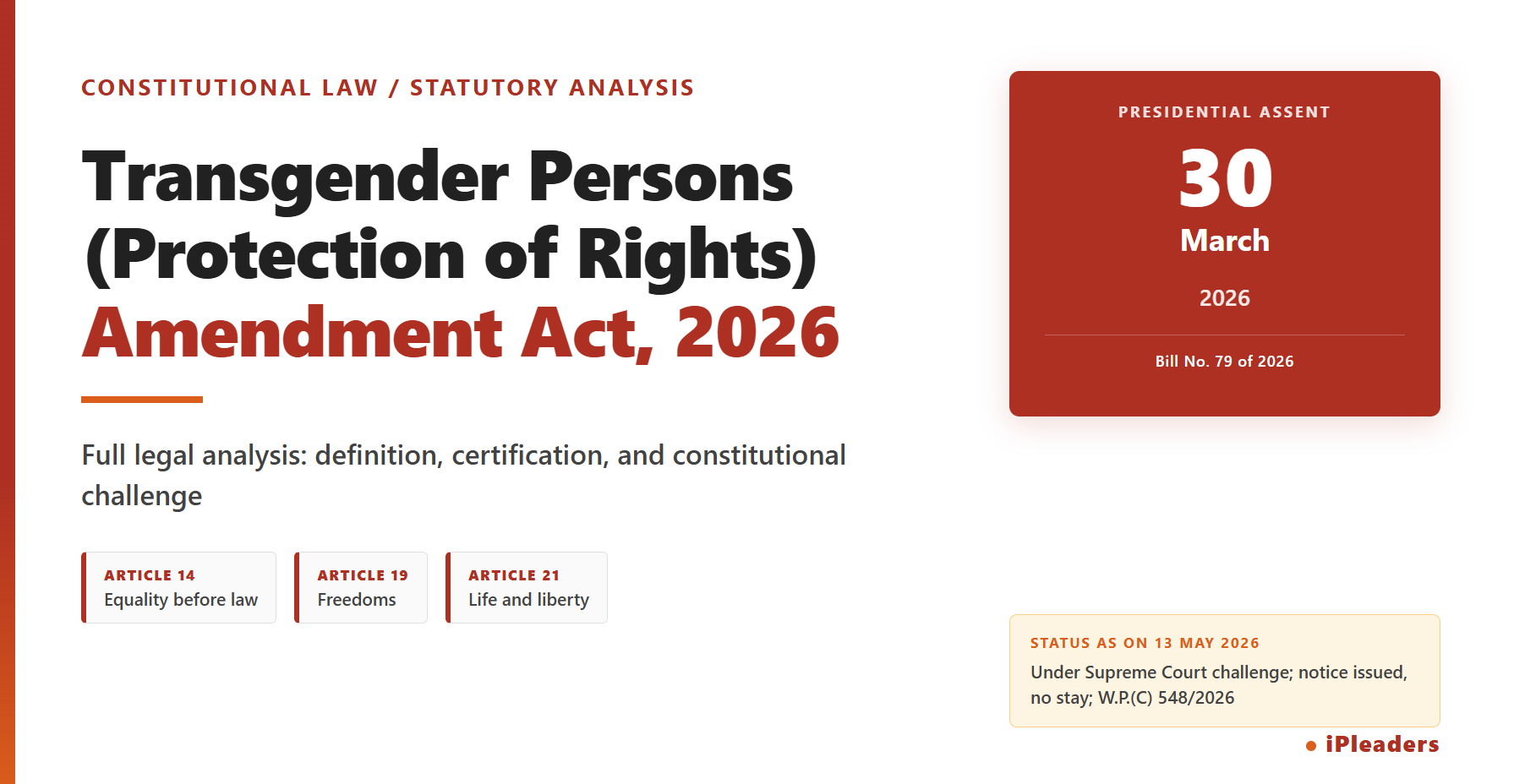
Last verified: 2026-05-13
The Transgender Persons (Protection of Rights) Amendment Act, 2026 went from introduction to law in seventeen days. On 13 March 2026, the Bill was tabled in the Lok Sabha. On 24 March, the lower house passed it by voice vote.
The Rajya Sabha followed a day later. On 30 March, the President’s assent landed, and the gazette notification went out the same week. Seventeen days, end to end.
That timeline is the story. The parent statute, the Transgender Persons (Protection of Rights) Act, 2019, took five years to draft, three Standing Committee reports, a Pre-Legislative Consultation Policy round, and several months of civil-society engagement after the Supreme Court’s 2014 ruling in National Legal Services Authority v. Union of India, (2014) 5 SCC 438 recognised self-perceived gender identity as a fundamental right.

The 2026 Amendment was processed without a Standing Committee referral, without Pre-Legislative Consultation Policy compliance, and without consultation with the statutorily constituted National Council for Transgender Persons (NCTP). The last point isn’t opinion. Civil-society Right to Information filings reportedly confirmed that the NCTP was never asked, and the parliamentary record carries opposition statements to the same effect.
Inside Parliament, the friction was visible. A DMK member of the Rajya Sabha moved to refer the Bill to a Select Committee. The motion was negatived. After voice-vote passage in the Lok Sabha, opposition members from seven parties walked out.
The Union Social Justice Minister defended the Bill as a measure to prevent “misuse of welfare schemes”. Senior opposition MPs framed it as a rollback of NALSA. No personal names, but the institutional shape of the debate was clear.
Why does a seventeen-day passage matter for civil liberties? Because the Supreme Court, in NALSA, had treated self-perceived gender identity as falling within Articles 14, 19 and 21 of the Constitution. A statute that erases the legislative codification of a Supreme-Court-declared fundamental right can’t, the petitioners argue, be processed like a routine procedural amendment.
Within five weeks of presidential assent, the Supreme Court issued notices on Article 32 writ petitions and referred the matter to a three-judge bench. The Act remains in force. It hasn’t been stayed. So what did the seventeen-day Bill actually change?
The Transgender Persons (Protection of Rights) Amendment Act, 2026 amends India’s 2019 transgender rights law to remove self-identification of gender, narrow the statutory definition of “transgender person”, and require medical-board recommendation before a District Magistrate can issue a transgender identity certificate. It received presidential assent on 30 March 2026 and is now under Supreme Court challenge.
The sections below break down each change: the new definition under Section 2(k), the deletion of Section 4(2), the medical-board procedure, the new offences under Section 18, and the constitutional challenge pending before a three-judge bench.
What the 2026 Amendment changes at a glance
The 2026 Amendment touches four pressure points in the 2019 architecture. The definition of “transgender person” is narrowed; self-perceived gender identity, which the 2019 Act codified in Section 4(2), is deleted. The certification process now runs through a medical board instead of a self-declaration affidavit. And a fresh set of criminal offences sits under an enlarged Section 18, with sharply higher penalty quanta.
Each change is small on paper. Read together, they reshape the statutory recognition pathway that around 32,000 certificate holders have already used since 2019.
The Act came into force on the day of presidential assent: 30 March 2026. The PRS India bill tracker carries the Bill text and the Lok Sabha and Rajya Sabha voting records. The e-Gazette notification followed within the same week.
Importantly, the Supreme Court has issued notice on the Article 32 challenge in W.P.(C) No. 548/2026 but hasn’t stayed the operation of the Amendment. So the position you’re reading is the position in force, with one large caveat: the constitutional question is sub judice.
What does that mean for a reader trying to plan a real-world step? Here’s the thing. If you hold a certificate issued under the Transgender Persons (Protection of Rights) Act, 2019, your statutory recognition isn’t automatically extinguished.

But the retroactive proviso in the new Section 2(k) of the Transgender Persons (Protection of Rights) Amendment Act, 2026 uses the unusual formulation “shall not include, nor shall ever have been so included, persons with different sexual orientations and self-perceived sexual identities”. On its plain reading the proviso targets self-perception-based claims rather than the named socio-cultural identities, but the practical consequence for trans-men, trans-women, non-binary and genderqueer persons who registered under the 2019 self-identification regime is the same: their statutory basis turns on whether they fit the narrower 2026 definition. Whether the proviso operates on certificates already issued is the legal question that District Magistrates, State welfare administrators, and the Supreme Court will spend the next twelve months working out.
Definitional narrowing under Section 2(k)
The 2019 definition of “transgender person” sweeps wide. It includes persons whose gender doesn’t match the sex assigned at birth, plus trans-men, trans-women, intersex persons, and a list of socio-cultural identities including hijra, kinner, aravani and jogta. The 2026 substitution rewrites this to a narrower list: principally hijra, kinner, aravani, jogta and the revived term “eunuch”.
Trans-men, trans-women, non-binary, genderqueer, and agender persons aren’t named. Intersex persons appear to be collapsed into the same category rather than retained as a distinct Section 2(i) classification.
Deletion of Section 4(2): the self-perceived gender identity clause
Section 4(2) of the parent Act read, in essence, that every transgender person had a right to self-perceived gender identity. That clause incorporated, into Indian statute, the language of Yogyakarta Principle 3 and the doctrinal core of NALSA. The 2026 Amendment deletes Section 4(2) outright. What survives is the bare right to a certificate, but only if the procedural conditions of the substituted Section 6 are met.
Insertion of medical-board certification procedure
Where the 2019 Act ran on a self-affidavit submitted to the District Magistrate, the 2026 process inserts a medical board between the applicant and the certificate. The board is, per the gazette text, headed by a Chief Medical Officer or Deputy Chief Medical Officer. Its recommendation is now a precondition to issuance. Section 7(1A) adds a parallel hospital-reporting requirement for gender-affirming surgery.
New criminal offences under Section 18
The 2019 Section 18 carried a single penalty band of six months to two years for a small set of offences including forced or bonded labour, denial of access, forced removal from residence, and abuse. The substituted 2026 Section 18 keeps those four offences at the same six-months-to-two-years band but layers on four new aggravated offences with sharply higher quanta. The headline aggravated quanta from the bill text are: rigorous imprisonment of 10 years to life with a minimum fine of two lakh rupees where an adult is kidnapped or abducted and forced to assume a transgender identity with grievous bodily harm; rigorous imprisonment for life with a minimum fine of five lakh rupees where the victim is a child; rigorous imprisonment of 5 to 10 years with a minimum fine of one lakh rupees where any person is compelled by force or allurement to present as transgender and used for begging or servitude; and rigorous imprisonment of 10 to 14 years with a minimum fine of three lakh rupees where such compulsion is directed at a child. Section 6 below works through each clause.
Table 1: 2019 Act vs 2026 Amendment at a glance
| Provision | 2019 Act | 2026 Amendment | Implication |
|---|---|---|---|
| Definition of transgender | Broad: includes trans-men, trans-women, intersex, hijra, kinner, aravani, jogta | Narrower: hijra, kinner, aravani, jogta, eunuch (revived) | Trans-men, trans-women, non-binary, genderqueer not named |
| Self-identification | Section 4(2) codified right to self-perceived gender identity | Section 4(2) deleted | Statutory codification of NALSA’s core right is removed |
| Certifying authority | District Magistrate on affidavit | District Magistrate on medical-board recommendation | DM no longer issues without board’s nod |
| Procedure | Self-affidavit; certificate within 30 days | Application, medical board (CMO/DCMO), recommendation, then DM | Adds an examination layer and timeline ambiguity |
| Hospital reporting | None | New Section 7(1A): hospital reports gender-affirming surgery to DM | Confidentiality concerns flagged by petitioners |
| Criminal offences | Six months to two years; four offences | Four 2019 offences retained at six-months-to-two-years; four new aggravated offences (kidnap-and-force, forced-begging) added | New aggravated band layered on top of original quanta |
| Penalty quantum | Imprisonment + fine; quantum modest, fines at judicial discretion | Aggravated band: 5 to 10 years to life depending on offence; minimum fines from ₹1 lakh to ₹5 lakh | Mandatory minimum fines introduced for aggravated offences |
| Retroactive effect | None | “Shall not include nor shall ever have been so included” proviso | Status of existing 32,000+ certificates contested |
The table isn’t subtle in what it shows. Eight headline provisions, eight points of departure. The rest of this analysis works through each row.
Background: the 2019 Act and the NALSA constitutional framework
To understand what the 2026 Amendment removes, you first need to see what the 2019 Act put in place. And to see what the 2019 Act put in place, you have to start with the 2014 ruling that compelled it. In National Legal Services Authority v. Union of India, (2014) 5 SCC 438, the Supreme Court held that gender identity is integral to dignity under Article 21, that self-perceived gender identity is part of the right to equality under Article 14, and that the right to expression under Article 19(1)(a) protects gender expression.
The Court rejected the biological test from the English decision in Corbett v. Corbett (otherwise Ashley), [1971] P 83 (which had pegged sex determination to chromosomes, gonads and genitalia) and held that gender, in Indian constitutional law, is a matter of self-identification rooted in the person’s lived experience.
So what did NALSA actually command? Three things in operational terms. First, the recognition of a “third gender” beyond the male and female binary. Second, the inclusion of transgender persons within socially and educationally backward classes for the purpose of reservation.
Third, the design of welfare measures including healthcare, public toilets, and social-stigma redressal. The 2019 Parliament was expected to translate these commands into statute. After three Standing Committee iterations, it did.
The NALSA framework and the rejection of the Corbett biological test
The NALSA Bench grounded its reasoning in two doctrinal moves. The first move took the right to dignity (later expanded and confirmed three years later in Justice K.S. Puttaswamy (Retd.) v. Union of India, (2017) 10 SCC 1) and stretched it to cover the recognition of self-defined identity.
The second move was the rejection of the Corbett “chromosomes plus gonads plus genitalia” test. The Court found Corbett wholly inadequate for a constitutional system rooted in dignity rather than biology. It is this twin move (dignity in, biology out) that the 2026 Amendment is alleged to reverse.
How the 2019 Act codified NALSA
The Transgender Persons (Protection of Rights) Act, 2019 contains the architecture that the 2026 Amendment now reshapes. Section 3 of the 2019 Act prohibits discrimination in employment, education, healthcare, public services, and the right to movement. Section 4 declares the right to be recognised as transgender.
Section 4(2) added the operative codification of self-perceived gender identity, the clause the 2026 Amendment now deletes. Section 6 set out the affidavit-based DM certification process. Section 18 carried the criminal-penalty framework.
The Yogyakarta Principles and Principle 3
Why did the 2019 drafting committee write “self-perceived gender identity” into Section 4(2)? Because that phrase is lifted, deliberately, from Yogyakarta Principle 3, an international instrument on the application of international human rights law to sexual orientation and gender identity. Yogyakarta Principle 3 holds that everyone has the right to recognition before the law and that no person shall be forced to undergo medical procedures, including sex reassignment surgery, sterilisation or hormonal therapy, as a requirement for legal recognition of their gender identity. The 2019 Section 4(2) was, in effect, the statutory mirror of Principle 3 inside Indian law.
Welfare scaffolding 2020 to 2026
Between the 2019 enactment and the 2026 Amendment, an administrative scaffolding rose around the statute. Around 32,000 transgender identity certificates were issued through the National Portal for Transgender Persons. The National Council for Transgender Persons (NCTP) was constituted to advise on welfare measures.
As of late 2024, twelve Garima Greh shelter homes were operating nationally, providing transitional accommodation, skill-building and medical access; the scheme target is at least one Garima Greh per State and the network is still ramping. The SMILE scheme (Support for Marginalised Individuals for Livelihood and Enterprise) was rolled out, funded by the Ministry of Social Justice. According to IndiaSpend’s reporting on 2021 to 2024 utilisation, only around 11% of allocated welfare funds were drawn down (a separate problem the Amendment doesn’t directly address).
The picture, in short, was patchy but real. There was a definition, a recognition pathway, a council, a shelter network, and an underwhelming but live welfare infrastructure. The 2026 Amendment touches the definition and the pathway. Everything downstream now sits on uncertain footing.
Section-by-section breakdown of the 2026 Amendment
The substantive provisions of the Transgender Persons (Protection of Rights) Amendment Act, 2026 cluster around six clauses. This section walks through each clause, what it replaces, and what it operationally means. Readers who want the consolidated table of 2019 versus 2026 should hold that in mind from Section 1; this section is the clause-level read.
Section 2(k): the new definition and the retroactive proviso
The substituted Section 2(k) restricts “transgender person” to two limbs. Limb (i) names the socio-cultural identities kinner, hijra, aravani, jogta and eunuch, and persons with intersex variations identified through five medical markers (primary sexual characteristics, external genitalia, chromosomal patterns, gonadal development, and endogenous hormone production or response). Limb (ii) covers any person or child who has been compelled, by force, allurement, inducement, deceit or undue influence, to assume or present a transgender identity through mutilation, emasculation, castration, amputation, or surgical, chemical or hormonal procedures (this limb is the statutory hook for the new aggravated offences under the substituted Section 18). The retroactive proviso reads in full: “Provided that it shall not include, nor shall ever have been so included, persons with different sexual orientations and self-perceived sexual identities.”
The retroactive phrasing matters. Ordinary statutory amendments operate prospectively; this proviso reads, on its face, as an attempt to extinguish past inclusion as well as bar future inclusion of those whose claim rests on self-perception. Whether such a retroactive proviso survives constitutional scrutiny is one of the three doctrinal flashpoints in the pending writ.
Deletion of Section 4(2): the operative removal
The 2019 Section 4(2) declared, in plain terms, that every transgender person had a right to self-perceived gender identity. The deletion is surgical. The right to a certificate under Section 4(1) survives, but the substantive content of that right (self-perception as the operative test) is gone. The new architecture replaces self-perception with the substituted Section 6 procedure described in the next subsection.
Substituted Section 6: the medical-board layer
Section 6, as substituted, requires that any application for a transgender identity certificate be referred to a medical board. The board is headed by the Chief Medical Officer (CMO) or, where notified, the Deputy Chief Medical Officer (DCMO) of the district. The board’s recommendation is a statutory precondition for the District Magistrate to issue the certificate. The procedure, document checklist and remedy on rejection are explored in Section 5 below.
New Section 7(1A): hospital reporting of gender-affirming surgery
Section 7(1A) is a new insertion. It requires hospitals to report to the District Magistrate the performance of any gender-affirming surgery. The gazette text uses “report” rather than “seek prior approval”, but the petitioners argue that mandatory reporting, attached to medical confidentiality, raises Article 21 concerns under the right to privacy. The detail on consent, reporting timeline and exemptions is expected in the rules under Section 22, which are yet to be notified.
Amended Section 18: new offences and enhanced penalty quanta
The substituted Section 18 of the Transgender Persons (Protection of Rights) Amendment Act, 2026 is the criminal-law spine of the Amendment. It retains the 2019 catalogue of offences (forced or bonded labour, denial of public-place access, forced removal from residence, and physical/sexual/verbal/emotional/economic abuse) at the original six-months-to-two-years quantum. It then adds four aggravated offences keyed to the new Section 2(k) limb (ii): kidnap and grievous-hurt-driven forced transgender-identity assumption (10 years to life, minimum fine ₹2 lakh, adult victim); the same offence against a child (rigorous imprisonment for life, minimum fine ₹5 lakh); force-or-allurement-driven compulsion to present as transgender combined with begging or servitude (5 to 10 years, minimum fine ₹1 lakh); and the child equivalent of that offence (10 to 14 years, minimum fine ₹3 lakh). Section 6 below works through the matrix.
Composition changes to the National Council for Transgender Persons
The Amendment changes the composition of the NCTP through a substitution to Section 16(2)(f) of the 2019 Act. Under the substituted clause, State Government and Union Territory representatives are now required to be officers “not below the rank of Director” in the concerned Ministry or Department, rotating one each from North, South, East, West and North-East regions, nominated by the Central Government as ex officio members. The earlier formulation simply referred to “representatives” by rotation without a rank requirement.
Petitioners argue that pegging the State/UT slot to senior administrators tilts the advisory body’s centre of gravity towards the bureaucracy and away from the community-representative slots Parliament built into the 2019 architecture. The Union government’s position is that the recomposition reflects administrative coherence and accountability.
The retroactive proviso and the question of existing certificate holders
That phrase again: “shall not include nor shall ever have been so included”. Around 32,000 transgender identity certificates were issued under the 2019 Act, many to trans-men and trans-women who fall outside the narrower 2026 definition. Do those certificates survive?
The Union government hasn’t yet notified rules under Section 22 clarifying the position. State welfare administrators are, in practice, continuing to honour existing certificates pending further notification. But the proviso’s plain reading is a problem, and the petitioners will press it.
Table 2: Section-wise change map
| Section | 2019 text (excerpt) | 2026 text (excerpt) | Nature of change | Operational impact |
|---|---|---|---|---|
| 2(k) | Broad definition including trans-men, trans-women, intersex, hijra, kinner | Two-limb definition (named socio-cultural identities + intersex variations; plus a forced-induction limb); retrospective proviso on self-perceived sexual identities | Substantive replacement | Self-perception-based recognition narrowed; retroactivity question |
| 4(2) | Right to self-perceived gender identity | Deleted | Operative removal | Statutory codification of NALSA’s core right gone |
| 6 | DM issues certificate on affidavit within 30 days | DM issues “after examining the recommendation of the authority” (medical board); discretion to seek further medical experts | Process substitution | Adds an examination layer; timeline now ambiguous |
| 7(1A) | (No equivalent) | New: medical institution furnishes details of gender-changing surgery to DM and authority | Insertion | Privacy and confidentiality concerns raised |
| 16(2)(f) | State / UT representatives by rotation, one per region | State / UT representatives by rotation, but not below the rank of Director | Composition change | Advisory body skews toward senior bureaucracy, per petitioners |
| 18 | Single band: six months to two years for four offences | Four 2019 offences retained at the same band; four new aggravated offences with quanta from 5 years to life and minimum fines from ₹1 lakh to ₹5 lakh | Substitution + enhancement | New aggravated offences plus sharply higher quanta |
That’s the clause-level read. The next section drills into what the new definition actually says about who counts as a transgender person and who, on the new wording, doesn’t.
The new definition of “transgender person”: what is in, what is out
The 2019 definition was deliberately inclusive. Whether you read it doctrinally (as a Yogyakarta-Principle-3-aligned statutory definition) or practically (as the gateway to welfare and recognition), it caught a wide net: trans-men, trans-women, persons with intersex variations, genderqueer persons, and a list of socio-cultural identities including hijra, kinner, aravani and jogta. The 2026 substituted Section 2(k) is narrower. So who is in, and who is out?
Who is now in the statutory definition
Limb (i) of the new definition names kinner, hijra, aravani, jogta and the revived term “eunuch”. The first four are familiar in Indian socio-cultural and legal usage; the fifth is a colonial-era term that had largely disappeared from statutory drafting after the repeal of the Criminal Tribes Act, 1871 and has returned in the 2026 substitution. Limb (i) also covers persons with intersex variations identified through five medical markers (primary sexual characteristics, external genitalia, chromosomal patterns, gonadal development, and endogenous hormone production or response).
Why does the revival of “eunuch” matter? Because that’s the precise term the Telangana Eunuchs Act used and which the Telangana High Court found unconstitutional in Vyjayanti Vasanta Mogli v. State of Telangana, (2023) SCC OnLine Tel 1131, holding that the term carried 1871-style criminal-registration baggage. The drafting choice has, accordingly, drawn pointed academic critique.
Who is now out
The 2026 Section 2(k) doesn’t name trans-men, trans-women, genderqueer or non-binary persons (categories that the 2019 definition had expressly included). Intersex persons remain covered, but only through a medical-marker test rather than through identity-based recognition. The petitioners argue that the dropping of the named identity categories, combined with the retrospective proviso aimed at “self-perceived sexual identities”, operates as a definitional exclusion of self-perception-based recognition. The Union government’s position, restated faithfully, is that the new definition is open-textured and that persons who fall outside Limb (i) may still seek recognition through the substituted Section 6 procedure where they qualify on intersex grounds.
The textual question is whether the absence of the named categories, read with the retroactive proviso, operates as a legislative exclusion. The Court will decide.
Regional identities
India’s transgender community is regionally diverse. Tamil Nadu’s thirunangai (trans-women) and thirunambi (trans-men) have State-level welfare recognition. Manipur’s nupi maanbi (trans-women) carry institutional standing in cultural and legal practice. Karnataka has shiva-shaktis as a recognised community.
None of these regional identities is named in the 2026 central definition. That doesn’t extinguish State-level welfare lists, but it creates a definitional fork: a person may be recognised by the State as a thirunangai but not by the Central definition as a transgender person. The federalism implications of that fork sit in Section 10.
Intersex persons under the new definition
The 2019 Act retained “person with intersex variations” as a stand-alone clause (Section 2(i)) alongside the broader transgender definition in Section 2(k). The 2026 substitution omits clause (i) and instead folds the medical markers of intersex variation directly into Limb (i) of the new Section 2(k). Activist groups and medical practitioners have called this a definitional confusion: intersex variation is a matter of biological characteristics, while transgender identity is a matter of self-defined gender. Collapsing the two, the critique runs, generates conceptual and clinical problems for intersex persons seeking medical care that the 2019 Act had specifically protected.
Gender identity versus sexual orientation under Indian law
A reader-orientation note. Gender identity and sexual orientation aren’t the same thing under Indian constitutional law. NALSA dealt with gender identity. Navtej Singh Johar v. Union of India, (2018) 10 SCC 1 in 2018 dealt with sexual orientation, specifically the reading down of Section 377 IPC.
The 2026 Amendment changes the definition of “transgender person” but doesn’t directly touch the post-Navtej position on sexual orientation. The two questions interact (a trans-woman in a same-sex relationship, for example, sits at the intersection), but they’re doctrinally distinct. Readers writing about the Amendment shouldn’t collapse them.
Who counts as a ‘transgender person’?
2019 Act definition vs 2026 Amendment definition
In 2019 only (excluded by 2026)
- Trans-men
- Trans-women
- Non-binary persons
- Genderqueer persons
- Agender persons
Common to both Acts
- Hijra
- Kinner
- Aravani
- Jogta
- Eunuch (term revived in 2026)
- Intersex persons (separate category in 2019; collapsed into ‘transgender’ in 2026)
Regional identities: status under each Act
| Identity | Status under 2019 | Status under 2026 |
|---|---|---|
| Thirunangai (Tamil Nadu) | Included by State welfare practice | Outside central definition; State practice may diverge |
| Thirunambi (Tamil Nadu) | Included by State welfare practice | Outside central definition; State practice may diverge |
| Nupi maanbi (Manipur) | Included by State welfare practice | Outside central definition; State practice may diverge |
| Shiva-shakti (Karnataka) | Included by State welfare practice | Outside central definition; State practice may diverge |
The new certification procedure: District Magistrate plus medical board
This is the procedural heart of the Amendment, and it’s where most affected readers will first feel the change. The 2019 process was structurally simple. The 2026 process, by design, adds a layer. The question every applicant in transit will ask is: what now?
The 2019 process
Under the Transgender Persons (Protection of Rights) Act, 2019, an applicant submitted an affidavit declaring their self-perceived gender identity to the District Magistrate. No medical examination was required. The DM issued the identity certificate within the procedure and timeline prescribed under the rules.
The process flowed through the National Portal for Transgender Persons; documentation was minimal; rejection grounds were narrow. That is the architecture against which the new procedure must be read.
The 2026 process
The substituted Section 6 of the Transgender Persons (Protection of Rights) Amendment Act, 2026 introduces a medical-board “authority” between the applicant and the certificate. The bill text rewrites Section 6(1) so that the District Magistrate, “after examining the recommendation of the authority and, if he considers either necessary or desirable, after taking the assistance of other medical experts”, issues the certificate. The “authority” is defined under the new Section 2(aa) as a medical board headed by the Chief Medical Officer or Deputy Chief Medical Officer. In practical sequence: the application is filed; the matter goes to the medical board; the board makes a recommendation; the DM may consult further medical experts; the DM then issues or refuses the certificate.
The composition of the board beyond the CMO/DCMO is to be notified under the Section 22 rules. A document checklist is also expected: identity proof, address proof, medical history declarations, and any prior gender-affirming-care documentation. The statutory 30-day timeline that anchored the 2019 process has, on a plain reading, gone. The Amendment is silent on the new timeline.
Section 7(1A) and the hospital reporting question
The new Section 7(1A) is the second procedural change. The bill text reads that “the medical institution in which the person who has undergone surgery to change gender, either as male or female, shall furnish the details of such person to the concerned District Magistrate and the authority in such form and manner as may be prescribed”. The reporting duty is institutional (on the medical institution) and runs both to the DM and to the medical-board authority. The form and manner of furnishing those details is left to delegated legislation under the amended Section 22.
The petitioners argue this raises confidentiality and Article 21 concerns. The relationship between the reporting obligation and the BNS / MTP / clinical-establishment privacy regime is unclarified; the rules under Section 22 are expected to address it.
Remedies if the medical board recommends against issuance
The Amendment doesn’t, on its face, set out an internal appellate forum against an adverse medical-board recommendation. A rejected applicant’s remedies, accordingly, are the standard administrative-law remedies: writ jurisdiction under Article 226 before the relevant High Court (challenging arbitrariness, procedural irregularity, or violation of natural justice), and the broader Article 32 jurisdiction if a fundamental right is engaged. The absence of a statutory appellate mechanism is, the petitioners argue, itself a constitutional infirmity (arbitrariness under Article 14 of the Constitution of India).
Birth certificate, Aadhaar and PAN implications
A transgender person seeking to update their name and gender on the birth certificate, Aadhaar, PAN or other records typically presents the transgender identity certificate as the supporting document. After 2026, the certificate’s underlying basis (the affidavit) has changed (the medical-board recommendation). Whether the Unique Identification Authority of India and the Income Tax Department issue revised KYC circulars to take account of the new certificate format is a Section 22 rules question. Practitioners advising fintech and KYC teams should anticipate at least six to nine months of ambiguous regulatory guidance, particularly on whether existing Aadhaar updates effected on a 2019-Act certificate require fresh verification.
For readers wanting deeper context on the welfare-access dimensions, the legal framework for transgender healthcare in India sets out the Ayushman Bharat TG Plus and SMILE-scheme architecture as it stood before the Amendment. The Telangana High Court’s reasoning in Vyjayanti Vasanta Mogli, in striking down the Telangana Eunuchs Act, treated State-mediated registration of identity as constitutionally suspect.
That reasoning maps directly onto the medical-board layer the 2026 Amendment introduces. The Rajasthan High Court, on 30 March 2026, struck a similar note in Ganga Kumari v. State of Rajasthan, 2026:RJ-JD:14683-DB, using the phrase “state-mediated entitlement” to describe the new procedural regime. The two HC observations now travel together in petitioners’ briefs.
Certification: 2019 Act vs 2026 Amendment
From self-identification to medical-board recommendation
2019 Act: affidavit based self-ID
2026 Amendment: medical board route
New criminal offences under Section 18: offences and penalty quanta
The criminal-law side of the Amendment is where the rhetoric and the gazette text diverge most visibly. The Union government’s stated rationale is the strengthening of criminal protections for transgender persons against trafficking, forced begging and exploitation. The petitioners’ read is broader and more anxious: that the new offences risk criminalising consensual community induction, particularly within the hijra gharana and guru-chela system. Which read prevails depends on how the courts construe the operative words.
The new offences
The substituted Section 18 enlarges the offence catalogue. The bill text retains the 2019 catalogue of four offences (forced or bonded labour, denial of public-place access, forced removal from residence, and physical/sexual/verbal/emotional/economic abuse) at the original six-months-to-two-years quantum. It then adds four new aggravated offences keyed to coercion-driven assumption of a transgender identity: kidnap and grievous-hurt-driven forced transgender-identity assumption of an adult (10 years to life, minimum fine ₹2 lakh); the same offence against a child (rigorous imprisonment for life, minimum fine ₹5 lakh); compelling any person to dress, present or conduct themselves outwardly as a transgender person and employing them for begging or servitude (5 to 10 years, minimum fine ₹1 lakh); and the equivalent offence against a child (10 to 14 years, minimum fine ₹3 lakh).
The operative words “force, threat, coercion, allurement, deception, inducement, or undue influence” run through clauses (g) and (h), the begging/servitude offences. The bill’s Statement of Objects and Reasons records that the Bharatiya Nyaya Sanhita, 2023 (notably its trafficking and forced-labour provisions) and the Juvenile Justice (Care and Protection of Children) Act, 2015 already address individual elements of these wrongs, but that no existing provision treats the conjunction of abduction, permanent bodily harm, and forced identity as a unified penal approach. Hence the substitution.
Penalty quanta
The penalty schedule has been substantially enhanced for the new aggravated offences. The 2019 catalogue of four offences (forced/bonded labour, denial of access, forced removal from residence, physical/sexual/verbal/emotional/economic abuse) is retained at the original six-months-to-two-years quantum with a discretionary fine. On top of that, four new aggravated offences carry the higher quanta and mandatory minimum fines. The mandatory minimum fines are new; the 2019 Section 18 left fines to judicial discretion.
Table 3: Section 18 penalty matrix (substituted by the 2026 Amendment)
| Clause | Offence | Sentence | Minimum fine |
|---|---|---|---|
| 18(a) | Compelling or enticing forced or bonded labour | Six months to two years | At discretion |
| 18(b) | Denial of right of passage / access to a public place | Six months to two years | At discretion |
| 18(c) | Forcing or causing the person to leave household, village or residence | Six months to two years | At discretion |
| 18(d) | Harm or endangerment; physical, sexual, verbal, emotional or economic abuse | Six months to two years | At discretion |
| 18(e) | Kidnap or abduction of an adult with grievous hurt (mutilation, emasculation, castration, amputation, or surgical / chemical / hormonal procedure), to compel assumption of transgender identity | 10 years to life rigorous imprisonment | ₹2 lakh |
| 18(f) | Kidnap or abduction of a child with grievous hurt, to compel assumption of transgender identity | Rigorous imprisonment for life | ₹5 lakh |
| 18(g) | Compelling any person to outwardly present as transgender against their will and using them for begging, solicitation, servitude or other forced / bonded labour | 5 to 10 years rigorous imprisonment | ₹1 lakh |
| 18(h) | The same offence against a child | 10 to 14 years rigorous imprisonment | ₹3 lakh |
A note for accuracy: clause-by-clause quanta above are taken from the bill text passed by both Houses (Bill No. 79 of 2026 as introduced in Lok Sabha; the operative text after the e-Gazette notification of 30 March 2026 follows the same schedule). The Amendment doesn’t insert a separate “forced-begging interface with BNS” clause; clauses (g) and (h) are the begging/servitude provisions and operate cumulatively with the trafficking and forced-labour provisions of the Bharatiya Nyaya Sanhita, 2023.
The Bharatiya Nyaya Sanhita interface
Section 143 of the Bharatiya Nyaya Sanhita, 2023 criminalises trafficking, including for forced labour or begging. The 2026 Amendment’s clauses (g) and (h), the begging-and-servitude offences, operate cumulatively with the BNS, as the bill’s Statement of Objects and Reasons explicitly contemplates. Where the conduct meets both descriptions, the prosecution may proceed under either or both regimes.
The doctrinal question is whether the dual-classification creates overlap problems (where the prosecution can elect between regimes) or coherent reinforcement (where the two statutes work together to fill protection gaps). The pending writ doesn’t foreground this point, but practitioners working on transgender-rights prosecutions and defences will need to track it.
The hijra gharana / guru-chela concern
This is the second-order concern that activist groups have flagged most sharply. The hijra gharana is a community kinship system in which a guru (senior member) accepts and trains chelas (apprentices), often providing housing, livelihood and community standing. The transition of a young person into the gharana is, in the community’s terms, voluntary and identity-affirming.
The petitioners’ worry is that the operative words “forcing or alluring” in Section 18 are broad enough to cover the consensual gharana-induction process if a prosecutor reads them expansively. Whether the courts construe “forcing or alluring” with a coercion test or with a wider behavioural test will determine whether the gharana system stands inside or outside the new criminal frame. This is, in our view, the single most consequential interpretive question in the criminal-law side of the Amendment.
Section 18: offences and penalty quanta
Adult vs child victim under the 2026 Amendment
Sections 18(a) to 18(d): pre-existing 2019 offences (retained)
Quantum: 6 months to 2 years imprisonment with fine (unchanged from 2019)
| Clause | Offence | Adult victim | Child victim |
|---|---|---|---|
| 18(e) / (f) | Kidnap plus grievous hurt | 18(e): 10 years to life RI Minimum fine Rs. 2 lakh |
18(f): Life RI Minimum fine Rs. 5 lakh |
| 18(g) / (h) | Force plus begging or servitude | 18(g): 5 to 10 years RI Minimum fine Rs. 1 lakh |
18(h): 10 to 14 years RI Minimum fine Rs. 3 lakh |
Constitutional challenges: Articles 14, 15, 19 and 21
This is the analytical centrepiece of the case against the Amendment. The petitioners argue that the deletion of Section 4(2), the new definition under Section 2(k), and the medical-board layer collectively violate four constitutional provisions.
The Union government’s response will rest on legislative competence, the legitimacy of welfare-misuse prevention as a State aim, and the deferential standard of review applied to economic and welfare legislation. Both sides cite NALSA. The Supreme Court will, in due course, decide.
The Article 14 argument: manifest arbitrariness
The petitioners’ Article 14 case runs on two tracks. First, that the new definition discriminates between similarly situated persons (a trans-woman and a hijra are similarly situated in their gender non-conformity but differently treated by the central definition). Second, that the Amendment is manifestly arbitrary under the manifest-arbitrariness doctrine the Supreme Court has consolidated in its post-2017 equality jurisprudence: the means chosen (definitional narrowing plus medical-board layer) don’t rationally connect to the stated end (preventing welfare misuse).
Why narrow the definition when the alleged misuse can be addressed by tightening the verification of welfare claims? The rationality gap is, the petitioners say, the Article 14 violation. For a primer on the underlying doctrine, Article 14 and the right to equality sets out the framework.
The Article 15 argument: discrimination on grounds of sex and gender identity
Article 15 of the Constitution of India prohibits discrimination on grounds of sex, among others. NALSA read “sex” to include gender identity. The petitioners argue that excluding trans-men, trans-women and non-binary persons from the statutory definition is direct or indirect discrimination on the prohibited ground. The Union government’s likely response is that gender-identity discrimination is permissible where there is a reasonable basis (here, welfare-misuse prevention) and that the central definition doesn’t foreclose State-level inclusion.
The Article 19 argument: expression of identity
Article 19(1)(a) protects freedom of speech and expression. NALSA held that gender expression sits within Article 19(1)(a). The petitioners argue that compelling a person to undergo medical-board examination as a precondition to legal recognition of their gender identity is a restriction on expression that isn’t “reasonable” under Article 19(2) (which doesn’t contemplate medical-examination requirements). The Union government will likely argue that the requirement is regulatory, not restrictive of expression.
The Article 21 argument: dignity, bodily autonomy, self-determination
This is the petitioners’ strongest doctrinal terrain. Article 21 of the Constitution protects life and personal liberty with dignity. NALSA, Puttaswamy, and Navtej Singh Johar collectively built a dignity-and-autonomy reading of Article 21 that encompasses gender identity.
The petitioners argue that the medical-board examination is, in substance, a State-mandated intrusion into bodily autonomy and self-definition, and that the deletion of Section 4(2) extinguishes a fundamental-right codification that Parliament can’t validly remove. The Rajasthan HC’s phrasing in Ganga Kumari (the “state-mediated entitlement” framing) is the practitioners’ favourite quote on this point. Anchored as it is in the 2014 NALSA architecture, the Article 21 case extends the dignity-plus-autonomy reading the Court has built over a decade of jurisprudence.
The Puttaswamy three-part test
The doctrinal test the Court will likely apply is the three-part proportionality test consolidated in Puttaswamy. The test requires: (i) lawful authority for the State action; (ii) a legitimate State aim; and (iii) proportionality between the means employed and the end pursued. The petitioners concede limb (i) (Parliament has the legislative competence). They contest limb (ii) (whether “preventing misuse of welfare schemes” is a legitimate aim, given the absence of empirical evidence of misuse in the NALSA-2019 regime) and limb (iii) (whether the medical-board layer is the least intrusive means, when a tightened welfare-verification protocol would achieve the same end without intruding into identity).
The retrospective proviso and the doctrine against retroactivity
The “shall not include nor shall ever have been so included” formulation is constitutionally unusual. Rights-restricting statutes are presumed to operate prospectively. Retrospective extinction of recognition already conferred under a previous statute raises Article 14 and Article 21 concerns.
The petitioners argue that the proviso, on a plain reading, attempts to extinguish past inclusion (a doctrinal move the courts have historically refused to validate where fundamental rights are engaged). The Union government’s likely position is that the proviso is declaratory rather than extinguishing, clarifying the original legislative intent. Which read survives will turn on the gazette text and the Court’s reading of the proviso’s purpose.
Is “preventing misuse of welfare schemes” a valid State aim?
The Union government’s stated rationale, restated faithfully, is that the 2019 architecture had been subject to misuse by persons falsely claiming transgender identity to access welfare schemes. The petitioners’ counter is empirical: where is the evidence? The IndiaSpend 2021 to 2024 data shows 11% scheme-fund utilisation, which the petitioners say is itself an answer (the schemes are under-utilised, not over-claimed).
The overbreadth critique runs that even if misuse exists, the definitional rewrite catches the entire population (including all bona fide transgender persons) rather than tightening verification at the welfare-claim step. The underbreadth critique runs the other way: if misuse is the concern, the new offences should target false claims, not the underlying definition.
The Rajasthan HC’s “state-mediated entitlement” phrasing
On 30 March 2026, the same day as presidential assent, a division bench of the Rajasthan High Court delivered an order in Ganga Kumari v. State of Rajasthan, 2026:RJ-JD:14683-DB observing that what the Supreme Court had recognised in NALSA as “an inviolable aspect of personhood now risks being reduced to a contingent, State-mediated entitlement”. The bench also directed the State to grant a 3% additional weightage in the maximum prescribed marks to transgender persons for selection in public employment and admission to educational institutions under the State, pending a formal policy decision.
The phrase has travelled rapidly. It is, as constitutional rhetoric goes, sharp and quotable, and it now appears in the petitioners’ briefs in the Supreme Court matter.
Practical implications: welfare, employment, healthcare, family law
The constitutional argument is the headline. The practical fallout is what affected persons actually live with. This section walks through the second-order consequences across four pressure points: existing certificate holders, healthcare access, employment and reservation, and family law.
Existing 32,000+ certificate holders
The first practical question is whether persons who hold certificates issued under the 2019 Act are required to re-apply under the 2026 regime. The retroactive proviso suggests the position is contested. As a matter of administrative practice, State welfare departments are continuing to honour existing certificates pending notification of rules under Section 22.
As a matter of statutory text, the position is unsettled. Practitioners are advising existing certificate holders to retain their original documentation, monitor State notifications, and avoid voluntary re-application until the Supreme Court rules.
Healthcare access and Ayushman Bharat
Ayushman Bharat TG Plus was the headline transgender-health insurance scheme rolled out alongside the 2019 architecture. Hospital empanelment had been incomplete: as of 2024, only a limited subset of empanelled hospitals carried gender-affirming-care capability. The medical-board layer in the new Section 6 adds an additional gatekeeper before insurance-funded care can be authorised.
For affected persons, the practical sequence is now: apply, wait for medical-board recommendation, wait for DM certificate, then approach the empanelled hospital. The cumulative delay is unpredictable. For a broader read on the welfare-access architecture, healthcare access for the LGBTQ+ community explains the pre-Amendment scheme landscape. (This is the second-order welfare effect the petitioners flagged most heavily.)
Employment and reservation
The 2014 NALSA judgment treated transgender persons as a backward class for reservation purposes. Several States (notably Rajasthan, following the Ganga Kumari direction) operate transgender-specific reservation lists. The 2026 central definition fork creates a problem: a person on a State OBC-transgender list may not fit the central definition.
Pending appointments, admission lists and promotion decisions made on the basis of the State list may be exposed to challenge in service tribunals. Whether the central narrowing displaces State practice is a federalism question (covered in Section 10).
Shelter and habitation: Garima Greh homes
Twelve Garima Greh shelter homes were operating nationally under the SMILE scheme as of late 2024, providing transitional accommodation and skill-building to transgender persons; the scheme target is at least one per State. The shelter homes had operated on the basis of the 2019-Act recognition. Anecdotal reporting suggests some residents have left in the weeks since assent due to legal uncertainty, although consolidated occupancy data isn’t yet published. The Ministry of Social Justice hasn’t issued a specific clarification on shelter-home admissions under the new regime.
Family law and the Arun Kumar precedent
The Madras High Court’s 2019 ruling in Arunkumar v. Inspector General of Registration, AIR 2019 Mad 265 held that the term “bride” in Section 5 of the Hindu Marriage Act, 1955 includes a trans-woman, allowing the registration of a marriage between a cis-man and a trans-woman. That holding relied on the 2019 Act’s broader definition. With trans-women now outside the central statutory definition, district registrars across States that apply the Hindu Marriage Act will have to decide afresh whether the Arunkumar precedent survives.
The Madras precedent itself isn’t overruled by the Amendment. But the doctrinal basis on which it rested has shifted, and fresh writ litigation in High Courts on the survival of Arunkumar is, in our view, almost certain.
Banking, KYC, PAN, Aadhaar
The KYC ecosystem operated on the basis of transgender identity certificates issued under the 2019 Act. The Reserve Bank of India and the Unique Identification Authority of India haven’t yet issued re-verification circulars. Practitioners advising fintech and compliance teams should treat the position as fluid for the next six to nine months. PAN and Aadhaar updates already effected on 2019-Act certificates are, for now, valid; whether they require fresh verification under the 2026 regime will turn on departmental circulars.
How the High Courts and the Supreme Court are responding
The litigation status is the second piece readers will want clarity on. The Act is in force. The Supreme Court has issued notice but not stayed it. The Rajasthan High Court has made the only post-assent observation.
Tamil Nadu, Kerala, Manipur and West Bengal are being watched closely. Each of these moves is sub judice in part, and this section reports them factually, without prediction.
The Supreme Court order of 4 May 2026
On 4 May 2026, a two-judge bench of the Supreme Court heard Article 32 writ petitions challenging the Amendment. The lead matter is Laxmi Narayan Tripathi v. Union of India, W.P.(C) No. 548/2026 (case pending; Indian Kanoon URL to be updated once the order is indexed). The bench issued notice to the Union of India and all States and Union Territories, refused to stay the operation of the Amendment, and referred the matter to a three-judge bench for substantive hearing.
The senior counsel for the petitioners argued that the Amendment nullifies the 2014 NALSA precedent. The Solicitor General appeared for the Union. The matter is returnable in four weeks.
What “no stay” means legally
A useful clarification for non-litigators. “No stay” doesn’t mean the Court has approved the Amendment. It means the Act remains in operation while the substantive challenge proceeds.
The petitioners proceed on final hearing. The Court’s reasoning in declining the stay (as paraphrased in the LiveLaw and Verdictum reports) included a calibration of the balance of convenience and the absence of an immediate irreparable harm threshold for the stay test. The substantive question is open.
The Rajasthan HC observation
The Rajasthan High Court’s order in Ganga Kumari v. State of Rajasthan, dated 30 March 2026, is the first post-assent judicial observation. The division bench observed that self-identification was being reduced to a “state-mediated entitlement”, directed a committee to identify marginalisation and recommend remedial measures, and awarded a 3% additional weightage in the maximum prescribed marks for transgender persons in Rajasthan public employment and education.
The order isn’t, strictly speaking, a constitutional challenge to the central Amendment; it’s a State-level direction. But the phrasing has been widely cited in petitioners’ briefs.
What other High Courts are expected to do
Tamil Nadu, Kerala, Manipur and West Bengal have State-level recognition of regional transgender identities (thirunangai, thirunambi, nupi maanbi). Each of these States is expected to issue welfare circulars maintaining the 2019-Act recognition pending Supreme Court resolution. Activist organisations have indicated that writs are being filed in these High Courts on welfare-access grounds. The strategic value of these parallel filings is that they generate State-specific records on which the Supreme Court can draw when assessing the proportionality of the central Amendment.
How a litigant can join the Supreme Court writ
A reader thinking about joining the SC writ should note three points. First, Article 32 jurisdiction is invoked by directly approaching the Supreme Court (the locus is the Court itself). Second, where a lead writ is pending, an additional litigant can file an intervention application rather than a fresh writ, to avoid duplicative litigation.
Third, the lead writ’s pleadings (the prayer, the grounds, the constitutional articles invoked) define the doctrinal frame. Adding a fresh ground requires a separate writ. The practical detail on Article 32 filings sits in Section 16.
Timeline for final hearing
The matter is returnable in four weeks before the three-judge bench. In practice, final hearing in an Article 32 constitutional challenge typically extends over multiple sittings, often spread over six to eighteen months from notice.
The parallel Supriyo @ Supriya Chakraborty v. Union of India, (2023) SCC OnLine SC 1348 Marriage Equality reference took around fifteen months from notice to final order. A realistic working estimate for Supriyo-style reasoning to apply here is a window of twelve to twenty-four months for a substantive decision; readers should treat that as a planning horizon, not a prediction.
Implementation status and State-level rules divergence
This section is shorter but consequential. The central Amendment is in force; the rules under it aren’t yet notified; State welfare circulars continue to operate on the 2019-Act basis. The federalism question is real.
Status of Central rules under Section 22
The 2026 Amendment expands the rule-making power in Section 22 of the 2019 Act, adding a new head for “the form and manner of details to be furnished by the medical institution under sub-section (1A)” of Section 7 and omitting the qualifier “revised” from the existing rule-making head on Section 7(2) certificates. As at 13 May 2026, no fresh rules have been notified by the Central government. Until they are, District Magistrates and CMOs across the country are operating on the 2019-Act procedural framework with the new statutory architecture sitting awkwardly on top of them. The interim is a regulatory gap.
State-level welfare circulars
Rajasthan, following Ganga Kumari, has effectively reaffirmed 2019-Act recognition through the 3% public-employment marks direction. Tamil Nadu’s Department of Social Welfare has indicated, in press statements, that the thirunangai and thirunambi recognition under State policy will continue.
Kerala, with its longstanding transgender policy, is reported to be preparing a State circular maintaining 2019-style certification for State-level welfare access. Manipur’s nupi maanbi recognition is similarly being maintained. The position is patchy but, for State-level welfare access, the 2019 architecture is largely surviving in practice.
Can a State refuse to implement the Central definition? Federalism, repugnancy and Article 254
The constitutional question. Welfare and public health sit on the Concurrent List. Where Central and State law conflict, Article 254 of the Constitution makes the Central law prevail (unless the State law has received presidential assent). A State can’t refuse to implement the Central definition for matters within Central legislative competence.
But the State retains rule-making power for matters squarely within State legislative competence (State welfare schemes, State employment, State educational reservation). So the answer is: a State can’t legislate against the Central definition but can administer State welfare schemes on its own definitional basis. The line between the two is precisely where the federalism litigation will run.
Historical context: from the Criminal Tribes Act 1871 to the 2026 Amendment
A historical reading helps locate the 2026 Amendment in the long arc of Indian transgender-rights law. The framing here is contested: petitioners and academic commentators argue the Amendment is a return to 1871-style registration logic; the Union government argues it’s a routine welfare-administration measure. The historical record itself is uncontested.
1871: the Criminal Tribes Act and the registration of hijra households
The colonial Criminal Tribes Act, 1871 was, in Indian legal history, a piece of criminalising registration legislation. Part II of the CTA dealt expressly with the registration of “eunuchs” and prescribed criminal liability for registered persons who kept under-age boys in their household. The Act was a continuous fixture of British Indian criminal administration until its repeal in 1952.
1952: CTA repeal and the survival of State Eunuchs Acts
The CTA was repealed in 1952 by the Habitual Offenders Act (a States-level recasting that retained some elements of the registration logic in a softer form). State-level Eunuchs Acts (notably the Telangana Eunuchs Act) survived for several decades in modified form. These State Acts retained the 1871 vocabulary and a milder version of its registration architecture, and were the legal residue against which 21st-century constitutional litigation eventually pushed.
2014: NALSA’s doctrinal correction
The 2014 NALSA judgment, which the 2026 Amendment is alleged to undo, marked the doctrinal correction. By rejecting Corbett, importing Yogyakarta Principle 3, and grounding self-identification in Articles 14, 19 and 21, NALSA placed Indian constitutional law on a footing that no longer depended on State-mediated registration of identity.
2018: Navtej Singh Johar and the dignity architecture
The 2018 ruling in Navtej Singh Johar v. Union of India, (2018) 10 SCC 1 read down Section 377 IPC, decriminalised consensual same-sex relations, and consolidated the dignity reading of Article 21 that NALSA had begun. The judgment expressly affirmed that gender identity and sexual orientation are integral to constitutional dignity. It is the doctrinal companion to NALSA in the 21st-century arc.
2019: legislative codification of NALSA
The 2019 Transgender Persons (Protection of Rights) Act was the legislative side of the NALSA-Navtej arc. It codified self-perceived gender identity in Section 4(2), set up the DM-certificate procedure, created the NCTP, and established a criminal-offence schedule under Section 18.
2023: Vyjayanti Mogli and the Telangana Eunuchs Act
In 2023, the Telangana High Court struck down the Telangana Eunuchs Act in Vyjayanti Mogli, holding that the Act resurrected 1871-style criminal-registration logic and violated Articles 14, 19 and 21. The reasoning is the closest precedent the petitioners cite for the constitutional infirmity of the 2026 architecture: where a statute reintroduces registration of identity as a precondition for legal recognition, the State-mediation problem revives. Whether the 2026 Amendment shares this character is the central interpretive question.
2026: the registration regime returns in modified form
The 2026 Amendment is, the petitioners argue, the return of the registration regime in a modified form: a medical-board examination replacing affidavit-based self-declaration. The Union government denies the parallel: the medical-board layer is procedural, not registration, and the underlying right to recognition survives. The historical question is whether the procedural form (medical-board examination) carries the substantive consequence (State-mediated identity) that the CTA-era registration regime carried. The answer will turn on how the Supreme Court reads the new Section 6.
Transgender rights in India: 1871 to 2026
From colonial criminalisation to constitutional protection, and a contested rollback
Criminal Tribes Act
Part II criminalises hijra households; registration regime introduced
CTA repealed
Habitual Offenders Act replaces CTA; some State Eunuchs Acts survive
NALSA v. Union of India
Supreme Court recognises self-perceived gender identity under Articles 14, 19, 21
K.S. Puttaswamy v. Union of India
9-judge bench: right to privacy is a fundamental right
Navtej Singh Johar v. Union of India
Section 377 read down; consensual same-sex relations decriminalised
Arunkumar v. IGR
Madras HC: trans-woman is a ‘bride’ under Section 5 HMA
Transgender Persons Act 2019
Section 4(2) codifies self-perceived gender identity
Vyjayanti Mogli v. State of Telangana
Telangana HC strikes down Eunuchs Act for 1871-style logic
Supriyo Chakraborty v. Union of India
SC declines marriage equality but reaffirms gender-identity rights
Amendment Act 2026
17-day passage; presidential assent on 30 March 2026
Ganga Kumari v. Rajasthan
First HC observation post-assent: ‘state-mediated entitlement’
SC notice in W.P.(C) 548/2026
Referred to 3-judge bench; refusal to stay; returnable in 4 weeks
International comparison: self-identification regimes worldwide
A short comparative section. Three jurisdictions are the standard references when discussing self-identification: Argentina (2012), Ireland (2015), and Denmark (2014). Each adopted a self-declaration model. The empirical experience is the point of comparison.
Argentina: Gender Identity Law, 2012
Argentina’s 2012 Gender Identity Law is widely regarded as the model self-identification statute. The Law permits any adult to change their registered gender by a simple administrative declaration, with no medical, psychiatric or judicial requirement. A decade of operation hasn’t produced documented fraud (per Amnesty International and Fair Observer summaries cited in the research brief). The administrative cost is minimal; the take-up has been steady.
Ireland: Gender Recognition Act, 2015
Ireland adopted self-declaration in 2015 after a lengthy parliamentary process. The Act requires an applicant to submit a self-declaration; no medical certification is required. Independent reviews by the Department of Social Protection haven’t identified misuse patterns.
Denmark: 2014 amendment
Denmark amended its civil-registration law in 2014 to permit self-declaration of gender. The Danish model includes a six-month reflection period but doesn’t require medical certification. The Danish Institute for Human Rights’ periodic reviews haven’t flagged misuse.
Empirical record on fraud
The Union government’s stated concern (welfare-misuse prevention) is, in the comparative literature, not empirically substantiated. Amnesty International and Fair Observer summaries cited in the research brief note that the three jurisdictions above operate self-identification regimes without documented fraud incidence. This doesn’t, in itself, defeat the Union government’s argument (different welfare-administration contexts may yield different misuse risks), but it’s a relevant empirical input the Supreme Court is likely to weigh when assessing the proportionality of the medical-board layer.
UN treaty-body posture
India’s next Universal Periodic Review cycle at the UN Human Rights Council will fall in the window during which this Amendment is examined. The Committee on Economic, Social and Cultural Rights (CESCR) and the Special Rapporteur on the human rights of LGBT persons have historically engaged with similar legislative reversals in other jurisdictions. Critical interventions are likely, although the formal UN posture isn’t a constitutional input the Court is bound to weigh.
Future outlook: the 3-judge bench, State rules and second-order effects
Looking forward. There are three doctrinal flashpoints and three administrative-tracking points. The first three sit before the three-judge bench. The second three are matters the Ministry of Social Justice and State welfare departments will work through over the next 24 to 36 months.
Three doctrinal flashpoints for the three-judge bench
The first flashpoint is whether Parliament can repeal the statutory codification of a Supreme-Court-declared fundamental right (the Section 4(2) deletion). The second is whether the retrospective proviso (“nor shall ever have been so included”) is constitutionally infirm for retroactivity. The third is whether the medical-board scheme survives the three-part Puttaswamy proportionality test. The Court will likely deal with each in turn, although the bench’s order will be a single composite reading.
State-rule divergence over the next 12 months
State welfare circulars maintaining 2019-Act recognition for State-administered schemes are likely from Tamil Nadu, Kerala, Manipur, West Bengal and Rajasthan (which has already moved). Karnataka and Maharashtra are watch points; their position hasn’t been clarified. The pattern of State-level NALSA-aligned welfare administration may, paradoxically, deepen even while the central definition narrows. Petitioners will likely use State circulars as evidence of administrative coherence under the 2019 model.
UN scrutiny window
India’s next Universal Periodic Review will examine the Amendment. Civil society shadow reports will likely be submitted by Indian and international human-rights organisations. The UN scrutiny is a soft-law input the Indian courts may consider but aren’t bound by.
What practitioners should track over 24 to 36 months
Three tracking items. First, the Section 22 rules notification (which will clarify medical-board composition, hospital-reporting protocol, certificate format). Second, the three-judge bench order in W.P.(C) 548/2026 and any interim directions.
Third, the second-order administrative consequences (RBI/UIDAI re-verification circulars, MCA/SEBI guidance on transgender-director KYC if any). Each is a separate workstream for compliance, welfare and litigation practitioners.
Second-order effects on India’s transgender community
Three downstream effects that the headline analysis tends to miss. Each is documented in the research brief; each sits in administrative practice rather than statute. The detail matters for affected persons more than the constitutional argument does.
Banking and KYC vacuum
The KYC regime relied on the 2019-Act certificate as the basis for transgender name and gender updates on bank accounts, PAN, Aadhaar and similar records. With the new retrospective proviso, those KYC records may, on a strict reading, require re-verification under the narrower definition. As at 13 May 2026, neither the RBI nor UIDAI has issued a re-verification circular.
Practitioners advising fintech and compliance teams should treat the regulatory position as ambiguous for the next six to nine months. Affected persons should retain their original 2019-Act documentation and avoid voluntary re-verification until a circular issues.
OBC reservation mismatch
Several States classify transgender persons within the OBC list. The 2026 narrowing creates a definitional fork: a person on a State OBC-transgender list may not fit the central definition. Pending appointments and admission lists made on the basis of the State list may be exposed to service-tribunal challenge.
The exposure is bidirectional: a candidate appointed under the State list may face a writ challenge from a non-transgender candidate arguing the appointment is invalid under the central definition; conversely, a candidate excluded under the central definition may file a writ arguing the State list controls. The litigation surface is large.
Family law and the Arun Kumar bride question
The third second-order effect runs through family law. The Madras HC’s 2019 ruling in Arunkumar v. Inspector General of Registration read “bride” in Section 5 of the Hindu Marriage Act, 1955 to include a trans-woman. The doctrinal basis was the 2019 Act’s broad definition.
With trans-women now outside the central statutory definition, registrar-level practice in States that apply the Hindu Marriage Act becomes unsettled. Whether Arunkumar survives as a precedent (its reasoning, after all, also rested on constitutional dignity, not solely on the 2019 Act) is a live question. Fresh writ litigation in Madras and elsewhere on the survival of Arunkumar is, in our view, almost certain over the next 12 months.
The legislative process: speed of passage and consultation gap
A return to the story-hook material with the detail. The procedural points aren’t, by themselves, grounds for striking down a statute (process failure doesn’t generally invalidate substance). But they form part of the manifest-arbitrariness Article 14 case and are factually relevant.
The 2014 Pre-Legislative Consultation Policy
The Pre-Legislative Consultation Policy of 2014 requires Central ministries to publish draft legislation for public comment, with at least 30 days’ notice, before introduction in Parliament. The policy is binding on ministries (although not on Parliament itself). The 2019 Transgender Act had complied. The 2026 Amendment didn’t.
The Ministry of Social Justice didn’t publish the draft Amendment for public comment under the Policy. This is documented in the parliamentary record and was raised by opposition MPs during the Bill’s passage.
The 17-day timeline against the Standing Committee benchmark
Most substantive legislation is referred to a parliamentary Standing Committee for scrutiny. The 2019 Act went through three Standing Committee iterations. The 2026 Amendment wasn’t referred.
The motion in the Rajya Sabha by a DMK MP to refer the Bill to a Select Committee was negatived. The Bill became law in 17 days without committee scrutiny.
The NCTP consultation gap
The National Council for Transgender Persons (NCTP) is the statutory advisory body constituted under the 2019 Act. Civil-society Right to Information filings reportedly confirmed that the NCTP wasn’t consulted before the Bill’s introduction, a charge also recorded in opposition statements on the parliamentary record. NCTP members are reported to have resigned in protest in late March 2026, although the formal NCTP record isn’t yet public. The Ministry of Social Justice hasn’t commented on the consultation gap.
The Select Committee motion and the seven-party walkout
In the Lok Sabha, after voice-vote passage, members from seven opposition parties (the Samajwadi Party, the Indian National Congress, Shiv Sena (UBT), the DMK, the CPI(M), the Trinamool Congress, and the Nationalist Congress Party) walked out, according to parliamentary reporting. In the Rajya Sabha, a DMK member moved a motion to refer the Bill to a Select Committee. The motion was negatived.
The Union government’s official rationale
The Union Social Justice Minister’s stated rationale, restated faithfully, was that the Amendment was designed to prevent misuse of welfare schemes, harmonise the statutory definition with related Central statutes, and strengthen criminal protections for the transgender community against exploitation. The position hasn’t been formally elaborated beyond the Bill’s Statement of Objects and Reasons and the Minister’s parliamentary speech. The petitioners’ counter (the misuse claim is empirically unsupported, the harmonisation rationale is uncorroborated, the criminal enhancement targets the community as much as it protects) sits in Sections 6 and 7.
How to file a writ challenging the 2026 Amendment under Article 32
Brief practitioner notes. Article 32 is the constitutional remedy for enforcement of fundamental rights by direct approach to the Supreme Court. The constitutional architecture is set out in the right to constitutional remedies under Article 32.
When Article 32 is the appropriate remedy
Article 32 is invoked where a fundamental right is alleged to have been violated and the petitioner seeks direct relief from the Supreme Court. It is the operative jurisdiction for constitutional challenges to Central legislation that allegedly violates Articles 14, 15, 19, 21 (or 25, 26 in religion cases). For State legislation, the petitioner may proceed under Article 226 before the relevant High Court instead.
Pleadings, prayer, supporting documents
A typical Article 32 writ challenging a Central statute will include: a prayer for declaring the impugned provisions void as violating named fundamental rights; supporting affidavits from the petitioner setting out personal locus standi (or in a PIL, the public-interest basis); a memorandum of grounds citing the specific Articles violated; and supporting case law (NALSA, Puttaswamy, Navtej Singh Johar, and proportionality-test precedent). The drafting standards are stringent: every ground must be specifically pleaded and supported.
Intervention applications in W.P.(C) 548/2026
Where a lead writ on the same constitutional issue is pending, the Supreme Court typically discourages duplicative writs and prefers consolidation through intervention applications. An affected person or organisation can file an intervention application in Laxmi Narayan Tripathi v. Union of India, W.P.(C) No. 548/2026 seeking to be heard as an intervenor on a discrete point. The intervention route preserves judicial economy and is often the more pragmatic path for organisations and individual petitioners alike.
Filing or supporting a constitutional challenge under Article 32 is one of the highest-skill practice areas at the Supreme Court Bar, and the doctrinal grounding (Article 14/19/21 doctrine, Puttaswamy three-part test application, PIL drafting, and Article 32/226 writ practice) is exactly what LawSikho’s Certificate Course in Constitutional Law and PIL is built around.
Frequently asked questions
Q1. When did the Transgender Persons (Protection of Rights) Amendment Act 2026 come into force?
The Amendment received presidential assent on 30 March 2026 and came into force on the same day, with the gazette notification issued in the same week. The Supreme Court has issued notice on Article 32 writ petitions but hasn’t stayed the operation of the Act.
Q2. Does the 2026 Amendment remove the right to self-identification of gender?
Yes, operationally. Section 4(2) of the 2019 Act, which codified the right to self-perceived gender identity, has been deleted. The right to a certificate survives, but the operative test is no longer self-perception but medical-board recommendation followed by District Magistrate issuance under the substituted Section 6.
Q3. What is the new definition of “transgender person” under the 2026 Amendment?
The new Section 2(k) has two limbs. Limb (i) names kinner, hijra, aravani, jogta and the revived term “eunuch”, and persons with intersex variations identified through five medical markers. Limb (ii) covers any person or child compelled to assume a transgender identity by mutilation, emasculation or hormonal procedures under force, allurement, deceit or undue influence. The retroactive proviso reads: “Provided that it shall not include, nor shall ever have been so included, persons with different sexual orientations and self-perceived sexual identities.” Trans-men, trans-women, non-binary and genderqueer persons are not named.
Q4. Who is excluded from the new transgender definition: trans-men, trans-women, non-binary persons?
Trans-men, trans-women, non-binary and genderqueer persons aren’t named in the substituted Section 2(k), even though the 2019 definition had expressly included them. Persons with intersex variations are still covered, but through a medical-marker test. Whether non-intersex trans persons can still seek recognition through the medical-board procedure under Section 6 is a textual question the Supreme Court will likely decide.
Q5. What happens to transgender certificates already issued under the 2019 Act?
Approximately 32,000 certificates were issued under the 2019 Act. State welfare departments are continuing to honour them pending notification of rules under Section 22. The retroactive proviso’s effect on these certificates is contested and forms part of the pending Supreme Court challenge.
Q6. What is the medical board procedure for getting a transgender certificate after 2026?
An applicant files the application with the District Magistrate, who refers it to a medical board headed by the Chief Medical Officer or Deputy Chief Medical Officer of the district. The board examines the applicant and makes a recommendation. The DM issues the certificate on the basis of the recommendation. The detailed composition and timeline are to be notified under Section 22 rules.
Q7. What documents do you need for a transgender certificate after the 2026 Amendment?
Identity proof, address proof, medical-history declarations and any prior gender-affirming-care documentation are expected to be the document checklist, although the formal list will be notified under the Section 22 rules. Until then, District Magistrates are operating on the 2019-Act documentation framework.
Q8. What can a transgender person do if the medical board recommends against issuing a certificate?
The Amendment doesn’t set out an internal appellate forum. A rejected applicant may approach the relevant High Court under Article 226 (challenging arbitrariness, procedural irregularity, or natural-justice violation) or the Supreme Court under Article 32 if a fundamental right is engaged.
Q9. What is the punishment for forcing or alluring someone into transgender identity?
The answer depends on the specific offence. Where the conduct involves kidnap or abduction with grievous hurt (mutilation, emasculation, castration, amputation, or surgical / chemical / hormonal procedure) to compel transgender-identity assumption, the substituted Section 18(e) prescribes 10 years to life rigorous imprisonment with a minimum fine of ₹2 lakh for an adult victim, and Section 18(f) prescribes rigorous imprisonment for life with a minimum fine of ₹5 lakh for a child. Where the conduct involves compelling a person to outwardly present as transgender against their will and using them for begging, solicitation or servitude, Section 18(g) prescribes 5 to 10 years rigorous imprisonment with a minimum fine of ₹1 lakh for an adult, and Section 18(h) prescribes 10 to 14 years with a minimum fine of ₹3 lakh for a child.
Q10. Does a hospital have to report a gender-affirming surgery to the District Magistrate?
Yes. The new Section 7(1A) requires hospitals to report the performance of any gender-affirming surgery to the District Magistrate. The detail on reporting timeline, exemptions and confidentiality protections is to be notified under the Section 22 rules.
Q11. How does the 2026 Amendment contradict the NALSA judgment?
NALSA held that self-perceived gender identity is a fundamental right under Articles 14, 19 and 21. The 2026 Amendment deletes Section 4(2), which had codified that right in statute, and replaces affidavit-based self-declaration with medical-board examination. The petitioners argue this reverses NALSA’s doctrinal commitments.
Q12. Has the Supreme Court stayed the 2026 Amendment?
No. The Supreme Court, on 4 May 2026, issued notice on the writ petitions and refused to stay the operation of the Act. The matter has been referred to a three-judge bench and is returnable in four weeks for substantive hearing.
Q13. Which Articles of the Constitution does the writ petition invoke?
The lead writ invokes Articles 14 (equality and manifest arbitrariness), 15 (discrimination on grounds of sex including gender identity), 19 (expression of identity), 21 (dignity, bodily autonomy, self-determination) and 32 (the constitutional remedy itself).
Q14. Was the National Council for Transgender Persons consulted before the Bill was introduced?
No. Civil-society Right to Information filings reportedly confirmed that the National Council for Transgender Persons (NCTP) wasn’t consulted before the Bill’s introduction, and opposition statements on the parliamentary record carry the same charge. NCTP members are reported to have resigned in protest during March 2026.
Q15. What is the difference between transgender and intersex under the 2026 Amendment?
The 2019 Act treated intersex persons as a distinct category within the wider transgender umbrella. The 2026 substitution appears to fold intersex variations into the same category, rather than retain a separate classification. Activist groups and clinicians have criticised the collapse as conceptually confused.
Q16. Does the 2026 Amendment affect transgender reservation in jobs and education?
Indirectly. State reservation lists rest on State-level definitions and policies, but the Central definition narrowing creates a fork. Pending appointments and admissions made on the basis of State lists may be exposed to service-tribunal challenge. Rajasthan, following Ganga Kumari, has reaffirmed a 3% public-employment marks direction for transgender persons.
Q17. Will the Hindu Marriage Act still recognise a trans-woman as a “bride” after the 2026 Amendment?
The Madras High Court’s 2019 ruling in Arun Kumar v. Inspector General of Registration held that “bride” in Section 5 of the Hindu Marriage Act includes a trans-woman. The Amendment doesn’t overrule that holding, but the doctrinal basis has shifted, and registrar-level practice may diverge until a High Court re-examines the question.
Q18. How does India’s 2026 law compare with Argentina, Ireland and Denmark?
Argentina (2012), Ireland (2015) and Denmark (2014) operate self-identification regimes with no medical or psychiatric requirement. A decade-plus of operation hasn’t produced documented fraud per Amnesty International and Fair Observer summaries. India’s 2026 Amendment moves in the opposite direction, adding a medical-board examination as a precondition to recognition.
References
Case Law
- Arunkumar v. Inspector General of Registration, AIR 2019 Mad 265: WP(MD) No. 4125 of 2019; Madras HC, Madurai Bench
- Corbett v. Corbett (otherwise Ashley), [1971] P 83; [1970] 2 All ER 33: UK Probate Division (English authority; not on Indian Kanoon)
- Ganga Kumari v. State of Rajasthan, 2026:RJ-JD:14683-DB: D.B. Civil Writ Petition No. 1358/2025; Rajasthan HC, division bench
- Laxmi Narayan Tripathi v. Union of India, W.P.(C) No. 548/2026: pending; coverage via Verdictum, LawBeat and Bar and Bench; Indian Kanoon URL to be substituted by Monitor on next refresh.
- National Legal Services Authority v. Union of India, (2014) 5 SCC 438: Writ Petition (Civil) No. 400 of 2012; SC, 2-judge bench
- Navtej Singh Johar v. Union of India, (2018) 10 SCC 1: AIR 2018 SC 4321; SC, 5-judge Constitution Bench
- Justice K.S. Puttaswamy (Retd.) v. Union of India, (2017) 10 SCC 1: Writ Petition (Civil) No. 494 of 2012; SC, 9-judge Constitution Bench
- Supriyo @ Supriya Chakraborty v. Union of India, (2023) SCC OnLine SC 1348: W.P.(C) No. 1011 of 2022; SC, 5-judge Constitution Bench
- Vyjayanti Vasanta Mogli v. State of Telangana, (2023) SCC OnLine Tel 1131: Telangana HC, division bench
Statutes
- Criminal Tribes Act, 1871: Part II on registration of “eunuchs” (historical reference)
- Constitution of India: Articles cited: 14, 15, 19, 21, 32, 226, 254
- Transgender Persons (Protection of Rights) Act, 2019: sections cited: 2, 3, 4, 4(2), 6, 7, 16, 18, 22
- Bharatiya Nyaya Sanhita, 2023: section cited: 143
- Transgender Persons (Protection of Rights) Amendment Act, 2026: sections cited: 2(k), 2(aa), 4, 6, 7(1A), 16, 18, 22 (Bill No. 79 of 2026, as passed by Parliament; e-Gazette notification 30 March 2026)
Secondary sources
- PRS India bill tracker: Transgender Persons (Protection of Rights) Amendment Bill, 2026
- e-Gazette of India: presidential assent notification, 30 March 2026
- LiveLaw, Verdictum and LawBeat: coverage of the Supreme Court order of 4 May 2026
- Amnesty International and Human Rights Watch: international commentary
- IndiaSpend: welfare-scheme utilisation data, 2021 to 2024
Legal disclaimer
This article is for informational and educational purposes only and does not constitute legal advice. The Transgender Persons (Protection of Rights) Amendment Act, 2026 is under Supreme Court challenge in W.P.(C) No. 548/2026 and the legal position may change after the three-judge bench’s decision. Readers should consult qualified legal counsel before acting on any matter discussed in this article.
 Serato DJ Crack 2025Serato DJ PRO Crack





 Allow notifications





