

Last verified: 9 May 2026
In February 2025, the Enforcement Directorate published an adjudication order that ought to be pinned to every founder’s office wall as a working primer on FEMA compliance for Indian startups. The order imposed a Rs 3.44 crore penalty on a foreign-funded Indian media company for keeping FDI at 100 per cent inside an entity that, under DPIIT’s Press Note 4 of 2019, was capped at 26 per cent. That headline figure was only half the story. The order added a Rs 5,000-per-day continuing penalty running from 15 October 2021 until the company brought its shareholding inside the cap. By the date of the order, that meter had been ticking for roughly 1,225 days.
The structural breach lived inside the company’s books for years. Equity had been issued and recorded; remittances had been received and routed; auditors had signed off. What never happened was a real-time reconciliation between the issued capital, the sectoral cap, and the regulatory filings that exist precisely to flag this sort of mismatch. The original consideration trail had not been re-checked against the 26 per cent ceiling once DPIIT’s 2019 cap kicked in. So the contravention compounded itself, quietly, on a daily-penalty clock the company didn’t see.
The personal-stakes pivot is sharper. Three directors of the company were each fined approximately Rs 1.14 crore by the same order. Director-level liability is the line every founder needs to register early. Section 42 of FEMA imputes a contravention by a company to “every person who, at the time the contravention was committed, was in charge of, and was responsible to, the company for the conduct of the business.” That includes the founders who signed the share-issue paperwork and the directors who signed the audited accounts. The penalty doesn’t sit on the corporate ledger alone. It comes home.

When FEMA goes wrong at a foreign-funded company, it goes wrong loudly. The four filings every Indian startup must master, FC-GPR, FC-TRS, FLA and APR, exist precisely so that the cap, the consideration, and the shareholding pattern are reconciled with RBI in real time. They are not paperwork. They are evidence trails. Done well, they protect the cap-table from drifting out of compliance and protect the directors from a personal demand notice. Done poorly, or not at all, they’re how a startup ends up in the same paragraph as the BBC WS India order. The rest of this guide is the technical playbook: when each form is triggered, where it goes, how the late-submission fee is calculated, what the 2024 Compounding Rules look like in practice, and which AD Bank rejection patterns send a high share of FC-GPR filings back for resubmission on first submission. Here’s exactly how FEMA compliance for Indian startups works in 2026, with the case law and the LSF math that no other guide puts in one place.
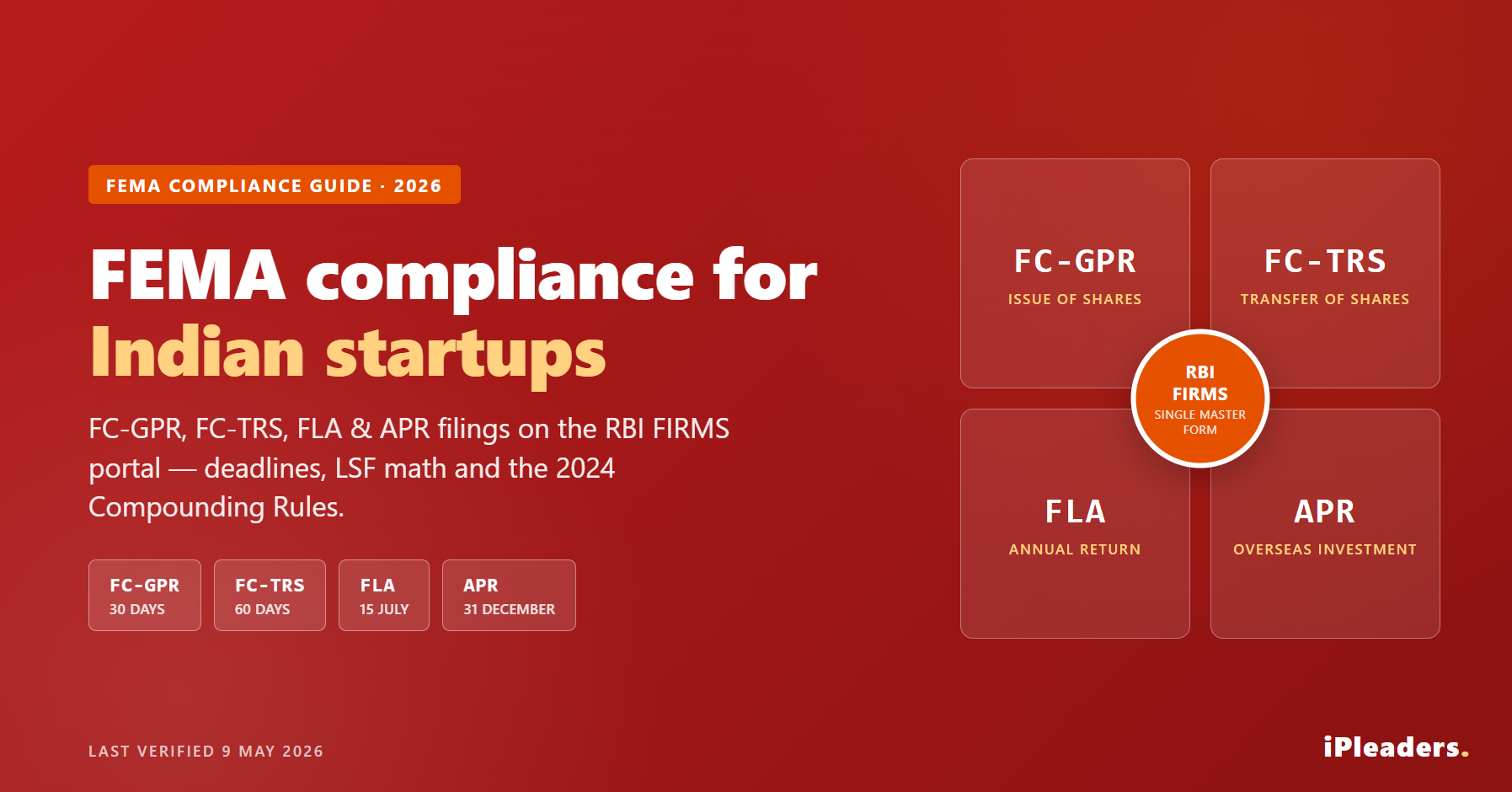
FEMA compliance for an Indian startup with foreign investment requires four core RBI filings: Form FC-GPR within 30 days of share allotment to a non-resident, Form FC-TRS within 60 days of share transfer involving a non-resident, the FLA return by 15 July annually, and the Annual Performance Report (APR) by 31 December for overseas investment. All four route through the AD Category-I bank on the FIRMS / FLAIR portals.
Now, before we walk through each filing, here’s how this guide is laid out. The four core forms come first, then the LSF and compounding regimes, then the case-law spine that AD Banks and the Enforcement Directorate actually rely on, and finally the calendar and 2024-26 changelog. Use the table of contents to jump.
What FEMA compliance means for an Indian startup, and why it’s not optional
A founder who has just received a USD seed cheque has, on the same day, become the trustee of a regulatory file that the RBI expects to see reconciled within 30 days. That file lives outside MCA, outside GST, outside Income Tax. It lives inside the Foreign Exchange Management framework. And the most common founder reaction to learning this is denial: “we already filed with MCA.” Filing with MCA does not satisfy Foreign Exchange Management Act, 1999 reporting obligations. They are separate regulators, separate portals, separate clocks.
So what does FEMA compliance for a startup actually consist of? At its heart, four recurring filings to RBI: FC-GPR when shares are issued to a non-resident, FC-TRS when shares are transferred between a resident and a non-resident, the FLA return every July, and the APR every December if the startup has made any overseas investment. Around these sit a cluster of secondary filings (Form CN for convertible notes, Form DI for downstream investment, Form ESOP for employee options, ECB-2 for borrowings) and two regularisation routes (Late Submission Fee and Compounding) for when something is missed.
In Mumbai, a Series A startup we’d describe as well-advised will have both the company secretary and the AD Category-I bank’s relationship manager on a recurring calendar invite, every month. The Supreme Court’s articulation in Vijay Karia v. Prysmian Cavi e Sistemi S.r.l., (2020) 11 SCC 1 makes the underlying point neatly: FEMA is a regulatory statute, not a constitutional one, and a breach of FEMA is not, on its own, a violation of “fundamental policy of Indian law” sufficient to refuse enforcement of a foreign arbitral award. But that holding cuts both ways. Yes, FEMA breaches don’t sink your award. They just generate their own penalty, their own compounding bill, and their own director-level demand notice.
From FERA to FEMA: the 1999 regulatory shift
FEMA replaced the older Foreign Exchange Regulation Act, 1973 in June 2000. The shift from FERA to FEMA was not cosmetic. FERA criminalised foreign-exchange contraventions; FEMA decriminalised them and routed them through a civil-penalty + compounding regime. That’s the historical pivot that lets Indian startups today regularise a missed FC-GPR through a Late Submission Fee instead of facing prosecution. Practitioners often describe the shift from FERA to FEMA in 1999 as the single most consequential reform that made the Indian VC ecosystem possible. The modern compounding architecture sits inside section 15, with the operating procedure in the 2024 Rules.
Why a 26 per cent cap or a missed FC-GPR can produce director-level penalties
Section 13 of FEMA permits a penalty of up to three times the amount involved in the contravention, or Rs 2 lakh, whichever is higher, plus a Rs 5,000-per-day continuing penalty. Section 42 then makes that penalty personal: every officer in default of the company, at the time of the contravention, is liable. The ED’s BBC WS India adjudication order of 21 February 2025 is the headline illustration. Three directors, Rs 1.14 crore each, on a single FDI-cap breach.
In practice, the worry founders raise on Reddit, “I’ve received a SAFE from a US accelerator and my CA says it’s an ECB and not equity, is that correct?”, connects to this: the moment a founder receives foreign money, the question of which form, which clock, and which portal is no longer optional. A SAFE that’s mis-classified as equity (instead of as a borrowing under the External Commercial Borrowings framework) can produce a Form CN that should never have been filed and an FC-GPR that won’t validate. The result, eighteen months later, is exactly the sort of file that ends in compounding.
What experienced practitioners know is that VC term sheets in 2025-26 increasingly carry FEMA reps and warranties, and the tag “missed FC-GPR” inside a Series A due-diligence pack is now treated as a material adverse condition trigger. A founder who has never filed FC-GPR cannot raise a Series A clean. The compliance file is itself an asset.
The four foundational FEMA filings: FC-GPR, FC-TRS, FLA, APR at a glance
Every founder who has Googled “FEMA filings” eventually finds one of the four forms first, and then discovers the other three. The trick is to see them as a system. The four forms cover a complete reporting cycle: FC-GPR captures the inbound flow at issuance, FC-TRS captures secondary transfers, FLA captures the annual stock of foreign liabilities and assets, and APR captures the performance of any overseas investments the Indian entity has made.
So which form for which event? The simple test: was new equity issued to a non-resident this period? FC-GPR. Was equity transferred between a resident and a non-resident? FC-TRS. Did this Indian entity hold any inbound foreign capital or any outbound foreign investment as of 31 March? FLA. Did the Indian entity hold any overseas direct investment (a JV or a wholly-owned subsidiary abroad) on 31 December? APR. Two of the four are event-triggered and run on short clocks (FC-GPR 30 days, FC-TRS 60 days). The other two are calendar-triggered and run annually (FLA 15 July, APR 31 December).

| Form | Trigger | Deadline | Portal | LSF formula |
|---|---|---|---|---|
| FC-GPR | Issue / allotment of shares to a non-resident | 30 days from allotment | FIRMS (SMF) | Rs 7,500 + 0.025% x A x n |
| FC-TRS | Transfer of shares between resident and non-resident | 60 days from transfer | FIRMS (SMF) | Rs 7,500 + 0.025% x A x n |
| FLA Return | Indian entity that has ever received FDI or made ODI (perpetual) | 15 July every year (revise by 30 September if unaudited) | FLAIR (separate from FIRMS) | LSF available; compounding beyond 36 months |
| APR | Indian entity holding ODI (JV or WOS) abroad | 31 December every year | OID portal (RBI), via AD Bank, statutory-auditor certified | LSF available; compounding beyond 36 months |
A common question practitioners raise on PAA queries is “FC-GPR vs FC-TRS difference?” The cleanest answer: FC-GPR is for primary issuance (the company hands new shares to a non-resident in exchange for money or assets); FC-TRS is for secondary transfer (an existing shareholder hands shares to or from a non-resident). Use this section as a fast lookup; the next four H2s are the deep dive into each form.
The pitfall here is the most expensive one in the FEMA universe: a founder or external CA files FC-GPR for what is actually an FC-TRS event (or vice versa). The form is wrong, the clock is wrong, and the AD Bank’s rejection trail produces a regulatory record of the error. Correcting it requires either a fresh filing under the right form (with LSF for the original delay) or a compounding application if the 36-month window has closed.
FC-GPR vs FC-TRS vs FLA vs APR
The four foundational FEMA filings every Indian startup must know
| Form | Trigger | Deadline | Portal & where filed | LSF available? |
|---|---|---|---|---|
| FC-GPR | Issue or allotment of shares to a non-resident | 30 days from allotment | FIRMS / SMF Filed via AD Category-I bank | Yes Rs 7,500 + 0.025% × A × n |
| FC-TRS | Transfer of shares between resident and non-resident | 60 days from transfer | FIRMS / SMF Filed via AD Category-I bank | Yes Same LSF formula |
| FLA Return | Indian entity that has ever received FDI or made ODI (perpetual obligation) | 15 July annually Revise by 30 September if unaudited |
FLAIR Direct to RBI (separate from FIRMS) | Yes Compounding beyond 36 months |
| APR | Indian entity holding overseas direct investment (JV or WOS) | 31 December annually | OID portal Via AD Bank, certified by statutory auditor | Yes Compounding beyond 36 months |
The legal architecture: FEMA 1999, NDI Rules 2019, OI Rules 2022, Master Direction No. 18
When a practitioner says “FEMA,” they’re using shorthand for at least four documents that together govern an Indian startup’s foreign-investment compliance. The parent statute is FEMA 1999. The operative rulebook for inbound investment is the Non-debt Instruments Rules, 2019. The rulebook for outbound investment is the OI framework of 2022. And the document the AD Bank actually opens on its desk is the RBI’s Master Direction on Reporting. Conflate these and you cite the wrong section in your compounding application; separate them and the architecture clicks into place.
So why does the architecture feel so layered? Because the Finance Act, 2015 amendment notified in October 2019 split rule-making power between the Central Government (for non-debt instruments) and RBI (for debt instruments). That split produced the NDI Rules 2019 (notified by MoF) on one side and the various RBI regulations on the other. The OI framework of August 2022 then completed the architecture for outbound investment, replacing the older FEMA 120/2004.
FEMA 1999: sections 6, 13, 15, 37A, 46
Section 6 of the Foreign Exchange Management Act, 1999 empowers RBI to regulate capital-account transactions. Section 13 carries the penalty (up to three times the amount or Rs 2 lakh, whichever is higher, plus the Rs 5,000-per-day continuing penalty). Section 15 enables compounding of compoundable contraventions. Section 37A, introduced by the Finance Act, 2015, lets the Enforcement Directorate seize equivalent-value Indian assets where a foreign-exchange contravention is suspected. Section 46 is the rule-making section under which the Master Direction lives. The Karnataka High Court’s ruling in Xiaomi Technology India Pvt. Ltd. v. Union of India, 2023 SCC OnLine Kar 26 upheld the constitutional validity of section 37A and rejected the challenge that the seizure power was disproportionate. The decision is on appeal before a Division Bench, but the underlying authority remains intact.
The historical lineage matters too. The Supreme Court’s articulation of public policy in Renusagar Power Co. Ltd. v. General Electric Co., 1994 Supp (1) SCC 644 is the doctrinal grandparent of every FEMA-versus-public-policy debate that came after. The court held that foreign-exchange laws are part of India’s “fundamental policy” but that not every breach amounts to a public-policy bar to enforcement. Vodafone International, Vijay Karia and Cruz City all read into Renusagar. Worth noting because every modern FEMA dispute about award enforcement lands somewhere on the Renusagar continuum. To trace the evolution of foreign investment law in India from the FERA era through to the 2022 OI Rules is to track a coherent forty-year regulatory shift from policing exchange to managing it.
Foreign Exchange Management (Non-debt Instruments) Rules, 2019: today’s FDI rulebook
The NDI Rules 2019, notified on 17 October 2019, replaced FEMA 20(R) of 2017. They define what counts as a “capital instrument” (equity, CCPS, CCD, share warrants), set the sectoral entry routes (automatic and government), prescribe the pricing schedule, and carry the reporting obligation that translates into FC-GPR and FC-TRS. The August 2024 NDI Fourth Amendment liberalised cross-border share swaps and clarified downstream investment treatment. Practitioners reading legacy 2018 commentary on FEMA 20(R) are reading the wrong rulebook, a small confusion that produces large filing errors.
A common Quora question is “NDI Rules 2019 vs FEMA 20(R) of 2017, which one governs my deal?” Always the NDI Rules 2019 for any allotment or transfer post-17 October 2019. FEMA 20(R) is dead law for current filings. We’d recommend treating any commentary that cites only “FEMA 20(R)” as outdated.
FEM (Overseas Investment) Rules, Regulations and Directions, 2022: ODI / OPI architecture
The OI framework, notified on 22 August 2022, replaced FEMA 120/2004. The most consequential change for startups is the explicit ODI / OPI distinction. Overseas Direct Investment (ODI) means a 10 per cent or more equity holding in a foreign entity, or strategic control regardless of percentage. Overseas Portfolio Investment (OPI) is everything below that. Only ODI triggers APR. This single distinction determines whether the December 31 reporting clock applies to your overseas investment or not.
Master Direction No. 18 on Reporting: the operational manual
RBI’s Master Direction on Reporting under the Foreign Exchange Management Act, 1999 (FED Master Direction No. 18/2015-16 dated 1 January 2016, periodically updated) is the document the AD Bank’s relationship manager actually opens. It contains the paragraph numbers for each Single Master Form sub-form, the FIRC formats, the KYC schema, and the LSF advice template. A startup that wants to understand why an AD Bank is rejecting its FC-GPR will find the answer in the Master Direction long before the answer surfaces in the parent statute.
The FIRMS portal and the Single Master Form: how reporting is structured today
The FIRMS portal is RBI’s online intake for foreign-investment reporting, launched in September 2018 with the Single Master Form (SMF) replacing the old ARF + FC-GPR two-step. Today the portal sits at https://firms.rbi.org.in/firms/ and handles FC-GPR, FC-TRS, ESOP, Form CN, Form DI, LLP-I, LLP-II, DRR, and InVI submissions. It does not handle FLA (that’s FLAIR, a separate portal) or compounding (PRAVAAH, since May 2025). Founders routinely conflate the three portals; the failure mode is wasted weeks.
Why does access architecture matter? Because the practical first hurdle in any FEMA filing is just getting onto the portal under the right user type with the right authorised signatory. Mis-register, and the registration cannot be unwound; the entity has to wait for a manual reset from RBI Helpdesk.
Logging in: Entity User vs Business User on FIRMS
| Role | Who registers | What they can do | Required documents |
|---|---|---|---|
| Entity User | The Indian company (one per CIN) | Master record on FIRMS; CIN, PAN, registered office details | CIN, PAN, board resolution, authorised-signatory KYC |
| Business User | The individual filing officer (one or more per Entity User) | Submits actual FC-GPR / FC-TRS forms; signs digitally | Aadhaar/PAN of officer, designation, employment evidence, Class 3 DSC |
Entity User is the company’s master record on the portal. Business User is the human filing officer (typically the company secretary or the external CA). One Entity User can have multiple Business Users; each Business User must register separately with their own KYC.
The Single Master Form (SMF) and its sub-forms
SMF is the unified data shell that opens once the Business User logs in. From there, the user picks a sub-form: FC-GPR for issuance, FC-TRS for transfers, ESOP for foreign-employee option exercises, Form CN for convertible notes, Form DI for downstream investment, LLP-I and LLP-II for LLPs receiving FDI, DRR for depository receipts, and InVI for InvITs. Each sub-form has its own document checklist, its own pricing-rule engine, and its own AD Bank approval queue.
A practitioner-grade tip: the SMF auto-fills the entity master data (CIN, PAN, paid-up capital) once Entity User is registered, but does not auto-validate the sectoral cap. That cap-check is on the user. Filing FC-GPR for a sector with a 26 per cent cap when your post-issuance shareholding is 30 per cent will pass the SMF mechanical check and land in AD Bank queue, where the rejection or escalation begins.
Authorised signatories, KYC, and digital signature
Both Entity User and Business User registration require a Class 3 Digital Signature Certificate (yes, even if the officer already has one for personal Income Tax filings, the FIRMS portal requires Class 3 specifically). The DSC takes 3-5 business days to issue through a licensed certifying authority. The KYC of the foreign investor that goes onto the SMF must be in the format prescribed in the Master Direction’s Annex; KYC sent in the foreign bank’s own template (for instance, a US-style W-8BEN or a Singapore correspondent’s KYC PDF) will not validate.
A common pain point on LinkedIn is “FIRMS vs FLAIR vs PRAVAAH, which portal does what?” Short answer: FIRMS for inbound capital reporting (FC-GPR, FC-TRS, etc.), FLAIR for the FLA return, PRAVAAH for compounding applications and (since May 2025) regulated-entity submissions. Three portals. Three logins. Three sets of credentials. Plan for it.
The pitfall is registering the wrong user type. We’d recommend registering Entity User and Business User on the same day, with the company secretary as the first Business User and at least one finance officer as a backup; reset takes weeks and a missed FC-GPR window costs LSF.
FIRMS Single Master Form: a 9-step process flow
How an FC-GPR or FC-TRS submission actually moves from registration to RBI acknowledgement
Entity User registration on FIRMS
Register the company on the FIRMS portal using CIN, PAN and authorised signatory KYC.
Business User registration
One Business User per filing officer; this is the actual login that submits the form.
Login to the SMF dashboard
Single Master Form is the unified gateway for every FEMA equity-side filing.
Select the sub-form
Choose FC-GPR, FC-TRS, ESOP, CN, DI, LLP-I, LLP-II, DRR or InVI based on the underlying transaction.
Fill data and upload documents
FIRC, RBI-format KYC, valuation certificate (within 90 days), board resolution, PAS-3 acknowledgement, declaration.
Submit to AD Category-I bank queue
The AD Bank picks up the filing for review; the clock for AD Bank action starts here.
AD Bank review: approve or query
Top rejection reasons: KYC mismatch and valuation aged beyond 90 days.
RBI acknowledgement number generated
On AD Bank approval, RBI generates a Unique Identification Number (UIN). Store it on the cap-table file.
Filing complete — FLA obligation now active
Archive the acknowledgement; the FLA reporting obligation is triggered for the next 15 July cycle.
Form FC-GPR: reporting Foreign Direct Investment received by an Indian company
Form FC-GPR is the single most-filed FEMA form in startup India. The trigger is narrow but unambiguous: an Indian company has issued capital instruments (equity, compulsorily convertible preference shares, compulsorily convertible debentures, share warrants) to a non-resident, and the consideration has been received via a normal banking channel. The clock is 30 days from the date of allotment, not from the date the money was received. That timing distinction kills filings that everyone assumed were on time.
Why does FC-GPR matter? Because it’s the single document that proves the Indian company is inside the sectoral cap, has applied the right pricing methodology, has obtained the right valuation certificate, and has the right KYC trail for the foreign investor. AD Banks know this; that’s why the rejection rates on FC-GPR are higher than for any other SMF sub-form. The Vodafone India Services Pvt. Ltd. v. Union of India, WP No. 871 of 2014 decision, where the Bombay High Court held that the alleged “premium shortfall” on a share allotment to an offshore parent could not be taxed as income under transfer-pricing provisions, sits in the background of every FC-GPR pricing argument. Pricing is FEMA’s domain, not income tax’s.
When FC-GPR is triggered and the 30-day deadline
The trigger is the allotment of capital instruments to a person resident outside India, not the receipt of foreign currency. Many founders wait for the FIRC to land before starting the SMF; that’s wasted runway. The recommended sequence: receive foreign currency, ask the AD Bank for an Advance Reporting Form acknowledgement (which used to be Form ARF; under SMF, this happens automatically when the inflow is tagged), allot shares within 60 days of receipt of money, then file FC-GPR within 30 days of allotment. Miss the 30-day window and LSF kicks in.
The category test is in Rule 2(t) of the Foreign Exchange Management (Non-debt Instruments) Rules, 2019: “capital instrument” means equity shares, debentures, preference shares and share warrants, all compulsorily convertible. Optionally convertible instruments (OCDs, OCPS) are not capital instruments and are treated as External Commercial Borrowings instead. That category test is the source of the most expensive FC-GPR errors.
Sectoral caps, pricing guidelines, and the 90-day valuation rule
Schedule I to the NDI Rules sets the sectoral cap and the entry route (automatic or government approval). Pricing must satisfy the foreign investment under the automatic route pricing schedule: for an unlisted company, the issue price must not be lower than the fair value computed by a SEBI-registered Category I merchant banker or a chartered accountant, by an internationally accepted methodology (DCF is most common; comparable companies and NAV are alternatives). The valuation report must be dated within 90 days of the date of allotment. That 90-day window is a cliff. A valuation older than 90 days at the date of allotment is grounds for FC-GPR rejection.
Documents checklist for FC-GPR
| Document | Source | Format | Common rejection reason |
|---|---|---|---|
| Foreign Inward Remittance Certificate (FIRC) | AD Category-I bank | RBI-prescribed | FIRC reference number mismatch with SMF entry |
| KYC of foreign investor | Foreign bank | RBI-prescribed format (Master Direction Annex) | Foreign-template KYC not in RBI format |
| Valuation certificate | SEBI-registered Cat-I merchant banker / CA | Certificate signed and dated | Aged > 90 days from allotment |
| Board resolution authorising allotment | Indian company | Certified true copy | Resolution dated after allotment |
| PAS-3 filed with MCA | Indian company | MCA receipt | PAS-3 not filed at all |
| Declaration of compliance with NDI Rules | Indian company, on letterhead | Authorised-signatory signed | Wrong sectoral cap quoted |
Step-by-step FC-GPR filing on FIRMS
- Receive funds. Foreign currency hits the AD Bank. Tag the inflow as “FDI” in the AD Bank’s CRM so it surfaces under FIRMS.
- Issue FIRC. AD Bank issues Foreign Inward Remittance Certificate; check the reference number.
- Hold the board meeting. Authorise allotment by board resolution; specify the price per share, number of shares, and class of instrument.
- Obtain the valuation certificate. From a SEBI-registered Cat-I merchant banker or a CA, dated within 90 days of allotment.
- Allot the shares. Within 60 days of receipt of money. Issue share certificates.
- File PAS-3 with MCA. Within 15 days of allotment.
- Login to FIRMS. Business User; select FC-GPR sub-form on SMF dashboard.
- Fill data and upload documents. FIRC, KYC (RBI-prescribed format), valuation, board resolution, PAS-3 acknowledgement, declaration.
- Submit. AD Bank queue picks it up. On approval, RBI generates a Unique Identification Number (UIN). On query, the AD Bank kicks back with a 15-day cure window.
Common AD Bank queries on FC-GPR
The most frequent: KYC not in RBI-prescribed format (this is the single biggest cause of FC-GPR rejection per Lexology’s RBI-queries dossier); valuation certificate aged beyond 90 days; FIRC missing or AD Bank reference number mismatch; pre-allotment / post-allotment shareholding pattern arithmetic mismatch; CCPS reported as equity (or vice versa). Each of these is fixable with a 15-day re-submission, but each delay extends the original 30-day window into LSF territory.
Edge cases: non-cash consideration, CCPS, sweat equity, ESOP
What if the foreign investor brings in machinery or services instead of cash? FC-GPR still applies. Schedule I to the NDI Rules permits non-cash consideration (capital goods, machinery, equipment, conversion of pre-incorporation expenses, or import payables) provided the valuation is supported and the sectoral cap is observed. Are CCPS treated as equity for FC-GPR? Yes; they’re “capital instruments” under Rule 2(t). But each tranche of CCPS conversion may itself trigger an additional reporting event if the conversion ratio is not pre-fixed. Sweat equity to a non-resident is permitted only with prior government approval and only for certain sectors. ESOP exercises by non-resident employees are reported via Form ESOP, not FC-GPR.
In practice, the question we get most is “my CA filed FC-GPR but the transaction was actually a transfer between an existing non-resident shareholder and a new non-resident, why was it rejected?” Because that’s an FC-TRS event, not an FC-GPR event. No new shares were issued; existing shares changed hands. The entire SMF entry must be cancelled (or, if approved in error, separately rectified) and a fresh FC-TRS filed under the right form. The 60-day FC-TRS clock keeps running on the original transfer date.
Form FC-TRS: reporting transfer of shares between resident and non-resident
If FC-GPR is the inbound issuance form, FC-TRS is the inbound and outbound transfer form. The trigger: capital instruments change hands between a resident and a non-resident (in either direction). The clock is 60 days from the date of transfer. The portal is the same (FIRMS, SMF). The pricing logic differs sharply from FC-GPR, and that’s where the most expensive errors live.
Why is FC-TRS trickier than FC-GPR? Because pricing depends on direction. For a resident-to-non-resident transfer, the price must not be lower than the floor (the SEBI-pricing-equivalent fair value). For a non-resident-to-resident transfer, the price must not be higher than the ceiling (same fair value). Get the direction wrong and you’ve either underpaid (a FEMA contravention) or overpaid (a tax problem and a FEMA contravention).
When FC-TRS is triggered and the 60-day deadline
The trigger is a transfer of capital instruments between a resident and a non-resident, by sale, gift, or any other mode of transfer. The reporting obligation is on the resident party (whether buyer or seller). For non-resident-to-non-resident inter-se transfers, FC-TRS is generally not required (unless one of the non-residents is a citizen of a country sharing a land border with India and the transfer triggers Press Note 3, 2020 sectoral approval). The 60-day clock starts on the date of transfer recorded in the share transfer deed.
Pricing guidelines for transfers
The pricing rules under Rule 9 of the Foreign Exchange Management (Non-debt Instruments) Rules, 2019 are direction-sensitive:
- Resident to non-resident: Price must be at or above the fair value computed by a SEBI-registered Cat-I merchant banker or a CA using DCF or other internationally accepted methodology.
- Non-resident to resident: Price must be at or below the same fair value.
- Non-resident to non-resident inter-se: No FEMA pricing rule; market price applies, no FC-TRS required (subject to Press Note 3, 2020 if applicable).
The Supreme Court’s approach in IDBI Trusteeship Services Ltd. v. Hubtown Ltd., (2017) 1 SCC 568 is the doctrinal anchor for composite-instrument cases. The court held that a foreign investment structured through CCPS plus Optionally Convertible Debentures is not, ipso facto, a colourable device contravening FEMA; each tranche must be tested individually, and where each tranche is FEMA-compliant, the composite cannot be re-characterised as an assured-return arrangement. For VC-funded startups using compulsorily convertible instruments, the case validates the FC-GPR / FC-TRS-eligible structures most term sheets rely on.
FC-TRS vs FC-GPR: the most common confusion
The single biggest FC-TRS misfile happens when a founder treats a secondary sale by an existing non-resident shareholder to a new non-resident shareholder as if it were a fresh issuance to the new shareholder. It isn’t. No new shares are issued; existing shares change hands. So FC-TRS applies (if one party is resident) or no FC-TRS at all (if both are non-resident). The fix: cancel the misfiled FC-GPR and file FC-TRS for the original transfer date, with LSF if past 60 days.
Step-by-step FC-TRS filing on FIRMS
- Confirm direction (R-to-NR or NR-to-R) and identify the reporting resident party.
- Obtain valuation certificate from a SEBI-registered Cat-I merchant banker or CA.
- Execute the share transfer deed (Form SH-4); the date of transfer is the date on the deed.
- Pay stamp duty on SH-4.
- Obtain consent letter from the seller and the buyer.
- Login to FIRMS as Business User; select FC-TRS sub-form.
- Fill data; upload SH-4, valuation certificate, FIRC (for NR-to-R inflow), consent letter, board acknowledgement.
- Submit. AD Bank queue picks it up. Approval triggers UIN; query triggers cure cycle.
Special cases: secondary sale, ESOP exercise, gift, sweat equity, NR-to-NR inter-se
A secondary sale by a non-resident to a resident triggers FC-TRS, with the resident as reporting party. ESOP exercise by a non-resident employee triggers Form ESOP (separate from FC-TRS); the underlying shares allotted on exercise are reported via FC-GPR if newly issued, or via FC-TRS if the option pool was held in trust. Gift between resident and non-resident relatives is permitted under Schedule III to the NDI Rules and triggers FC-TRS at zero consideration. Inter-se transfers between two non-residents are generally outside the FC-TRS net (subject to Press Note 3, 2020). Sweat equity to a non-resident is prior-approval territory.
The pitfall most external CAs fall into is treating an NR-to-NR inter-se transfer as if it required FC-TRS. It doesn’t, in most cases, and filing it generates an SMF entry that the AD Bank cannot process. We’d recommend confirming the no-FC-TRS-required rule against the Master Direction’s Annex before filing anything that involves two non-resident parties.
Documents checklist for FC-TRS
| Document | Source | When required |
|---|---|---|
| Share transfer deed (SH-4) | Buyer and seller | Always |
| Valuation certificate | SEBI Cat-I merchant banker / CA | Always (R-to-NR or NR-to-R) |
| FIRC | AD Bank | When NR-to-R inflow |
| Consent letter from buyer and seller | Both parties | Always |
| Board acknowledgement | Indian company | Always |
| Tax residency certificate (TRC) of NR | Foreign tax authority | When DTAA benefit claimed |
A community pain point: “What pricing rules apply when a buy-back is from a non-resident shareholder?” The pricing rule reverses. A buy-back from a non-resident is treated as a transfer from the non-resident to the resident company; the buy-back price must not exceed the fair value. The Companies Act buy-back rules apply on top.
FLA Return: Annual Return on Foreign Liabilities and Assets
The FLA return is the annual stock-taking exercise. It captures, as of 31 March each year, the entire stock of foreign liabilities (foreign capital received) and foreign assets (overseas investment held) of the Indian entity. It’s filed not on FIRMS but on a separate portal called FLAIR (https://flair.rbi.org.in/), with separate credentials. The deadline is 15 July every year. Miss it and the LSF runs.
Why does FLA matter so much, given that the data is mostly already on FIRMS through FC-GPR / FC-TRS? Because FLA is the macro-prudential return; RBI uses it to compile India’s external balance-sheet statistics. It sits inside RBI’s data architecture for IMF reporting. A missed FLA is not just a startup-level compliance failure; it’s a hole in India’s national external accounts.
Who must file FLA: the perpetual obligation
The FLA filer set is broad: every Indian company, LLP, and Alternative Investment Fund (AIF) that has at any point received FDI or made ODI must file FLA every year. This is a perpetual obligation. The misconception “we had no foreign activity this year, so no FLA” is wrong, and the misconception “our foreign investor exited last year, so no FLA” is also wrong. Once you have ever received FDI, the FLA obligation continues as long as the entity exists or until the foreign capital and the foreign assets both go to zero (and even then, a final FLA showing zero is recommended).
The 15 July deadline and the unaudited-accounts route
The deadline is 15 July following the financial year-end (31 March). The catch: Indian audit timelines often stretch into August or September, so a 15 July deadline forces founders into a choice. Either file FLA on a provisional / unaudited basis by 15 July, then revise by 30 September once accounts are audited; or skip the deadline and pay LSF. The provisional-then-revised route is the practitioner-default and is explicitly permitted by the Master Direction.
FLAIR portal: registration, USERID, password
FLAIR is a separate portal from FIRMS. Entity registration on FLAIR is one-time and produces a USERID and password sent to the registered email of the authorised signatory. The credentials cannot be carried over from FIRMS; they’re a separate set. Reset takes 5-7 working days through RBI Helpdesk.
Step-by-step FLA filing on FLAIR
- Register as FLAIR Entity User (one-time).
- Login with USERID and password; download the FLA Excel template for the relevant year.
- Populate the template with foreign liabilities (FDI inflows by country, by instrument, market value as of 31 March) and foreign assets (ODI by country, by instrument, market value as of 31 March).
- Validate the Excel macros; any formula error blocks upload.
- Upload the validated Excel to FLAIR.
- Receive submission acknowledgement by email; this is the proof of timely filing.
Common errors on FLA
The most common: currency mismatch (entry in INR when the schedule expects USD, or vice versa); market valuation versus face value confusion (the schedule expects market value, not par value, for unlisted-equity FDI); treatment of redeemed CCPS (still goes in the FLA in the year of redemption); no-FDI-this-year filings (still mandatory; just file zero values across the relevant columns).
In practice, the biggest exposure is the founder who ignored FLA for three years because “we had no new FDI.” Three years of non-filing exposes the entity to LSF for each year individually (LSF compounds across years), or to compounding for years beyond the 36-month LSF cliff. The current practitioner approach is to file all back-year FLAs together with consolidated LSF advice, accepting the cumulative cost rather than letting the exposure tip into compounding.
The pitfall founders walk into most often is omitting NRI / OCI investments thinking they don’t count as FDI. NRI investments on a non-repatriation basis are reported separately, but on a repatriation basis they’re standard FDI and go on FLA. Get the basis classification right before filing.
APR: Annual Performance Report for Indian entities holding overseas direct investment
APR is the outbound mirror of FLA. Where FLA captures foreign capital coming into India, APR captures the performance of capital going out. It’s filed only by Indian entities that hold Overseas Direct Investment (ODI) in foreign joint ventures or wholly-owned subsidiaries. The deadline is 31 December each year, and the certification standard is materially higher than FLA’s: APR must be certified by the statutory auditor of the Indian entity.
The single biggest startup confusion here is APR vs FLA. They are not the same form, not the same deadline, not the same portal, and not the same direction of capital. FLA is inbound + outbound stock-taking on FLAIR by 15 July. APR is outbound performance reporting on the OID portal (via AD Bank) by 31 December. Both can be due in the same year; both are mandatory; one does not substitute for the other.
When APR is triggered: ODI under OI Rules 2022
APR applies to any Indian entity holding ODI as defined in Rule 2 of the Foreign Exchange Management (Overseas Investment) Rules, 2022. ODI is, broadly, an investment of 10 per cent or more of the equity capital of a foreign entity, or any investment that confers control regardless of percentage. Below that 10 per cent / no-control threshold, the investment is OPI (Overseas Portfolio Investment), which has a separate disclosure regime but no APR. The 10-per-cent / control test is the gating question.
The Vodafone International ruling sits in the background of every ODI structure that uses an offshore SPV between the Indian parent and the foreign target. The Supreme Court’s “look at, not look through” doctrine still informs how RBI views layered foreign-investment vehicles. For startups that send capital out at Series B+ (most often via Mauritius or Singapore SPVs to acquire technology assets), the Vodafone framework determines when the SPV is respected and when it’s looked through to the underlying Indian transaction.
OPI vs ODI: the 10 per cent threshold and control test
| Test | OPI | ODI |
|---|---|---|
| Equity holding | < 10% | >= 10% |
| Control | No | Yes (regardless of equity %) |
| Reporting form | OPI disclosure (separate) | Form ODI (initial); APR (annual) |
| Annual filing | None | APR by 31 December |
| Repatriation | Permitted under LRS for individuals; corporate routes via OPI rules | Permitted via ODI rules |
This OPI / ODI line determines whether the Indian entity even has an APR obligation. A startup that holds 8 per cent of a US tech company has no APR obligation. The same startup that holds 12 per cent does. To understand how an Indian company makes overseas investment under the 2022 OI framework is to internalise this gating test.
APR for joint ventures vs wholly-owned subsidiaries
APR applies to both. A joint venture (where the Indian entity owns less than 100 per cent of the foreign entity) and a wholly-owned subsidiary (100 per cent) are both ODI vehicles. The APR data fields differ slightly (JV asks for partner-wise contributions; WOS asks for sole-equity data), but the deadline and the certification standard are identical.
Step-by-step APR filing on the OID portal
- Collect the financials of the overseas WOS / JV for the year ending 31 December.
- Have the Indian entity’s statutory auditor certify the APR data.
- Login to the OID portal via the AD Bank’s interface.
- Fill the APR template with country, sector, equity contribution, loans and guarantees outstanding, retained earnings, profit / loss for the year.
- Attach the auditor’s certificate.
- Submit via the AD Bank, which forwards to RBI.
- Receive acknowledgement.
Dormant overseas WOS: APR still applies
A founder might assume that a dormant foreign WOS (one with no operations and no financial activity in the year) doesn’t need an APR. It does. Rule 10 of the OI Rules makes APR a perpetual obligation as long as ODI is held, regardless of the WOS’s operational status. The dormant-WOS APR is short (mostly zeros) but mandatory.
A common practitioner question: “Can the APR be filed on unaudited accounts?” No. APR specifically requires statutory-auditor certification. The unaudited-then-revised route that works for FLA does not work for APR.
The pitfall: filing APR for an OPI investment when none was required. The result is a confused regulatory file (the AD Bank doesn’t know what to do with it) and an erroneous data point in RBI’s external accounts. The fix is to withdraw the filing through the AD Bank and re-classify the investment correctly.
Other startup-relevant FEMA filings: Form ESOP, Form CN, Form DI, Form ODI, Form DRR, ECB-2, LLP-I/II
The four foundational forms cover the main FEMA cycle, but a startup’s compliance file extends further. Each of the secondary forms below is its own filing, with its own clock and its own portal. Missing one is as costly as missing FC-GPR.
Why are there so many? Because each instrument or transaction type that’s specific enough to deserve its own SMF sub-form has produced one, layered into the SMF over time. The layered architecture is annoying for founders but rational for RBI: each sub-form’s data is structured so that AD Banks and RBI’s internal systems can pull, validate, and audit it without manual re-keying.
Form ESOP: foreign employees exercising Indian stock options
Form ESOP is filed on FIRMS within 30 days of an ESOP exercise by a non-resident employee (or by a resident employee of an overseas branch / subsidiary). It’s distinct from FC-GPR even though the underlying mechanic is similar (allotment of shares). Founders running global ESOP pools (US-based engineers exercising options in the Indian parent) file Form ESOP, not FC-GPR. Pricing is governed by the ESOP scheme document; the SEBI / Companies Act ESOP rules apply on top.
Form CN: convertible notes by DPIIT-recognised startups
Schedule VII to the Foreign Exchange Management (Non-debt Instruments) Rules, 2019 (originally notified by the 2017 amendment to the predecessor regulations and carried into the 2019 NDI Rules) permits a DPIIT-recognised startup to issue Convertible Notes (CNs) of Rs 25 lakh or more to a non-resident investor. The CN must convert to equity, or be repaid, within a maximum tenure read with the Companies (Acceptance of Deposits) framework. Practitioner commentary aligns this at up to 10 years for foreign-investor CNs after the 2024 amendment cycle (the previous standard was 5 years). Form CN is filed within 30 days of CN issuance.
The structural advantage of a CN over an FC-GPR equity issuance is that a CN doesn’t crystallise the issue price on day one; the conversion price is set at the time of the next priced round. This is exactly what early-stage startups need. The catch: only DPIIT-recognised startups can issue CNs. A non-DPIIT-recognised company that issues a “convertible note” to a foreign investor has, in fact, issued either an ECB or a non-compliant equity instrument, depending on structure.
Form DI: downstream investment
Form DI is filed by an Indian company that itself receives FDI and then makes a downstream investment into another Indian company. The August 2024 NDI Fourth Amendment liberalised this further by clarifying that downstream investment is treated at par with FDI for many purposes, and the January 2025 clarification extended the par-treatment to additional fact patterns. Form DI is filed within 30 days of the downstream investment. The Form DI filer is the Indian-funded Indian company making the downstream move.
Form ODI, Form DRR, ECB-2, LLP-I, LLP-II
Form ODI is the initial outbound investment form (filed when an Indian entity first makes ODI in a foreign JV / WOS). After the initial Form ODI, annual APR takes over. Form DRR is for depository receipts. ECB-2 is the half-yearly return for external commercial borrowings (ECB) under FEMA, filed by 7 January and 7 July each year. LLP-I and LLP-II are the LLP equivalents of FC-GPR and FC-TRS for LLPs receiving FDI.
SAFE notes under FEMA: why a SAFE risks ECB reclassification
SAFE notes (Simple Agreement for Future Equity) are a US accelerator favourite, and many Indian startups receive their first foreign cheque as a SAFE. The FEMA problem: a SAFE is neither equity (because no shares are issued at the time of the cheque) nor a CN (because most issuers aren’t DPIIT-recognised, and the SAFE structure isn’t aligned with Schedule VII). So what is it? Most practitioners treat a SAFE as an External Commercial Borrowing under the ECB framework, which means the AD Bank must clear it under ECB rules and ECB-2 returns are due half-yearly. Early signals from the ecosystem suggest a SAFE-specific carve-out under the NDI Rules is on the regulatory roadmap (the DPIIT-Inc42 lobbying since 2023 has been consistent), but until that amendment lands, treating a SAFE as an ECB is the safer default.
The practitioner question we hear most: “We received a SAFE from a US accelerator, my CA says it’s an ECB and not equity, is that correct?” Probably yes, unless the issuer is DPIIT-recognised and the SAFE is restructured to align with Schedule VII. The pitfall is filing Form CN for a SAFE when neither the issuer nor the instrument satisfies Schedule VII, which produces an FC-GPR-style rejection cycle and a regulatory record that’s hard to clean.
FEMA pricing guidelines, valuation, and CA certificates: what AD Banks actually check
AD Banks reject FC-GPR and FC-TRS filings on valuation grounds more often than on KYC grounds. The pricing schedule under Schedule I of the NDI Rules is short, but the application is fact-sensitive. A startup that gets the methodology right and the certifying professional right has solved most of the AD Bank’s review check before submission.
So why is pricing the most-rejected category? Because it’s where founders try to be clever. A favourable DCF model can shift the issue price by a factor of two; a tight comparable-companies analysis can do similar work. AD Banks see this and push back. The Bombay High Court in the Vodafone India Services ruling articulated the principle that pricing on a share allotment is a FEMA matter, not an income-tax matter. That’s a shield for founders against income-tax over-reach but not a shield against AD Bank pricing review.
Pricing methodology by instrument
| Instrument | Pricing rule | Who certifies |
|---|---|---|
| Equity (unlisted) | Floor = fair value via DCF / NAV / comparables | SEBI-registered Cat-I merchant banker or CA |
| Equity (listed) | SEBI ICDR pricing for preferential issues | SEBI-registered merchant banker |
| CCPS | Same as equity (treated as capital instrument) | SEBI Cat-I MB or CA |
| CCD | Same as equity (treated as capital instrument) | SEBI Cat-I MB or CA |
| Form CN (DPIIT startup) | Conversion price set at next priced round; no day-one valuation | Not required at issuance |
| SAFE | Treated as ECB; pricing per ECB rules (all-in cost ceiling) | ECB-route certification |
Who can issue a valuation certificate
For unlisted FDI under the NDI Rules, the certifier must be a SEBI-registered Category I merchant banker or a chartered accountant. For listed-company preferential issues, only a SEBI-registered merchant banker. Registered Valuers under the Companies Act, 2013 (IBBI-registered) are recognised for Companies Act purposes but the FEMA NDI Rules continue to specify SEBI Cat-I MB / CA. Practitioner default is to engage a SEBI Cat-I MB whose certificate is acceptable for both FEMA and Companies Act purposes.
DCF, NAV, comparable companies: when each applies
DCF is the default for an operating startup with forward visibility. NAV (Net Asset Value) is acceptable for asset-heavy entities with limited operating history. Comparable companies analysis works when there’s a credible peer set in India. AD Banks generally prefer DCF for startups, with NAV / comparables as a sanity-check overlay. We’d recommend obtaining at least two methodologies in the same valuation report to pre-empt AD Bank queries.
The 90-day valuation freshness rule: the cliff that breaks FC-GPR
The valuation certificate must be dated within 90 days of the date of allotment. This is the most-ignored deadline in FEMA practice. The cure: time the valuation report so that it’s issued within 30-60 days before the planned allotment date, leaving buffer. A valuation aged 91+ days at allotment is automatic FC-GPR rejection.
Buy-back from non-resident shareholders: pricing reversal
When a startup buys back shares from a non-resident, the pricing logic flips. The buy-back price must not exceed the fair value (NR-to-R ceiling). The Companies Act buy-back rules (limit on percentage of paid-up capital, debt-equity ratio, no fresh issuance for 6 months after buy-back) apply on top. Practitioners often miss the FEMA pricing leg of a buy-back because the Companies Act process is the visible workflow.
The pitfall, again, is the 90-day cliff. A founder who locks in a valuation in March, drags the allotment to June, and files FC-GPR in July finds the AD Bank rejecting on valuation-aged grounds before any other check.
Common founder mistakes and AD Bank rejection reasons that turn into FEMA notices
AD Banks have internal rule-engines that catch most FEMA filing errors automatically. A handful of rejection categories account for the great majority of FC-GPR / FC-TRS queries and resubmissions in 2025-26 (the categories below appear consistently across practitioner write-ups by EquityList, TreeLife, Lexology and AhlawatAssociates). Knowing them in advance means pre-validating before submission, which collapses the rejection cycle from weeks to zero.
The bigger reason this matters: a silent rejection, where the AD Bank pushes back and the founder doesn’t notice for two weeks, eats up the 30-day FC-GPR window. By the time the founder notices, the original deadline is gone and LSF kicks in.
KYC not in RBI-prescribed format
The single biggest rejection reason. The Master Direction’s Annex specifies the KYC format the foreign investor’s bank must use; foreign banks routinely send their own templates (W-8BEN for US tax, Singapore correspondent KYC, EU GDPR-compliant KYC). None of those validate. The cure: send the RBI-prescribed format to the foreign investor’s bank in advance of the funding round and make compliance a closing condition.
Valuation certificate aged beyond 90 days
Second most common. The cure is timing discipline: lock the valuation date 30-60 days before allotment.
FIRC missing or AD Bank reference number mismatch
The FIRC reference number on the SMF entry must exactly match the AD Bank’s internal record. Typos kill it. The cure: copy-paste from the FIRC PDF, do not re-key.
Pre / post shareholding pattern arithmetic mismatch
The SMF asks for pre-issuance and post-issuance shareholding patterns. If the math doesn’t balance (the new shares plus old shares does not equal the post-issuance total), automatic rejection. The cure: build the post-issuance cap-table in Excel before opening SMF and copy values across.
Wrong instrument classification
CCPS reported as equity, CN reported as CCPS, OCD reported as CCD. Each of these is a separate instrument category with different rules. The cure: check the instrument’s terms (specifically, “compulsorily” vs “optionally” convertible) before classifying.
Filed FC-GPR for what is actually a FC-TRS event
Already covered. The cure: confirm whether shares are being newly issued or transferred before opening SMF.
Filed nothing: the worst case
The BBC WS India order is the Enforcement Directorate’s order on BBC WS India outcome. A complete non-filing, especially when combined with a sectoral-cap breach, lands as a section 13 penalty (3x the amount or Rs 2 lakh, whichever is higher), plus the Rs 5,000-per-day continuing penalty, plus director-level liability under section 42. The non-obvious second-order effect is that VC term sheets in 2025-26 carry FEMA reps and warranties; a startup with a “filed nothing” history cannot raise a Series A clean. The compliance gap follows the company through every subsequent fundraise.
| Rejection reason | Cure |
|---|---|
| KYC not in RBI-prescribed format | Send Master Direction Annex KYC to foreign bank pre-closing |
| Valuation aged > 90 days | Lock valuation 30-60 days pre-allotment |
| FIRC reference mismatch | Copy-paste from FIRC PDF into SMF |
| Pre/post shareholding mismatch | Build post-issuance cap-table in Excel first |
| CCPS reported as equity | Check instrument terms; classify per Rule 2(t) |
| FC-GPR filed for FC-TRS event | Confirm issuance vs transfer before opening SMF |
| Complete non-filing | Don’t be the next BBC WS order |
Late Submission Fee (LSF) regime: formula, worked example, and the new caps
The Late Submission Fee regime is RBI’s discount window for delayed filings. Pay the LSF, and the contravention is regularised without a compounding application. Miss the LSF, or let the delay run past 36 months, and the only route is compounding (which is materially more expensive and slower).
So why does LSF exist? Because RBI’s view is that most FEMA delays are administrative slippage (a missed clock, a rejected SMF entry, a delayed valuation) rather than substantive contravention. The LSF lets the regulator clear the pipeline without escalating every delay to the compounding cell.
The LSF formula
The formula, codified in RBI A.P. (DIR Series) Circular No. 16 of 30 September 2022 and retained in the 2024 Master Direction, is:
LSF = Rs 7,500 + (0.025% x A x n)
Where: – A = the amount involved in the contravention (in INR; convert at the contravention-date FX rate). – n = the number of years of delay, rounded up to the nearest month and expressed to two decimal points (so an 18-month delay is n = 1.50; a 30-month delay is n = 2.50). – The Rs 7,500 is a flat administrative fee. – The maximum LSF is capped at 100 per cent of A (rounded up to the nearest hundred), per the same circular.
Worked numerical example: Rs 5 crore seed round, FC-GPR delayed 18 months
Imagine a startup that closed a Rs 5 crore seed round, allotted shares on 1 January 2025, and filed FC-GPR on 1 July 2026. The original deadline was 31 January 2025 (30 days from allotment). The delay is 17 months past the deadline, rounded up to 18 months. Eighteen months expressed as years to two decimals is n = 1.50.
| Parameter | Value |
|---|---|
| A (amount involved) | Rs 5,00,00,000 |
| n (years of delay, two decimals) | 1.50 |
| Variable component | 0.025% x 5,00,00,000 x 1.50 = Rs 18,750 |
| Fixed component | Rs 7,500 |
| Total LSF | Rs 26,250 |
Rs 26,250 to regularise a Rs 5 crore filing 18 months past deadline. The number is striking precisely because it is so much smaller than what most founders fear when they realise the deadline has lapsed. That’s the whole point of the LSF: a non-trivial but manageable price to clear administrative slippage without a compounding application. The amount only starts to bite when both A and n are large together (a Rs 50 crore round delayed 30 months produces LSF in the multi-lakh range). For typical seed and Series A delays, LSF is the obviously cheaper route compared to compounding (where the section 13 ceiling is 3x the amount or Rs 2 lakh whichever is higher, before the row-5 cap discussed in the next section).
The 30-day LSF advice payment window
After the AD Bank computes the LSF, RBI issues an LSF advice. The startup has 30 days from the date of advice to pay. Miss this window, and RBI escalates the matter to compounding suo moto. The 30-day clock is not negotiable.
The 36-month cliff: beyond 3 years, no LSF
LSF is available only for delays up to 3 years (36 months) from the original deadline. Past that, the only route is compounding under section 15. A Rs 5 crore FC-GPR filed at month 37 cannot use LSF; it must go through a compounding application.
Maximum LSF cap
The 30 September 2022 circular set a per-filing cap on LSF, which has been refined in the 2024 Master Direction. The cap prevents the formula from spiralling on very large amounts (think Rs 100 crore series rounds), but for typical seed and Series A startups the formula is well within the cap and the cap doesn’t bind. Founders should compute the formula first and apply the cap only if the formula output exceeds it.
The pitfall: assuming compounding is always cheaper. For short delays (3-12 months) on small amounts (sub Rs 10 crore), LSF wins; for long delays (24-36 months) on large amounts, the comparison gets closer; past 36 months, LSF is unavailable.
Compounding under section 13 of FEMA: the 2024 Rules and April 2025 amendment
When LSF runs out, compounding is the next regularisation route. Compounding is the formal admission of contravention plus payment of a compounded penalty (which is materially less than the section 13 maximum but still real money). The route is discretionary on RBI’s side, paperwork-heavy on the applicant’s side, and increasingly digitised on the operational side (PRAVAAH portal since May 2025).
Why does compounding exist as a separate route from LSF? Because it lets RBI clear contraventions that are too old, too large, or too substantively non-trivial for the LSF formula. The compounding cell decides the penalty case-by-case, within the section 13 ceiling, applying the parameters in the Compounding Rules.
Section 13 of FEMA: the penalty section
Section 13 of the Foreign Exchange Management Act, 1999 permits a penalty of up to three times the amount involved in the contravention, or Rs 2 lakh, whichever is higher, plus the Rs 5,000-per-day continuing penalty. That’s the ceiling. Compounding settles the case at a lower number, typically a small fraction of the 3x maximum, depending on the nature and duration of the contravention.
When compounding applies: section 15 (compoundable contraventions)
Section 15 of FEMA permits compounding of any contravention except those involving section 3(a) (unauthorised dealings in foreign exchange involving hawala-style transactions). All FC-GPR / FC-TRS / FLA / APR delays are compoundable. Sectoral-cap breaches are compoundable but with greater RBI scrutiny. Section 37A-flagged matters (the kind that produced the Xiaomi seizure) generally fall outside the compounding window, because once the ED has invoked section 37A the matter has shifted from RBI’s compounding cell to ED adjudication.
Where to file: AD Bank, regional RBI, central RBI, or PRAVAAH
Application routing depends on the amount involved and the contravention type. For amounts up to Rs 1 crore, the regional RBI office handles it. Above Rs 1 crore, the central RBI compounding cell. Cases involving sectoral caps or larger sums go to the central cell. Since 1 May 2025, the PRAVAAH portal is the mandatory digital channel for regulated-entity submissions; physical filings are still accepted but are being phased out. Filing at the wrong office adds 60-90 days to the resolution timeline.
The four-stage compounding workflow
- Application. File the compounding application on PRAVAAH (or physical, as fallback), with: nature of contravention, amount involved, duration, prior compounding history, application fee of Rs 10,000.
- Hearing. RBI compounding officer schedules a hearing (typically 60-90 days from application). The applicant or the authorised representative attends in person or via video.
- Order. RBI passes a compounding order within 180 days of application (the 2024 Rules made this a hard timeline). The order quantifies the compounding amount.
- Payment. Compounding amount paid within 15 days of order. Failure to pay within 15 days vacates the compounding and reverts the case to section 13 adjudication.
The 2024 Foreign Exchange (Compounding Proceedings) Rules
The 2024 Rules, notified by the Department of Economic Affairs through G.S.R. 566(E) on 12 September 2024 and operational from 1 October 2024, replaced the 2000 Rules. Key changes:
- Application fee raised from Rs 5,000 to Rs 10,000.
- 180-day timeline for the compounding authority to pass an order (carried over from the 2000 Rules and formally codified).
- Revised monetary thresholds for compounding officers (an Assistant General Manager handles up to Rs 60 lakh, escalating to a Chief General Manager for matters above Rs 5 crore).
- Rule 9 introduces an explicit list of non-compoundable contraventions for the first time.
- Express alignment with the PRAVAAH digital channel and electronic-payment options.
April 2025 amendment: Rs 2,00,000 cap on row-5 contraventions
The April 2025 amendments to the Compounding Directions, notified by RBI through A.P. (DIR Series) Circulars on 22 April 2025 and 24 April 2025, introduced a discretionary cap of Rs 2,00,000 on compounding amounts for row-5 contraventions in the computation matrix (the residual category covering most non-reporting and reporting-related FEMA contraventions). The cap operates “subject to the satisfaction of the compounding authority” and is not automatic. Where it applies, a startup that previously faced a six- or seven-figure compounding bill on a row-5 contravention is shielded by the Rs 2 lakh ceiling. The compounding-versus-LSF arithmetic shifts accordingly past the 36-month LSF cliff: compounding becomes affordable for cases that would once have run to many lakhs.
Looking forward, the May 2025 RBI consultation paper hinted at a broader consolidation of LSF and compounding into a single graduated penalty schedule. Practitioners expect that consolidated table in the 2027 cycle. Until then, the two regimes operate in parallel.
RBI vs ED: when compounding is no longer available
Compounding is RBI’s territory. ED adjudication is a separate stream. Section 37A (asset seizure) is ED’s enforcement tool. If ED has invoked section 37A or has issued a section 16 show-cause notice, RBI compounding is generally unavailable. The Delhi High Court’s decision in Cruz City 1 Mauritius Holdings v. Unitech Ltd., 2017 SCC OnLine Del 7810 is informative on this jurisdictional split: a FEMA contravention does not, by itself, render a foreign arbitral award unenforceable on public-policy grounds, but actual remittance pursuant to enforcement still requires RBI permission. The Cruz City framework keeps the regulatory and enforcement streams distinct.
A practitioner-grade caveat: even after RBI compounds a contravention, ED can in some narrow circumstances open separate proceedings on the underlying transaction (e.g., where the underlying remittance was hawala-tinged). The Karnataka HC’s section 37A ruling in Xiaomi makes clear that section 37A’s seizure power is constitutional and operates independently of section 13’s penalty mechanism.
Decision matrix: LSF vs compounding for a 2-year FC-GPR delay
For 24 months of delay, n = 2.00. The variable component of LSF is 0.025% x A x 2.00, plus the Rs 7,500 flat fee.
| Delay | Amount | LSF | Compounding (post-April 2025 row-5) | Recommended route |
|---|---|---|---|---|
| 2 yrs (n = 2.00) | Rs 1 cr | Rs 12,500 | Up to Rs 2,00,000 (cap may apply) | LSF (cheaper, faster) |
| 2 yrs (n = 2.00) | Rs 5 cr | Rs 32,500 | Up to Rs 2,00,000 (cap may apply) | LSF (still cheaper) |
| 2 yrs (n = 2.00) | Rs 10 cr | Rs 57,500 | Up to Rs 2,00,000 (cap may apply) | LSF (cheaper); narrower margin |
| 2 yrs (n = 2.00) | Rs 50 cr | Rs 2,57,500 | Up to Rs 2,00,000 (cap may apply) | Compounding (capped lower) |
| 4 yrs (48 months) | Any | LSF unavailable | Compounding | Compounding (no choice) |
The April 2025 row-5 cap of Rs 2,00,000 is discretionary: it is “subject to the satisfaction of the compounding authority” and applies to row-5 contraventions in the computation matrix. So while the cap shifts the LSF-vs-compounding break-even decisively in favour of compounding for high-amount delays, founders should not treat the Rs 2 lakh figure as a guaranteed ceiling. For the typical seed / Series A startup with delays under 36 months and amounts under Rs 25 crore, LSF remains the dominant route.
The pitfall: filing at the wrong RBI office. Sub Rs 1 crore matters at the regional office, above at the central; sectoral-cap matters always central. Routing wrong adds 60-90 days. Worth getting right the first time.
Missed a FEMA deadline? LSF, compounding, or ED
A decision tree for founders who have just discovered an unfiled FC-GPR, FC-TRS, FLA or APR
Worked example — corrected LSF math
Allotment of Rs 5 crore to a non-resident, FC-GPR delayed by 18 months (n = 1.50 years).
= 7,500 + 18,750
Total LSF: Rs 26,250Note: ‘n’ is in YEARS, rounded upward to the nearest month and expressed to two decimals (per RBI Circular No. 16 / 2022). For most seed and Series A delays under 36 months, LSF is decisively cheaper than compounding.
Landmark FEMA cases every startup should understand
Eight cases (seven judgments and one regulatory order) form the FEMA case-spine that AD Banks, the compounding cell, and ED actually rely on. Most competitor guides cite zero. A founder who can name three of these in a regulatory letter has already shifted the conversation.
The point of this section is not academic. Each case maps to a startup decision: how to price an allotment, how to structure CCPS+OCD, how to handle a remittance pursuant to an arbitral award, and where the section 37A line sits.
Vodafone India Services (2014, Bombay HC)
Vodafone India Services Pvt. Ltd. v. Union of India, WP No. 871 of 2014. The Bombay High Court held that issue of equity at a premium by an Indian subsidiary to its non-resident parent is a capital-account transaction and the alleged premium “shortfall” cannot be taxed as income under transfer-pricing provisions. FEMA pricing concerns do not generate income-tax jurisdiction. For startups: pricing on FC-GPR is FEMA’s domain, not income tax’s.
Vodafone International Holdings (2012, Supreme Court)
Vodafone International Holdings B.V. v. Union of India, (2012) 6 SCC 613. The Supreme Court (3-judge bench) held that cross-border indirect transfers of an Indian asset through an offshore SPV are not, on their face, a “look-through” device. Foreign exchange transactions are matters of corporate planning unless the structure is a colourable device. The “look at, not look through” doctrine still informs how AD Banks view layered foreign-investment vehicles in cross-border deals, particularly Mauritius / Singapore SPVs at Series B+.
IDBI Trusteeship / Hubtown (2017, Supreme Court)
IDBI Trusteeship Services Ltd. v. Hubtown Ltd., (2017) 1 SCC 568 (decided 15 November 2016). The Supreme Court (2-judge bench) held that a foreign investment structured through CCPS plus OCDs is not, ipso facto, a colourable device contravening FEMA. Each tranche must be tested individually. For startups using compulsorily convertible instruments, Hubtown validates the FC-GPR-eligible structures most term sheets rely on, but the protection runs tranche-by-tranche, not blanket.
Cruz City (2017, Delhi HC)
Cruz City 1 Mauritius Holdings v. Unitech Ltd., 2017 SCC OnLine Del 7810. A FEMA contravention does not, by itself, render a foreign arbitral award unenforceable on public-policy grounds. But actual remittance pursuant to enforcement still requires RBI permission. For startups: the FC-GPR / FC-TRS reporting trail determines how clean the post-award remittance can be.
Vijay Karia (2020, Supreme Court)
Vijay Karia v. Prysmian Cavi e Sistemi S.r.l., (2020) 11 SCC 1. The Supreme Court (3-judge bench) held that mere FEMA breach is not a violation of “fundamental policy of Indian law” sufficient to refuse enforcement of a foreign arbitral award under section 48 of the Arbitration Act. The corollary, often missed: FEMA is regulatory, not constitutional, but the regulatory consequences (section 13 penalty, compounding, LSF) remain real.
Renusagar (1994, Supreme Court)
Renusagar Power Co. Ltd. v. General Electric Co., 1994 Supp (1) SCC 644. The Supreme Court held that foreign-exchange laws are part of India’s “fundamental policy” but not every breach amounts to a public-policy bar to enforcement. The grandfather case for every FEMA-versus-public-policy debate. Vijay Karia, Cruz City and Hubtown all read into Renusagar.
Xiaomi (2023, Karnataka HC)
Xiaomi Technology India Pvt. Ltd. v. Union of India, 2023 SCC OnLine Kar 26. Karnataka High Court (Single Judge) upheld the constitutional validity of section 37A. Section 37A permits ED to seize equivalent-value Indian assets where a foreign-exchange contravention is suspected. For startups: mis-structured royalty / management-fee remittances can escalate from a missed FC-GPR into an asset freeze.
BBC WS India ED Penalty (2025)
The Enforcement Directorate’s adjudication order of 21 February 2025 on BBC World Service India Pvt. Ltd. imposed a Rs 3.44 crore penalty for keeping FDI at 100 per cent in violation of the 26 per cent digital-news cap, plus a Rs 5,000-per-day continuing penalty since 15 October 2021, plus director-level penalties of approximately Rs 1.14 crore each on three directors. The single most-cited regulatory marker on sectoral-cap FDI breaches in 2025-26.
The pitfall is misreading Hubtown to validate every CCPS+OCD structure. Hubtown’s tranche-by-tranche test means each instrument must independently satisfy FEMA pricing and structural rules. A blanket “Hubtown protects us” is not a defence; the AD Bank will look at each tranche.
A 12-month FEMA compliance calendar for Indian startups
Indian fiscal-year cadence drives FEMA’s calendar. April through March, the four foundational forms have predictable cycles: FLA in July (with an unaudited-then-revised option through September), APR in December, and FC-GPR / FC-TRS as triggered events any time. The discipline is to pre-set the calendar, not react to it.
Why does a founder need a calendar instead of just a checklist? Because the AD Bank’s review queue, the CA’s audit timeline, and the FIRMS / FLAIR portal credentials all run on parallel clocks. A founder who hasn’t pre-blocked the CA’s calendar in May will find statutory audit running into August and FLA’s July deadline gone.
The 12-month rhythm
| Month | Milestone |
|---|---|
| April | Begin FLA prep; reconcile prior-year FC-GPR/FC-TRS |
| May | Statutory audit kicks off; collect overseas WOS / JV data for APR planning |
| June | Final FLA data assembly; if accounts not audited, prepare provisional filing |
| July (15) | FLA filing on FLAIR (mandatory); use unaudited route if necessary |
| August | Mid-year review of FC-GPR / FC-TRS filings; SMF dashboard reconciliation |
| September (30) | FLA revision if filed on unaudited basis; statutory audit close |
| October | Begin APR data collection from overseas WOS / JV |
| November | APR auditor certification; review OPI vs ODI classification |
| December (31) | APR filing (mandatory); statutory-auditor certified |
| January | Year-end review; archive FIRMS acknowledgements; ECB-2 (7 January) if applicable |
| February | Track regulatory amendments (RBI circulars); scenario plan next-cycle |
| March | Quarter-end review; ECB-2 mid-cycle check |
Triggered any time
- FC-GPR: 30 days from non-resident share allotment.
- FC-TRS: 60 days from share transfer involving a non-resident.
- Form CN: 30 days from CN issue (DPIIT-recognised startups).
- Form DI: 30 days from downstream investment.
- Form ESOP: 30 days from foreign employee option exercise.
Indian fiscal year drives the cadence
Why Apr-Mar? Because the FY ends 31 March, FLA captures stock as of 31 March, the unaudited-then-revised window runs to September, and APR (a calendar-year report on overseas investment performance) lands at 31 December. The dates are not arbitrary; they’re stitched to India’s fiscal-year architecture.
The pitfall is treating the calendar as optional in a year of zero foreign activity. FLA is mandatory as long as foreign capital ever sat on the books; APR is mandatory as long as overseas investment is held. Zero-activity years still need filings.
An Indian startup’s FEMA-relevant year
Fixed deadlines (FLA in July, APR in December) and floating event triggers across the Indian fiscal year
Floating event triggers — can land in any month
These five filings are not on the calendar — they fire from a transaction. The clock starts on the event date, not the fiscal year.
Recent regulatory changes (2024-2026) and what’s coming next
The 2024-26 regulatory cycle is the most consequential FEMA-regulatory cycle since the 2019 NDI Rules. Five amendments and one consultation paper have re-shaped the architecture. A founder relying on 2018 commentary is reading the wrong rulebook.
So why so much movement now? Because the 2017 FEMA 20(R) architecture had aged out (corporate structures, cross-border swaps, downstream investments had moved beyond the rulebook), and the September 2024 + April 2025 + March 2026 amendments closed the gaps in sequence. Founders who track these don’t just stay compliant; they unlock structures (cross-border swaps, longer convertible notes, capped compounding) that weren’t available 18 months ago.
August 2024: NDI Fourth Amendment
The Foreign Exchange Management (Non-debt Instruments) Fourth Amendment Rules, 2024, notified 16 August 2024, liberalised cross-border share swaps and clarified downstream investment treatment for OCI / NRI non-repatriable holdings. The most consequential change for startups: cross-border swaps are now an explicit M&A pathway, not a grey area requiring case-by-case approval.
September 2024 + October 2024: Compounding Rules + Master Direction
The Foreign Exchange (Compounding Proceedings) Rules, 2024 notified 12 September 2024 (operational 1 October 2024) replaced the 2000 Rules. Application fee Rs 10,000; 180-day order timeline; PRAVAAH alignment.
January 2025: Downstream investment clarified
The January 2025 clarification put downstream investment at par with FDI for many treatment purposes, simplifying Form DI filings.
April 2025: Rs 2,00,000 cap on row-5 contraventions
The April 2025 amendment to the Compounding Directions introduced a Rs 2,00,000 cap on row-5 (miscellaneous reporting) contraventions. As covered in the compounding section, this is the change with the largest direct impact on startup compounding bills.
May 2025: PRAVAAH portal mandate
From 1 May 2025, the PRAVAAH portal is the mandatory digital channel for regulated-entity submissions. Compounding applications, regulatory queries, and certain RBI submissions now route through PRAVAAH. FIRMS and FLAIR remain operational for their respective filings.
March 2026: ECB simplification
The Foreign Exchange Management (Borrowing and Lending) (First Amendment) Regulations, 2026 simplified the ECB framework, with implications for SAFE-style instruments classified as ECB and for ECB-2 returns.
Future outlook (2026-2029)
Early signals from RBI suggest a consolidated PRAVAAH gateway absorbing FIRMS + FLAIR + ECB reporting within 24 months; a possible SAFE-specific carve-out under NDI Rules (the DPIIT-Inc42 lobbying since 2023 is consistent on this); and a unified LSF + compounding penalty schedule (the May 2025 RBI consultation paper floated this; expect the consolidated table in 2027). Practitioners expect the ODI / OPI line to be re-examined as Indian outbound investment scales.
The pitfall: relying on pre-amendment commentary. Most online FEMA commentary written before September 2024 still quotes the 2000 Compounding Rules. Practitioners who haven’t updated their templates are still quoting Rs 5,000 application fees. Verify dates on every commentary source.
Frequently asked questions
1. What is FEMA compliance for an Indian startup?
FEMA compliance for a foreign-funded Indian startup means filing four core RBI forms: FC-GPR (within 30 days of allotment to a non-resident), FC-TRS (within 60 days of transfer with a non-resident), FLA (by 15 July annually), and APR (by 31 December for any overseas investment). Plus secondary forms (Form CN, Form DI, Form ESOP, ECB-2) where applicable. All routes through the AD Category-I bank.
2. What is Form FC-GPR and when must it be filed?
Form FC-GPR is the SMF sub-form on the FIRMS portal used to report issue of capital instruments (equity, CCPS, CCD, share warrants) to a non-resident. It must be filed within 30 days of the date of allotment (not the date of receipt of money). It’s the single most-filed FEMA form in startup India.
3. What is the difference between FC-GPR and FC-TRS?
FC-GPR is for primary issuance (the company hands new shares to a non-resident). FC-TRS is for secondary transfer (an existing shareholder hands shares to or from a non-resident). FC-GPR is on a 30-day clock; FC-TRS is on a 60-day clock. Both are filed on FIRMS through the SMF.
4. Is the FLA return mandatory if the company had no foreign investment activity this year?
Yes. FLA is a perpetual obligation for any Indian company, LLP, or AIF that has at any point received FDI or made ODI. A zero-activity year still requires a filing showing zero values. The misconception “no activity, no filing” produces three-year backlogs.
5. Who must file the Annual Performance Report (APR) under FEMA?
Any Indian entity (company, LLP, registered partnership) that holds Overseas Direct Investment (ODI) in a foreign joint venture or wholly-owned subsidiary. ODI means a 10 per cent or more equity holding, or any holding that confers control. Below that threshold, the investment is OPI and APR doesn’t apply.
6. What is the deadline for filing FC-GPR after share allotment?
30 days from the date of allotment. The clock does not start on the date of receipt of money; it starts on the allotment date recorded in the board resolution. Miss it and LSF kicks in (the formula is Rs 7,500 + 0.025 per cent x A x n, with A as the amount involved and n as years of delay rounded up to the nearest month).
7. What is the deadline for FC-TRS filing?
60 days from the date of transfer recorded on the share transfer deed (Form SH-4). The reporting obligation is on the resident party.
8. When is the FLA return due each year?
15 July following the financial year-end (31 March). If accounts are unaudited by 15 July, file on a provisional basis and revise by 30 September.
9. When is the APR due?
31 December every year, certified by the statutory auditor of the Indian entity. Unlike FLA, APR cannot be filed on unaudited accounts.
10. Can a DPIIT-recognised startup issue convertible notes to a foreign investor?
Yes, under Schedule VII to the NDI Rules 2019. The CN must be Rs 25 lakh or more and must convert to equity (or be repaid) within the maximum tenure prescribed for startup convertible notes. Practitioner commentary post-2024 reads this at up to 10 years. Form CN is filed on FIRMS within 30 days of issue. Non-DPIIT-recognised companies cannot issue Schedule-VII CNs.
11. What is Form CN and when do I file it?
Form CN is the SMF sub-form for reporting Convertible Notes issued by DPIIT-recognised startups to non-resident investors. File within 30 days of CN issue. The CN is a debt-equity hybrid that converts to equity at a future priced round.
12. What is the Late Submission Fee (LSF) for FC-GPR / FC-TRS / FLA / APR?
The formula is Rs 7,500 + (0.025 per cent x A x n), where A is the amount involved and n is the number of years of delay, rounded up to the nearest month and expressed to two decimals (so an 18-month delay is n = 1.50). The maximum LSF is capped at 100 per cent of A. LSF is available for delays up to 36 months. Beyond 36 months, only compounding applies.
13. After how many years of delay can I no longer use LSF and must apply for compounding?
Three years (36 months) from the original deadline. Past 36 months, LSF is unavailable and the only regularisation route is a compounding application under section 15 of FEMA.
14. What is compounding under section 13 of FEMA?
Compounding is the formal admission of a contravention and payment of a settled penalty (less than the section 13 maximum of 3x the amount or Rs 2 lakh, whichever is higher). It’s governed by section 15 read with the Foreign Exchange (Compounding Proceedings) Rules, 2024. Most FC-GPR / FC-TRS / FLA / APR delays are compoundable.
15. What changed under the Foreign Exchange (Compounding Proceedings) Rules, 2024 and the April 2025 amendment?
The 2024 Rules raised the application fee from Rs 5,000 to Rs 10,000 and formally codified the 180-day timeline for the compounding authority to pass an order (carried over from the 2000 Rules). They introduced an explicit list of non-compoundable contraventions (Rule 9) and aligned the process with the PRAVAAH portal. The April 2025 amendment to the Compounding Directions then introduced a discretionary Rs 2,00,000 cap on compounding amounts for row-5 contraventions in the computation matrix, applicable subject to the compounding authority’s satisfaction.
16. What is the role of an AD Category-I bank in FEMA reporting?
The AD Category-I bank is the gatekeeper. Every FC-GPR / FC-TRS / Form CN / Form DI / Form ESOP filing routes through the AD Bank’s queue on FIRMS; the AD Bank reviews, queries, and approves before RBI generates a UIN. The AD Bank also issues FIRCs, accepts foreign inflows, and handles outbound remittances.
17. What are the consequences of a complete FC-GPR non-filing?
A section 13 penalty of up to 3x the amount involved or Rs 2 lakh, whichever is higher, plus a Rs 5,000-per-day continuing penalty, plus director-level liability under section 42. The BBC WS India order (Rs 3.44 crore + Rs 1.14 crore on each director) is the headline 2025 illustration.
18. FC-GPR vs FC-TRS vs FLA vs APR: when does each apply?
FC-GPR for issuance of shares to a non-resident (30 days). FC-TRS for transfer of shares involving a non-resident (60 days). FLA for the annual stock-take of foreign liabilities and assets (15 July). APR for the annual performance report on overseas direct investment (31 December). All four can apply to the same startup in the same year.
References
Case Law
- BBC World Service India Pvt. Ltd., ED Adjudication Order dated 21 February 2025: regulatory order; The Hindu coverage.
- Cruz City 1 Mauritius Holdings v. Unitech Ltd., 2017 SCC OnLine Del 7810: Delhi High Court (Vibhu Bakhru, J.), 11 April 2017.
- IDBI Trusteeship Services Ltd. v. Hubtown Ltd., (2017) 1 SCC 568: Supreme Court (Kurian Joseph and R.F. Nariman, JJ.), 15 November 2016; AIR 2017 SC (CIV) 945.
- Renusagar Power Co. Ltd. v. General Electric Co., 1994 Supp (1) SCC 644: Supreme Court, 7 October 1993; AIR 1994 SC 860.
- Vijay Karia v. Prysmian Cavi e Sistemi S.r.l., (2020) 11 SCC 1: Supreme Court (R.F. Nariman, Aniruddha Bose and V. Ramasubramanian, JJ.), 13 February 2020; AIR 2020 SC 1807.
- Vodafone International Holdings B.V. v. Union of India, (2012) 6 SCC 613: Supreme Court (S.H. Kapadia C.J., K.S. Radhakrishnan and Swatanter Kumar, JJ.), 20 January 2012.
- Vodafone India Services Pvt. Ltd. v. Union of India, WP No. 871 of 2014: Bombay High Court (Mohit S. Shah C.J. and M.S. Sanklecha, J.), 10 October 2014.
- Xiaomi Technology India Pvt. Ltd. v. Union of India, 2023 SCC OnLine Kar 26: Karnataka High Court (M. Nagaprasanna, J.), 21 April 2023.
Statutes
- Foreign Exchange Management Act, 1999: sections cited: 1, 3, 6, 13, 15, 37A, 42, 46.
- Foreign Exchange Management (Non-debt Instruments) Rules, 2019 (FEMA notifications hub): provisions cited: Rule 2(t), Rule 9, Schedule I, Schedule VII (read with the August 2024 NDI Fourth Amendment).
- Foreign Exchange Management (Overseas Investment) Rules, Regulations and Directions, 2022: provisions cited: Rule 2, Rule 9, Rule 10.
- Foreign Exchange (Compounding Proceedings) Rules, 2024 (PIB press release on G.S.R. 566(E) of 12 September 2024): operational from 1 October 2024.
- Companies Act, 2013, Section 42: read with the Companies (Prospectus and Allotment of Securities) Rules, 2014.
Secondary sources
- RBI Master Direction No. 18 on Reporting under the Foreign Exchange Management Act, 1999 (FED Master Direction No. 18/2015-16, dated 1 January 2016, periodically updated).
- RBI A.P. (DIR Series) Circular No. 16 dated 30 September 2022 (uniform Late Submission Fee matrix).
- DPIIT Press Note No. 4 of 2019 (digital news media sectoral cap of 26 per cent): PIB release of the 18 September 2019 Press Note.
- The Hindu coverage of the ED’s BBC WS India FEMA penalty (21 February 2025).
- Bar and Bench coverage of the Karnataka HC ruling on section 37A in Xiaomi.
Disclaimer
This article is for informational purposes only and does not constitute legal advice. For specific legal guidance, consult a qualified legal professional.
 Serato DJ Crack 2025Serato DJ PRO Crack




 Allow notifications





